EP1587158B1 - Overcharge protection for electrochemical cells - Google Patents
Overcharge protection for electrochemical cells Download PDFInfo
- Publication number
- EP1587158B1 EP1587158B1 EP05007806.2A EP05007806A EP1587158B1 EP 1587158 B1 EP1587158 B1 EP 1587158B1 EP 05007806 A EP05007806 A EP 05007806A EP 1587158 B1 EP1587158 B1 EP 1587158B1
- Authority
- EP
- European Patent Office
- Prior art keywords
- carbonate
- lithium
- cell
- methyl
- salt
- Prior art date
- Legal status (The legal status is an assumption and is not a legal conclusion. Google has not performed a legal analysis and makes no representation as to the accuracy of the status listed.)
- Expired - Lifetime
Links
Images


Classifications
-
- H—ELECTRICITY
- H01—ELECTRIC ELEMENTS
- H01M—PROCESSES OR MEANS, e.g. BATTERIES, FOR THE DIRECT CONVERSION OF CHEMICAL ENERGY INTO ELECTRICAL ENERGY
- H01M6/00—Primary cells; Manufacture thereof
- H01M6/14—Cells with non-aqueous electrolyte
- H01M6/16—Cells with non-aqueous electrolyte with organic electrolyte
- H01M6/162—Cells with non-aqueous electrolyte with organic electrolyte characterised by the electrolyte
- H01M6/166—Cells with non-aqueous electrolyte with organic electrolyte characterised by the electrolyte by the solute
-
- C—CHEMISTRY; METALLURGY
- C09—DYES; PAINTS; POLISHES; NATURAL RESINS; ADHESIVES; COMPOSITIONS NOT OTHERWISE PROVIDED FOR; APPLICATIONS OF MATERIALS NOT OTHERWISE PROVIDED FOR
- C09D—COATING COMPOSITIONS, e.g. PAINTS, VARNISHES OR LACQUERS; FILLING PASTES; CHEMICAL PAINT OR INK REMOVERS; INKS; CORRECTING FLUIDS; WOODSTAINS; PASTES OR SOLIDS FOR COLOURING OR PRINTING; USE OF MATERIALS THEREFOR
- C09D5/00—Coating compositions, e.g. paints, varnishes or lacquers, characterised by their physical nature or the effects produced; Filling pastes
- C09D5/08—Anti-corrosive paints
- C09D5/082—Anti-corrosive paints characterised by the anti-corrosive pigment
-
- E—FIXED CONSTRUCTIONS
- E04—BUILDING
- E04H—BUILDINGS OR LIKE STRUCTURES FOR PARTICULAR PURPOSES; SWIMMING OR SPLASH BATHS OR POOLS; MASTS; FENCING; TENTS OR CANOPIES, IN GENERAL
- E04H12/00—Towers; Masts or poles; Chimney stacks; Water-towers; Methods of erecting such structures
- E04H12/02—Structures made of specified materials
-
- E—FIXED CONSTRUCTIONS
- E04—BUILDING
- E04H—BUILDINGS OR LIKE STRUCTURES FOR PARTICULAR PURPOSES; SWIMMING OR SPLASH BATHS OR POOLS; MASTS; FENCING; TENTS OR CANOPIES, IN GENERAL
- E04H12/00—Towers; Masts or poles; Chimney stacks; Water-towers; Methods of erecting such structures
- E04H12/02—Structures made of specified materials
- E04H12/12—Structures made of specified materials of concrete or other stone-like material, with or without internal or external reinforcements, e.g. with metal coverings, with permanent form elements
-
- H—ELECTRICITY
- H01—ELECTRIC ELEMENTS
- H01M—PROCESSES OR MEANS, e.g. BATTERIES, FOR THE DIRECT CONVERSION OF CHEMICAL ENERGY INTO ELECTRICAL ENERGY
- H01M10/00—Secondary cells; Manufacture thereof
- H01M10/05—Accumulators with non-aqueous electrolyte
- H01M10/056—Accumulators with non-aqueous electrolyte characterised by the materials used as electrolytes, e.g. mixed inorganic/organic electrolytes
- H01M10/0564—Accumulators with non-aqueous electrolyte characterised by the materials used as electrolytes, e.g. mixed inorganic/organic electrolytes the electrolyte being constituted of organic materials only
- H01M10/0566—Liquid materials
- H01M10/0567—Liquid materials characterised by the additives
-
- H—ELECTRICITY
- H01—ELECTRIC ELEMENTS
- H01M—PROCESSES OR MEANS, e.g. BATTERIES, FOR THE DIRECT CONVERSION OF CHEMICAL ENERGY INTO ELECTRICAL ENERGY
- H01M10/00—Secondary cells; Manufacture thereof
- H01M10/05—Accumulators with non-aqueous electrolyte
- H01M10/056—Accumulators with non-aqueous electrolyte characterised by the materials used as electrolytes, e.g. mixed inorganic/organic electrolytes
- H01M10/0564—Accumulators with non-aqueous electrolyte characterised by the materials used as electrolytes, e.g. mixed inorganic/organic electrolytes the electrolyte being constituted of organic materials only
- H01M10/0566—Liquid materials
- H01M10/0568—Liquid materials characterised by the solutes
-
- H—ELECTRICITY
- H01—ELECTRIC ELEMENTS
- H01M—PROCESSES OR MEANS, e.g. BATTERIES, FOR THE DIRECT CONVERSION OF CHEMICAL ENERGY INTO ELECTRICAL ENERGY
- H01M10/00—Secondary cells; Manufacture thereof
- H01M10/42—Methods or arrangements for servicing or maintenance of secondary cells or secondary half-cells
- H01M10/4235—Safety or regulating additives or arrangements in electrodes, separators or electrolyte
-
- H—ELECTRICITY
- H01—ELECTRIC ELEMENTS
- H01M—PROCESSES OR MEANS, e.g. BATTERIES, FOR THE DIRECT CONVERSION OF CHEMICAL ENERGY INTO ELECTRICAL ENERGY
- H01M6/00—Primary cells; Manufacture thereof
- H01M6/14—Cells with non-aqueous electrolyte
- H01M6/16—Cells with non-aqueous electrolyte with organic electrolyte
- H01M6/162—Cells with non-aqueous electrolyte with organic electrolyte characterised by the electrolyte
- H01M6/168—Cells with non-aqueous electrolyte with organic electrolyte characterised by the electrolyte by additives
-
- H—ELECTRICITY
- H01—ELECTRIC ELEMENTS
- H01M—PROCESSES OR MEANS, e.g. BATTERIES, FOR THE DIRECT CONVERSION OF CHEMICAL ENERGY INTO ELECTRICAL ENERGY
- H01M2300/00—Electrolytes
- H01M2300/0017—Non-aqueous electrolytes
- H01M2300/0025—Organic electrolyte
-
- Y—GENERAL TAGGING OF NEW TECHNOLOGICAL DEVELOPMENTS; GENERAL TAGGING OF CROSS-SECTIONAL TECHNOLOGIES SPANNING OVER SEVERAL SECTIONS OF THE IPC; TECHNICAL SUBJECTS COVERED BY FORMER USPC CROSS-REFERENCE ART COLLECTIONS [XRACs] AND DIGESTS
- Y02—TECHNOLOGIES OR APPLICATIONS FOR MITIGATION OR ADAPTATION AGAINST CLIMATE CHANGE
- Y02E—REDUCTION OF GREENHOUSE GAS [GHG] EMISSIONS, RELATED TO ENERGY GENERATION, TRANSMISSION OR DISTRIBUTION
- Y02E60/00—Enabling technologies; Technologies with a potential or indirect contribution to GHG emissions mitigation
- Y02E60/10—Energy storage using batteries
-
- Y—GENERAL TAGGING OF NEW TECHNOLOGICAL DEVELOPMENTS; GENERAL TAGGING OF CROSS-SECTIONAL TECHNOLOGIES SPANNING OVER SEVERAL SECTIONS OF THE IPC; TECHNICAL SUBJECTS COVERED BY FORMER USPC CROSS-REFERENCE ART COLLECTIONS [XRACs] AND DIGESTS
- Y02—TECHNOLOGIES OR APPLICATIONS FOR MITIGATION OR ADAPTATION AGAINST CLIMATE CHANGE
- Y02P—CLIMATE CHANGE MITIGATION TECHNOLOGIES IN THE PRODUCTION OR PROCESSING OF GOODS
- Y02P70/00—Climate change mitigation technologies in the production process for final industrial or consumer products
- Y02P70/50—Manufacturing or production processes characterised by the final manufactured product
Definitions
- Primary and secondary batteries comprise one or more electrochemical cells.
- Many batteries comprise lithium cells, also known as lithium-ion cells, because of lithium's large reduction potential, low molecular weight of elemental lithium, and high power density.
- Lithium cells refer to batteries containing metallic lithium as the negative electrode and batteries which contain a lithium ion host material as the negative electrode.
- the small size and high mobility of lithium cations allow for the possibility of rapid recharging.
- a lithium secondary cell In a lithium secondary cell, one of most important concerns is safety and, in particular, the safety problem posed by an overcharge situation, i.e., the application of an overvoltage to a fully charged cell.
- an overcharge situation i.e., the application of an overvoltage to a fully charged cell.
- One danger of overcharging lithium cells employing metal oxide cathodes is that oxygen evolution can occur and create explosive mixtures within the cell. Another danger is that the cell can overheat and cause burns.
- a lithium-based secondary cell which is of the non-aqueous type
- two methods have been developed for dealing with overcharge; one method utilizes a chemical reaction and the other method an electronic circuit.
- the chemical method has typically involved the addition of a redox shuttle additive also referred to as a reversible oxidation/reduction agent, which is reversibly oxidized just above the fully charged cell voltage. Then, the additive migrates across the electrolyte solution in its oxidized state to the anode where it is reduced back to its original state.
- Electronic circuits typically disable, sometimes permanently, the battery when activated.
- the solution for preventing overcharge damage in '119 involved the addition of a substituted benzene, e.g., a dimethoxy fluoro or bromo benzene as a redox shuttle additive in a cell comprised of a metal lithium anode, a lithium cobalt oxide cathode, LiPF 6 electrolyte salt and a mixture of propylene carbonate and dimethyl carbonate.
- a substituted benzene e.g., a dimethoxy fluoro or bromo benzene
- a redox shuttle additive e.g., a redox shuttle additive in a cell comprised of a metal lithium anode, a lithium cobalt oxide cathode, LiPF 6 electrolyte salt and a mixture of propylene carbonate and dimethyl carbonate.
- US 6,004,698 discloses a solid polymer electrolyte electrochemical storage cell having an organic redox shuttle additive for overcharge protection based on alkali metal salts of triazoles, imidazoles, pyrazines, cyanobenzenes and substituted 1,2-diones.
- the threshold potential of these redox shuttle additives typically ranges from 2.5 to 3.3 V.
- Closoboranes employed are of the formula Z 2 B n X n and ZCB m X m wherein Z is an alkali metal, C is carbon, R is a radical selected from the group consisting of organic hydrogen and halogen atoms, B is boron, X is one or more substituents from the group consisting of hydrogen and the halogens, m is an integer from 5 to 11, and n is an integer from 6 to 12.
- closoborane electrolytes employed in the electrochemical cells include lithium octabromooctaborate, lithium decachlorodecaborate, lithium dodecachlorododecaborate, and lithium iododecaborate.
- US 6,346,351 discloses electrolyte systems for a rechargeable cell of high compatibility towards positive electrode structures based upon a salt and solvent mixture.
- Lithium tetrafluoroborate and lithium hexafluorophosphate are examples of salts.
- solvents include ethylene carbonate, dimethyl carbonate, propylene carbonate, and so forth.
- known electrolytes for lithium cells which include lithium perchlorate, lithium hexafluoroarsenate, lithium trifluoromethylsulfonate, lithium tetrafluoroborate, lithium bromide, and lithium hexafluoroantimonate electrolytes incorporated in solvents.
- the present invention is useful for primary and secondary cells, especially those that are susceptible to damage from overcharging.
- the salt that provides overcharge protection will also be referred to herein as overcharge protection salt.
- the electrolyte may comprise only one or more salts that provide overcharge protection, because for those embodiments the overcharge protection salts will also create ions for carrying current.
- the electrolyte of the cell may further comprise one or more nonreversibly oxidizable salts that create ions for current carrying, but would be susceptible to overcharging without the overcharge protection salt present in the electrolyte or without the provision of some other overcharge protection means for the cell, e.g. redox shuttle additives or electronic circuits.
- the overcharge protection salt of this invention may contribute to the conductivity of the cell by creating current carrying ions.
- an effective amount, which may be determined experimentally, of overcharge protecting salt is added to the cell, if used alone, or if used in combination with a nonreversibly oxidizable salt in the electrolyte of the cell.
- the reversible oxidation potential (overcharge protection potential) of the overcharge protection salt should be from 0.1 to 2 volt, or 0.1 to 1 volt, preferably 0.1 to 0.5 volts above the design voltage of the cell.
- the design voltage of the cell is the maximum voltage that the cell is designed to charge and recharge to.
- the electrolyte of the cells of this invention may further comprise nonreversibly oxidizable salt in a carrier (solvent) that provides current by the movement of ions across the electrolyte solution/electrode interface.
- Nonreversibly oxidizable salts include lithium salts, sodium salts and magnesium salts, and the like.
- a nonreversibly oxidizable lithium salt in a carrier (electrolyte solution) allows lithium ions to move into and out of the electrode materials.
- nonreversibly oxidizable sodium salts are particularly useful in sodium or sodium ion cells
- nonreversibly oxidizable magnesium salts are particularly useful in magnesium or magnesium ion cells.
- the overcharge protection salts used with the nonreversibly oxidizable salts has the same cation as the nonreversibly oxidizable salt, and/or the same cation as one or more of the electrodes in the cell.
- the overcharge protecting salt is provided by the above defined lithium salt
- the nonreversibly oxidizable salt is a lithium salt, for example lithium hexafluorophosphate, that is typically of low cost.
- the electrolyte comprises a nonreversibly oxidizable lithium salt
- the cell may be referred to herein as a lithium or lithium-ion cell.
- the overcharge protection salt acts as a redox shuttle, thereby preventing irreversible electrode reactions on overcharge, thus maintaining capacity and power capability of the cell; and extending the cell's life.
- the salt that provides overcharge protection can be chosen to have a reversible oxidation potential between 3.2 and 5.0 volts, between 3.8 and 4.8 volts or between 4.2 and 4.6 volts measured relative to lithium.
- nonreversibly oxidizable salt or variants thereof refer to salts that when used as the electrolyte in a cell without an overcharge protection salt or other means for overcharge protection are susceptible to detrimental overcharging, because they do not reversibly oxidize or do not reversibly oxidize at a sufficient rate to prevent overcharging.
- battery electrochemical cell
- cell may be used interchangeably herein, although a battery may comprise one to hundreds or more cells.
- a cell is used to generate current by a chemical reaction.
- the electrochemical cells of this invention can be used in batteries, fuel cells and ultracapacitors, for example.
- carrier is used to refer to a single solvent or a mixture of two or more solvents or any other material, for example, a polymer backbone, that dissolves and dissociates the one or more salts in the electrolyte so that the electrolyte contains solvated ions.
- electrostatic battery means the part of the battery that contains the overcharge protection salts of this invention, optionally including one or more nonreversible oxidizable salts, and optionally including carriers and other additives.
- Other additives include passive film forming additives, flame retardant additives, other redox shuttle additives.
- electrophilic salt is used to mean a salt or salts that dissociate into current carrying ions and may include nonreversible oxidizable salts and/or the overcharge protection salts of this invention.
- electrolyte solution is used to mean one or more of the overcharge protection salts of this invention dissolved in a carrier, optionally including one or more nonreversible electrolyte salts, and optionally including other additives.
- the "threshold potential” means a potential at which an oxidation current starts to flow in cyclic voltammetric experiments.
- the threshold potential is a useful criteria to know a reversible oxidation/reduction potential.
- Cells of the 3 to 5 volt, or the 4 volt class typically operate over a voltage range of about 3.2 to 5 volts.
- One presently popular lithium ion cell comprises a lithium cobalt oxide cathode and graphite anode and typically operates over a design voltage range from 2.9 to 4.2 volts. After discharge, these cells, if desired, can be recharged. In those cases where the lithium cell includes a non-reversibly oxidized salt, there is an opportunity to overcharge the cell, particularly in those cases where there is an electronic circuit failure.
- Overcharging the cell i.e., effecting a voltage continuation of beyond a range of about 0.1 to 2 volt higher than the voltage rating of the cell may result in degradation of the cathode, degradation of the carrier and creation of significant amounts of heat, which may lead to explosive reactions.
- Nonreversibly oxidizable salts that may be employed in the 3 to 5 volt, and particularly the 4 volt, class of cells include lithium salts, such as lithium perchlorate, lithium hexafluorophosphate, lithium hexafluoroarsenate, lithium trifluoromethylsulfonate, lithium tetrafluoroborate, lithium tetrakis(pentafluorophenyl)borate lithium bromide, lithium hexafluoroantimonate, LiB(C 6 H 5 ) 4 , LiN(SO 2 CF 3 ) 2 , LiN(SO 2 CF 2 CF 3 ) and lithium bis(chelato)borates such as Li[(C 2 O 4 ) 2 B], lithium bis (dicarboxylic acid) borate, LiBF 3 C 2 F 5 and LiPF 3 (CF 2 CF 3 ) 3 or a mixture of any two or more thereof.
- lithium salts such as lithium perchlorate, lithium hexafluor
- the overcharge protection provided by the overcharge protection salt of this invention is useful in other electrochemical cells, particularly any cells operating with non-aqueous electrolytes, and/or using the nonreversibly oxidizable salts listed above.
- the overcharge protection salt can be used to protect the cell against overcharging and as the electrolyte salt to contribute to the conductivity of the cell.
- the electrolyte may further comprise a nonreversibly oxidizable salt.
- the nonreversibly oxidizable salt is the salt that dissociates into current carrying ions providing little or no ability to reversibly oxidize to prevent overcharging, and the overcharge protection salt will prevent the cell from overcharging during charge or recharge of the cell.
- the overcharge protection salt and the nonreversibly oxidizable salt may both create current carrying ions, and may both participate in charging and discharging of a cell; however the overcharge protection will be substantially provided by the overcharge protection salt.
- the overcharge protection salt will be used in the electrolyte in an amount sufficient to offer overcharge protection.
- the anion of the overcharge protection salt is one that typically exhibits reversible oxidation/reduction potential vs. lithium metal between 3.2 and 5.0 volts, preferably between 3.8 and 4.8 volts and more preferably between 4.2 and 4.6 volts.
- the reversible oxidation/reduction potential should be about 0.1 to 2 V or 0.1 to 1 V, preferably 0.1 to 0.5 volts above the design voltage of the cell.
- the reversible oxidation/reduction potential of the overcharge protection salt may be less than the design voltage of the cell, e.g., 0.1 to 0.3 volts below the design voltage of the cell, it follows that if such salt is used the cell cannot be fully charged.
- a typical overcharge condition without overcharge protection results in excess reaction at the cathode which can result in irreversible damage to the cathode.
- the overcharge protection salt protects against excess reaction at the cathode by being oxidized at a potential that is less than the potential at which irreversible damage to the cathode begins, and preferably at a potential that is above the potential of a fully charged cell. After the overcharge protection salt is oxidized, the oxidized anions are able to migrate to the anode where the overcharge protection salt is reversibly reduced. When the overcharge protection salt is present in sufficient amounts, the redox process is repeated continually during the overcharge condition with an effective shuttle of the oxidized anions moving to the anode and the reduced anions in their original form migrating to the cathode.
- Overcharge protection salts are the lithium fluoroborate cluster salts, which have a reversible oxidation potential vs. lithium metal within a range of 3.2 volts and 5 volts.
- the lithium fluoroborate cluster salts which have a reversible oxidation/reduction potential between 3.8 and 4.8 volts and some of which have a reversible oxidation/reduction potential of from 4.2 and 4.6 volts are well suited to be used for overcharge protection within 4 volt cells, for example lithium-ion (electrolyte salt) cells.
- the lithium salts suited for use as the overcharge protection salts in cells are those selected from the broad range of salts that are reversibly oxidized at a potential slightly above that of the design voltage of the cell.
- the reversible oxidation/reduction potential of the salt is from 0.1 to 2 volt and preferably not more that 0.5 volts above the design voltage of the cell. This minimizes the chance for solvent and cathode decomposition and production of explosive mixtures within the cell or battery.
- the overcharge protection salt which exhibit reversible oxidation/reduction is a lithium fluoroborate represented by the formula Li 2 B 10 F x Z 10-x wherein x is at least 3.
- the salts include Li 2 B 10 F 10 , and Li 2 B 10 F 8-10 Br 0-2 .
- the overcharge protection salts of this invention are reversibly oxidized at a potential that changes with the dielectric constant of the carrier, and/or with the chemical substitution on the overcharge protection salt.
- the change in the threshold potential is significant, i.e. for every unit increase in the dielectric constant, the threshold potential increases by 1 mV or greater, or 2 mV or greater, or 4 mV or greater, or 6 mV or greater or 15 mV or greater. These increases in the threshold potential were determined for dielectric constants between 15 to 100.
- the overcharge protection salts and optionally the carrier can be tailored to the cell design.
- the threshold potential and overcharge protection potential (oxidation/reduction potential) of the overcharge protection salt are determined by the chemical substitution on the overcharge protection salt (borate cluster salt), as well as the solvation energy of the ions in the electrolyte which is a function of the carrier. For example, the presence of hydrogen or OH groups on the overcharge protection salt tend to lower the threshold potential and overcharge protection potential (oxidation/reduction potential) as compared to the same overcharge protection salt substituted with one or more fluorine atoms instead of hydrogen or OH groups.
- an overcharge protection salt of this invention substituted with chlorine atoms or O-fluoroalkyl instead of hydrogen or OH groups or fluorines can increase the threshold potential and overcharge protection potential (oxidation/reduction potential) of the overcharge protection salt in the electrolyte.
- overcharge protection salt selection Another factor in the overcharge protection salt selection resides in electrolyte design due to the differences in the viscosity of the overcharge protection salt and the optional nonreversably oxidizable salt in the carrier of the electrolyte.
- lithium chloroborates tend to impart higher viscosities to the electrolyte solution than do the lithium fluoroborates.
- a feature of the overcharge protection salts of this invention is that the potential at which the overcharge protection salts of this invention are reversibly oxidized is a function of the dielectric constant of the carrier.
- the overcharge protection can be tuned to occur at different potentials, depending on cell design, by selecting carriers of different dielectric constants and/or viscosities.
- the dielectric constants and viscosities may to a certain degree be related, that is, typically but not always, the higher the dielectric constant of the solvent, the higher the viscosity.
- the dielectric constant and viscosity of the carrier (solvent(s)) influences the solvation of the overcharge protection salt(s) and its(their) solvation energies.
- the carrier is a single solvent then the dielectric constant for the carrier can be approximated by using the dielectric constant of that solvent.
- the carrier may be a mixture of two or more solvents. Carriers with different dielectric constants can be obtained by mixing solvents of different dielectric constants at different ratios.
- the overcharge protection potential should be from 0.1 to 2 volt, or from 0.1 to 1 volt or preferably 0.1 to 0.5 volts above the design voltage of the cell.
- the threshold potential of the overcharge protection salt should be above the design voltage of the cell, preferably greater than or equal to about 0.1 V above the design voltage of the cell.
- the solvents (carrier) can be chosen such that the threshold potential of the overcharge protection salt is above the design voltage of the cell and such that the overcharge protection salt provides overcharge protection between 0.1 to 2 volts, or between 0.1 to 1 volt or preferably 0.1 to 0.5 volts above the design voltage of the cell.
- an overcharge protection salt which has an oxidation/reduction potential less than the design voltage of the cell, can be used but such salt can limit cell performance.
- the overcharge protection salt is added to the cell, specifically to the electrolyte, in an effective amount generally sufficient to provide overcharge protection.
- One or more of the overcharge protection salts can be used as 100% of the electrolyte salt in a cell, or one or more of the overcharge protection salts can be added to one or more nonreversably oxidizable salt as part of the electrolyte in a cell.
- a range from 1 to 100%, or 1 to 99%, or 1 to 95%, or 3 to 70%, or from about 10% to 30% by weight of the total salt employed in the electrolyte of the cell is the overcharge protection salt (having reversible oxidation/reduction potential) and is added to the electrolyte of the cell.
- overcharge protection salts When lower levels of the overcharge protection salts are employed there is the possibility that ion-migration from the overcharge protection salt may be insufficient to effect a redox shuttle within the cell and thus, for example in a lithium ion battery, excess lithium may also migrate from the cathode, resulting in an irreversible structure change. Thus, higher levels of the overcharge protection salt may be required where the design rate of discharge and recharge of the cell is high.
- the level of overcharge protection salt is a design parameter for the cell.
- overcharge protection salts of this invention e.g. the partially halogenated lithium salts
- the cell or battery of this invention may be a lithium secondary cell in the 3 to 5 volt, and particularly the 4 volt class cells.
- the negative electrodes, or anodes for use in a cell of this invention may comprise non-graphitizing carbon, natural or artificial graphite carbon, tin oxide, lithium, silicon, or germanium compound. Any of the conventional negative electrode compositions may be used in combination with the overcharge protection salts of this invention for example, the lithium salts, particularly the fluorinated lithium dodecaborohydride salts.
- the positive electrode, or cathode for use in cells can comprise any known compositions employed in cells.
- a lithium transition metal/main group metal composite oxide is used as the positive electrode.
- the cathode in such a cell may be comprised of LiCoO 2 , LiNiO 2 , LiNi 1- ⁇ Co y Met z O 2 , LiMn 0.5 Ni 0.5 O 2 , LiMn 0.3 Co 0.3 Ni 0.3 O 2 , LiFePO 4 , LiMn 2 O 4 , LiFeO 2 , LiMet 0.5 Mn 1.5 O 4 , vanadium oxide, or mixtures of any two or more thereof, wherein Met is Al, Mg, Ti, B, Ga, Si, Ni, or Co, and wherein 0 ⁇ x ⁇ 0.3, 0 ⁇ z ⁇ 0.5, 0 ⁇ y ⁇ 0.5.
- the positive electrode is comprised of a spinel manganese oxide with a formula of Li 1+x Mn 2-x Met y O 4-m X n , wherein Met is Al, Mg, Ti, B, Ga, Si, Ni, or Co, and X is S or F, and wherein 0 ⁇ x ⁇ 0.3, 0 ⁇ z ⁇ 0.5, 0 ⁇ y ⁇ 0.5, 0 ⁇ m ⁇ 0.5 and 0 ⁇ n ⁇ 0.5.
- the carriers of this invention can be organic or inorganic carriers.
- the carriers may be aprotic.
- Aprotic inorganic carriers include SO 2 , SOCl 2 , SO 2 Cl 2 and the like.
- Aprotic organic solvents or carriers for the cells and batteries of this invention generally are anhydrous.
- Examples of common aprotic solvents or carriers for forming the electrolyte system in the cell include dimethyl carbonate (DMC), ethyl methyl carbonate (EMC), diethyl carbonate (DEC), methyl propyl carbonate (MPC), ethyl propyl carbonate (EPC), ethylene carbonate (EC), propylene carbonate (PC), dipropyl carbonate (DPC), bis(trifluoroethyl) carbonate, bis(pentafluoropropyl) carbonate, trifluoroethyl methyl carbonate, pentafluoroethyl methyl carbonate, heptafluoropropyl methyl carbonate, perfluorobutyl methyl carbonate, trifluoroethyl ethyl carbonate, pentafluoroethyl ethyl carbonate, heptafluoroprop
- the salts present in the electrolytes are present in an amount from 0.3 to 1.2 moles per liter of the electrolyte solution; however, smaller or larger amounts are possible.
- the electrolyte system can comprise an aprotic gel polymer carrier/solvent.
- Suitable gel polymer carrier/solvents include polyethers, polyethylene oxides, polyimides, polyphosphazines, polyacrylonitriles, polysiloxanes, polyether grafted polysiloxanes, derivatives of the foregoing, copolymers of the foregoing, crosslinked and network structures of the foregoing, blends of the foregoing, and the like, to which is added an appropriate ionic electrolyte salt.
- gel-polymer carrier/solvents employed in lithium cells include those prepared from polymer matrices derived from polypropylene oxides, polysiloxanes, sulfonated polyimides, perfluorinated membranes (NafionTM resins), divinyl polyethylene glycols, polyethylene glycol-bis-(methyl acrylates), polyethylene glycol-bis(methyl methacrylates), derivatives of the foregoing, copolymers of the foregoing, crosslinked and network structures of the foregoing.
- Cells of this invention may additionally comprise a separator.
- the separator for the cell often is a microporous polymer film.
- polymers for forming films include: nylon, cellulose, nitrocellulose, polysulfone, polyacrylonitrile, polyvinylidene fluoride, polypropylene, polyethylene, polybutene, and the like. Any of the polymer carriers listed above can also serve as a separator. Recently, ceramic separators have been evaluated.
- the cell is not limited to particular shapes, and can take any appropriate shape such as cylindrical shape, a coin shape, a square, or prismatic shape.
- a lithium cell comprised of a plurality of cells is also not limited to particular capacities, and can have any appropriate capacity, for example, from the amount needed for small appliances to the capacity required for hybrid electric and electric cars.
- the cell of this invention may further comprise additional overcharge protection means, if desired, such as redox shuttle additives or electronic circuits, known to a person of skill in the art.
- the dielectric constants of the pure solvents were obtained from literature [ Kang Xu, Chemical Reviews, 2004, 104, 4303-4417 ] and the dielectric constants of the solvent mixtures were estimated using mixing rules for solvent mixtures [ Lithium Batteries (Science and Technology), Glolam-Abbas Nazri and Gianfranco Pistoia (Eds.), Chapter 17, M. Nazri, Kluwer Academic Publishers (2004 )].
- Li 2 B 12 F 9 H 3 has a lower threshold potential than Li 2 B 12 F 12 ; therefore, having fewer fluorines on a borate cluster should provide a lower threshold potential.
- Example 7 Chronopotentiometry of Li 2 B 12 F 9 H 3 in EC/DEC, EC/PC and EC/DEC/PC
- the EC:DEC:PC solvent mixture yielded a potential of 4.58 V vs Li/Li + .
- Example 8 Chronoamperometry in Li 2 B 12 F 9 H 3 in EC/DEC and EC/DEC/PC
- Li 2 B 12 F 9 H 3 Chronoamperometry experiments were carried out in 0.4 M Li 2 B 12 F 9 H 3 dissolved in different solvents: EC:DEC (3:7) and EC:DEC:PC (4:5:2).
- a constant potential of 4.3 V vs Li/Li + was applied to an electrochemical cell similar to the one described in Example 2 and the temperature was maintained at 80° C. The current was recorded as a function of time and is shown in Figure 3 . Higher oxidation currents were observed in EC:DEC solvent mixture compared to EC:DEC:PC solvent mixture.
- This example indicates that Li 2 B 12 F 9 H 3 is easier to oxidize in EC:DEC than it is to oxidize in the higher dielectric EC:DEC:PC solvent mixture.
- ⁇ E( ⁇ , ⁇ ) is the change in potential for the oxidation/reduction process (which takes the molecule or ion from state 1 to state 2) when moving it from solvent ⁇ to solvent ⁇ ;
- e is the electron charge
- N av is Avagadro's number
- ⁇ 0 is the permittivity of free space
- k ⁇ is the dielectric constant of solvent ⁇
- z i is the charge (as a multiple of the electron charge) on the oxidized/reduced species in state i
- r i is the effective Born radius in state i
- B has the numerical value 7.20 eV-A or equivalently 695 (kJ/mol)A.
- the dielectric constant of a solvent or a mixture of solvents has an affect on the oxidation potential of the overcharge protection salt in the electrolyte solution. Therefore the dielectric constant of the carrier can be adjusted by changing the composition of the carrier to tune the oxidation potential of the overcharge protection salt to optimize the cell design. Additionally, Figure 4 shows that the threshold potential varies with x in Li 2 B 12 F x H 12-x .
- 1,2-di-methoxy-4-bromo-benzene as an overcharge protection redox shuttle compound was disclosed in US 5,763,119 .
- Cyclic voltammetry experiments were carried out in an electrochemical cell similar to the one described in Examples 2-6. The scan rate was 20 mV/s.
- the oxidation threshold potential in both EC/DEC and PC containing solvents was 4.18 V.
- the solvent dielectric had no impact on the oxidation threshold potential.
- Example 10 Overcharge in a lithium-ion cell containing 0.4M Li 2 B 12 F 9 H 3 in 3:7 EC:DEC
- a coin type cell battery (diameter 20 mm, thickness 3.2 mm) comprised of a positive electrode, negative electrode, separator and electrolyte was prepared at room temperature.
- the positive electrode consisted of LiCo 0.8 Ni 0.15 Al 0.05 O 2 (positive electrode active material) 84% by weight, carbon black (conducting agent) 4% by weight, SFG-6 graphite (conducting agent) 4% by weight, polyvinylidene fluoride (binder) 8% by weight on an aluminum foil current collector.
- the negative electrode consisted of MAG-10 graphite (anode active material) 92% by weight, polyvinylidene fluoride (binder) 8% by weight on a copper foil current collector.
- the separator was CelgardTM 3501, (available from Celgard Inc.) a microporous polypropylene film.
- the electrolyte was a 0.4 M solution of Li 2 B 12 F 9 H 3 in 3:7 by weight EC:DEC.
- the cell was charged by a constant current of 2 mA (1 C-rate) to a voltage of 4.1 V followed by a discharge current of 2 mA (1C-rate) to 3V.
- the cell was then overcharged by a constant current of 2 mA (1C-rate) to a voltage greater than 4.1V. A voltage plateau at approximately 4.5V was observed.
- Example 11 Overcharge in a lithium-ion cell containing 0.4M Li 2 B 12 F 9 H 3 in 4:5:2 EC:DEC:PC
- Example 10 A cell was prepared and charged according to the procedure of Example 10, except that the electrolyte comprised a 0.4 M solution of Li 2 B 12 F 9 H 3 in 4:5:2 by weight, EC:DEC:PC, which has a dielectric constant of ⁇ 40. A voltage plateau of approximately 4.6 V was observed.
- Example 12 Overcharge in a lithium-ion cell containing 0.4M Li 2 B 12 F 9 H 3 in EC:PC
- Example 10 A cell was prepared and charged according to the procedure of Example 10, except that the electrolyte comprised a 0.4 M solution of Li 2 B 12 F 9 H 3 in 1:1 by weight, EC:PC, which has a dielectric constant of ⁇ 74. A voltage plateau of approximately 4.8 V was observed.
- Threshold potentials of Li 2 B 12 F 9 H 3 and Li 2 B 12 F 12 in different carriers EC:DEC (3:7) EC:DEC:PC (4:5:2) PC:GBL (1:1) EC:PC (1:1) Estimated Dielectric Constant 28 40 54 74 Li 2 B 12 F 9 H 3 Threshold potential 4.35 4.38 4.42 4.54 Li 2 B 12 F 12 Threshold Potential 4.51 ------- 4.66 -------
- the cycling characteristics of a 4 volt class lithium cell employing a LiNi 0.8 Co 0.15 Al 0.05 O 2 cathode vs. a graphite anode having as the electrolyte a 0.4 molar solution of lithium hexafluorophosphate in a 3:7 weight mixture of ethylene carbonate (EC) and ethyl methyl carbonate were determined.
- the cell was cycled between 3 volts and 5.5 volts using a constant current charge and discharge at a current density of 0.67mA/cm 2 .
- the design voltage of this cell is about 4.3 volts. It is typical of lithium cells normally susceptible to overcharge conditions.
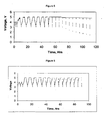
- Figure 5 shows that the lithium hexafluorophosphate, a commonly used lithium electrolyte salt in lithium-based cells for cell phones, does not afford overcharge protection. At a current density of 10 mA and after only 6 cycles the cell capacity completely faded and the cell could not be charged or discharged further.
- the results show that the cell, when successively overcharged, became completely inoperative after about 50 to 60 hours.
- the lithium salt, lithium hexafluorophosphate, is not reversibly oxidizable and continued overcharge led to irreversible capacity loss from destruction of the cathode.
- Example 13 Evaluation of Lithium Secondary Cell With LiPF 6 Including 3% By Weight Li 2 B 12 F 12
- Comparative Example 2 The procedure of Comparative Example 2 was repeated except that 3% by weight of Li 2 B 12 F 12 (average 10-12 fluorine atoms) was added to determine whether it would provide some overcharge protection to the cell. Cycling characteristics of the cell using LiNi 0.8 Co 0.15 Al 0.05 O 2 vs. Graphite having as electrolyte LiPF 6 /EC:EMC (3:7) +3 wt% Li 2 B 12 F 12 additive by weight of total salt. The cell was cycled between 3volt and 5.5volt using a constant current (10mA) charge and discharge at a current density of 0.67mA/cm 2 . The results are shown in Figure 6 .
- Figure 6 shows that the cell was effectively cycled through 90 hours without failure of the cell. However, there was some reduction in capacity suggesting that although there was some overcharge protection afforded, there was insufficient lithium dodecafluoroborate salt in the electrolyte to provide a fully reversible oxidation/reduction shuttle for that cell design.
- Example 14 Salt Evaluation of Lithium Secondary Cell With LiPF 6 Salt Including Li 2 B 12 F 12
- Example 13 The procedure of Example 13 was repeated except that a 1.2 M LiPF 6 /EC:DEC (1:1) solution was mixed with an equivalent volume of 0.4 M Li 2 B 12 F 12 /EC:DMC(3:7) solution.
- the Li 2 B 12 F 12 additive corresponds to ⁇ 50% by weight of the total salt mixture.
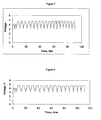
- the cell was cycled between 3 volts and 5.5 volts using a constant current (10mA) charge and discharge at a current density of 0.67mA/cm 2 . The results are shown in Figure 7 .
- Example 13 The procedure of Example 13 was repeated except that the electrolyte comprised 0.4M Li 2 B 12 F 12 in 3:7 EC:DMC. The cell was cycled between 3V and 5.5V using a constant current (10mA) charge and discharge at a current density of 0.67 mA/cm 2 . The results are shown in Figure 8 .
- overcharge protection can be imparted to cells and batteries by incorporating an overcharge protection salt that is reversibly oxidizable at a voltage within the design range of a 3-5 volt class cell.
- overcharge protection salts when present in sufficient amount can act as a continuous redox shuttle thereby affording overcharge protection without a significant reduction in capacity, or power capability.
- Lesser quantities of overcharge protection salts provide some overcharge protection but may fail as a continuous redox shuttle if not present in the cells at a sufficient concentration, particularly if the cells are operating at higher current densities.
- the Examples 2-13 also show that these salts, unlike other redox shuttle additives shown in comparative Example 1, allow the potential of the overcharge protection to be tuned based on the dielectric constant of the carrier.
Landscapes
- Chemical & Material Sciences (AREA)
- Engineering & Computer Science (AREA)
- Electrochemistry (AREA)
- General Chemical & Material Sciences (AREA)
- Manufacturing & Machinery (AREA)
- Chemical Kinetics & Catalysis (AREA)
- Inorganic Chemistry (AREA)
- General Physics & Mathematics (AREA)
- Architecture (AREA)
- Condensed Matter Physics & Semiconductors (AREA)
- Physics & Mathematics (AREA)
- Wood Science & Technology (AREA)
- Life Sciences & Earth Sciences (AREA)
- Materials Engineering (AREA)
- Structural Engineering (AREA)
- Civil Engineering (AREA)
- Organic Chemistry (AREA)
- Secondary Cells (AREA)
- Battery Electrode And Active Subsutance (AREA)
Applications Claiming Priority (4)
| Application Number | Priority Date | Filing Date | Title |
|---|---|---|---|
| US56119304P | 2004-04-09 | 2004-04-09 | |
| US561193P | 2004-04-09 | ||
| US97810 | 2005-04-01 | ||
| US11/097,810 US7785740B2 (en) | 2004-04-09 | 2005-04-01 | Overcharge protection for electrochemical cells |
Publications (3)
| Publication Number | Publication Date |
|---|---|
| EP1587158A2 EP1587158A2 (en) | 2005-10-19 |
| EP1587158A3 EP1587158A3 (en) | 2010-01-06 |
| EP1587158B1 true EP1587158B1 (en) | 2013-05-15 |
Family
ID=34934939
Family Applications (1)
| Application Number | Title | Priority Date | Filing Date |
|---|---|---|---|
| EP05007806.2A Expired - Lifetime EP1587158B1 (en) | 2004-04-09 | 2005-04-08 | Overcharge protection for electrochemical cells |
Country Status (6)
| Country | Link |
|---|---|
| US (1) | US7785740B2 (enExample) |
| EP (1) | EP1587158B1 (enExample) |
| JP (2) | JP4938247B2 (enExample) |
| KR (1) | KR100758570B1 (enExample) |
| CN (1) | CN100530811C (enExample) |
| TW (1) | TWI257726B (enExample) |
Families Citing this family (57)
| Publication number | Priority date | Publication date | Assignee | Title |
|---|---|---|---|---|
| US7550230B2 (en) * | 2001-03-15 | 2009-06-23 | Powergenix Systems, Inc. | Electrolyte composition for nickel-zinc batteries |
| US7968235B2 (en) * | 2003-07-17 | 2011-06-28 | Uchicago Argonne Llc | Long life lithium batteries with stabilized electrodes |
| CA2479589C (en) * | 2003-09-04 | 2011-05-24 | Air Products And Chemicals, Inc. | Polyfluorinated boron cluster anions for lithium electrolytes |
| US9012096B2 (en) * | 2004-05-28 | 2015-04-21 | Uchicago Argonne, Llc | Long life lithium batteries with stabilized electrodes |
| US7419623B2 (en) * | 2004-08-03 | 2008-09-02 | Air Products And Chemicals, Inc. | Proton conducting mediums for electrochemical devices and electrochemical devices comprising the same |
| US7981388B2 (en) * | 2004-08-23 | 2011-07-19 | Air Products And Chemicals, Inc. | Process for the purification of lithium salts |
| US7465517B2 (en) | 2004-08-23 | 2008-12-16 | Air Products And Chemicals, Inc. | High purity lithium polyhalogenated boron cluster salts useful in lithium batteries |
| US20080026297A1 (en) * | 2005-01-11 | 2008-01-31 | Air Products And Chemicals, Inc. | Electrolytes, cells and methods of forming passivaton layers |
| US20060216612A1 (en) * | 2005-01-11 | 2006-09-28 | Krishnakumar Jambunathan | Electrolytes, cells and methods of forming passivation layers |
| US8329344B2 (en) * | 2005-02-16 | 2012-12-11 | Daikin Industries, Ltd. | Electrolytic solution |
| CN101160684A (zh) * | 2005-03-02 | 2008-04-09 | U芝加哥阿谷尼有限公司 | 用于锂电池的充电过度保护的新型氧化还原穿梭化合物 |
| US20060204843A1 (en) * | 2005-03-10 | 2006-09-14 | Ivanov Sergei V | Polyfluorinated boron cluster anions for lithium electrolytes |
| WO2006101779A2 (en) * | 2005-03-15 | 2006-09-28 | The University Of Chicago | Non-aqueous electrolytes for lithium ion batteries |
| US8062792B2 (en) * | 2005-04-26 | 2011-11-22 | Uchicago Argonne Llc | Processes for making dense, spherical active materials for lithium-ion cells |
| US20090123837A1 (en) * | 2005-06-06 | 2009-05-14 | Michael Gratzel | Lithium rechargeable electrochemical cell |
| US20070072085A1 (en) * | 2005-09-26 | 2007-03-29 | Zonghai Chen | Overcharge protection for electrochemical cells |
| US7968231B2 (en) * | 2005-12-23 | 2011-06-28 | U Chicago Argonne, Llc | Electrode materials and lithium battery systems |
| TWI338396B (en) * | 2006-01-17 | 2011-03-01 | Lg Chemical Ltd | Additives for non-aqueous electrolyte and lithium secondary battery using the same |
| US8367253B2 (en) * | 2006-02-02 | 2013-02-05 | U Chicago Argonne Llc | Lithium-ion batteries with intrinsic pulse overcharge protection |
| US8133616B2 (en) | 2006-02-14 | 2012-03-13 | Dow Global Technologies Llc | Lithium manganese phosphate positive material for lithium secondary battery |
| WO2007136206A1 (en) * | 2006-05-22 | 2007-11-29 | Lg Chem, Ltd. | Secondary battery having electrode for improvement of stability during overcharge |
| EP1901388A1 (en) * | 2006-09-14 | 2008-03-19 | High Power Lithium S.A. | Overcharge and overdischarge protection in lithium-ion batteries |
| JP2010514144A (ja) | 2006-12-20 | 2010-04-30 | アール. ダーン,ジェフリー | リチウムバッテリー電解質で使用するためのフッ素化化合物 |
| US8758945B2 (en) | 2007-03-06 | 2014-06-24 | Air Products And Chemicals, Inc. | Overcharge protection by coupling redox shuttle chemistry with radical polymerization additives |
| US9755269B2 (en) * | 2007-11-30 | 2017-09-05 | Air Products And Chemicals, Inc. | Dodecaborate salt radical anion compositions and methods for making and using such compositions |
| JP4725594B2 (ja) * | 2008-04-04 | 2011-07-13 | トヨタ自動車株式会社 | リチウム二次電池の製造方法 |
| US8187746B2 (en) | 2008-05-16 | 2012-05-29 | Uchicago Argonne, Llc | Surface modification agents for lithium batteries |
| US8277683B2 (en) * | 2008-05-30 | 2012-10-02 | Uchicago Argonne, Llc | Nano-sized structured layered positive electrode materials to enable high energy density and high rate capability lithium batteries |
| US8795905B2 (en) | 2008-07-10 | 2014-08-05 | Uchicago Argonne, Llc | Electrolytes for lithium ion batteries |
| RU2384525C1 (ru) * | 2008-11-05 | 2010-03-20 | Институт химии Дальневосточного отделения Российской академии наук (статус государственного учреждения) (Институт химии ДВО РАН) | Способ получения фторзамещенных додекагидро-клозо-додекаборатов цезия |
| US8450404B2 (en) * | 2009-06-16 | 2013-05-28 | Honeywell Federal Manufacturing & Technologies, Llc | Compositions containing borane or carborane cage compounds and related applications |
| JP5770268B2 (ja) | 2010-05-11 | 2015-08-26 | ソルベイ ユーエスエイ インコーポレイテッド | 共役ポリマーおよびデバイスのドーピング |
| CN103403948A (zh) * | 2011-02-28 | 2013-11-20 | 昭和电工株式会社 | 二次电池用非水电解液和非水电解液二次电池 |
| US8703329B2 (en) | 2011-03-25 | 2014-04-22 | Enerdel, Inc. | Redox shuttle for high voltage lithium battery |
| WO2012147502A1 (ja) * | 2011-04-27 | 2012-11-01 | 昭和電工株式会社 | 二次電池用非水電解液および非水電解液二次電池 |
| CN103503220A (zh) * | 2011-04-28 | 2014-01-08 | 昭和电工株式会社 | 二次电池用非水电解液和非水电解液二次电池 |
| EP2764518A1 (en) | 2011-10-04 | 2014-08-13 | Plextronics, Inc. | Improved doping methods for hole injection and transport layers |
| US8652672B2 (en) | 2012-03-15 | 2014-02-18 | Aquion Energy, Inc. | Large format electrochemical energy storage device housing and module |
| EP2831942B1 (en) | 2012-03-27 | 2018-11-21 | Johnson Controls Technology Company | Polysulfone coating for high voltage lithium-ion cells |
| US9117596B2 (en) | 2012-03-27 | 2015-08-25 | Johnson Controls Technology Company | Capacitor electrodes for lead-acid battery with surface-modified additives |
| PL2840641T3 (pl) * | 2012-04-17 | 2019-07-31 | Daikin Industries, Ltd. | Roztwór elektrolitu, urządzenie elektrochemiczne, litowo-jonowa bateria akumulatorowa oraz moduł |
| US9806378B2 (en) * | 2012-04-17 | 2017-10-31 | Daikin Industries, Ltd. | Electrolytic solution containing mixture of fluorinated chain carbonates, electrochemical device, lithium ion secondary battery and module |
| CN103427125B (zh) * | 2012-05-15 | 2016-04-13 | 清华大学 | 硫基聚合物锂离子电池的循环方法 |
| US20140038037A1 (en) * | 2012-08-02 | 2014-02-06 | Toyota Motor Engineering & Manufacturing North America, Inc. | Magnesium borohydride and its derivatives as magnesium ion transfer media |
| CN102810679B (zh) * | 2012-08-17 | 2015-04-15 | 福建南平南孚电池有限公司 | 锂-二硫化铁电池 |
| JP6031965B2 (ja) * | 2012-11-22 | 2016-11-24 | Tdk株式会社 | リチウムイオン二次電池用非水電解液及びリチウムイオン二次電池 |
| US8945756B2 (en) | 2012-12-12 | 2015-02-03 | Aquion Energy Inc. | Composite anode structure for aqueous electrolyte energy storage and device containing same |
| KR20140094959A (ko) | 2013-01-23 | 2014-07-31 | 삼성에스디아이 주식회사 | 리튬 이차 전지용 전해액 및 이를 포함하는 리튬 이차 전지 |
| CN103337659B (zh) * | 2013-06-27 | 2015-11-11 | 湖南有色郴州氟化学有限公司 | 添加剂组合物、电解液 |
| CN106299470A (zh) * | 2015-05-20 | 2017-01-04 | 宁德时代新能源科技股份有限公司 | 固态聚合物电解质及使用该电解质的全固态锂离子电池 |
| US11289700B2 (en) | 2016-06-28 | 2022-03-29 | The Research Foundation For The State University Of New York | KVOPO4 cathode for sodium ion batteries |
| CN108565514B (zh) * | 2018-06-29 | 2021-09-17 | 桑顿新能源科技(长沙)有限公司 | 一种电解液防过充添加剂及电解液与锂离子电池 |
| WO2020124521A1 (zh) * | 2018-12-21 | 2020-06-25 | 深圳市大疆创新科技有限公司 | 对锂电池进行充电的方法及相关装置 |
| FR3095204A1 (fr) * | 2019-04-16 | 2020-10-23 | Sce France | Solvants carbonates pour électrolytes non aqueux, électrolytes non aqueux et dispositifs électrochimiques, et leurs procédés de fabrication |
| KR20220056576A (ko) * | 2020-10-28 | 2022-05-06 | 현대자동차주식회사 | 리튬 이차전지용 전해액 및 이를 포함하는 리튬 이차전지 |
| EP3771011A3 (de) * | 2020-12-09 | 2021-06-30 | Innolith Technology AG | Auf so2-basierender elektrolyt für eine wiederaufladbare batteriezelle und wiederaufladbare batteriezellen damit |
| WO2023240266A2 (en) * | 2022-06-09 | 2023-12-14 | The Regents Of The University Of California | Boron cluster weakly-coordinating anions and related materials |
Family Cites Families (38)
| Publication number | Priority date | Publication date | Assignee | Title |
|---|---|---|---|---|
| US3551120A (en) | 1962-12-21 | 1970-12-29 | Du Pont | Substituted dodecaborates |
| US4020240A (en) | 1975-09-03 | 1977-04-26 | P. R. Mallory & Co., Inc. | Electrochemical cell with clovoborate salt in electrolyte and method of operation and composition of matter |
| US4071664A (en) | 1977-04-01 | 1978-01-31 | P. R. Mallory & Co. Inc. | Electrolyte salt additive |
| US4201839A (en) | 1978-11-01 | 1980-05-06 | Exxon Research And Engineering Co. | Cell containing an alkali metal anode, a solid cathode, and a closoborane and/or closocarborane electrolyte |
| US4331743A (en) | 1980-09-02 | 1982-05-25 | Duracell International Inc. | Method for increasing recycling life of non-aqueous cells |
| US4857423A (en) | 1987-11-30 | 1989-08-15 | Eic Labotatories, Inc. | Overcharge protection of secondary, non-aqueous batteries |
| DE3884572T2 (de) | 1987-11-30 | 1994-02-03 | Eic Lab Inc | Überladeschutz für nichtwässrige Sekundärbatterien. |
| US4849309A (en) | 1988-08-01 | 1989-07-18 | The United States Of America As Represented By The United States Department Of Energy | Overcharge tolerant high-temperature cells and batteries |
| US4935316A (en) | 1989-07-25 | 1990-06-19 | The United States Of America As Represented By The United States Department Of Energy | Overdischarge protection in high-temperature cells and batteries |
| JP2717890B2 (ja) | 1991-05-27 | 1998-02-25 | 富士写真フイルム株式会社 | リチウム二次電池 |
| JP3259436B2 (ja) | 1993-05-31 | 2002-02-25 | ソニー株式会社 | 非水電解液二次電池 |
| JP3809657B2 (ja) * | 1994-03-07 | 2006-08-16 | ソニー株式会社 | 非水電解液二次電池 |
| JP3493873B2 (ja) * | 1995-04-28 | 2004-02-03 | ソニー株式会社 | 非水電解液二次電池 |
| US5736275A (en) | 1996-04-30 | 1998-04-07 | The University Of Chicago | High power bipolar battery/cells with enhanced overcharge tolerance |
| EP0963618B1 (en) | 1996-09-30 | 2004-05-06 | Danionics A/S | An electrolyte system, a method for the preparation thereof, the use thereof and a battery containing the electrolyte system |
| EP0850933A1 (fr) | 1996-12-30 | 1998-07-01 | Centre National De La Recherche Scientifique (Cnrs) | Sels d'anions pentacycliques ou dérivés de tétrazapentalène, et leurs utilisations comme matériaux à conduction ionique |
| US5882812A (en) | 1997-01-14 | 1999-03-16 | Polyplus Battery Company, Inc. | Overcharge protection systems for rechargeable batteries |
| IL132189A (en) | 1997-04-03 | 2003-10-31 | Univ Colorado State Res Found | Polyhalogenated monoheteroborane anion compositions |
| US6448447B1 (en) | 1997-04-03 | 2002-09-10 | Colorado State University Research Foundation | Fluoroborate salts comprising a reactive cation and uses thereof |
| GB9717220D0 (en) | 1997-08-15 | 1997-10-22 | Aea Technology Plc | Eklectrolyte for a rechargeable cell |
| US6004698A (en) | 1997-08-21 | 1999-12-21 | The United States Of America As Represented By The United States Department Of Energy | Solid polymer electrolyte electrochemical storage cell containing a redox shuttle additive for overcharge protection |
| DE19910968A1 (de) | 1999-03-12 | 2000-11-09 | Merck Patent Gmbh | Anwendung von Additiven in Elektrolyten für elektrochemische Zellen |
| WO2001029920A1 (en) | 1999-10-18 | 2001-04-26 | The Regents Of The University Of California | Shutdown and redox shuttle additives for batteries |
| CN1112739C (zh) | 2000-06-15 | 2003-06-25 | 华南理工大学 | 锂离子二次电池过充电保护方法 |
| US6511773B1 (en) | 2000-06-30 | 2003-01-28 | Lithium Energy Associates, Inc. | Lithium rechargeable inorganic electrolyte cell |
| CN100414765C (zh) * | 2000-09-05 | 2008-08-27 | 三星Sdi株式会社 | 锂电池 |
| US6335466B1 (en) | 2000-10-31 | 2002-01-01 | Colorado State University Research Foundation | Fluorinated amino polyhedral borate compounds |
| US20020110735A1 (en) * | 2000-12-18 | 2002-08-15 | Farnham William B. | Additive for lithium-ion battery |
| EP1256995B1 (en) | 2000-12-28 | 2016-08-03 | Panasonic Corporation | Nonaqueous electrolytic secondary battery |
| US6942949B2 (en) | 2002-08-12 | 2005-09-13 | Lg Chem, Ltd. | Rechargeable lithium electrochemical cell |
| US6781005B1 (en) * | 2003-05-01 | 2004-08-24 | Air Products And Chemicals, Inc. | Process for the fluorination of boron hydrides |
| CA2479589C (en) * | 2003-09-04 | 2011-05-24 | Air Products And Chemicals, Inc. | Polyfluorinated boron cluster anions for lithium electrolytes |
| US7311993B2 (en) | 2003-09-04 | 2007-12-25 | Air Products And Chemicals, Inc. | Polyfluorinated boron cluster anions for lithium electrolytes |
| ES2358515T3 (es) * | 2003-09-17 | 2011-05-11 | Ube Industries, Ltd. | Solución electrolítica no acuosa y batería secundaria de litio que la utiliza. |
| DE102004011522A1 (de) * | 2004-03-08 | 2005-09-29 | Chemetall Gmbh | Leitsalze für Lithiumionenbatterien und deren Herstellung |
| WO2005099024A2 (en) * | 2004-04-01 | 2005-10-20 | 3M Innovative Properties Company | Redox shuttle for rechargeable lithium-ion cell |
| BE1016128A6 (fr) * | 2004-07-22 | 2006-03-07 | Messadek Jallal | Combinaisons therapeutiques |
| US20060216612A1 (en) | 2005-01-11 | 2006-09-28 | Krishnakumar Jambunathan | Electrolytes, cells and methods of forming passivation layers |
-
2005
- 2005-04-01 US US11/097,810 patent/US7785740B2/en active Active
- 2005-04-08 EP EP05007806.2A patent/EP1587158B1/en not_active Expired - Lifetime
- 2005-04-08 CN CNB2005100762260A patent/CN100530811C/zh not_active Expired - Lifetime
- 2005-04-08 TW TW094111245A patent/TWI257726B/zh not_active IP Right Cessation
- 2005-04-09 KR KR1020050029732A patent/KR100758570B1/ko not_active Expired - Lifetime
- 2005-04-11 JP JP2005114017A patent/JP4938247B2/ja not_active Expired - Fee Related
-
2011
- 2011-08-12 JP JP2011176485A patent/JP2011253827A/ja active Pending
Also Published As
| Publication number | Publication date |
|---|---|
| US7785740B2 (en) | 2010-08-31 |
| TWI257726B (en) | 2006-07-01 |
| EP1587158A2 (en) | 2005-10-19 |
| CN1700505A (zh) | 2005-11-23 |
| JP2005302727A (ja) | 2005-10-27 |
| TW200541131A (en) | 2005-12-16 |
| US20050227143A1 (en) | 2005-10-13 |
| CN100530811C (zh) | 2009-08-19 |
| KR100758570B1 (ko) | 2007-09-14 |
| JP4938247B2 (ja) | 2012-05-23 |
| JP2011253827A (ja) | 2011-12-15 |
| EP1587158A3 (en) | 2010-01-06 |
| KR20060047152A (ko) | 2006-05-18 |
Similar Documents
| Publication | Publication Date | Title |
|---|---|---|
| EP1587158B1 (en) | Overcharge protection for electrochemical cells | |
| KR100817695B1 (ko) | 과충전 보호를 제공하는 전기화학전지 | |
| JP4187959B2 (ja) | 非水電解液およびそれを用いた二次電池 | |
| KR100657225B1 (ko) | 전지의 안전성을 향상시키기 위한 전해액 용매 및 이를포함하는 리튬 이차 전지 | |
| EP1702374B1 (en) | Ionic liquid-modified cathode and electrochemical device using the same | |
| EP2237360B1 (en) | Overcharge protection by coupling redox shuttle chemicals with radical polymerization additives | |
| US6797437B2 (en) | Electrolyte system and energy storage device using same | |
| US7341807B2 (en) | Non-flammable nonaqueous electrolyte solution and lithium ion cell using same | |
| US8679684B2 (en) | Electrolyte for lithium-sulphur batteries and lithium-sulphur batteries using the same | |
| JP4807072B2 (ja) | 非水電解質二次電池 | |
| EP2709194B1 (en) | Lithium-sulfur battery with performance enhanced additives | |
| EP4080636B1 (en) | Non-aqueous electrolyte for lithium secondary battery and lithium secondary battery including the same | |
| EP1815546B1 (en) | Electrolyte for lithium-sulphur batteries and lithium-sulphur batteries using the same | |
| EP3893311B1 (en) | Use of a compound as an additive of a non-aqueous electrolyte solution, non-aqueous electrolyte for lithium secondary battery and lithium secondary battery including the same | |
| EP3706229B1 (en) | Non-aqueous electrolyte and lithium secondary battery comprising same | |
| HK1146156B (en) | Overcharge protection by coupling redox shuttle chemistry with radical polymerization additives |
Legal Events
| Date | Code | Title | Description |
|---|---|---|---|
| PUAI | Public reference made under article 153(3) epc to a published international application that has entered the european phase |
Free format text: ORIGINAL CODE: 0009012 |
|
| AK | Designated contracting states |
Kind code of ref document: A2 Designated state(s): AT BE BG CH CY CZ DE DK EE ES FI FR GB GR HU IE IS IT LI LT LU MC NL PL PT RO SE SI SK TR |
|
| AX | Request for extension of the european patent |
Extension state: AL BA HR LV MK YU |
|
| PUAL | Search report despatched |
Free format text: ORIGINAL CODE: 0009013 |
|
| AK | Designated contracting states |
Kind code of ref document: A3 Designated state(s): AT BE BG CH CY CZ DE DK EE ES FI FR GB GR HU IE IS IT LI LT LU MC NL PL PT RO SE SI SK TR |
|
| AX | Request for extension of the european patent |
Extension state: AL BA HR LV MK YU |
|
| 17P | Request for examination filed |
Effective date: 20100205 |
|
| 17Q | First examination report despatched |
Effective date: 20100319 |
|
| AKX | Designation fees paid |
Designated state(s): AT BE BG CH CY CZ DE DK EE ES FI FR GB GR HU IE IS IT LI LT LU MC NL PL PT RO SE SI SK TR |
|
| REG | Reference to a national code |
Ref country code: DE Ref legal event code: R079 Ref document number: 602005039546 Country of ref document: DE Free format text: PREVIOUS MAIN CLASS: H01M0010420000 Ipc: H01M0010052000 |
|
| GRAP | Despatch of communication of intention to grant a patent |
Free format text: ORIGINAL CODE: EPIDOSNIGR1 |
|
| RIC1 | Information provided on ipc code assigned before grant |
Ipc: H01M 10/0568 20100101ALI20121112BHEP Ipc: H01M 6/16 20060101ALI20121112BHEP Ipc: H01M 10/42 20060101AFI20121112BHEP Ipc: H01M 10/0567 20100101ALI20121112BHEP |
|
| RIC1 | Information provided on ipc code assigned before grant |
Ipc: H01M 10/0568 20100101ALI20121203BHEP Ipc: H01M 10/052 20100101AFI20121203BHEP Ipc: H01M 10/42 20060101ALI20121203BHEP Ipc: H01M 6/16 20060101ALI20121203BHEP Ipc: H01M 10/0567 20100101ALI20121203BHEP |
|
| GRAS | Grant fee paid |
Free format text: ORIGINAL CODE: EPIDOSNIGR3 |
|
| GRAA | (expected) grant |
Free format text: ORIGINAL CODE: 0009210 |
|
| AK | Designated contracting states |
Kind code of ref document: B1 Designated state(s): AT BE BG CH CY CZ DE DK EE ES FI FR GB GR HU IE IS IT LI LT LU MC NL PL PT RO SE SI SK TR |
|
| REG | Reference to a national code |
Ref country code: GB Ref legal event code: FG4D Ref country code: CH Ref legal event code: EP |
|
| REG | Reference to a national code |
Ref country code: AT Ref legal event code: REF Ref document number: 612532 Country of ref document: AT Kind code of ref document: T Effective date: 20130615 |
|
| REG | Reference to a national code |
Ref country code: IE Ref legal event code: FG4D |
|
| REG | Reference to a national code |
Ref country code: DE Ref legal event code: R096 Ref document number: 602005039546 Country of ref document: DE Effective date: 20130711 |
|
| RAP2 | Party data changed (patent owner data changed or rights of a patent transferred) |
Owner name: AIR PRODUCTS AND CHEMICALS, INC. |
|
| REG | Reference to a national code |
Ref country code: AT Ref legal event code: MK05 Ref document number: 612532 Country of ref document: AT Kind code of ref document: T Effective date: 20130515 |
|
| REG | Reference to a national code |
Ref country code: LT Ref legal event code: MG4D |
|
| REG | Reference to a national code |
Ref country code: NL Ref legal event code: VDEP Effective date: 20130515 |
|
| PG25 | Lapsed in a contracting state [announced via postgrant information from national office to epo] |
Ref country code: GR Free format text: LAPSE BECAUSE OF FAILURE TO SUBMIT A TRANSLATION OF THE DESCRIPTION OR TO PAY THE FEE WITHIN THE PRESCRIBED TIME-LIMIT Effective date: 20130816 Ref country code: FI Free format text: LAPSE BECAUSE OF FAILURE TO SUBMIT A TRANSLATION OF THE DESCRIPTION OR TO PAY THE FEE WITHIN THE PRESCRIBED TIME-LIMIT Effective date: 20130515 Ref country code: SI Free format text: LAPSE BECAUSE OF FAILURE TO SUBMIT A TRANSLATION OF THE DESCRIPTION OR TO PAY THE FEE WITHIN THE PRESCRIBED TIME-LIMIT Effective date: 20130515 Ref country code: LT Free format text: LAPSE BECAUSE OF FAILURE TO SUBMIT A TRANSLATION OF THE DESCRIPTION OR TO PAY THE FEE WITHIN THE PRESCRIBED TIME-LIMIT Effective date: 20130515 Ref country code: AT Free format text: LAPSE BECAUSE OF FAILURE TO SUBMIT A TRANSLATION OF THE DESCRIPTION OR TO PAY THE FEE WITHIN THE PRESCRIBED TIME-LIMIT Effective date: 20130515 Ref country code: PT Free format text: LAPSE BECAUSE OF FAILURE TO SUBMIT A TRANSLATION OF THE DESCRIPTION OR TO PAY THE FEE WITHIN THE PRESCRIBED TIME-LIMIT Effective date: 20130916 Ref country code: ES Free format text: LAPSE BECAUSE OF FAILURE TO SUBMIT A TRANSLATION OF THE DESCRIPTION OR TO PAY THE FEE WITHIN THE PRESCRIBED TIME-LIMIT Effective date: 20130826 Ref country code: SE Free format text: LAPSE BECAUSE OF FAILURE TO SUBMIT A TRANSLATION OF THE DESCRIPTION OR TO PAY THE FEE WITHIN THE PRESCRIBED TIME-LIMIT Effective date: 20130515 Ref country code: IS Free format text: LAPSE BECAUSE OF FAILURE TO SUBMIT A TRANSLATION OF THE DESCRIPTION OR TO PAY THE FEE WITHIN THE PRESCRIBED TIME-LIMIT Effective date: 20130915 |
|
| PG25 | Lapsed in a contracting state [announced via postgrant information from national office to epo] |
Ref country code: BG Free format text: LAPSE BECAUSE OF FAILURE TO SUBMIT A TRANSLATION OF THE DESCRIPTION OR TO PAY THE FEE WITHIN THE PRESCRIBED TIME-LIMIT Effective date: 20130815 Ref country code: PL Free format text: LAPSE BECAUSE OF FAILURE TO SUBMIT A TRANSLATION OF THE DESCRIPTION OR TO PAY THE FEE WITHIN THE PRESCRIBED TIME-LIMIT Effective date: 20130515 |
|
| PG25 | Lapsed in a contracting state [announced via postgrant information from national office to epo] |
Ref country code: DK Free format text: LAPSE BECAUSE OF FAILURE TO SUBMIT A TRANSLATION OF THE DESCRIPTION OR TO PAY THE FEE WITHIN THE PRESCRIBED TIME-LIMIT Effective date: 20130515 Ref country code: BE Free format text: LAPSE BECAUSE OF FAILURE TO SUBMIT A TRANSLATION OF THE DESCRIPTION OR TO PAY THE FEE WITHIN THE PRESCRIBED TIME-LIMIT Effective date: 20130515 Ref country code: SK Free format text: LAPSE BECAUSE OF FAILURE TO SUBMIT A TRANSLATION OF THE DESCRIPTION OR TO PAY THE FEE WITHIN THE PRESCRIBED TIME-LIMIT Effective date: 20130515 Ref country code: EE Free format text: LAPSE BECAUSE OF FAILURE TO SUBMIT A TRANSLATION OF THE DESCRIPTION OR TO PAY THE FEE WITHIN THE PRESCRIBED TIME-LIMIT Effective date: 20130515 Ref country code: CZ Free format text: LAPSE BECAUSE OF FAILURE TO SUBMIT A TRANSLATION OF THE DESCRIPTION OR TO PAY THE FEE WITHIN THE PRESCRIBED TIME-LIMIT Effective date: 20130515 |
|
| PG25 | Lapsed in a contracting state [announced via postgrant information from national office to epo] |
Ref country code: NL Free format text: LAPSE BECAUSE OF FAILURE TO SUBMIT A TRANSLATION OF THE DESCRIPTION OR TO PAY THE FEE WITHIN THE PRESCRIBED TIME-LIMIT Effective date: 20130515 Ref country code: RO Free format text: LAPSE BECAUSE OF FAILURE TO SUBMIT A TRANSLATION OF THE DESCRIPTION OR TO PAY THE FEE WITHIN THE PRESCRIBED TIME-LIMIT Effective date: 20130515 Ref country code: IT Free format text: LAPSE BECAUSE OF FAILURE TO SUBMIT A TRANSLATION OF THE DESCRIPTION OR TO PAY THE FEE WITHIN THE PRESCRIBED TIME-LIMIT Effective date: 20130515 |
|
| PLBE | No opposition filed within time limit |
Free format text: ORIGINAL CODE: 0009261 |
|
| STAA | Information on the status of an ep patent application or granted ep patent |
Free format text: STATUS: NO OPPOSITION FILED WITHIN TIME LIMIT |
|
| 26N | No opposition filed |
Effective date: 20140218 |
|
| REG | Reference to a national code |
Ref country code: DE Ref legal event code: R097 Ref document number: 602005039546 Country of ref document: DE Effective date: 20140218 |
|
| PG25 | Lapsed in a contracting state [announced via postgrant information from national office to epo] |
Ref country code: LU Free format text: LAPSE BECAUSE OF FAILURE TO SUBMIT A TRANSLATION OF THE DESCRIPTION OR TO PAY THE FEE WITHIN THE PRESCRIBED TIME-LIMIT Effective date: 20140408 Ref country code: MC Free format text: LAPSE BECAUSE OF FAILURE TO SUBMIT A TRANSLATION OF THE DESCRIPTION OR TO PAY THE FEE WITHIN THE PRESCRIBED TIME-LIMIT Effective date: 20130515 |
|
| REG | Reference to a national code |
Ref country code: CH Ref legal event code: PL |
|
| REG | Reference to a national code |
Ref country code: IE Ref legal event code: MM4A |
|
| PG25 | Lapsed in a contracting state [announced via postgrant information from national office to epo] |
Ref country code: CH Free format text: LAPSE BECAUSE OF NON-PAYMENT OF DUE FEES Effective date: 20140430 Ref country code: LI Free format text: LAPSE BECAUSE OF NON-PAYMENT OF DUE FEES Effective date: 20140430 |
|
| REG | Reference to a national code |
Ref country code: FR Ref legal event code: PLFP Year of fee payment: 11 |
|
| PG25 | Lapsed in a contracting state [announced via postgrant information from national office to epo] |
Ref country code: IE Free format text: LAPSE BECAUSE OF NON-PAYMENT OF DUE FEES Effective date: 20140408 |
|
| REG | Reference to a national code |
Ref country code: FR Ref legal event code: PLFP Year of fee payment: 12 |
|
| PG25 | Lapsed in a contracting state [announced via postgrant information from national office to epo] |
Ref country code: CY Free format text: LAPSE BECAUSE OF FAILURE TO SUBMIT A TRANSLATION OF THE DESCRIPTION OR TO PAY THE FEE WITHIN THE PRESCRIBED TIME-LIMIT Effective date: 20130515 |
|
| PG25 | Lapsed in a contracting state [announced via postgrant information from national office to epo] |
Ref country code: TR Free format text: LAPSE BECAUSE OF FAILURE TO SUBMIT A TRANSLATION OF THE DESCRIPTION OR TO PAY THE FEE WITHIN THE PRESCRIBED TIME-LIMIT Effective date: 20130515 Ref country code: HU Free format text: LAPSE BECAUSE OF FAILURE TO SUBMIT A TRANSLATION OF THE DESCRIPTION OR TO PAY THE FEE WITHIN THE PRESCRIBED TIME-LIMIT; INVALID AB INITIO Effective date: 20050408 |
|
| REG | Reference to a national code |
Ref country code: FR Ref legal event code: PLFP Year of fee payment: 13 |
|
| REG | Reference to a national code |
Ref country code: FR Ref legal event code: PLFP Year of fee payment: 14 |
|
| REG | Reference to a national code |
Ref country code: DE Ref legal event code: R082 Ref document number: 602005039546 Country of ref document: DE Ref country code: DE Ref legal event code: R082 Ref document number: 602005039546 Country of ref document: DE Representative=s name: ANDREA SOMMER PATENTANWAELTE PARTNERSCHAFT MBB, DE |
|
| REG | Reference to a national code |
Ref country code: DE Ref legal event code: R082 Ref document number: 602005039546 Country of ref document: DE Representative=s name: ANDREA SOMMER PATENTANWAELTE PARTNERSCHAFT MBB, DE |
|
| P01 | Opt-out of the competence of the unified patent court (upc) registered |
Effective date: 20230522 |
|
| PGFP | Annual fee paid to national office [announced via postgrant information from national office to epo] |
Ref country code: GB Payment date: 20240222 Year of fee payment: 20 |
|
| PGFP | Annual fee paid to national office [announced via postgrant information from national office to epo] |
Ref country code: FR Payment date: 20240223 Year of fee payment: 20 |
|
| PGFP | Annual fee paid to national office [announced via postgrant information from national office to epo] |
Ref country code: DE Payment date: 20240220 Year of fee payment: 20 |
|
| REG | Reference to a national code |
Ref country code: DE Ref legal event code: R071 Ref document number: 602005039546 Country of ref document: DE |
|
| REG | Reference to a national code |
Ref country code: GB Ref legal event code: PE20 Expiry date: 20250407 |
|
| PG25 | Lapsed in a contracting state [announced via postgrant information from national office to epo] |
Ref country code: GB Free format text: LAPSE BECAUSE OF EXPIRATION OF PROTECTION Effective date: 20250407 |