EP1585104A2 - Instrument de musique à clavier, droit, avec un plaque d'ouverture/fermeture fixé sur la partie supérieure d'un coffre - Google Patents
Instrument de musique à clavier, droit, avec un plaque d'ouverture/fermeture fixé sur la partie supérieure d'un coffre Download PDFInfo
- Publication number
- EP1585104A2 EP1585104A2 EP05006755A EP05006755A EP1585104A2 EP 1585104 A2 EP1585104 A2 EP 1585104A2 EP 05006755 A EP05006755 A EP 05006755A EP 05006755 A EP05006755 A EP 05006755A EP 1585104 A2 EP1585104 A2 EP 1585104A2
- Authority
- EP
- European Patent Office
- Prior art keywords
- open
- close board
- support
- musical instrument
- board
- Prior art date
- Legal status (The legal status is an assumption and is not a legal conclusion. Google has not performed a legal analysis and makes no representation as to the accuracy of the status listed.)
- Granted
Links
- 230000006870 function Effects 0.000 claims description 3
- 230000000694 effects Effects 0.000 abstract description 5
- 230000008859 change Effects 0.000 description 3
- 239000000463 material Substances 0.000 description 3
- 230000035807 sensation Effects 0.000 description 2
- 230000000007 visual effect Effects 0.000 description 2
- 239000002023 wood Substances 0.000 description 2
- 239000010437 gem Substances 0.000 description 1
- 230000007246 mechanism Effects 0.000 description 1
- 230000004044 response Effects 0.000 description 1
Images

Classifications
-
- G—PHYSICS
- G10—MUSICAL INSTRUMENTS; ACOUSTICS
- G10C—PIANOS, HARPSICHORDS, SPINETS OR SIMILAR STRINGED MUSICAL INSTRUMENTS WITH ONE OR MORE KEYBOARDS
- G10C3/00—Details or accessories
- G10C3/02—Cases
-
- G—PHYSICS
- G10—MUSICAL INSTRUMENTS; ACOUSTICS
- G10C—PIANOS, HARPSICHORDS, SPINETS OR SIMILAR STRINGED MUSICAL INSTRUMENTS WITH ONE OR MORE KEYBOARDS
- G10C1/00—General design of pianos, harpsichords, spinets or similar stringed musical instruments with one or more keyboards
- G10C1/02—General design of pianos, harpsichords, spinets or similar stringed musical instruments with one or more keyboards of upright pianos
Definitions
- This invention relates to upright keyboard musical instruments such as upright pianos, which are equipped with top boards having opening and closing functions.
- keyboard musical instruments such as grand pianos and upright pianos are equipped with top boards, which are attached to top positions of main bodies and are free to be opened or closed. During musical performance, top boards are appropriately opened so that musical tones are emitted to the outside of the cases and are thus increased in tone volume.
- Japanese Patent Application Publication No. H11-305761 discloses an example of a keyboard musical instrument, which is equipped with a support rod for supporting the lower portion of a top board to be opened, and a buffer device for preventing the top board from rapidly rotating when it is closed.
- Conventionally known keyboard musical instruments control tone volumes by opening and closing top boards, wherein they prevent user's fingers from being caught between cases and top boards, which are opened or closed.
- keyboard musical instruments particularly, upright pianos
- top boards are opened or closed only for the purpose of tone volume control.
- users play keyboard musical instruments such as grand pianos with top boards in the open condition, for example, they can directly view movements of hammers included in actions, which demonstrate entertaining effects in musical performance.
- grand pianos upright pianos cannot demonstrate such entertaining effects in musical performance.
- An upright keyboard musical instrument of this invention includes an opening and closing board, namely, an open/close board attached to the top position of a case, whose lower surface forms a mirror for reflecting an image of an internal member of the case; and a lid prop for supporting the open/close board to be opened with a prescribed angle therewith (e.g., 15° and 40°).
- the lid prop is rotatably arranged in proximity to the open/close board so as to rotate about a support axis to realize the prescribed angle therewith.
- the lid prop has at least one support surface that is formed normal to the support axis so as to support the open/close board with the prescribed angle therewith.
- the lid prop is formed in an L-shape or in a pentagonal shape to have a plurality of support surfaces, which are each formed normal to the support axis to have different lengths measured with respect to the support axis, thus realizing different angles with respect to the open/close board.
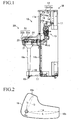
- FIG. 1 is a side view showing an upright keyboard musical instrument M in accordance with a first embodiment of the invention, wherein the upright keyboard musical instrument M is constituted by a main body 10 and a keyboard assembly 20 that projects forwards from the main body 10.
- the outline of the main body 10 is constituted by a case 11 having a rectangular box-like shape
- the outline of the keyboard assembly 20 is constituted by a keyboard casing having a rectangular box-like shape, which projects forwards from the center portion of the case 11 vertically standing.
- the upper portion of the main body 10 is covered with a top board 12, which can be freely opened or closed.
- the upper portion of the keyboard assembly 20 is covered with a fall board 22 that can be freely opened or closed.
- a keyboard 23 having a plurality of white keys and black keys is arranged inside of the keyboard casing 21.
- the case 11 includes a plurality of actions 13, which are interlocked with the keys of the keyboard 23 and are respectively driven upon depression of the keys, and a plurality of strings (not shown) that are struck by hammers 13a included in the actions 13.
- a sound board (not shown) is arranged for the case 11.
- a frame 14 is attached to the upper end of a rear portion inside of the case 11; and an emblem 14a is attached to the center portion of a front surface of the frame 14.
- the top board 12 is constituted by a top board rear 12a, which is fixed to the case 11, and an open/close board 12b, which is hinged to the front end of the top board rear 12a and can be freely opened or closed.
- the lower surface of the open/close board 12b is subjected to mirror surface finishing and is thus capable of visually showing images of objects.
- a lid prop 16 (which forms a rotation support member of the present invention) is arranged in proximity to the center portion of the open/close board 12b lying in front-back directions, relative to one side of the case 11, wherein the lid prop 16 rotates about a support axis 15 whose axial line is directed horizontally.
- the lid prop 16 is entirely constituted by a board member roughly having an L-shape in side view, wherein a hole 16a is formed at a prescribed position close to the corner of the L-shape.
- Support surfaces 16b and 16c realized by flat surfaces are formed at both ends of the L-shape.
- the overall shape of the L-shaped lid prop 16 is defined by lengths 11 and 12, which are respectively measured using line segments 'a' and 'b', wherein the line segment 'a' extends from the center point of the hole 16a to rectangularly cross the support surface 16b, and the line segment 'b' extends from the center point of the hole 16a to rectangularly cross the support surface 16c.
- the length 11 lies between the center point of the hole 16a and an intersecting point at which the line segment 'a' rectangularly intersects with the support surface 16b; and the length 12 lies between the center point of the hole 16a and an intersecting point at which the line segment 'b' rectangularly intersects with the support surface 16c.
- the length 11 is approximately two times longer than the length 12.
- an angle formed between the line segments 'a' and 'b' is approximately set to 60°.
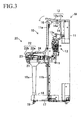
- Corner portions of the support surface 16b are curved in such a way that as shown in FIG. 2, the radius of curvature of the lower corner is set to be greater than the radius of curvature of the upper corner, whereby the lower corner is smoothly curved.
- the upper corner of the support surface 16b is formed to be aligned with the extension of the support surface 16c.
- corner portions of the support surface 16c are curved in such a way that as shown in FIG. 2, the radius of curvature of the left corner is set to be greater than the radius of curvature of the right corner, whereby the left corner is smoothly curved.
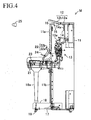
- the support axis 15 is fixed at a prescribed position at which the shortest length between the center of the support axis 15 and the interior wall of an upper front portion 11a of the case 11 becomes shorter than the shortest length between the center of the support axis 15 and the support surface 16b, which is identical to the length 11. Therefore, when the open/close board 12b is gradually opened in the initial state shown in FIG. 1 so that the lid prop 16 rotates in a counterclockwise direction, the open/close board 12b is finally opened as shown in FIG. 3 in which the support surface 16b of the lid prop 16 comes in contact with the upper end of the upper front portion 11a so that the lid prop 16b is stopped and cannot be rotated further. In this state, the open/close board 12b cannot move downward below the position of the lid prop 16, whereby a gap is maintained between the open/close board 12b and the upper end of the upper front portion 11a.
- a pedal assembly 17 including three pedals (only one of which is illustrated for the sake of convenience) is attached to the center of the lower end of a lower front portion 11b of the case 11.
- Support bases 18 for supporting the keyboard assembly 20 project forwards from both ends of the lower end of the lower front portion 11b.
- Legs 18a are arranged between the upper surfaces of the front portions of the support bases 18 and both ends of the lower surfaces of the keyboard casing 21.
- wheels 19 are attached to the rear positions of the lower surface of the case 11 and the front positions of the lower surfaces of the support bases 18, thus allowing the upright keyboard musical instrument M to move.
- the fall board 22 of the keyboard assembly 20 is formed as an open/close cover having an L-shape in cross section, which is constituted by an upper portion 22a and a front portion 22b.
- a music stand 24 for mounting a musical score thereon is attached to the lower surface of the upper portion 22a of the fall board 22.
- the music stand 24 is hinged to the lower surface of the upper portion 22a.
- the music stand 24 is folded to lie along the lower surface of the upper portion 22a.
- the music stand 24 is folded down to project forwards from the upper portion 22a of the fall board 22 that is opened.
- the music stand 24 is roughly maintained in a horizontal state, which allows a musical score to be mounted thereon.
- the fall board 22 is opened, and the music stand 24 is folded down as necessary so that a musical score may be placed thereon.
- the user plays the upright keyboard musical instrument M to produce small tone volumes
- the user plays the keyboard 23 in the closed state of the top board 12.
- the upright keyboard musical instrument M gently produces musical tones with relatively small tone volumes.
- the front end of the open/close board 12b is slightly lifted up so as to allow the lid prop 16 to rotate in the counterclockwise direction in FIG. 1, wherein as shown in FIG. 4, the support surface 16c is directed upwards.
- the open/close board 12b is slightly lowered and is thus supported by the lid prop 16.
- the lower surface of the open/close board 12b comes in contact with the overall area of the support surface 16c and the upper corner of the support surface 16b, wherein the line segment b connecting between the support surface 16c and the support axis 15 crosses at a right angle with the lower surface of the open/close board 12b, which is maintained in a stable manner.
- the user or player
- eyes 25 which are positioned as shown in FIG. 4.
- the upright keyboard musical instrument M can produce and emit slightly louder musical tones into the surrounding space thereof.
- the front end of the open/close board 12b is lifted up again so as to allow the top board 16 to further rotate in the counterclockwise direction in FIG. 4, whereby the support surface 16b is directed upwards.
- the open/close board 12b is slightly lowered down and is thus supported by the lid prop 16.
- the open/close board 12b is opened with a relatively great angle as shown in FIG. 5.
- the overall area of the support surface 16b of the lid prop 16 comes in contact with the lower surface of the open/close board 12b, wherein the line segment a connecting between the support surface 16b and the support axis 15 crosses at a right angle with the lower surface of the open/close board 12b, which is maintained in a stable manner.
- the user can view the actions 13 via the lower surface of the open/close board 12b with eyes 25, which are positioned as shown in FIG. 5.
- the user visually feels as if the actions 13 are horizontally arranged.
- the user can play the upright keyboard musical instrument M while viewing the movements of the actions 13 with sensations that the user plays a grand piano.
- the upright keyboard musical instrument M can produce and emit powerful loud musical tones into the surrounding space.
- the front end of the open/close board 12b is slightly lifted up so as to allow the lid prop 16 to rotate in the clockwise direction in FIG. 5, whereby the support surface 16b is directed downwards. Then, the open/close board 12b is lowered down and closed.
- the lid prop 16 further rotates in the counterclockwise direction in FIG. 5, the lid prop 16 is brought into contact with the upper end of the upper front portion 11a of the case and is thus stopped in movement, wherein the open/close board 12b is stopped just above the lid prop 16 as shown in FIG. 3.
- This mechanism reliably prevent user's fingers from being caught between the open/close board 12b and the upper end of the upper front portion 11a of the case 11, so that the user would not be injured.
- the lid prop 16 rotates in the clockwise direction in FIG. 5
- the lid prop 16 and the open/close board 12b are stopped as shown in FIG. 4. That is, even when the lid prop 16 rotates in both of the clockwise direction and counterclockwise direction, it is possible to reliably prevent user' fingers from being caught between the open/close board 12b and the upper end of the upper front portion 11a of the case 11, so that the user would not be injured.
- the upright keyboard musical instrument M uses the open/close board 12b whose lower surface is subjected to mirror surface finishing, wherein when the open/close board 12b is opened, the user can view the emblem 14a of the main body 10 or the actions 13 in response to the open angle of the open/close board 12b. Therefore, the user can play the upright keyboard musical instrument M while viewing the emblem 14a; and the user can play it while viewing the actions 13 with sensations as if the user plays a grand piano.
- tone volumes of musical tones produced by the upright keyboard musical instrument M can be controlled by appropriately opening or closing the open/close board 12b.
- the present embodiment is advantageous in that the open/close board 12b can be freely opened or closed with simple operation by rotating the lid prop 16, which is realized by slightly lifting up the open/close board 12b.
- FIG. 6 shows a lid prop 26 installed in an upright keyboard musical instrument in accordance with a second embodiment of the invention.
- the lid prop 26 is formed by a pentagonal board that is horizontally elongated in side view and is constituted by three sections, namely, 'planar' support surfaces 26b, 26c, and 26d, which are defined using different lengths 13, 14, and 15 designated by line segments 'c', 'd', and 'e' measured with respect to a hole 26a.
- the line segment 'c' is elongated from the center point of the hole 26a and rectangularly crosses the support surface 26b so as to define the length 13; the line segment 'd' is elongated from the center point of the hole 26a and rectangularly crosses the support surface 26c so as to define the length 14; and the line segment 'e' is elongated from the center point of the hole 26a and rectangularly crosses the support surface 26d so as to define the length 15.
- the length 13 is approximately three times longer than the length 14; and the length 15 is approximately a half of the length 13.
- an angle formed between the line segments c and d is set to 80°; and an angle formed between the line segments d and e is set to 70°.
- the upright keyboard musical instrument is capable of changing the open angle of the open/close board 12b by three steps, which guarantees an appropriate condition for viewing internal members of the main body via the open/close board 12b, regardless of changes of positions of user's eyes 25, which vary according to user's physical dimensions. Effects and operations of the upright keyboard musical instrument of the second embodiment are similar to those of the upright keyboard musical instrument M of the first embodiment.
- the upright keyboard musical instrument according to this invention is not necessarily limited to the aforementioned embodiments; hence, it can be modified in a variety of ways, which will be described below.
- the lower surface of the open/close board 12b is subjected to mirror surface finishing so that the user can view internal members of the main body 10.
- the open/close board 12b is composed of a wood material so that the lower surface thereof is coated with a film, which is then subjected to mirror surface finishing.
- the open/close board 12b is composed of material other than a wood material so that the lower surface thereof is subjected to mirror surface finishing.
- the member for supporting the open/close board 12b is not necessarily limited to the lid props 16 and 26 and can be appropriately formed in other shapes.
- the lid prop can be shaped to have a single support surface or shaped to have three or more support surfaces.
- the member for supporting the open/close board 12b is not necessarily limited to the lid props 16 and 26 that are rotatably installed below the open/close board 12b. That is, it is possible to use rod-like members for supporting the open/close board 12b.
- FIG. 3 shows the condition for preventing user's fingers from being caught between the upper end of the upper front portion 11a of the case 11 and the open/close board 12b that may be accidentally folded down.
- This condition can be used for one step for controlling the open angle of the open/close board 12b.
- This realizes the upright keyboard musical instrument M equipped with the top board 16 to be controlled in the open angle of the open/close board 12b in three steps.
- this realizes the upright keyboard musical instrument equipped with the top board 26 to be controlled in the open angle of the open/close board 12b in four steps.
- the emblem 14a is attached to the frame 14, however, which can be decorated using other members.
- the frame 14 can be decorated using other members.
- this invention is not necessarily limited to 'acoustic' upright keyboard musical instruments but is applicable to 'electronic' upright keyboard musical instruments.
Landscapes
- Physics & Mathematics (AREA)
- Engineering & Computer Science (AREA)
- Acoustics & Sound (AREA)
- Multimedia (AREA)
- Electrophonic Musical Instruments (AREA)
- Toys (AREA)
Applications Claiming Priority (2)
| Application Number | Priority Date | Filing Date | Title |
|---|---|---|---|
| JP2004097533A JP4635464B2 (ja) | 2004-03-30 | 2004-03-30 | アップライト型鍵盤楽器 |
| JP2004097533 | 2004-03-30 |
Publications (3)
| Publication Number | Publication Date |
|---|---|
| EP1585104A2 true EP1585104A2 (fr) | 2005-10-12 |
| EP1585104A3 EP1585104A3 (fr) | 2011-12-21 |
| EP1585104B1 EP1585104B1 (fr) | 2013-12-04 |
Family
ID=34909433
Family Applications (1)
| Application Number | Title | Priority Date | Filing Date |
|---|---|---|---|
| EP05006755.2A Expired - Lifetime EP1585104B1 (fr) | 2004-03-30 | 2005-03-29 | Instrument de musique à clavier, droit, avec une planche d'ouverture/fermeture fixée sur la partie supérieure d'un coffre |
Country Status (6)
| Country | Link |
|---|---|
| US (1) | US7301084B2 (fr) |
| EP (1) | EP1585104B1 (fr) |
| JP (1) | JP4635464B2 (fr) |
| KR (1) | KR100639126B1 (fr) |
| CN (2) | CN2802640Y (fr) |
| TW (1) | TWI297881B (fr) |
Families Citing this family (7)
| Publication number | Priority date | Publication date | Assignee | Title |
|---|---|---|---|---|
| JP4635464B2 (ja) * | 2004-03-30 | 2011-02-23 | ヤマハ株式会社 | アップライト型鍵盤楽器 |
| JP5066817B2 (ja) * | 2006-03-06 | 2012-11-07 | ヤマハ株式会社 | 楽器 |
| JP5227678B2 (ja) * | 2008-06-23 | 2013-07-03 | 株式会社河合楽器製作所 | グランドピアノの大屋根前支持装置 |
| JP2013097278A (ja) * | 2011-11-02 | 2013-05-20 | Roland Corp | 楽器 |
| JP6548001B2 (ja) * | 2015-03-02 | 2019-07-24 | カシオ計算機株式会社 | 鍵盤楽器 |
| JP7069647B2 (ja) * | 2017-11-07 | 2022-05-18 | ヤマハ株式会社 | 楽器及びアップライトピアノ |
| JP2019090981A (ja) * | 2017-11-16 | 2019-06-13 | ヤマハ株式会社 | アップライトピアノ |
Citations (3)
| Publication number | Priority date | Publication date | Assignee | Title |
|---|---|---|---|---|
| US1405433A (en) | 1921-12-10 | 1922-02-07 | Peterson Carl | Lid adjuster and support |
| GB488760A (en) | 1937-08-03 | 1938-07-13 | Douglas Walter Grover | Improvements relating to piano and like musical instrument cases provided with hinged tops |
| JPH11305761A (ja) | 1998-04-23 | 1999-11-05 | Yamaha Corp | 鍵盤楽器 |
Family Cites Families (11)
| Publication number | Priority date | Publication date | Assignee | Title |
|---|---|---|---|---|
| US3969970A (en) * | 1974-11-08 | 1976-07-20 | Libbey-Owens-Ford Company | Transparent grand piano tops |
| JPS5451824U (fr) * | 1977-09-17 | 1979-04-10 | ||
| JPS5461629U (fr) * | 1977-10-08 | 1979-04-28 | ||
| JPH07230272A (ja) * | 1994-02-18 | 1995-08-29 | Kawai Musical Instr Mfg Co Ltd | アップライトピアノの屋根取付構造 |
| JP3475013B2 (ja) * | 1996-06-10 | 2003-12-08 | 株式会社河合楽器製作所 | 楽器の生地塗り外装部品及びその製造方法 |
| KR0137013Y1 (ko) * | 1996-09-24 | 1999-04-01 | 배순훈 | 피아노의 상부덮개 지지구조 |
| JPH10153993A (ja) * | 1996-11-22 | 1998-06-09 | Kawai Musical Instr Mfg Co Ltd | アップライトピアノのケース部品 |
| US5818360A (en) * | 1997-04-28 | 1998-10-06 | Acer Incorporated | Configuration for a computer input device |
| JP3497711B2 (ja) * | 1997-10-27 | 2004-02-16 | 株式会社河合楽器製作所 | グランドピアノの大屋根前開閉機構 |
| JP2000242161A (ja) * | 1999-02-22 | 2000-09-08 | Chiba Community Television:Kk | 鍵盤楽器の練習方法 |
| JP4635464B2 (ja) * | 2004-03-30 | 2011-02-23 | ヤマハ株式会社 | アップライト型鍵盤楽器 |
-
2004
- 2004-03-30 JP JP2004097533A patent/JP4635464B2/ja not_active Expired - Fee Related
-
2005
- 2005-03-25 US US11/090,578 patent/US7301084B2/en not_active Expired - Fee Related
- 2005-03-28 CN CNU2005200120809U patent/CN2802640Y/zh not_active Expired - Lifetime
- 2005-03-28 TW TW094109600A patent/TWI297881B/zh not_active IP Right Cessation
- 2005-03-28 KR KR1020050025567A patent/KR100639126B1/ko not_active Expired - Fee Related
- 2005-03-28 CN CN2005100601663A patent/CN1677481B/zh not_active Expired - Fee Related
- 2005-03-29 EP EP05006755.2A patent/EP1585104B1/fr not_active Expired - Lifetime
Patent Citations (3)
| Publication number | Priority date | Publication date | Assignee | Title |
|---|---|---|---|---|
| US1405433A (en) | 1921-12-10 | 1922-02-07 | Peterson Carl | Lid adjuster and support |
| GB488760A (en) | 1937-08-03 | 1938-07-13 | Douglas Walter Grover | Improvements relating to piano and like musical instrument cases provided with hinged tops |
| JPH11305761A (ja) | 1998-04-23 | 1999-11-05 | Yamaha Corp | 鍵盤楽器 |
Also Published As
| Publication number | Publication date |
|---|---|
| EP1585104A3 (fr) | 2011-12-21 |
| CN1677481B (zh) | 2011-02-09 |
| KR100639126B1 (ko) | 2006-10-31 |
| JP4635464B2 (ja) | 2011-02-23 |
| US7301084B2 (en) | 2007-11-27 |
| EP1585104B1 (fr) | 2013-12-04 |
| CN1677481A (zh) | 2005-10-05 |
| KR20060044860A (ko) | 2006-05-16 |
| TWI297881B (en) | 2008-06-11 |
| TW200602621A (en) | 2006-01-16 |
| US20050217454A1 (en) | 2005-10-06 |
| CN2802640Y (zh) | 2006-08-02 |
| JP2005283955A (ja) | 2005-10-13 |
Similar Documents
| Publication | Publication Date | Title |
|---|---|---|
| US20070178952A1 (en) | Game apparatus and game program | |
| TW548122B (en) | Game system | |
| TW527203B (en) | Game system | |
| US7301084B2 (en) | Upright keyboard musical instrument | |
| US6288313B1 (en) | Keyboard musical instrument having split rear top board and/or visual display unit | |
| US6417436B1 (en) | Hand-operated dancing machine | |
| JP3670590B2 (ja) | ゲーム用演出装置 | |
| JP6548001B2 (ja) | 鍵盤楽器 | |
| JP3469949B2 (ja) | 電子楽器の鍵盤装置 | |
| JP4158035B2 (ja) | 電子楽器 | |
| JPH06118943A (ja) | 鍵盤楽器 | |
| JP7171066B2 (ja) | 遊技機 | |
| CN1707601A (zh) | 具可调力度琴键的数位键盘乐器 | |
| JP2003091274A (ja) | 電子楽器の鍵盤装置 | |
| JP2022025208A (ja) | 遊技機 | |
| JP6343317B2 (ja) | 遊技機 | |
| JP6343318B2 (ja) | 遊技機 | |
| JP6352355B2 (ja) | 遊技機 | |
| JP2022025207A (ja) | 遊技機 | |
| JP6235671B1 (ja) | 遊技機 | |
| JP2024033669A (ja) | 遊技機 | |
| JP2001175246A (ja) | ピアノ | |
| JP2001013959A (ja) | 遊技用楽器入力装置 | |
| JP2006201242A (ja) | 電子音楽装置 | |
| JP2000288255A (ja) | アミューズメント装置及びコントローラ |
Legal Events
| Date | Code | Title | Description |
|---|---|---|---|
| PUAI | Public reference made under article 153(3) epc to a published international application that has entered the european phase |
Free format text: ORIGINAL CODE: 0009012 |
|
| AK | Designated contracting states |
Kind code of ref document: A2 Designated state(s): AT BE BG CH CY CZ DE DK EE ES FI FR GB GR HU IE IS IT LI LT LU MC NL PL PT RO SE SI SK TR |
|
| AX | Request for extension of the european patent |
Extension state: AL BA HR LV MK YU |
|
| RAP1 | Party data changed (applicant data changed or rights of an application transferred) |
Owner name: YAMAHA CORPORATION |
|
| PUAL | Search report despatched |
Free format text: ORIGINAL CODE: 0009013 |
|
| AK | Designated contracting states |
Kind code of ref document: A3 Designated state(s): AT BE BG CH CY CZ DE DK EE ES FI FR GB GR HU IE IS IT LI LT LU MC NL PL PT RO SE SI SK TR |
|
| AX | Request for extension of the european patent |
Extension state: AL BA HR LV MK YU |
|
| RIC1 | Information provided on ipc code assigned before grant |
Ipc: G10C 3/02 20060101AFI20111118BHEP |
|
| 17P | Request for examination filed |
Effective date: 20120621 |
|
| AKX | Designation fees paid |
Designated state(s): DE ES FR GB IT |
|
| 17Q | First examination report despatched |
Effective date: 20120810 |
|
| GRAP | Despatch of communication of intention to grant a patent |
Free format text: ORIGINAL CODE: EPIDOSNIGR1 |
|
| INTG | Intention to grant announced |
Effective date: 20130611 |
|
| RIN1 | Information on inventor provided before grant (corrected) |
Inventor name: OKADA, KEITA |
|
| GRAS | Grant fee paid |
Free format text: ORIGINAL CODE: EPIDOSNIGR3 |
|
| GRAA | (expected) grant |
Free format text: ORIGINAL CODE: 0009210 |
|
| AK | Designated contracting states |
Kind code of ref document: B1 Designated state(s): DE ES FR GB IT |
|
| REG | Reference to a national code |
Ref country code: GB Ref legal event code: FG4D |
|
| REG | Reference to a national code |
Ref country code: DE Ref legal event code: R096 Ref document number: 602005042040 Country of ref document: DE Effective date: 20140130 |
|
| PG25 | Lapsed in a contracting state [announced via postgrant information from national office to epo] |
Ref country code: ES Free format text: LAPSE BECAUSE OF FAILURE TO SUBMIT A TRANSLATION OF THE DESCRIPTION OR TO PAY THE FEE WITHIN THE PRESCRIBED TIME-LIMIT Effective date: 20131204 |
|
| REG | Reference to a national code |
Ref country code: DE Ref legal event code: R097 Ref document number: 602005042040 Country of ref document: DE |
|
| PLBE | No opposition filed within time limit |
Free format text: ORIGINAL CODE: 0009261 |
|
| STAA | Information on the status of an ep patent application or granted ep patent |
Free format text: STATUS: NO OPPOSITION FILED WITHIN TIME LIMIT |
|
| 26N | No opposition filed |
Effective date: 20140905 |
|
| GBPC | Gb: european patent ceased through non-payment of renewal fee |
Effective date: 20140329 |
|
| REG | Reference to a national code |
Ref country code: DE Ref legal event code: R097 Ref document number: 602005042040 Country of ref document: DE Effective date: 20140905 |
|
| REG | Reference to a national code |
Ref country code: FR Ref legal event code: ST Effective date: 20141128 |
|
| PG25 | Lapsed in a contracting state [announced via postgrant information from national office to epo] |
Ref country code: FR Free format text: LAPSE BECAUSE OF NON-PAYMENT OF DUE FEES Effective date: 20140331 Ref country code: GB Free format text: LAPSE BECAUSE OF NON-PAYMENT OF DUE FEES Effective date: 20140329 |
|
| PG25 | Lapsed in a contracting state [announced via postgrant information from national office to epo] |
Ref country code: IT Free format text: LAPSE BECAUSE OF FAILURE TO SUBMIT A TRANSLATION OF THE DESCRIPTION OR TO PAY THE FEE WITHIN THE PRESCRIBED TIME-LIMIT Effective date: 20131204 |
|
| PGFP | Annual fee paid to national office [announced via postgrant information from national office to epo] |
Ref country code: DE Payment date: 20160322 Year of fee payment: 12 |
|
| REG | Reference to a national code |
Ref country code: DE Ref legal event code: R119 Ref document number: 602005042040 Country of ref document: DE |
|
| PG25 | Lapsed in a contracting state [announced via postgrant information from national office to epo] |
Ref country code: DE Free format text: LAPSE BECAUSE OF NON-PAYMENT OF DUE FEES Effective date: 20171003 |