EP1579124B1 - Elektromechanisch betätigbare feststellbremse - Google Patents
Elektromechanisch betätigbare feststellbremse Download PDFInfo
- Publication number
- EP1579124B1 EP1579124B1 EP03789204.9A EP03789204A EP1579124B1 EP 1579124 B1 EP1579124 B1 EP 1579124B1 EP 03789204 A EP03789204 A EP 03789204A EP 1579124 B1 EP1579124 B1 EP 1579124B1
- Authority
- EP
- European Patent Office
- Prior art keywords
- brake
- electromechanical actuator
- parking brake
- drum
- threaded nut
- Prior art date
- Legal status (The legal status is an assumption and is not a legal conclusion. Google has not performed a legal analysis and makes no representation as to the accuracy of the status listed.)
- Expired - Lifetime
Links
- 238000000034 method Methods 0.000 claims description 3
- 238000009434 installation Methods 0.000 claims 1
- 230000020347 spindle assembly Effects 0.000 description 3
- 238000001514 detection method Methods 0.000 description 1
- 238000004519 manufacturing process Methods 0.000 description 1
Images



Classifications
-
- F—MECHANICAL ENGINEERING; LIGHTING; HEATING; WEAPONS; BLASTING
- F16—ENGINEERING ELEMENTS AND UNITS; GENERAL MEASURES FOR PRODUCING AND MAINTAINING EFFECTIVE FUNCTIONING OF MACHINES OR INSTALLATIONS; THERMAL INSULATION IN GENERAL
- F16D—COUPLINGS FOR TRANSMITTING ROTATION; CLUTCHES; BRAKES
- F16D51/00—Brakes with outwardly-movable braking members co-operating with the inner surface of a drum or the like
- F16D51/46—Self-tightening brakes with pivoted brake shoes, i.e. the braked member increases the braking action
- F16D51/48—Self-tightening brakes with pivoted brake shoes, i.e. the braked member increases the braking action with two linked or directly-interacting brake shoes
-
- F—MECHANICAL ENGINEERING; LIGHTING; HEATING; WEAPONS; BLASTING
- F16—ENGINEERING ELEMENTS AND UNITS; GENERAL MEASURES FOR PRODUCING AND MAINTAINING EFFECTIVE FUNCTIONING OF MACHINES OR INSTALLATIONS; THERMAL INSULATION IN GENERAL
- F16D—COUPLINGS FOR TRANSMITTING ROTATION; CLUTCHES; BRAKES
- F16D51/00—Brakes with outwardly-movable braking members co-operating with the inner surface of a drum or the like
- F16D51/46—Self-tightening brakes with pivoted brake shoes, i.e. the braked member increases the braking action
- F16D51/48—Self-tightening brakes with pivoted brake shoes, i.e. the braked member increases the braking action with two linked or directly-interacting brake shoes
- F16D51/50—Self-tightening brakes with pivoted brake shoes, i.e. the braked member increases the braking action with two linked or directly-interacting brake shoes mechanically actuated
-
- F—MECHANICAL ENGINEERING; LIGHTING; HEATING; WEAPONS; BLASTING
- F16—ENGINEERING ELEMENTS AND UNITS; GENERAL MEASURES FOR PRODUCING AND MAINTAINING EFFECTIVE FUNCTIONING OF MACHINES OR INSTALLATIONS; THERMAL INSULATION IN GENERAL
- F16D—COUPLINGS FOR TRANSMITTING ROTATION; CLUTCHES; BRAKES
- F16D65/00—Parts or details
- F16D65/14—Actuating mechanisms for brakes; Means for initiating operation at a predetermined position
-
- F—MECHANICAL ENGINEERING; LIGHTING; HEATING; WEAPONS; BLASTING
- F16—ENGINEERING ELEMENTS AND UNITS; GENERAL MEASURES FOR PRODUCING AND MAINTAINING EFFECTIVE FUNCTIONING OF MACHINES OR INSTALLATIONS; THERMAL INSULATION IN GENERAL
- F16D—COUPLINGS FOR TRANSMITTING ROTATION; CLUTCHES; BRAKES
- F16D65/00—Parts or details
- F16D65/14—Actuating mechanisms for brakes; Means for initiating operation at a predetermined position
- F16D65/16—Actuating mechanisms for brakes; Means for initiating operation at a predetermined position arranged in or on the brake
- F16D65/22—Actuating mechanisms for brakes; Means for initiating operation at a predetermined position arranged in or on the brake adapted for pressing members apart, e.g. for drum brakes
-
- F—MECHANICAL ENGINEERING; LIGHTING; HEATING; WEAPONS; BLASTING
- F16—ENGINEERING ELEMENTS AND UNITS; GENERAL MEASURES FOR PRODUCING AND MAINTAINING EFFECTIVE FUNCTIONING OF MACHINES OR INSTALLATIONS; THERMAL INSULATION IN GENERAL
- F16D—COUPLINGS FOR TRANSMITTING ROTATION; CLUTCHES; BRAKES
- F16D65/00—Parts or details
- F16D65/38—Slack adjusters
- F16D2065/386—Slack adjusters driven electrically
-
- F—MECHANICAL ENGINEERING; LIGHTING; HEATING; WEAPONS; BLASTING
- F16—ENGINEERING ELEMENTS AND UNITS; GENERAL MEASURES FOR PRODUCING AND MAINTAINING EFFECTIVE FUNCTIONING OF MACHINES OR INSTALLATIONS; THERMAL INSULATION IN GENERAL
- F16D—COUPLINGS FOR TRANSMITTING ROTATION; CLUTCHES; BRAKES
- F16D66/00—Arrangements for monitoring working conditions, e.g. wear, temperature
- F16D2066/003—Position, angle or speed
-
- F—MECHANICAL ENGINEERING; LIGHTING; HEATING; WEAPONS; BLASTING
- F16—ENGINEERING ELEMENTS AND UNITS; GENERAL MEASURES FOR PRODUCING AND MAINTAINING EFFECTIVE FUNCTIONING OF MACHINES OR INSTALLATIONS; THERMAL INSULATION IN GENERAL
- F16D—COUPLINGS FOR TRANSMITTING ROTATION; CLUTCHES; BRAKES
- F16D2121/00—Type of actuator operation force
- F16D2121/18—Electric or magnetic
- F16D2121/24—Electric or magnetic using motors
-
- F—MECHANICAL ENGINEERING; LIGHTING; HEATING; WEAPONS; BLASTING
- F16—ENGINEERING ELEMENTS AND UNITS; GENERAL MEASURES FOR PRODUCING AND MAINTAINING EFFECTIVE FUNCTIONING OF MACHINES OR INSTALLATIONS; THERMAL INSULATION IN GENERAL
- F16D—COUPLINGS FOR TRANSMITTING ROTATION; CLUTCHES; BRAKES
- F16D2125/00—Components of actuators
- F16D2125/18—Mechanical mechanisms
- F16D2125/20—Mechanical mechanisms converting rotation to linear movement or vice versa
- F16D2125/34—Mechanical mechanisms converting rotation to linear movement or vice versa acting in the direction of the axis of rotation
- F16D2125/40—Screw-and-nut
-
- F—MECHANICAL ENGINEERING; LIGHTING; HEATING; WEAPONS; BLASTING
- F16—ENGINEERING ELEMENTS AND UNITS; GENERAL MEASURES FOR PRODUCING AND MAINTAINING EFFECTIVE FUNCTIONING OF MACHINES OR INSTALLATIONS; THERMAL INSULATION IN GENERAL
- F16D—COUPLINGS FOR TRANSMITTING ROTATION; CLUTCHES; BRAKES
- F16D2125/00—Components of actuators
- F16D2125/18—Mechanical mechanisms
- F16D2125/44—Mechanical mechanisms transmitting rotation
- F16D2125/46—Rotating members in mutual engagement
- F16D2125/48—Rotating members in mutual engagement with parallel stationary axes, e.g. spur gears
-
- F—MECHANICAL ENGINEERING; LIGHTING; HEATING; WEAPONS; BLASTING
- F16—ENGINEERING ELEMENTS AND UNITS; GENERAL MEASURES FOR PRODUCING AND MAINTAINING EFFECTIVE FUNCTIONING OF MACHINES OR INSTALLATIONS; THERMAL INSULATION IN GENERAL
- F16D—COUPLINGS FOR TRANSMITTING ROTATION; CLUTCHES; BRAKES
- F16D2125/00—Components of actuators
- F16D2125/18—Mechanical mechanisms
- F16D2125/44—Mechanical mechanisms transmitting rotation
- F16D2125/46—Rotating members in mutual engagement
- F16D2125/52—Rotating members in mutual engagement with non-parallel stationary axes, e.g. worm or bevel gears
Definitions
- the present invention relates to an electromechanically actuated parking brake for motor vehicles, having the features of the preamble of claim 1.
- a parking brake is off US 4928543A known.
- a drum brake that performs the function of a "simplex" drum brake during service braking and performs the function of a "duo-servo" type drum brake during parking brake operations.
- an electromechanically actuated device is provided in the known drum brake, which cancels the effect of the supporting device of the two brake shoes and realizes a floating storage.
- the brake shoes are simultaneously brought into engagement with the brake drum for carrying out a parking brake operation.
- the brake shoes during a parking brake operation are adjustable only by a single predetermined distance, which is not sufficient in particular with worn brake pads to achieve the required clamping force.
- the threaded nut has a straight toothing, which forms a fferradgetriebe with a driven by the electromechanical actuator helical gear.
- the threaded nut has a spur toothing, which forms a spur gear with a driven by the electromechanical actuator gear.
- the electromechanical actuator is mounted radially to the brake drum at an angle adapted to the available space relative to a plane which is perpendicular to the axis of the brake drum.
- the electromechanical actuator is mounted tangentially to the brake drum.
- a reduction gear is provided between the electromechanical actuator and the helical gear.
- a particularly advantageous development of the subject invention provides that the electromechanical actuator is formed by an electric motor having a sensor for detecting has the position of its rotor. By this measure, the lining wear of the brake shoes can be determined.
- the brake drum is arranged in the central region of a brake disc.
- the inventive electromechanically actuated parking brake shown in the drawing consists essentially of a known drum brake type "duo-servo", and an electromechanical actuator 15.
- the drum brake type “duo-servo” has a brake drum 5, provided with friction surfaces Pair of brake shoes 3, 4 and an expanding lock 2, which is the friction surfaces of the brake shoes 3, 4 with the inside the brake drum 5 can engage.
- Characteristic of the drum brake type “Duo-Servo” is a freely movable or floating support device 14, which is opposite to the expansion lock 2 and between the Bremsbakken 3, 4 is arranged.
- the support device 14 is combined with an adjusting device.
- the electromechanical actuator 15 is mounted radially to the brake drum 5 on a wheel carrier, not shown, preferably at an angle of about 30 ° relative to the illustrated sectional plane, which is particularly advantageous in terms of limited space conditions on the wheel.
- the electromechanical actuator 15 drives via a non-descript reduction gear 12 a fferrad 1, whereby the already mentioned Sp Drschsch 2, based on Fig.2 will be explained in more detail, is operated.
- the expanding lock 2 is designed as a threaded nut spindle arrangement 8, the threaded nut 6 has on the outer surface a toothing which is parallel to the axis of the threaded nut 6.
- the just mentioned helical gear 1 forms a helical gear.
- the threaded nut 6 is set in a rotational movement. Due to this rotational movement of the threaded nut 6, the spindle 7 of the threaded nut spindle arrangement 8 performs a translational movement and brings the two brake shoes 3, 4 with the desired clamping force even with worn brake pads with the brake drum 5 into engagement.
- either the reduction gear 12 or the threaded nut spindle assembly 8 is self-locking. By this measure remain the brake shoes 3, 4 in the de-energized state of the electromechanical actuator 15 with the brake drum 5 into engagement.
- the already mentioned electromechanical actuator 15 is formed by an electric motor and has a sensor, not shown, which detects the position of its rotor. This makes it possible to determine how many revolutions of the rotor and thus both the helical gear 1 and the threaded nut 6 complete. With the help of this information, a very reliable working pad wear detection of the brake shoes 3, 4 can be realized.
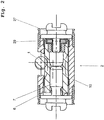
- the expanding lock 2 is described below with reference to Fig.2 explained in more detail.
- the expanding lock 2 is formed by a threaded nut spindle arrangement 8 whose threaded nut 6 is rotatably mounted in a housing 10 of the expanding lock 2 with the aid of an axial bearing 29.
- the spur toothing on the outer surface of the threaded nut 6 is indicated only schematically and standing in engagement with her ringrad 1 shown only in section.
- the electromechanical actuator drives the helical gear 1
- the threaded nut 6, as already described is set in rotation.
- the spindle 7 performs a translational movement in the drawing to the left and presses the first brake shoe 3 against the brake drum 5.
- the electromechanical actuator 15 is mounted tangentially to the brake drum 5 on a mudguard 9, which in turn is fixedly connected to the wheel carrier, not shown.
- This arrangement of the electromechanical actuator 15 is also advantageous in terms of limited space conditions on the wheel.
- the electromechanical actuator 15 drives a gear 11 via a reduction gear 22, whereby the expanding lock 2 is actuated and the two brake shoes 3, 4 are brought into engagement with the inside of the brake drum 5.
- the expansion lock 2 is in turn formed from a threaded nut spindle arrangement 18, as shown in particular in FIG Figure 4 is shown.
- the threaded nut 16 has on its outer surface a spur toothing and forms with the gear 11 a spur gear spur gear.
- the reduction gear 22 or the threaded nut spindle assembly 18 be designed to be self-locking, so that the set clamping force after switching off the electromechanical actuator 15 is maintained.
- the electromechanical actuator 15 with the brake shoes 3, 4, the support device 14 and the mudguard 9 form a preassembled module, which can be particularly easily mounted in the manufacture of motor vehicles.
- both described embodiments of the parking brake according to the invention can be combined with a hydraulic disc brake for service braking by the brake drum 5 arranged in the central region of a brake disc.
- This has the advantage that the parking brake according to the invention operated with a particularly cost-effective control of the electromechanical actuator 15 and the power requirement can be minimized to the electromechanical actuator 15.
Landscapes
- Engineering & Computer Science (AREA)
- General Engineering & Computer Science (AREA)
- Mechanical Engineering (AREA)
- Braking Arrangements (AREA)
Description
- Die vorliegende Erfindung betrifft eine elektromechanisch betätigbare Feststellbremse für Kraftfahrzeuge, mit den Merkmalen vom oberbegriff von Patentanspruch 1. Eine derartige Feststellbremse ist aus
US 4928543A bekannt. - Aus der deutschen Offenlegungsschrift
DE 198 46 420 A1 ist eine Trommelbremse bekannt, die während Betriebsbremsungen die Funktion einer Trommelbremse vom Typ "Simplex" erfüllt und während Feststellbremsvorgängen die Funktion einer Trommelbremse vom Typ "Duo-Servo" erfüllt. Dazu ist bei der vorbekannten Trommelbremse eine elektromechanisch betätigbare Vorrichtung vorgesehen, die die Wirkung der Abstützvorrichtung der beiden Bremsbacken aufhebt und eine schwimmende Lagerung realisiert. Durch diese Maßnahme werden gleichzeitig die Bremsbacken mit der Bremstrommel zur Durchführung eines Feststellbremsvorganges in Eingriff gebracht. Als weniger vorteilhaft ist bei der vorbekannten Trommelbremse anzusehen, dass die Bremsbacken während eines Feststellbremsvorganges nur um eine einzige vorbestimmte Wegstrecke verstellbar sind, die insbesondere bei verschlissenen Bremsbelägen nicht ausreichend ist, um die erforderliche Zuspannkraft zu erreichen. - Es ist daher Aufgabe der Erfindung, eine elektromechanisch betätigbare Feststellbremse der eingangs genannten Gattung dahingehend zu verbessern, dass die Zuspannkraft während eines stromlosen Feststellbremsvorgangs zuverlässig verfügbar ist.
- Diese Aufgabe wird erfindungsgemäß durch die kennzeichnechen Merkmale von Anspruch 1 gelöst.
- Eine vorteilhafte Weiterbildung des Erfindungsgegenstandes sieht vor, dass die Gewindemutter eine Geradverzahnung aufweist, die mit einem vom elektromechanischen Aktuator angetriebenen Schraubrad ein Schraubradgetriebe bildet.
- Bei einer weiteren vorteilhaften Weiterbildung des Erfindungsgegenstandes weist die Gewindemutter eine Geradverzahnung auf, die mit einem vom elektromechanischen Aktuator angetriebenen Zahnrad ein Stirnradgetriebe bildet.
- Es ist vorgesehen, dass der elektromechanische Aktuator radial zur Bremstrommel unter einem dem vorhandenen Bauraum angepassten Winkel relativ zu einer Ebene, die senkrecht zur Achse der Bremstrommel steht, angebracht ist.
- Bei einer vorteilhaften Weiterbildung ist der elektromechanische Aktuator tangential zur Bremstrommel angebracht.
- Außerdem ist zwischen dem elektromechanischen Aktuator und dem Schraubrad bzw. dem Zahnrad ein Untersetzungsgetriebe vorgesehen.
- Eine besonders vorteilhafte Weiterbildung des Erfindungsgegenstandes sieht vor, dass der elektromechanische Aktuator durch einen Elektromotor gebildet ist, der einen Sensor zur Erfassung der Position seines Rotors aufweist. Durch diese Maßnahme ist der Belagverschleiß der Bremsbacken ermittelbar.
- Bei einer weiteren vorteilhaften Ausführung des Erfindungsgegenstandes ist die Bremstrommel im mittleren Bereich einer Bremsscheibe angeordnet.
- Die Erfindung wird nachfolgend anhand von zwei Ausführungsbeispielen im Zusammenhang mit der beiliegenden Zeichnung näher erläutert. In der Zeichnung zeigen:
- Fig.1
- eine vereinfachte Darstellung einer ersten Ausführung der erfindungsgemäßen Feststellbremse,
- Fig.2
- eine Schnittdarstellung eines Spreizschlosses, das in der in
Fig.1 dargestellten Feststellbremse einsetzbar ist, - Fig.3a, b
- eine zweite Ausführung der erfindungsgemäßen Feststellbremse in einer schematischen perspektivischen Darstellung in Rück- und in Vorderansicht und
- Fig.4
- eine Schnittdarstellung eines Spreizschloss, das in der in
Fig.3 dargestellten Feststellbremse einsetzbar ist. - Die in der Zeichnung dargestellte erfindungsgemäße elektromechanisch betätigbare Feststellbremse besteht im wesentlichen aus einer an sich bekannten Trommelbremse vom Typ "Duo-Servo", sowie einem elektromechanischen Aktuator 15. Die Trommelbremse vom Typ "Duo-Servo" weist eine Bremstrommel 5, ein mit Reibflächen versehenes Paar von Bremsbacken 3, 4 und ein Spreizschloss 2 auf, das die Reibflächen der Bremsbacken 3, 4 mit der Innenseite der Bremstrommel 5 in Eingriff bringen kann. Charakteristisch für die Trommelbremse vom Typ "Duo-Servo" ist eine frei bewegliche bzw. schwimmend gelagerte Abstützvorrichtung 14, die dem Spreizschloss 2 gegenüber liegt und zwischen den Bremsbakken 3, 4 angeordnet ist. Außerdem ist die Abstützvorrichtung 14 mit einer Nachstellvorrichtung kombiniert.
- Bei der in
Fig.1 dargestellten ersten Ausführung ist der elektromechanische Aktuator 15 radial zur Bremstrommel 5 an einem nicht dargestellten Radträger vorzugsweise unter einem Winkel von etwa 30° gegenüber der dargestellten Schnittebene angebracht, was hinsichtlich der beschränkten Bauraumverhältnisse am Rad besonders vorteilhaft ist. Der elektromechanische Aktuator 15 treibt über ein nicht näher beschriebenes Untersetzungsgetriebe 12 ein Schraubrad 1 an, wodurch das bereits erwähnte Spreizschloss 2, das anhand vonFig.2 noch näher erläutert wird, betätigt wird. Dabei ist das Spreizschloss 2 als Gewindemutter-Spindel-Anordnung 8 ausgebildet, deren Gewindemutter 6 auf der äußeren Oberfläche eine Verzahnung aufweist, die parallel zur Achse der Gewindemutter 6 verläuft. Mit dieser Geradverzahnung der Gewindemutter 6 bildet das eben erwähnte Schraubrad 1 ein Schraubradgetriebe. Bei einer Betätigung des Schraubrads 1 durch den elektromechanischen Aktuator 15 wird die Gewindemutter 6 in eine Rotationsbewegung versetzt. Aufgrund dieser Rotationsbewegung der Gewindemutter 6 vollzieht die Spindel 7 der Gewindemutter-Spindel-Anordnung 8 eine Translationsbewegung und bringt die beiden Bremsbacken 3, 4 mit der gewünschten Zuspannkraft auch bei verschlissenen Bremsbelägen mit der Bremstrommel 5 in Eingriff. - Um einen Feststellbremsvorgang durchführen zu können, ist entweder das Untersetzungsgetriebe 12 oder die Gewindemutter-Spindel-Anordnung 8 selbsthemmend ausgebildet. Durch diese Maßnahme verbleiben die Bremsbacken 3, 4 im stromlosen Zustand des elektromechanischen Aktuators 15 mit der Bremstrommel 5 in Eingriff.
- Der bereits erwähnte elektromechanische Aktuator 15 wird durch einen Elektromotor gebildet und weist einen nicht dargestellten Sensor auf, der die Position seines Rotors erfasst. Dadurch ist ermittelbar, wie viele Umdrehungen der Rotor und damit sowohl das Schraubrad 1 als auch die Gewindemutter 6 vollziehen. Mit Hilfe dieser Informationen ist eine sehr zuverlässig arbeitende Belagverschleißerkennung der Bremsbacken 3, 4 realisierbar.
- Das Spreizschloss 2 wird im Folgenden anhand von
Fig.2 näher erläutert. Wie bereits erwähnt, wird das Spreizschloss 2 durch eine Gewindemutter-Spindel-Anordnung 8 gebildet, deren Gewindemutter 6 in einem Gehäuse 10 des Spreizschlosses 2 mit Hilfe eines Axiallagers 29 drehbar gelagert ist. Die Geradverzahnung auf der äußeren Oberfläche der Gewindemutter 6 ist lediglich schematisch angedeutet und das mit ihr in Eingriff stehende Schraubrad 1 lediglich im Schnitt dargestellt. Sobald der elektromechanische Aktuator das Schraubrad 1 antreibt, wird die Gewindemutter 6, wie bereits beschrieben, in Rotation versetzt. Dadurch vollzieht die Spindel 7 eine Translationsbewegung in der Zeichnung nach links und drückt die erste Bremsbacke 3 gegen die Bremstrommel 5. Die so erzielte Zuspannkraft stützt sich über das Axiallager 29 auf einem Druckstück 27 ab. Als Gegenreaktion wird auch die zweite Bremsbacke 4 gegen die Bremstrommel gedrückt und das Spreizschloss 2 zentriert sich selbst innerhalb der Bremstrommel 5. Um den eben beschriebenen Vorgang zu ermöglichen, muss das Spreizschloss 2 bzw. die Gewindemutter-Spindel-Anordnung 8 frei beweglich, also schwimmend gelagert, sein. Aus diesem Grund bildet die Achse des elektromechanischen Aktuators 15 bzw. des Schraubrades 1 mit der Achse der geradverzahnten Gewindemutter 6 keinen rechten Winkel, sondern ist entsprechend der Steigung des Schraubrads 1 winkelverdreht. Dieser Winkelversatz ergibt die Möglichkeit, dass der gesamte Innenbereich des Spreizschlosses 2 im Gehäuse 10 axial verschiebbar ist. Dadurch werden die Spiele innerhalb der Bremstrommel 5 ausgeglichen. - Bei der in
Fig.3a und Fig.3b dargestellten zweiten Ausführung der erfindungsgemäßen Feststellbremse ist der elektromechanische Aktuator 15 tangential zur Bremstrommel 5 an einem Schmutzblech 9 angebracht, das wiederum fest mit dem nicht dargestellten Radträger verbunden ist. Diese Anordnung des elektromechanischen Aktuators 15 ist ebenfalls vorteilhaft hinsichtlich der beschränkten Bauraumverhältnisse am Rad. - Der elektromechanische Aktuator 15 treibt über ein Untersetzungsgetriebe 22 ein Zahnrad 11 an, wodurch das Spreizschloss 2 betätigt wird und die beiden Bremsbacken 3, 4 mit der Innenseite der Bremstrommel 5 in Eingriff gebracht werden. Das Spreizschloss 2 wird wiederum aus einer Gewindemutter-Spindel-Anordnung 18 gebildet, wie es insbesondere in
Fig.4 dargestellt ist. Die Gewindemutter 16 weist auf ihrer äußeren Oberfläche eine Geradverzahnung auf und bildet mit dem Zahnrad 11 ein geradverzahntes Stirnradgetriebe. Sobald der elektromechanische Aktuator 15 das Zahnrad 11 über das Untersetzungsgetriebe 22 antreibt, wird die Gewindemutter 16 in Rotation versetzt, wonach die Spindel 17 eine Translationsbewegung vollzieht und die der Spindel 17 zugeordnete Bremsbacke 3 gegen die Bremstrommel 5 drückt. Als Gegenreaktion wird auch die andere Bremsbacke 4 gegen die Bremstrommel 5 gedrückt und das Spreizschloss 2 zentriert sich selbst. Die für diesen Vorgang notwendige schwimmende Lagerung des Spreizschlosses 2 wird dadurch realisiert, dass das Zahnrad 11 mit der Gewindemutter 16 ein geradverzahntes Stirnradgetriebe bildet und das Zahnrad 11 breiter als die Geradverzahnung am Außenumfang der Gewindemutter 16 ausgeführt ist. Dadurch ist die Gewindemutter-Spindel-Anordnung 18 horizontal frei beweglich, wie es insbesondereFig.4 verdeutlicht. - Um einen Feststellbremsvorgang durchführen zu können muss wie bei der anhand von
Fig.1 undFig.2 beschriebenen ersten Ausführung der erfinderischen Feststellbremse das Untersetzungsgetriebe 22 oder die Gewindemutter-Spindel-Anordnung 18 selbsthemmend ausgeführt sein, damit die eingestellte Zuspannkraft nach Abschalten des elektromechanischen Aktuators 15 erhalten bleibt. - Bei beiden beschriebenen Ausführungsbeispielen der erfindungsgemäßen Feststellbremse kann der elektromechanische Aktuator 15 mit den Bremsbacken 3, 4, der Abstützvorrichtung 14 und dem Schmutzblech 9 ein vormontierte Baugruppe bilden, die bei der Herstellung von Kraftfahrzeugen besonders einfach montiert werden kann.
- Außerdem können beide beschriebene Ausführungsbeispiele der erfindungsgemäßen Feststellbremse mit einer hydraulischen Scheibenbremse für Betriebsbremsungen kombiniert werden, indem die Bremstrommel 5 im mittleren Bereich einer Bremsscheibe angeordnet. Dies hat den Vorteil, dass die erfindungsgemäße Feststellbremse mit einer besonders kostengünstigen Ansteuerung des elektromechanischen Aktuators 15 betrieben und die Leistungsanforderung an den elektromechanischen Aktuator 15 minimiert werden kann.
Claims (8)
- Elektromechanisch betätigbare Feststellbremse für Kraftfahrzeuge, die als eine Trommelbremse ausgeführt ist, mit einer Bremstrommel (5) und mit einem von einem elektromechanischen Aktuator (15) mit einem Untersetzungsgetriebe (12,22) betätigbaren, schwimmend gelagerten Spreizschloss, das auf zwei Bremsbacken (3,4) wirkt, wobei das Spreizschloss (2) durch eine Gewindemutter-Spindel-Anordnung (8, 18) gebildet ist, deren Gewindemutter (6, 16) vom elektromechanischen Aktuator (15) angetrieben wird, dadurch gekennzeichnet, dass das Untersetzungsgetriebe (12, 22) oder die Gewindemutter-Spindel-Anordnung (8, 18) selbsthemmend ausgebildet ist, um im stromlosen Zustand einen Feststellvorgang zu ermöglichen, dass die Trommelbremse zusätzlich eine schwimmend gelagerte Abstützvorrichtung (14) aufweist, die dem Spreizschloss (2) gegenüber liegend vorgesehen ist, und wobei die Bremstrommel (5) im mittleren Bereich einer Bremsscheibe angeordnet ist.
- Elektromechanisch betätigbare Feststellbremse nach Anspruch 1, dadurch gekennzeichnet, dass die Gewindemutter (6) eine Geradverzahnung aufweist, die mit einem vom elektromechanischen Aktuator (15) angetriebenen Schraubrad (1) ein Schraubradgetriebe bildet.
- Elektromechanisch betätigbare Feststellbremse nach Anspruch 1, dadurch gekennzeichnet, dass die Gewindemutter (16) eine Geradverzahnung aufweist, die mit einem vom elektromechanischen Aktuator (15) angetriebenen Zahnrad (11) ein Stirnradgetriebe bildet.
- Elektromechanisch betätigbare Feststellbremse nach Anspruch 1 oder 2, dadurch gekennzeichnet, dass der elektromechanische Aktuator (15) radial zur Bremstrommel (5) unter einem dem vorhandenen Bauraum angepassten Winkel relativ zu einer Ebene, die senkrecht zur Achse der Bremstrommel (5) steht, angebracht ist.
- Elektromechanisch betätigbare Feststellbremse nach Anspruch 1 oder 3, dadurch gekennzeichnet, dass der elektromechanische Aktuator (15) tangential zur Bremstrommel (5) angebracht ist.
- Elektromechanisch betätigbare Feststellbremse nach Anspruch 2, dadurch gekennzeichnet, dass das Untersetzungsgetriebe (12) zwischen dem elektromechanischen Aktuator (15) und dem Schraubrad (1) vorgesehen ist.
- Elektromechanisch betätigbare Feststellbremse nach Anspruch 3, dadurch gekennzeichnet, dass das Untersetzungsgetriebe (22) zwischen dem elektromechanischen Aktuator (15) und dem Zahnrad (11) vorgesehen ist.
- Elektromechanisch betätigbare Feststellbremse nach einem der vorhergehenden Ansprüche, dadurch gekennzeichnet, dass der elektromechanische Aktuator (15) durch einen Elektromotor gebildet ist, der einen Sensor zur Erfassung der Position seines Rotors aufweist.
Applications Claiming Priority (5)
| Application Number | Priority Date | Filing Date | Title |
|---|---|---|---|
| DE10261095 | 2002-12-20 | ||
| DE10261095 | 2002-12-20 | ||
| DE10343246 | 2003-09-17 | ||
| DE10343246 | 2003-09-17 | ||
| PCT/EP2003/013997 WO2004059189A1 (de) | 2002-12-20 | 2003-12-10 | Elektromechanisch betätigbare feststellbremse |
Publications (2)
| Publication Number | Publication Date |
|---|---|
| EP1579124A1 EP1579124A1 (de) | 2005-09-28 |
| EP1579124B1 true EP1579124B1 (de) | 2018-10-17 |
Family
ID=32683482
Family Applications (1)
| Application Number | Title | Priority Date | Filing Date |
|---|---|---|---|
| EP03789204.9A Expired - Lifetime EP1579124B1 (de) | 2002-12-20 | 2003-12-10 | Elektromechanisch betätigbare feststellbremse |
Country Status (6)
| Country | Link |
|---|---|
| US (1) | US20060278477A1 (de) |
| EP (1) | EP1579124B1 (de) |
| JP (1) | JP4800767B2 (de) |
| KR (1) | KR20050084449A (de) |
| BR (1) | BR0307758B1 (de) |
| WO (1) | WO2004059189A1 (de) |
Cited By (1)
| Publication number | Priority date | Publication date | Assignee | Title |
|---|---|---|---|---|
| DE102019207671B3 (de) * | 2019-05-24 | 2020-08-20 | Continental Teves Ag & Co. Ohg | Spreizeinrichtung für eine Trommelbremse |
Families Citing this family (35)
| Publication number | Priority date | Publication date | Assignee | Title |
|---|---|---|---|---|
| DE102004049434A1 (de) * | 2004-01-21 | 2005-10-06 | Continental Teves Ag & Co. Ohg | Elektromechanisch betätigbare Feststellbremse |
| US8011482B2 (en) * | 2005-10-31 | 2011-09-06 | Kelsey-Hayes Company | Electric actuator unit for a vehicle brake assembly |
| DE102008013747B4 (de) | 2007-03-16 | 2016-07-07 | Continental Teves Ag & Co. Ohg | Feststellbremse für Kraftfahrzeuge sowie Bremsbacke hierfür |
| CN101796319B (zh) | 2007-09-05 | 2013-01-02 | 大陆-特韦斯贸易合伙股份公司及两合公司 | 用于机动车的能机电式致动的驻车制动器及其致动方法 |
| DE102008050215A1 (de) | 2008-10-02 | 2010-04-08 | Continental Teves Ag & Co. Ohg | Elektromechanisch betätigbare Feststellbremse für Kraftfahrzeuge |
| US9446748B2 (en) * | 2010-04-16 | 2016-09-20 | Gregory A Ward | Portable antilock brake system |
| JP5546491B2 (ja) * | 2011-03-31 | 2014-07-09 | 株式会社アドヴィックス | 電動駐車ブレーキ装置 |
| KR101421948B1 (ko) * | 2012-12-13 | 2014-07-22 | 현대자동차주식회사 | 전동식 파킹브레이크 엑추에이터 구조 |
| FR3013408B1 (fr) * | 2013-11-19 | 2015-12-25 | Chassis Brakes Int Bv | Frein a tambour fonctionnant en mode simplex et/ou en mode duo servo |
| DE102013224922A1 (de) * | 2013-12-04 | 2015-06-11 | Continental Teves Ag & Co. Ohg | Elektromechanisch betätigbare Trommelbremse |
| FR3016014B1 (fr) * | 2013-12-30 | 2017-03-31 | Chassis Brakes Int Bv | Actionneur avec systeme vis-ecrou irreversible, frein a tambour et dispositif de freinage ainsi equipes |
| FR3016015B1 (fr) * | 2013-12-30 | 2017-03-31 | Chassis Brakes Int Bv | Motoreducteur a train epicycloidal et frein a tambour et dispositif de freinage ainsi equipes |
| FR3016016B1 (fr) * | 2013-12-30 | 2016-02-12 | Chassis Brakes Int Bv | Motoreducteur avec moteur electrique adaptable pour actionneur de frein a tambour |
| US9476469B2 (en) | 2014-01-22 | 2016-10-25 | Akebono Brake Industry Co., Ltd | Electric drum or drum-in-hat park brake |
| EP3163113B1 (de) * | 2014-06-26 | 2020-06-03 | Akebono Brake Industry Co., Ltd. | Trommelbremsvorrichtung |
| KR101532231B1 (ko) * | 2014-07-23 | 2015-07-01 | 현대모비스 주식회사 | 차량용 제동장치 |
| KR20170023319A (ko) * | 2015-08-20 | 2017-03-03 | 현대모비스 주식회사 | 차량용 브레이크 |
| CN105299105A (zh) * | 2015-12-01 | 2016-02-03 | 潍坊埃锐制动系统有限公司 | 用于鼓式制动器的电子驻车制动装置 |
| CN107521489A (zh) * | 2016-06-21 | 2017-12-29 | 香宾 | 一种提高驾驶安全的道路辅助系统汽车 |
| KR101889455B1 (ko) | 2016-10-17 | 2018-09-21 | 현대모비스 주식회사 | 전자식 주차 브레이크 장치 |
| US11060572B2 (en) * | 2017-02-07 | 2021-07-13 | ZF Active Safety US Inc. | Electric actuator assembly for a drum brake assembly |
| DE102017218219A1 (de) * | 2017-10-12 | 2019-04-18 | Continental Teves Ag & Co. Ohg | Spreizeinheit für Trommelbremse mit Verschleißwegnachstellung und die Trommelbremse |
| KR101988517B1 (ko) * | 2018-01-08 | 2019-06-13 | 주식회사 만도 | 차량용 로터리 댐퍼의 감쇠력 보상장치 |
| DE102018102848A1 (de) * | 2018-02-08 | 2019-08-08 | Brose Fahrzeugteile Gmbh & Co. Kommanditgesellschaft, Bamberg | Trommelbremse mit Bremselementen |
| KR20190128346A (ko) * | 2018-05-08 | 2019-11-18 | 주식회사 만도 | 드럼 일체형 파킹 브레이크 |
| FR3091324B1 (fr) * | 2018-12-27 | 2021-01-29 | Foundation Brakes France | Actionneur pour frein electromecanique a detecteur d’etat integre |
| US11339842B2 (en) | 2019-03-26 | 2022-05-24 | Akebono Brake Industry Co., Ltd. | Brake system with torque distributing assembly |
| KR102647979B1 (ko) * | 2019-04-12 | 2024-03-15 | 에이치엘만도 주식회사 | 전자식 주차 브레이크 |
| DE102019206031B4 (de) * | 2019-04-26 | 2020-11-19 | Continental Teves Ag & Co. Ohg | Spreizeinrichtung für eine Trommelbremse |
| KR102258686B1 (ko) * | 2019-10-29 | 2021-05-31 | 현대모비스 주식회사 | 전자제어식 브레이크 장치 |
| KR102401766B1 (ko) | 2021-08-11 | 2022-05-25 | 주식회사 만도 | 전자기계식 브레이크 및 이를 구비하는 차량 |
| KR102403441B1 (ko) * | 2021-12-22 | 2022-05-30 | 주식회사 만도 | 전자기계식 드럼 브레이크 |
| US12296799B2 (en) * | 2022-09-16 | 2025-05-13 | ZF Active Safety US Inc. | Actuator for drum brake assembly |
| DE102023208048A1 (de) | 2023-08-23 | 2025-02-27 | Robert Bosch Gesellschaft mit beschränkter Haftung | Elektromechanische Trommelbremse |
| US20250377029A1 (en) * | 2024-06-11 | 2025-12-11 | ZF Active Safety US Inc. | Apparatus for drum brake assembly |
Citations (2)
| Publication number | Priority date | Publication date | Assignee | Title |
|---|---|---|---|---|
| US4793447A (en) * | 1986-12-23 | 1988-12-27 | Allied-Signal Inc. | Electrically operated disc brake |
| US6209689B1 (en) * | 1997-11-22 | 2001-04-03 | Continental Teves Ag & Co., Ohg | Method and system for actuating an electromechanically operable parking brake for automotive vehicles |
Family Cites Families (9)
| Publication number | Priority date | Publication date | Assignee | Title |
|---|---|---|---|---|
| US3809191A (en) * | 1969-08-04 | 1974-05-07 | Index Ind Inc | Auxiliary braking system |
| US4928543A (en) * | 1988-04-19 | 1990-05-29 | Allied-Signal Inc. | Electrically operated drum brake |
| JP3726443B2 (ja) * | 1997-09-29 | 2005-12-14 | トヨタ自動車株式会社 | 電動ブレーキ装置 |
| JP2000297833A (ja) * | 1999-04-15 | 2000-10-24 | Akebono Brake Ind Co Ltd | 電動式パーキングブレーキ |
| JP4335375B2 (ja) * | 1999-09-10 | 2009-09-30 | 豊生ブレーキ工業株式会社 | モータ駆動ドラムブレーキ用アクチュエータ |
| NL1013783C2 (nl) * | 1999-12-07 | 2001-06-08 | Skf Eng & Res Centre Bv | Trommelrem en elektrische actuator daarvoor. |
| JP2001173693A (ja) * | 1999-12-21 | 2001-06-26 | Hosei Brake Ind Ltd | モータ駆動ブレーキ用アクチュエータ |
| JP2001254770A (ja) * | 2000-03-13 | 2001-09-21 | Akebono Brake Ind Co Ltd | ドラムブレーキ装置におけるパーキング機構 |
| ITTO20011137A1 (it) * | 2001-12-07 | 2003-06-09 | Skf Ind Spa | Attuatore a doppia vite. |
-
2003
- 2003-12-10 EP EP03789204.9A patent/EP1579124B1/de not_active Expired - Lifetime
- 2003-12-10 BR BRPI0307758-6A patent/BR0307758B1/pt not_active IP Right Cessation
- 2003-12-10 WO PCT/EP2003/013997 patent/WO2004059189A1/de not_active Ceased
- 2003-12-10 JP JP2005509697A patent/JP4800767B2/ja not_active Expired - Fee Related
- 2003-12-10 US US10/540,165 patent/US20060278477A1/en not_active Abandoned
- 2003-12-10 KR KR1020057011640A patent/KR20050084449A/ko not_active Ceased
Patent Citations (2)
| Publication number | Priority date | Publication date | Assignee | Title |
|---|---|---|---|---|
| US4793447A (en) * | 1986-12-23 | 1988-12-27 | Allied-Signal Inc. | Electrically operated disc brake |
| US6209689B1 (en) * | 1997-11-22 | 2001-04-03 | Continental Teves Ag & Co., Ohg | Method and system for actuating an electromechanically operable parking brake for automotive vehicles |
Cited By (1)
| Publication number | Priority date | Publication date | Assignee | Title |
|---|---|---|---|---|
| DE102019207671B3 (de) * | 2019-05-24 | 2020-08-20 | Continental Teves Ag & Co. Ohg | Spreizeinrichtung für eine Trommelbremse |
Also Published As
| Publication number | Publication date |
|---|---|
| WO2004059189A1 (de) | 2004-07-15 |
| KR20050084449A (ko) | 2005-08-26 |
| JP2006511773A (ja) | 2006-04-06 |
| BR0307758A (pt) | 2004-12-21 |
| EP1579124A1 (de) | 2005-09-28 |
| BR0307758B1 (pt) | 2014-08-19 |
| US20060278477A1 (en) | 2006-12-14 |
| JP4800767B2 (ja) | 2011-10-26 |
Similar Documents
| Publication | Publication Date | Title |
|---|---|---|
| EP1579124A1 (de) | Elektromechanisch betätigbare feststellbremse | |
| EP1025372B1 (de) | Bremsenanordnung für ein landfahrzeug | |
| DE10112570B4 (de) | Elektrisch betätigbare Scheibenbremse | |
| EP1706298B1 (de) | Elektromechanisch betätigbare feststellbremse | |
| EP1692413B1 (de) | Selbstverstärkende elektromechanische fahrzeugbremse | |
| EP2812595B1 (de) | Belaghaltesystem einer scheibenbremse eines kraftfahrzeugs | |
| DE112012001273T5 (de) | Elektrische Bremse mit Parkmechanismus | |
| DE102012217275A1 (de) | Scheibenbremsvorrichtung | |
| EP1664573B1 (de) | Azimutbremse fuer windkraftanlagen | |
| DE19621533A1 (de) | Elektromotorische Bremsvorrichtung | |
| WO2011113554A2 (de) | Scheibenbremse und herstellungsverfahren für eine scheibenbremse | |
| DE102011086152B4 (de) | Bremseinrichtung | |
| EP3077694A2 (de) | Elektromotorisch betreibbares trommelbremsmodul | |
| EP3487735B1 (de) | Fahrzeugbetriebsbremse mit elektromechanisch-hydraulischer bremskraftverstärkung | |
| DE102006012440A1 (de) | Bremse mit Spindel und Kurvenscheiben-Anordnung | |
| DE10317949B4 (de) | Elektrisch betätigte Bremsanordnung für ein Getriebe | |
| DE102021129954A1 (de) | Trägerbaugruppe und Antriebsbaugruppe für eine Aktorbaugruppe für eine Fahrzeugbremse sowie Aktorbaugruppe | |
| EP1307666A1 (de) | Scheibenbremse | |
| DE102007054498A1 (de) | Elektromechanisch betätigbare Feststellbremse | |
| EP2467611B1 (de) | Radial wirkende rotationsarretierung | |
| DE102021212784B3 (de) | Kombinierte Radbremse eines Fahrzeugs einschließlich Vorrichtung zur Betätigung von Betriebsbremse und Feststellbremse | |
| DE69102746T2 (de) | Elektromechanische Steuerung mit Hilfe einer Zentrifuge. | |
| DE10227828B4 (de) | Elektrisch betätigbare Kraftfahrzeug-Scheibenbremse | |
| DE602004011324T2 (de) | Bremssattel für eine elektromechanische Scheibenbremse | |
| EP2002141B1 (de) | Selbstverstärkende scheibenbremse und verfahren zu deren ansteuerung |
Legal Events
| Date | Code | Title | Description |
|---|---|---|---|
| PUAI | Public reference made under article 153(3) epc to a published international application that has entered the european phase |
Free format text: ORIGINAL CODE: 0009012 |
|
| 17P | Request for examination filed |
Effective date: 20050720 |
|
| AK | Designated contracting states |
Kind code of ref document: A1 Designated state(s): AT BE BG CH CY CZ DE DK EE ES FI FR GB GR HU IE IT LI LU MC NL PT RO SE SI SK TR |
|
| AX | Request for extension of the european patent |
Extension state: AL LT LV MK |
|
| DAX | Request for extension of the european patent (deleted) | ||
| RBV | Designated contracting states (corrected) |
Designated state(s): CZ DE ES FR GB IT |
|
| 17Q | First examination report despatched |
Effective date: 20100615 |
|
| REG | Reference to a national code |
Ref country code: DE Ref legal event code: R079 Ref document number: 50315793 Country of ref document: DE Free format text: PREVIOUS MAIN CLASS: F16D0065270000 Ipc: F16D0065140000 |
|
| GRAP | Despatch of communication of intention to grant a patent |
Free format text: ORIGINAL CODE: EPIDOSNIGR1 |
|
| RIC1 | Information provided on ipc code assigned before grant |
Ipc: F16D 125/52 20120101ALN20180514BHEP Ipc: F16D 65/14 19680901AFI20180514BHEP Ipc: F16D 121/24 20120101ALN20180514BHEP Ipc: F16D 65/22 19680901ALI20180514BHEP Ipc: F16D 125/48 20120101ALN20180514BHEP Ipc: F16D 51/50 19680901ALI20180514BHEP Ipc: F16D 125/40 20120101ALN20180514BHEP |
|
| INTG | Intention to grant announced |
Effective date: 20180615 |
|
| GRAS | Grant fee paid |
Free format text: ORIGINAL CODE: EPIDOSNIGR3 |
|
| GRAA | (expected) grant |
Free format text: ORIGINAL CODE: 0009210 |
|
| RAP1 | Party data changed (applicant data changed or rights of an application transferred) |
Owner name: CONTINENTAL TEVES AG & CO. OHG |
|
| RIN1 | Information on inventor provided before grant (corrected) |
Inventor name: SALZMANN, SEBASTIAN Inventor name: WEILER, ROLF Inventor name: SCHMITT, STEFAN, JOHANNES Inventor name: BALZ, JUERGEN Inventor name: KAISER, ANDREAS |
|
| AK | Designated contracting states |
Kind code of ref document: B1 Designated state(s): CZ DE ES FR GB IT |
|
| REG | Reference to a national code |
Ref country code: GB Ref legal event code: FG4D Free format text: NOT ENGLISH |
|
| REG | Reference to a national code |
Ref country code: DE Ref legal event code: R096 Ref document number: 50315793 Country of ref document: DE |
|
| RIC2 | Information provided on ipc code assigned after grant |
Ipc: F16D 125/40 20120101ALN20180514BHEP Ipc: F16D 51/50 20060101ALI20180514BHEP Ipc: F16D 125/48 20120101ALN20180514BHEP Ipc: F16D 121/24 20120101ALN20180514BHEP Ipc: F16D 65/14 20060101AFI20180514BHEP Ipc: F16D 65/22 20060101ALI20180514BHEP Ipc: F16D 125/52 20120101ALN20180514BHEP |
|
| PG25 | Lapsed in a contracting state [announced via postgrant information from national office to epo] |
Ref country code: ES Free format text: LAPSE BECAUSE OF FAILURE TO SUBMIT A TRANSLATION OF THE DESCRIPTION OR TO PAY THE FEE WITHIN THE PRESCRIBED TIME-LIMIT Effective date: 20181017 |
|
| REG | Reference to a national code |
Ref country code: DE Ref legal event code: R097 Ref document number: 50315793 Country of ref document: DE |
|
| PG25 | Lapsed in a contracting state [announced via postgrant information from national office to epo] |
Ref country code: CZ Free format text: LAPSE BECAUSE OF FAILURE TO SUBMIT A TRANSLATION OF THE DESCRIPTION OR TO PAY THE FEE WITHIN THE PRESCRIBED TIME-LIMIT Effective date: 20181017 Ref country code: IT Free format text: LAPSE BECAUSE OF FAILURE TO SUBMIT A TRANSLATION OF THE DESCRIPTION OR TO PAY THE FEE WITHIN THE PRESCRIBED TIME-LIMIT Effective date: 20181017 |
|
| PLBE | No opposition filed within time limit |
Free format text: ORIGINAL CODE: 0009261 |
|
| STAA | Information on the status of an ep patent application or granted ep patent |
Free format text: STATUS: NO OPPOSITION FILED WITHIN TIME LIMIT |
|
| 26N | No opposition filed |
Effective date: 20190718 |
|
| GBPC | Gb: european patent ceased through non-payment of renewal fee |
Effective date: 20190117 |
|
| PG25 | Lapsed in a contracting state [announced via postgrant information from national office to epo] |
Ref country code: FR Free format text: LAPSE BECAUSE OF NON-PAYMENT OF DUE FEES Effective date: 20181217 |
|
| PG25 | Lapsed in a contracting state [announced via postgrant information from national office to epo] |
Ref country code: GB Free format text: LAPSE BECAUSE OF NON-PAYMENT OF DUE FEES Effective date: 20190117 |
|
| PGFP | Annual fee paid to national office [announced via postgrant information from national office to epo] |
Ref country code: DE Payment date: 20191231 Year of fee payment: 17 |
|
| REG | Reference to a national code |
Ref country code: DE Ref legal event code: R119 Ref document number: 50315793 Country of ref document: DE |
|
| PG25 | Lapsed in a contracting state [announced via postgrant information from national office to epo] |
Ref country code: DE Free format text: LAPSE BECAUSE OF NON-PAYMENT OF DUE FEES Effective date: 20210701 |