EP1574204B1 - Verfahren zum Färben von menschlichen Haaren - Google Patents
Verfahren zum Färben von menschlichen Haaren Download PDFInfo
- Publication number
- EP1574204B1 EP1574204B1 EP05012828A EP05012828A EP1574204B1 EP 1574204 B1 EP1574204 B1 EP 1574204B1 EP 05012828 A EP05012828 A EP 05012828A EP 05012828 A EP05012828 A EP 05012828A EP 1574204 B1 EP1574204 B1 EP 1574204B1
- Authority
- EP
- European Patent Office
- Prior art keywords
- hair
- composition
- dye
- human hair
- process according
- Prior art date
- Legal status (The legal status is an assumption and is not a legal conclusion. Google has not performed a legal analysis and makes no representation as to the accuracy of the status listed.)
- Expired - Lifetime
Links
- 238000000034 method Methods 0.000 title claims description 18
- 238000004040 coloring Methods 0.000 title 1
- 239000000203 mixture Substances 0.000 claims abstract description 27
- 239000000975 dye Substances 0.000 claims abstract description 15
- 238000004043 dyeing Methods 0.000 claims abstract description 11
- 238000001035 drying Methods 0.000 claims abstract description 7
- QGZKDVFQNNGYKY-UHFFFAOYSA-N Ammonia Chemical compound N QGZKDVFQNNGYKY-UHFFFAOYSA-N 0.000 claims description 6
- BVKZGUZCCUSVTD-UHFFFAOYSA-M Bicarbonate Chemical compound OC([O-])=O BVKZGUZCCUSVTD-UHFFFAOYSA-M 0.000 claims description 3
- 239000003513 alkali Substances 0.000 claims description 3
- 229910021529 ammonia Inorganic materials 0.000 claims description 3
- AFOSIXZFDONLBT-UHFFFAOYSA-N divinyl sulfone Chemical group C=CS(=O)(=O)C=C AFOSIXZFDONLBT-UHFFFAOYSA-N 0.000 claims description 3
- GSEJCLTVZPLZKY-UHFFFAOYSA-N Triethanolamine Chemical compound OCCN(CCO)CCO GSEJCLTVZPLZKY-UHFFFAOYSA-N 0.000 claims description 2
- BVKZGUZCCUSVTD-UHFFFAOYSA-L Carbonate Chemical compound [O-]C([O-])=O BVKZGUZCCUSVTD-UHFFFAOYSA-L 0.000 claims 1
- 125000001174 sulfone group Chemical group 0.000 claims 1
- 238000005406 washing Methods 0.000 abstract description 3
- KAFMJMRINAXISZ-UHFFFAOYSA-N 2-[4-[[2-acetamido-4-[bis(3-methoxy-3-oxopropyl)amino]phenyl]diazenyl]-3-(2-sulfoethylsulfonyl)phenyl]sulfonylethanesulfonic acid Chemical group CC(=O)NC1=CC(N(CCC(=O)OC)CCC(=O)OC)=CC=C1N=NC1=CC=C(S(=O)(=O)CCS(O)(=O)=O)C=C1S(=O)(=O)CCS(O)(=O)=O KAFMJMRINAXISZ-UHFFFAOYSA-N 0.000 abstract 2
- MNFFCZPWCVNRJZ-UHFFFAOYSA-N 4-[[2-acetamido-4-[bis(3-methoxy-3-oxopropyl)amino]phenyl]diazenyl]-6-ethenylsulfonylbenzene-1,3-disulfonic acid Chemical compound CC(=O)NC1=CC(N(CCC(=O)OC)CCC(=O)OC)=CC=C1N=NC1=CC(S(=O)(=O)C=C)=C(S(O)(=O)=O)C=C1S(O)(=O)=O MNFFCZPWCVNRJZ-UHFFFAOYSA-N 0.000 abstract 2
- 239000000987 azo dye Substances 0.000 abstract 2
- 239000000985 reactive dye Substances 0.000 description 12
- JUJWROOIHBZHMG-UHFFFAOYSA-N Pyridine Chemical compound C1=CC=NC=C1 JUJWROOIHBZHMG-UHFFFAOYSA-N 0.000 description 8
- 239000000243 solution Substances 0.000 description 6
- 230000037308 hair color Effects 0.000 description 4
- UMJSCPRVCHMLSP-UHFFFAOYSA-N pyridine Natural products COC1=CC=CN=C1 UMJSCPRVCHMLSP-UHFFFAOYSA-N 0.000 description 4
- XLYOFNOQVPJJNP-UHFFFAOYSA-N water Substances O XLYOFNOQVPJJNP-UHFFFAOYSA-N 0.000 description 4
- 102000011782 Keratins Human genes 0.000 description 3
- 108010076876 Keratins Proteins 0.000 description 3
- HEMHJVSKTPXQMS-UHFFFAOYSA-M Sodium hydroxide Chemical compound [OH-].[Na+] HEMHJVSKTPXQMS-UHFFFAOYSA-M 0.000 description 3
- 239000003795 chemical substances by application Substances 0.000 description 3
- 230000007613 environmental effect Effects 0.000 description 3
- 230000003700 hair damage Effects 0.000 description 3
- 230000003647 oxidation Effects 0.000 description 3
- 238000007254 oxidation reaction Methods 0.000 description 3
- 239000000126 substance Substances 0.000 description 3
- NLXLAEXVIDQMFP-UHFFFAOYSA-N Ammonia chloride Chemical compound [NH4+].[Cl-] NLXLAEXVIDQMFP-UHFFFAOYSA-N 0.000 description 2
- 0 CC(CC1*)=CC=C1N=*c(ccc(*)c1)c1C(C(*)=O)=C Chemical compound CC(CC1*)=CC=C1N=*c(ccc(*)c1)c1C(C(*)=O)=C 0.000 description 2
- 206010013786 Dry skin Diseases 0.000 description 2
- LFQSCWFLJHTTHZ-UHFFFAOYSA-N Ethanol Chemical compound CCO LFQSCWFLJHTTHZ-UHFFFAOYSA-N 0.000 description 2
- 239000000443 aerosol Substances 0.000 description 2
- 230000003113 alkalizing effect Effects 0.000 description 2
- 239000007864 aqueous solution Substances 0.000 description 2
- 238000006243 chemical reaction Methods 0.000 description 2
- 239000000982 direct dye Substances 0.000 description 2
- 230000000694 effects Effects 0.000 description 2
- 239000000839 emulsion Substances 0.000 description 2
- 238000000605 extraction Methods 0.000 description 2
- 239000006260 foam Substances 0.000 description 2
- 239000000499 gel Substances 0.000 description 2
- JVTAAEKCZFNVCJ-UHFFFAOYSA-N lactic acid Chemical compound CC(O)C(O)=O JVTAAEKCZFNVCJ-UHFFFAOYSA-N 0.000 description 2
- BWHMMNNQKKPAPP-UHFFFAOYSA-L potassium carbonate Chemical compound [K+].[K+].[O-]C([O-])=O BWHMMNNQKKPAPP-UHFFFAOYSA-L 0.000 description 2
- HZAXFHJVJLSVMW-UHFFFAOYSA-N 2-Aminoethan-1-ol Chemical compound NCCO HZAXFHJVJLSVMW-UHFFFAOYSA-N 0.000 description 1
- DGAQECJNVWCQMB-PUAWFVPOSA-M Ilexoside XXIX Chemical compound C[C@@H]1CC[C@@]2(CC[C@@]3(C(=CC[C@H]4[C@]3(CC[C@@H]5[C@@]4(CC[C@@H](C5(C)C)OS(=O)(=O)[O-])C)C)[C@@H]2[C@]1(C)O)C)C(=O)O[C@H]6[C@@H]([C@H]([C@@H]([C@H](O6)CO)O)O)O.[Na+] DGAQECJNVWCQMB-PUAWFVPOSA-M 0.000 description 1
- QAOWNCQODCNURD-UHFFFAOYSA-L Sulfate Chemical compound [O-]S([O-])(=O)=O QAOWNCQODCNURD-UHFFFAOYSA-L 0.000 description 1
- 239000002253 acid Substances 0.000 description 1
- 239000000980 acid dye Substances 0.000 description 1
- 230000002378 acidificating effect Effects 0.000 description 1
- 239000012670 alkaline solution Substances 0.000 description 1
- 235000019270 ammonium chloride Nutrition 0.000 description 1
- 150000004649 carbonic acid derivatives Chemical class 0.000 description 1
- 239000004359 castor oil Substances 0.000 description 1
- 235000019438 castor oil Nutrition 0.000 description 1
- 239000006103 coloring component Substances 0.000 description 1
- 239000008139 complexing agent Substances 0.000 description 1
- 230000003750 conditioning effect Effects 0.000 description 1
- 239000000470 constituent Substances 0.000 description 1
- 230000006378 damage Effects 0.000 description 1
- 230000001419 dependent effect Effects 0.000 description 1
- 238000009967 direct dyeing Methods 0.000 description 1
- 239000006185 dispersion Substances 0.000 description 1
- 239000003205 fragrance Substances 0.000 description 1
- 125000000524 functional group Chemical group 0.000 description 1
- ZEMPKEQAKRGZGQ-XOQCFJPHSA-N glycerol triricinoleate Natural products CCCCCC[C@@H](O)CC=CCCCCCCCC(=O)OC[C@@H](COC(=O)CCCCCCCC=CC[C@@H](O)CCCCCC)OC(=O)CCCCCCCC=CC[C@H](O)CCCCCC ZEMPKEQAKRGZGQ-XOQCFJPHSA-N 0.000 description 1
- 239000004310 lactic acid Substances 0.000 description 1
- 235000014655 lactic acid Nutrition 0.000 description 1
- 230000005923 long-lasting effect Effects 0.000 description 1
- 239000000463 material Substances 0.000 description 1
- 238000005259 measurement Methods 0.000 description 1
- 229920005615 natural polymer Polymers 0.000 description 1
- 239000007800 oxidant agent Substances 0.000 description 1
- 150000002978 peroxides Chemical class 0.000 description 1
- 235000015497 potassium bicarbonate Nutrition 0.000 description 1
- 229910000027 potassium carbonate Inorganic materials 0.000 description 1
- 235000011181 potassium carbonates Nutrition 0.000 description 1
- 239000002243 precursor Substances 0.000 description 1
- 238000002360 preparation method Methods 0.000 description 1
- RUOJZAUFBMNUDX-UHFFFAOYSA-N propylene carbonate Chemical compound CC1COC(=O)O1 RUOJZAUFBMNUDX-UHFFFAOYSA-N 0.000 description 1
- 235000015424 sodium Nutrition 0.000 description 1
- CDBYLPFSWZWCQE-UHFFFAOYSA-L sodium carbonate Substances [Na+].[Na+].[O-]C([O-])=O CDBYLPFSWZWCQE-UHFFFAOYSA-L 0.000 description 1
- 229910000029 sodium carbonate Inorganic materials 0.000 description 1
- 239000002904 solvent Substances 0.000 description 1
- 239000003381 stabilizer Substances 0.000 description 1
- 239000000758 substrate Substances 0.000 description 1
- 239000004094 surface-active agent Substances 0.000 description 1
- 229920001059 synthetic polymer Polymers 0.000 description 1
- 239000002562 thickening agent Substances 0.000 description 1
- 238000003809 water extraction Methods 0.000 description 1
- 230000002087 whitening effect Effects 0.000 description 1
Classifications
-
- A—HUMAN NECESSITIES
- A61—MEDICAL OR VETERINARY SCIENCE; HYGIENE
- A61K—PREPARATIONS FOR MEDICAL, DENTAL OR TOILETRY PURPOSES
- A61K8/00—Cosmetics or similar toiletry preparations
- A61K8/18—Cosmetics or similar toiletry preparations characterised by the composition
- A61K8/30—Cosmetics or similar toiletry preparations characterised by the composition containing organic compounds
- A61K8/49—Cosmetics or similar toiletry preparations characterised by the composition containing organic compounds containing heterocyclic compounds
- A61K8/4906—Cosmetics or similar toiletry preparations characterised by the composition containing organic compounds containing heterocyclic compounds with one nitrogen as the only hetero atom
- A61K8/4926—Cosmetics or similar toiletry preparations characterised by the composition containing organic compounds containing heterocyclic compounds with one nitrogen as the only hetero atom having six membered rings
-
- A—HUMAN NECESSITIES
- A61—MEDICAL OR VETERINARY SCIENCE; HYGIENE
- A61K—PREPARATIONS FOR MEDICAL, DENTAL OR TOILETRY PURPOSES
- A61K8/00—Cosmetics or similar toiletry preparations
- A61K8/18—Cosmetics or similar toiletry preparations characterised by the composition
- A61K8/30—Cosmetics or similar toiletry preparations characterised by the composition containing organic compounds
- A61K8/46—Cosmetics or similar toiletry preparations characterised by the composition containing organic compounds containing sulfur
- A61K8/466—Cosmetics or similar toiletry preparations characterised by the composition containing organic compounds containing sulfur containing sulfonic acid derivatives; Salts
-
- A—HUMAN NECESSITIES
- A61—MEDICAL OR VETERINARY SCIENCE; HYGIENE
- A61Q—SPECIFIC USE OF COSMETICS OR SIMILAR TOILETRY PREPARATIONS
- A61Q5/00—Preparations for care of the hair
- A61Q5/10—Preparations for permanently dyeing the hair
Definitions
- the invention relates to a novel process for dyeing human hair, which results in long-lasting colorations with good color properties such as light, washing and environmental stability, with no hair damage occurs even with repeated use.
- oxidation dye preparation containing oxidation dye precursors and oxidizing agents
- permanent hair dyeing can be achieved, since a reaction takes place directly with the hair.
- hair damage can occur, especially with sensitive hair.
- the invention is based on the task to avoid the disadvantages of both methods, and to cause a permanent hair coloring without any hair damage.
- Reactive dyes have long been known; they have in addition to a coloring component at least one reactive group in the molecule, which is bound by reaction with functional groups of the substrate, in this case the hair keratin, to this.
- these reactive substances which are defined, for example, in Römpp Chemie Lexikon, 9th ed., P. 3805-3806, with detailed references, also contain hydrophilic groups.
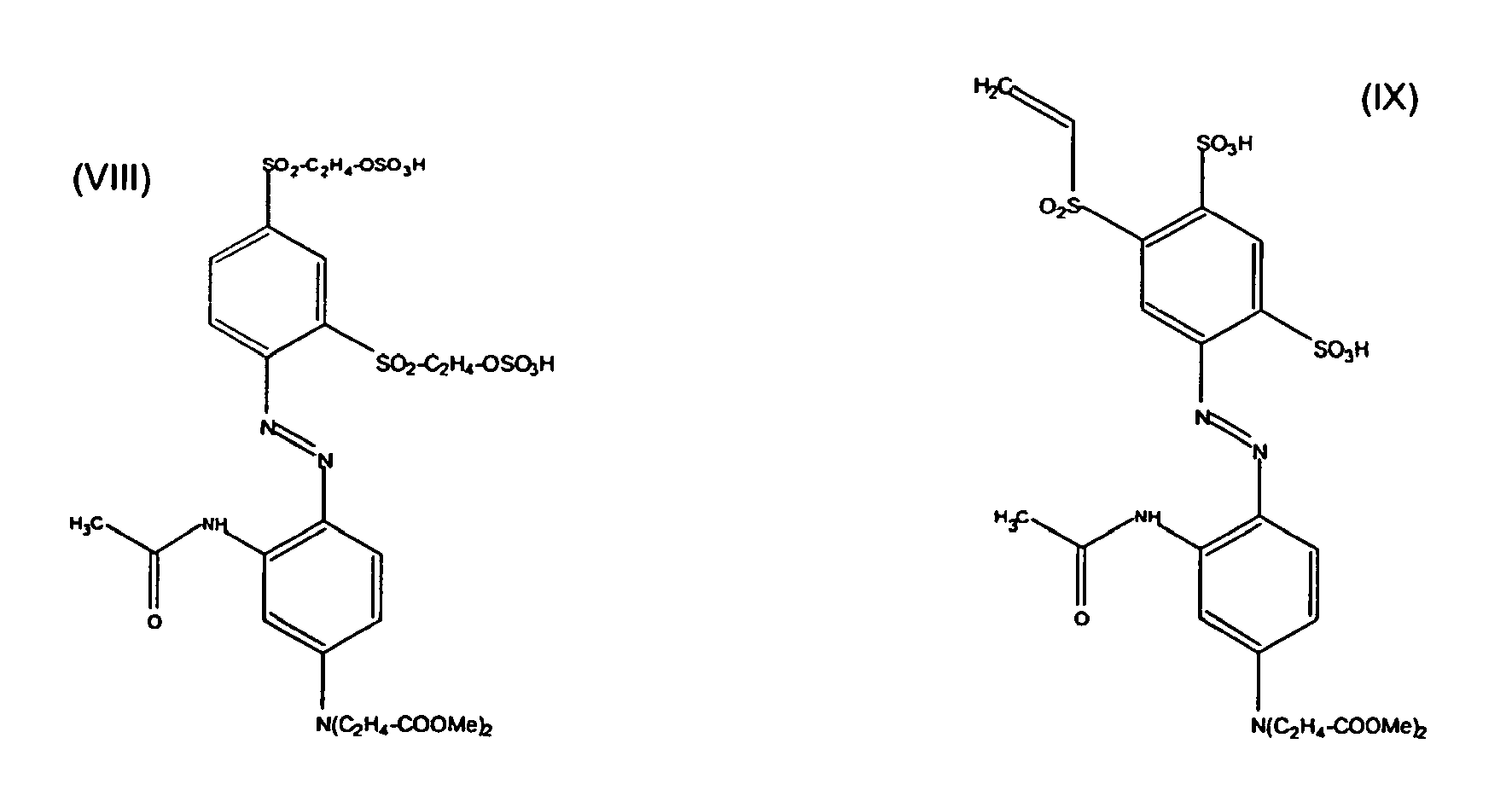
- the reactive dyes according to the invention correspond to the following formulas:
- the reactive dyes can be used in all media used for hair dyeing, in particular solutions, emulsions, gels or (foam) aerosols, the usual in such compositions substances such as surfactants, thickeners, fragrances, stabilizers, solubilizers, natural and / or synthetic polymers, complexing agents, etc. included;
- the composition of these support materials is basically known and described, for example, in the monograph by K. Schrader, Kunststoff und Japanese Patent Application, the composition of these support materials is between 2 and 5, preferably about 2.5 to 4, and is adjusted in a manner known per se.
- the concentration of the reactive dyes in the composition applied to the hair is dependent on the structure thereof and the desired color intensity; it is generally from about 0.01 to about 5, in particular from about 0.05 to 2.5, preferably from about 0.1 to about 1 wt .-%. Direct dyeing dyes can also be added for shading the dyeing.
- the exposure time of this acid reactive dye composition is preferably about 10 to 30 minutes; it can be reduced by heat.
- a further operation b) can be switched on, which includes an intermediate rinsing and optionally drying of the hair.
- the alkaline composition to be applied following process step b) and, if optionally carried out, c) has a pH of 7.5 to 12, preferably about 8 to 11, in particular about 8.5 to 10.
- alkalizing agents are ammonia, monoethanolamine and alkali carbonates and bicarbonates, such as sodium and potassium carbonate and bicarbonate. In principle, however, other alkalizing agents such as di- and triethanolamine and other hydroxyalkanolamines can be used.
- the exposure time of the alkaline composition to the hair is about 1 to 20, preferably about 5 to 15 minutes. Thereafter, the hair is washed or rinsed and dried.
- This alkaline composition can also be in the form of a solution, emulsion, dispersion, gel or (foam) aerosol and contain further constituents, for example nourishing or conditioning substances. These components are known per se to those skilled in the art and therefore require no further explanation.
- Acid Dye Solutions Carrier Solution: 25.0% by weight propylene carbonate 5.0 ethanol 3.0 PEG-40 hydrogenated castor oil 5.0 lactic acid 0.3 NaOH, 32% 0.1 reactive dye ad 100.0 water
- the alkaline treatment agent used was a solution of 2.70% by weight of ammonium chloride and 3.36% by weight of 25% strength ammonia in 94.14% by weight of water with a pH of 9.6; the exposure time was uniform for 10 minutes at room temperature.
- Reactive dye generally formula Extractable dye from the hair colour IX 18% red VIII 19% red
Landscapes
- Health & Medical Sciences (AREA)
- Life Sciences & Earth Sciences (AREA)
- Animal Behavior & Ethology (AREA)
- General Health & Medical Sciences (AREA)
- Public Health (AREA)
- Veterinary Medicine (AREA)
- Birds (AREA)
- Epidemiology (AREA)
- Cosmetics (AREA)
- Coloring (AREA)
Description
- Die Erfindung betrifft ein neuartiges Verfahren zum Färben von menschlichen Haaren, das langanhaltende Färbungen mit guten Farbeigenschaften wie Licht-, Wasch- und Umweltstabilität ergibt, wobei auch bei wiederholter Anwendung keine Haarschädigung auftritt.
- Einerseits die Färbung mit direktziehenden Farbstoffen, die zwar das Haar auch bei wiederholter Anwendung nicht schädigt, aber zu Färbungen führt, die nicht sehr langlebig sind und auch bei wiederholter Haarwäsche und durch Umwelteinflüsse verblassen, da die verwendeten direktziehenden Farbstoffe nur oberflächlich auf das Haar aufziehen.
- Alternativ dazu lassen sich durch die Anwendung von Oxidationsfarbstoffzubereitung, die Oxidationsfarbstoffvorprodukte und Oxidationsmittel enthalten, dauerhafte Haarfärbungen erzielen, da dabei eine Reaktion direkt mit den Haaren stattfindet. Bei kurzfristig wiederholter Anwendung können jedoch, insbesondere bei empfindlichen Haaren, Haarschädigungen auftreten.
- Die Erfindung geht von der Aufgabenstellung aus, die Nachteile beider Verfahren zu vermeiden, und eine dauerhafte Haarfärbung ohne jedwede Haarschädigung zu bewirken.
- Die Lösung dieser Aufgabe besteht in einem neuen Verfahren zum Färben von menschlichen Haaren, das durch die Kombination folgender Verfahrensschritte gekennzeichnet ist:
- a) Aufbringen einer Zusammensetzung mit einem pH-Wert von 2 bis 5, enthaltend mindestens einen Reaktivfarbstoff, auf menschliches Haar;
- b) Einwirkenlassen zwischen etwa 5 bis 45 Minuten;
- c) gegebenenfalls Spülen und Trocknen; Aufbringen einer alkalischen Zusammensetzung mit einem pH-Wert von 7,5 bis 12;
- d) Einwirkenlassen für 1 bis 20 Minuten; und
- e) Ausspülen bzw. Auswaschen und Trocknen des gefärbten Haares.
- Dadurch wird eine dauerhafte, gegenüber Umwelteinflüssen und Haarwäschen stabile Haarfärbung erzielt, die in ihrer Wirkung einer durch Oxidationsfarbstoffe erzielbaren Haarfärbung nahekommt, ohne deren Nachteile aufzuweisen.
- Reaktivfarbstoffe sind seit langem bekannt; sie weisen neben einer farbgebenden Komponente mindestens eine reaktive Gruppe im Molekül auf, die durch Reaktion mit funktionellen Gruppen des Substrats, im vorliegenden Fall das Haarkeratin, an dieses gebunden wird.
In der Regel enthalten diese Reaktivstoffe, die beispielsweise in Römpp Chemie Lexikon, 9. Aufl., S. 3805-3806, mit ausführlichen Literaturhinweisen definiert sind, auch noch hydrophile Gruppen.
Erfindungsgemäß werden bevorzugt Reaktivfarbstoffe eingesetzt, die entweder mindestens eine Vinylsulfongruppe aufweisen oder mindestens eine Sulfatoethylsulfongruppe enthalten, die Sulfat abspalten kann und in die Vinylsulfongruppe übergeht, die dann mit reaktiven Gruppen des Haarkeratins reagiert. - Die erfindungsgemäßen Reaktivfarbstoffe entsprechen den folgenden Formeln:
- Zur Applikation können die Reaktivfarbstoffe in allen zur Haarfärbung benutzten Medien angewandt werden, insbesondere Lösungen, Emulsionen, Gelen oder (Schaum-)Aerosolen, die die in solchen Zusammensetzungen üblichen Stoffe wie oberflächenaktive Mittel, Verdickungsmittel, Riechstoffe, Stabilisatoren, Lösungsvermittler, natürliche und/oder synthetische Polymere, Komplexbildner, etc. enthalten; die Zusammensetzung dieser Trägermaterialien ist grundsätzlich bekannt und beispielsweise in der Monographie von K. Schrader, Grundlagen und Rezepturen der Kosmetika, 2. Aufl. (1989), S. 796-798, beschrieben.
Der pH-Wert der Zusammensetzung liegt zwischen 2 und 5, vorzugsweise etwa 2,5 bis 4, und wird auf an sich bekannte Weise eingestellt. - Die Konzentration der Reaktivfarbstoffe in der auf das Haar applizierten Zusammensetzung ist abhängig von der Struktur derselben und der erwünschten Farbintensität; sie liegt im allgemeinen bei etwa 0,01 bis etwa 5, insbesondere etwa 0,05 bis 2,5, vorzugsweise etwa 0,1 bis etwa 1 Gew.-%.
Dabei können zur Nuancierung der Färbung auch direktziehende Farbstoffe zugesetzt werden.
Die Einwirkungszeit dieser sauren Reaktivfarbstoff-Zusammensetzung liegt vorzugsweise bei etwa 10 bis 30 Minuten; sie kann durch Wärmeeinwirkung vermindert werden.
Zwischen die Verfahrensschritte b) und d), d.h. Einwirkung der sauren Reaktivfarbstoff-Zusammensetzung und Aufbringung der alkalischen Zusammensetzung, kann ein weiterer Arbeitsgang b) eingeschaltet werden, der eine zwischenzeitliche Spülung und gegebenenfalls Trocknung des Haares beinhaltet.
Die im Anschluß an den Verfahrensschritt b) und, falls fakultativ durchgeführt, c) aufzubringende alkalische Zusammensetzung weist einen pH-Wert von 7,5 bis 12, vorzugsweise etwa 8 bis 11, insbesondere etwa 8,5 bis 10 auf. - Bevorzugte Alkalisierungsmittel sind Ammoniak, Monoethanolamin sowie Alkalicarbonate und -hydrogencarbonate wie Natrium- und Kaliumcarbonat und -hydrogencarbonat.
Grundsätzlich können jedoch auch andere Alkalisierungsmittel wie Di- und Triethanolamin sowie weitere Hydroxyalkanolamine eingesetzt werden.
Die Einwirkungszeit der alkalischen Zusammensetzung auf dem Haar beträgt etwa 1 bis 20, vorzugsweise etwa 5 bis 15 Minuten.
Danach wird das Haar gewaschen bzw. gespült und getrocknet.
Diese alkalische Zusammensetzung kann ebenfalls als Lösung, Emulsion, Dispersion, Gel oder (Schaum-)Aerosol vorliegen und weitere Bestandteile, z.B. pflegende oder konditionierende Substanzen, enthalten.
Diese Bestandteile sind dem Fachmann an sich bekannt und bedürfen daher keiner weiteren Erläuterungen. - Durch eine Peroxid-Behandlung kann eine weitere Aufhellung des Haares bewirkt werden.
- Die folgenden Beispiele beschreiben die Erfindung im Detail:
- Haarsträhnen aus unbehandeltem Menschenhaar wurden angefeuchtet; anschließend wurde jeweils eine 0,1%-ige wäßrige Lösung (pH3) der unter 3. definierten Reaktivfarbstoffe gleichmäßig aufgetragen.
- Nach der Einwirkung wurde mit Wasser gespült, getrocknet und anschließend eine alkalische Lösung der weiter unten definierten Zusammensetzungen aufgetragen. Nach erfolgter Einwirkung bei Raumtemperatur wurde wiederum gespült und getrocknet.
Es wurden sowohl die Farbintensität durch die bekannte Messung der ΔE-Werte als auch die Bindung des Farbstoffs an das Haar durch die Bestimmung der Stabilität der Farbstoffaufnahme mittels Extraktion durch ein Pyridin/Wasser-Gemisch im Vergleich zu nicht erfindungsgemäß behandelten Haarsträhnen, d.h. solchen, bei denen keine alkalische Nachbehandlung durchgeführt worden war, untersucht.
Die 72-stündige Extraktion durch eine 50%-ige wäßrige Pyridinlösung ist ein Maß für die Menge des Farbstoffs, der mit dem Haarkeratin reagiert hat, d.h., je mehr Farbstoff mittels Pyridin extrahiert wird, desto niedriger der Bindungsgrad und damit die Farbwirkung. -
Saure Farbstofflösungen Trägerlösung: 25,0 (Gew.-%) Propylencarbonat 5,0 Ethanol 3,0 PEG-40 Hydriertes Ricinusöl 5,0 Milchsäure 0,3 NaOH, 32%-ig 0,1 Reaktivfarbstoff ad 100,0 Wasser - Nach der in I. beschriebenen Methode wurden weitere Reaktivfarbstoffe in Kombination mit einer alkalischen Nachbehandlung zur Haarfärbung eingesetzt und dabei der Anteil des an das Haar gebundenen Farbstoffs durch Pyridin/Wasser-Extraktion über 72 Stunden bestimmt.
- Als alkalisches Behandlungsmittel wurde dabei eine Lösung aus 2,70 Gew.-% Ammoniumchlorid und 3,36 Gew.-% 25%-igem Ammoniak in 94,14 Gew.-% Wasser mit einem pH-Wert von 9,6 eingesetzt; die Einwirkungszeit betrug einheitlich 10 Minuten bei Raumtemperatur.
- Die erhaltenen Ergebnisse sind in der folgenden Tabelle dokumentiert:
Reaktivfarbstoff (Allgemeine Formel Extrahierbarer Farbstoff aus dem Haar Farbe IX 18% Rot VIII 19% Rot
Claims (6)
- Verfahren zum Färben von menschlichen Haaren, gekennzeichnet durch die Kombination folgender Verfahrensschritte:a) Aufbringen einer Zusammensetzung mit einem pH-Wert von 2 bis 5, enthaltend mindestens einen Reaktivfarbstoff ausgewählt aus
 b) Einwirkenlassen zwischen etwa 5 bis 45 Minuten;c) gegebenenfalls Spülen und Trocknen;d) Aufbringen einer alkalischen Zusammensetzung mit einem pH-Wert von 7,5 bis 12;e) Einwirkenlassen für 1 bis 20 Minuten; undf) Ausspülen bzw. Auswaschen und Trocknen des gefärbten Haares.
 - Verfahren nach Anspruch 1, dadurch gekennzeichnet, daß die in der Verfahrensstufe a) aufgebrachte Zusammensetzung mindestens einen Reaktivfarbstoff, der mindestens eine Vinylsulfongruppe aufweist, enthält.
- Verfahren nach Anspruch 1, dadurch gekennzeichnet, daß die in der Verfahrensstufe a) aufgebrachte Zusammensetzung mindestens einen Reaktivfarbstoff, der mindestens eine Sulfatoethylsulfongruppe aufweist, enthält.
- Verfahren nach einem oder mehreren der Ansprüche 1 bis 3, dadurch gekennzeichnet, daß die in der Verfahrensstufe d) aufgebrachte alkalische Zusammensetzung einen pH-Wert von 8 bis 11 aufweist.
- Verfahren nach einem oder mehreren der Ansprüche 1 bis 4, dadurch gekennzeichnet, daß die in der Verfahrensstufe d) aufgebrachte alkalische Zusammensetzung Ammoniak und/oder Mono-, Di- oder Triethanolamin enthält.
- Verfahren nach einem oder mehreren der Ansprüche 1 bis 4, dadurch gekennzeichnet, daß die in der Verfahrensstufe d) aufgebrachte alkalische Zusammensetzung mindestens ein Alkalicarbonat und/oder Alkalihydrogencarbonat enthält.
Priority Applications (2)
| Application Number | Priority Date | Filing Date | Title |
|---|---|---|---|
| DE50110729T DE50110729D1 (de) | 2001-11-12 | 2001-11-12 | Verfahren zum Färben von menschlichen Haaren |
| AT05012828T ATE335463T1 (de) | 2001-11-12 | 2001-11-12 | Verfahren zum färben von menschlichen haaren |
Applications Claiming Priority (1)
| Application Number | Priority Date | Filing Date | Title |
|---|---|---|---|
| EP01126489A EP1312340B1 (de) | 2001-11-12 | 2001-11-12 | Verfahren zum Färben von menschlichen Haaren |
Related Parent Applications (1)
| Application Number | Title | Priority Date | Filing Date |
|---|---|---|---|
| EP01126489A Division EP1312340B1 (de) | 2001-11-12 | 2001-11-12 | Verfahren zum Färben von menschlichen Haaren |
Publications (2)
| Publication Number | Publication Date |
|---|---|
| EP1574204A1 EP1574204A1 (de) | 2005-09-14 |
| EP1574204B1 true EP1574204B1 (de) | 2006-08-09 |
Family
ID=8179183
Family Applications (3)
| Application Number | Title | Priority Date | Filing Date |
|---|---|---|---|
| EP01126489A Expired - Lifetime EP1312340B1 (de) | 2001-11-12 | 2001-11-12 | Verfahren zum Färben von menschlichen Haaren |
| EP05012829A Expired - Lifetime EP1656928B1 (de) | 2001-11-12 | 2001-11-12 | Verfahren zum Färben von menschlichen Haaren |
| EP05012828A Expired - Lifetime EP1574204B1 (de) | 2001-11-12 | 2001-11-12 | Verfahren zum Färben von menschlichen Haaren |
Family Applications Before (2)
| Application Number | Title | Priority Date | Filing Date |
|---|---|---|---|
| EP01126489A Expired - Lifetime EP1312340B1 (de) | 2001-11-12 | 2001-11-12 | Verfahren zum Färben von menschlichen Haaren |
| EP05012829A Expired - Lifetime EP1656928B1 (de) | 2001-11-12 | 2001-11-12 | Verfahren zum Färben von menschlichen Haaren |
Country Status (3)
| Country | Link |
|---|---|
| EP (3) | EP1312340B1 (de) |
| AT (1) | ATE327728T1 (de) |
| DE (2) | DE50110729D1 (de) |
Family Cites Families (4)
| Publication number | Priority date | Publication date | Assignee | Title |
|---|---|---|---|---|
| US4102641A (en) * | 1972-09-29 | 1978-07-25 | Avon Products, Inc. | Method of dyeing human hair with reactive dyes |
| DE19731166A1 (de) * | 1997-07-21 | 1999-01-28 | Basf Ag | Verwendung von Reaktivfarbstoffen zum Färben von Haaren |
| US6086639A (en) * | 1999-03-09 | 2000-07-11 | Dystar Textilfarben Gmbh & Co. Deutschland Kg | Black dye mixtures of fiber-reactive azo dyes and use thereof for dyeing hydroxy- and/or carboxamido-containing fiber material |
| JP2003183140A (ja) * | 2001-12-25 | 2003-07-03 | Kao Corp | ヒト毛髪の染色方法 |
-
2001
- 2001-11-12 DE DE50110729T patent/DE50110729D1/de not_active Expired - Lifetime
- 2001-11-12 DE DE50109973T patent/DE50109973D1/de not_active Expired - Lifetime
- 2001-11-12 EP EP01126489A patent/EP1312340B1/de not_active Expired - Lifetime
- 2001-11-12 AT AT01126489T patent/ATE327728T1/de not_active IP Right Cessation
- 2001-11-12 EP EP05012829A patent/EP1656928B1/de not_active Expired - Lifetime
- 2001-11-12 EP EP05012828A patent/EP1574204B1/de not_active Expired - Lifetime
Also Published As
| Publication number | Publication date |
|---|---|
| EP1574204A1 (de) | 2005-09-14 |
| EP1312340B1 (de) | 2006-05-31 |
| EP1656928B1 (de) | 2008-01-02 |
| EP1312340A1 (de) | 2003-05-21 |
| DE50110729D1 (de) | 2006-09-21 |
| ATE327728T1 (de) | 2006-06-15 |
| EP1656928A1 (de) | 2006-05-17 |
| DE50109973D1 (de) | 2006-07-06 |
Similar Documents
| Publication | Publication Date | Title |
|---|---|---|
| EP0277996B1 (de) | Mittel zum oxidativen färben von haaren, verfahren zu seiner herstellung und verwendung des mittels | |
| DE3817687C3 (de) | Verfahren zum Färben keratinischer Fasern mit Oxidationsbasen in Kombination mit einem Jodid | |
| DE69821324T2 (de) | Zweistufiges Verfahren zum direkten Färben von Keratinfasern unter Verwendung von basischen Direktfarbstoffen | |
| WO1980000214A1 (fr) | Preparation permettant la coloration de cheveux | |
| DE1097086B (de) | Verfahren und Mittel zum Faerben des menschlichen Haares | |
| DE29624635U1 (de) | Aufhellende Zusammensetzung zum Färben von Keratinfasern, die einen speziellen Direktfarbstoff enthält | |
| EP1086685B1 (de) | Zwei-komponenten-kit eine lösung und eine Emulsion enthaltend und verfahren zum entfärben von gefärbten Haaren | |
| EP0727203B1 (de) | Oxidationshaarfärbemittel | |
| DE4227864A1 (de) | Alkylglycoside in Färbemitteln | |
| DE69818991T2 (de) | Haarfärben mit melanin-prekursoren in der anwesenheit von jodat und peroxid | |
| EP0852136A1 (de) | Verfahren zum Färben von keratinhaltigen Fasern | |
| EP0663204A1 (de) | Haarfärbemittel | |
| DE3131366A1 (de) | Haarfaerbemittel auf der basis von nitro-direktfarbstoffen und verfahren zur faerbung unter verwendung der genannten mittel | |
| DE2924230C2 (de) | ||
| DE1802395A1 (de) | Mittel zum Faerben von Keratinfasern | |
| EP1574204B1 (de) | Verfahren zum Färben von menschlichen Haaren | |
| EP1312339B1 (de) | Verfahren zum Färben von menschlichen Haaren | |
| DE10114546B4 (de) | Verfahren zum Färben von menschlichen Haaren | |
| DE1949749A1 (de) | Mittel zum Faerben menschlicher Haare | |
| DE3942315A1 (de) | Schaumfoermiges haartoenungsmittel | |
| EP0881894B1 (de) | Färbemittel zur färbung von keratinischen fasern | |
| EP0896519B1 (de) | Färbemittel zur färbung von keratinischen fasern | |
| DE60304451T2 (de) | Verwendung von ceramiden in haarbehandlungsmitteln | |
| EP1310231B1 (de) | Verfahren zum Färben von menschlichen Haaren | |
| DE102004045353A1 (de) | Mittel zur Entfernung von Oxidationshaarfarben |
Legal Events
| Date | Code | Title | Description |
|---|---|---|---|
| PUAI | Public reference made under article 153(3) epc to a published international application that has entered the european phase |
Free format text: ORIGINAL CODE: 0009012 |
|
| AC | Divisional application: reference to earlier application |
Ref document number: 1312340 Country of ref document: EP Kind code of ref document: P |
|
| AK | Designated contracting states |
Kind code of ref document: A1 Designated state(s): AT BE CH CY DE DK ES FI FR GB GR IE IT LI LU MC NL PT SE TR |
|
| RIN1 | Information on inventor provided before grant (corrected) |
Inventor name: PRATT, DOMINIC, DR. Inventor name: NOECKER, BERND, DR. Inventor name: MOEHRING, HARTMUT, DR. |
|
| RIC1 | Information provided on ipc code assigned before grant |
Ipc: A61Q 5/10 20060101ALI20060207BHEP Ipc: A61K 8/46 20060101AFI20060207BHEP |
|
| GRAP | Despatch of communication of intention to grant a patent |
Free format text: ORIGINAL CODE: EPIDOSNIGR1 |
|
| 17P | Request for examination filed |
Effective date: 20060301 |
|
| GRAS | Grant fee paid |
Free format text: ORIGINAL CODE: EPIDOSNIGR3 |
|
| AKX | Designation fees paid |
Designated state(s): AT BE CH CY DE DK ES FI FR GB GR IE IT LI LU MC NL PT SE TR |
|
| GRAA | (expected) grant |
Free format text: ORIGINAL CODE: 0009210 |
|
| AC | Divisional application: reference to earlier application |
Ref document number: 1312340 Country of ref document: EP Kind code of ref document: P |
|
| AK | Designated contracting states |
Kind code of ref document: B1 Designated state(s): AT BE CH CY DE DK ES FI FR GB GR IE IT LI LU MC NL PT SE TR |
|
| PG25 | Lapsed in a contracting state [announced via postgrant information from national office to epo] |
Ref country code: IT Free format text: LAPSE BECAUSE OF FAILURE TO SUBMIT A TRANSLATION OF THE DESCRIPTION OR TO PAY THE FEE WITHIN THE PRESCRIBED TIME-LIMIT;WARNING: LAPSES OF ITALIAN PATENTS WITH EFFECTIVE DATE BEFORE 2007 MAY HAVE OCCURRED AT ANY TIME BEFORE 2007. THE CORRECT EFFECTIVE DATE MAY BE DIFFERENT FROM THE ONE RECORDED. Effective date: 20060809 Ref country code: FI Free format text: LAPSE BECAUSE OF FAILURE TO SUBMIT A TRANSLATION OF THE DESCRIPTION OR TO PAY THE FEE WITHIN THE PRESCRIBED TIME-LIMIT Effective date: 20060809 Ref country code: IE Free format text: LAPSE BECAUSE OF FAILURE TO SUBMIT A TRANSLATION OF THE DESCRIPTION OR TO PAY THE FEE WITHIN THE PRESCRIBED TIME-LIMIT Effective date: 20060809 Ref country code: NL Free format text: LAPSE BECAUSE OF FAILURE TO SUBMIT A TRANSLATION OF THE DESCRIPTION OR TO PAY THE FEE WITHIN THE PRESCRIBED TIME-LIMIT Effective date: 20060809 |
|
| REG | Reference to a national code |
Ref country code: GB Ref legal event code: FG4D Free format text: NOT ENGLISH |
|
| REG | Reference to a national code |
Ref country code: CH Ref legal event code: EP |
|
| REG | Reference to a national code |
Ref country code: IE Ref legal event code: FG4D Free format text: LANGUAGE OF EP DOCUMENT: GERMAN |
|
| REF | Corresponds to: |
Ref document number: 50110729 Country of ref document: DE Date of ref document: 20060921 Kind code of ref document: P |
|
| PG25 | Lapsed in a contracting state [announced via postgrant information from national office to epo] |
Ref country code: DK Free format text: LAPSE BECAUSE OF FAILURE TO SUBMIT A TRANSLATION OF THE DESCRIPTION OR TO PAY THE FEE WITHIN THE PRESCRIBED TIME-LIMIT Effective date: 20061109 Ref country code: SE Free format text: LAPSE BECAUSE OF FAILURE TO SUBMIT A TRANSLATION OF THE DESCRIPTION OR TO PAY THE FEE WITHIN THE PRESCRIBED TIME-LIMIT Effective date: 20061109 |
|
| PG25 | Lapsed in a contracting state [announced via postgrant information from national office to epo] |
Ref country code: ES Free format text: LAPSE BECAUSE OF FAILURE TO SUBMIT A TRANSLATION OF THE DESCRIPTION OR TO PAY THE FEE WITHIN THE PRESCRIBED TIME-LIMIT Effective date: 20061120 |
|
| PG25 | Lapsed in a contracting state [announced via postgrant information from national office to epo] |
Ref country code: CH Free format text: LAPSE BECAUSE OF NON-PAYMENT OF DUE FEES Effective date: 20061130 Ref country code: BE Free format text: LAPSE BECAUSE OF NON-PAYMENT OF DUE FEES Effective date: 20061130 Ref country code: MC Free format text: LAPSE BECAUSE OF NON-PAYMENT OF DUE FEES Effective date: 20061130 Ref country code: LI Free format text: LAPSE BECAUSE OF NON-PAYMENT OF DUE FEES Effective date: 20061130 |
|
| GBT | Gb: translation of ep patent filed (gb section 77(6)(a)/1977) |
Effective date: 20061115 |
|
| PG25 | Lapsed in a contracting state [announced via postgrant information from national office to epo] |
Ref country code: PT Free format text: LAPSE BECAUSE OF FAILURE TO SUBMIT A TRANSLATION OF THE DESCRIPTION OR TO PAY THE FEE WITHIN THE PRESCRIBED TIME-LIMIT Effective date: 20070109 |
|
| ET | Fr: translation filed | ||
| NLV1 | Nl: lapsed or annulled due to failure to fulfill the requirements of art. 29p and 29m of the patents act | ||
| REG | Reference to a national code |
Ref country code: IE Ref legal event code: FD4D |
|
| PLBE | No opposition filed within time limit |
Free format text: ORIGINAL CODE: 0009261 |
|
| STAA | Information on the status of an ep patent application or granted ep patent |
Free format text: STATUS: NO OPPOSITION FILED WITHIN TIME LIMIT |
|
| REG | Reference to a national code |
Ref country code: CH Ref legal event code: PL |
|
| 26N | No opposition filed |
Effective date: 20070510 |
|
| BERE | Be: lapsed |
Owner name: KPSS-KAO PROFESSIONAL SALON SERVICES G.M.B.H. Effective date: 20061130 |
|
| PG25 | Lapsed in a contracting state [announced via postgrant information from national office to epo] |
Ref country code: AT Free format text: LAPSE BECAUSE OF NON-PAYMENT OF DUE FEES Effective date: 20061112 |
|
| PG25 | Lapsed in a contracting state [announced via postgrant information from national office to epo] |
Ref country code: GR Free format text: LAPSE BECAUSE OF FAILURE TO SUBMIT A TRANSLATION OF THE DESCRIPTION OR TO PAY THE FEE WITHIN THE PRESCRIBED TIME-LIMIT Effective date: 20061110 |
|
| PG25 | Lapsed in a contracting state [announced via postgrant information from national office to epo] |
Ref country code: TR Free format text: LAPSE BECAUSE OF FAILURE TO SUBMIT A TRANSLATION OF THE DESCRIPTION OR TO PAY THE FEE WITHIN THE PRESCRIBED TIME-LIMIT Effective date: 20060809 Ref country code: LU Free format text: LAPSE BECAUSE OF NON-PAYMENT OF DUE FEES Effective date: 20061112 |
|
| PG25 | Lapsed in a contracting state [announced via postgrant information from national office to epo] |
Ref country code: CY Free format text: LAPSE BECAUSE OF FAILURE TO SUBMIT A TRANSLATION OF THE DESCRIPTION OR TO PAY THE FEE WITHIN THE PRESCRIBED TIME-LIMIT Effective date: 20060809 |
|
| REG | Reference to a national code |
Ref country code: FR Ref legal event code: CD Owner name: KAO GERMANY GMBH, DE Effective date: 20120411 |
|
| PGFP | Annual fee paid to national office [announced via postgrant information from national office to epo] |
Ref country code: GB Payment date: 20121130 Year of fee payment: 12 |
|
| PGFP | Annual fee paid to national office [announced via postgrant information from national office to epo] |
Ref country code: FR Payment date: 20121219 Year of fee payment: 12 |
|
| PGFP | Annual fee paid to national office [announced via postgrant information from national office to epo] |
Ref country code: DE Payment date: 20130131 Year of fee payment: 12 |
|
| GBPC | Gb: european patent ceased through non-payment of renewal fee |
Effective date: 20131112 |
|
| REG | Reference to a national code |
Ref country code: FR Ref legal event code: ST Effective date: 20140731 |
|
| REG | Reference to a national code |
Ref country code: DE Ref legal event code: R119 Ref document number: 50110729 Country of ref document: DE Effective date: 20140603 |
|
| PG25 | Lapsed in a contracting state [announced via postgrant information from national office to epo] |
Ref country code: DE Free format text: LAPSE BECAUSE OF NON-PAYMENT OF DUE FEES Effective date: 20140603 |
|
| PG25 | Lapsed in a contracting state [announced via postgrant information from national office to epo] |
Ref country code: GB Free format text: LAPSE BECAUSE OF NON-PAYMENT OF DUE FEES Effective date: 20131112 Ref country code: FR Free format text: LAPSE BECAUSE OF NON-PAYMENT OF DUE FEES Effective date: 20131202 |