EP1568853A2 - Dispositif et méthode de contrôle de distribution variable pour moteur à combustion - Google Patents
Dispositif et méthode de contrôle de distribution variable pour moteur à combustion Download PDFInfo
- Publication number
- EP1568853A2 EP1568853A2 EP05004038A EP05004038A EP1568853A2 EP 1568853 A2 EP1568853 A2 EP 1568853A2 EP 05004038 A EP05004038 A EP 05004038A EP 05004038 A EP05004038 A EP 05004038A EP 1568853 A2 EP1568853 A2 EP 1568853A2
- Authority
- EP
- European Patent Office
- Prior art keywords
- variable valve
- angle
- basis
- internal combustion
- combustion engine
- Prior art date
- Legal status (The legal status is an assumption and is not a legal conclusion. Google has not performed a legal analysis and makes no representation as to the accuracy of the status listed.)
- Withdrawn
Links
- 238000002485 combustion reaction Methods 0.000 title claims description 30
- 238000000034 method Methods 0.000 title claims description 10
- 230000007246 mechanism Effects 0.000 claims abstract description 80
- 238000001514 detection method Methods 0.000 claims description 34
- 230000002093 peripheral effect Effects 0.000 claims description 22
- 230000004907 flux Effects 0.000 claims description 8
- 238000010586 diagram Methods 0.000 description 12
- 238000006073 displacement reaction Methods 0.000 description 12
- 230000001276 controlling effect Effects 0.000 description 8
- 238000002347 injection Methods 0.000 description 5
- 239000007924 injection Substances 0.000 description 5
- 230000001681 protective effect Effects 0.000 description 4
- PKOMXLRKGNITKG-UHFFFAOYSA-L calcium;hydroxy(methyl)arsinate Chemical compound [Ca+2].C[As](O)([O-])=O.C[As](O)([O-])=O PKOMXLRKGNITKG-UHFFFAOYSA-L 0.000 description 3
- 230000000694 effects Effects 0.000 description 3
- 239000000446 fuel Substances 0.000 description 3
- WABPQHHGFIMREM-UHFFFAOYSA-N lead(0) Chemical compound [Pb] WABPQHHGFIMREM-UHFFFAOYSA-N 0.000 description 3
- 241001247986 Calotropis procera Species 0.000 description 2
- 230000003197 catalytic effect Effects 0.000 description 2
- 239000000463 material Substances 0.000 description 2
- 102220491290 Annexin A1_S34A_mutation Human genes 0.000 description 1
- 230000005540 biological transmission Effects 0.000 description 1
- 239000000498 cooling water Substances 0.000 description 1
- 230000003111 delayed effect Effects 0.000 description 1
- 238000005553 drilling Methods 0.000 description 1
- 230000005284 excitation Effects 0.000 description 1
- 230000001939 inductive effect Effects 0.000 description 1
- 239000000696 magnetic material Substances 0.000 description 1
- 230000005389 magnetism Effects 0.000 description 1
- 230000004048 modification Effects 0.000 description 1
- 238000012986 modification Methods 0.000 description 1
- 230000001105 regulatory effect Effects 0.000 description 1
- 230000004043 responsiveness Effects 0.000 description 1
- 229920003002 synthetic resin Polymers 0.000 description 1
- 239000000057 synthetic resin Substances 0.000 description 1
- 238000011144 upstream manufacturing Methods 0.000 description 1
- XLYOFNOQVPJJNP-UHFFFAOYSA-N water Substances O XLYOFNOQVPJJNP-UHFFFAOYSA-N 0.000 description 1
Images











Classifications
-
- F—MECHANICAL ENGINEERING; LIGHTING; HEATING; WEAPONS; BLASTING
- F01—MACHINES OR ENGINES IN GENERAL; ENGINE PLANTS IN GENERAL; STEAM ENGINES
- F01L—CYCLICALLY OPERATING VALVES FOR MACHINES OR ENGINES
- F01L1/00—Valve-gear or valve arrangements, e.g. lift-valve gear
- F01L1/20—Adjusting or compensating clearance
- F01L1/22—Adjusting or compensating clearance automatically, e.g. mechanically
- F01L1/24—Adjusting or compensating clearance automatically, e.g. mechanically by fluid means, e.g. hydraulically
- F01L1/2405—Adjusting or compensating clearance automatically, e.g. mechanically by fluid means, e.g. hydraulically by means of a hydraulic adjusting device located between the cylinder head and rocker arm
-
- F—MECHANICAL ENGINEERING; LIGHTING; HEATING; WEAPONS; BLASTING
- F01—MACHINES OR ENGINES IN GENERAL; ENGINE PLANTS IN GENERAL; STEAM ENGINES
- F01L—CYCLICALLY OPERATING VALVES FOR MACHINES OR ENGINES
- F01L1/00—Valve-gear or valve arrangements, e.g. lift-valve gear
- F01L1/34—Valve-gear or valve arrangements, e.g. lift-valve gear characterised by the provision of means for changing the timing of the valves without changing the duration of opening and without affecting the magnitude of the valve lift
-
- F—MECHANICAL ENGINEERING; LIGHTING; HEATING; WEAPONS; BLASTING
- F01—MACHINES OR ENGINES IN GENERAL; ENGINE PLANTS IN GENERAL; STEAM ENGINES
- F01L—CYCLICALLY OPERATING VALVES FOR MACHINES OR ENGINES
- F01L1/00—Valve-gear or valve arrangements, e.g. lift-valve gear
- F01L1/34—Valve-gear or valve arrangements, e.g. lift-valve gear characterised by the provision of means for changing the timing of the valves without changing the duration of opening and without affecting the magnitude of the valve lift
- F01L1/344—Valve-gear or valve arrangements, e.g. lift-valve gear characterised by the provision of means for changing the timing of the valves without changing the duration of opening and without affecting the magnitude of the valve lift changing the angular relationship between crankshaft and camshaft, e.g. using helicoidal gear
-
- F—MECHANICAL ENGINEERING; LIGHTING; HEATING; WEAPONS; BLASTING
- F01—MACHINES OR ENGINES IN GENERAL; ENGINE PLANTS IN GENERAL; STEAM ENGINES
- F01L—CYCLICALLY OPERATING VALVES FOR MACHINES OR ENGINES
- F01L1/00—Valve-gear or valve arrangements, e.g. lift-valve gear
- F01L1/34—Valve-gear or valve arrangements, e.g. lift-valve gear characterised by the provision of means for changing the timing of the valves without changing the duration of opening and without affecting the magnitude of the valve lift
- F01L1/344—Valve-gear or valve arrangements, e.g. lift-valve gear characterised by the provision of means for changing the timing of the valves without changing the duration of opening and without affecting the magnitude of the valve lift changing the angular relationship between crankshaft and camshaft, e.g. using helicoidal gear
- F01L1/356—Valve-gear or valve arrangements, e.g. lift-valve gear characterised by the provision of means for changing the timing of the valves without changing the duration of opening and without affecting the magnitude of the valve lift changing the angular relationship between crankshaft and camshaft, e.g. using helicoidal gear making the angular relationship oscillate, e.g. non-homokinetic drive
-
- F—MECHANICAL ENGINEERING; LIGHTING; HEATING; WEAPONS; BLASTING
- F01—MACHINES OR ENGINES IN GENERAL; ENGINE PLANTS IN GENERAL; STEAM ENGINES
- F01L—CYCLICALLY OPERATING VALVES FOR MACHINES OR ENGINES
- F01L13/00—Modifications of valve-gear to facilitate reversing, braking, starting, changing compression ratio, or other specific operations
- F01L13/0015—Modifications of valve-gear to facilitate reversing, braking, starting, changing compression ratio, or other specific operations for optimising engine performances by modifying valve lift according to various working parameters, e.g. rotational speed, load, torque
- F01L13/0021—Modifications of valve-gear to facilitate reversing, braking, starting, changing compression ratio, or other specific operations for optimising engine performances by modifying valve lift according to various working parameters, e.g. rotational speed, load, torque by modification of rocker arm ratio
-
- F—MECHANICAL ENGINEERING; LIGHTING; HEATING; WEAPONS; BLASTING
- F01—MACHINES OR ENGINES IN GENERAL; ENGINE PLANTS IN GENERAL; STEAM ENGINES
- F01L—CYCLICALLY OPERATING VALVES FOR MACHINES OR ENGINES
- F01L13/00—Modifications of valve-gear to facilitate reversing, braking, starting, changing compression ratio, or other specific operations
- F01L13/0015—Modifications of valve-gear to facilitate reversing, braking, starting, changing compression ratio, or other specific operations for optimising engine performances by modifying valve lift according to various working parameters, e.g. rotational speed, load, torque
- F01L13/0021—Modifications of valve-gear to facilitate reversing, braking, starting, changing compression ratio, or other specific operations for optimising engine performances by modifying valve lift according to various working parameters, e.g. rotational speed, load, torque by modification of rocker arm ratio
- F01L13/0026—Modifications of valve-gear to facilitate reversing, braking, starting, changing compression ratio, or other specific operations for optimising engine performances by modifying valve lift according to various working parameters, e.g. rotational speed, load, torque by modification of rocker arm ratio by means of an eccentric
-
- F—MECHANICAL ENGINEERING; LIGHTING; HEATING; WEAPONS; BLASTING
- F02—COMBUSTION ENGINES; HOT-GAS OR COMBUSTION-PRODUCT ENGINE PLANTS
- F02D—CONTROLLING COMBUSTION ENGINES
- F02D13/00—Controlling the engine output power by varying inlet or exhaust valve operating characteristics, e.g. timing
-
- F—MECHANICAL ENGINEERING; LIGHTING; HEATING; WEAPONS; BLASTING
- F02—COMBUSTION ENGINES; HOT-GAS OR COMBUSTION-PRODUCT ENGINE PLANTS
- F02D—CONTROLLING COMBUSTION ENGINES
- F02D45/00—Electrical control not provided for in groups F02D41/00 - F02D43/00
-
- F—MECHANICAL ENGINEERING; LIGHTING; HEATING; WEAPONS; BLASTING
- F01—MACHINES OR ENGINES IN GENERAL; ENGINE PLANTS IN GENERAL; STEAM ENGINES
- F01L—CYCLICALLY OPERATING VALVES FOR MACHINES OR ENGINES
- F01L13/00—Modifications of valve-gear to facilitate reversing, braking, starting, changing compression ratio, or other specific operations
- F01L13/0015—Modifications of valve-gear to facilitate reversing, braking, starting, changing compression ratio, or other specific operations for optimising engine performances by modifying valve lift according to various working parameters, e.g. rotational speed, load, torque
- F01L13/0063—Modifications of valve-gear to facilitate reversing, braking, starting, changing compression ratio, or other specific operations for optimising engine performances by modifying valve lift according to various working parameters, e.g. rotational speed, load, torque by modification of cam contact point by displacing an intermediate lever or wedge-shaped intermediate element, e.g. Tourtelot
- F01L2013/0073—Modifications of valve-gear to facilitate reversing, braking, starting, changing compression ratio, or other specific operations for optimising engine performances by modifying valve lift according to various working parameters, e.g. rotational speed, load, torque by modification of cam contact point by displacing an intermediate lever or wedge-shaped intermediate element, e.g. Tourtelot with an oscillating cam acting on the valve of the "Delphi" type
Definitions
- the present invention relates to a variable valve operating control apparatus for an internal combustion engine having a variable valve timing mechanism and a control method thereof.
- variable valve timing mechanism which varies a timing of opening and closing an engine valve due to a rotational phase of a camshaft with respect to a crankshaft of an internal combustion engine being varied.
- a rotational phase is detected on the basis of a interval between a detection signal at a reference rotational position of a crankshaft and a detection signal at a reference rotational position of a camshaft, and the variable valve timing mechanism is feedback-controlled on the basis of the detected result.
- an object of the present invention is to avoid bringing about an overshoot due to a delay in updating a rotational phase detected on the basis of reference rotational positions.
- a centric phase of an operating angle of an engine valve is detected each predetermined crank angle, and further, a centric phase of an operating angle of the engine valve is detected each predetermined time, and in a timing of updating each predetermined crank angle, a Variable valve Timing Control mechanism is feedback-controlled on the basis of the centric phase detected each predetermined crank angle, and during the interval of updating at each predetermined crank angle, the Variable valve Timing Control mechanism is feedback-controlled on the basis of the centric phase detected each predetermined time.
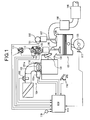
- FIG. 1 is a system block diagram of an engine on vehicle in an embodiment of the present invention.
- An electronic control throttle 104 is set at an intake pipe 102 of an internal combustion engine 101 in FIG. 1.
- Electronic control throttle 104 is a device controlling to open and close a throttle valve 103b by a throttle motor 103a.
- Exhaust gas of engine 101 is exhausted from combustion chamber 106 via an exhaust valve 107, and thereafter, the exhaust gas is purged through a front catalytic converter 108 and a rear catalytic converter 109, and is discharged in the atmosphere.
- Exhaust valve 107 is controlled to open and close so as to maintain given lift, operating angle, and valve timing by a cam 111 supported pivotally by an exhaust side camshaft 110.
- a Variable valve Event and Lift (VEL) mechanism 112 which sequentially varies a lift of intake valve 105 along with an operating angle is provided at intake valve 105 side.
- VTC Variable valve Timing Control
- An engine control unit (ECU) 114 in which a microcomputer is built-in controls VEL mechanism 112 and VTC mechanism 113 so as to obtain a required intake air quantity, a required cylinder residual gas ratio, and the like which correspond to a required torque, and on the other hand, controls electronic control throttle 104 so as to obtain a required suction pressure.
- ECU engine control unit
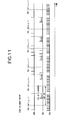
- crank angle sensor 117 detects a portion to be detected which is provided each crank angle of 10° with respect to a rotator rotating so as to be integrated with crankshaft 120, and in accordance therewith, as shown in FIG 11, crank angle sensor 117 outputs a unit angle signal POS each crank angle of 10°.
- crank angle sensor 117 is structured that, because two points of the portions to be detected are sequentially omitted at two points with an interval at a crank angle of 180°, the unit angle signals POS is not outputted sequentially twice.
- crank angle of 180° corresponds to a phase difference of the strokes between the cylinders in a four-cylinder engine in the present embodiment.
- the portion at which the unit angle signal POS is interrupted for a short time is detected on the basis of an output period and the like of the unit angle signal POS, and for example, a reference rotational position of crankshaft 120 is detected on the basis of a unit angle signal POS which is outputted for the first time after the unit angle signal POS is interrupted.
- ECU 114 calculates an engine rotational speed by counting a period between detecting the reference rotational positions or the number of generations of the unit angle signals POS per a predetermined time.
- crank angle sensor 117 separately outputs a reference angle signal REF at every reference rotational position (each angle of 180°) of crankshaft 120 and a unit angle signal POS without any omission.
- cam sensor 132 outputs a cam signal CAM denoting a cylinder number (the first cylinder through the fourth cylinder) by a pulse number each cam angle of 90° corresponding to a crank angle of 180° as shown in FIG 11, by detecting a portion to be detected which is provided at the rotator rotating so as to be integrated with the camshaft.
- An electromagnetic fuel injection valve 131 is provided at an intake port 130 at an upstream side of intake valve 105 in each cylinder.
- Fuel injection valve 131 is controlled to open the valve by an injection pulse signal from ECU 114, and injects out fuel of a quantity which is in proportion to an injection pulse width of the injection pulse signal.
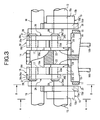
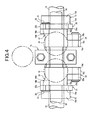
- FIG. 2 to FIG 4 show the structure of VEL mechanism 112 in detail.
- VEL mechanism 112 shown in FIG. 2 to FIG. 4 has a pair of intake valves 105 and 105, a hollow shaped camshaft 13 (driving shaft) supported to be freely pivotable by a cam bearing 14 of a cylinder head 11, two eccentric cams 15 and 15 (driving cams) which are the rotating cams supported pivotally by camshaft 13, a control shaft 16 supported to be freely pivotable by same cam bearing 14 at a position above camshaft 13, a pair of rocker arms 18 and 18 supported to be freely rockable via a control cam 17 by control shaft 16, and a pair of respectively separated rocker cams 20 and 20 which are disposed via valve lifters 19 and 19 at the top end portions of respective intake valves 105 and 105.
- Eccentric cams 15 and 15, and rocker arms 18 and 18 are linked with one another by link arms 25 and 25, and rocker arms 18 and 18, and rocker cams 20 and 20 are linked with one another by link members 26 and 26.
- rocker arms 18 and 18, link arms 25 and 25, and link members 26 and 26 structure a transmission mechanism.
- eccentric cam 15 is formed in a substantially ring shape, and is formed from a small-diameter cam main body 15a and a flange portion 15b provided so as to be integrated with the outer end surface of cam main body 15a, and a camshaft through hole 15c is formed so as to pass through in the inner axis direction, and the axis X of cam main body 15a is eccentric by a predetermined amount from the axis Y of camshaft 13.
- eccentric cams 15 are fixed to be press-fitted at the both outer sides which do not interfere with valve lifters 19 with respect to camshaft 13 via camshaft through hole 15c.
- Rocker arm 18 is, as shown in FIG. 4, formed to be wound in a substantially crank shape, and a base portion 18a at the center thereof is supported to be freely pivotable by control cam 17.
- a pin hole 18d into which a pin 21 connected to a top end portion of link arm 25 is press-fitted is formed so as to pass through one end portion 18b provided so as to protrude at the outer end portion of base portion 18a, and on the other hand, a pin hole 18e into which a pin 28 linking together with one end portion 26a, which will be described later, of each link member 26 is press-fitted is formed at an other end portion 18c provided so as to protrude at the inner end portion of base portion 18a.
- Control cam 17 is formed in a cylinder shape, and is fixed to the outer periphery of control shaft 16, and as shown in FIG 2, the position of an axis position P1 is eccentric by ⁇ from an axis P2 of control shaft 16.
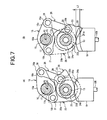
- Rocker cam 20 is, as shown in FIG. 2, FIG. 6, and FIG. 7, substantially a horizontal U-shape, and a bearing hole 22a into which camshaft 13 is supported to be freely pivotable by being fitted is formed so as to pass through a substantially ring shaped base end portion 22, and a pin hole 23a is formed so as to pass through an end portion 23 positioned at other end portion 18c of rocker arm 18.
- a basic circular surface 24a at base end portion 22 side and a cam surface 24b extending so as to be a circular arc shape from basic circular surface 24a to an end portion 23 edge side are formed at the bottom surface of rocker cam 20, and basic circular surface 24a and cam surface 24b are structured so as to touch a predetermined position on the top surface of each valve lifter 19 in accordance with a rocked position of rocker cam 20.
- a predetermined angle range ⁇ 1 on basic circular surface 24a is set so as to be a base circle zone as shown in FIG. 2, and a zone from base circle zone ⁇ 1 to a predetermined angle range ⁇ 2 on cam surface 24b is set so as to be a so-called ramp zone, and moreover, a zone from ramp zone ⁇ 2 to a predetermined angle range ⁇ 3 on cam surface 24b is set so as to be a lift zone.
- link arm 25 has a ring shaped base portion 25a and a protruded end 25b provided so as to protrude at a predetermined position on the outer peripheral surface of base portion 25a, and an fitting-into hole 25c which is fitted into the outer peripheral surface of cam main body 15a of eccentric cam 15 to be freely pivotable is formed at the central position of base portion 25a, and on the other hand, a pin hole 25d into which pin 21 is inserted to be freely pivotable is formed so as to pass through protruded end 25b.
- link member 26 is formed in a straight shape with a predetermined length, and pin through holes 26c and 26d into which the end portions of respective pins 28 and 29 which have been press-fitted into respective pin holes 18d and 23a of other end portion 18c of rocker arm 18 and the end portion of rocker cam 20 are inserted to be freely rotatable are formed so as to pass through circular both end portions 26a and 26b.
- snap rings 30, 31, and 32 regulating the movements in the axis direction of link arm 25 and link member 26 are provided to one end portions of respective pins 21, 28, and 29.
- the lift is varied in accordance with a positional relationship between the axis P2 of control shaft 16 and the axis P1 of control cam 17, and the position of the axis P2 of control shaft 16 with respect to the axis P1 of control cam 17 is varied by controlling control shaft 16 to rotate.
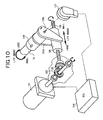
- Control shaft 16 is, in accordance with a structure as shown in FIG. 10, controlled to rotate by a DC servo motor (actuator) 121 within a predetermined rotational angle range limited by a stopper, and due to the angle of control shaft 16 being varied by actuator 121, the lift and the operating angle of intake valve 105 are sequentially varied within a variable range, which is limited by the stopper, between the maximum lift and the minimum lift (refer to FIG. 9).
- DC servo motor 121 is disposed such that the rotating shaft thereof is made to be parallel with control shaft 16, and a bevel gear 122 is supported pivotally at the top end of the rotating shaft.
- a pair of stays 123a and 123b are fixed to the top end of control shaft 16, and a nut 124 is supported so as to be rockable at the periphery of the shaft which is parallel with control shaft 16 to which the top end portions of pair of stays 123a and 123b are connected.
- a bevel gear 126 engaged into above-described bevel gear 122 is supported pivotally at the top end of a threaded bar 125 made to engage with above-described nut 124, and threaded bar 125 is made to rotate by a rotation of DC servo motor 121, and a position of nut 124 engaging with threaded bar 125 is displaced in the axis direction of threaded bar 125, and therefore, control shaft 16 is made to rotate.
- the direction in which the position of nut 124 is made to approach to bevel gear 126 is a direction in which a valve lift is made small, and in contrast thereto, the direction in which the position of nut 124 is made be away from bevel gear 126 is a direction in which a valve lift is made large.
- a potentiometer system angle sensor 127 detecting an angle of control shaft 16 is provided at the top end of control shaft 16, and ECU 114 feedback-controls DC servo motor 121 such that an actual angle detected by angle sensor 127 is made to agree with a target angle (a value corresponding to a target lift).
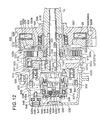
- VTC mechanism 113 Next, the structure of VTC mechanism 113 will be described with reference to FIG 12 to FIG 22.
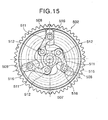
- VTC mechanism 113 has a timing sprocket 502 which is assembled into the front end portion of camshaft 13 so as to be relatively rotatable, and which is made to link with crankshaft 120 via a timing chain (not illustrated), assembling angle changing means 504 which is fixed to the inner periphery of timing sprocket 502, and which changes an assembling angle between timing sprocket 502 and camshaft 13, operating force providing means 505 driving assembling angle changing means 504, relative displacement detecting means 506 detecting an angle of relative rotational displacement of camshaft 13 with respect to timing sprocket 502, and a VTC cover 532 which is fixed to a head cover of the cylinder cover, and which covers the front surfaces of the assembling angle changing means 504 and relative displacement detecting means 506.
- a driven shaft member 507 is fixed to the end portion of camshaft 13 by a cam bolt 510.
- a flange 507a is provided so as to be integrated with driven shaft member 507.
- Timing sprocket 502 is formed from a large-diameter cylinder portion 502a at which a gear portion 503 with which the timing chain is engaged is formed, a small-diameter cylinder portion 502b, and a disk portion 502c connecting between cylinder portion 502a and cylinder portion 502b.
- Cylinder portion 502b is assembled so as to be rotatable by a ball bearing 530 with respect to flange 507a of driven shaft member 507.
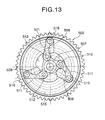
- three grooves 508 are formed in a radial pattern along radial directions of timing sprocket 502 at the surface at cylinder portion 502b side of disk portion 502c.
- protruding portions 509 protruding in a radial pattern in radial directions are formed so as to be integrated with camshaft 13 side end surface of flange portion 507a of driven shaft member 507.
- the base ends of three links 511 are respectively connected to respective protruding portions 509 so as to be rotatable by pins 512.
- Cylindrical lobes 513 engaging with respective grooves 508 so as to be freely rockable are formed so as to be integrated with the top ends of respective links 511.
- respective links 511 are connected to driven shaft member 507 via pins 512 in a state in which respective lobes 513 engage with corresponding grooves 508, when the top end sides of links 511 are displaced along grooves 508 by receiving external force, timing sprocket 502 and driven shaft member 507 are relatively rotated by the effects of respective links 511.
- accommodating holes 514 opening toward camshaft 13 side are formed at lobes 513 of respective links 511.
- a disk type intermediate rotator 518 is supported to be freely pivotable via a bearing 529 at driven shaft member 507 which is further at camshaft 13 side than protruding portion 509.
- Spiral slot 515 is formed at the end surface at protruding portion 509 side of intermediate rotator 518, and engagement pins 516 at the top ends of respective links 511 are engaged with spiral slot 515.
- Spiral slot 515 is formed so as to gradually reduce the diameter along the rotational direction of timing sprocket 502.
- Assembling angle changing means 504 is structured from grooves 508, links 511, lobes 513, engagement pins 516, intermediate rotator 518, spiral slot 515, and the like of timing sprocket 502.
- Operating force providing means 505 has a spiral spring 519 urging intermediate rotator 518 in the rotational direction of timing sprocket 502, and a hysteresis brake 520 generating braking force which rotates intermediate rotator 518 in a direction opposite to the rotational direction of timing sprocket 502.
- ECU 114 controls the braking force of hysteresis brake 520 in accordance with a operating state of internal combustion engine 101, and in accordance therewith, intermediate rotator 518 can be relatively rotated with respect to timing sprocket 502 up to a position where the urging force of spiral spring 519 and the braking force of hysteresis brake 520 are made to be in balance.
- spiral spring 519 is disposed in cylinder portion 502a of timing sprocket 502, and an outer peripheral end portion 519a is engaged with the inner periphery of cylinder portion 502a, and an inner peripheral end portion 519b is engaged with an engagement slot 518b of a base portion 518a of intermediate rotator 518.
- Hysteresis brake 520 has a hysteresis ring 523, an electromagnetic coil 524 serving as magnetic field control means, and a coil yoke 525 inducing magnetism of electromagnetic coil 524.
- Hysteresis ring 523 is attached to the rear end portion of intermediate rotator 518 via a retainer plate 522 and a protrusion 522a provided so as to be integrated with the rear end surface of retainer plate 522.
- Energizing (exciting current) to electromagnetic coil 524 is controlled by ECC 114 in accordance with a operating state of the engine.
- Hysteresis ring 523 is structure from a disk type base portion 523a, and a cylinder portion 523b connected to the outer periphery side of base portion 523a via a screw 523c.
- base portion 523a is connected to retainer plate 522 due to respective protrusions 522a being press-fitted into bushes 521 provided at positions at uniform intervals in the circumferential direction.
- hysteresis ring 523 is formed from a material having the characteristic that the magnetic flux is varied so as to have a phase delay with respect to a variation in the external magnetic field (refer to FIG 17), and cylinder portion 523b receives braking effect by coil yoke 525.
- Coil yoke 525 is formed so as to surround electromagnetic coil 524, and the outer peripheral surface thereof is fixed to a cylinder head out of the drawing.
- the side of the inner periphery of coil yoke 525 supports camshaft 13 to be freely pivotable via a needle bearing 528, and base portion 523a side of hysteresis ring 523 is supported so as to freely pivotable by a ball bearing 531.
- a plurality of convex portions 526a and 527a which structure a magnetic field generating unit are formed at uniform intervals along the circumferential direction at facing surfaces 526 and 527.
- convex portions 526a on the one facing surface 526 and convex portions 527a on other facing surface 527 are disposed alternately in the circumferential direction, and adjacent convex portions 526a and 527a of facing surfaces 526 and 527 are entirely shifted in the circumferential direction.
- a magnetic field in the direction deflected in the circumferential direction is generated between convex portions 526a and 527a adjacent to one another of facing surfaces 526 and 527 by excitation of electromagnetic coil 524 (refer to FIG. 19).
- cylinder portion 523a of hysteresis ring 523 is set in the gap between the both facing surfaces 526 and 527 in a non-contacting state.
- braking force is generated due to a divergence between the direction of the magnetic flux and the direction of the magnetic field inside hysteresis ring 523.
- the braking force is made to be a value which is substantially in proportion to the strength of the magnetic field, i.e., a magnitude of an exciting current of electromagnetic coil 524 regardless of a relative velocity between facing surfaces 526 and 527 and hysteresis ring 523.
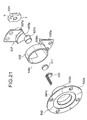
- relative displacement detecting means 506 is structured from a magnetic field generating mechanism provided at driven shaft member 507 side, and a sensor mechanism which is provided at VTC cover 532 side which is the fixing unit side, and which detects a variation in a magnetic field from the magnetic field generating mechanism.
- the magnetic field generating mechanism has a magnet base 533 formed from a non-magnetic material fixed at the front end side of flange 507a, a permanent magnet 534 which is accommodated in a groove 533a formed at the top end portion of magnet base 533, and which is fixed by a pin 533c, a sensor base 535 fixed at the top end edge of cylinder portion 502b of timing sprocket 502, and a first yoke member 537 and a second yoke member 538 which are fixed at the front end surface of sensor base 535 via a cylindrical yoke holder 536.
- a seal member 551 preventing dirt and the like from entering the sensor mechanism is set between the outer peripheral surface of magnet base 533 and the inner peripheral surface of sensor base 535.
- magnet base 533 has a set of protruded walls 533b and 533b forming groove 533a whose top and bottom are opened, and permanent magnet 534 is accommodated between both protruded walls 533b and 533b.
- Permanent magnet 534 is formed in a long elliptical shape in a direction of elongating groove 533a, and the center of the top end portion and the center of the bottom end portion are set to the centers of the north pole and the south pole.
- first yoke member 537 is structured from a plate shaped base portion 537a fixed to sensor base 535, a fan shaped yoke portion 537b provided so as to be integrated with the inner peripheral edge of base portion 537a, and a cylindrical central yoke portion 537c provided so as to be integrated with a main portion of fan shaped yoke portion 537b.
- central yoke portion 537c is disposed at the front surface of permanent magnet 534.
- Second yoke member 538 is structured from a plate shaped base portion 538a fixed to sensor base 535, a plate shaped circular arc yoke portion 538b provided so as to be integrated with the upper peripheral edge of base portion 538a, and a ring yoke portion 538c provided so as to be integrated with the rear end portion of circular arc yoke portion 538b in a same curvature.
- Ring yoke portion 538c is disposed so as to surround the outer peripheral side of a fourth yoke member 542 which will be described later.
- the sensor mechanism has a ring shaped element holder 540, a third yoke member 541 serving as a rectifying yoke, a bottled cylinder shaped forth yoke member 542 serving as a rectifying yoke, a synthetic resin protective cap 543, a protective member 544, and a Hall element 545.
- Element holder 540 is disposed at the inside of VTC cover 532, and supports the front end portion of yoke holder 536 so as to be freely rotatable by a ball bearing 539 at the inner peripheral side.
- Third yoke member 541 is disposed so as to face central yoke portion 537c of first yoke member 537 via an air gap G.
- Fourth yoke member 542 is fixed to the inner periphery of element holder 540 by a bolt.
- Protective cap 543 is fixed to the inner peripheral surface of the cylinder portion of fourth yoke member 542, and supports third yoke member 541.
- Protective member 544 is fitted into to be attached to the outer periphery of a cylindrical protrusion 542c provided so as to be integrated with the center of the bottom wall of fourth yoke member 542.
- Hall element 545 is maintained between third yoke member 541 and protrusion 542c of fourth yoke member 542, and a lead wire 545a is pulled out of Hall element 545.
- three protruding portions 540a are integrally provided at uniform intervals in the circumferential direction, and ends of pins 546 are respectively fixed to be press-fitted into fixing holes provided by drilling respective protruding portions 540a.
- holes 532a are formed at uniform intervals in the circumferential direction at the inner side of VTC cover 532, and rubber bushes 547 are respectively fixed to the insides of holes 532a.
- pins 546 are inserted into the holes drilled at the centers of rubber bushes 547, and in accordance therewith, element holder 540 is supported at VTC cover 532.
- the outer race of ball bearing 539 is fixed so as to be press-fitted into element holder 540.
- the outer race of ball bearing 539 is energized in the direction of camshaft 13 due to a spring force of a coil spring 549 set between the inner surface of VTC cover 532 and fourth yoke member 542, and in accordance therewith, positioning in the axis direction is carried out, and generation of looseness is prevented.
- a stopper body 548 choking the openings at the outer sides of respective holding holes 506a is screwed up on VTC cover 532.
- Third yoke member 541 is formed in a disk type, and is disposed so as to face central yoke member 537c of first yoke member 537 from the axis direction with an air gap G of a predetermined width (about 1 mm).
- an air gap G1 is formed between the inner peripheral surface of ring yoke portion 538c of second yoke member 538 and an outer peripheral surface of cylinder portion 542b of fourth yoke member 542.
- Fourth yoke member 542 has a disk type base portion 542a fixed to element holder 540, a small-diameter cylinder portion 542b which is provided so as to be integrated with the side end surface of Hall element 545 of base portion 542a, and a protrusion 542c provided at the bottom wall surrounded by cylinder portion 542b.
- Protrusion 542c is disposed coaxially with permanent magnet 534, central yoke member 537c of first yoke member 537, and third yoke member 541.
- Lead wire 545a of Hall element 545 is connected to ECU 114.
- intermediate rotator 518 is made to rotate at the maximum in the direction in which the engine is rotated with respect to timing sprocket 502 by the force of spiral spring 519 (refer to FIG. 13), and the centric phase of the operating angle of intake valve 105 is maintained at the maximum retard side.
- the engine is started to operate from this state, and when electromagnetic coil 524 of hysteresis brake 520 is exited on the basis of a request to vary the centric phase to be at the advance side, braking force against the force of spiral spring 519 is applied to intermediate rotator 518.
- intermediate rotator 518 is rotated in a direction opposite to timing sprocket 502, and in accordance therewith, engagement pins 516 at the top ends of links 511 are led to spiral slot 515, and the top end portions of links 511 are displaced inward along groove 508 in the radial direction.
- an assembling angle between timing sprocket 502 and driven shaft member 507 is varied to be at the advance side due to the effects of links 511, and the variation to being at the advance side is controlled in accordance with a magnitude of an exciting current of electromagnetic coil 524.
- FIG 14 shows a state at a maximum advance
- FIG. 15 shows a state at an intermediate advance
- Detection of a relative displacement angle by relative displacement detecting means 506 is carried out as follows.
- a relative rotational phase between camshaft 13 and timing sprocket 502 is varied, and when permanent magnet 534 of relative displacement detecting means 506 is rotated, for example, by an angle of ⁇ as shown in FIG. 22, a magnetic field Z outputted from the center P of the north pole is transmitted to fan shaped yoke portion 537b of first yoke member 537, and is transmitted to central yoke member 537c, and moreover, the magnetic field Z is transmitted to Hall element 545 through third yoke member 541 via the air gap G.
- the magnetic field Z which has been transmitted to Hall element 545 is transmitted to cylinder portion 542b via protrusion 542c of fourth yoke member 542 from Hall element 545, and is further transmitted to ring yoke portion 538c of second yoke member 538 via the air gap G1, and is returned to the south pole of permanent magnet 534.
- a relative rotational displacement angle (a advance value of a rotational phase) of camshaft 13 with respect to crankshaft 120 is found by a computation on the basis of the sequential detection signals (variation in the voltages) outputted from Hall element 545 via lead wire 545a.
- ECU 114 computes a advance target of the rotational phase in VTC mechanism 113, and feedback-controls an exciting current of electromagnetic coil 524 so as to make an actual rotational phase agree with the advance target.
- the flowchart of FIG. 23 shows the main routine of feedback-control of VTC mechanism 113 by ECU 114.
- a target VTC angle TGVTC which is a advance target of a rotational phase of camshaft 13 with respect to crankshaft 120 is read.
- a latest advance value REVTCref of the rotational phase detected on the basis of an angle from a reference rotational position of crankshaft 120 to a reference rotational position of camshaft 13 is read.
- the detection of the rotational phase based on the reference rotational positions is carried out by counting the unit angle signals POS at an angle from a reference rotational position of crankshaft 120 detected by detecting a position at which a unit angle signal POS from crank angle sensor 117 is omitted up to a position at which a cam signal CAM (a head signal at each crank angle of 180°) is outputted from first cam sensor 132.
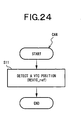
- a counter is made to count up each generation of a unit angle signal POS, and on the other hand, the counter is made to be reset to 0 at the reference rotational position of crankshaft 120, and at step S11 in the flowchart of FIG. 24 in which an interruption is executed every time when a cam signal CAM (a head signal at each crank angle of 180°) is outputted, a rotational phase is detected by judging a value in the counter at that point in time.
- a cam signal CAM a head signal at each crank angle of 180°
- a detected value of the rotational phase based on the reference rotational position is updated every time when a cam signal CAM is outputted from first cam sensor 132 (each crank angle of 180°), and at step S32, a value which has been updated at a time when a latest cam signal CAM is generated is read.
- a latest advance value REVTCnow computed on the basis of a detection signal from Hall element 545 is read.
- a advance value REVTCref of the rotational phase which is read at step S32 is updated each constant crank angle, in a case in which an updating period is made long because of low engine rotational speed, time passes during a time from a latest updated timing to a timing of executing the main routine, and when the rotational phase is varied, an error is brought about with respect to an actual rotational phase.
- the advance value REVTCnow is a detected data without being influenced by an engine rotational speed, and without bringing about a large delay in detection with respect to an actual rotational phase.
- step S34 it is judged whether or not this moment in time is a timing of outputting a cam signal CAM, and is a timing of updating the advance value REVTCref.
- step S32 When it is the timing of updating the advance value REVTCref, because the advance value REVTCref read at step S32 this time is a most up-to-date value of the centric phase at this point in time, the routine proceeds to step S36, and the advance value REVTCref is set to a detection value REVTC used for controlling the feedback control of the VTC mechanism 113.
- step S34 when it is judged that the moment in time is not a timing of outputting a cam signal CAM, the routine proceeds to step S35.
- step S35 it is judged whether or not an update of the advance value REVTCnow has been carried out from the timing of outputting a cam signal CAM at the last time (the timing of updating the advance value REVTCref) up to the point in time.
- the advance value REVTCref updated in the timing of outputting the cam signal CAM at the last time i.e., the advance value REVTCref read at step S32 this time is a most up-to-date value up to now.
- step S36 the advance value REVTCref read at step S32 is set to a detection value REVTC used for controlling the feedback control of VTC mechanism 113.
- the advance value REVTCnow read at step S33 is a most up-to-date detection value as a centric value.
- step S37 the advance value REVTCnow read at step S33 is set to a detection value REVTC used for controlling the feedback control of VTC mechanism 113.
- a feedback-controlled amount of TC mechanism 113 (an exciting current value of electromagnetic coil 524) is computed on the basis of a deviation between the detection value REVTC and a target advance value TGVTC at that point in time.
- a duty signal for controlling the exciting current is outputted in accordance with the feedback-controlled amount.
- VTC mechanism 113 is controlled on the basis of the advance value REVTCnow in place of the advance value REVTCref.
- VTC mechanism 113 is controlled on the basis of the advance value REVTCref in which there is the possibility that an error is brought about with an actual value because time has passed from the time of the updating, which can avoid overshooting the target advance value TGVTC.
- the advance value REVTCref detected on the basis of a pulse signal has less error.
- step S34A it is judged whether or not an engine rotational speed is greater than or equal to a predetermined rotational speed, in other words, a period of updating the advance value REVTCref is less than or equal to a period of updating the advance value REVTCnow.
- VTC mechanism 113 is always made to be feedback-controlled on the basis of the advance value REVTCref.
- step S34B the routine proceeds to step S34B on and after, and the detection value REVTC is set in the same way as steps S34 to S37 in the flowchart of FIG. 23.
- second cam sensor 133 is formed from a rotator 133a and a gap sensor 133b fixed so as to face onto the peripheral edge of rotator 133a.
- Rotator 133a is formed such that the radius is sequentially varied in the circumference direction, and is made to rotate so as to be integrated with camshaft 13.
- gap sensor 133b is, as shown in FIG. 28, sequentially varied due to a distance between gap sensor 133b and the peripheral edge of rotator 133a being varied by the rotations of the camshaft.
- the output of gap sensor 133b and the angle position of the camshaft have a constant correlation, and the angle position of the camshaft can be detected on the basis of the output of gap sensor 133b.
- gap sensor 133b is a cam angle signal CAMA.
- the angle position of crankshaft 120 is detected by counting the number of generations of the unit angle signals POS from a reference rotational position of crankshaft 120 detected by detecting a position at which the unit angle signal POS from crank angle sensor 117 is omitted. Further, the angle position of camshaft 13 is detected on the basis of the cam angle signal CAMA from second cam sensor 133.
- an angle of crankshaft 120 can be determined in an arbitrary timing with a minimum unit being as 10°.
- an angle of camshaft 13 can be determined in an arbitrary timing by reading a cam angle signal CAMA from second cam sensor 133 (an output from gap sensor 133b).
- a advance value REVTCnow of the rotational phase of camshaft 13 with respect to crankshaft 120 is computed on the basis of an angle position of crankshaft 120 and an angle position of camshaft 13 at that point in time.
- step S33 a most up-to-date value of the advance value REVTCnow which has been determined on the basis of the angle position of crankshaft 120 and the angle position of camshaft 13 is read.
- the advance value REVTCnow determined on the basis of the angle position of crankshaft 120 and the angle position of camshaft 13, which is read at step S33, is a most up-to-date value of the value which is updated each microtime, and is not greatly delayed in the detection as compared with the advance value REVTCref. Accordingly, the advance value REVTCnow detected by the gap sensor 133b has necessary and sufficient detecting responsiveness in place of the advance value REVTCnow detected by Hall element 545.
- a centric phase can be detected in an arbitrary timing on the basis of detected results of gap sensor at crankshaft 120 side and gap sensor 133b.
- the detection value REVTC is used only for controlling the feedback control of VTC mechanism 113.
- the detection value REVTC is used for, for example, controlling VEL mechanism 112 (for example, a control of limiting a maximum lift amount, and the like).
- a mechanism which makes a rotational phase of camshaft 13 with respect to crankshaft 120 variable and a mechanism which makes an operating angle/a lift variable are not limited to VTC mechanism 13 and VEL mechanism 112 described above, and well-known mechanisms can be appropriately used.
- VTC mechanism 113 may be provided at exhaust valve 107 side, and the feedback control may be carried out in the same way in the above described embodiment.
- advance value REVTCnow may be calibrated on the basis of the advance value REVTCref.
Landscapes
- Engineering & Computer Science (AREA)
- Mechanical Engineering (AREA)
- General Engineering & Computer Science (AREA)
- Chemical & Material Sciences (AREA)
- Combustion & Propulsion (AREA)
- Valve Device For Special Equipments (AREA)
- Output Control And Ontrol Of Special Type Engine (AREA)
- Combined Controls Of Internal Combustion Engines (AREA)
Applications Claiming Priority (4)
| Application Number | Priority Date | Filing Date | Title |
|---|---|---|---|
| JP2004051628 | 2004-02-26 | ||
| JP2004051628 | 2004-02-26 | ||
| JP2005000337 | 2005-01-05 | ||
| JP2005000337A JP2005273650A (ja) | 2004-02-26 | 2005-01-05 | 内燃機関の可変動弁制御装置 |
Publications (1)
| Publication Number | Publication Date |
|---|---|
| EP1568853A2 true EP1568853A2 (fr) | 2005-08-31 |
Family
ID=34752161
Family Applications (1)
| Application Number | Title | Priority Date | Filing Date |
|---|---|---|---|
| EP05004038A Withdrawn EP1568853A2 (fr) | 2004-02-26 | 2005-02-24 | Dispositif et méthode de contrôle de distribution variable pour moteur à combustion |
Country Status (5)
| Country | Link |
|---|---|
| US (1) | US7011057B2 (fr) |
| EP (1) | EP1568853A2 (fr) |
| JP (1) | JP2005273650A (fr) |
| KR (1) | KR20060043188A (fr) |
| CN (1) | CN1661207A (fr) |
Cited By (2)
| Publication number | Priority date | Publication date | Assignee | Title |
|---|---|---|---|---|
| DE102014112543A1 (de) * | 2014-09-01 | 2016-03-03 | Volkswagen Aktiengesellschaft | Verfahren zur Bestimmung der Position einer Nockenwelle einer Verbrennungskraftmaschine und Verbrennungskraftmaschine zur Durchführung eines solchen Verfahrens |
| US9669243B2 (en) | 2008-04-23 | 2017-06-06 | Basf Se | Delivery of hydrophobic benefit agents from bodywashes and the like onto a keratinous substrate |
Families Citing this family (7)
| Publication number | Priority date | Publication date | Assignee | Title |
|---|---|---|---|---|
| JP4684950B2 (ja) * | 2006-06-16 | 2011-05-18 | 日立オートモティブシステムズ株式会社 | 制御装置 |
| JP2007332896A (ja) * | 2006-06-16 | 2007-12-27 | Hitachi Ltd | 回転角検出装置の出力特性学習装置 |
| JP2008025456A (ja) * | 2006-07-21 | 2008-02-07 | Hitachi Ltd | 位相角検出装置及び該位相角検出装置を用いた内燃機関のバルブタイミング制御装置 |
| PL2150400T3 (pl) * | 2007-04-23 | 2012-07-31 | Pirelli | Sposób układania przynajmniej elastycznego elementu w procesie wytwarzania opon do pojazdów, proces wytwarzania opon do pojazdów oraz aparat do układania przynajmniej jednego elementu elastycznego |
| KR100962192B1 (ko) * | 2007-11-27 | 2010-06-10 | 현대자동차주식회사 | 내연기관의 가변밸브 제어장치 및 방법 |
| US20090173062A1 (en) * | 2008-01-04 | 2009-07-09 | Caterpillar Inc. | Engine system having valve actuated filter regeneration |
| CN102818705B (zh) * | 2012-08-09 | 2013-09-25 | 哈尔滨东安汽车发动机制造有限公司 | 气门反跳试验方法 |
Citations (3)
| Publication number | Priority date | Publication date | Assignee | Title |
|---|---|---|---|---|
| JP2000297686A (ja) | 1999-04-15 | 2000-10-24 | Denso Corp | 内燃機関の制御装置 |
| JP2004051628A (ja) | 2002-05-28 | 2004-02-19 | Ishihara Sangyo Kaisha Ltd | ピリジン系化合物又はその塩、それらの製造方法及びそれらを含有する除草剤 |
| JP2005000337A (ja) | 2003-06-11 | 2005-01-06 | Senju Sprinkler Kk | 水道用スプリンクラーヘッドの接続継手 |
Family Cites Families (2)
| Publication number | Priority date | Publication date | Assignee | Title |
|---|---|---|---|---|
| JP4159854B2 (ja) * | 2002-10-31 | 2008-10-01 | 株式会社日立製作所 | 可変バルブタイミング機構の制御装置 |
| JP4268839B2 (ja) * | 2003-06-26 | 2009-05-27 | 株式会社日立製作所 | 内燃機関の可変動弁制御装置 |
-
2005
- 2005-01-05 JP JP2005000337A patent/JP2005273650A/ja not_active Ceased
- 2005-02-24 EP EP05004038A patent/EP1568853A2/fr not_active Withdrawn
- 2005-02-24 US US11/064,100 patent/US7011057B2/en not_active Expired - Fee Related
- 2005-02-25 KR KR1020050016130A patent/KR20060043188A/ko not_active Withdrawn
- 2005-02-28 CN CN2005100511455A patent/CN1661207A/zh active Pending
Patent Citations (3)
| Publication number | Priority date | Publication date | Assignee | Title |
|---|---|---|---|---|
| JP2000297686A (ja) | 1999-04-15 | 2000-10-24 | Denso Corp | 内燃機関の制御装置 |
| JP2004051628A (ja) | 2002-05-28 | 2004-02-19 | Ishihara Sangyo Kaisha Ltd | ピリジン系化合物又はその塩、それらの製造方法及びそれらを含有する除草剤 |
| JP2005000337A (ja) | 2003-06-11 | 2005-01-06 | Senju Sprinkler Kk | 水道用スプリンクラーヘッドの接続継手 |
Cited By (2)
| Publication number | Priority date | Publication date | Assignee | Title |
|---|---|---|---|---|
| US9669243B2 (en) | 2008-04-23 | 2017-06-06 | Basf Se | Delivery of hydrophobic benefit agents from bodywashes and the like onto a keratinous substrate |
| DE102014112543A1 (de) * | 2014-09-01 | 2016-03-03 | Volkswagen Aktiengesellschaft | Verfahren zur Bestimmung der Position einer Nockenwelle einer Verbrennungskraftmaschine und Verbrennungskraftmaschine zur Durchführung eines solchen Verfahrens |
Also Published As
| Publication number | Publication date |
|---|---|
| KR20060043188A (ko) | 2006-05-15 |
| JP2005273650A (ja) | 2005-10-06 |
| US20050188934A1 (en) | 2005-09-01 |
| CN1661207A (zh) | 2005-08-31 |
| US7011057B2 (en) | 2006-03-14 |
Similar Documents
| Publication | Publication Date | Title |
|---|---|---|
| US7159545B2 (en) | Valve timing control apparatus for internal combustion engine and control method thereof | |
| US20070295295A1 (en) | Phase angle detection apparatus and variable valve timing control apparatus using the phase angle detection apparatus for internal combustion engine | |
| US6920852B2 (en) | Apparatus and method for controlling engine valve opening in internal combustion engine | |
| EP1568860B1 (fr) | Dispositif de commande de soupape variable pour moteur à combustion interne et méthode de contrôle | |
| EP1568853A2 (fr) | Dispositif et méthode de contrôle de distribution variable pour moteur à combustion | |
| US7441524B2 (en) | Valve timing control apparatus for internal combustion engine and control method thereof | |
| US20030131812A1 (en) | Control apparatus of variable valve timing mechanism and method thereof | |
| US7246582B2 (en) | Variable valve control apparatus and variable valve controlling method for internal combustion engine | |
| US20030121500A1 (en) | Ignition timing control apparatus for internal combustion engine and method thereof | |
| US8452519B2 (en) | Valve timing control apparatus for internal combustion engine | |
| US7011060B2 (en) | Valve timing control apparatus for internal combustion engine and control method thereof | |
| JP2000282901A (ja) | 内燃機関の可変動弁装置における作動角センサ故障判定装置 | |
| JP4200111B2 (ja) | 動弁制御装置 | |
| JP4313626B2 (ja) | 可変バルブタイミング機構の制御装置 | |
| EP1275826B1 (fr) | Commande et méthode de variation de soupape et dispositif de levage | |
| US7055474B2 (en) | Variable valve control apparatus for internal combustion engine and method thereof | |
| JP2005220758A (ja) | 内燃機関の制御装置 | |
| JP2005220760A (ja) | 可変動弁制御装置及び制御装置 | |
| JP4298535B2 (ja) | 内燃機関の可変動弁制御装置 | |
| JP2008286172A (ja) | 可変動弁機構の制御装置 | |
| JP4299159B2 (ja) | 内燃機関の可変動弁制御装置 | |
| JP2005016365A (ja) | 内燃機関の可変動弁制御装置 | |
| JP2006118439A (ja) | 内燃機関の制御装置 | |
| JP2005023873A (ja) | 可変動弁機構付内燃機関の始動制御装置 |
Legal Events
| Date | Code | Title | Description |
|---|---|---|---|
| PUAI | Public reference made under article 153(3) epc to a published international application that has entered the european phase |
Free format text: ORIGINAL CODE: 0009012 |
|
| AK | Designated contracting states |
Kind code of ref document: A2 Designated state(s): AT BE BG CH CY CZ DE DK EE ES FI FR GB GR HU IE IS IT LI LT LU MC NL PL PT RO SE SI SK TR |
|
| AX | Request for extension of the european patent |
Extension state: AL BA HR LV MK YU |
|
| STAA | Information on the status of an ep patent application or granted ep patent |
Free format text: STATUS: THE APPLICATION HAS BEEN WITHDRAWN |
|
| 18W | Application withdrawn |
Effective date: 20090526 |