EP1566803A2 - Verbesserungen für oder in Bezug auf den Kopierschutz von optischen Platten - Google Patents
Verbesserungen für oder in Bezug auf den Kopierschutz von optischen Platten Download PDFInfo
- Publication number
- EP1566803A2 EP1566803A2 EP05250583A EP05250583A EP1566803A2 EP 1566803 A2 EP1566803 A2 EP 1566803A2 EP 05250583 A EP05250583 A EP 05250583A EP 05250583 A EP05250583 A EP 05250583A EP 1566803 A2 EP1566803 A2 EP 1566803A2
- Authority
- EP
- European Patent Office
- Prior art keywords
- data
- content
- subversive
- unreadable
- region
- Prior art date
- Legal status (The legal status is an assumption and is not a legal conclusion. Google has not performed a legal analysis and makes no representation as to the accuracy of the status listed.)
- Withdrawn
Links
- 230000003287 optical effect Effects 0.000 title claims abstract description 64
- 238000000034 method Methods 0.000 claims description 62
- 230000003139 buffering effect Effects 0.000 claims description 25
- 230000008859 change Effects 0.000 claims description 7
- 238000009877 rendering Methods 0.000 claims description 3
- 230000002411 adverse Effects 0.000 abstract description 3
- 230000008569 process Effects 0.000 description 6
- 238000012937 correction Methods 0.000 description 5
- 239000000463 material Substances 0.000 description 4
- 230000007704 transition Effects 0.000 description 4
- UDCXNLDCQOXJNC-UHFFFAOYSA-N 2-n,4-n,1,3-tetraphenyl-1,3,2,4-diazadiphosphetidine-2,4-diamine Chemical compound C=1C=CC=CC=1NP(N1C=2C=CC=CC=2)N(C=2C=CC=CC=2)P1NC1=CC=CC=C1 UDCXNLDCQOXJNC-UHFFFAOYSA-N 0.000 description 3
- 230000004048 modification Effects 0.000 description 3
- 238000012986 modification Methods 0.000 description 3
- 230000004075 alteration Effects 0.000 description 2
- 230000000694 effects Effects 0.000 description 2
- 108091081062 Repeated sequence (DNA) Proteins 0.000 description 1
- 238000010367 cloning Methods 0.000 description 1
- 238000011161 development Methods 0.000 description 1
- 238000003780 insertion Methods 0.000 description 1
- 230000037431 insertion Effects 0.000 description 1
- 238000011084 recovery Methods 0.000 description 1
Images







Classifications
-
- G—PHYSICS
- G11—INFORMATION STORAGE
- G11B—INFORMATION STORAGE BASED ON RELATIVE MOVEMENT BETWEEN RECORD CARRIER AND TRANSDUCER
- G11B20/00—Signal processing not specific to the method of recording or reproducing; Circuits therefor
- G11B20/10—Digital recording or reproducing
-
- G—PHYSICS
- G11—INFORMATION STORAGE
- G11B—INFORMATION STORAGE BASED ON RELATIVE MOVEMENT BETWEEN RECORD CARRIER AND TRANSDUCER
- G11B27/00—Editing; Indexing; Addressing; Timing or synchronising; Monitoring; Measuring tape travel
- G11B27/02—Editing, e.g. varying the order of information signals recorded on, or reproduced from, record carriers
- G11B27/031—Electronic editing of digitised analogue information signals, e.g. audio or video signals
- G11B27/034—Electronic editing of digitised analogue information signals, e.g. audio or video signals on discs
-
- G—PHYSICS
- G11—INFORMATION STORAGE
- G11B—INFORMATION STORAGE BASED ON RELATIVE MOVEMENT BETWEEN RECORD CARRIER AND TRANSDUCER
- G11B20/00—Signal processing not specific to the method of recording or reproducing; Circuits therefor
- G11B20/00086—Circuits for prevention of unauthorised reproduction or copying, e.g. piracy
-
- G—PHYSICS
- G11—INFORMATION STORAGE
- G11B—INFORMATION STORAGE BASED ON RELATIVE MOVEMENT BETWEEN RECORD CARRIER AND TRANSDUCER
- G11B20/00—Signal processing not specific to the method of recording or reproducing; Circuits therefor
- G11B20/00086—Circuits for prevention of unauthorised reproduction or copying, e.g. piracy
- G11B20/00572—Circuits for prevention of unauthorised reproduction or copying, e.g. piracy involving measures which change the format of the recording medium
- G11B20/00579—Circuits for prevention of unauthorised reproduction or copying, e.g. piracy involving measures which change the format of the recording medium said format change concerning the data encoding, e.g., modulation schemes violating run-length constraints, causing excessive DC content, or involving uncommon codewords or sync patterns
-
- G—PHYSICS
- G11—INFORMATION STORAGE
- G11B—INFORMATION STORAGE BASED ON RELATIVE MOVEMENT BETWEEN RECORD CARRIER AND TRANSDUCER
- G11B20/00—Signal processing not specific to the method of recording or reproducing; Circuits therefor
- G11B20/00086—Circuits for prevention of unauthorised reproduction or copying, e.g. piracy
- G11B20/0092—Circuits for prevention of unauthorised reproduction or copying, e.g. piracy involving measures which are linked to media defects or read/write errors
- G11B20/00927—Circuits for prevention of unauthorised reproduction or copying, e.g. piracy involving measures which are linked to media defects or read/write errors wherein said defects or errors are generated on purpose, e.g. intended scratches
-
- G—PHYSICS
- G11—INFORMATION STORAGE
- G11B—INFORMATION STORAGE BASED ON RELATIVE MOVEMENT BETWEEN RECORD CARRIER AND TRANSDUCER
- G11B2220/00—Record carriers by type
- G11B2220/20—Disc-shaped record carriers
- G11B2220/25—Disc-shaped record carriers characterised in that the disc is based on a specific recording technology
- G11B2220/2537—Optical discs
- G11B2220/2562—DVDs [digital versatile discs]; Digital video discs; MMCDs; HDCDs
Definitions
- the present invention relates to a method of copy protecting an optical disc carrying content and control data and to such a copy protected optical disc.
- the invention also relates to a volume of content for application to a data carrying disc.
- WO 00/74053 proposes copy protecting audio data on a digital audio compact disc (CD-DA) by rendering control data encoded onto the disc incorrect and/or inaccurate.
- CD-DA digital audio compact disc
- the incorrect data encoded onto the CD is either inaccessible to, or not generally used by, a CD-DA player. Therefore a legitimate audio CD can be played normally on a compact disc music player, but the incorrect data renders the protected audio data on the CD unplayable by a CD-ROM drive.
- the present invention seeks to provide a copy protection method in which this risk of interference with a legitimate use is reduced.
- a copy protected optical disc carrying content and control data in a data area, the content being arranged in one or more content files, and the control data providing access to the content, wherein at least one region which contains unreadable or subversive data is provided within the data area, and wherein access to the or each region of unreadable or subversive data is prevented during normal playback of the content on the disc.
- the unreadable or subversive data which is provided on the disc does not interfere with any legitimate usage of the disc because during normal playback the unreadable or subversive data is not accessed. This means, therefore, that unreadable or subversive data which is particularly effective can be incorporated onto the disc to provide maximum copy protection.
- the data on an optical disc When the data on an optical disc is to be copied, the data is generally accessed on a sector by sector or file by file basis. It will be appreciated that the unreadable or subversive data will then either prevent or significantly slow the copying process, or will invoke error correction or data recovery techniques which will render the subsequent copy disc unplayable.
- the content files may comprise any structures in the data area containing content.
- the control data comprises any data providing a control function.
- the unreadable or subversive data may be within the content and/or the control data on the optical disc and may be any type of data which will generally be unreadable or otherwise subvert playing or reading of the optical disc.
- At least one region of unreadable or subversive data is formed within the content files, that is, either within an individual content file or between content files.
- At least one region of unreadable or subversive data is formed as a gap between content files.
- the content files are video object files and are composed of video objects (VOBs) which are divided into cells, and the cells can be accessed by respective pointers in a program chain.
- VOBs video objects
- At least one region of unreadable or subversive data may be formed as an additional cell within a video object, as an unstructured region within a video object, or between video objects, or in an existing cell within a video object. At least one region of unreadable or subversive data may be formed in a video object which is interleaved with existing content.
- that region of unreadable or subversive data is not accessed because there are no pointers to the region.
- the unreadable or subversive data cannot interfere with the playing of the movie.
- pointers accessing the at least one region of unreadable or subversive data but program chains defined by said control data are altered such that the unreadable or subversive data is not accessed during normal playback of the content on the disc.
- pointers to said at least one region the unreadable or subversive data still does not interfere with the playing of a movie as it is not accessed.
- video objects containing cells are interleaved to form an interleaved block.
- the or each region of unreadable or subversive data is formed within an unplayed interleaved unit.
- one or more regions of unreadable or subversive data are formed in existing cells within video objects, it may be convenient to alter control data to ensure that the unreadable or subversive data is not accessed during playback even though pointers accessing said existing cells do exist.
- one or more further regions of unreadable or subversive data may be formed within video objects, in one or more unstructured regions and/or within one or more additional cells. It may be convenient to arrange that there are no pointers accessing any of these further regions of unreadable or subversive data.
- At least one region of unreadable or subversive data is formed as a gap between content files.
- the control data does not provide navigable paths to the or each gap between content files.
- the gap or gaps between content files may be existing gaps, for example, provided between files within a DVD-Video zone. Additionally and/or alternatively, gaps may be created between contiguous files for the receipt of unreadable or subversive data.
- the or each region of unreadable or subversive data contains both buffering data and subversive data. This is to ensure that a device will not encounter the subversive data during normal play of the optical disc.
- the or each region may contain buffering data followed by subversive data, and/or the or each region may contain buffering data following the subversive data.
- the buffering data comprises non-subversive data such as sectors of zeros.
- the unreadable or subversive data may include or comprise data patterns chosen to cause DSV problems. Examples of DSV patterns, and their uses, are described, for example, in earlier application No. WO 02/11136.
- the data patterns are chosen to ensure that the DSV has a significant absolute value.
- the data patterns are chosen to produce a DSV which has a rapid rate of change.
- the unreadable or subversive data has incorrect control data associated therewith.
- the incorrect control data associated with the unreadable or subversive data may comprise incorrect error correcting codes.
- the unreadable or subversive data includes or has mistimed waveform transitions.
- the unreadable or subversive data may additionally and/or alternatively include or comprise bits or sectors which have been mechanically or physically damaged.
- the unreadable or subversive data may additionally and/or alternatively include or comprise information bits or sectors of information bits whose information content has been rendered incorrect.
- the present invention also extends to a method of copy protecting an optical disc carrying content and control data in a data area, wherein the content is arranged in one or more content files, and the control data provides access to the content, the method comprising the steps of:
- At least one region of unreadable or subversive data is formed within an individual content file. Additionally and/or alternatively, at least one such region is formed between content files, for example, is formed as a gap between two adjacent content files.
- the content files are video object files which are composed of video objects (VOBs) which are divided into cells, and wherein the cells can be accessed by respective pointers in a program chain.
- VOBs video objects
- the method further comprises forming at least one region of unreadable or subversive data as an additional cell within a video object.
- the method further comprises forming at least one region of unreadable or subversive data as an unstructured region within a video object or between video objects.
- the method further comprises forming at least one region of unreadable or subversive data in an existing cell within a video object.
- the method further comprises forming each region of unreadable or subversive data within a video object which is interleaved with existing content.
- the method may further comprise arranging that there are no pointers accessing at least one region of unreadable or subversive data.
- the method may comprise altering program chains defined by said control data such that the unreadable or subversive data is not accessed during normal playback of the content on the disc.
- the method further comprises forming at least one region of unreadable or subversive data as a gap between content files.
- the method may further comprise arranging that the control data does not provide navigable paths to the or each gap between content files.
- the gaps between the content files may be existing or may be created to receive the unreadable or subversive data.
- both buffering data and the subversive data are provided within the or each said region.
- the method further comprises forming the subversive data in the or each said region so that it is surrounded by buffering data.
- the method or methods of providing the unreadable or subversive data may be chosen as required.
- the method may comprise including data patterns, which are chosen to cause DSV problems, into a region of the content files.
- the data patterns may be chosen to ensure that the DSV has a significant absolute value and/or to produce a DSV which has a rapid rate of change.
- the method may comprise rendering control data in a region of a content file incorrect to provide the unreadable or subversive data.
- the incorrect data resulting in the unreadable or subversive data may comprise incorrect error correcting codes.
- a method of the invention may additionally and/or alternatively comprise including mistimed waveform transitions into data in a region of a content file to render that data unreadable or subversive.
- the method may further comprise mechanically or physically damaging bits or sectors within a region of a content file.
- the method may further comprise including information bits or sectors of information bits, whose information content has been rendered incorrect, in a region of a content file.
- a volume of content for application to a data carrying disc, the content being arranged within one or more content files, and the content being accessible by control data defining navigable paths, wherein the content files have been altered to include at least one region containing unreadable or subversive data, and control data defining the navigable paths has been adjusted such that access to the or each region of unreadable or subversive data will be prevented during normal playback of a disc.
- a volume content of an embodiment of the invention may be encoded and applied, for example, to a DVD to provide copy protection for the content.
- the or each said region contains both buffering data and subversive data.
- the buffering data may be used to ensure that a player does not inadvertently encounter the subversive data when navigating an optical disc on which the volume of content has been encoded.
- the or each said region contains buffering data followed by subversive data and/or buffering data following the subversive data.
- the buffering data comprises sectors of zeros.
- At least one region of unreadable or subversive data is formed within an individual content file, between content files, and/or as a gap between two adjacent content files.
- At least one region of unreadable or subversive data is formed as an unstructured region within a video object or between video objects.
- At least one region of unreadable or subversive data is formed as an additional cell within a video object.
- At least one region of unreadable or subversive data is formed in an existing cell within a video object.
- At least one region of unreadable or subversive data may be formed in a video object which is interleaved with existing content.
- the program chains do not include pointers accessing at least one region of unreadable or subversive data.
- control data defining the program chains is altered such that the unreadable or subversive data is not accessed during normal playback of the content on the disc.
- At least one region of unreadable or subversive data is formed as a gap between content files.
- the control data does not provide navigable paths to the or each gap between content files.
- the or each gap between content files may be pre-existing or may have been created to receive the unreadable or subversive data.
- the unreadable or subversive data includes or comprises data patterns chosen to cause DSV problems.
- the data patterns may have been chosen to ensure that the DSV has a significant absolute value. Additionally and/or alternatively, the data patterns may have been chosen to produce a DSV which has rapid rate of change.
- the unreadable or subversive data may have incorrect control data associated therewith.
- the incorrect control data associated with the unreadable or subversive data may comprise incorrect error correcting codes.
- the unreadable or subversive data may include mistimed waveform transitions.
- the unreadable or subversive data includes or comprises bits or sectors which have been mechanically or physically damaged.
- the unreadable or subversive data includes or comprises information bits or sectors of information bits whose information content has been rendered incorrect.
- the present invention is applicable to optical discs in general, but is described herein with reference to DVD formats.
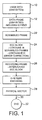
- Figure 1 shows the steps which are taken in formatting user data to be applied to a DVD.
- This user data is the information which is to be written to, and accessed from the disc and may comprise text, graphics, video, audio, programs and other content, and control data.
- the user data is organised into blocks 10 which each contain 2,048 bytes.
- the first step in the formatting is to incorporate each block 10 of user data into a corresponding data frame 12 which has 2,064 bytes.
- the additional bytes incorporate identification and error correction codes.
- the data frame 12 is then scrambled to form a scrambled frame 22.
- This scrambling is to remove repeated sequences of data.
- the scrambling may be performed by XORing sixteen consecutive data frames with a first table and then XORing the next sixteen consecutive data frames with a second table and so on.
- the scrambled frame 22, therefore, includes 16 x 16 data frames 12.
- an ECC block 24 is formed by error correction encoding in which sixteen consecutive scrambled frames 22 are arranged into an array having 192 rows each containing 172 bytes. To each of the 172 columns, sixteen bytes of "outer parity" are added and to each of the resulting 208 rows ten bytes of "inner parity” are added. These parity bytes are error correction codes related to the data in the rows and columns by known and understood error correction techniques.
- the ECC block 24 is then input to interleaving means to create sixteen recording frames 26. These recording frames 26 are created by interleaving rows from the ECC block 24. Thus, the 37,856 bytes contained in the ECC block 24 are rearranged into sixteen recording frames R 0 , R 1 , ..R 15 each of which has 2,336 bytes. Since each recording frame R has 182 columns there are sixteen recording frames each consisting of 13 rows.
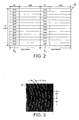
- the recording frames 26 are then subjected to EFM Plus encoding whereby a sequence of bits, that is, a series of 0s and 1s, is produced. Thereafter the data is arranged into sixteen physical sectors 28. One physical sector 28 is shown in Figure 2. As can be seen, the EFM Plus encoded data from each recording frame is split down the middle and four byte sync codes S 0 , and S 1 are inserted in front of each half row. Thereafter, the resulting sequence of bits 30 is applied to a disc 32.
- EFM Plus encoding processes the data with 8 to 16 modulation, that is each eight bit byte is translated into a sixteen bit byte. This is done by selecting each sixteen bit code from a set of four tables. The encoding is arranged to maintain a low level of DSV (Digital Sum Value).
- DSV Digital Sum Value
- the bit stream 30 is written to the disc 32 by an appropriate mastering means to form pits and lands.
- the mastering means will generally be a laser beam recorder. Laser beam recorders are also used in mastering houses, but alternative mastering techniques are available and may be utilised.
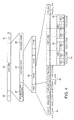
- Figure 3 shows an enlarged part of a DVD showing the pits 6 thereon. As is well known, these pits extend along a spiral track on the surface of the disc 32 and are separated by lands.
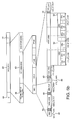
- the data on the DVD is arranged along the spiral track. As shown in Figure 4, this data is structured to have a Lead-in 40, a data area 42 and a Lead-out 44.
- the structure of the data on the DVD is the subject of standards, and is well known to those skilled in the art. Accordingly, only parts of the data structure of a DVD-Video which are relevant to the present invention are described and illustrated herein.
- the data area 42 includes a volume descriptor 46 which identifies the structure and contents of the data in the data area 42. This volume descriptor 46 is followed by a DVD-Video zone 43 and possibly by other DVD zones 45.
- the DVD-Video zone 43 comprises structures such as a Video Manager (VMG) and a number of video title sets (VTSs).
- IFO Information files (IFO) 48 are provided in the Video Manager (VMG) and in each of the video title sets (VTSs) and provide the syntax by which navigation to video objects (VOBs) 50 is achieved.
- each video object 50 contains MPEG streams, such as video, audio, and other content streams.
- the other content streams may comprise text and graphics, for example.
- a video object 50 also includes control data for controlling the presentation of its content together with control data enabling the data within the video object to be searched.
- the video objects 50 compose a set of video objects for the titles (VTSTT_VOBS) in video title set VTS#1.
- the VTSTT_VOBS is divided into video object files 51 whose size does not exceed 1GB.
- Figure 5 shows the structure of a video title set (VTS) and illustrates how, in a DVD, a movie, for example, stored in a single video object 50, can be accessed and navigated and thereby played.
- VTS video title set
- Figure 5 illustrates how a single video object 50 is addressed.
- each title 54 includes one or more program chains 56.
- the title 54 "TITLE yy" addresses the chosen video object 50 and does so by way of program chain x.
- Each program chain 56 includes a number of individual programs as 58 which are typically arranged to be played in sequence.
- Each of the programs 58 has one or more pointers as 60, and each pointer 60 addresses a particular part of the corresponding video object.
- each video object 50 is divided into a number of individual cells 70.
- each of the programs 58 points, by way of its pointer 60, to an individual one of the cells 70 of the video object 50.
- program 1 it is possible as also indicated in Figure 5 for a single program 58, as program 1, to have more pointers 60, for example, two pointers which address two cells 70, as cells 1/1 and 1/2.
- the arrangement is generally that, as the programs 58 are played in sequence by way of the relevant program chain 56, the cells 70 within the video object 50 are similarly accessed in order.
- Figure 6 shows an arrangement similar to that of Figure 5 except that the DVD illustrated in Figure 6 has been copy protected by an embodiment of the present invention. It will be seen, by a comparison of Figures 5 and 6, that an unstructured region 72 has been interposed between two cells 70 of the video object 50. As is also shown in Figure 6, subversive data indicated at 74 has been incorporated within the unstructured region 72. There is a buffer area 76 on either side of the subversive data 74 within the unstructured region.
- the subversive data 74 in the unstructured region 72 of the video object 50 may be any data which will stop or subvert a drive reading or playing the content of the region 72 on an optical disc, and/or will stop or significantly slow down the copying of data from the optical disc and/or will prevent usable copies of data on the disc being made.
- Examples of subversive data which meet these requirements include data with incorrect error correcting codes, and information which has been deliberately altered.
- the data might be, or include, data patterns chosen to cause DSV problems, for example, chosen to ensure that the DSV has a significant absolute value and/or that the DSV has a rapid rate of change. A description of DSV data patterns and the problems they cause is given, for example, in WO 02/11136. It is additionally and/or alternatively possible to provide data which has mistimed waveform transitions.
- values of the data which may be content and/or control data, will be changed during encoding of the data onto the optical disc whereby the subversive data is produced.
- the buffer area 76 there is a buffer area 76 on either side of the subversive data 74 within the unstructured region 72.
- some devices do read ahead when playing a disc.
- a device which has been caused to access the first cell and then the second cell of the video object file 50 may look ahead to the next cell and, in the arrangement of Figure 6, would encounter the unstructured region 72.
- the areas of buffer data are provided.
- the data within the buffering zones 76 has non-subversive properties and, for example comprises pluralities of zeros.
- a DVD can be provided with subversive data as 74 without risk that that subversive data will adversely affect normal playing of the disc.
- VTSI Video Title Set Information
- subversive data 74 may be included in the video object 50 by inserting therein an unstructured region 72 also containing buffering zones 76.
- the subversive data may alternatively be contained in a structured cell which is never accessed. That is, a region of subversive data may be inserted into existing or additional, but unplayed, cells. It is generally preferred that buffering zones are provided around the subversive data.
- VTSTT_VOBS size of the VTSTT_VOBS. If the resulting size of the video object files 51 into which VTSTT_VOBS is divided exceeds the maximum size allowed, (1 GB), the boundaries of the video object files 51 are moved and/or new video object files 51 may be created.
- FIGS 7 and 8 show the tables in the Video Manager Information File (VMGI) 48 and in the Video Title Set Information File (VTSI) 48. These tables may be altered to incorporate a region of subversive data as described above.
- VMGI Video Manager Information File
- VTSI Video Title Set Information File
- FIG. 7 shows the Video Manager Information (VMGI) table 80 which is found in the VMG information file 48 of a DVD.
- VMGI Video Manager Information
- FIG. 8 shows the Video Title Set Information (VTSI) table 90, which is contained within a VTS information file 48.
- VTSI Video Title Set Information
- VTSI_MAT Video Title Set Information Management Table
- VTS_n_0.IFO Video Title Set Information Management Table
- the value for the end sector of the first interleaved unit (ILVU) in the VTS_PGCIT should also be increased by x. Interleaving is described below.
- VTS_C_ADT Video Title Set Cell Address Table
- the value of the sector numbers are increased by x.
- the additional cell shown as 72 in Figure 6a, will be assigned a VOB and a cell ID, shown as cell 1/3.
- the cell IDs for cells a+1 and following will need to be adjusted and the VOB IDs for cells a+1 onwards may also need to be altered.
- All the tables containing information for the VOB and the cell ID will require modification. These tables include the Cell Position Table (C_POSIT) within the VTS_PGCIT table in the VTSI Table 90, and the VTS Cell Piece Information (VTS_CPI) entries within the VTS_C_ADT table in the VTSI Table 90.
- C_POSIT Cell Position Table
- VTS_CPI VTS Cell Piece Information
- DSI_GI DSI General Information
- subversive data is provided in an unstructured region and/or in an additional cell inserted into a video object 50. Additionally and/or alternatively, subversive data may be incorporated into one or more existing cells. Where an existing cell already contains data, the subversive data may be inserted into the existing cell by overwriting the existing data with subversive data. As previously, it will have to be ensured that there is no navigation to the existing cell which incorporates the subversive data during playback of the content on the disc. Of course, it will also have to be ensured that any data which has been overwritten is not required during playback of the content on the disc.
- the subversive data is inserted in the video object 50. It is additionally and/or alternatively possible to include the subversive data in other regions of the content files to which there is normally navigation during playback of the content on the disc.
- the DVD-Video zone 43 comprises a Video Manager (VMG) and a number of video title sets (VTSs) which are composed of various files. There is navigation to these files, for example, by way of the information files (IFO) 48 provided.
- VMG Video Manager
- VTSs video title sets
- gaps 49 are provided between files and subversive data may be inserted into such gaps 49. It will be appreciated that no navigation is provided to such gaps 49.
- gaps 49 may be inserted between files in the DVD-Video zone 43 and then subversive data may be inserted into the gaps created.
- Figure 6b illustrates locations at which gaps 49 may be inserted.
- Space for the gaps 49 can be allocated by adjusting the values for the start sector addresses in the VMGI and/or in the relevant VTSI, in the VIDEO_TS folder prior to the image building process, as such values determine the location of the files within the DVD-VIDEO zone 43. For example, in order to create a gap 49 of size x between the VIDEO_TS.IFO and VIDEO_TS.VOB files, the value for the start address of the VMGM_VOBS in the VMG management table VMGI_MAT within the VMGI (VIDEO_TS.IFO) is increased by x. In addition, within the Title Search Pointer Table (TT_SRPT) which is within the VMGI, the value for the VTS starting sector for all titles is increased by x. Alternatively, gaps may be provided after the image building process.
- TT_SRPT Title Search Pointer Table
- Figures 9a and 9b illustrate a known technique for allowing two or more versions of a movie, for example, to be carried by a single DVD in an efficient manner.
- the movie is stored in video objects 50 and the material which is common to both versions of the movie is only present once on the disc to preserve space. Where the two versions diverge, their content is interleaved so that the size of the jumps required by the device playing the disc during disc playback are sufficiently small that seamless playback of the content can occur.
- Figures 9a and 9b illustrate a portion of the playback of two versions of a single movie where Figure 9a shows playback of a first version, for example, the theatrical release version, whilst Figure 9b shows playback of an extended version, for example, the director's cut.
- the cells 1/1, 1/2, 1/3 of a first video object 50 (VOB 1) are common to both versions but that, in Figure 9a, the theatrical version then plays the cell 2/1 which constitutes a second video object (VOB 2) and then moves to the first cell 4/1 of a fourth video object (VOB 4).
- the extended version omits the second video object (VOB 2), and thus the cell 2/1, and plays instead the cells 3/1 and 3/2 in a third video object (VOB 3).
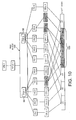
- Figure 10 shows the structure of the video title set (VTS) for the technique illustrated in Figures 9a and 9b and shows an arrangement of the cells 2/1 and 3/1 and 3/2 of Figures 9a and 9b on the disc.
- VTS video title set
- the second and third video objects, VOB 2 and VOB 3 have each been sliced into three parts and have been interleaved as indicated at 150 to form three interleaved units (ILVUS). The effect is to interleave the cell 2/1 with cell 3/1 and with cell 3/2.
- a program chain block 100 containing two program chains 56 is provided.
- the first program chain PGC 1 will play the theatrical version of the movie as illustrated in Figure 9a, whilst the second program chain PGC 2 will play the director's cut version illustrated in Figure 9b.
- This interleaving technique can be utilised to provide an alternative embodiment of the copy protection technique as described above, as is illustrated in Figures 11 and 12.
- the cells with the content which is to be played are provided along a single, sequential, navigable path.
- an additional cell 3/1 is provided which contains subversive data, as is illustrated in Figure 12.
- an additional video object, VOB 3, split into one or more ILVUs 154 is provided, where one or more ILVUs 154 contain subversive data and are interleaved with existing content data.
- FIG 12 illustrates an interleaved block 156 composed of two video objects, VOB 2 and VOB 3, which have been interleaved.
- This interleaved block 156 is interposed between the first and fourth video objects 50.
- cell 1/2 contains playable information.
- This cell 1/2 has been assigned a new VOB ID and effectively sliced and interleaved with the ILVUs 154 of subversive data.
- pointers navigate the drive over the regions of subversive data.
- buffer zones and other techniques may be used within the subversive data regions to ensure that they do not interfere with normal play of the disc.
- the subversive data may be any data which will stop a drive reading or playing an optical disc and may be in accordance with any of the examples described above.
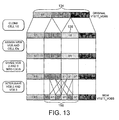
- Figures 11, 12 and 13 illustrate how an interleaved block 156 can be created, and how subversive data, including any pre- or post-buffering data, can be arranged in unplayed interleaved units (ILVUs).
- Figure 11 shows original material having only a single playback path 130.
- Figure 11 also shows the corresponding logical structure of the relevant video title set VTS 1.
- the single relevant video title set VTS 1 has one program chain PGC 1 with three programs PG 1, PG 2, PG 3, and three pointers cell 1, cell 2, cell 3 pointing to a contiguous block 134 in VTSTT_VOBS. It will be appreciated that generally execution of the program chain PGC 1 will play the cells 1/1, 1/2 and 1/3 in order, that is, playback will be along the path 130.
- Figure 12 shows the provision of subversive data 154 in a cell 3/1 to which there is no navigable path.
- Figure 12 also shows the logical structure of the relevant video title set VTS 1.
- the navigable path 130 of Figure 12 includes cells 1/1, 2/1 and 4/1.
- the cell 3/1, containing the subversive data, is provided along a non-navigable path 130'.
- the structure of Figure 12 has a single program chain PGC 1 with three programs PG 1, PG 2 and PG 3, and three pointers cell 1, cell 2, cell 3.
- the subversive data 154 in the third video object has been interleaved with the second video object to form the interleaved block 156 having unplayed interleaved units 154.
- Figure 13 shows one embodiment of the creation of an interleaved block 156 from a contiguous block 134 in the VTSTT_VOBS.
- Figure 13 shows the original cells 1/1, 1/2 and 1/3 (134) in the VTSTT_VOBS.
- the cell 1/2 is then cloned to produce clone 136 which is inserted between cells 1/2 and 1/3.
- cloning a cell other material may be inserted into VTSTT_VOBS.
- new cell IDs and video object IDs are assigned. As shown in Figure 13, the four regions or cells 1/1, 1/2, 1/2 and 1/3, are assigned new VOB and Cell IDs.
- the second and third video objects, VOB 2 and VOB 3 are each divided into an equal number of interleaved units which are then interleaved as shown in Figure 13.
- Figure 14 shows a video title set in which subversive data has been inserted into an interleaved block which already exists in the VTSTT_VOBS.
- VOBs 2 and 3 were already interleaved in the original VTSTT_VOBS.
- a further interleaved VOB is added.
- Subversive data 154 is inserted into one or more of the unplayed interleaved units of the new VOB 4. As previously, there are no navigable paths to the new VOB 4.
- an optical disc is copy protected by incorporating subversive data in the data area, for example, in or between content files, and by ensuring that no navigable paths lead to the subversive data. This ensures that the optical disc can be played without problems but prevents the making of usable copies, particularly when copying is on a sector by sector or file by file basis.
- An additional or alternative technique is to provide pointers to subversive data but to alter control data associated with the programs so that regions including subversive data are not accessed during playback.
- pointers may be provided in program chain PGC 1 to cell 3/1.
- suitable pre-commands or other arrangements are made such that the playback of cell 3/1 is prevented.
- This technique is effective to prevent copying where the copying device copies by identifying each program path and then copies the cells accessed by the program paths.
Landscapes
- Engineering & Computer Science (AREA)
- Signal Processing (AREA)
- Computer Security & Cryptography (AREA)
- Multimedia (AREA)
- Signal Processing For Digital Recording And Reproducing (AREA)
- Management Or Editing Of Information On Record Carriers (AREA)
- Television Signal Processing For Recording (AREA)
Applications Claiming Priority (4)
| Application Number | Priority Date | Filing Date | Title |
|---|---|---|---|
| US939186 | 2001-08-24 | ||
| US54597904P | 2004-02-19 | 2004-02-19 | |
| US545979P | 2004-02-19 | ||
| US10/939,186 US8059937B2 (en) | 2004-02-19 | 2004-09-10 | Relating to the copy protection of optical discs |
Publications (2)
| Publication Number | Publication Date |
|---|---|
| EP1566803A2 true EP1566803A2 (de) | 2005-08-24 |
| EP1566803A3 EP1566803A3 (de) | 2006-08-23 |
Family
ID=34316862
Family Applications (1)
| Application Number | Title | Priority Date | Filing Date |
|---|---|---|---|
| EP05250583A Withdrawn EP1566803A3 (de) | 2004-02-19 | 2005-02-03 | Verbesserungen für oder in Bezug auf den Kopierschutz von optischen Platten |
Country Status (8)
| Country | Link |
|---|---|
| US (2) | US8059937B2 (de) |
| EP (1) | EP1566803A3 (de) |
| JP (1) | JP2005251379A (de) |
| KR (1) | KR100687383B1 (de) |
| AU (1) | AU2005200509B2 (de) |
| CA (1) | CA2496137C (de) |
| GB (1) | GB2411282B (de) |
| NZ (1) | NZ538108A (de) |
Cited By (7)
| Publication number | Priority date | Publication date | Assignee | Title |
|---|---|---|---|---|
| GB2445590A (en) * | 2007-01-12 | 2008-07-16 | Zootech Ltd | Copy protected media having navigation selection logic and read barriers |
| GB2457510A (en) * | 2008-02-14 | 2009-08-19 | Fortium Technologys Ltd | Copy protection system for optical discs |
| EP2229679A4 (de) * | 2008-01-16 | 2011-06-01 | Rovi Solutions Corp | Vorrichtung und verfahren zum kopierschutz der inhalte eines aufzeichnungsmediums |
| EP2135245A4 (de) * | 2007-03-07 | 2011-10-19 | Macrovision Corp | Vorrichtung und verfahren zum kopierschutz eines inhaltstragenden aufzeichnungsmediums |
| EP2062146A4 (de) * | 2006-09-06 | 2014-01-08 | Sonic Solutions Llc | Verfahren, system und medien zur verwendung beim schutz von inhalten |
| EP1959447A3 (de) * | 2007-02-15 | 2014-03-12 | Sonopress Ibermemory S.A,. | Aufzeichnungsverfahren |
| US9358806B2 (en) | 2007-05-29 | 2016-06-07 | Fortium Technologies Ltd. | Laser reactive media and apparatus and method for writing an image onto such media |
Families Citing this family (11)
| Publication number | Priority date | Publication date | Assignee | Title |
|---|---|---|---|---|
| EP1914748A3 (de) * | 2003-10-31 | 2013-12-11 | Sony DADC Austria AG | DVD-Kopierschutz |
| GB0403719D0 (en) * | 2004-02-19 | 2004-03-24 | Macrovision Europ Ltd | Improvements in or relating to the defeat of the copy protection of optical discs |
| US7761927B2 (en) * | 2005-09-21 | 2010-07-20 | Rovi Solutions Limited | Apparatus and method for monitoring and controlling access to data on a computer readable medium |
| WO2007083658A1 (ja) * | 2006-01-17 | 2007-07-26 | Pioneer Corporation | 複製防止構造を生成する情報記録装置および情報記録方法 |
| US8155315B2 (en) * | 2006-01-26 | 2012-04-10 | Rovi Solutions Corporation | Apparatus for and a method of downloading media content |
| TW200830323A (en) * | 2006-09-06 | 2008-07-16 | Sonic Solutions | Methods, system and mediums for use in protecting content |
| JP2008159117A (ja) * | 2006-12-21 | 2008-07-10 | Victor Co Of Japan Ltd | データ記録媒体 |
| US8375461B2 (en) * | 2007-03-14 | 2013-02-12 | Rovi Solutions Corporation | Apparatus for and a method of copy-protecting a content carrying recording medium |
| US7755980B2 (en) * | 2007-04-04 | 2010-07-13 | Rovi Solutions Corporation | Copy protection of optical discs |
| US20090217388A1 (en) * | 2008-02-27 | 2009-08-27 | Macrovision Corporation | Apparatus for and a method of copy-protecting a content carrying recording medium |
| US20100214893A1 (en) * | 2009-02-25 | 2010-08-26 | Aylward Adrian R | Copy protection using complexity and uncomputability |
Family Cites Families (52)
| Publication number | Priority date | Publication date | Assignee | Title |
|---|---|---|---|---|
| US4584641A (en) | 1983-08-29 | 1986-04-22 | Paul Guglielmino | Copyprotecting system for software protection |
| JP2590071B2 (ja) | 1986-08-29 | 1997-03-12 | 株式会社東芝 | 情報処理装置 |
| FR2607953A1 (fr) | 1986-12-03 | 1988-06-10 | Matityahou Moshe | Procedes de marquage et de reconnaissance d'un support de logiciel, pour le proteger de la copie illegitime, et combinaison d'un logiciel et d'un tel support |
| US5319627A (en) * | 1991-11-04 | 1994-06-07 | Matsushita Graphic Communication System, Inc. | Method for managing a defect in an optical disk by assigning logical addresses based upon cumulative number of defects in the disk |
| JP2575989B2 (ja) | 1992-03-18 | 1997-01-29 | 富士通株式会社 | 光ディスクのコピー防止方法及び装置 |
| JPH07235130A (ja) | 1994-02-21 | 1995-09-05 | Sanyo Electric Co Ltd | コピープロテクトを有する記録媒体とその再生装置 |
| JP3729421B2 (ja) | 1994-03-18 | 2005-12-21 | 富士通株式会社 | 不正使用防止方法及び不正使用防止システム |
| JP2682439B2 (ja) | 1994-05-10 | 1997-11-26 | 日本電気株式会社 | データの不正複写防止方法及び不正複写防止機能を有する情報記録制御装置 |
| EP1313021B1 (de) | 1995-06-30 | 2007-01-03 | Sony Corporation | Datenaufzeichnungsverfahren, Datenwiedergabeverfahren, und Datenaufzeichnungs-/wiedergabeeinrichtung und Aufzeichnungsmedium |
| JP3467964B2 (ja) | 1995-08-10 | 2003-11-17 | ソニー株式会社 | データ記録装置及び方法、データ再生装置及び方法、記録媒体、並びにデータ伝送方法 |
| JPH09245438A (ja) * | 1996-03-12 | 1997-09-19 | Pioneer Electron Corp | 情報記録媒体並びにその記録装置及び再生装置 |
| CN1294588C (zh) | 1996-07-24 | 2007-01-10 | 皇家菲利浦电子有限公司 | 光盘录取装置 |
| US5787068A (en) | 1996-11-07 | 1998-07-28 | Imation Corp. | Method and arrangement for preventing unauthorized duplication of optical discs using barriers |
| AU7472998A (en) | 1997-05-16 | 1998-12-08 | Imation Corp. | Arrangement and method for preventing use of unauthorized duplicates of data storage media using address information |
| DE69839231T2 (de) * | 1997-05-30 | 2009-03-12 | Macrovision Europe Ltd., Maidenhead | Kopierschutzverfahren für einen Aufzeichnungsträger |
| EP0903743B1 (de) * | 1997-09-17 | 2002-05-08 | Matsushita Electric Industrial Co., Ltd | Videodatenschnittgerät und rechnerlesbares Aufzeichnungsmedium zur Speicherung eines Schnittprogramms |
| TW385436B (en) | 1997-12-12 | 2000-03-21 | Toshiba Corp | Digital recording system using variable recording rate |
| JPH11283340A (ja) | 1998-03-26 | 1999-10-15 | Victor Co Of Japan Ltd | オーディオディスク及びオーディオデータのエンコード装置、デコード装置並びにコピー管理方法 |
| JPH11317012A (ja) | 1998-05-08 | 1999-11-16 | Matsushita Electric Ind Co Ltd | 光ディスク、光ディスク装置、光ディスクのコピー防止方法 |
| JP2000105970A (ja) | 1998-09-29 | 2000-04-11 | Nec Home Electronics Ltd | Cd−romのコピー防止方法 |
| US6681077B1 (en) * | 1999-04-02 | 2004-01-20 | Matsushita Electric Industrial Co., Ltd. | Optical disc, recording device and reproducing device |
| GB9912312D0 (en) | 1999-05-26 | 1999-07-28 | Dilla Limited C | The copy protection of digital audio compact discs |
| JP2001216418A (ja) | 2000-02-04 | 2001-08-10 | Yamaha Corp | 音楽データ販売方法、および著作物データ販売方法 |
| GB0003531D0 (en) | 2000-02-15 | 2000-04-05 | Dilla Limited C | The copy protection of digital audio compact discs |
| GB0003530D0 (en) | 2000-02-15 | 2000-04-05 | Dilla Limited C | The copy protection of digital audio compact discs |
| JP3508680B2 (ja) | 2000-02-24 | 2004-03-22 | 日本電気株式会社 | コンテンツ不正コピー防止方法およびシステム |
| US7072256B2 (en) | 2000-03-08 | 2006-07-04 | Matsushita Electric Industrial Co., Ltd. | Information recording medium, information recording method and information reproduction method |
| CN100468546C (zh) | 2000-04-07 | 2009-03-11 | 索尼达德克奥地利股份公司 | 光盘拷贝防止系统 |
| JP2001307424A (ja) | 2000-04-21 | 2001-11-02 | Pioneer Electronic Corp | 情報記録装置及び方法、情報再生装置及び方法並びに情報記録媒体 |
| JP2001357637A (ja) | 2000-06-14 | 2001-12-26 | Sony Corp | 情報再生装置、情報処理方法及び情報記録媒体 |
| JP2002042451A (ja) * | 2000-07-24 | 2002-02-08 | Victor Co Of Japan Ltd | オーディオデータ記録再生ディスク及びその再生装置、再生方法並びに記録方法 |
| US7464411B2 (en) * | 2000-07-28 | 2008-12-09 | Macrovision Corporation | Copy protection for optical discs |
| TW517230B (en) * | 2000-10-06 | 2003-01-11 | Pioneer Corp | Information recording and reproducing apparatus, information reproducing method, recording medium, information recording medium in which recording control program is stored, information recording and reproducing control program |
| RU2004115730A (ru) | 2000-11-27 | 2005-02-27 | Макровижн Юроп Лимитед (Gb) | Диск dvd с защитой от копирования и способ его производства и проверки достоверности |
| US7043484B2 (en) * | 2000-12-05 | 2006-05-09 | Dvdemand Technologies Inc. | System and method for producing storage media images |
| JP2002251820A (ja) | 2000-12-19 | 2002-09-06 | Emudeikku:Kk | 記録媒体、記録装置、記録方法、コンピュータプログラム |
| GB0124723D0 (en) | 2001-10-15 | 2001-12-05 | Macrovision Corp | Improvements in or relating to the copy protection of optical discs |
| JP2003257120A (ja) | 2002-03-05 | 2003-09-12 | Sharp Corp | ディスク記録再生装置およびディスク記録再生媒体 |
| GB2386245B (en) | 2002-03-08 | 2005-12-07 | First 4 Internet Ltd | Data protection system |
| JP2003281821A (ja) * | 2002-03-22 | 2003-10-03 | Sony Corp | 書き込み可能な記録媒体、識別情報の記録方法、情報記録装置、識別情報の再生方法および情報再生装置 |
| JP3971635B2 (ja) * | 2002-04-08 | 2007-09-05 | 株式会社ソニー・ディスクアンドデジタルソリューションズ | データ記録媒体、データ記録方法および装置 |
| ATE468586T1 (de) | 2002-04-17 | 2010-06-15 | Sony Dadc Austria Ag | Kopierschutzsystem für optische platten |
| TW594700B (en) * | 2002-06-07 | 2004-06-21 | Mediatek Inc | Method for performing DSV protection on EFM/EFM+ encoding system and its device |
| JP2004022098A (ja) | 2002-06-18 | 2004-01-22 | Max International Inc | 音楽cdのコピー防止方法とその音楽cdの生産方法及びシステム |
| US20060146660A1 (en) * | 2002-10-10 | 2006-07-06 | Wataru Ikeda | Optical disc, reproducing device, program, reproducing method, recording method |
| GB2402541B (en) | 2003-06-05 | 2008-01-02 | Zootech Ltd | Scrambled video streams in an audiovisual product |
| EP1914748A3 (de) | 2003-10-31 | 2013-12-11 | Sony DADC Austria AG | DVD-Kopierschutz |
| DE10355404B3 (de) | 2003-11-25 | 2005-03-10 | Ok Media Disc Service Gmbh & C | Kopiergeschützter Datenträger und Verfahren zum Bewirken eines Kopierschutzes von Datenmengen |
| GB0403719D0 (en) | 2004-02-19 | 2004-03-24 | Macrovision Europ Ltd | Improvements in or relating to the defeat of the copy protection of optical discs |
| US7761927B2 (en) * | 2005-09-21 | 2010-07-20 | Rovi Solutions Limited | Apparatus and method for monitoring and controlling access to data on a computer readable medium |
| US7609944B2 (en) | 2006-07-05 | 2009-10-27 | Macrovision Corporation | Copy protection of optical discs |
| US8254761B2 (en) | 2007-03-07 | 2012-08-28 | Rovi Solutions Corporation | Copying digital content by emulating playing of a recording medium by a player |
-
2004
- 2004-09-10 US US10/939,186 patent/US8059937B2/en active Active
-
2005
- 2005-02-03 GB GB0502253A patent/GB2411282B/en not_active Expired - Fee Related
- 2005-02-03 EP EP05250583A patent/EP1566803A3/de not_active Withdrawn
- 2005-02-07 AU AU2005200509A patent/AU2005200509B2/en not_active Ceased
- 2005-02-08 CA CA2496137A patent/CA2496137C/en not_active Expired - Fee Related
- 2005-02-08 NZ NZ538108A patent/NZ538108A/en not_active IP Right Cessation
- 2005-02-18 JP JP2005042838A patent/JP2005251379A/ja active Pending
- 2005-02-18 KR KR1020050013658A patent/KR100687383B1/ko not_active Expired - Fee Related
-
2011
- 2011-10-12 US US13/272,051 patent/US20120033946A1/en not_active Abandoned
Non-Patent Citations (1)
| Title |
|---|
| None |
Cited By (10)
| Publication number | Priority date | Publication date | Assignee | Title |
|---|---|---|---|---|
| EP2062146A4 (de) * | 2006-09-06 | 2014-01-08 | Sonic Solutions Llc | Verfahren, system und medien zur verwendung beim schutz von inhalten |
| GB2445590A (en) * | 2007-01-12 | 2008-07-16 | Zootech Ltd | Copy protected media having navigation selection logic and read barriers |
| EP1959447A3 (de) * | 2007-02-15 | 2014-03-12 | Sonopress Ibermemory S.A,. | Aufzeichnungsverfahren |
| EP2135245A4 (de) * | 2007-03-07 | 2011-10-19 | Macrovision Corp | Vorrichtung und verfahren zum kopierschutz eines inhaltstragenden aufzeichnungsmediums |
| US9358806B2 (en) | 2007-05-29 | 2016-06-07 | Fortium Technologies Ltd. | Laser reactive media and apparatus and method for writing an image onto such media |
| EP2229679A4 (de) * | 2008-01-16 | 2011-06-01 | Rovi Solutions Corp | Vorrichtung und verfahren zum kopierschutz der inhalte eines aufzeichnungsmediums |
| GB2457510A (en) * | 2008-02-14 | 2009-08-19 | Fortium Technologys Ltd | Copy protection system for optical discs |
| GB2457482A (en) * | 2008-02-14 | 2009-08-19 | Fortium Technologys Ltd | Copy protection system for optical discs |
| WO2009101406A1 (en) | 2008-02-14 | 2009-08-20 | Fortium Technologies Ltd. | Copy protection system for optical discs |
| GB2457482B (en) * | 2008-02-14 | 2012-10-03 | Fortium Technologys Ltd | Copy protection system for optical discs |
Also Published As
| Publication number | Publication date |
|---|---|
| KR20060043001A (ko) | 2006-05-15 |
| GB2411282A (en) | 2005-08-24 |
| AU2005200509B2 (en) | 2007-06-14 |
| CA2496137C (en) | 2012-01-03 |
| KR100687383B1 (ko) | 2007-02-27 |
| EP1566803A3 (de) | 2006-08-23 |
| CA2496137A1 (en) | 2005-08-19 |
| JP2005251379A (ja) | 2005-09-15 |
| US20050185926A1 (en) | 2005-08-25 |
| GB0502253D0 (en) | 2005-03-09 |
| GB2411282B (en) | 2007-05-30 |
| NZ538108A (en) | 2006-09-29 |
| AU2005200509A1 (en) | 2005-09-08 |
| US8059937B2 (en) | 2011-11-15 |
| AU2005200509B8 (en) | 2005-09-08 |
| US20120033946A1 (en) | 2012-02-09 |
Similar Documents
| Publication | Publication Date | Title |
|---|---|---|
| US20120033946A1 (en) | Copy protection of optical discs | |
| AU2007269930B2 (en) | Improvements in or relating to the copy protection of optical discs | |
| CA2554770C (en) | Improvements in or relating to the defeat of the copy protection of optical discs | |
| CA2506172C (en) | Improvements in or relating to the copy protection of optical discs | |
| EP2135245A1 (de) | Vorrichtung und verfahren zum kopierschutz eines inhaltstragenden aufzeichnungsmediums | |
| EP2132743A1 (de) | Vorrichtung und verfahren zum kopierschutz eines inhaltstragenden aufzeichnungsmediums | |
| US7755980B2 (en) | Copy protection of optical discs | |
| CN100492516C (zh) | 在或涉及光盘的复制保护方面的改进 | |
| JP2010529579A5 (de) |
Legal Events
| Date | Code | Title | Description |
|---|---|---|---|
| PUAI | Public reference made under article 153(3) epc to a published international application that has entered the european phase |
Free format text: ORIGINAL CODE: 0009012 |
|
| 17P | Request for examination filed |
Effective date: 20050214 |
|
| AK | Designated contracting states |
Kind code of ref document: A2 Designated state(s): AT BE BG CH CY CZ DE DK EE ES FI FR GB GR HU IE IS IT LI LT LU MC NL PL PT RO SE SI SK TR |
|
| AX | Request for extension of the european patent |
Extension state: AL BA HR LV MK YU |
|
| PUAL | Search report despatched |
Free format text: ORIGINAL CODE: 0009013 |
|
| AK | Designated contracting states |
Kind code of ref document: A3 Designated state(s): AT BE BG CH CY CZ DE DK EE ES FI FR GB GR HU IE IS IT LI LT LU MC NL PL PT RO SE SI SK TR |
|
| AX | Request for extension of the european patent |
Extension state: AL BA HR LV MK YU |
|
| AKX | Designation fees paid |
Designated state(s): AT BE BG CH CY CZ DE DK EE ES FI FR GB GR HU IE IS IT LI LT LU MC NL PL PT RO SE SI SK TR |
|
| 111Z | Information provided on other rights and legal means of execution |
Free format text: AT BE BG CH CY CZ DE DK EE ES FI FR GB GR HU IE IS IT LT LU MC NL PL PT RO SE SI SK TR Effective date: 20090226 |
|
| 17Q | First examination report despatched |
Effective date: 20100322 |
|
| RAP1 | Party data changed (applicant data changed or rights of an application transferred) |
Owner name: ROVI SOLUTIONS CORPORATION |
|
| 111Z | Information provided on other rights and legal means of execution |
Free format text: AT BE BG CH CY CZ DE DK EE ES FI FR GB GR HU IE IS IT LT LU MC NL PL PT RO SE SI SK TR AT BE BG CH CY CZ DE DK EE ES FI FR GB GR HU IE IS IT LT LU MC NL PL PT RO SE SI SK TR Effective date: 20090226 |
|
| STAA | Information on the status of an ep patent application or granted ep patent |
Free format text: STATUS: THE APPLICATION IS DEEMED TO BE WITHDRAWN |
|
| 18D | Application deemed to be withdrawn |
Effective date: 20130109 |
|
| R11X | Information provided on other rights and legal means of execution (corrected) |
Free format text: AT BE BG CH CY CZ DE DK EE ES FI FR GB GR HU IE IS IT LT LU MC NL PL PT RO SE SI SK TR Effective date: 20120705 |