EP1560273B1 - Halbleiter-weisslichtquelle - Google Patents
Halbleiter-weisslichtquelle Download PDFInfo
- Publication number
- EP1560273B1 EP1560273B1 EP03774413A EP03774413A EP1560273B1 EP 1560273 B1 EP1560273 B1 EP 1560273B1 EP 03774413 A EP03774413 A EP 03774413A EP 03774413 A EP03774413 A EP 03774413A EP 1560273 B1 EP1560273 B1 EP 1560273B1
- Authority
- EP
- European Patent Office
- Prior art keywords
- phosphor
- light
- sialon
- light source
- crystal
- Prior art date
- Legal status (The legal status is an assumption and is not a legal conclusion. Google has not performed a legal analysis and makes no representation as to the accuracy of the status listed.)
- Expired - Lifetime
Links
Images

Classifications
-
- C—CHEMISTRY; METALLURGY
- C09—DYES; PAINTS; POLISHES; NATURAL RESINS; ADHESIVES; COMPOSITIONS NOT OTHERWISE PROVIDED FOR; APPLICATIONS OF MATERIALS NOT OTHERWISE PROVIDED FOR
- C09K—MATERIALS FOR MISCELLANEOUS APPLICATIONS, NOT PROVIDED FOR ELSEWHERE
- C09K11/00—Luminescent materials, e.g. electroluminescent or chemiluminescent
- C09K11/08—Luminescent materials, e.g. electroluminescent or chemiluminescent containing inorganic luminescent materials
- C09K11/0883—Arsenides; Nitrides; Phosphides
-
- C—CHEMISTRY; METALLURGY
- C09—DYES; PAINTS; POLISHES; NATURAL RESINS; ADHESIVES; COMPOSITIONS NOT OTHERWISE PROVIDED FOR; APPLICATIONS OF MATERIALS NOT OTHERWISE PROVIDED FOR
- C09K—MATERIALS FOR MISCELLANEOUS APPLICATIONS, NOT PROVIDED FOR ELSEWHERE
- C09K11/00—Luminescent materials, e.g. electroluminescent or chemiluminescent
- C09K11/08—Luminescent materials, e.g. electroluminescent or chemiluminescent containing inorganic luminescent materials
- C09K11/77—Luminescent materials, e.g. electroluminescent or chemiluminescent containing inorganic luminescent materials containing rare earth metals
- C09K11/7728—Luminescent materials, e.g. electroluminescent or chemiluminescent containing inorganic luminescent materials containing rare earth metals containing europium
- C09K11/77348—Silicon Aluminium Nitrides or Silicon Aluminium Oxynitrides
-
- H—ELECTRICITY
- H10—SEMICONDUCTOR DEVICES; ELECTRIC SOLID-STATE DEVICES NOT OTHERWISE PROVIDED FOR
- H10H—INORGANIC LIGHT-EMITTING SEMICONDUCTOR DEVICES HAVING POTENTIAL BARRIERS
- H10H20/00—Individual inorganic light-emitting semiconductor devices having potential barriers, e.g. light-emitting diodes [LED]
- H10H20/80—Constructional details
- H10H20/85—Packages
- H10H20/851—Wavelength conversion means
- H10H20/8511—Wavelength conversion means characterised by their material, e.g. binder
- H10H20/8512—Wavelength conversion materials
-
- H—ELECTRICITY
- H10—SEMICONDUCTOR DEVICES; ELECTRIC SOLID-STATE DEVICES NOT OTHERWISE PROVIDED FOR
- H10W—GENERIC PACKAGES, INTERCONNECTIONS, CONNECTORS OR OTHER CONSTRUCTIONAL DETAILS OF DEVICES COVERED BY CLASS H10
- H10W72/00—Interconnections or connectors in packages
- H10W72/01—Manufacture or treatment
- H10W72/015—Manufacture or treatment of bond wires
- H10W72/01515—Forming coatings
-
- H—ELECTRICITY
- H10—SEMICONDUCTOR DEVICES; ELECTRIC SOLID-STATE DEVICES NOT OTHERWISE PROVIDED FOR
- H10W—GENERIC PACKAGES, INTERCONNECTIONS, CONNECTORS OR OTHER CONSTRUCTIONAL DETAILS OF DEVICES COVERED BY CLASS H10
- H10W72/00—Interconnections or connectors in packages
- H10W72/071—Connecting or disconnecting
- H10W72/075—Connecting or disconnecting of bond wires
-
- H—ELECTRICITY
- H10—SEMICONDUCTOR DEVICES; ELECTRIC SOLID-STATE DEVICES NOT OTHERWISE PROVIDED FOR
- H10W—GENERIC PACKAGES, INTERCONNECTIONS, CONNECTORS OR OTHER CONSTRUCTIONAL DETAILS OF DEVICES COVERED BY CLASS H10
- H10W74/00—Encapsulations, e.g. protective coatings
-
- H—ELECTRICITY
- H10—SEMICONDUCTOR DEVICES; ELECTRIC SOLID-STATE DEVICES NOT OTHERWISE PROVIDED FOR
- H10W—GENERIC PACKAGES, INTERCONNECTIONS, CONNECTORS OR OTHER CONSTRUCTIONAL DETAILS OF DEVICES COVERED BY CLASS H10
- H10W90/00—Package configurations
- H10W90/701—Package configurations characterised by the relative positions of pads or connectors relative to package parts
- H10W90/751—Package configurations characterised by the relative positions of pads or connectors relative to package parts of bond wires
- H10W90/756—Package configurations characterised by the relative positions of pads or connectors relative to package parts of bond wires between a chip and a stacked lead frame, conducting package substrate or heat sink
-
- Y—GENERAL TAGGING OF NEW TECHNOLOGICAL DEVELOPMENTS; GENERAL TAGGING OF CROSS-SECTIONAL TECHNOLOGIES SPANNING OVER SEVERAL SECTIONS OF THE IPC; TECHNICAL SUBJECTS COVERED BY FORMER USPC CROSS-REFERENCE ART COLLECTIONS [XRACs] AND DIGESTS
- Y02—TECHNOLOGIES OR APPLICATIONS FOR MITIGATION OR ADAPTATION AGAINST CLIMATE CHANGE
- Y02B—CLIMATE CHANGE MITIGATION TECHNOLOGIES RELATED TO BUILDINGS, e.g. HOUSING, HOUSE APPLIANCES OR RELATED END-USER APPLICATIONS
- Y02B20/00—Energy efficient lighting technologies, e.g. halogen lamps or gas discharge lamps
Definitions
- the invention relates to the optoelectronics, namely to constructions of semiconductor sources for the emission of white light.
- Semiconductor devices that emit white light are very significant from the point of view of their use as economical and safe light sources and can replace traditional incandescent and cold light lamps in lighting systems.
- the described principle of obtaining white light is based on the present construction of the semiconductor source for white light ( US 5998925, published in 1999 ).
- the aforementioned light source includes a semiconductor electroluminescent crystal based on a multi-element system AL-In-Ga-N which generates light in the violet-blue spectral region and a coating containing a phosphor for which aluminum yttrium garnet is used which is activated by zer.
- the phosphor used in the aforementioned construction has a relatively narrow excitation spectrum in the blue-violet spectral region with a maximum at a wavelength of 470 nm, while the AL-In-Ga-N crystals have remarkable scattering depending on the lengths of the generation waves.
- the crystals have a maximum efficiency in the short-wave range of 400-450 nm, whereby the light efficiency of the semiconductor light source to be considered is reduced.
- the phosphor used in this construction has a relatively low temperature for quenching the luminescence.
- the phosphor additionally contains fluorine in a proportion of 1-25% at in relation to the total content of nitrogen, oxygen and fluorine in the oxonitride- ⁇ -Sialvnmaterial.
- fluorine introduction into the phosphor simplifies the valence tuning of the elements of the phosphors.
- fluorine introduction into the matrix increases the ionic content of the bonds around the europium atom, resulting in a large increase in luminescent efficiency.
- a radiation crystal based on the multi-element system Al-In-Ga is used which, depending on the content of In and Ga in the active region, emits such a light as the true (saturated) violet, blue or is close to light blue (the half width of the spectral line is about 15-20 nm, and the position of the maximum varies in the range of 400-470 nm wavelength.
- the yellow light of luminescence required to implement the invention as an additive to the violet-blue light is provided by the center-to-center transitions of the bivalent europium atoms introduced into the phosphor particles, the basis of which is oxinitride- ⁇ -sialon material ,
- the oxynitride- ⁇ -sialon materials belong to the extensive group of Sia-ion materials and represent oxonitride phases of variable compositions (solid solutions) including silicon (Si), aluminum (Al), oxygen (O), nitrogen (N ) contain ( RA Andriyevskiy, II Spivak, "Silicon Nitride and the Materials Based on It", M: Verlag Metallurgie, 1984, pages 5-15 ).
- the composition of sialon may include other elements in addition to the four elements mentioned. In particular, silicon may be partially replaced by germanium, and aluminum may be partially replaced by gallium.
- the composition of sialon may include alkaline metals and alkaline earth metals such as lithium, sodium, potassium, rubidium, cesium, beryllium, magnesium, calcium, strontium and barium.
- the basis for the phosphor is oxinitride- ⁇ -sialon material which, independently of the concrete composition, structurally represents ⁇ -silicon nitride, its carcass matrix (and accordingly the carcass matrix of oxynitride- ⁇ -sialon) has cavities tuned to the dimensions and coordination with the atoms of the activator of the phosphor, with divalent europium being the activator.
- bivalent europium-activated oxynitride- ⁇ -sialon material having a composition in the range of 0.25% Eu, 10% Si, 2.0% Al, 1.75% O may be used may be up to 15.25% N
- the maximum effectiveness of the photoluminescence was achieved with a composition of the phosphor of 0.5% Eu, 7.5% Si, 4.5% Al, 3.5% O and 12.5% N.
- the divalent europium activated oxynitride- ⁇ -sialon material selected as the phosphor has a broad excitation spectrum in the wavelength range of 400-470nm, which has the area of occurrence of maxima of the typical radiation spectra of the crystals the base of Al-In-Ga-H.
- the phosphor emits light in the range of 560-580 nm wavelengths, which corresponds to the yellow spectral range, which results in white light in combination with the light emitted by the crystal.
- the ability of the oxynitride- ⁇ -sialon matrix to heterovalent substitutions in addition to the europium in the phosphor one or more elements from the group Ce, Pr, Nd, Sm, Gd, Tb, Dy, Ho, Er, Tm, Yb, Mn, Ti To include Cr, Sn or their compounds.
- the introduction of the mentioned elements allows to manage the frequency characteristics of the excitation spectra and the emissions of the phosphor. This is achieved in that the atoms of the mentioned elements, by absorbing the exciting radiation, not only supplement the radiation spectrum but can also transfer the energy to the neighboring atomic beams (mainly europium), i.e. a sensitizing effect can be realized.
- the total amount of europium and of additionally recorded elements at which a significant luminescence effect is achieved is at least 0.3% at.
- the maximum possible, total amount of europium and additionally recorded elements is of course possible Filling level of the matrix cavities limited by the phosphor selected as the basis of the specific oxynitride- ⁇ -sialon material.
- the incorporation of fluorine into the phosphor simplifies the tuning of the valences of the elements that make up the composition of the phosphor, and at the same time increases the ion content of the carcass matrix, thereby positively affecting the luminescence efficiency.
- the fluorine content limits in the phosphor are 1-25% at of the total content of oxygen, nitrogen and fluorine in the phosphor.
- the amount of fluorine should be at least 1% at. With an amount of fluorine of more than 25% at, the durability of the carcass structure of the phosphor is lost.
- the phosphor can be prepared from the respective organometallic or inorganic compounds by the method of co-hydrolytic sedimentation by means of a concentrated solution of ammonia of the highly active oxide mixture of those metals selected as constituents of the cation part of the ⁇ -sialon matrix to be synthesized Salts are won.
- the dried mixture of the obtained oxides with europium oxide or europium fluoride as well as with the oxide (oxides) or the fluoride (fluorides) of the respective element (elements) mixed wherein the method of wet grinding in a Medium of isopropyl alcohol is used.
- the mixture is subjected to a staged annealing in an ammonia atmosphere, whereby the degree of dissociation in the reactor is controlled.
- the homogenizing annealing of the product is carried out in a nitrogen atmosphere at a temperature higher than 1500 ° C.
- the size of the particles of the phosphor to be obtained varies in the range of 5-25 mkm.
- the coating containing the phosphor may be embodied as a radiation crystal-covering immersion medium which is the particles of the europium divalent europium activated oxonitride- ⁇ -sialon material dispersed in an epoxy composition.
- a radiation crystal-covering immersion medium which is the particles of the europium divalent europium activated oxonitride- ⁇ -sialon material dispersed in an epoxy composition.
- Of the Content of phosphor in the composition may vary within a wide range and normally be from 30-60% by weight.
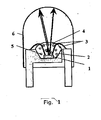
- a source of white light includes a semiconductor radiation crystal 1 of Al-In-Ga-N mounted in a micro-reflector 2.
- the crystal 1 is equipped with inputs 3 for bringing the power supply.
- the crystal 1 has a coating containing a phosphor.
- the coating is an immersion medium filling the microreflector 2 and, in an epoxy composition 4, represents dispersed particles 5 of the phosphor.
- the phosphor used is a bivalent europium-activated ⁇ -sialon material.
- a lens 6 made of a transparent epoxy composition is glued thereto.
- This semiconductor source operates in the following manner.
- the crystal 1 is connected by means of the inputs 3 to the power supply source (not shown in the drawing); He begins to emit light in the blue-violet spectral range.
- the particles 5 of the phosphor dispersed in the epoxy composition 4 absorb a part of the radiation of the crystal 1 and emit the light in the yellow spectral range.
- the two radiations give the white color, mixing them in a ratio determined by the thickness of the phosphor coating and the concentration of the particles contained therein.
- the phosphor whose composition corresponded to the formula Eu 0.5 , Si 7.5 , AL 4.5 , O 3.5 , N 12.5 (SiAlON: Eu), and the light source were tested in which the Al in-Ga-N-crystal was obtained with the method of gas phase epitaxy of organometallic compounds A1, 1a and Ga in the presence of ammonia, with quantum-metric heterostructure having the composition of the active In In 0.2 Ga 0.8 N and a coating containing the above-mentioned phosphor ,
- the existing on the market phosphor aluminum yttrium garnet brand PTCW01-B which was activated with Zer, production "Phosphor Tech", USA (YAG: Ce), and tested the light source, in which the Al In-Ga-N crystal having the same spectral characteristics which are also present in the crystal in the light source according to the invention and the coating containing the phosphor YAG: Ce was used
- the excitation spectra of the phosphors SiAlON: Eu and YAG: Ce were investigated.
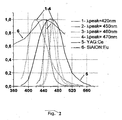
- Fig. 2 are (in relative units) the dependencies of the intensities of the excitation spectra of the phosphors SiAl0N: Eu (curve 6) and YAG: Ce (curve 5) of the wavelength and (in relative units) the dependencies of the intensities of the radiation spectra of the crystals on the basis of Systems Al-In-Ga-N with a different content of In and Ga in the active region (curves 1-4) shown by the wavelength.
- the quantum output of the radiation of the phosphors SiAlON: Eu and YAG: Ce was investigated.
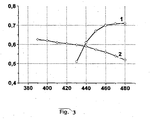
- Fig. 3 The dependencies of the quantum output of the emission of the phosphors SiAlON: Eu (curve 2) and YAG: Ce (curve 1) are shown by the wavelength of the exciting radiation.
- the phosphor SiAlON: Eu has a broad excitation spectrum covering the entire range of wavelengths from 400 to 480nm, which contains the maxima of the typical radiation spectra of the crystals based on the Al-In-Ga-N system, and an almost flat dependence on the wavelength of the quantum output of the emission in the region of the wavelength to be considered, which increases slightly towards the short-wave edge.
- the phosphor YAG: Ce is characterized by the bell-like shape of the curve of the excitation spectrum, which drops almost to zero at the short-wave edge of the wavelength range of 400-480nm. Accordingly shows the curve of the quantum output of the phosphor YAG: Ce a significant decrease in the wavelengths, which are less than 440nm.
- the phosphor SiAlON: EU is characterized by a broad range of wavelengths due to the matching of the excitation spectrum with the radiation spectra (pumps) of the crystals based on the Al-In-Ga-N system, so that the scope of the is extended to use for the light source according to the invention suitable crystals.
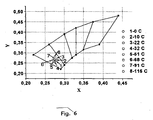
- Fig. 5 is shown (in relative units) the dependence of the wavelength of the radiation spectra of the light sources with the phosphor SiAlON: Eu at different temperatures in the range of 0 to 115 ° C, while in Fig. 6 the position of the chromaticity coordinates corresponding to said radiation spectra is shown on the color diagram.
- the ratio of the blue and yellow stripes in the radiation spectra of the light source remains practically constant when changing the temperature (there is no deletion effect of the photoluminescence) and accordingly, as can be seen from the drawing in Fig. 6 can discern, the color coordinates of the radiation barely change with the temperature, while remaining within one and the same hue of the white color.
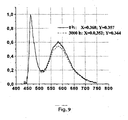
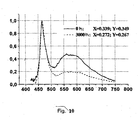
- the performance degradation of the spectral characteristics has been dependent on the time of use of the light source with the phosphor SiAlON: Eu ( Fig. 9 ) and the Light source with the phosphor YAG: Ce ( Fig. 10 ).
- the solid line depicts the dependencies on the wavelength of the intensities of the radiation spectra of the corresponding light sources at the initial moment of time, and the dotted line shows the dependencies after the 3000 hours of use, with the ambient temperature being 60 ° C and the feed dc current 20mmA was.
- Fig. 9 As it turned out Fig. 9 can be detected, takes place, depending on the time no remarkable change in the spectral characteristics of the light source with the phosphor SiAlON: Eu, while Fig. 10 the spectral characteristic of the light source with the phosphor YAG: Ce shows a shift of the color into the blue region as a function of time.
- the new white light semiconductor source developed by the inventors comprising a crystal based on the Al-In-Ga-N system and a coating comprising the phosphor oxinitride- ⁇ -sialon, represented by divalent europium is activated, via a high optical efficiency.
- the light source according to the invention has a high temperature and time stability of the parameters.
- the present invention can be widely used in various industries.
- the proposed semiconductor sources for white light can be used as elements of lighting devices, especially in systems with LEDs, for example for light-optical railway traffic lights, as signal lights in life jackets, for illuminating structural elements in furniture, for the illumination of Manyschildem and advertising space.
Landscapes
- Chemical & Material Sciences (AREA)
- Inorganic Chemistry (AREA)
- Engineering & Computer Science (AREA)
- Materials Engineering (AREA)
- Organic Chemistry (AREA)
- Luminescent Compositions (AREA)
- Electrochromic Elements, Electrophoresis, Or Variable Reflection Or Absorption Elements (AREA)
Description
- Die Erfindung bezieht sich auf die Optoelektronik, und zwar auf Konstruktionen von Halbleiterquellen für die Ausstrahlung von Weißlicht.
- Halbleitergeräte, die Weißlicht ausstrahlen, sind vom Standpunkt ihrer Nutzung als wirtschaftliche und sichere Lichtquellen sehr bedeutungsvoll und können die traditionellen Glühlampen und Kaltlichtlampen in Beleuchtungssystemen ersetzen.
- Es sind Konstruktionen mit LEDs bekannt, zum Beispiel durch den Artikel von S. Nakamura, G. FasoL "The blue laser diode", Kapitel 10.4 "White LEDs", S. 343, Springer-Verlag, Berlin 1997,
US-Patent 5962971, veröffentlicht 2001 , die einen Halbleiter-Elektrolumineszenzkristall, der das Licht im blauen Spektralbereich ausstrahlt, und eine auf dem Kristall aufgetragene Beschichtung aus Fotoluminiszenzmaterial aufweisen, dessen Anregungsspektrum mit dem Strahlungsspektrum des Kristalls abgestimmt ist. Dabei strahlt das Fotolumineszenzmaterial gelbes Licht aus, das bei der Vermischung mit dem vom Kristall ausgestrahlten Licht Weißlicht ergibt. - Das beschriebene Prinzip der Gewinnung von Weißlicht liegt der vorliegenden Konstruktion der Halbleiterquelle für Weißlicht zugrunde (
US 5998925, veröffentlicht 1999 ). - Die erwähnte Lichtquelle enthält einen Halbleiter-Elektrolumineszenzkristall auf der Basis eines Mehrelementen-Systems AL-In-Ga-N, das Licht im violett-blauen Spektralbereich erzeugt, und eine Beschichtung, die einen Leuchtstoff enthält, für das Aluminiuum-Yttrium-Granat verwendet wird, das durch Zer aktiviert ist.
- Der in der erwähnten Konstruktion verwendete Leuchtstoff hat im blau-violetten Spektralbereich ein verhältnismäßig enges Anregungsspektrum mit einem Maximum bei einer Wellenlänge von 470 nm, während die AL-In-Ga-N-Kristalle eine bemerkenswerte Streuung abhängig von den Längen der Erzeugungswellen haben. Dabei verfügen die Kristalle über eine maximale Effektivität im kurzwelligen Bereich von 400-450 nm, wodurch der Lichtwirkungsgrad der zu betrachtenden Halbleiterlichtquelle verringert wird.
- Außerdem verfügt der in dieser Konstruktion verwendete Leuchtstoff über eine verhältnismäßig niedrige Temperatur zum Löschen der Lumineszenz.
- Es ist ferner bekannt durch EU-aktiviertes α-Sialon-Material als Leuchtstoff zur Erzeugung von weißem Licht zu verwenden, wobei eine sehr effiziente Lumineszenz erreicht wird (Krevel van J W H et Al "Luminescence Properties of Terbium-, Cerium-, Or Europhium-doped Alpha-Sialon Materials" Journal of solid state chemistry, Orlando, FI, US, Bd. 165, Nr. 1, 1. April 2002 (2002-04-01), Seiten 19 - 24, XP001157540 ISSN: 0022-4596).
- Es ist Aufgabe der Erfindung, auf der Basis von AL-In-Ga-N-Strahlungskristallen unter Verwendung der bekannten Zusammensetzungen eine Halbleiterquelle für Weißlicht zu schaffen, die eine hohe optische Effektivität und Stabilität der Parameter verfügt.
- Die gestellte Aufgabe wird nach der Erfindung dadurch gelöst, dass der Leuchtstoff zusätzlich Fluor in einem Anteil von 1 - 25 % at im Verhältnis zum Gesamtgehalt von Stickstoff, Sauerstoff und Fluor im Oxonitrid-α-Sialvnmaterial enthält.
- Die Einführung von Fluor in den Leuchtstoff vereinfacht die Valenzabstimmung der Elemente der Leuchtstoffe. Gleichzeitig erhöht die Fluoreinführung in die Matrix die Ionengehaltstufe der Bindungen rings um das Europium-Atom, was eine hohe Zunahme der Lumineszenzeffektivität zur Folge hat.
- Bei der Lichtquelle gemäß der Erfindung wird ein Strahlungskristall auf der Basis des Mehrelementen-Systems Al-In-Ga verwendet, der je nach dem Gehalt an In und Ga im aktiven Bereich ein solches Licht austrahlt, das dem echten (gesättigten) violetten, blauen oder hellblauen Licht nahe liegt (die Halbbreite der spektralen Linie beträgt ca. 15 - 20 nm, und die Lage des Maximums variiert im Bereich einer Wellenlänge von 400 - 470 nm.
- Das für de Realisierung der Erfindung erforderliche gelbe Licht der Lumineszenz als Zusatz zum violett-blauen Licht wird durch die zentrumsintemen Übergänge der Atome vom zweiwertigen Europium gewährleistet, das in die Teilchen des Leuchtstoffs eingeführt ist, dessen Grundlage ein Oxinitrid-α-Sialon-Material bildet.
- Die Oxinitrid- α-Sialon-Materialien gehören zu der umfangreichen Gruppe der Sia-Ionmaterialien und stellen Oxonitrid-Phasen von variablen Zusammensetzungen dar (feste Lösungen), die Silizium (Si), Aluminium (Al), Sauerstoff (O), Stickstoff (N) enthalten (R. A. Andriyewskiy, I. I. Spivak, "Siliziumnitrid und die Materialien auf seiner Grundlage", M: Verlag Metallurgie, 1984, Seiten 5-15). Zur Zusammensetzung von Sialon können außer den erwähnten vier Elementen auch andere Elemente gehören. Insbesondere kann Silizium teilweise durch Germanium ersetzt werden, und Aluminium kann durch Gallium teilweise ersetzt werden. Außerdem können zur Zusammensetzung von Sialon alkalische Metalle und Erdalkalimetalle, wie Lithium, Natrium, Kalium, Rubidium, Zäsium, Berylium, Magnesium, Kalzium, Strontium und Barium, gehören.
- Bei der vorliegenden Erfindung wird als Grundlage für den Leuchtstoff Oxinitrid- α-Sialon-Material verwendet, das unabhänig von der konkreten Zusammensetzung in struktureller Hinsicht α-Siliziumnitrid wiedergibt, dessen Karkassematrix (und dementsprechend die Karkassematrix von Oxinitrid-α-Sialon) Höhlen besitzt, die nach den Ausmaßen und der Koordination mit den Atomen des Aktivators des Leuchtstoffs abgestimmt sind, wobei als Aktivator zweiwertiges Europium ausgewählt ist.
- Insbesondere kann als Leuchtstoff bei der Halbleiterlichtquelle gemäß der Erfindung durch zweiwertiges Europium aktiviertes Oxinitrid-α-Sialon-Material verwendet werden, dessen Zusammensetzung im Bereich von 0,25% Eu, 10% Si, 2,0% Al, 1,75% O bis 15,25% N liegen kann. Die maximale Effektivität der Fotolumineszenz wurde bei einer Zusammensetzung des Leuchtstoffs von 0,5% Eu, 7,5% Si, 4,5% Al, 3,5% O und 12,5% N erreicht.
- Wie von den Erfindern durchgeführte Untersuchungen zeigten, besitzt das als Leuchtstoff ausgewählte, durch zweiwertiges Europium aktivierte Oxinitrid-α-Sialon-Material ein breites Anregungsspektrum im Bereich der Wellenlängen von 400-470nm, der das Gebiet des Auftretens von Maxima der typischen Strahlungsspektren der Kristalle auf der Basis von Al-In-Ga-H überdeckt. Dabei strahlt der Leuchtstoff Licht im Bereich der Wellenlangen von 560-580nm ab, der dem gelben Spektralbereich entspricht, der in der Kombination mit dem vom Kristall ausgestrahlten Licht weißes Licht ergibt.
- Die Fähigkeit der Oxinitrid-α-Sialonmatrix zu heterovalenten Ersetzungen erlaubt neben dem Europium in den Leuchtstoff ein oder mehrere Elemente aus der Gruppe Ce, Pr, Nd, Sm, Gd, Tb, Dy, Ho, Er, Tm, Yb, Mn, Ti, Cr, Sn oder deren Verbindungen aufzunehmen. Die Einführung der erwähnten Elemente erlaubt, die Frequenzcharakteristiken der Anregungsspektren und der Ausstrahlungen des Leuchtstoffs zu verwalten. Dies wird dadurch erreicht, dass die Atome der erwähnten Elemente, indem sie die anregende Ausstrahlung absorbieren, nicht nur das Strahlungsspektrum ergänzen, sondern auch die Energie den benachbarten Atomstrahlem (hauptsächlich Europium) übergeben können, d.h., dass ein Sensibilisierungseffekt realisiert werden kann.
- Die summarische Menge an Europium und an zusätzlich aufgenommenen Elementen, bei der (registriert beim Versuch) ein wesentlicher Lumineszenzeffekt erreicht wird, beträgt mindestens 0,3% at. Die maximal mögliche, summarische Menge an Europium und an zusätzlich aufgenommenen Elementen wird von dem natürlich möglichen Auffüllungsgrad der Matrixhöhlen durch den als Grundlage ausgewählten Leuchtstoff des konkreten Oxinitrid-α-Sialon-Materials begrenzt.
- Die Einmischung von Fluor in den Leuchtstoff vereinfacht die Abstimmung der Valenzen der Elemente, die zur Zusammensetzung des Leuchtstoffs gehören, und erhöht gleichzeitig den lonengehalt der Karkassematrix, wodurch die Lumineszenzeffektivität positiv beeinflusst wird. Die Grenzwerte des Gehalts an Fluor im Leuchtstoff beträgt von 1-25% at vom gesamten Gehalt an Sauerstoff, Stickstoff und Fluor im Leuchtstoff. Damit die oben genannten Effekte auftreten können, soll die Menge an Fluor mindestens 1 % at sein. Bei einer Menge an Fluor von mehr als 25% at geht die Standfestigkeit der Karkassenstruktur des Leuchtstoffs verloren.
- Der Leuchtstoff kann insbesondere mit dem Verfahren der gemeinsamen hydrolytischen Sedimentation mittels einer konzentrierten Lösung von Ammoniak der hochaktiven Oxid-Mischung jener Metalle, die als Bestandteile der Grundlage des Kationteils der zu synthetisierenden α-Sialon-Matrix ausgewählt sind, aus den jeweiligen elementorganischen Verbindungen oder unorganischen Salzen gewonnen werden. Zur Einführung von Europium und anderen zusätzlichen Elementen in den Leuchtstoff wird die ausgetrocknete Mischung der gewonnenen Oxide mit Europiumoxid oder Europiumfluorid sowie mit dem Oxid (Oxiden) oder dem Fluorid (Fluoriden) des jeweiligen Elements (Elemente) gemischt, wobei das Verfahren des Nassmahlens in einem Medium aus Isopropylalkohol eingesetzt wird. Dann wird die Mischung einem gestuften Glühen in einer Ammoniak-Atmosphäre unterzogen, wobei der Dissoziationsgrad im Reaktor kontrolliert wird. In der Schlussphase der Synthese wird das homogenisierende Glühen des Produkts in einer Stickstoff-Atmosphäre bei einer Temperatur von mehr als 1500°C durchgeführt. Das Ausmaß der Teilchen des zu gewinnenden Leuchtstoffs variiert im Bereich von 5-25 mkm.
- Bei der Halbleiterlichtquelle gemäß der Erfindung kann die Beschichtung, die den Leuchtstoff enthält, als ein den Strahlungskristall deckenden Immersionsmedium ausgeführt sein, das die in einer Epoxid-Zusammensetzung verteilten Teilchen des durch das zweiwertige Europium aktivierten Oxonitrid-α-Sialon-Materials darstellt. Der Gehalt an Leuchtstoff in der Zusammensetzung kann in einem großen Bereich variieren und normalerweise von 30-60 Gew.% betragen.
- Die vorliegende Erfindung wird nun anhand von Ausführungsbeispielen näher erläutert. Es zeigen:
- Fig.1
- einen Schnitt durch eine Halbleiterquelle für Weißlicht gemäß der Erfindung,
- Fig. 2
- eine Darstellung des Anregungsspektrums eines Leuchtstoffs aus 0,5% Eu, 7,5% Si, 4,5% Al, 3,5% O, 12,5% N (weiter SiAION:Eu), eine Darstellung des Anregungsspektrums eines Leuchtstoffs aus Aluminium- Yttrium-Granat der Marke PTCW01-B, das durch Zer aktiviert ist, Produktion "Phosphor Tech", USA (weiter YAG:Ce) und eine Darstellung der Arten der typischen Strahlungsspektren der Strahlungskristalle auf der Basis des Systems Al-ln-Ga-N mit einem unterschiedlichen Gehalt an In und Ga im aktiven Bereich,
- Fig. 3
- eine Darstellung der Abhängigkeiten des Quantenausgangs der Aus- strahlung des Leuchtstoffe SiAlON:Eu und YAG:Ce von der Wellenlänge der anregenden Strahlung,
- Fig. 4
- eine Darstellung der Spektren der Fotolumineszenz für die Leuchtstoffe SiAlON:Eu und YAG:Ce,
- Figuren 5 und 6
- Darstellungen der Ergebnisse der Untersuchungen der Temperaturstabilität für die Lichtquelle mit dem Leuchtstoff SiAlON:Eu,
- Figuren 7 und 8
- Darstellungen der Ergebnisse der Untersuchungen der Temperaturstabilität für die Lichtquelle mit dem Leuchtstoff YAG:Ce,
- Figuren 9 und 10
- Darstellungen des Abbaus der Spektralcharakteristiken in Abhängigkeit von der Zeit der Nutzungsdauer der Lichtquelle mit dem Leuchtstoff SiAlON:Eu und der Lichtquelle mit dem Leuchtstoff YAG:Ce.
- Eine Quelle für Weißlicht enthält einen Halbleiter-Strahlungs-Kristall 1 aus Al-In-Ga-N, der in einem Mikroreflektor 2 montiert ist. Der Kristall 1 ist mit Eingängen 3 für das Heranführen der Stromversorgung ausgestattet. Der Kristall 1 weist eine Beschichtung auf, die einen Leuchtstoff enthält. Die Beschichtung ist ein den Mikroreflektor 2 füllendes Immersionsmedium und stellt in einer Epoxid-Zusammensetzung 4 verteilte Teilchen 5 des Leuchtstoffs dar. Als Leuchtstoff wurde ein durch zweiwertiges Europium aktiviertes α-Sialon-Material verwendet. Zur Abdichtung der Lichtquelle und zur Bildung einer Strahlungsindikatrix wird darauf eine Linse 6 aus einer durchsichtigen Epoxid-Zusammensetzung aufgeklebt.
- Diese Halbleiterquelle arbeitet auf folgende Weise.
- Der Kristall 1 wird mit Hilfe der Eingänge 3 an die Stromversorgungsquelle (auf der Zeichnung nicht gezeigt) angeschlossen; dabei beginnt er, Licht im blau-violetten Spektralbereich auszustrahlen. Die Teilchen 5 des Leuchtstoffs, die in der Epoxid-Zusammensetzung 4 verteilt sind, absorbieren einen Teil der Strahlung des Kristalls 1 und strahlen das Licht im gelben Spektralbereich aus. Die beiden Strahlungen ergeben die weiße Farbe, wobei sie in einem Verhältnis gemischt werden, die von der Stärke der Leuchtstoffbeschichtung und der Konzentration der darin enthaltenen Teilchen bestimmt wird.
- Es wurden der Leuchtstoff, dessen Zusammensetzung der Formel Eu 0,5, Si 7,5, AL 4,5, O 3,5, N12,5 (SiAlON:Eu) entsprach, und die Lichtquelle getestet, in der der Al-In-Ga-N-Kristall verwendet wurde, der mit dem Verfahren der Gasphasenepitaxie aus metallorganischen Verbindungen A1, 1a und Ga in Anwesenheit von Ammoniak gewonnen wurde, mit quantenmetrischer Heterostruktur, die die Zusammensetzung des aktiven Bereichs In0.2Ga0.8N sowie eine Beschichtung hat, die den oben genannten Leuchtstoff enthält. Zum Vergleich wurden der auf dem Markt vorhandene Leuchtstoff aus Aluminium-Yttrium-Granat der Marke PTCW01-B, der mit Zer aktiviert wurde, Produktion "Phosphor Tech", USA (YAG:Ce), und die Lichtquelle getestet, in der der Al-ln-Ga-N-Kristall mit den gleichen Spektralcharakteristiken, die auch bei dem Kristall in der Lichtquelle gemäß der Erfindung vorhanden sind, und die Beschichtung, die den Leuchtstoff YAG:Ce enthält, verwendet wurde
- Es wurden die Anregungsspektren der Leuchtstoffe SiAlON:Eu und YAG:Ce untersucht. In
Fig. 2 sind (in relativen Einheiten) die Abhängigkeiten der Intensitäten der Anregungsspektren der Leuchtstoffe SiAl0N:Eu (Kurve 6) und YAG:Ce (Kurve 5) von der Wellenlänge sowie (in relativen Einheiten) die Abhängigkeiten der Intensivitäten der Strahlungsspektren der Kristalle auf der Basis des Systems Al-In-Ga-N mit einem unterschiedlichen Gehalt an In und Ga im aktiven Bereich (Kurven 1-4) von der Wellenlänge dargestellt. - Es wurde der Quantenausgang der Strahlung der Leuchtstoffe SiAlON:Eu und YAG:Ce untersucht. In
Fig. 3 sind die Abhängigkeiten des Quantenausgangs der Ausstrahlung der Leuchtstoffe SiAlON:Eu (Kurve 2) und YAG:Ce (Kurve 1) von der Wellenlänge der anregenden Ausstrahlung dargestellt. - Wie sich aus den grafischen Darstellungen in den
Figuren 2 und3 erkennen lässt, hat der Leuchtstoff SiAlON:Eu ein breites Anregungsspektrum, das den ganzen Bereich der Wellenlängen von 400 bis 480nm überdeckt, in dem sich die Maxima der typischen Strahlungsspektren der Kristalle auf der Basis des Systems Al-In-Ga-N befinden, und eine fast flache, zum kurzwelligen Rand etwas steigende Abhängigkeit von der Wellenlänge des Quantenausgangs der Ausstrahlung im zu betrachtenden Bereich der Wellenlängen. Gleichzeitig zeichnet sich der Leuchtstoff YAG:Ce durch die glockenartige Form der Kurve des Anregungsspektrums aus, die fast bis auf Null am kurzwelligen Rand des Wellenlängenbereichs von 400-480nm abfällt. Dementsprechend zeigt die Kurve des Quantenausgangs des Leuchtstoffs YAG:Ce einen erheblichen Rückgang bei den Wellenlängen, die weniger als 440nm betragen. - Daraus lässt sich schlussfolgem, dass der Leuchtstoff SiAlON:EU durch die Übereinstimmung des Anregungsspektrums mit den Strahlungsspektren (Pumpen) der Kristalle auf der Basis des Systems Al-In-Ga-N durch einen breiten Bereich der Wellenlängen charakterisiert ist, so dass der Umfang der zur Nutzung für die Lichtquelle gemäß der Erfindung geeigneten Kristalle erweitert wird.
- Der Leuchtstoff SiAlON:EU ist auch durch eine hohe Quanteneffektivität der Umgestaltung der Pumpen-Ausstrahlung in die Lumineszenzausstrahlung charakterisiert. Es ist in diesem Zusammenhang besonders aktuell, dass sich, wie die letzten experimentalen Untersuchungen von T. Mukai, "Recent Progress in Group-III Nitride Light-emitting Diodes", IEEE J. on selected topic of quantum electronics, V. 6, Nr. 2, 2002, Seite 264, zeigen, der maximale äußere Quantenausgang (maximale Effektivität) der Al-bi-Ga-N-LEDs im kurzwelligen Bereich (λ=400-440nm) des zu betrachtenden Bereichs der Wellenlängen beobachten lässt.
- Es wurden die Spektren der Fotolumineszenz der Leuchtstoffe SiAlON:Eu und YAG:Ce bei der Anregung durch die Pumpen-Ausstrahlung λmax=470nm untersucht. In
Fig. 4 sind (in relativen Einheiten) die Abhängigkeiten der Intensitäten der Strahlungsspektren für die Leuchtstoffe SiAION:Eu (punktierte Linie) und YAG:Ce (Volllinie) von der Wellenlänge gezeigt - Wie aus den Kurven hervorgeht, haben beide Leuchtstoffe die gleiche, dominante Wellenlänge der Ausstrahlung λdom=574nm, was erlaubt, bei der Vermischung mit der Pumpen-Ausstrahlung für jeden der Leuchtstoffe weißes Licht zu erhalten, das dem "idealen" Weißlicht nahe kommt (für den Leuchtstoff SiAlON:Eu sind die Farbenkoordinaten x=0,325 und y=0,346; für den Leuchtstoff YAG:Ce sind die Farbenkoordinaten x=0,324 und y=0,342). Jedoch gilt als wichtiger Vorteil des Leuchtstoffs SiAl0N:Eu die Abwesenheit eines "Langweiten-Schwanzes" in seinem Fotolumineszenzspektrum, der außerhalb des vom menschlichen Auge wahrnehmbaren Spektralbereichs liegt, was sich auf seine Lichteffektivität auswirkt (die Lichteffektivität für den Leuchtstoff SiA10N:Eu beträgt Kv=310 Im/W, für den Leuchtstoff YAG:Ce Kv=260 Im/W).
- Es wurde die Veränderung in Abhängigkeit von der Umgebungstemperatur der Spektralcharakteristiken der Lichtquelle mit der Pumpen-Ausstrahlung λmax=470nm jedes Leuchtstoffs SiAlON:Eu bzw. YAG:Ce untersucht.
- In
Fig. 5 ist (in relativen Einheiten) die Abhängigkeit von der Wellenlänge der Strahlungsspektren der Lichtquellen mit dem Leuchtstoff SiAlON:Eu bei unterschiedlichen Temperaturen im Bereich von 0 bis 115°C dargestellt, während inFig. 6 die den erwähnten Strahlungsspektren entsprechende Position der Farbigkeitskoordinaten auf dem Farbendiagramm dargestellt ist. - Wie aus den Kurven in
Fig. 5 zu erkennen ist, bleibt bei der Veränderung der Temperatur das Verhältnis der blauen und gelben Streifen in den Strahlungsspektren der Lichtquelle praktisch konstant (es gibt keinen Löscheffekt der Fotolumineszenz) und dementsprechend, wie sich aus der Zeichnung inFig. 6 erkennen lässt, ändem sich die Farbigkeitskoordinaten der Ausstrahlung kaum mit der Temperatur, wobei sie innerhalb einer und derselben Tönung der weißen Farbe bleiben. - In den
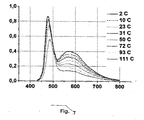
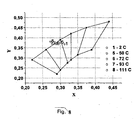
Figuren 7 und8 sind die Ergebnisse der gleichen Untersuchungen der Temperaturstabilität für die Lichtquelle mit dem Leuchtstoff YAG:Ce (im Temperatur bereich von 0 bis 111 °C) dargestellt. - Wie sich aus den Kurven in diesen Figuren erkennen lässt, erfolgt ab der Temperatur von 50°C ein bemerkenswertes Löschen der Fotolumineszenz, das zur Veränderung der Farbigkeitskoordinaten der Ausstrahlung der Lichtquelle und zu einer Abstrahlung außerhalb der Bereichs der weißen Farbe (
Fig. 8 ) führt. - Ferner wurde der Leistungsabfall der Spektralcharakteristiken abhängig von der Zeit der Nutzungsdauer der Lichtquelle mit dem Leuchtstoff SiAlON:Eu (
Fig. 9 ) und der Lichtquelle mit dem Leuchtstoff YAG:Ce (Fig. 10 ) untersucht. In denFiguren 9 und10 sind mit der Volllinie (in relativen Einheiten) die Abhängigkeiten von der Wellenlänge der Intensitäten der Strahlungsspektren der entsprechenden Lichtquellen im Anfangsmoment der Zeit und mit der gestrichelten Linie die betreffende Abhängigkeiten nach der Nutzungsdauer von 3000 Stunden gezeigt, wobei die Umgebungstemperatur 60°C und der Speisegleichstrom 20mmA betrug. - Wie sich aus
Fig. 9 erkennen lasst, erfolgt abhängig von der Zeit keine bemerkenswerte Veränderung der Spektralcharakteristik der Lichtquelle mit dem Leuchtstoff SiAlON:Eu, während nachFig. 10 die Spektralcharakteristik der Lichtquelle mit dem Leuchtstoff YAG:Ce abhängig von der Zeit eine Verschiebung der Farbe in den blauen Bereich zeigt. - Wie Untersuchungen gezeigt haben, verfügt die neue, von den Erfindern entwickelte Halbleiterquelle für Weißlicht, die einen Kristall auf der Basis des Systems Al-ln-Ga-N und eine Beschichtung, die den Leuchtstoff Oxinitrid-α-Sialon aufweist, der durch zweiwertiges Europium aktiviert ist, über eine hohe optische Effektivität.
- Außerdem verfügt die Lichtquelle gemäß der Erfindung über eine hohe Temperatur- und Zeit-Stabilität der Parameter.
- Die vorliegende Erfindung kann eine breite Anwendung in verschiedenen Wirtschaftszweigen finden. Die vorgeschlagenen Halbleiterquellen für Weißlicht können als Elemente von Leuchteinrichtungen, insbesondere in Systemen mit LEDs, beispielsweise für lichtoptische Eisenbahnampeln, als Signallichter im Rettungswesten, für das Ausleuchten von konstruktiven Elementen bei Möbeln, für die Beleuchtung von Werbeschildem und von Werbeflächen verwendet werden.
- Besonders bedeutungsvoll ist die Nutzung der vorliegenden Erfindung in Lichteinrichtungen, die für die Straßenbeleuchtung und der Beleuchtung von Räumen vorgesehen sind. Die Halbleiterquelle für Weißlicht gemäß der Erfindung wurde im Forschungslaboratorium für optische Messungen ZAO "Swetlana-Optoelektronik" erprobt und hat eine hohe optische Effektivität gezeigt.
Claims (1)
- Halbleiterquelle für Weißlicht, die einen Halbleiter-Strahlungskristall (1) auf der Basis eines Mehrelementensystems Al-In-Ga-N, das Licht im violett-blauen Spektralbereich erzeugt, und eine Beschichtung aufweist, die einen Leuchtstoff (5) enthält, der einen Teil des vom Kristall (1) ausgestrahlten Lichts absorbiert und Licht im gelben Spektralbereich abstrahlt, wobei als Leuchtstoff (5) durch zweiwertiges Europium aktiviertes α-Sialonmaterial verwendet wird und wobei der Leuchtstoff (5) zusätzlich ein Element oder mehrere Elemente aus der Gruppe Ce, Pr, Nd, Sm, Gd, Tb, Dy, Ho, Er, Tm, Yb, Mn, Ti, Cr, Sn enthält,
dadurch gekennzeichnet,
dass der Leuchtstoff (5) zusätzlich Fluor in einem Anteil von 1-25 % at im Verhältnis zum Gesamtgehalt von Stickstoff, Sauerstoff und Fluor im Oxonitrid-α-Sialonmaterial enthält.
Applications Claiming Priority (3)
| Application Number | Priority Date | Filing Date | Title |
|---|---|---|---|
| RU2002129264 | 2002-10-25 | ||
| RU2002129264/28A RU2219622C1 (ru) | 2002-10-25 | 2002-10-25 | Полупроводниковый источник белого света |
| PCT/RU2003/000472 WO2004038815A1 (en) | 2002-10-25 | 2003-10-23 | Semiconductor white light source |
Publications (3)
| Publication Number | Publication Date |
|---|---|
| EP1560273A1 EP1560273A1 (de) | 2005-08-03 |
| EP1560273A4 EP1560273A4 (de) | 2008-06-18 |
| EP1560273B1 true EP1560273B1 (de) | 2011-07-06 |
Family
ID=32067138
Family Applications (1)
| Application Number | Title | Priority Date | Filing Date |
|---|---|---|---|
| EP03774413A Expired - Lifetime EP1560273B1 (de) | 2002-10-25 | 2003-10-23 | Halbleiter-weisslichtquelle |
Country Status (5)
| Country | Link |
|---|---|
| EP (1) | EP1560273B1 (de) |
| AT (1) | ATE515551T1 (de) |
| AU (1) | AU2003284852A1 (de) |
| RU (1) | RU2219622C1 (de) |
| WO (1) | WO2004038815A1 (de) |
Families Citing this family (20)
| Publication number | Priority date | Publication date | Assignee | Title |
|---|---|---|---|---|
| CA2592096C (en) * | 2004-12-22 | 2013-08-06 | Seoul Semiconductor Co., Ltd. | Light emitting device |
| RU2379787C2 (ru) * | 2005-03-24 | 2010-01-20 | Эдженси оф Саэнс, Текнолоджи энд Рисёч | Белый светоизлучающий диод на основе нитрида металла группы iii |
| US7800123B2 (en) * | 2005-05-25 | 2010-09-21 | Koninklijke Philips Electronics N.V. | Electroluminescence device |
| RU2313157C1 (ru) * | 2006-06-09 | 2007-12-20 | Институт проблем технологии микроэлектроники и особочистых материалов Российской Академии Наук (ИПТМ РАН) | Способ получения видимого света и люминесцентные источники на его основе (варианты) |
| WO2007148253A1 (en) * | 2006-06-21 | 2007-12-27 | Philips Intellectual Property & Standards Gmbh | Light emitting device with a at least one ceramic spherical color converter material |
| DE102006034139A1 (de) * | 2006-07-24 | 2008-01-31 | Patent-Treuhand-Gesellschaft für elektrische Glühlampen mbH | Lichtquelle und Leuchtstoffschicht für eine Lichtquelle |
| US7521862B2 (en) * | 2006-11-20 | 2009-04-21 | Philips Lumileds Lighting Co., Llc | Light emitting device including luminescent ceramic and light-scattering material |
| WO2008068689A1 (en) * | 2006-12-05 | 2008-06-12 | Philips Intellectual Property & Standards Gmbh | Illumination device, particularly with luminescent ceramics |
| RU2352028C1 (ru) * | 2007-11-23 | 2009-04-10 | Учреждение Российской академии наук Институт металлоорганической химии им.Г.А.Разуваева РАН | Органический светоизлучающий диод |
| US8129735B2 (en) * | 2008-09-24 | 2012-03-06 | Koninklijke Philips Electronics N.V. | LED with controlled angular non-uniformity |
| WO2010090289A1 (ja) * | 2009-02-05 | 2010-08-12 | シーシーエス株式会社 | Led発光装置 |
| KR101749220B1 (ko) * | 2009-06-04 | 2017-06-20 | 코닌클리케 필립스 엔.브이. | 효율적인 광 방출 디바이스 및 그러한 디바이스의 제조 방법 |
| WO2011004637A1 (ja) * | 2009-07-06 | 2011-01-13 | シャープ株式会社 | 照明装置、表示装置、及びテレビジョン受像器 |
| CN102194970B (zh) * | 2010-03-12 | 2014-06-25 | 四川新力光源股份有限公司 | 脉冲电流驱动的白光led照明装置 |
| CN102192422B (zh) * | 2010-03-12 | 2014-06-25 | 四川新力光源股份有限公司 | 白光led照明装置 |
| DE112010005456T5 (de) | 2010-03-16 | 2013-06-13 | "Dis Plus" Ltd. | Verfahren zur Lichtstromfarbregelung einer Weißleuchtdiode und Einrichtung zur Durchführung des Verfahrens |
| MX2013005202A (es) * | 2010-03-30 | 2013-11-20 | Changchn Inst Of Applied Chemistry Chinese Academy Of Sciences | Dispositivo de corriente alterna de led blanco. |
| RU2455335C2 (ru) * | 2010-05-26 | 2012-07-10 | Геннадий Николаевич Мельников | Фотолюминофор желто-оранжевого свечения и светодиод на его основе |
| RU2456712C1 (ru) * | 2011-03-02 | 2012-07-20 | Федеральное государственное бюджетное учреждение науки Институт физики твердого тела Российской академии наук (ИФТТ РАН) | Источник белого света |
| RU2472252C1 (ru) * | 2011-06-22 | 2013-01-10 | Государственное образовательное учреждение высшего профессионального образования Томский государственный университет систем управления и радиоэлектроники (ГОУ ВПО ТУСУР) | Способ изготовления полупроводникового источника света |
Family Cites Families (6)
| Publication number | Priority date | Publication date | Assignee | Title |
|---|---|---|---|---|
| TW383508B (en) * | 1996-07-29 | 2000-03-01 | Nichia Kagaku Kogyo Kk | Light emitting device and display |
| US6351069B1 (en) * | 1999-02-18 | 2002-02-26 | Lumileds Lighting, U.S., Llc | Red-deficiency-compensating phosphor LED |
| RU2214073C2 (ru) * | 1999-12-30 | 2003-10-10 | Общество с ограниченной ответственностью "Научно-производственное предприятие "Кристаллы и Технологии" | Источник белого света |
| US6522065B1 (en) * | 2000-03-27 | 2003-02-18 | General Electric Company | Single phosphor for creating white light with high luminosity and high CRI in a UV led device |
| RU2170995C1 (ru) * | 2000-08-31 | 2001-07-20 | Общество с ограниченной ответственностью "Корвет - Лайтс" | Светодиодное устройство |
| GB2373368B (en) * | 2001-03-12 | 2004-10-27 | Arima Optoelectronics Corp | Light emitting devices |
-
2002
- 2002-10-25 RU RU2002129264/28A patent/RU2219622C1/ru not_active IP Right Cessation
-
2003
- 2003-10-23 AU AU2003284852A patent/AU2003284852A1/en not_active Abandoned
- 2003-10-23 AT AT03774413T patent/ATE515551T1/de active
- 2003-10-23 WO PCT/RU2003/000472 patent/WO2004038815A1/ru not_active Ceased
- 2003-10-23 EP EP03774413A patent/EP1560273B1/de not_active Expired - Lifetime
Also Published As
| Publication number | Publication date |
|---|---|
| AU2003284852A1 (en) | 2004-05-13 |
| ATE515551T1 (de) | 2011-07-15 |
| WO2004038815A1 (en) | 2004-05-06 |
| EP1560273A4 (de) | 2008-06-18 |
| EP1560273A1 (de) | 2005-08-03 |
| RU2219622C1 (ru) | 2003-12-20 |
Similar Documents
| Publication | Publication Date | Title |
|---|---|---|
| EP1116419B1 (de) | Leuchtstoffanordnung wellenlängenkonvertierende vergussmasse und lichtquelle | |
| DE60312733T2 (de) | Beleuchtungsvorrichtung mit strahlungsquelle und fluoreszenzmaterial | |
| EP1116418B1 (de) | Leuchstoff für lichtquellen und zugehörige lichtquelle | |
| EP1560273A1 (de) | Halbleiter-weisslichtquelle | |
| EP1206802B1 (de) | Weiss emittierende beleuchtungseinheit auf led-basis | |
| DE60224798T2 (de) | Breitbandige terbium-granat-leuchtstoffe und damit ausgerüstete weisslichtquellen | |
| DE112007000656B4 (de) | Leuchtstoff, Verfahren zur Herstellung desselben und lichtemittierende Vorrichtungen unter Verwendung desselben | |
| DE112005000370T5 (de) | Leuchtstoff, Verfahren zur Herstellung desselben und lichtmittierende Vorrichtung unter Verwendung des Leuchtstoffs | |
| DE10360546A1 (de) | Leuchtstoff und Lichtquelle mit derartigem Leuchtstoff | |
| DE112007001645T5 (de) | Phosphor, Verfahren zu dessen Herstellung und Licht emittierender Apparat | |
| WO2010020495A1 (de) | Alpha-sialon-leuchtstoff | |
| DE1800671B2 (de) | Leuchtstoff auf der basis von oxychalcogeniden seltener erden | |
| DE19951790A1 (de) | Leuchtstoff für Lichtquellen und zugehörige Lichtquelle | |
| DE102018108842A1 (de) | Leuchtstoffkombination, Konversionselement, optoelektronische Vorrichtung | |
| DE102004060707A1 (de) | Rotes Fluoreszenz-Material, Weißlicht emittierende Diode, die rotes Fluoreszenz-Material verwendet und Beleuchtungssystem, das eine Weißlicht emittierende Diode verwendet | |
| DE102009035100A1 (de) | Leuchtdiode und Konversionselement für eine Leuchtdiode | |
| WO2018185116A2 (de) | Uranyl-sensibilisierte europium-leuchtstoffe | |
| DE102004060708B4 (de) | Rotes Fluoreszenzmaterial und Weißlicht emittierende Dioden, die rotes Fluoreszenzmaterial verwenden | |
| DE102011014958B4 (de) | Gelblicht emittierende Fluorosulfidleuchtstoffe und deren Herstellungsverfahren, sowie eine diesen Leuchtstoff umfassende Weißlicht emittierende Diode | |
| DE19934126A1 (de) | Leuchtstoff für Lichtquellen und zugehörige Lichtquelle | |
| DE10300622B4 (de) | Fluoreszenzpulver zum Herstellen von Weiß-Licht-Emittierenden-Dioden großer Helligkeit und Weiß-Licht-Emittierende Vorrichtung | |
| WO2019238506A1 (de) | Leuchtstoff und beleuchtungsvorrichtung | |
| DE102006027026A1 (de) | Verfahren zur Herstellung eines Linienemitter-Leuchtstoffes | |
| DE112014006040B4 (de) | Leuchtstoff und lichtemittierende Vorrichtung | |
| WO2024033022A1 (de) | Leuchtstoff, verfahren zur herstellung eines leuchtstoffs und strahlungsemittierendes bauelement |
Legal Events
| Date | Code | Title | Description |
|---|---|---|---|
| PUAI | Public reference made under article 153(3) epc to a published international application that has entered the european phase |
Free format text: ORIGINAL CODE: 0009012 |
|
| 17P | Request for examination filed |
Effective date: 20050525 |
|
| AK | Designated contracting states |
Kind code of ref document: A1 Designated state(s): AT BE BG CH CY CZ DE DK EE ES FI FR GB GR HU IE IT LI LU MC NL PT RO SE SI SK TR |
|
| AX | Request for extension of the european patent |
Extension state: LT LV |
|
| DAX | Request for extension of the european patent (deleted) | ||
| A4 | Supplementary search report drawn up and despatched |
Effective date: 20080521 |
|
| 17Q | First examination report despatched |
Effective date: 20090204 |
|
| RIC1 | Information provided on ipc code assigned before grant |
Ipc: C09K 11/08 20060101AFI20101102BHEP Ipc: C09K 11/77 20060101ALI20101102BHEP Ipc: H05B 33/14 20060101ALI20101102BHEP Ipc: H01L 33/50 20100101ALN20101102BHEP |
|
| GRAP | Despatch of communication of intention to grant a patent |
Free format text: ORIGINAL CODE: EPIDOSNIGR1 |
|
| GRAS | Grant fee paid |
Free format text: ORIGINAL CODE: EPIDOSNIGR3 |
|
| GRAA | (expected) grant |
Free format text: ORIGINAL CODE: 0009210 |
|
| AK | Designated contracting states |
Kind code of ref document: B1 Designated state(s): AT BE BG CH CY CZ DE DK EE ES FI FR GB GR HU IE IT LI LU MC NL PT RO SE SI SK TR |
|
| REG | Reference to a national code |
Ref country code: GB Ref legal event code: FG4D Free format text: NOT ENGLISH |
|
| REG | Reference to a national code |
Ref country code: CH Ref legal event code: EP |
|
| REG | Reference to a national code |
Ref country code: IE Ref legal event code: FG4D Free format text: LANGUAGE OF EP DOCUMENT: GERMAN |
|
| REG | Reference to a national code |
Ref country code: DE Ref legal event code: R096 Ref document number: 50313805 Country of ref document: DE Effective date: 20110825 |
|
| REG | Reference to a national code |
Ref country code: NL Ref legal event code: VDEP Effective date: 20110706 |
|
| PG25 | Lapsed in a contracting state [announced via postgrant information from national office to epo] |
Ref country code: SI Free format text: LAPSE BECAUSE OF FAILURE TO SUBMIT A TRANSLATION OF THE DESCRIPTION OR TO PAY THE FEE WITHIN THE PRESCRIBED TIME-LIMIT Effective date: 20110706 |
|
| PG25 | Lapsed in a contracting state [announced via postgrant information from national office to epo] |
Ref country code: SE Free format text: LAPSE BECAUSE OF FAILURE TO SUBMIT A TRANSLATION OF THE DESCRIPTION OR TO PAY THE FEE WITHIN THE PRESCRIBED TIME-LIMIT Effective date: 20110706 Ref country code: NL Free format text: LAPSE BECAUSE OF FAILURE TO SUBMIT A TRANSLATION OF THE DESCRIPTION OR TO PAY THE FEE WITHIN THE PRESCRIBED TIME-LIMIT Effective date: 20110706 Ref country code: PT Free format text: LAPSE BECAUSE OF FAILURE TO SUBMIT A TRANSLATION OF THE DESCRIPTION OR TO PAY THE FEE WITHIN THE PRESCRIBED TIME-LIMIT Effective date: 20111107 |
|
| REG | Reference to a national code |
Ref country code: IE Ref legal event code: FD4D |
|
| PG25 | Lapsed in a contracting state [announced via postgrant information from national office to epo] |
Ref country code: GR Free format text: LAPSE BECAUSE OF FAILURE TO SUBMIT A TRANSLATION OF THE DESCRIPTION OR TO PAY THE FEE WITHIN THE PRESCRIBED TIME-LIMIT Effective date: 20111007 Ref country code: CY Free format text: LAPSE BECAUSE OF FAILURE TO SUBMIT A TRANSLATION OF THE DESCRIPTION OR TO PAY THE FEE WITHIN THE PRESCRIBED TIME-LIMIT Effective date: 20110706 |
|
| BERE | Be: lapsed |
Owner name: SVETLANA-OPTOELEKTRONIKA" Effective date: 20111031 |
|
| PG25 | Lapsed in a contracting state [announced via postgrant information from national office to epo] |
Ref country code: SK Free format text: LAPSE BECAUSE OF FAILURE TO SUBMIT A TRANSLATION OF THE DESCRIPTION OR TO PAY THE FEE WITHIN THE PRESCRIBED TIME-LIMIT Effective date: 20110706 Ref country code: IE Free format text: LAPSE BECAUSE OF FAILURE TO SUBMIT A TRANSLATION OF THE DESCRIPTION OR TO PAY THE FEE WITHIN THE PRESCRIBED TIME-LIMIT Effective date: 20110706 Ref country code: CZ Free format text: LAPSE BECAUSE OF FAILURE TO SUBMIT A TRANSLATION OF THE DESCRIPTION OR TO PAY THE FEE WITHIN THE PRESCRIBED TIME-LIMIT Effective date: 20110706 |
|
| PLBE | No opposition filed within time limit |
Free format text: ORIGINAL CODE: 0009261 |
|
| STAA | Information on the status of an ep patent application or granted ep patent |
Free format text: STATUS: NO OPPOSITION FILED WITHIN TIME LIMIT |
|
| PG25 | Lapsed in a contracting state [announced via postgrant information from national office to epo] |
Ref country code: IT Free format text: LAPSE BECAUSE OF FAILURE TO SUBMIT A TRANSLATION OF THE DESCRIPTION OR TO PAY THE FEE WITHIN THE PRESCRIBED TIME-LIMIT Effective date: 20110706 Ref country code: RO Free format text: LAPSE BECAUSE OF FAILURE TO SUBMIT A TRANSLATION OF THE DESCRIPTION OR TO PAY THE FEE WITHIN THE PRESCRIBED TIME-LIMIT Effective date: 20110706 Ref country code: EE Free format text: LAPSE BECAUSE OF FAILURE TO SUBMIT A TRANSLATION OF THE DESCRIPTION OR TO PAY THE FEE WITHIN THE PRESCRIBED TIME-LIMIT Effective date: 20110706 Ref country code: MC Free format text: LAPSE BECAUSE OF NON-PAYMENT OF DUE FEES Effective date: 20111031 |
|
| REG | Reference to a national code |
Ref country code: CH Ref legal event code: PL |
|
| 26N | No opposition filed |
Effective date: 20120411 |
|
| PG25 | Lapsed in a contracting state [announced via postgrant information from national office to epo] |
Ref country code: DK Free format text: LAPSE BECAUSE OF FAILURE TO SUBMIT A TRANSLATION OF THE DESCRIPTION OR TO PAY THE FEE WITHIN THE PRESCRIBED TIME-LIMIT Effective date: 20110706 |
|
| PG25 | Lapsed in a contracting state [announced via postgrant information from national office to epo] |
Ref country code: CH Free format text: LAPSE BECAUSE OF NON-PAYMENT OF DUE FEES Effective date: 20111031 Ref country code: LI Free format text: LAPSE BECAUSE OF NON-PAYMENT OF DUE FEES Effective date: 20111031 Ref country code: BE Free format text: LAPSE BECAUSE OF NON-PAYMENT OF DUE FEES Effective date: 20111031 |
|
| REG | Reference to a national code |
Ref country code: DE Ref legal event code: R097 Ref document number: 50313805 Country of ref document: DE Effective date: 20120411 |
|
| REG | Reference to a national code |
Ref country code: AT Ref legal event code: MM01 Ref document number: 515551 Country of ref document: AT Kind code of ref document: T Effective date: 20111023 |
|
| PG25 | Lapsed in a contracting state [announced via postgrant information from national office to epo] |
Ref country code: AT Free format text: LAPSE BECAUSE OF NON-PAYMENT OF DUE FEES Effective date: 20111023 |
|
| PG25 | Lapsed in a contracting state [announced via postgrant information from national office to epo] |
Ref country code: ES Free format text: LAPSE BECAUSE OF FAILURE TO SUBMIT A TRANSLATION OF THE DESCRIPTION OR TO PAY THE FEE WITHIN THE PRESCRIBED TIME-LIMIT Effective date: 20111017 |
|
| PG25 | Lapsed in a contracting state [announced via postgrant information from national office to epo] |
Ref country code: LU Free format text: LAPSE BECAUSE OF NON-PAYMENT OF DUE FEES Effective date: 20111023 |
|
| PG25 | Lapsed in a contracting state [announced via postgrant information from national office to epo] |
Ref country code: BG Free format text: LAPSE BECAUSE OF FAILURE TO SUBMIT A TRANSLATION OF THE DESCRIPTION OR TO PAY THE FEE WITHIN THE PRESCRIBED TIME-LIMIT Effective date: 20111006 |
|
| PG25 | Lapsed in a contracting state [announced via postgrant information from national office to epo] |
Ref country code: TR Free format text: LAPSE BECAUSE OF FAILURE TO SUBMIT A TRANSLATION OF THE DESCRIPTION OR TO PAY THE FEE WITHIN THE PRESCRIBED TIME-LIMIT Effective date: 20110706 |
|
| PG25 | Lapsed in a contracting state [announced via postgrant information from national office to epo] |
Ref country code: HU Free format text: LAPSE BECAUSE OF FAILURE TO SUBMIT A TRANSLATION OF THE DESCRIPTION OR TO PAY THE FEE WITHIN THE PRESCRIBED TIME-LIMIT Effective date: 20110706 |
|
| REG | Reference to a national code |
Ref country code: FR Ref legal event code: PLFP Year of fee payment: 13 |
|
| REG | Reference to a national code |
Ref country code: FR Ref legal event code: PLFP Year of fee payment: 14 |
|
| PGFP | Annual fee paid to national office [announced via postgrant information from national office to epo] |
Ref country code: FR Payment date: 20170330 Year of fee payment: 14 |
|
| PGFP | Annual fee paid to national office [announced via postgrant information from national office to epo] |
Ref country code: GB Payment date: 20170330 Year of fee payment: 14 |
|
| PGFP | Annual fee paid to national office [announced via postgrant information from national office to epo] |
Ref country code: DE Payment date: 20170330 Year of fee payment: 14 |
|
| PGFP | Annual fee paid to national office [announced via postgrant information from national office to epo] |
Ref country code: FI Payment date: 20170412 Year of fee payment: 14 |
|
| REG | Reference to a national code |
Ref country code: DE Ref legal event code: R119 Ref document number: 50313805 Country of ref document: DE |
|
| GBPC | Gb: european patent ceased through non-payment of renewal fee |
Effective date: 20171023 |
|
| REG | Reference to a national code |
Ref country code: FR Ref legal event code: ST Effective date: 20180629 |
|
| PG25 | Lapsed in a contracting state [announced via postgrant information from national office to epo] |
Ref country code: DE Free format text: LAPSE BECAUSE OF NON-PAYMENT OF DUE FEES Effective date: 20180501 Ref country code: FI Free format text: LAPSE BECAUSE OF NON-PAYMENT OF DUE FEES Effective date: 20171023 Ref country code: GB Free format text: LAPSE BECAUSE OF NON-PAYMENT OF DUE FEES Effective date: 20171023 |
|
| PG25 | Lapsed in a contracting state [announced via postgrant information from national office to epo] |
Ref country code: FR Free format text: LAPSE BECAUSE OF NON-PAYMENT OF DUE FEES Effective date: 20171031 |