EP1559155B1 - Verfahren zur herstellung von speichern für elektronische energie auf basis von wiederaufladbaren lithium-polymer-zellen - Google Patents
Verfahren zur herstellung von speichern für elektronische energie auf basis von wiederaufladbaren lithium-polymer-zellen Download PDFInfo
- Publication number
- EP1559155B1 EP1559155B1 EP03763813A EP03763813A EP1559155B1 EP 1559155 B1 EP1559155 B1 EP 1559155B1 EP 03763813 A EP03763813 A EP 03763813A EP 03763813 A EP03763813 A EP 03763813A EP 1559155 B1 EP1559155 B1 EP 1559155B1
- Authority
- EP
- European Patent Office
- Prior art keywords
- process according
- cathode
- anode
- separator
- composition
- Prior art date
- Legal status (The legal status is an assumption and is not a legal conclusion. Google has not performed a legal analysis and makes no representation as to the accuracy of the status listed.)
- Expired - Lifetime
Links
- 238000000034 method Methods 0.000 title claims abstract description 49
- 229920000642 polymer Polymers 0.000 title claims abstract description 26
- 238000004519 manufacturing process Methods 0.000 title claims abstract description 9
- 229910052744 lithium Inorganic materials 0.000 title claims abstract description 7
- WHXSMMKQMYFTQS-UHFFFAOYSA-N Lithium Chemical compound [Li] WHXSMMKQMYFTQS-UHFFFAOYSA-N 0.000 title abstract description 6
- 150000003839 salts Chemical class 0.000 claims abstract description 47
- 239000000203 mixture Substances 0.000 claims abstract description 39
- 230000008569 process Effects 0.000 claims abstract description 37
- 239000002904 solvent Substances 0.000 claims abstract description 28
- 239000000654 additive Substances 0.000 claims abstract description 22
- 238000000576 coating method Methods 0.000 claims abstract description 21
- 239000011248 coating agent Substances 0.000 claims abstract description 16
- 239000000178 monomer Substances 0.000 claims abstract description 9
- 229910052902 vermiculite Inorganic materials 0.000 claims abstract description 8
- 239000010455 vermiculite Substances 0.000 claims abstract description 8
- 235000019354 vermiculite Nutrition 0.000 claims abstract description 8
- 150000001875 compounds Chemical class 0.000 claims abstract description 7
- 229910003439 heavy metal oxide Inorganic materials 0.000 claims abstract description 6
- 239000006185 dispersion Substances 0.000 claims abstract description 5
- 229910052751 metal Inorganic materials 0.000 claims abstract description 4
- 239000002184 metal Substances 0.000 claims abstract description 4
- -1 perfluoroalkyl ethers Chemical class 0.000 claims description 24
- 229920005596 polymer binder Polymers 0.000 claims description 21
- 239000002491 polymer binding agent Substances 0.000 claims description 21
- OKTJSMMVPCPJKN-UHFFFAOYSA-N Carbon Chemical compound [C] OKTJSMMVPCPJKN-UHFFFAOYSA-N 0.000 claims description 19
- 239000002131 composite material Substances 0.000 claims description 14
- BQCIDUSAKPWEOX-UHFFFAOYSA-N 1,1-Difluoroethene Chemical class FC(F)=C BQCIDUSAKPWEOX-UHFFFAOYSA-N 0.000 claims description 13
- 230000000996 additive effect Effects 0.000 claims description 12
- 229920001577 copolymer Polymers 0.000 claims description 9
- 238000002156 mixing Methods 0.000 claims description 9
- 229910052799 carbon Inorganic materials 0.000 claims description 8
- 239000003960 organic solvent Substances 0.000 claims description 8
- 238000012545 processing Methods 0.000 claims description 7
- RTZKZFJDLAIYFH-UHFFFAOYSA-N Diethyl ether Chemical compound CCOCC RTZKZFJDLAIYFH-UHFFFAOYSA-N 0.000 claims description 6
- 239000004020 conductor Substances 0.000 claims description 5
- LYCAIKOWRPUZTN-UHFFFAOYSA-N ethylene glycol Natural products OCCO LYCAIKOWRPUZTN-UHFFFAOYSA-N 0.000 claims description 5
- 229920001973 fluoroelastomer Polymers 0.000 claims description 5
- 238000000227 grinding Methods 0.000 claims description 5
- KAKZBPTYRLMSJV-UHFFFAOYSA-N Butadiene Chemical compound C=CC=C KAKZBPTYRLMSJV-UHFFFAOYSA-N 0.000 claims description 4
- RRHGJUQNOFWUDK-UHFFFAOYSA-N Isoprene Chemical compound CC(=C)C=C RRHGJUQNOFWUDK-UHFFFAOYSA-N 0.000 claims description 4
- 239000011888 foil Substances 0.000 claims description 4
- 229920001197 polyacetylene Polymers 0.000 claims description 4
- 229920001897 terpolymer Polymers 0.000 claims description 4
- 229920001774 Perfluoroether Polymers 0.000 claims description 3
- 229920001971 elastomer Polymers 0.000 claims description 3
- 239000004744 fabric Substances 0.000 claims description 3
- WGCNASOHLSPBMP-UHFFFAOYSA-N hydroxyacetaldehyde Natural products OCC=O WGCNASOHLSPBMP-UHFFFAOYSA-N 0.000 claims description 3
- 238000004804 winding Methods 0.000 claims description 3
- 239000004698 Polyethylene Substances 0.000 claims description 2
- 229920000265 Polyparaphenylene Polymers 0.000 claims description 2
- 239000004793 Polystyrene Substances 0.000 claims description 2
- 125000005910 alkyl carbonate group Chemical group 0.000 claims description 2
- HSFWRNGVRCDJHI-UHFFFAOYSA-N alpha-acetylene Natural products C#C HSFWRNGVRCDJHI-UHFFFAOYSA-N 0.000 claims description 2
- 229920005549 butyl rubber Polymers 0.000 claims description 2
- 229910052804 chromium Inorganic materials 0.000 claims description 2
- 239000007772 electrode material Substances 0.000 claims description 2
- 238000004146 energy storage Methods 0.000 claims description 2
- 229910021389 graphene Inorganic materials 0.000 claims description 2
- HCDGVLDPFQMKDK-UHFFFAOYSA-N hexafluoropropylene Chemical class FC(F)=C(F)C(F)(F)F HCDGVLDPFQMKDK-UHFFFAOYSA-N 0.000 claims description 2
- 229910052748 manganese Inorganic materials 0.000 claims description 2
- 229910052750 molybdenum Inorganic materials 0.000 claims description 2
- 229910052759 nickel Inorganic materials 0.000 claims description 2
- 229920000620 organic polymer Polymers 0.000 claims description 2
- 229920001083 polybutene Polymers 0.000 claims description 2
- 229920000573 polyethylene Polymers 0.000 claims description 2
- 229920000098 polyolefin Polymers 0.000 claims description 2
- 229920000128 polypyrrole Polymers 0.000 claims description 2
- 229920002223 polystyrene Polymers 0.000 claims description 2
- 229920001289 polyvinyl ether Polymers 0.000 claims description 2
- 239000000843 powder Substances 0.000 claims description 2
- 238000003860 storage Methods 0.000 claims description 2
- 230000008961 swelling Effects 0.000 claims description 2
- BFKJFAAPBSQJPD-UHFFFAOYSA-N tetrafluoroethene Chemical class FC(F)=C(F)F BFKJFAAPBSQJPD-UHFFFAOYSA-N 0.000 claims description 2
- 229910052719 titanium Inorganic materials 0.000 claims description 2
- 229910052721 tungsten Inorganic materials 0.000 claims description 2
- 229910052726 zirconium Inorganic materials 0.000 claims description 2
- 229920001007 Nylon 4 Polymers 0.000 claims 1
- 235000013877 carbamide Nutrition 0.000 claims 1
- 150000004292 cyclic ethers Chemical class 0.000 claims 1
- 238000004090 dissolution Methods 0.000 claims 1
- 230000007717 exclusion Effects 0.000 claims 1
- 239000000835 fiber Substances 0.000 claims 1
- 238000009830 intercalation Methods 0.000 claims 1
- 230000002687 intercalation Effects 0.000 claims 1
- 229920000233 poly(alkylene oxides) Polymers 0.000 claims 1
- 229920002589 poly(vinylethylene) polymer Polymers 0.000 claims 1
- 239000000126 substance Substances 0.000 claims 1
- 238000002604 ultrasonography Methods 0.000 claims 1
- 229910052720 vanadium Inorganic materials 0.000 claims 1
- 239000010405 anode material Substances 0.000 abstract description 12
- 239000006229 carbon black Substances 0.000 abstract description 10
- 238000001125 extrusion Methods 0.000 abstract description 9
- 239000010406 cathode material Substances 0.000 abstract description 7
- 238000003475 lamination Methods 0.000 abstract description 3
- 230000008901 benefit Effects 0.000 abstract description 2
- 238000005516 engineering process Methods 0.000 abstract description 2
- 230000005012 migration Effects 0.000 abstract description 2
- 238000013508 migration Methods 0.000 abstract description 2
- 239000005518 polymer electrolyte Substances 0.000 abstract description 2
- 239000011149 active material Substances 0.000 abstract 1
- 125000000217 alkyl group Chemical group 0.000 abstract 1
- 125000004108 n-butyl group Chemical group [H]C([H])([H])C([H])([H])C([H])([H])C([H])([H])* 0.000 abstract 1
- 230000000379 polymerizing effect Effects 0.000 abstract 1
- XKRFYHLGVUSROY-UHFFFAOYSA-N Argon Chemical compound [Ar] XKRFYHLGVUSROY-UHFFFAOYSA-N 0.000 description 24
- 239000003792 electrolyte Substances 0.000 description 16
- 229910052786 argon Inorganic materials 0.000 description 12
- 229920006370 Kynar Polymers 0.000 description 11
- 229910002804 graphite Inorganic materials 0.000 description 10
- 239000010439 graphite Substances 0.000 description 10
- 150000004706 metal oxides Chemical class 0.000 description 10
- 229910013870 LiPF 6 Inorganic materials 0.000 description 9
- 239000000463 material Substances 0.000 description 8
- ZMXDDKWLCZADIW-UHFFFAOYSA-N N,N-Dimethylformamide Chemical compound CN(C)C=O ZMXDDKWLCZADIW-UHFFFAOYSA-N 0.000 description 7
- IEJIGPNLZYLLBP-UHFFFAOYSA-N dimethyl carbonate Chemical compound COC(=O)OC IEJIGPNLZYLLBP-UHFFFAOYSA-N 0.000 description 7
- 239000007788 liquid Chemical class 0.000 description 7
- 230000001681 protective effect Effects 0.000 description 6
- 229920000049 Carbon (fiber) Polymers 0.000 description 5
- 239000004917 carbon fiber Substances 0.000 description 5
- 238000005562 fading Methods 0.000 description 5
- 239000007789 gas Substances 0.000 description 5
- 229920000570 polyether Polymers 0.000 description 5
- 229920000036 polyvinylpyrrolidone Polymers 0.000 description 5
- 239000001267 polyvinylpyrrolidone Substances 0.000 description 5
- 235000013855 polyvinylpyrrolidone Nutrition 0.000 description 5
- MYRTYDVEIRVNKP-UHFFFAOYSA-N 1,2-Divinylbenzene Chemical compound C=CC1=CC=CC=C1C=C MYRTYDVEIRVNKP-UHFFFAOYSA-N 0.000 description 4
- SECXISVLQFMRJM-UHFFFAOYSA-N N-Methylpyrrolidone Chemical compound CN1CCCC1=O SECXISVLQFMRJM-UHFFFAOYSA-N 0.000 description 4
- WHNWPMSKXPGLAX-UHFFFAOYSA-N N-Vinyl-2-pyrrolidone Chemical compound C=CN1CCCC1=O WHNWPMSKXPGLAX-UHFFFAOYSA-N 0.000 description 4
- 239000004721 Polyphenylene oxide Substances 0.000 description 4
- 238000001035 drying Methods 0.000 description 4
- 229910044991 metal oxide Inorganic materials 0.000 description 4
- YEJRWHAVMIAJKC-UHFFFAOYSA-N 4-Butyrolactone Chemical compound O=C1CCCO1 YEJRWHAVMIAJKC-UHFFFAOYSA-N 0.000 description 3
- 229910018072 Al 2 O 3 Inorganic materials 0.000 description 3
- OIFBSDVPJOWBCH-UHFFFAOYSA-N Diethyl carbonate Chemical compound CCOC(=O)OCC OIFBSDVPJOWBCH-UHFFFAOYSA-N 0.000 description 3
- XTHFKEDIFFGKHM-UHFFFAOYSA-N Dimethoxyethane Chemical compound COCCOC XTHFKEDIFFGKHM-UHFFFAOYSA-N 0.000 description 3
- KMTRUDSVKNLOMY-UHFFFAOYSA-N Ethylene carbonate Chemical compound O=C1OCCO1 KMTRUDSVKNLOMY-UHFFFAOYSA-N 0.000 description 3
- MZRVEZGGRBJDDB-UHFFFAOYSA-N N-Butyllithium Chemical compound [Li]CCCC MZRVEZGGRBJDDB-UHFFFAOYSA-N 0.000 description 3
- 239000000010 aprotic solvent Substances 0.000 description 3
- 229920001940 conductive polymer Polymers 0.000 description 3
- DOIRQSBPFJWKBE-UHFFFAOYSA-N dibutyl phthalate Chemical compound CCCCOC(=O)C1=CC=CC=C1C(=O)OCCCC DOIRQSBPFJWKBE-UHFFFAOYSA-N 0.000 description 3
- 125000004177 diethyl group Chemical group [H]C([H])([H])C([H])([H])* 0.000 description 3
- 239000001301 oxygen Substances 0.000 description 3
- 229910052760 oxygen Inorganic materials 0.000 description 3
- 239000002245 particle Substances 0.000 description 3
- 238000002360 preparation method Methods 0.000 description 3
- QQONPFPTGQHPMA-UHFFFAOYSA-N propylene Natural products CC=C QQONPFPTGQHPMA-UHFFFAOYSA-N 0.000 description 3
- XLYOFNOQVPJJNP-UHFFFAOYSA-N water Substances O XLYOFNOQVPJJNP-UHFFFAOYSA-N 0.000 description 3
- IJGRMHOSHXDMSA-UHFFFAOYSA-N Atomic nitrogen Chemical compound N#N IJGRMHOSHXDMSA-UHFFFAOYSA-N 0.000 description 2
- RYGMFSIKBFXOCR-UHFFFAOYSA-N Copper Chemical compound [Cu] RYGMFSIKBFXOCR-UHFFFAOYSA-N 0.000 description 2
- VGGSQFUCUMXWEO-UHFFFAOYSA-N Ethene Chemical compound C=C VGGSQFUCUMXWEO-UHFFFAOYSA-N 0.000 description 2
- 239000005977 Ethylene Substances 0.000 description 2
- 108091036429 KCNQ1OT1 Proteins 0.000 description 2
- 229920003171 Poly (ethylene oxide) Polymers 0.000 description 2
- 239000004743 Polypropylene Substances 0.000 description 2
- PPBRXRYQALVLMV-UHFFFAOYSA-N Styrene Chemical compound C=CC1=CC=CC=C1 PPBRXRYQALVLMV-UHFFFAOYSA-N 0.000 description 2
- 238000010521 absorption reaction Methods 0.000 description 2
- QVGXLLKOCUKJST-UHFFFAOYSA-N atomic oxygen Chemical compound [O] QVGXLLKOCUKJST-UHFFFAOYSA-N 0.000 description 2
- 238000010924 continuous production Methods 0.000 description 2
- 239000010949 copper Substances 0.000 description 2
- 125000004122 cyclic group Chemical group 0.000 description 2
- 125000000118 dimethyl group Chemical group [H]C([H])([H])* 0.000 description 2
- 239000000945 filler Substances 0.000 description 2
- 239000011245 gel electrolyte Substances 0.000 description 2
- VLKZOEOYAKHREP-UHFFFAOYSA-N n-Hexane Chemical compound CCCCCC VLKZOEOYAKHREP-UHFFFAOYSA-N 0.000 description 2
- 229920000191 poly(N-vinyl pyrrolidone) Polymers 0.000 description 2
- 229920001155 polypropylene Polymers 0.000 description 2
- 239000007787 solid Substances 0.000 description 2
- 238000003756 stirring Methods 0.000 description 2
- 238000009736 wetting Methods 0.000 description 2
- 239000010457 zeolite Substances 0.000 description 2
- FMQPBWHSNCRVQJ-UHFFFAOYSA-N 1,1,1,3,3,3-hexafluoropropan-2-yl 2-methylprop-2-enoate Chemical compound CC(=C)C(=O)OC(C(F)(F)F)C(F)(F)F FMQPBWHSNCRVQJ-UHFFFAOYSA-N 0.000 description 1
- LCPUCXXYIYXLJY-UHFFFAOYSA-N 1,1,2,4,4,4-hexafluorobutyl 2-methylprop-2-enoate Chemical compound CC(=C)C(=O)OC(F)(F)C(F)CC(F)(F)F LCPUCXXYIYXLJY-UHFFFAOYSA-N 0.000 description 1
- RBACIKXCRWGCBB-UHFFFAOYSA-N 1,2-Epoxybutane Chemical compound CCC1CO1 RBACIKXCRWGCBB-UHFFFAOYSA-N 0.000 description 1
- LYCAIKOWRPUZTN-NMQOAUCRSA-N 1,2-dideuteriooxyethane Chemical compound [2H]OCCO[2H] LYCAIKOWRPUZTN-NMQOAUCRSA-N 0.000 description 1
- OSSNTDFYBPYIEC-UHFFFAOYSA-N 1-ethenylimidazole Chemical compound C=CN1C=CN=C1 OSSNTDFYBPYIEC-UHFFFAOYSA-N 0.000 description 1
- VIEHKBXCWMMOOU-UHFFFAOYSA-N 2,2,3,3,4,4,4-heptafluorobutyl 2-methylprop-2-enoate Chemical compound CC(=C)C(=O)OCC(F)(F)C(F)(F)C(F)(F)F VIEHKBXCWMMOOU-UHFFFAOYSA-N 0.000 description 1
- IZXIZTKNFFYFOF-UHFFFAOYSA-N 2-Oxazolidone Chemical class O=C1NCCO1 IZXIZTKNFFYFOF-UHFFFAOYSA-N 0.000 description 1
- 125000004200 2-methoxyethyl group Chemical group [H]C([H])([H])OC([H])([H])C([H])([H])* 0.000 description 1
- KGIGUEBEKRSTEW-UHFFFAOYSA-N 2-vinylpyridine Chemical compound C=CC1=CC=CC=N1 KGIGUEBEKRSTEW-UHFFFAOYSA-N 0.000 description 1
- MXRGSJAOLKBZLU-UHFFFAOYSA-N 3-ethenylazepan-2-one Chemical compound C=CC1CCCCNC1=O MXRGSJAOLKBZLU-UHFFFAOYSA-N 0.000 description 1
- NLXLAEXVIDQMFP-UHFFFAOYSA-N Ammonia chloride Chemical compound [NH4+].[Cl-] NLXLAEXVIDQMFP-UHFFFAOYSA-N 0.000 description 1
- 101100126625 Caenorhabditis elegans itr-1 gene Proteins 0.000 description 1
- BVKZGUZCCUSVTD-UHFFFAOYSA-L Carbonate Chemical compound [O-]C([O-])=O BVKZGUZCCUSVTD-UHFFFAOYSA-L 0.000 description 1
- MYMOFIZGZYHOMD-UHFFFAOYSA-N Dioxygen Chemical compound O=O MYMOFIZGZYHOMD-UHFFFAOYSA-N 0.000 description 1
- YCKRFDGAMUMZLT-UHFFFAOYSA-N Fluorine atom Chemical compound [F] YCKRFDGAMUMZLT-UHFFFAOYSA-N 0.000 description 1
- HBBGRARXTFLTSG-UHFFFAOYSA-N Lithium ion Chemical compound [Li+] HBBGRARXTFLTSG-UHFFFAOYSA-N 0.000 description 1
- 239000002033 PVDF binder Substances 0.000 description 1
- 229920002319 Poly(methyl acrylate) Polymers 0.000 description 1
- 239000004372 Polyvinyl alcohol Substances 0.000 description 1
- 229910004298 SiO 2 Inorganic materials 0.000 description 1
- XSQUKJJJFZCRTK-UHFFFAOYSA-N Urea Chemical compound NC(N)=O XSQUKJJJFZCRTK-UHFFFAOYSA-N 0.000 description 1
- CUJRVFIICFDLGR-UHFFFAOYSA-N acetylacetonate Chemical compound CC(=O)[CH-]C(C)=O CUJRVFIICFDLGR-UHFFFAOYSA-N 0.000 description 1
- 239000002253 acid Substances 0.000 description 1
- NIXOWILDQLNWCW-UHFFFAOYSA-N acrylic acid group Chemical group C(C=C)(=O)O NIXOWILDQLNWCW-UHFFFAOYSA-N 0.000 description 1
- 239000004480 active ingredient Substances 0.000 description 1
- 150000001336 alkenes Chemical class 0.000 description 1
- 125000005907 alkyl ester group Chemical group 0.000 description 1
- 150000005215 alkyl ethers Chemical class 0.000 description 1
- WYTGDNHDOZPMIW-RCBQFDQVSA-N alstonine Natural products C1=CC2=C3C=CC=CC3=NC2=C2N1C[C@H]1[C@H](C)OC=C(C(=O)OC)[C@H]1C2 WYTGDNHDOZPMIW-RCBQFDQVSA-N 0.000 description 1
- PNEYBMLMFCGWSK-UHFFFAOYSA-N aluminium oxide Inorganic materials [O-2].[O-2].[O-2].[Al+3].[Al+3] PNEYBMLMFCGWSK-UHFFFAOYSA-N 0.000 description 1
- 235000012211 aluminium silicate Nutrition 0.000 description 1
- CNLWCVNCHLKFHK-UHFFFAOYSA-N aluminum;lithium;dioxido(oxo)silane Chemical compound [Li+].[Al+3].[O-][Si]([O-])=O.[O-][Si]([O-])=O CNLWCVNCHLKFHK-UHFFFAOYSA-N 0.000 description 1
- 229920001400 block copolymer Polymers 0.000 description 1
- 150000001642 boronic acid derivatives Chemical class 0.000 description 1
- MTAZNLWOLGHBHU-UHFFFAOYSA-N butadiene-styrene rubber Chemical compound C=CC=C.C=CC1=CC=CC=C1 MTAZNLWOLGHBHU-UHFFFAOYSA-N 0.000 description 1
- 239000006227 byproduct Substances 0.000 description 1
- 239000004202 carbamide Substances 0.000 description 1
- 150000004649 carbonic acid derivatives Chemical class 0.000 description 1
- 239000003054 catalyst Substances 0.000 description 1
- 150000004770 chalcogenides Chemical class 0.000 description 1
- 239000003795 chemical substances by application Substances 0.000 description 1
- 239000008199 coating composition Substances 0.000 description 1
- 230000000052 comparative effect Effects 0.000 description 1
- 239000011889 copper foil Substances 0.000 description 1
- 229910052593 corundum Inorganic materials 0.000 description 1
- 238000005336 cracking Methods 0.000 description 1
- 230000003247 decreasing effect Effects 0.000 description 1
- 238000007872 degassing Methods 0.000 description 1
- 230000001419 dependent effect Effects 0.000 description 1
- 125000004386 diacrylate group Chemical group 0.000 description 1
- VAYGXNSJCAHWJZ-UHFFFAOYSA-N dimethyl sulfate Chemical compound COS(=O)(=O)OC VAYGXNSJCAHWJZ-UHFFFAOYSA-N 0.000 description 1
- UZZWBUYVTBPQIV-UHFFFAOYSA-N dme dimethoxyethane Chemical compound COCCOC.COCCOC UZZWBUYVTBPQIV-UHFFFAOYSA-N 0.000 description 1
- 239000000428 dust Substances 0.000 description 1
- 230000007613 environmental effect Effects 0.000 description 1
- 125000001495 ethyl group Chemical group [H]C([H])([H])C([H])([H])* 0.000 description 1
- 235000013861 fat-free Nutrition 0.000 description 1
- 238000011049 filling Methods 0.000 description 1
- 239000007888 film coating Substances 0.000 description 1
- 238000009501 film coating Methods 0.000 description 1
- 239000003063 flame retardant Substances 0.000 description 1
- 229910052731 fluorine Inorganic materials 0.000 description 1
- 239000011737 fluorine Substances 0.000 description 1
- 238000009472 formulation Methods 0.000 description 1
- 239000008187 granular material Substances 0.000 description 1
- LNCPIMCVTKXXOY-UHFFFAOYSA-N hexyl 2-methylprop-2-enoate Chemical compound CCCCCCOC(=O)C(C)=C LNCPIMCVTKXXOY-UHFFFAOYSA-N 0.000 description 1
- 229920001519 homopolymer Polymers 0.000 description 1
- 125000002887 hydroxy group Chemical group [H]O* 0.000 description 1
- 125000002883 imidazolyl group Chemical group 0.000 description 1
- 150000003949 imides Chemical class 0.000 description 1
- 238000010348 incorporation Methods 0.000 description 1
- 230000008595 infiltration Effects 0.000 description 1
- 238000001764 infiltration Methods 0.000 description 1
- 239000004615 ingredient Substances 0.000 description 1
- 230000002452 interceptive effect Effects 0.000 description 1
- 230000037427 ion transport Effects 0.000 description 1
- DLEDOFVPSDKWEF-UHFFFAOYSA-N lithium butane Chemical compound [Li+].CCC[CH2-] DLEDOFVPSDKWEF-UHFFFAOYSA-N 0.000 description 1
- 229910001416 lithium ion Inorganic materials 0.000 description 1
- MHCFAGZWMAWTNR-UHFFFAOYSA-M lithium perchlorate Chemical compound [Li+].[O-]Cl(=O)(=O)=O MHCFAGZWMAWTNR-UHFFFAOYSA-M 0.000 description 1
- 229910001486 lithium perchlorate Inorganic materials 0.000 description 1
- 238000011068 loading method Methods 0.000 description 1
- 230000007774 longterm Effects 0.000 description 1
- 239000011159 matrix material Substances 0.000 description 1
- 230000007246 mechanism Effects 0.000 description 1
- 239000002931 mesocarbon microbead Substances 0.000 description 1
- 150000002734 metacrylic acid derivatives Chemical class 0.000 description 1
- 150000002739 metals Chemical class 0.000 description 1
- 125000005397 methacrylic acid ester group Chemical group 0.000 description 1
- 125000005395 methacrylic acid group Chemical group 0.000 description 1
- 125000000956 methoxy group Chemical group [H]C([H])([H])O* 0.000 description 1
- LVQPBIMCRZQQBC-UHFFFAOYSA-N methoxymethyl 2-methylprop-2-enoate Chemical compound COCOC(=O)C(C)=C LVQPBIMCRZQQBC-UHFFFAOYSA-N 0.000 description 1
- 239000011325 microbead Substances 0.000 description 1
- 239000011859 microparticle Substances 0.000 description 1
- 238000012986 modification Methods 0.000 description 1
- 230000004048 modification Effects 0.000 description 1
- 229910052757 nitrogen Inorganic materials 0.000 description 1
- 239000004745 nonwoven fabric Substances 0.000 description 1
- 229910052615 phyllosilicate Inorganic materials 0.000 description 1
- 229920003229 poly(methyl methacrylate) Polymers 0.000 description 1
- 229920002239 polyacrylonitrile Polymers 0.000 description 1
- 229920000767 polyaniline Polymers 0.000 description 1
- 239000004926 polymethyl methacrylate Substances 0.000 description 1
- 229920002451 polyvinyl alcohol Polymers 0.000 description 1
- 229920002981 polyvinylidene fluoride Polymers 0.000 description 1
- RUOJZAUFBMNUDX-UHFFFAOYSA-N propylene carbonate Chemical compound CC1COC(=O)O1 RUOJZAUFBMNUDX-UHFFFAOYSA-N 0.000 description 1
- 125000004805 propylene group Chemical group [H]C([H])([H])C([H])([*:1])C([H])([H])[*:2] 0.000 description 1
- 239000002516 radical scavenger Substances 0.000 description 1
- 238000007789 sealing Methods 0.000 description 1
- 238000000926 separation method Methods 0.000 description 1
- 238000007086 side reaction Methods 0.000 description 1
- 150000004760 silicates Chemical class 0.000 description 1
- 239000007784 solid electrolyte Substances 0.000 description 1
- 239000004071 soot Substances 0.000 description 1
- 229910052596 spinel Inorganic materials 0.000 description 1
- 239000011029 spinel Substances 0.000 description 1
- 229910052642 spodumene Inorganic materials 0.000 description 1
- 239000007858 starting material Substances 0.000 description 1
- 230000032258 transport Effects 0.000 description 1
- 125000001889 triflyl group Chemical group FC(F)(F)S(*)(=O)=O 0.000 description 1
- 238000003466 welding Methods 0.000 description 1
- 229910001845 yogo sapphire Inorganic materials 0.000 description 1
Classifications
-
- H—ELECTRICITY
- H01—ELECTRIC ELEMENTS
- H01M—PROCESSES OR MEANS, e.g. BATTERIES, FOR THE DIRECT CONVERSION OF CHEMICAL ENERGY INTO ELECTRICAL ENERGY
- H01M4/00—Electrodes
- H01M4/02—Electrodes composed of, or comprising, active material
- H01M4/13—Electrodes for accumulators with non-aqueous electrolyte, e.g. for lithium-accumulators; Processes of manufacture thereof
-
- H—ELECTRICITY
- H01—ELECTRIC ELEMENTS
- H01M—PROCESSES OR MEANS, e.g. BATTERIES, FOR THE DIRECT CONVERSION OF CHEMICAL ENERGY INTO ELECTRICAL ENERGY
- H01M10/00—Secondary cells; Manufacture thereof
- H01M10/04—Construction or manufacture in general
- H01M10/0436—Small-sized flat cells or batteries for portable equipment
-
- H—ELECTRICITY
- H01—ELECTRIC ELEMENTS
- H01M—PROCESSES OR MEANS, e.g. BATTERIES, FOR THE DIRECT CONVERSION OF CHEMICAL ENERGY INTO ELECTRICAL ENERGY
- H01M10/00—Secondary cells; Manufacture thereof
- H01M10/05—Accumulators with non-aqueous electrolyte
- H01M10/052—Li-accumulators
- H01M10/0525—Rocking-chair batteries, i.e. batteries with lithium insertion or intercalation in both electrodes; Lithium-ion batteries
-
- H—ELECTRICITY
- H01—ELECTRIC ELEMENTS
- H01M—PROCESSES OR MEANS, e.g. BATTERIES, FOR THE DIRECT CONVERSION OF CHEMICAL ENERGY INTO ELECTRICAL ENERGY
- H01M10/00—Secondary cells; Manufacture thereof
- H01M10/05—Accumulators with non-aqueous electrolyte
- H01M10/056—Accumulators with non-aqueous electrolyte characterised by the materials used as electrolytes, e.g. mixed inorganic/organic electrolytes
- H01M10/0564—Accumulators with non-aqueous electrolyte characterised by the materials used as electrolytes, e.g. mixed inorganic/organic electrolytes the electrolyte being constituted of organic materials only
- H01M10/0565—Polymeric materials, e.g. gel-type or solid-type
-
- H—ELECTRICITY
- H01—ELECTRIC ELEMENTS
- H01M—PROCESSES OR MEANS, e.g. BATTERIES, FOR THE DIRECT CONVERSION OF CHEMICAL ENERGY INTO ELECTRICAL ENERGY
- H01M4/00—Electrodes
- H01M4/02—Electrodes composed of, or comprising, active material
- H01M4/04—Processes of manufacture in general
- H01M4/0402—Methods of deposition of the material
- H01M4/0404—Methods of deposition of the material by coating on electrode collectors
-
- H—ELECTRICITY
- H01—ELECTRIC ELEMENTS
- H01M—PROCESSES OR MEANS, e.g. BATTERIES, FOR THE DIRECT CONVERSION OF CHEMICAL ENERGY INTO ELECTRICAL ENERGY
- H01M4/00—Electrodes
- H01M4/02—Electrodes composed of, or comprising, active material
- H01M4/04—Processes of manufacture in general
- H01M4/0402—Methods of deposition of the material
- H01M4/0411—Methods of deposition of the material by extrusion
-
- H—ELECTRICITY
- H01—ELECTRIC ELEMENTS
- H01M—PROCESSES OR MEANS, e.g. BATTERIES, FOR THE DIRECT CONVERSION OF CHEMICAL ENERGY INTO ELECTRICAL ENERGY
- H01M4/00—Electrodes
- H01M4/02—Electrodes composed of, or comprising, active material
- H01M4/13—Electrodes for accumulators with non-aqueous electrolyte, e.g. for lithium-accumulators; Processes of manufacture thereof
- H01M4/131—Electrodes based on mixed oxides or hydroxides, or on mixtures of oxides or hydroxides, e.g. LiCoOx
-
- H—ELECTRICITY
- H01—ELECTRIC ELEMENTS
- H01M—PROCESSES OR MEANS, e.g. BATTERIES, FOR THE DIRECT CONVERSION OF CHEMICAL ENERGY INTO ELECTRICAL ENERGY
- H01M4/00—Electrodes
- H01M4/02—Electrodes composed of, or comprising, active material
- H01M4/13—Electrodes for accumulators with non-aqueous electrolyte, e.g. for lithium-accumulators; Processes of manufacture thereof
- H01M4/133—Electrodes based on carbonaceous material, e.g. graphite-intercalation compounds or CFx
-
- H—ELECTRICITY
- H01—ELECTRIC ELEMENTS
- H01M—PROCESSES OR MEANS, e.g. BATTERIES, FOR THE DIRECT CONVERSION OF CHEMICAL ENERGY INTO ELECTRICAL ENERGY
- H01M4/00—Electrodes
- H01M4/02—Electrodes composed of, or comprising, active material
- H01M4/13—Electrodes for accumulators with non-aqueous electrolyte, e.g. for lithium-accumulators; Processes of manufacture thereof
- H01M4/139—Processes of manufacture
-
- H—ELECTRICITY
- H01—ELECTRIC ELEMENTS
- H01M—PROCESSES OR MEANS, e.g. BATTERIES, FOR THE DIRECT CONVERSION OF CHEMICAL ENERGY INTO ELECTRICAL ENERGY
- H01M10/00—Secondary cells; Manufacture thereof
- H01M10/05—Accumulators with non-aqueous electrolyte
- H01M10/056—Accumulators with non-aqueous electrolyte characterised by the materials used as electrolytes, e.g. mixed inorganic/organic electrolytes
- H01M10/0564—Accumulators with non-aqueous electrolyte characterised by the materials used as electrolytes, e.g. mixed inorganic/organic electrolytes the electrolyte being constituted of organic materials only
- H01M10/0566—Liquid materials
- H01M10/0567—Liquid materials characterised by the additives
-
- H—ELECTRICITY
- H01—ELECTRIC ELEMENTS
- H01M—PROCESSES OR MEANS, e.g. BATTERIES, FOR THE DIRECT CONVERSION OF CHEMICAL ENERGY INTO ELECTRICAL ENERGY
- H01M10/00—Secondary cells; Manufacture thereof
- H01M10/05—Accumulators with non-aqueous electrolyte
- H01M10/056—Accumulators with non-aqueous electrolyte characterised by the materials used as electrolytes, e.g. mixed inorganic/organic electrolytes
- H01M10/0564—Accumulators with non-aqueous electrolyte characterised by the materials used as electrolytes, e.g. mixed inorganic/organic electrolytes the electrolyte being constituted of organic materials only
- H01M10/0566—Liquid materials
- H01M10/0568—Liquid materials characterised by the solutes
-
- H—ELECTRICITY
- H01—ELECTRIC ELEMENTS
- H01M—PROCESSES OR MEANS, e.g. BATTERIES, FOR THE DIRECT CONVERSION OF CHEMICAL ENERGY INTO ELECTRICAL ENERGY
- H01M10/00—Secondary cells; Manufacture thereof
- H01M10/42—Methods or arrangements for servicing or maintenance of secondary cells or secondary half-cells
- H01M2010/4292—Aspects relating to capacity ratio of electrodes/electrolyte or anode/cathode
-
- H—ELECTRICITY
- H01—ELECTRIC ELEMENTS
- H01M—PROCESSES OR MEANS, e.g. BATTERIES, FOR THE DIRECT CONVERSION OF CHEMICAL ENERGY INTO ELECTRICAL ENERGY
- H01M2300/00—Electrolytes
- H01M2300/0017—Non-aqueous electrolytes
- H01M2300/0025—Organic electrolyte
- H01M2300/0028—Organic electrolyte characterised by the solvent
- H01M2300/0037—Mixture of solvents
- H01M2300/0042—Four or more solvents
-
- H—ELECTRICITY
- H01—ELECTRIC ELEMENTS
- H01M—PROCESSES OR MEANS, e.g. BATTERIES, FOR THE DIRECT CONVERSION OF CHEMICAL ENERGY INTO ELECTRICAL ENERGY
- H01M4/00—Electrodes
- H01M4/02—Electrodes composed of, or comprising, active material
- H01M4/36—Selection of substances as active materials, active masses, active liquids
- H01M4/48—Selection of substances as active materials, active masses, active liquids of inorganic oxides or hydroxides
- H01M4/50—Selection of substances as active materials, active masses, active liquids of inorganic oxides or hydroxides of manganese
- H01M4/505—Selection of substances as active materials, active masses, active liquids of inorganic oxides or hydroxides of manganese of mixed oxides or hydroxides containing manganese for inserting or intercalating light metals, e.g. LiMn2O4 or LiMn2OxFy
-
- H—ELECTRICITY
- H01—ELECTRIC ELEMENTS
- H01M—PROCESSES OR MEANS, e.g. BATTERIES, FOR THE DIRECT CONVERSION OF CHEMICAL ENERGY INTO ELECTRICAL ENERGY
- H01M4/00—Electrodes
- H01M4/02—Electrodes composed of, or comprising, active material
- H01M4/36—Selection of substances as active materials, active masses, active liquids
- H01M4/48—Selection of substances as active materials, active masses, active liquids of inorganic oxides or hydroxides
- H01M4/52—Selection of substances as active materials, active masses, active liquids of inorganic oxides or hydroxides of nickel, cobalt or iron
- H01M4/525—Selection of substances as active materials, active masses, active liquids of inorganic oxides or hydroxides of nickel, cobalt or iron of mixed oxides or hydroxides containing iron, cobalt or nickel for inserting or intercalating light metals, e.g. LiNiO2, LiCoO2 or LiCoOxFy
-
- H—ELECTRICITY
- H01—ELECTRIC ELEMENTS
- H01M—PROCESSES OR MEANS, e.g. BATTERIES, FOR THE DIRECT CONVERSION OF CHEMICAL ENERGY INTO ELECTRICAL ENERGY
- H01M4/00—Electrodes
- H01M4/02—Electrodes composed of, or comprising, active material
- H01M4/64—Carriers or collectors
- H01M4/66—Selection of materials
- H01M4/661—Metal or alloys, e.g. alloy coatings
-
- Y—GENERAL TAGGING OF NEW TECHNOLOGICAL DEVELOPMENTS; GENERAL TAGGING OF CROSS-SECTIONAL TECHNOLOGIES SPANNING OVER SEVERAL SECTIONS OF THE IPC; TECHNICAL SUBJECTS COVERED BY FORMER USPC CROSS-REFERENCE ART COLLECTIONS [XRACs] AND DIGESTS
- Y02—TECHNOLOGIES OR APPLICATIONS FOR MITIGATION OR ADAPTATION AGAINST CLIMATE CHANGE
- Y02E—REDUCTION OF GREENHOUSE GAS [GHG] EMISSIONS, RELATED TO ENERGY GENERATION, TRANSMISSION OR DISTRIBUTION
- Y02E60/00—Enabling technologies; Technologies with a potential or indirect contribution to GHG emissions mitigation
- Y02E60/10—Energy storage using batteries
-
- Y—GENERAL TAGGING OF NEW TECHNOLOGICAL DEVELOPMENTS; GENERAL TAGGING OF CROSS-SECTIONAL TECHNOLOGIES SPANNING OVER SEVERAL SECTIONS OF THE IPC; TECHNICAL SUBJECTS COVERED BY FORMER USPC CROSS-REFERENCE ART COLLECTIONS [XRACs] AND DIGESTS
- Y02—TECHNOLOGIES OR APPLICATIONS FOR MITIGATION OR ADAPTATION AGAINST CLIMATE CHANGE
- Y02P—CLIMATE CHANGE MITIGATION TECHNOLOGIES IN THE PRODUCTION OR PROCESSING OF GOODS
- Y02P70/00—Climate change mitigation technologies in the production process for final industrial or consumer products
- Y02P70/50—Manufacturing or production processes characterised by the final manufactured product
-
- Y—GENERAL TAGGING OF NEW TECHNOLOGICAL DEVELOPMENTS; GENERAL TAGGING OF CROSS-SECTIONAL TECHNOLOGIES SPANNING OVER SEVERAL SECTIONS OF THE IPC; TECHNICAL SUBJECTS COVERED BY FORMER USPC CROSS-REFERENCE ART COLLECTIONS [XRACs] AND DIGESTS
- Y10—TECHNICAL SUBJECTS COVERED BY FORMER USPC
- Y10T—TECHNICAL SUBJECTS COVERED BY FORMER US CLASSIFICATION
- Y10T29/00—Metal working
- Y10T29/49—Method of mechanical manufacture
- Y10T29/49002—Electrical device making
- Y10T29/49108—Electric battery cell making
- Y10T29/49112—Electric battery cell making including laminating of indefinite length material
Definitions
- Electric energy storages consist of a composite system of anode, cathode and separator.
- the storage system consists of Li-intercalatable carbon as the anode, a Li-intercalatable heavy metal oxide as the cathode, and a separator as a separating intermediate layer.
- the composite obtained is then processed into multiple layers and processed into prismatic or wound cells.
- a lithium polymer battery which is ready for use after forming; with voltage of about 4 volts and cycle times> 300.
- NMP ethyl P yrrolidon
- this polymer solution with the cathode or anode-specific additives such as Li-intercalatable metal oxides or Li-intercalatable carbons (carbon black, graphite, etc.) is added and dispersed and then this dispersion according to the film coating technique on current collectors (films, Tapes, nets or the like - Cu preferably for the anode, Al preferably for the cathode) is applied.
- a variant (1a) of the coating technique described above consists in the use of aqueous polymer dispersions instead of the polymer solutions with organic solvents.
- the coatings obtained according to 1 or 1a are after drying (wound) processed into prismatic or wound cells, wherein as a separator, a so-called. Separator z.
- B. Cellgard or similar. is used with porous structures, a system thus prepared is housed and filled prior to sealing with (electrolyte) Leitsalzates (i.e., conducting salt dissolved in aprotic solvents). (eg by applying a vacuum).
- the Bellcore process (1b) is another variant of the coating technique, here already a component (dibutyl phthalate DBP, for example) was incorporated into the anode or cathode material before the assembly of anode / cathode / separator in the so-called Bellcore process (see Lit 2) is dissolved out to provide sufficient porosity ie absorption capacity for the Leitsalziösung (electrolyte).
- a component dibutyl phthalate DBP, for example
- a fundamentally different process (2) is the extrusion z. B. from the separator (PolymerGelElektrolyt) and z. B. a cathode ( US Pat 4818643 . EP 015498B1 ) or the extrusion of anode, separator and cathode in parallel extruders and subsequent merging (DEO10020031) coextrusion.
- the literature Polymeric Materials and Processing, JM Charrier, Hanser Verlag Kunststoff 1990 p 387/388 ).
- the WO 97/44847 refers to a continuous process for producing a lithium secondary battery.
- the solid polymer electrolytes are extruded with the active electrode material in a continuous, one-step process to form composite electrolyte electrodes.
- the electrode-solid electrolyte composite for the cathode consists inter alia of metal chalcogenides, polymer binder, liquid and electrolyte salt, for the anode inter alia intercalatable carbon, polymer binder, liquid and electrolyte salt.
- the present invention avoids the disadvantages of the known methods by a new process concept with new components.
- the active components of the electrode masses are wetted or soaked after evacuation with conductive salt, Leitsalzadditiven and / or solvents, for. B. by intensive grinding or stirring, optionally at elevated temperatures - preferably up to 100 ° C. All work is carried out under argon.
- Suitable electrolyte salts are: (see Lit 1 - Introduction) LiPF 6 , LiCF 3 SO 3 , Li [N (SO 2 CF 3 ) 2 ], Li [C (SO 2 CF 3 ) 3 ], LiOB (Lioxalatoborate) or other organo-Li borates u. ä.
- Leitsalzadditive are: Organic salts of the above-mentioned guide rollers in which Li by an organic radical z. B.
- imidazolyl + is replaced, further Liacetylacetonat, Limetaborat, Lisilikate also natural such as spodumene, Petalit, Lepidolith, Kryolithionit, also carbon fibers or powder, which are impregnated with Li salts or coated, furthermore MgO, BaO, Al 2 O 3 or similar, as phyllosilicates z.
- serpentine and / or skeletal silicates such as zeolites, which act as acid scavenger, water adsorber or depot for conductive salts, solvents or electrolytes.
- Glycol ethers dimethoxyethane, DME and homologues
- oxazolidinones subst.
- Urea and fluoroether low molecular weight with molecular weights up to 1500
- the processing takes place in the absence of air (oxygen and nitrogen), argon is preferred as protective gas.
- the active components are degassed in vacuo at temperatures between -20 and 200 ° C, preferably from RT to 100 ° C, at pressures of 2 to 10 -4 Torr, preferably at 2 to 10 -2 Torr, before using LS, LSA or LM contaminated.
- the polymer binders are networks (fabrics) or the like, which should preferably be electrically conductive, contain conductive salts, additives and solvents or have a coating of conductive salt, optionally in combination with the solvent.
- the polymer binders are polymers having molecular weights of from 20,000 to 2 million, preferably from 30,000 to 500,000.
- polyolefins polyethylene, polypropylene, polybutenes and their copolymers, preferably with olefins or acrylic / methacrylic acid esters with alkyl ester groups C> 3, also polyvinyl ethers, and polystyrene and copolymers with butadiene or isoprene, preferably block copolymers which are prepared anionically, also Rubber z. B. butyl rubber and / or SB-rubber or polydienes (manufactured with Ziegler / Natta catalysts: Ref. HG Elias Makromoleküle Vol. 2, p. 141 [1992] Verlag Hüthig u.
- fluoroelastomers preferably co- or terpolymers based on PVDF, HFP, TFE and / or perfluoro-alkoxy derivatives (ref. Ullmann's Encyclopedia of Industrial Chemistry Vol A 11, p 402-427, Verlag VCH-Weinheim 1988 ),
- polyether prepared from ethylene, propene, butene oxide as a homo- and / or copolymer with capped end groups - in question, including polyvinylpyrrolidone and copolymers z.
- vinylimidazole or Methacrylklam or vinylcaprolactam deserve interest.
- the polymer binders listed above by mixing z. B. with conductivity soot used as electrically conductive polymers in the Li-battery system.
- the polymer binders according to the invention are prepared by incorporation or coating.
- Styroflex® styrene / butadiene / styrene tri-block polymer with 30 wt% carbon fibers (ref. Ullmann's Encyclopedia of Industrial Chemistry Vol A 11p 42-64 ) and then coated with a coating of (10 wt%) polyvinylpyrrolidone (Luviskol) in 1 M LiOB / Dimethoxiethanat and used as a matrix for the active anode or cathode mass
- analogous PB are fluoroelastomers such as Kynar 2801® and / or Dyneon THV 200® used; these are z.
- intrinsically conductive polymers such as polyacetylene, polypyrrole, polyaniline or even carbon fibers are used, they are preferably soaked with conductive salt + solvent (LiOB + DMC / DEC) and then used as a grid, mesh or the like. used for fixing the electrode masses, optionally in combination with the other z.
- conductive salt + solvent LiOB + DMC / DEC
- the separator is an intermediate layer separating anode and cathode as film, mesh, non-woven, fabric or the like and is manufactured or used either by liquid coating or extrusion.
- the separator can be used as a separate intermediate layer, but can also be an integral part of the cathode or anode.
- the separator consists of organic polymers (see polymer binder PB) at least 1 wt.% Unbeatable with conductive salt, conductive salt additives and solvents.
- porous structures are preferred.
- Arrester they serve to dissipate the current generated in the battery system (to + or - pole of the battery); they should have firm adhesion with the electrode masses and show the lowest possible electrical contact resistance.
- arresters are carbon fibers, graphite, electrically conductive polymers and / or metals in question, preferably the cathode conductor is primed z.
- the cathode conductor is primed z.
- Essential for the arresters is the presence of an active fat-free and coating-free surface on which then the primer or the active electrode masses are applied.
- the primer layers are 0.1 to 10 ⁇ m thick. Primer layers are obtained by -C plasma coating, application of z.
- the inventive method is based on the coating or extrusion technology in which all components required for the respective electrodes or for the separator as spreadable, coatable or extrusionsloise mixtures with solvent, electrolyte salt, additives and the active components (Li-intercalatable Kohleristoffen or Li-intercalatable heavy metal oxides) are present and are processed in a continuous, preferably single-stage process, wherein the monomers polymerize and solidify.
- the blends are dispersible pastes which are applied to the primed drains at room temperature, e.g. B.
- Cu film primed - is coated with the anode material (15-40 microns thick), then applied with the separator, the cathode material (15 - 40 microns thick) and at the end of Kathodenableiter (Al foil primed with Dyneon THV / carbon black) hung up.
- Kathodenableiter Al foil primed with Dyneon THV / carbon black
- the manufacturing process can also be designed so that a double-sided coating can take place or that parallel anode or Kathodenableiter be coated and then the separator as an insulating intermediate layer - impregnated as a foil with conductive salt and solvent or as a coating laminate is integrated into the composite.
- a significant advantage of the process is also the use of small amounts of vermiculite which, upon lamination, inflates at elevated temperatures, providing additional porous structure with improved migration conditions for the "electrical" transport operations.
- the anode materials contain:
- the separator (as gel electrolyte):
- the cathode compositions contain:
- Organic solvents are preferably aprotic solvents which are suitable as solvents for the conductive salts but also as swelling agents for the polymer binders, furthermore polymerizable monomers or fluorine-containing flame retardants.
- the separator compositions (included in the solids content) contain at least 1% by weight. Vermiculite (unblooded).
- All composites of anode, separator and cathode also contain in at least one component unsaturated, crosslinkable, reactive double bonds containing active ingredients.
- Components 1, 3 and 4 are used by R.T. mixed thoroughly (2 h) and then mixed with 4, 5, 7a, 7b, 7c (R.T., 1 h).
- the graphite (6) is introduced, mixed with the conductive salt (8) and ground for about 30 min at RT, then the capped polyether and the solvent (7c) is added in succession and stirred for a further 1 1 ⁇ 2 h (RT).
- the graphites (3) and (6) used were degassed before use at 10 -2 Torr and 100 ° C and then further processed under argon.
- polyether (2) instead of polyether (2), poly-n-hexyl methacrylate molecular weight 30-50,000 is used.
- the work is carried out under argon, the graphites are baked in vacuo at 100 ° C and 0.1 Torr and then reacted at RT with n-butyllithium (5% in n-hexane) (to 100 g of graphite 10 ml of n-BuLi solution then heated again, degassed and as above and further processed.
- n-butyllithium 5% in n-hexane
- the conductive salt used is 7% by weight of LiPF 6 and 1% by weight of MgO.
- the conductive salt used is lioxalatoborate LiOB 8% by weight and instead of divinylbenzene 1% by weight of vinylpyrrolidone is used.
- the polymer binder (1) used is 4% by weight of Dyneon THV swollen with 1% by weight of hexafluoro 1,5 pentanediyldimethacrylate and mixed with 10% by weight of graphite (6) UF8® and thoroughly ground at 50 ° C., 60 minutes (argon protective atmosphere).
- the millbase is extruded from a Collinextruder at 65-70 ° C from a slot die on a primed copper foil: thickness 30- 40 microns and compacted by subsequent lamination to 25-30 microns.
- ethylene glycol dialkyl ether is used.
- All graphites used had an ash content (DIN 51903, 800 ° C) ⁇ 0.01% and contained no particles ⁇ 6 ⁇ m.
- Li intercalate metal oxide CoOxid 70 Second Polymer binder: Kynar 2801® 6 Third polymer additive Luviskol.RTM 1 (molar mass 5-10,000) Third a monomer: ethylene glycol 2 4th Leitsalz: Lioxalatoborat 7 5th additive: - 6th Solvent: a) DME dimethoxyethane 1 b) EC ethyl carbonate 6 c) DEC diethyl carbonate 4 d) DMC dimethyl carbonate 2
- the cathode mass KM I is prepared by mixing LiCoOxid (1) with Lioxalatoborat then the mixture of polymer binder (2), polymer additive (3), monomer (3a) and the solvents (6a - 6d), added and still intensively 2 h at RT mixed.
- Li-intercalated metal oxide (1) a mixture of LiNiOxyd LiCoOxide (weight 1: 1) is used.
- the conductive salt (4) used is Li (trifluoromethylsulfonyl) imide Li [N (SO 2 CF 3 ) 2 ] and the conductive salt additive Al 2 O 3 .
- Li-intercalated metal oxide (1) spinel MnOxide As Li-intercalated metal oxide (1) spinel MnOxide is used, namely 65% by weight, the LiMnOxid is then mixed with 5% by weight Ensaco carbon black and the conductive salt (4) and the solvent (6 b) EC and 30 min. milled in a ball mill, then the mixture of the remaining starting ingredients: monomer (3a) polymer binder (2), polymer additive (3), and the solvents (6 a, 6 c, 6 d) was added and 60 min at RT (40 V / Min).
- anode and cathode are layers between anode and cathode and consist of polymers with a porous structure, which are present as tissue, nonwovens, nets, perforated films o. ⁇ . And have a thickness of 10-30 .mu.m, preferably from 5 to 20 microns.
- the materials may be organic or inorganic in nature, optionally mixtures; a suitable form of the separator are sol-gel coatings or coatings, which are applied to the anode or cathode material - even on both - and then form the separator layer S between the anode and cathode during assembly.
- a preferred form of the separator are extruded films in the specified thicknesses, which can also be produced by extrusion in anode or cathode compositions and then combined by coextrusion into composite systems corresponding to the arrangements in FIGS. 2a / 2b (ref. LM Carrier: Polymeric materials and processing, Hanser Verlag Kunststoff [1990] p 387 ).
- the above reference shows arrangements for coextrusion and merging of the individual extrudates into a unitary composite system.
- polymers z As fluoroelastomers based on tetrafluoroethylene, hexafluoropropene and vinylidene fluoride as Bi or terpolymer z. Kynar 2801®, Dyneon THV 120®, or the like, polyvinylpyrrolidone, polyethers, and the like. Polymers containing the solvents based on alkyl carbonates or low molecular weight glycol ethers; or polyfluoroethers swollen are used.
- the proportion of polymers is 5-20% by weight, the solvent 10-50% by weight, based in each case on the total weight of the separator.
- Suitable conductive salts which are used in amounts of 1-15% by weight, are the compounds listed under the anode and cathode compositions.
- As Leitsalz additive are MgO, Al 2 O 3 .
- SiO 2 and builders such as kaolins, zeolites, serpentines and vermiculite expanded and unblown preferred.
- the anode material AM II was - under protective gas (Ar) in a Collin extruder at temperatures of 40 - 45 ° C via a slot die 150 mm wide, 15 - 20 microns thick directly on a Cu foil (9 microns thick) and at 80 ° C laminated.
- the resulting system of Cu arrester with anode material was combined in a further step with a separator S I and the primed Al applied cathode material KM I to form a battery assembly system and laminated at 80 ° C.
- the composite system produced according to Ex. 1 is processed into a winding, enclosed and by laser welding of the electrode leads to + or - Pol to a usable battery.
- the ⁇ of the battery is 8 cm
- the charge is galvanostatic (Digatron charger) 1st stage to about 3 volts, then to 3.5 and finally to 4.1 volts, each with 0.15 mA / cm 2 .
- the discharge takes place with 0.15 mA / cm 2 .
- the discharge capacity is 43 Ah, with an active area of 1.5 m 2 .
- the cyclic stability is> 300, the "fading" ⁇ 1%.
Landscapes
- Chemical & Material Sciences (AREA)
- Engineering & Computer Science (AREA)
- General Chemical & Material Sciences (AREA)
- Chemical Kinetics & Catalysis (AREA)
- Electrochemistry (AREA)
- Manufacturing & Machinery (AREA)
- Materials Engineering (AREA)
- Physics & Mathematics (AREA)
- Condensed Matter Physics & Semiconductors (AREA)
- Dispersion Chemistry (AREA)
- General Physics & Mathematics (AREA)
- Inorganic Chemistry (AREA)
- Secondary Cells (AREA)
- Battery Electrode And Active Subsutance (AREA)
Abstract
Description
- Speicher für elektrische Energie bestehen aus einem Verbundsystem aus Anode, Kathode und Separator.
- Bei Lithium Polymer Zellen besteht das Speichersystem aus Li-interkalierbarem Kohlenstoff als Anode, einem Li-interkalierbarem Schwermetalloxid als Kathode und einem Separator als trennende Zwischenschicht.
- Der erhaltene Verbund wird dann zu Mehrfachlagen verarbeitet und zu prismatischen bzw. Wickelzellen verarbeitet. Nach dem Einhausen und Polen liegt eine Lithium-Polymer Batterie vor, die nach dem Formieren betriebsbereit ist; mit Spannung von ca. 4 Volt und Zyklenzeiten > 300.
- Einzelheiten zur Herstellung und zum System sind literaturbekannt und dem "Handbook of Battery Materials" edit. I.O. Besenhard, Verlag VCH, Weinheim, 1999, zu entnehmen (1). Spezielle Herstellungsverfahren, wie z. B. den sog. Bellcore-Prozeß sind beschrieben in "Lithium Ion Batteries" edit M. Wakihara et O. Yamamoto, Verlag VCH, Weinheim 1998 S. 235 u. Fig. 10.9 (2).
- Zur Herstellung der Lithium-Polymer Batterie werden grundsätzlich verschiedene Prozesse verwendet. 1. der Beschichtungsprozeß, bei dem (die) der für die Kathoden- bzw. Anodenmasse erforderliche Polymerbinder gelöst wird (z. B. ca. 5 - 10%ig Fluorelastomere Homo oder Copolymere in z. B. N-Methyl-Pyrrolidon (NMP) und diese Polymerlösung mit den kathoden- bzw. anodenspezifischen Zusätzen wie Li-interkalierbare Metalloxide bzw. Li-interkalierbare Kohlenstoffe (Ruß, Graphit o.ä.) versetzt und dispergiert wird und dann diese Dispersion entsprechend der Filmbeschichtungstechnik auf Stromkollektoren (Folien, Bändern, Netzen o.ä. - Cu vorzugsweise für die Anode, Al vorzugsweise für die Kathode) aufgetragen wird.
- Eine Variante (1a) der oben beschriebenen Beschichtungstechnik besteht in der Verwendung von wässrigen Polymerdispersionen anstelle der Polymerlösungen mit organischen Lösungsmitteln. Die nach 1 bzw. 1a erhaltenen Beschichtungen werden nach dem Trocknen (gewickelt) zu prismatischen oder Wickelzellen verarbeitet, wobei als Zwischenlage ein sog. Separator z. B. aus Cellgard o.ä. mit porösen Strukturen verwendet wird, ein derart hergestelltes System wird eingehaust und vor dem Verschließen mit (Elektrolyt) Leitsalzlösung (d. h. Leitsalz gelöst in aprotischen Lösungsmitteln) gefüllt. (z. B. durch Anlegen von Vakuum).
- Der Bellcore-Prozeß (1b) ist eine weitere Variante der Beschichtungstechnik, hier wurde schon in die Anoden- bzw. Kathodenmasse eine Komponente (Dibutylphthalat DBP z.B.) mit eingearbeitet, die vor der Zusammenführung von Anode/Kathode/Separator im sog. Bellcore-Prozeß (vgl. Lit 2) herausgelöst wird, um ausreichende Porosität d. h. Aufnahmevermögen für die Leitsalziösung (Elektrolyt) zu schaffen.
- Ein grundsätzlich anderer Prozeß (2) ist die Extrusion z. B. vom Separator (PolymerGelElektrolyt) und z. B. einer Kathode (
US Pat 4818643 ,EP 015498B1 - Die bislang beschriebenen Verfahren haben allesamt, wenn auch unterschiedliche Nachteile: Bei den Beschichtungsprozessen (1 -1a) muß in allen Fällen das organische Lösungsmittel bzw. das Wasser (eingeschleppt durch die Polymerlösung bzw. Dispersion) beseitigt werden. Verbleibendes Lösungsmittel führt zum "Fading", d. h. Nachlassen der Batterie-Effizienz und mangelndes Zyklenstabilität, das organische Lösungsmittel muß aus Kostengründen und zum Umweltschutz entfernt werden, das bedeutet hohe Trocknungstemperaturen bzw. beim Konti-Prozeß längere Trocknungszeiten bei niederen Trocknungstemperaturen und Vakuum, analoges gilt für die Abtrennung von Wasser. Nachteile entstehen im Film: Inhomogenitäten, Rißbildung beim engen Wickeln, verminderte Haftung auf den Stromkollektoren, Schädigung der Stromkollektoren, Unterwanderung des Films durch den Elektrolyten, u. ä..
- Bei der Befüllung mit dem Elektrolyten erfolgt nur mangelnde Benetzung der Anoden- bzw. Kathodenmasse.
- Beim Prozeß 1b ist die Porosität zur Aufnahme des Elektrolyten gegeben, jedoch gelten alle anderen bei 1 - 1a genannten Nachteile auch für 1b.
- Bei (2) dem Extruderprozeß wird u. a. Polyethylenoxid (PEO) verwendet (
US Pat 4818643 ), das jedoch beim Batteriebetrieb keine Langzeitstabilität aufweist, d. h. Zyklenstabilität < 100. Der andere Extruderprozeß arbeitet vgl. Beispiele mit Elektrolyten auf Basis von EC/γ-BL (d. h. Ethylencarbonat, γ-Butyrolacton) mit LiClO4 als Leitsalz, auch dieses System zeigt geringe Zyklenstabilität < 100, da unter den Betriebsbedingungen der Batterie das γ-BLreagiert und störende Nebenprodukte liefert; auch das beanspruchte Polymer PMM (Polymethylacrylat) ist ebenfalls nicht stabil und führt zu störenden Nebenreaktionen. Die in den Beispielen genannten Rezepturen für Anode, Kathode und Separator (Polymer Gel Elektrolyt) und das im Beispiel (1) zitierte Verfahren führen zu keiner funktionstüchtigen Batterie mit den offenbarten Daten. - Die
WO 97/44847 - Die vorliegende Erfindung vermeidet die Nachteile der bekannten Verfahren durch ein neues Verfahrenskonzept mit neuen Komponenten.
- Die vorliegende Erfindung löst die erfindungsgemäße Aufgabe durch das Verfahren gemäß dem Patentanspruch 1. Weitere Ausführungsformen sind in den abhängigen Patentansprüchen dargelegt.
- 1. Elektrodenmassen und Separator werden durch Flüssigbeschichtung bzw. Flüssigextrusion hergestellt, d. h. die Massen enthalten den Elektrolyten und das jeweilige optimale Leitsalz.
- 2. Vor der Verarbeitung, d. h. Flüssigbeschichtung, Flüssigextrusion, werden die Anodenmassen wie auch die Kathodenmassen auch anderen Einsatzstoffen zugeführt, d. h.
- a) Staubanteile mit Partikelgrößen < 6 µm werden ausgesiebt
- b) die Materialien werden im Vakuum entgast und dadurch von adsorbierter Luft und Sauerstoff befreit
- c) die Verarbeitung erfolgt unter Argon
- d) das Anodenmaterial, d. h. Li-interkalierbare Kohlenstoffe werden vor dem Einsatz mit Li-n-Butyl behandelt.
- e) durch Vermahlen erfolgt jeweils eine innige Vermischung und Benetzung der Eläktrodenmassen mit Leitsalz und Elektrolyt (aprotisches Lösungsmittel).
- Für die Anode (AM):
- Graphit natürlich, gemahlen, ungemahlen, modifiziert. Graphit synth., Mesophasen, Microbeads, Graphene, Polyphenylene, Polyacetylene: allesamt C-Materialien, die mit Li - Interkalate bilden können.
- Für die Kathode: Ni, Co, Cr, Mo, W, Mn, Ti, Zr-Oxide u. ä. Schwermetalloxide, die mit Li - Interkalate bilden können.
- Die Aktiv-Komponenten der Elektrodenmassen werden nach dem Evakuieren mit Leitsalz, Leitsalzadditiven und/oder Lösungsmitteln benetzt bzw. durchtränkt, z. B. durch intensives Mahlen oder Rühren, gegebenenfalls bei erhöhten Temperaturen - vorzugsweise bis zu 100 °C. Alle Arbeiten erfolgen unter Argon.
- Als Leitsalze kommen in Frage: (vgl. Lit 1 - Einleitung) LiPF6, LiCF3SO3, Li[N(SO2CF3)2], Li[C(SO2CF3)3], LiOB (Lioxalatoborat) bzw. andere Organo Li-borate u. ä. Leitsalzadditive sind: Organische Salze der oben angeführten Leitwalzen bei denen Li durch einen organischen Rest z. B. Imidazolyl+ ersetzt ist, ferner Liacetylacetonat, Limetaborat, Lisilikate auch natürliche wie Spodumen, Petalit, Lepidolith, Kryolithionit, ferner Kohlenstofffasern oder -pulver, die mit Li-Salzen getränkt bzw. ummantelt sind, ferner MgO, BaO, Al2O3 o.ä., wie Schichtsilikate z. B. Serpentin und/oder Gerüstsilikate, wie Zeolithe, die als Säurefänger, Wasseradsorber oder Depot für Leitsalze, Lösungsmittel bzw. Elektrolyte wirken.
- Erfindungsgemäße Lösungsmittel (vgl. Lit 1) sind:
- Carbonate: Diethyl-, DEC, Dimethyl-, DMC, Ethyl-Methyl-, EMC, Ethylen-, EC, Propylen-, PC u.ä. z. B. Methoxiethylmethylcarbonat.
- Glykolether: Dimethoxiethan, DME und Homologe Oxazolidinone: subst. Harnstoffe sowie Fluorether (niedermolekular mit Molmassen bis zu 1500) und Fluoralkylmethacrylsäureester und Analoge wie: geeignete Fluorderivate sind ungesättigte, polymerisierbare Verbindungen der allgemeinen Formel I CH2 =C (R1) - COO - R2
R1 = H, vorzugsweise CH3
R2 = PerBuoralkyle oder
z. B. Heptafluorobutylmethacrylat (2,2,3,3,4,4,4) alkylether mit C2 bis C20
Hexafluorobutylmethacrylat (2,2,3,4,4,4)
Hexafluoroisopropylmethacrylat (1,1,1,3,3,3)
Perfluoroctylmethacrylat
Octafluoropentylmethacrylat (2,2,3,3,4,4,5,5)
Perfluoroundecylmethacrylat
Trifluoromethoximethylacrylat CH = C (CH3) -COO CH2CH2 - O - CF3
ferner spezielle Monomere mit Ether- bzw. Carbonat-Resten wie Methoximethylmethacrylat (CH2 = C (CH3) - COÖ CH2CH2 - 0-CH3) oder z. B. Diacrylate(methacrylate) Hexafluoro 1,5-pentandiyldimethacrylat
CH2 = C (CH3) - COO CH2 (CF2)3 CH2 - OOC - C (CH3) = CH2 und/oder Monomere wie Vinylpyridin, Vinylpyrrolidon o. ä. - Die Verarbeitung erfolgt unter Ausschluß von Luft (Sauerstoff und auch Stickstoff), als Schutzgas wird Argon bevorzugt.
- Die Aktivkomponenten werden im Vakuum bei Temperaturen zwischen-20 und 200 °C, vorzugsweise von RT bis 100°C entgast, bei Drücken von 2 bis 10-4 Torr, vorzugsweise bei 2 bis 10-2 Torr, bevor sie mit LS, LSA bzw. LM kontaminiert werden.
- Zur intensiven Durchmischung dienen übliche Mahl-, bzw. Mischwerkzeuge aber auch Ultraschallgeräte. Wesentliches Merkmal ist das Herstellen von "Batches".
- (Lit. Ullmann's Encyclopedia of Industrial Chemistry, B. 2. 5-1 bis 5-38, 7-1 bis 7-36, 24-1, 25-1 bis 25-31 bis 27-16 [1988], VCH Weinheim)
- Modifizierungen der Li-interkalierbaren Kohlenstoffe mit Li-Alkylen sind Voraussetzung für die Verwendung dieser Komponenten. Einzelheiten zur Darstellung der Aktiven Komponenten der Elektrodenmassen werden in den Beispielen mitgeteilt.
- Die Polymerbinder sind Netzwerke (Gewebe) o.ä., die vorzugsweise elektrisch leitfähig sein sollten Leitsalze, Additive und Lösungsmittel inkorporiert enthalten oder eine Ummantelung aus Leitsalz, Additiv gegebenenfalls in Kombination mit dem Lösungsmittel besitzen.
- Die Polymerbinder sind Polymere mit Molmassen von 20 000 bis 2 Millionen, vorzugsweise von 30 000 bis 500 000.
- In Frage kommen Polyolefine, Polyethylen, Polypropylen, Polybutene sowie deren Copolymere, vorzugsweise mit Olefinen oder Acryl-/Methacrylsäureestern mit Alkylestergruppen C>3, ferner Polyvinylether, sowie Polystyrol und Copolymere mit Butadien bzw. Isopren, vorzugsweise Blockcopolymere, die anionisch hergestellt werden, außerdem Kautschuk z. B. Butylkautschuk und/oder SB-Rubber bzw. Polydiene (hergestellt mit Ziegler/Natta Katalysatoren: Lit. H.G. Elias Makromoleküle Bd. 2, S. 141 [1992] Verlag Hüthig u. Wepf - Basel), ferner Fluorelastomere vorzugsweise Co- bzw. Terpolymere auf Basis von PVDF, HFP, TFE und/oder Perfluor-alkoxy-Derivaten (Lit. Ullmann's Encyclopedia of Industrial Chemistry Vol A 11, p 402 - 427, Verlag VCH - Weinheim 1988), außerdem kommen Polyether, hergestellt aus Ethylen-, Propen-, Butenoxid als Homo- und/oder Copolymer mit verkappten Endgruppen - in Frage, auch Polyvinylpyrrolidon und Copolymere z. B. Vinylimidazol oder Methacrylsäureestem oder Vinylcaprolactam verdienen Interesse. Nach dem erfindungsgemäßen Verfahren werden die oben aufgeführten Polymerbinder durch Abmischen z. B. mit Leitfähigkeitsruß als elektrisch leitfähige Polymere im Li-BatterieSystem eingesetzt.
- Das Herstellen der erfindungsgemäßen Polymerbinder erfolgt durch Inkorporieren oder Ummanteln. Beispielsweise wird Styroflex® Styrol/Butadien/Styrol Dreiblockpolymerisat mit 30 Gew% Kohlenstofffasern (Lit. Ullmann's Encyclopedia of Industrial Chemistry Vol A 11 p 42-64) gefüllt und dann mit einer Beschichtung aus (10 Gew%) Polyvinylpyrrolidon (Luviskol) in 1 M LiOB/Dimethoxiethanlösung gecoatet und als Matrix für die aktive Anoden- bzw. Kathodenmasse verwendet, analog werden als PB Fluorelastomere wie Kynar 2801® und/oder Dyneon THV 200® verwendet; diese werden z. B. mit einer Lösung aus EC/PC 1:1 und LS: LiPF6 (1M)mit LSA: MgO und gegebenenfalls Carbonfasem versetzt.
- Werden intrinsich leitfähige Polymere wie Polyacetylen, Polypyrrol, Polyanilin oder auch Carbonfasern eingesetzt, so werden diese vorzugsweise mit Leitsalz + Lösungsmittel (LiOB + DMC/DEC) getränkt und dann als Gitter, Netz o.ä. zur Fixierung der Elektrodenmassen verwendet, gegebenenfalls auch in Kombination mit den anderen z. B. oben erwähnten Polymerbindern.
- Der Separator ist eine Zwischenschicht, trennt Anode und Kathode als Folie, Netzgewebe, Vlies, Gewebe o.ä und wird entweder durch Flüssigbeschichtung oder Extrusion hergestellt oder eingesetzt.
- Der Separator:
- a) hat ausreichende Leitfähigkeit für den lonentransport der Leitsalz-Komponenten,
- b) ist ein Leitsalz und Lösungsmittel-Depot
- c) zeigt Flexibilität
- d) dient als Schmelzsicherung bei Überlast
- e) und zeigt keine Versagensmechanismen bei normalem Batteriebetrieb, der definierten Be- und Entladung.
- Der Separator kann als separate Zwischenschicht verwendet werden, kann aber auch integrierter Bestandteil der Kathode bzw. Anode sein.
- Der Separator besteht aus organischen Polymeren (vgl. Polymerbinder PB) mind. 1 Gew.% ungeblöhtern vorrichit Leitsalz, Leitsalzadditiven und Lösungsmitteln.
- Für die erfindungsgemäße Verwendung werden poröse Strukturen bevorzugt.
- Die Herstellung erfolgt durch Extrusion
- Ableiter: Sie dienen zur Ableitung des in dem Batteriesystem erzeugten Stromes (zu + bzw. - Pol der Batterie); sie sollen feste Haftung mit den Elektrodenmassen haben und möglichst geringen elektrischen Übergangswiderstand zeigen.
- Als Ableiter kommen Carbonfasern, Graphit, Elektrisch leitfähige Polymere und/oder Metalle in Frage, vorzugsweise ist der Kathodenableiter geprimert z. B. mit Ruß/Terpolymeren Dyneon THV. Wesentlich bei den Ableitern ist das Vorliegen einer aktiven fettfreien und belagfreien Oberfläche auf die dann der Primer bzw. die aktiven Elektrodenmassen aufgetragen werden. Die Primerschichten sind 0,1 bis 10 µm stark. Primerschichten werden erhalten durch -C-Plasma-Beschichtung, Auftragen von z. B. rußgefüllten Polymeren z. B. Kynar 2801 mit 30 Gew% Ruß in NMP, Polyacrylnitril mit 30 Gew% Ruß in DMF, Dyneon THV® 30 Gew% Ruß, wässrig, Polyvinylalkohol + 30 Gew% Ruß, wässrig (DMF = Dimethylformämid, NMP = N-Methylpyrrolidon).
- Das erfindungsgemäße Verfahren beruht auf der Beschichtungs- bzw. Extrusionstechnologie bei der alle erforderlichen Komponenten für die jeweiligen Elektroden bzw. auch für den Separator als streichfähige, beschichtungsfähige bzw. extrusionsfähige Gemische mit Lösungsmittel, Leitsalz, Additiven und den Aktivkomponenten (Li-interkalierbaren Kohleristoffen bzw. Li-interkalierbaren Schwermetalloxiden) vorliegen und in einem kontinuierlichen, vorzugsweise einstufigem Prozeß verarbeitet werden, wobei die Monomeren polymerisieren und sich verfestigen. Die Gemische sind Dispersionen bzw. streichfähige Pasten, die bei Raumtemperatur auf die geprimerten Ableiter aufgetragen werden, z. B. Cu-Folie geprimert - wird mit der Anodenmasse beschichtet (15-40 µm stark), dann mit dem Separator die Kathodenmasse aufgetragen (15 - 40 µm stark) und zum Abschluß der Kathodenableiter (Al-Folie geprimert mit Dyneon THV/Ruß) aufgelegt. Das entstandene Verbindungssystem wird laminiert und gewickelt, eingehaust, gepolt usw. zu verkaufsfähigen, wiederaufladbaren Li-Batterien verarbeitet.
- Der Herstellprozeß kann auch so gestaltet werden, daß eine doppelseitige Beschichtung erfolgen kann bzw., daß parallel Anoden- bzw. Kathodenableiter beschichtet werden und dann der Separator als isolierende Zwischenschicht - als Folie getränkt mit Leitsalz und Lösungsmittel oder als Beschichtungslaminat in den Verbund integriert wird.
- Ein wesentlicher Vorteil des Verfahrens liegt auch in der Verwendung geringer Mengen von Vermiculit, der beim Laminieren unter erhöhten Temperaturen aufbläht und so für zusätzliche porige Struktur- mit verbesserten Migrationsbedingungen für die "elektrische" Transportvorgänge sorgt.
-

-

-
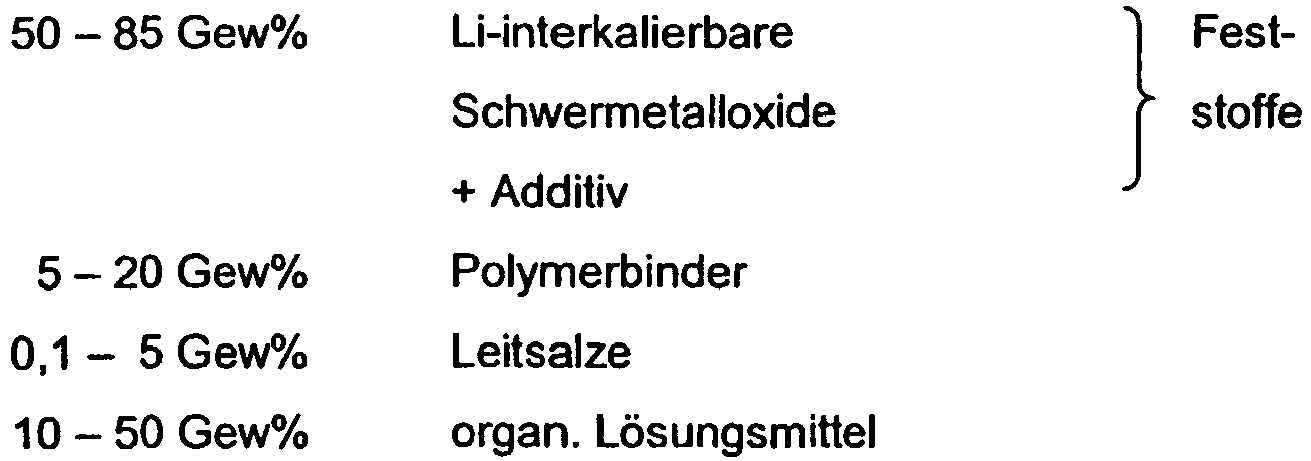
- Organische Lösungsmittel sind vorzugsweise aprotische Lösungsmittel, die als Lösungsmittel für die Leitsalze aber auch als Quellmittel für die Polymerbinder in Frage kommen, ferner polymerisierbare Monomere bzw. fluorenthaltende Flammschutzmittel.
- Im folgenden werden einige der erfindungsgemäßen Beschichtungsmassen beschrieben: Die Separatormassen (im Feststoffanteil inbegriffen) enthalten mindestens 1 Gew%. Vermiculit (ungebläht).
- Sämtliche Verbunde aus Anode, Separator und Kathode enthalten außerdem in mindestens 1 Komponente ungesättigte, vernetzbare, reaktive Doppelbindungen enthaltende Wirkstoffe.
-
Gew% 1. Polymerbinder: Kynar 2801® + Divinylbenzol 4 + 1 2. Polyether: Polyox WSR 301®* 3 3. Graphit (synth.): MCMB® 3 4. Additiv: MgO 2 Vermiculit (ungebläht) 1 5. Lösungsmittel: Ethylencarbonat EC 5 6. Graphit (nat.): UF8® 65 7. Lösungsmittel: a) Perfluoroetylmethacrylat 2 b) Diethylcarbonat:DEC 4 c) Dimethylcarbonat:DMC 3 8. Leitsalz: Litriflate 8 *Der Ether wurde vor der Verwendung mit Dimethylsulfat verkappt, d. h. die vorliegenden - OH Gruppen wurden in -OCH3 Endgruppen umgewandelt. - Die Komponenten 1, 3 und 4. werden bei R.T. intensiv gemischt (2 h) und dann mit 4, 5, 7a, 7b, 7c vermischt (R.T., 1 h).
- Parallel wird der Graphit (6) vorgelegt, mit dem Leitsalz (8) versetzt und ca. 30 Min bei R.T. gemahlen, dann wird nacheinander der verkappte Polyether und das Lösungsmittel (7c) zugesetzt und weitere 1 ½ h gerührt (R.T.). Die verwendeten Graphite (3) sowie (6) wurden vor dem Einsatz bei 10-2 Torr und 100 °C entgast und anschließend unter Argon weiterverarbeitet.
- Statt Polyether (2) wird Poly-n-Hexylmethacrylat Molmasse 30 - 50 000 verwendet.
- Die Arbeiten erfolgen unter Argon, die Graphite werden im Vakuum bei 100 °C und 0,1 Torr ausgeheizt und dann bei R. T. mit n-Butyllithium (5%ig in n-Hexan) umgesetzt (auf 100 g Graphit 10 ml n-BuLi Lösung anschließend erneut aufgeheizt, entgast und wie oben und weiterverarbeitet.
- Als Leitsalz werden 7 Gew% LiPF6 und 1 Gew% MgO eingesetzt.
- Als Leitsalz wird Lioxalatoborat LiOB 8 Gew% verwendet und statt Divinylbenzol 1 Gew% wird Vinylpyrrolidon eingesetzt.
- Als Polymerbinder (1) werden 4 Gew% Dyneon THV gequollen mit 1 Gew% Hexafluoro 1,5 pentandiyldimethacrylat verwendet und mit 10 Gew% Graphit (6) UF8® versetzt und bei 50 °C, 60 Min. innig vermahlen (Argon-Schutzatmosphäre), dann werden 5 Gew% (2) Polyox WSR 301®, der mit Methacrylsäuregruppen an den endständigen OH-Gruppen verestert wurde und 8 Gew% Leitsalz (8) LiPF6 zugefügt und erneut 60 Min. vermahlen, anschließend werden 60 Teile Graphit (6) UF8® und die Lösungsmittel (7a - 7 c) + (5) sowie das Leitsalzadditiv 1 Gew% Liacetylacetonat in das Mahlgut gegeben und erneut 60 Min. bei 50 °C gemahlen.
- Anschließend wird das Mahlgut aus einem Collinextruder bei 65 - 70°C aus einer Breitschlitzdüse auf eine geprimerte Cu-Folie extrudiert: Dicke 30 - 40 µm und durch anschließendes Laminieren auf 25 - 30 µm verdichtet.
- Alle Arbeiten erfolgen unter Argon als Schutzgas, die verwendeten Graphite wurden vor der Verwendung bei 100 °C. 3 h bei 0,1 Torr entgast und mit Li-n-Butyl entspr. Anodenmasse AM II behandelt.
- Entsprechend AM I als Lösungsmittel 7a (2 Gew%) wird Ethylenglykoldialkylether verwendet.
- Alle verwendeten Graphite hatten einen Aschegehalt (DIN 51903, 800 °C) < 0,01% und enthielten keine Partikel < 6 µm.
-
Gew% 1. Li Interkalat Metalloxid: CoOxid 70 2. Polymerbinder: Kynar 2801® 6 3. Polymeradditiv Luviskol® 1 (Molmasse 5-10 000) 3. a Monomer: Ethylenglykoldimethacrylat 2 4. Leitsalz: Lioxalatoborat 7 5. Additiv: - 6. Lösungsmittel: a) DME Dimethoxiethan 1 b) EC Ethylcarbonat 6 c) DEC Diethylcarbonat 4 d) DMC Dimethylcarbonat 2 - Die Kathodenmasse KM I wird hergestellt durch Abmischen von LiCoOxid (1) mit Lioxalatoborat dann wird die Mischung von Polymerbinder (2), Polymeradditiv (3), Monomer (3a) und den Lösungsmitteln (6a - 6d), zugefügt und noch intensiv 2 h bei R.T. gemischt.
- Als Li-interkaliertes Metalloxid (1) wird ein Gemisch LiNiOxyd LiCoOxyd (Gewicht 1:1) verwendet.
- Als Leitsalz (4) wird Li(trifluoromethylsulfonyl)imid Li[N(SO2CF3)2] und als Leitsalzadditiv Al2O3 verwendet.
- Als Li-interkaliertes Metalloxid (1) wird Spinell MnOxid verwendet, und zwar 65 Gew%, das LiMnOxid wird dann mit 5 Gew% Ensaco Ruß und dem Leitsalz (4) sowie dem Lösungsmittel (6 b) EC versetzt und 30 Min. bei R.T. in einer Kugelmühle gemahlen, anschließend wird die Mischung aus den restlichen Ansatzbestandteilen: Monomer (3a) Polymerbinder (2), Polymeradditiv (3), und den Lösungsmitteln (6 a, 6 c, 6 d) zugefügt und 60 Min bei R. T. (40 V/Min) gemischt.
- Alle Schwermetalloxide wurden entgast 10-1 Torr, 1 h 100°C und unter Argon verarbeitet. Mikropartikel < 6 µm wurden ausgesiebt.
- sind Schichten zwischen Anode und Kathode und bestehen aus Polymeren mit poröser Struktur, die als Gewebe, Vliese, Netze, perforierte Folien o. ä. vorliegen und eine Dicke von 10-30 µm, vorzugsweise von 5 - 20 µm aufweisen. Die Materialien können organischer oder anorganischer Natur sein, gegebenenfalls sind es Gemische; eine geeignete Form des Separators sind Sol-Gel-Überzüge bzw. Beschichtungen, die auf die Anoden- bzw. Kathodenmasse - auch auf beiden - aufgebracht werden und dann beim Zusammenfügen die Separatorschicht S zwischen Anode und Kathode bilden.
- Eine bevorzugte Form des Separators sind extrudierte Folien in den angegebenen Dicken, die in Anoden- bzw. Kathodenmassen auch durch Extrusion herstellbar sind und dann durch Coextrusion zu Verbundsystemen entsprechend den Anordnungen Bild 2a/2b zusammengeführt werden (Lit. L.M. Carrier: Polymeric materials and processing, Hanser Verlag Munich [1990] p 387).
- Die obige Literaturstelle zeigt Anordnungen für die Coextrusion und das Zusammenführen der einzelnen Extrudate zu einem einheitlichen Verbundsystem.
- Bei den extrudierten Separatoren werden Polymere z. B. Fluorelastomere auf Basis von Tetrafluorethylen, Hexafluorpropen sowie Vinylidenfluorid als Bi oder Terpolymer z. B. Kynar 2801®, Dyneon THV 120 ® o. ä. Polyvinylpyrrolidon, Polyether u.ä. Polymere, die mit den Lösungsmitteln auf Basis von Alkylcarbonaten oder niedermolekularen Glykolethern; oder Polyfluorethern gequollen sind verwendet.
- Der Anteil der Polymeren beträgt 5-20 Gew%, der der Lösungsmittel 10-50 Gew% jeweils bezogen auf das Gesamtgewicht des Separators.
- Als Leitsalze, die in Mengen von 1-15 Gew% Verwendung finden, kommen die unter den Anoden- und Kathodenmassen aufgezählten Verbindungen in Frage.
- Als Leitsalz-Additiv sind MgO, Al2O3. SiO2 und Gerüstsubstanzen wie Kaoline, Zeolithe, Serpentine sowie Vermiculit gebläht und ungebläht bevorzugt.
- Zur Herstellung der Separatormassen werden Polymeren z. B. Kynar 2801® + Polyvinylpyrrolidon (Molmasse 5000) mit Ethylencarbonat und Propylencarbonat versetzt und in einem Voith-Mischer bei 100 °C gemischt, 60 Min. Schutzgas Argon, anschließend wird abgekühlt auf R. T. und die Masse granuliert, dann wird dieses Granulat in einem Collin-Extruder eingetragen (Einfüllstutzen 1) und bei Temp. von 85 - 90 °C extrudiert, gleichzeitig wird eine Mischung aus Diethylcarbonat / LiPF6 /MgO und Vermiculit (ungebläht) unter Rühren in den 2. Einfüllstutzen des Extruders eindosiert und das Gemenge bei Verweilzeiten von ca. 2 Minuten über eine Breitschlitzdüse 15 cm breit als Folie von 30 - 35 µm Dicke ausgetragen und als Zwischenschicht zwischen Anode und Kathode, die mit Ableiterfolien versehen sind in einem Laminator zusammengeführt und zu einem Verbundsystem verdichtet.
- Sämtliche Separatorenmassen SI-S-VII 1 enthalten Gew% Vermiculit (ungebläht)
- Die Anodenmasse AM II - wurde unter Schutzgas (Ar) in einem Collin-Extruder bei Temperaturen von 40 - 45 °C über eine Breitschlitzdüse 150 mm breit, 15 - 20 µm dick direkt auf eine Cu-Folie (9 µm stark)aufgetragen und bei 80°C laminiert.
- Das erhaltene System aus Cu-Ableiter mit Anodenmasse wurde in einem weiteren Schritt mit einem Separator S I und der aufgeprimerten Al aufgebrachten Kathodenmasse KM I zu einem Batterieverbundsystem zusammengeführt und bei 80 °C laminiert.
- Das entsprechend Bsp. 1 hergestellte Verbundsystem wird zu einem Wickel verarbeitet, eingehaust und durch Laserschweißen der Elektrodenableiter zu + bzw. - Pol zu einer gebrauchsfähigen Batterie. Der ∅ der Batterie beträgt 8 cm, die Ladung erfolgt galvanostatisch (Digatron Ladegerät) 1. Stufe bis ca. 3 Volt, dann bis 3,5 und zum Schluß bis 4.1 Volt, jeweils mit 0,15 mA/cm2.
- Die Entladung erfolgt mit 0,15 mA/cm2. Die Entladekapazität beträgt 43 Ah, bei einer Aktivfläche von 1,5 m2.
- Die Cyclenstabilität liegt bei> 300, das "Fading" ~ 1 %.
Tabelle 1 Beispiel 3 4 5 6 7 8 Anodenmasse AM I II III IV V I Kathodenmasse KM I II III IV I I Separator S I III IV V VI VI Entladekapazität (Ah) 43 42 44 42 42 42 Cyclenstabilität > 300 > 300 > 300 >300 > 300 > 350 Fading ~1% ~1% 1% ~1-2% < 1 % <2% - Die Verarbeitung erfolgt entsprechend der Beispiele 1 - 2 als Separator wurde benutzt, Angaben in (.) sind Gewichtsteile
S I Kynar 2801 (30) Polymethylmetha crylat (5) MgO (9) 0,5 LiOB in EC/PC (55) S II Kynar 2801 (30), Styroflex (2) MgO (3) 1M LiPF6 in EC/DC (64) S III Dyneon THV 200 (32) MgO (7) 1 M LiPF6 in EC/DC (60) S IV Polypropylen (20) Polyvinylpyrrolidon (10) MgO (9) 1 M LiPF6 in EC/DC (60) S V Kynar 2801 (30) Styroflex (2) Li acac (7) 0,5 M LiOB in DME (60) S VI Kynar 2801 (30) Al2O3 (5) LiOB (4) 1 M Litriflat in EC/DC (60) S VII Kynar 2801 (30) Styroflex (5) MgO (4) 1 M LiPF6 in EC/DC (60) EC/PGVolumen 1 : 1, EC/DC Volumen 1 : 1 - Wird nicht unter den erfindungsgemäßen Bedingungen gearbeitet, d. h.
- 1. Entgasen der Aktiven Massen.
- 2. Intensives Vermischen der Einsatzstoffe unter Schutzgas (Argon).
- 3. Separates zweistufiges Mischen der Aktiv-Komponenten, so werden Cyclenstabilitäten. von nur 50 -150 erreicht bei einem Fading > 2,5 %.
Claims (22)
- Verfahren zur Herstellung von Speichern für elektrische Energie, wobei eine Anodenmasse aus Lithium-interkalierbaren Kohlenstoffen, die mit Lithium-Alkylen modifiziert sind, als Anodenaktivmasse im Gemisch mit Leitsalz, Leitsalzadditiv, Polymerbinder und/oder organischem Lösungsmittel sowie eine Kathodenmasse aus Lithium-interkalierbaren Schwermetalloxiden als Kathodenaktivmasse im Gemisch mit Leitsalz, Leitsalzadditiv, Polymerbinder und/oder organischem Lösungsmittel bereitgestellt wird, wobei die Elektroden-Aktivkomponenten zunächst bei Temperaturen zwischen -20 und 200°C und Drücken von 2 bis 10-4 Torr entgast und dann unter Luftausschluss mit Polymerbinder, Leitsalz, Leitsalzadditiv und/oder organischem Lösungsmittel intensiv vermahlen oder gerührt werden, die Anodenmasse, die Kathodenmasse sowie eine mindestens 1-Gew.% ungeblähten Vermiculit enthaltende Separatormasse, die als extrusionsfähiges Gemisch mit organischem Lösungsmittel, Leitsalz, Additiven und Polymeren vorliegt, kontinuierlich co-extrudiert werden, so dass die Kathoden- und Anodenmassen mit der Separatormasse als Zwischenschicht zu einem Verbundsystem angeordnet werden, wobei die Anodenmasse wie auch die Kathodenmasse auf jeweilige Stromableiter aufgetragen werden.
- Verfahren nach Anspruch 1, dadurch gekennzeichnet, dass die Arbeiten in Gegenwart von Perfluoralkylethern durchgeführt werden.
- Verfahren nach Anspruch 1 oder 2, dadurch gekennzeichnet, dass als aktive Elektrodenmassen für die Anode Li-interkalierbare synthetische und/oder natürliche Graphite, und/oder Graphene, Polyphenylene, Polyacetylene oder Nano-dimensionierte Carbonfasern in Mengen von 50-85 Gew.-% zur Anwendung gelangen.
- Verfahren nach einem der Ansprüche 1 bis 3, dadurch gekennzeichnet, dass als aktive Elektrodenmassen für die Kathode Li-interkalierbare Oxide des Ti, Zr, V, Cr, Mo, W, Mn, Co, Ni für sich oder im Gemisch angewendet werden, wobei die Interkalations-Verbindungen in orientierter Form mit verzerrten Gitterstrukturen vorliegen und in Mengen von 50-85 Gew.-% eingesetzt werden.
- Verfahren nach einem der vorhergehenden Ansprüche, dadurch gekennzeichnet, dass als Leitsalze Li-Verbindungen in Mengen von 10 bis 100%, bezogen auf die jeweiligen aktiven Elektrodenmaterialien, zur Anwendung kommen.
- Verfahren nach einem der vorhergehenden Ansprüche, dadurch gekennzeichnet, dass als Additive Li-Verbindungen, Gerüstsubstanzen sowie Carbonfasern und/oder Kohlenstoffpulver eingesetzt werden.
- Verfahren nach Anspruch 6, dadurch gekennzeichnet, dass die Additive mit Li-Salzen getränkt oder ummantelt werden.
- Verfahren nach Anspruch 6 oder 7, dadurch gekennzeichnet, dass die Additive in Mengen von 0,1 bis 30%, bezogen auf die Leitsalze, eingesetzt werden.
- Verfahren nach einem der Ansprüche 1 bis 8, dadurch gekennzeichnet, dass als Lösungsmittel zum Lösen oder Dispergieren der Leitsalze bzw. der Additive und zum Quellen der organischen Polymeren: Alkylcarbonate, Glykolether, substituierte und/oder cyclische Harnstoffe, Fluorether, jeweils mit Molmassen bis zu 1500 oder Monomere mit Perfluoralkylresten oder Ether- oder Carbonatalkylresten verwendet werden.
- Verfahren nach Anspruch 9, dadurch gekennzeichnet, dass das Lösungsmittel in Mengen von 1 bis 1000%, bezogen auf die eingesetzten Leitsalze, verwendet werden.
- Verfahren nach einem der vorhergehenden Ansprüche, dadurch gekennzeichnet, dass der Polymerbinder PB, Polyolefine, Polyethylen, Polypyrrolidon, Polybutene sowie deren Homologe und Copolymere, Polyvinylether, Polystyrol und Copolymere mit Butadien bzw. Isopren, Blockpolymere, SBR-Kautschuk, Butylkautschuk, Cis- und/oder 1,2-Polybutadiene, Fluorelastomere, Co- bzw. Terpolymere auf Basis von Vinylidenfluorid, Hexafluorpropen, Tetrafluorethen und/oder Perfluoralkoxy-Derivaten, ferner Polyalkylenoxide mit verkappten Endgruppen und cyclische Ether umfasst.
- Verfahren nach Anspruch 11, dadurch gekennzeichnet, dass der Polymerbinder in Mengen von 5 bis 30 Gew.-%, bezogen auf die jeweiligen aktiven Elektrodenmassen, eingesetzt wird.
- Verfahren nach einem der vorhergehenden Ansprüche, dadurch gekennzeichnet, dass die Herstellung der Elektrodenmassen stufenweise erfolgt, so dass die jeweiligen aktiven Komponenten mit anteiligen Mengen an Leitsalz, Additiv und Lösungsmittel innig vermischt und/oder gemahlen werden und dann mit den anderen Elektrodenkomponenten compoundiert werden.
- Verfahren nach Anspruch 13, dadurch gekennzeichnet, dass die Vermischung und/oder Vermahlung im Wirbelbett oder Ultraschallbad erfolgt.
- Verfahren nach Anspruch 13 oder 14, dadurch gekennzeichnet, dass die Vermischung und/oder Vermahlung bei Temperaturen von -20 bis 200°C erfolgt.
- Verfahren nach einem der vorhergehenden Ansprüche, dadurch gekennzeichnet, dass die Herstellung des erfindungsgemäßen Verbundsystems aus Anode/Separator/Kathode dadurch erfolgt, dass die Elektrodenmasse wie auch die Separatormasse in einem kontinuierlichen, einstufigen Prozess verarbeitet werden.
- Verfahren nach Anspruch 16, dadurch gekennzeichnet, dass die Elektrodenmassen auf Ableiter, ausgewählt aus Metallfolien, Kohlenstofffaser-Geweben, Netzen, Polyacetylen-, Polypyrrolfolien, aufgetragen werden.
- Verfahren nach Anspruch 17, dadurch gekennzeichnet, dass als Kathodenableiter geprimerte Al-Folie verwendet wird.
- Verfahren nach einem der Ansprüche 17 oder 18, dadurch gekennzeichnet, dass die Beschichtung ein- oder zweiseitig erfolgt.
- Verfahren nach einem der Ansprüche 17 bis 19, dadurch gekennzeichnet, dass das hergestellte Verbundsystem bei Temperaturen von Raumtemperatur bis zu 100°C laminiert wird.
- Verfahren nach einem der vorhergehenden Ansprüche, dadurch gekennzeichnet, dass das Herstellen des Gesamtverbundes bestehend aus Ableitern, Elektrodenmassen mit der Separatorzwischenschicht kontinuierlich erfolgt und/oder das Herstellen einer Li-Polymer-Batterie durch Schichtung und/oder Wickeln mit anschließendem Einhausen und Polen erfolgt.
- Verfahren nach einem der vorhergehenden Ansprüche, dadurch gekennzeichnet, dass die hergestellten Massen für elektrophoretische Systeme, Dioden oder Sensoren oder Energiespeicher eingesetzt werden.
Applications Claiming Priority (3)
| Application Number | Priority Date | Filing Date | Title |
|---|---|---|---|
| DE10231319A DE10231319B4 (de) | 2002-07-11 | 2002-07-11 | Verfahren zur Herstellung von Speichern für elektrische Energie auf Basis von wiederaufladbaren Lithium-Polymer-Zellen |
| DE10231319 | 2002-07-11 | ||
| PCT/EP2003/007517 WO2004008559A2 (de) | 2002-07-11 | 2003-07-10 | Verfahren zur herstellung von speichern für elektrische energie auf basis von wiederaufladbaren lithium-polymer-zellen |
Publications (2)
| Publication Number | Publication Date |
|---|---|
| EP1559155A2 EP1559155A2 (de) | 2005-08-03 |
| EP1559155B1 true EP1559155B1 (de) | 2012-06-20 |
Family
ID=29761879
Family Applications (1)
| Application Number | Title | Priority Date | Filing Date |
|---|---|---|---|
| EP03763813A Expired - Lifetime EP1559155B1 (de) | 2002-07-11 | 2003-07-10 | Verfahren zur herstellung von speichern für elektronische energie auf basis von wiederaufladbaren lithium-polymer-zellen |
Country Status (5)
| Country | Link |
|---|---|
| US (1) | US20060032045A1 (de) |
| EP (1) | EP1559155B1 (de) |
| AU (1) | AU2003246680A1 (de) |
| DE (1) | DE10231319B4 (de) |
| WO (1) | WO2004008559A2 (de) |
Families Citing this family (19)
| Publication number | Priority date | Publication date | Assignee | Title |
|---|---|---|---|---|
| DE102004053479A1 (de) * | 2004-11-05 | 2006-05-11 | Dilo Trading Ag | Hochleistungsbatterien mit Titanaten als negativem und Eisenphosphat als positivem Elektrodenmaterial und Verfahren zur Herstellung der Hochleistungsbatterien |
| DE202005021884U1 (de) * | 2005-09-06 | 2010-11-18 | Dilo Trading Ag | Spezial Lithium-Polymer-Batterien |
| US7745528B2 (en) | 2006-10-06 | 2010-06-29 | The Trustees Of Princeton University | Functional graphene-rubber nanocomposites |
| JP2011501383A (ja) | 2007-10-26 | 2011-01-06 | サイオン パワー コーポレイション | バッテリ電極用プライマー |
| US8097967B2 (en) | 2008-06-30 | 2012-01-17 | Demand Energy Networks, Inc. | Energy systems, energy devices, energy utilization methods, and energy transfer methods |
| US8319358B2 (en) | 2008-06-30 | 2012-11-27 | Demand Energy Networks, Inc. | Electric vehicle charging methods, battery charging methods, electric vehicle charging systems, energy device control apparatuses, and electric vehicles |
| US8178241B2 (en) | 2008-08-28 | 2012-05-15 | 3M Innovative Properties Company | Electrode including current collector with nano-scale coating and method of making the same |
| KR101115922B1 (ko) * | 2010-02-02 | 2012-02-13 | 주식회사 엘지화학 | 케이블형 이차전지의 제조방법 |
| DE102010032770A1 (de) | 2010-07-29 | 2012-02-02 | Li-Tec Battery Gmbh | Verfahren und Vorrichtung zur Herstellung eines mehrschichtigen Elektrodenaufbaus, galvanische Zelle |
| WO2012174145A2 (en) | 2011-06-13 | 2012-12-20 | Demand Energy Networks, Inc. | Energy systems and energy supply methods |
| GB201121170D0 (en) | 2011-12-09 | 2012-01-18 | Univ Leeds | Galvanic cells and components therefore |
| EP2744019B1 (de) * | 2012-12-14 | 2016-11-23 | Taranis GmbH | Verfahren zum Herstellen eines Beschichtungsmaterials zum Beschichten von Elektrodenträgern und Beschichtungsmaterial in Granulatform |
| CN107078267B (zh) * | 2014-05-07 | 2021-05-07 | 索尔维公司 | 复合电极 |
| JP7245648B2 (ja) | 2015-07-27 | 2023-03-24 | ソルヴェイ(ソシエテ アノニム) | 電極形成組成物 |
| EP3469643A1 (de) * | 2016-06-14 | 2019-04-17 | Solvay SA | Flexible batterie |
| CN106222728B (zh) * | 2016-07-21 | 2018-05-18 | 电子科技大学 | 一种聚偏氟乙烯-六氟丙烯隔膜的制备方法 |
| CN109870650B (zh) * | 2017-11-17 | 2021-09-24 | 奥动新能源汽车科技有限公司 | 电池监控方法及系统 |
| US11515571B2 (en) | 2018-03-05 | 2022-11-29 | Robert Bosch Gmbh | Hot melt extruded solid state battery components |
| CN109560282A (zh) * | 2018-12-12 | 2019-04-02 | 长虹格兰博科技股份有限公司 | 一种电极活性组合物、电极极片、电极极片制备方法和低温化成方法 |
Citations (2)
| Publication number | Priority date | Publication date | Assignee | Title |
|---|---|---|---|---|
| US5316875A (en) * | 1991-07-19 | 1994-05-31 | Matsushita Electric Industrial Co., Ltd. | Secondary battery with nonaqueous electrolyte and method of manufacturing same |
| US5743921A (en) * | 1995-07-03 | 1998-04-28 | General Motors Corporation | Method of making a cell using a lithium-deactivated carbon anode |
Family Cites Families (14)
| Publication number | Priority date | Publication date | Assignee | Title |
|---|---|---|---|---|
| DE2908324A1 (de) | 1979-03-03 | 1980-09-18 | Hoechst Ag | Triazolsubstituierte hydratopasaeurederivate, verfahren zu ihrer herstellung und ihre verwendung als pflanzenschutzmittel |
| GB8333388D0 (en) | 1983-12-15 | 1984-01-25 | Raychem Ltd | Materials for electrical devices |
| JPH0554912A (ja) * | 1991-08-27 | 1993-03-05 | Matsushita Electric Ind Co Ltd | 非水電解液二次電池およびその製造法 |
| US5437692A (en) * | 1994-11-02 | 1995-08-01 | Dasgupta; Sankar | Method for forming an electrode-electrolyte assembly |
| EP0876683B1 (de) * | 1996-01-25 | 2002-09-25 | Danionics A/S | Elektrode/stromkollektor, laminate für eine elektrochemische vorrichtung |
| US5749927A (en) * | 1996-05-24 | 1998-05-12 | W. R. Grace & Co. -Conn. | Continuous process to produce lithium-polymer batteries |
| EP0973609B1 (de) * | 1997-02-26 | 2009-04-15 | Integument Technologies, Inc. | Polymerverbundstoffe sowie verfahren zu deren herstellung und verwendung |
| DE19839217C2 (de) * | 1998-08-28 | 2001-02-08 | Fraunhofer Ges Forschung | Pastöse Massen, Schichten und Schichtverbände, Zellen und Verfahren zur Herstellung |
| US6692873B1 (en) * | 1999-08-05 | 2004-02-17 | Skc Co., Ltd. | Composition for forming electrode active material of lithium secondary battery, composition for forming separator and method of preparing lithium secondary battery using the compositions |
| DE10020031C2 (de) * | 2000-04-22 | 2002-05-29 | Franz W Winterberg | Verfahren zur Herstellung von wiederaufladbaren Lithium-Polymer-Batterien |
| US7332242B2 (en) * | 2000-09-01 | 2008-02-19 | Itochu Corporation | Lithium-based battery having extensible, ion-impermeable polymer covering on the battery container |
| JP4002829B2 (ja) * | 2000-09-06 | 2007-11-07 | 日立マクセル株式会社 | 電気化学素子用電極材料とその製造方法および電気化学素子 |
| EP1197494A3 (de) * | 2000-09-21 | 2004-05-26 | Kanto Kagaku Kabushiki Kaisha | Neue Organoborat Verbindungen und nichtwässrige Elektrolyten und Lithium-Sekundärbatterie, die diese enthalten |
| US7138209B2 (en) * | 2000-10-09 | 2006-11-21 | Samsung Sdi Co., Ltd. | Positive active material for rechargeable lithium battery and method of preparing same |
-
2002
- 2002-07-11 DE DE10231319A patent/DE10231319B4/de not_active Expired - Fee Related
-
2003
- 2003-07-10 WO PCT/EP2003/007517 patent/WO2004008559A2/de not_active Ceased
- 2003-07-10 AU AU2003246680A patent/AU2003246680A1/en not_active Abandoned
- 2003-07-10 US US10/520,972 patent/US20060032045A1/en not_active Abandoned
- 2003-07-10 EP EP03763813A patent/EP1559155B1/de not_active Expired - Lifetime
Patent Citations (2)
| Publication number | Priority date | Publication date | Assignee | Title |
|---|---|---|---|---|
| US5316875A (en) * | 1991-07-19 | 1994-05-31 | Matsushita Electric Industrial Co., Ltd. | Secondary battery with nonaqueous electrolyte and method of manufacturing same |
| US5743921A (en) * | 1995-07-03 | 1998-04-28 | General Motors Corporation | Method of making a cell using a lithium-deactivated carbon anode |
Also Published As
| Publication number | Publication date |
|---|---|
| WO2004008559A2 (de) | 2004-01-22 |
| WO2004008559A3 (de) | 2005-03-03 |
| EP1559155A2 (de) | 2005-08-03 |
| AU2003246680A1 (en) | 2004-02-02 |
| AU2003246680A8 (en) | 2004-02-02 |
| DE10231319A1 (de) | 2004-01-22 |
| US20060032045A1 (en) | 2006-02-16 |
| DE10231319B4 (de) | 2013-08-14 |
Similar Documents
| Publication | Publication Date | Title |
|---|---|---|
| EP1559155B1 (de) | Verfahren zur herstellung von speichern für elektronische energie auf basis von wiederaufladbaren lithium-polymer-zellen | |
| DE69738111T2 (de) | Lithiumionensekundärbatterie und deren herstellung | |
| DE102017105307A1 (de) | Primer-oberflächenbeschichtung für silicium-basierte hochleistungselektroden | |
| DE112011105809B4 (de) | Abgedichtete Lithiumsekundärbatterie und Verfahren zum Herstellen derselben | |
| DE102015108488B4 (de) | Anode und Anoden-Verbundmaterial für einen Lithium-Luft-Akkumulator und Lithium-Luft-Akkumulator | |
| DE10218510B4 (de) | Herstellungsfrische negative Elektrode für einen wiederaufladbaren Akkumulator, Akkumulator und Verfahren zur Herstellung einer negativen Elektrode | |
| DE112019007641T5 (de) | Positives aktivmaterial, positive elektrode, nichtwässriger-elektrolyt-energiespeicher vorrichtung, verfahren zum herstellen eines positiven aktivmaterials, verfahren zum herstellen einer positiven elektrode, und verfahren zum herstellen einer nichtwässriger-elektrolyt-energiespeichervorrichtung | |
| DE10308945B4 (de) | Li-Polymer-Batterien mit Separator-Dispersion und Verfahren für ihre Herstellung | |
| DE10252305B4 (de) | Aktivierte Kathodenmasse, Kathode und Verfahren zur Herstellung einer Kathode | |
| DE112019000894T5 (de) | Positives aktives material, positive elektrode, nichtwässrige elektrolyt-energiespeichereinrichtung, verfahren zur herstellung von positivem aktiven material, verfahren zur herstellung einer positiven elektrode und verfahren zur herstellung einer nichtwässrigen elektrolyt-energiespeichereinrichtung | |
| DE69006407T2 (de) | Nichtwässerige alkalische Metallbatterie mit verbesserter Kathode. | |
| DE10352063B4 (de) | Lithium-Polymerzelle, Verfahren zu deren Herstellung und Lithium-Polymer-Batterie-System damit | |
| DE102004053479A1 (de) | Hochleistungsbatterien mit Titanaten als negativem und Eisenphosphat als positivem Elektrodenmaterial und Verfahren zur Herstellung der Hochleistungsbatterien | |
| EP1652261B1 (de) | Lithium-polymer-energiespeicher und verfahren zu ihrer herstellung | |
| EP1759430B1 (de) | Lithium-polymer-energiespeicher und verfahren zu ihrer herstellun | |
| DE102023112154A1 (de) | Natriumionenbatterie, Verfahren zum Herstellen einer Natriumionenbatterie und Verwendung einer Natriumionenbatterie | |
| EP1588451B1 (de) | Verfahren zum herstellen von lithium-polymer-zellen aus mindestens einer als folienband vorgefertigten anoden- und kathodenmasse | |
| DE10328572B4 (de) | Lithium-Polymer-Batterie-Systeme und Verfahren zur Herstellung | |
| DE10107384B4 (de) | Verwendung einer speziellen Polymers als Haftvermittler und Lithium-Polymer-Batterie | |
| DE10344637B4 (de) | Ableiter für Elektroden, Verfahren zur Herstellung von Elektrodenableitern und Verwendung eines Ableiters | |
| DE102004044478B4 (de) | Lithium-Sekundär-Batterie und Verfahren zur Herstellung einer Lithium-Sekundär-Batterie | |
| DE10262247B4 (de) | Herstellungsfrische negative Elektrode, herstellungsfrischer Akkumulator und Verfahren zur Herstellung einer negativen Elektrode | |
| DE102006007220B4 (de) | Verfahren zum Herstellen von Lithium-Polymer-Energiespeichern | |
| DE102008001292A1 (de) | Wiederaufladbare Lithium-Ionen-Zellen mit geschichteten Elektrodenmassen und modifizierten Deckschichten und Verfahren zur Herstellung derselben | |
| DE10115210B4 (de) | Verwendung spezieller Polymere als Haftvermittler für Lithium-Batterien und Lithium-Polymer-Batterie |
Legal Events
| Date | Code | Title | Description |
|---|---|---|---|
| PUAI | Public reference made under article 153(3) epc to a published international application that has entered the european phase |
Free format text: ORIGINAL CODE: 0009012 |
|
| 17P | Request for examination filed |
Effective date: 20050525 |
|
| AK | Designated contracting states |
Kind code of ref document: A2 Designated state(s): AT BE BG CH CY CZ DE DK EE ES FI FR GB GR HU IE IT LI LU MC NL PT RO SE SI SK TR |
|
| AX | Request for extension of the european patent |
Extension state: AL LT LV MK |
|
| DAX | Request for extension of the european patent (deleted) | ||
| RBV | Designated contracting states (corrected) |
Designated state(s): CZ FR GB |
|
| REG | Reference to a national code |
Ref country code: DE Ref legal event code: 8566 |
|
| 17Q | First examination report despatched |
Effective date: 20070118 |
|
| GRAP | Despatch of communication of intention to grant a patent |
Free format text: ORIGINAL CODE: EPIDOSNIGR1 |
|
| RIC1 | Information provided on ipc code assigned before grant |
Ipc: H01M 10/04 20060101AFI20111130BHEP Ipc: H01M 4/13 20100101ALI20111130BHEP Ipc: H01M 4/04 20060101ALI20111130BHEP Ipc: H01M 10/056 20100101ALI20111130BHEP Ipc: H01M 10/052 20100101ALI20111130BHEP |
|
| GRAS | Grant fee paid |
Free format text: ORIGINAL CODE: EPIDOSNIGR3 |
|
| GRAA | (expected) grant |
Free format text: ORIGINAL CODE: 0009210 |
|
| AK | Designated contracting states |
Kind code of ref document: B1 Designated state(s): CZ FR GB |
|
| REG | Reference to a national code |
Ref country code: GB Ref legal event code: FG4D Free format text: NOT ENGLISH |
|
| PLBE | No opposition filed within time limit |
Free format text: ORIGINAL CODE: 0009261 |
|
| STAA | Information on the status of an ep patent application or granted ep patent |
Free format text: STATUS: NO OPPOSITION FILED WITHIN TIME LIMIT |
|
| 26N | No opposition filed |
Effective date: 20130321 |
|
| PGFP | Annual fee paid to national office [announced via postgrant information from national office to epo] |
Ref country code: CZ Payment date: 20130627 Year of fee payment: 11 |
|
| PGFP | Annual fee paid to national office [announced via postgrant information from national office to epo] |
Ref country code: GB Payment date: 20130723 Year of fee payment: 11 |
|
| REG | Reference to a national code |
Ref country code: FR Ref legal event code: PLFP Year of fee payment: 12 |
|
| GBPC | Gb: european patent ceased through non-payment of renewal fee |
Effective date: 20140710 |
|
| PG25 | Lapsed in a contracting state [announced via postgrant information from national office to epo] |
Ref country code: CZ Free format text: LAPSE BECAUSE OF NON-PAYMENT OF DUE FEES Effective date: 20140710 |
|
| PG25 | Lapsed in a contracting state [announced via postgrant information from national office to epo] |
Ref country code: GB Free format text: LAPSE BECAUSE OF NON-PAYMENT OF DUE FEES Effective date: 20140710 |
|
| PGFP | Annual fee paid to national office [announced via postgrant information from national office to epo] |
Ref country code: FR Payment date: 20150127 Year of fee payment: 12 |
|
| REG | Reference to a national code |
Ref country code: FR Ref legal event code: ST Effective date: 20160331 |
|
| PG25 | Lapsed in a contracting state [announced via postgrant information from national office to epo] |
Ref country code: FR Free format text: LAPSE BECAUSE OF NON-PAYMENT OF DUE FEES Effective date: 20150731 |