EP1557818A2 - Dispositif et méthode pour la sélection de chansons - Google Patents
Dispositif et méthode pour la sélection de chansons Download PDFInfo
- Publication number
- EP1557818A2 EP1557818A2 EP04030499A EP04030499A EP1557818A2 EP 1557818 A2 EP1557818 A2 EP 1557818A2 EP 04030499 A EP04030499 A EP 04030499A EP 04030499 A EP04030499 A EP 04030499A EP 1557818 A2 EP1557818 A2 EP 1557818A2
- Authority
- EP
- European Patent Office
- Prior art keywords
- song
- sensibility
- songs
- storage
- word
- Prior art date
- Legal status (The legal status is an assumption and is not a legal conclusion. Google has not performed a legal analysis and makes no representation as to the accuracy of the status listed.)
- Withdrawn
Links
- 238000000034 method Methods 0.000 title claims description 11
- 230000001020 rhythmical effect Effects 0.000 claims description 4
- 238000013500 data storage Methods 0.000 description 22
- 230000035945 sensitivity Effects 0.000 description 7
- 230000005236 sound signal Effects 0.000 description 6
- 238000006243 chemical reaction Methods 0.000 description 4
- 238000010187 selection method Methods 0.000 description 4
- 230000004044 response Effects 0.000 description 2
- 239000008280 blood Substances 0.000 description 1
- 210000004369 blood Anatomy 0.000 description 1
- 230000003247 decreasing effect Effects 0.000 description 1
- 238000010586 diagram Methods 0.000 description 1
- 238000000605 extraction Methods 0.000 description 1
- 230000037308 hair color Effects 0.000 description 1
- 230000035876 healing Effects 0.000 description 1
- 238000001228 spectrum Methods 0.000 description 1
- 235000019640 taste Nutrition 0.000 description 1
Images




Classifications
-
- G—PHYSICS
- G10—MUSICAL INSTRUMENTS; ACOUSTICS
- G10H—ELECTROPHONIC MUSICAL INSTRUMENTS; INSTRUMENTS IN WHICH THE TONES ARE GENERATED BY ELECTROMECHANICAL MEANS OR ELECTRONIC GENERATORS, OR IN WHICH THE TONES ARE SYNTHESISED FROM A DATA STORE
- G10H1/00—Details of electrophonic musical instruments
- G10H1/0033—Recording/reproducing or transmission of music for electrophonic musical instruments
- G10H1/0041—Recording/reproducing or transmission of music for electrophonic musical instruments in coded form
- G10H1/0058—Transmission between separate instruments or between individual components of a musical system
-
- G—PHYSICS
- G10—MUSICAL INSTRUMENTS; ACOUSTICS
- G10H—ELECTROPHONIC MUSICAL INSTRUMENTS; INSTRUMENTS IN WHICH THE TONES ARE GENERATED BY ELECTROMECHANICAL MEANS OR ELECTRONIC GENERATORS, OR IN WHICH THE TONES ARE SYNTHESISED FROM A DATA STORE
- G10H2240/00—Data organisation or data communication aspects, specifically adapted for electrophonic musical tools or instruments
- G10H2240/075—Musical metadata derived from musical analysis or for use in electrophonic musical instruments
- G10H2240/085—Mood, i.e. generation, detection or selection of a particular emotional content or atmosphere in a musical piece
Definitions
- This invention relates to a device and method for selecting a song from among a plurality of songs.
- the physical characteristics of songs are extracted beforehand as data, the songs are classified according to the extraction results, and the classifications are used in song selection.
- the physical characteristic data of a song is, for example, power spectrum data obtained from the song data.
- Such song selection method is disclosed in Japanese Patent Kokai (Laid-open application) No. 10-134549.
- Another physical characteristic data of a song is a pattern (i.e., change with time) of frequency bandwidth, lengths of sounds, and musical score of the song, which are prepared by an N-gram method.
- One object of this invention is to provide a song selection apparatus capable of presenting songs appropriate to the sensitivities of the user.
- Another object of this invention is to provide a song selection method capable of presenting songs appropriate to the sensitivities of the user.
- an improved song selection apparatus for selecting one or more songs from among a plurality of songs according to an input operation by a user.
- the song selection apparatus includes a storage for storing a song characteristic quantity for each of the songs.
- the song selection apparatus also includes a first setting unit for setting personal properties (e.g., age and gender) according to the input operation.
- the song selection apparatus also includes a second setting unit for setting a sensibility word according to the input operation.
- the song selection apparatus also includes a selector for finding (or selecting) one or more songs having song characteristic quantities corresponding to the personal properties set by the first setting unit and to the sensibility word set by the second setting unit.
- Songs conforming to the user's personal properties such as age and gender and his/her sensitivity (sensibility) can be presented to the user, so that song selection by the user becomes easy.
- a song selection method for selecting one or more songs from among a plurality of songs according to an input operation by a user.
- Song characteristic quantities are stored in a memory for each of the songs.
- Personal properties are determined according to the user input operation.
- a sensibility word is also determined according to the user input operation.
- One or more songs are found (selected) having song characteristic quantities corresponding to the personal properties and the sensibility word.
- Songs conforming to the user's personal properties such as age and gender, and to his/her sensitivity (sensibility) can be presented to the user, so that song selection by the user becomes easy.
- a song selection apparatus 12 includes a song/music input device 1, operation input device 2, data storage devices 3, 4 and 5, control device 6, display device 7, song reproduction (playback) device 8, digital-analog conversion device 9, and speaker(s) 10.
- the song/music input device 1 is connected to the control device 6 and data storage device 3, and is used to input audio signals, for example, PCM data of digitized songs to the song selection apparatus 12.
- the song input device 1 may be, for example, a disc player which plays CDs or other discs, or a streaming interface which receives streaming distribution of song data.
- the operation input device 2 is operated by a user to input data, information, instructions and commands into the song selection apparatus 12.
- the operation input device 2 is provided with such buttons as alphanumeric buttons, a "YES” button, "NO” button, "END” button, and "NEXT SONG" button.
- the output of the operation input device 2 is connected to the control device 6. It should be noted that the button types of the operation input device 2 are not limited to the above-described buttons.
- the data storage device 3 which is the third storage, stores, in the form of files, song data provided by the song input device 1.
- Song data is data of reproduction sounds of a song, and may be, for example, PCM data, MP3 data, or MIDI data.
- the song name, singer name, and other song information is stored for each song in the data storage device 3.
- Song data for n songs (where n is greater than one) is stored in the data storage device 3.
- the data storage device 4 stores character parameters of the n songs (or n song data) in a characteristic parameter database (first storage).
- the characteristic parameters include the degree of chord change #1, degree of chord change #2, degree of chord change #3, beat (number of beats per unit time), maximum beat level, mean amplitude level, maximum amplitude level, and the key.
- the degree of chord change #1 is the number of chords per minute in the song; the degree of chord change #2 is the number of types of chords used in the song; and the degree of chord change #3 is the number of impressive points, such as discord, which give a certain impression to a listener during the chord progression.
- Chords themselves have elements which may provide depth to a song, or impart a sense of tension to the listener, or similar.
- a song may be provided with atmosphere through a chord progression.
- Chords having such psychological elements are optimal as song-characterizing quantities used by the song selection apparatus 12 to select songs based on sensibility words (impression words).
- the chords provide not only the characteristics of the melody but also the intentions of the composer, including the meaning of the lyrics, to some extent; hence, the chords are used in the characteristic parameters.
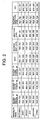
- Predetermined sensibility words are stored in the data storage device 4. For each of these sensibility words are stored, as the default database (second storage means), mean values and unbiased variances of the respective characteristic parameters.
- the database includes a plurality of data tables corresponding to a plurality of age-gender classifications.
- the characteristic parameters include, as mentioned earlier, the degree of chord change #1, degree of chord change #2, degree of chord change #3, beat, maximum beat level, mean amplitude level, maximum amplitude level, and the key.
- the mean values and unbiased variances are correction values used together with the characteristic parameters to compute sensitivity (sensibility) conformance values. Mean values and unbiased variances will be described later. As shown in Fig. 5, user ages are divided into teens, 20's. 30's, 40's, and 50 and older, and these age groups are associated with gender to make five data tables for males and five data tables for females. In this embodiment, therefore, there are prepared ten age-gender classifications and ten data tables.
- Fig. 2 shows one of such data tables. As depicted, the mean values and unbiased variances of the characteristic parameters for the respective sensibility words are stored in the table format.
- the “sensibility words (impression words)” are words expressing feelings felt when a human listens to a song. For example, “rhythmical”, “quiet”, “bright”, “sad” “soothing (healing)”, and “lonely” are the sensibility words.
- a matching song database (fourth storage means) and nonmatching song database (sixth storage means) are formed in the data storage device 5.
- each of these databases is stored 50 song data for each sensibility word.
- song data for more than 50 songs is to be written, the new data is written while erasing the oldest data.
- the number of songs stored for each sensibility word in the matching song database and in the nonmatching song database is not limited to 50, but may be a different number.
- the control device 6 includes for example a microcomputer, and performs song selection operation according to an input operation by a user (will be described).
- the display device 7 displays selection items/fields of the control by the control device 6, the song contents entered from the song input device 1, and a list of songs presented to the user.
- the playback device 8 reads and plays back song data for a song selected by the user from the data storage device 3, and outputs the data sequentially as digital audio signals to the digital/analog converter 9.
- the digital/analog converter 9 converts the digital audio signals into analog audio signals, and supplies the analog audio signals to the speaker 10.
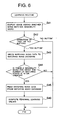
- song selection operation in the song selection apparatus 12 having the above described configuration is described with reference to Fig. 3.
- a single user uses the song selection apparatus 12; if a plurality of users share the song selection apparatus, a user may input his/her ID code via the operation input device 2 when starting the song selection operation.
- the user ID code is used to determine whether this user utilizes his/her own personal learning values (will be described). It should be noted that when a single user uses the song selection apparatus 12, the user also has an option to use or not his/her personal learning values if the personal learning values are available.
- the control device 6 When song selection operation begins, the control device 6 first causes the display device 7 to display an image in order to request selection of the user's age and gender, as shown in step S1. On the screen of the display device 7 are displayed, as selection options for age and gender, i.e., teens, 20's, 30's, 40's, 50 or older, mail and female. An instruction for the user to select one from the options for age and one from the options for gender is displayed. The user can perform an input operation, via the operation input device 2, to input the user's own age and gender according to this display. After execution of step S1, the control device 6 determines whether there has been input from the user through the input device 2 (step S2).
- step S3 If there has been input, the input content, that is, the user's age and gender, are stored (step S3), and the display device 7 is caused to display an image requesting selection of a sensibility word (step S4).
- sensibility words for song selection "rhythmical”, “quiet”, “bright”, “sad”, “soothing” and “lonely” are displayed on the screen of the display device 7, and in addition an "other sensibility word” item is displayed.
- an instruction to select one from among the displayed options is shown.
- the user can perform an input operation through the operation input device 2 to select one of these sensibility words or the "other sensibility word” according to the display.
- step S4 the control device 6 determines whether there has been an input from the user (step S5).
- the control device 6 determines whether one of the sensibility words displayed has been selected, according to the output from the operation input device 2 (step S6). That is, a determination is made as to whether one of the predetermined sensibility words or the "other sensibility word" has been selected.
- the control device 6 captures the selected sensibility word (step S7), and determines whether, for the selected sensibility word, there exist personal learning values (step S8).
- Personal learning values are the mean value and unbiased variance, specific to the user, of each of the characteristic parameters for the selected sensibility word; the mean values and unbiased variances are computed in a step described below, and stored in a personal learning value database (fifth storage means) in the data storage device 4.
- step S9 a data table within the default database, determined by the user's age and gender, is selected (step S9), and mean values and unbiased variances for the characteristic parameters of the selected sensibility word are read from this data table (step S10).
- the ten data tables are prepared in the data storage device 4.
- the control device 6 selects one of the data tables based on the user age and gender in step S9.
- step S11 an image asking the user whether to select a song using the personal learning values is displayed on the display device 7 (step S11).
- the user can perform an input operation on a "YES” button or a "NO” button on the operation input device 2, according to the display, to decide whether or not to use personal learning values.
- the control device 6 determines whether there has been input operation of the "YES” button or of the "NO” button (step S12). If there is input operation of the "YES” button indicating that personal learning values are to be used, the mean values and unbiased variance of the characteristic parameters corresponding to the selected sensibility word are read from the personal learning value database (step S13).
- control device 6 proceeds to step S9 and step S10, and the mean values and unbiased variances of the characteristic parameters corresponding to the selected sensibility word are read from the data table within the default database determined by the age and gender of the user.
- the control device 6 Upon reading the mean values and unbiased variances of the characteristic parameters in step S10 or in step S13, the control device 6 calculates the sensibility conformance value (matching value) for each of the n songs (step S14).
- the sensibility conformance value for the ith song is computed as follows.
- Sensibility conformance value (1/
- the degree of chord change #1 of the ith song is a(i)
- the degree of chord change #2 of the ith song is b(i)
- the degree of chord change #3 of the ith song is c(i)
- the beat of the ith song is d(i)
- the maximum beat level of the ith song is e(i)
- the mean amplitude level of the ith song is f(i)
- the maximum amplitude level of the ith song is g(i)
- the key of the ith song is h(i).
- the selected sensibility word is A
- the mean value and unbiased variance of this sensibility word A are Ma and Sa for the degree of chord change #1, Mb and Sb for the degree of chord change #2, Mc and Sc for the degree of chord change #3, Md and Sd for the beat, Me and Se for the maximum beat level, Mf and Sf for the mean amplitude level, Mg and Sg for the maximum amplitude level, and Mh and Sh for the key.
- the control device 6 Upon computing the sensibility conformance value for each of the n songs, the control device 6 creates a song list showing songs in order of the decreasing sensibility conformance value (step S15), and causes the display device 7 to display an image showing this song list (step S16).
- the screen of the display device 7 shows song names, singer names, and other song information, read from the data storage device 3. As mentioned above, the songs are listed from the one having the greatest sensibility conformance value.
- step S6 the control device 6 causes the display device 7 to display an image to request input of a sensibility word (step S17).
- the user can use the operation input device 2 to input, as text, any arbitrary sensibility word, according to the displayed instructions.
- step S17 the control device 6 determines whether text has been input (step S18). If there has been input, the control device 6 captures and stores the input text as a sensibility word (step S19).
- the control device 6 uses the songs #1 through #n stored in the data storage device 3 to create a random song list (step S20), and then proceeds to the step S16 (Fig. 4) and causes the display device 7 to display an image showing this song list. On the screen of the display device 7 are listed, in random order, the names, singers, and other song information of the n songs.
- the variable m is set to 1 in step S21 after step S16.
- song data for the mth (i.e., first) song in the song list is read from the data storage device 3 and is supplied to the playback device 8 together with a playback command (step S22).
- the playback device 8 reproduces the song data for the mth song thus supplied, and this song data is supplied, as digital signals, to the digital/analog conversion device 9.
- playback sounds for the mth song are output from the speaker 10.
- the user can listen to the mth song.
- step S23 an image is displayed on the display device 7 to ask the user whether or not to perform personal learning for the song being played back.
- the user presses (or touches) the "YES” button or the “NO” button on the display of the operation input device 2 to select whether or not to perform personal learning for the song being played back.
- step S24 the control device 6 determines whether there has been operation input of the "YES” button or of the "NO” button (step S24). If there has been input of the "YES” button, indicating that personal learning is to be performed, processing proceeds to the learning routine (step S31).
- step S25 the display device 7 displays an image asking the user whether to proceed to playback of the next song on the list of songs, or whether to halt song selection.
- the control device 6 determines whether there has been input operation of the "Next Song” button (step S26). If there has not been input operation of the "Next Song” button, then the control device determines whether there has been operation of the "End” button (step S27).
- step S28 the variable m is increased by 1 to compute the new value of the variable m (step S28), and a determination is made as to whether the variable m is greater than the final number MAX of the song list (step S29). If m>MAX, the song selection operation ends. On the occasion of this ending, the display device 7 may display an image informing the user that all the songs on the song list have been played back. On the other hand, if m ⁇ MAX, processing returns to step S22 and the above operations are repeated.
- step S30 the song playback device 8 is instructed to halt song playback (step S30). This terminates the song selection by the control device 6; but it should be noted that processing may also return to step S1 or to step S4.
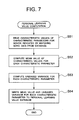
- step S31 the control device 6 first causes the display device 7 to display an image to ask the user whether the song currently being played back matches the sensibility word which has been selected or input (step S41).
- the user uses the operation input device 2 to input "YES” or "NO", according to this onscreen display, to indicate whether or not the song being played back matches the sensibility word.
- step S42 the control device 6 determines whether there has been input using either the "YES” button or the "NO” button (step S42). If there is input using the "YES” button, indicating that the song being played back matches the sensibility word, matching song data of this song is written to the matching song database in the data storage device 5 (step S43). This writing is carried out for respective sensibility words.
- the learning routine ends and processing goes to the step S25 (Fig. 4).
- step S44 determines whether there is a sensibility word for which the number of matching songs written in the matching song database has reached ten (step S44). If, for example, ten songs match the sensibility word concerned, then the matching song data of this sensibility word is read from the matching song database of the data storage device 5 (step S45) and is used to compute personal learning values using statistical processing (step S46). In step S44, "10 songs" is used for determination, but another value for the number of songs may be used.
- a sensibility word A for which the number of matching songs has reached 10 or greater.
- the values of the characteristic parameters (degree of chord change #1, degree of chord change #2, degree of chord change #3, beat, maximum beat level, mean amplitude level, maximum amplitude level, and key) for the songs having the sensibility word A are read from the characteristic parameter database of the data storage device 4 (step S51), and the mean Mave of the values for each characteristic parameter are computed (step S52). Further, the unbiased variance S for each characteristic parameter is also computed (step S53).
- the control device 6 writes the mean value Mave and unbiased variance S computed for each characteristic parameter into a certain storage area in the personal learning value database.
- the personal learning value database has storage areas for the respective characteristic parameters with respect to the sensibility word A (step S54).
- control device 6 After computing the personal learning values, the control device 6 returns to the step S25 (Fig. 4), and continues the operation (steps S26 to S30) as described above.
- the songs are presented to the user in the order conforming to the user's age and gender and also to a selected sensibility word.
- the accuracy of selection can be improved. That is, song selection is possible which accommodates differences in song images for a given sensibility word with differences in user age and gender.
- the more the user utilizes this song selection apparatus 12 the better the song selection apparatus 12 can make a song selection in terms of the user sensitivities.
- ages are divided into the five groups of teenagers, 20's, 30's, 40's, and 50 and older; but other way of grouping the ages is also acceptable. Further, division by exact age itself is possible; or, division into finer age groups, such as the first half of each decade and the second half of each decade, may also be used, or a coarser division, for example into under-30 and 30-and-older groups, is also possible.
- a data table within the default database is selected according to both age group and gender; however, the data table within the default database may be selected according to either the age group alone or the gender alone.
- the data tables for males alone may be used to select a data table in response to the input operation; or, when the user enters the gender only, either the data table for males in their 20's or the data table for females in their 20's may be selected in response to the input operation.
- the song selection operation for a single user is described; when performing song selection operation to select a song according to tastes common to a plurality of users, separate data tables for 20's and 30's may be prepared to calculate sensibility conformance values, and the song may be selected according to the total of these values.
- personal properties are age and gender, but any conditions or parameters which identify human characteristics or human attributes can be used, such as race, occupation, ethnic group, blood type, hair color, eye color, religion, and area of residence.
- songs are selected from all of the songs stored in the data storage device 3, but the songs from which song selection is performed may differ according to the user's age. For example, traditional Japanese enka ballads may be excluded when the user's age is in the teens or 20's; recent hit songs may be excluded when the user's age is 50 or above.
- the degree of chord change #1, degree of chord change #2, degree of chord change #3, beat, maximum beat level, mean amplitude level, maximum amplitude level, and the key are the characteristic parameters of songs, but other parameters are possible. Also, sensibility conformance values may be computed for at least one among the degrees of the three chord changes #1 through #3.
- Degrees of chord change are not limited to the above-described degrees of chord changes #1 to #3.
- the amount of change in the chord root, or the number of changes to other types of chords, such as changes from a major chord to a minor chord can also be used as degrees of chord change.
- mean values and unbiased variances are used as correction values, but other values may be used.
- a multiplicative factor, variance or other weighting value to correct a degree of chord change or other characteristic value may be used.
- nonmatching song data of the song may be written to the nonmatching song database in the data storage device 5. Then, similar to computation of the personal learning values using the matching song data, nonmatching song data may be read from the nonmatching song database of the data storage device 5, and may be used to compute personal learning values through statistical processing. Personal learning values computed based on nonmatching song data may be stored in a second personal learning value database (seventh storage means), as shown in Fig. 8.
- the personal learning values (mean values, unbiased variances) for this nonmatching song data are reflected through the correction values ⁇ a, ⁇ b, ⁇ c, ⁇ d, ⁇ e, ⁇ f, ⁇ g, and ⁇ h when computing the sensibility conformance value as shown below.
- Sensibility conformance value [(1/
- the correction values ⁇ a, ⁇ b, ⁇ c, ⁇ d, ⁇ e, ⁇ f, ⁇ g, and ⁇ h act so as to reduce the sensibility conformance value, and are set according to the mean values and unbiased variances which are the personal learning values based on nonmatching song data read out for each characteristic parameter.
Landscapes
- Physics & Mathematics (AREA)
- Engineering & Computer Science (AREA)
- Acoustics & Sound (AREA)
- Multimedia (AREA)
- Indexing, Searching, Synchronizing, And The Amount Of Synchronization Travel Of Record Carriers (AREA)
- Information Retrieval, Db Structures And Fs Structures Therefor (AREA)
- Electrophonic Musical Instruments (AREA)
- Management Or Editing Of Information On Record Carriers (AREA)
Applications Claiming Priority (2)
| Application Number | Priority Date | Filing Date | Title |
|---|---|---|---|
| JP2004014197 | 2004-01-22 | ||
| JP2004014197A JP4322691B2 (ja) | 2004-01-22 | 2004-01-22 | 選曲装置 |
Publications (2)
| Publication Number | Publication Date |
|---|---|
| EP1557818A2 true EP1557818A2 (fr) | 2005-07-27 |
| EP1557818A3 EP1557818A3 (fr) | 2005-08-03 |
Family
ID=34631925
Family Applications (1)
| Application Number | Title | Priority Date | Filing Date |
|---|---|---|---|
| EP04030499A Withdrawn EP1557818A3 (fr) | 2004-01-22 | 2004-12-22 | Dispositif et méthode pour la sélection de chansons |
Country Status (3)
| Country | Link |
|---|---|
| US (1) | US7247786B2 (fr) |
| EP (1) | EP1557818A3 (fr) |
| JP (1) | JP4322691B2 (fr) |
Cited By (1)
| Publication number | Priority date | Publication date | Assignee | Title |
|---|---|---|---|---|
| DE102005052890A1 (de) * | 2005-11-07 | 2007-05-16 | Kristoffer Schwarz | Elektronisches Notenpult |
Families Citing this family (13)
| Publication number | Priority date | Publication date | Assignee | Title |
|---|---|---|---|---|
| USRE43379E1 (en) * | 2003-10-09 | 2012-05-15 | Pioneer Corporation | Music selecting apparatus and method |
| US20060083119A1 (en) * | 2004-10-20 | 2006-04-20 | Hayes Thomas J | Scalable system and method for predicting hit music preferences for an individual |
| WO2006072856A2 (fr) * | 2005-01-04 | 2006-07-13 | Koninklijke Philips Electronics N.V. | Appareil et procede permettant de traiter des donnees reproductibles |
| US7612280B2 (en) * | 2006-05-22 | 2009-11-03 | Schneider Andrew J | Intelligent audio selector |
| JP2008015595A (ja) * | 2006-07-03 | 2008-01-24 | Sony Corp | コンテンツ選択推薦方法、サーバ、コンテンツ再生装置、コンテンツ記録装置およびコンテンツ選択推薦用プログラム |
| CN101114288A (zh) * | 2006-07-26 | 2008-01-30 | 鸿富锦精密工业(深圳)有限公司 | 具有点歌功能的便携式电子装置 |
| US7873634B2 (en) * | 2007-03-12 | 2011-01-18 | Hitlab Ulc. | Method and a system for automatic evaluation of digital files |
| JP4697165B2 (ja) * | 2007-03-27 | 2011-06-08 | ヤマハ株式会社 | 音楽再生制御装置 |
| JP4470189B2 (ja) | 2007-09-14 | 2010-06-02 | 株式会社デンソー | 自動車用音楽再生システム |
| EP2068255A3 (fr) * | 2007-12-07 | 2010-03-17 | Magix Ag | Système et méthode pour génération éfficace des listes d'écoute à base de similarité sur des dispositifs portables |
| JP5259212B2 (ja) * | 2008-02-26 | 2013-08-07 | Kddi株式会社 | 音楽連動型広告配信方法、装置およびシステム |
| JP2012008623A (ja) * | 2010-06-22 | 2012-01-12 | Jvc Kenwood Corp | プレイリスト作成装置、プレイリスト作成方法、及びプレイリスト作成プログラム |
| BE1025967B1 (nl) | 2018-01-31 | 2019-09-03 | Stephan Kliché | Werkwijze en interface voor het adaptief creëren van multimedia afspeellijsten |
Citations (1)
| Publication number | Priority date | Publication date | Assignee | Title |
|---|---|---|---|---|
| EP1304628A2 (fr) * | 2001-10-19 | 2003-04-23 | Pioneer Corporation | Méthode et appareil pour sélectionner et reproduire d'information |
Family Cites Families (10)
| Publication number | Priority date | Publication date | Assignee | Title |
|---|---|---|---|---|
| JPH10134549A (ja) | 1996-10-30 | 1998-05-22 | Nippon Columbia Co Ltd | 楽曲検索装置 |
| US6504089B1 (en) * | 1997-12-24 | 2003-01-07 | Canon Kabushiki Kaisha | System for and method of searching music data, and recording medium for use therewith |
| US6545209B1 (en) * | 2000-07-05 | 2003-04-08 | Microsoft Corporation | Music content characteristic identification and matching |
| US6913466B2 (en) * | 2001-08-21 | 2005-07-05 | Microsoft Corporation | System and methods for training a trainee to classify fundamental properties of media entities |
| US7532943B2 (en) * | 2001-08-21 | 2009-05-12 | Microsoft Corporation | System and methods for providing automatic classification of media entities according to sonic properties |
| AU2001296621A1 (en) * | 2000-10-05 | 2002-04-15 | Digitalmc Corporation | Method and system to classify music |
| KR100401012B1 (ko) * | 2000-12-15 | 2003-10-30 | 김연경 | 감정상태에 기초한 선곡기능을 가진 음악제공시스템 및 방법 |
| US6987221B2 (en) * | 2002-05-30 | 2006-01-17 | Microsoft Corporation | Auto playlist generation with multiple seed songs |
| US7166791B2 (en) * | 2002-07-30 | 2007-01-23 | Apple Computer, Inc. | Graphical user interface and methods of use thereof in a multimedia player |
| EP1528536A1 (fr) * | 2003-10-09 | 2005-05-04 | Pioneer Corporation | Dispositif et méthode pour la sélection d'un morceau de musique |
-
2004
- 2004-01-22 JP JP2004014197A patent/JP4322691B2/ja not_active Expired - Fee Related
- 2004-12-22 EP EP04030499A patent/EP1557818A3/fr not_active Withdrawn
-
2005
- 2005-01-14 US US11/034,851 patent/US7247786B2/en not_active Expired - Fee Related
Patent Citations (1)
| Publication number | Priority date | Publication date | Assignee | Title |
|---|---|---|---|---|
| EP1304628A2 (fr) * | 2001-10-19 | 2003-04-23 | Pioneer Corporation | Méthode et appareil pour sélectionner et reproduire d'information |
Cited By (2)
| Publication number | Priority date | Publication date | Assignee | Title |
|---|---|---|---|---|
| DE102005052890A1 (de) * | 2005-11-07 | 2007-05-16 | Kristoffer Schwarz | Elektronisches Notenpult |
| DE102005052890B4 (de) * | 2005-11-07 | 2009-04-16 | Kristoffer Schwarz | Elektronisches Notenpult |
Also Published As
| Publication number | Publication date |
|---|---|
| US7247786B2 (en) | 2007-07-24 |
| US20050160901A1 (en) | 2005-07-28 |
| EP1557818A3 (fr) | 2005-08-03 |
| JP2005209276A (ja) | 2005-08-04 |
| JP4322691B2 (ja) | 2009-09-02 |
Similar Documents
| Publication | Publication Date | Title |
|---|---|---|
| US7741554B2 (en) | Apparatus and method for automatically creating music piece data | |
| US7247786B2 (en) | Song selection apparatus and method | |
| JP4067372B2 (ja) | 運動補助装置 | |
| EP1791111A1 (fr) | Dispositif de création de contenu et méthode de création de contenu | |
| EP1705588A1 (fr) | Méthode de recherche de contenu, méthode de recherche de la liste du contenu, appareil de recherche de contenu, appareil de recherche de la liste du contenu et serveur de recherche | |
| JP2006517679A (ja) | オーディオ再生装置、方法及びコンピュータプログラム | |
| US7629529B2 (en) | Music-piece retrieval and playback apparatus, and related method | |
| JP6288197B2 (ja) | 評価装置及びプログラム | |
| JP6102076B2 (ja) | 評価装置 | |
| USRE43379E1 (en) | Music selecting apparatus and method | |
| JP3783267B2 (ja) | Bgm端末装置 | |
| JP4182613B2 (ja) | カラオケ装置 | |
| JP2000148167A (ja) | メドレー楽曲の編集方法に特徴を有するカラオケ装置および通信カラオケシステム | |
| JPH1195775A (ja) | 音楽再生装置 | |
| US7385130B2 (en) | Music selecting apparatus and method | |
| JPH11237890A (ja) | 歌唱採点機能付きカラオケ装置における歌唱採点方法 | |
| JP2020014716A (ja) | 音楽療法のための歌唱補助装置 | |
| JP2007271977A (ja) | 評価基準判定装置、制御方法及びプログラム | |
| JP2019101148A (ja) | 通信カラオケシステム | |
| JP4723222B2 (ja) | 選曲装置及び方法 | |
| JP2007256619A (ja) | 評価装置、制御方法及びプログラム | |
| JPH1026992A (ja) | カラオケ装置 | |
| JPH1115482A (ja) | 楽音再生装置 | |
| JP4447524B2 (ja) | 統一テンポのメドレー選曲処理に特徴を有するカラオケ装置 | |
| US20250306849A1 (en) | Music selection device, music selection method, and storage medium |
Legal Events
| Date | Code | Title | Description |
|---|---|---|---|
| PUAI | Public reference made under article 153(3) epc to a published international application that has entered the european phase |
Free format text: ORIGINAL CODE: 0009012 |
|
| PUAL | Search report despatched |
Free format text: ORIGINAL CODE: 0009013 |
|
| AK | Designated contracting states |
Kind code of ref document: A2 Designated state(s): AT BE BG CH CY CZ DE DK EE ES FI FR GB GR HU IE IS IT LI LT LU MC NL PL PT RO SE SI SK TR |
|
| AX | Request for extension of the european patent |
Extension state: AL BA HR LV MK YU |
|
| AK | Designated contracting states |
Kind code of ref document: A3 Designated state(s): AT BE BG CH CY CZ DE DK EE ES FI FR GB GR HU IE IS IT LI LT LU MC NL PL PT RO SE SI SK TR |
|
| AX | Request for extension of the european patent |
Extension state: AL BA HR LV MK YU |
|
| 17P | Request for examination filed |
Effective date: 20050728 |
|
| AKX | Designation fees paid |
Designated state(s): DE FR GB |
|
| 17Q | First examination report despatched |
Effective date: 20100525 |
|
| RAP1 | Party data changed (applicant data changed or rights of an application transferred) |
Owner name: PIONEER CORPORATION |
|
| STAA | Information on the status of an ep patent application or granted ep patent |
Free format text: STATUS: THE APPLICATION IS DEEMED TO BE WITHDRAWN |
|
| 18D | Application deemed to be withdrawn |
Effective date: 20101005 |