EP1557614A1 - Kontaktelement und Deckenelement - Google Patents
Kontaktelement und Deckenelement Download PDFInfo
- Publication number
- EP1557614A1 EP1557614A1 EP04405038A EP04405038A EP1557614A1 EP 1557614 A1 EP1557614 A1 EP 1557614A1 EP 04405038 A EP04405038 A EP 04405038A EP 04405038 A EP04405038 A EP 04405038A EP 1557614 A1 EP1557614 A1 EP 1557614A1
- Authority
- EP
- European Patent Office
- Prior art keywords
- contact
- contact surface
- contact element
- element according
- strips
- Prior art date
- Legal status (The legal status is an assumption and is not a legal conclusion. Google has not performed a legal analysis and makes no representation as to the accuracy of the status listed.)
- Granted
Links
Images
Classifications
-
- F—MECHANICAL ENGINEERING; LIGHTING; HEATING; WEAPONS; BLASTING
- F24—HEATING; RANGES; VENTILATING
- F24D—DOMESTIC- OR SPACE-HEATING SYSTEMS, e.g. CENTRAL HEATING SYSTEMS; DOMESTIC HOT-WATER SUPPLY SYSTEMS; ELEMENTS OR COMPONENTS THEREFOR
- F24D3/00—Hot-water central heating systems
- F24D3/12—Tube and panel arrangements for ceiling, wall, or underfloor heating
- F24D3/16—Tube and panel arrangements for ceiling, wall, or underfloor heating mounted on, or adjacent to, a ceiling, wall or floor
- F24D3/165—Suspended radiant heating ceiling
-
- Y—GENERAL TAGGING OF NEW TECHNOLOGICAL DEVELOPMENTS; GENERAL TAGGING OF CROSS-SECTIONAL TECHNOLOGIES SPANNING OVER SEVERAL SECTIONS OF THE IPC; TECHNICAL SUBJECTS COVERED BY FORMER USPC CROSS-REFERENCE ART COLLECTIONS [XRACs] AND DIGESTS
- Y02—TECHNOLOGIES OR APPLICATIONS FOR MITIGATION OR ADAPTATION AGAINST CLIMATE CHANGE
- Y02B—CLIMATE CHANGE MITIGATION TECHNOLOGIES RELATED TO BUILDINGS, e.g. HOUSING, HOUSE APPLIANCES OR RELATED END-USER APPLICATIONS
- Y02B30/00—Energy efficient heating, ventilation or air conditioning [HVAC]
Definitions
- the invention relates to a contact element according to the The preamble of claim 1 and a ceiling element, which a contact element comprises.
- Ceiling elements of this type will be used for the air conditioning of rooms.
- the Contact elements serve to produce a good thermal contact between cooling or heating fluid flowed through pipes and a perforated plate of the Ceiling element with which they are glued.
- the Contact elements glued directly to the perforated plate.
- the fleece is cut out so that it's the one from the contact surfaces covered areas of the perforated plate and then leaves on the Ceiling plate placed and glued at points with her. It
- the contact elements so accurate on the To arrange the perforated plate and to cut the fleece so precisely that it's everywhere exactly to the edges of the contact surfaces enough. Often there remain narrow strips free at which then air circulates through the hole blanket. However, this leads usually quickly lead to pollution of the ceiling in this Range, which is undesirable for aesthetic reasons.
- the invention is based on the object, a To specify contact element, which directly with the perforated ceiling can be glued, so that a more reliable mechanical and thermal contact is ensured with the same, which at the same time allows the perforated plate in such a way to cover with fleece that no areas remain free and the cover of the perforated plate at the edges of the Contact surface is always complete.
- a should corresponding ceiling element can be specified.
- the invention allows the area not covered by the contact areas without gap without having difficult-to-fulfill requirements for Precision of the production would have to be made.
- One Another advantage of the invention is that the fleece is reliably fixed to the perforated plate.
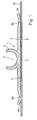
- the inventive contact element 1 is as elongated Contact rail of constant cross-section formed and is preferably made of aluminum. It includes one rectangular contact plate 2, which on an upper side a centrally disposed guide 3 carries, which a channel 4 to Recording a cooling or heating fluid pipe forms. At the bottom, the contact plate forms a level contact surface 5. Connect to both longitudinal edges the contact surface 5 via a rounded edge with a Radius of e.g. 0.5 mm continuously flat edge strips 6a, b, which with the contact surface 5 an angle of 150 ° include and at the edge of the contact plate 2 at least 0.5mm, preferably at least 1mm above the plane of Contact surface 5 are. Are angles between 120 ° and 160 ° well suited. The edge strips could also be curved, e.g. slightly convex, with smooth transition to the contact surface. Preferably, they rise to the edge of the contact plate outside steadily and do not form outward facing Stages.
- the contact surface 5 breaks down into one the most part the same engaging adhesive surface, which of a Adhesive layer 7 is covered and of the adhesive layer. 7 free boundary strips 8a, b, which extend from the edge of Adhesive surface extend to the edge of the contact surface 5, where connect the edge strips 6a, b.
- the adhesive layer 7 connects the contact element 1 with a perforated plate 9. Your Thickness is between 0.18mm and 0.2mm.
- the adhesive surface may also be slightly higher than their surroundings, i.e. the reason of a shallow depression in the contact surface form.
- the perforated plate 9 carries several parallel with distance juxtaposed contact elements 1.
- the not of the contact surfaces 5 of the same covered area is of a fleece 10, a about 0.2 mm thick acoustic fleece with Sound-absorbing effect, covered.
- the fleece 10 is enough on both sides of the contact plate 2 at least to the outside Edge of the boundary strip 8a, b, but it is advantageous if it under the border strip 8a, b and possibly up in the Near the adhesive layer 7 is pulled.
- the nonwoven 10 is preferably slightly thicker than the adhesive layer 7 and Therefore, under the border strip 8a, b slightly clamped and thus reliably recorded. It can be up to the edge of Adhesive layer 7 are sufficient, but this is not required.
- the position of the edge of the nonwoven 10 can be about the width of the Border strip 8a; b stagger without disturbing uncovered strip at the top of the perforated plate 9 would create.
- the contact elements 1 first with an approx. 0.25mm thick Glue layer and then against the top of the Perforated plate 9 pressed, wherein the adhesive layer on the said thickness is compressed from 0.18mm to 0.2mm and, slightly laterally expanding, the adhesive surface covered.
- the nonwoven 10 can be either in strips, which fit between the contact elements or in one piece, with cut out strip-shaped openings whose width each slightly larger than that of the adhesive surface, with adjoined by the transverse edges of the openings Sections.
- the fleece is placed, whereby it between the Contact elements 1 is slightly bulging and the Outer edges bordering the edges of the Contact plates 2 pending. Then those at the openings adjoining edge regions of the fleece by pressure the same from above and stroking movements against the Contact plate 2 under the edge strips 6a; b pressed, from which they led below the contact surface 5 in the further until the web 10 between the contact elements. 1 lying flat on the perforated plate 9, with the edges of the Openings under the boundary strips 8a, b.
- the edge stripes 6a, b allow each a problem-free insertion of the the opening bounding edges of the fleece under the Contact surface 5.
Landscapes
- Engineering & Computer Science (AREA)
- Physics & Mathematics (AREA)
- Thermal Sciences (AREA)
- Chemical & Material Sciences (AREA)
- Combustion & Propulsion (AREA)
- Mechanical Engineering (AREA)
- General Engineering & Computer Science (AREA)
- Building Environments (AREA)
- Fixed Capacitors And Capacitor Manufacturing Machines (AREA)
- Thermistors And Varistors (AREA)
- Burglar Alarm Systems (AREA)
- Connector Housings Or Holding Contact Members (AREA)
Abstract
Description
- Fig. 1
- zeigt einen Querschnitt durch einen Teil eines erfindungsgemässen Deckenelements.
- 1
- Kontaktelement
- 2
- Kontaktplatte
- 3
- Führung
- 4
- Kanal
- 5
- Kontaktfläche
- 6a,b
- Randstreifen
- 7
- Kleberschicht
- 8a,b
- Grenzstreifen
- 9
- Lochplatte
- 10
- Vlies
Claims (10)
- Kontaktelement mit einer Kontaktplatte (2), welche an einer Unterseite eine ebene Kontaktfläche (5) aufweist und mit mindestens einer an der Oberseite der Kontaktplatte (2) angeordneten, sich im wesentlichen über ihre Länge erstreckenden Führung (3) für ein Rohr, dadurch gekennzeichnet, dass an zwei einander gegenüberliegenden Rändern der Kontaktfläche (5) jeweils nach aussen ansteigende Randstreifen (6a, 6b) stufenlos an dieselbe anschliessen.
- Kontaktelement nach Anspruch 1, dadurch gekennzeichnet, dass die Randstreifen (6a, 6b) sich jeweils stufenlos bis zu einem Aussenrand der Kontaktplatte (2) erstrecken und dort, vorzugsweise um mindestens 0,5mm, über der Ebene der Kontaktfläche (5) liegen.
- Kontaktelement nach Anspruch 1 oder 2, dadurch gekennzeichnet, dass die Randstreifen (6a, 6b) eben sind und mit der Kontaktfläche (5) einen stumpfen Winkel, der vorzugsweise zwischen 120° und 160° liegt, einschliessen.
- Kontaktelement nach einem der Ansprüche 1 bis 3, dadurch gekennzeichnet, dass die Kontaktfläche (5) rechteckig ist und die Randstreifen (6a, 6b) an ihre Längsränder anschliessen.
- Kontaktelement nach Anspruch 4, dadurch gekennzeichnet, dass sein Querschnitt über seine Länge im wesentlichen konstant ist.
- Kontaktelement nach einem der Ansprüche 1 bis 5, dadurch gekennzeichnet, dass die Kontaktfläche (5) eine Kleberschicht (7) trägt, welche von den Randstreifen (6a, 6b) beabstandet ist.
- Kontaktelement nach den Ansprüchen 4 oder 5 und Anspruch 6, dadurch gekennzeichnet, dass die Kleberschicht (7) annähernd die ganze Kontaktfläche (5) bedeckt, wobei an deren Längsränder anschliessende Grenzstreifen (8a, 8b) frei bleiben.
- Deckenelement mit mindestens einem Kontaktelement (1) nach einem der Ansprüche 1 bis 7 sowie mit einer Lochplatte (9), mit deren Oberseite eine Klebefläche des mindestens einen Kontaktelements (1), welche sich über einen Teil der Kontaktfläche (5), der an die Randstreifen (6a, 6b) anschliessende Grenzstreifen (8a, 8b) frei lässt, erstreckt, mittels einer Kleberschicht (7) verklebt ist sowie mit einem Vlies (10), welches vom mindestens einen Kontaktelement (1) freie Bereiche der Oberseite der Lochplatte (9) bedeckt, wobei die Klebefläche ausgespart ist, das Vlies (10) jedoch überall mindestens bis zum Rand der Kontaktfläche (5) und vorzugsweise in die Grenzstreifen (8a, 8b) hinein reicht.
- Deckenelement nach Anspruch 8, dadurch gekennzeichnet, dass die Dicke des Vlieses (10) geringfügig grösser ist als die der Kleberschicht (7), so dass unter den Grenzstreifen (8a, 8b) liegende Teile desselben leicht geklemmt sind.
- Deckenelement nach Anspruch 8 oder 9, dadurch gekennzeichnet, dass das Vlies (10) die nicht von der Kontaktfläche (5) des mindestens einen Kontaktelements (1) bedeckten Teile der Oberseite der Lochplatte (9) lückenlos bedeckt.
Priority Applications (3)
| Application Number | Priority Date | Filing Date | Title |
|---|---|---|---|
| AT04405038T ATE397192T1 (de) | 2004-01-21 | 2004-01-21 | Kontaktelement und deckenelement |
| DE502004007273T DE502004007273D1 (de) | 2004-01-21 | 2004-01-21 | Kontaktelement und Deckenelement |
| EP04405038A EP1557614B1 (de) | 2004-01-21 | 2004-01-21 | Kontaktelement und Deckenelement |
Applications Claiming Priority (1)
| Application Number | Priority Date | Filing Date | Title |
|---|---|---|---|
| EP04405038A EP1557614B1 (de) | 2004-01-21 | 2004-01-21 | Kontaktelement und Deckenelement |
Publications (2)
| Publication Number | Publication Date |
|---|---|
| EP1557614A1 true EP1557614A1 (de) | 2005-07-27 |
| EP1557614B1 EP1557614B1 (de) | 2008-05-28 |
Family
ID=34626559
Family Applications (1)
| Application Number | Title | Priority Date | Filing Date |
|---|---|---|---|
| EP04405038A Expired - Lifetime EP1557614B1 (de) | 2004-01-21 | 2004-01-21 | Kontaktelement und Deckenelement |
Country Status (3)
| Country | Link |
|---|---|
| EP (1) | EP1557614B1 (de) |
| AT (1) | ATE397192T1 (de) |
| DE (1) | DE502004007273D1 (de) |
Cited By (1)
| Publication number | Priority date | Publication date | Assignee | Title |
|---|---|---|---|---|
| FR2973405A1 (fr) * | 2011-03-30 | 2012-10-05 | Philippe Bergey | Rail thermique pour dalle chauffante |
Citations (5)
| Publication number | Priority date | Publication date | Assignee | Title |
|---|---|---|---|---|
| FR1306680A (fr) * | 1961-09-05 | 1962-10-19 | Perfectionnements apportés aux ensembles du genre des planchers chauffants | |
| FR86576E (fr) * | 1964-10-14 | 1966-03-04 | Nessi Freres & Cie | Plaques préfabriquées pour plafonds chauffants et rafraîchissants |
| DE1946011A1 (de) * | 1969-09-11 | 1971-03-25 | Welz Hans Joachim Dipl Ing | Deckenstrahlungsheizung bzw. -kuehlung |
| US4635710A (en) * | 1984-02-02 | 1987-01-13 | William Shelley | Linear radiant ceiling panel |
| EP0859200A2 (de) * | 1997-02-13 | 1998-08-19 | Tever Technik Vertriebs- und Beteiligungs-GmbH & Co. Beratungs KG | Heizpaneel |
-
2004
- 2004-01-21 EP EP04405038A patent/EP1557614B1/de not_active Expired - Lifetime
- 2004-01-21 AT AT04405038T patent/ATE397192T1/de not_active IP Right Cessation
- 2004-01-21 DE DE502004007273T patent/DE502004007273D1/de not_active Expired - Lifetime
Patent Citations (5)
| Publication number | Priority date | Publication date | Assignee | Title |
|---|---|---|---|---|
| FR1306680A (fr) * | 1961-09-05 | 1962-10-19 | Perfectionnements apportés aux ensembles du genre des planchers chauffants | |
| FR86576E (fr) * | 1964-10-14 | 1966-03-04 | Nessi Freres & Cie | Plaques préfabriquées pour plafonds chauffants et rafraîchissants |
| DE1946011A1 (de) * | 1969-09-11 | 1971-03-25 | Welz Hans Joachim Dipl Ing | Deckenstrahlungsheizung bzw. -kuehlung |
| US4635710A (en) * | 1984-02-02 | 1987-01-13 | William Shelley | Linear radiant ceiling panel |
| EP0859200A2 (de) * | 1997-02-13 | 1998-08-19 | Tever Technik Vertriebs- und Beteiligungs-GmbH & Co. Beratungs KG | Heizpaneel |
Cited By (1)
| Publication number | Priority date | Publication date | Assignee | Title |
|---|---|---|---|---|
| FR2973405A1 (fr) * | 2011-03-30 | 2012-10-05 | Philippe Bergey | Rail thermique pour dalle chauffante |
Also Published As
| Publication number | Publication date |
|---|---|
| DE502004007273D1 (de) | 2008-07-10 |
| EP1557614B1 (de) | 2008-05-28 |
| ATE397192T1 (de) | 2008-06-15 |
Similar Documents
| Publication | Publication Date | Title |
|---|---|---|
| EP0769659B1 (de) | Kontaktelement und Deckenelement für eine Heiz- und Kühldecke | |
| EP1452816A3 (de) | Plattenwärmetauscher | |
| EP1557614B1 (de) | Kontaktelement und Deckenelement | |
| DE2009547A1 (de) | Heizelement | |
| EP1428953A1 (de) | Raumbegrenzungs-Paneel | |
| WO2010009946A1 (de) | Schienenfahrzeug mit höhenausgleich für eine fussbodenplatte | |
| EP1777469A1 (de) | Kühlelement | |
| EP2995871A1 (de) | Deckenelement sowie heiz- und kühldecke | |
| DE4441296C1 (de) | Universallüfter mit plissierten Seitenteilen in gespritzter Ausführung | |
| EP3309314A1 (de) | Deckenelement sowie heiz- und kühldecke | |
| AT413719B (de) | Vorrichtung für die in-dach-verbindung von wenigstens zwei plattenförmigen bauteilen auf einem schrägdach | |
| EP2811232A1 (de) | Deckenelement für eine Heiz- und Kühldecke sowie Heiz- und Kühldecke | |
| DE10043528A1 (de) | Scheibenbremsbelag | |
| EP0461444B1 (de) | Wärmedämmung für grosse Temperaturintervalle im Tieftemperaturbereich | |
| EP1295991A1 (de) | Schallschutzelement | |
| DE69924730T3 (de) | Tür, Türpaneel und Herstellungsverfahren dafür | |
| DE102017006751A1 (de) | Verbundbauteil, Zusammenbau mit einem solchen Verbundbauteil, und Fahrzeug mit einem solchen Zusammenbau | |
| DE4419920A1 (de) | Traufenlüftungsprofil | |
| DE20210805U1 (de) | Isolierendes Bauelement | |
| EP1162410A1 (de) | Joch, Schienenanordnung sowie Deckenelement für eine Heiz- und Kühldecke | |
| CH670470A5 (de) | ||
| DE10052070A1 (de) | Mobile Trennwand | |
| DE1609932C (de) | Dacheindeckungsplatte aus Kunststoff | |
| CH709603A1 (de) | Deckenelement für eine Heiz- und Kühldecke. | |
| DE202009014711U1 (de) | Aufhängevorrichtung für ein Deckensegel |
Legal Events
| Date | Code | Title | Description |
|---|---|---|---|
| PUAI | Public reference made under article 153(3) epc to a published international application that has entered the european phase |
Free format text: ORIGINAL CODE: 0009012 |
|
| AK | Designated contracting states |
Kind code of ref document: A1 Designated state(s): AT BE BG CH CY CZ DE DK EE ES FI FR GB GR HU IE IT LI LU MC NL PT RO SE SI SK TR |
|
| AX | Request for extension of the european patent |
Extension state: AL LT LV MK |
|
| 17P | Request for examination filed |
Effective date: 20060121 |
|
| AKX | Designation fees paid |
Designated state(s): AT CH DE GB LI NL |
|
| 17Q | First examination report despatched |
Effective date: 20070604 |
|
| GRAP | Despatch of communication of intention to grant a patent |
Free format text: ORIGINAL CODE: EPIDOSNIGR1 |
|
| RAP1 | Party data changed (applicant data changed or rights of an application transferred) |
Owner name: MWH BARCOL-AIR AG |
|
| GRAS | Grant fee paid |
Free format text: ORIGINAL CODE: EPIDOSNIGR3 |
|
| GRAA | (expected) grant |
Free format text: ORIGINAL CODE: 0009210 |
|
| AK | Designated contracting states |
Kind code of ref document: B1 Designated state(s): AT CH DE GB LI NL |
|
| REG | Reference to a national code |
Ref country code: GB Ref legal event code: FG4D Free format text: NOT ENGLISH |
|
| REG | Reference to a national code |
Ref country code: CH Ref legal event code: EP |
|
| REF | Corresponds to: |
Ref document number: 502004007273 Country of ref document: DE Date of ref document: 20080710 Kind code of ref document: P |
|
| REG | Reference to a national code |
Ref country code: CH Ref legal event code: NV Representative=s name: ZIMMERLI, WAGNER & PARTNER AG |
|
| PLBE | No opposition filed within time limit |
Free format text: ORIGINAL CODE: 0009261 |
|
| STAA | Information on the status of an ep patent application or granted ep patent |
Free format text: STATUS: NO OPPOSITION FILED WITHIN TIME LIMIT |
|
| 26N | No opposition filed |
Effective date: 20090303 |
|
| REG | Reference to a national code |
Ref country code: CH Ref legal event code: PFA Owner name: MWH BARCOL-AIR AG Free format text: MWH BARCOL-AIR AG#GRUNDSTRASSE 10B#8712 STAEFA (CH) -TRANSFER TO- MWH BARCOL-AIR AG#GRUNDSTRASSE 10B#8712 STAEFA (CH) |
|
| PGFP | Annual fee paid to national office [announced via postgrant information from national office to epo] |
Ref country code: AT Payment date: 20100113 Year of fee payment: 7 Ref country code: DE Payment date: 20100114 Year of fee payment: 7 Ref country code: GB Payment date: 20100120 Year of fee payment: 7 |
|
| PGFP | Annual fee paid to national office [announced via postgrant information from national office to epo] |
Ref country code: NL Payment date: 20100101 Year of fee payment: 7 |
|
| REG | Reference to a national code |
Ref country code: NL Ref legal event code: V1 Effective date: 20110801 |
|
| GBPC | Gb: european patent ceased through non-payment of renewal fee |
Effective date: 20110121 |
|
| PG25 | Lapsed in a contracting state [announced via postgrant information from national office to epo] |
Ref country code: AT Free format text: LAPSE BECAUSE OF NON-PAYMENT OF DUE FEES Effective date: 20110121 Ref country code: GB Free format text: LAPSE BECAUSE OF NON-PAYMENT OF DUE FEES Effective date: 20110121 |
|
| REG | Reference to a national code |
Ref country code: DE Ref legal event code: R119 Ref document number: 502004007273 Country of ref document: DE Effective date: 20110802 |
|
| PG25 | Lapsed in a contracting state [announced via postgrant information from national office to epo] |
Ref country code: NL Free format text: LAPSE BECAUSE OF NON-PAYMENT OF DUE FEES Effective date: 20110801 |
|
| PGFP | Annual fee paid to national office [announced via postgrant information from national office to epo] |
Ref country code: CH Payment date: 20130129 Year of fee payment: 10 |
|
| PG25 | Lapsed in a contracting state [announced via postgrant information from national office to epo] |
Ref country code: DE Free format text: LAPSE BECAUSE OF NON-PAYMENT OF DUE FEES Effective date: 20110802 |
|
| REG | Reference to a national code |
Ref country code: CH Ref legal event code: NV Representative=s name: WAGNER PATENT AG, CH |
|
| REG | Reference to a national code |
Ref country code: CH Ref legal event code: PL |
|
| PG25 | Lapsed in a contracting state [announced via postgrant information from national office to epo] |
Ref country code: LI Free format text: LAPSE BECAUSE OF NON-PAYMENT OF DUE FEES Effective date: 20140131 Ref country code: CH Free format text: LAPSE BECAUSE OF NON-PAYMENT OF DUE FEES Effective date: 20140131 |