EP1555851A2 - Verfahren zur Herstellung von Otoplastiken und Otoplastik - Google Patents
Verfahren zur Herstellung von Otoplastiken und Otoplastik Download PDFInfo
- Publication number
- EP1555851A2 EP1555851A2 EP04017958A EP04017958A EP1555851A2 EP 1555851 A2 EP1555851 A2 EP 1555851A2 EP 04017958 A EP04017958 A EP 04017958A EP 04017958 A EP04017958 A EP 04017958A EP 1555851 A2 EP1555851 A2 EP 1555851A2
- Authority
- EP
- European Patent Office
- Prior art keywords
- earmold
- ear
- shell
- hearing aid
- individual
- Prior art date
- Legal status (The legal status is an assumption and is not a legal conclusion. Google has not performed a legal analysis and makes no representation as to the accuracy of the status listed.)
- Withdrawn
Links
Images



Classifications
-
- H—ELECTRICITY
- H04—ELECTRIC COMMUNICATION TECHNIQUE
- H04R—LOUDSPEAKERS, MICROPHONES, GRAMOPHONE PICK-UPS OR LIKE ACOUSTIC ELECTROMECHANICAL TRANSDUCERS; ELECTRIC HEARING AIDS; PUBLIC ADDRESS SYSTEMS
- H04R25/00—Electric hearing aids
- H04R25/65—Housing parts, e.g. shells, tips or moulds, or their manufacture
- H04R25/652—Ear tips; Ear moulds
-
- H—ELECTRICITY
- H04—ELECTRIC COMMUNICATION TECHNIQUE
- H04R—LOUDSPEAKERS, MICROPHONES, GRAMOPHONE PICK-UPS OR LIKE ACOUSTIC ELECTROMECHANICAL TRANSDUCERS; ELECTRIC HEARING AIDS; PUBLIC ADDRESS SYSTEMS
- H04R25/00—Electric hearing aids
- H04R25/65—Housing parts, e.g. shells, tips or moulds, or their manufacture
- H04R25/658—Manufacture of housing parts
-
- B—PERFORMING OPERATIONS; TRANSPORTING
- B29—WORKING OF PLASTICS; WORKING OF SUBSTANCES IN A PLASTIC STATE IN GENERAL
- B29C—SHAPING OR JOINING OF PLASTICS; SHAPING OF MATERIAL IN A PLASTIC STATE, NOT OTHERWISE PROVIDED FOR; AFTER-TREATMENT OF THE SHAPED PRODUCTS, e.g. REPAIRING
- B29C64/00—Additive manufacturing, i.e. manufacturing of three-dimensional [3D] objects by additive deposition, additive agglomeration or additive layering, e.g. by 3D printing, stereolithography or selective laser sintering
- B29C64/10—Processes of additive manufacturing
-
- B—PERFORMING OPERATIONS; TRANSPORTING
- B33—ADDITIVE MANUFACTURING TECHNOLOGY
- B33Y—ADDITIVE MANUFACTURING, i.e. MANUFACTURING OF THREE-DIMENSIONAL [3D] OBJECTS BY ADDITIVE DEPOSITION, ADDITIVE AGGLOMERATION OR ADDITIVE LAYERING, e.g. BY 3D PRINTING, STEREOLITHOGRAPHY OR SELECTIVE LASER SINTERING
- B33Y80/00—Products made by additive manufacturing
-
- H—ELECTRICITY
- H04—ELECTRIC COMMUNICATION TECHNIQUE
- H04R—LOUDSPEAKERS, MICROPHONES, GRAMOPHONE PICK-UPS OR LIKE ACOUSTIC ELECTROMECHANICAL TRANSDUCERS; ELECTRIC HEARING AIDS; PUBLIC ADDRESS SYSTEMS
- H04R2225/00—Details of deaf aids covered by H04R25/00, not provided for in any of its subgroups
- H04R2225/025—In the ear hearing aids [ITE] hearing aids
-
- H—ELECTRICITY
- H04—ELECTRIC COMMUNICATION TECHNIQUE
- H04R—LOUDSPEAKERS, MICROPHONES, GRAMOPHONE PICK-UPS OR LIKE ACOUSTIC ELECTROMECHANICAL TRANSDUCERS; ELECTRIC HEARING AIDS; PUBLIC ADDRESS SYSTEMS
- H04R2225/00—Details of deaf aids covered by H04R25/00, not provided for in any of its subgroups
- H04R2225/77—Design aspects, e.g. CAD, of hearing aid tips, moulds or housings
Definitions
- the present invention relates to a method according to the preamble of claim 1 and an earmold according to that of claim 7.
- the present invention is based on problems that arise in the manufacture of in-ear hearing aids to have.
- the solution found in this regard can generally be applied to earmolds, to their definition is pointed out below.
- This form is then sent to the hearing aid manufacturer, where, based on this form, the Hearing aid shell is cast from a plastic.
- the described procedure is on the one hand extremely labor-intensive, and the resulting hearing aid remains of its wearing comfort as well as from the space use her considered mostly suboptimal.
- the mentioned in the conventional Materials used in manufacturing processes also require a relatively high wall thickness of the in-ear hearing aid shell, which further the space available for the mentioned functional parts, than this anyway Case is reduced.
- the present invention aims to remedy these drawbacks mentioned.
- she draws is characterized by the fact that the at least one shape is digitized three-dimensionally to a record and the earmold or whose shell is created by an additive construction process, controlled by the record.
- this manufacturing method is particularly suitable for in-the-ear hearing aids, it can with similar benefits also for external ear hearing aids, continue to be used for other earmolds, as for the production of headphones of all kinds, of water protection inserts, noise protection inserts, etc.
- the method is taken into account that the field of application of earmolds - it is especially on in-ear otoplastics pointed out - in everyday life is subjected to great dynamics, such as the ear canal by chewing movements.
- great dynamics such as the ear canal by chewing movements.
- an earmold to be a device that is immediately outside the pinna and / or is applied to the auricle and / or in the ear canal.
- These include external ear hearing aids, in-the-ear hearing aids, Headphones, noise protection and water protection inserts etc.
- a thin layer of material is deposited on a surface This is like the laser sintering or the stereolithography still over the entire surface, be it like the thermojet process already in the contour of a section of the earpiece under construction or its shell. thereupon The desired sectional shape is stabilized or solidified.
- a new layer is deposited as described above and this in turn solidified and connected to the underlying, already finished layer. So layer by layer becomes the Otoplasty or its shell created by additive layer-by-layer application.
- For industrial production is preferably not only the cut layer for an individual Otoplastic or its shell stored or solidified, but at the same time several each individual.
- At laser sinter solidifies e.g. one laser, usually mirror-controlled, one behind the other the slice layers of several earmolds or their shells, before all solidified cut layers are lowered together. Thereupon, after Laying a new layer of powder over all already solidified and lowered cutting layers, in turn the formation of the several further cut layers.
- the respective earmolds or their shells digitally controlled, individually manufactured.
- either a single laser beam is used for solidifying the plurality of slice layers and / or More than one beam is operated and controlled in parallel.
- An alternative to this procedure is to solidify a slice with a laser at a time, while at the same time the powder layer is deposited for the formation of a further earmold or earmold shell. Thereafter, the same laser becomes the prepared powder layer corresponding to the cut layer for the further plastic solidify while the previously solidified layer is lowered and there a new powder layer is deposited.
- the Laser then works intermittently between two or more earmolds or earmold shells wherein the laser insert dead time resulting from the powder deposition during the formation of one of the shells for the Solidification of a cut layer of another earmold under construction is exploited.
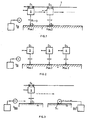
- Fig. 1 is shown schematically how, in a variant, by means of laser sintering or laser or stereolithography several earmolds or their shells are manufactured industrially in a parallel process.
- the laser with control unit 5 and beam 3 is mounted above the material bed 1 for powder or liquid medium.
- position 1 it solidifies the layer S 1 of a first otoplastic or its shell, driven by the first individual data set D 1 .
- a displacement device 7 in a second position, where he creates the layer S 2 according to a further individual contour with the individual record D 2 .
- several of the lasers can be moved as a unit and in each case more than one individual earmold layer can be created simultaneously.
- laser 5 solidifies layer S 1 on a powder bed or liquid bed 1 , and then changes over to bed 1b (dashed line), whereupon, during the solidification phase on bed 1 a, the powder application device 9 b over a previously solidified layer S 1 .
- Powder removes or, in laser or stereolithography, the layer S 1 . is lowered. Only when the laser 5 becomes active at the bed 1b is carried out with the powder dispenser 9a depositing a renewed layer of powder over the just solidified layer S 1 at the bed 1a, or the layer S 1 is done lowering in the fluid bed 1a.
- thermojet method and the analog productivity increase simultaneously cut layers filed by more than one earmold or their shells, practically in a drawing train by a Application header or, in parallel, by several.
- materials for additive construction methods which are to a rubber-elastic and but dimensionally stable shell can be formed, which, if desired, locally different up to extremely thin-walled and still can be realized tear resistant.
- the digitization of the individual application area in particular of the application area for a hearing aid, in particular in-ear hearing aid, in a specialized Institution, in the last-mentioned case with the audiologist.
- the individual form recorded there, as digital 3D information will be transmitted to a production center, in particular in connection with hearing aids, be it by sending a data carrier, be it by Intemettax etc. in the production center is, in particular using the above-mentioned method, the earmold or its shell, considered in the Case ie the in-ear hearing aid shell, individually shaped.
- a production center in particular in connection with hearing aids, be it by sending a data carrier, be it by Intemettax etc.
- the production center is, in particular using the above-mentioned method, the earmold or its shell, considered in the Case ie the in-ear hearing aid shell, individually shaped.
- thermoplastic materials used in general to a relatively elastic, conforming outer shape is also the shaping of pressure points at Otoplastics or their shells far less critical than was previously the case, which is especially for in-ear earmoulds is of crucial importance.
- in-ear earmoulds can be used as hearing protection devices, Headphones, water protection devices, but especially for in-the-ear hearing aids, similar to rubber elastic Grafting be used, and it nestles its surface optimally to the Appllkations Symposium, the auditory canal, on.
- such elements are those with the proposed technique directly in the earmold shell can be installed, for example: holders and holders for components, cerumen protection systems, Ventilation ducts for in-ear earmoulds, supporting elements that support the latter in the ear canal for in-ear earmolds, like so-called claws (English channel locks).
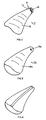
- FIG. 4 shows, for example and schematically, an in-ear earmold 11, for example an in-the-ear hearing device, in which the acoustic output 13 to the eardrum protected by a cerumen cap 15 is.
- This protective cap 15 is until now in the production as a separate part on the shell 16 of the otoplasty eleventh applied and fixed for example by gluing or welding.
- the cerumen protective cap 15a is directly attached to the shell 16a of the otherwise identical in-ear earmold 11a integrated.
- the material of the shell 16a is homogeneous in that of Cerumen cap 15a over.
- cerumen protection systems and other functional elements by use of the mentioned manufacturing process can be integrated integrally.
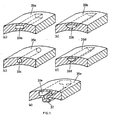
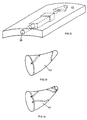
- FIGS. 7 (a) to (f) on the basis of perspective, schematic representations of sections of FIGS Ear canal adjacent outer wall 18 of in-ear earmoulds, novel ventilation grooves sections shown.
- the profile of the ventilation groove 20a is rectangular or square-shaped with predefined, exactly maintained dimensioning conditions.
- the profile of the ventilation groove 20b is circular or Elliptic sector-shaped, again with exactly predetermined cross-sectional boundary curve 21 b.
- the cross-sectional shape of the provided vent grooves 20 may already have some predictability and influencing the acoustic transmission conditions along this groove, in case of contact with the inner wall of the auditory canal, will be realized.
- the acoustic behavior is also dependent on the length, with which extends the groove 20 along the earmold outer wall 18.
- FIGS. 7 (c) to (f) show further ventilation groove profiles which are additionally cerumen-protected are.
- the profile of the groove 20c according to FIG. 7 (c) is T-shaped.
- Fig. 7 (d) to 7 (f) following the illustrated principle of Fig. 7 (c), is the cross-sectional shape of the wide groove portion 27d to 27f formed with different shapes, as shown in FIG. 7 (d) circular sector or according to the sector an ellipse, according to Fig. 7 (e) triangular, according to Fig. 7 (f) circular or elliptical.
- vent grooves 29 for example, according to FIG. 8, which, progressively advancing in their longitudinal direction, define different profiles, as they are optionally made of profiles in FIG are shown compiled according to FIG.
- the groove adjacent to the auditory canal can be mathematically modeled and checked, then into the in-ear earmold or their shell are integrated.
- the intended ventilation grooves form longer than this principle by the longitudinal extent of a considered in the ear otoplasty.
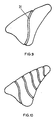
- this is achieved in that such grooves 31 with training, as they are shown with reference to FIGS. 7 and 8, for example, in predetermined curves along the surface of the earmold be performed, for example, as shown in Fig. 9, practically as the earmold thread-like grooves.
- Further optimization flexibility is achieved in that not only a vent groove, but several are guided on the surface of the earmold, as shown schematically in Fig. 10 is.
- the high flexibility of the groove design means that depending on the application area in the ear canal specifically different dimensioned, with respect to cerumen protection and acoustic transmission conditions optimized respectively Ventilation grooves along the earmold surface can be realized.
- This training variant of the novel ventilation systems is based on at least sections completely integrated into the earmold closed against the ear canal ventilation ducts. This system will subsequently explained on the basis of his training on an earmold shell. But it is important to emphasize that then, if no further aggregates are to be integrated on the considered otoplastic and they are designed as a solid plastic is, the following comments, of course, also on a channel guide arbitrarily by the mentioned Obtain full plastic throughout.
- FIG. 11 in analogy to FIG. 7, different cross-sectional shapes and area ratios are proposed Ventilation channels 33a to 33e shown.
- the one incorporated into the otoplastic shell 35a has Ventilation duct 33a Rectangular or square cross-sectional shape.
- the embodiment according to FIG. 11 (b) it has, 35b, a circular sector or elliptical sector-shaped channel cross-sectional shape.
- the embodiment according to Fig. 11 (c) has the intended ventilation channel 33 c circular or elliptical cross-sectional shape
- FIG. 11 (d) has a triangular cross-sectional shape.
- the otoplastic shell has a complex internal shaping, eg. B. an integrated bracket section 37.
- a complex internal shaping eg. B. an integrated bracket section 37.
- FIG. 12 shows a variant of a fully integrated ventilation channel 39.
- the along its longitudinal extent as shown for example in the Otoplastikschale 41, different cross-sectional shapes and / or has cross-sectional dimensions, which in the sense of the realization of different acoustic Impedance elements, the acoustic transmission behavior can be optimized.
- ventilation ducts especially those in this section illustrated closed construction, quite at least in sections simultaneously as acoustic Conductor sections on the output side active electromechanical transducer, such as the output side of microphones, for example in in-the-ear hearing aids, can be exploited.
- FIGS. 13 and 14 show, in analogy to FIGS. 9 and 10, how, on the one hand, the respective earmold 43 extended the integrated ventilation channels explained in this section by appropriate web guide or on the other hand as two and more of the mentioned channels, possibly with different and / or varying channel cross-sections, in analogy to FIG. 12, are integrated at the earmold.
- FIG. 15 schematically shows a longitudinal sectional illustration of an in-ear otoplastic
- FIG. 16 a schematic cross-sectional view of a portion of this earmold.
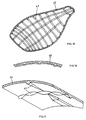
- the earmold e.g. to record electronic components-has a shell 45, which is stocking-like, thin-walled made of elastic material.
- the dimensional stability of the - outside in the illustrated embodiment smooth - shell skin is - where desired - ensured by attached to the shell integrally inside ribs 47 which, with respect to the shell skin, from the same material are made.
- the course of the wall thickness of shell skin 45 becomes the density and shape of the ribs 47 previously calculated and then the earmold constructed according to the calculated data.
- the above-described manufacturing process using additive construction process extremely well.
- the just described training of the in-ear earmould can be combined with a thoroughly Ventilation system, as explained with reference to FIGS. 7 to 14.
- the provided ribs for influencing the dimensional stability or flexibility in certain areas of the otoplastic also with different Cross-sectional profile are formed, possibly also in its longitudinal extent progressively from a cross section going over to the other.
- an outer rib pattern may also be provided. According to FIGS. 18 and 19, for this purpose, if appropriate with regions of different density, orientation and profile shape, on the outer surface of the earmold 49 worked up a pattern of ribs 51.
- this can be used for the otoplastic with cavity considered here, but also for earmolds with no cavity, so for example with no electronic components, e.g. for hearing protection equipment or water protection devices.
- earmold is schematic in a cross-sectional view shown in Fig. 20.
- the interior 53 is made, for example, of extremely compressible absorption material manufactured and surrounded by a shaping skin shell 55 with the rib pattern 57.
- skin 55th and the rib pattern 57 are made integral together.
- the manufacturing method explained above is suitable with the help of additive construction procedures. How far in the near future these additive construction procedures can be realized by changing the processed materials on a workpiece, remain an open question. Should this be possible, the web is free, for example, on the embodiment of FIG. 20 and the filler 53 simultaneously with the shell skin 55 and the ribs 57 in each build-up layers build sequentially.
- earmolds may be provided which are likely to leave a cavity for male assemblies such as electronic components, but in which the space between such a lumen 59 is specific to the necessary volumes and shapes of additional designed units to be installed and the shell skin 55 is filled for example by a spring-loaded or sound-absorbing material or components to be installed with such a material to the shell skin 55 are poured out.
- the shell skin 55 or 45, according to FIGS. 15, 16 and 17, may well be made of electrically conductive material Material be made, which at the same time an electrical shielding effect for internal electronic components is created. This also applies, if necessary, to the filling 53 according to FIG. 20.
- an otoplastic was shown using the example of an in-ear otoplastic, whose Shell with internal and / or external ribs is dimensionally stabilized, which is an extremely light and targeted formable construction results.
- this design can also be used for outer ear earmoulds be used.
- a further embodiment of an in-ear earmold is shown, which specifically in a Range is bendable or compressible.
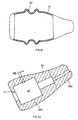
- the shell 61 of an otoplastic in particular the shell of an in-ear hearing aid, has for this purpose in one or more predetermined areas a corrugated or corrugated hose training 63, to which it is, according to the respective needs, bendable or compressible.
- Fig. 21 this If the procedure is based on the shell of an in-ear otoplastic, this procedure can be completely and if necessary also for an outer ear earmould realize. Again, this is preferably the initially explained Manufacturing process used.
- the internal volume the earmold be filled with the requirements of the corresponding filling material or integrated internals therein be embedded in such filler, resulting in a higher stability of the device results and improved Acoustic conditions.
- the conventional problem is that even if the hearing aid internals could be maintained over long periods of life, for example, only the transmission behavior the hearing aid should be readjusted according to the respective hearing conditions, anyway always new hearing aids have to be designed, just because of the fact that the former no longer fit satisfactorily in the ear canal.
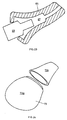
- an in-ear earmold 65 is shown schematically and in longitudinal section, to which the shape of the Inneraumes 67 substantially the shape of the in Fig. 23 schematically illustrated, male electronic module 69 corresponds.
- the earmold 65 is made of rubber-elastic material and can, as shown in Fig. 23, on the Electronics module 69 are slipped.
- the shaping of the interior 67 is such that the or possibly the plurality male modules are positively positioned and held directly by the earmold 65. by virtue of By this procedure, it is easily possible, one and the same electronic modules 69 with different earmolds 65th To provide such as in a growing child, the changing ear canal education Take into account.
- the earmold is practically an easily replaceable disposable accessory for the in-ear hearing aid. Not only to changing conditions in the application area, namely the ear canal, bill To wear, but also simply for reasons of pollution, the otoplasty 65 can be easily changed. This Concept can even be exploited, if necessary - for example, in ear canal inflammation - medical applications for example, by applying medicaments to the earmold outer surface or at least to use sterilized earmolds at regular intervals.
- the phase plate 1 otherwise provided in conventional in-the-ear hearing aids is built as part of the module holder, integrally with the otoplastic.
- the layer-to-layer build-up method set forth in section 1) as in FIG. 22 dash-dotted lines and in the direction indicated by the arrow AB
- the otoplastic in the above-mentioned construction direction AB it would be readily possible for the otoplastic in the above-mentioned construction direction AB to be arranged according to requirements respective areas made of different materials.
- This also applies to the earmolds described in Sections 2) and 3) as well as to those explained in the following sections 5), 6) and 7).
- FIG. 24 shows a further embodiment of an otoplastic, again by way of example with reference to an in-ear hearing device. shown, which allows a simple, rapid replacement of the internal installations. in principle It is proposed, the earmold shell in several parts and assembled on an in-ear earmold with internals form, as shown in FIG. 24.
- acoustic / electrical transducers or electro-acoustic output transducer input and output side assembled over as independent parts acoustic conductors, namely tube-like structures to couple with the environment of the hearing aid, or, in particular in the case of input-side acoustic / electrical converters, these with their recording surface directly in the areas the surfaces of the hearing aid to place, possibly only by small cavities and protective measures separated from the environment.
- a converter module 75 has an acoustic input and output 77 on.
- the shell 79 of the earmold of an in-ear or an outer ear hearing aid or a headphone has, integrated into it, an acoustic conductor 81 on. It is at least partially and as shown in Fig. 25 within the wall of the earmold shell 79.
- acoustic stub lines or line sections 83 preferably the respective acoustic impedance of the acoustic conductor 81 adapted.
- FIG. 26 shows only two centralized transducers to form a module and their entrances to the desired receiving openings 85 through the mentioned guidance of the acoustic To connect conductor 89.
- any manufactured earmold as mentioned in particular to mark each in-ear earmold, especially any in-the-ear hearing aid. It is therefore suggested in the earmold or in the shell, by indentations and / or by bulges an individual Provide identification, which together with the individual customer -. Manufacturer - Product serial number, Left-right application etc. may contain. Such a marking is in a much preferred manner and Made way in the manufacture of the earmold with the removal method described under 1). This will ensure that any confusion of the earmoulds is excluded from the production. This is especially important in the subsequent, possibly automated assembly with other modules, such as the assembly of in-the-ear hearing aids.
- these impressions are scanned and the respective digital data records in the memory unit 95 filed.
- the dynamics of the application area by X-rays be recorded.
- the arithmetic unit 97 controls the manufacturing process 99 for the earmold. For example, and as is customary today, in-ear earmolds are made with relative hard shell, the arithmetic unit 97 calculates from the stored on the memory unit 95 dynamic data and optionally, as shown schematically at K, other manufacturing parameters, the best fit for the earmold, so optimum wearing comfort is achieved in everyday life, while maintaining their functionality.
Landscapes
- Engineering & Computer Science (AREA)
- Manufacturing & Machinery (AREA)
- Health & Medical Sciences (AREA)
- General Health & Medical Sciences (AREA)
- Neurosurgery (AREA)
- Otolaryngology (AREA)
- Physics & Mathematics (AREA)
- Acoustics & Sound (AREA)
- Signal Processing (AREA)
Abstract
Description
- Beim Fertigungsverfahren auf der Basis des obgenannten Abdruckes müssen Kunststoffmaterialien eingesetzt werden, welche zu relativ harten, formstabilen Schalen führen. Dies wiederum führt, beim Einsetzen des fertiggestellten Im-Ohr-Hörgerätes ins individuelle Ohr, praktisch immer dazu, dass die Schale aufgrund verbleibender Druckstellen überarbeitet werden muss.
- Wohl ermöglicht das obgenannte Vorgehen eine dem einen Abdruck entsprechende Aussenformung der resultierenden, relativ harten Schale, nicht aber das Ausbilden komplexer Innen- und/oder Aussenformen, wie dies beispielsweise für die montageoptimierte Aufnahme von Funktionsteilen des Hörgerätes wünschbar wäre. Unter Funktionsteilen verstehen wir dabei sämtliche Aggregate, welche für die Aufnahme, Verarbeitung und Wiedergabe der Audiosignale verantwortlich sind, also von Mikrophonen, Digitalprozessoren, Lautsprechern und den zugeordneten Hilfsaggregaten, wie für Fernsteuerungen, binaurale Signalübertragungen, Batterien etc. Dabei ist darauf hinzuweisen, dass eine optimale Packung dieser Funktionsteile unter Ausnützung des zur Verfügung stehenden Platzes nur individuell vorgenommen werden kann, denn die Geometrie des Gehörganges kann individuell stark schwanken.
- Fig. 1
- ein vereinfachtes Schema einer nach dem erfindungsgemässen Verfahren arbeitenden Fertigungsanlage für die Optimierung industrieller Fertigung von Otoplastiken;
- Fig. 2
- in einer Darstellung analog zu derjenigen von Fig. 1, eine weitere Anlagenkonzeption;
- Fig. 3
- in Darstellung analog zu denjenigen der Figuren 1 und 2, eine noch weitere Anlagenkonzeption;
- Fig. 4
- schematisch ein Im-Ohr-Hörgerät mit auf bekannte Art und Weise aufgesetzter Cerumen-Schutzkappe;
- Fig. 5
- in Darstellung analog zu Fig. 4, ein nach dem erfindungsgemässen Verfahren mit Cerumen-Schutzkappe gefertigtes Im-Ohr-Hörgerät;
- Fig. 6
- ein Im-Ohr-Hörgerät mit einer auf bekannte Art und Weise eingearbeiteten Belüftungsnut;
- Fig. 7(a) bis (f)
- anhand perspektivisch dargestellter Ausschnitte von Otoplastik-Schalenoberflächen, mit dem erfindungsgemässen Verfahren realisierte Belüftungsnuten;
- Fig. 8
- anhand eines schematischen Ausschnittes einer Otoplastik-Oberfläche, eine nach dem erfindungsgemässen Verfahren realisierte Belüftungsnut mit entlang ihrer Längsausdehnung variierendem Querschnitt bzw. variierender Querschnittsform;
- Fig. 9
- schematisch eine Im-Ohr-Otoplastik mit nach dem erfindungsgemässen Verfahren gearbeiteter, verlängerter Belüftungsnut;
- Fig. 10
- in Darstellung analog zu Fig. 9, eine Im-Ohr-Otoplastik mit mehreren erfindungsgemäss gefertigten Belüftungsnuten;
- Fig. 11 (a) bis (e)
- Ausschnitte von Otoplastikschalen mit nach dem erfindungsgemässen Verfahren eingearbeiteten Belüftungskanälen verschiedener Querschnittsformen und Dimensionen;
- Fig. 12
- in einer Darstellung analog zu derjenigen von Fig. 8, ein nach dem erfindungsgemässen Verfahren realisierter Belüftungskanal in einer Otoplastikschale mit entlang seiner Längsausdehnung variierender Querschnittsform bzw. variierender Querschnittsfläche;
- Fig. 13
- in Analogie zur Darstellung von Fig. 9, schematisch eine Im-Ohr-Otoplastik mit nach dem erfindungsgemässen Verfahren eingearbeitetem, verlängerten Belüftungskanal;
- Fig. 14
- in Darstellung analog zu Fig. 10, eine Im-Ohr-Otoplastik mit mehreren Belüftungskanälen, gefertigt nach dem erfindungsgemässen Verfahren;
- Fig. 15
- schematisch eine Länggsschnittdarstellung einer Im-Ohr-Otoplastik mit gerippter Innenfläche;
- Fig. 16
- einen Ausschnitt der Otoplastik gemäss Fig. 15 im Querschnitt, wobei die Rippen unterschiedliche Querschnittsflächen aufweisen;
- Fig. 17
- perspektivisch den Ausschnitt einer Otoplastikschale mit Innenrippung nach Fig. 15 oder 16, wobei die Rippen entlang ihrer Längsausdehnung unterschiedliche Querschnittsformen und Dimensionen aufweisen;
- Fig. 18
- in Darstellung analog zu Fig. 15, eine Im-Ohr-Otoplastik mit erfindungsgemäss gefertigter Aussenrippung;
- Fig. 19
- schematisch einen Ausschnitt aus einer gemäss Fig. 18 gerippten Otoplastikschale mit Rippen unterschiedlicher Querschnittsflächen;
- Fig. 20
- schematisch einen Querschnitt durch eine Otoplastik mit Aussenrippung, ggf. Innenrippung, und mindestens teilweise Füllmaterial-gefülltem Innenraum;
- Fig. 21
- schematisch einen Längsschnitt-Ausschnitt einer erfindungsgemäss gefertigten Otoplastikschale mit biege- und stauchflexibler Partie;
- Fig. 22
- schematisch im Längsschnitt, eine erfindungsgemäss gefertigte Im-Ohr-Otoplastik mit Aufnahmeraum für ein Elektronikmodul;
- Fig. 23
- die Otoplastik nach Fig. 22 bei ihrem Aufstülpen über ein Elektronikmodul;
- Fig. 24
- perspektivisch und schematisch, eine Im-Ohr-Otoplastik, wie insbesondere ein Im-Ohr-Hörgerät, mit zweiteiliger, separierbarer und assemblierbarer erfindungsgemäss gefertigter Otoplastikschale;
- Fig. 25
- ausschnittsweise und schematisch, die Integration von akustischen Leitern und Anpassgliedem zu einem akustisch/elektrischen oder elektrisch/akustischen Wandler, in einer erfindungsgemäss gefertigten Otoplastik;
- Fig. 26
- in Darstellung analog zu derjenigen von Fig. 25, die Anordnung zweier oder mehrerer akustischer Leiter in der Schale einer erfindungsgemäss gefertigten Otoplastikschale, und
- Fig. 27
- anhand eines vereinfachten Signalfluss/Funktionsblockdiagrammes, ein neuartiges Vorgehen bzw. eine neuartige Anordnung zu dessen Ausführung, bei dem bzw. der die Dynamik des Applikationsbereiches einer Otoplastik für deren Formgebung berücksichtigt wird.
- http://ltk.hut.fi/∼koukka/RP/rptree.html (1)
oder auf - Wohlers Report 2000, Rapid Prototyping & Tooling State of the industry (2)
- Lasersintern: Auf einem Pulverbett wird, beispielsweise mittels eines Rollers, Heissschmelzpulver in einer dünnen Schicht aufgetragen. Mittels eines Laserstrahls wird die Pulverschicht verfestigt, wobei der Laserstrahl u.a. entsprechend einer Schnittschicht der Otoplastik bzw. Otoplastikschale mittels der 3D-Forminformation des individuellen Applikationsbereiches angesteuert wird. Es entsteht in dem im übrigen losen Pulver eine verfestigte Schnittschicht der Otoplastik bzw. deren Schale. Diese wird aus der Pulververlegeebene abgesenkt und darüber eine neue Pulverschicht aufgebracht, diese wiederum einer Schnittschicht entsprechend laserverfestigt, etc.
- Laser- bzw. Stereolithographie: Eine erste Schnittschicht einer Otoplastik bzw. einer Otoplastikschale wird mittels UV-Laser an der Oberfläche flüssigen Fotopolymers verfestigt. Die verfestigte Schicht wird abgesenkt und wird wieder von Flüssigpolymer bedeckt. Mittels des erwähnten UV-Lasers wird, auf der bereits verfestigten Schicht, die zweite Schnittschicht der Otoplastik bzw. deren Schale verfestigt. Wiederum erfolgt die Laserpositionssteuerung u.a. mittels der 3D-Daten bzw. Information des individuellen, vorgängig erfassten Applikationsbereiches.
- Thermojetverfahren: Die Konturbildung entsprechend einer Schnittschicht der Otoplastik bzw. der Otoplastikschale wird ähnlich wie bei einem Tintenstrahldrucker durch Flüssigauftrag u.a. gemäss der digitalisierten 3D-Forminformation, insbesondere auch des individuellen Applikationsbereiches vorgenommen. Danach wird die abgelegte Schnitt-"Zeichnung" verfestigt. Wiederum wird gemäss dem Prinzip der additiven Aufbauverfahren Schicht um Schicht zum Aufbau der Otoplastik bzw. deren Schale abgelegt.
- http://www.padtinc.com/srv_rpm_sls.html (3)
- "Selective Laser Sintering (SLS) of Ceramics", Muskesh Agarwala et al., presented at the Solid Freeform Fabrication Symposium, Austin, TX, August 1999, (4)
- http://www.caip.rutgers.edu/RP_Library/process.html (5)
- http://www.biba.uni-bremen.de/groups/rp/lom.html bzw.
- http://www.biba.uni-bremen.de/groups/rp/rp_intro.html (6)
- Donald Klosterman et al., "Direct Fabrication of Polymer Composite Structures with Curved LOM", Solid Freeform Fabrication Symposium, University of Texas at Austin, August 1999, (7)
- http://lff.me.utexas.edu/sls.html (8)
- http://www.padtinc.com/srv_rpm_sla.html (9)
- http://www.cs.hut.fi/∼ado/rp/rp.html (10)
- Bezüglich akustischem Verhalten: Die heute bekannten Belüftungsrinnen sind kaum an die jeweiligen akustischen Erfordernisse angepasst. So können sie kaum, bei aktiven Otoplastiken, wie z.B. bei Im-Ohr-Hörgeräten, dazu beitragen, die Rückkopplungsproblematikvon elektromechanischem Ausgangswandler zu akustisch/elektrischem Eingangswandler wirksam lösen zu helfen. Auch bei passiven Im-Ohr-Otoplastiken, wie Gehörschutz-Einrichtungen, vermögen sie nicht, das erwünschte Schutzverhalten zu unterstützen und gleichzeitig die erwünschten Belüftungseigenschaften beizubehalten.
- Cerumenempfindlichkeit: Die heute eingesetzten Belüftungsrinnen in der Aussflächen von Im-Ohr-Otoplastiken sind äusserst Cerumenbildungs-empfindlich. Die Cerumenbildung vermag, je nach deren Intensität, rasch die vorgesehene Belüftungsrinnen bezüglich ihrer Belüftungseigenschaften zu beeinträchtigen, wenn nicht gar vollständig zu verstopfen.
- nutenähnlich gegen die Gehörgangwandung mindestens zum Teil offen sind,
- gegen die Wandung des Gehörganges hin vollständig geschlossen sind.
Claims (23)
- Verfahren zur Herstellung von Otoplastikteilen, bei dem vom individuellen Applikationsbereich mindestens eine Form dreidimensional zu einem Datensatz digitalisiert wird und der Otoplastikteil wie folgt aufgebaut wird:dadurch gekennzeichnet, dass in der Lage Schnittschichten mit je individuellen Formen mehrerer Otoplastikteile, durch jeweilige Datensätze gesteuert, verfestigt werden.(a) Ablegen einer Lage Materials;(b) Verfestigen einer Schnittschicht mit der individuellen Form des individuellen Otoplastikteils, gesteuert mit dem Datensatz;(c) Aufbringen einer weiteren Lage des Materials.über der verfestigten Schnittschicht und Wiederholen der Schritte (b) bis (c),
- Verfahren zur Herstellung von Otoplastikteilen, bei dem vom individuellen Applikationsbereich mindestens eine Form dreidimensional zu einem Datensatz digitalisiert wird und der Otoplastikteil wie folgt aufgebaut wird:dadurch gekennzeichnet, dass Schnittschichten mehrerer individueller Otoplastikteile in einem gemeinsamen Arbeitsgang mittels jeweiligen Datensätzen gesteuert abgelegt und dann verfestigt werden, bevor weitere Schnittschichten auf die verfestigten abgelegt werden.(a) Auftragen einer Schnittschicht mit der individuellen Form des individuellen Otoplastikteils;(b) Verfestigen der aufgetragenen Schnittschicht;(c) Auftragen einer weiteren Schnittschicht über der verfestigten und Wiederholen der Schritte (a) bis (c),
- Verfahren zur Herstellung von Otoplastikteilen, bei dem vom individuellen Applikationsbereich mindestens eine Form dreidimensional zu einem Datensatz digitalisiert wird und der Otoplastikteil wie folgt aufgebaut wird:dadurch gekennzeichnet, dass während dem Verfestigen der Schnittschicht des einen Otoplastikteils eine Lage Material für einen weiteren individuellen Otoplastikteil abgelegt wird.(a) Ablegen einer Lage eines Materials;(b) Verfestigen einer Schnittschicht mit der individuellen Form des individuellen Otoplastikteils, gesteuert mit dem Datensatz;(c) Aufbringen einer weiteren Lage des Materials über der verfestigten Schnittschicht und Wiederholen der Schritte (b) bis (c),
- Verfahren nach einem der Ansprüche 1 bis 3, dadurch gekennzeichnet, dass die Formnahme durch Erstellen mindestens eines Abdruckes vom Applikationsbereich erfolgt, der Abdruck oder die Abdrücke abgetastet werden und die Abtastsignale digitalisiert werden.
- Verfahren nach einem der Ansprüche 1 bis 4, dadurch gekennzeichnet, dass Formnahme und ggf. Digitalisierung an verteilten Frontzentren vorgenommen wird, die Datensätze an ein Produktionszentrum übermittelt werden, wo das Ortoplastikteil erstellt wird.
- Verfahren nach einem der Ansprüche 1 bis 5, dadurch gekennzeichnet, dass als additives Aufbauverfahren Lasersintern, Stereolithographie oder ein Thermojetverfahren eingesetzt wird.
- Otoplastikteil hergestellt nach einem der Ansprüche 1 bis 6, dadurch gekennzeichnet, dass mindestens ein Teil seiner Umhüllung aus in Schichten verfestigtem Thermoplastmaterial besteht.
- Otoplastikteil nach Anspruch 7, dadurch gekennzeichnet, dass er Teil eines Im-Ohr-Hörgerätes oder eines Aussenohr-Hörgerätes oder eines Kopfhörers oder eines Schutzeinsatzes gegen Lärm oder Wasser ist.
- Verfahren nach einem der Ansprüche 1 bis 8, dadurch gekennzeichnet, dass am Teil durch Einbuchtungen und/oder Auswölbungen eine individuelle Kennzeichnung angebracht wird.
- Verfahren nach einem der Ansprüche 1 bis 9, dadurch gekennzeichnet, dass der Otoplastikteil mindestens Teil einer Otoplastikschale ist.
- Verfahren zur Herstellung eines Hörgerätes, dadurch gekennzeichnet, dass ein Teil einer Otoplastikschale nach einem der Ansprüche 1 bis 9 hergestellt wird, Einbauten in den Schalenteil eingelegt werden und die Schale mittels eines zweiten Schalenteils assembliert wird.
- Verfahren nach Anspruch 11, dadurch gekennzeichnet, dass der zweite Schalenteil nach einem der Ansprüche 1 bis 9 hergestellt wird.
- Verfahren nach einem der Ansprüche 11 oder 12, dadurch gekennzeichnet, dass die Einbauten ein Elektronikmodul umfassen.
- Verfahren nach einem der Ansprüche 11 bis 13, dadurch gekennzeichnet, dass die Schalenteile trennbar assembliert werden.
- Verfahren nach einem der Ansprüche 11 bis 14, dadurch gekennzeichnet, dass die Schalenteile zerstörungsfrei untrennbar assembliert werden.
- Verfahren nach einem der Ansprüche 11 bis 15, dadurch gekennzeichnet, dass die Schalenteile mittels Einrastverschlüssen, Einklinkverschlüssen oder Bajonettähnlichen Verschlüssen assembliert werden.
- Verfahren nach einem der Ansprüche 11 bis 16 zur Herstellung eines Aussenohr-Hörgerätes.
- Verfahren nach einem der Ansprüche 11 bis 16 zur Herstellung eines Im-Ohr-Hörgerätes.
- Verfahren nach einem der Ansprüche 17 oder 18, dadurch gekennzeichnet, dass das Gerät ein Hörhilfegerät, ein Kopfhörer, ein Lärm- oder ein Wasserschutz-Ohreinsatz ist.
- Verfahren zur Herstellung eines Hörgerätes, ausgehend von einem nach einem der Ansprüche 11 bis 19 hergestellten Hörgerät, dadurch gekennzeichnet, dass man die Hörgeräteschale öffnet, die Einbauten daraus entfernt und das Hörgerät nach einem der Ansprüche 11 bis 19 wieder erstellt.
- Verfahren nach Anspruch 20, dadurch gekennzeichnet, dass man bei der Herstellung des Hörgerätes dessen ästhetisches Erscheinungsbild wechselt.
- Verfahren nach einem der Ansprüche 20 oder 21, dadurch gekennzeichnet, dass das herzustellende Hörgerät lösbar assemblierte Schalenteile hat.
- Verfahren nach einem der Ansprüche 1 bis 10, dadurch gekennzeichnet, dass man am Otoplastikteil eine Ausformung vorsieht für ein aufzunehmendes Modul.
Applications Claiming Priority (4)
| Application Number | Priority Date | Filing Date | Title |
|---|---|---|---|
| PCT/CH2000/000356 WO2002003756A1 (de) | 2000-06-30 | 2000-06-30 | Verfahren zur herstellung von im-ohr-hörgeräten und im-ohr-hörgerät |
| WOPCT/CH00/00356 | 2000-06-30 | ||
| EP04004629A EP1427251A3 (de) | 2000-06-30 | 2000-09-25 | Verfahren zur Herstellung von Otoplastiken und Otoplastik |
| EP00960273A EP1295509B1 (de) | 2000-06-30 | 2000-09-25 | Verfahren zur herstellung von otoplastiken und otoplastik |
Related Parent Applications (1)
| Application Number | Title | Priority Date | Filing Date |
|---|---|---|---|
| EP04004629A Division EP1427251A3 (de) | 2000-06-30 | 2000-09-25 | Verfahren zur Herstellung von Otoplastiken und Otoplastik |
Publications (2)
| Publication Number | Publication Date |
|---|---|
| EP1555851A2 true EP1555851A2 (de) | 2005-07-20 |
| EP1555851A3 EP1555851A3 (de) | 2006-08-16 |
Family
ID=4358099
Family Applications (4)
| Application Number | Title | Priority Date | Filing Date |
|---|---|---|---|
| EP00938437A Expired - Lifetime EP1295508B1 (de) | 2000-06-30 | 2000-06-30 | Verfahren zur herstellung von im-ohr-hörgeräten und im-ohr-hörgerät |
| EP04017958A Withdrawn EP1555851A3 (de) | 2000-06-30 | 2000-09-25 | Verfahren zur Herstellung von Otoplastiken und Otoplastik |
| EP00960273A Expired - Lifetime EP1295509B1 (de) | 2000-06-30 | 2000-09-25 | Verfahren zur herstellung von otoplastiken und otoplastik |
| EP04004629A Withdrawn EP1427251A3 (de) | 2000-06-30 | 2000-09-25 | Verfahren zur Herstellung von Otoplastiken und Otoplastik |
Family Applications Before (1)
| Application Number | Title | Priority Date | Filing Date |
|---|---|---|---|
| EP00938437A Expired - Lifetime EP1295508B1 (de) | 2000-06-30 | 2000-06-30 | Verfahren zur herstellung von im-ohr-hörgeräten und im-ohr-hörgerät |
Family Applications After (2)
| Application Number | Title | Priority Date | Filing Date |
|---|---|---|---|
| EP00960273A Expired - Lifetime EP1295509B1 (de) | 2000-06-30 | 2000-09-25 | Verfahren zur herstellung von otoplastiken und otoplastik |
| EP04004629A Withdrawn EP1427251A3 (de) | 2000-06-30 | 2000-09-25 | Verfahren zur Herstellung von Otoplastiken und Otoplastik |
Country Status (8)
| Country | Link |
|---|---|
| EP (4) | EP1295508B1 (de) |
| JP (2) | JP2004502392A (de) |
| CN (1) | CN100477815C (de) |
| AU (4) | AU5384800A (de) |
| CA (2) | CA2412481C (de) |
| DE (2) | DE50010130D1 (de) |
| DK (1) | DK1295509T3 (de) |
| WO (2) | WO2002003756A1 (de) |
Cited By (1)
| Publication number | Priority date | Publication date | Assignee | Title |
|---|---|---|---|---|
| EP3192280A1 (de) * | 2014-09-08 | 2017-07-19 | Sonova AG | Verfahren zur herstellung eines gehäuses für ein hörgerät, gehäuse für hörgerät und hörgerät |
Families Citing this family (37)
| Publication number | Priority date | Publication date | Assignee | Title |
|---|---|---|---|---|
| US6540045B1 (en) | 2000-06-30 | 2003-04-01 | Phonak Ag | Method for manufacturing an ear device and ear device |
| WO2002003756A1 (de) * | 2000-06-30 | 2002-01-10 | Phonak Ag | Verfahren zur herstellung von im-ohr-hörgeräten und im-ohr-hörgerät |
| US7014010B2 (en) | 2000-06-30 | 2006-03-21 | Phonak Ag | Method for manufacturing an ear device and ear device |
| US7625335B2 (en) | 2000-08-25 | 2009-12-01 | 3Shape Aps | Method and apparatus for three-dimensional optical scanning of interior surfaces |
| JP2004508155A (ja) * | 2000-09-25 | 2004-03-18 | フォーナック アーゲー | 耳内取付耳用装置及び耳用装置 |
| US7050876B1 (en) | 2000-10-06 | 2006-05-23 | Phonak Ltd. | Manufacturing methods and systems for rapid production of hearing-aid shells |
| DK1368986T3 (da) | 2001-03-02 | 2012-02-27 | 3Shape As | Fremgangsmåde til modellering af specialfremstillede ørestykker |
| EP1246506A1 (de) | 2001-03-26 | 2002-10-02 | Widex A/S | CAD-CAM-System zum Entwurf eines Hörgerätes |
| EP1246507A1 (de) * | 2001-03-26 | 2002-10-02 | Widex A/S | Hörgerät mit Abdichtungsring |
| EP1246505A1 (de) * | 2001-03-26 | 2002-10-02 | Widex A/S | Hörgerät mit einer Frontplatte, die zur Anpassung an die Hörgeräteschale automatisch hergestellt wird |
| US6660208B2 (en) * | 2001-03-30 | 2003-12-09 | 3D Systems, Inc. | Detoxification of solid freeform fabrication materials |
| EP1257151A3 (de) * | 2001-05-08 | 2004-01-14 | Dr. Vossieck GmbH | Hörgerät mit Druckausgleich |
| US7191029B2 (en) | 2001-06-22 | 2007-03-13 | Siemens Hearing Instruments, Inc. | Rapid prototype fabrication of a monolithic hearing instrument housing with an integrally-fabricated faceplate |
| AU7834201A (en) | 2001-07-26 | 2001-11-20 | Phonak Ag | Method for manufacturing hearing devices |
| AU2008201247B2 (en) * | 2001-10-17 | 2009-11-05 | Phonak Ag | Apparatus and Method for Applying a Substance to a Human Body |
| DE10204894A1 (de) | 2002-02-06 | 2003-08-21 | Siemens Audiologische Technik | Im Ohr tragbares Hörhilfegerät oder Hörhilfegerät mit im Ohr tragbarer Otoplastik |
| JP2005131050A (ja) * | 2003-10-29 | 2005-05-26 | Matsushita Electric Ind Co Ltd | 外耳道形状の測定方法及び補聴器シェルの製造方法並びに補聴器 |
| US7162323B2 (en) | 2004-04-05 | 2007-01-09 | Hearing Aid Express, Inc. | Decentralized method for manufacturing hearing aid devices |
| EP1674060A1 (de) * | 2004-12-23 | 2006-06-28 | Phonak Ag | Verfahren zur Versorgung mit einem Gehörschutzstöpsel |
| DE102005020118B3 (de) * | 2005-04-29 | 2006-08-31 | Bernhard Kubicke | Gehäuse für ein HdO-Hörgerät |
| CA2613507C (en) * | 2005-06-27 | 2011-03-15 | Widex A/S | A method and a tool for shaping an elongated deformable member for a hearing aid |
| US7720243B2 (en) | 2006-10-12 | 2010-05-18 | Synygis, Llc | Acoustic enhancement for behind the ear communication devices |
| EP2914019B1 (de) | 2008-12-22 | 2017-09-13 | Oticon A/s | Ein Hörgerätesystem mit Elektroden |
| US20100226502A1 (en) | 2009-03-06 | 2010-09-09 | Siemens Hearing Instruments, Inc. | Method For Fabricating A Hearing Device |
| DE102009043597A1 (de) * | 2009-09-25 | 2011-04-07 | Siemens Aktiengesellschaft | Verfahren zum Herstellen eines markierten Gegenstandes |
| DK2581038T3 (en) | 2011-10-14 | 2018-02-19 | Oticon As | Automatic real-time hearing aid fitting based on auditory evoked potentials |
| EP2615854A1 (de) | 2012-06-14 | 2013-07-17 | Oticon A/s | Gehäuse für ein Hörgerät |
| US20140166388A1 (en) * | 2012-12-17 | 2014-06-19 | Cotron Corporation | Ear tip |
| AU2014302635B8 (en) | 2013-06-24 | 2018-12-06 | President And Fellows Of Harvard College | Printed three-dimensional (3D) functional part and method of making |
| EP2950555A1 (de) | 2014-05-28 | 2015-12-02 | Oticon A/s | Automatische Echtzeit-Hörgeräteanpassung basierend auf auditorisch evorzierten Potentialen, die durch natürliche Tonsignale erzeugt werden |
| DE102014216086A1 (de) * | 2014-08-13 | 2016-02-18 | Sivantos Pte. Ltd. | Vorrichtung und Verfahren zur Integration von Hörgerätekomponenten |
| CA3042232C (en) * | 2015-10-30 | 2021-12-14 | Transverse Technology Limited | An enclosure for an audio speaker |
| US10542358B2 (en) | 2017-08-30 | 2020-01-21 | Gn Hearing A/S | Earpiece with canal microphone, ambient microphone and receiver |
| CN108055632B (zh) * | 2018-02-11 | 2020-05-26 | 佛山博智医疗科技有限公司 | 耳道形态模化制作装置和方法 |
| CN109848414B (zh) * | 2019-01-31 | 2021-02-02 | 攀枝花三帝科技有限公司 | 一种3d打印定制化助听器的制作方法 |
| EP3706440A1 (de) * | 2019-03-08 | 2020-09-09 | GN Hearing A/S | Hörgerät mit entlüftung |
| EP4018935A1 (de) * | 2020-12-23 | 2022-06-29 | Sonova AG | Verfahren zur bestimmung der geometrie eines ohrkanals oder eines ohrs einer person |
Citations (1)
| Publication number | Priority date | Publication date | Assignee | Title |
|---|---|---|---|---|
| EP1295509B1 (de) * | 2000-06-30 | 2004-04-21 | Phonak Ag | Verfahren zur herstellung von otoplastiken und otoplastik |
Family Cites Families (16)
| Publication number | Priority date | Publication date | Assignee | Title |
|---|---|---|---|---|
| GB191308960A (en) * | 1913-04-16 | 1914-02-12 | Hermann Nieriker | Improvements in and relating to Means for Protecting the Human Ear against Objectionable Noises and the like. |
| US4194512A (en) * | 1977-06-08 | 1980-03-25 | Foti Thomas M | Probe for nystagmus testing |
| DE8518681U1 (de) * | 1985-06-27 | 1986-06-12 | Siemens AG, 1000 Berlin und 8000 München | Hörhilfe |
| JPS6232800A (ja) * | 1985-08-06 | 1987-02-12 | Rion Co Ltd | 補聴器用耳型の製作方法 |
| US5068902A (en) * | 1986-11-13 | 1991-11-26 | Epic Corporation | Method and apparatus for reducing acoustical distortion |
| DE8816266U1 (de) * | 1988-01-19 | 1989-04-13 | Siemens AG, 1000 Berlin und 8000 München | Ohreinsatz für Hörgeräte, insbesondere Otoplastik für In-dem-Ohr-Hörgeräte und Ohrpaßstück für Hinter-dem-Ohr-Hörgeräte |
| CH677570A5 (de) * | 1989-05-17 | 1991-05-31 | Ascom Audiosys Ag | |
| ATE120065T1 (de) * | 1989-07-26 | 1995-04-15 | Siemens Audiologische Technik | Verfahren und vorrichtung zur herstellung einer gehäuseschale eines in-dem-ohr-hörgerätes sowie nach dem verfahren hergestellte gehäuseschale. |
| EP0451784A3 (en) * | 1990-04-12 | 1991-11-13 | Beltone Electronics Corporation | Modular hearing aid system |
| US5487012A (en) * | 1990-12-21 | 1996-01-23 | Topholm & Westermann Aps | Method of preparing an otoplasty or adaptive earpiece individually matched to the shape of an auditory canal |
| DE19525865A1 (de) * | 1995-07-15 | 1997-01-16 | Sennheiser Electronic | Hörhilfe mit einem elektrodynamischen Schallwandler |
| JPH0966021A (ja) * | 1995-08-31 | 1997-03-11 | Toshiba Corp | 内視鏡 |
| JP2837649B2 (ja) * | 1995-10-04 | 1998-12-16 | リオン株式会社 | 挿耳形補聴器用シェルの製造方法 |
| BE1010200A3 (nl) * | 1996-04-26 | 1998-03-03 | Variphone Benelux Naamloze Ven | Werkwijze en inrichting voor het vervaardigen van oorstukjes. |
| DE19727677A1 (de) * | 1997-06-30 | 1999-01-07 | Huels Chemische Werke Ag | Verfahren und Vorrichtung zur Herstellung von dreidimensionalen Objekten |
| EP1058594A2 (de) * | 1998-12-10 | 2000-12-13 | William Forrest Fagan | Verfahren zur herstellung von hörgerätschalen |
-
2000
- 2000-06-30 WO PCT/CH2000/000356 patent/WO2002003756A1/de not_active Ceased
- 2000-06-30 JP JP2002507028A patent/JP2004502392A/ja active Pending
- 2000-06-30 AU AU5384800A patent/AU5384800A/xx active Pending
- 2000-06-30 DE DE50010130T patent/DE50010130D1/de not_active Expired - Lifetime
- 2000-06-30 AU AU2000253848A patent/AU2000253848B2/en not_active Expired
- 2000-06-30 CN CNB008195552A patent/CN100477815C/zh not_active Expired - Lifetime
- 2000-06-30 EP EP00938437A patent/EP1295508B1/de not_active Expired - Lifetime
- 2000-06-30 CA CA2412481A patent/CA2412481C/en not_active Expired - Lifetime
- 2000-09-25 AU AU2000272654A patent/AU2000272654B9/en not_active Expired
- 2000-09-25 DE DE50006193T patent/DE50006193D1/de not_active Expired - Lifetime
- 2000-09-25 EP EP04017958A patent/EP1555851A3/de not_active Withdrawn
- 2000-09-25 DK DK00960273T patent/DK1295509T3/da active
- 2000-09-25 EP EP00960273A patent/EP1295509B1/de not_active Expired - Lifetime
- 2000-09-25 JP JP2001510287A patent/JP2003534826A/ja active Pending
- 2000-09-25 WO PCT/CH2000/000519 patent/WO2001005207A2/de not_active Ceased
- 2000-09-25 EP EP04004629A patent/EP1427251A3/de not_active Withdrawn
- 2000-09-25 AU AU7265400A patent/AU7265400A/xx active Pending
- 2000-09-25 CA CA002412934A patent/CA2412934C/en not_active Expired - Lifetime
Patent Citations (1)
| Publication number | Priority date | Publication date | Assignee | Title |
|---|---|---|---|---|
| EP1295509B1 (de) * | 2000-06-30 | 2004-04-21 | Phonak Ag | Verfahren zur herstellung von otoplastiken und otoplastik |
Cited By (1)
| Publication number | Priority date | Publication date | Assignee | Title |
|---|---|---|---|---|
| EP3192280A1 (de) * | 2014-09-08 | 2017-07-19 | Sonova AG | Verfahren zur herstellung eines gehäuses für ein hörgerät, gehäuse für hörgerät und hörgerät |
Also Published As
| Publication number | Publication date |
|---|---|
| AU2000272654B2 (en) | 2006-01-12 |
| AU2000253848B2 (en) | 2006-04-06 |
| EP1427251A3 (de) | 2006-08-16 |
| EP1295508B1 (de) | 2005-04-20 |
| EP1295509B1 (de) | 2004-04-21 |
| EP1427251A2 (de) | 2004-06-09 |
| AU2000253848A1 (en) | 2002-04-11 |
| DK1295509T3 (da) | 2004-08-16 |
| JP2003534826A (ja) | 2003-11-25 |
| EP1555851A3 (de) | 2006-08-16 |
| CN100477815C (zh) | 2009-04-08 |
| EP1295508A1 (de) | 2003-03-26 |
| CA2412481C (en) | 2010-04-13 |
| WO2002003756A1 (de) | 2002-01-10 |
| JP2004502392A (ja) | 2004-01-22 |
| CA2412934A1 (en) | 2001-01-25 |
| DE50006193D1 (de) | 2004-05-27 |
| AU2000272654B9 (en) | 2006-08-03 |
| WO2001005207A2 (de) | 2001-01-25 |
| EP1295509A2 (de) | 2003-03-26 |
| DE50010130D1 (de) | 2005-05-25 |
| AU5384800A (en) | 2002-01-14 |
| CN1461578A (zh) | 2003-12-10 |
| CA2412481A1 (en) | 2002-12-05 |
| WO2001005207A3 (de) | 2001-12-06 |
| AU7265400A (en) | 2001-02-05 |
| CA2412934C (en) | 2009-10-27 |
Similar Documents
| Publication | Publication Date | Title |
|---|---|---|
| EP1295509B1 (de) | Verfahren zur herstellung von otoplastiken und otoplastik | |
| EP1320339B1 (de) | Otoplastik und verfahren zur fertigung einer otoplastik | |
| EP2986032B1 (de) | Vorrichtung und verfahren zur integration von hörgerätekomponenten | |
| DE102008038213B3 (de) | Hörhilfegerät mit einer Wandlerschutzeinrichtung | |
| US6863151B2 (en) | Method for manufacturing an ear device and ear device | |
| EP1330938B1 (de) | Otoplastik | |
| DE102005013834A1 (de) | Verfahren zur Herstellung einer Hörhilfekomponente und entsprechende Hörhilfekomponente | |
| EP1323331B1 (de) | Verfahren zur fertigung von otoplastiken | |
| EP1320341B1 (de) | Otoplastik | |
| EP1321011B1 (de) | Otoplastik mit eingebautem modul, im-ohr-otoplastik und verfahren zur anpassung von otoplastiken | |
| WO2002024128A1 (de) | Im-ohr-otoplastik | |
| EP1906703A1 (de) | Otoplastik mit Verbindungseinrichtung | |
| EP4153395B1 (de) | Formwerkzeug zur verarbeitung von expandierbaren oder expandierten kunststoffpartikeln | |
| DE102020101904A1 (de) | Verfahren zur Herstellung eines Luftkanalbauteils mit einem additiven Herstellungsverfahren unter Veränderung wenigstens eines Prozessparameters während der Verfahrensausführung und derartiges Luftkanalbauteil | |
| DE202004011467U1 (de) | Gehörgangsplastik für Hinter-dem-Ohr-Hörgeräte | |
| DE102009009286B4 (de) | Hörvorrichtung mit individuell ausgerichteter Elektronikkomponente und Herstellungsverfahren | |
| EP2694233A1 (de) | Giessform zur herstellung eines gusskörpers | |
| DE102009016483A1 (de) | Verfahren zum Herstellen eines Gehäuseteils eines Hörgeräts und entsprechendes Gehäuseteil | |
| DE102015217748A1 (de) | Verfahren zur Herstellung eines Dentalmodells und solchermassen hergestelltes Dentalmodell | |
| DE102024102515A1 (de) | Hörgerät mit einer Schale, die einen komprimierbaren Bereich enthält, und Verfahren zur Herstellung desselben | |
| AU2008201247A1 (en) | Apparatus and Method for Applying a Substance to a Human Body |
Legal Events
| Date | Code | Title | Description |
|---|---|---|---|
| PUAI | Public reference made under article 153(3) epc to a published international application that has entered the european phase |
Free format text: ORIGINAL CODE: 0009012 |
|
| AC | Divisional application: reference to earlier application |
Ref document number: 1295509 Country of ref document: EP Kind code of ref document: P Ref document number: 1427251 Country of ref document: EP Kind code of ref document: P |
|
| AK | Designated contracting states |
Kind code of ref document: A2 Designated state(s): CH DE DK FR GB IT LI |
|
| PUAL | Search report despatched |
Free format text: ORIGINAL CODE: 0009013 |
|
| AK | Designated contracting states |
Kind code of ref document: A3 Designated state(s): CH DE DK FR GB IT LI |
|
| 17P | Request for examination filed |
Effective date: 20061118 |
|
| AKX | Designation fees paid |
Designated state(s): CH DE DK FR GB LI |
|
| RAP1 | Party data changed (applicant data changed or rights of an application transferred) |
Owner name: SONOVA AG |
|
| 17Q | First examination report despatched |
Effective date: 20170331 |
|
| STAA | Information on the status of an ep patent application or granted ep patent |
Free format text: STATUS: THE APPLICATION IS DEEMED TO BE WITHDRAWN |
|
| 18D | Application deemed to be withdrawn |
Effective date: 20171011 |
|
| RIC1 | Information provided on ipc code assigned before grant |
Ipc: H04R 25/00 20060101AFI20050527BHEP |