EP1555452B1 - Stelleinrichtung zur Übertragung von Kolbenkräften auf die Ein-/Ausrückeinrichtung einer Doppelkupplung. - Google Patents
Stelleinrichtung zur Übertragung von Kolbenkräften auf die Ein-/Ausrückeinrichtung einer Doppelkupplung. Download PDFInfo
- Publication number
- EP1555452B1 EP1555452B1 EP04030388A EP04030388A EP1555452B1 EP 1555452 B1 EP1555452 B1 EP 1555452B1 EP 04030388 A EP04030388 A EP 04030388A EP 04030388 A EP04030388 A EP 04030388A EP 1555452 B1 EP1555452 B1 EP 1555452B1
- Authority
- EP
- European Patent Office
- Prior art keywords
- ring
- pistons
- regulating mechanism
- mechanism according
- rings
- Prior art date
- Legal status (The legal status is an assumption and is not a legal conclusion. Google has not performed a legal analysis and makes no representation as to the accuracy of the status listed.)
- Expired - Lifetime
Links
Images


Classifications
-
- A—HUMAN NECESSITIES
- A47—FURNITURE; DOMESTIC ARTICLES OR APPLIANCES; COFFEE MILLS; SPICE MILLS; SUCTION CLEANERS IN GENERAL
- A47K—SANITARY EQUIPMENT; ACCESSORIES THEREFOR, e.g. TOILET ACCESSORIES
- A47K13/00—Seats or covers for all kinds of closets
- A47K13/10—Devices for raising and lowering ; Collapsible or rotating seats or covers
-
- F—MECHANICAL ENGINEERING; LIGHTING; HEATING; WEAPONS; BLASTING
- F16—ENGINEERING ELEMENTS AND UNITS; GENERAL MEASURES FOR PRODUCING AND MAINTAINING EFFECTIVE FUNCTIONING OF MACHINES OR INSTALLATIONS; THERMAL INSULATION IN GENERAL
- F16D—COUPLINGS FOR TRANSMITTING ROTATION; CLUTCHES; BRAKES
- F16D25/00—Fluid-actuated clutches
- F16D25/08—Fluid-actuated clutches with fluid-actuated member not rotating with a clutching member
- F16D25/082—Fluid-actuated clutches with fluid-actuated member not rotating with a clutching member the line of action of the fluid-actuated members co-inciding with the axis of rotation
- F16D25/083—Actuators therefor
-
- A—HUMAN NECESSITIES
- A47—FURNITURE; DOMESTIC ARTICLES OR APPLIANCES; COFFEE MILLS; SPICE MILLS; SUCTION CLEANERS IN GENERAL
- A47K—SANITARY EQUIPMENT; ACCESSORIES THEREFOR, e.g. TOILET ACCESSORIES
- A47K13/00—Seats or covers for all kinds of closets
- A47K13/24—Parts or details not covered in, or of interest apart from, groups A47K13/02 - A47K13/22
- A47K13/26—Mounting devices for seats or covers
-
- F—MECHANICAL ENGINEERING; LIGHTING; HEATING; WEAPONS; BLASTING
- F16—ENGINEERING ELEMENTS AND UNITS; GENERAL MEASURES FOR PRODUCING AND MAINTAINING EFFECTIVE FUNCTIONING OF MACHINES OR INSTALLATIONS; THERMAL INSULATION IN GENERAL
- F16D—COUPLINGS FOR TRANSMITTING ROTATION; CLUTCHES; BRAKES
- F16D21/00—Systems comprising a plurality of actuated clutches
-
- F—MECHANICAL ENGINEERING; LIGHTING; HEATING; WEAPONS; BLASTING
- F16—ENGINEERING ELEMENTS AND UNITS; GENERAL MEASURES FOR PRODUCING AND MAINTAINING EFFECTIVE FUNCTIONING OF MACHINES OR INSTALLATIONS; THERMAL INSULATION IN GENERAL
- F16D—COUPLINGS FOR TRANSMITTING ROTATION; CLUTCHES; BRAKES
- F16D25/00—Fluid-actuated clutches
- F16D25/08—Fluid-actuated clutches with fluid-actuated member not rotating with a clutching member
- F16D25/088—Fluid-actuated clutches with fluid-actuated member not rotating with a clutching member the line of action of the fluid-actuated members being distinctly separate from the axis of rotation
-
- F—MECHANICAL ENGINEERING; LIGHTING; HEATING; WEAPONS; BLASTING
- F16—ENGINEERING ELEMENTS AND UNITS; GENERAL MEASURES FOR PRODUCING AND MAINTAINING EFFECTIVE FUNCTIONING OF MACHINES OR INSTALLATIONS; THERMAL INSULATION IN GENERAL
- F16D—COUPLINGS FOR TRANSMITTING ROTATION; CLUTCHES; BRAKES
- F16D25/00—Fluid-actuated clutches
- F16D25/10—Clutch systems with a plurality of fluid-actuated clutches
Definitions
- the invention relates to an adjusting device for transmitting a control force of an input / Ausgur worn on a dual clutch for coupling a drive shaft with two transmission input shafts.
- Actuating devices for mutual coupling of the respective clutch of a drive shaft with a transmission input shaft are already known from DE 34 46 460 C2, in each of which a clutch is disengaged with a disc spring of one associated with the disk spring concerned adjusting mechanism with a coaxial to the clutch axis annular piston.
- the two annular pistons are spaced apart radially in the housing.
- All 6 servomotors are located on a coaxially extending to the coupling axis pitch circle, wherein the respective 3 of a clutch associated adjusting pistons are arranged at 120 ° to each other and are always acted upon synchronously in the operating state with pressure.
- the pistons are adapted in their length of the corresponding tread and thus the length of the cylinder, which adversely affects the weight of the input / Ausgur worn.
- At least two concentrically arranged around the axis of the input / Ausgur coupled between the outer cylindrical main body part and the inner cylindrical basic body part rings are in operative connection with at least two pistons arranged around this axis on a pitch circle.
- the three pistons, which are offset by 120.degree. Relative to each other for a coupling over the pitch circle diameter, can be arranged at any desired offset on the pitch circle diameter relative to the other three pistons associated with the second clutch.
- the coupling of the pressure surfaces for a release bearing is effected by the pressure surfaces of the three responsible for each clutch piston via an adapter in the form of a ring are interconnected. This is about so-called extensions in direct connection with each individual piston, which are thereby indirectly connected.
- the inner ring is guided on the inner cylindrical body portion relative to the outer ring and the outer ring on the outer diameter of the cylindrical body portion and is axially displaceable.
- the outer ring on the inner ring relative to the outer cylindrical body portion is axially displaceable. This ensures that, for example, the outer release bearing relative to the inner release bearing is independent of this axially displaceable by means of the corresponding ring
- the power transmission is advantageously carried out via at least two extensions attached to the end faces of the piston-side ends of the rings in the axial direction.
- the 6 extensions are thus all evenly loaded. Since, as already mentioned, each of three pistons, the force is transmitted to a clutch, the rings must each also be provided with three extensions. These are in turn offset by 120 ° to each other and all have the same length. This has the advantage that abut both the piston on the bottom plate of the body and all 6 projections on the 6 piston surfaces in the pressureless state of the input / Ausgur issued.
- the two rings assume a starting position, in which the piston-side end faces lie in one plane. This starting position can be used for example as a reference point for an adjustment of the rings or the bearing rings for each release bearing for disc spring of the respective clutch.
- the rings When pairing the rings always corresponds, for example, a recess of the inner ring with an extension of the outer ring.
- the extensions of the inner ring are in communication with the recesses of the outer ring.
- the extensions can be made massive, which is very advantageous for the transmission of high forces and reduces the material load.
- Another advantage of the solution according to the invention is that the extensions of the rings end in cylindrical punches, which guarantee a lossless power transmission as possible.
- the axes of symmetry of the mating elements are aligned with those of the pistons, which is also a prerequisite for optimum power transmission from the piston to the corresponding ring and thus precludes tilting of the pistons in their guideways. As a result, an additional friction is also avoided and thus extends the life of the input / Ausgur worn.
- the basis for the lossless power transmission is provided according to the invention characterized in that the pistons are hollow and thus the pressure surfaces are moved into the interior of the individual pistons. Inside the piston, the pressure surface at the end of a cylindrical recess forms the end of the cavity. With the cylindrical recess an axial guide for the voltage applied to the pressure surface punch of the extensions of the respective ring is achieved simultaneously.
- the engaging / disengaging device or the slave cylinder consists essentially of a double-cylindrical basic body 9 with an inner cylindrical basic body part 9a and an outer cylindrical basic body part 9b, which is open towards one side, the inner cylindrical basic body part 9a extending over the outer cylindrical body portion 9b protrudes.
- the other side of the main body 9 is closed by a bottom plate 9c.
- blind holes 10 are introduced in the space between the outer cylindrical body portion 9b and inner cylindrical body portion 9a.
- These blind holes 10 in turn each have a through hole for a fluid connection for the pressure medium supply 15.
- the blind holes 10 are arranged on a concentric circle 2 and each spaced at an angle of 60 ° from each other.
- the thickness of the bottom plate 9c of the base body 9 depends essentially on the length of the guide and the size of the diameter of the individual blind hole 10 after the piston 3a, 3b to be received therein.
- the same diameter sizes of the 6 blind holes 10 are selected and for maximum space utilization this determined by the distance between the outer cylindrical body portion 9b and inner cylindrical body portion 9a.
- the diameters of the pistons 3a, 3b are therefore also the same size.
- Each blind hole 10 constitutes a cylinder for the respective piston 3a, 3b and serves to receive it.
- the rings 4a and 4b are received and guided between the inner cylindrical basic body part 9a and the outer cylindrical basic body part 9b. From this figure it can also be seen that at the piston end of the rings 4a, 4b, projections 7a, 7b are mounted, the feet of which partially project beyond the lateral surface of the respective ring 4a, 4b. At the same time, it can be seen that these extensions 7a, 7b terminate in cylindrical punches 16a, 16b. Since the extensions 7a, 7b on the one hand serve for the axial movement within the main body 9 and thus for the transmission of force from the pistons to the bearing rings and therefore have to have a certain stability for high pressures, their cross section must be interpreted accordingly.
- the extensions 7a, 7b adapted in the form of recesses 12a, 12b of the other ring 4b, 4a received.
- the extensions 7a, 7b are designed so that they have a correspondingly strong foot, which is mounted mainly on the piston-side end face of the ring 4a, 4b. This foot is detached from a cylindrical punch 16a, 16b whose axis of symmetry lies on the diameter of the ring 4a, 4b.
- the punches 16a, 16b having a length and a diameter advantageously corresponding to the axial extent and the diameter corresponding to the dimensions of the cylindrical cavity of a piston 3a, 3b, face with their end surfaces with the pressure surfaces 19, 20 of the pistons 3a , 3b in contact.
- Each piston 3a, 3b is provided with a projection 3c, with which it rests axially on the bottom plate 9c and at the same time serves to receive a seal 11 that the fluid located in the cylinder 10 can not get into the surrounding body 9.
- the input / output device 1 If the input / output device 1 is pressurized by fluid, it is transmitted via the holes provided in the bottom plate 9c of the base body 9 to the three pistons 3a or 3b associated with the corresponding coupling. As a result, the pistons 3a or 3b are moved axially in the direction of the release bearings 6a, 6b in their cylinders 10.
- the rings 4a, 4b via correspondingly provided piston-shaped extensions 7a, 7b, which merge into cylindrical punches 16a and 16b, with the respectively associated pistons 3a, 3b contactable and play with axially displaceable one inside the other.
- the pistons 3a and 3b are indirectly connected to each other.
- the projections 7b on the ring 4b associated with the recesses 12a of the ring 4a Accordingly, the guide surfaces of the recesses 12b of the ring 4b associated with the extensions of the ring 4a.
- the recesses 12a of the ring 4a have with respect to the ring 4b the peculiarity that they do not extend over the entire width of the ring 4a, but in front of the end, which rests against the bearing ring 6a.
- FIG. 3 shows an input / output device 1 in the starting position, d. H. without pressurization of the pistons 3a, 3b.
- the two extensions 7a and 7b can be seen, which end in the punches 16a and 16b, which abut in this position on the pressure surfaces 19, 20 of the pistons 3a and 3b.
- FIG. 4a shows one of the three pistons 3a arranged concentrically around the pitch circle 2 in the disengaged state and FIG. 4b correspondingly in the engaged state.
- Figures 5a and 5b illustrate the operation of the input / Ausgur Anlagen 1 for the piston 3b accordingly.
- FIG. 6 shows the arrangement of the pressure surfaces of the two rings 4a and 4b in the installed state. From this it can be seen that the pressure force regardless of the choice of the pressure piston 3 a or 3 b axially always on the imaginary pitch circle diameter 2 of the extensions 7 a and 7 b, which is aligned with the pitch circle diameter of the piston 3 a and 3 b, is transmitted. As a result, a largely loss-free transmission of the pressure force from the pistons 3a and 3b to the rings 4a and 4b is ensured.
Landscapes
- Engineering & Computer Science (AREA)
- General Engineering & Computer Science (AREA)
- Mechanical Engineering (AREA)
- Health & Medical Sciences (AREA)
- Public Health (AREA)
- Hydraulic Clutches, Magnetic Clutches, Fluid Clutches, And Fluid Joints (AREA)
Description
- Die Erfindung betrifft eine Stelleinrichtung zur Übertragung einer Stellkraft einer Ein-/Ausrückeinrichtung auf eine Doppelkupplung zum Kuppeln einer Antriebswelle mit zwei Getriebeeingangswellen.
- Stelleinrichtungen zum wechselseitigen Kuppeln der jeweiligen Kupplung einer Antriebswelle mit einer Getriebeeingangswelle sind bereits aus der DE 34 46 460 C2 bekannt, bei der jeweils eine Kupplung mit einer Tellerfeder von je einem mit der betreffenden Tellerfeder verbundenem Stellmechanismus mit einem zur Kupplungsachse koaxial liegenden Ringkolben ausgerückt wird. Die beiden Ringkolben sind dabei im Gehäuse radial voneinander beabstandet.
- Eine weitere Möglichkeit, eine Antriebswelle mit einer Getriebeeingangswelle über wechselseitiges Kuppeln der jeweiligen Kupplung einer Doppelkupplung in Eingriff zu bringen und dabei die Hystereseeigenschaften der vorgenannten Lösung zu verbessern, wird in der DE 199 53 091 C1 beschrieben. Hierbei wird die hydraulische Fläche der zwei koaxial zur Kupplungsachse liegenden Ringkolben, wie sie die DE 34 46 460 C2 offenbart, ersetzt durch mehrere Teilflächen, die sich aus den Druckflächen stangenförmig ausgebildeter Einzelkolben ergeben. Diese Einzelkolben, hier als Stellmotore bezeichnet, werden bei Betätigung mit Druckmittel beaufschlagt. Jeder Kupplung sind dabei drei mit ihrer Achse parallel zur Kupplungsachse angeordnete Stellmotoren zugeordnet. Alle 6 Stellmotoren liegen auf einem zur Kupplungsachse koaxial verlaufendem Teilkreis, wobei die jeweils 3 einer Kupplung zugeordneten Stellkolben um jeweils 120° zueinander angeordnet sind und im Betriebszustand immer synchron mit Druck beaufschlagt werden.
- Diese Lösungen haben jedoch den Nachteil, dass die Druckbeaufschlagung eines Kolbens bzw. eines Kolbensystems (bestehend aus drei Kolben) nie zentrisch für jeden einzelnen Kolben erfolgt, so dass jeder immer nur exzentrisch mit Druck beaufschlagt wird. Das führt zum Verkippen der Kolben gegenüber ihrer Lauffläche im Zylinder, damit zu erhöhter Reibung und letztendlich zu Verschleiß der Kolben und deren Laufflächen.
- Außerdem sind die Kolben in ihrer Länge der entsprechenden Lauffläche und damit der Länge der Zylinder angepasst, was das Gewicht der Ein-/Ausrückeinrichtung negativ beeinflusst.
- Weiterhin sind bei der DE 199 53 091 C1 die drei Kolben mechanisch nicht miteinander gekoppelt, so dass bei unterschiedlich hohen Druckkräften jeder Kolben unterschiedlich weit ausfährt. Dies führt zu einer Verkippung des Lagers und damit zu dessen Kollision mit dem Gehäuse. Von Nachteil ist weiterhin die direkte Anbindung der drei Kolben an das jeweilige Lager. Das führt zu einer punktförmigen Belastung des Lagers und damit zur Herabsetzung der Lebensdauer des Lagers.
- Daher ist es Aufgabe der Erfindung, unter Beibehaltung einer vorgegebenen Bauraumgröße eine Ein-/Ausrückeinrichtung vorzuschlagen, mit der eine zentrische und axial geführte Übertragung hoher Druckkräfte bei kleiner Dimensionierung der Kolben auf den Lagerring des jeweiligen Ausrücklagers bzw. die zugeordnete Kupplung realisierbar ist.
- Diese Aufgabe wird mit den Merkmalen des Patentanspruchs 1 in vorteilhafter Weise gelöst, indem die Druckflächen der Kolben der jeweils zugeordneten Kupplung miteinander koppelbar sind und die Führungsbahn der Kolben verlängerbar ist.
- Dazu stehen in vorteilhafter Weise mindestens zwei konzentrisch um die Achse der Ein-/Ausrückeinrichtung zwischen dem äußeren zylindrischen Grundkörperteil und dem inneren zylindrischen Grundkörperteil angeordnete Ringe in Wirkverbindung mit jeweils mindestens zwei um diese Achse auf einem Teilkreis angeordneten Kolben. Besonders vorteilhaft ist es immer, drei Kolben für die Betätigung einer Kupplung vorzusehen, die jeweils um 120° zueinander versetzt angeordnet sind, damit bereits bei der Krafteinleitung in den Ring eine möglichst gleichmäßige Anlage an diesem gewährleistet ist. Die jeweils drei für eine Kupplung über den Teilkreisdurchmesser um 120° zueinander versetzt angeordneten Kolben können zu den anderen drei der zweiten Kupplung zugehörigen Kolben beliebig versetzt auf dem Teilkreisdurchmesser angeordnet werden.
- Die Koppelung der Druckflächen für ein Ausrücklager erfolgt dadurch, indem die Druckflächen der drei für die jeweilige Kupplung zuständigen Kolben über einen Adapter in Form eines Rings miteinander verbunden werden. Dieser steht über so genannte Fortsätze in unmittelbarer Verbindung mit jedem einzelnen Kolben, die dadurch indirekt miteinander verbunden werden.
- Diese Lösung ermöglicht, dass der Druck synchron über vorgesehene Anschlüsse in der Bodenplatte des Grundkörpers der Ein-/Ausrückeinrichtung eingeleitet wird, der auf jeden der drei Kolben zentrisch wirkt. Da die Kolben und der jeweilige Lagerring nicht auf einer Wirkungslinie liegen, wird dieser Versatz durch den zugehörigen Ring ausgeglichen.
Die Weitergabe der Druckkraft erfolgt somit nicht direkt über die jeweiligen Kolbenflächen auf einen Lagerring, sondern über die Stirn-(Druck)fläche des entsprechenden Rings. Umgekehrt werden von der Kupplung herrührende Belastungsunterschiede über den Ring ausgeglichen und die einzelnen Kolben werden in ihrer Führungsbahn nicht verkantet. Das führt wiederum dazu, dass Verschleiß sowohl an der Führungsbahn als auch am Kolben vermieden wird. - Auf diese Weise wird die Ausrückkraft gleichmäßig auf den Lagerring des Ausrücklagers übertragen. Diese gleichmäßige Kraftverteilung wird außerdem ermöglicht durch die konzentrische Anordnung der Ringe um die Achse der Ein-/Ausrückeinrichtung und deren senkrecht zu dieser verlaufenden Ebenen der Druckflächen.
- Ein weiterer Vorteil der erfinderischen Lösung besteht darin, dass der innere Ring auf dem inneren zylindrischen Grundkörperteil gegenüber dem äußeren Ring und der äußere Ring am äußeren Durchmesser des zylindrischen Grundkörperteils geführt wird und axial verschiebbar ist.
Eine weitere Möglichkeit wäre auch, dass der äußere Ring auf dem inneren Ring gegenüber dem äußeren zylindrischen Grundkörperteils axial verschiebbar ist.
Dadurch wird erreicht, dass beispielsweise das äußere Ausrücklager gegenüber dem inneren Ausrücklager unabhängig von diesem axial mittels des entsprechenden Rings verschiebbar ist - Die Kraftübertragung erfolgt vorteilhafterweise über mindestens jeweils zwei an den Stirnseiten der kolbenseitigen Enden der Ringe in axialer Richtung angebrachte Fortsätze. Durch die Anpassung der Durchmesser der beiden Ringe wird erreicht, dass der Versatz von Kolben zu Ring gleich groß ist. Die 6 Fortsätze werden somit alle gleichmäßig belastet.
Da, wie bereits erwähnt, jeweils von drei Kolben die Kraft auf eine Kupplung übertragen wird, müssen die Ringe jeweils ebenfalls mit drei Fortsätzen versehen sein. Diese sind wiederum um 120° zueinander versetzt angeordnet und haben alle die gleiche Länge. Das hat den Vorteil, dass im drucklosen Zustand der Ein-/Ausrückeinrichtung, sowohl die Kolben an der Bodenplatte des Grundkörpers als auch alle 6 Fortsätze an den 6 Kolbenflächen anliegen. Dabei nehmen die beiden Ringe eine Ausgangsposition ein, in der die kolbenseitigen Stirnflächen in einer Ebene liegen. Diese Ausgangsstellung kann beispielsweise als Referenzpunkt für eine Justierung der Ringe bzw. der Lagerringe für jedes Ausrücklager zur Tellerfeder der jeweiligen Kupplung genutzt werden. - Sowohl für die axiale Führung beider Ringe innerhalb des Grundköpers bzw. der Ringe zueinander als auch für die Auslegung der jeweils erforderlichen Führungsfläche ist es weiterhin besonders vorteilhaft, dass an den kolbenseitigen Stirnseiten beider Ringe wiederum drei am Umfang angeordnete Ausnehmungen gleicher Größe vorgesehen sind, die sich in axialer Richtung über die Breite des jeweiligen Rings erstrecken, wobei immer im Wechsel nach einer Ausnehmung ein Fortsatz folgt.
- Bei der Paarung der Ringe korrespondiert immer beispielsweise eine Ausnehmung des inneren Rings mit einem Fortsatz des äußeren Rings. Diesem Prinzip folgend stehen die Fortsätze des inneren Rings mit den Ausnehmungen des äußeren Rings in Verbindung. Durch diese konstruktive Ausbildung können die Fortsätze massiv ausgebildet werden, was für die Übertragung hoher Kräfte sehr vorteilhaft ist und die Werkstoffbelastung verringert.
- Ein weiterer Vorteil der erfindungsgemäßen Lösung besteht darin, dass die Fortsätze der Ringe in zylindrischen Stempeln enden, die eine möglichst verlustfreie Kraftübertragung garantieren. Außerdem fluchten die Symmetrieachsen der Paarungselemente mit denen der Kolben, was ebenfalls für eine optimale Kraftübertragung vom Kolben auf den entsprechenden Ring Voraussetzung ist und damit eine Verkippung der Kolben in ihren Führungsbahnen ausschließt. Dadurch wird ebenfalls eine zusätzliche Reibung vermieden und somit die Lebensdauer der Ein-/Ausrückeinrichtung verlängert.
- Die Grundlage für die möglichst verlustfreie Kraftübertragung wird gemäß der Erfindung dadurch geschaffen, dass die Kolben hohl ausgeführt sind und damit die Druckflächen ins Innere des einzelnen Kolbens verlegt werden. Im Innern der Kolben bildet die Druckfläche am Ende einer zylindrischen Ausnehmung den Abschluss des Hohlraums. Mit der zylindrischen Ausnehmung wird gleichzeitig eine axiale Führung für die an der Druckfläche anliegenden Stempel der Fortsätze des jeweiligen Rings erreicht.
- Vorteilhaft ist es außerdem, unter Berücksichtigung der Größe der auftretenden Kräfte alle miteinander in Verbindung stehenden Teile, wie den Grundkörper, die Ringe Kolben aus einem gießbaren Material herzustellen. Auf diese Weise können spanende Bearbeitungsschritte entfallen, was zu einer Zeit- und Materialeinsparung führt und letztendlich die Herstellungskosten erheblich senkt.
- Die Erfindung soll nachfolgend an einem Ausführungsbeispiel näher erläutert werden.
- Es zeigen:
- Fig. 1
- eine räumliche Ansicht einer erfindungsgemäßen Ein-/Ausrückeinrichtung in Explosionsdarstellung,
- Fig. 2
- einen Kolben,
- Fig. 3
- einen Schnitt durch eine erfindungsgemäße Ein-/Ausrückeinrichtung,
- Fig. 4a
- einen Teilschnitt durch die Ein-/Ausrückeinrichtung gemäß Fig. 3, wobei die Kolben 3a mit Druck beaufschlagt sind und der Ring 4a ausgerückt ist,
- Fig. 4b
- einen Teilschnitt gemäß Fig. 3, wobei sich der Ring 4a und somit auch die Kolben 3a sich in ihrer Ausgangstellung befinden,
- Fig. 5a
- einen Teilschnitt durch den Nehmerzylinder gemäß Fig. 3, wobei die Kolben 3b mit Druck beaufschlagt sind und der Ring 4b ausgerückt ist,
- Fig. 5b
- einen Teilschnitt gemäß Fig. 3, wobei sich der Ring 4b und somit auch die Kolben 3b sich in ihrer Ausgangstellung befinden,
- Fig. 6
- Druckflächen der Ringe 4a und 4b (Ringe im eingebauten Zustand)
- Die Ein-/Ausrückvorrichtung bzw. der Nehmerzylinder besteht gemäß Figur 1 im Wesentlichen aus einem doppelzylindrischen Grundkörper 9 mit einem inneren zylindrischen Grundkörperteil 9a und einem äußeren zylindrischen Grundkörperteil 9b, der nach einer Seite hin offen ist, wobei das innere zylindrische Grundkörperteil 9a längenmäßig über das äußere zylindrische Grundkörperteil 9b hinausragt. Die andere Seite des Grundkörpers 9 ist durch eine Bodenplatte 9c verschlossen. In diese Bodenplatte 9c sind im Zwischenraum zwischen äußerem zylindrischen Grundkörperteil 9b und innerem zylindrischem Grundkörperteil 9a 6 Grundlochbohrungen 10 eingebracht. Diese Grundlochbohrungen 10 weisen wiederum jeweils eine Durchgangsbohrung für einen Fluidanschluss für die Druckmittelzufuhr 15 auf.
- Die Grundlochbohrungen 10 sind auf einem konzentrischen Teilkreis 2 angeordnet und jeweils in einem Winkel von 60° voneinander beabstandet. Die Stärke der Bodenplatte 9c des Grundkörpers 9 richtet sich im Wesentlichen nach der Länge der Führung und die Größe des Durchmessers der einzelnen Grundlochbohrung 10 nach dem darin aufzunehmenden Kolben 3a, 3b. Vorteilhafter Weise werden gleiche Durchmessergrößen der 6 Grundlochbohrungen 10 gewählt und zur maximalen Raumausnutzung diese vom Abstand zwischen äußerem zylindrischen Grundkörperteil 9b und innerem zylindrischen Grundkörperteil 9a bestimmt. Die Durchmesser der Kolben 3a, 3b sind damit entsprechend ebenfalls gleich groß.
- Jede Grundlochbohrung 10 stellt einen Zylinder für den jeweiligen Kolben 3a, 3b dar und dient zu dessen Aufnahme.
- In diesem Grundkörper 9 werden die Ringe 4a und 4b zwischen dem inneren zylindrischen Grundkörperteil 9a und dem äußeren zylindrischen Grundkörperteil 9b aufgenommen und geführt. Aus dieser Figur ist ebenfalls ersichtlich, dass am kolbenseitigen Ende der Ringe 4a, 4b, Fortsätze 7a, 7b angebracht sind, deren Füße teilweise die Mantelfläche des jeweiligen Rings 4a, 4b überragen. Gleichzeitig ist erkennbar, dass diese Fortsätze 7a, 7b in zylindrischen Stempeln 16a, 16b enden. Da die Fortsätze 7a, 7b einerseits zur axialen Bewegung innerhalb des Grundkörpers 9 und damit zur Kraftübertragung von den Kolben auf die Lagerringe dienen und dafür für hohe Drücke eine bestimmte Stabilität aufweisen müssen, ist deren Querschnitt entsprechend auszulegen. Andererseits wird durch sie eine Verringerung der Breite der Ringe 4a, 4b bzw. eine Verlängerung der Ausrückfläche möglich. Diesen beiden Funktionen gerecht zu werden und außerdem den Bauraum nicht zu vergrößern, werden die Fortsätze 7a, 7b in deren Form angepassten Ausnehmungen 12a, 12b vom jeweils anderen Ring 4b, 4a aufgenommen. Um dem geringen Raumangebot Rechnung zu tragen, sind die Fortsätze 7a, 7b so gestaltet, dass sie einen entsprechend starken Fuß aufweisen, der hauptsächlich an der kolbenseitigen Stirnseite des Rings 4a, 4b angebracht ist. Dieser Fuß wird von einem zylindrischen Stempel 16a, 16b abgelöst, dessen Symmetrieachse auf dem Durchmesser des Rings 4a, 4b liegt. Zur Erhöhung der Festigkeit der Fortsätze 7a, 7b bei gleichzeitig optimaler Auslegung der Druckfläche wird der jeweils der Kontaktfläche zugewandte Teil des Stempels 16a, 16b über den Fuß des Fortsatzes 7a, 7b hinaus verlängert und reicht auf einer Länge, die der Länge des Fortsatzes 7a, 7b des kontaktierten Rings 4a, 4b entspricht, in den Innenumfang des Rings 4a, 4b hinein.
- Die Stempel 16a, 16b mit einer Länge und mit einem Durchmesser, die in vorteilhafter Weise der axialen Ausdehnung und dem Durchmesser, die den Abmessungen des zylindrischen Hohlraums eines Kolbens 3a, 3b entsprechen, stehen mit ihren Stirnflächen mit den Druckflächen 19, 20 der Kolben 3a, 3b in Kontakt.
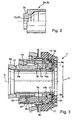
- Die besondere Gestaltung eines Kolbens 3a, 3b geht aus der Figur 2 hervor. Jeder Kolben 3a, 3b ist mit einem Ansatz 3c versehen, mit dem er axial an der Bodenplatte 9c anliegt und der gleichzeitig zur Aufnahme einer Dichtung 11 dient, dass das sich im Zylinder 10 befindende Fluid nicht in den diesen umgebenden Grundkörper 9 gelangen kann.
- Wird die Ein-/Ausrückvorrichtung 1 durch Fluid mit Druck beaufschlagt, wird dieser über die in der Bodenplatte 9c des Grundkörpers 9 vorgesehenen Bohrungen auf die der entsprechenden Kupplung zugeordneten drei Kolben 3a oder 3b übertragen. Dadurch werden die Kolben 3a oder 3b in ihren Zylindern 10 axial in Richtung Ausrücklager 6a, 6b bewegt.
- Wie bereits erwähnt, sind die Ringe 4a, 4b über entsprechend vorgesehene kolbenförmige Fortsätze 7a, 7b, die in zylinderförmige Stempel 16a und 16b übergehen, mit den jeweils zugeordneten Kolben 3a, 3b kontaktierbar und spielbehaftet axial ineinander verschiebbar. Auf diese Weise sind die Kolben 3a bzw. 3b indirekt miteinander verbunden. Weiterhin sind beispielsweise den Fortsätzen 7b am Ring 4b die Ausnehmungen 12a des Ringes 4a zugeordnet. Entsprechend sind die Führungsflächen der Ausnehmungen 12b des Ringes 4b den Fortsätzen des Ringes 4a zugeordnet.
- Die Ausnehmungen 12a des Ringes 4a weisen gegenüber dem Ring 4b die Besonderheit auf, dass sie nicht über die gesamte Breite des Ringes 4a verlaufen, sondern vor dem Ende, das an dem Lagerring 6a anliegt.
- Bei Druckbeaufschlagung der entsprechenden drei Kolben 3a bzw. 3b drücken diese gleichzeitig auf die jeweiligen Fortsätze 7a oder 7b, wodurch der Ring 4a bzw. der Ring 4b mit dem Ausrücklager 6a oder 6b ein- oder ausgerückt und damit die entsprechende Kupplung betätigt wird.
- Die Figur 3 zeigt eine Ein-/Ausrückeinrichtung 1 in der Ausgangsstellung, d. h. ohne Druckbeaufschlagung der Kolben 3a, 3b. In dieser Figur sind auch die beiden Fortsätze 7a und 7b erkennbar, die in den Stempeln 16a und 16b enden, die in dieser Stellung an den Druckflächen 19, 20 der Kolben 3a und 3b anliegen.
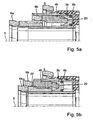
- Die Figur 4a zeigt einen der drei der konzentrisch um den Teilkreis 2 angeordneten Kolben 3a im ausgerückten und die Figur 4b entsprechend im eingerückten Zustand. Die Figuren 5a und 5b verdeutlichen die Funktionsweise der Ein-/Ausrückeinrichtung 1 für die Kolben 3b entsprechend.
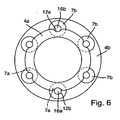
- Die Figur 6 zeigt die Anordnung der Druckflächen der beiden Ringe 4a und 4b im eingebauten Zustand. Hieraus ist erkennbar, dass die Druckkraft unabhängig von der Wahl der mit Druck beaufschlagten Kolben 3a oder 3b axial immer über den gedachten Teilkreisdurchmesser 2 der Fortsätze 7a bzw. 7b, der mit dem Teilkreisdurchmesser der Kolben 3a bzw. 3b fluchtet, übertragen wird. Dadurch wird eine weitestgehend verlustfreie Übertragung der Druckkraft von den Kolben 3a bzw. 3b auf die Ringe 4a bzw. 4b gewährleistet.
-
- 1
- Ein-/Ausrückvorrichtung / Nehmerzylinder
- 2
- Konzentrischer Teilkreis
- 3a
- Kolben
- 3b
- Kolben
- 3c
- Ansatz
- 4a
- innerer Ring
- 4b
- äußerer Ring
- 5
- Achse der Ein-/Ausrückvorrichtung
- 6a
- inneres Ausrücklager
- 6b
- äußeres Ausrücklager
- 7a
- Fortsätze
- 7b
- Fortsätze
- 8a
- Dichtungen
- 8b
- Dichtungen
- 9
- Grundkörper
- 9a
- inneres zylindrisches Grundkörperteil
- 9b
- äußeres zylindrisches Grundkörperteil
- 9c
- Bodenplatte
- 10
- Grundlochbohrung, Zylinder
- 11
- Dichtung
- 12a
- Ausnehmung
- 12b
- Ausnehmung
- 15
- Druckmittelzufuhr
- 16a
- Stempel
- 16b
- Stempel
- 17
- Gehäuse
- 18
- Schräge
- 19
- Druckfläche Kolben 3a
- 20
- Druckfläche Kolben 3b
- 21
- Stirnfläche des Rings 4a
- 22
- Stirnfläche des Rings 4b
- 23
- Anschlag
Claims (12)
- Stelleinrichtung zur Übertragung einer Stellkraft einer Ein-/Ausrückeinrichtung (1) auf eine Doppelkupplung mit mindestens für jede Kupplung zwei parallel zur Kupplungsachse bzw. zur Achse (5) der Ein-/Ausrückeinrichtung (1) angeordneten mit Druck beaufschlagbare Kolben (3a, 3b), die auf einem zur Achse (5) konzentrischen Teilkreis (2) angeordnet sind, dadurch gekennzeichnet, dass die Druckflächen (19) der Kolben (3a) jeweils miteinander und die Druckflächen (20) der Kolben (3b) jeweils miteinander mechanisch koppelbar sind und die Führungsbahn der Kolben (3a, 3b) verlängerbar ist.
- Stelleinrichtung nach Anspruch 1, dadurch gekennzeichnet, dass mindestens zwei konzentrisch um die Achse (5) zwischen dem äußeren zylindrischen Grundkörperteil (9b) und dem inneren zylindrischen Grundkörperteil (9a) angeordnete Ringe (4a, 4b) in Wirkverbindung mit mindestens zwei um die Achse (5) auf dem Teilkreis (2) angeordneten Kolben (3a, 3b) stehen.
- Stelleinrichtung nach Anspruch 2, dadurch gekennzeichnet, dass der Ring (4a) auf dem inneren zylindrischen Grundkörperteil (9a) gegenüber dem Ring (4b) und der Ring (4b) auf dem äußeren zylindrischen Grundkörperteil (9b) gegenüber dem inneren Ring 4a axial verschiebbar ist.
- Stelleinrichtung nach den Ansprüchen 1 bis 3, dadurch gekennzeichnet, dass der Ring (4a) mit seiner Stirnfläche (21) mit dem Ausrücklager (6a) und der Ring (4b) mit seiner Stirnfläche (22) mit dem Ausrücklager (6b) in Verbindung steht und die Ebenen der Stirnflächen (21, 22) senkrecht zur Achse (5) der Ein-/Ausrückeinrichtung (1) verlaufen.
- Stelleinrichtung nach den Ansprüchen 1 bis 4, dadurch gekennzeichnet, dass eine größenmäßige Abhängigkeit besteht zwischen dem Innendurchmesser des Ringes (4b) bzw. dem Außendurchmesser des Ringes (4a) und dem Durchmesser des Teilkreises (2)..
- Stelleinrichtung nach den Ansprüchen 1 bis 5, dadurch gekennzeichnet, dass die Stirnseiten der kolbenseitigen Enden der Ringe (4a, 4b) mindestens jeweils zwei Fortsätze (7a, 7b) in axialer Richtung aufweisen, wobei deren endseitiger Teil von zylindrischen Stempeln (16a, 16b) gebildet wird und die Fortsätze (7a, 7b) gleiche Längen aufweisen.
- Stelleinrichtung nach den Ansprüchen 1 bis 6, dadurch gekennzeichnet, dass an den kolbenseitigen Stirnseiten der Ringe (4a, 4b) mindestens zwei am Umfang angeordnete Ausnehmungen (12a, 12b) vorgesehen sind, die in axialer Richtung sich über die Breite der Ringe (4a, 4b) erstrecken, wobei jeweils nach einer Ausnehmung (12a, 12b) ein Fortsatz (7a, 7b) folgt.
- Stelleinrichtung nach Anspruch 7, dadurch gekennzeichnet, dass die Fortsätze (7b) des Rings (4b) lagemäßig mit den Ausnehmungen (12a) des Rings (4a) korrespondieren und in diesen axial bewegbar sind.
- Stelleinrichtung nach den Ansprüchen 6 bis 8, dadurch gekennzeichnet, dass die Symmetrieachsen der Stempel (16a, 16b) der Fortsätze (7a, 7b) mit denen der Ausnehmungen (12a, 12b) und denen der Kolben (3a, 3b) fluchten.
- Stelleinrichtung nach den Ansprüchen 1, 6 und 9, dadurch gekennzeichnet, dass die Kolben (3a, 3b) hohl ausgeführt sind und die Stempel (16a, 16b) mit den inneren Kolbenflächen (19, 20) in Verbindung stehen.
- Stelleinrichtung nach einem der Ansprüche 2 bis 10, dadurch gekennzeichnet, dass die Gesamtbreite der Ringe (4a) und (4b) mit dem Durchmesser eines Kolbens (3a, 3b) korrespondiert.
- Stelleinrichtung nach den Ansprüchen 2 bis 11, dadurch gekennzeichnet, dass der Grundkörper (9), die Ringe (4a, 4b) und die Kolben (3a, 3b) aus einem gießbaren Material herstellbar sind.
Applications Claiming Priority (2)
| Application Number | Priority Date | Filing Date | Title |
|---|---|---|---|
| DE102004002344 | 2004-01-16 | ||
| DE102004002344 | 2004-01-16 |
Publications (2)
| Publication Number | Publication Date |
|---|---|
| EP1555452A1 EP1555452A1 (de) | 2005-07-20 |
| EP1555452B1 true EP1555452B1 (de) | 2007-01-31 |
Family
ID=34609585
Family Applications (1)
| Application Number | Title | Priority Date | Filing Date |
|---|---|---|---|
| EP04030388A Expired - Lifetime EP1555452B1 (de) | 2004-01-16 | 2004-12-22 | Stelleinrichtung zur Übertragung von Kolbenkräften auf die Ein-/Ausrückeinrichtung einer Doppelkupplung. |
Country Status (7)
| Country | Link |
|---|---|
| US (1) | US7267215B2 (de) |
| EP (1) | EP1555452B1 (de) |
| JP (1) | JP2005201452A (de) |
| KR (1) | KR20050075699A (de) |
| CN (1) | CN100421982C (de) |
| AT (1) | ATE353122T1 (de) |
| DE (2) | DE102004061789A1 (de) |
Families Citing this family (25)
| Publication number | Priority date | Publication date | Assignee | Title |
|---|---|---|---|---|
| DE502005000459D1 (de) * | 2004-03-31 | 2007-04-26 | Luk Lamellen & Kupplungsbau | Hydraulisches Kupplungsbetätigungssystem |
| CN101821523B (zh) * | 2007-10-11 | 2012-08-08 | 卢克摩擦片和离合器两合公司 | 离合器操作系统 |
| DE102009034401B4 (de) | 2008-08-11 | 2019-07-04 | Schaeffler Technologies AG & Co. KG | Kupplungsausrücksystem |
| DE102009050346B4 (de) | 2008-11-17 | 2019-08-08 | Schaeffler Technologies AG & Co. KG | Kupplungsausrücksystem mit Verdrehsicherung für Nehmerzylinderkolben |
| DE102009053488B4 (de) | 2008-12-11 | 2019-05-23 | Schaeffler Technologies AG & Co. KG | Einrichtung zur Übertragung einer Kolbenkraft einer Ein-/Ausrückeinrichtung auf die jeweilige Teilkupplung einer Doppelkupplung |
| DE102009056899B4 (de) | 2008-12-22 | 2019-06-06 | Schaeffler Technologies AG & Co. KG | Kupplungsausrücksystem |
| DE102009053486B4 (de) | 2008-12-22 | 2019-06-06 | Schaeffler Technologies AG & Co. KG | Kupplungsausrücksystem für eine Reibungskupplung |
| DE102009056378B4 (de) | 2008-12-22 | 2019-05-23 | Schaeffler Technologies AG & Co. KG | Kupplungsbetätigungssystem |
| JP2010156402A (ja) * | 2008-12-26 | 2010-07-15 | Nsk Ltd | クラッチレリーズ軸受装置 |
| DE102010022101A1 (de) * | 2009-06-22 | 2010-12-23 | Luk Lamellen Und Kupplungsbau Beteiligungs Kg | Ein-/Ausrückeinrichtung zur Übertragung einer Kolbenkraft auf mindestens eine Kupplung |
| KR101028231B1 (ko) * | 2009-06-30 | 2011-04-11 | 현대자동차주식회사 | Dct 컨트롤 장치 |
| US8636125B2 (en) * | 2009-08-26 | 2014-01-28 | GM Global Technology Operations LLC | Actuation device having wiper seals for a dual clutch transmission |
| GB2474517A (en) * | 2009-10-19 | 2011-04-20 | Gm Global Tech Operations Inc | A clutch actuation device for a dual clutch including concentric slave cylinders |
| JP5500018B2 (ja) * | 2010-09-21 | 2014-05-21 | 日産自動車株式会社 | 車両のクラッチ制御装置 |
| US8474586B2 (en) * | 2010-10-18 | 2013-07-02 | GM Global Technology Operations LLC | Clutch actuation assembly with satellite pistons |
| DE112011104293A5 (de) * | 2010-12-09 | 2013-09-12 | Schaeffler Technologies AG & Co. KG | Ausrücker für eine Doppelkupplung mit Wegsensierung |
| DE102012221535A1 (de) * | 2011-12-23 | 2013-06-27 | Schaeffler Technologies AG & Co. KG | Reibungskupplung |
| JP5841454B2 (ja) * | 2012-02-24 | 2016-01-13 | 株式会社エクセディ | ツインクラッチ用シリンダ装置及びそれを備えたツインクラッチ用作動装置 |
| EP2917601B1 (de) * | 2012-11-07 | 2018-12-12 | Schaeffler Technologies AG & Co. KG | Doppelkupplung mit einer kupplungsbetätigungseinrichtung |
| US9249883B2 (en) * | 2013-01-17 | 2016-02-02 | Gm Global Technology Operations, Llc | Anti-rotate attenuation device |
| CN105579728A (zh) * | 2013-09-24 | 2016-05-11 | 舍弗勒技术股份两合公司 | 静液压的离合器执行器 |
| DE102014226299B3 (de) * | 2014-12-17 | 2015-10-15 | Schaeffler Technologies AG & Co. KG | Nehmerzylinder mit Transportsicherung sowie Verfahren zur Fixierung eines Kolbens an einem Ausrücklager |
| CN106286632A (zh) * | 2016-09-28 | 2017-01-04 | 江阴职业技术学院 | 汽车变速箱双离合器 |
| DE102019117109A1 (de) * | 2019-06-25 | 2020-12-31 | Fte Automotive Gmbh | Betätigungsmodul zur Betätigung von Drehmomentübertragungseinrichtungen eines Fahrzeuggetriebes |
| CN111963582B (zh) * | 2020-09-10 | 2022-03-11 | 浙江亚太机电股份有限公司 | 带缸套的柱塞式离合器主缸结构 |
Family Cites Families (12)
| Publication number | Priority date | Publication date | Assignee | Title |
|---|---|---|---|---|
| US2376545A (en) * | 1937-12-24 | 1945-05-22 | William T Livermore | Transmission |
| US2636585A (en) * | 1946-08-30 | 1953-04-28 | William T Livermore | Automatic fluid pressure transmission |
| FR2216856A5 (de) * | 1973-02-02 | 1974-08-30 | Ferodo Sa | |
| GB2071794B (en) * | 1980-03-17 | 1984-05-02 | Automotive Prod Co Ltd | Rotary transmission control system |
| DE3446460A1 (de) | 1984-12-20 | 1986-07-03 | Dr.Ing.H.C. F. Porsche Ag, 7000 Stuttgart | Doppelkupplung fuer ein kraftfahrzeuggetriebe |
| DE3504086A1 (de) * | 1985-02-07 | 1986-08-07 | Fichtel & Sachs Ag, 8720 Schweinfurt | Doppelnehmerzylinder mit zwei ausruecklagern zur betaetigung von schlepper-doppelkupplungen |
| US4875561A (en) * | 1987-10-09 | 1989-10-24 | Borg-Warner Automotive, Inc. | Dual clutch application area and control |
| ES2150832B1 (es) * | 1996-06-12 | 2001-06-16 | Fichtel & Sachs Ag | Dispositivo de maniobra para la maniobra, en particular maniobra neumatica, de un embrague de friccion. |
| DE19953091C1 (de) * | 1999-11-04 | 2001-08-23 | Daimler Chrysler Ag | Anordnung zum Kuppeln einer Antriebswelle mit einer oder beiden von zwei Getriebewellen eines Zahnräderwechselgetriebes |
| DE10191680B4 (de) * | 2000-04-28 | 2020-03-19 | Schaeffler Technologies AG & Co. KG | Betätigungseinrichtung für ein Getriebe |
| JP5023372B2 (ja) * | 2000-11-22 | 2012-09-12 | シェフラー テクノロジーズ アクチエンゲゼルシャフト ウント コンパニー コマンディートゲゼルシャフト | クラッチ装置 |
| ITTO20020480A1 (it) * | 2002-06-07 | 2003-12-09 | Magneti Marelli Powertrain Spa | Gruppo di trasmissione bi-frizione per un autoveicolo. |
-
2004
- 2004-12-22 EP EP04030388A patent/EP1555452B1/de not_active Expired - Lifetime
- 2004-12-22 DE DE102004061789A patent/DE102004061789A1/de not_active Withdrawn
- 2004-12-22 DE DE502004002827T patent/DE502004002827D1/de not_active Expired - Lifetime
- 2004-12-22 AT AT04030388T patent/ATE353122T1/de not_active IP Right Cessation
-
2005
- 2005-01-12 KR KR1020050002733A patent/KR20050075699A/ko not_active Ceased
- 2005-01-13 US US11/034,704 patent/US7267215B2/en not_active Expired - Fee Related
- 2005-01-17 JP JP2005009566A patent/JP2005201452A/ja not_active Withdrawn
- 2005-01-17 CN CNB2005100047263A patent/CN100421982C/zh not_active Expired - Fee Related
Also Published As
| Publication number | Publication date |
|---|---|
| DE102004061789A1 (de) | 2005-08-04 |
| US7267215B2 (en) | 2007-09-11 |
| ATE353122T1 (de) | 2007-02-15 |
| JP2005201452A (ja) | 2005-07-28 |
| DE502004002827D1 (de) | 2007-03-22 |
| KR20050075699A (ko) | 2005-07-21 |
| CN100421982C (zh) | 2008-10-01 |
| EP1555452A1 (de) | 2005-07-20 |
| CN1640712A (zh) | 2005-07-20 |
| US20050155835A1 (en) | 2005-07-21 |
Similar Documents
| Publication | Publication Date | Title |
|---|---|---|
| EP1555452A1 (de) | Stelleinrichtung zur Übertragung von Kolbenkräften auf die Ein-/Ausrückeinrichtung einer Doppelkupplung. | |
| EP2780614B1 (de) | Betätigungsvorrichtung für einen drehbaren verschlussteil eines ventils | |
| DE102011120393B4 (de) | Zentrifugal ausgeglichene Hydraulikkupplungsanordnung | |
| DE102009054794B4 (de) | Radiale Drehdurchführung und Buchse hierfür | |
| EP1987265B1 (de) | Klemm- und/oder bremsvorrichtung | |
| DE102015202916B4 (de) | Kupplungsvorrichtung mit Hebelbetätigung | |
| DE102011120576A1 (de) | Hydraulischer Einzelkolbenaktuator mit drei Positionen | |
| EP2916025B1 (de) | Betätigungseinheit für eine Kupplung | |
| EP1548333A1 (de) | Druckmittelbetätigte Schaltvorrichtung eines Stufenwechselgetriebes | |
| DE102013218507A1 (de) | Vorrichtung zum Nutenstoßen | |
| DE102012200217B4 (de) | Neutraleinstellungsvorrichtung einer verstellbaren Hydraulikmaschine | |
| DE69210564T2 (de) | Vorrichtung zum Einstellen des Stösselhubes an einer Presse | |
| DE602004001988T2 (de) | Drehventilbetätigungsvorrichtung | |
| DE2403173B2 (de) | Doppelgleitringdichtung | |
| EP2047156B1 (de) | Ventileinrichtung mit handhilfsbetätigunseinrichtung | |
| DE19628117C2 (de) | Drehantrieb, insbesondere Schwenkmotor | |
| DE102020210397B3 (de) | Hydrostatische servoeinheit | |
| EP0676278B1 (de) | Hubverstelleinrichtung für Exzenterpressen oder Stanzen | |
| DE102014013992A1 (de) | Kolben eines fluidbetätigten Linearantriebes und zugehöriger Linearantrieb | |
| DE1917368B2 (de) | Mit Druckluft arbeitende Hilfs kraft Schaltvorrichtung fur synchronisierte Wechselgetriebe von Kraftfahrzeugen | |
| EP1786593B1 (de) | Brems- und klemmeinrichtung mit getriebe für eine linearführung | |
| EP2474754B1 (de) | Selbstverstärkende Scheibenbremse mit pneumatischer oder elektromechanischer Betätigung | |
| EP2202413A1 (de) | Pneumatischer Antrieb mit Druckausgleich | |
| AT518408B1 (de) | Ventilbetätigungseinrichtung für zumindest ein gaswechselventil | |
| DE10122260B4 (de) | Linearantriebseinrichtung zum Öffnen und Schließen von Formwerkzeugen sowie Aufbringen einer Schließkraft hierauf |
Legal Events
| Date | Code | Title | Description |
|---|---|---|---|
| PUAI | Public reference made under article 153(3) epc to a published international application that has entered the european phase |
Free format text: ORIGINAL CODE: 0009012 |
|
| AK | Designated contracting states |
Kind code of ref document: A1 Designated state(s): AT BE BG CH CY CZ DE DK EE ES FI FR GB GR HU IE IS IT LI LT LU MC NL PL PT RO SE SI SK TR |
|
| AX | Request for extension of the european patent |
Extension state: AL BA HR LV MK YU |
|
| 17P | Request for examination filed |
Effective date: 20060120 |
|
| AKX | Designation fees paid |
Designated state(s): AT BE BG CH CY CZ DE DK EE ES FI FR GB GR HU IE IS IT LI LT LU MC NL PL PT RO SE SI SK TR |
|
| GRAP | Despatch of communication of intention to grant a patent |
Free format text: ORIGINAL CODE: EPIDOSNIGR1 |
|
| GRAS | Grant fee paid |
Free format text: ORIGINAL CODE: EPIDOSNIGR3 |
|
| GRAA | (expected) grant |
Free format text: ORIGINAL CODE: 0009210 |
|
| AK | Designated contracting states |
Kind code of ref document: B1 Designated state(s): AT BE BG CH CY CZ DE DK EE ES FI FR GB GR HU IE IS IT LI LT LU MC NL PL PT RO SE SI SK TR |
|
| PG25 | Lapsed in a contracting state [announced via postgrant information from national office to epo] |
Ref country code: NL Free format text: LAPSE BECAUSE OF FAILURE TO SUBMIT A TRANSLATION OF THE DESCRIPTION OR TO PAY THE FEE WITHIN THE PRESCRIBED TIME-LIMIT Effective date: 20070131 Ref country code: SI Free format text: LAPSE BECAUSE OF FAILURE TO SUBMIT A TRANSLATION OF THE DESCRIPTION OR TO PAY THE FEE WITHIN THE PRESCRIBED TIME-LIMIT Effective date: 20070131 Ref country code: PL Free format text: LAPSE BECAUSE OF FAILURE TO SUBMIT A TRANSLATION OF THE DESCRIPTION OR TO PAY THE FEE WITHIN THE PRESCRIBED TIME-LIMIT Effective date: 20070131 Ref country code: IE Free format text: LAPSE BECAUSE OF FAILURE TO SUBMIT A TRANSLATION OF THE DESCRIPTION OR TO PAY THE FEE WITHIN THE PRESCRIBED TIME-LIMIT Effective date: 20070131 Ref country code: FI Free format text: LAPSE BECAUSE OF FAILURE TO SUBMIT A TRANSLATION OF THE DESCRIPTION OR TO PAY THE FEE WITHIN THE PRESCRIBED TIME-LIMIT Effective date: 20070131 Ref country code: DK Free format text: LAPSE BECAUSE OF FAILURE TO SUBMIT A TRANSLATION OF THE DESCRIPTION OR TO PAY THE FEE WITHIN THE PRESCRIBED TIME-LIMIT Effective date: 20070131 |
|
| REG | Reference to a national code |
Ref country code: GB Ref legal event code: FG4D Free format text: NOT ENGLISH |
|
| REG | Reference to a national code |
Ref country code: CH Ref legal event code: EP |
|
| REG | Reference to a national code |
Ref country code: IE Ref legal event code: FG4D Free format text: LANGUAGE OF EP DOCUMENT: GERMAN |
|
| REF | Corresponds to: |
Ref document number: 502004002827 Country of ref document: DE Date of ref document: 20070322 Kind code of ref document: P |
|
| PG25 | Lapsed in a contracting state [announced via postgrant information from national office to epo] |
Ref country code: SE Free format text: LAPSE BECAUSE OF FAILURE TO SUBMIT A TRANSLATION OF THE DESCRIPTION OR TO PAY THE FEE WITHIN THE PRESCRIBED TIME-LIMIT Effective date: 20070430 Ref country code: BG Free format text: LAPSE BECAUSE OF FAILURE TO SUBMIT A TRANSLATION OF THE DESCRIPTION OR TO PAY THE FEE WITHIN THE PRESCRIBED TIME-LIMIT Effective date: 20070430 |
|
| PG25 | Lapsed in a contracting state [announced via postgrant information from national office to epo] |
Ref country code: ES Free format text: LAPSE BECAUSE OF FAILURE TO SUBMIT A TRANSLATION OF THE DESCRIPTION OR TO PAY THE FEE WITHIN THE PRESCRIBED TIME-LIMIT Effective date: 20070512 |
|
| PG25 | Lapsed in a contracting state [announced via postgrant information from national office to epo] |
Ref country code: IS Free format text: LAPSE BECAUSE OF FAILURE TO SUBMIT A TRANSLATION OF THE DESCRIPTION OR TO PAY THE FEE WITHIN THE PRESCRIBED TIME-LIMIT Effective date: 20070531 |
|
| PG25 | Lapsed in a contracting state [announced via postgrant information from national office to epo] |
Ref country code: PT Free format text: LAPSE BECAUSE OF FAILURE TO SUBMIT A TRANSLATION OF THE DESCRIPTION OR TO PAY THE FEE WITHIN THE PRESCRIBED TIME-LIMIT Effective date: 20070702 |
|
| ET | Fr: translation filed | ||
| NLV1 | Nl: lapsed or annulled due to failure to fulfill the requirements of art. 29p and 29m of the patents act | ||
| GBV | Gb: ep patent (uk) treated as always having been void in accordance with gb section 77(7)/1977 [no translation filed] |
Effective date: 20070131 |
|
| REG | Reference to a national code |
Ref country code: IE Ref legal event code: FD4D |
|
| PG25 | Lapsed in a contracting state [announced via postgrant information from national office to epo] |
Ref country code: SK Free format text: LAPSE BECAUSE OF FAILURE TO SUBMIT A TRANSLATION OF THE DESCRIPTION OR TO PAY THE FEE WITHIN THE PRESCRIBED TIME-LIMIT Effective date: 20070131 Ref country code: GB Free format text: LAPSE BECAUSE OF FAILURE TO SUBMIT A TRANSLATION OF THE DESCRIPTION OR TO PAY THE FEE WITHIN THE PRESCRIBED TIME-LIMIT Effective date: 20070131 |
|
| PLBE | No opposition filed within time limit |
Free format text: ORIGINAL CODE: 0009261 |
|
| STAA | Information on the status of an ep patent application or granted ep patent |
Free format text: STATUS: NO OPPOSITION FILED WITHIN TIME LIMIT |
|
| PG25 | Lapsed in a contracting state [announced via postgrant information from national office to epo] |
Ref country code: CZ Free format text: LAPSE BECAUSE OF FAILURE TO SUBMIT A TRANSLATION OF THE DESCRIPTION OR TO PAY THE FEE WITHIN THE PRESCRIBED TIME-LIMIT Effective date: 20070131 Ref country code: RO Free format text: LAPSE BECAUSE OF FAILURE TO SUBMIT A TRANSLATION OF THE DESCRIPTION OR TO PAY THE FEE WITHIN THE PRESCRIBED TIME-LIMIT Effective date: 20070131 |
|
| 26N | No opposition filed |
Effective date: 20071101 |
|
| PG25 | Lapsed in a contracting state [announced via postgrant information from national office to epo] |
Ref country code: LT Free format text: LAPSE BECAUSE OF FAILURE TO SUBMIT A TRANSLATION OF THE DESCRIPTION OR TO PAY THE FEE WITHIN THE PRESCRIBED TIME-LIMIT Effective date: 20070131 |
|
| PG25 | Lapsed in a contracting state [announced via postgrant information from national office to epo] |
Ref country code: GR Free format text: LAPSE BECAUSE OF FAILURE TO SUBMIT A TRANSLATION OF THE DESCRIPTION OR TO PAY THE FEE WITHIN THE PRESCRIBED TIME-LIMIT Effective date: 20070501 |
|
| BERE | Be: lapsed |
Owner name: LUK LAMELLEN UND KUPPLUNGSBAU BETEILIGUNGS K.G. Effective date: 20071231 |
|
| PG25 | Lapsed in a contracting state [announced via postgrant information from national office to epo] |
Ref country code: MC Free format text: LAPSE BECAUSE OF NON-PAYMENT OF DUE FEES Effective date: 20071231 |
|
| PG25 | Lapsed in a contracting state [announced via postgrant information from national office to epo] |
Ref country code: BE Free format text: LAPSE BECAUSE OF NON-PAYMENT OF DUE FEES Effective date: 20071231 |
|
| PG25 | Lapsed in a contracting state [announced via postgrant information from national office to epo] |
Ref country code: EE Free format text: LAPSE BECAUSE OF FAILURE TO SUBMIT A TRANSLATION OF THE DESCRIPTION OR TO PAY THE FEE WITHIN THE PRESCRIBED TIME-LIMIT Effective date: 20070131 |
|
| PGFP | Annual fee paid to national office [announced via postgrant information from national office to epo] |
Ref country code: IT Payment date: 20081220 Year of fee payment: 5 |
|
| PG25 | Lapsed in a contracting state [announced via postgrant information from national office to epo] |
Ref country code: AT Free format text: LAPSE BECAUSE OF NON-PAYMENT OF DUE FEES Effective date: 20071222 |
|
| PG25 | Lapsed in a contracting state [announced via postgrant information from national office to epo] |
Ref country code: CY Free format text: LAPSE BECAUSE OF FAILURE TO SUBMIT A TRANSLATION OF THE DESCRIPTION OR TO PAY THE FEE WITHIN THE PRESCRIBED TIME-LIMIT Effective date: 20070131 |
|
| REG | Reference to a national code |
Ref country code: CH Ref legal event code: PL |
|
| PG25 | Lapsed in a contracting state [announced via postgrant information from national office to epo] |
Ref country code: LU Free format text: LAPSE BECAUSE OF NON-PAYMENT OF DUE FEES Effective date: 20071222 |
|
| PG25 | Lapsed in a contracting state [announced via postgrant information from national office to epo] |
Ref country code: TR Free format text: LAPSE BECAUSE OF FAILURE TO SUBMIT A TRANSLATION OF THE DESCRIPTION OR TO PAY THE FEE WITHIN THE PRESCRIBED TIME-LIMIT Effective date: 20070131 Ref country code: HU Free format text: LAPSE BECAUSE OF FAILURE TO SUBMIT A TRANSLATION OF THE DESCRIPTION OR TO PAY THE FEE WITHIN THE PRESCRIBED TIME-LIMIT Effective date: 20070801 |
|
| PG25 | Lapsed in a contracting state [announced via postgrant information from national office to epo] |
Ref country code: LI Free format text: LAPSE BECAUSE OF NON-PAYMENT OF DUE FEES Effective date: 20081231 Ref country code: CH Free format text: LAPSE BECAUSE OF NON-PAYMENT OF DUE FEES Effective date: 20081231 |
|
| PG25 | Lapsed in a contracting state [announced via postgrant information from national office to epo] |
Ref country code: IT Free format text: LAPSE BECAUSE OF NON-PAYMENT OF DUE FEES Effective date: 20091222 |
|
| REG | Reference to a national code |
Ref country code: DE Ref legal event code: R081 Ref document number: 502004002827 Country of ref document: DE Owner name: SCHAEFFLER TECHNOLOGIES AG & CO. KG, DE Free format text: FORMER OWNER: SCHAEFFLER TECHNOLOGIES GMBH & CO. KG, 91074 HERZOGENAURACH, DE Effective date: 20120828 Ref country code: DE Ref legal event code: R081 Ref document number: 502004002827 Country of ref document: DE Owner name: SCHAEFFLER TECHNOLOGIES GMBH & CO. KG, DE Free format text: FORMER OWNER: SCHAEFFLER TECHNOLOGIES GMBH & CO. KG, 91074 HERZOGENAURACH, DE Effective date: 20120828 |
|
| REG | Reference to a national code |
Ref country code: FR Ref legal event code: TP Owner name: SCHAEFFLER TECHNOLOGIES AG & CO. KG, DE Effective date: 20130408 |
|
| REG | Reference to a national code |
Ref country code: DE Ref legal event code: R081 Ref document number: 502004002827 Country of ref document: DE Owner name: SCHAEFFLER TECHNOLOGIES GMBH & CO. KG, DE Free format text: FORMER OWNER: SCHAEFFLER TECHNOLOGIES AG & CO. KG, 91074 HERZOGENAURACH, DE Effective date: 20140218 Ref country code: DE Ref legal event code: R081 Ref document number: 502004002827 Country of ref document: DE Owner name: SCHAEFFLER TECHNOLOGIES AG & CO. KG, DE Free format text: FORMER OWNER: SCHAEFFLER TECHNOLOGIES AG & CO. KG, 91074 HERZOGENAURACH, DE Effective date: 20140218 |
|
| REG | Reference to a national code |
Ref country code: DE Ref legal event code: R081 Ref document number: 502004002827 Country of ref document: DE Owner name: SCHAEFFLER TECHNOLOGIES AG & CO. KG, DE Free format text: FORMER OWNER: SCHAEFFLER TECHNOLOGIES GMBH & CO. KG, 91074 HERZOGENAURACH, DE Effective date: 20150213 |
|
| REG | Reference to a national code |
Ref country code: FR Ref legal event code: PLFP Year of fee payment: 12 |
|
| REG | Reference to a national code |
Ref country code: FR Ref legal event code: PLFP Year of fee payment: 13 |
|
| REG | Reference to a national code |
Ref country code: FR Ref legal event code: PLFP Year of fee payment: 14 |
|
| PGFP | Annual fee paid to national office [announced via postgrant information from national office to epo] |
Ref country code: FR Payment date: 20171229 Year of fee payment: 14 |
|
| PGFP | Annual fee paid to national office [announced via postgrant information from national office to epo] |
Ref country code: DE Payment date: 20180228 Year of fee payment: 14 |
|
| REG | Reference to a national code |
Ref country code: DE Ref legal event code: R119 Ref document number: 502004002827 Country of ref document: DE |
|
| PG25 | Lapsed in a contracting state [announced via postgrant information from national office to epo] |
Ref country code: DE Free format text: LAPSE BECAUSE OF NON-PAYMENT OF DUE FEES Effective date: 20190702 Ref country code: FR Free format text: LAPSE BECAUSE OF NON-PAYMENT OF DUE FEES Effective date: 20181231 |
|
| P01 | Opt-out of the competence of the unified patent court (upc) registered |
Effective date: 20230522 |