EP1555250A2 - Schlichtezusammensetzung - Google Patents
Schlichtezusammensetzung Download PDFInfo
- Publication number
- EP1555250A2 EP1555250A2 EP05000185A EP05000185A EP1555250A2 EP 1555250 A2 EP1555250 A2 EP 1555250A2 EP 05000185 A EP05000185 A EP 05000185A EP 05000185 A EP05000185 A EP 05000185A EP 1555250 A2 EP1555250 A2 EP 1555250A2
- Authority
- EP
- European Patent Office
- Prior art keywords
- optionally
- component
- compounds
- dispersions
- groups
- Prior art date
- Legal status (The legal status is an assumption and is not a legal conclusion. Google has not performed a legal analysis and makes no representation as to the accuracy of the status listed.)
- Granted
Links
Classifications
-
- C—CHEMISTRY; METALLURGY
- C08—ORGANIC MACROMOLECULAR COMPOUNDS; THEIR PREPARATION OR CHEMICAL WORKING-UP; COMPOSITIONS BASED THEREON
- C08G—MACROMOLECULAR COMPOUNDS OBTAINED OTHERWISE THAN BY REACTIONS ONLY INVOLVING UNSATURATED CARBON-TO-CARBON BONDS
- C08G18/00—Polymeric products of isocyanates or isothiocyanates
- C08G18/06—Polymeric products of isocyanates or isothiocyanates with compounds having active hydrogen
- C08G18/70—Polymeric products of isocyanates or isothiocyanates with compounds having active hydrogen characterised by the isocyanates or isothiocyanates used
- C08G18/703—Isocyanates or isothiocyanates transformed in a latent form by physical means
- C08G18/705—Dispersions of isocyanates or isothiocyanates in a liquid medium
- C08G18/706—Dispersions of isocyanates or isothiocyanates in a liquid medium the liquid medium being water
-
- A—HUMAN NECESSITIES
- A61—MEDICAL OR VETERINARY SCIENCE; HYGIENE
- A61B—DIAGNOSIS; SURGERY; IDENTIFICATION
- A61B17/00—Surgical instruments, devices or methods
- A61B17/14—Surgical saws
-
- C—CHEMISTRY; METALLURGY
- C03—GLASS; MINERAL OR SLAG WOOL
- C03C—CHEMICAL COMPOSITION OF GLASSES, GLAZES OR VITREOUS ENAMELS; SURFACE TREATMENT OF GLASS; SURFACE TREATMENT OF FIBRES OR FILAMENTS MADE FROM GLASS, MINERALS OR SLAGS; JOINING GLASS TO GLASS OR OTHER MATERIALS
- C03C25/00—Surface treatment of fibres or filaments made from glass, minerals or slags
- C03C25/10—Coating
- C03C25/24—Coatings containing organic materials
- C03C25/26—Macromolecular compounds or prepolymers
-
- C—CHEMISTRY; METALLURGY
- C03—GLASS; MINERAL OR SLAG WOOL
- C03C—CHEMICAL COMPOSITION OF GLASSES, GLAZES OR VITREOUS ENAMELS; SURFACE TREATMENT OF GLASS; SURFACE TREATMENT OF FIBRES OR FILAMENTS MADE FROM GLASS, MINERALS OR SLAGS; JOINING GLASS TO GLASS OR OTHER MATERIALS
- C03C25/00—Surface treatment of fibres or filaments made from glass, minerals or slags
- C03C25/10—Coating
- C03C25/24—Coatings containing organic materials
- C03C25/26—Macromolecular compounds or prepolymers
- C03C25/32—Macromolecular compounds or prepolymers obtained otherwise than by reactions involving only carbon-to-carbon unsaturated bonds
- C03C25/326—Polyureas; Polyurethanes
-
- C—CHEMISTRY; METALLURGY
- C08—ORGANIC MACROMOLECULAR COMPOUNDS; THEIR PREPARATION OR CHEMICAL WORKING-UP; COMPOSITIONS BASED THEREON
- C08G—MACROMOLECULAR COMPOUNDS OBTAINED OTHERWISE THAN BY REACTIONS ONLY INVOLVING UNSATURATED CARBON-TO-CARBON BONDS
- C08G18/00—Polymeric products of isocyanates or isothiocyanates
- C08G18/06—Polymeric products of isocyanates or isothiocyanates with compounds having active hydrogen
- C08G18/08—Processes
- C08G18/0838—Manufacture of polymers in the presence of non-reactive compounds
- C08G18/0842—Manufacture of polymers in the presence of non-reactive compounds in the presence of liquid diluents
- C08G18/0861—Manufacture of polymers in the presence of non-reactive compounds in the presence of liquid diluents in the presence of a dispersing phase for the polymers or a phase dispersed in the polymers
- C08G18/0866—Manufacture of polymers in the presence of non-reactive compounds in the presence of liquid diluents in the presence of a dispersing phase for the polymers or a phase dispersed in the polymers the dispersing or dispersed phase being an aqueous medium
-
- C—CHEMISTRY; METALLURGY
- C08—ORGANIC MACROMOLECULAR COMPOUNDS; THEIR PREPARATION OR CHEMICAL WORKING-UP; COMPOSITIONS BASED THEREON
- C08G—MACROMOLECULAR COMPOUNDS OBTAINED OTHERWISE THAN BY REACTIONS ONLY INVOLVING UNSATURATED CARBON-TO-CARBON BONDS
- C08G18/00—Polymeric products of isocyanates or isothiocyanates
- C08G18/06—Polymeric products of isocyanates or isothiocyanates with compounds having active hydrogen
- C08G18/08—Processes
- C08G18/10—Prepolymer processes involving reaction of isocyanates or isothiocyanates with compounds having active hydrogen in a first reaction step
- C08G18/12—Prepolymer processes involving reaction of isocyanates or isothiocyanates with compounds having active hydrogen in a first reaction step using two or more compounds having active hydrogen in the first polymerisation step
-
- C—CHEMISTRY; METALLURGY
- C08—ORGANIC MACROMOLECULAR COMPOUNDS; THEIR PREPARATION OR CHEMICAL WORKING-UP; COMPOSITIONS BASED THEREON
- C08G—MACROMOLECULAR COMPOUNDS OBTAINED OTHERWISE THAN BY REACTIONS ONLY INVOLVING UNSATURATED CARBON-TO-CARBON BONDS
- C08G18/00—Polymeric products of isocyanates or isothiocyanates
- C08G18/06—Polymeric products of isocyanates or isothiocyanates with compounds having active hydrogen
- C08G18/28—Polymeric products of isocyanates or isothiocyanates with compounds having active hydrogen characterised by the compounds used containing active hydrogen
- C08G18/2805—Compounds having only one group containing active hydrogen
- C08G18/2815—Monohydroxy compounds
- C08G18/283—Compounds containing ether groups, e.g. oxyalkylated monohydroxy compounds
-
- A—HUMAN NECESSITIES
- A61—MEDICAL OR VETERINARY SCIENCE; HYGIENE
- A61B—DIAGNOSIS; SURGERY; IDENTIFICATION
- A61B17/00—Surgical instruments, devices or methods
- A61B2017/00743—Type of operation; Specification of treatment sites
- A61B2017/00792—Plastic surgery
Definitions
- the invention relates to novel thermo-yellowing sizing compositions, their preparation and use.
- the z. T. significantly more than 200 ° C, it often comes to unwanted Thermal yellowing of the coatings produced.
- hydrazines and hydrazides are chain extenders in polyurethanes, for example From US-A 4,147,679 or DE-A 23 14 513 known. In part, they are also in Mixtures with other chain extenders such as diamines used (US-A 3,415,768). she serve to improve flexibility, hardness, durability and drying of the coatings.
- the object of the present invention was therefore to provide thermo-yellowing stable or thermal yellowing sizing compositions in comparison to Finishing the state of the art.
- Suitable polyisocyanates of component A1) are the aromatic, araliphatic, aliphatic or cycloaliphatic polyisocyanates, which also include iminooxadiazinedione, Isocyanurate, uretdione, urethane, allophanate, biuret, urea, oxadiazinetrione, Oxazolidinon-, acylurea and / or carbodiimide structures may have. These can be used in A1) individually or in any mixtures with each other.
- Suitable aromatic, araliphatic, aliphatic or cycloaliphatic polyisocyanates are accessible by phosgenation or by phosgene-free processes, for example by thermal urethane cleavage, accessible di- or triisocyanates of molecular weight range from 140 to 400 g / mol with aliphatic, cycloaliphatic, araliphatic and / or aromatically bound isocyanate groups such as 1,4-diisocyanatobutane, 1,5-diisocyanatopentane, 1,6-diisocyanatohexane (HDI), 2-methyl-1,5-diisocyanatopentane, 1,5-diisocyanato-2,2-dimethylpentane, 2,2,4 - or 2,4,4-trimethyl-1,6-diisocyanatohexane, 1,10-diisocyanatodecane, 1,3- and 1,4-diisocyanatocycl
- polyisocyanates or polyisocyanate mixtures of the abovementioned are preferred Type with exclusively aliphatic and / or cycloaliphatic bound isocyanate groups used.
- hexamethylene diisocyanate isophorone diisocyanate
- isomeric bis (4,4'-isocyanatocyclohexyl) methanes as well as their mixtures.
- Polymeric polyols or polyamines according to the definition of component A2) come typically from the group of polyacrylates, polyesters, polylactones, polyethers, polycarbonates, Polyestercarbonates, polyacetals, polyolefins and polysiloxanes and preferably have a Functionality based on NCO-reactive functionalities from 1.5 to 4.
- polymeric polyols of the aforementioned type with a number average Molecular weight of 600-2,500 g / mol and with an OH functionality of 2 to 3.
- Hydroxyl-containing polycarbonates are by reaction of carbonic acid derivatives, e.g. Diphenyl carbonate, dimethyl carbonate or Phosgene with diols available.
- diols come e.g. Ethylene glycol, 1,2- and 1,3-propanediol, 1,3- and 1,4-butanediol, 1,6-hexanediol, 1,8-octanediol, neopentyl glycol, 1,4-bis-hydroxymethylcyclohexane, 2-methyl-1,3-propanediol, 2,2,4-trimethylpentanediol-1,3, dipropylene glycol, polypropylene glycols, dibutylene glycol, Polybutylene glycols, bisphenol A, tetrabromobisphenol A but also lactone-modified Diols in question.
- Ethylene glycol 1,2- and 1,3-propanediol, 1,3- and 1,4-butanediol, 1,6-hexanediol, 1,8-octanediol, neopentyl glyco
- the diol component preferably contains from 40 to 100% by weight of hexanediol, preferably 1,6-hexanediol and / or hexanediol derivatives, particularly preferably those derivatives which in addition to terminal OH groups ether or ester groups, such as products by Reaction of 1 mole of hexanediol with at least 1 mole, preferably 1 to 2 moles of caprolactone according to DE-A 17 70 245 or by etherification of hexanediol with itself to di- or Trihexylenglykol were obtained.
- the preparation of such derivatives is e.g. from DE-A 15 70 540 known.
- the polyether-polycarbonate diols described in DE-A 37 17 060 can also be used.
- the hydroxyl polycarbonates are preferably linear, but may optionally by incorporation polyfunctional components, in particular low molecular weight polyols are branched.
- polyfunctional components in particular low molecular weight polyols are branched.
- glycerol trimethylolpropane, hexanetriol-1,2,6, butantriol-1,2,4, Trimethylolpropane, pentaerythritol, quinitol, mannitol, and sorbitol, methylglycoside, 1,3,4,6-dianhydrohexite.
- Suitable polyether polyols according to the definition of component A2) are those in the Polyurethane chemistry per se known polytetramethylene glycol polyethers, e.g. about polymerization of tetrahydrofuran can be prepared by cationic ring opening.
- suitable polyether polyols are polyethers such as those using starter molecules prepared polyols of styrene oxide, propylene oxide, butylene oxide or epichlorohydrin, in particular of propylene oxide.
- Suitable polyester polyols according to the definition of component A2) are e.g. Reaction products of polyvalent, preferably bivalent and optionally in addition trihydric alcohols with polybasic, preferably dibasic carboxylic acids.
- Free polycarboxylic acids can also be the corresponding polycarboxylic anhydrides or corresponding Polycarboxylic acid esters of lower alcohols or mixtures thereof for the preparation the polyester can be used.
- the polycarboxylic acids may be aliphatic, cycloaliphatic, of aromatic and / or heterocyclic nature and optionally, e.g. by halogen atoms substituted and / or unsaturated.
- Suitable compounds for this purpose are, for example, aliphatic monoalcohols or monoamines said molecular weight range having 1 to 18 carbon atoms, such as e.g. Ethanol, n-butanol, Ethylene glycol monobutyl ether, 2-ethylhexanol, 1-octanol, 1-dodecanol, 1-hexadecanol, diethylamine, Dibutylamine, ethanolamine, N-methylethanolamine, N, N-diethanolamine, amines of Jeffamin® M series (Huntsman Corp. Europe, Belgium) or amino-functional polyethylene oxides and polypropylene oxides.
- Ethanol n-butanol
- Ethylene glycol monobutyl ether 2-ethylhexanol
- 1-octanol 1-dodecanol
- 1-hexadecanol diethylamine
- Dibutylamine ethanol
- Preferred isocyanate-reactive groups are hydroxyl or amino groups.
- Suitable ionically or potentially ionically hydrophilic compounds according to the definition of component A4 are, for example, mono- and dihydroxycarboxylic acids, mono- and diaminocarboxylic acids, mono- and dihydroxysulfonic acids, mono- and diaminosulfonic acids and also mono- and dihydroxyphosphonic acids or mono- and diaminophosphonic acids and their salts, such as dimethylolpropionic acid.
- cyclohexylaminopropanesulfonic acid e.g. in WO 01/88006 as Compound according to the definition of component A4 can be used.
- Preferred ionic or potentially ionic compounds are those which have carboxy or Carboxylate and / or sulfonate groups and / or ammonium groups.
- Particularly preferred ionic compounds are those which contain carboxyl and / or sulfonate groups as ionic or potentially ionic groups, such as the salts of N- (2-aminoethyl) - ⁇ -alanine, of 2- (2-amino-ethylamino) ethanesulfonic acid or of the addition product of IPDI and acrylic acid (EP-A 0 916 647, Example 1) and dimethylolpropionic acid.
- carboxyl and / or sulfonate groups as ionic or potentially ionic groups, such as the salts of N- (2-aminoethyl) - ⁇ -alanine, of 2- (2-amino-ethylamino) ethanesulfonic acid or of the addition product of IPDI and acrylic acid (EP-A 0 916 647, Example 1) and dimethylolpropionic acid.
- Nonionic hydrophilizing compounds are also, for example, monovalent, in the statistical Means 5 to 70, preferably 7 to 55 ethylene oxide units per molecule having Polyalkylenoxidpolyetheralkohole, as in a conventional manner by alkoxylation of suitable starter molecules (for example, in Ullmanns Encyclopadie der ischen Chemie, 4th Edition, Volume 19, Verlag Chemie, Weinheim pp. 31-38).
- Suitable starter molecules are, for example, saturated monoalcohols, such as methanol, ethanol, n-propanol, Isopropanol, n-butanol, isobutanol, sec-butanol, the isomers pentanols, hexanols, Octanols and nonanols, n-decanol, n-dodecanol, n-tetradecanol, n-hexadecanol, n-octadecanol, Cyclohexanol, the isomeric methylcyclohexanols or hydroxymethylcyclohexane, 3-ethyl-3-hydroxymethyloxetane or tetrahydrofurfuryl alcohol, diethylene glycol monoalkyl ethers such as Diethylene glycol monobutyl ether, unsaturated alcohols such as allyl alcohol, 1,1-dimethylallyl alcohol or o
- Alkylene oxides suitable for the alkoxylation reaction are in particular ethylene oxide and Propylene oxide, in any order or even in a mixture in the alkoxylation reaction can be used.
- the polyalkylene oxide polyether alcohols are either pure polyethylene oxide polyethers or mixed polyalkylene oxide polyethers, their alkylene oxide units to at least 30 mol%, preferably at least 40 mol% consist of ethylene oxide units.
- Preferred nonionic compounds are monofunctional mixed polyalkylene oxide polyethers, the at least 40 mol% ethylene oxide and at most 60 mol% propylene oxide units exhibit.
- hydrazine and / or its hydrates as a component C1).
- Preferred is the use of hydrazine monohydrate.
- chain extenders can also be used in component C2). These correspond to the above definitions of the compounds suitable for A2) - A5), with the proviso that the compounds used in C2) have -NH 2 and / or NH groups.
- component A1 7 to 45% by weight of component A1), 50 to 91% by weight of component A2), 0 to 30% by weight of compounds A3), 0 to 12% by weight of component A4), 0 to 0 are preferred 15% by weight of component A5), 0.1 to 5.0% by weight of C1) (based on pure hydrazine N 2 H 4 ) and 0 to 15% by weight of C 2 ), the sum of A4) and A5) is 0.1 to 27 wt .-% and the sum of all components added to 100 wt .-%.
- component A1 10 to 30% by weight of component A1), 65 to 90% by weight of component A2), 0 to 10% by weight of component A3), 0 to 10% by weight of component A4), 0 to 15% by weight of component A5), 0.1 to 3.0% by weight of C1) (based on pure hydrazine N 2 H 4 ) and 0 to 10% by weight of C2), the sum of A4) and A5) is 0.1 to 25 wt .-% and add the sum of all components to 100 wt .-%.
- component A1 from 8 to 27% by weight of component A1), from 65 to 85% by weight of component A2), from 0 to 8% by weight of component A3), from 0 to 10% by weight of component A4), 0 to 15 wt .-% component A5), 1.0 to 2.5 wt .-% C1) (based on pure hydrazine N 2 H 4 ), and 0 to 8 wt .-% C2), wherein the sum of A4) and A5) is 0.1 to 25 wt .-% and add the sum of the components to 100 wt .-%.
- the process for preparing the aqueous PU dispersions may be in one or more Stages in homogeneous, or in multi-stage reaction, partially stirred in disperse phase become. After completely or partially carried out polyaddition from A1) - A5) takes place Dispersing, emulsifying or dissolving step. Subsequently, if necessary, another Polyaddition or modification in disperse phase.
- Acetone method or derivatives thereof are used for the preparation of the aqueous PU dispersions known from the prior art. A summary of this Methods can be found in methods of organic chemistry (Houben-Weyl, Extension and Episodes to the 4th edition, volume E20, H. Bartl and J. Falbe, Stuttgart, New York, Thieme 1987, S. 1671-1682). Preferred is the acetone method.
- the constituents A2) to A5) which are not primary or secondary amino groups and the polyisocyanate component A1) to Preparation of a polyurethane prepolymer completely or partially submitted and optionally with a water-miscible but isocyanate-inert solvent A6) diluted and heated to higher temperatures, preferably in the range of 50 to 120 ° C.
- Suitable solvents are the usual aliphatic ketofunctional solvents, e.g. Acetone, butanone, not only at the beginning of production, but optionally in parts also can be added later. Preferred are acetone and butanone. It is possible the Reaction under normal pressure or elevated pressure, e.g. above the normal pressure boiling temperature a solvent such as e.g. Perform acetone.
- Catalysts such as e.g. Triethylamine, 1,4-diazabicyclo [2,2,2] octane, dibutyltin oxide, Tin dioctoate or dibutyltin dilaurate, tin bis (2-ethylhexanoate) or other organometallic Compounds with submitted or added later. Preference is given to dibutyltin dilaurate.
- the molar ratio is from isocyanate groups to isocyanate-reactive groups 1.0 to 3.5, preferably 1.1 to 3.0, more preferably 1.1 to 2.5.
- the reaction of the components A1) - A5) to the prepolymer takes place partially or completely, but preferably completely.
- the degree of conversion is usually by monitoring the NCO content monitored the reaction mixture.
- both spectroscopic measurements e.g. Infrared or near-infrared spectra, determinations of refractive index as well as chemical Analyzes, such as titrations, of samples taken. It will be like that Polyurethane prepolymers containing free isocyanate groups, in bulk or in solution receive.
- bases such as ammonia, ammonium carbonate or bicarbonate, Trimethylamine, triethylamine, tributylamine, diisopropylethylamine, dimethylethanolamine, Diethylethanolamine, triethanolamine, potassium hydroxide or sodium carbonate used, preferably triethylamine, triethanolamine, dimethylethanolamine or diisopropylethylamine.
- the amount of substance of the bases is between 50 and 100%, preferably between 60 and 90% of the Amount of the anionic groups.
- cationic groups sulfuric acid dimethyl esters or succinic acid used. Are only nonionic hydrophilic Compounds A5) used with ether groups, eliminating the neutralization step.
- the Neutralization can also be carried out simultaneously with the dispersion in which the dispersing water already contains the neutralizing agent.
- step B if not yet or only partially under A), the resulting prepolymer with the aid of aliphatic ketones such as acetone happen or butanone dissolved.
- step C the component C1) and potential NH 2 - and / or NHfunktionelle components C2) with the remaining isocyanate groups reacted.
- This chain extension / termination can be carried out either in a solvent before dispersion, during dispersion or in water after dispersion.
- the chain extension of the prepolymers is preferably carried out before the dispersion.
- the chain extension ie the equivalent ratio of NCO-reactive groups of the Chain extension in C1) and optionally C2) used compounds to free NCO groups of Prepolymer is usually between 40-200%, preferably between 70-180%, especially preferably between 80-160% and most preferably between 101-150%, where C1) in an amount to be added is that at least 40%, preferably at least 50% and especially preferably at least 70% of the NCO groups are reacted with compounds of component C1) are.
- monoamines such as e.g. Diethylamine, dibutylamine, ethanolamine, N-methylethanolamine or N, N-diethanolamine be used.
- the amine components C1) and optionally C2) may optionally be diluted with water or solvent Form are used individually or in mixtures in the process according to the invention, in principle, any order of addition is possible.
- the diluent content preferably 70 to 95 wt .-%.
- component C1 For chain extension, preference is given first to component C1) with the compounds from C2) as defined by A4) and then added with the compounds C2) according to the definitions of A2) and / or A3).
- step C the preparation of the PU dispersions from the prepolymers takes place subsequently to the chain extension (step C)).
- chain extended Polyurethane polymer optionally under high shear, e.g. strong stirring, either in the dispersing water is added or, conversely, the dispersing water is stirred to the Prepolymer solutions.
- the water is added to the dissolved prepolymer.
- the solvent still contained in the dispersions after the dispersing step usually becomes then removed by distillation. A distance already during the dispersion is also possible.
- the dispersions thus obtained have a solids content of 10 to 70 wt .-%, preferably 25 to 65 wt .-% and particularly preferably 30 to 65 wt .-%.
- the dispersion can be very finely divided be adjusted so that it has practically the appearance of a solution, but also very coarse Settings are possible, which are also sufficiently stable.
- aqueous polyurethane dispersions by polyacrylates modify.
- an emulsion of olefinically unsaturated monomers e.g. Esters of (meth) acrylic acid and alcohols having 1 to 18 C atoms, styrene, vinyl esters or butadiene carried out, as described for example in DE-A 19 53 348, EP-A 0 167 188, EP-A 0 189 945 and EP-A 0 308 115 are described.
- these monomers can also contain functional groups such as hydroxyl, epoxy, methylol or acetoacetoxy.
- film-forming resins of component II are those known in the art in water dispersible, emulsifiable or soluble polymers.
- polyester polymers or epoxy group-containing polyester polymers polyurethanes, acrylic polymers, vinyl polymers such as polyvinyl acetate, polyurethane dispersions, polyacrylate dispersions, polyurethane-polyacrylate hybrid dispersions, Polyvinyl ether or Polyvinylesterdispersionen, polystyrene or Polyacrylnitrildispersionen .
- the solids content of the film-forming resins is typically 10 to 95 wt .-%, preferably 30 to 95 wt .-%.
- the PU dispersions of component I) as well as the film-forming resins of component II) may have reactive groups relative to the crosslinker component III).
- crosslinkers of component III polyisocyanates with optionally blocked NCO groups and / or amino crosslinker resins such as e.g. Melamine resins are used.
- hydrophilic or hydrophilic water-soluble or water-dispersible blocked polyisocyanates in crosslinking component III.
- At least a crosslinker and / or film-forming resin is used.
- auxiliaries and additives are added to the size compositions. These may be adhesion promoters, lubricants, antistatic agents but also the skilled person per se well-known paint additives such as dyes, pigments, leveling agents, light and anti-aging agents, UV absorber and so on.
- adhesion promoters such as talc, talc, talc, talc, talc, talc, talc, talct, talctyl, talctyl, talctyl, talctyl, talctyl, talctyl, stearic acid, stearate, stearate, stearate, stearate, stearate, stearate, stearate, talctylene glycol, glycerin, talctyl, talctyl, talctyl, talctyl, talctyl, talctyl
- silane coupling agents such as 3-aminopropyltrimethoxy or triethoxysilane, N- (2-aminoethyl) -3-aminopropyltrimethoxysilane, 3-glycidylpropyltrimethoxysilane, Vinyltrimethoxysilane, vinyltriethoxysilane or 3-methacryloxypropyltriethoxysilane.
- concentration of silane coupling agents in the layer compositions of the invention is preferably 0.05 to 2 wt .-%, particularly preferably 0.15 to 0.85 Wt .-%, based on the total size composition.
- the size compositions according to the invention may contain one or more nonionic and / or ionic lubricants as part of component IV), such as polyalkylene glycol ethers of fatty alcohols or fatty amines, polyalkylene glycol ethers and glycerol esters of Fatty acids having 12 to 18 carbon atoms, polyalkylene glycols, higher fatty acid amides 12 to 18 carbon atoms of polyalkylene glycols and / or alkyleneamines, quaternary nitrogen compounds, e.g. ethoxylated imidazolinium salts, mineral oils and waxes.
- the lubricant (s) are preferably in a total concentration of 0.05 to 1.5 wt .-% based on the entire size composition applied.
- the size compositions according to the invention may also contain one or more antistatics as Part of component IV).
- antistatics for example, lithium chloride, ammonium chloride, Cr III salts, organic titanium compounds, aryl alkyl sulfates or sulfonates, Aryl polyglycol ether sulfonates or quaternary nitrogen compounds.
- the antistatics will be preferably used in concentrations of 0.01 to 0.8 wt .-% applied.
- the preparation of the sizing compositions can according to the methods known per se respectively.
- water is placed in a suitable mixing vessel and stirred the binder (component I)), the hardener (component III)) and then the lubricant and optionally further auxiliaries from component IV) are added.
- the pH value adjusted to 5-7 and a hydrolyzate of a coupling agent from component IV) was added.
- the sizing composition is ready for use and may optionally be applied after pH adjustment.
- the sizing compositions can be prepared by any method, for example by Spray or rolling applicators are applied to a suitable substrate and cured.
- Suitable substrates are for example selected from the group metal, wood, glass, Glass fibers, carbon fibers, stone, ceramic minerals, concrete, hard and flexible plastics various types, woven and non-woven textiles, leather, paper, hard fibers, straw and bitumen which may also be provided with conventional primers prior to painting can be.
- Preferred substrates are glass fibers, carbon fibers, metals, textiles and leather. Particularly preferred substrates are glass fibers.
- the glass fibers used are both those used for glass fiber production, known glass types such as E, A, C, and S glass according to DIN 1259-1 and the others in themselves known products of glass fiber manufacturers suitable.
- known glass types such as E, A, C, and S glass according to DIN 1259-1 and the others in themselves known products of glass fiber manufacturers suitable.
- the mentioned glass types for the Production of continuous glass fibers have the E glass fibers due to their alkali-free, high Tensile strength and high modulus of elasticity are of greatest importance for the reinforcement of Plastics.
- the sizings become high velocity spinnerets pulled glass filaments immediately after their solidification, i. applied before winding.
- the sized glass fibers can be either wet or dry for example Cut glass to be processed. Drying of the final or intermediate product takes place Temperatures between 50 to 200 ° C, preferably 90 to 150 ° C instead. Under drying is included not only to understand the removal of other volatiles, but e.g. also the solidification of the sizing ingredients. Only after drying has finished the sizing in transforms the finished coating mass.
- the proportion of sizing, based on the sized glass fibers preferably 0.1 to 5.0 wt .-%, particularly preferably 0.1 to 3.0 wt .-% and most preferably from 0.3 to 1.5% by weight.
- thermoplastics or thermosetting polymers can be used.
- suitable as thermoplastic polymers polyolefins such as Polyethylene or polypropylene, polyvinyl chloride, polymers such as styrene / acrylonitrile copolymers, ABS, polymethacrylate or polyoxymethylene, aromatic and / or aliphatic polyamides such Polyamide-6 or polyamide-6,6, polycondensates such as polycarbonate, polyethylene terephthalate, liquid-crystalline polyaryl esters, polyarylene oxide, polysulfone, polyarylene sulfide, polyarylsulfone, Polyethersulfone, polyarylether or polyetherketone or polyadducts such as polyurethanes.
- duroplastic curable polymers may be mentioned as examples: epoxy resins, unsaturated Polyester resins, phenolic resins, amine resins, polyurethane resins, polyisocyanurates, epoxy / isocyanurate combination resins, Furan resins, cyanurate resins and bismaleimide resins.
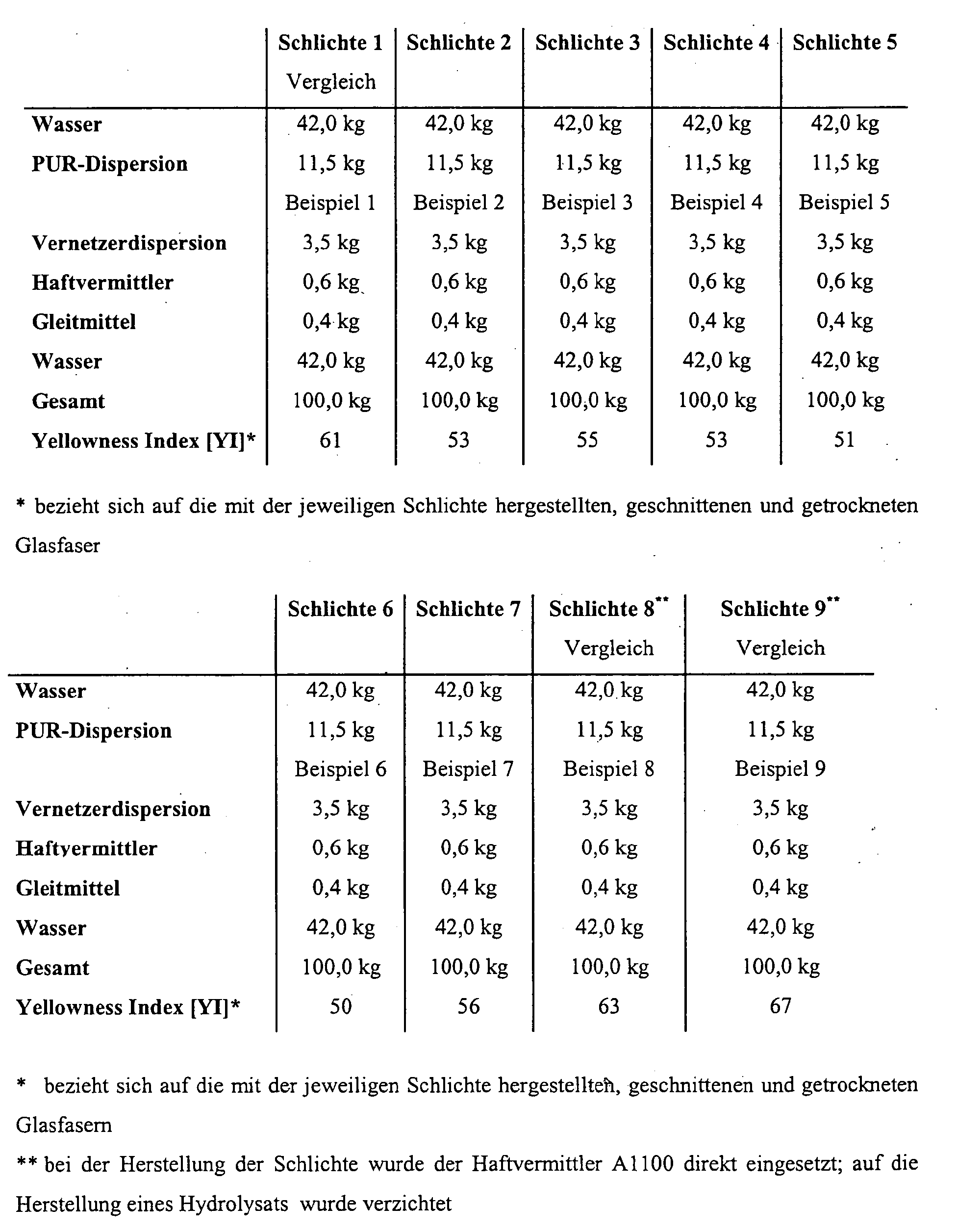
- the solids contents were determined according to DIN-EN ISO 3251. NCO contents were, Unless expressly stated otherwise volumetrically determined in accordance with DIN-EN ISO 11909. The Yellowness indices were determined using the CIELAB method (DIN 5033).
- a storage-stable aqueous dispersion of the blocked polyisocyanate was obtained with a Solids content of 30.0%.
- Example 1 Comparative Example
- Baybond® PU 401 anionic and non-ionically hydrophilicized PUR dispersion with a solids content of 40% and a mean particle size of 100-300 nm, Bayer AG, Leverkusen, DE
- polyester PE 170 HN polyester polyol, OH number 66 mg KOH / g, number average molecular weight 1700 g / mol, Bayer AG, Leverkusen, DE
- polyether LB 25 monofunctional Ethylene oxide / propylene oxide based polyethers number average molecular weight 2250 g / mol, OH number 25 mg KOH / g, Bayer AG, Leverkusen, DE
- Desmorapid® Z dibutyltin dilaurate, Bayer AG, Leverkusen, DE
- polyester PE 170 polyol, OH number 66 mg KOH / g, number average molecular weight 1700 g / mol, Bayer AG, Leverkusen, DE
- polyether LB 25 monofunctional Ethylene oxide / propylene oxide based polyethers number average molecular weight 2250 g / mol, OH number 25 mg KOH / g, Bayer AG, Leverkusen, DE
- Desmorapid® Z dibutyltin dilaurate, Bayer AG, Leverkusen, DE
- polyester PE 170 HN polyester polyol, OH number 66 mg KOH / g, number average Molecular weight 1700 g / mol, Bayer AG, Leverkusen, DE
- polyether LB 25 Monofunctional ethylene oxide / propylene oxide based polyether number average molecular weight 2250 g / mol, OH number 25 mg KOH / g, Bayer AG, Leverkusen, DE
- Desmorapid® Z Dibutyltin dilaurate, Bayer AG, Leverkusen, DE
- polyester PE 170 HN polyester polyol, OH number 66 mg KOH / g, number average molecular weight 1700 g / mol, Bayer AG, Leverkusen, DE
- polyether LB 25 monofunctional Ethylene oxide / propylene oxide based polyethers number average molecular weight 2250 g / mol, OH number 25 mg KOH / g, Bayer AG, Leverkusen, DE
- Desmorapid® Z dibutyltin dilaurate, Bayer AG, Leverkusen, DE
- polyester PE.170 HN polyester polyol, OH number 66 mg KOH / g, number average molecular weight 1700 g / mol, Bayer AG, Leverkusen, DE
- polyether LB 25 monofunctional Ethylene oxide / propylene oxide based polyethers number average molecular weight 2250 g / mol, OH number 25 mg KOH / g, Bayer AG, Leverkusen, DE
- Desmorapid® Z dibutyltin dilaurate, Bayer AG, Leverkusen, DE
- PolyTHF 2000 polyether based on tetrahydrofuran, OH number 56 mg KOH / g, number-average molecular weight 2000 g / mol
- polyether LB 25 monofunctional Ethylene oxide / propylene oxide based polyethers number average molecular weight 2250 g / mol, OH number 25 mg KOH / g, Bayer AG, Leverkusen, DE
- Desmorapid® Z dibutyltin dilaurate, Bayer AG, Leverkusen, DE
- Table 1 gives details of the sizing compositions.
- the preparation of the compositions was carried out as follows: in a mixing vessel was half of given amount of water and with stirring successively the invention PUR dispersions, film-forming resins, crosslinker dispersion and lubricant (Breox® 50-A 140, BP Chemicals, UK). Thereafter, the pH was adjusted to 5-7 with acetic acid and a prepared according to the manufacturer hydrolyzate of 3-aminopropyl-triethoxysilane (A1100, UCC, New York, USA) as an aqueous primer solution. After another Stirring time of 15 minutes, the sizing was ready for use.
- the sizing compositions were applied to glass fibers.
- the thus sized glass fibers were then cut and dried.
Landscapes
- Chemical & Material Sciences (AREA)
- Health & Medical Sciences (AREA)
- Organic Chemistry (AREA)
- Chemical Kinetics & Catalysis (AREA)
- Life Sciences & Earth Sciences (AREA)
- Polymers & Plastics (AREA)
- Medicinal Chemistry (AREA)
- Engineering & Computer Science (AREA)
- Dispersion Chemistry (AREA)
- Geochemistry & Mineralogy (AREA)
- Materials Engineering (AREA)
- General Chemical & Material Sciences (AREA)
- General Life Sciences & Earth Sciences (AREA)
- Manufacturing & Machinery (AREA)
- Surgery (AREA)
- Medical Informatics (AREA)
- Dentistry (AREA)
- Molecular Biology (AREA)
- Biomedical Technology (AREA)
- Veterinary Medicine (AREA)
- Nuclear Medicine, Radiotherapy & Molecular Imaging (AREA)
- Oral & Maxillofacial Surgery (AREA)
- Public Health (AREA)
- General Health & Medical Sciences (AREA)
- Heart & Thoracic Surgery (AREA)
- Animal Behavior & Ethology (AREA)
- Polyurethanes Or Polyureas (AREA)
- Paints Or Removers (AREA)
- Treatments For Attaching Organic Compounds To Fibrous Goods (AREA)
- Artificial Filaments (AREA)
- Macromonomer-Based Addition Polymer (AREA)
- Compositions Of Macromolecular Compounds (AREA)
Abstract
Description
- A) zunächst ein NCO-gruppenhaltiges Polyurethanprepolymer durch Umsetzung von
- A1) Polyisocyanaten mit
- A2) polymeren Polyolen und/oder Polyaminen mit zahlenmittleren Molekulargewichten von 400 bis 8 000 g/mol,
- A3) gegebenenfalls niedermolekularen Verbindungen mit zahlenmittleren Molekulargewichten von 17 - 400 g/mol ausgewählt aus der Gruppe bestehend aus Monound Polyalkoholen, Mono- und Polyaminen sowie Aminoalkoholen,
- A4) isocyanatreaktiven, ionisch oder potentiell ionisch hydrophilierenden Verbindungen und/oder
- A5) isocyanatreaktiven nichtionisch hydrophilierenden Verbindungen
- A6) gegebenenfalls in aliphatischen Ketonen als Lösemittel
- die Verbindungen der Komponente C2) primäre und/oder sekundäre Aminogruppen aufweisen,
- die Gesamtmengen von C1) und C2) so bemessen sind, dass ein rechnerischer Kettenverlängerungsgrad von 40 bis 200 % erreicht wird und
- das Mengenverhältnis von C1) und C2) so bemessen ist, dass mindestens 40 % der freien Isocyanatgruppen mit Aminogruppen aus der Komponente C1) kettenverlängert bzw. terminiert werden.
- R
- ein Alkylen- oder Arylenrest mit 1 bis 10 C-Atomen, bevorzugt 2 bis 6 C-Atomen,
- x
- 2 bis 6 und
- y
- 3 bis 5 ist,
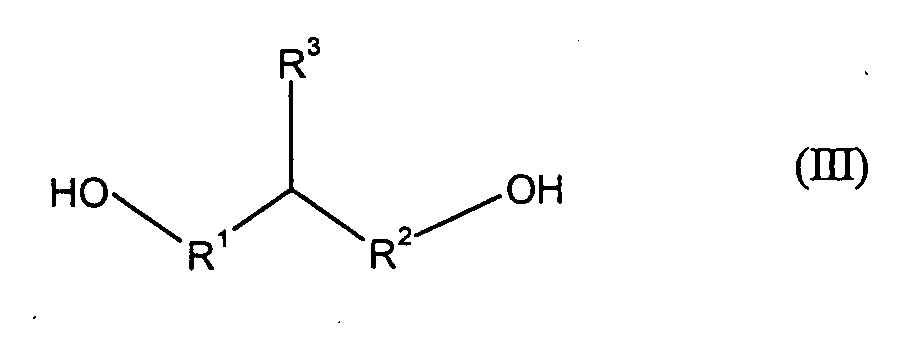
- R1 und R2
- unabhängig voneinander jeweils . einen zweiwertigen aliphatischen, cycloaliphatischen oder aromatischen Rest mit 1 bis 18 C-Atomen, die durch Sauerstoff und/oder Stickstoffatome unterbrochen sein können, bedeuten und
- R3 '
- für einen alkoxyterminierten Polyethylenoxidrest steht.
Claims (7)
- Schlichtezusammensetzungen enthaltenddadurch gekennzeichnet, dass die in I) eingesetzten PUR-Dispersionen erhältlich sind in demI) ein oder mehrere Polyurethan-Polyhamstoffdispersionen (PUR-Dispersionen)II) gegebenenfalls weitere filmbildende HarzeIII) gegebenenfalls VernetzerIV) Hilfs- und Zusatzstoffe,A) zunächst ein NCO-gruppenhaltiges Polyurethanprepolymer durch Umsetzung vonmit der Maßgabe hergestellt wird, dass in keiner der Komponenten A1) bis A5) primäre oder sekundäre Aminogruppen enthalten sind,A1) Polyisocyanaten mitA2) polymeren Polyolen und/oder Polyaminen mit zahlenmittleren Molekulargewichten von 400 bis 8 000 g/mol,A3) gegebenenfalls niedermolekularen Verbindungen mit zahlenmittleren Molekulargewichten von 17 - 400 g/mol ausgewählt aus der Gruppe bestehend aus Monound Polyalkoholen, Mono- und Polyaminen sowie Aminoalkoholen,A4) isocyanatreaktiven, ionisch oder potentiell ionisch hydrophilierenden Verbindungen und/oderA5) isocyanatreaktiven nichtionisch hydrophilierenden VerbindungenA6) gegebenenfalls in inerten LösemittelnB) das aus Schritt A) erhaltene Prepolymer entweder in aliphatischen Ketonen gelöst oder, sofern die Herstellung bereits in inerten Lösemitteln durchgeführt wurde, dessen Lösung gegebenenfalls durch weitere Zugabe aliphatischer Ketone verdünnt wird undC) die noch freien NCO-Gruppen des Prepolymers mit einer Kettenverlängerungskomponente enthaltendmit der Maßgabe umgesetzt werden, dassC1) Hydrazin und/oder Hydrazinhydrat undC2) gegebenenfalls Verbindungen entsprechend der Definition der Komponenten A2), A3), A4) und/oder A5)die Verbindungen der Komponente C2) primäre und/oder sekundäre Aminogruppen aufweisen,die Gesamtmengen von C1) und C2) so bemessen sind, dass ein rechnerischer Kettenverlängerungsgrad von 40 bis 200 % erreicht wird unddas Mengenverhältnis von C1) und C2) so bemessen ist, dass mindestens 40 % der freien Isocyanatgruppen mit Aminogruppen aus der Komponente C 1 ) kettenverlängert bzw. terminiert werden.
- Schlichtezusammensetzungen gemäß Anspruch 1, dadurch gekennzeichnet, dass bei der Herstellung der PUR-Dispersionen in Schritt B) und gegebenenfalls Schritt A) Aceton oder Butanon als Lösemittel eingesetzt wird.
- Schlichtezusammensetzungen gemäß Anspruch 1 oder 2, dadurch gekennzeichnet, dass bei der Herstellung der PUR-Dispersionen in den Schritten A) - C) 8 bis 27 Gew.-% Komponente A1), 65 bis 85 Gew.-% Komponente A2), 0 bis 8 Gew.-% Komponente, A3), 0 bis 10 Gew.-% Komponente A4), 0 bis 15 Gew.-% Komponente A5), 1,0 bis 2,5 Gew.-% C1) (bezogen auf reines Hydrazin N2H4), und 0 bis 8 Gew.-% C2) eingesetzt, wobei die Summe von A4) und A5) 0,1 bis 25 Gew.-% beträgt und sich die Summe der Komponenten zu 100 Gew.-% aufaddiert.
- Schlichtezusammensetzungen gemäß einem der Ansprüche 1 bis 3, dadurch gekennzeichnet dass bei der Herstellung der PUR-Dispersionen die Mengen von C1) und C2) so bemessen werden, dass ein rechnerischer Kettenverlängerungsgrad von 101 - 150 % resultiert.
- Formkörper und/oder Beschichtungen hergestellt unter Verwendung von Schlichtezusammensetzungen gemäß einem der Ansprüche 1 bis 4.
- Substrate beschichtet mit Beschichtungen hergestellt unter Verwendung von Schlichtezusammensetzungen gemäß einem der Ansprüche 1 bis 4.
- Glasfasern hergestellt unter Verwendung von Schlichtezusammensetzungen gemäß einem der Ansprüche 1 bis 4.
Applications Claiming Priority (2)
| Application Number | Priority Date | Filing Date | Title |
|---|---|---|---|
| DE102004002527 | 2004-01-16 | ||
| DE102004002527A DE102004002527A1 (de) | 2004-01-16 | 2004-01-16 | Schlichtezusammensetzung |
Publications (3)
| Publication Number | Publication Date |
|---|---|
| EP1555250A2 true EP1555250A2 (de) | 2005-07-20 |
| EP1555250A3 EP1555250A3 (de) | 2009-07-08 |
| EP1555250B1 EP1555250B1 (de) | 2013-08-14 |
Family
ID=34609600
Family Applications (1)
| Application Number | Title | Priority Date | Filing Date |
|---|---|---|---|
| EP05000185.8A Expired - Lifetime EP1555250B1 (de) | 2004-01-16 | 2005-01-07 | Schlichtezusammensetzung |
Country Status (11)
| Country | Link |
|---|---|
| US (1) | US20050159541A1 (de) |
| EP (1) | EP1555250B1 (de) |
| JP (1) | JP4781679B2 (de) |
| KR (1) | KR20050075712A (de) |
| CN (1) | CN1644620A (de) |
| BR (1) | BRPI0500090A (de) |
| CA (1) | CA2492338A1 (de) |
| DE (1) | DE102004002527A1 (de) |
| ES (1) | ES2435098T3 (de) |
| MX (1) | MXPA05000587A (de) |
| RU (1) | RU2005100796A (de) |
Cited By (3)
| Publication number | Priority date | Publication date | Assignee | Title |
|---|---|---|---|---|
| EP1905788A3 (de) * | 2006-09-29 | 2008-09-24 | Bayer MaterialScience AG | Schlichtezusammensetzung |
| WO2010102718A1 (de) * | 2009-03-09 | 2010-09-16 | Bayer Materialscience Ag | Reaktive polyurethan-zusammensetzungen |
| WO2013041902A1 (en) * | 2011-09-23 | 2013-03-28 | Ocv Intellectual Capital, Llc | Reinforcing fibers and their use for concrete reinforcement |
Families Citing this family (10)
| Publication number | Priority date | Publication date | Assignee | Title |
|---|---|---|---|---|
| US20070072989A1 (en) * | 2004-03-19 | 2007-03-29 | Piret Willy H | Two-part sizing composition for reinforcement fibers |
| DE102006046650A1 (de) * | 2006-09-29 | 2008-04-03 | Bayer Materialscience Ag | Wässrige Beschichtungsmittel auf Basis von Polyurethan-Dispersionen |
| EP2332587A1 (de) * | 2009-12-12 | 2011-06-15 | Bayer MaterialScience AG | Polyurethan-Dispersionen zur Versiegelung von Zitzen der Milchdrüse bei milchliefernden Tieren |
| JP2014009290A (ja) * | 2012-06-29 | 2014-01-20 | Dic Corp | ウレタン樹脂組成物、繊維集束剤、ガラス繊維及び炭素繊維、ならびに、成形材料 |
| CN103866622A (zh) * | 2014-02-25 | 2014-06-18 | 苏州恒康新材料有限公司 | 一种双马来酰亚胺树脂施胶剂及其制备方法 |
| DE102015100925A1 (de) * | 2014-11-12 | 2016-05-12 | Hib Trim Part Solutions Gmbh | Verfahren zur Herstellung eines Zierteils mit Echtkarbonoptik |
| CN110343225B (zh) * | 2019-06-28 | 2022-02-18 | 宁夏共享化工有限公司 | 低发气量的呋喃树脂及其制备方法 |
| CN115506155B (zh) * | 2021-06-22 | 2025-02-28 | 北京化工大学 | 一种纤维表面处理的浸胶体系及其制备方法 |
| KR102613741B1 (ko) * | 2021-06-30 | 2023-12-14 | 주식회사 케이씨씨 | 사이징 조성물 및 이를 사용한 유리 섬유 |
| CN117843256B (zh) * | 2023-12-26 | 2026-05-29 | 巨石集团有限公司 | 一种玻璃纤维浸润剂及其制备方法、产品和应用 |
Family Cites Families (18)
| Publication number | Priority date | Publication date | Assignee | Title |
|---|---|---|---|---|
| DE1241104B (de) * | 1965-06-05 | 1967-05-24 | Bayer Ag | Verfahren zur Herstellung von vernetzten Kunststoffen |
| DE1770591A1 (de) * | 1968-06-07 | 1971-11-04 | Bayer Ag | Lineare,segmentierte Polyurethanelastomere |
| DE1918504A1 (de) * | 1969-04-11 | 1970-10-29 | Bayer Ag | Segmentierte Polyurethanelastomere |
| BE757936A (fr) * | 1969-10-23 | 1971-04-01 | Bayer Ag | Procede de preparation de polymeres anioniques modifies en emulsion |
| DE2314513C3 (de) * | 1973-03-23 | 1980-08-28 | Bayer Ag, 5090 Leverkusen | Verfahren zur Herstellung von wäßrigen Polyurethandispersionen |
| US4108814A (en) * | 1974-09-28 | 1978-08-22 | Bayer Aktiengesellschaft | Aqueous polyurethane dispersions from solvent-free prepolymers using sulfonate diols |
| US4147679A (en) * | 1976-06-02 | 1979-04-03 | Ppg Industries, Inc. | Water-reduced urethane coating compositions |
| US4447571A (en) * | 1980-04-09 | 1984-05-08 | Witco Chemical Corporation | Stabilization of polyurethanes |
| US4880691A (en) * | 1984-02-17 | 1989-11-14 | The Dow Chemical Company | Fine denier fibers of olefin polymers |
| NL8401785A (nl) * | 1984-06-04 | 1986-01-02 | Polyvinyl Chemie Holland | Werkwijze voor de bereiding van een waterige dispersie van urethan-acrylaat entcopolymeren, alsmede aldus verkregen stabiele waterige dispersie. |
| US4644030A (en) * | 1985-02-01 | 1987-02-17 | Witco Corporation | Aqueous polyurethane - polyolefin compositions |
| JPH0737338B2 (ja) * | 1986-06-12 | 1995-04-26 | 大日本インキ化学工業株式会社 | ガラス繊維用水性サイズ剤 |
| GB8721538D0 (en) * | 1987-09-14 | 1987-10-21 | Polyvinyl Chemie Holland Bv | Aqueous dispersions |
| US5137967A (en) * | 1990-07-06 | 1992-08-11 | Reichhold Chemicals, Inc. | Hydrazine extended aqueous polyurethane |
| US5700867A (en) * | 1993-10-01 | 1997-12-23 | Toyo Ink Manufacturing Co., Ltd. | Aqueous dispersion of an aqueous hydrazine-terminated polyurethane |
| ES2197959T3 (es) * | 1996-03-01 | 2004-01-16 | Bayer Ag | Poliuretanoureas solubles o dispersables en agua, procedimiento para su fabricacion y su uso como recubrimiento de cualquier sustrato. |
| DE19611850A1 (de) * | 1996-03-26 | 1997-10-02 | Bayer Ag | Verwendung von ionischen und nichtionischen wäßrigen Polyurethandispersionen auf Basis von 1-Methyl-2,4- und/oder -2,6-diisocyanatocyclohexan als Bindemittel für Glasfaserschlichten sowie spezielle ionische und nichtionische wäßrige Polyurethandispersionen auf Basis von 1-Methyl-2,4- und/oder -2,6-diisocyanatocyclohexan |
| DE10201546A1 (de) * | 2002-01-17 | 2003-07-31 | Bayer Ag | Stabilisierte wässrige Polyurethan-Polyharnstoff Dispersionen |
-
2004
- 2004-01-16 DE DE102004002527A patent/DE102004002527A1/de not_active Withdrawn
-
2005
- 2005-01-07 EP EP05000185.8A patent/EP1555250B1/de not_active Expired - Lifetime
- 2005-01-07 ES ES05000185T patent/ES2435098T3/es not_active Expired - Lifetime
- 2005-01-11 CA CA002492338A patent/CA2492338A1/en not_active Abandoned
- 2005-01-12 US US11/034,112 patent/US20050159541A1/en not_active Abandoned
- 2005-01-13 MX MXPA05000587A patent/MXPA05000587A/es unknown
- 2005-01-13 BR BR0500090-4A patent/BRPI0500090A/pt not_active Application Discontinuation
- 2005-01-13 JP JP2005006137A patent/JP4781679B2/ja not_active Expired - Fee Related
- 2005-01-14 RU RU2005100796/04A patent/RU2005100796A/ru not_active Application Discontinuation
- 2005-01-14 KR KR1020050003627A patent/KR20050075712A/ko not_active Ceased
- 2005-01-17 CN CNA200510004547XA patent/CN1644620A/zh active Pending
Cited By (3)
| Publication number | Priority date | Publication date | Assignee | Title |
|---|---|---|---|---|
| EP1905788A3 (de) * | 2006-09-29 | 2008-09-24 | Bayer MaterialScience AG | Schlichtezusammensetzung |
| WO2010102718A1 (de) * | 2009-03-09 | 2010-09-16 | Bayer Materialscience Ag | Reaktive polyurethan-zusammensetzungen |
| WO2013041902A1 (en) * | 2011-09-23 | 2013-03-28 | Ocv Intellectual Capital, Llc | Reinforcing fibers and their use for concrete reinforcement |
Also Published As
| Publication number | Publication date |
|---|---|
| KR20050075712A (ko) | 2005-07-21 |
| EP1555250A3 (de) | 2009-07-08 |
| EP1555250B1 (de) | 2013-08-14 |
| MXPA05000587A (es) | 2005-07-19 |
| ES2435098T3 (es) | 2013-12-18 |
| US20050159541A1 (en) | 2005-07-21 |
| RU2005100796A (ru) | 2006-06-20 |
| JP2005200822A (ja) | 2005-07-28 |
| BRPI0500090A (pt) | 2005-09-06 |
| JP4781679B2 (ja) | 2011-09-28 |
| DE102004002527A1 (de) | 2005-08-04 |
| CA2492338A1 (en) | 2005-07-16 |
| CN1644620A (zh) | 2005-07-27 |
Similar Documents
| Publication | Publication Date | Title |
|---|---|---|
| EP1711547B1 (de) | Beschichtungsmittelzusammensetzung | |
| DE102004002526A1 (de) | Thermovergilbungsstabile Polyurethan-Polyharnstoff Dispersionen | |
| EP0792900B1 (de) | Verwendung von ionischen und nichtionischen wässrigen Polyurethandispersionen als Bindemittel für Glasfaserschlichten sowie diese Dispersionen | |
| EP1474487B1 (de) | Stabilisierte wässrige polyurethan-polyharnstoff dispersionen | |
| EP1516012B1 (de) | Glasfaserverstärkte kunststoffe | |
| EP1375549B1 (de) | Nachvernetzbare Polyurethan-Polyharnstoff Dispersionen | |
| EP1555250B1 (de) | Schlichtezusammensetzung | |
| EP1905788A2 (de) | Schlichtezusammensetzung | |
| EP1578837B1 (de) | Hydrophile polyurethan-polyharnstoff-dispersionen | |
| DE10306243A1 (de) | Einkomponenten-Beschichtungssysteme | |
| EP1065228A2 (de) | Bindemittelkombination für wässrige Beschichtungen | |
| DE102005018692A1 (de) | Schlichtezusammensetzung | |
| WO2019121388A1 (de) | Frostbeständige klebstoffe auf basis von polyisocyanaten | |
| DE10226924A1 (de) | Schlichtezusammensetzung | |
| EP4363475B1 (de) | Nicht-ionisch hydrophilierte polyurethan-dispersionen mit methacrylat-doppelbindungen | |
| EP4367153A1 (de) | Zweikomponentige polyurethandispersionsklebstoffe | |
| EP4112670A1 (de) | Nicht-ionisch hydrophilierte polyurethan-dispersionen mit acrylat-doppelbindungen | |
| HK1100674A (en) | Coating agent composition |
Legal Events
| Date | Code | Title | Description |
|---|---|---|---|
| PUAI | Public reference made under article 153(3) epc to a published international application that has entered the european phase |
Free format text: ORIGINAL CODE: 0009012 |
|
| AK | Designated contracting states |
Kind code of ref document: A2 Designated state(s): AT BE BG CH CY CZ DE DK EE ES FI FR GB GR HU IE IS IT LI LT LU MC NL PL PT RO SE SI SK TR |
|
| AX | Request for extension of the european patent |
Extension state: AL BA HR LV MK YU |
|
| PUAL | Search report despatched |
Free format text: ORIGINAL CODE: 0009013 |
|
| AK | Designated contracting states |
Kind code of ref document: A3 Designated state(s): AT BE BG CH CY CZ DE DK EE ES FI FR GB GR HU IE IS IT LI LT LU MC NL PL PT RO SE SI SK TR |
|
| AX | Request for extension of the european patent |
Extension state: AL BA HR LV MK YU |
|
| RIC1 | Information provided on ipc code assigned before grant |
Ipc: C08G 18/08 20060101ALI20090603BHEP Ipc: C03C 25/26 20060101ALI20090603BHEP Ipc: C08G 18/28 20060101ALI20090603BHEP Ipc: C08G 18/70 20060101ALI20090603BHEP Ipc: C03C 25/32 20060101AFI20050503BHEP Ipc: C08G 18/12 20060101ALI20090603BHEP |
|
| 17P | Request for examination filed |
Effective date: 20100108 |
|
| AKX | Designation fees paid |
Designated state(s): AT BE BG CH CY CZ DE DK EE ES FI FR GB GR HU IE IS IT LI LT LU MC NL PL PT RO SE SI SK TR |
|
| 17Q | First examination report despatched |
Effective date: 20110426 |
|
| R17C | First examination report despatched (corrected) |
Effective date: 20110504 |
|
| GRAP | Despatch of communication of intention to grant a patent |
Free format text: ORIGINAL CODE: EPIDOSNIGR1 |
|
| RAP1 | Party data changed (applicant data changed or rights of an application transferred) |
Owner name: BAYER INTELLECTUAL PROPERTY GMBH |
|
| GRAS | Grant fee paid |
Free format text: ORIGINAL CODE: EPIDOSNIGR3 |
|
| GRAA | (expected) grant |
Free format text: ORIGINAL CODE: 0009210 |
|
| AK | Designated contracting states |
Kind code of ref document: B1 Designated state(s): AT BE BG CH CY CZ DE DK EE ES FI FR GB GR HU IE IS IT LI LT LU MC NL PL PT RO SE SI SK TR |
|
| REG | Reference to a national code |
Ref country code: GB Ref legal event code: FG4D Free format text: NOT ENGLISH |
|
| REG | Reference to a national code |
Ref country code: AT Ref legal event code: REF Ref document number: 626714 Country of ref document: AT Kind code of ref document: T Effective date: 20130815 Ref country code: CH Ref legal event code: EP |
|
| REG | Reference to a national code |
Ref country code: DE Ref legal event code: R081 Ref document number: 502005013904 Country of ref document: DE Owner name: COVESTRO DEUTSCHLAND AG, DE Free format text: FORMER OWNER: BAYER MATERIALSCIENCE AKTIENGESELLSCHAFT, 51373 LEVERKUSEN, DE |
|
| REG | Reference to a national code |
Ref country code: IE Ref legal event code: FG4D Free format text: LANGUAGE OF EP DOCUMENT: GERMAN |
|
| REG | Reference to a national code |
Ref country code: DE Ref legal event code: R096 Ref document number: 502005013904 Country of ref document: DE Effective date: 20131010 |
|
| REG | Reference to a national code |
Ref country code: NL Ref legal event code: T3 |
|
| REG | Reference to a national code |
Ref country code: ES Ref legal event code: FG2A Ref document number: 2435098 Country of ref document: ES Kind code of ref document: T3 Effective date: 20131218 |
|
| REG | Reference to a national code |
Ref country code: LT Ref legal event code: MG4D |
|
| PG25 | Lapsed in a contracting state [announced via postgrant information from national office to epo] |
Ref country code: LT Free format text: LAPSE BECAUSE OF FAILURE TO SUBMIT A TRANSLATION OF THE DESCRIPTION OR TO PAY THE FEE WITHIN THE PRESCRIBED TIME-LIMIT Effective date: 20130814 Ref country code: CY Free format text: LAPSE BECAUSE OF FAILURE TO SUBMIT A TRANSLATION OF THE DESCRIPTION OR TO PAY THE FEE WITHIN THE PRESCRIBED TIME-LIMIT Effective date: 20130703 Ref country code: PT Free format text: LAPSE BECAUSE OF FAILURE TO SUBMIT A TRANSLATION OF THE DESCRIPTION OR TO PAY THE FEE WITHIN THE PRESCRIBED TIME-LIMIT Effective date: 20131216 Ref country code: SE Free format text: LAPSE BECAUSE OF FAILURE TO SUBMIT A TRANSLATION OF THE DESCRIPTION OR TO PAY THE FEE WITHIN THE PRESCRIBED TIME-LIMIT Effective date: 20130814 Ref country code: IS Free format text: LAPSE BECAUSE OF FAILURE TO SUBMIT A TRANSLATION OF THE DESCRIPTION OR TO PAY THE FEE WITHIN THE PRESCRIBED TIME-LIMIT Effective date: 20131214 |
|
| PG25 | Lapsed in a contracting state [announced via postgrant information from national office to epo] |
Ref country code: PL Free format text: LAPSE BECAUSE OF FAILURE TO SUBMIT A TRANSLATION OF THE DESCRIPTION OR TO PAY THE FEE WITHIN THE PRESCRIBED TIME-LIMIT Effective date: 20130814 Ref country code: FI Free format text: LAPSE BECAUSE OF FAILURE TO SUBMIT A TRANSLATION OF THE DESCRIPTION OR TO PAY THE FEE WITHIN THE PRESCRIBED TIME-LIMIT Effective date: 20130814 Ref country code: SI Free format text: LAPSE BECAUSE OF FAILURE TO SUBMIT A TRANSLATION OF THE DESCRIPTION OR TO PAY THE FEE WITHIN THE PRESCRIBED TIME-LIMIT Effective date: 20130814 Ref country code: GR Free format text: LAPSE BECAUSE OF FAILURE TO SUBMIT A TRANSLATION OF THE DESCRIPTION OR TO PAY THE FEE WITHIN THE PRESCRIBED TIME-LIMIT Effective date: 20131115 |
|
| PG25 | Lapsed in a contracting state [announced via postgrant information from national office to epo] |
Ref country code: CY Free format text: LAPSE BECAUSE OF FAILURE TO SUBMIT A TRANSLATION OF THE DESCRIPTION OR TO PAY THE FEE WITHIN THE PRESCRIBED TIME-LIMIT Effective date: 20130814 |
|
| PG25 | Lapsed in a contracting state [announced via postgrant information from national office to epo] |
Ref country code: CZ Free format text: LAPSE BECAUSE OF FAILURE TO SUBMIT A TRANSLATION OF THE DESCRIPTION OR TO PAY THE FEE WITHIN THE PRESCRIBED TIME-LIMIT Effective date: 20130814 Ref country code: RO Free format text: LAPSE BECAUSE OF FAILURE TO SUBMIT A TRANSLATION OF THE DESCRIPTION OR TO PAY THE FEE WITHIN THE PRESCRIBED TIME-LIMIT Effective date: 20130814 Ref country code: EE Free format text: LAPSE BECAUSE OF FAILURE TO SUBMIT A TRANSLATION OF THE DESCRIPTION OR TO PAY THE FEE WITHIN THE PRESCRIBED TIME-LIMIT Effective date: 20130814 Ref country code: DK Free format text: LAPSE BECAUSE OF FAILURE TO SUBMIT A TRANSLATION OF THE DESCRIPTION OR TO PAY THE FEE WITHIN THE PRESCRIBED TIME-LIMIT Effective date: 20130814 Ref country code: SK Free format text: LAPSE BECAUSE OF FAILURE TO SUBMIT A TRANSLATION OF THE DESCRIPTION OR TO PAY THE FEE WITHIN THE PRESCRIBED TIME-LIMIT Effective date: 20130814 |
|
| PGFP | Annual fee paid to national office [announced via postgrant information from national office to epo] |
Ref country code: AT Payment date: 20131224 Year of fee payment: 10 |
|
| PLBE | No opposition filed within time limit |
Free format text: ORIGINAL CODE: 0009261 |
|
| STAA | Information on the status of an ep patent application or granted ep patent |
Free format text: STATUS: NO OPPOSITION FILED WITHIN TIME LIMIT |
|
| 26N | No opposition filed |
Effective date: 20140515 |
|
| BERE | Be: lapsed |
Owner name: BAYER INTELLECTUAL PROPERTY G.M.B.H. Effective date: 20140131 |
|
| REG | Reference to a national code |
Ref country code: DE Ref legal event code: R097 Ref document number: 502005013904 Country of ref document: DE Effective date: 20140515 |
|
| PG25 | Lapsed in a contracting state [announced via postgrant information from national office to epo] |
Ref country code: LU Free format text: LAPSE BECAUSE OF FAILURE TO SUBMIT A TRANSLATION OF THE DESCRIPTION OR TO PAY THE FEE WITHIN THE PRESCRIBED TIME-LIMIT Effective date: 20140107 Ref country code: MC Free format text: LAPSE BECAUSE OF FAILURE TO SUBMIT A TRANSLATION OF THE DESCRIPTION OR TO PAY THE FEE WITHIN THE PRESCRIBED TIME-LIMIT Effective date: 20130814 |
|
| REG | Reference to a national code |
Ref country code: CH Ref legal event code: PL |
|
| PG25 | Lapsed in a contracting state [announced via postgrant information from national office to epo] |
Ref country code: CH Free format text: LAPSE BECAUSE OF NON-PAYMENT OF DUE FEES Effective date: 20140131 Ref country code: LI Free format text: LAPSE BECAUSE OF NON-PAYMENT OF DUE FEES Effective date: 20140131 |
|
| REG | Reference to a national code |
Ref country code: IE Ref legal event code: MM4A |
|
| PG25 | Lapsed in a contracting state [announced via postgrant information from national office to epo] |
Ref country code: IE Free format text: LAPSE BECAUSE OF NON-PAYMENT OF DUE FEES Effective date: 20140107 Ref country code: BE Free format text: LAPSE BECAUSE OF NON-PAYMENT OF DUE FEES Effective date: 20140131 |
|
| REG | Reference to a national code |
Ref country code: AT Ref legal event code: MM01 Ref document number: 626714 Country of ref document: AT Kind code of ref document: T Effective date: 20150107 |
|
| PG25 | Lapsed in a contracting state [announced via postgrant information from national office to epo] |
Ref country code: AT Free format text: LAPSE BECAUSE OF NON-PAYMENT OF DUE FEES Effective date: 20150107 |
|
| REG | Reference to a national code |
Ref country code: FR Ref legal event code: PLFP Year of fee payment: 12 |
|
| REG | Reference to a national code |
Ref country code: DE Ref legal event code: R081 Ref document number: 502005013904 Country of ref document: DE Owner name: COVESTRO DEUTSCHLAND AG, DE Free format text: FORMER OWNER: BAYER INTELLECTUAL PROPERTY GMBH, 40789 MONHEIM, DE |
|
| PG25 | Lapsed in a contracting state [announced via postgrant information from national office to epo] |
Ref country code: BG Free format text: LAPSE BECAUSE OF FAILURE TO SUBMIT A TRANSLATION OF THE DESCRIPTION OR TO PAY THE FEE WITHIN THE PRESCRIBED TIME-LIMIT Effective date: 20130814 |
|
| PG25 | Lapsed in a contracting state [announced via postgrant information from national office to epo] |
Ref country code: HU Free format text: LAPSE BECAUSE OF FAILURE TO SUBMIT A TRANSLATION OF THE DESCRIPTION OR TO PAY THE FEE WITHIN THE PRESCRIBED TIME-LIMIT; INVALID AB INITIO Effective date: 20050107 |
|
| REG | Reference to a national code |
Ref country code: GB Ref legal event code: 732E Free format text: REGISTERED BETWEEN 20160922 AND 20160928 |
|
| REG | Reference to a national code |
Ref country code: NL Ref legal event code: PD Owner name: COVESTRO DEUTSCHLAND AG; DE Free format text: DETAILS ASSIGNMENT: VERANDERING VAN EIGENAAR(S), OVERDRACHT; FORMER OWNER NAME: BAYER INTELLECTUAL PROPERTY GMBH Effective date: 20160810 |
|
| REG | Reference to a national code |
Ref country code: FR Ref legal event code: TP Owner name: COVESTRO DEUTSCHLAND AG, DE Effective date: 20161115 |
|
| REG | Reference to a national code |
Ref country code: FR Ref legal event code: PLFP Year of fee payment: 13 |
|
| REG | Reference to a national code |
Ref country code: ES Ref legal event code: PC2A Owner name: BAYER MATERIALSCIENCE AG Effective date: 20170125 |
|
| REG | Reference to a national code |
Ref country code: FR Ref legal event code: PLFP Year of fee payment: 14 |
|
| REG | Reference to a national code |
Ref country code: ES Ref legal event code: PC2A Owner name: COVESTRO DEUTSCHLAND AG Effective date: 20171219 |
|
| PGFP | Annual fee paid to national office [announced via postgrant information from national office to epo] |
Ref country code: ES Payment date: 20200203 Year of fee payment: 16 |
|
| PGFP | Annual fee paid to national office [announced via postgrant information from national office to epo] |
Ref country code: GB Payment date: 20201230 Year of fee payment: 17 |
|
| PGFP | Annual fee paid to national office [announced via postgrant information from national office to epo] |
Ref country code: TR Payment date: 20210106 Year of fee payment: 17 |
|
| REG | Reference to a national code |
Ref country code: ES Ref legal event code: FD2A Effective date: 20220413 |
|
| PG25 | Lapsed in a contracting state [announced via postgrant information from national office to epo] |
Ref country code: ES Free format text: LAPSE BECAUSE OF NON-PAYMENT OF DUE FEES Effective date: 20210108 |
|
| GBPC | Gb: european patent ceased through non-payment of renewal fee |
Effective date: 20220107 |
|
| PG25 | Lapsed in a contracting state [announced via postgrant information from national office to epo] |
Ref country code: GB Free format text: LAPSE BECAUSE OF NON-PAYMENT OF DUE FEES Effective date: 20220107 |
|
| PGFP | Annual fee paid to national office [announced via postgrant information from national office to epo] |
Ref country code: NL Payment date: 20221226 Year of fee payment: 19 Ref country code: FR Payment date: 20221221 Year of fee payment: 19 |
|
| PGFP | Annual fee paid to national office [announced via postgrant information from national office to epo] |
Ref country code: DE Payment date: 20231220 Year of fee payment: 20 |
|
| PGFP | Annual fee paid to national office [announced via postgrant information from national office to epo] |
Ref country code: IT Payment date: 20231228 Year of fee payment: 20 |
|
| REG | Reference to a national code |
Ref country code: NL Ref legal event code: MM Effective date: 20240201 |
|
| PG25 | Lapsed in a contracting state [announced via postgrant information from national office to epo] |
Ref country code: TR Free format text: LAPSE BECAUSE OF NON-PAYMENT OF DUE FEES Effective date: 20220107 |
|
| PG25 | Lapsed in a contracting state [announced via postgrant information from national office to epo] |
Ref country code: FR Free format text: LAPSE BECAUSE OF NON-PAYMENT OF DUE FEES Effective date: 20240131 |
|
| PG25 | Lapsed in a contracting state [announced via postgrant information from national office to epo] |
Ref country code: NL Free format text: LAPSE BECAUSE OF NON-PAYMENT OF DUE FEES Effective date: 20240201 |
|
| PG25 | Lapsed in a contracting state [announced via postgrant information from national office to epo] |
Ref country code: NL Free format text: LAPSE BECAUSE OF NON-PAYMENT OF DUE FEES Effective date: 20240201 Ref country code: FR Free format text: LAPSE BECAUSE OF NON-PAYMENT OF DUE FEES Effective date: 20240131 |
|
| REG | Reference to a national code |
Ref country code: DE Ref legal event code: R071 Ref document number: 502005013904 Country of ref document: DE |