EP1549000A2 - Reduzierung des Energieverbrauches eines mobilen Endgerätes, das Bilder überträgt - Google Patents
Reduzierung des Energieverbrauches eines mobilen Endgerätes, das Bilder überträgt Download PDFInfo
- Publication number
- EP1549000A2 EP1549000A2 EP04027318A EP04027318A EP1549000A2 EP 1549000 A2 EP1549000 A2 EP 1549000A2 EP 04027318 A EP04027318 A EP 04027318A EP 04027318 A EP04027318 A EP 04027318A EP 1549000 A2 EP1549000 A2 EP 1549000A2
- Authority
- EP
- European Patent Office
- Prior art keywords
- image data
- communication terminal
- side communication
- transmission
- frame images
- Prior art date
- Legal status (The legal status is an assumption and is not a legal conclusion. Google has not performed a legal analysis and makes no representation as to the accuracy of the status listed.)
- Withdrawn
Links
Images

Classifications
-
- H—ELECTRICITY
- H04—ELECTRIC COMMUNICATION TECHNIQUE
- H04W—WIRELESS COMMUNICATION NETWORKS
- H04W52/00—Power management, e.g. Transmission Power Control [TPC] or power classes
- H04W52/02—Power saving arrangements
- H04W52/0209—Power saving arrangements in terminal devices
- H04W52/0225—Power saving arrangements in terminal devices using monitoring of external events, e.g. the presence of a signal
- H04W52/0229—Power saving arrangements in terminal devices using monitoring of external events, e.g. the presence of a signal where the received signal is a wanted signal
- H04W52/0232—Power saving arrangements in terminal devices using monitoring of external events, e.g. the presence of a signal where the received signal is a wanted signal according to average transmission signal activity
-
- H—ELECTRICITY
- H04—ELECTRIC COMMUNICATION TECHNIQUE
- H04W—WIRELESS COMMUNICATION NETWORKS
- H04W88/00—Devices specially adapted for wireless communication networks, e.g. terminals, base stations or access point devices
- H04W88/02—Terminal devices
-
- Y—GENERAL TAGGING OF NEW TECHNOLOGICAL DEVELOPMENTS; GENERAL TAGGING OF CROSS-SECTIONAL TECHNOLOGIES SPANNING OVER SEVERAL SECTIONS OF THE IPC; TECHNICAL SUBJECTS COVERED BY FORMER USPC CROSS-REFERENCE ART COLLECTIONS [XRACs] AND DIGESTS
- Y02—TECHNOLOGIES OR APPLICATIONS FOR MITIGATION OR ADAPTATION AGAINST CLIMATE CHANGE
- Y02D—CLIMATE CHANGE MITIGATION TECHNOLOGIES IN INFORMATION AND COMMUNICATION TECHNOLOGIES [ICT], I.E. INFORMATION AND COMMUNICATION TECHNOLOGIES AIMING AT THE REDUCTION OF THEIR OWN ENERGY USE
- Y02D30/00—Reducing energy consumption in communication networks
- Y02D30/70—Reducing energy consumption in communication networks in wireless communication networks
Definitions
- the present invention relates to a technical field of a communication terminal that transmits and receives image data. Also, the present invention relates to a technical field of a communication terminal having, for example, a so-called video phone function.
- a second-generation cellular phone communication system using a narrow-band communication system has widely spread.
- a PDC/GSM system has spread as the narrow-band communication system.
- the PDC personal digital cellular
- GSM global system for mobile communications
- GSM global system for mobile communications
- the conventional second-generation cellular phone communication system has been shifting to a third-generation cellular phone system using a wideband communication system that is represented by a wideband-CDMA (code division multiple access) system.
- a so-called video phone function is one of the killer contents in the third-generation cellular phone system.
- the video phone function is expected to widely spread as a standard function in the communication terminal (cellular terminal) in the future.
- the communication terminal such as the cellular phone on whose portability emphasis is placed
- a battery chargeable battery mounted for its operation
- a power capacity is restricted.
- a maximal reduction in power consumption during operation has been demanded.
- the battery life of the communication terminal becomes short, and the usability of a user remarkably deteriorates.
- the battery life represents the battery lifetime of the chargeable battery that is required to be again charged by power consumption accompanied by use after the communication terminal has been charged into a fully charged state.
- the power consumption further increases with an additional function such as the so-called video phone function in addition to the problem on the power consumption that is attributable to the above communication system. Then, the problem on the power consumption which is attributable to the inclusion of the video phone function is caused by a sequential processing of until transmitting and receiving a photographed motion picture as image data. For that reason, in the communication terminal of the third-generation cellular phone system, it is anxious to reduce the power consumption by using some means.
- JP 2001-136423 A has proposed that in order to reduce the power consumption in a communication terminal with a video phone function, when there is no change in an image photographed by a camera provided in the terminal, a power of the camera turns off.
- the communication terminal stores the image data of the photographed image in a storage device, and judges whether there is a change in the photographed image, or not, by comparing the stored image data with image data of a newly photographed image, during the photograph by the camera. Then, the communication terminal stops dispatching of a power to an image photographing circuit including the camera until a predetermined period of time elapses or a user conducts restart operation, when it is judged that there is no change between both of image data. Accordingly, the communication terminal disclosed in JP 2001-136423 A can suppress the useless power consumption.
- JP 2001-136423 A suffers from the following problem.
- the dispatching of the power to the camera stops when there is no change in the photographed image as described above. For that reason, in the communication terminal, after the above predetermined period of time has elapsed, or when the user conducts the restart operation, some period of time is required since the dispatching of the power to the image photographing circuit and the camera is restarted until image data of the newly photographed image is outputted. Accordingly, an operating response is low, and the operationality is not good.
- the video phone function is a high-load function that much occupies (consumes) individual system resources in the case where it is treated as the overall system including the cellular phone and its equipment side. For that reason, in order to efficiently supply the video phone service to a larger number of users in the radio system of the cellular phone, there is something that radio traffic needs to be reduced.
- the image data that is stored in the storage device is transmitted to a communication terminal as a receiver. Accordingly, the technique that is disclosed in JP 2001-136423 A does not obtain the reduction effect on the radio traffic.
- the radio graphic increases with a high function such as the video phone function in the radio communication system in the recent years, and a technique of reducing the radio traffic has been desired in such a radio communication system.
- the present invention has been made in view of the above problems, and therefore a main object of the present invention is to efficiently reduce the power consumption of a communication terminal without deterioration of the operationality of a user.
- Another object of the present invention is to reduce the power consumption of a communication terminal without deterioration of the operationality of a user; and to reduce radio traffic in a radio communication system.
- a method of reducing power consumption in a communication terminal that transmits and receives image data including: stopping transmission of new image data from a transmission side communication terminal (1A) to a reception side communication terminal (1B) in a duration where a difference between image data inputted in time series is smaller than a predetermined value; and displaying an image, on the reception side communication terminal (1B), on the basis of image data that has already been received in a duration where the reception side communication terminal cannot receive the new image data from the transmission side communication terminal (1A).
- the image displayed on the reception side communication terminal (1B) is a still picture based on the latest image data that is received before the reception side communication terminal (1B) cannot receive the new image data.
- input image data to be compared with the predetermined value is, for example, image data of two frame images in question among image data of a plurality of frame images that are inputted in time series
- the image data of two frame images in question is, for example, image data of two frame images that are continuous in time series, or image data of two frame images that are at a predetermined frame interval among the image data of a plurality of frame images that are inputted in time series.
- the above object is achieved even by a communication system that corresponds to the power consumption reducing method in the communication terminal having each of the above structures, and the communication terminal that constitutes the communication system.
- the above object is achieved even by a computer program that realizes the above communication terminal by means of a computer, and a computer readable storage medium in which the computer program is stored.
- the wideband CDMA communication system which is one example of the wideband communication system, is of a system that spreads a signal energy to a frequency band that is far wider than the band width of the information to perform communication.
- one chip section represented by Tc is a fixed value.
- a one-bit information section represented by T is variable according to the amount of communicated information. Accordingly, in the case where the amount of information to be communicated is small, a data rate is lowered so that communication can be performed. For that reason, since T per Tc becomes long, the spreading factor SF becomes resultantly a large value. Then, in the case where the spreading factor SF is larger, because more chips (unit power) are required in transmission of data of one symbol, a power peak of a desired wave after dispreading becomes large.
- the power peak after dispreading at a reception side communication terminal can ensure a sufficient level as required even in the case where the radio transmission power is lowered by positively reducing the amount of information to be transmitted. Then, a reduction in the radio transmission power at a transmission side communication terminal means a reduction in the power consumption of the communication terminal.
- an SIR (signal interference ratio) of another communication terminal having the transmission wave of the communication terminal as an undesired wave is relatively improved as the radio transmission power of the transmission side communication terminal is lowered. As a result, this contributes to the efficient use of a limited line subscriber capacity of the overall radio communication system.
- a reduction in the radio transmission power of the transmission side communication terminal contributes not to only a reduction in the power consumption of the communication terminal but also a reduction in the radio traffic as the overall communication system.
- a cellular phone 1 according to this embodiment has a structure for realizing the above knowledge. Hereinafter, its structure will be described.
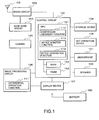
- FIG. 1 is a block diagram showing the structure of a cellular phone according to an embodiment of the present invention.
- the cellular phone 1 shown in the figure is a cellular phone (mobile communication terminal) having a so-called video phone function.
- the cellular phone 1 includes, as shown in FIG. 1, a control circuit 101, an antenna 102, a radio circuit 103, a base band circuit 104, a camera (image pickup device) 105, an image processing circuit 106, a display device 107, a key operation device 108, a storage device (image memory) 109, a microphone 121, a speaker 122, and a battery 150.
- the cellular phone 1 is operated by an electric power that is supplied from a battery (chargeable battery) 150.
- the control circuit 101 includes a CPU (central processing unit) 151, a RAM (random access memory) 152, a ROM (read only memory) 153, and peripheral circuits (not shown).
- the control circuit 101 controls the entire operation (the video phone function, a communication function such as transmission and reception of e-mail, etc. ) of the cellular phone 1 having the structure shown in FIG. 1.
- the CPU 151 executes a software program group that is read out of the ROM 53 while using the RAM 152 as a work area.
- the CPU 151 executes the respective programs of a comparison judgment function 112, a notice monitor function 113, and a notice generation function 114 so as to realize the characteristic transmission and reception operation in this embodiment (which will be described in more detail later).
- the cellular phone 1 transmits and receives image data and voice data with respect to another cellular phone 1 that is a communicated party during calling at the time when the video phone function is executed. Accordingly, the cellular phone 1 functions not only as a transmission side communication terminal but also as a reception side communication terminal.
- the cellular phone 1 in the case of emphasizing that the cellular phone 1 having the above device structure is a transmission side communication terminal, the cellular phone 1 may be called “cellular phone 1A", and in the case of emphasizing that the cellular phone 1 is a reception side communication terminal, the cellular phone 1 may be called “cellular phone 1B”.
- the key operation device 108 is an input device such as a ten key or a pointing device via which a user inputs a variety of operations.
- the user starts a communication operation through the video phone communication by using the key operation device 108.
- the camera 105 starts the photograph of a moving picture on the basis of an instruction from the control circuit 101.
- the camera 105 is an image pickup device using an image pickup device such as a CCD (charge coupled device) or a CMOS (complementary metal-oxide semiconductor).
- the camera 105 inputs an image signal (image data) of a frame unit which represents a photographed image to the image processing circuit 106 in time series.
- the control circuit 101 transmits image data of the photographed image and voice data that represents a voice that is inputted from the microphone 121 to the cellular phone 1B through the base band circuit 104, the radio circuit 103, and the antenna 102.
- the image processing circuit 106 has a differential operation function 111.
- the differential operation function 111 calculates a variation (difference) Dv of a position of an object to be photographed at real time on the basis of image data of two frame images which are inputted to the image processing circuit 106 from the camera 105 in time series.
- the object to be photographed by the camera 105 is a user per se of the cellular phone 1 in the general use of the video phone function.
- the control circuit 101 compares the variation (difference value) Dv between two frame images by the differential operation function 111 of the image processing circuit 106 with a predetermined specific value Th by means of the comparison judgment function 112. As a result of comparison, in the case where it is judged that the variation is equal to or lower than the specific value (predetermined threshold value) Th, and there is no change between those two frame images, the control circuit 101 generates control information (hereinafter referred to as "transmission stop notice SI”) which is for announcing that the transmission of the image data to the cellular phone 1B is stopped.
- the control circuit 101 of the cellular phone 1A generates the transmission stop notice SI by means of the notice generation function 113.
- control circuit 101 transmits the transmission stop notice SI to the cellular phone 1B through the base band circuit 104, the radio circuit 103, and the antenna 102. Then, the control circuit 101 stops only the transmission of the image data among the transmission and reception operation of the image data and the voice data which is performed after the start of the video phone communication. The operation state continues until that the variation between two new frame images that are sequentially inputted to the image processing circuit 106 exceeds a predetermined value (specific value Th) is detected by the differential operation function 111, or the call end operation by the user is detected.
- a predetermined value specifically value Th
- the reception of the transmission stop notice SI is monitored by the notice monitor function 114 of the control circuit 101. Then, upon receiving the transmission stop notice SI, the control circuit 101 starts the display of the still image on the basis of the image data (latest image data) that has been finally received from the cellular phone 1A and continues the voice call.
- the control circuit 101 of the cellular phone 1A generates control information (hereinafter referred to as "transmission restart notice TI") for announcing that the transmission of the imaged data to the cellular phone 1B is restarted in accordance with the detected result of the differential operation function 111. More specifically, the control circuit 101 of the cellular phone 1A generates the transmission restart notice TI when it is detected, by the differential operation function 111, that the variation between the two new frame images that are sequentially inputted to the image processing circuit 106 exceeds the specific value Th. In addition, the control circuit 101 transmits the transmission restart notice TI to the cellular phone 1B through the base band circuit 104, the radio circuit 103, and the antenna 102.
- transmission restart notice TI control information for announcing that the transmission of the imaged data to the cellular phone 1B is restarted in accordance with the detected result of the differential operation function 111. More specifically, the control circuit 101 of the cellular phone 1A generates the transmission restart notice TI when it is detected, by the differential operation function
- control circuit 101 restarts the transmission of the image data which has been stopped after the transmission stop notice SI has been transmitted.
- the operation state continues until that the variation between two new frame images that are sequentially inputted to the image processing circuit 106 is again equal to or lower than specific value Th is detected by the differential operation function 111, or the call end operation by the user is detected.
- the reception of the transmission restart notice TI is monitored by the notice monitor function 114 of the control circuit 101. Then, upon receiving the transmission restart notice TI, the control circuit 101 starts the display of the moving picture on the basis of the image data that is sequentially received from the cellular phone 1A and continues the voice call.
- the cellular phone 1A principally transmits the voice data and the image data to a base station (not shown) during the video phone communication.
- the transmission of the image data is performed in the case where there is a difference that exceeds the predetermined value (specific value Th) between two time-series frame images of the image photographed by the camera 105 as described above.
- the camera 105 photographs the user of the cellular phone 1A according to an instruction from the control circuit 101.
- the camera 105 outputs image data of the photographed image to the image processing circuit 106 in one frame unit.
- the image processing circuit 106 subjects inputted image data to arbitrary image processing (forexample, adjustment of brightness or contrast, etc.).
- the control circuit 101 saves the image data that has been subjected to the image processing in the storage device 109 once.
- the storage device 109 saves image data of two frames which are continuous in time series and consists of image data of the frame image before one frame and image data of the latest frame.
- the control circuit 101 transfers the image data of the two new and old frames which are saved within the storage device 109 to the image processing circuit 106.
- the image processing circuit 106 calculates the amount of difference between image data of the two frames by means of the differential operation function 111. Then, the image processing circuit 106 notifies the data difference amount to the control circuit 101 as a difference value Dv obtained by quantifying the data difference value.
- control circuit 101 and the image processing circuit 106 are constituted as separate devices.
- control circuit 101 and the image processing circuit 106 are not limited to the above device structure, but the device structure including the image processing circuit 106 in the control circuit 101 may be applied.
- the comparison judgment function 112 compares the notified difference value Dv with the predetermined specific value Th, and judges the magnitude relation of the calculated difference value Dv and the specific value Th.
- the control circuit 101 reads the image data of the latest frame that is saved in the storage device 19 from the RAM 152 in the case where the judgment result is equal to or higher than the specific value Th. Then, the control circuit 101 converts the image data of the latest frame and the voice data corresponding to the voice of the user which is inputted to the microphone 121 into modulated signals by means of the baseband circuit 104 as data within the transmission traffic channel (TCH) data.
- the radio circuit 103 radiates the modulated signals toward an aerial through the antenna 102 as radio signals after the modulated signals have been up-converted to a predetermined ling frequency.
- the control circuit 101 realizes the data transmission of the moving picture and the voice while executing the above sequence of operations for each of the image data of the two frames that are continuous in time series.
- control circuit 101 generates the transmission stop notice SI by means of the notice generation function 114 in the case where it is judged by the comparison judgment function 112 that the difference value Dv that has been notified from the image processing circuit 106 is equal to or lower than the specific value Th. Then, the control circuit 101 notifies the transmission stop notice SI to the cellular phone 1B, which functions as a receiver, through the radio circuit 103 and the base band circuit 104 by using an additional information bit within the TCH data to be transmitted. After that, the control circuit 101 stops the transmission operation of the image data, and switches to the voice call operation including no image data within the TCH data.
- the control circuit 101 After that, the control circuit 101 generates the transmission restart notice TI by means of the notice generation function 114 in the case where the comparison operation result between the difference value Dv and the specific value Th is returned to the specific value Th or higher.
- the control circuit 101 notifies the transmission restart notice TI to the cellular phone 1B through the radio circuit 103 and the base band circuit 104 by using the additional information bit within the TCH data to be transmitted. After that, the control circuit 101 restarts the video phone operation including the moving picture and voice by restarting the transmission operation of the image data.
- the cellular phone 1 receives the voice data and the image data from the base station (not shown) in principle during the video phone communication.
- the reception of the image data is performed in the case where there is a difference that exceeds the specific value Th between the two time-series frame images of the images photographed by the camera 10, as described above.
- the radio circuit 103 receives a radio signal from the aerial through the antenna 102. Then, the radio circuit 103 demodulates the received radio signal by means of the base band circuit 104 after being down-converted from the line frequency.
- the demodulated data includes image data and voice data, and each of the image data and the voice data is inputted to the control circuit 101.
- the control circuit 101 outputs the inputted voice data by means of a speaker 122 as a voice. Also, the control circuit 101 outputs the inputted image data to the image processing circuit 106. In this situation, the image processing circuit 106 subjects the image data to arbitrary image processing (for example, the adjustment of brightness or contrast, etc.), to thereby restore the image data of one frame. The control circuit 101 saves the image data of one frame which has been restored by the image processing circuit 106 in the storage device 109 once. Then, the control circuit 101 displays a moving picture on the display device 107 on the basis of the image data that has been saved in the storage device 109.
- arbitrary image processing for example, the adjustment of brightness or contrast, etc.
- the above operation is performed for the respective received frame image data, to thereby realize the reception and display of the moving picture data.
- the control circuit 101 always monitors the reception of the following signals by means of the notice monitor function 113 during the execution of the above series of operations. That is, there is a case where the transmission stop notice SI or the transmission restart notice TI is included in the additional information bit within the received TCH data which is transmitted from the cellular phone 1A as described above. Accordingly, the cellular phone 1B as the receiver monitors whether or not the transmission stop notice SI or the transmission restart notice TI is included in the additional information bit within the received TCH data which is demodulated on the basis of the received radio signal.
- the control circuit 101 cannot receive new image data after the notice monitor function 113 detects the transmission stop notice SI within the received TCH data . Accordingly, the control circuit 101 displays the still picture on the display device 107 on the basis of the image data (latest image data) that has been finally saved in the storage device 109, and continues the voice call operation on the basis of the voice data.
- control circuit 101 can sequentially receive the new image data after the notice monitor function 113 detects that the transmission restart notice TI is included in the received TCH data. Accordingly, the control circuit 101 displays the moving picture on the display device 107 on the basis of the image data that is sequentially updated in the storage device 109 according to the newly received TCH data, and continues the voice call operation on the basis of the voice data.
- the RAM 152 and the storage device 109 may be realized in two separate areas within the physically same device.
- FIG. 2 is a flowchart showing an image transmission control process which is executed by the cellular phone 1 in this embodiment.
- the flowchart represents a processing procedure of a software program that is executed by the CPU 151 in the control circuit 101 shown in FIG. 1.
- the CPU 151 of the control circuit 101 instructs a photograph operation to the camera 105 and stores the image data of the photographed two frames in the storage device 109 according to the user's selection of execution of the video phone function (step 201). That is, the CPU 151 stores the image data of the continuous two frame images among the frame images that are inputted to the image processing circuit 106 from the camera 105 in the time series in the storage device 109. In this situation, the storage device 109 stores the image data of the frame image before one frame and the image data of the latest frame, which are continuous in time series.
- image data (A) the image data of the frame image before one frame
- image data (B) the image data of the latest frame
- image data (C) a third frame image that is acquired newly.
- the CPU 151 updates the image data that has been temporarily stored within the storage device 109 (Step S202) . That is, the CPU 151 deletes the image data (A) that has been stored before from the storage device 109 when the CPU 151 stores the image data (C) subsequent to the image data (B) in the storage device 109. Then, the CPU 151 saves the image data (B) as the image data (A) and the image data (C) as the image data (B).
- the CPU 151 transfers the image data (A) and the image data (B) within the storage device 109 to the image processing circuit 106 so as to detect the presence and absence of the movement between the stored two frame images.
- the image processing circuit 106 calculates an amount of difference between the image data of the two frames by means of the differential operation function 111.
- the CPU 151 acquires the difference value Dv obtained by quantifying the difference value from the image processing circuit 106 (Step S203).
- the difference value Dv may be directly calculated by the control circuit.
- the CPU 151 executes the comparison judgment function 112 to compare the difference value Dv with the specific value Th that has been registered in the storage device 109 or the like in advance. Then, the CPU 151 proceeds with Step S205 if the difference value Dv is larger than the specific value Th, and proceeds with Step S206 if the difference value Dv is equal to or lower than the specific value Th (Step S204) . In this case, the CPU 151 has the image data (B) of the latest frame which has been saved in the storage device 109 as effective data.
- Step S204 the CPU 151 should transmit the image data to the cellular phone 1B.
- the CPU 151 stops transmitting the image data before a previous control cycle, the CPU 151 must notify the restart of transmission of the image data to the cellular phone 1B. Therefore, the CPU 151 judges whether the transmission of the image data to the cellular phone 1B has been already stopped, or not (Step S205) . This judgment can be readily made with the general processing structure, for example, turning on a predetermined internal flag, in accordance with the transmission of the transmission stop notice S1, for example, in Step S207 which will be described later.
- Step S205 the CPU 151 transmits the transmission restart notice TI to the cellular phone 1B, and restarts the transmission of the image data (B) which is the latest frame (Step S209) .
- Step S208 the CPU 151 continues to transmit the image data (B) which is the latest frame to the cellular phone 1B (Step S208).
- Step S204 in the case where it is judged in Step S204 that the difference value Dv is smaller than the specific value Th, there is substantially no difference between the two frame images to be compared (that is, the movement of the object to be photographed). Accordingly, in this case, the radio transmission power of the cellular phone 1A should be reduced (that is, the power consumption should be reduced) by stopping the transmission of the unnecessary image data.
- the CPU 151 sets the image data (B) of the latest frame which has been saved in the storage device 109 as invalid data (Step S206) . Then, the CPU 151 transmits the transmission stop notice S1 to the cellular phone 1B, and stops the transmission of the image data (B) (Step S207). As a result, the CPU 151 stops the transmission of the image data (B) which has been continuously performed till the previous control cycle.
- the CPU 151 returns the processing to Step S201 after executing the processing of S207 to S209, and also continues the above sequence of processing until the call end operation by the user is detected. That is, in this embodiment, the cellular phone 1A continues photographing by means of the camera 105 and updating of the image data within the storage device 109 even during stopping of transmission of the image data.
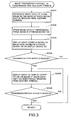
- FIG. 3 is a flowchart showing an image reception control process which is executed by the cellular phone 1 in this embodiment.
- the flowchart represents a processing procedure of a software program which is executed by the CPU 151 in the control circuit 101 shown in FIG. 1.
- the CPU 151 reproduces the image data of a frame unit by demodulating and binarizing the received signal that has been received from the cellular phone 1A by means of the radio circuit 103 and the base band circuit 104 (Step S301).
- the CPU 151 stores the reproduced image data of one frame in the storage device 109 (Step S302) . Then, the CPU 151 displays an image on the display device 107 on the basis of the image data that has been stored in the storage device 109 in Step S302 (Step S303).
- the CPU 151 executes the notice monitor function 113, to thereby judge whether the transmission stop notice SI is included in the radio signal that has been received from the cellular phone 1A, or not (Step S304).
- the transmission stop notice SI and the transmission restart notice TI are notified by using the additional information within the received TCH data.
- the cellular phone 1A stops the transmission of the image data which has been performed up to now after transmitting the transmission stop notice SI. Accordingly, the cellular phone 1B cannot acquire the image data of a new frame image for displaying the moving picture in the case where the reception of the transmission stop notice SI is detected by the judgment in Step S304. Therefore, the CPU 151 displays the image (still picture) on the display device 107 on the basis of the latest image data that has been finally received from the cellular phone 1A (Step S305). Then, the CPU 151 continues the display of the still picture in Step S304 until it is judged in Step 5306 that the transmission restart notice TI is included in the radio signal that has been received from the cellular phone 1A.
- the CPU 151 continues to reproduce the voice data since the CPU 151 receives the transmission stop notice SI until the CPU 151 receives the transmission restart notice TI (Step S305, Step S306) . Accordingly, during that, the user continues the voice call while viewing the still picture that is displayed on the display device 107.
- the CPU 151 continuously uses the image data that has been finally saved in the storage device 109.
- the image data that has been finally saved is image data of one frame which has been saved in the storage device 109 in Step S301 in the control cycle immediately before receiving the transmission stop notice SI.
- the power consumption can be reduced as much as Step S301 to Step S303 are not executed while the still picture is continuously displayed as compared with a case where Steps S301 to S303 are executed in every control cycle. Accordingly, even in the cellular phone 1B, the battery life of the battery 150 can be extended.
- the CPU 151 returns the processing to Step S301 in the case of detecting the transmission restart notice TI in Step S305. Then, the CPU 151 displays a moving picture based on image data that is received newly in the storage device 109 on the display device 107 while sequentially updating the image data until again detecting the transmission stop notice SI in Step S303. Accordingly, the user conducts voice call while viewing the moving picture that is displayed on the display device 107.
- the cellular phone 1A stops the transmission of the image data even during execution of the video phone communication in the case where the difference (movement) Dv between the image data of two frame images that are continuous in time series is smaller than the specific value Th.
- the transmission power of the cellular phone 1 as the transmitter can be reduced, and hence the power consumption can be reduced. Accordingly, the battery life of the battery 150 can be extended, and hence the convenience of the cellular phone 1 is improved.
- the still picture is displayed by the cellular phone 1B in the case where no large change (movement) is found in the state of the object to be photographed at the transmission side. Then, in the case where the object to be photographed is changed, the display of the moving picture is restarted immediately in the cellular phone 1B. Accordingly, there is no case where an uncomfortable feeling is given to the user of the cellular phone 1 as the receiver.
- the cellular phone 1B is not required to perform the process of reproducing the image data based on the received radio signal and the process of storing the reproduced image data since the cellular phone 1B receives the transmission stop notice SI until the cellular phone 1B receives the transmission restart notice TI. Accordingly, even in the cellular phone 1 as the receiver, the power consumption can be reduced. Therefore, the battery life of the battery 150 can be extended, and hence the convenience of the cellular phone 1 is improved.
- the cellular phone 1A stops the transmission of the image data as described above, to thereby reduce the radio traffic in the communication system. As a result, this contributes to the efficient use of a limited line subscriber capacity of the radio communication system.
- the cellular phone 1A continues photographing by the camera 105 and updating of the image data within the storage device 109 even during the stop of transmission of the image data. That is, there is no case where the power supply to the camera 105 is interrupted during the video phone communication. Accordingly, in this embodiment, in the cellular phone 1 as the transmitter, there is no need to take a period of time taken till the stabilization of operation with restart of power dispatching to the camera into account, which is different from JP 2001-136423 A described in the above "background of the invention". That is, according to the cellular phone 1 of this embodiment, there is no case where the operation feeling is sacrificed for achieving a reduction in power consumption.
- the cellular phone 1 that realizes the video phone function by means of voice and moving picture has been exemplified.
- the video phone function and the transmission and reception of the voice data are not essential. That is, the present invention is preferably applied to a system in which image data for reproducing a moving picture bymeans of a reception side communication terminal is sequentially transmitted to the reception side communication terminal from a transmission side communication terminal.
- the reduction in the power consumption of the cellular phone 1A at the time of the video phone communication is realized, and the reduction in the radio traffic by stopping the transmission of the image data is also realized.
- the present invention is not limited to the communication system of the cellular phone.
- the present invention can be also applied to a monitor system that is made up of an image monitor terminal that sends moving picture data and an image processing device that receives the moving picture data.
- the present invention is not limited to the above processing structure. That is, the present invention may be constituted to select two frame images whose difference is to be calculated by using a frame interval (for example, five-frame interval) specified in advance instead of calculating the difference at every frame interval (two continuous frame images) . Also, in the case where the second modification is applied to, for example, the structure of the cellular phone 1 shown in FIG.
- the selection of the two frame images may be autonomously performed by the image processing device 106, or may be performed in the process of updating the image data within the storage device 109 by the control circuit 101.
- the second modification is preferably applied to a case where the frame rate of the camera 105 (that is, the number of frame images that are photographed per unit time) is high in speed. Then, when the frame images which should be subjected to difference calculation are selected as in this modification, a load of the operation processing can be reduced, and hence power saving of the terminal and an improvement in the performance of the device can be expected.
- the image data (A) is deleted, and the image data (B) is updated to the image data (A) whereas the image data (C) is updated to the image data (B). That is, in the updating process, the frame image as a reference is updated to the latest frame image in every control cycle.
- the frame image as the reference of comparison is fixed to the image data (A) during stop of transmission of the image data. More specifically, the image data (A) is kept as it is, the image data (B) is deleted, and the image data (C) is updated to the imaged data (B) during stop of transmission of the image data.
- the cellular phone 1 having the device structure in which the camera 105 that photographs a frame image is integrated with the communication terminal has been exemplified.
- the present invention is not limited to the above device structure. That is, the present invention can be applied to even a device structure in which a communication terminal that transmits image data is separated from an image pickup device that photographs a frame image which is the original of the image data.
- the reference value Th to which the CPU 151 refers at the time of executing the difference operation has the same value (threshold value) between a case where the transmission of the image data is stopped and a case where the transmission of the image data is restarted.
- a different value may be applied to the threshold value at the time of executing the difference operation.
- the reference value (Th1) at the time of stopping the transmission is set to be larger than the reference value (Th2) at the time of restarting the transmission, thereby permitting the transmission operation in the cellular phone 1A to be stabilized.
- the present invention that has been exemplified by way of the above embodiment and its modifications is achieved by reading a computer program that can realize the functions of the flowcharts (FIGS. 2 and 3) referred to in the above description to the CPU 151 of the device and executing the computer program after the computer program is supplied to the above cellular phone 1.
- the computer program that is supplied to the device may be stored in a storage device such as a readable and writable memory.
- a method of supplying the computer program to each device can currently adopt a general procedure such as a method involving installing the computer program into the device by using an appropriate jig or a method involving downloading the computer program from the external through a communication line such as the Internet, at the manufacturing stage before shipping, at the maintenance stage after shipping, or the like.
- the present invention is constituted by codes or storage medium of the computer program.
Landscapes
- Engineering & Computer Science (AREA)
- Computer Networks & Wireless Communication (AREA)
- Signal Processing (AREA)
- Mobile Radio Communication Systems (AREA)
- Telephone Function (AREA)
- Control Of Indicators Other Than Cathode Ray Tubes (AREA)
- Telephonic Communication Services (AREA)
- Two-Way Televisions, Distribution Of Moving Picture Or The Like (AREA)
Applications Claiming Priority (2)
| Application Number | Priority Date | Filing Date | Title |
|---|---|---|---|
| JP2003424856A JP2005184632A (ja) | 2003-12-22 | 2003-12-22 | 通信端末における消費電力削減方法及び通信端末 |
| JP2003424856 | 2003-12-22 |
Publications (2)
| Publication Number | Publication Date |
|---|---|
| EP1549000A2 true EP1549000A2 (de) | 2005-06-29 |
| EP1549000A3 EP1549000A3 (de) | 2005-11-23 |
Family
ID=34544933
Family Applications (1)
| Application Number | Title | Priority Date | Filing Date |
|---|---|---|---|
| EP20040027318 Withdrawn EP1549000A3 (de) | 2003-12-22 | 2004-11-17 | Reduzierung des Energieverbrauches eines mobilen Endgerätes, das Bilder überträgt |
Country Status (4)
| Country | Link |
|---|---|
| US (1) | US20050136985A1 (de) |
| EP (1) | EP1549000A3 (de) |
| JP (1) | JP2005184632A (de) |
| CN (1) | CN1638473A (de) |
Families Citing this family (6)
| Publication number | Priority date | Publication date | Assignee | Title |
|---|---|---|---|---|
| JP5141477B2 (ja) * | 2008-09-29 | 2013-02-13 | 沖電気工業株式会社 | 動画像受信装置、動画像通信システム、動画像受信プログラム及び動画像通信プログラム |
| JPWO2011004868A1 (ja) * | 2009-07-08 | 2012-12-20 | 京セラ株式会社 | 無線基地局及び通信制御方法 |
| JP2014131140A (ja) * | 2012-12-28 | 2014-07-10 | Yamaha Corp | 通信システム、avレシーバ、および通信アダプタ装置 |
| WO2014117338A1 (zh) * | 2013-01-30 | 2014-08-07 | 东莞宇龙通信科技有限公司 | 终端和应用程序的快速启动方法 |
| KR102167646B1 (ko) | 2014-04-01 | 2020-10-19 | 삼성전자주식회사 | 프레임 정보를 제공하는 전자 장치 및 방법 |
| WO2020090109A1 (ja) * | 2018-11-02 | 2020-05-07 | Necディスプレイソリューションズ株式会社 | 画像表示装置及び画像伝送方法 |
Family Cites Families (10)
| Publication number | Priority date | Publication date | Assignee | Title |
|---|---|---|---|---|
| DE3853713T2 (de) * | 1987-12-17 | 1996-01-18 | Mitsubishi Electric Corp | Verfahren zur Übertragung und Anzeige eines Standbildes in einem Standbild-Videotelefon. |
| WO1996027987A1 (fr) * | 1995-03-08 | 1996-09-12 | Hitachi, Ltd. | Terminal portatif pour communication multimedia |
| EP2285119B1 (de) * | 1997-06-09 | 2015-08-05 | Hitachi, Ltd. | Bilddekodierung |
| JP3466951B2 (ja) * | 1999-03-30 | 2003-11-17 | 株式会社東芝 | 液晶表示装置 |
| JP2001103565A (ja) * | 1999-09-30 | 2001-04-13 | Toshiba Corp | 移動無線端末 |
| JP2001136423A (ja) * | 1999-11-02 | 2001-05-18 | Kyocera Corp | 携帯テレビ電話端末およびその送信方法 |
| TW494382B (en) * | 2000-03-22 | 2002-07-11 | Toshiba Corp | Display apparatus and driving method of display apparatus |
| JP2002027145A (ja) * | 2000-07-05 | 2002-01-25 | Toshiba Corp | 無線通信端末 |
| GB2366467B (en) * | 2000-08-23 | 2003-11-26 | Motorola Inc | Mobile terminal battery power conservation |
| GB2379572B (en) * | 2001-09-11 | 2003-09-24 | Donald William Bursill | A method of displaying images |
-
2003
- 2003-12-22 JP JP2003424856A patent/JP2005184632A/ja active Pending
-
2004
- 2004-11-17 EP EP20040027318 patent/EP1549000A3/de not_active Withdrawn
- 2004-11-24 US US10/995,305 patent/US20050136985A1/en not_active Abandoned
- 2004-12-09 CN CNA2004100985334A patent/CN1638473A/zh active Pending
Also Published As
| Publication number | Publication date |
|---|---|
| US20050136985A1 (en) | 2005-06-23 |
| JP2005184632A (ja) | 2005-07-07 |
| CN1638473A (zh) | 2005-07-13 |
| EP1549000A3 (de) | 2005-11-23 |
Similar Documents
| Publication | Publication Date | Title |
|---|---|---|
| JP3866735B2 (ja) | 多機能型移動通信端末 | |
| JP5226074B2 (ja) | 通信機器 | |
| WO2021227615A1 (zh) | 一种提升通话质量的方法及终端 | |
| EP1276308A2 (de) | Mobiles Kommunikationsendgerät mit Kamera | |
| US8374648B2 (en) | Method for performing communication function in wireless terminal | |
| EP4236434B1 (de) | Kanalumschaltverfahren, elektronische vorrichtung und speichermedium | |
| US8525869B2 (en) | Method for video telephony communication and a terminal using the same | |
| CN109639996B (zh) | 高动态场景成像方法、移动终端及计算机可读存储介质 | |
| EP3462789A1 (de) | Verfahren und vorrichtung zur reduzierung des energieverbrauchs von mobilen endgeräten | |
| US20190364221A1 (en) | Camera Control Method and Terminal | |
| EP1549000A2 (de) | Reduzierung des Energieverbrauches eines mobilen Endgerätes, das Bilder überträgt | |
| US8977264B2 (en) | Apparatus and method for preventing performance degradation of call service in a portable terminal | |
| JP4618168B2 (ja) | 携帯電話装置 | |
| JP4793095B2 (ja) | 携帯電話機、該携帯電話機に用いられるカメラ動作休止方法及びカメラ動作休止制御プログラム | |
| JP2003122339A (ja) | 移動通信端末 | |
| KR101138563B1 (ko) | 휴대 전화기 | |
| JP2004048166A (ja) | 移動通信システム、この移動通信システムに用いられる携帯端末装置及び発信局 | |
| CN118201006A (zh) | 通信方法、装置、电子设备及可读存储介质 | |
| JP2002369073A (ja) | 移動無線端末 | |
| JP2003163759A (ja) | 携帯端末装置 | |
| JP2003273800A (ja) | 無線通信装置、状態移行制御方法、及びプログラム | |
| WO2003077535A1 (en) | Captured image display device and captured image display method | |
| CN115052322B (zh) | 触发小区切换的方法、装置、存储介质及芯片 | |
| JP4413352B2 (ja) | 移動無線端末及び外部記憶ユニット | |
| CN114125313B (zh) | 一种图像增强处理方法、设备及计算机可读存储介质 |
Legal Events
| Date | Code | Title | Description |
|---|---|---|---|
| PUAI | Public reference made under article 153(3) epc to a published international application that has entered the european phase |
Free format text: ORIGINAL CODE: 0009012 |
|
| AK | Designated contracting states |
Kind code of ref document: A2 Designated state(s): AT BE BG CH CY CZ DE DK EE ES FI FR GB GR HU IE IS IT LI LU MC NL PL PT RO SE SI SK TR |
|
| AX | Request for extension of the european patent |
Extension state: AL HR LT LV MK YU |
|
| PUAL | Search report despatched |
Free format text: ORIGINAL CODE: 0009013 |
|
| AK | Designated contracting states |
Kind code of ref document: A3 Designated state(s): AT BE BG CH CY CZ DE DK EE ES FI FR GB GR HU IE IS IT LI LU MC NL PL PT RO SE SI SK TR |
|
| AX | Request for extension of the european patent |
Extension state: AL HR LT LV MK YU |
|
| 17P | Request for examination filed |
Effective date: 20051021 |
|
| AKX | Designation fees paid |
Designated state(s): DE FR GB IT |
|
| STAA | Information on the status of an ep patent application or granted ep patent |
Free format text: STATUS: THE APPLICATION IS DEEMED TO BE WITHDRAWN |
|
| 18D | Application deemed to be withdrawn |
Effective date: 20060509 |