EP1548012A2 - Verfahren zur Herstellung von Phenylenbisoxazolinen - Google Patents
Verfahren zur Herstellung von Phenylenbisoxazolinen Download PDFInfo
- Publication number
- EP1548012A2 EP1548012A2 EP04105404A EP04105404A EP1548012A2 EP 1548012 A2 EP1548012 A2 EP 1548012A2 EP 04105404 A EP04105404 A EP 04105404A EP 04105404 A EP04105404 A EP 04105404A EP 1548012 A2 EP1548012 A2 EP 1548012A2
- Authority
- EP
- European Patent Office
- Prior art keywords
- reaction
- catalyst
- dinitrile
- aminoalcohol
- zinc
- Prior art date
- Legal status (The legal status is an assumption and is not a legal conclusion. Google has not performed a legal analysis and makes no representation as to the accuracy of the status listed.)
- Granted
Links
Classifications
-
- C—CHEMISTRY; METALLURGY
- C07—ORGANIC CHEMISTRY
- C07D—HETEROCYCLIC COMPOUNDS
- C07D263/00—Heterocyclic compounds containing 1,3-oxazole or hydrogenated 1,3-oxazole rings
- C07D263/02—Heterocyclic compounds containing 1,3-oxazole or hydrogenated 1,3-oxazole rings not condensed with other rings
- C07D263/08—Heterocyclic compounds containing 1,3-oxazole or hydrogenated 1,3-oxazole rings not condensed with other rings having one double bond between ring members or between a ring member and a non-ring member
- C07D263/10—Heterocyclic compounds containing 1,3-oxazole or hydrogenated 1,3-oxazole rings not condensed with other rings having one double bond between ring members or between a ring member and a non-ring member with only hydrogen atoms, hydrocarbon or substituted hydrocarbon radicals, directly attached to ring carbon atoms
-
- Y—GENERAL TAGGING OF NEW TECHNOLOGICAL DEVELOPMENTS; GENERAL TAGGING OF CROSS-SECTIONAL TECHNOLOGIES SPANNING OVER SEVERAL SECTIONS OF THE IPC; TECHNICAL SUBJECTS COVERED BY FORMER USPC CROSS-REFERENCE ART COLLECTIONS [XRACs] AND DIGESTS
- Y02—TECHNOLOGIES OR APPLICATIONS FOR MITIGATION OR ADAPTATION AGAINST CLIMATE CHANGE
- Y02P—CLIMATE CHANGE MITIGATION TECHNOLOGIES IN THE PRODUCTION OR PROCESSING OF GOODS
- Y02P20/00—Technologies relating to chemical industry
- Y02P20/50—Improvements relating to the production of bulk chemicals
- Y02P20/582—Recycling of unreacted starting or intermediate materials
Definitions
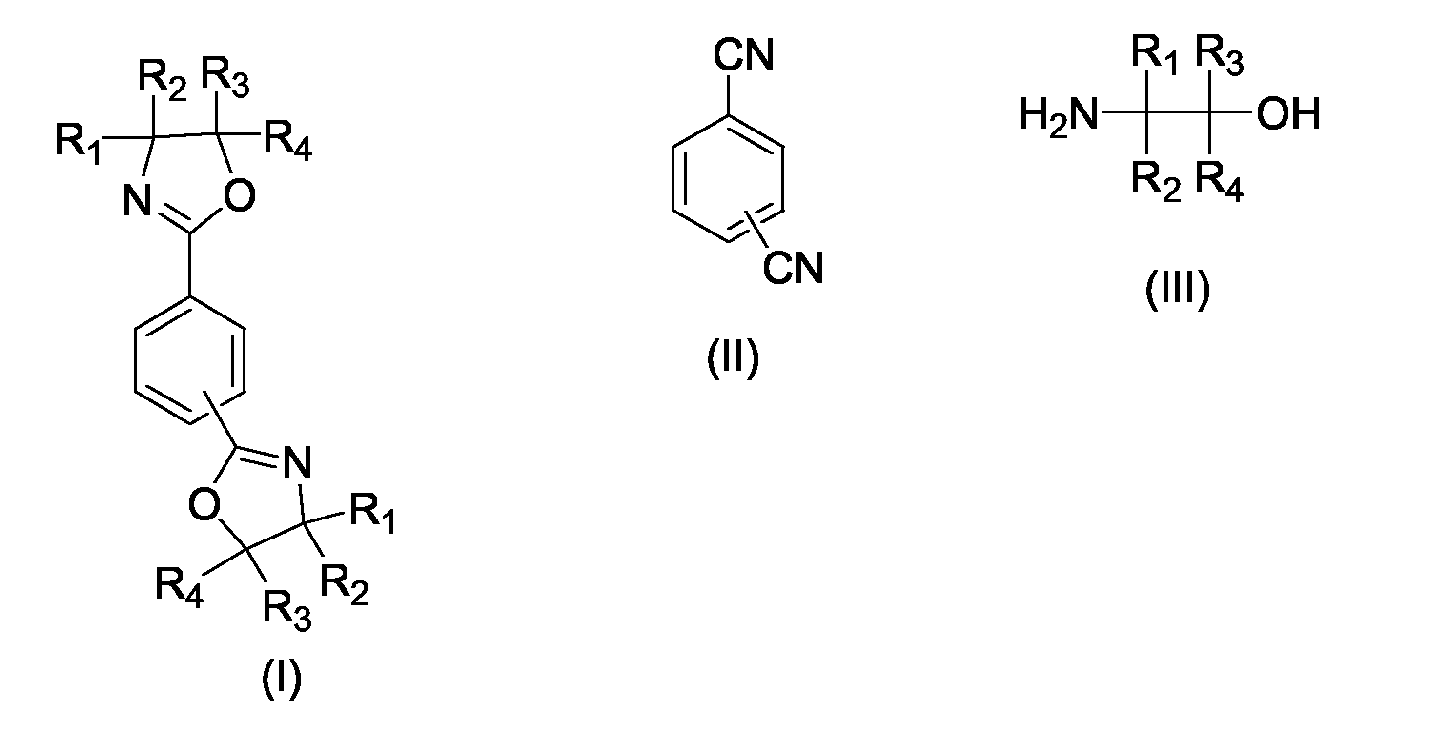
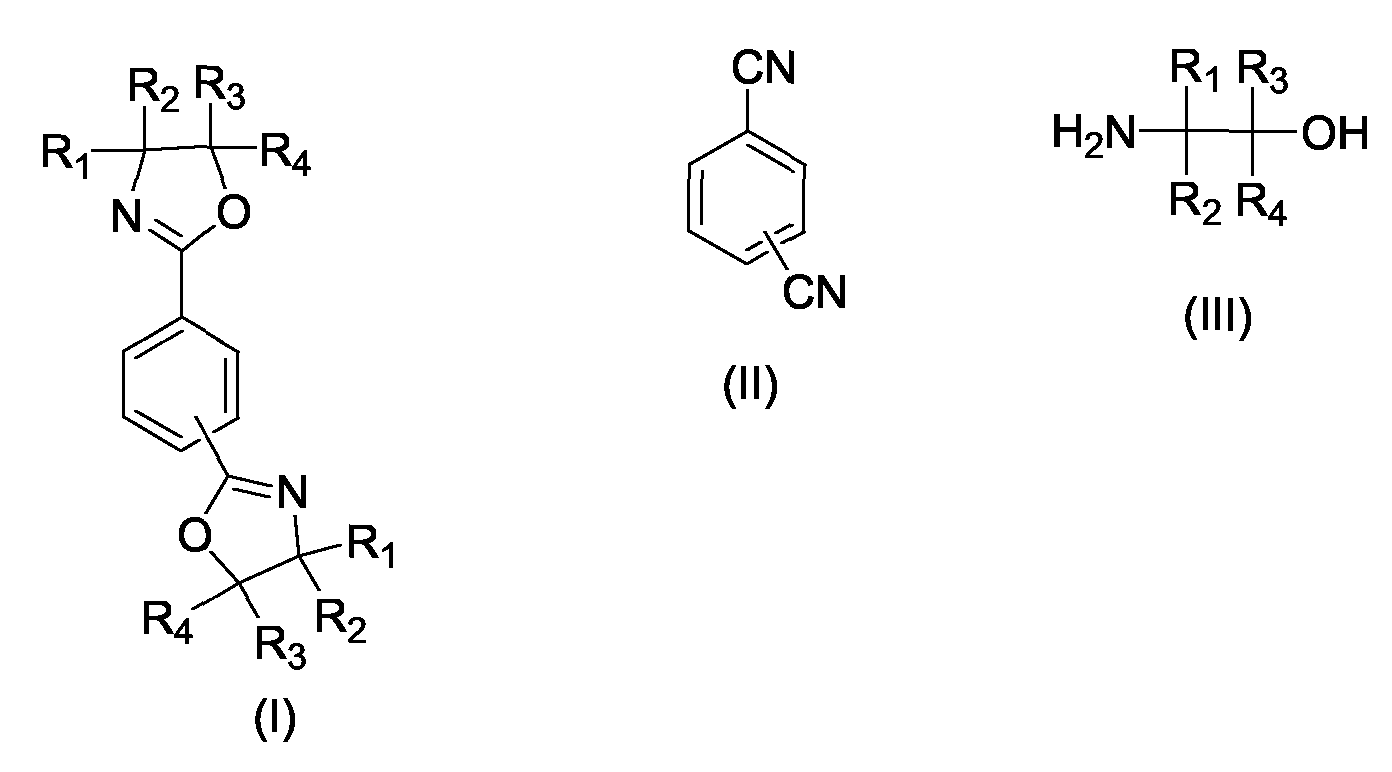
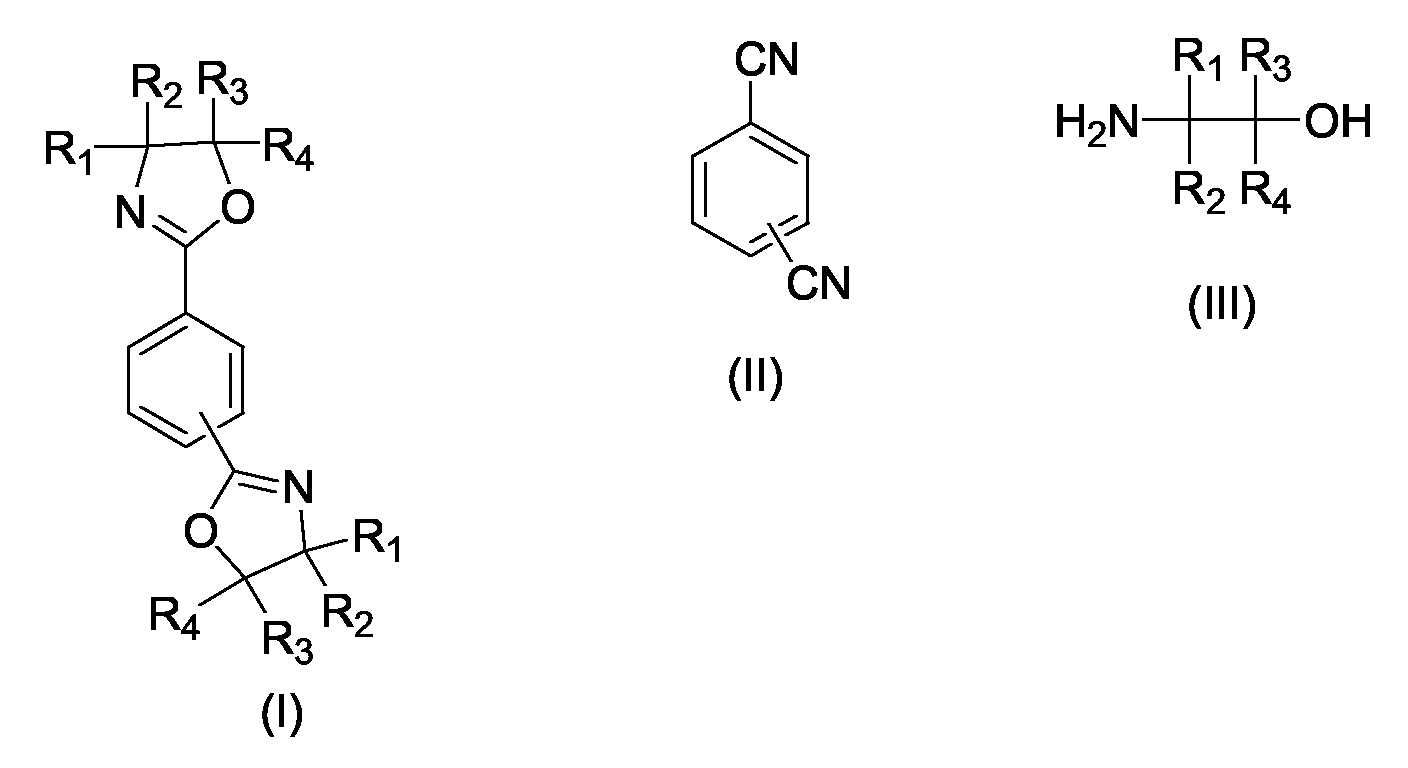
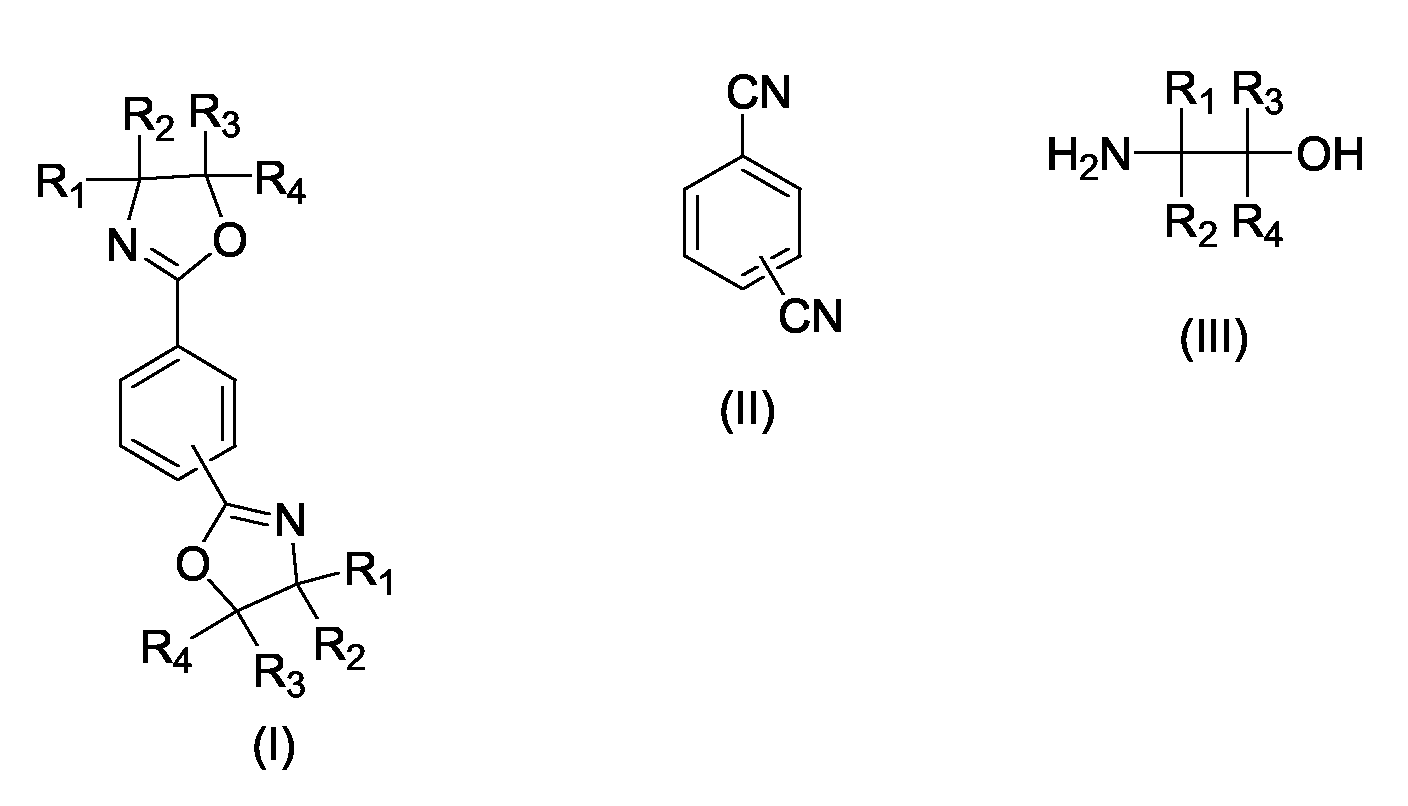
- the present invention relates to a process for the preparation of phenylenebisoxazolines (I), in particular 2,2 '- (1,4-phenylene) bis- [4,5-dihydro-1,3-oxazole] and 2,2' - ( 1,3-phenylene) bis- [4,5-dihydro-1,3-oxazole], by reacting terephthalodinitrile or isophthalonitrile (II) with 1,2-aminoalcohols (III) according to the general equation wherein R 1 , R 2 , R 3 , R 4 may be the same or independently hydrogen, methyl, ethyl, n-propyl or iso-propyl.
- the phenylenebisoxazolines obtainable by the process according to the invention may i.a. when Chain extender or stabilizer in polymers, especially in polyesters and polyamides (Journal of Applied Polymer Science 1997, 65, 1813-1819, WO 0166633; WO 9634909).
- catalysts for the reaction described above for example, according to DE 21 58 615, DE 21 27 776, CA no. 94: 15 708 Salts of inorganic or organic acids of metals of the 1st, 2nd, 11th (IB) and 12th (IIB) group of the periodic table.
- the catalysts known to those skilled in the art are zinc chloride, zinc acetate, Nickel acetate or cadmium acetate used.
- cobalt, chromium, iron and copper catalysts for the desired heterocyclization be used.
- Zinc carboxylic acid salts are preferred of saturated, aliphatic carboxylic acids having from two to ten carbon atoms, which may be both branched and unbranched, such as zinc acetate, Zinc propionate, zinc n-butyrate, zinc isobutyrate etc. or also of zinc 2-ethylhexanoate, the each used as a single component or as a mixture of several components can.
- zinc 2-ethylhexanoate is very particularly preferred as a catalyst.
- 2-aminoethanol is preferred according to the invention as 2-aminoalcohol used.
- the zinc carboxylic acid salts to be preferably used offer the advantage of greater catalytic activity with the lowest possible toxicity and easier Handling, at the same time good availability.
- the molar ratio of aminoalcohol to dinitrile is at least 2: 1. Preferred However, the aminoalcohol is in a 4- to 8-fold molar ratio, based on the Dinitrile used. This adds to the concentration of dinitrile during the reaction kept low.
- the reaction according to the invention in the temperature range of about 50 ° C to about 200 ° C, preferably at 100 ° C to 150 ° C, carried out, but especially at a temperature of 120 ° C to 140 ° C.
- reaction is very particularly preferably carried out at atmospheric pressure, since here the least effort is required.
- the reaction can be carried out with or without solvent.
- Suitable solvents should be inert under the chosen reaction conditions and preferably form an azeotrope with the amino alcohol used, which separates again at room temperature into its constituents.
- Aromatic hydrocarbons or ether compounds which have the desired properties, in particular when 2-aminoethanol is used, are preferred according to the invention.
- no water is added during the synthesis and isolation of the phenylenebisoxazolines.
- it is advantageous to separate the excess amino alcohol during and / or after the reaction preferably by azeotropic distillation with a suitable solvent.
- the total reaction time to be chosen is dependent on the temperature and can range from 1 to 14 hours according to the invention. At reaction temperatures of 100 ° to 150 ° C., however, total reaction times of from 1 to 4 hours, in particular from 1.5 to about 3 hours, are preferably used.
- This relatively short reaction time means a further advantage over the previously known methods, such as that of DE 2158615, in which significantly longer reaction times of 6 or 12 hours according to Example 1 or 2 must be used. This makes it possible to increase the space-time yields in an advantageous manner, which plays a very important role for the economic efficiency of a technical process.
- the reaction according to the invention of dinitrile with aminoalcohol can be carried out both batchwise and be carried out partly continuously or continuously. This can vary depending on technical requirements are handled flexibly, which is another important advantage represents the process.
- a solubilizer at the end of the reaction before cooling the reaction mixture, so that the reaction mixture forms a homogeneous liquid phase at room temperature.
- a solubilizer preferably short-chain linear or branched aliphatic or cycloaliphatic alcohols having a chain length of C 1 to C 6 are used, but in particular isopropanol.
- crystallizing product succeeds easily in one step z. B. by filtration from the mother liquor to separate. Solvents and solubilizers can be easily recovered by distillation from the mother liquor and used again in the process.
- the inventive method also leads to products with excellent purity from over 99.0%, preferably even up to over 99.5%, which surprisingly also no discoloration, as opposed to conventional products Method.
- Example 1 further shows, the procedure given there leads to a distinct discolored product in contrast to the method according to the invention. This is particularly evident in the comparison of the relative degrees of whiteness, measured according to DIN 5033 (Principle 45/0), in which the product according to the invention with values of 75% or 82-92% performs significantly better compared to the product of the comparative example with one value of only 39%. According to the invention, it is possible to obtain degrees of whiteness of> 70%, preferably of> 80% but in particular of> 90%.
- liquid zinc 2-ethylhexanoate is generally very well suited as a catalyst for the synthesis of phenylenebisoxazolines from terephthalodinitrile or isophthalodinitrile.
- the reaction with zinc 2-ethylhexanoate is significantly accelerated.
- the reaction of 1 mole equivalent (moleq) terephthalodinitrile with 2.28 moleq ethanolamine and 0.05 moleq zinc acetate dihydrate even after more than 7 h at 132 ° C, still showed significant amounts of the intermediate 4- (4.5- dihydro-2-oxazolyl) -benzonitrils.
- Zinc 2-ethylhexanoate can therefore be used in all processes for the preparation of 1,3-phenylenebisoxazolines and of 1,4-phenylenebisoxazolines of the general formula I
- Reaction of an aromatic dinitrile of the general formula II with an aminoalcohol of general formula III are used advantageously as a catalyst and solves in particular the Tasks of an improved space-time yield, improved catalyst separation, the anhydrous workup and feasibility on an industrial scale.
- Another aspect of the invention is a method according to claim 22.
- the initially 2-phase suspension was heated with stirring to reflux temperature. Subsequently, 128.1 g (1 moleq) of isophtalodinitrile (IPN) over a period of 2h. continuously metered as a solid to the hot bottom. In the process, ammonia was formed as exhaust gas.
- IPN isophtalodinitrile
- the now single-phase reaction mixture was about 1 h. at Reflux temperature stirred.
- Excess ethanolamine (EA) was then passed through with the aid of a water separator azeotropic distillation as far as possible from the mixture.
- the EA which accumulates as a separate phase in the water separator, could be used directly in further Approaches are used.
- TPN terephthalonitrile
- reaction product was in the form of a thick slurry in the excess ethanolamine. While cooling, it was diluted by stirring in 115 ml of isopropanol, after which the reaction product was easily filtered off. The crystal slurry was washed on the filter with 95 g of isopropanol. Thereafter, the filter cake was slurried in plenty of water (470 g) with stirring, filtered and washed vigorously with water (three times with 200 g each) to quantitatively remove the ethanolamine. Thereafter, it was washed with acetone (three times with 100 g) to remove the bulk of water, and then dried.
Landscapes
- Chemical & Material Sciences (AREA)
- Organic Chemistry (AREA)
- Heterocyclic Carbon Compounds Containing A Hetero Ring Having Nitrogen And Oxygen As The Only Ring Hetero Atoms (AREA)
- Low-Molecular Organic Synthesis Reactions Using Catalysts (AREA)
Abstract
in Gegenwart eines geeigneten Katalysators, bei dem der Katalysator, der Aminoalkohol und ggf. ein geeignetes Lösungsmittel bei Reaktionstemperatur vorgelegt werden und das jeweils eingesetzte Dinitril zudosiert wird.
Description

Während der Synthese und der Isolierung der Phenylenbisoxazoline wird jedoch vorzugsweise kein Wasser zugesetzt. Generell ist es von Vorteil, den überschüssigen Aminoalkohol während und/oder im Anschluss an die Reaktion abzutrennen, vorzugsweise durch azeotrope Destillation mit einem geeigneten Lösungsmittel.
Dadurch gelingt es die Raum-Zeit-Ausbeuten in vorteilhafter Weise zu erhöhen, was für die Wirtschaftlichkeit eines technischen Verfahrens eine ganz bedeutende Rolle spielt.
Dies wird insbesondere am Vergleich der relativen Weißgrade, gemessen nach DIN 5033 (Prinzip 45/0), deutlich, bei dem das erfindungsgemäße Produkt mit Werten von 75 % bzw. 82 - 92 % deutlich besser abschneidet im Vergleich zum Produkt des Vergleichsbeispiels mit einem Wert von nur 39 %. Erfindungsgemäß ist es möglich, Weißgrade von > 70 %, bevorzugt von > 80 % insbesondere aber von > 90% zu erhalten.
Ein weiterer Vorteil beim Einsatz von Zink-2-ethylhexanoat ist, dass dieser flüssige, im Reaktionssystem relativ gut lösliche Katalysator ohne wäßrige Aufarbeitung während der Filtration des Endproduktes in der Mutterlauge verbleibt und somit einfach und vollständig abgetrennt werden kann.
- Säule: fused silica, FS-SE-54
- Mobile Phase: Stickstoff
- Detektion: FID (Flammenionisationsdetektor)
- Temperaturprogramm: Start: 50 °C, Rate: 10 °C/min, Ende: 250 °C
- Injektionstemperatur: 250 °C
- Flußrate: 2 ml/min
- Säule: Hypersil MOS, 5 µm, 125 x 4 mm
- Mobile Phase: Wasser, Methanol, es wird ein Gradient gefahren
- Detektion: UV bei 242 bzw. 270 nm
- Temperatur: Raumtemperatur
- Flußrate: 1 ml/min
- Geräte: Colortester LFM1 (DR.LANGE), Emaille-Arbeitsstandard LZM 024 als unmittelbarem Weißstandard (gegen Referenzstandard Bariumsulfat = 100% Weißgrad geeicht), Pulverrundküvette mit 50 mm Durchmesser, Blaufilter (Z-Filter) mit Wellenlängenbereich 400 - 700 nm
- Durchführung: Das Gerät wird zunächst mit dem Emaille-Arbeitsstandard geeicht. Anschließend wird die Probe in der Rundküvette mit ca. 2 cm Füllstand gleichmäßig eingefüllt und in die Meßvorrichtung des Colortesters eingebracht. Danach wird die Probe unter 45 ° im gewählten Wellenlängenbereich (400 - 700 nm) beleuchtet und die diffuse Reflexion des Lichts unter 0° gemessen und mit der des Weißstandards verglichen. Der Rz-Wert wird vom Gerät ausgegeben und gibt den relativen Weißgrad in % bezogen auf den Referenzstandard Bariumsulfat (= 100 %) an.
Anders als beim Vergleichsbeispiel kam es hier zu keiner Grün- oder Blaufärbung der Reaktionslösung. Nach Ende der TPN-Zugabe wurde das Reaktionsgemisch 1Std. bei 130 °C nachgerührt.
Danach lag das Reaktionsprodukt als dicker Brei im überschüssigen Ethanolamin vor. Während des Abkühlens verdünnte man durch Einrühren von 115 ml Isopropanol, wonach sich das Reaktionsprodukt leicht abfiltrieren ließ. Der Kristallbrei wurde auf dem Filter mit 95 g Isopropanol nachgewaschen. Danach wurde der Filterkuchen in viel Wasser (470 g) unter Rühren aufgeschlämmt, filtriert und mit Wasser (dreimal mit je 200 g) kräftig nachgewaschen, um das Ethanolamin quantitativ zu entfernen. Hiernach wurde noch mit Aceton (dreimal mit je 100 g) nachgewaschen, um die Hauptmenge Wasser zu entfernen, und anschließend getrocknet. Es wurden 292 g grau-grünes Pulver enthalten, was einer Ausbeute von 89,9 % d. Th. an 2,2'-(1,4-Phenylen) bis-[4,5-dihydro-1,3-oxazol] entspricht, bezogen auf eingesetztes TPN.
Der Schmelzpunkt des Produktes lag bei 238 - 247 °C bei einer Reinheit von: 99,1 Gew.% (HPLC).
Claims (23)
- Verfahren zur Herstellung von 1,3-Phenylenbisoxazolinen und 1,4-Phenylenbisoxazolinen der allgemeinen Formel I durch Umsetzung eines aromatischen Dinitrils der allgemeinen Formel II mit einem 2-Aminoalkohol der allgemeinen Formel IIIwobei R1, R2, R3, R4 gleich oder voneinander verschieden sein können und jeweils Wasserstoff, Methyl, Ethyl, n-Propyl oder iso-Propyl bedeuten können ,
in Gegenwart eines geeigneten Katalysators,
dadurch gekennzeichnet, dass der Katalysator, der Aminoalkohol und ggf. ein geeignetes Lösungsmittel bei Reaktionstemperatur vorgelegt werden und das jeweils eingesetzte Dinitril zudosiert wird. - Verfahren nach Anspruch 1,
dadurch gekennzeichnet, dass das jeweils eingesetzte Dinitril als Feststoff, als Schmelze oder in einem geeigneten Lösungsmittel gelöst zudosiert wird. - Verfahren nach Anspruch 1 oder 2,
dadurch gekennzeichnet, dass als Katalysator eine oder mehrere Zinkverbindungen eingesetzt werden. - Verfahren nach Anspruch 3,
dadurch gekennzeichnet, dass ein oder mehrere Zinkcarbonsäuresalze als Katalysator eingesetzt werden. - Verfahren nach Anspruch 4,
dadurch gekennzeichnet, dass als Katalysator Zink-2-ethylhexanoat eingesetzt wird. - Verfahren nach einem der vorherigen Ansprüche,
dadurch gekennzeichnet, dass als 2-Aminoalkohol 2-Aminoethanol eingesetzt wird. - Verfahren nach einem der vorherigen Ansprüche,
dadurch gekennzeichnet, dass das molare Verhältnis von Aminoalkohol zu Dinitril mindestens 2 : 1 beträgt. - Verfahren nach Anspruch 7,
dadurch gekennzeichnet, dass das molare Verhältnis von Aminoalkohol zu Dinitril 4 : 1 bis 8 : 1 beträgt. - Verfahren nach einem der vorherigen Ansprüche,
dadurch gekennzeichnet, dass als Reaktionstemperatur eine Temperatur im Bereich von 50 °C bis 200 °C gewählt wird. - Verfahren nach Anspruch 9,
dadurch gekennzeichnet, dass als Reaktionstemperatur eine Temperatur im Bereich von 100 bis 150 °C, vorzugsweise im Bereich von 120 bis 140 °C gewählt wird. - Verfahren nach einem der vorherigen Ansprüche,
dadurch gekennzeichnet, dass als Abgas entstehender Ammoniak abgetrieben wird. - Verfahren nach einem der vorherigen Ansprüche,
dadurch gekennzeichnet, dass der überschüssige Aminoalkohol während und/oder im Anschluss an die Reaktion abgetrennt wird. - Verfahren nach Anspruch 12,
dadurch gekennzeichnet, dass der überschüssige Aminoalkohol durch azeotrope Destillation abgetrennt wird. - Verfahren nach Anspruch 12 oder 13,
dadurch gekennzeichnet, dass der abgetrennte überschüssige Aminoalkohol in die Reaktionsstufe zurückgeführt wird. - Verfahren nach einem der vorherigen Ansprüche,
dadurch gekennzeichnet, dass die Reaktion bei Drücken von 0.5 bara bis etwa 10 bara, vorzugsweise bei Drücken von 0.5 bara bis Normaldruck durchgeführt wird. - Verfahren nach einem der vorherigen Ansprüche,
dadurch gekennzeichnet, dass während der Synthese und der Isolierung der Phenylenbisoxazoline kein Wasser zugesetzt wird. - Verfahren nach einem der vorherigen Ansprüche,
dadurch gekennzeichnet, dass die Reaktion in Gegenwart eines Lösungsmittels durchgeführt wird, das mit dem eingesetzten Aminoalkohol Azeotrope bilden kann, die sich bei Raumtemperatur wieder in ihre Bestandteile auftrennen. - Verfahren nach Anspruch 17,
dadurch gekennzeichnet, dass als Lösungsmittel aromatische Kohlenwasserstoffe oder Etherverbindungen eingesetzt werden. - Verfahren nach Anspruch 18,
dadurch gekennzeichnet, dass als Lösungsmittel Toluol, Xylol - isomerenrein oder als Isomerengemisch - oder Dibutylether eingesetzt werden. - Verfahren nach einem der vorherigen Ansprüche,
dadurch gekennzeichnet, dass das Verfahren diskontinuierlich, teilweise kontinuierlich oder kontinuierlich durchgeführt wird. - Verfahren nach einem der vorhergehenden Ansprüche,
dadurch gekennzeichnet, dass vor dem Abkühlen der Reaktionsmischung eine geeignete Menge eines Lösungsvermittlers zugesetzt wird, so dass die Reaktionsmischung bei Raumtemperatur eine homogene Flüssigphase bildet. - Verfahren zur Herstellung von 1,3-Phenylenbisoxazolinen und von 1,4-Phenylenbisoxazolinen der allgemeinen Formel I durch Umsetzung eines aromatischen Dinitrils der allgemeinen Formel II mit einem Aminoalkohol der allgemeinen Formel III,wobei R1, R2, R3, R4 gleich oder voneinander verschieden sein können und jeweils Wasserstoff, Methyl, Ethyl, n-Propyl oder iso-Propyl bedeuten können,
dadurch gekennzeichnet, dass als Katalysator Zink-2-ethylhexanoat eingesetzt wird. - Verfahren nach Anspruch 22,
dadurch gekennzeichnet, dass bezogen auf eingesetztes Dinitril 0,1 - 5 Mol-%, besonders bevorzugt 1 - 2 Mol-% Zink-2-ethylhexanoat als Katalysator eingesetzt werden
Priority Applications (1)
| Application Number | Priority Date | Filing Date | Title |
|---|---|---|---|
| EP06118403A EP1801107B1 (de) | 2003-12-23 | 2004-10-29 | Verfahren zur Herstellung von Phenylenbisoxazolinen |
Applications Claiming Priority (2)
| Application Number | Priority Date | Filing Date | Title |
|---|---|---|---|
| DE10360757 | 2003-12-23 | ||
| DE10360757A DE10360757A1 (de) | 2003-12-23 | 2003-12-23 | Verfahren zur Herstellung von Phenylenbisoxazolinen |
Related Child Applications (1)
| Application Number | Title | Priority Date | Filing Date |
|---|---|---|---|
| EP06118403A Division EP1801107B1 (de) | 2003-12-23 | 2004-10-29 | Verfahren zur Herstellung von Phenylenbisoxazolinen |
Publications (3)
| Publication Number | Publication Date |
|---|---|
| EP1548012A2 true EP1548012A2 (de) | 2005-06-29 |
| EP1548012A3 EP1548012A3 (de) | 2005-10-05 |
| EP1548012B1 EP1548012B1 (de) | 2007-10-03 |
Family
ID=34530361
Family Applications (2)
| Application Number | Title | Priority Date | Filing Date |
|---|---|---|---|
| EP06118403A Expired - Lifetime EP1801107B1 (de) | 2003-12-23 | 2004-10-29 | Verfahren zur Herstellung von Phenylenbisoxazolinen |
| EP04105404A Expired - Lifetime EP1548012B1 (de) | 2003-12-23 | 2004-10-29 | Verfahren zur Herstellung von Phenylenbisoxazolinen |
Family Applications Before (1)
| Application Number | Title | Priority Date | Filing Date |
|---|---|---|---|
| EP06118403A Expired - Lifetime EP1801107B1 (de) | 2003-12-23 | 2004-10-29 | Verfahren zur Herstellung von Phenylenbisoxazolinen |
Country Status (4)
| Country | Link |
|---|---|
| EP (2) | EP1801107B1 (de) |
| AT (1) | ATE374756T1 (de) |
| DE (3) | DE10360757A1 (de) |
| ES (2) | ES2294433T3 (de) |
Cited By (4)
| Publication number | Priority date | Publication date | Assignee | Title |
|---|---|---|---|---|
| EP2166005A1 (de) | 2008-09-23 | 2010-03-24 | Evonik Degussa GmbH | Verfahren zur Herstellung von Phenylenbisoxazolinen |
| WO2012082487A2 (en) | 2010-12-14 | 2012-06-21 | 3M Innovative Properties Company | Oxazolinyl-containing polymers and grafted compounds prepared from the oxazolinyl-containing polymers |
| US8834971B2 (en) | 2010-11-17 | 2014-09-16 | Evonik Degussa Gmbh | Process for continuous preparation of a prepolymer based on phenolic resins, oxazolines and epoxides |
| CN120058629A (zh) * | 2025-02-27 | 2025-05-30 | 江苏维尤纳特精细化工有限公司 | 一种2,2-(1,3-亚苯基)双(2-噁唑啉)的制备方法 |
Family Cites Families (5)
| Publication number | Priority date | Publication date | Assignee | Title |
|---|---|---|---|---|
| US3741961A (en) * | 1970-09-03 | 1973-06-26 | Jefferson Chem Co Inc | Metal catalyzed cyclization of organic nitriles and amino alcohols oramino thiols |
| BE791871A (fr) * | 1971-11-26 | 1973-03-16 | Veba Chemie Ag | Procede de preparation d'esters d'imido-acide cycliques, et produits obtenus |
| DE3224880A1 (de) * | 1982-07-03 | 1984-01-05 | Chemische Werke Hüls AG, 4370 Marl | Verfahren zur herstellung von reinen, wasserfreien imidsaeureestern durch umsetzung von nitrilen mit aminoalkoholen |
| GB9021051D0 (en) * | 1990-09-27 | 1990-11-07 | Ici Plc | Catalyst composition |
| JPH05140129A (ja) * | 1991-11-15 | 1993-06-08 | Kao Corp | 環状イミノエーテルの製造方法 |
-
2003
- 2003-12-23 DE DE10360757A patent/DE10360757A1/de not_active Withdrawn
-
2004
- 2004-10-29 DE DE502004009770T patent/DE502004009770D1/de not_active Expired - Lifetime
- 2004-10-29 EP EP06118403A patent/EP1801107B1/de not_active Expired - Lifetime
- 2004-10-29 EP EP04105404A patent/EP1548012B1/de not_active Expired - Lifetime
- 2004-10-29 DE DE502004005125T patent/DE502004005125D1/de not_active Expired - Lifetime
- 2004-10-29 ES ES04105404T patent/ES2294433T3/es not_active Expired - Lifetime
- 2004-10-29 AT AT04105404T patent/ATE374756T1/de not_active IP Right Cessation
- 2004-10-29 ES ES06118403T patent/ES2329604T3/es not_active Expired - Lifetime
Cited By (10)
| Publication number | Priority date | Publication date | Assignee | Title |
|---|---|---|---|---|
| EP2166005A1 (de) | 2008-09-23 | 2010-03-24 | Evonik Degussa GmbH | Verfahren zur Herstellung von Phenylenbisoxazolinen |
| CN101684105A (zh) * | 2008-09-23 | 2010-03-31 | 赢创德固赛有限责任公司 | 制备杂环的方法 |
| WO2010034562A1 (de) * | 2008-09-23 | 2010-04-01 | Evonik Degussa Gmbh | Verfahren zur herstellung von phenylenbisoxazolinen |
| JP2010077129A (ja) * | 2008-09-23 | 2010-04-08 | Evonik Degussa Gmbh | 複素環式化合物の製造方法 |
| US8222406B2 (en) | 2008-09-23 | 2012-07-17 | Evonik Degussa Gmbh | Process for preparing heterocycles |
| CN101684105B (zh) * | 2008-09-23 | 2014-09-10 | 赢创德固赛有限责任公司 | 制备杂环的方法 |
| US8834971B2 (en) | 2010-11-17 | 2014-09-16 | Evonik Degussa Gmbh | Process for continuous preparation of a prepolymer based on phenolic resins, oxazolines and epoxides |
| WO2012082487A2 (en) | 2010-12-14 | 2012-06-21 | 3M Innovative Properties Company | Oxazolinyl-containing polymers and grafted compounds prepared from the oxazolinyl-containing polymers |
| US8816004B2 (en) | 2010-12-14 | 2014-08-26 | 3M Innovative Properties Company | Oxazolinyl-containing polymers and grafted compounds prepared from the oxazolinyl-containing polymers |
| CN120058629A (zh) * | 2025-02-27 | 2025-05-30 | 江苏维尤纳特精细化工有限公司 | 一种2,2-(1,3-亚苯基)双(2-噁唑啉)的制备方法 |
Also Published As
| Publication number | Publication date |
|---|---|
| EP1801107B1 (de) | 2009-07-15 |
| ES2329604T3 (es) | 2009-11-27 |
| EP1548012A3 (de) | 2005-10-05 |
| DE502004005125D1 (de) | 2007-11-15 |
| EP1548012B1 (de) | 2007-10-03 |
| ATE374756T1 (de) | 2007-10-15 |
| DE502004009770D1 (de) | 2009-08-27 |
| ES2294433T3 (es) | 2008-04-01 |
| DE10360757A1 (de) | 2005-07-28 |
| EP1801107A1 (de) | 2007-06-27 |
Similar Documents
| Publication | Publication Date | Title |
|---|---|---|
| EP1801107B1 (de) | Verfahren zur Herstellung von Phenylenbisoxazolinen | |
| DD150741A5 (de) | Verfahren zur herstellung von 2',6'-dialkyl-n-(alkoxymethyl)-2-chloracetaniliden | |
| DE112016003289T5 (de) | Verfahren zur herstellung einer 4-(trifluormethylsulfonyl)phenol-verbindung | |
| EP0548650A1 (de) | Verfahren zur Herstellung von substituierten 3-Alkoxy-acrylestern | |
| DE69829613T2 (de) | Verfahren zur Herstellung von Heteroarylcarbonsäureamiden und -estern | |
| DE19835866B4 (de) | Verfahren zur Herstellung von 5-Perfluoralkyluracilderivaten | |
| EP1296962B1 (de) | Verfahren zur herstellung von substituierten 5-amino-n-phenyl-1,2,4-triazol-3-sulfonamiden | |
| EP0705815B1 (de) | Verfahren zur Herstellung von N-Arylaminoacrylsäurederivaten | |
| EP0688763B1 (de) | Verfahren zur Herstellung von Hydroxycarbonsäureaniliden | |
| EP2166005B1 (de) | Verfahren zur Herstellung von Phenylenbisoxazolinen | |
| EP0634411B1 (de) | Verfahren zur Herstellung von 8- 4'-[4"-(Pyrimidin-2'''-yl)-piperazin-1"-yl]-butyl -8-aza-spiro[4,5] decan-7,9-dion (= Buspiron) und dessen Hydrochloriden in hoher Reinheit | |
| DE2619321C2 (de) | Oxalsäurederivate, ihre Herstellung und ihre Verwendung | |
| EP1232151A1 (de) | Verfahren zur herstellung von benzofuranonoximen | |
| EP0152598A1 (de) | Cyanomethyl-(2-cyano-ethyl)-(3-hydroxy-propyl)-amin, seine Verwendung zur Herstellung von 1-(3-Hydroxy-propyl)-1,4-diazepan und 1,4 Bis-[3-(3,4,5-trimethoxy-benzoyloxy)-propyl]-diazepan | |
| EP1554255A1 (de) | Verfahren zur herstellung von 2-amino-4-chlor-6-alkoxypyrimidinen | |
| DE10231496B4 (de) | Verfahren zur Herstellung von hochreinem, kristallinem 4-Amino-5,6-dimethoxypyrimidin | |
| EP0423595B1 (de) | Verfahren zur Herstellung von 3-Trichlormethyl-pyridin | |
| EP0523619A2 (de) | Verfahren zur Herstellung von N-Cyanimidocarbonaten | |
| EP0224902A1 (de) | Verbesserte Verfahren zur Herstellung von D-threo-1-(p-Methylsulfonylphenyl)-2-dichloracetamido-propandiol-1,3-(Thiamphenicol)sowie Verwendung geeigneter Zwischenprodukte | |
| DE3607993A1 (de) | Verfahren zur herstellung von diaziridinen und produkte daraus | |
| WO2001096277A1 (de) | Verfahren zur herstellung von 2,3,4,6-tetramethylmandelsäure und 2,3,4,6-tetramethylmandelsäureacetat | |
| EP1070706B1 (de) | Verfahren zur Herstellung von 1-substituierten 5-Hydroxy-imidazolin-2,4-dionen und 1-substituierten 5-Alkoxy-imidazolin-2,4-dionen | |
| DE4331223A1 (de) | Verfahren zur Herstellung von 2-Ethoxy-4,6-dihydroxypyrimidin oder dessen Alkalisalz | |
| DE3324845C1 (de) | Verfahren zur Herstellung von S,S-Diphenylsulfoximin | |
| DE69431706T2 (de) | Verfahren zur Herstellung von 5-Amino-dihydropyrrol, Zwischenprodukt davon und Verfahren zur Herstellung des Zwischenprodukts |
Legal Events
| Date | Code | Title | Description |
|---|---|---|---|
| PUAI | Public reference made under article 153(3) epc to a published international application that has entered the european phase |
Free format text: ORIGINAL CODE: 0009012 |
|
| 17P | Request for examination filed |
Effective date: 20041029 |
|
| AK | Designated contracting states |
Kind code of ref document: A2 Designated state(s): AT BE BG CH CY CZ DE DK EE ES FI FR GB GR HU IE IT LI LU MC NL PL PT RO SE SI SK TR |
|
| AX | Request for extension of the european patent |
Extension state: AL HR LT LV MK |
|
| PUAL | Search report despatched |
Free format text: ORIGINAL CODE: 0009013 |
|
| AK | Designated contracting states |
Kind code of ref document: A3 Designated state(s): AT BE BG CH CY CZ DE DK EE ES FI FR GB GR HU IE IT LI LU MC NL PL PT RO SE SI SK TR |
|
| AX | Request for extension of the european patent |
Extension state: AL HR LT LV MK |
|
| AKX | Designation fees paid |
Designated state(s): AT BE BG CH CY CZ DE DK EE ES FI FR GB GR HU IE IT LI LU MC NL PL PT RO SE SI SK TR |
|
| 17Q | First examination report despatched |
Effective date: 20060614 |
|
| RAP1 | Party data changed (applicant data changed or rights of an application transferred) |
Owner name: DEGUSSA GMBH |
|
| GRAP | Despatch of communication of intention to grant a patent |
Free format text: ORIGINAL CODE: EPIDOSNIGR1 |
|
| GRAS | Grant fee paid |
Free format text: ORIGINAL CODE: EPIDOSNIGR3 |
|
| GRAA | (expected) grant |
Free format text: ORIGINAL CODE: 0009210 |
|
| AK | Designated contracting states |
Kind code of ref document: B1 Designated state(s): AT BE BG CH CY CZ DE DK EE ES FI FR GB GR HU IE IT LI LU MC NL PL PT RO SE SI SK TR |
|
| REG | Reference to a national code |
Ref country code: GB Ref legal event code: FG4D Free format text: NOT ENGLISH |
|
| REG | Reference to a national code |
Ref country code: CH Ref legal event code: EP |
|
| RAP2 | Party data changed (patent owner data changed or rights of a patent transferred) |
Owner name: EVONIK DEGUSSA GMBH |
|
| REG | Reference to a national code |
Ref country code: IE Ref legal event code: FG4D Free format text: LANGUAGE OF EP DOCUMENT: GERMAN |
|
| REF | Corresponds to: |
Ref document number: 502004005125 Country of ref document: DE Date of ref document: 20071115 Kind code of ref document: P |
|
| GBT | Gb: translation of ep patent filed (gb section 77(6)(a)/1977) |
Effective date: 20071205 |
|
| NLT2 | Nl: modifications (of names), taken from the european patent patent bulletin |
Owner name: EVONIK DEGUSSA GMBH Effective date: 20071107 |
|
| NLV1 | Nl: lapsed or annulled due to failure to fulfill the requirements of art. 29p and 29m of the patents act | ||
| REG | Reference to a national code |
Ref country code: ES Ref legal event code: FG2A Ref document number: 2294433 Country of ref document: ES Kind code of ref document: T3 |
|
| PG25 | Lapsed in a contracting state [announced via postgrant information from national office to epo] |
Ref country code: NL Free format text: LAPSE BECAUSE OF FAILURE TO SUBMIT A TRANSLATION OF THE DESCRIPTION OR TO PAY THE FEE WITHIN THE PRESCRIBED TIME-LIMIT Effective date: 20071003 Ref country code: SE Free format text: LAPSE BECAUSE OF FAILURE TO SUBMIT A TRANSLATION OF THE DESCRIPTION OR TO PAY THE FEE WITHIN THE PRESCRIBED TIME-LIMIT Effective date: 20080103 |
|
| ET | Fr: translation filed | ||
| PG25 | Lapsed in a contracting state [announced via postgrant information from national office to epo] |
Ref country code: BG Free format text: LAPSE BECAUSE OF FAILURE TO SUBMIT A TRANSLATION OF THE DESCRIPTION OR TO PAY THE FEE WITHIN THE PRESCRIBED TIME-LIMIT Effective date: 20080103 Ref country code: MC Free format text: LAPSE BECAUSE OF NON-PAYMENT OF DUE FEES Effective date: 20071031 Ref country code: PL Free format text: LAPSE BECAUSE OF FAILURE TO SUBMIT A TRANSLATION OF THE DESCRIPTION OR TO PAY THE FEE WITHIN THE PRESCRIBED TIME-LIMIT Effective date: 20071003 Ref country code: PT Free format text: LAPSE BECAUSE OF FAILURE TO SUBMIT A TRANSLATION OF THE DESCRIPTION OR TO PAY THE FEE WITHIN THE PRESCRIBED TIME-LIMIT Effective date: 20080303 |
|
| REG | Reference to a national code |
Ref country code: IE Ref legal event code: FD4D |
|
| PG25 | Lapsed in a contracting state [announced via postgrant information from national office to epo] |
Ref country code: DK Free format text: LAPSE BECAUSE OF FAILURE TO SUBMIT A TRANSLATION OF THE DESCRIPTION OR TO PAY THE FEE WITHIN THE PRESCRIBED TIME-LIMIT Effective date: 20071003 Ref country code: CZ Free format text: LAPSE BECAUSE OF FAILURE TO SUBMIT A TRANSLATION OF THE DESCRIPTION OR TO PAY THE FEE WITHIN THE PRESCRIBED TIME-LIMIT Effective date: 20071003 |
|
| RAP2 | Party data changed (patent owner data changed or rights of a patent transferred) |
Owner name: EVONIK DEGUSSA GMBH |
|
| PLBE | No opposition filed within time limit |
Free format text: ORIGINAL CODE: 0009261 |
|
| STAA | Information on the status of an ep patent application or granted ep patent |
Free format text: STATUS: NO OPPOSITION FILED WITHIN TIME LIMIT |
|
| PG25 | Lapsed in a contracting state [announced via postgrant information from national office to epo] |
Ref country code: RO Free format text: LAPSE BECAUSE OF FAILURE TO SUBMIT A TRANSLATION OF THE DESCRIPTION OR TO PAY THE FEE WITHIN THE PRESCRIBED TIME-LIMIT Effective date: 20071003 Ref country code: SK Free format text: LAPSE BECAUSE OF FAILURE TO SUBMIT A TRANSLATION OF THE DESCRIPTION OR TO PAY THE FEE WITHIN THE PRESCRIBED TIME-LIMIT Effective date: 20071003 |
|
| 26N | No opposition filed |
Effective date: 20080704 |
|
| PG25 | Lapsed in a contracting state [announced via postgrant information from national office to epo] |
Ref country code: IE Free format text: LAPSE BECAUSE OF FAILURE TO SUBMIT A TRANSLATION OF THE DESCRIPTION OR TO PAY THE FEE WITHIN THE PRESCRIBED TIME-LIMIT Effective date: 20071003 |
|
| PG25 | Lapsed in a contracting state [announced via postgrant information from national office to epo] |
Ref country code: GR Free format text: LAPSE BECAUSE OF FAILURE TO SUBMIT A TRANSLATION OF THE DESCRIPTION OR TO PAY THE FEE WITHIN THE PRESCRIBED TIME-LIMIT Effective date: 20080104 Ref country code: EE Free format text: LAPSE BECAUSE OF FAILURE TO SUBMIT A TRANSLATION OF THE DESCRIPTION OR TO PAY THE FEE WITHIN THE PRESCRIBED TIME-LIMIT Effective date: 20071003 |
|
| PG25 | Lapsed in a contracting state [announced via postgrant information from national office to epo] |
Ref country code: FI Free format text: LAPSE BECAUSE OF FAILURE TO SUBMIT A TRANSLATION OF THE DESCRIPTION OR TO PAY THE FEE WITHIN THE PRESCRIBED TIME-LIMIT Effective date: 20071003 |
|
| PG25 | Lapsed in a contracting state [announced via postgrant information from national office to epo] |
Ref country code: SI Free format text: LAPSE BECAUSE OF FAILURE TO SUBMIT A TRANSLATION OF THE DESCRIPTION OR TO PAY THE FEE WITHIN THE PRESCRIBED TIME-LIMIT Effective date: 20071003 |
|
| PG25 | Lapsed in a contracting state [announced via postgrant information from national office to epo] |
Ref country code: CY Free format text: LAPSE BECAUSE OF FAILURE TO SUBMIT A TRANSLATION OF THE DESCRIPTION OR TO PAY THE FEE WITHIN THE PRESCRIBED TIME-LIMIT Effective date: 20071003 |
|
| PG25 | Lapsed in a contracting state [announced via postgrant information from national office to epo] |
Ref country code: LU Free format text: LAPSE BECAUSE OF NON-PAYMENT OF DUE FEES Effective date: 20071029 |
|
| PG25 | Lapsed in a contracting state [announced via postgrant information from national office to epo] |
Ref country code: HU Free format text: LAPSE BECAUSE OF FAILURE TO SUBMIT A TRANSLATION OF THE DESCRIPTION OR TO PAY THE FEE WITHIN THE PRESCRIBED TIME-LIMIT Effective date: 20080404 Ref country code: TR Free format text: LAPSE BECAUSE OF FAILURE TO SUBMIT A TRANSLATION OF THE DESCRIPTION OR TO PAY THE FEE WITHIN THE PRESCRIBED TIME-LIMIT Effective date: 20071003 |
|
| PGFP | Annual fee paid to national office [announced via postgrant information from national office to epo] |
Ref country code: AT Payment date: 20091015 Year of fee payment: 6 Ref country code: CH Payment date: 20091026 Year of fee payment: 6 Ref country code: DE Payment date: 20091026 Year of fee payment: 6 Ref country code: ES Payment date: 20091023 Year of fee payment: 6 |
|
| PGFP | Annual fee paid to national office [announced via postgrant information from national office to epo] |
Ref country code: FR Payment date: 20091110 Year of fee payment: 6 Ref country code: GB Payment date: 20091022 Year of fee payment: 6 Ref country code: IT Payment date: 20091024 Year of fee payment: 6 |
|
| PGFP | Annual fee paid to national office [announced via postgrant information from national office to epo] |
Ref country code: BE Payment date: 20091130 Year of fee payment: 6 |
|
| BERE | Be: lapsed |
Owner name: EVONIK DEGUSSA G.M.B.H. Effective date: 20101031 |
|
| REG | Reference to a national code |
Ref country code: CH Ref legal event code: PL |
|
| GBPC | Gb: european patent ceased through non-payment of renewal fee |
Effective date: 20101029 |
|
| PG25 | Lapsed in a contracting state [announced via postgrant information from national office to epo] |
Ref country code: CH Free format text: LAPSE BECAUSE OF NON-PAYMENT OF DUE FEES Effective date: 20101031 Ref country code: FR Free format text: LAPSE BECAUSE OF NON-PAYMENT OF DUE FEES Effective date: 20101102 Ref country code: LI Free format text: LAPSE BECAUSE OF NON-PAYMENT OF DUE FEES Effective date: 20101031 |
|
| REG | Reference to a national code |
Ref country code: FR Ref legal event code: ST Effective date: 20110630 |
|
| PG25 | Lapsed in a contracting state [announced via postgrant information from national office to epo] |
Ref country code: GB Free format text: LAPSE BECAUSE OF NON-PAYMENT OF DUE FEES Effective date: 20101029 Ref country code: BE Free format text: LAPSE BECAUSE OF NON-PAYMENT OF DUE FEES Effective date: 20101031 Ref country code: AT Free format text: LAPSE BECAUSE OF NON-PAYMENT OF DUE FEES Effective date: 20101029 |
|
| REG | Reference to a national code |
Ref country code: DE Ref legal event code: R119 Ref document number: 502004005125 Country of ref document: DE Effective date: 20110502 |
|
| REG | Reference to a national code |
Ref country code: ES Ref legal event code: FD2A Effective date: 20111118 |
|
| PG25 | Lapsed in a contracting state [announced via postgrant information from national office to epo] |
Ref country code: IT Free format text: LAPSE BECAUSE OF NON-PAYMENT OF DUE FEES Effective date: 20101029 |
|
| PG25 | Lapsed in a contracting state [announced via postgrant information from national office to epo] |
Ref country code: ES Free format text: LAPSE BECAUSE OF NON-PAYMENT OF DUE FEES Effective date: 20101030 |
|
| PG25 | Lapsed in a contracting state [announced via postgrant information from national office to epo] |
Ref country code: DE Free format text: LAPSE BECAUSE OF NON-PAYMENT OF DUE FEES Effective date: 20110502 |