EP1548012A2 - Method of preparation of phenylenebisoxazolines. - Google Patents
Method of preparation of phenylenebisoxazolines. Download PDFInfo
- Publication number
- EP1548012A2 EP1548012A2 EP04105404A EP04105404A EP1548012A2 EP 1548012 A2 EP1548012 A2 EP 1548012A2 EP 04105404 A EP04105404 A EP 04105404A EP 04105404 A EP04105404 A EP 04105404A EP 1548012 A2 EP1548012 A2 EP 1548012A2
- Authority
- EP
- European Patent Office
- Prior art keywords
- reaction
- catalyst
- dinitrile
- aminoalcohol
- zinc
- Prior art date
- Legal status (The legal status is an assumption and is not a legal conclusion. Google has not performed a legal analysis and makes no representation as to the accuracy of the status listed.)
- Granted
Links
Classifications
-
- C—CHEMISTRY; METALLURGY
- C07—ORGANIC CHEMISTRY
- C07D—HETEROCYCLIC COMPOUNDS
- C07D263/00—Heterocyclic compounds containing 1,3-oxazole or hydrogenated 1,3-oxazole rings
- C07D263/02—Heterocyclic compounds containing 1,3-oxazole or hydrogenated 1,3-oxazole rings not condensed with other rings
- C07D263/08—Heterocyclic compounds containing 1,3-oxazole or hydrogenated 1,3-oxazole rings not condensed with other rings having one double bond between ring members or between a ring member and a non-ring member
- C07D263/10—Heterocyclic compounds containing 1,3-oxazole or hydrogenated 1,3-oxazole rings not condensed with other rings having one double bond between ring members or between a ring member and a non-ring member with only hydrogen atoms, hydrocarbon or substituted hydrocarbon radicals, directly attached to ring carbon atoms
-
- Y—GENERAL TAGGING OF NEW TECHNOLOGICAL DEVELOPMENTS; GENERAL TAGGING OF CROSS-SECTIONAL TECHNOLOGIES SPANNING OVER SEVERAL SECTIONS OF THE IPC; TECHNICAL SUBJECTS COVERED BY FORMER USPC CROSS-REFERENCE ART COLLECTIONS [XRACs] AND DIGESTS
- Y02—TECHNOLOGIES OR APPLICATIONS FOR MITIGATION OR ADAPTATION AGAINST CLIMATE CHANGE
- Y02P—CLIMATE CHANGE MITIGATION TECHNOLOGIES IN THE PRODUCTION OR PROCESSING OF GOODS
- Y02P20/00—Technologies relating to chemical industry
- Y02P20/50—Improvements relating to the production of bulk chemicals
- Y02P20/582—Recycling of unreacted starting or intermediate materials
Definitions
- the present invention relates to a process for the preparation of phenylenebisoxazolines (I), in particular 2,2 '- (1,4-phenylene) bis- [4,5-dihydro-1,3-oxazole] and 2,2' - ( 1,3-phenylene) bis- [4,5-dihydro-1,3-oxazole], by reacting terephthalodinitrile or isophthalonitrile (II) with 1,2-aminoalcohols (III) according to the general equation wherein R 1 , R 2 , R 3 , R 4 may be the same or independently hydrogen, methyl, ethyl, n-propyl or iso-propyl.
- the phenylenebisoxazolines obtainable by the process according to the invention may i.a. when Chain extender or stabilizer in polymers, especially in polyesters and polyamides (Journal of Applied Polymer Science 1997, 65, 1813-1819, WO 0166633; WO 9634909).
- catalysts for the reaction described above for example, according to DE 21 58 615, DE 21 27 776, CA no. 94: 15 708 Salts of inorganic or organic acids of metals of the 1st, 2nd, 11th (IB) and 12th (IIB) group of the periodic table.
- the catalysts known to those skilled in the art are zinc chloride, zinc acetate, Nickel acetate or cadmium acetate used.
- cobalt, chromium, iron and copper catalysts for the desired heterocyclization be used.
- Zinc carboxylic acid salts are preferred of saturated, aliphatic carboxylic acids having from two to ten carbon atoms, which may be both branched and unbranched, such as zinc acetate, Zinc propionate, zinc n-butyrate, zinc isobutyrate etc. or also of zinc 2-ethylhexanoate, the each used as a single component or as a mixture of several components can.
- zinc 2-ethylhexanoate is very particularly preferred as a catalyst.
- 2-aminoethanol is preferred according to the invention as 2-aminoalcohol used.
- the zinc carboxylic acid salts to be preferably used offer the advantage of greater catalytic activity with the lowest possible toxicity and easier Handling, at the same time good availability.
- the molar ratio of aminoalcohol to dinitrile is at least 2: 1. Preferred However, the aminoalcohol is in a 4- to 8-fold molar ratio, based on the Dinitrile used. This adds to the concentration of dinitrile during the reaction kept low.
- the reaction according to the invention in the temperature range of about 50 ° C to about 200 ° C, preferably at 100 ° C to 150 ° C, carried out, but especially at a temperature of 120 ° C to 140 ° C.
- reaction is very particularly preferably carried out at atmospheric pressure, since here the least effort is required.
- the reaction can be carried out with or without solvent.
- Suitable solvents should be inert under the chosen reaction conditions and preferably form an azeotrope with the amino alcohol used, which separates again at room temperature into its constituents.
- Aromatic hydrocarbons or ether compounds which have the desired properties, in particular when 2-aminoethanol is used, are preferred according to the invention.
- no water is added during the synthesis and isolation of the phenylenebisoxazolines.
- it is advantageous to separate the excess amino alcohol during and / or after the reaction preferably by azeotropic distillation with a suitable solvent.
- the total reaction time to be chosen is dependent on the temperature and can range from 1 to 14 hours according to the invention. At reaction temperatures of 100 ° to 150 ° C., however, total reaction times of from 1 to 4 hours, in particular from 1.5 to about 3 hours, are preferably used.
- This relatively short reaction time means a further advantage over the previously known methods, such as that of DE 2158615, in which significantly longer reaction times of 6 or 12 hours according to Example 1 or 2 must be used. This makes it possible to increase the space-time yields in an advantageous manner, which plays a very important role for the economic efficiency of a technical process.
- the reaction according to the invention of dinitrile with aminoalcohol can be carried out both batchwise and be carried out partly continuously or continuously. This can vary depending on technical requirements are handled flexibly, which is another important advantage represents the process.
- a solubilizer at the end of the reaction before cooling the reaction mixture, so that the reaction mixture forms a homogeneous liquid phase at room temperature.
- a solubilizer preferably short-chain linear or branched aliphatic or cycloaliphatic alcohols having a chain length of C 1 to C 6 are used, but in particular isopropanol.
- crystallizing product succeeds easily in one step z. B. by filtration from the mother liquor to separate. Solvents and solubilizers can be easily recovered by distillation from the mother liquor and used again in the process.
- the inventive method also leads to products with excellent purity from over 99.0%, preferably even up to over 99.5%, which surprisingly also no discoloration, as opposed to conventional products Method.
- Example 1 further shows, the procedure given there leads to a distinct discolored product in contrast to the method according to the invention. This is particularly evident in the comparison of the relative degrees of whiteness, measured according to DIN 5033 (Principle 45/0), in which the product according to the invention with values of 75% or 82-92% performs significantly better compared to the product of the comparative example with one value of only 39%. According to the invention, it is possible to obtain degrees of whiteness of> 70%, preferably of> 80% but in particular of> 90%.
- liquid zinc 2-ethylhexanoate is generally very well suited as a catalyst for the synthesis of phenylenebisoxazolines from terephthalodinitrile or isophthalodinitrile.
- the reaction with zinc 2-ethylhexanoate is significantly accelerated.
- the reaction of 1 mole equivalent (moleq) terephthalodinitrile with 2.28 moleq ethanolamine and 0.05 moleq zinc acetate dihydrate even after more than 7 h at 132 ° C, still showed significant amounts of the intermediate 4- (4.5- dihydro-2-oxazolyl) -benzonitrils.
- Zinc 2-ethylhexanoate can therefore be used in all processes for the preparation of 1,3-phenylenebisoxazolines and of 1,4-phenylenebisoxazolines of the general formula I
- Reaction of an aromatic dinitrile of the general formula II with an aminoalcohol of general formula III are used advantageously as a catalyst and solves in particular the Tasks of an improved space-time yield, improved catalyst separation, the anhydrous workup and feasibility on an industrial scale.
- Another aspect of the invention is a method according to claim 22.
- the initially 2-phase suspension was heated with stirring to reflux temperature. Subsequently, 128.1 g (1 moleq) of isophtalodinitrile (IPN) over a period of 2h. continuously metered as a solid to the hot bottom. In the process, ammonia was formed as exhaust gas.
- IPN isophtalodinitrile
- the now single-phase reaction mixture was about 1 h. at Reflux temperature stirred.
- Excess ethanolamine (EA) was then passed through with the aid of a water separator azeotropic distillation as far as possible from the mixture.
- the EA which accumulates as a separate phase in the water separator, could be used directly in further Approaches are used.
- TPN terephthalonitrile
- reaction product was in the form of a thick slurry in the excess ethanolamine. While cooling, it was diluted by stirring in 115 ml of isopropanol, after which the reaction product was easily filtered off. The crystal slurry was washed on the filter with 95 g of isopropanol. Thereafter, the filter cake was slurried in plenty of water (470 g) with stirring, filtered and washed vigorously with water (three times with 200 g each) to quantitatively remove the ethanolamine. Thereafter, it was washed with acetone (three times with 100 g) to remove the bulk of water, and then dried.
Landscapes
- Chemical & Material Sciences (AREA)
- Organic Chemistry (AREA)
- Heterocyclic Carbon Compounds Containing A Hetero Ring Having Nitrogen And Oxygen As The Only Ring Hetero Atoms (AREA)
- Low-Molecular Organic Synthesis Reactions Using Catalysts (AREA)
Abstract
Gegenstand der Erfindung ist einVerfahren zur Herstellung von 1,3-Phenylenbisoxazolinen und
1,4-Phenylenbisoxazolinen der allgemeinen Formel I durch Umsetzung eines aromatischen
Dinitrils der allgemeinen Formel II mit einem 2-Aminoalkohol der allgemeinen Formel III
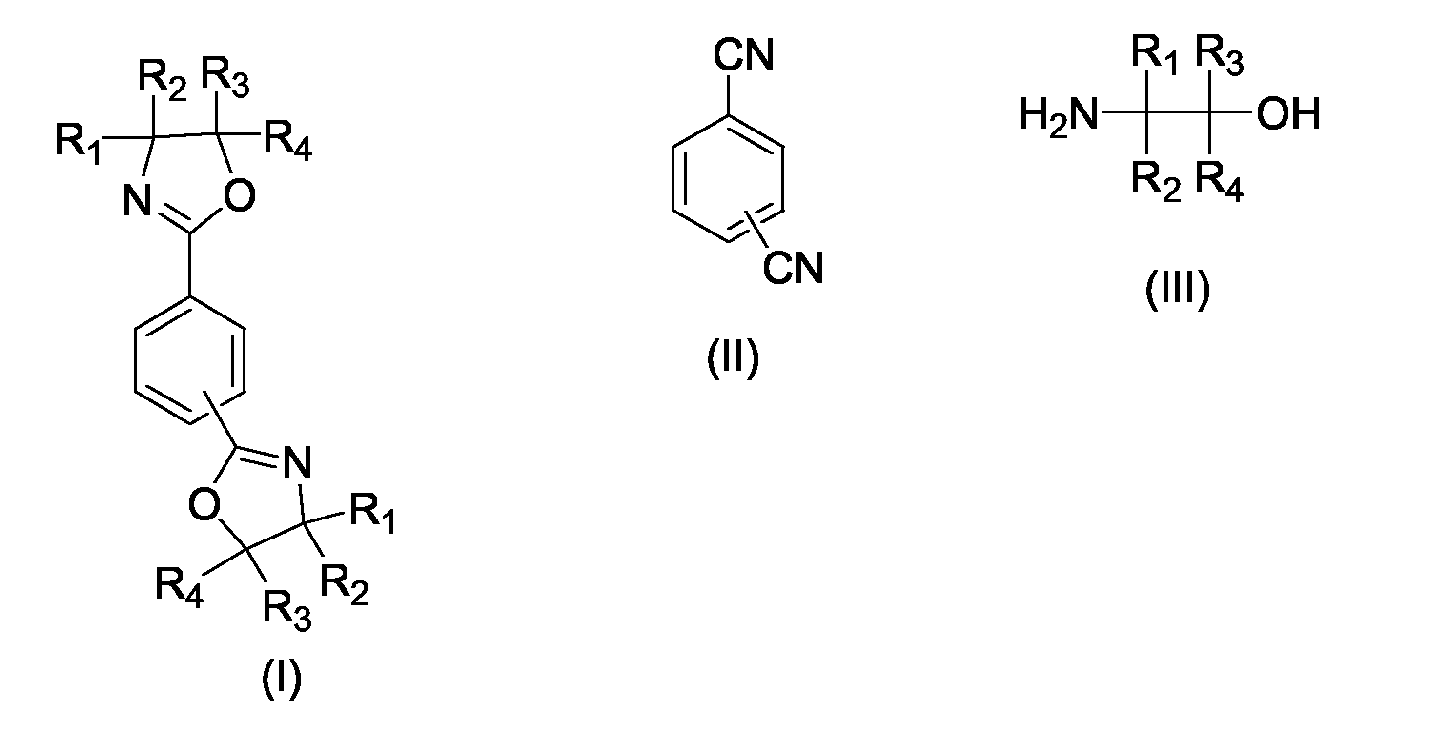
in Gegenwart eines geeigneten Katalysators, bei dem der Katalysator, der Aminoalkohol und
ggf. ein geeignetes Lösungsmittel bei Reaktionstemperatur vorgelegt werden und das jeweils
eingesetzte Dinitril zudosiert wird.The invention relates to a process for the preparation of 1,3-phenylenebisoxazolines and 1,4-phenylenebisoxazolines of the general formula I by reacting an aromatic dinitrile of the general formula II with a 2-aminoalcohol of the general formula III
in the presence of a suitable catalyst, in which the catalyst, the amino alcohol and optionally a suitable solvent are initially introduced at the reaction temperature and the particular dinitrile used is added.
Description
Die vorliegende Erfindung betrifft ein Verfahren zur Herstellung von Phenylenbisoxazolinen (I),
insbesondere von 2,2'-(1,4-Phenylen)bis-[4,5-dihydro-1,3-oxazol] und 2,2'-(1,3-Phenylen)bis-[4,5-dihydro-1,3-oxazol],
durch Umsetzung von Terephthalodinitril bzw. Isophthalodinitril (II)
mit 1,2-Aminoalkoholen (III) nach der allgemeinen Gleichung

Die durch das erfindungsgemäße Verfahren zugänglichen Phenylenbisoxazoline können u.a. als Kettenverlängerer oder Stabilisator in Polymeren, insbesondere in Polyestern und Polyamiden eingesetzt werden (Journal of Applied Polymer Science 1997, 65, 1813-1819; WO 0166633; WO 9634909).The phenylenebisoxazolines obtainable by the process according to the invention may i.a. when Chain extender or stabilizer in polymers, especially in polyesters and polyamides (Journal of Applied Polymer Science 1997, 65, 1813-1819, WO 0166633; WO 9634909).
Aus der Literatur sind dem Fachmann zahlreiche Synthesewege für die Herstellung von Phenylenbisoxazolinen bekannt.Numerous synthetic routes for the preparation of the skilled worker are known from the literature Phenylenbisoxazolinen known.
Als besonders vorteilhaft hat sich die einstufige Synthese dieser Verbindungen ausgehend von Terephthalodinitril bzw. Isophthalodinitril und einem beliebig substituierten 1,2-Aminoalkohol erwiesen. Obwohl die Cyclisierung insbesondere bei aromatischen Nitrilen auch ohne Katalysator abläuft (DE 21 35 644), ist eine wirtschaftliche Synthese nur auf katalytischem Wege möglich. Particularly advantageous is the one-stage synthesis of these compounds starting from Terephthalodinitrile or isophthalonitrile and an arbitrarily substituted 1,2-aminoalcohol proved. Although the cyclization especially in aromatic nitriles without Catalyst expires (DE 21 35 644), is an economical synthesis only on catalytic Ways possible.
Als Katalysatoren für die oben beschriebene Reaktion können beispielsweise gemäß DE 21 58 615, DE 21 27 776, CA-Nr. 94: 15 708 Salze anorganischer oder organischer Säuren von Metallen der 1., 2., 11. (IB) und 12. (IIB) Gruppe des Periodensystems dienen. Besonders häufig werden dabei die dem Fachmann bekannten Katalysatoren Zinkchlorid, Zinkacetat, Nickelacetat oder Cadmiumacetat eingesetzt. Darüber hinaus können laut US 3 741 961 auch z. B. Cobalt-, Chrom-, Eisen- und Kupferkatalysatoren für die gewünschte Heterocyclisierung verwendet werden.As catalysts for the reaction described above, for example, according to DE 21 58 615, DE 21 27 776, CA no. 94: 15 708 Salts of inorganic or organic acids of metals of the 1st, 2nd, 11th (IB) and 12th (IIB) group of the periodic table. Especially frequently the catalysts known to those skilled in the art are zinc chloride, zinc acetate, Nickel acetate or cadmium acetate used. In addition, according to US 3,741,961 also z. As cobalt, chromium, iron and copper catalysts for the desired heterocyclization be used.
Nachteil all dieser Verfahrensweisen ist zum einen der Einsatz von teils hochgiftigen Schwermetallverbindungen. Zum anderen sind die eingesetzten Schwermetallsalze nur zu einem geringen Teil im Reaktionsgemisch löslich und können insbesondere bei festen Phenylenbisoxazolin-Produkten nicht durch einfache Filtration vom Produkt abgetrennt werden, wie hier festgestellt wurde, im Gegensatz zu der Aussage aus DE 21 58 615 (Seite 5), nach der die Entfernung der Katalysatoren angeblich keine Schwierigkeiten bereiten würde. In den meisten Fällen ist somit zur Abtrennung des Katalysators durch Auflösen eine wässrige Aufarbeitung notwendig, bei der ein Schwermetall-belasteter Abwasserstrom anfällt, der kostenintensiv entsorgt werden muss.Disadvantage of all these procedures is the use of partly highly toxic on the one hand Heavy metal compounds. On the other hand, the heavy metal salts used are only one small part soluble in the reaction mixture and can be particularly solid Phenylenebisoxazoline products are not separated from the product by simple filtration, As stated here, in contrast to the statement from DE 21 58 615 (page 5), according to the The removal of the catalysts would allegedly not cause any difficulties. In the In most cases, therefore, the separation of the catalyst by dissolution of an aqueous Workup necessary, in which a heavy metal-contaminated wastewater stream is obtained, the must be disposed of cost-intensive.
Darüber hinaus weist vor allem das Verfahren nach DE 21 27 776 niedrige Ausbeuten von ca. 30 - 60 % und sehr lange Reaktionszeiten von bis zu 25 Stunden auf.In addition, especially the method according to DE 21 27 776 low yields of about 30 - 60% and very long reaction times of up to 25 hours.
Jüngere Patentschriften beschreiben den Einsatz von Ru- oder Rh-Edelmetallkomplexen als geeignete Katalysatoren für die Oxazolinsynthese wie beispielsweise JP 06056803. Diese Verbindungen sind jedoch für eine großtechnische Produktion der Zielverbindungen zu teuer.Recent patents describe the use of Ru or Rh noble metal complexes as suitable catalysts for oxazoline synthesis such as JP 06056803. This However, compounds are too expensive for large scale production of the target compounds.
Dass zur Beschleunigung des Reaktionsumsatzes der jeweilige Aminoalkohol bevorzugt im Überschuss eingesetzt wird, ist Stand der Technik. Eine Recyclierung der eingesetzten Überschüsse wird in den oben genannten Literaturstellen jedoch nicht beschrieben. Im Falle einer wässrigen Aufarbeitung gelangt überschüssiger Aminoalkohol sogar zusammen mit dem Katalysator in den Abwasserstrom. That in order to accelerate the reaction conversion of the respective amino alcohol preferably in Excess is used is state of the art. A recycling of the used However, excesses are not described in the abovementioned references. In the event of an aqueous workup reaches excess amino alcohol even with the Catalyst in the sewage stream.
In der Literatur wird bezüglich der Edukte keine bevorzugte Dosierreihenfolge oder Dosierweise beschrieben. Es ist jedoch bekannt, dass es bei der Reaktion von Dinitril mit Aminoalkohol mit oder ohne Katalysator zur Bildung intensiv gefärbter organischer Nebenprodukte (Chromophore) kommt, was sich durch die weiter unten ausgeführte Nacharbeitung von DE 21 58 615 nochmals bestätigt hat. Dies führt insbesondere bei schwerlöslichen Produkten, wie dem 2,2'-(1,4-Phenylen)bis-[4,5-dihydro-1,3-oxazol], zu Problemen, da verfärbtes Produkt nicht durch konventionelle Methoden wie z. B. Umkristallisation gereinigt werden kann. Da sich solche Produktverfärbungen selbst wenn sie nur in Spuren auftreten in den nachfolgenden Produkten oder Mischungen, insbesondere bei Anwendungen in Polymeren, fortpflanzen und zu nachteiligen Effekten führen, sind solche Verfärbungen unerwünscht.In the literature, with respect to the starting materials no preferred dosing or Dosing described. However, it is known that in the reaction of dinitrile with Aminoalcohol with or without catalyst to form intensively colored organic Byproducts (chromophores) come, as indicated by the below Reworking of DE 21 58 615 has confirmed again. This leads in particular poorly soluble products such as 2,2 '- (1,4-phenylene) bis- [4,5-dihydro-1,3-oxazole] Problems because discolored product not by conventional methods such. B. Recrystallization can be purified. Because such product discoloration even if they only in traces occur in the following products or mixtures, in particular at Applications in polymers, propagate and lead to adverse effects are those Discoloration undesirable.
Es bestand demnach die Aufgabe, ein im technischen Maßstab durchführbares Verfahren bereitzustellen, das die oben genannten Probleme löst und es erlaubt, hochreine und insbesondere farblose Phenylenbisoxazoline unter Recyclierung eingesetzter Überschüsse an Reagenzien und gegebenenfalls verwendeter Lösungsmittel mit Hilfe verfügbarer, möglichst untoxischer Katalysatoren in möglichst hoher Raum-Zeitausbeute herzustellen.It was therefore the task of an industrially feasible process which solves the above problems and allows it to be highly pure and in particular colorless phenylenebisoxazolines with recycling of used excesses Reagents and optionally used solvents by means of available, if possible produce nontoxic catalysts in the highest possible space-time yield.
Darüber hinaus sollte bei einem solchen Verfahren während der Aufarbeitung auf den Einsatz von Wasser oder wässrigen Mischungen verzichtet werden können und die Nachteile der herkömmlichen Verfahren vermieden werden.In addition, in such a process during the workup should be on the use water or aqueous mixtures can be dispensed with and the disadvantages of conventional methods are avoided.
Gelöst werden diese sowie weitere nicht explizit genannten Aufgaben, die jedoch aus den hierin diskutierten Zusammenhängen ohne weiteres ableitbar oder erschließbar sind durch ein Verfahren nach Anspruch 1. Zweckmäßige Ausformungen und Abwandlungen des erfindungsgemäßen Verfahrens werden in den auf Anspruch 1 rückbezogenen Unteransprüchen unter Schutz gestellt.These are solved as well as other tasks that are not explicitly mentioned, but which are made hereunder are easily derivable or can be deduced by a Method according to claim 1. Advantageous embodiments and modifications of the The method according to the invention are in the subclaims referring back to claim 1 put under protection.
Dadurch dass man zur Herstellung von 1,3-Phenylenbisoxazolinen und 1,4-Phenylenbisoxazolinen
der allgemeinen Formel I durch Umsetzung eines aromatischen Dinitrils
der allgemeinen Formel II mit einem 2-Aminoalkohol der allgemeinen Formel III
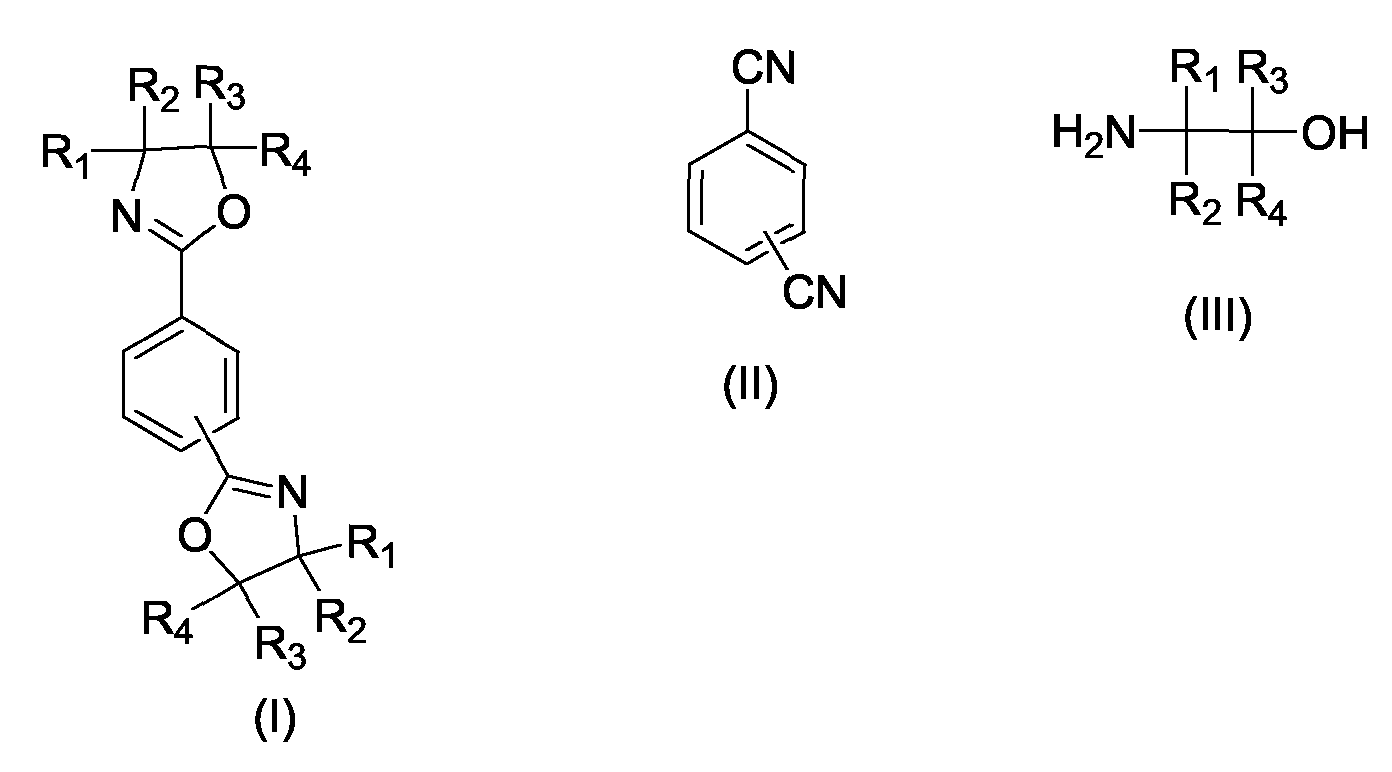
Dabei ist es vorteilhaft, wenn das jeweils eingesetzte Dinitril als Feststoff, als Schmelze oder in einem geeigneten Lösungsmittel gelöst zudosiert wird.It is advantageous if the particular dinitrile used as a solid, as a melt or in is added dissolved to a suitable solvent.
Durch die erfindungsgemäße Verfahrensweise bleibt zudem die Konzentration an aromatischem Dinitril im Reaktionsgemisch während der gesamten Reaktion niedrig, was im Gegensatz zur an sich technisch einfacheren Zudosierung des Aminoalkohols zum vorgelegten Dinitril oder der gemeinsamen Vorlage der Edukte offenbar dazu beiträgt, dass deutlich weniger farbige Nebenprodukte gebildet werden. Erfindungsgemäß erhält man die hochreinen Produkte als farblose Kristalle, ohne dass ein zusätzlicher Reinigungsschritt notwendig wäre.By the method according to the invention also remains the concentration of aromatic Dinitrile in the reaction mixture during the entire reaction low, which in contrast to technically easier addition of the amino alcohol to the presented dinitrile or the common template of the educts apparently contributes significantly less colored By-products are formed. According to the invention gives the high purity products as colorless crystals, without the need for an additional purification step.
Als vorteilhaft hat sich dabei der Einsatz von Zinkverbindungen als Katalysator erwiesen, wobei sowohl eine Zinkverbindung als auch ein Gemisch von mehreren Zinkverbindungen nebeneinander eingesetzt werden können. Vorzugsweise werden dabei Zinkcarbonsäuresalze von gesättigten, aliphatischen Carbonsäuren mit zwei bis zehn Kohlenstoffatomen eingesetzt, die sowohl verzweigt als auch unverzweigt sein können, wie beispielsweise Zinkacetat, Zinkpropionat, Zink-n-butyrat, Zinkisobutyrat etc. oder auch von Zink-2-ethylhexanoat, die jeweils als Einzelkomponente oder als Gemisch von mehreren Komponenten eingesetzt werden können. Ganz besonders bevorzugt wird dabei jedoch die Verwendung von Zink-2-ethylhexanoat als Katalysator. Als 2-Aminoalkohol wird erfindungsgemäß bevorzugt 2-Aminoethanol eingesetzt.The use of zinc compounds has proved to be advantageous as a catalyst, wherein both a zinc compound and a mixture of several zinc compounds can be used side by side. Zinc carboxylic acid salts are preferred of saturated, aliphatic carboxylic acids having from two to ten carbon atoms, which may be both branched and unbranched, such as zinc acetate, Zinc propionate, zinc n-butyrate, zinc isobutyrate etc. or also of zinc 2-ethylhexanoate, the each used as a single component or as a mixture of several components can. However, the use of zinc 2-ethylhexanoate is very particularly preferred as a catalyst. 2-aminoethanol is preferred according to the invention as 2-aminoalcohol used.
Die vorzugsweise zu verwendenden Zinkcarbonsäuresalze bieten den Vorteil großer katalytischer Aktivität bei gleichzeitig geringstmöglicher Toxizität und einfacher Handhabbarkeit, bei gleichzeitig guter Verfiigbarkeit.The zinc carboxylic acid salts to be preferably used offer the advantage of greater catalytic activity with the lowest possible toxicity and easier Handling, at the same time good availability.
Das molare Verhältnis von Aminoalkohol zu Dinitril beträgt dabei mindestens 2 : 1. Bevorzugt wird der Aminoalkohol jedoch in einem 4- bis 8-fachen molaren Verhältnis, bezogen auf das Dinitril eingesetzt. Dadurch wird die Konzentration an Dinitril während der Reaktion zusätzlich niedrig gehalten.The molar ratio of aminoalcohol to dinitrile is at least 2: 1. Preferred However, the aminoalcohol is in a 4- to 8-fold molar ratio, based on the Dinitrile used. This adds to the concentration of dinitrile during the reaction kept low.
Die Reaktion wird erfindungsgemäß im Temperaturbereich von etwa 50 °C bis etwa 200°C, vorzugsweise bei 100 °C bis 150 °C, durchgeführt, insbesondere aber bei einer Temperatur von 120 °C bis 140 °C.The reaction according to the invention in the temperature range of about 50 ° C to about 200 ° C, preferably at 100 ° C to 150 ° C, carried out, but especially at a temperature of 120 ° C to 140 ° C.
Je nach Substrat und technischen Voraussetzungen wird die Reaktion vorzugsweise bei Drücken von etwa 0.5 bara (= bar absolut) bis 10 bara durchgeführt.Depending on the substrate and technical requirements, the reaction is preferably at pressures from about 0.5 bara (= absolute bar) to 10 bara.
Dabei ist es insbesondere bei der Fahrweise unter leichtem Unterdruck (bezogen auf Normaldruck) von Vorteil, entstehendes Abgas damit schneller zu entfernen.It is particularly in the driving under slight negative pressure (based on Normal pressure) of advantage, thus resulting exhaust gas to remove faster.
Die Reaktion wird jedoch ganz besonders bevorzugt bei Normaldruck durchgeführt, da hier der geringste Aufwand erforderlich ist.However, the reaction is very particularly preferably carried out at atmospheric pressure, since here the least effort is required.
Die Reaktion kann mit oder ohne Lösungsmittel durchgeführt werden. Geeignete Lösungsmittel
sollten dabei unter den gewählten Reaktionsbedingungen inert sein und vorzugsweise mit dem
eingesetzten Aminoalkohol ein Azeotrop bilden, welches sich bei Raumtemperatur wieder in
seine Bestandteile auftrennt. Erfindungsgemäß bevorzugt werden dabei aromatische
Kohlenwasserstoffe oder Etherverbindungen, die insbesondere bei Verwendung von 2-Aminoethanol
die gewünschten Eigenschaften aufweisen.
Während der Synthese und der Isolierung der Phenylenbisoxazoline wird jedoch vorzugsweise
kein Wasser zugesetzt. Generell ist es von Vorteil, den überschüssigen Aminoalkohol während
und/oder im Anschluss an die Reaktion abzutrennen, vorzugsweise durch azeotrope Destillation
mit einem geeigneten Lösungsmittel.The reaction can be carried out with or without solvent. Suitable solvents should be inert under the chosen reaction conditions and preferably form an azeotrope with the amino alcohol used, which separates again at room temperature into its constituents. Aromatic hydrocarbons or ether compounds which have the desired properties, in particular when 2-aminoethanol is used, are preferred according to the invention.
However, during the synthesis and isolation of the phenylenebisoxazolines, preferably no water is added. In general, it is advantageous to separate the excess amino alcohol during and / or after the reaction, preferably by azeotropic distillation with a suitable solvent.
Dabei kann überschüssiger Aminoalkohol ohne wässrige Aufarbeitung durch azeotrope Destillation mit einem geeigneten Lösemittel wie z. B. Toluol, Xylol - in reiner Form oder als Isomerengemisch - oder Dibutylether im Falle von Ethanolamin in reiner Form isoliert und in die Reaktionsstufe zurückgeführt bzw. in weiteren Ansätzen wieder verwendet werden. Eine wässrige Aufarbeitung entfällt bei dem erfindungsgemäßen Verfahren somit völlig, was von großem Vorteil ist, weil damit gleichzeitig eine Entsorgung oder Aufbereitung belasteter Abwässer vermieden wird.In this case, excess amino alcohol without aqueous workup by azeotropic Distillation with a suitable solvent such. As toluene, xylene - in pure form or as Isomeric mixture or dibutyl ether isolated in the case of ethanolamine in pure form and in the reaction stage recycled or used in other approaches again. A aqueous work-up is therefore completely eliminated in the process according to the invention, which is from great advantage is because at the same time a disposal or treatment burdened Wastewater is avoided.
Die zu wählende Gesamtreaktionszeit, inklusive der Zeit der Zugabe von Reagenzien, ist dabei
abhängig von der Temperatur und kann erfindungsgemäß von 1 bis 14 Stunden reichen. Bei
Reaktionstemperaturen von 100 - 150 °C werden jedoch vorzugsweise Gesamtreaktionszeiten
von 1 bis 4 Stunden, insbesondere von 1,5 bis etwa 3 Stunden angewendet. Diese relativ kurze
Reaktionszeit bedeutet einen weiteren Vorteil gegenüber den bisher bekannten Verfahren, wie
beispielsweise dem von DE 2158615 , bei dem deutlich längere Reaktionszeiten von 6 bzw. 12
Stunden gemäß Beispiel 1 bzw. 2 angewendet werden müssen.
Dadurch gelingt es die Raum-Zeit-Ausbeuten in vorteilhafter Weise zu erhöhen, was für die
Wirtschaftlichkeit eines technischen Verfahrens eine ganz bedeutende Rolle spielt.The total reaction time to be chosen, including the time of the addition of reagents, is dependent on the temperature and can range from 1 to 14 hours according to the invention. At reaction temperatures of 100 ° to 150 ° C., however, total reaction times of from 1 to 4 hours, in particular from 1.5 to about 3 hours, are preferably used. This relatively short reaction time means a further advantage over the previously known methods, such as that of DE 2158615, in which significantly longer reaction times of 6 or 12 hours according to Example 1 or 2 must be used.
This makes it possible to increase the space-time yields in an advantageous manner, which plays a very important role for the economic efficiency of a technical process.
Die erfindungsgemäße Umsetzung von Dinitril mit Aminoalkohol kann sowohl diskontinuierlich, teilweise kontinuierlich oder aber auch kontinuierlich durchgeführt werden. Dies kann je nach technischen Voraussetzungen flexibel gehandhabt werden, was einen weiteren wichtigen Vorteil des Verfahrens darstellt.The reaction according to the invention of dinitrile with aminoalcohol can be carried out both batchwise and be carried out partly continuously or continuously. This can vary depending on technical requirements are handled flexibly, which is another important advantage represents the process.
Weiter kann es von Vorteil sein, am Ende der Reaktion vor dem Abkühlen der Reaktionsmischung eine geeignete Menge eines Lösungsvermittlers zuzusetzen, so dass die Reaktionsmischung bei Raumtemperatur eine homogene Flüssigphase bildet. Hier werden vorzugsweise kurzkettige lineare oder verzweigte aliphatische oder cycloaliphatische Alkohole mit einer Kettenlänge von C1 bis C6 verwendet, insbesondere jedoch Isopropanol. Auf diese Weise gelingt es kristallisierendes Produkt problemlos in einem Schritt z. B. durch Filtration von der Mutterlauge abzutrennen. Lösungsmittel und Lösungsvermittler können aus der Mutterlauge einfach destillativ zurückgewonnen werden und im Verfahren wieder eingesetzt werden.Further, it may be advantageous to add a suitable amount of a solubilizer at the end of the reaction before cooling the reaction mixture, so that the reaction mixture forms a homogeneous liquid phase at room temperature. Here, preferably short-chain linear or branched aliphatic or cycloaliphatic alcohols having a chain length of C 1 to C 6 are used, but in particular isopropanol. In this way, crystallizing product succeeds easily in one step z. B. by filtration from the mother liquor to separate. Solvents and solubilizers can be easily recovered by distillation from the mother liquor and used again in the process.
Das erfindungsgemäße Verfahren führt außerdem zu Produkten mit hervorragender Reinheit von über 99,0 %, vorzugsweise sogar von bis zu über 99,5 %, die überraschenderweise auch keinerlei Verfärbungen mehr aufweisen, im Gegensatz zu Produkten aus herkömmlichen Verfahren.The inventive method also leads to products with excellent purity from over 99.0%, preferably even up to over 99.5%, which surprisingly also no discoloration, as opposed to conventional products Method.
Wie das nach DE 21 5 816 , Beispiel 1 ausgeführte Vergleichsbeispiel desweiteren zeigt, führt
die dort angegebene Verfahrensweise zu einem deutlichen verfärbten Produkt im Gegensatz
zum erfindungsgemäßen Verfahren.
Dies wird insbesondere am Vergleich der relativen Weißgrade, gemessen nach DIN 5033
(Prinzip 45/0), deutlich, bei dem das erfindungsgemäße Produkt mit Werten von 75 % bzw. 82
- 92 % deutlich besser abschneidet im Vergleich zum Produkt des Vergleichsbeispiels mit einem
Wert von nur 39 %. Erfindungsgemäß ist es möglich, Weißgrade von > 70 %, bevorzugt von >
80 % insbesondere aber von > 90% zu erhalten.As the comparison example carried out according to DE 21 5 816, Example 1 further shows, the procedure given there leads to a distinct discolored product in contrast to the method according to the invention.
This is particularly evident in the comparison of the relative degrees of whiteness, measured according to DIN 5033 (Principle 45/0), in which the product according to the invention with values of 75% or 82-92% performs significantly better compared to the product of the comparative example with one value of only 39%. According to the invention, it is possible to obtain degrees of whiteness of> 70%, preferably of> 80% but in particular of> 90%.
Die erfindungsgemäßen Produkte können daher auch ohne weiteren Reinigungsaufwand direkt beispielsweise in Polymeren - wie eingangs beschrieben - weiterverwendet werden, was einen erheblichen Vorteil darstellt.The products of the invention can therefore directly without further purification For example, in polymers - as described above - continue to be used, which is a represents significant advantage.
Darüber hinaus wurde nun überraschenderweise gefunden, dass flüssiges Zink-2-ethylhexanoat
ganz generell hervorragend als Katalysator für die Synthese von Phenylenbisoxazolinen aus
Terephthalodinitril oder Isophthalodinitril geeignet ist. Im Vergleich zu Zinkacetat wird die
Reaktion mit Zink 2-ethylhexanoat deutlich beschleunigt. So zeigte etwa die Reaktion von
1 Molequivalent (moleq) Terephthalodinitril mit 2,28 moleq Ethanolamin und 0,05 moleq
Zinkacetat-dihydrat auch nach über 7 h bei 132 °C immer noch erhebliche Mengen des als
Zwischenprodukt entstehenden 4-(4,5-Dihydro-2-oxazolyl)-benzonitrils. Ein entsprechender
Versuch mit 0,05 moleq Zink 2-ethylhexanoat zeigte dagegen bereits nach 5 h vollständigen
Umsatz. Die Verwendung von Zink-2-ethylhexanoat ermöglicht damit eine deutliche
Verbesserung der Raum-Zeit-Ausbeute im Vergleich zum herkömmlichen Einsatz von
Zinkacetat oder anderer schwerer löslicher Zinksalze. Erfindungsgemäß werden bezogen auf
eingesetztes Dinitril 0,1 - 5 Mol-%, vorzugsweise 1 - 2 Mol-% Zink-2-ethylhexanoat
eingesetzt.
Ein weiterer Vorteil beim Einsatz von Zink-2-ethylhexanoat ist, dass dieser flüssige, im
Reaktionssystem relativ gut lösliche Katalysator ohne wäßrige Aufarbeitung während der
Filtration des Endproduktes in der Mutterlauge verbleibt und somit einfach und vollständig
abgetrennt werden kann.In addition, it has now surprisingly been found that liquid zinc 2-ethylhexanoate is generally very well suited as a catalyst for the synthesis of phenylenebisoxazolines from terephthalodinitrile or isophthalodinitrile. Compared to zinc acetate, the reaction with zinc 2-ethylhexanoate is significantly accelerated. Thus, for example, the reaction of 1 mole equivalent (moleq) terephthalodinitrile with 2.28 moleq ethanolamine and 0.05 moleq zinc acetate dihydrate, even after more than 7 h at 132 ° C, still showed significant amounts of the intermediate 4- (4.5- dihydro-2-oxazolyl) -benzonitrils. By contrast, a corresponding experiment with 0.05 moleq of zinc 2-ethylhexanoate already showed complete conversion after 5 h. The use of zinc 2-ethylhexanoate thus allows a significant improvement in the space-time yield compared to the conventional use of zinc acetate or other sparingly soluble zinc salts. Based on the dinitrile used, 0.1 to 5 mol%, preferably 1 to 2 mol%, of zinc 2-ethylhexanoate are used according to the invention.
Another advantage of using zinc 2-ethylhexanoate is that this liquid, relatively readily soluble in the reaction system catalyst without aqueous workup during the filtration of the final product in the mother liquor remains and thus can be easily and completely separated.
Zink-2-ethylhexanoat kann daher bei allen Verfahren zur Herstellung von 1,3-Phenylenbisoxazolinen und von 1,4-Phenylenbisoxazolinen der allgemeinen Formel I durch Umsetzung eines aromatischen Dinitrils der allgemeinen Formel II mit einem Aminoalkohol der allgemeinen Formel III vorteilhaft als Katalysator eingesetzt werden und löst insbesondere die Aufgaben einer verbesserten Raum-Zeit-Ausbeute, einer verbesserten Katalysatorabtrennung, der wasserfreien Aufarbeitung sowie der Durchführbarkeit im technischen Maßstab. Dem gemäß ist ein weiterer Aspekt der Erfindung ein Verfahren gemäß Anspruch 22.Zinc 2-ethylhexanoate can therefore be used in all processes for the preparation of 1,3-phenylenebisoxazolines and of 1,4-phenylenebisoxazolines of the general formula I Reaction of an aromatic dinitrile of the general formula II with an aminoalcohol of general formula III are used advantageously as a catalyst and solves in particular the Tasks of an improved space-time yield, improved catalyst separation, the anhydrous workup and feasibility on an industrial scale. According to Another aspect of the invention is a method according to claim 22.
Die folgenden Beispiele sollen das erfindungsgemäße Verfahren näher erläutern, nicht jedoch auf die speziell genannten Umstände einschränken.The following examples are intended to illustrate the process of the invention in more detail, but not to the specific circumstances mentioned.
Dabei wurden die folgenden analytischen Bestimmungsmethoden verwendet:
- Säule: fused silica, FS-SE-54
- Mobile Phase: Stickstoff
- Detektion: FID (Flammenionisationsdetektor)
- Temperaturprogramm: Start: 50 °C, Rate: 10 °C/min, Ende: 250 °C
- Injektionstemperatur: 250 °C
- Flußrate: 2 ml/min
- Säule: Hypersil MOS, 5 µm, 125 x 4 mm
- Mobile Phase: Wasser, Methanol, es wird ein Gradient gefahren
- Detektion: UV bei 242 bzw. 270 nm
- Temperatur: Raumtemperatur
- Flußrate: 1 ml/min
- Geräte: Colortester LFM1 (DR.LANGE), Emaille-Arbeitsstandard LZM 024 als unmittelbarem Weißstandard (gegen Referenzstandard Bariumsulfat = 100% Weißgrad geeicht), Pulverrundküvette mit 50 mm Durchmesser, Blaufilter (Z-Filter) mit Wellenlängenbereich 400 - 700 nm
- Durchführung: Das Gerät wird zunächst mit dem Emaille-Arbeitsstandard geeicht. Anschließend wird die Probe in der Rundküvette mit ca. 2 cm Füllstand gleichmäßig eingefüllt und in die Meßvorrichtung des Colortesters eingebracht. Danach wird die Probe unter 45 ° im gewählten Wellenlängenbereich (400 - 700 nm) beleuchtet und die diffuse Reflexion des Lichts unter 0° gemessen und mit der des Weißstandards verglichen. Der Rz-Wert wird vom Gerät ausgegeben und gibt den relativen Weißgrad in % bezogen auf den Referenzstandard Bariumsulfat (= 100 %) an.
- Column: fused silica, FS-SE-54
- Mobile phase: nitrogen
- Detection: FID (flame ionization detector)
- Temperature program: Start: 50 ° C, Rate: 10 ° C / min, End: 250 ° C
- Injection temperature: 250 ° C
- Flow rate: 2 ml / min
- Column: Hypersil MOS, 5 μm, 125 x 4 mm
- Mobile phase: water, methanol, a gradient is driven
- Detection: UV at 242 and 270 nm, respectively
- Temperature: room temperature
- Flow rate: 1 ml / min
- Equipment: Colortester LFM1 (DR.LANGE), enamel working standard LZM 024 as direct white standard (against reference standard barium sulphate = 100% whiteness calibrated), powder round cuvette with 50 mm diameter, blue filter (Z filter) with wavelength range 400 - 700 nm
- Procedure: The device is first calibrated with the enamel working standard. Subsequently, the sample is filled evenly in the round cuvette with about 2 cm level and introduced into the measuring device of the color tester. Thereafter, the sample is illuminated at 45 ° in the selected wavelength range (400-700 nm) and the diffuse reflection of the light is measured below 0 ° and compared with that of the white standard. The R z value is output by the device and indicates the relative brightness in% relative to the reference standard barium sulfate (= 100%).
In einem 1 L-Mehrhalskolben mit Flügelrührer, Sumpfkontaktthermometer, Wasserabscheider, Rückflusskühler, Feststoffdosierer (mit Förderschnecke) und Stickstoffabdeckung wurden 244,3 g Ethanolamin (4 moleq), 318,5 g Xylol und 23,7 g Zink-2-ethylhexanoat bei Raumtemperatur vorgelegt.In a 1 L multi-necked flask with paddle stirrer, bottom contact thermometer, water separator, Reflux condenser, solids feeder (with screw conveyor) and nitrogen blanket were 244.3 Ethanolamine (4 moleq), 318.5 g of xylene and 23.7 g of zinc 2-ethylhexanoate at room temperature submitted.
Die zunächst 2-phasige Suspension wurde unter Rühren bis auf Rückflusstemperatur erhitzt. Anschließend wurden 128,1 g (1 moleq) Isophtalodinitril (IPN) über einen Zeitraum von 2Std. kontinuierlich als Feststoff zum heißen Sumpf zudosiert. Dabei entstand Ammoniak als Abgas.The initially 2-phase suspension was heated with stirring to reflux temperature. Subsequently, 128.1 g (1 moleq) of isophtalodinitrile (IPN) over a period of 2h. continuously metered as a solid to the hot bottom. In the process, ammonia was formed as exhaust gas.
Nach Ende der IPN-Dosierung wurde das nun einphasige Reaktionsgemisch ca. 1Std. bei Rückflusstemperatur nachgerührt. After the end of the IPN dosage, the now single-phase reaction mixture was about 1 h. at Reflux temperature stirred.
Anschließend wurde überschüssiges Ethanolamin (EA) mit Hilfe eines Wasserabscheiders durch azeotrope Destillation soweit wie möglich aus dem Gemisch entfernt.Excess ethanolamine (EA) was then passed through with the aid of a water separator azeotropic distillation as far as possible from the mixture.
Das sich als separate Phase im Wasserabscheider sammelnde EA konnte direkt in weiteren Ansätzen eingesetzt werden.The EA, which accumulates as a separate phase in the water separator, could be used directly in further Approaches are used.
Nach Abkühlen des Reaktionsgemisches auf 80 °C wurden 100 g i-PrOH zum Sumpf hinzugegeben. Anschließend wurde das homogene Gemisch unter Rühren weiter bis auf Raumtemperatur abgekühlt. Die ausgefallenen Kristalle wurden über eine Glasfilternutsche abgesaugt, zweimal mit Cyclohexan gewaschen und anschließend im Vakuum getrocknet.After cooling the reaction mixture to 80 ° C, 100 g of i-PrOH to the bottom added. Subsequently, the homogeneous mixture was further stirred with stirring Room temperature cooled. The precipitated crystals were passed through a glass suction chute filtered off, washed twice with cyclohexane and then dried in vacuo.
Aus den organischen Wasch- und Filtrationslösungen konnten die verwendeten Lösungsmittel sehr einfach beispielsweise destillativ zurückgewonnen und in weiteren Ansätzen wieder eingesetzt werden.From the organic washing and filtration solutions, the solvents used very simply, for example, recovered by distillation and in further batches again be used.
Man erhielt 2,2'-(1,3-Phenylen)bis-[4,5-dihydro-1,3-oxazol] in Form farbloser, rieselfähiger Kristalle mit einer Reinheit >99,5 % (laut GC). Zusammen mit dem aus dem Filtrat durch Nachfällung isolierten Material lag die Gesamtausbeute an Zielprodukt bei 78 % d. Th.. Der Weißgrad (Rz) betrug 75 % (bezogen auf Bariumsulfat als Referenzstandard =100%) und nach Waschen mit Isopropanol 82%.This gave 2,2 '- (1,3-phenylene) bis- [4,5-dihydro-1,3-oxazole] in the form of colorless, free-flowing crystals with a purity of> 99.5% (according to GC). Together with the material isolated from the filtrate by replenishment, the total yield of target product was 78% d. Th. The whiteness (R z ) was 75% (based on barium sulfate as reference standard = 100%) and after washing with isopropanol 82%.
In einem 1 L-Mehrhalskolben mit Flügelrührer, Sumpfkontaktthermometer, Rückflusskühler,
Feststoffdosierapparatur (mit Förderschnecke) und Stickstoffabdeckung wurden 489 g
Ethanolamin (8 moleq) bei Raumtemperatur mit 17,6 g Zink-2-ethylhexanoat (0,05 moleq)
versetzt und unter Rühren auf eine Reaktionstemperatur von 130 °C erhitzt. Anschließend
wurden 128 g Terephthalodinitril (1 moleq) innerhalb von 2Std.kontinuierlich als Feststoff in
den beheizten Reaktionssumpf gefördert. Dabei entstand Ammoniak als Abgas. Nach ca. 1 Std.
begannen aus der homogenen, schwach gelblichen Lösung farblose Kristalle auszufallen.
Anders als beim Vergleichsbeispiel kam es hier zu keiner Grün- oder Blaufärbung der
Reaktionslösung. Nach Ende der TPN-Zugabe wurde das Reaktionsgemisch 1Std. bei 130 °C
nachgerührt. In a 1 L multi-necked flask with paddle stirrer, bottom contact thermometer, reflux condenser, solids metering apparatus (screw conveyor) and nitrogen blanket, 489 g of ethanolamine (8 moleq) at room temperature were added 17.6 g of zinc 2-ethylhexanoate (0.05 moleq) and stirred heated to a reaction temperature of 130 ° C. Subsequently, 128 g of terephthalodinitrile (1 moleq) were continuously fed as a solid into the heated reaction sump within 2 hours. In the process, ammonia was formed as exhaust gas. After about 1 hour, colorless crystals began to precipitate out of the homogeneous, slightly yellowish solution.
Unlike the comparative example, no green or blue coloration of the reaction solution occurred here. At the end of the TPN addition, the reaction mixture was allowed to stand for 1 h. stirred at 130 ° C.
Das Reaktionsgemisch wurde auf Raumtemperatur abgekühlt und die ausgefallenen Kristalle wurden über eine Glasfilternutsche (Porengröße Nr. 4) abgesaugt, nacheinander zweimal mit je 90 g Methanol auf der Nutsche gewaschen und in einem Rotationsverdampfer bei 25-10 mbar und 80 °C Badtemperatur 4 Stunden lang getrocknet. Man erhielt 2,2'-(1,4-Phenylen)bis-[4,5-dihydro-1,3-oxazol] in Form farbloser, rieselfähiger Kristalle. Zusammen mit dem durch Nachfällung aus der Ethanolamin-Mutterlauge gewonnenen Produkt lag die Ausbeute der Reaktion bei 75 % d. Th. bei einer Reinheit des Produkts von > 99,5 Gew.% (laut HPLC). Der Weißgrad (Rz) betrug 92 % (bezogen auf Bariumsulfat als Referenzstandard =100 %).The reaction mixture was cooled to room temperature and the precipitated crystals were filtered off with suction through a glass suction filter (pore size No. 4), successively washed twice with 90 g of methanol on the suction filter and in a rotary evaporator at 25-10 mbar and 80 ° C bath temperature for 4 hours dried. This gave 2,2 '- (1,4-phenylene) bis- [4,5-dihydro-1,3-oxazole] in the form of colorless, free-flowing crystals. Together with the product obtained by post-precipitation from the ethanolamine mother liquor, the yield of the reaction was 75% of theory. Th. At a purity of the product of> 99.5 wt.% (According to HPLC). The whiteness (R z ) was 92% (based on barium sulfate as reference standard = 100%).
92,3 g Terephthalsäuredinitril (TPN) wurden bei Raumtemperatur in 275 g Ethanolamin unter
Rühren eingetragen. Dann wurden 1,45 g Zinkacetatdihydrat zugegeben und im Stickstoffstrom
auf 100 °C erhitzt. Nach ca. 1 Std. war die Hauptmenge an TPN unter Abspaltung von
Ammoniak in Lösung gegangen und die Lösung zeigte eine intensiv dunkelgrüne Färbung.
Daraufhin wurden weitere 99,9 g TPN eingetragen, insgesamt also 1,5 Mol. Das Molverhältnis
TPN:Ethanolamin betrug demnach 1:3. Die Katalysatormenge betrug 0,75 Gew.% bezogen auf
TPN. Nach kurzer Zeit trat unter weiterer Ammoniakabspaltung Lösung ein. Bald darauf
begann das Reaktionsprodukt aus der tiefgrünen Lösung auszufallen. Es wurde 6 Std. auf 105-110
°C erhitzt.
Danach lag das Reaktionsprodukt als dicker Brei im überschüssigen Ethanolamin vor. Während
des Abkühlens verdünnte man durch Einrühren von 115 ml Isopropanol, wonach sich das
Reaktionsprodukt leicht abfiltrieren ließ. Der Kristallbrei wurde auf dem Filter mit 95 g
Isopropanol nachgewaschen. Danach wurde der Filterkuchen in viel Wasser (470 g) unter
Rühren aufgeschlämmt, filtriert und mit Wasser (dreimal mit je 200 g) kräftig nachgewaschen,
um das Ethanolamin quantitativ zu entfernen. Hiernach wurde noch mit Aceton (dreimal mit je
100 g) nachgewaschen, um die Hauptmenge Wasser zu entfernen, und anschließend getrocknet.
Es wurden 292 g grau-grünes Pulver enthalten, was einer Ausbeute von 89,9 % d. Th. an 2,2'-(1,4-Phenylen)
bis-[4,5-dihydro-1,3-oxazol] entspricht, bezogen auf eingesetztes TPN.
Der Schmelzpunkt des Produktes lag bei 238 - 247 °C bei einer Reinheit von: 99,1 Gew.%
(HPLC). 92.3 g of terephthalonitrile (TPN) were added at room temperature in 275 g of ethanolamine with stirring. Then, 1.45 g of zinc acetate dihydrate was added and heated to 100 ° C in a stream of nitrogen. After about 1 hour, the majority of TPN had gone into solution with elimination of ammonia and the solution showed an intense dark green color. Thereupon, a further 99.9 g of TPN were introduced, totaling 1.5 mol. The molar ratio TPN: ethanolamine was therefore 1: 3. The amount of catalyst was 0.75% by weight, based on TPN. After a short time, further ammonia cleavage occurred. Soon after, the reaction product began to precipitate out of the deep green solution. It was heated to 105-110 ° C for 6 hrs.
Thereafter, the reaction product was in the form of a thick slurry in the excess ethanolamine. While cooling, it was diluted by stirring in 115 ml of isopropanol, after which the reaction product was easily filtered off. The crystal slurry was washed on the filter with 95 g of isopropanol. Thereafter, the filter cake was slurried in plenty of water (470 g) with stirring, filtered and washed vigorously with water (three times with 200 g each) to quantitatively remove the ethanolamine. Thereafter, it was washed with acetone (three times with 100 g) to remove the bulk of water, and then dried. There were 292 g of gray-green powder, resulting in a yield of 89.9% d. Th. Corresponds to 2,2 '- (1,4-phenylene) bis- [4,5-dihydro-1,3-oxazole], based on TPN used.
The melting point of the product was 238-247 ° C. with a purity of 99.1% by weight (HPLC).
Der Weißgrad (Rz) betrug 39 % (bezogen auf Bariumsulfat als Referenzstandard =100%).The whiteness (R z ) was 39% (based on barium sulfate as reference standard = 100%).
Claims (23)
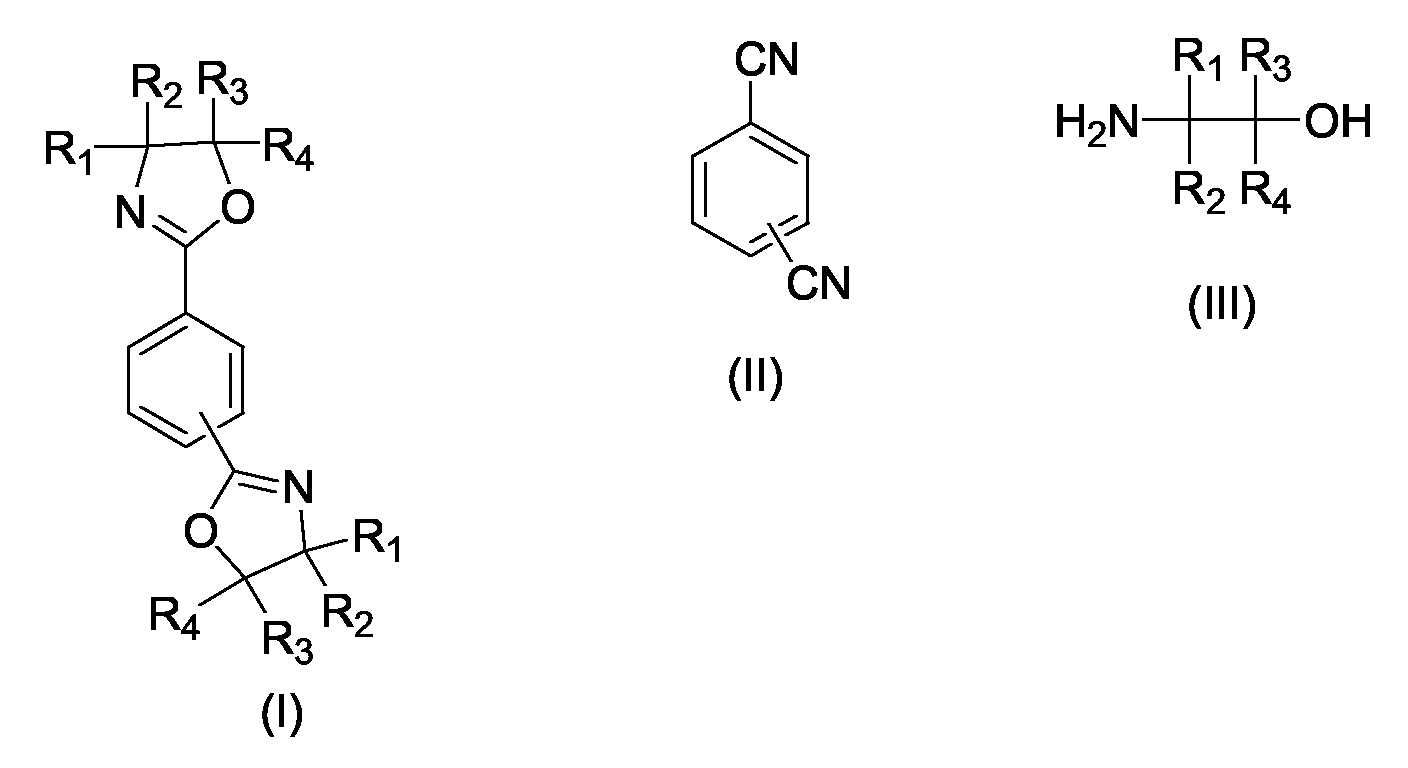
in Gegenwart eines geeigneten Katalysators,
dadurch gekennzeichnet, dass der Katalysator, der Aminoalkohol und ggf. ein geeignetes Lösungsmittel bei Reaktionstemperatur vorgelegt werden und das jeweils eingesetzte Dinitril zudosiert wird.A process for preparing 1,3-phenylenebisoxazolines and 1,4-phenylenebisoxazolines of general formula I by reacting an aromatic dinitrile of general formula II with a 2-aminoalcohol of general formula III
in the presence of a suitable catalyst,
characterized in that the catalyst, the amino alcohol and optionally a suitable solvent are initially charged at the reaction temperature and the particular dinitrile used is added.
dadurch gekennzeichnet, dass das jeweils eingesetzte Dinitril als Feststoff, als Schmelze oder in einem geeigneten Lösungsmittel gelöst zudosiert wird.Method according to claim 1,
characterized in that the particular dinitrile used is added dissolved as a solid, as a melt or in a suitable solvent.
dadurch gekennzeichnet, dass als Katalysator eine oder mehrere Zinkverbindungen eingesetzt werden. Method according to claim 1 or 2,
characterized in that as catalyst one or more zinc compounds are used.
dadurch gekennzeichnet, dass ein oder mehrere Zinkcarbonsäuresalze als Katalysator eingesetzt werden.Method according to claim 3,
characterized in that one or more zinc carboxylic acid salts are used as catalyst.
dadurch gekennzeichnet, dass als Katalysator Zink-2-ethylhexanoat eingesetzt wird.Method according to claim 4,
characterized in that the catalyst used is zinc 2-ethylhexanoate.
dadurch gekennzeichnet, dass als 2-Aminoalkohol 2-Aminoethanol eingesetzt wird.Method according to one of the preceding claims,
characterized in that is used as 2-aminoalcohol 2-aminoethanol.
dadurch gekennzeichnet, dass das molare Verhältnis von Aminoalkohol zu Dinitril mindestens 2 : 1 beträgt.Method according to one of the preceding claims,
characterized in that the molar ratio of aminoalcohol to dinitrile is at least 2: 1.
dadurch gekennzeichnet, dass das molare Verhältnis von Aminoalkohol zu Dinitril 4 : 1 bis 8 : 1 beträgt.Method according to claim 7,
characterized in that the molar ratio of aminoalcohol to dinitrile is 4: 1 to 8: 1.
dadurch gekennzeichnet, dass als Reaktionstemperatur eine Temperatur im Bereich von 50 °C bis 200 °C gewählt wird.Method according to one of the preceding claims,
characterized in that a temperature in the range of 50 ° C to 200 ° C is selected as the reaction temperature.
dadurch gekennzeichnet, dass als Reaktionstemperatur eine Temperatur im Bereich von 100 bis 150 °C, vorzugsweise im Bereich von 120 bis 140 °C gewählt wird.Method according to claim 9,
characterized in that a temperature in the range of 100 to 150 ° C, preferably in the range of 120 to 140 ° C is selected as the reaction temperature.
dadurch gekennzeichnet, dass als Abgas entstehender Ammoniak abgetrieben wird.Method according to one of the preceding claims,
characterized in that as exhaust gas resulting ammonia is driven off.
dadurch gekennzeichnet, dass der überschüssige Aminoalkohol während und/oder im Anschluss an die Reaktion abgetrennt wird.Method according to one of the preceding claims,
characterized in that the excess aminoalcohol is separated during and / or subsequent to the reaction.
dadurch gekennzeichnet, dass der überschüssige Aminoalkohol durch azeotrope Destillation abgetrennt wird.Method according to claim 12,
characterized in that the excess amino alcohol is separated by azeotropic distillation.
dadurch gekennzeichnet, dass der abgetrennte überschüssige Aminoalkohol in die Reaktionsstufe zurückgeführt wird.Method according to claim 12 or 13,
characterized in that the separated excess amino alcohol is recycled to the reaction stage.
dadurch gekennzeichnet, dass die Reaktion bei Drücken von 0.5 bara bis etwa 10 bara, vorzugsweise bei Drücken von 0.5 bara bis Normaldruck durchgeführt wird.Method according to one of the preceding claims,
characterized in that the reaction at pressures of 0.5 bara to about 10 bara, preferably at pressures of 0.5 bara to normal pressure is performed.
dadurch gekennzeichnet, dass während der Synthese und der Isolierung der Phenylenbisoxazoline kein Wasser zugesetzt wird.Method according to one of the preceding claims,
characterized in that no water is added during the synthesis and isolation of the phenylenebisoxazolines.
dadurch gekennzeichnet, dass die Reaktion in Gegenwart eines Lösungsmittels durchgeführt wird, das mit dem eingesetzten Aminoalkohol Azeotrope bilden kann, die sich bei Raumtemperatur wieder in ihre Bestandteile auftrennen.Method according to one of the preceding claims,
characterized in that the reaction is carried out in the presence of a solvent which can form azeotropes with the aminoalcohol used, which at room temperature are separated again into their constituents.
dadurch gekennzeichnet, dass als Lösungsmittel aromatische Kohlenwasserstoffe oder Etherverbindungen eingesetzt werden.Method according to claim 17,
characterized in that the solvents used are aromatic hydrocarbons or ether compounds.
dadurch gekennzeichnet, dass als Lösungsmittel Toluol, Xylol - isomerenrein oder als Isomerengemisch - oder Dibutylether eingesetzt werden.Method according to claim 18,
characterized in that the solvent used is toluene, xylene - isomerically pure or as a mixture of isomers or dibutyl ether.
dadurch gekennzeichnet, dass das Verfahren diskontinuierlich, teilweise kontinuierlich oder kontinuierlich durchgeführt wird.Method according to one of the preceding claims,
characterized in that the process is carried out batchwise, partially continuously or continuously.
dadurch gekennzeichnet, dass vor dem Abkühlen der Reaktionsmischung eine geeignete Menge eines Lösungsvermittlers zugesetzt wird, so dass die Reaktionsmischung bei Raumtemperatur eine homogene Flüssigphase bildet.Method according to one of the preceding claims,
characterized in that prior to cooling the reaction mixture, a suitable amount of a solubilizer is added, so that the reaction mixture forms a homogeneous liquid phase at room temperature.
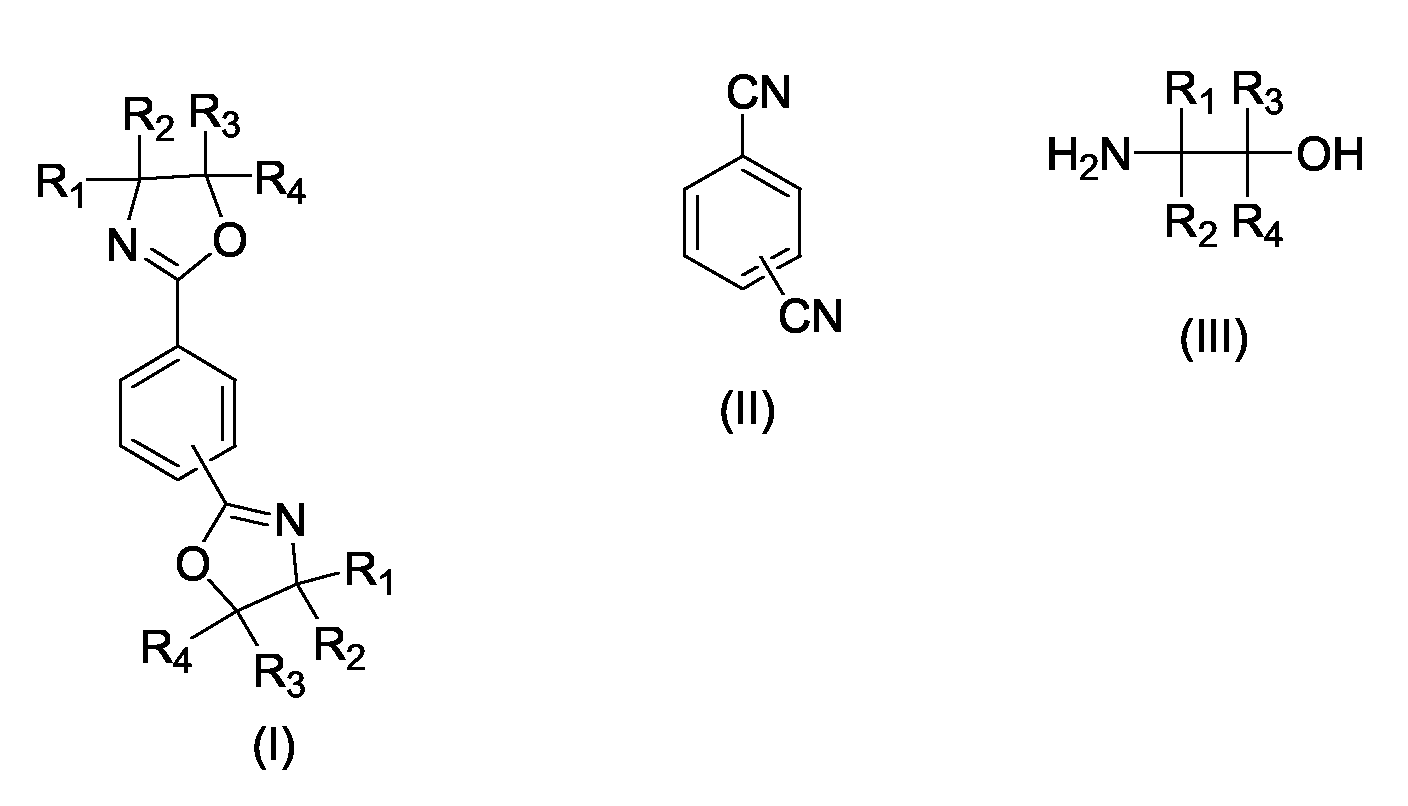
dadurch gekennzeichnet, dass als Katalysator Zink-2-ethylhexanoat eingesetzt wird.Process for the preparation of 1,3-phenylenebisoxazolines and of 1,4-phenylenebisoxazolines of the general formula I by reacting an aromatic dinitrile of the general formula II with an aminoalcohol of the general formula III,
characterized in that the catalyst used is zinc 2-ethylhexanoate.
dadurch gekennzeichnet, dass bezogen auf eingesetztes Dinitril 0,1 - 5 Mol-%, besonders bevorzugt 1 - 2 Mol-% Zink-2-ethylhexanoat als Katalysator eingesetzt werdenMethod according to claim 22,
characterized in that based on dinitrile used 0.1 to 5 mol%, particularly preferably 1 to 2 mol% of zinc 2-ethylhexanoate are used as a catalyst
Priority Applications (1)
| Application Number | Priority Date | Filing Date | Title |
|---|---|---|---|
| EP06118403A EP1801107B1 (en) | 2003-12-23 | 2004-10-29 | Process for the preparation of phenylenebisisoxazoles |
Applications Claiming Priority (2)
| Application Number | Priority Date | Filing Date | Title |
|---|---|---|---|
| DE10360757 | 2003-12-23 | ||
| DE10360757A DE10360757A1 (en) | 2003-12-23 | 2003-12-23 | Process for the preparation of phenylenebisoxazolines |
Related Child Applications (1)
| Application Number | Title | Priority Date | Filing Date |
|---|---|---|---|
| EP06118403A Division EP1801107B1 (en) | 2003-12-23 | 2004-10-29 | Process for the preparation of phenylenebisisoxazoles |
Publications (3)
| Publication Number | Publication Date |
|---|---|
| EP1548012A2 true EP1548012A2 (en) | 2005-06-29 |
| EP1548012A3 EP1548012A3 (en) | 2005-10-05 |
| EP1548012B1 EP1548012B1 (en) | 2007-10-03 |
Family
ID=34530361
Family Applications (2)
| Application Number | Title | Priority Date | Filing Date |
|---|---|---|---|
| EP06118403A Expired - Lifetime EP1801107B1 (en) | 2003-12-23 | 2004-10-29 | Process for the preparation of phenylenebisisoxazoles |
| EP04105404A Expired - Lifetime EP1548012B1 (en) | 2003-12-23 | 2004-10-29 | Method of preparation of phenylenebisoxazolines. |
Family Applications Before (1)
| Application Number | Title | Priority Date | Filing Date |
|---|---|---|---|
| EP06118403A Expired - Lifetime EP1801107B1 (en) | 2003-12-23 | 2004-10-29 | Process for the preparation of phenylenebisisoxazoles |
Country Status (4)
| Country | Link |
|---|---|
| EP (2) | EP1801107B1 (en) |
| AT (1) | ATE374756T1 (en) |
| DE (3) | DE10360757A1 (en) |
| ES (2) | ES2329604T3 (en) |
Cited By (4)
| Publication number | Priority date | Publication date | Assignee | Title |
|---|---|---|---|---|
| EP2166005A1 (en) | 2008-09-23 | 2010-03-24 | Evonik Degussa GmbH | Method for making phenylenebisoxazolines |
| WO2012082487A2 (en) | 2010-12-14 | 2012-06-21 | 3M Innovative Properties Company | Oxazolinyl-containing polymers and grafted compounds prepared from the oxazolinyl-containing polymers |
| US8834971B2 (en) | 2010-11-17 | 2014-09-16 | Evonik Degussa Gmbh | Process for continuous preparation of a prepolymer based on phenolic resins, oxazolines and epoxides |
| CN120058629A (en) * | 2025-02-27 | 2025-05-30 | 江苏维尤纳特精细化工有限公司 | Preparation method of 2,2- (1, 3-phenylene) bis (2-oxazoline) |
Family Cites Families (5)
| Publication number | Priority date | Publication date | Assignee | Title |
|---|---|---|---|---|
| US3741961A (en) * | 1970-09-03 | 1973-06-26 | Jefferson Chem Co Inc | Metal catalyzed cyclization of organic nitriles and amino alcohols oramino thiols |
| BE791871A (en) * | 1971-11-26 | 1973-03-16 | Veba Chemie Ag | PROCESS FOR PREPARING CYCLIC IMIDO-ACID ESTERS, AND PRODUCTS OBTAINED |
| DE3224880A1 (en) * | 1982-07-03 | 1984-01-05 | Chemische Werke Hüls AG, 4370 Marl | METHOD FOR PRODUCING PURE, WATER-FREE IMIDOIC ACID ESTERS BY REALIZING NITRILE WITH AMINO ALCOHOLS |
| GB9021051D0 (en) * | 1990-09-27 | 1990-11-07 | Ici Plc | Catalyst composition |
| JPH05140129A (en) * | 1991-11-15 | 1993-06-08 | Kao Corp | Method for producing cyclic imino ether |
-
2003
- 2003-12-23 DE DE10360757A patent/DE10360757A1/en not_active Withdrawn
-
2004
- 2004-10-29 ES ES06118403T patent/ES2329604T3/en not_active Expired - Lifetime
- 2004-10-29 AT AT04105404T patent/ATE374756T1/en not_active IP Right Cessation
- 2004-10-29 ES ES04105404T patent/ES2294433T3/en not_active Expired - Lifetime
- 2004-10-29 EP EP06118403A patent/EP1801107B1/en not_active Expired - Lifetime
- 2004-10-29 EP EP04105404A patent/EP1548012B1/en not_active Expired - Lifetime
- 2004-10-29 DE DE502004005125T patent/DE502004005125D1/en not_active Expired - Lifetime
- 2004-10-29 DE DE502004009770T patent/DE502004009770D1/en not_active Expired - Lifetime
Cited By (10)
| Publication number | Priority date | Publication date | Assignee | Title |
|---|---|---|---|---|
| EP2166005A1 (en) | 2008-09-23 | 2010-03-24 | Evonik Degussa GmbH | Method for making phenylenebisoxazolines |
| CN101684105A (en) * | 2008-09-23 | 2010-03-31 | 赢创德固赛有限责任公司 | Process for preparing heterocycles |
| WO2010034562A1 (en) * | 2008-09-23 | 2010-04-01 | Evonik Degussa Gmbh | Method for producing phenylene bis-oxazolines |
| JP2010077129A (en) * | 2008-09-23 | 2010-04-08 | Evonik Degussa Gmbh | Method for producing heterocyclic compound |
| US8222406B2 (en) | 2008-09-23 | 2012-07-17 | Evonik Degussa Gmbh | Process for preparing heterocycles |
| CN101684105B (en) * | 2008-09-23 | 2014-09-10 | 赢创德固赛有限责任公司 | Process for preparing heterocycles |
| US8834971B2 (en) | 2010-11-17 | 2014-09-16 | Evonik Degussa Gmbh | Process for continuous preparation of a prepolymer based on phenolic resins, oxazolines and epoxides |
| WO2012082487A2 (en) | 2010-12-14 | 2012-06-21 | 3M Innovative Properties Company | Oxazolinyl-containing polymers and grafted compounds prepared from the oxazolinyl-containing polymers |
| US8816004B2 (en) | 2010-12-14 | 2014-08-26 | 3M Innovative Properties Company | Oxazolinyl-containing polymers and grafted compounds prepared from the oxazolinyl-containing polymers |
| CN120058629A (en) * | 2025-02-27 | 2025-05-30 | 江苏维尤纳特精细化工有限公司 | Preparation method of 2,2- (1, 3-phenylene) bis (2-oxazoline) |
Also Published As
| Publication number | Publication date |
|---|---|
| ES2329604T3 (en) | 2009-11-27 |
| DE502004005125D1 (en) | 2007-11-15 |
| ES2294433T3 (en) | 2008-04-01 |
| DE502004009770D1 (en) | 2009-08-27 |
| EP1548012B1 (en) | 2007-10-03 |
| EP1801107A1 (en) | 2007-06-27 |
| DE10360757A1 (en) | 2005-07-28 |
| ATE374756T1 (en) | 2007-10-15 |
| EP1548012A3 (en) | 2005-10-05 |
| EP1801107B1 (en) | 2009-07-15 |
Similar Documents
| Publication | Publication Date | Title |
|---|---|---|
| EP1801107B1 (en) | Process for the preparation of phenylenebisisoxazoles | |
| DE1966974A1 (en) | DIMETHYLFORMIMINIUM HALOGENSULPHITE-N-HALOGENIDES, METHOD OF PREPARATION AND USE | |
| DE112016003289T5 (en) | PROCESS FOR PREPARING A 4- (TRIFLUOROMETHYLSULFONYL) PHENOL COMPOUND | |
| EP0628536A2 (en) | Process for the preparation of amines | |
| DE69829613T2 (en) | Process for the preparation of heteroarylcarboxylic acid amides and esters | |
| EP0548650A1 (en) | Process for the preparation of substituted 3-alkoxy-acrylic acid esters | |
| DE69219582T2 (en) | NEW CONNECTION AND SEPARATORY REPUBLIC | |
| DE19835866B4 (en) | Process for the preparation of 5-perfluoroalkyluracil derivatives | |
| EP1296962B1 (en) | Method for preparing substituted 5-amino-n-phenyl-1,2,4-triazole-3-sulfonamides | |
| EP0705815B1 (en) | Process for the preparation of N-arylaminoacrylic acid derivatives | |
| EP0688763B1 (en) | Process for preparing anilides of hydroxycarboxylic acids | |
| WO2001090062A2 (en) | Method for the production of trifluoroethoxy-substituted benzoic acids | |
| EP0551632A2 (en) | Process for the preparation of halogenoanthranilic acid | |
| EP0634411B1 (en) | Process for the preparation of 8- 4'-[4"-(pyrimidin-2'''-yl)-piperazin-1''-yl]-butyl -8-aza-spiro[4,5]decan-7,9-dione and of its hydrochlorides of high purity | |
| DE2619321C2 (en) | Oxalic acid derivatives, their production and their use | |
| EP0152598A1 (en) | Cyanomethyl-(2-cyano-ethyl)-(3-hydroxy-propyl)-amine and its use for the production of 1-(3-hydroxy-propyl)-1,4-diazepan and 1,4-bis-[3-(3,4,5-trimethoxy-benzoyloxy)-propyl]-diazepan | |
| WO2004037795A1 (en) | Method for the production of 2-amino-4-chloro-6-alkoxypyrimidines | |
| DE10231496B4 (en) | Process for the preparation of high purity, crystalline 4-amino-5,6-dimethoxypyrimidine | |
| EP0423595B1 (en) | Process for the preparation of 3-trichloromethyl pyridine | |
| EP0523619A2 (en) | Process for the preparation of N-cyanimidocarbonates | |
| EP0224902A1 (en) | Process for the preparation of D-threo-1(p-methylsulfonylphenyl)-2-dichloracetamido-propandiol-1,3-(Thiamphenicol)and use of suitable intermediate products | |
| DE3607993A1 (en) | METHOD FOR PRODUCING DIAZIRIDINES AND PRODUCTS THEREOF | |
| WO2001096277A1 (en) | Method for producing 2,3,4,6-tetramethyl mandelic acid and 2,3,4,6-tetramethyl mandelic acid acetate | |
| EP1070706B1 (en) | Process for the preparation of 1-substituted 5-hydroxy-imidazolin-2,4-diones and 1-substituted 5-alkoxy-imidazolin-2,4-diones | |
| DE4331223A1 (en) | Process for the preparation of 2-ethoxy-4,6-dihydroxypyrimidine or its alkali salt |
Legal Events
| Date | Code | Title | Description |
|---|---|---|---|
| PUAI | Public reference made under article 153(3) epc to a published international application that has entered the european phase |
Free format text: ORIGINAL CODE: 0009012 |
|
| 17P | Request for examination filed |
Effective date: 20041029 |
|
| AK | Designated contracting states |
Kind code of ref document: A2 Designated state(s): AT BE BG CH CY CZ DE DK EE ES FI FR GB GR HU IE IT LI LU MC NL PL PT RO SE SI SK TR |
|
| AX | Request for extension of the european patent |
Extension state: AL HR LT LV MK |
|
| PUAL | Search report despatched |
Free format text: ORIGINAL CODE: 0009013 |
|
| AK | Designated contracting states |
Kind code of ref document: A3 Designated state(s): AT BE BG CH CY CZ DE DK EE ES FI FR GB GR HU IE IT LI LU MC NL PL PT RO SE SI SK TR |
|
| AX | Request for extension of the european patent |
Extension state: AL HR LT LV MK |
|
| AKX | Designation fees paid |
Designated state(s): AT BE BG CH CY CZ DE DK EE ES FI FR GB GR HU IE IT LI LU MC NL PL PT RO SE SI SK TR |
|
| 17Q | First examination report despatched |
Effective date: 20060614 |
|
| RAP1 | Party data changed (applicant data changed or rights of an application transferred) |
Owner name: DEGUSSA GMBH |
|
| GRAP | Despatch of communication of intention to grant a patent |
Free format text: ORIGINAL CODE: EPIDOSNIGR1 |
|
| GRAS | Grant fee paid |
Free format text: ORIGINAL CODE: EPIDOSNIGR3 |
|
| GRAA | (expected) grant |
Free format text: ORIGINAL CODE: 0009210 |
|
| AK | Designated contracting states |
Kind code of ref document: B1 Designated state(s): AT BE BG CH CY CZ DE DK EE ES FI FR GB GR HU IE IT LI LU MC NL PL PT RO SE SI SK TR |
|
| REG | Reference to a national code |
Ref country code: GB Ref legal event code: FG4D Free format text: NOT ENGLISH |
|
| REG | Reference to a national code |
Ref country code: CH Ref legal event code: EP |
|
| RAP2 | Party data changed (patent owner data changed or rights of a patent transferred) |
Owner name: EVONIK DEGUSSA GMBH |
|
| REG | Reference to a national code |
Ref country code: IE Ref legal event code: FG4D Free format text: LANGUAGE OF EP DOCUMENT: GERMAN |
|
| REF | Corresponds to: |
Ref document number: 502004005125 Country of ref document: DE Date of ref document: 20071115 Kind code of ref document: P |
|
| GBT | Gb: translation of ep patent filed (gb section 77(6)(a)/1977) |
Effective date: 20071205 |
|
| NLT2 | Nl: modifications (of names), taken from the european patent patent bulletin |
Owner name: EVONIK DEGUSSA GMBH Effective date: 20071107 |
|
| NLV1 | Nl: lapsed or annulled due to failure to fulfill the requirements of art. 29p and 29m of the patents act | ||
| REG | Reference to a national code |
Ref country code: ES Ref legal event code: FG2A Ref document number: 2294433 Country of ref document: ES Kind code of ref document: T3 |
|
| PG25 | Lapsed in a contracting state [announced via postgrant information from national office to epo] |
Ref country code: NL Free format text: LAPSE BECAUSE OF FAILURE TO SUBMIT A TRANSLATION OF THE DESCRIPTION OR TO PAY THE FEE WITHIN THE PRESCRIBED TIME-LIMIT Effective date: 20071003 Ref country code: SE Free format text: LAPSE BECAUSE OF FAILURE TO SUBMIT A TRANSLATION OF THE DESCRIPTION OR TO PAY THE FEE WITHIN THE PRESCRIBED TIME-LIMIT Effective date: 20080103 |
|
| ET | Fr: translation filed | ||
| PG25 | Lapsed in a contracting state [announced via postgrant information from national office to epo] |
Ref country code: BG Free format text: LAPSE BECAUSE OF FAILURE TO SUBMIT A TRANSLATION OF THE DESCRIPTION OR TO PAY THE FEE WITHIN THE PRESCRIBED TIME-LIMIT Effective date: 20080103 Ref country code: MC Free format text: LAPSE BECAUSE OF NON-PAYMENT OF DUE FEES Effective date: 20071031 Ref country code: PL Free format text: LAPSE BECAUSE OF FAILURE TO SUBMIT A TRANSLATION OF THE DESCRIPTION OR TO PAY THE FEE WITHIN THE PRESCRIBED TIME-LIMIT Effective date: 20071003 Ref country code: PT Free format text: LAPSE BECAUSE OF FAILURE TO SUBMIT A TRANSLATION OF THE DESCRIPTION OR TO PAY THE FEE WITHIN THE PRESCRIBED TIME-LIMIT Effective date: 20080303 |
|
| REG | Reference to a national code |
Ref country code: IE Ref legal event code: FD4D |
|
| PG25 | Lapsed in a contracting state [announced via postgrant information from national office to epo] |
Ref country code: DK Free format text: LAPSE BECAUSE OF FAILURE TO SUBMIT A TRANSLATION OF THE DESCRIPTION OR TO PAY THE FEE WITHIN THE PRESCRIBED TIME-LIMIT Effective date: 20071003 Ref country code: CZ Free format text: LAPSE BECAUSE OF FAILURE TO SUBMIT A TRANSLATION OF THE DESCRIPTION OR TO PAY THE FEE WITHIN THE PRESCRIBED TIME-LIMIT Effective date: 20071003 |
|
| RAP2 | Party data changed (patent owner data changed or rights of a patent transferred) |
Owner name: EVONIK DEGUSSA GMBH |
|
| PLBE | No opposition filed within time limit |
Free format text: ORIGINAL CODE: 0009261 |
|
| STAA | Information on the status of an ep patent application or granted ep patent |
Free format text: STATUS: NO OPPOSITION FILED WITHIN TIME LIMIT |
|
| PG25 | Lapsed in a contracting state [announced via postgrant information from national office to epo] |
Ref country code: RO Free format text: LAPSE BECAUSE OF FAILURE TO SUBMIT A TRANSLATION OF THE DESCRIPTION OR TO PAY THE FEE WITHIN THE PRESCRIBED TIME-LIMIT Effective date: 20071003 Ref country code: SK Free format text: LAPSE BECAUSE OF FAILURE TO SUBMIT A TRANSLATION OF THE DESCRIPTION OR TO PAY THE FEE WITHIN THE PRESCRIBED TIME-LIMIT Effective date: 20071003 |
|
| 26N | No opposition filed |
Effective date: 20080704 |
|
| PG25 | Lapsed in a contracting state [announced via postgrant information from national office to epo] |
Ref country code: IE Free format text: LAPSE BECAUSE OF FAILURE TO SUBMIT A TRANSLATION OF THE DESCRIPTION OR TO PAY THE FEE WITHIN THE PRESCRIBED TIME-LIMIT Effective date: 20071003 |
|
| PG25 | Lapsed in a contracting state [announced via postgrant information from national office to epo] |
Ref country code: GR Free format text: LAPSE BECAUSE OF FAILURE TO SUBMIT A TRANSLATION OF THE DESCRIPTION OR TO PAY THE FEE WITHIN THE PRESCRIBED TIME-LIMIT Effective date: 20080104 Ref country code: EE Free format text: LAPSE BECAUSE OF FAILURE TO SUBMIT A TRANSLATION OF THE DESCRIPTION OR TO PAY THE FEE WITHIN THE PRESCRIBED TIME-LIMIT Effective date: 20071003 |
|
| PG25 | Lapsed in a contracting state [announced via postgrant information from national office to epo] |
Ref country code: FI Free format text: LAPSE BECAUSE OF FAILURE TO SUBMIT A TRANSLATION OF THE DESCRIPTION OR TO PAY THE FEE WITHIN THE PRESCRIBED TIME-LIMIT Effective date: 20071003 |
|
| PG25 | Lapsed in a contracting state [announced via postgrant information from national office to epo] |
Ref country code: SI Free format text: LAPSE BECAUSE OF FAILURE TO SUBMIT A TRANSLATION OF THE DESCRIPTION OR TO PAY THE FEE WITHIN THE PRESCRIBED TIME-LIMIT Effective date: 20071003 |
|
| PG25 | Lapsed in a contracting state [announced via postgrant information from national office to epo] |
Ref country code: CY Free format text: LAPSE BECAUSE OF FAILURE TO SUBMIT A TRANSLATION OF THE DESCRIPTION OR TO PAY THE FEE WITHIN THE PRESCRIBED TIME-LIMIT Effective date: 20071003 |
|
| PG25 | Lapsed in a contracting state [announced via postgrant information from national office to epo] |
Ref country code: LU Free format text: LAPSE BECAUSE OF NON-PAYMENT OF DUE FEES Effective date: 20071029 |
|
| PG25 | Lapsed in a contracting state [announced via postgrant information from national office to epo] |
Ref country code: HU Free format text: LAPSE BECAUSE OF FAILURE TO SUBMIT A TRANSLATION OF THE DESCRIPTION OR TO PAY THE FEE WITHIN THE PRESCRIBED TIME-LIMIT Effective date: 20080404 Ref country code: TR Free format text: LAPSE BECAUSE OF FAILURE TO SUBMIT A TRANSLATION OF THE DESCRIPTION OR TO PAY THE FEE WITHIN THE PRESCRIBED TIME-LIMIT Effective date: 20071003 |
|
| PGFP | Annual fee paid to national office [announced via postgrant information from national office to epo] |
Ref country code: AT Payment date: 20091015 Year of fee payment: 6 Ref country code: CH Payment date: 20091026 Year of fee payment: 6 Ref country code: DE Payment date: 20091026 Year of fee payment: 6 Ref country code: ES Payment date: 20091023 Year of fee payment: 6 |
|
| PGFP | Annual fee paid to national office [announced via postgrant information from national office to epo] |
Ref country code: FR Payment date: 20091110 Year of fee payment: 6 Ref country code: GB Payment date: 20091022 Year of fee payment: 6 Ref country code: IT Payment date: 20091024 Year of fee payment: 6 |
|
| PGFP | Annual fee paid to national office [announced via postgrant information from national office to epo] |
Ref country code: BE Payment date: 20091130 Year of fee payment: 6 |
|
| BERE | Be: lapsed |
Owner name: EVONIK DEGUSSA G.M.B.H. Effective date: 20101031 |
|
| REG | Reference to a national code |
Ref country code: CH Ref legal event code: PL |
|
| GBPC | Gb: european patent ceased through non-payment of renewal fee |
Effective date: 20101029 |
|
| PG25 | Lapsed in a contracting state [announced via postgrant information from national office to epo] |
Ref country code: CH Free format text: LAPSE BECAUSE OF NON-PAYMENT OF DUE FEES Effective date: 20101031 Ref country code: FR Free format text: LAPSE BECAUSE OF NON-PAYMENT OF DUE FEES Effective date: 20101102 Ref country code: LI Free format text: LAPSE BECAUSE OF NON-PAYMENT OF DUE FEES Effective date: 20101031 |
|
| REG | Reference to a national code |
Ref country code: FR Ref legal event code: ST Effective date: 20110630 |
|
| PG25 | Lapsed in a contracting state [announced via postgrant information from national office to epo] |
Ref country code: GB Free format text: LAPSE BECAUSE OF NON-PAYMENT OF DUE FEES Effective date: 20101029 Ref country code: BE Free format text: LAPSE BECAUSE OF NON-PAYMENT OF DUE FEES Effective date: 20101031 Ref country code: AT Free format text: LAPSE BECAUSE OF NON-PAYMENT OF DUE FEES Effective date: 20101029 |
|
| REG | Reference to a national code |
Ref country code: DE Ref legal event code: R119 Ref document number: 502004005125 Country of ref document: DE Effective date: 20110502 |
|
| REG | Reference to a national code |
Ref country code: ES Ref legal event code: FD2A Effective date: 20111118 |
|
| PG25 | Lapsed in a contracting state [announced via postgrant information from national office to epo] |
Ref country code: IT Free format text: LAPSE BECAUSE OF NON-PAYMENT OF DUE FEES Effective date: 20101029 |
|
| PG25 | Lapsed in a contracting state [announced via postgrant information from national office to epo] |
Ref country code: ES Free format text: LAPSE BECAUSE OF NON-PAYMENT OF DUE FEES Effective date: 20101030 |
|
| PG25 | Lapsed in a contracting state [announced via postgrant information from national office to epo] |
Ref country code: DE Free format text: LAPSE BECAUSE OF NON-PAYMENT OF DUE FEES Effective date: 20110502 |