EP1547983A1 - Apatit enthaltender film und Verfahren zu dessen Herstellung - Google Patents
Apatit enthaltender film und Verfahren zu dessen Herstellung Download PDFInfo
- Publication number
- EP1547983A1 EP1547983A1 EP04253440A EP04253440A EP1547983A1 EP 1547983 A1 EP1547983 A1 EP 1547983A1 EP 04253440 A EP04253440 A EP 04253440A EP 04253440 A EP04253440 A EP 04253440A EP 1547983 A1 EP1547983 A1 EP 1547983A1
- Authority
- EP
- European Patent Office
- Prior art keywords
- apatite
- precursor composition
- light
- substrate
- containing compound
- Prior art date
- Legal status (The legal status is an assumption and is not a legal conclusion. Google has not performed a legal analysis and makes no representation as to the accuracy of the status listed.)
- Granted
Links
Images



Classifications
-
- C—CHEMISTRY; METALLURGY
- C03—GLASS; MINERAL OR SLAG WOOL
- C03C—CHEMICAL COMPOSITION OF GLASSES, GLAZES OR VITREOUS ENAMELS; SURFACE TREATMENT OF GLASS; SURFACE TREATMENT OF FIBRES OR FILAMENTS MADE FROM GLASS, MINERALS OR SLAGS; JOINING GLASS TO GLASS OR OTHER MATERIALS
- C03C17/00—Surface treatment of glass, not in the form of fibres or filaments, by coating
- C03C17/22—Surface treatment of glass, not in the form of fibres or filaments, by coating with other inorganic material
-
- C—CHEMISTRY; METALLURGY
- C01—INORGANIC CHEMISTRY
- C01B—NON-METALLIC ELEMENTS; COMPOUNDS THEREOF; METALLOIDS OR COMPOUNDS THEREOF NOT COVERED BY SUBCLASS C01C
- C01B25/00—Phosphorus; Compounds thereof
- C01B25/16—Oxyacids of phosphorus; Salts thereof
- C01B25/26—Phosphates
- C01B25/32—Phosphates of magnesium, calcium, strontium, or barium
-
- C—CHEMISTRY; METALLURGY
- C03—GLASS; MINERAL OR SLAG WOOL
- C03C—CHEMICAL COMPOSITION OF GLASSES, GLAZES OR VITREOUS ENAMELS; SURFACE TREATMENT OF GLASS; SURFACE TREATMENT OF FIBRES OR FILAMENTS MADE FROM GLASS, MINERALS OR SLAGS; JOINING GLASS TO GLASS OR OTHER MATERIALS
- C03C17/00—Surface treatment of glass, not in the form of fibres or filaments, by coating
- C03C17/22—Surface treatment of glass, not in the form of fibres or filaments, by coating with other inorganic material
- C03C17/23—Oxides
- C03C17/25—Oxides by deposition from the liquid phase
-
- C—CHEMISTRY; METALLURGY
- C03—GLASS; MINERAL OR SLAG WOOL
- C03C—CHEMICAL COMPOSITION OF GLASSES, GLAZES OR VITREOUS ENAMELS; SURFACE TREATMENT OF GLASS; SURFACE TREATMENT OF FIBRES OR FILAMENTS MADE FROM GLASS, MINERALS OR SLAGS; JOINING GLASS TO GLASS OR OTHER MATERIALS
- C03C2204/00—Glasses, glazes or enamels with special properties
- C03C2204/02—Antibacterial glass, glaze or enamel
-
- C—CHEMISTRY; METALLURGY
- C03—GLASS; MINERAL OR SLAG WOOL
- C03C—CHEMICAL COMPOSITION OF GLASSES, GLAZES OR VITREOUS ENAMELS; SURFACE TREATMENT OF GLASS; SURFACE TREATMENT OF FIBRES OR FILAMENTS MADE FROM GLASS, MINERALS OR SLAGS; JOINING GLASS TO GLASS OR OTHER MATERIALS
- C03C2217/00—Coatings on glass
- C03C2217/20—Materials for coating a single layer on glass
- C03C2217/21—Oxides
- C03C2217/212—TiO2
-
- C—CHEMISTRY; METALLURGY
- C03—GLASS; MINERAL OR SLAG WOOL
- C03C—CHEMICAL COMPOSITION OF GLASSES, GLAZES OR VITREOUS ENAMELS; SURFACE TREATMENT OF GLASS; SURFACE TREATMENT OF FIBRES OR FILAMENTS MADE FROM GLASS, MINERALS OR SLAGS; JOINING GLASS TO GLASS OR OTHER MATERIALS
- C03C2217/00—Coatings on glass
- C03C2217/20—Materials for coating a single layer on glass
- C03C2217/21—Oxides
- C03C2217/228—Other specific oxides
-
- C—CHEMISTRY; METALLURGY
- C03—GLASS; MINERAL OR SLAG WOOL
- C03C—CHEMICAL COMPOSITION OF GLASSES, GLAZES OR VITREOUS ENAMELS; SURFACE TREATMENT OF GLASS; SURFACE TREATMENT OF FIBRES OR FILAMENTS MADE FROM GLASS, MINERALS OR SLAGS; JOINING GLASS TO GLASS OR OTHER MATERIALS
- C03C2217/00—Coatings on glass
- C03C2217/20—Materials for coating a single layer on glass
- C03C2217/21—Oxides
- C03C2217/23—Mixtures
-
- C—CHEMISTRY; METALLURGY
- C03—GLASS; MINERAL OR SLAG WOOL
- C03C—CHEMICAL COMPOSITION OF GLASSES, GLAZES OR VITREOUS ENAMELS; SURFACE TREATMENT OF GLASS; SURFACE TREATMENT OF FIBRES OR FILAMENTS MADE FROM GLASS, MINERALS OR SLAGS; JOINING GLASS TO GLASS OR OTHER MATERIALS
- C03C2217/00—Coatings on glass
- C03C2217/20—Materials for coating a single layer on glass
- C03C2217/21—Oxides
- C03C2217/24—Doped oxides
-
- C—CHEMISTRY; METALLURGY
- C03—GLASS; MINERAL OR SLAG WOOL
- C03C—CHEMICAL COMPOSITION OF GLASSES, GLAZES OR VITREOUS ENAMELS; SURFACE TREATMENT OF GLASS; SURFACE TREATMENT OF FIBRES OR FILAMENTS MADE FROM GLASS, MINERALS OR SLAGS; JOINING GLASS TO GLASS OR OTHER MATERIALS
- C03C2217/00—Coatings on glass
- C03C2217/20—Materials for coating a single layer on glass
- C03C2217/28—Other inorganic materials
-
- C—CHEMISTRY; METALLURGY
- C03—GLASS; MINERAL OR SLAG WOOL
- C03C—CHEMICAL COMPOSITION OF GLASSES, GLAZES OR VITREOUS ENAMELS; SURFACE TREATMENT OF GLASS; SURFACE TREATMENT OF FIBRES OR FILAMENTS MADE FROM GLASS, MINERALS OR SLAGS; JOINING GLASS TO GLASS OR OTHER MATERIALS
- C03C2217/00—Coatings on glass
- C03C2217/70—Properties of coatings
- C03C2217/71—Photocatalytic coatings
-
- C—CHEMISTRY; METALLURGY
- C03—GLASS; MINERAL OR SLAG WOOL
- C03C—CHEMICAL COMPOSITION OF GLASSES, GLAZES OR VITREOUS ENAMELS; SURFACE TREATMENT OF GLASS; SURFACE TREATMENT OF FIBRES OR FILAMENTS MADE FROM GLASS, MINERALS OR SLAGS; JOINING GLASS TO GLASS OR OTHER MATERIALS
- C03C2218/00—Methods for coating glass
- C03C2218/10—Deposition methods
- C03C2218/11—Deposition methods from solutions or suspensions
- C03C2218/111—Deposition methods from solutions or suspensions by dipping, immersion
-
- C—CHEMISTRY; METALLURGY
- C03—GLASS; MINERAL OR SLAG WOOL
- C03C—CHEMICAL COMPOSITION OF GLASSES, GLAZES OR VITREOUS ENAMELS; SURFACE TREATMENT OF GLASS; SURFACE TREATMENT OF FIBRES OR FILAMENTS MADE FROM GLASS, MINERALS OR SLAGS; JOINING GLASS TO GLASS OR OTHER MATERIALS
- C03C2218/00—Methods for coating glass
- C03C2218/10—Deposition methods
- C03C2218/11—Deposition methods from solutions or suspensions
- C03C2218/113—Deposition methods from solutions or suspensions by sol-gel processes
-
- Y—GENERAL TAGGING OF NEW TECHNOLOGICAL DEVELOPMENTS; GENERAL TAGGING OF CROSS-SECTIONAL TECHNOLOGIES SPANNING OVER SEVERAL SECTIONS OF THE IPC; TECHNICAL SUBJECTS COVERED BY FORMER USPC CROSS-REFERENCE ART COLLECTIONS [XRACs] AND DIGESTS
- Y10—TECHNICAL SUBJECTS COVERED BY FORMER USPC
- Y10T—TECHNICAL SUBJECTS COVERED BY FORMER US CLASSIFICATION
- Y10T428/00—Stock material or miscellaneous articles
- Y10T428/12—All metal or with adjacent metals
- Y10T428/12493—Composite; i.e., plural, adjacent, spatially distinct metal components [e.g., layers, joint, etc.]
- Y10T428/12729—Group IIA metal-base component
Definitions
- the present invention relates to an apatite-containing film having photocatalytic activity, a light-transmitting material comprising said film, and a process for producing said film.
- the photocatalytic reaction comprises a stage where the reactant is adsorbed on the catalyst; and a stage where electrons and/or holes, which are generated by light absorption of the catalyst, move to adsorbed species that then undergo reaction.
- a stage where the reactant is adsorbed on the catalyst and a stage where electrons and/or holes, which are generated by light absorption of the catalyst, move to adsorbed species that then undergo reaction.
- semiconductor materials have drawn researcher's attention as photocatalytic materials.
- a representative material is titanium dioxide (TiO 2 ).
- Titanium dioxide exhibits the desired characteristics in terms of electron and hole generation. However, it also has the following problems. First, among the substances that are needed to be removed by photocatalytic reaction are those which are not easily adsorbed on titanium dioxide. It is often difficult to fully remove such substances by titanium dioxide. This is why there has been a need for photocatalytic materials having high adsorbing capability.
- Exemplified products that are required to have good light-transmission include a protective cover of a display device and a transparent building material. In most cases, these products employ glass as the substrate.
- the refractive index of titanium dioxide is about three times that of glass. Therefore, in order to suppress the occurrence of interference fringes in those products, it is also desired to develop photocatalysts having refractive indices close to that of glass.
- photocatalytic materials must be formed in film. It is known to form films of photocatalytic materials by physical deposition techniques such as sputtering and laser ablation, but these techniques require forming films under vacuum. They also involve difficulty in forming uniform, large-area films. A further problem is that the performance of the photocatalytic materials decreases during the process of ion collision or laser irradiation.
- Another known method comprises the steps of preparing a photocatalytic material, dividing it into particles, and applying them together with a binder to form a film. However, this method suffers a problem of lowered photocatalytic activity because the binder blocks the contact between the photocatalyst and the atmosphere. Hence, it is also desired to develop a simple method for preparing large-area films having good photocatalytic activity.
- a Ti-containing calcium hydroxyapatite has been reported as a photocatalytic material that satisfies the requirements on adsorbing capability and refractive index (see JP 2000-327315 A).
- the apatite is rarely soluble and has great tendency to precipitate, thus presenting difficulty in controlling the reaction of the starting materials and the thickness of the formed film in the wet process. Therefore, no simple method has been reported for preparation of apatite films having photocatalytic activity and transparency.
- an apatite-containing film having photocatalytic activity a light-transmitting material comprising such a film, and a process for producing such a film.
- an apatite-containing film having photocatalytic activity can be prepared at normal pressure, and it is also possible to provide a light-transmitting material comprising an apatite-containing film having photocatalytic activity.
- a process for producing an apatite-containing film having photocatalytic activity which comprises the steps of: preparing a liquid mixture comprising a Ca-containing compound and a P-containing compound; subjecting the liquid mixture to reaction to prepare an apatite-precursor composition; applying the apatite-precursor composition to a substrate; and drying the applied apatite-precursor composition.
- the liquid mixture comprising a Ca-containing compound and a P-containing compound further comprises a Ti-containing compound.
- the apatite-precursor composition is in the form of a sol.
- an embodiment of the present invention further comprises the step of heating the apatite-precursor composition such that a maximum temperature is in the range of 400-800°C after the drying step.
- X Ca represents the number of moles of Ca in the apatite
- X Ti represents the number of moles of Ti in the apatite
- the apatite is calcium hydroxyapatite.
- the calcium hydroxyapatite contains Ti atoms occupying Ca sites.
- the substrate is made of glass.
- the apatite-containing film has an angle of contact with water within the range of 5-20°, and the change in the angle of contact with water induced by light irradiation at 1 mW/cm 2 for 80 hours is within 5°.
- an apatite-containing film having photocatalytic activity which is produced by preparing a liquid mixture comprising a Ca-containing compound and a P-containing compound; subjecting the liquid mixture to reaction to prepare an apatite-precursor composition; applying the apatite-precursor composition to a substrate; and drying the applied apatite-precursor composition.
- a light-transmitting material which has a substrate and an apatite-containing film embodying the second aspect of the present invention, and which has a light transmittance of at least 85% and a light reflectance of no more than 15% at wavelengths of 400-700 nm.
- the substrate is made of glass.
- a display device comprising a light-transmitting material embodying the third aspect of the present invention.
- a building material comprising a light-transmitting material embodying the third aspect of the present invention.
- a process for preparing an apatite-containing film having photocatalytic activity comprising the steps of preparing a liquid mixture comprising a Ca-containing compound and a P-containing compound; subjecting the liquid mixture to reaction to prepare an apatite-precursor composition; applying the apatite-precursor composition to a substrate; and drying the applied apatite-precursor composition.
- steps can all be performed at normal pressure.
- no special equipment such as a vacuum system, is required to perform a process embodying the present invention.
- a large-area film can be prepared at low cost.
- the term "photocatalyst” refers to a catalyst whose activity increases under light irradiation as compared to that in the absence of irradiation.
- the reactants for which an apatite-containing film embodying the present invention shows catalytic activity include, without limitation, those substances which generally undergo photocatalysis, for example, the substances described in K. Hashimoto and A. Fujishima, CMC, 1988, supra, and K. Hashimoto, BKC, 2002, supra.
- Exemplary reactants include organics such as alcohols, aldehydes and halides; inorganics such as NOx and SOx; lipids; proteins such as albumin; viruses; bacteria; and fungi.
- Apatite refers to substances that have the same crystal structure as fluoroapatite [Ca 10 (PO 4 ) 6 F 2 ] and have the formula: A x (BO y ) z X s ⁇ n(H 2 O) wherein A represents Ca, Ti, Sr, Ba, Pb, Na, K, Y, Ce, Co, Ni, Cu, Al, La, Cr, Fe, Mg or combinations thereof; B represents P, S, V, Si, As or combinations thereof; X represents F, Cl, OH, O or combinations thereof; y is a value determined by B; x, z and s are values determined by the valencies of A, (BO y ) and X, respectively; n is in the range of 0-20. All or a part of A, (BO y ) and X may be replaced with other ions.
- the apatite encompasses fluoroapatite, chloroapatite and hydroxyapatite.
- the apatite is preferably calcium hydroxyapatite.
- the term "calcium hydroxyapatite" (which is hereunder abbreviated as CaHAP) refers to Ca 10 (PO 4 ) 6 (OH) 2 , which may have partial substitution of Ca, (PO 4 ) and/or OH.
- Fig. 1 shows the crystal structure of Ca 10 (P0 4 ) 6 (OH) 2 .
- the apatite-containing film may contain substances other than apatite.
- it may contain calcium carbonate and calcium phosphate that have been formed as by-products. It should, however, be noted that among the components of the apatite-containing film, apatite accounts for the largest proportion by weight.
- the first step in a process embodying the present invention is to prepare a liquid mixture comprising a Ca-containing compound and a P-containing compound.
- the liquid mixture may further contain a solvent.
- the liquid mixture is not limited to solutions and encompasses suspensions.
- the Ca-containing compounds include, without limitation, complexes (e.g. calcium EDTA), calcium nitrate, calcium sulfate and calcium oxalate.
- the P-containing compounds include, without limitation, phosphorus pentoxide, phosphoric acid and ammonium phosphate.
- the solvents include, without limitation, water, alcohols (e.g. methanol, ethanol, n-propanol, isopropanol, n-butanol and t-butanol), ethers (e.g. diethyl ether, diisopropyl ether, tetrahydrofuran and dioxane), carbon halides (e.g.
- methylene chloride ethylene chloride, chloroform and carbon tetrachloride
- aliphatic hydrocarbons e.g. hexane
- cyclic hydrocarbons e.g. cyclohexane
- aromatic hydrocarbons e.g. benzene, toluene and xylene
- the liquid mixture may further comprise a Ti-containing compound.
- the Ti-containing compounds include, without limitation, titanium alkoxides, titanium complexes and titanium-containing salts.
- Exemplary titanium alkoxides include titanium tetraisopropoxide, titanium tetra-n-butoxide, titanium tetramethoxide and titanium tetraethoxide.
- Exemplary titanium complexes include titanium EDTA, titanium acetylacetonato, titanium octylene glycolate, titanium tetraacetyl acetonato, titanium ethyl acetoacetate, titanium lactate and titanium triethanolaminate.
- Exemplary titanium-containing salts include titanium sulfate, titanium nitrate, titanium trichloride and titanium tetrachloride.
- the amount of the Ti-containing compound is determined such that X Ti / (X Ca + X Ti ) in the apatite produced (where X Ca represents the number of moles of Ca in the apatite and X Ti represents the number of moles of Ti in the apatite) is at least 0.0001, preferably at least 0.001, and more preferably at least 0.01, but is no more than 0.15, preferably no more than 0.125. If X Ti / (X Ca + X Ti ) is less than 0.0001, significant photocatalytic activity may not be obtained; if X Ti /(X Ca + X Ti ) exceeds 0.15, an undesired phase may appear, occasionally leading to lowered photocatalytic activity.
- Ti atoms preferably occupy at least one type of the Ca sites, resulting in substitution of Ca atoms. However, Ti atoms may occupy other sites.
- the liquid mixture may further comprise compounds containing other elements than Ca, P and Ti.
- it may additionally comprise a F-containing compound in order to replace a part of X with F.
- F-containing compounds include trifluoroacetic acid, hexafluorophosphoric acid, ammonium hexafluorophosphate and ammonium fluoride.
- a pH modifier and an inhibitor for the decomposition of the Ti-containing compound may be added to the liquid mixture.
- a reaction initiator and a reaction accelerator may also be added to the liquid mixture. These reagents may be added during the step of preparing the liquid mixture or they may be added in subsequent steps.
- the thus prepared liquid mixture is subjected to reaction to prepare an apatite-precursor composition.
- Reaction of the liquid mixture may be performed by agitating it at room temperature or by heating it appropriately.
- the step of preparing the liquid mixture and that of subjecting the liquid mixture to reaction may be carried out simultaneously.
- the reaction of the liquid mixture means a reaction involving the Ca-containing compound, P-containing compound, Ti-containing compound, components derived from those compounds, the solvent, and combinations thereof.
- Examples include: a reaction in which Ca 2+ and polyphosphate ions agglomerate into fine particles which then form a sol; a reaction in which a titanium alkoxide undergoes a decomposition and/or a polycondensation to form a sol; and a reaction for forming a complex having phosphorus ligands coordinated to the Ti ion.
- Examples of decomposition of alkoxides include alcoholysis and hydrolysis.
- the apatite-precursor refers to a substance that is generated by the reaction of the liquid mixture and is formed into the apatite by subsequent drying and/or heating. Examples include Ca-, P- and Ti-containing colloidal particles.
- the apatite precursor does not need to have the long-range order of the apatite structure but it preferably has the framework of the apatite structure in local domains.
- the apatite-precursor composition has, preferably, fluidity from the viewpoint of coating.
- An example of the composition having fluidity is a sol containing fine particles of the apatite precursor.
- the apatite-precursor composition can be applied by any known techniques. Examples include dip coating, spray coating, blade coating, roll coating and gravure coating.
- the apatite-precursor composition In the step of drying the apatite-precursor composition, not only are the solvent and by-products of the reaction removed but reactions such as decomposition and polymerization are allowed to proceed further, thereby forming the apatite. If the apatite-precursor composition is a sol, it is dried into a gel that in turn forms the apatite-containing film. The drying rate is chosen as appropriate not to cause cracking in the film.
- the drying temperature is not limited to any particular value as long as it permits removal of the solvent; it is typically at least 80°C, preferably at least 100°C, but not be higher than 400°C, preferably not higher than 250°C.
- the apatite-containing film may be heated to an even higher temperature.
- the characteristics of the apatite-containing film such as crystallinity, transparency and photocatalytic activity, can be improved.
- a maximum temperature to be reached in the heating step is at least 400°C, preferably at least 500°C, but not be higher than 800°C, preferably not higher than 700°C. If the maximum temperature is less than 400°C, heating may often prove to be ineffective; if the maximum ultimate temperature exceeds 800°C, the substrate may sometimes be damaged.
- the heating step is preferably performed in an oxygen-containing atmosphere, say, in air.
- the thickness of an apatite-containing film embodying the present invention is chosen as appropriate for its specific use and is at least 20 nm, preferably at least 50 nm, but not be greater than 10 ⁇ m, preferably not greater than 1 ⁇ m, more preferably not greater than 500 nm.
- a cycle consisting of the coating, drying and heating steps may be repeated. If desired, a cycle consisting of the coating and drying steps may be repeated before the heating step.
- the substrate on which the apatite-containing film is to be formed include, but are not limited to, glass, plastics (e.g. polyacrylate and PET), metals (e.g. aluminum, copper, zinc and nickel), graphite, concrete, nonflammables (e.g. ceramics such as plasterboard, calcium silicate board and flexible board), etc.
- An undercoat may be formed on the substrate before forming the apatite-containing film.
- the substrate is preferably made of a material having a refractive index close to that of the apatite, as exemplified by glass. Examples of the glass include Pyrex glass, soda-lime glass and silica glass. If the drying step is followed by the additional heating step, Pyrex glass and silica glass having high heat resistance are preferred.
- An embodiment of the present invention also relates to a light-transmitting material which has a substrate and the apatite-containing film having photocatalytic activity, wherein the apatite-containing film has a light transmittance of at least 85% and a light reflectance of no more than 15% at wavelengths of 400-700 nm.
- the light transmittance at wavelengths of 400-700 nm refers to the average of the transmittances in the stated wavelength range.
- Light-transmitting materials embodying the present invention have the light transmittance of at least 85%, preferably at least 88%.
- the upper limit of the light transmittance is not restricted in any way, but in order to satisfy other characteristics, it is preferably set not to exceed 99%.
- the light reflectance at wavelengths of 400-700 nm refers to the average of the reflectance in the stated wavelength range.
- the light reflectance of interest is not higher than 15%, preferably not higher than 12%, more preferably not higher than 10%.
- the lower limit of the light reflectance is not restricted in any way but in order to satisfy other characteristics, it is preferably set to be at least 1%.
- Light-transmitting materials that satisfy the above-stated conditions for light transmittance and reflectance can be prepared by the aforementioned process.
- An apatite-containing film embodying the present invention has an angle of contact with water in the range of 5-20°.
- This film is characterized in that the angle of contact with water observed after irradiation of black light at 1 mW/cm 2 for 80 hours differs by no more than 5° from the initial value; and that the film does not undergo photo-induced hydrophilization in contrast to titanium dioxide.
- Calcium nitrate tetrahydrate [Ca(NO 3 ) 2 ⁇ 4H 2 O, 2.125 g] was added to 100 mL of ethanol, and the resulting mixture was stirred at room temperature until the calcium nitrate dissolved completely.
- phosphorus pentoxide P 2 O 5 , 0.4258 g
- Titanium tetraisopropoxide Ti[OCH(CH 3 ) 2 ] 4 , 0.2842 g
- the sol was used for dip coating of each substrate in an area of 5 cm x 5 cm. Dip coating was performed in a nitrogen atmosphere at room temperature with the coated substrates being withdrawn at a rate of 24 cm/min. The dip-coated samples were dried at 150°C for 30 min and then fired at 600°C for 30 min in the atmosphere. The cycle of dip coating, drying and firing steps was repeated 2, 5 or 10 times. The samples prepared by passing through the respective cycles are hereunder designated 2-, 5- and 10-layered coats.
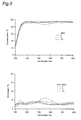
- the average transmittance at wavelengths of 400-700 nm was 93% for each of the 2-layered coat, the 5-layered coat and the substrate, and 89.8% for the 10-layered coat.
- the average reflectance at wavelengths of 400-700 nm was 6.5% for the 2-layered coat, 6.1% for the 5-layered coat, 8.1% for the 10-layered coat, and 6.0% for the substrate.
- the transmittance and reflectance data on the samples were almost comparable to those on glass used as the substrate and the samples were highly transparent.
- Each of the samples was placed in a closed vessel (capacity, 1 L; made of silica glass) and the interior of the vessel was replaced with synthetic air.
- a saturated vapor of acetaldehyde (0.5 mL) was supplied into the vessel by means of a syringe and ultraviolet light was applied (black light at 1 mW/cm 2 ; FL10BLB of Toshiba Lighting & Technology Corporation).
- the gas in the vessel was sampled in a volume of 1 mL by means of a syringe and subjected to gas chromatography (Shimadzu GC-8A combined with FID detector and a column packed with activated carbon and PEG-1000) for quantitative analysis of the residual acetaldehyde and the produced carbon dioxide.
- gas chromatography Shiadzu GC-8A combined with FID detector and a column packed with activated carbon and PEG-1000
- the results of the 2-layered coat are shown in Fig. 4, as compared with the results from an apatite powder having the same composition.
- the apatite-containing powder was irradiated continuously, the film was shielded from light for a certain period of time as indicated in Fig. 4, thereby verifying the dependency of the catalytic activity on light.
- the substrate area on which the film was formed i.e. 5 cm x 5 cm, is regarded to be the area of the film.
- the apatite-containing film subjected to the evaluation of photocatalytic activity had very high photocatalytic activity, and produced more than 200 ppmv/hr of carbon dioxide in a surface area of 1 m 2 .
- a process embodying the present invention provides a simple method for producing apatite-containing films having photocatalytic activity, as well as light-transmitting materials comprising such apatite-containing films.
- a process embodying the present invention can also be employed to produce electronic equipment, in particular, their display devices, keyboards, mouses and casings, as well as building materials that comprise apatite-containing films. In doing so, outstanding antifouling, odor-masking and antibacterial properties can be imparted without design limitations. It can also be applied to various uses where transparency is required, such as transparent covers of display devices and transparent building materials, in order to impart desired characteristics without impairing the transparency.
Landscapes
- Chemical & Material Sciences (AREA)
- Organic Chemistry (AREA)
- Life Sciences & Earth Sciences (AREA)
- Engineering & Computer Science (AREA)
- Chemical Kinetics & Catalysis (AREA)
- General Chemical & Material Sciences (AREA)
- Geochemistry & Mineralogy (AREA)
- Materials Engineering (AREA)
- Inorganic Chemistry (AREA)
- Catalysts (AREA)
Applications Claiming Priority (2)
| Application Number | Priority Date | Filing Date | Title |
|---|---|---|---|
| JP2003409885 | 2003-12-09 | ||
| JP2003409885 | 2003-12-09 |
Publications (2)
| Publication Number | Publication Date |
|---|---|
| EP1547983A1 true EP1547983A1 (de) | 2005-06-29 |
| EP1547983B1 EP1547983B1 (de) | 2010-11-10 |
Family
ID=34544892
Family Applications (1)
| Application Number | Title | Priority Date | Filing Date |
|---|---|---|---|
| EP04253440A Expired - Lifetime EP1547983B1 (de) | 2003-12-09 | 2004-06-10 | Verfahren zur Herstellung von Apatit enthaltendem film |
Country Status (5)
| Country | Link |
|---|---|
| US (1) | US20050123773A1 (de) |
| EP (1) | EP1547983B1 (de) |
| KR (1) | KR100619487B1 (de) |
| CN (1) | CN1286560C (de) |
| DE (1) | DE602004029977D1 (de) |
Families Citing this family (4)
| Publication number | Priority date | Publication date | Assignee | Title |
|---|---|---|---|---|
| JP4319184B2 (ja) * | 2005-12-22 | 2009-08-26 | 富士通株式会社 | 光触媒、その製造方法および光触媒を用いた物品 |
| JP5699546B2 (ja) * | 2010-11-05 | 2015-04-15 | 日立化成株式会社 | 複合基材及びその複合基材の製造方法 |
| US10661225B2 (en) * | 2016-12-07 | 2020-05-26 | Solvay Sa | Copper supported catalyst comprising a Ca-deficient hydroxyapatite for waste gas NOx removal |
| CN108910856B (zh) * | 2018-08-15 | 2021-10-26 | 济南大学 | 一种含磷酸钛钙及钛氢磷酸盐双晶相的多孔材料的制备方法及所得产品 |
Citations (6)
| Publication number | Priority date | Publication date | Assignee | Title |
|---|---|---|---|---|
| EP0322250A1 (de) * | 1987-12-23 | 1989-06-28 | Sumitomo Chemical Company, Limited | Hydroxyapatit enthaltende Beschichtungsflüssigkeit und Verfahren zur Herstellung eines Hydroxyapatitüberzugs unter Verwendung derselben |
| JPH10287411A (ja) * | 1997-04-07 | 1998-10-27 | Agency Of Ind Science & Technol | 水酸アパタイト膜の形成方法 |
| JP2001097705A (ja) * | 1999-09-28 | 2001-04-10 | Yuken Industry Co Ltd | 水酸アパタイト被膜の形成方法 |
| JP2001302220A (ja) * | 2001-03-30 | 2001-10-31 | Fujitsu Ltd | 金属修飾アパタイト材料及びその製造方法 |
| JP2003175338A (ja) | 2001-12-12 | 2003-06-24 | Fujitsu Ltd | 光触媒機能を有する金属修飾アパタイト膜の形成方法および金属修飾アパタイト被膜材 |
| US20030219624A1 (en) * | 2002-05-21 | 2003-11-27 | Fujitsu Limited | Method of forming antibacterial layer containing metal-modified apatite |
Family Cites Families (2)
| Publication number | Priority date | Publication date | Assignee | Title |
|---|---|---|---|---|
| US2000A (en) * | 1841-03-12 | Improvement in the manufacture of starch | ||
| JPH0322250A (ja) * | 1990-06-01 | 1991-01-30 | Matsushita Electric Ind Co Ltd | カートリッジ着脱装置 |
-
2004
- 2004-06-10 DE DE602004029977T patent/DE602004029977D1/de not_active Expired - Lifetime
- 2004-06-10 US US10/864,340 patent/US20050123773A1/en not_active Abandoned
- 2004-06-10 EP EP04253440A patent/EP1547983B1/de not_active Expired - Lifetime
- 2004-06-15 KR KR1020040043897A patent/KR100619487B1/ko not_active Expired - Fee Related
- 2004-06-18 CN CNB2004100766708A patent/CN1286560C/zh not_active Expired - Fee Related
Patent Citations (6)
| Publication number | Priority date | Publication date | Assignee | Title |
|---|---|---|---|---|
| EP0322250A1 (de) * | 1987-12-23 | 1989-06-28 | Sumitomo Chemical Company, Limited | Hydroxyapatit enthaltende Beschichtungsflüssigkeit und Verfahren zur Herstellung eines Hydroxyapatitüberzugs unter Verwendung derselben |
| JPH10287411A (ja) * | 1997-04-07 | 1998-10-27 | Agency Of Ind Science & Technol | 水酸アパタイト膜の形成方法 |
| JP2001097705A (ja) * | 1999-09-28 | 2001-04-10 | Yuken Industry Co Ltd | 水酸アパタイト被膜の形成方法 |
| JP2001302220A (ja) * | 2001-03-30 | 2001-10-31 | Fujitsu Ltd | 金属修飾アパタイト材料及びその製造方法 |
| JP2003175338A (ja) | 2001-12-12 | 2003-06-24 | Fujitsu Ltd | 光触媒機能を有する金属修飾アパタイト膜の形成方法および金属修飾アパタイト被膜材 |
| US20030219624A1 (en) * | 2002-05-21 | 2003-11-27 | Fujitsu Limited | Method of forming antibacterial layer containing metal-modified apatite |
Non-Patent Citations (8)
| Title |
|---|
| K. HASHIMOTO, BKC, 2002 |
| K. HASHIMOTO: "Saishin hikari shokubai gijutsu to jitsuyoka senryaku", BKC, 2002 |
| K. HASHIMOTO; A. FUJISHIMA, CMC, 1988 |
| K. HASHIMOTO; A. FUJISHIMA: "Sanka chitan hikari shokubai no subete -- kohkin, bouo, kuhki joka no tameni", CMC, 1988 |
| PATENT ABSTRACTS OF JAPAN vol. 1999, no. 01 29 January 1999 (1999-01-29) * |
| PATENT ABSTRACTS OF JAPAN vol. 2000, no. 21 3 August 2001 (2001-08-03) * |
| PATENT ABSTRACTS OF JAPAN vol. 2002, no. 02 2 April 2002 (2002-04-02) * |
| PATENT ABSTRACTS OF JAPAN vol. 2003, no. 10 8 October 2003 (2003-10-08) * |
Also Published As
| Publication number | Publication date |
|---|---|
| KR100619487B1 (ko) | 2006-09-08 |
| DE602004029977D1 (de) | 2010-12-23 |
| CN1286560C (zh) | 2006-11-29 |
| CN1626280A (zh) | 2005-06-15 |
| KR20050056111A (ko) | 2005-06-14 |
| US20050123773A1 (en) | 2005-06-09 |
| EP1547983B1 (de) | 2010-11-10 |
Similar Documents
| Publication | Publication Date | Title |
|---|---|---|
| US7989258B2 (en) | Apatite-containing film having photocatalytic activity and a process for producing it | |
| Rampaul et al. | Titania and tungsten doped titania thin films on glass; active photocatalysts | |
| CA2314381C (en) | Article having photocatalytic activity | |
| Ponja et al. | Aerosol assisted chemical vapour deposition of hydrophobic TiO 2–SnO 2 composite film with novel microstructure and enhanced photocatalytic activity | |
| US6835688B2 (en) | Photocatalytic material, photocatalyst, photocatalytic article, and method for the preparation thereof | |
| JP4335446B2 (ja) | 酸化チタンゾル、薄膜およびそれらの製造法 | |
| US20090239738A1 (en) | Titanium Oxide Photocatalyst, Process For Producing The Same And Application | |
| JP2011529804A (ja) | 乾式蒸着法によってTiO2またはZnOの透明薄膜で被覆された石骨材から製造された、太陽光による劣化に対する高い耐性を有する石板状の物品 | |
| WO1996013327A1 (en) | Titanium oxide photocatalyst structure and method of manufacturing the same | |
| JP4995428B2 (ja) | 酸化チタン塗膜形成方法 | |
| WO2006095464A1 (ja) | 酸化チタンコーティング剤、及び酸化チタン塗膜形成方法 | |
| O'Neill et al. | Atmospheric pressure chemical vapour deposition of thin films of Nb 2 O 5 on glass | |
| EP1547983B1 (de) | Verfahren zur Herstellung von Apatit enthaltendem film | |
| JP3224123B2 (ja) | 計器用カバーガラス | |
| US11248768B2 (en) | Transparent optical element for a motor vehicle | |
| JPH0971437A (ja) | 窓用ガラス | |
| Duminica et al. | Pyrosol deposition of anatase TiO2 thin films starting from Ti (OiPr) 4/acetylacetone solutions | |
| JP3381886B2 (ja) | 光触媒構造体及びその製造方法 | |
| JPH10146530A (ja) | 酸化チタン系光触媒およびその製造方法 | |
| JP4571793B2 (ja) | 水性光触媒コーティング液 | |
| JP5035824B2 (ja) | アモルファスリン酸カルシウム薄膜付き光触媒 | |
| JP4212703B2 (ja) | 多孔質薄膜の製造方法 | |
| JP2010115608A (ja) | 光触媒膜およびそれを有する物品 | |
| JP3258023B2 (ja) | 酸化チタン光触媒構造体及びその製造方法 | |
| JP2013503098A (ja) | バナジウム酸ビスマス粒子及びその製造方法 |
Legal Events
| Date | Code | Title | Description |
|---|---|---|---|
| PUAI | Public reference made under article 153(3) epc to a published international application that has entered the european phase |
Free format text: ORIGINAL CODE: 0009012 |
|
| AK | Designated contracting states |
Kind code of ref document: A1 Designated state(s): AT BE BG CH CY CZ DE DK EE ES FI FR GB GR HU IE IT LI LU MC NL PL PT RO SE SI SK TR |
|
| AX | Request for extension of the european patent |
Extension state: AL HR LT LV MK |
|
| 17P | Request for examination filed |
Effective date: 20050803 |
|
| AKX | Designation fees paid |
Designated state(s): DE FR GB |
|
| 17Q | First examination report despatched |
Effective date: 20060908 |
|
| 17Q | First examination report despatched |
Effective date: 20060908 |
|
| RTI1 | Title (correction) |
Free format text: APATITE-CONTAINING FILM PRODUCTION PROCESS |
|
| GRAP | Despatch of communication of intention to grant a patent |
Free format text: ORIGINAL CODE: EPIDOSNIGR1 |
|
| GRAS | Grant fee paid |
Free format text: ORIGINAL CODE: EPIDOSNIGR3 |
|
| GRAA | (expected) grant |
Free format text: ORIGINAL CODE: 0009210 |
|
| AK | Designated contracting states |
Kind code of ref document: B1 Designated state(s): DE FR GB |
|
| REG | Reference to a national code |
Ref country code: GB Ref legal event code: FG4D |
|
| REF | Corresponds to: |
Ref document number: 602004029977 Country of ref document: DE Date of ref document: 20101223 Kind code of ref document: P |
|
| PLBE | No opposition filed within time limit |
Free format text: ORIGINAL CODE: 0009261 |
|
| STAA | Information on the status of an ep patent application or granted ep patent |
Free format text: STATUS: NO OPPOSITION FILED WITHIN TIME LIMIT |
|
| 26N | No opposition filed |
Effective date: 20110811 |
|
| REG | Reference to a national code |
Ref country code: DE Ref legal event code: R097 Ref document number: 602004029977 Country of ref document: DE Effective date: 20110811 |
|
| REG | Reference to a national code |
Ref country code: FR Ref legal event code: PLFP Year of fee payment: 13 |
|
| REG | Reference to a national code |
Ref country code: FR Ref legal event code: PLFP Year of fee payment: 14 |
|
| REG | Reference to a national code |
Ref country code: FR Ref legal event code: PLFP Year of fee payment: 15 |
|
| PGFP | Annual fee paid to national office [announced via postgrant information from national office to epo] |
Ref country code: DE Payment date: 20200527 Year of fee payment: 17 Ref country code: FR Payment date: 20200512 Year of fee payment: 17 |
|
| PGFP | Annual fee paid to national office [announced via postgrant information from national office to epo] |
Ref country code: GB Payment date: 20200603 Year of fee payment: 17 |
|
| REG | Reference to a national code |
Ref country code: DE Ref legal event code: R119 Ref document number: 602004029977 Country of ref document: DE |
|
| GBPC | Gb: european patent ceased through non-payment of renewal fee |
Effective date: 20210610 |
|
| PG25 | Lapsed in a contracting state [announced via postgrant information from national office to epo] |
Ref country code: GB Free format text: LAPSE BECAUSE OF NON-PAYMENT OF DUE FEES Effective date: 20210610 Ref country code: DE Free format text: LAPSE BECAUSE OF NON-PAYMENT OF DUE FEES Effective date: 20220101 |
|
| PG25 | Lapsed in a contracting state [announced via postgrant information from national office to epo] |
Ref country code: FR Free format text: LAPSE BECAUSE OF NON-PAYMENT OF DUE FEES Effective date: 20210630 |