EP1547624A1 - Luftreiniger - Google Patents
Luftreiniger Download PDFInfo
- Publication number
- EP1547624A1 EP1547624A1 EP03794261A EP03794261A EP1547624A1 EP 1547624 A1 EP1547624 A1 EP 1547624A1 EP 03794261 A EP03794261 A EP 03794261A EP 03794261 A EP03794261 A EP 03794261A EP 1547624 A1 EP1547624 A1 EP 1547624A1
- Authority
- EP
- European Patent Office
- Prior art keywords
- temperature
- discharge
- air purifier
- charcoal
- absorbent material
- Prior art date
- Legal status (The legal status is an assumption and is not a legal conclusion. Google has not performed a legal analysis and makes no representation as to the accuracy of the status listed.)
- Withdrawn
Links
Images

Classifications
-
- A—HUMAN NECESSITIES
- A61—MEDICAL OR VETERINARY SCIENCE; HYGIENE
- A61L—METHODS OR APPARATUS FOR STERILISING MATERIALS OR OBJECTS IN GENERAL; DISINFECTION, STERILISATION OR DEODORISATION OF AIR; CHEMICAL ASPECTS OF BANDAGES, DRESSINGS, ABSORBENT PADS OR SURGICAL ARTICLES; MATERIALS FOR BANDAGES, DRESSINGS, ABSORBENT PADS OR SURGICAL ARTICLES
- A61L9/00—Disinfection, sterilisation or deodorisation of air
- A61L9/16—Disinfection, sterilisation or deodorisation of air using physical phenomena
- A61L9/22—Ionisation
-
- A—HUMAN NECESSITIES
- A61—MEDICAL OR VETERINARY SCIENCE; HYGIENE
- A61L—METHODS OR APPARATUS FOR STERILISING MATERIALS OR OBJECTS IN GENERAL; DISINFECTION, STERILISATION OR DEODORISATION OF AIR; CHEMICAL ASPECTS OF BANDAGES, DRESSINGS, ABSORBENT PADS OR SURGICAL ARTICLES; MATERIALS FOR BANDAGES, DRESSINGS, ABSORBENT PADS OR SURGICAL ARTICLES
- A61L9/00—Disinfection, sterilisation or deodorisation of air
- A61L9/01—Deodorant compositions
- A61L9/014—Deodorant compositions containing sorbent material, e.g. activated carbon
-
- A—HUMAN NECESSITIES
- A61—MEDICAL OR VETERINARY SCIENCE; HYGIENE
- A61L—METHODS OR APPARATUS FOR STERILISING MATERIALS OR OBJECTS IN GENERAL; DISINFECTION, STERILISATION OR DEODORISATION OF AIR; CHEMICAL ASPECTS OF BANDAGES, DRESSINGS, ABSORBENT PADS OR SURGICAL ARTICLES; MATERIALS FOR BANDAGES, DRESSINGS, ABSORBENT PADS OR SURGICAL ARTICLES
- A61L9/00—Disinfection, sterilisation or deodorisation of air
- A61L9/16—Disinfection, sterilisation or deodorisation of air using physical phenomena
-
- B—PERFORMING OPERATIONS; TRANSPORTING
- B01—PHYSICAL OR CHEMICAL PROCESSES OR APPARATUS IN GENERAL
- B01D—SEPARATION
- B01D53/00—Separation of gases or vapours; Recovering vapours of volatile solvents from gases; Chemical or biological purification of waste gases, e.g. engine exhaust gases, smoke, fumes, flue gases, aerosols
- B01D53/32—Separation of gases or vapours; Recovering vapours of volatile solvents from gases; Chemical or biological purification of waste gases, e.g. engine exhaust gases, smoke, fumes, flue gases, aerosols by electrical effects other than those provided for in group B01D61/00
-
- B—PERFORMING OPERATIONS; TRANSPORTING
- B01—PHYSICAL OR CHEMICAL PROCESSES OR APPARATUS IN GENERAL
- B01J—CHEMICAL OR PHYSICAL PROCESSES, e.g. CATALYSIS OR COLLOID CHEMISTRY; THEIR RELEVANT APPARATUS
- B01J20/00—Solid sorbent compositions or filter aid compositions; Sorbents for chromatography; Processes for preparing, regenerating or reactivating thereof
- B01J20/02—Solid sorbent compositions or filter aid compositions; Sorbents for chromatography; Processes for preparing, regenerating or reactivating thereof comprising inorganic material
- B01J20/04—Solid sorbent compositions or filter aid compositions; Sorbents for chromatography; Processes for preparing, regenerating or reactivating thereof comprising inorganic material comprising compounds of alkali metals, alkaline earth metals or magnesium
- B01J20/041—Oxides or hydroxides
-
- B—PERFORMING OPERATIONS; TRANSPORTING
- B01—PHYSICAL OR CHEMICAL PROCESSES OR APPARATUS IN GENERAL
- B01J—CHEMICAL OR PHYSICAL PROCESSES, e.g. CATALYSIS OR COLLOID CHEMISTRY; THEIR RELEVANT APPARATUS
- B01J20/00—Solid sorbent compositions or filter aid compositions; Sorbents for chromatography; Processes for preparing, regenerating or reactivating thereof
- B01J20/02—Solid sorbent compositions or filter aid compositions; Sorbents for chromatography; Processes for preparing, regenerating or reactivating thereof comprising inorganic material
- B01J20/20—Solid sorbent compositions or filter aid compositions; Sorbents for chromatography; Processes for preparing, regenerating or reactivating thereof comprising inorganic material comprising free carbon; comprising carbon obtained by carbonising processes
-
- B—PERFORMING OPERATIONS; TRANSPORTING
- B01—PHYSICAL OR CHEMICAL PROCESSES OR APPARATUS IN GENERAL
- B01J—CHEMICAL OR PHYSICAL PROCESSES, e.g. CATALYSIS OR COLLOID CHEMISTRY; THEIR RELEVANT APPARATUS
- B01J20/00—Solid sorbent compositions or filter aid compositions; Sorbents for chromatography; Processes for preparing, regenerating or reactivating thereof
- B01J20/22—Solid sorbent compositions or filter aid compositions; Sorbents for chromatography; Processes for preparing, regenerating or reactivating thereof comprising organic material
- B01J20/24—Naturally occurring macromolecular compounds, e.g. humic acids or their derivatives
-
- B—PERFORMING OPERATIONS; TRANSPORTING
- B01—PHYSICAL OR CHEMICAL PROCESSES OR APPARATUS IN GENERAL
- B01J—CHEMICAL OR PHYSICAL PROCESSES, e.g. CATALYSIS OR COLLOID CHEMISTRY; THEIR RELEVANT APPARATUS
- B01J20/00—Solid sorbent compositions or filter aid compositions; Sorbents for chromatography; Processes for preparing, regenerating or reactivating thereof
- B01J20/30—Processes for preparing, regenerating, or reactivating
- B01J20/3078—Thermal treatment, e.g. calcining or pyrolizing
-
- C—CHEMISTRY; METALLURGY
- C01—INORGANIC CHEMISTRY
- C01B—NON-METALLIC ELEMENTS; COMPOUNDS THEREOF; METALLOIDS OR COMPOUNDS THEREOF NOT COVERED BY SUBCLASS C01C
- C01B32/00—Carbon; Compounds thereof
- C01B32/30—Active carbon
- C01B32/312—Preparation
- C01B32/336—Preparation characterised by gaseous activating agents
-
- B—PERFORMING OPERATIONS; TRANSPORTING
- B01—PHYSICAL OR CHEMICAL PROCESSES OR APPARATUS IN GENERAL
- B01D—SEPARATION
- B01D2253/00—Adsorbents used in seperation treatment of gases and vapours
- B01D2253/10—Inorganic adsorbents
- B01D2253/102—Carbon
-
- B—PERFORMING OPERATIONS; TRANSPORTING
- B01—PHYSICAL OR CHEMICAL PROCESSES OR APPARATUS IN GENERAL
- B01D—SEPARATION
- B01D2257/00—Components to be removed
- B01D2257/90—Odorous compounds not provided for in groups B01D2257/00 - B01D2257/708
-
- B—PERFORMING OPERATIONS; TRANSPORTING
- B01—PHYSICAL OR CHEMICAL PROCESSES OR APPARATUS IN GENERAL
- B01D—SEPARATION
- B01D2257/00—Components to be removed
- B01D2257/91—Bacteria; Microorganisms
-
- B—PERFORMING OPERATIONS; TRANSPORTING
- B01—PHYSICAL OR CHEMICAL PROCESSES OR APPARATUS IN GENERAL
- B01D—SEPARATION
- B01D2259/00—Type of treatment
- B01D2259/80—Employing electric, magnetic, electromagnetic or wave energy, or particle radiation
- B01D2259/818—Employing electrical discharges or the generation of a plasma
-
- B—PERFORMING OPERATIONS; TRANSPORTING
- B01—PHYSICAL OR CHEMICAL PROCESSES OR APPARATUS IN GENERAL
- B01J—CHEMICAL OR PHYSICAL PROCESSES, e.g. CATALYSIS OR COLLOID CHEMISTRY; THEIR RELEVANT APPARATUS
- B01J2220/00—Aspects relating to sorbent materials
- B01J2220/40—Aspects relating to the composition of sorbent or filter aid materials
- B01J2220/46—Materials comprising a mixture of inorganic and organic materials
-
- B—PERFORMING OPERATIONS; TRANSPORTING
- B01—PHYSICAL OR CHEMICAL PROCESSES OR APPARATUS IN GENERAL
- B01J—CHEMICAL OR PHYSICAL PROCESSES, e.g. CATALYSIS OR COLLOID CHEMISTRY; THEIR RELEVANT APPARATUS
- B01J2220/00—Aspects relating to sorbent materials
- B01J2220/40—Aspects relating to the composition of sorbent or filter aid materials
- B01J2220/48—Sorbents characterised by the starting material used for their preparation
- B01J2220/4812—Sorbents characterised by the starting material used for their preparation the starting material being of organic character
- B01J2220/4825—Polysaccharides or cellulose materials, e.g. starch, chitin, sawdust, wood, straw, cotton
Definitions
- the present invention relates to an air purifier, especially an ionic wind-type air purifier, which can remove airborne dust, smoke from cigarette or cigar or tobacco, harmful gas and the like.
- An ionic wind-type air purifier employs the ionic wind which is produced by applying a high voltage of about 5 to 10 kV between electrodes for corona discharge to ionize fine particles. More specifically, the ionized particles are moved by an electric field between the electrode to produce an ionic wind through which dust or smoke from cigarette or cigar or tobacco in the air is adsorbed on a dust collecting electrode to purify the air.
- Air purifiers of this type are disclosed, for example, in Japanese Patent Laid-Open Nos. 172190/1985 and 140657/1987.
- Japanese Patent Laid-Open No. 199653/1998 discloses that a coating of activated carbon is utilized as a surface of an electrode located opposite to a corona discharge electrode.
- the apparatus disclosed in this laid-open publication is an ionic wind generator utilizing negative ions in which ozone involved in corona discharge is removed by taking advantage of the activated carbon.
- Japanese Patent Laid-Open No. 226207/2000 discloses a production process of an activated wood charcoal having both a low-temperature carbonized part and a high-temperature carbonized part. This production process comprises the steps of: heat-treating wood chips at 450 to 550°C to carbonize the wood chips (a low-temperature carbonization step); and subsequently heat-treating the carbonized wood chips at 800 to 900°C to further carbonize the wood chips (a high-temperature carbonization step).
- a low-temperature carbonization step a low-temperature carbonization step
- subsequently heat-treating the carbonized wood chips at 800 to 900°C to further carbonize the wood chips
- the present inventors have now found that the use of a carbon molding, which has been carbonized at a specific temperature, as a dust collecting electrode in an ionic wind-type air purifier can realize an air purifier having a very high level of air purifying power. More specifically, it has been found that, when a gas absorbent material produced by combining a high-temperature carbonized charcoal, which has been carbonized at a temperature of about 800°C or above, a low-temperature carbonized charcoal, which has been carbonized at a temperature of about 500°C or below, and alginic acid or calcium oxide is used as an electrode, an air purifier capable of efficiently removing airborne dust, smoke from cigarette or cigar or tobacco, harmful gas and the like can be realized.
- an object of the present invention is to provide an air purifier having a high level of air purifying power.
- an air purifier comprising at least a discharge electrode capable of producing ions upon discharge, a counter electrode located opposite to the discharge electrode, and a power supply capable of applying voltage between the discharge electrode and the counter electrode for inducing discharge for producing ions at the discharge electrode, the counter electrode comprising a gas absorbent material comprising: a high-temperature carbonized charcoal which has been carbonized at a temperature of about 800°C or above; a low-temperature carbonized charcoal which has been carbonized at a temperature of about 500°C or below; and alginic acid or its salt or calcium oxide.
- the air purifier according to the present invention basically comprises a discharge electrode capable of producing ions upon discharge, a counter electrode located opposite to the discharge electrode, and a power supply capable of applying voltage between the discharge electrode and the counter electrode for inducing discharge for producing ions at the discharge electrode.
- Fig. 1 is a typical diagram showing this basic construction.
- a discharge electrode 1 is in the form of a needle formed of, for example, carbon, platinum, tungsten, gold, silver, titanium, stainless steels, nickel, tantalum, copper, phosphor bronze, a metal plated wire, or a nickel plated wire.
- discharge capable of producing ions is carried out.
- discharge at the discharge electrode is the so-called "gaseous discharge" which includes corona discharge, glow discharge, and arc discharge.
- An electrode 2 is provided opposite to the discharge electrode 1.
- the counter electrode 2 comprises a gas absorbent material which will be described later.
- Voltage for inducing discharge in the discharge electrode 1 is applied from a power supply 3 across the two electrodes. The voltage may be properly determined. When the discharge is corona discharge, however, the voltage is generally, for example, about 4000 to 10000 V.
- the counter electrode 2 is an excellent gas absorbent material, and the carried floating matter 5 is efficiently adsorbed on this gas absorbent material, whereby air purification is carried out.
- a plurality of discharge electrodes 1 and a plurality of counter electrodes 2 may be provided.
- the utilization of a plurality of discharge electrodes 1 and/or a plurality of counter electrodes 2 are sometimes advantageous from the viewpoint of purification efficiency.
- the gas absorbent material constituting the counter electrode comprises: a high-temperature carbonized charcoal which has been carbonized at a temperature of about 800°C or above; a low-temperature carbonized charcoal which has been carbonized at a temperature of about 500°C or below; and alginic acid or calcium oxide.
- the high-temperature carbonized charcoal refers to a charcoal produced by carbonization at a temperature of about 800°C or above.
- the high-temperature carbonized charcoal refers to a charcoal produced by carbonization at a temperature of about 800 to 1300°C, more preferably at a temperature of 900 to 1000°C.
- Activation for example, activation by air or activation by steam, may be carried out in a refining process involved in the production of the high-temperature carbonized charcoal.
- the low-temperature carbonized charcoal refers to a charcoal produced by carbonization at a temperature of about 550°C or below. In a preferred embodiment of the present invention, the low-temperature carbonized charcoal refers to a charcoal produced by carbonization at a temperature of about 300 to 550°C, more preferably at a temperature of 450 to 500°C.
- wood usable as a raw material for charcoal is not particularly limited and includes conifers such as cryptomerias, Japanese cypresses (hinoki), pines, and Japanese larches, bamboos and, in addition, building waste materials.
- the high-temperature carbonized charcoal and the low-temperature carbonized charcoal are different from each other in absorptive capacity.
- the high-temperature carbonized charcoal has high absorptive properties for formaldehyde, benzene, toluene, xylene, ethylbenzene, chlorobenzene and the like.
- the low-temperature carbonized charcoal has high absorptive properties for ammonia, amine and the like.
- a mixture of the high-temperature carbonized charcoal with the low-temperature carbonized charcoal has a good absorptive capacity for various materials.
- the mixing ratio of the high-temperature carbonized charcoal to the low-temperature carbonized charcoal may be properly determined by taking into consideration the type of gas to be captured by the air purifier according to the present invention.
- the mixing ratio of the high-temperature carbonized charcoal to the low-temperature carbonized charcoal on a weight basis is preferably 30 : 70 to 60 : 40, more preferably 40 : 60 to 50 : 50.
- the high-temperature carbonized charcoal and the low-temperature carbonized charcoal are ground to a powder which is then used for contemplated applications.
- the particle diameter may be properly determined.
- the particle diameter is preferably about 0.3 to 9.5 mm, more preferably about 0.6 to 1.18 mm.
- the absorbent material according to the present invention can also advantageously possess antistatic effect and electromagnetic radiation shielding effect.
- the low-temperature carbonized charcoal generally has a volume resistivity of about 10 9 to 10 12 ⁇ cm 3 .
- alginic acid or its salt for example, sodium, potassium, or calcium salt
- the gas absorptive activity of the alginic acids is of course zero or, if any, is low. Therefore, it is surprising that the coexistence of the charcoal and the alginic acids can significantly improve the gas absorptive activity of the mixture of the high-temperature carbonized charcoal with the low-temperature carbonized charcoal.
- the alginic acid or its salt refers to purified alginic acid or its salt and, in addition, materials composed mainly of alginic acid, for example, carageenan and chondrus.
- the amount of alginic acid or its salt added may be properly determined from the viewpoints of a function as a binder and an improvement in gas absorptive activity.
- the lower limit of the amount of alginic acid or its salt added is preferably about 5% by weight, more preferably about 10% by weight.
- the upper limit of the amount of alginic acid or its salt added is preferably about 25% by weight, more preferably about 15% by weight.
- the gas absorbent material used in the present invention comprises calcium oxide in addition to the high-temperature carbonized charcoal and the low-temperature carbonized charcoal.
- This calcium oxide functions to improve the gas absorptive capacity of the high-temperature carbonized charcoal and the low-temperature carbonized charcoal.
- the gas absorbent material can advantageously improve its fire resisting performance.
- shell baked calcium produced by baking shell, and quick lime may be utilized as calcium oxide.
- the amount of calcium oxide added may be properly determined from the viewpoint of improving the gas absorptive activity.
- the lower limit of the amount of calcium oxide added is preferably about 5% by weight, and the upper limit of the amount of calcium oxide added is preferably about 15% by weight, more preferably about 7% by weight.
- the gas absorbent material used in the present invention may include both alginic acid and calcium oxide.
- the addition of a combination of alginic acid with calcium oxide can further improve the gas absorptive activity of the high-temperature carbonized charcoal and the low-temperature carbonized charcoal.
- the gas absorbent material used in the present invention may include a binder with the proviso that the above alginic acid is included.
- Binders usable herein include diatomaceous earth, cement, polymeric binders such as isocyanate resin emulsions, and starch pastes.
- diatomaceous earth or cement is advantageous in that the fire resisting performance of the gas absorbent material can be improved. Further, when diatomaceous earth or cement is utilized, the utilization of diatomaceous earth or cement in combination with a polymeric binder as a binder is preferred.
- the amount of the binder added may be properly determined. When the amount of the binder added is excessively large, however, the gas absorptive activity of the gas absorbent material is sometimes deteriorated. Therefore, preferably, the amount of the binder added is carefully determined.
- the amount of the binder added in the gas absorbent material according to the present invention is preferably about 10 to 40% by weight.
- the gas absorbent material can easily be produced by pouring a mixture, prepared by mixing a high-temperature carbonized charcoal, a low-temperature carbonized charcoal, alginic acid or calcium oxide, optionally a binder, and other ingredients together, into a mold for molding, and drying the molding (at room temperature to 60°C or below for about 3 to 5 hr).
- fillers or reinforcements include fibrous materials, such as Manila hemps and wood pulps, wire gauzes, and lattice or honeycomb structures.
- the gas absorbent material used in the present invention may be in any form without particular limitation.
- the gas absorbent material is in a board form.
- the board-shaped counter electrode may serve also as an indoor construction material, for example, a wall material or a ceiling material.
- a decorative paper may be applied to the surface of the gas absorbent material in a board form to improve the appearance.
- the decorative paper is not limited so far as it has such a certain level of air permeability that does not sacrifice the function of the gas absorbent material.
- the gas absorbent material is basically electrically conductive and can be connected directly to the power supply.
- a high-temperature carbonized charcoal and a low-temperature carbonized charcoal used in the following examples were prepared as follows.
- a concrete oven having an internal volume of 16 m 3 which has a flame port in its front, has an exhaust port in its back lower part, and has been covered in its interior with refractory bricks, was provided. Wood was placed in the oven, and initial firing was carried out from the flame port. After the elapse of about 24 hr from the initial firing, decomposition and carbonization began, and a temperature of 300 to 400°C continued for additional about 48 hr. Thereafter, the temperature rose to 400 to 550°C. This temperature rise was judged to indicate the completion of carbonization and the initiation of a refining process.
- the oven was fully hermetically sealed and was cooled.
- the charcoal thus obtained was used as low-temperature carbonized charcoal.
- the carbonization temperature was 900 to 1100°C, and this temperature was kept for 3 hr.
- the charcoal thus obtained was used as a high-temperature carbonized charcoal.
- the activation by air was carried out by forcibly feeding air into the oven at an air flow rate of 10 to 20 m 3 /min until the temperature reached about 900 to 1000°C.
- the activation by steam was carried out by forcibly feeding steam at a rate of 0.5 to 2 liters/min simultaneously with the force feeding of the air.
- the mixture thus obtained was poured into a frame, followed by press molding to a given thickness.
- the whole assembly including the frame was then placed in a drying oven and was dried at room temperature or a temperature of 60°C or below for about 3 to 5 hr.
- the whole assembly was taken out of the drying oven, and the frame was then removed to prepare a board having a size of 300 ⁇ 400 ⁇ 15 mm which was then cut into a size of 200 ⁇ 150 ⁇ 15 mm for use as a gas absorbent material.
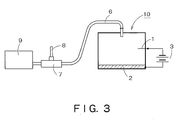
- the gas absorbent material prepared in Example 2 was used to construct an apparatus 10 shown in Fig. 2. Specifically, a box formed of a transparent plastic material (180 ⁇ 210 ⁇ 120 mm) for easy visual observation was provided. The gas absorbent material was placed on the bottom of the box and was used as a counter electrode 2. A discharge electrode 1 formed of a metallic needle was provided on the wall surface of this box. A d.c. high-voltage source 3 was connected to a position between the discharge electrode 1 and the counter electrode 2. The source 3 in its negative side was connected to the discharge electrode 1, and the source in its positive side was connected to the counter electrode 2 side.
- the apparatus 10 is constructed so that cigarette smoke is introduced through an introduction tube 6.
- a negative pressure generator 7 is connected to the introduction tube 6 and is constructed so that a cigarette 8 can be inserted into the negative pressure generator 7. Since air is guided from an compressed air source 9 to the negative pressure generator 7, smoke from the cigarette 8, together with the air, is introduced into the apparatus 10 through the introduction tube 6. The following experiment was carried out using this apparatus construction.
Landscapes
- Chemical & Material Sciences (AREA)
- Health & Medical Sciences (AREA)
- Organic Chemistry (AREA)
- Analytical Chemistry (AREA)
- Chemical Kinetics & Catalysis (AREA)
- Animal Behavior & Ethology (AREA)
- Life Sciences & Earth Sciences (AREA)
- Veterinary Medicine (AREA)
- Public Health (AREA)
- General Health & Medical Sciences (AREA)
- Epidemiology (AREA)
- Inorganic Chemistry (AREA)
- Engineering & Computer Science (AREA)
- Thermal Sciences (AREA)
- Physics & Mathematics (AREA)
- Materials Engineering (AREA)
- General Chemical & Material Sciences (AREA)
- Oil, Petroleum & Natural Gas (AREA)
- Solid-Sorbent Or Filter-Aiding Compositions (AREA)
Applications Claiming Priority (3)
| Application Number | Priority Date | Filing Date | Title |
|---|---|---|---|
| JP2002259867 | 2002-09-05 | ||
| JP2002259867 | 2002-09-05 | ||
| PCT/JP2003/011378 WO2004022113A1 (ja) | 2002-09-05 | 2003-09-05 | 空気清浄器 |
Publications (2)
| Publication Number | Publication Date |
|---|---|
| EP1547624A1 true EP1547624A1 (de) | 2005-06-29 |
| EP1547624A4 EP1547624A4 (de) | 2006-08-30 |
Family
ID=31973084
Family Applications (1)
| Application Number | Title | Priority Date | Filing Date |
|---|---|---|---|
| EP03794261A Withdrawn EP1547624A4 (de) | 2002-09-05 | 2003-09-05 | Luftreiniger |
Country Status (7)
| Country | Link |
|---|---|
| US (1) | US20060032376A1 (de) |
| EP (1) | EP1547624A4 (de) |
| JP (1) | JPWO2004022113A1 (de) |
| KR (1) | KR20050057187A (de) |
| CN (1) | CN1678355A (de) |
| AU (1) | AU2003261971A1 (de) |
| WO (1) | WO2004022113A1 (de) |
Cited By (1)
| Publication number | Priority date | Publication date | Assignee | Title |
|---|---|---|---|---|
| EP3884551A1 (de) * | 2018-11-19 | 2021-09-29 | CabinAir Sweden AB | Ionisierungseinheit zum negativen laden von in einem luftstrom vorhandenen schwebeteilchen, luftreinigungsvorrichtung und an ein fahrzeug angepasste vorrichtung |
Families Citing this family (9)
| Publication number | Priority date | Publication date | Assignee | Title |
|---|---|---|---|---|
| ES2383686T3 (es) * | 2003-06-05 | 2012-06-25 | Daikin Industries, Ltd. | Dispositivo de descarga y purificador de aire |
| CN100446816C (zh) * | 2004-04-27 | 2008-12-31 | 健康之路株式会社 | 室内环境改善方法及接地电极装置 |
| CN100391591C (zh) * | 2005-08-17 | 2008-06-04 | 黎伯忠 | 空气污染治理的吸附材料及其制备方法 |
| KR101747666B1 (ko) * | 2008-11-25 | 2017-06-15 | 코닌클리케 필립스 엔.브이. | 공중 부유 입자들을 감지하기 위한 센서 |
| JP5032534B2 (ja) * | 2009-06-22 | 2012-09-26 | パナソニック株式会社 | 美容装置 |
| CN101934085B (zh) * | 2009-07-01 | 2012-11-07 | 东莞市宇洁新材料有限公司 | 一种低温等离子催化净化模块 |
| US8834803B2 (en) | 2012-10-19 | 2014-09-16 | Hussmann Corporation | Electro hydrodynamic thruster for decontaminating a display case |
| CN105987440A (zh) * | 2015-01-27 | 2016-10-05 | 共立电器产业株式会社 | 空气净化器 |
| CN119841316B (zh) * | 2025-01-17 | 2025-07-29 | 徐州华睿炭材料科技有限公司 | 一种松脂基活性炭及其制备方法 |
Family Cites Families (25)
| Publication number | Priority date | Publication date | Assignee | Title |
|---|---|---|---|---|
| NL194766A (de) * | 1954-02-23 | |||
| GB1135737A (de) * | 1965-10-23 | 1900-01-01 | ||
| US3411512A (en) * | 1966-05-31 | 1968-11-19 | Wayne A. Johnson | Electrolytic tobacco smoke filter |
| US3463168A (en) * | 1967-04-27 | 1969-08-26 | John H Troll | Electrostatically charged tobacco smoke filter |
| JPS62254852A (ja) * | 1986-04-30 | 1987-11-06 | Matsushita Seiko Co Ltd | 空気清浄機 |
| NL8701660A (nl) * | 1987-07-14 | 1989-02-01 | Tno | Verbrandingsinrichting met een gefluidiseerd bed. |
| DE3839956C2 (de) * | 1987-11-28 | 1998-07-02 | Toyo Boseki | Elektret-Folie und Verfahren zu ihrer Herstellung |
| JP2733973B2 (ja) * | 1988-08-08 | 1998-03-30 | 株式会社デンソー | 空気清浄器 |
| CA1314237C (en) * | 1988-11-01 | 1993-03-09 | William E. Pick | Charging element having odour absorbing properties for an electrostatic air filter |
| JPH02172545A (ja) * | 1988-12-23 | 1990-07-04 | Hiroaki Kanazawa | 空気清浄機 |
| US5085134A (en) * | 1990-05-17 | 1992-02-04 | Hofstra Joseph S | Smoker's booth |
| KR940001414B1 (ko) * | 1991-12-31 | 1994-02-23 | 삼성전자 주식회사 | 전기집진기 |
| RU2026751C1 (ru) * | 1992-05-13 | 1995-01-20 | Елена Владимировна Володина | Устройство для стерилизации и тонкой фильтрации газа |
| JPH0767948A (ja) * | 1993-08-31 | 1995-03-14 | Matsushita Electric Ind Co Ltd | 活性炭造粒体、脱臭材および脱臭材の製造法 |
| US5622543A (en) * | 1995-09-20 | 1997-04-22 | Yang; Chen-Ho | Rectilinear turbulent flow type air purifier |
| US5614002A (en) * | 1995-10-24 | 1997-03-25 | Chen; Tze L. | High voltage dust collecting panel |
| JPH09215945A (ja) * | 1996-02-09 | 1997-08-19 | Aten:Kk | 静電式ガス吸着機 |
| DK0989901T3 (da) * | 1997-06-13 | 2005-06-27 | Hoelter Heinz | Ionisationsfilter til rensning af luft |
| JP3953671B2 (ja) * | 1999-02-03 | 2007-08-08 | 日の丸カーボテクノ株式会社 | 活性化木炭の製造方法 |
| JP2001239113A (ja) * | 2000-03-01 | 2001-09-04 | Mitsubishi Paper Mills Ltd | 空気清浄化フィルター |
| US6491743B1 (en) * | 2000-09-11 | 2002-12-10 | Constantinos J. Joannou | Electronic cartridge filter |
| JP3632579B2 (ja) * | 2000-09-21 | 2005-03-23 | 三菱電機株式会社 | 空気浄化装置 |
| US6497754B2 (en) * | 2001-04-04 | 2002-12-24 | Constantinos J. Joannou | Self ionizing pleated air filter system |
| WO2002085426A2 (de) * | 2001-04-24 | 2002-10-31 | Ulrich Lersch | Atemluftfilter |
| TW589911B (en) * | 2001-09-14 | 2004-06-01 | Sanei Kensetsu Kabushiki Kaish | Heating element using charcoal |
-
2003
- 2003-09-05 US US10/524,375 patent/US20060032376A1/en not_active Abandoned
- 2003-09-05 AU AU2003261971A patent/AU2003261971A1/en not_active Abandoned
- 2003-09-05 WO PCT/JP2003/011378 patent/WO2004022113A1/ja not_active Ceased
- 2003-09-05 EP EP03794261A patent/EP1547624A4/de not_active Withdrawn
- 2003-09-05 JP JP2004534178A patent/JPWO2004022113A1/ja active Pending
- 2003-09-05 CN CNA038208059A patent/CN1678355A/zh active Pending
- 2003-09-05 KR KR1020057003779A patent/KR20050057187A/ko not_active Ceased
Cited By (1)
| Publication number | Priority date | Publication date | Assignee | Title |
|---|---|---|---|---|
| EP3884551A1 (de) * | 2018-11-19 | 2021-09-29 | CabinAir Sweden AB | Ionisierungseinheit zum negativen laden von in einem luftstrom vorhandenen schwebeteilchen, luftreinigungsvorrichtung und an ein fahrzeug angepasste vorrichtung |
Also Published As
| Publication number | Publication date |
|---|---|
| AU2003261971A1 (en) | 2004-03-29 |
| US20060032376A1 (en) | 2006-02-16 |
| KR20050057187A (ko) | 2005-06-16 |
| WO2004022113A1 (ja) | 2004-03-18 |
| EP1547624A4 (de) | 2006-08-30 |
| JPWO2004022113A1 (ja) | 2005-12-22 |
| CN1678355A (zh) | 2005-10-05 |
Similar Documents
| Publication | Publication Date | Title |
|---|---|---|
| US20060032376A1 (en) | Air purifier | |
| DE4034417A1 (de) | Hochreaktive reagentien und zusammensetzungen fuer die abgas- und abwasserreinigung, ihre herstellung und ihre verwendung | |
| AU2003246378A1 (en) | Separator for use in high-energy batteries and method for the production thereof | |
| JP2008186660A (ja) | 電極構造体およびこれを用いたプラズマ生成装置 | |
| CN112194477A (zh) | 多孔陶瓷材料的制备方法及该方法得到的多孔材料 | |
| KR20160122516A (ko) | 자체 공기정화 기능을 가지는 흡연부스 | |
| JPWO2006013695A1 (ja) | 炭酸ガス吸収材、それを用いた炭酸ガス分離方法、および炭酸ガス分離装置 | |
| US20060142155A1 (en) | Gas absorbing material | |
| JP6985663B2 (ja) | 窯業系サイディング廃材の再生方法 | |
| US6940043B2 (en) | Heating element using charcoal | |
| CN107252608B (zh) | 一种烧结木炭烟尘处理装置 | |
| CN211098175U (zh) | 一种工业厂房空气除尘的装置 | |
| CN112010672B (zh) | 具有远红外复合空气净化功能的陶瓷砖及其制备工艺 | |
| RU2133241C1 (ru) | Композиция для огнезащитного покрытия | |
| CN211530403U (zh) | 平板石墨烯高能离子芯装置 | |
| CN207872397U (zh) | 一种电除尘器末电场后微细颗粒物的再捕集装置 | |
| CN104645764B (zh) | 一种高效空气净化器 | |
| CN1088995A (zh) | 高牢固度吸氢及其同位素吸气剂 | |
| CN104874266B (zh) | 一种电离子净化设备 | |
| JP2007302486A (ja) | 断熱材 | |
| CN111313240B (zh) | 平板石墨烯高能离子芯装置及其制作方法 | |
| Wu et al. | Preparation of eco-environmental protection bricks from lake sludge | |
| JP2835005B2 (ja) | 吸音材 | |
| US309940A (en) | fowlee | |
| JPH06100382A (ja) | 透水性ブロックの製造方法 |
Legal Events
| Date | Code | Title | Description |
|---|---|---|---|
| PUAI | Public reference made under article 153(3) epc to a published international application that has entered the european phase |
Free format text: ORIGINAL CODE: 0009012 |
|
| 17P | Request for examination filed |
Effective date: 20050225 |
|
| AK | Designated contracting states |
Kind code of ref document: A1 Designated state(s): AT BE BG CH CY CZ DE DK EE ES FI FR GB GR HU IE IT LI LU MC NL PT RO SE SI SK TR |
|
| AX | Request for extension of the european patent |
Extension state: AL LT LV MK |
|
| DAX | Request for extension of the european patent (deleted) | ||
| A4 | Supplementary search report drawn up and despatched |
Effective date: 20060731 |
|
| STAA | Information on the status of an ep patent application or granted ep patent |
Free format text: STATUS: THE APPLICATION HAS BEEN WITHDRAWN |
|
| 18W | Application withdrawn |
Effective date: 20061010 |