EP1542913B1 - Klappschachtel - Google Patents
Klappschachtel Download PDFInfo
- Publication number
- EP1542913B1 EP1542913B1 EP03766260A EP03766260A EP1542913B1 EP 1542913 B1 EP1542913 B1 EP 1542913B1 EP 03766260 A EP03766260 A EP 03766260A EP 03766260 A EP03766260 A EP 03766260A EP 1542913 B1 EP1542913 B1 EP 1542913B1
- Authority
- EP
- European Patent Office
- Prior art keywords
- box
- lid
- collar
- region
- wall
- Prior art date
- Legal status (The legal status is an assumption and is not a legal conclusion. Google has not performed a legal analysis and makes no representation as to the accuracy of the status listed.)
- Expired - Lifetime
Links
- 235000019504 cigarettes Nutrition 0.000 claims abstract description 32
- 238000004519 manufacturing process Methods 0.000 claims abstract description 7
- 238000004080 punching Methods 0.000 claims description 15
- 239000000853 adhesive Substances 0.000 claims description 5
- 230000001070 adhesive effect Effects 0.000 claims description 5
- 239000011111 cardboard Substances 0.000 claims description 3
- 238000012856 packing Methods 0.000 description 8
- 238000004806 packaging method and process Methods 0.000 description 4
- 238000004026 adhesive bonding Methods 0.000 description 2
- 150000001875 compounds Chemical class 0.000 description 2
- 238000005520 cutting process Methods 0.000 description 2
- 239000003292 glue Substances 0.000 description 2
- 230000001154 acute effect Effects 0.000 description 1
- 230000015572 biosynthetic process Effects 0.000 description 1
- 238000010276 construction Methods 0.000 description 1
- 239000000463 material Substances 0.000 description 1
- 239000011087 paperboard Substances 0.000 description 1
Images




Classifications
-
- B—PERFORMING OPERATIONS; TRANSPORTING
- B65—CONVEYING; PACKING; STORING; HANDLING THIN OR FILAMENTARY MATERIAL
- B65D—CONTAINERS FOR STORAGE OR TRANSPORT OF ARTICLES OR MATERIALS, e.g. BAGS, BARRELS, BOTTLES, BOXES, CANS, CARTONS, CRATES, DRUMS, JARS, TANKS, HOPPERS, FORWARDING CONTAINERS; ACCESSORIES, CLOSURES, OR FITTINGS THEREFOR; PACKAGING ELEMENTS; PACKAGES
- B65D5/00—Rigid or semi-rigid containers of polygonal cross-section, e.g. boxes, cartons or trays, formed by folding or erecting one or more blanks made of paper
- B65D5/42—Details of containers or of foldable or erectable container blanks
- B65D5/54—Lines of weakness to facilitate opening of container or dividing it into separate parts by cutting or tearing
- B65D5/5495—Lines of weakness to facilitate opening of container or dividing it into separate parts by cutting or tearing for separating interconnected containers
-
- B—PERFORMING OPERATIONS; TRANSPORTING
- B65—CONVEYING; PACKING; STORING; HANDLING THIN OR FILAMENTARY MATERIAL
- B65D—CONTAINERS FOR STORAGE OR TRANSPORT OF ARTICLES OR MATERIALS, e.g. BAGS, BARRELS, BOTTLES, BOXES, CANS, CARTONS, CRATES, DRUMS, JARS, TANKS, HOPPERS, FORWARDING CONTAINERS; ACCESSORIES, CLOSURES, OR FITTINGS THEREFOR; PACKAGING ELEMENTS; PACKAGES
- B65D85/00—Containers, packaging elements or packages, specially adapted for particular articles or materials
- B65D85/07—Containers, packaging elements or packages, specially adapted for particular articles or materials for compressible or flexible articles
- B65D85/08—Containers, packaging elements or packages, specially adapted for particular articles or materials for compressible or flexible articles rod-shaped or tubular
- B65D85/10—Containers, packaging elements or packages, specially adapted for particular articles or materials for compressible or flexible articles rod-shaped or tubular for cigarettes
- B65D85/1036—Containers formed by erecting a rigid or semi-rigid blank
- B65D85/1045—Containers formed by erecting a rigid or semi-rigid blank having a cap-like lid hinged to an edge
- B65D85/1048—Containers formed by erecting a rigid or semi-rigid blank having a cap-like lid hinged to an edge characterized by the shape of the container
- B65D85/10484—Containers formed by erecting a rigid or semi-rigid blank having a cap-like lid hinged to an edge characterized by the shape of the container having rounded corners
-
- B—PERFORMING OPERATIONS; TRANSPORTING
- B65—CONVEYING; PACKING; STORING; HANDLING THIN OR FILAMENTARY MATERIAL
- B65D—CONTAINERS FOR STORAGE OR TRANSPORT OF ARTICLES OR MATERIALS, e.g. BAGS, BARRELS, BOTTLES, BOXES, CANS, CARTONS, CRATES, DRUMS, JARS, TANKS, HOPPERS, FORWARDING CONTAINERS; ACCESSORIES, CLOSURES, OR FITTINGS THEREFOR; PACKAGING ELEMENTS; PACKAGES
- B65D85/00—Containers, packaging elements or packages, specially adapted for particular articles or materials
- B65D85/07—Containers, packaging elements or packages, specially adapted for particular articles or materials for compressible or flexible articles
- B65D85/08—Containers, packaging elements or packages, specially adapted for particular articles or materials for compressible or flexible articles rod-shaped or tubular
- B65D85/10—Containers, packaging elements or packages, specially adapted for particular articles or materials for compressible or flexible articles rod-shaped or tubular for cigarettes
- B65D85/1072—Bundle of cigarette packs
Definitions
- the invention relates to a folding box for cigarettes or cigarette packs, consisting of a blank - pack blank - thin cardboard with adjoining areas for an outer box side flap and lid side flap, box front wall and lid front wall, box side wall and lid side wall , Box rear panel and lid rear panel, and with a box edge strip for connection to the side flaps to form a box part with box front wall, box back wall, box side walls and a lid with lid front wall, lid back wall and lid side walls, wherein a collar integrally connected to the package blank at a free edge of the box side flap is foldable against an inside of the package blank during manufacture.
- the invention has for its object to develop a folding box of the type mentioned or their cut and improve, so that a production of folding boxes on efficient packaging machines is possible.
- the folding box according to the invention is characterized in that the box strip arranged opposite the box side flap is in each case connected on the inside in the region of the collar with the collar flap and outside the collar with the box side flap.
- the present folding box is particularly advantageous as a bundle pack for cigarettes suitable, so for receiving a group of cigarette packs. Due to the corresponding dimensions of the blank and the folding box made therefrom, a group of five juxtaposed cigarette packs is arranged in an upright position within the folding box. Furthermore, two so-formed container folding boxes can be connected to a separable or detachable unit with each other, wherein the folding boxes with bottom walls are adjacent to each other and are releasably connected to each other, for example by adhesive tabs or the like.
- the embodiments shown in the drawings are folding boxes for receiving a group of packages, namely cigarette packs 10. These are also folding boxes basically known design.
- the group is arranged within a large-volume bundle pack in the execution as a folding box.
- the positioning of the cigarette pack 10 takes place in the embodiment of Fig. 1 .
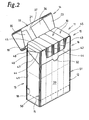
- Fig. 2 in two stacked groups of packs 11, 12.
- the cigarette packs 10 are positioned within the pack groups 11, 12 in a row next to each other and aligned one above the other, such that each two cigarette packs 10 are arranged exactly one above the other, with a total of ten cigarette packs 10. Der The pack contents formed in this way completely fill the bundle pack or folding box.
- the folding box consists, as is usual, of a lower box part 13 and a (top) cover 14. Within the folding box is a collar 15. This sits with a predominant, lower portion within the box part 13. An outstanding from the box part 13, Upper collar head 16 is included in the closed position of the lid 14.
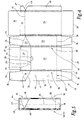
- the folding box consists of a one-piece blank, namely a Patriotzuschnitt according to Fig. 3 ,
- a pack blank 17 as part of the overall blank forms by cutting lines against each other delimited cutting areas, namely in the transverse direction successively a marginal box side tabs 18 with upwardly subsequent lid side tabs 19.
- Adjacent thereto is a box front wall 20 with subsequent lid front wall 21st
- the box rear wall 24 and the lid rear wall 25 Adjacent thereto is a box front wall 20 with subsequent lid front wall 21st
- a box side wall 22 with lid side wall 23 Adjacent thereto is a box side wall 22 with lid side wall 23.
- the box rear wall 24 and the lid rear wall 25 Adjacent thereto is a box front wall 20 with subsequent lid front wall 21st
- a box side wall 22 with lid side wall 23 Adjacent thereto is a box side wall 22 with lid side wall 23.
- the box rear wall 24 and the lid rear wall 25
- Die projecting walls of the box part 13 on the one hand and the lid 14 on the other hand are delimited in the region of the front wall and side walls by a punching line 28 having a plurality of residual compounds 29, 30 of the material to provide a connection between the lid 14 and box part 13 before the first opening of the lid 14th
- a punching line 28 having a plurality of residual compounds 29, 30 of the material to provide a connection between the lid 14 and box part 13 before the first opening of the lid 14th
- two residual joints 29 are formed at a distance from one another, while in the area of the box side tabs 18 and the box side wall 22 a central residual joint 30 is formed.
- the remaining compounds 29, 30 are severed the first time the lid 14 is opened.
- Box rear wall 24 and lid rear wall 25 are delimited from each other by a hinge line 31, which is formed in partial areas as a punching line.
- the punching line 28 extends in the region of the box side flap 18 and in the region of the box side wall 22 obliquely down to a transverse portion of the punching line 28 in the area of the box front wall 20.
- In the center of the box front wall 20 is at the punching line 28 formed below the same opening 32 which is semi-circular limited and facilitates the opening of the folding box when first put into use.
- An upper end wall 33 of the lid 14 and a lower bottom wall 34 of the box part 13 each consist of a plurality of folded folding flaps, which are arranged in extension of the walls 19, 21, 23, 25 and the walls 18, 20, 22 and 24 respectively.
- trapezoidal shaped corner tabs 35, 36 are arranged, which lie in the finished folding box on the inside of the end wall 33 and bottom wall 34 .
- a substantially rectangular inner tab 37 is attached in each case. This is slightly smaller than the area of the end wall 33 and bottom wall 34.
- the inner tab 37 is located on the outside of the corner tabs 35, 36 at.
- Outer cover tabs 38 are arranged in the region of the box rear wall 24 and the lid rear wall 25.
- the cover tabs 38 form the outer side or outer layer of the front wall 33 and bottom wall 34.
- the cover tabs 38 correspond in size and contour exactly to the end wall 33 and the bottom wall 34, respectively.
- a special feature is the positioning of the collar 15 as part of the overall blank.
- the collar 15 connects to the box side flap 18, with one of two collar flaps 39, 40.
- the collar flap 40 is connected via a fold line 41 with a free edge of the box side flap 18.
- the fold line 41 is formed by punches or partial cuts so that a slight tension-free folding is possible.
- the collar 15 has in the region of a central collar front wall 42 a conventional central recess 43 which is bounded by an upper collar edge 44. This extends starting from a collar corner 45 each sloping obliquely, while continuing the oblique course on the two collar tabs 39, 40. In the area of the box side flap 18, the collar edge 44 connects exactly to the end of the punching line 28, however at a slightly different angle.
- the collar 15 is folded around the folding line 41 in a first folding step until it rests against the inside of the package blank 17 (FIG. Fig. 4 ).
- the collar tab 40 rests against the inside of the box side flap 18.
- This first folding step is preferably carried out already in the manufacture of the blank in a paper or cardboard production, so that already prepared in terms of the collar 15, partially folded blanks for further processing are delivered.
- the collar front wall 42 covers part of the box front wall 20 and the lid front wall 21.
- the collar tab 39 is located on the box side wall 22.
- the collar 15 is in this folded position only in the area of the box side flap 18 with connected to the package blank 17, namely by (two) glue points 46.
- This first folding step is advantageously carried out by the blank manufacturer, so that blanks in the shape according to Fig. 4 be delivered or the packaging machine supplied.
- the blank can now be folded around the block-shaped package contents, wherein expediently the box side wall 22 and lid side wall 23 are applied to the package contents and the blank is otherwise folded in a U-shape.
- the box strip 26 is connected to the free side of the collar flap 40 by gluing.
- the lid strip 27 separated from the box strip 26 is also adhesively bonded to the inside of the lid side flap 19.
- the collar edge 44 extends in the region of the box side flap 18 and in the box side wall 22 from the front side of the folding box to the back obliquely downwards, while a closing edge formed by the punching line 28 is directed obliquely upward from the front to the back.
- Collar edge 44 and closing edge or punching line 28 converge at an acute angle and in a rear contact point 48.
- box strips 26 and cover strips 27 are separated from each other at the level of the hinge line 31 by a wedge-shaped punch-out 49. This results in obliquely directed edges of box strips 26 and cover strips 27 corresponding to the course of closing edge and collar edge 44 (FIG. Fig. 5 ).
- the angle defined by the cutout 49 is slightly larger than the angle defined by the collar edge 44 and the closing edge in the region of package sides such that the punching 49 delimiting oblique edges of the box strips 26 and cover strips 27 are not visible from outside (FIG. Fig. 5 ).
- a special feature is the formation of the folding box with round packing edges 50, 51 in the area of the box part 13 and cover 14 and in the region of the collar 15.
- the rounding of the packing edges 50, 51 is particularly dimensioned to match the dimensions of the package contents in this area are particularly adapted to rounding of cigarettes - cigarette packs 10 - or to the curves of cigarette packs 10 with upright round edges ( Fig. 2 ).
- the curves of the packing edges 50, 51 can also have a larger radius.
- the collar 15 is designed so that after the first folding step ( Fig. 4 ) Round edges 52, 53 of the collar 15 are exactly on the associated pack edges 50, 51 of the box front wall 20.
- the collar 15 is formed, namely with regard to the course of the collar edge 44, in that the contact point 48 lies outside the region of the round packaging edges 50, 51 ( Fig. 5 ). Furthermore, the inner folding tabs of the end wall 33 and bottom wall 34 are formed on the basis of punchings 54 so that they are formed outside the region of the round packing edges 50, 51.
- the package may also be formed with beveled edges, that is to say beveled packing edges, to create an octagonal package of cross-section.
- the collar 15 is dimensioned so that a lower edge 55 extends at a small distance above the bottom wall 34.
- the collar 15 is dimensioned such that the cigarette packs 10 of both pack groups 11, 12 are stably supported. This means that the collar extends at least to below a center of the cigarette packs 10 of the lower pack group 12.
- a bundle pack designed as a folding box consists of two part packs 56, 57.
- Each of these split packs 56, 57 is a folding box with the features of the embodiment according to FIG Fig.1 to Fig. 5 , The difference is only in the dimension of the blank and thus the folding box or sub-package 56, 57.
- each sub-package 56, 57 is such that a pack group 11 or 12 of five cigarette packs 10 in a sub-package 56, 57 recording.
- the cigarette packs 10 are arranged in the same way as the pack groups 11, 12 in the folding box according to Fig. 2 , ie in upright position with complete filling of the room contents.
- a collar 15 also extends in this embodiment to directly in the region of a bottom wall 34, so that collar front wall 42 and collar tabs 39, 40 support the (single) pack group 11, 12 over almost the full height.
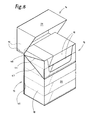
- Fig. 6 are two such sub-packages 56, 57 combined to form a container unit.
- the sub-packages 56, 57 (releasably) connected to each other.
- the exemplary embodiment shown has in the region of adjacent narrow side walls in each case a connecting member, namely an adhesive label 58 with a line of weakness, namely a perforation line 59 in the region of the abutting bottom walls 34.
- the in Fig. 6 The unit shown may be shared by the merchant or consumer by severing the perforation line 59.
- FIG. 8 Another peculiarity arises Fig. 8 , Again, a folding box - with rectangular in cross-section packaging edges - designed as a bundle pack for a number of cigarette packs 10.
- the special feature is the arrangement of the cigarette packs 10 within the folding box. These are positioned with large pack sides, namely with front and back side by side in the folding box. Their layout dimension is thus selected to correspond to the dimension of a front or back of a standard cigarette packet 10.
- the height of the folding box corresponds to the number of cigarette packs lying flat one above the other, in accordance with the exemplary embodiment Fig. 8 the height of five cigarette packs 10.
Landscapes
- Engineering & Computer Science (AREA)
- Mechanical Engineering (AREA)
- Packaging Of Annular Or Rod-Shaped Articles, Wearing Apparel, Cassettes, Or The Like (AREA)
- Cartons (AREA)
- Closing Of Containers (AREA)
- Data Exchanges In Wide-Area Networks (AREA)
- Use Of Switch Circuits For Exchanges And Methods Of Control Of Multiplex Exchanges (AREA)
Description
- Die Erfindung betrifft eine Klappschachtel für Zigaretten oder Zigarettenpackungen, bestehend aus einem Zuschnitt - Packungszuschnitt - aus dünnem Karton mit aneinander anschließenden Bereichen für einen äußeren Schachtel-Seitenlappen und Deckel-Seitenlappen, Schachtel-Vorderwand und Deckel-Vorderwand, Schachtel-Seitenwand und Deckel-Seitenwand, Schachtel-Rückwand und Deckel-Rückwand sowie mit einem randseitigen Schachtelstreifen zur Verbindung mit den Seitenlappen unter Bildung eines Schachtelteils mit Schachtel-Vorderwand, Schachtel-Rückwand, Schachtel-Seitenwänden und eines Deckels mit Deckel-Vorderwand, Deckel-Rückwand und Deckel-Seitenwänden, wobei ein einstückig mit dem Packungszuschnitt an einem freien Rand des Schachtel-Seitenlappens verbundener Kragen bei der Fertigung gegen eine Innenseite des Packungszuschnitts faltbar ist.
- Eine so ausgebildete Klappschachtel für Zigaretten oder Zigarettenpackungen ist bekannt durch
US 5 143 213 . Bei dieser bekannten Packung erstreckt sich ein an einer Rückwand (Schachtel-Rückwand, Deckel-Rückwand) angeordneter Randstreifen zur Verbindung mit einer zugeordneten Seitenwand über die volle Länge der Packungsrückwand. Weiterhin ist der einstückig mit dem Zuschnitt verbundene Kragen so ausgebildet, dass ein freier randseitiger Kragenlappen sich bis zur Bodenwand der Packung erstreckt. Hierdurch ergibt sich eine konstruktiv ungünstige Überlagerung von Faltlappen im Bereich der Seitenwand, insbesondere im Bereich der Seitenwand des Deckels. - Der Erfindung liegt die Aufgabe zugrunde, eine Klappschachtel der eingangs genannten Art bzw. deren Zuschnitt weiterzuentwickeln und zu verbessern, so dass eine Fertigung von Klappschachteln auf leistungsfähigen Verpackungsmaschinen möglich ist.
- Zur Lösung dieser Aufgabe ist die erfindungsgemäße Klappschachtel dadurch gekennzeichnet, dass der gegenüberliegend zum Schachtel-Seitenlappen angeordnete Schachtelstreifen im Bereich des Kragens mit der Kragen-Lasche und außerhalb des Kragens mit dem Schachtel-Seitenlappen jeweils innenseitig verbunden ist.
- Die vorliegende Klappschachtel ist besonders vorteilhaft als Gebindepackung für Zigaretten geeignet, also zur Aufnahme einer Gruppe von Zigarettenpackungen. Aufgrund entsprechender Abmessungen des Zuschnitts und der daraus gefertigten Klappschachtel ist eine Gruppe von fünf nebeneinander angeordneten Zigarettenpackungen in aufrechter Position innerhalb der Klappschachtel angeordnet. Des Weiteren können zwei so ausgebildete Gebinde-Klappschachteln zu einer teilbaren bzw. lösbaren Einheit miteinander verbunden sein, wobei die Klappschachteln mit Bodenwänden aneinander liegen und beispielsweise durch Klebelaschen oder dergleichen miteinander lösbar verbunden sind.
- Weitere Besonderheiten der erfindungsgemäßen Klappschachtel bzw. des Zuschnitts werden nachfolgend anhand der Zeichnungen näher erläutert. Es zeigt:
- Fig. 1
- eine Klappschachtel in Schließstellung, in perspektivischer Darstellung,
- Fig. 2
- die Packung gemäß
Fig. 1 bei geöffneter Stellung des Deckels, - Fig. 3
- einen ausgebreiteten Zuschnitt, nämlich Gesamtzuschnitt für eine Klappschachtel gemäß
Fig. 1 ,Fig. 2 , - Fig. 4
- den Zuschnitt bzw. Gesamtzuschnitt gemäß
Fig. 3 in einer Zwischenfaltstellung, - Fig. 5
- die Klappschachtel bei geschlossenem Deckel in Seitenansicht,
- Fig. 6
- eine andere Ausführungsform einer Klappschachtel bzw. einer Gebindepackung in perspektivischer Darstellung bei geöffnetem Deckel,
- Fig. 7
- einen modifizierten Zuschnitt für eine (Teil-)Klappschachtel der Gebindepackung gemäß
Fig. 6 in ausgebreiteter Stellung, - Fig. 8
- eine weitere Ausführung einer Klappschachtel als Gebindepackung für Zigaretten in perspektivischer Darstellung.
- Die in den Zeichnungen dargestellten Ausführungsbeispiele sind Klappschachteln für die Aufnahme einer Gruppe von Packungen, nämlich Zigarettenpackungen 10. Diese sind ebenfalls Klappschachteln grundsätzlich bekannter Ausführung. Die Gruppe ist innerhalb einer großvolumigen Gebindepackung in der Ausführung als Klappschachtel angeordnet. Die Positionierung der Zigarettenpackung 10 erfolgt bei dem Ausführungsbeispiel der
Fig. 1 ,Fig. 2 in zwei übereinander angeordneten Packungsgruppen 11, 12. Die Zigarettenpackungen 10 sind innerhalb der Packungsgruppen 11, 12 in einer Reihe nebeneinander positioniert und ausgerichtet übereinander angeordnet, derart, dass jeweils zwei Zigarettenpackungen 10 exakt übereinander angeordnet sind, mit einer Gesamtheit von zehn Zigarettenpackungen 10. Der so gebildete Packungsinhalt füllt die Gebindepackung bzw. Klappschachtel vollständig aus. - Die Klappschachtel besteht, wie grundsätzlich üblich, aus einem unteren Schachtelteil 13 und einem (oberen) Deckel 14. Innerhalb der Klappschachtel befindet sich ein Kragen 15. Dieser sitzt mit einem überwiegenden, unteren Abschnitt innerhalb des Schachtelteils 13. Ein aus dem Schachtelteil 13 herausragender, oberer Kragen-Kopf 16 ist in Schließstellung vom Deckel 14 umfasst.
- Die Klappschachtel besteht insgesamt aus einem einstückigen Zuschnitt, nämlich einem Gesamtzuschnitt gemäß
Fig. 3 . Ein Packungszuschnitt 17 als Teil des Gesamtzuschnitts bildet durch Prägelinien gegeneinander abgegrenzte Zuschnittbereiche, nämlich in Querrichtung aufeinander folgend einen randseitigen Schachtel-Seitenlappen 18 mit nach oben anschließendem Deckel-Seitenlappen 19. Benachbart hierzu befindet sich eine Schachtel-Vorderwand 20 mit anschließender Deckel-Vorderwand 21. Es folgt in Querrichtung eine Schachtel-Seitenwand 22 mit Deckel-Seitenwand 23. Hieran schließen Schachtel-Rückwand 24 und Deckel-Rückwand 25 an. Am freien Rand der Schachtel-Rückwand 24 befindet sich ein Schachtelstreifen 26 mit einem entsprechenden Deckelstreifen 27. Die vorstehenden Wandungen des Schachtelteils 13 einerseits und des Deckels 14 andererseits sind im Bereich von Vorderwand und Seitenwänden durch eine Stanzlinie 28 voneinander abgegrenzt, die mehrere Restverbindungen 29, 30 des Materials aufweist zur Schaffung einer Verbindung zwischen Deckel 14 und Schachtelteil 13 vor erstmaligem Öffnen des Deckels 14. Im Bereich von Schachtel-Vorderwand 20 und Deckel-Vorderwand 21 sind zwei Restverbindungen 29 mit Abstand voneinander gebildet, während im Bereich von Schachtel-Seitenlappen 18 und Schachtel-Seitenwand 22 jeweils eine mittige Restverbindung 30 gebildet ist. Die Restverbindungen 29, 30 werden beim erstmaligen Öffnen des Deckels 14 durchtrennt. Schachtel-Rückwand 24 und Deckel-Rückwand 25 sind durch eine Gelenklinie 31 voneinander abgegrenzt, die in Teilbereichen als Stanzlinie ausgebildet ist. Die Stanzlinie 28 verläuft im Bereich des Schachtel-Seitenlappens 18 und im Bereich der Schachtel-Seitenwand 22 schräg nach unten bis zu einem quergerichteten Abschnitt der Stanzlinie 28 im Bereich der Schachtel-Vorderwand 20. In der Mitte der Schachtel-Vorderwand 20 ist an der Stanzlinie 28 unterhalb derselben eine Öffnung 32 gebildet, die halbkreisförmig begrenzt ist und das Öffnen der Klappschachtel bei erstmaliger Ingebrauchnahme erleichtert. - Eine obere Stirnwand 33 des Deckels 14 und eine untere Bodenwand 34 des Schachtelteils 13 besteht jeweils aus mehreren übereinander gefalteten Faltlappen, die in Verlängerung der Wandungen 19, 21, 23, 25 bzw. der Wandungen 18, 20, 22 und 24 angeordnet sind. Im Bereich von Schachtel-Seitenlappen 18 und Deckel-Seitenlappen 19 sowie im Bereich der Schachtel-Seitenwand 22 und der Deckel-Seitenwand 23 sind trapezförmig ausgebildete Ecklappen 35, 36 angeordnet, die bei der fertigen Klappschachtel an der Innenseite von Stirnwand 33 und Bodenwand 34 liegen. Im Bereich der Schachtel-Vorderwand 20 und im Bereich der Deckel-Vorderwand 21 ist jeweils ein im Wesentlichen rechteckiger Innenlappen 37 angebracht. Dieser ist geringfügig kleiner als die Fläche von Stirnwand 33 und Bodenwand 34. Der Innenlappen 37 liegt an der Außenseite der Ecklappen 35, 36 an. Äußere Decklappen 38 sind im Bereich von Schachtel-Rückwand 24 und Deckel-Rückwand 25 angeordnet. Die Decklappen 38 bilden die Außenseite bzw. Außenlage von Stirnwand 33 und Bodenwand 34. Die Decklappen 38 entsprechen in Größe und Kontur exakt der Stirnwand 33 bzw. der Bodenwand 34.
- Eine Besonderheit ist die Positionierung des Kragens 15 als Teil des Gesamtzuschnitts. Der Kragen 15 schließt an den Schachtel-Seitenlappen 18 an, und zwar mit einem von zwei Kragen-Laschen 39, 40. Die Kragen-Lasche 40 ist über eine Faltlinie 41 mit einem freien Rand des Schachtel-Seitenlappens 18 verbunden. Die Faltlinie 41 ist durch Stanzungen bzw. Teilschnitte so ausgebildet, dass eine leichte spannungsfreie Faltung möglich ist.
- Der Kragen 15 weist im Bereich einer mittleren Kragen-Vorderwand 42 eine übliche mittige Vertiefung 43 auf, die von einer oberen Kragenkante 44 begrenzt ist. Diese erstreckt sich ausgehend von einer Kragenecke 45 jeweils schräg abfallend, und zwar unter Fortsetzung des schrägen Verlaufs über die beiden Kragen-Laschen 39, 40. Im Bereich des Schachtel-Seitenlappens 18 schließt die Kragenkante 44 exakt an das Ende der Stanzlinie 28 an, allerdings unter einem geringfügig anderen Winkel.
- Bei der Herstellung der Klappschachtel wird in einem ersten Faltschritt der Kragen 15 um die Faltlinie 41 gefaltet bis zur Anlage an der Innenseite des Packungszuschnitts 17 (
Fig. 4 ). Die Kragen-Lasche 40 liegt dabei innenseitig am Schachtel-Seitenlappen 18 an. Dieser erste Faltschritt wird vorzugsweise bereits bei der Fertigung des Zuschnitts in einer Papier- bzw. Kartonagenfertigung durchgeführt, so dass bereits hinsichtlich des Kragens 15 vorbereitete, teilgefaltete Zuschnitte für die Weiterverarbeitung angeliefert werden. Die Kragen-Vorderwand 42 bedeckt einen Teil der Schachtel-Vorderwand 20 und der Deckel-Vorderwand 21. Weiterhin liegt die Kragen-Lasche 39 an der Schachtel-Seitenwand 22. Der Kragen 15 ist in dieser Faltstellung lediglich im Bereich des Schachtel-Seitenlappens 18 mit dem Packungszuschnitt 17 verbunden, nämlich durch (zwei) Leimpunkte 46. Dieser erste Faltschritt wird zweckmäßigerweise vom Zuschnitthersteller durchgeführt, so dass Zuschnitte in der Gestalt gemäßFig. 4 angeliefert bzw. der Verpackungsmaschine zugeführt werden. - Der Zuschnitt kann nun um den blockförmigen Packungsinhalt herumgefaltet werden, wobei zweckmäßigerweise die Schachtel-Seitenwand 22 und Deckel-Seitenwand 23 an den Packungsinhalt angelegt und der Zuschnitt im Übrigen U-förmig gefaltet wird. Zur Vervollständigung einer hülsenförmigen Zwischenfaltstellung wird der Schachtelstreifen 26 mit der freien Seite der Kragen-Lasche 40 durch Klebung verbunden. Entsprechend wird der von dem Schachtelstreifen 26 getrennte Deckel-Streifen 27 mit der Innenseite des Deckel-Seitenlappens 19 ebenfalls durch Klebung verbunden. Danach werden die Faltlappen zur Bildung der Stirnwand 33 und der Bodenwand 34 gefaltet und durch Klebung miteinander verbunden.
- Durch den Verlauf der Stanzlinie 28 einerseits und die Konturen des Kragens 15, insbesondere der Kragenkante 44 andererseits verläuft die Kragenkante 44 im Bereich des Schachtel-Seitenlappens 18 und im Bereich der Schachtel-Seitenwand 22 von der Frontseite der Klappschachtel zur Rückseite schräg abwärts gerichtet, während eine durch die Stanzlinie 28 gebildete Schließkante schräg aufwärts gerichtet ist von der Frontseite zur Rückseite. Kragenkante 44 und Schließkante bzw. Stanzlinie 28 laufen unter einem spitzen Winkel und in einem rückseitigen Berührungspunkt 48 zusammen.
- Wegen der vorstehenden Packungskonstruktion sind Schachtel-Streifen 26 und Deckelstreifen 27 in Höhe der Gelenklinie 31 durch eine keilförmige Ausstanzung 49 voneinander getrennt. Es entstehen so schräg gerichtete Ränder von Schachtelstreifen 26 und Deckelstreifen 27 entsprechend dem Verlauf von Schließkante und Kragenkante 44 (
Fig. 5 ). Der durch die Ausstanzung 49 definierte Winkel ist etwas größer als der durch Kragenkante 44 und Schließkante definierte Winkel im Bereich von Packungsseiten, derart, dass die Ausstanzung 49 begrenzende Schrägränder von Schachtelstreifen 26 und Deckelstreifen 27 von Außen nicht sichtbar sind (Fig. 5 ). - Eine Besonderheit ist die Ausbildung der Klappschachtel mit runden Packungskanten 50, 51 im Bereich von Schachtelteil 13 und Deckel 14 sowie im Bereich des Kragens 15. Die Rundung der Packungskanten 50, 51 ist insbesondere so bemessen, dass sie an die Abmessungen des Packungsinhalts in diesem Bereich angepasst sind, insbesondere an Rundungen von Zigaretten - bei Zigarettenpackungen 10 - oder an die Rundungen von Zigarettenpackungen 10 mit aufrechten Rundkanten (
Fig. 2 ). Die Rundungen der Packungskanten 50, 51 können aber auch eine größeren Radius aufweisen. Der Kragen 15 ist dabei so ausgebildet, dass nach dem ersten Faltschritt (Fig. 4 ) Rundkanten 52, 53 des Kragens 15 exakt auf den zugeordneten Packungskanten 50, 51 von Schachtel-Vorderwand 20 liegen. Weiterhin ist der Kragen 15 so ausgebildet, nämlich hinsichtlich des Verlaufs der Kragenkante 44, dass der Berührungspunkt 48 außerhalb des Bereichs der runden Packungskanten 50, 51 liegt (Fig. 5 ). Weiterhin sind die innenliegenden Faltlappen von Stirnwand 33 und Bodenwand 34 auf Grund von Stanzungen 54 so ausgebildet, dass sie außerhalb des Bereichs der runden Packungskanten 50, 51 gebildet sind. - In analoger Weise kann die Packung auch mit Schrägkanten, also abgeschrägten Packungskanten ausgebildet sein unter Schaffung einer im Querschnitt achteckigen Packung.
- Bei einer Gebindepackung für in zwei übereinander angeordneten Packungsgruppen 11, 12 gebildetem Packungsinhalt ist der Kragen 15 so bemessen, dass sich eine Unterkante 55 mit geringem Abstand oberhalb der Bodenwand 34 erstreckt. Der Kragen 15 ist so dimensioniert, dass die Zigarettenpackungen 10 beider Packungsgruppen 11, 12 stabil abgestützt sind. Dies bedeutet, dass sich der Kragen mindestens bis unterhalb einer Mitte der Zigarettenpackungen 10 der unteren Packungsgruppe 12 erstreckt.
- Eine Besonderheit ist in
Fig. 6 undFig. 7 dargestellt. Eine als Klappschachtel gestaltete Gebindepackung besteht aus zwei Teilpackungen 56, 57. Jede dieser Teilpackungen 56, 57 ist eine Klappschachtel mit den Merkmalen des Ausführungsbeispiels gemäßFig.1 bis Fig. 5 . Der Unterschied besteht lediglich in der Abmessung des Zuschnitts und damit der Klappschachtel bzw. Teilpackung 56, 57. Jede Teilpackung 56, 57 ist nämlich so bemessen, dass eine Packungsgruppe 11 bzw. 12 aus fünf Zigarettenpackungen 10 in einer Teilpackung 56, 57 Aufnahme findet. Die Zigarettenpackungen 10 sind dabei in gleicher Weise angeordnet wie die Packungsgruppen 11, 12 in der Klappschachtel gemäßFig. 2 , also in aufrechter Positionierung unter vollständigem Ausfüllen des Rauminhalts. Ein Kragen 15 erstreckt sich auch bei diesem Ausführungsbeispiel bis unmittelbar in den Bereich einer Bodenwand 34, so dass Kragen-Vorderwand 42 und Kragen-Laschen 39, 40 die (einzelne) Packungsgruppe 11, 12 über nahezu die volle Höhe stützen. - Gemäß
Fig. 6 sind zwei derartige Teilpackungen 56, 57 zu einer Gebindeeinheit zusammengefasst. Zu diesem Zweck liegen zwei übereinstimmend ausgebildete Teilpackungen 56, 57 mit den Bodenwänden 34 aneinander. In diesem Bereich sind die Teilpackungen 56, 57 (lösbar) miteinander verbunden. Das gezeigte Ausführungsbeispiel weist im Bereich von benachbarten schmalen Seitenwänden jeweils ein Verbindungsorgan auf, nämlich ein Klebeetikett 58 mit einer Schwächungslinie, nämlich einer Perforationslinie 59 im Bereich der aneinanderstoßenden Bodenwände 34. Die inFig. 6 gezeigte Einheit kann vom Händler oder Verbraucher geteilt werden mittels Durchtrennung der Perforationslinie 59. - Die Anordnung der Teilpackungen 56, 57 ist so gewählt, dass sie seitenverkehrt angeordnet sind, also jeweils Schachtel-Vorderwand 20 der einen Teilpackung 56 auf derselben Seite wie Schachtel-Rückwand 24 der anderen Teilpackung 57.
- Eine weitere Besonderheit ergibt sich aus
Fig. 8 . Auch hier ist eine Klappschachtel - mit im Querschnitt rechtwinkligen Packungskanten - als Gebindepackung für eine Anzahl von Zigarettenpackungen 10 ausgebildet. Die Besonderheit besteht in der Anordnung der Zigarettenpackungen 10 innerhalb der Klappschachtel. Diese sind mit großflächigen Packungsseiten, nämlich mit Vorderseite und Rückseite aneinanderliegend in der Klappschachtel positioniert. Deren Grundrissabmessung ist demnach so gewählt, dass sie der Abmessung einer Vorder- oder Rückseite einer standardmäßigen Zigarettenpackung 10 entspricht. Die Höhe der Klappschachtel entspricht der Anzahl der flach liegend übereinander angeordneten Zigarettenpackungen 10, bei dem Ausführungsbeispiel gemäßFig. 8 der Höhe von fünf Zigarettenpackungen 10. -
- 10
- Zigarettenpackung
- 11
- Packungsgruppe
- 12
- Packungsgruppe
- 13
- Schachtelteil
- 14
- Deckel
- 15
- Kragen
- 16
- Kragen-Kopf
- 17
- Packungszuschnitt
- 18
- Schachtel-Seitenlappen
- 19
- Deckel-Seitenlappen
- 20
- Schachtel-Vorderwand
- 21
- Deckel-Vorderwand
- 22
- Schachtel-Seitenwand
- 23
- Deckel-Seitenwand
- 24
- Schachtel-Rückwand
- 25
- Deckel-Rückwand
- 26
- Schachtelstreifen
- 27
- Deckelstreifen
- 28
- Stanzlinie
- 29
- Restverbindung
- 30
- Restverbindung
- 31
- Gelenklinie
- 32
- Öffnung
- 33
- Stirnwand
- 34
- Bodenwand
- 35
- Ecklappen
- 36
- Ecklappen
- 37
- Innenlappen
- 38
- Deckellappen
- 39
- Kragen-Lasche
- 40
- Kragen-Lasche
- 41
- Faltlinie
- 42
- Kragen-Vorderwand
- 43
- Vertiefung
- 44
- Kragenkante
- 45
- Kragenecke
- 46
- Leimpunkt
- 48
- Punkt
- 49
- Ausstanzung
- 50
- Packungskante
- 51
- Packungskante
- 52
- Rundkante
- 53
- Rundkante
- 54
- Stanzung
- 55
- Unterkante
- 56
- Teilpackung
- 57
- Teilpackung
- 58
- Klebeetikett
- 59
- Perforationslinie
Claims (6)
- Klappschachtel für Zigaretten oder Zigarettenpackungen (10), bestehend aus einem Zuschnitt - Packungszuschnitt (17) - aus dünnem Karton mit aneinander anschließenden Bereichen für einen äußeren Schachtel-Seitenlappen (18) und Deckel-Seitenlappen (19), Schachtel-Vorderwand (20) und Deckel-Vorderwand (21), Schachtel-Seitenwand (22) und Deckel-Seitenwand (23), Schachtel-Rückwand (24) und Deckel-Rückwand (25) sowie mit einem randseitigen Schachtelstreifen (26) zur Verbindung mit den Seitenlappen (18, 19) unter Bildung eines Schachtelteils (13) mit Schachtel-Vorderwand (20), Schachtel-Rückwand (24), Schachtel-Seitenwänden (22) und eines Deckels (14) mit Deckel-Vorderwand (20), Deckel-Rückwand (25) und Deckel-Seitenwänden (23), wobei ein einstückig mit dem Packungszuschnitt (17) an einem freien Rand des Schachtel-Seitenlappens (18) verbundener Kragen (15) bei der Fertigung gegen eine Innenseite des Packungszuschnitts (17) faltbar ist, dadurch gekennzeichnet, dass der gegenüberliegend zum Schachtel-Seitenlappen (18) angeordnete Schachtelstreifen (26) im Bereich des Kragens (15) mit der Kragen-Lasche (40) und außerhalb des Kragens (15) mit dem Schachtel-Seitenlappen (18) jeweils innenseitig verbunden ist.
- Klappschachtel nach Anspruch 1, gekennzeichnet durch folgende Merkmale:a) ein im Bereich der Deckel-Rückwand (25) seitlich angebrachter Deckelstreifen (27) in Fortsetzung des Schachtelstreifens (26) ist mit dem Deckel-Seitenlappen (19) verbunden,b) der Schachtelstreifen (26) und der Deckelstreifen (27) sind durch eine keilförmige Ausstanzung (29) voneinander abgegrenzt unter Bildung von schräggerichteten Kanten,c) der durch die Ausstanzung (49) definierte Winkel ist etwas größer als der durch eine Kragenkante (44) einerseits und durch eine schräggerichtete Stanzlinie (28) zwischen Schachtelteil (13) und Deckel (14) andererseits definierte Winkel im Bereich von Packungsseiten, derart, dass die die Ausstanzung (49) begrenzenden Schrägränder von außen nicht sichtbar sind.
- Klappschachtel nach Anspruch 1 oder 2, dadurch gekennzeichnet, dass zur Aufnahme von zwei übereinander angeordneten Packungsgruppen (11, 12) aus Einzelpackungen bzw. Zigarettenpackungen (10) der Kragen (15) bis in einen Bereich der unteren Packungsgruppe (12) verlängert ist, insbesondere bis in einen Bereich unterhalb einer gedachten horizontalen Mittelebene der Packungen der unteren Packungsgruppe (12).
- Klappschachtel nach Anspruch 1 oder einem der weiteren Ansprüche, dadurch gekennzeichnet, dass die als Gebindepackung dienende Klappschachtel in der Höhe so bemessen ist, dass sie der Höhe einer standardmäßigen Zigarettenpackung (10) entspricht und in der Breite vorzugsweise so bemessen ist, dass fünf nebeneinander positionierte Zigarettenpackungen (10) Aufnahme finden.
- Klappschachtel nach Anspruch 4, dadurch gekennzeichnet, dass mindestens zwei Klappschachteln als Teilpackungen (56, 57) zu einer Gebindeeinheit vereinigt sind, wobei vorzugsweise die Teilpackungen (56, 57) mit ihren Bodenwänden (34) aneinander liegen und in diesem Bereich lösbar miteinander verbunden sind.
- Klappschachtel nach Anspruch 5, dadurch gekennzeichnet, dass die Teilpackungen (56, 57) an mindestens zwei einander gegenüberliegenden Seiten, insbesondere an Schmalseiten, durch jeweils ein Klebeetikett (58) miteinander verbunden sind, wobei vorzugsweise das Klebeetikett eine Perforationslinie (59) im Bereich der aneinanderliegenden Bodenwände (34) aufweist.
Applications Claiming Priority (5)
| Application Number | Priority Date | Filing Date | Title |
|---|---|---|---|
| DE10235083 | 2002-07-31 | ||
| DE10235083 | 2002-07-31 | ||
| DE10243925A DE10243925A1 (de) | 2002-09-20 | 2002-09-20 | Klappschachtel |
| DE10243925 | 2002-09-20 | ||
| PCT/EP2003/008029 WO2004013018A1 (de) | 2002-07-31 | 2003-07-23 | Klappschachtel |
Publications (2)
| Publication Number | Publication Date |
|---|---|
| EP1542913A1 EP1542913A1 (de) | 2005-06-22 |
| EP1542913B1 true EP1542913B1 (de) | 2010-03-10 |
Family
ID=31496741
Family Applications (1)
| Application Number | Title | Priority Date | Filing Date |
|---|---|---|---|
| EP03766260A Expired - Lifetime EP1542913B1 (de) | 2002-07-31 | 2003-07-23 | Klappschachtel |
Country Status (6)
| Country | Link |
|---|---|
| US (1) | US20060054518A1 (de) |
| EP (1) | EP1542913B1 (de) |
| AT (1) | ATE460360T1 (de) |
| AU (1) | AU2003254571A1 (de) |
| DE (1) | DE50312505D1 (de) |
| WO (1) | WO2004013018A1 (de) |
Families Citing this family (13)
| Publication number | Priority date | Publication date | Assignee | Title |
|---|---|---|---|---|
| ITBO20000676A1 (it) * | 2000-11-20 | 2002-05-20 | Gd Spa | Involucro di tipo rigido a coperchio incernierato per articoli da fumo |
| WO2005087619A1 (ja) * | 2004-03-12 | 2005-09-22 | Japan Tobacco Inc. | 棒状喫煙物品のヒンジリッド型パッケージ及びそのブランク |
| DE102004037433A1 (de) * | 2004-07-30 | 2006-03-23 | Focke & Co.(Gmbh & Co. Kg) | Klappschachtel für Zigaretten sowie Verfahren und Vorrichtung zum Herstellen derselben |
| US20060138207A1 (en) * | 2004-08-23 | 2006-06-29 | Andrew Levine | Knock-down, folded, flip-top cigarette box with pop-out tab |
| EP2141091B1 (de) * | 2007-05-01 | 2016-03-23 | Japan Tobacco Inc. | Verpackung für stabförmigen rauchartikel und rohling dafür |
| US8006835B2 (en) * | 2007-12-12 | 2011-08-30 | Philip Morris Usa Inc. | Blank for forming sleeve including a pocket |
| USD624816S1 (en) * | 2008-04-02 | 2010-10-05 | Philip Morris Usa Inc. | Packaging container |
| US8910784B2 (en) * | 2008-12-10 | 2014-12-16 | Philip Morris Usa Inc. | Packet sleeve including pocket |
| DE102010023753A1 (de) | 2010-06-15 | 2011-12-15 | Focke & Co. (Gmbh & Co. Kg) | Packung für Zigaretten sowie Verfahren und Vorrichtung zur Herstellung derselben |
| GB201104265D0 (en) * | 2011-03-14 | 2011-04-27 | British American Tobacco Co | Pack |
| WO2014146957A1 (en) * | 2013-03-18 | 2014-09-25 | Philip Morris Products S.A. | Tamper evident container |
| US20160227835A1 (en) * | 2015-02-06 | 2016-08-11 | R.J. Reynolds Tobacco Company | Container with tamper evident portion |
| WO2017022064A1 (ja) * | 2015-08-04 | 2017-02-09 | 日本たばこ産業株式会社 | パッケージキット |
Family Cites Families (16)
| Publication number | Priority date | Publication date | Assignee | Title |
|---|---|---|---|---|
| US2473055A (en) * | 1945-01-05 | 1949-06-14 | Waldorf Paper Prod Co | Reclosing carton |
| US2922564A (en) * | 1956-08-09 | 1960-01-26 | Robert E Van Rosen | Box or container |
| US2951627A (en) * | 1956-09-10 | 1960-09-06 | Cornell Paperboard Products Co | Snap top cardboard box |
| US3708108A (en) * | 1971-09-22 | 1973-01-02 | Burt Co Inc F | Flip top carton |
| GB8416365D0 (en) * | 1984-06-27 | 1984-08-01 | Cadbury Typhoo Ltd | Tea bag package |
| GB8906466D0 (en) * | 1989-03-21 | 1989-05-04 | Premier Brands Uk | Improvements relating to packaging containers |
| US5143213A (en) * | 1990-10-09 | 1992-09-01 | Philip Morris Incorporated | Multi-pack flip-top cigarette carton |
| US5141106A (en) * | 1991-10-08 | 1992-08-25 | Philip Morris Inc. | Two separate cartons combined as a single unit by adhesive/carrier means |
| US5161733A (en) * | 1991-06-03 | 1992-11-10 | Philip Morris Incorporated | Hinge lid cigarette carton with innerframe, and blank and method therefor |
| US5205403A (en) * | 1991-10-08 | 1993-04-27 | Philip Morris Incorporated | Multiple unit carton |
| IT1264279B1 (it) * | 1993-11-29 | 1996-09-23 | Gd Spa | Metodo e macchina per la realizzazione di pacchetti doppi di sigarette |
| DE29516763U1 (de) | 1995-10-24 | 1996-02-08 | Wanfried-Druck Kalden GmbH, 37281 Wanfried | Geschlossener Faltschachtelkörper mit eingearbeitetem Klappverschlußdeckel |
| EG21600A (en) * | 1997-07-09 | 2001-12-31 | Reemtsma H F & Ph | Blank for cigarette pack |
| DE19912995A1 (de) * | 1999-03-23 | 2000-09-28 | Focke & Co | Packung nach Art einer Zigarettenstange |
| IT1309976B1 (it) * | 1999-04-16 | 2002-02-05 | Gd Spa | Sbozzato di materiale di incarto per il confezionamento di uninvolucro rigido con coperchio incernierato per un gruppo ordinato di |
| ITBO20000741A1 (it) * | 2000-12-22 | 2002-06-22 | Gd Spa | Sbozzato per involucri di tipo rigido a coperchio incernierato per articoli da fumo e procedimento per la realizzazione di detti involucri |
-
2003
- 2003-07-23 EP EP03766260A patent/EP1542913B1/de not_active Expired - Lifetime
- 2003-07-23 AU AU2003254571A patent/AU2003254571A1/en not_active Abandoned
- 2003-07-23 US US10/521,000 patent/US20060054518A1/en not_active Abandoned
- 2003-07-23 AT AT03766260T patent/ATE460360T1/de not_active IP Right Cessation
- 2003-07-23 WO PCT/EP2003/008029 patent/WO2004013018A1/de not_active Ceased
- 2003-07-23 DE DE50312505T patent/DE50312505D1/de not_active Expired - Lifetime
Also Published As
| Publication number | Publication date |
|---|---|
| WO2004013018A1 (de) | 2004-02-12 |
| AU2003254571A1 (en) | 2004-02-23 |
| US20060054518A1 (en) | 2006-03-16 |
| EP1542913A1 (de) | 2005-06-22 |
| DE50312505D1 (de) | 2010-04-22 |
| ATE460360T1 (de) | 2010-03-15 |
Similar Documents
| Publication | Publication Date | Title |
|---|---|---|
| DE4329368B4 (de) | Weichpackung für Zigaretten | |
| EP0745541B1 (de) | Klappschachtel für Zigaretten | |
| EP0778212B1 (de) | Klappschachtel für Zigaretten oder dergleichen | |
| EP0675056B1 (de) | Klappschachtel für Zigaretten oder dergleichen | |
| EP1615830B2 (de) | Klappschachtel für zigaretten | |
| EP0625469B1 (de) | Verpackung, nämlich Klappschachtel | |
| EP1204572B1 (de) | Klappschachtel für zigaretten | |
| EP0837012B2 (de) | Klappschachtel für Zigaretten | |
| EP1163170B1 (de) | Packung nach art einer zigarettenstange | |
| EP0134549B1 (de) | Kappenschachtel für Zigaretten oder dergleichen | |
| EP1747153B1 (de) | Zigarettenpackung | |
| EP1051340A1 (de) | (zigaretten-)packung aus faltbarem verpackungsmaterial | |
| EP0685409B1 (de) | Gebindepackung für Zigaretten-Packungen | |
| EP1542913A1 (de) | Klappschachtel | |
| EP1015353B1 (de) | Klappschachtel für zigaretten | |
| DE102011105695A1 (de) | Packung für Zigaretten sowie Zuschnitt, Materialbahn und Verfahren zum Herstellen derselben | |
| EP0519257A2 (de) | Verpackung für eine Mehrzahl von Packungen | |
| DE2408879C2 (de) | Quaderförmige Schachtel aus faltbarem Material, insbesondere Hartbox für Zigaretten | |
| EP3823914A1 (de) | Packung für produkte der zigarettenindustrie | |
| DE102005014864A1 (de) | Zigarettenpackung | |
| EP2064134B1 (de) | Klappschachtel für zigaretten sowie zuschnitt für klappschachteln | |
| DE10243925A1 (de) | Klappschachtel | |
| DE7720150U1 (de) | Verpackung zur Aufnahme von einzelnen Gegenstaenden insbesondere Zigarettenpackungen | |
| DE20114995U1 (de) | Gebindezuschnitt | |
| WO2023088744A2 (de) | Packung für produkte der zigarettenindustrie |
Legal Events
| Date | Code | Title | Description |
|---|---|---|---|
| PUAI | Public reference made under article 153(3) epc to a published international application that has entered the european phase |
Free format text: ORIGINAL CODE: 0009012 |
|
| TPAC | Observations filed by third parties |
Free format text: ORIGINAL CODE: EPIDOSNTIPA |
|
| 17P | Request for examination filed |
Effective date: 20050203 |
|
| AK | Designated contracting states |
Kind code of ref document: A1 Designated state(s): AT BE BG CH CY CZ DE DK EE ES FI FR GB GR HU IE IT LI LU MC NL PT RO SE SI SK TR |
|
| AX | Request for extension of the european patent |
Extension state: AL LT LV MK |
|
| DAX | Request for extension of the european patent (deleted) | ||
| 17Q | First examination report despatched |
Effective date: 20081125 |
|
| GRAP | Despatch of communication of intention to grant a patent |
Free format text: ORIGINAL CODE: EPIDOSNIGR1 |
|
| GRAS | Grant fee paid |
Free format text: ORIGINAL CODE: EPIDOSNIGR3 |
|
| GRAA | (expected) grant |
Free format text: ORIGINAL CODE: 0009210 |
|
| AK | Designated contracting states |
Kind code of ref document: B1 Designated state(s): AT BE BG CH CY CZ DE DK EE ES FI FR GB GR HU IE IT LI LU MC NL PT RO SE SI SK TR |
|
| REG | Reference to a national code |
Ref country code: GB Ref legal event code: FG4D Free format text: NOT ENGLISH |
|
| REG | Reference to a national code |
Ref country code: CH Ref legal event code: EP |
|
| REG | Reference to a national code |
Ref country code: IE Ref legal event code: FG4D |
|
| REF | Corresponds to: |
Ref document number: 50312505 Country of ref document: DE Date of ref document: 20100422 Kind code of ref document: P |
|
| PLBI | Opposition filed |
Free format text: ORIGINAL CODE: 0009260 |
|
| 26 | Opposition filed |
Opponent name: G.D SOCIETA PER AZIONI Effective date: 20100524 |
|
| REG | Reference to a national code |
Ref country code: NL Ref legal event code: VDEP Effective date: 20100310 |
|
| PG25 | Lapsed in a contracting state [announced via postgrant information from national office to epo] |
Ref country code: SI Free format text: LAPSE BECAUSE OF FAILURE TO SUBMIT A TRANSLATION OF THE DESCRIPTION OR TO PAY THE FEE WITHIN THE PRESCRIBED TIME-LIMIT Effective date: 20100310 Ref country code: FI Free format text: LAPSE BECAUSE OF FAILURE TO SUBMIT A TRANSLATION OF THE DESCRIPTION OR TO PAY THE FEE WITHIN THE PRESCRIBED TIME-LIMIT Effective date: 20100310 |
|
| REG | Reference to a national code |
Ref country code: IE Ref legal event code: FD4D |
|
| PG25 | Lapsed in a contracting state [announced via postgrant information from national office to epo] |
Ref country code: EE Free format text: LAPSE BECAUSE OF FAILURE TO SUBMIT A TRANSLATION OF THE DESCRIPTION OR TO PAY THE FEE WITHIN THE PRESCRIBED TIME-LIMIT Effective date: 20100310 Ref country code: SE Free format text: LAPSE BECAUSE OF FAILURE TO SUBMIT A TRANSLATION OF THE DESCRIPTION OR TO PAY THE FEE WITHIN THE PRESCRIBED TIME-LIMIT Effective date: 20100310 Ref country code: RO Free format text: LAPSE BECAUSE OF FAILURE TO SUBMIT A TRANSLATION OF THE DESCRIPTION OR TO PAY THE FEE WITHIN THE PRESCRIBED TIME-LIMIT Effective date: 20100310 Ref country code: NL Free format text: LAPSE BECAUSE OF FAILURE TO SUBMIT A TRANSLATION OF THE DESCRIPTION OR TO PAY THE FEE WITHIN THE PRESCRIBED TIME-LIMIT Effective date: 20100310 Ref country code: GR Free format text: LAPSE BECAUSE OF FAILURE TO SUBMIT A TRANSLATION OF THE DESCRIPTION OR TO PAY THE FEE WITHIN THE PRESCRIBED TIME-LIMIT Effective date: 20100611 Ref country code: ES Free format text: LAPSE BECAUSE OF FAILURE TO SUBMIT A TRANSLATION OF THE DESCRIPTION OR TO PAY THE FEE WITHIN THE PRESCRIBED TIME-LIMIT Effective date: 20100621 Ref country code: CY Free format text: LAPSE BECAUSE OF FAILURE TO SUBMIT A TRANSLATION OF THE DESCRIPTION OR TO PAY THE FEE WITHIN THE PRESCRIBED TIME-LIMIT Effective date: 20100310 |
|
| PG25 | Lapsed in a contracting state [announced via postgrant information from national office to epo] |
Ref country code: SK Free format text: LAPSE BECAUSE OF FAILURE TO SUBMIT A TRANSLATION OF THE DESCRIPTION OR TO PAY THE FEE WITHIN THE PRESCRIBED TIME-LIMIT Effective date: 20100310 Ref country code: CZ Free format text: LAPSE BECAUSE OF FAILURE TO SUBMIT A TRANSLATION OF THE DESCRIPTION OR TO PAY THE FEE WITHIN THE PRESCRIBED TIME-LIMIT Effective date: 20100310 Ref country code: BG Free format text: LAPSE BECAUSE OF FAILURE TO SUBMIT A TRANSLATION OF THE DESCRIPTION OR TO PAY THE FEE WITHIN THE PRESCRIBED TIME-LIMIT Effective date: 20100610 |
|
| PLAX | Notice of opposition and request to file observation + time limit sent |
Free format text: ORIGINAL CODE: EPIDOSNOBS2 |
|
| BERE | Be: lapsed |
Owner name: FOCKE & CO. (GMBH & CO. KG) Effective date: 20100731 |
|
| PG25 | Lapsed in a contracting state [announced via postgrant information from national office to epo] |
Ref country code: DK Free format text: LAPSE BECAUSE OF FAILURE TO SUBMIT A TRANSLATION OF THE DESCRIPTION OR TO PAY THE FEE WITHIN THE PRESCRIBED TIME-LIMIT Effective date: 20100310 Ref country code: PT Free format text: LAPSE BECAUSE OF FAILURE TO SUBMIT A TRANSLATION OF THE DESCRIPTION OR TO PAY THE FEE WITHIN THE PRESCRIBED TIME-LIMIT Effective date: 20100712 Ref country code: IE Free format text: LAPSE BECAUSE OF FAILURE TO SUBMIT A TRANSLATION OF THE DESCRIPTION OR TO PAY THE FEE WITHIN THE PRESCRIBED TIME-LIMIT Effective date: 20100310 |
|
| PG25 | Lapsed in a contracting state [announced via postgrant information from national office to epo] |
Ref country code: MC Free format text: LAPSE BECAUSE OF NON-PAYMENT OF DUE FEES Effective date: 20100731 |
|
| REG | Reference to a national code |
Ref country code: CH Ref legal event code: PL |
|
| REG | Reference to a national code |
Ref country code: FR Ref legal event code: ST Effective date: 20110331 |
|
| PG25 | Lapsed in a contracting state [announced via postgrant information from national office to epo] |
Ref country code: LI Free format text: LAPSE BECAUSE OF NON-PAYMENT OF DUE FEES Effective date: 20100731 Ref country code: CH Free format text: LAPSE BECAUSE OF NON-PAYMENT OF DUE FEES Effective date: 20100731 |
|
| PLAF | Information modified related to communication of a notice of opposition and request to file observations + time limit |
Free format text: ORIGINAL CODE: EPIDOSCOBS2 |
|
| PG25 | Lapsed in a contracting state [announced via postgrant information from national office to epo] |
Ref country code: FR Free format text: LAPSE BECAUSE OF NON-PAYMENT OF DUE FEES Effective date: 20100802 |
|
| PLBB | Reply of patent proprietor to notice(s) of opposition received |
Free format text: ORIGINAL CODE: EPIDOSNOBS3 |
|
| PG25 | Lapsed in a contracting state [announced via postgrant information from national office to epo] |
Ref country code: BE Free format text: LAPSE BECAUSE OF NON-PAYMENT OF DUE FEES Effective date: 20100731 |
|
| PLCK | Communication despatched that opposition was rejected |
Free format text: ORIGINAL CODE: EPIDOSNREJ1 |
|
| PG25 | Lapsed in a contracting state [announced via postgrant information from national office to epo] |
Ref country code: AT Free format text: LAPSE BECAUSE OF NON-PAYMENT OF DUE FEES Effective date: 20100723 |
|
| PLBN | Opposition rejected |
Free format text: ORIGINAL CODE: 0009273 |
|
| STAA | Information on the status of an ep patent application or granted ep patent |
Free format text: STATUS: OPPOSITION REJECTED |
|
| 27O | Opposition rejected |
Effective date: 20111015 |
|
| REG | Reference to a national code |
Ref country code: DE Ref legal event code: R100 Ref document number: 50312505 Country of ref document: DE Effective date: 20111015 |
|
| PG25 | Lapsed in a contracting state [announced via postgrant information from national office to epo] |
Ref country code: LU Free format text: LAPSE BECAUSE OF NON-PAYMENT OF DUE FEES Effective date: 20100723 Ref country code: HU Free format text: LAPSE BECAUSE OF FAILURE TO SUBMIT A TRANSLATION OF THE DESCRIPTION OR TO PAY THE FEE WITHIN THE PRESCRIBED TIME-LIMIT Effective date: 20100911 |
|
| PG25 | Lapsed in a contracting state [announced via postgrant information from national office to epo] |
Ref country code: TR Free format text: LAPSE BECAUSE OF FAILURE TO SUBMIT A TRANSLATION OF THE DESCRIPTION OR TO PAY THE FEE WITHIN THE PRESCRIBED TIME-LIMIT Effective date: 20100310 |
|
| PGFP | Annual fee paid to national office [announced via postgrant information from national office to epo] |
Ref country code: IT Payment date: 20160720 Year of fee payment: 14 Ref country code: GB Payment date: 20160720 Year of fee payment: 14 Ref country code: DE Payment date: 20160720 Year of fee payment: 14 |
|
| REG | Reference to a national code |
Ref country code: DE Ref legal event code: R119 Ref document number: 50312505 Country of ref document: DE |
|
| GBPC | Gb: european patent ceased through non-payment of renewal fee |
Effective date: 20170723 |
|
| PG25 | Lapsed in a contracting state [announced via postgrant information from national office to epo] |
Ref country code: GB Free format text: LAPSE BECAUSE OF NON-PAYMENT OF DUE FEES Effective date: 20170723 Ref country code: DE Free format text: LAPSE BECAUSE OF NON-PAYMENT OF DUE FEES Effective date: 20180201 |
|
| PG25 | Lapsed in a contracting state [announced via postgrant information from national office to epo] |
Ref country code: IT Free format text: LAPSE BECAUSE OF NON-PAYMENT OF DUE FEES Effective date: 20170723 |