EP1532095B1 - Verfahren zur herstellung von aldehyden durch hydroformylierung von olefinisch ungesättigten verbindungen, katalysiert durch unmodifizierte metallkomplexe in gegenwart von cyclischen kohlensäureestern - Google Patents
Verfahren zur herstellung von aldehyden durch hydroformylierung von olefinisch ungesättigten verbindungen, katalysiert durch unmodifizierte metallkomplexe in gegenwart von cyclischen kohlensäureestern Download PDFInfo
- Publication number
- EP1532095B1 EP1532095B1 EP03794848A EP03794848A EP1532095B1 EP 1532095 B1 EP1532095 B1 EP 1532095B1 EP 03794848 A EP03794848 A EP 03794848A EP 03794848 A EP03794848 A EP 03794848A EP 1532095 B1 EP1532095 B1 EP 1532095B1
- Authority
- EP
- European Patent Office
- Prior art keywords
- hydroformylation
- catalyst
- process according
- reaction
- cyclic carbonic
- Prior art date
- Legal status (The legal status is an assumption and is not a legal conclusion. Google has not performed a legal analysis and makes no representation as to the accuracy of the status listed.)
- Expired - Lifetime
Links
- 238000007037 hydroformylation reaction Methods 0.000 title claims description 109
- 150000001875 compounds Chemical class 0.000 title claims description 34
- 229910052751 metal Inorganic materials 0.000 title claims description 26
- 239000002184 metal Substances 0.000 title claims description 26
- -1 cyclic carbonic acid esters Chemical class 0.000 title description 34
- 150000001299 aldehydes Chemical class 0.000 title description 19
- 238000004519 manufacturing process Methods 0.000 title 1
- 239000003054 catalyst Substances 0.000 claims description 93
- 238000000034 method Methods 0.000 claims description 78
- 150000001336 alkenes Chemical class 0.000 claims description 65
- 230000008569 process Effects 0.000 claims description 61
- 239000002904 solvent Substances 0.000 claims description 25
- 239000000203 mixture Substances 0.000 claims description 24
- 239000012454 non-polar solvent Substances 0.000 claims description 19
- 239000000047 product Substances 0.000 claims description 18
- 125000004432 carbon atom Chemical group C* 0.000 claims description 17
- 239000011541 reaction mixture Substances 0.000 claims description 15
- 150000002148 esters Chemical class 0.000 claims description 14
- 230000000737 periodic effect Effects 0.000 claims description 14
- 239000007795 chemical reaction product Substances 0.000 claims description 11
- 125000004122 cyclic group Chemical group 0.000 claims description 11
- 125000003118 aryl group Chemical group 0.000 claims description 10
- 125000000217 alkyl group Chemical group 0.000 claims description 7
- 125000002723 alicyclic group Chemical group 0.000 claims description 6
- 125000001931 aliphatic group Chemical group 0.000 claims description 6
- 229910052760 oxygen Inorganic materials 0.000 claims description 6
- 229930195733 hydrocarbon Natural products 0.000 claims description 5
- RUOJZAUFBMNUDX-UHFFFAOYSA-N propylene carbonate Chemical compound CC1COC(=O)O1 RUOJZAUFBMNUDX-UHFFFAOYSA-N 0.000 claims description 5
- KMTRUDSVKNLOMY-UHFFFAOYSA-N Ethylene carbonate Chemical compound O=C1OCCO1 KMTRUDSVKNLOMY-UHFFFAOYSA-N 0.000 claims description 4
- 150000002430 hydrocarbons Chemical class 0.000 claims description 4
- 229910052757 nitrogen Inorganic materials 0.000 claims description 4
- 239000004215 Carbon black (E152) Substances 0.000 claims description 3
- 230000003197 catalytic effect Effects 0.000 claims description 3
- ZZXUZKXVROWEIF-UHFFFAOYSA-N 1,2-butylene carbonate Chemical compound CCC1COC(=O)O1 ZZXUZKXVROWEIF-UHFFFAOYSA-N 0.000 claims description 2
- WKBOTKDWSSQWDR-UHFFFAOYSA-N Bromine atom Chemical compound [Br] WKBOTKDWSSQWDR-UHFFFAOYSA-N 0.000 claims description 2
- ZAMOUSCENKQFHK-UHFFFAOYSA-N Chlorine atom Chemical compound [Cl] ZAMOUSCENKQFHK-UHFFFAOYSA-N 0.000 claims description 2
- PXGOKWXKJXAPGV-UHFFFAOYSA-N Fluorine Chemical compound FF PXGOKWXKJXAPGV-UHFFFAOYSA-N 0.000 claims description 2
- GDTBXPJZTBHREO-UHFFFAOYSA-N bromine Substances BrBr GDTBXPJZTBHREO-UHFFFAOYSA-N 0.000 claims description 2
- 229910052794 bromium Inorganic materials 0.000 claims description 2
- 239000000460 chlorine Substances 0.000 claims description 2
- 229910052801 chlorine Inorganic materials 0.000 claims description 2
- 229910052731 fluorine Inorganic materials 0.000 claims description 2
- 239000011737 fluorine Substances 0.000 claims description 2
- 125000001424 substituent group Chemical group 0.000 claims description 2
- PNDPGZBMCMUPRI-UHFFFAOYSA-N iodine Chemical compound II PNDPGZBMCMUPRI-UHFFFAOYSA-N 0.000 claims 1
- 150000003254 radicals Chemical class 0.000 claims 1
- 239000010948 rhodium Substances 0.000 description 52
- 229910052703 rhodium Inorganic materials 0.000 description 45
- MHOVAHRLVXNVSD-UHFFFAOYSA-N rhodium atom Chemical compound [Rh] MHOVAHRLVXNVSD-UHFFFAOYSA-N 0.000 description 42
- 238000006243 chemical reaction Methods 0.000 description 40
- 239000003446 ligand Substances 0.000 description 32
- 238000000926 separation method Methods 0.000 description 26
- 230000015572 biosynthetic process Effects 0.000 description 23
- JRZJOMJEPLMPRA-UHFFFAOYSA-N olefin Natural products CCCCCCCC=C JRZJOMJEPLMPRA-UHFFFAOYSA-N 0.000 description 19
- 238000010626 work up procedure Methods 0.000 description 18
- 238000003786 synthesis reaction Methods 0.000 description 16
- 239000007789 gas Substances 0.000 description 15
- 238000004821 distillation Methods 0.000 description 13
- 238000002474 experimental method Methods 0.000 description 13
- 150000001298 alcohols Chemical class 0.000 description 12
- 238000009835 boiling Methods 0.000 description 11
- QQONPFPTGQHPMA-UHFFFAOYSA-N Propene Chemical compound CC=C QQONPFPTGQHPMA-UHFFFAOYSA-N 0.000 description 10
- 239000006227 byproduct Substances 0.000 description 10
- 238000005191 phase separation Methods 0.000 description 9
- 239000002244 precipitate Substances 0.000 description 9
- 150000003283 rhodium Chemical class 0.000 description 9
- 239000000243 solution Substances 0.000 description 8
- 230000000694 effects Effects 0.000 description 7
- 238000000605 extraction Methods 0.000 description 7
- 150000004651 carbonic acid esters Chemical class 0.000 description 6
- 238000011084 recovery Methods 0.000 description 6
- 238000004064 recycling Methods 0.000 description 6
- 150000003839 salts Chemical class 0.000 description 6
- 239000007858 starting material Substances 0.000 description 6
- XYFCBTPGUUZFHI-UHFFFAOYSA-N Phosphine Chemical compound P XYFCBTPGUUZFHI-UHFFFAOYSA-N 0.000 description 5
- 238000004817 gas chromatography Methods 0.000 description 5
- 239000003456 ion exchange resin Substances 0.000 description 5
- 229920003303 ion-exchange polymer Polymers 0.000 description 5
- 150000002739 metals Chemical class 0.000 description 5
- 239000008139 complexing agent Substances 0.000 description 4
- 230000008929 regeneration Effects 0.000 description 4
- 238000011069 regeneration method Methods 0.000 description 4
- VXNZUUAINFGPBY-UHFFFAOYSA-N 1-Butene Chemical compound CCC=C VXNZUUAINFGPBY-UHFFFAOYSA-N 0.000 description 3
- UFHFLCQGNIYNRP-UHFFFAOYSA-N Hydrogen Chemical compound [H][H] UFHFLCQGNIYNRP-UHFFFAOYSA-N 0.000 description 3
- VQTUBCCKSQIDNK-UHFFFAOYSA-N Isobutene Chemical compound CC(C)=C VQTUBCCKSQIDNK-UHFFFAOYSA-N 0.000 description 3
- OAICVXFJPJFONN-UHFFFAOYSA-N Phosphorus Chemical compound [P] OAICVXFJPJFONN-UHFFFAOYSA-N 0.000 description 3
- 230000002378 acidificating effect Effects 0.000 description 3
- 238000007792 addition Methods 0.000 description 3
- 239000003463 adsorbent Substances 0.000 description 3
- 125000004429 atom Chemical group 0.000 description 3
- QVGXLLKOCUKJST-UHFFFAOYSA-N atomic oxygen Chemical compound [O] QVGXLLKOCUKJST-UHFFFAOYSA-N 0.000 description 3
- 230000008901 benefit Effects 0.000 description 3
- 239000012018 catalyst precursor Substances 0.000 description 3
- 238000006555 catalytic reaction Methods 0.000 description 3
- 238000001816 cooling Methods 0.000 description 3
- 230000009849 deactivation Effects 0.000 description 3
- 238000006471 dimerization reaction Methods 0.000 description 3
- 238000010828 elution Methods 0.000 description 3
- 239000011552 falling film Substances 0.000 description 3
- 150000004820 halides Chemical class 0.000 description 3
- 239000001257 hydrogen Substances 0.000 description 3
- 229910052739 hydrogen Inorganic materials 0.000 description 3
- 230000006872 improvement Effects 0.000 description 3
- 150000002500 ions Chemical class 0.000 description 3
- FBUKVWPVBMHYJY-UHFFFAOYSA-N nonanoic acid Chemical compound CCCCCCCCC(O)=O FBUKVWPVBMHYJY-UHFFFAOYSA-N 0.000 description 3
- 239000001301 oxygen Substances 0.000 description 3
- 150000003003 phosphines Chemical class 0.000 description 3
- AQSJGOWTSHOLKH-UHFFFAOYSA-N phosphite(3-) Chemical class [O-]P([O-])[O-] AQSJGOWTSHOLKH-UHFFFAOYSA-N 0.000 description 3
- XRBCRPZXSCBRTK-UHFFFAOYSA-N phosphonous acid Chemical class OPO XRBCRPZXSCBRTK-UHFFFAOYSA-N 0.000 description 3
- 229910052698 phosphorus Inorganic materials 0.000 description 3
- 239000011574 phosphorus Substances 0.000 description 3
- 239000000126 substance Substances 0.000 description 3
- 239000010409 thin film Substances 0.000 description 3
- HVLLSGMXQDNUAL-UHFFFAOYSA-N triphenyl phosphite Chemical compound C=1C=CC=CC=1OP(OC=1C=CC=CC=1)OC1=CC=CC=C1 HVLLSGMXQDNUAL-UHFFFAOYSA-N 0.000 description 3
- RIOQSEWOXXDEQQ-UHFFFAOYSA-N triphenylphosphine Chemical compound C1=CC=CC=C1P(C=1C=CC=CC=1)C1=CC=CC=C1 RIOQSEWOXXDEQQ-UHFFFAOYSA-N 0.000 description 3
- XLYOFNOQVPJJNP-UHFFFAOYSA-N water Substances O XLYOFNOQVPJJNP-UHFFFAOYSA-N 0.000 description 3
- POILWHVDKZOXJZ-ARJAWSKDSA-M (z)-4-oxopent-2-en-2-olate Chemical compound C\C([O-])=C\C(C)=O POILWHVDKZOXJZ-ARJAWSKDSA-M 0.000 description 2
- OBETXYAYXDNJHR-UHFFFAOYSA-N 2-Ethylhexanoic acid Chemical compound CCCCC(CC)C(O)=O OBETXYAYXDNJHR-UHFFFAOYSA-N 0.000 description 2
- MHNNAWXXUZQSNM-UHFFFAOYSA-N 2-methylbut-1-ene Chemical compound CCC(C)=C MHNNAWXXUZQSNM-UHFFFAOYSA-N 0.000 description 2
- 125000003903 2-propenyl group Chemical group [H]C([*])([H])C([H])=C([H])[H] 0.000 description 2
- QTBSBXVTEAMEQO-UHFFFAOYSA-M Acetate Chemical compound CC([O-])=O QTBSBXVTEAMEQO-UHFFFAOYSA-M 0.000 description 2
- IJGRMHOSHXDMSA-UHFFFAOYSA-N Atomic nitrogen Chemical compound N#N IJGRMHOSHXDMSA-UHFFFAOYSA-N 0.000 description 2
- CPELXLSAUQHCOX-UHFFFAOYSA-M Bromide Chemical compound [Br-] CPELXLSAUQHCOX-UHFFFAOYSA-M 0.000 description 2
- KAKZBPTYRLMSJV-UHFFFAOYSA-N Butadiene Chemical compound C=CC=C KAKZBPTYRLMSJV-UHFFFAOYSA-N 0.000 description 2
- OKTJSMMVPCPJKN-UHFFFAOYSA-N Carbon Chemical compound [C] OKTJSMMVPCPJKN-UHFFFAOYSA-N 0.000 description 2
- UGFAIRIUMAVXCW-UHFFFAOYSA-N Carbon monoxide Chemical compound [O+]#[C-] UGFAIRIUMAVXCW-UHFFFAOYSA-N 0.000 description 2
- VEXZGXHMUGYJMC-UHFFFAOYSA-M Chloride anion Chemical compound [Cl-] VEXZGXHMUGYJMC-UHFFFAOYSA-M 0.000 description 2
- OTMSDBZUPAUEDD-UHFFFAOYSA-N Ethane Chemical compound CC OTMSDBZUPAUEDD-UHFFFAOYSA-N 0.000 description 2
- KRHYYFGTRYWZRS-UHFFFAOYSA-M Fluoride anion Chemical compound [F-] KRHYYFGTRYWZRS-UHFFFAOYSA-M 0.000 description 2
- VEXZGXHMUGYJMC-UHFFFAOYSA-N Hydrochloric acid Chemical compound Cl VEXZGXHMUGYJMC-UHFFFAOYSA-N 0.000 description 2
- 239000002253 acid Substances 0.000 description 2
- 125000002252 acyl group Chemical group 0.000 description 2
- 125000003545 alkoxy group Chemical group 0.000 description 2
- 238000004380 ashing Methods 0.000 description 2
- MUALRAIOVNYAIW-UHFFFAOYSA-N binap Chemical group C1=CC=CC=C1P(C=1C(=C2C=CC=CC2=CC=1)C=1C2=CC=CC=C2C=CC=1P(C=1C=CC=CC=1)C=1C=CC=CC=1)C1=CC=CC=C1 MUALRAIOVNYAIW-UHFFFAOYSA-N 0.000 description 2
- 230000002051 biphasic effect Effects 0.000 description 2
- SHZIWNPUGXLXDT-UHFFFAOYSA-N caproic acid ethyl ester Natural products CCCCCC(=O)OCC SHZIWNPUGXLXDT-UHFFFAOYSA-N 0.000 description 2
- 229910052799 carbon Inorganic materials 0.000 description 2
- 229910002091 carbon monoxide Inorganic materials 0.000 description 2
- 125000002915 carbonyl group Chemical group [*:2]C([*:1])=O 0.000 description 2
- 150000007942 carboxylates Chemical class 0.000 description 2
- 229920001577 copolymer Polymers 0.000 description 2
- 238000007700 distillative separation Methods 0.000 description 2
- 125000005843 halogen group Chemical group 0.000 description 2
- FUZZWVXGSFPDMH-UHFFFAOYSA-N hexanoic acid Chemical compound CCCCCC(O)=O FUZZWVXGSFPDMH-UHFFFAOYSA-N 0.000 description 2
- 125000001145 hydrido group Chemical group *[H] 0.000 description 2
- 125000004435 hydrogen atom Chemical group [H]* 0.000 description 2
- XMBWDFGMSWQBCA-UHFFFAOYSA-N hydrogen iodide Chemical compound I XMBWDFGMSWQBCA-UHFFFAOYSA-N 0.000 description 2
- 238000005984 hydrogenation reaction Methods 0.000 description 2
- 239000012535 impurity Substances 0.000 description 2
- 239000007788 liquid Substances 0.000 description 2
- ZGEGCLOFRBLKSE-UHFFFAOYSA-N methylene hexane Natural products CCCCCC=C ZGEGCLOFRBLKSE-UHFFFAOYSA-N 0.000 description 2
- WWZKQHOCKIZLMA-UHFFFAOYSA-M octanoate Chemical compound CCCCCCCC([O-])=O WWZKQHOCKIZLMA-UHFFFAOYSA-M 0.000 description 2
- QMMOXUPEWRXHJS-UHFFFAOYSA-N pentene-2 Natural products CCC=CC QMMOXUPEWRXHJS-UHFFFAOYSA-N 0.000 description 2
- 150000004878 phosphinanes Chemical class 0.000 description 2
- 150000000057 phosphinines Chemical class 0.000 description 2
- 125000005538 phosphinite group Chemical group 0.000 description 2
- OJMIONKXNSYLSR-UHFFFAOYSA-N phosphorous acid Chemical compound OP(O)O OJMIONKXNSYLSR-UHFFFAOYSA-N 0.000 description 2
- 238000001556 precipitation Methods 0.000 description 2
- 150000003284 rhodium compounds Chemical class 0.000 description 2
- 239000007787 solid Substances 0.000 description 2
- 239000011877 solvent mixture Substances 0.000 description 2
- 238000001179 sorption measurement Methods 0.000 description 2
- 125000000383 tetramethylene group Chemical group [H]C([H])([*:1])C([H])([H])C([H])([H])C([H])([H])[*:2] 0.000 description 2
- XTTGYFREQJCEML-UHFFFAOYSA-N tributyl phosphite Chemical compound CCCCOP(OCCCC)OCCCC XTTGYFREQJCEML-UHFFFAOYSA-N 0.000 description 2
- 238000005829 trimerization reaction Methods 0.000 description 2
- COIOYMYWGDAQPM-UHFFFAOYSA-N tris(2-methylphenyl)phosphane Chemical compound CC1=CC=CC=C1P(C=1C(=CC=CC=1)C)C1=CC=CC=C1C COIOYMYWGDAQPM-UHFFFAOYSA-N 0.000 description 2
- BWHDROKFUHTORW-UHFFFAOYSA-N tritert-butylphosphane Chemical compound CC(C)(C)P(C(C)(C)C)C(C)(C)C BWHDROKFUHTORW-UHFFFAOYSA-N 0.000 description 2
- YMJAIEYASUCCMJ-UHFFFAOYSA-N (1-isoquinolin-1-ylnaphthalen-2-yl)-diphenylphosphane Chemical compound C1=CC=CC=C1P(C=1C(=C2C=CC=CC2=CC=1)C=1C2=CC=CC=C2C=CN=1)C1=CC=CC=C1 YMJAIEYASUCCMJ-UHFFFAOYSA-N 0.000 description 1
- NFRYVRNCDXULEX-UHFFFAOYSA-N (2-diphenylphosphanylphenyl)-diphenylphosphane Chemical compound C1=CC=CC=C1P(C=1C(=CC=CC=1)P(C=1C=CC=CC=1)C=1C=CC=CC=1)C1=CC=CC=C1 NFRYVRNCDXULEX-UHFFFAOYSA-N 0.000 description 1
- CDJHPMXMJUCLPA-UHFFFAOYSA-N (3-diphenylphosphanyl-2-bicyclo[2.2.1]hept-5-enyl)-diphenylphosphane Chemical compound C1C2C=CC1C(P(C=1C=CC=CC=1)C=1C=CC=CC=1)C2P(C=1C=CC=CC=1)C1=CC=CC=C1 CDJHPMXMJUCLPA-UHFFFAOYSA-N 0.000 description 1
- DAFHKNAQFPVRKR-UHFFFAOYSA-N (3-hydroxy-2,2,4-trimethylpentyl) 2-methylpropanoate Chemical compound CC(C)C(O)C(C)(C)COC(=O)C(C)C DAFHKNAQFPVRKR-UHFFFAOYSA-N 0.000 description 1
- GGQQNYXPYWCUHG-RMTFUQJTSA-N (3e,6e)-deca-3,6-diene Chemical compound CCC\C=C\C\C=C\CC GGQQNYXPYWCUHG-RMTFUQJTSA-N 0.000 description 1
- KZPYGQFFRCFCPP-UHFFFAOYSA-N 1,1'-bis(diphenylphosphino)ferrocene Chemical compound [Fe+2].C1=CC=C[C-]1P(C=1C=CC=CC=1)C1=CC=CC=C1.C1=CC=C[C-]1P(C=1C=CC=CC=1)C1=CC=CC=C1 KZPYGQFFRCFCPP-UHFFFAOYSA-N 0.000 description 1
- REQHFDTZLMVFIX-UHFFFAOYSA-N 1,1-bis(diphenylphosphanyl)ethyl-diphenylphosphane Chemical compound C=1C=CC=CC=1P(C=1C=CC=CC=1)C(P(C=1C=CC=CC=1)C=1C=CC=CC=1)(C)P(C=1C=CC=CC=1)C1=CC=CC=C1 REQHFDTZLMVFIX-UHFFFAOYSA-N 0.000 description 1
- XGCDBGRZEKYHNV-UHFFFAOYSA-N 1,1-bis(diphenylphosphino)methane Chemical compound C=1C=CC=CC=1P(C=1C=CC=CC=1)CP(C=1C=CC=CC=1)C1=CC=CC=C1 XGCDBGRZEKYHNV-UHFFFAOYSA-N 0.000 description 1
- 150000005045 1,10-phenanthrolines Chemical class 0.000 description 1
- ZKWQSBFSGZJNFP-UHFFFAOYSA-N 1,2-bis(dimethylphosphino)ethane Chemical compound CP(C)CCP(C)C ZKWQSBFSGZJNFP-UHFFFAOYSA-N 0.000 description 1
- QFMZQPDHXULLKC-UHFFFAOYSA-N 1,2-bis(diphenylphosphino)ethane Chemical compound C=1C=CC=CC=1P(C=1C=CC=CC=1)CCP(C=1C=CC=CC=1)C1=CC=CC=C1 QFMZQPDHXULLKC-UHFFFAOYSA-N 0.000 description 1
- AJNZWRKTWQLAJK-UHFFFAOYSA-N 1-[2-(2,5-dimethylphospholan-1-yl)phenyl]-2,5-dimethylphospholane Chemical compound CC1CCC(C)P1C1=CC=CC=C1P1C(C)CCC1C AJNZWRKTWQLAJK-UHFFFAOYSA-N 0.000 description 1
- WGOBPPNNYVSJTE-UHFFFAOYSA-N 1-diphenylphosphanylpropan-2-yl(diphenyl)phosphane Chemical compound C=1C=CC=CC=1P(C=1C=CC=CC=1)C(C)CP(C=1C=CC=CC=1)C1=CC=CC=C1 WGOBPPNNYVSJTE-UHFFFAOYSA-N 0.000 description 1
- GQEZCXVZFLOKMC-UHFFFAOYSA-N 1-hexadecene Chemical class CCCCCCCCCCCCCCC=C GQEZCXVZFLOKMC-UHFFFAOYSA-N 0.000 description 1
- HMGZOSYEGSYDNI-UHFFFAOYSA-N 1-octyl-2,4,6-triphenylphosphinane Chemical compound CCCCCCCCP1C(C=2C=CC=CC=2)CC(C=2C=CC=CC=2)CC1C1=CC=CC=C1 HMGZOSYEGSYDNI-UHFFFAOYSA-N 0.000 description 1
- JHGANFHXERNTDK-UHFFFAOYSA-N 2,5-diethyl-2,3-dihydro-1H-phosphindole Chemical compound CCC1=CC=C2PC(CC)CC2=C1 JHGANFHXERNTDK-UHFFFAOYSA-N 0.000 description 1
- CCROAANFXIWLTK-UHFFFAOYSA-N 2,6-bis(2,4-dimethylphenyl)-1-octyl-4-phenylphosphinane Chemical compound CCCCCCCCP1C(C=2C(=CC(C)=CC=2)C)CC(C=2C=CC=CC=2)CC1C1=CC=C(C)C=C1C CCROAANFXIWLTK-UHFFFAOYSA-N 0.000 description 1
- YRKKPRNXRCQRIS-UHFFFAOYSA-N 2,6-bis(2,4-dimethylphenyl)-4-phenylphosphinine Chemical compound CC1=CC(C)=CC=C1C1=CC(C=2C=CC=CC=2)=CC(C=2C(=CC(C)=CC=2)C)=P1 YRKKPRNXRCQRIS-UHFFFAOYSA-N 0.000 description 1
- HASPSDXUIJUWQW-UHFFFAOYSA-N 2,6-dimethyl-4-phenylphosphinine Chemical compound CC1=PC(C)=CC(C=2C=CC=CC=2)=C1 HASPSDXUIJUWQW-UHFFFAOYSA-N 0.000 description 1
- MIOCUERTSIJEDP-UHFFFAOYSA-N 2-diethylphosphanylethyl(diethyl)phosphane Chemical compound CCP(CC)CCP(CC)CC MIOCUERTSIJEDP-UHFFFAOYSA-N 0.000 description 1
- BKOOMYPCSUNDGP-UHFFFAOYSA-N 2-methylbut-2-ene Chemical compound CC=C(C)C BKOOMYPCSUNDGP-UHFFFAOYSA-N 0.000 description 1
- RCBGGJURENJHKV-UHFFFAOYSA-N 2-methylhept-1-ene Chemical compound CCCCCC(C)=C RCBGGJURENJHKV-UHFFFAOYSA-N 0.000 description 1
- IRUDSQHLKGNCGF-UHFFFAOYSA-N 2-methylhex-1-ene Chemical compound CCCCC(C)=C IRUDSQHLKGNCGF-UHFFFAOYSA-N 0.000 description 1
- WPTCSQBWLUUYDV-UHFFFAOYSA-N 2-quinolin-2-ylquinoline Chemical class C1=CC=CC2=NC(C3=NC4=CC=CC=C4C=C3)=CC=C21 WPTCSQBWLUUYDV-UHFFFAOYSA-N 0.000 description 1
- OMDCSPXITNMPHV-UHFFFAOYSA-N 2h-oxaphosphinine Chemical compound O1PC=CC=C1 OMDCSPXITNMPHV-UHFFFAOYSA-N 0.000 description 1
- QDMFTFWKTYXBIW-UHFFFAOYSA-N 3-Methyl-1-heptene Chemical compound CCCCC(C)C=C QDMFTFWKTYXBIW-UHFFFAOYSA-N 0.000 description 1
- YICAEXQYKBMDNH-UHFFFAOYSA-N 3-[bis(3-hydroxypropyl)phosphanyl]propan-1-ol Chemical compound OCCCP(CCCO)CCCO YICAEXQYKBMDNH-UHFFFAOYSA-N 0.000 description 1
- FWXAUDSWDBGCMN-UHFFFAOYSA-N 3-diphenylphosphanylbutan-2-yl(diphenyl)phosphane Chemical compound C=1C=CC=CC=1P(C=1C=CC=CC=1)C(C)C(C)P(C=1C=CC=CC=1)C1=CC=CC=C1 FWXAUDSWDBGCMN-UHFFFAOYSA-N 0.000 description 1
- ZQDPJFUHLCOCRG-UHFFFAOYSA-N 3-hexene Chemical compound CCC=CCC ZQDPJFUHLCOCRG-UHFFFAOYSA-N 0.000 description 1
- YHQXBTXEYZIYOV-UHFFFAOYSA-N 3-methylbut-1-ene Chemical compound CC(C)C=C YHQXBTXEYZIYOV-UHFFFAOYSA-N 0.000 description 1
- XTVRLCUJHGUXCP-UHFFFAOYSA-N 3-methyleneheptane Chemical compound CCCCC(=C)CC XTVRLCUJHGUXCP-UHFFFAOYSA-N 0.000 description 1
- RITONZMLZWYPHW-UHFFFAOYSA-N 3-methylhex-1-ene Chemical compound CCCC(C)C=C RITONZMLZWYPHW-UHFFFAOYSA-N 0.000 description 1
- XZJZVNABSFJYOK-UHFFFAOYSA-N 3-methylidenenonane Chemical compound CCCCCCC(=C)CC XZJZVNABSFJYOK-UHFFFAOYSA-N 0.000 description 1
- GLUPFQMLFXGTNL-UHFFFAOYSA-N 3-methyloct-1-ene Chemical compound CCCCCC(C)C=C GLUPFQMLFXGTNL-UHFFFAOYSA-N 0.000 description 1
- GNETVOUSGGAEDK-UHFFFAOYSA-N 4-bis[4-(dimethylamino)phenyl]phosphanyl-n,n-dimethylaniline Chemical compound C1=CC(N(C)C)=CC=C1P(C=1C=CC(=CC=1)N(C)C)C1=CC=C(N(C)C)C=C1 GNETVOUSGGAEDK-UHFFFAOYSA-N 0.000 description 1
- BCJVBDBJSMFBRW-UHFFFAOYSA-N 4-diphenylphosphanylbutyl(diphenyl)phosphane Chemical compound C=1C=CC=CC=1P(C=1C=CC=CC=1)CCCCP(C=1C=CC=CC=1)C1=CC=CC=C1 BCJVBDBJSMFBRW-UHFFFAOYSA-N 0.000 description 1
- ZCYVEMRRCGMTRW-UHFFFAOYSA-N 7553-56-2 Chemical compound [I] ZCYVEMRRCGMTRW-UHFFFAOYSA-N 0.000 description 1
- PNEYBMLMFCGWSK-UHFFFAOYSA-N Alumina Chemical class [O-2].[O-2].[O-2].[Al+3].[Al+3] PNEYBMLMFCGWSK-UHFFFAOYSA-N 0.000 description 1
- QGZKDVFQNNGYKY-UHFFFAOYSA-O Ammonium Chemical compound [NH4+] QGZKDVFQNNGYKY-UHFFFAOYSA-O 0.000 description 1
- ROFVEXUMMXZLPA-UHFFFAOYSA-N Bipyridyl Chemical class N1=CC=CC=C1C1=CC=CC=N1 ROFVEXUMMXZLPA-UHFFFAOYSA-N 0.000 description 1
- LFQSCWFLJHTTHZ-UHFFFAOYSA-N Ethanol Chemical compound CCO LFQSCWFLJHTTHZ-UHFFFAOYSA-N 0.000 description 1
- VGGSQFUCUMXWEO-UHFFFAOYSA-N Ethene Chemical compound C=C VGGSQFUCUMXWEO-UHFFFAOYSA-N 0.000 description 1
- QZUPHAGRBBOLTB-UHFFFAOYSA-N NSC 244302 Chemical compound C=1C=CC=CC=1P(C(C)(C)C)C1=CC=CC=C1 QZUPHAGRBBOLTB-UHFFFAOYSA-N 0.000 description 1
- JKIJEFPNVSHHEI-UHFFFAOYSA-N Phenol, 2,4-bis(1,1-dimethylethyl)-, phosphite (3:1) Chemical compound CC(C)(C)C1=CC(C(C)(C)C)=CC=C1OP(OC=1C(=CC(=CC=1)C(C)(C)C)C(C)(C)C)OC1=CC=C(C(C)(C)C)C=C1C(C)(C)C JKIJEFPNVSHHEI-UHFFFAOYSA-N 0.000 description 1
- 229920002873 Polyethylenimine Polymers 0.000 description 1
- 229920002367 Polyisobutene Polymers 0.000 description 1
- 239000004793 Polystyrene Substances 0.000 description 1
- OFOBLEOULBTSOW-UHFFFAOYSA-N Propanedioic acid Natural products OC(=O)CC(O)=O OFOBLEOULBTSOW-UHFFFAOYSA-N 0.000 description 1
- 229920002125 Sokalan® Polymers 0.000 description 1
- KRWTWSSMURUMDE-UHFFFAOYSA-N [1-(2-methoxynaphthalen-1-yl)naphthalen-2-yl]-diphenylphosphane Chemical group COC1=CC=C2C=CC=CC2=C1C(C1=CC=CC=C1C=C1)=C1P(C=1C=CC=CC=1)C1=CC=CC=C1 KRWTWSSMURUMDE-UHFFFAOYSA-N 0.000 description 1
- IOPQYDKQISFMJI-UHFFFAOYSA-N [1-[2-bis(4-methylphenyl)phosphanylnaphthalen-1-yl]naphthalen-2-yl]-bis(4-methylphenyl)phosphane Chemical group C1=CC(C)=CC=C1P(C=1C(=C2C=CC=CC2=CC=1)C=1C2=CC=CC=C2C=CC=1P(C=1C=CC(C)=CC=1)C=1C=CC(C)=CC=1)C1=CC=C(C)C=C1 IOPQYDKQISFMJI-UHFFFAOYSA-N 0.000 description 1
- GRTJBNJOHNTQBO-UHFFFAOYSA-N [2-(2-diphenylphosphanylphenyl)phenyl]-diphenylphosphane Chemical group C1=CC=CC=C1P(C=1C(=CC=CC=1)C=1C(=CC=CC=1)P(C=1C=CC=CC=1)C=1C=CC=CC=1)C1=CC=CC=C1 GRTJBNJOHNTQBO-UHFFFAOYSA-N 0.000 description 1
- SZKMTZNASRXXCE-UHFFFAOYSA-N [2-[2-(diphenylphosphanylmethyl)phenyl]phenyl]methyl-diphenylphosphane Chemical compound C=1C=CC=C(C=2C(=CC=CC=2)CP(C=2C=CC=CC=2)C=2C=CC=CC=2)C=1CP(C=1C=CC=CC=1)C1=CC=CC=C1 SZKMTZNASRXXCE-UHFFFAOYSA-N 0.000 description 1
- 238000009825 accumulation Methods 0.000 description 1
- 150000001242 acetic acid derivatives Chemical class 0.000 description 1
- 125000005595 acetylacetonate group Chemical group 0.000 description 1
- 150000007513 acids Chemical class 0.000 description 1
- 230000009471 action Effects 0.000 description 1
- 230000003213 activating effect Effects 0.000 description 1
- 230000000274 adsorptive effect Effects 0.000 description 1
- 150000001335 aliphatic alkanes Chemical class 0.000 description 1
- 150000001338 aliphatic hydrocarbons Chemical class 0.000 description 1
- 239000003513 alkali Substances 0.000 description 1
- 150000001412 amines Chemical class 0.000 description 1
- 229910052787 antimony Inorganic materials 0.000 description 1
- WATWJIUSRGPENY-UHFFFAOYSA-N antimony atom Chemical compound [Sb] WATWJIUSRGPENY-UHFFFAOYSA-N 0.000 description 1
- 229940111121 antirheumatic drug quinolines Drugs 0.000 description 1
- 239000011260 aqueous acid Substances 0.000 description 1
- 239000007864 aqueous solution Substances 0.000 description 1
- 150000004945 aromatic hydrocarbons Chemical class 0.000 description 1
- 229910052785 arsenic Inorganic materials 0.000 description 1
- RQNWIZPPADIBDY-UHFFFAOYSA-N arsenic atom Chemical compound [As] RQNWIZPPADIBDY-UHFFFAOYSA-N 0.000 description 1
- UZCPNEBHTFYJNY-UHFFFAOYSA-N benzyl(diphenyl)phosphane Chemical compound C=1C=CC=CC=1CP(C=1C=CC=CC=1)C1=CC=CC=C1 UZCPNEBHTFYJNY-UHFFFAOYSA-N 0.000 description 1
- MVKZAEARORRRPG-UHFFFAOYSA-N bis(2-methoxyphenyl)-phenylphosphane Chemical compound COC1=CC=CC=C1P(C=1C(=CC=CC=1)OC)C1=CC=CC=C1 MVKZAEARORRRPG-UHFFFAOYSA-N 0.000 description 1
- IAQRGUVFOMOMEM-UHFFFAOYSA-N butene Natural products CC=CC IAQRGUVFOMOMEM-UHFFFAOYSA-N 0.000 description 1
- WXMZPPIDLJRXNK-UHFFFAOYSA-N butyl(diphenyl)phosphane Chemical compound C=1C=CC=CC=1P(CCCC)C1=CC=CC=C1 WXMZPPIDLJRXNK-UHFFFAOYSA-N 0.000 description 1
- 150000001732 carboxylic acid derivatives Chemical class 0.000 description 1
- 150000001735 carboxylic acids Chemical class 0.000 description 1
- 238000004140 cleaning Methods 0.000 description 1
- 229910017052 cobalt Inorganic materials 0.000 description 1
- 239000010941 cobalt Substances 0.000 description 1
- GUTLYIVDDKVIGB-UHFFFAOYSA-N cobalt atom Chemical compound [Co] GUTLYIVDDKVIGB-UHFFFAOYSA-N 0.000 description 1
- 150000001869 cobalt compounds Chemical class 0.000 description 1
- 230000000052 comparative effect Effects 0.000 description 1
- 238000006482 condensation reaction Methods 0.000 description 1
- 150000005676 cyclic carbonates Chemical class 0.000 description 1
- 238000000354 decomposition reaction Methods 0.000 description 1
- 239000007857 degradation product Substances 0.000 description 1
- 230000001419 dependent effect Effects 0.000 description 1
- 230000005595 deprotonation Effects 0.000 description 1
- 238000010537 deprotonation reaction Methods 0.000 description 1
- BOUYBUIVMHNXQB-UHFFFAOYSA-N dicyclohexyl(2-dicyclohexylphosphanylethyl)phosphane Chemical compound C1CCCCC1P(C1CCCCC1)CCP(C1CCCCC1)C1CCCCC1 BOUYBUIVMHNXQB-UHFFFAOYSA-N 0.000 description 1
- OWFLJHJHQKHZJR-UHFFFAOYSA-N dicyclohexyl(dicyclohexylphosphanylmethyl)phosphane Chemical compound C1CCCCC1P(C1CCCCC1)CP(C1CCCCC1)C1CCCCC1 OWFLJHJHQKHZJR-UHFFFAOYSA-N 0.000 description 1
- VPLLTGLLUHLIHA-UHFFFAOYSA-N dicyclohexyl(phenyl)phosphane Chemical compound C1CCCCC1P(C=1C=CC=CC=1)C1CCCCC1 VPLLTGLLUHLIHA-UHFFFAOYSA-N 0.000 description 1
- NSSMTQDEWVTEKN-UHFFFAOYSA-N diethoxy(methyl)phosphane Chemical compound CCOP(C)OCC NSSMTQDEWVTEKN-UHFFFAOYSA-N 0.000 description 1
- LMZLQYYLELWCCW-UHFFFAOYSA-N dimethoxy(phenyl)phosphane Chemical compound COP(OC)C1=CC=CC=C1 LMZLQYYLELWCCW-UHFFFAOYSA-N 0.000 description 1
- MRNJHNUEBDGNEL-UHFFFAOYSA-N dimethylphosphanylmethyl(dimethyl)phosphane Chemical compound CP(C)CP(C)C MRNJHNUEBDGNEL-UHFFFAOYSA-N 0.000 description 1
- QXKPLZDCTKREIA-UHFFFAOYSA-N diphenoxy(phenyl)phosphane Chemical compound C=1C=CC=CC=1OP(C=1C=CC=CC=1)OC1=CC=CC=C1 QXKPLZDCTKREIA-UHFFFAOYSA-N 0.000 description 1
- AAXGWYDSLJUQLN-UHFFFAOYSA-N diphenyl(propyl)phosphane Chemical compound C=1C=CC=CC=1P(CCC)C1=CC=CC=C1 AAXGWYDSLJUQLN-UHFFFAOYSA-N 0.000 description 1
- PRGMURMHIIOBIW-UHFFFAOYSA-N diphenyl-(5-sulfonylcyclohexa-1,3-dien-1-yl)phosphane Chemical compound C1=CC(=S(=O)=O)CC(P(C=2C=CC=CC=2)C=2C=CC=CC=2)=C1 PRGMURMHIIOBIW-UHFFFAOYSA-N 0.000 description 1
- 125000004185 ester group Chemical group 0.000 description 1
- 150000002170 ethers Chemical class 0.000 description 1
- JCRCPEDXAHDCAJ-UHFFFAOYSA-N ethoxy(diphenyl)phosphane Chemical compound C=1C=CC=CC=1P(OCC)C1=CC=CC=C1 JCRCPEDXAHDCAJ-UHFFFAOYSA-N 0.000 description 1
- WUOIAOOSKMHJOV-UHFFFAOYSA-N ethyl(diphenyl)phosphane Chemical compound C=1C=CC=CC=1P(CC)C1=CC=CC=C1 WUOIAOOSKMHJOV-UHFFFAOYSA-N 0.000 description 1
- 150000003948 formamides Chemical class 0.000 description 1
- 125000000524 functional group Chemical group 0.000 description 1
- 229910052736 halogen Inorganic materials 0.000 description 1
- 150000002367 halogens Chemical group 0.000 description 1
- 238000010438 heat treatment Methods 0.000 description 1
- WHNGQRQJGDUZPJ-UHFFFAOYSA-N hexyl(diphenyl)phosphane Chemical compound C=1C=CC=CC=1P(CCCCCC)C1=CC=CC=C1 WHNGQRQJGDUZPJ-UHFFFAOYSA-N 0.000 description 1
- 238000007172 homogeneous catalysis Methods 0.000 description 1
- BHEPBYXIRTUNPN-UHFFFAOYSA-N hydridophosphorus(.) (triplet) Chemical compound [PH] BHEPBYXIRTUNPN-UHFFFAOYSA-N 0.000 description 1
- 238000011065 in-situ storage Methods 0.000 description 1
- 239000011630 iodine Substances 0.000 description 1
- 229910052740 iodine Inorganic materials 0.000 description 1
- 238000006317 isomerization reaction Methods 0.000 description 1
- 125000001449 isopropyl group Chemical group [H]C([H])([H])C([H])(*)C([H])([H])[H] 0.000 description 1
- 150000002596 lactones Chemical class 0.000 description 1
- 230000007774 longterm Effects 0.000 description 1
- 239000011976 maleic acid Substances 0.000 description 1
- 239000000463 material Substances 0.000 description 1
- 229910044991 metal oxide Inorganic materials 0.000 description 1
- 150000004706 metal oxides Chemical class 0.000 description 1
- OAADXJFIBNEPLY-UHFFFAOYSA-N methoxy(diphenyl)phosphane Chemical compound C=1C=CC=CC=1P(OC)C1=CC=CC=C1 OAADXJFIBNEPLY-UHFFFAOYSA-N 0.000 description 1
- 238000002156 mixing Methods 0.000 description 1
- 239000002808 molecular sieve Substances 0.000 description 1
- 150000005673 monoalkenes Chemical class 0.000 description 1
- 230000007935 neutral effect Effects 0.000 description 1
- 150000002825 nitriles Chemical class 0.000 description 1
- 239000012299 nitrogen atmosphere Substances 0.000 description 1
- QJGQUHMNIGDVPM-UHFFFAOYSA-N nitrogen group Chemical group [N] QJGQUHMNIGDVPM-UHFFFAOYSA-N 0.000 description 1
- RVYIWUYXLMNNCL-UHFFFAOYSA-L nonanoate;rhodium(2+) Chemical compound [Rh+2].CCCCCCCCC([O-])=O.CCCCCCCCC([O-])=O RVYIWUYXLMNNCL-UHFFFAOYSA-L 0.000 description 1
- 125000005474 octanoate group Chemical class 0.000 description 1
- 238000006384 oligomerization reaction Methods 0.000 description 1
- 150000002902 organometallic compounds Chemical class 0.000 description 1
- 230000003647 oxidation Effects 0.000 description 1
- 238000007254 oxidation reaction Methods 0.000 description 1
- MPQXHAGKBWFSNV-UHFFFAOYSA-N oxidophosphanium Chemical class [PH3]=O MPQXHAGKBWFSNV-UHFFFAOYSA-N 0.000 description 1
- 125000004430 oxygen atom Chemical group O* 0.000 description 1
- UPDNYUVJHQABBS-UHFFFAOYSA-N phenoxy(diphenyl)phosphane Chemical compound C=1C=CC=CC=1OP(C=1C=CC=CC=1)C1=CC=CC=C1 UPDNYUVJHQABBS-UHFFFAOYSA-N 0.000 description 1
- 150000003018 phosphorus compounds Chemical class 0.000 description 1
- 229910000073 phosphorus hydride Inorganic materials 0.000 description 1
- 229920002401 polyacrylamide Polymers 0.000 description 1
- 229920002223 polystyrene Polymers 0.000 description 1
- 150000004032 porphyrins Chemical class 0.000 description 1
- 238000002360 preparation method Methods 0.000 description 1
- YWAKXRMUMFPDSH-UHFFFAOYSA-N propyl ethylene Natural products CCCC=C YWAKXRMUMFPDSH-UHFFFAOYSA-N 0.000 description 1
- 150000003222 pyridines Chemical class 0.000 description 1
- 150000004040 pyrrolidinones Chemical class 0.000 description 1
- MCJGNVYPOGVAJF-UHFFFAOYSA-N quinolin-8-ol Chemical compound C1=CN=C2C(O)=CC=CC2=C1 MCJGNVYPOGVAJF-UHFFFAOYSA-N 0.000 description 1
- 150000003248 quinolines Chemical class 0.000 description 1
- 239000011347 resin Substances 0.000 description 1
- 229920005989 resin Polymers 0.000 description 1
- 230000002441 reversible effect Effects 0.000 description 1
- 229930195734 saturated hydrocarbon Natural products 0.000 description 1
- 238000010517 secondary reaction Methods 0.000 description 1
- URGAHOPLAPQHLN-UHFFFAOYSA-N sodium aluminosilicate Chemical compound [Na+].[Al+3].[O-][Si]([O-])=O.[O-][Si]([O-])=O URGAHOPLAPQHLN-UHFFFAOYSA-N 0.000 description 1
- 159000000000 sodium salts Chemical class 0.000 description 1
- 230000006641 stabilisation Effects 0.000 description 1
- 238000011105 stabilization Methods 0.000 description 1
- 239000003381 stabilizer Substances 0.000 description 1
- 230000003068 static effect Effects 0.000 description 1
- 150000003462 sulfoxides Chemical class 0.000 description 1
- VZCYOOQTPOCHFL-UHFFFAOYSA-N trans-butenedioic acid Natural products OC(=O)C=CC(O)=O VZCYOOQTPOCHFL-UHFFFAOYSA-N 0.000 description 1
- 229910052723 transition metal Inorganic materials 0.000 description 1
- 150000003624 transition metals Chemical class 0.000 description 1
- IFXORIIYQORRMJ-UHFFFAOYSA-N tribenzylphosphane Chemical compound C=1C=CC=CC=1CP(CC=1C=CC=CC=1)CC1=CC=CC=C1 IFXORIIYQORRMJ-UHFFFAOYSA-N 0.000 description 1
- TUQOTMZNTHZOKS-UHFFFAOYSA-N tributylphosphine Chemical compound CCCCP(CCCC)CCCC TUQOTMZNTHZOKS-UHFFFAOYSA-N 0.000 description 1
- HSSMNYDDDSNUKH-UHFFFAOYSA-K trichlororhodium;hydrate Chemical compound O.Cl[Rh](Cl)Cl HSSMNYDDDSNUKH-UHFFFAOYSA-K 0.000 description 1
- WLPUWLXVBWGYMZ-UHFFFAOYSA-N tricyclohexylphosphine Chemical compound C1CCCCC1P(C1CCCCC1)C1CCCCC1 WLPUWLXVBWGYMZ-UHFFFAOYSA-N 0.000 description 1
- DHWBYAACHDUFAT-UHFFFAOYSA-N tricyclopentylphosphane Chemical compound C1CCCC1P(C1CCCC1)C1CCCC1 DHWBYAACHDUFAT-UHFFFAOYSA-N 0.000 description 1
- BDZBKCUKTQZUTL-UHFFFAOYSA-N triethyl phosphite Chemical compound CCOP(OCC)OCC BDZBKCUKTQZUTL-UHFFFAOYSA-N 0.000 description 1
- RXJKFRMDXUJTEX-UHFFFAOYSA-N triethylphosphine Chemical compound CCP(CC)CC RXJKFRMDXUJTEX-UHFFFAOYSA-N 0.000 description 1
- CYTQBVOFDCPGCX-UHFFFAOYSA-N trimethyl phosphite Chemical compound COP(OC)OC CYTQBVOFDCPGCX-UHFFFAOYSA-N 0.000 description 1
- DMEUUKUNSVFYAA-UHFFFAOYSA-N trinaphthalen-1-ylphosphane Chemical compound C1=CC=C2C(P(C=3C4=CC=CC=C4C=CC=3)C=3C4=CC=CC=C4C=CC=3)=CC=CC2=C1 DMEUUKUNSVFYAA-UHFFFAOYSA-N 0.000 description 1
- AXVOAMVQOCBPQT-UHFFFAOYSA-N triphos Chemical compound C=1C=CC=CC=1P(C=1C=CC=CC=1)CCP(C=1C=CC=CC=1)CCP(C=1C=CC=CC=1)C1=CC=CC=C1 AXVOAMVQOCBPQT-UHFFFAOYSA-N 0.000 description 1
- SJHCUXCOGGKFAI-UHFFFAOYSA-N tripropan-2-yl phosphite Chemical compound CC(C)OP(OC(C)C)OC(C)C SJHCUXCOGGKFAI-UHFFFAOYSA-N 0.000 description 1
- QOPBTFMUVTXWFF-UHFFFAOYSA-N tripropyl phosphite Chemical compound CCCOP(OCCC)OCCC QOPBTFMUVTXWFF-UHFFFAOYSA-N 0.000 description 1
- ILLOBGFGKYTZRO-UHFFFAOYSA-N tris(2-ethylhexyl) phosphite Chemical compound CCCCC(CC)COP(OCC(CC)CCCC)OCC(CC)CCCC ILLOBGFGKYTZRO-UHFFFAOYSA-N 0.000 description 1
- DAGQYUCAQQEEJD-UHFFFAOYSA-N tris(2-methylpropyl)phosphane Chemical compound CC(C)CP(CC(C)C)CC(C)C DAGQYUCAQQEEJD-UHFFFAOYSA-N 0.000 description 1
- MHDLYQWLYLNKDL-UHFFFAOYSA-N tris(2-tert-butyl-4-methoxyphenyl) phosphite Chemical compound CC(C)(C)C1=CC(OC)=CC=C1OP(OC=1C(=CC(OC)=CC=1)C(C)(C)C)OC1=CC=C(OC)C=C1C(C)(C)C MHDLYQWLYLNKDL-UHFFFAOYSA-N 0.000 description 1
- HBYRZSMDBQVSHO-UHFFFAOYSA-N tris(2-tert-butyl-4-methylphenyl) phosphite Chemical compound CC(C)(C)C1=CC(C)=CC=C1OP(OC=1C(=CC(C)=CC=1)C(C)(C)C)OC1=CC=C(C)C=C1C(C)(C)C HBYRZSMDBQVSHO-UHFFFAOYSA-N 0.000 description 1
- LFNXCUNDYSYVJY-UHFFFAOYSA-N tris(3-methylphenyl)phosphane Chemical compound CC1=CC=CC(P(C=2C=C(C)C=CC=2)C=2C=C(C)C=CC=2)=C1 LFNXCUNDYSYVJY-UHFFFAOYSA-N 0.000 description 1
- IQKSLJOIKWOGIZ-UHFFFAOYSA-N tris(4-chlorophenyl)phosphane Chemical compound C1=CC(Cl)=CC=C1P(C=1C=CC(Cl)=CC=1)C1=CC=C(Cl)C=C1 IQKSLJOIKWOGIZ-UHFFFAOYSA-N 0.000 description 1
- GEPJPYNDFSOARB-UHFFFAOYSA-N tris(4-fluorophenyl)phosphane Chemical compound C1=CC(F)=CC=C1P(C=1C=CC(F)=CC=1)C1=CC=C(F)C=C1 GEPJPYNDFSOARB-UHFFFAOYSA-N 0.000 description 1
- UYUUAUOYLFIRJG-UHFFFAOYSA-N tris(4-methoxyphenyl)phosphane Chemical compound C1=CC(OC)=CC=C1P(C=1C=CC(OC)=CC=1)C1=CC=C(OC)C=C1 UYUUAUOYLFIRJG-UHFFFAOYSA-N 0.000 description 1
- FEVFLQDDNUQKRY-UHFFFAOYSA-N tris(4-methylphenyl) phosphite Chemical compound C1=CC(C)=CC=C1OP(OC=1C=CC(C)=CC=1)OC1=CC=C(C)C=C1 FEVFLQDDNUQKRY-UHFFFAOYSA-N 0.000 description 1
- WXAZIUYTQHYBFW-UHFFFAOYSA-N tris(4-methylphenyl)phosphane Chemical compound C1=CC(C)=CC=C1P(C=1C=CC(C)=CC=1)C1=CC=C(C)C=C1 WXAZIUYTQHYBFW-UHFFFAOYSA-N 0.000 description 1
- KWRYGKPSSDOTQV-UHFFFAOYSA-N tris(5-sulfonylcyclohexa-1,3-dien-1-yl)phosphane Chemical compound C1=CC(=S(=O)=O)CC(P(C=2CC(C=CC=2)=S(=O)=O)C=2CC(C=CC=2)=S(=O)=O)=C1 KWRYGKPSSDOTQV-UHFFFAOYSA-N 0.000 description 1
- DLQYXUGCCKQSRJ-UHFFFAOYSA-N tris(furan-2-yl)phosphane Chemical compound C1=COC(P(C=2OC=CC=2)C=2OC=CC=2)=C1 DLQYXUGCCKQSRJ-UHFFFAOYSA-N 0.000 description 1
- NZIQBDROTUFRHZ-UHFFFAOYSA-N tritert-butyl phosphite Chemical compound CC(C)(C)OP(OC(C)(C)C)OC(C)(C)C NZIQBDROTUFRHZ-UHFFFAOYSA-N 0.000 description 1
- 229920003169 water-soluble polymer Polymers 0.000 description 1
- 239000004711 α-olefin Substances 0.000 description 1
Images
Classifications
-
- C—CHEMISTRY; METALLURGY
- C07—ORGANIC CHEMISTRY
- C07C—ACYCLIC OR CARBOCYCLIC COMPOUNDS
- C07C45/00—Preparation of compounds having >C = O groups bound only to carbon or hydrogen atoms; Preparation of chelates of such compounds
- C07C45/49—Preparation of compounds having >C = O groups bound only to carbon or hydrogen atoms; Preparation of chelates of such compounds by reaction with carbon monoxide
- C07C45/50—Preparation of compounds having >C = O groups bound only to carbon or hydrogen atoms; Preparation of chelates of such compounds by reaction with carbon monoxide by oxo-reactions
-
- C—CHEMISTRY; METALLURGY
- C07—ORGANIC CHEMISTRY
- C07D—HETEROCYCLIC COMPOUNDS
- C07D319/00—Heterocyclic compounds containing six-membered rings having two oxygen atoms as the only ring hetero atoms
- C07D319/04—1,3-Dioxanes; Hydrogenated 1,3-dioxanes
- C07D319/06—1,3-Dioxanes; Hydrogenated 1,3-dioxanes not condensed with other rings
-
- Y—GENERAL TAGGING OF NEW TECHNOLOGICAL DEVELOPMENTS; GENERAL TAGGING OF CROSS-SECTIONAL TECHNOLOGIES SPANNING OVER SEVERAL SECTIONS OF THE IPC; TECHNICAL SUBJECTS COVERED BY FORMER USPC CROSS-REFERENCE ART COLLECTIONS [XRACs] AND DIGESTS
- Y02—TECHNOLOGIES OR APPLICATIONS FOR MITIGATION OR ADAPTATION AGAINST CLIMATE CHANGE
- Y02P—CLIMATE CHANGE MITIGATION TECHNOLOGIES IN THE PRODUCTION OR PROCESSING OF GOODS
- Y02P20/00—Technologies relating to chemical industry
- Y02P20/50—Improvements relating to the production of bulk chemicals
- Y02P20/584—Recycling of catalysts
Definitions
- the present invention relates to a process for the preparation of aldehydes by hydroformylation of olefinically unsaturated compounds, in particular olefins, catalyzed by an unmodified metal catalyst of a metal of the 8th to 10th group of the Periodic Table of the Elements, which is carried out in the presence of cyclic carbonic acid esters as a solvent.
- hydroformylation The reactions between olefin compounds, carbon monoxide, and hydrogen in the presence of a catalyst to give the C atom-richer aldehydes are known as hydroformylation (oxination).
- the catalysts used in these reactions are often compounds of the transition metals of the 8th to 10th group of the Periodic Table of the Elements, in particular compounds of rhodium and cobalt.
- the hydroformylation with rhodium compounds generally offers the advantage of higher chemo- and regioselectivity compared to catalysis with cobalt compounds and is thus usually also more economically attractive.
- complexes are mostly used which consist of rhodium and compounds of the 15th group of the Periodic Table of the Elements, preferably of trivalent phosphorus compounds as ligands ( WO-A-87/07261 ).
- ligands for example, compounds from the classes of phosphines, phosphites and phosphonites.
- Terminal olefins can be easily reacted in the presence of phosphine-modified rhodium catalysts.
- indigenous and very particularly internally highly branched olefins require strongly activating ligands, such as. B. phosphite ligands.
- the so-called "naked" or unmodified rhodium has proved to be well suited for olefins which are difficult to oxine.
- It is one or more Metal species that form under hydroformylation conditions from a metal salt in the absence of modifying ligands.
- modifying ligands compounds containing one or more donor atoms of the 15th group of the Periodic Table of the Elements are to be understood as modifying ligands compounds containing one or more donor atoms of the 15th group of the Periodic Table of the Elements.
- modifying ligands should not be considered alkoxy, carbonyl, hydrido, alkyl, aryl, allyl, acyl or alkene ligands, as well as the counterions of the metal salts used for catalyst formation, eg. As halides such as fluoride, chloride, bromide or iodide, acetylacetonate, carboxylates such as acetate, 2-ethylhexanoate, hexanoate, octanoate or nonanoate.
- halides such as fluoride, chloride, bromide or iodide, acetylacetonate, carboxylates such as acetate, 2-ethylhexanoate, hexanoate, octanoate or nonanoate.
- Modifying ligands for the purposes of this application are ligands containing donor atoms from the 15th group of the Periodic Table of the Elements, such as nitrogen, phosphorus, arsenic or antimony, and in particular phosphorus.
- the ligands may be mono- or polydentate, with chiral ligands both the racemate and an enantiomer or diastereomer can be used.
- phosphorous ligands are in particular phosphines, phosphinines, phosphinanes, phosphine oxides, phosphites, phosphonites and phosphinites to call.
- phosphines are triphenylphosphine, tris (p-tolyl) phosphine, tris (m-tolyl) phosphine, tris (o-tolyl) phosphine, tris (p-methoxyphenyl) phosphine, tris (p-fluorophenyl) phosphine, tris (p- chlorophenyl) phosphine, tris (p-dimethylaminophenyl) phosphine, ethyldiphenylphosphine, propyldiphenylphosphine, t-butyldiphenylphosphine, n-butyldiphenylphosphine, n-hexyldiphenylphosphine, c-hexyldiphenylphosphine, dicyclohexylphenylphosphine, tricyclohexylphosphine, tricyclopen
- phosphinines examples include 2,6-dimethyl-4-phenylphosphinin, 2,6-bis (2,4-dimethylphenyl) -4-phenylphosphinin and other in WO 00/55164 described ligands.
- phosphinanes examples include 2,6-bis (2,4-dimethylphenyl) -1-octyl-4-phenylphosphinane, 1-octyl-2,4,6-triphenylphosphinane and other in WO 02/00669 described ligands.
- phosphites are trimethyl phosphite, triethyl phosphite, tri-n-propyl phosphite, tri-i-propyl phosphite, tri-n-butyl phosphite, tri-i-butyl phosphite, tri-t-butyl phosphite, tris (2-ethylhexyl) phosphite, triphenyl phosphite, tris ( 2,4-di-t-butylphenyl) phosphite, tris (2-t-butyl-4-methoxyphenyl) phosphite, tris (2-t-butyl-4-methylphenyl) phosphite, tris (p-cresyl) phosphite.
- sterically hindered phosphite ligands such as those in EP 155 508 . US 4,668,651 . US 4,748,261 . US 4,769,498 . US 4,774,361 . U.S. 4,835,299 . U.S. 4,885,401 . US 5 059 710 . US 5 113 022 . US 5,179,055 . US 5,260,491 . US 5,264,616 . US 5,288,918 . US 5,360,938 .
- EP 472,071 . EP 518,241 and WO 97/20795 be described.
- sterically hindered Phosophiten are each 1 or 2 isopropyl and / or tert-butyl-substituted, preferably in ortho position to the Phosphitestergruppierung, substituted triphenyl phosphites mentioned.
- Other bisphosphite ligands include in EP 1 099 677 . EP 1 099 678 . WO 02/00670 . JP 10279587 . EP 472017 . WO 01/21627 . WO 97/40001 . WO 97/40002 . US 4769498 . EP 213639 and EP 214622 called.
- Examples of phosphonites are methyldiethoxyphosphine, phenyldimethoxyphosphine, phenyldiphenoxyphosphine, 6-phenoxy-6H-dibenz [c, e] [1,2] oxaphosphorine and its derivatives in which the hydrogen atoms are wholly or partially replaced by alkyl, aryl or halogen atoms and ligands in the WO 98/43935 .
- Common phosphinite ligands are among others in US 5,710,344 . WO 95 06627 . US 5,360,938 . JP 07082281 described. Examples include diphenyl (phenoxy) phosphine and its derivatives, in which the hydrogen atoms are wholly or partially replaced by alkyl, aryl or halogen atoms, diphenyl (methoxy) phosphine, diphenyl (ethoxy) phosphine, etc.
- the separation of reaction product, unreacted starting material and catalyst is usually carried out by distillation.
- the hydroformylation is therefore carried out in the presence of a high-boiling solvent, so that, inter alia, a high-boiling catalyst-containing fraction is obtained during the workup by distillation, which can be recycled to the process.
- a high-boiling solvent such as in DE 2 062 703 . DE 2 715 685 . DE 2 802 922 .
- EP 017183 is described.
- inert organic liquids DE 3 126 265
- reaction products aldehydes, alcohols
- aliphatic and aromatic hydrocarbons esters, ethers and water
- DE 4 419 898 aliphatic and aromatic hydrocarbons
- GB 1 197 902 saturated hydrocarbons, aromatics, alcohols and n-paraffins are used.
- polar substances are understood to mean substances from the following classes of compounds: nitriles, cyclic acetals, alcohols, pyrrolidones, lactones, formamides, sulfoxides and water.
- the unmodified rhodium catalysts prove to be particularly unstable.
- the mononuclear complex HRh (CO) 3 in the absence of modifying ligands, is the active species in hydroformylation.
- the complex HRh (CO) 3 is only stable at temperatures below 20 ° C and high pressure ( NS Imyanitov, Rhodium Express, (1995), 10/11, 3-64 ) and is in equilibrium with a binuclear species that is not itself active but serves as a reservoir for active catalyst ( EV Slivinskii, YA Rozovskii, GA Korneeva, VI Kurkin, Kinetics and Catalysis (1998), 39 (6), 764-774 ) ( AR El'man, VI Kurkin, EV Slivinskii, SM Loktev, Neftekhimiya (1990), 30 (1), 46 -52 ).
- hydroformylation-inactive clusters form with increasing molecular weight. Under the conditions of an intensive hydroformylation reaction, the formation of the low molecular weight clusters is reversible. It has been demonstrated that clusters can be regenerated up to Rh 4 (CO) 12 . The stabilization of the active species under hydroformylation conditions could also be demonstrated ( Yu. Kagan, YA Rozovskii, EV Slivinsky, GA Korneeva, VI Kurkin, SM Loktev, Kinetika i Kataliz (1987), 28 (6), 1508-1511 ). By contrast, higher-molecular clusters can not be converted back into active species under hydroformylation conditions ( Yu. B.
- WO 02/20451 and US 5,208,194 claim the recovery of rhodium from charged ion exchangers by burning them and isolating rhodium as an oxide from the resulting ash.
- US 4,388,279 are proposed as adsorbents salts of the metals of the 1st and 2nd group of the Periodic Table of the Elements, zeolitic molecular sieves and ion exchange resins.
- WO 01/72679 claims a process for adsorbing rhodium on activated carbon, polysilicic acids and aluminum oxides at elevated temperature in the presence of hydrogen.
- the patent EP 0 355 837 describes a process for the adsorption of rhodium on basic ion exchange resins modified with ionically bound organophosphorus ligands.
- the regeneration of the resin is carried out by elution by means of organophosphorus ligand-containing solution.
- the font WO 97/03938 claims a method of adsorbing active rhodium species as well as impurities on acidic ion exchange resins.
- the regeneration is carried out in the first step by elution of the impurities with a neutral solvent, then by elution of the active rhodium species with an acidic solvent.
- the catalyst thus recovered is reused in the hydroformylation, if appropriate after rehydration.
- a common disadvantage of adsorptive rhodium recovery processes is the unsatisfactorily solved task of re-releasing the active species.
- the solvents or solvent mixtures proposed for this purpose are not inert in the hydroformylation but lead to secondary reactions.
- acidic solvents induce the highly exothermic and difficult to control aldolization of Aldehydes.
- Alcohols and amines undergo condensation reactions with aldehydes, thus reducing product yield. It is therefore absolutely necessary to remove the stated solvents or solvent mixtures before recycling the catalyst.
- This concept is technically extremely complex and expensive.
- adsorption on ion exchangers with subsequent ashing and metallurgical rhodium recovery has attained a certain industrial significance.
- This process is technically simple, but still in need of improvement: expensive basic ion exchangers are used as consumables and the ashing with subsequent metallurgical workup of the metal oxides is associated with further extremely complex process steps.
- rhodium is extracted from the reactor effluent with solutions of different complexing agents and recycled after re-release in the hydroformylation reactor.
- DE 4 230 871 the aqueous solution is returned directly to the reaction.
- EP 0 538 732 the extraction of the reactor effluent with aqueous phosphine solution is claimed under synthesis gas pressure.
- WO 97/03938 claims as complexing agents water-soluble polymers such as polyacrylic acids, maleic acid copolymers and phosphono-methylated polyvinylamines, polyethyleneimines and polyacrylamides.
- EP 0 588 225 claims as complexing agents pyridines, quinolines, 2,2'-bipyridines, 1,10-phenanthrolines, 2,2'-biquinolines, 2,2 ', 6', 2 "-terpyridines and porphyrins, optionally in sulfonated and / or carboxylated
- the complexing agents required in aqueous extraction are often expensive and difficult to access, and these processes require two additional steps (extraction and catalyst release) to increase the technical complexity.
- JP 10-226662 describes a process for the hydroformylation of olefinic compounds, in which a rhodium catalyst with a sodium salt of sulfonated triphenylphosphine as a cocatalyst, ie a modified catalyst is used.
- the reaction is carried out in the presence of a polar component and a carboxylic acid.
- polar components z. B. also be used ethylene carbonate.
- the polar component can be recycled to the hydroformylation reaction along with the acid and catalyst.
- the process is only applicable to the hydroformylation of the relatively reactive terminal olefins. For internal and especially internally highly branched olefins, the activity of the catalyst for industrial application is far from sufficient.
- the present invention accordingly provides a process for the catalytic hydroformylation of olefinically unsaturated compounds having 3 to 24 carbon atoms, wherein the catalyst used is an unmodified catalyst having at least one metal of groups 8 to 10 of the Periodic Table of the Elements, which is characterized in that the hydroformylation is carried out in the presence of at least one cyclic carbonic ester of the formula I
- R 1 , R 2 , R 3 , R 4 in each case identical or different: H, substituted or unsubstituted, aliphatic, alicyclic, aromatic, aliphatic-alicyclic, aliphatic-aromatic, alicyclic-aromatic hydrocarbon radicals having 1 to 27 carbon atoms.
- X bivalent substituted or unsubstituted, aliphatic, alicyclic, aromatic, aliphatic-alicyclic, aliphatic-aromatic hydrocarbon radical having 1 to 27 C atoms, is carried out, wherein the proportion of the carbonic acid ester is at least 1 wt .-% of the reaction mixture.
- carbonic acid esters as solvent ensures that the hydroformylation can be carried out in the presence of unmodified catalyst, in particular rhodium catalyst, and the unmodified catalyst can be reused.
- rhodium has a significantly higher activity in the conversion of ethylenically unsaturated compounds which are difficult to oxect.
- a disadvantage is the low thermal stability ( NS Imyanitov, Rhodium Express, (1995), 10/11, 3-64 ).
- Examples of hardly oxierbaren ethylenisch insatiated connections are internal and in particular internally highly branched olefins, which are contained in the Isomerengemischen, which are obtained by di- and Oligomermaschine of propene and n-butene, as for example Tripropen, Tetrapropen, Dibuten, Tributen, Tetrabuten and Pentabuten.
- the process according to the invention has the particular advantage that the catalyst has an increased long-term stability compared to catalysts that are available in conventional solvents be used.
- the solvent used also the separation of the catalyst from the reaction mixture is easily possible, since the catalyst is present regardless of the type of workup (by distillation or phase separation) in the phase in which the cyclic carbonic acid ester used as solvent is present.
- This mixture can be run directly again as a catalyst solution in the hydroformylation reactor.
- the separation of the reaction product by phase separation into a product and unreacted educt containing fraction and a catalyst-containing fraction is much gentler for the catalyst as a distillative workup.
- a thermal load of the catalyst under reduced pressure is eliminated, which is why the formation of non-active metal catalyst species and metal-containing precipitates is avoided.
- deactivation by the formation of the non-active metal catalyst species and metal-containing precipitates is also largely prevented in the distillative separation.
- the inventive method it is now possible to carry out the hydroformylation of internally combinverillonn olefins at temperatures of up to 220 ° C and using catalysts with particularly high activity. In this way it is possible to increase the conversion and the selectivity of the hydroformylation in particular of internally highly branched olefins.
- the substituents R 1 to R 4 and X may be the same or different and substituted by O, N, NH, N-alkyl or N-dialkyl radicals.
- these radicals may carry functional groups such as halogens (fluorine, chlorine, bromine, iodine), -OH, -OR, -C (O) alkyl, -CN or -C (O) oalkyl.
- C, CH or CH 2 radicals can be replaced by O, N, NH, N-alkyl or N-dialkyl radicals if they are at least three C atoms removed from the O atom of the ester group.
- the alkyl groups may in turn contain 1 to 27 carbon atoms.
- the proportion of cyclic carbonic acid esters is between 1 and 98 wt .-%, preferably between 5 and 70 wt .-%, but particularly preferably between 5 and 50 wt .-% of the reaction mass.
- the hydroformylation reaction according to the invention is therefore carried out in the presence of at least one nonpolar solvent immiscible with the cyclic carbonic ester I.
- Carbonic acid esters of the formula I have a dielectric constant of more than 30.
- the nonpolar solvents used in the process according to the invention which are immiscible with the cyclic carbonic ester I have D k values of less than 20, preferably from 1.1 to 10, particularly preferably 1.1 to 5 on.
- reaction product of the hydroformylation can be extracted with a non-polar solvent which is immiscible with the cyclic carbonic ester I, it being possible for the solvent to already be present in the reaction mixture during the reaction or to be added only after the reaction has ended.
- non-polar solvents may be substituted or unsubstituted hydrocarbons having 10 to 50 carbon atoms such.
- Texanol or isomer mixtures obtained in the tetra- or pentamerization of propene or butene with subsequent hydrogenation, d. H. Tetrabutane, pentabutane, tetrapropane and / or pentapropane.
- olefins having 3 to 24 carbon atoms in particular the olefin used for the hydroformylation, as a non-polar solvent in that the hydroformylation reaction is not carried out until complete conversion (eg only up to 95%, preferably 90%). , more preferably 80%) and / or further olefin during and / or after the hydroformylation reaction is added to the reaction mixture.
- the proportion of nonpolar solvents is between 0 and 90% by weight, preferably between 5 and 50% by weight, more preferably between 5 and 30% by weight of the reaction mass.
- the non-polar solvents if they are not the olefinically unsaturated compound used, must be largely inert under the reaction conditions of the hydroformylation reaction.
- the reaction mixture in the hydroformylation reactor can be one- or two-phase over the entire conversion range.
- the feed mixture is initially two-phase at low conversion and becomes single-phase in the course of the reaction at higher conversions.
- a single-phase educt mixture to lead to a two-phase product mixture during the performance of the process according to the invention.
- the phase behavior can be strongly temperature-dependent. For example, a single-phase reaction mixture at reaction temperature may decompose into two phases upon cooling. A biphasic reaction mixture at reaction temperature may also become homogeneous upon cooling.
- the process of the invention can be carried out with various catalytically active metals of the 8th to 10th group of the Periodic Table of the Elements, but preferably with rhodium.
- unmodified metals comprising groups 8 to 10 of the Periodic Table of the Elements are catalysts which have no modifying ligands.
- modifying ligands compounds containing one or more donor atoms of the 15th group of the Periodic Table of the Elements are to be understood as modifying ligands compounds containing one or more donor atoms of the 15th group of the Periodic Table of the Elements.
- modifying ligands should not apply to carbonyl, hydrido, alkoxy, alkyl, aryl, allyl, acyl or alkene ligands, as well as the counterions of the metal salts used for catalyst formation, eg. As halides such as fluoride, chloride, bromide or iodide, acetylacetonate, carboxylates such as acetate, 2-ethylhexanoate, hexanoate, octanoate or nonanoate.
- a particularly preferred unmodified catalyst is HRh (CO) 3 .
- the active catalyst complex for the hydroformylation reaction is formed from a salt or a compound of the metal (catalyst precursor) and synthesis gas.
- Typical catalyst precursors are Rh (I), Rh (II) and Rh (III) salts, for example acetates, octanoates, nonanoates, acetylacetonates or halides, and the rhodium carbonyls.
- concentration of the metal in the reaction mixture is preferably in the range of 1 ppm to 1000 ppm, preferably in the range of 5 ppm to 300 ppm.
- the starting materials for a hydroformylation according to the process of the invention are compounds which contain ethylenically unsaturated CC double bonds, in particular olefins or mixtures of olefins, in particular monoolefins having 3 to 24, preferably 4 to 16, particularly preferably 4 to 12 carbon atoms with terminal or internal CC double bonds, such as. B.
- olefins or olefin mixtures obtained by Fischer-Tropsch synthesis are also possible to use as well as olefins obtained by oligomerization of ethene or olefins which are accessible via methathesis reactions.
- Preferred starting materials are C 4 , C 6 , C 8 , C 9 , C 12 or C 16 olefin mixtures.
- the inventive method can also be used for the hydroformylation of polymeric olefinically unsaturated compounds such as polyisobutene or 1,3-butadiene or isobutene copolymers.
- the molar mass of the polymeric olefins is insignificant, the olefin need only be sufficiently soluble in the hydroformylation medium.
- the molar mass of the polymeric olefins is preferably below 10000 g / mol, more preferably below 5000 g / mol.
- the volume ratio of carbon monoxide to hydrogen in the synthesis gas is generally in the range from 2: 1 to 1: 2, in particular at a volume ratio of 1: 1.
- the synthesis gas is advantageously used in excess, for example up to three times the stoichiometric amount.
- the hydroformylations are generally carried out at pressures of 1 to 350 bar, preferably at pressures of 15 to 270 bar.
- the applied pressure depends on the structure of the feed olefins, the catalyst used and the desired effect.
- ⁇ -olefins can be converted under rhodium catalysis at pressures below 100 bar with high space-time yields to the corresponding aldehydes.
- olefins with internal double bonds in particular branched olefins, however, higher pressures are appropriate.
- the reaction temperatures of the inventive method are preferably from 20 to 220 ° C, preferably from 100 ° C to 200 ° C, preferably from 150 ° C to 190 ° C, particularly preferably from 160 to 180 ° C.
- a reaction temperature of over 150 ° C in particular the ratio of terminal to internal double bonds can be improved because at the higher temperatures by accelerated isomerization more terminal double bonds are provided and thus a hydroformylation takes place increasingly in the preferred terminal position.
- the process according to the invention can be carried out batchwise or continuously. However, a continuous mode of operation is preferred.
- reactors virtually all gas-liquid reactors known to the person skilled in the art are suitable, for example gas-stirred stirred tanks or bubble columns, and tubular reactors with or without recycling. Cascaded bubble columns and tube reactors with static mixing elements are preferably used.
- the reactor effluent obtained in the process according to the invention optionally has unreacted olefinically unsaturated compound (olefins), reaction products, reaction by-products, at least one cyclic carbonic acid ester, optionally a nonpolar solvent and the catalyst.
- olefins olefinically unsaturated compound
- reaction products reaction by-products
- at least one cyclic carbonic acid ester optionally a nonpolar solvent and the catalyst.
- the reactor effluent can be one or two-phase. As already mentioned above, a phase separation can be achieved or prevented by appropriate additions of cyclic carbonic acid esters or nonpolar solvent.
- the workup of the reactor discharge can be carried out in two variants in the process according to the invention, depending on the phase behavior of the reactor discharge.
- work-up by phase separation according to variant A is preferably used ; in the case of a single-phase reactor discharge, preference is given to using distillative work-up according to variant B.
- the two-phase reactor effluent of the hydroformylation reaction is preferably separated by separating the phases into a fraction containing predominantly the catalyst and cyclic carbonates or esters and containing predominantly the hydroformylation products and unreacted olefins or olefinically unsaturated compounds.
- the non-polar solvent may also be identical to the starting olefin, so that either the hydroformylation reaction is not carried out until complete conversion (eg only up to 95%, preferably 90%, particularly preferably 80%) and / or further olefin during and / or after the hydroformylation reaction is added to the reaction mixture.
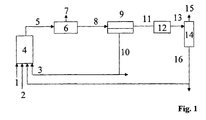
- the variant A of the method according to the invention is characterized Fig. 1 explained in more detail, without the process being limited to this embodiment variant: synthesis gas (1), olefins (2) and hydroformylation catalyst dissolved in cyclic carbonic acid ester or a mixture of a plurality of cyclic carbonic acid esters (3) are reacted in the hydroformylation reactor (4).
- the reactor discharge (5) can optionally be freed from the excess synthesis gas (7) in a flash tank (6).
- the stream (8) thus obtained is preferably in a separation apparatus (9) in a heavy phase (10) containing most of the cyclic carbonic ester and the catalyst and high-boiling by-products and a light phase (11), the hydroformylation, not reacted olefin and optionally the non-polar solvent contained separately.
- the phase separation can be carried out at temperatures of 0 ° C to 130 ° C, but preferably between 10 ° C and 60 ° C.
- the phase separation can, for. B. be carried out in a Settler alterner.
- the phase separation in the separation apparatus (9) under synthesis gas at a pressure of 1 to 350 bar, preferably at 15 to 270 bar, but more preferably carried out at the same pressure which is used in the hydroformylation reactor (4).
- the separation apparatus (9) may optionally be preceded by a heat exchanger for cooling the material flow (5) (in FIG Fig. 1 Not shown).
- catalyst residues can be removed from the stream (11).
- Stream (11) or (13) are now fed to the separation stage (14).
- the reaction products (aldehydes and alcohols) and unreacted olefins (15) are separated and fed to a further work-up or hydrogenation.
- the olefin separated from the stream (15) can be passed into the same reactor or into an optional second reaction stage.
- the likewise separated fraction (16) contains z.
- residues of the cyclic carbonic acid ester the reaction products, optionally further added non-polar solvent and high-boiling by-products.
- Fraction (16) may be discarded or recycled to the hydroformylation reactor (4).
- a work-up is carried out before the return, be discharged in the unwanted by-products.
- the catalyst separation in the separation apparatus (9) can be carried out as an extraction, in which at least part of the fraction (16) and / or at least part of the fresh olefin (2) is fed directly to the stream (8).
- the extraction is preferably carried out continuously, it may be one-stage or operated as a multi-stage process in counter, DC or cross flow.
- Catalyst-containing effluent streams such as from the stream (10) or the separation stage (12), can be worked up by known methods onto the catalyst metal in a recyclable form.
- the homogeneous reactor effluent of the hydroformylation reaction is separated by distillation into a lower-boiling fraction containing predominantly the hydroformylation products and optionally unreacted olefins or olefinically unsaturated compounds and a higher-boiling fraction comprising predominantly cyclic carbonic acid esters and catalyst.
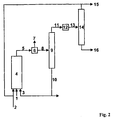
- the variant B of the method according to the invention is characterized Fig. 2
- the reactor discharge (5) can optionally be freed from the excess synthesis gas (7) in a flash tank (6).
- the stream (8) thus obtained is passed into a separation apparatus (9) and by distillation into a high-boiling fraction (10) containing most of the cyclic carbonic acid ester and the catalyst and a low-boiling phase (11) containing the hydroformylation products, unreacted Olefin and optionally non-polar solvent contains, separated.
- the catalyst-containing fraction (10) is recycled to the hydroformylation reactor.
- a work-up step can be carried out in which high-boiling by-products and / or catalyst degradation products are discharged (in Fig.2 Not shown).
- Fraction (11) can optionally be freed from catalyst residues in a separation step (12).
- the stream 13 is then fed to the distillation stage (14).
- the hydroformylation products (aldehydes and alcohols) (16) are separated by distillation from the unreacted olefin (15).
- Catalyst-containing discharge streams, such as from the stream (10) or the separation stage (12) can, according to methods which the skilled person z. B. off WO 02/20451 or US 5,208,194 are known to be worked up on the catalyst metal in a recyclable form.
- the hydroformylation products can then be worked up further.
- Unreacted olefin (15) may be passed to the same hydroformylation reactor or to an optional second reaction stage.
- the separation is preferably via falling-film, short-stretch or thin-film evaporators or combinations of these Apparatuses.
- the advantage of such a combination may be, for example, to separate in a first step still dissolved synthesis gas and most of the products and the unreacted starting materials of the catalyst-containing alkylene carbonate solution (for example in a falling film evaporator or flash evaporator), then in a second Step (for example in a combination of two columns) to carry out the separation of the remaining alkylene carbonates and the separation of products and unreacted starting materials.
- the catalyst effluents obtained in both variants A and B of the process according to the invention are preferably further converted into aldehydes (alcohols), olefins, solvents and by-products separated.
- aldehydes alcohols
- olefins olefins
- solvents by-products separated.
- Olefin and / or solvent alkylene carbonate and / or nonpolar solvent
- the variants of the process according to the invention include the separation of the reactor effluent and optionally the hydroformylation products; This can be done for example by distillation. In addition, however, is also a use of other separation methods z.
- As the extraction such as in WO 01/68247 . EP 0 922 691 . WO 99/38832 . US 5 648 554 and US 5,138,101 described or permeation, such as in DE 1953641 . GB 1312076 . NL 8700881 . DE 3842819 . WO 9419104 . DE 19632600 and EP 1103303 described, possible.
- the separation different procedures are applicable.
- the separation is preferably via falling-film, short-stretch or thin-film evaporators or combinations of these apparatuses.
- the extractive separation is advantageously carried out continuously. It can be designed as a single-stage process or operated as a multi-stage process in countercurrent or cross-flow.
- the catalyst-containing fraction is expediently recycled to the hydroformylation reaction. This is of course independent of the composition of the fractions in which the catalyst is dissolved.
- reaction effluent freed from synthesis gas and catalyst and optionally from solvent can be hydrogenated before or after olefin separation and then worked up by distillation to give pure alcohol.
- the process according to the invention can be carried out in one or more stages.
- a second hydroformylation stage which converts the difficultly hydroformylatable, internal olefins, in particular the internally highly branched olefins, to the desired aldehydes under more drastic reaction conditions (for example higher temperature and / or higher pressure).
- a separation of unreacted olefins and hydroformylation products (aldehydes and alcohols) is carried out first and the unreacted olefins are recycled to the same hydroformylation stage or fed to a second hydroformylation stage or even further hydroformylation stages.
- the second hydroformylation stage it is also possible in the second hydroformylation stage to use a completely different catalyst system, i. another catalyst metal or a ligand-modified catalyst metal. It may also be desirable to add a higher concentration of catalyst to the unreacted olefins to convert even less hydroformylatable olefins to the desired products. In all cases, it is necessary to add the cyclic carbonic acid esters in the stated amounts in the further hydroformylation stages.
- the olefinically unsaturated compounds which can be used in the process according to the invention are those which have been obtained as unreacted olefinically unsaturated compounds from the reactor effluent of a first hydroformylation reaction.
- the entire reaction product or only a part thereof, in particular a part which comprises the major part of the unreacted olefinic compounds from the first stage can be used. It may well be advantageous if, in this process variant, the first hydroformylation reaction was carried out in the presence of a ligand-modified catalyst.
- the composition of the lighter hydrocarbon phase separated in a phase separation vessel was determined by gas chromatography.
- the results of gas chromatography and the reaction conditions such as temperature and rhodium concentration are summarized in Table 1.
- the stated proportions (in% by mass) refer to the composition of the lighter hydrocarbon phase, with any carbonic acid ester and catalyst present being excluded.
- the catalyst solution obtained in the work-up of the reactor effluent of experiment 5 was used again. No.
- Example 2 Analogously to Example 1, di-n-butene (560 g) was hydroformylated. The reactor effluents of Experiments 7 to 13 were always single-phase and free of (rhodium) precipitates. In contrast to Example 1, the reactor effluent without workup was analyzed by gas chromatography. The results of gas chromatography and the reaction conditions such as temperature, pressure and rhodium concentration are summarized in Table 2. ⁇ b> Table 2: ⁇ / b> Hydroformylation of di-n-butene at different pressures, rhodium concentrations and temperatures. The stated proportions (in% by mass) refer to the composition of the reactor effluent, whereby existing carbonic acid ester and catalyst were excluded. No.
Landscapes
- Chemical & Material Sciences (AREA)
- Organic Chemistry (AREA)
- Chemical Kinetics & Catalysis (AREA)
- Organic Low-Molecular-Weight Compounds And Preparation Thereof (AREA)
- Low-Molecular Organic Synthesis Reactions Using Catalysts (AREA)
Applications Claiming Priority (5)
| Application Number | Priority Date | Filing Date | Title |
|---|---|---|---|
| DE10240253 | 2002-08-31 | ||
| DE10240253 | 2002-08-31 | ||
| DE10327435 | 2003-06-18 | ||
| DE10327435A DE10327435A1 (de) | 2002-08-31 | 2003-06-18 | Verfahren zur Herstellung von Aldehyden durch Hydroformylierung von olefinisch ungesättigten Verbindungen, katalysiert durch unmodifizierte Metallkomplexe von Metallen der 8. bis 10. Gruppe des PSE in Gegenwart von cyclischen Kohlensäureestern |
| PCT/EP2003/008737 WO2004024661A1 (de) | 2002-08-31 | 2003-08-07 | Verfahren zur herstellung von aldehyden durch hydroformylierung von olefinisch ungesättigten verbindungen, katalysiert durch unmodifizierte metallkomplexe in gegenwart von cyclischen kohlensäureestern |
Publications (2)
| Publication Number | Publication Date |
|---|---|
| EP1532095A1 EP1532095A1 (de) | 2005-05-25 |
| EP1532095B1 true EP1532095B1 (de) | 2010-01-27 |
Family
ID=31995047
Family Applications (1)
| Application Number | Title | Priority Date | Filing Date |
|---|---|---|---|
| EP03794848A Expired - Lifetime EP1532095B1 (de) | 2002-08-31 | 2003-08-07 | Verfahren zur herstellung von aldehyden durch hydroformylierung von olefinisch ungesättigten verbindungen, katalysiert durch unmodifizierte metallkomplexe in gegenwart von cyclischen kohlensäureestern |
Country Status (12)
| Country | Link |
|---|---|
| US (1) | US7193116B2 (pl) |
| EP (1) | EP1532095B1 (pl) |
| JP (1) | JP2005537330A (pl) |
| KR (1) | KR100988732B1 (pl) |
| CN (1) | CN1290814C (pl) |
| AU (1) | AU2003250219A1 (pl) |
| BR (1) | BR0313814B1 (pl) |
| CA (1) | CA2506258A1 (pl) |
| MX (1) | MXPA05001396A (pl) |
| PL (1) | PL206922B1 (pl) |
| RU (1) | RU2336261C2 (pl) |
| WO (1) | WO2004024661A1 (pl) |
Families Citing this family (40)
| Publication number | Priority date | Publication date | Assignee | Title |
|---|---|---|---|---|
| DE10058383A1 (de) * | 2000-11-24 | 2002-05-29 | Oxeno Olefinchemie Gmbh | Neue Phosphininverbindungen und deren Metallkomplexe |
| DE50211172D1 (de) * | 2001-09-26 | 2007-12-20 | Oxeno Olefinchemie Gmbh | Phthalsäurealkylestergemische mit kontrollierter viskosität |
| DE10149348A1 (de) | 2001-10-06 | 2003-04-10 | Oxeno Olefinchemie Gmbh | Verfahren zur Herstellung von 1-Olefin mit Palladiumcarbenverbindungen |
| DE10210918B4 (de) | 2002-03-13 | 2004-06-03 | Oxeno Olefinchemie Gmbh | Verfahren zur Herstellung von Bisphosphiten |
| DE10220801A1 (de) * | 2002-05-10 | 2003-11-20 | Oxeno Olefinchemie Gmbh | Verfahren zur Rhodium-katalysierten Hydroformylierung von Olefinen unter Reduzierung der Rhodiumverluste |
| DE10223593A1 (de) * | 2002-05-27 | 2003-12-11 | Degussa | Hydroxydiphosphine und deren Verwendung in der Katalyse |
| DE10225565A1 (de) | 2002-06-10 | 2003-12-18 | Oxeno Olefinchemie Gmbh | Katalysator und Verfahren zur Hydrierung von aromatischen Verbindungen |
| AU2003253389A1 (en) * | 2002-08-31 | 2004-03-19 | Oxeno Olefinchemie Gmbh | Method for the hydroformylation of olefinically unsaturated compounds, especially olefins, in the presence of cyclic carbonic acid esters |
| US7193116B2 (en) | 2002-08-31 | 2007-03-20 | Oxeno Olefinchemie Gmbh | Method for producing aldehydes by means of hydroformylation of olefinically unsaturated compounds, said hydroformylation being catalyzed by unmodified metal complexes in the presence of cyclic carbonic acid esters |
| DE10257499A1 (de) | 2002-12-10 | 2004-07-01 | Oxeno Olefinchemie Gmbh | Verfahren zur Herstellung von 1-Olefinen durch katalytische Spaltung von 1-Alkoxyalkanen |
| DE10329042A1 (de) * | 2003-06-27 | 2005-01-13 | Oxeno Olefinchemie Gmbh | Verfahren zur Herstellung von 1-Octen aus Crack-C4 |
| DE10359628A1 (de) * | 2003-12-18 | 2005-07-21 | Oxeno Olefinchemie Gmbh | Katalysator und Verfahren zur Herstellung von 1-Olefinen aus 2-Hydroxyalkanen |
| DE10360772A1 (de) * | 2003-12-23 | 2005-07-28 | Oxeno Olefinchemie Gmbh | Verfahren zur Herstellung von Organoacylphosphiten |
| DE10360771A1 (de) * | 2003-12-23 | 2005-07-28 | Oxeno Olefinchemie Gmbh | Verfahren zur Herstellung von dreiwertigen Organophosphor-Verbindungen |
| DE102004033410A1 (de) * | 2004-02-14 | 2005-09-01 | Oxeno Olefinchemie Gmbh | Verfahren zur Herstellung von Olefinen mit 8 bis 12 Kohlenstoffatomen |
| DE102004013514A1 (de) * | 2004-03-19 | 2005-10-06 | Oxeno Olefinchemie Gmbh | Verfahren zur Hydroformylierung von Olefinen in Anwesenheit von neuen phosphororganischen Verbindungen |
| DE102004021128A1 (de) * | 2004-04-29 | 2005-11-24 | Oxeno Olefinchemie Gmbh | Vorrichtung und Verfahren für die kontinuierliche Umsetzung einer Flüssigkeit mit einem Gas an einem festen Katalysator |
| DE102005036039A1 (de) | 2004-08-28 | 2006-03-02 | Oxeno Olefinchemie Gmbh | Verfahren zur Herstellung von 2,7-Octadienylderivaten |
| DE102004059293A1 (de) | 2004-12-09 | 2006-06-14 | Oxeno Olefinchemie Gmbh | Verfahren zur Hydroformylierung von Olefinen |
| DE102004063673A1 (de) * | 2004-12-31 | 2006-07-13 | Oxeno Olefinchemie Gmbh | Verfahren zur kontinuierlichen katalytischen Hydrierung von hydrierbaren Verbindungen an festen, im Festbett angeordneten Katalysatoren mit einem wasserstoffhaltigen Gas |
| DE102005014055A1 (de) * | 2005-03-23 | 2006-09-28 | Degussa Ag | Unsymmetrisch substituierte Phospholankatalysatoren |
| DE102005035816A1 (de) * | 2005-07-30 | 2007-02-01 | Oxeno Olefinchemie Gmbh | Verfahren zur Hydrierung von Oxo-Aldehyden mit hohen Estergehalten |
| DE102005042464A1 (de) | 2005-09-07 | 2007-03-08 | Oxeno Olefinchemie Gmbh | Carbonylierungsverfahren unter Zusatz von sterisch gehinderten sekundären Aminen |
| DE102006058682A1 (de) * | 2006-12-13 | 2008-06-19 | Evonik Oxeno Gmbh | Bisphosphitliganden für die übergangsmetallkatalysierte Hydroformylierung |
| DE102008002187A1 (de) * | 2008-06-03 | 2009-12-10 | Evonik Oxeno Gmbh | Verfahren zur Herstellung von C5-Aldehydgemischen mit hohem n-Pentanalanteil |
| KR101896721B1 (ko) | 2009-07-23 | 2018-09-07 | 에보닉 피브레 게엠베하 | 중합 용액으로 제조된 폴리이미드 막 |
| DE102009029050A1 (de) | 2009-08-31 | 2011-03-03 | Evonik Oxeno Gmbh | Organophosphorverbindungen basierend auf Tetraphenol(TP)-substituierten Strukturen |
| DE102009029284A1 (de) | 2009-09-08 | 2011-03-10 | Evonik Oxeno Gmbh | Verfahren zur Oligomerisierung von Olefinen |
| DE102009047351A1 (de) | 2009-12-01 | 2011-06-09 | Evonik Goldschmidt Gmbh | Komposit-Siliconmembranen mit hoher Trennwirkung |
| DE102010041821A1 (de) | 2010-09-30 | 2012-04-05 | Evonik Oxeno Gmbh | Einsatz von Supported Ionic Liquid Phase (SILP) Katalysatorsystemen in der Hydroformylierung von olefinhaltigen Gemischen zu Aldehydgemischen mit hohem Anteil von in 2-Stellung unverzweigten Aldehyden |
| DE102010043558A1 (de) | 2010-11-08 | 2012-05-10 | Evonik Oxeno Gmbh | Verfahren zur Hydroformylierung von ungesättigten Verbindungen |
| DE102012202779A1 (de) | 2012-02-23 | 2013-08-29 | Evonik Oxeno Gmbh | Verfahren und Vorrichtung zur technischen Hydroformylierung von Isobuten und zum Auftrennen des Produktgemisches |
| CN104854118B (zh) | 2012-10-12 | 2016-12-14 | 赢创德固赛有限公司 | 各种不同的不对称双亚磷酸酯混合物及其作为催化剂混合物在加氢甲酰化中的用途 |
| DE102012223572A1 (de) | 2012-12-18 | 2014-06-18 | Evonik Industries Ag | Steuerung der Viskosität von Reaktionslösungen in Hydroformylierungverfahren |
| DE102014209534A1 (de) * | 2014-05-20 | 2015-11-26 | Evonik Degussa Gmbh | Neue Monophosphitliganden mit einer Carbonat-Gruppe |
| US10245583B1 (en) * | 2017-09-12 | 2019-04-02 | Chevron Phillips Chemical Company, Lp | Use of charge-containing molecules linked with covalent bonds to enhance acetylene hydrogenation catalysts |
| WO2019098242A1 (ja) | 2017-11-15 | 2019-05-23 | 三菱ケミカル株式会社 | アルデヒドの製造方法及びアルコールの製造方法 |
| EP4008710B1 (de) | 2020-12-04 | 2024-05-01 | OQ Chemicals GmbH | Verfahren zur hydroformylierung von olefinen in homogener phase |
| EP4008709B1 (de) | 2020-12-04 | 2024-05-01 | OQ Chemicals GmbH | Verfahren zur herstellung polyzyklischer aliphatischer dialdehyde |
| CN119565678B (zh) * | 2024-11-22 | 2025-10-10 | 中国石油化工股份有限公司 | 一种氢甲酰基化催化剂及其制备方法与应用 |
Family Cites Families (47)
| Publication number | Priority date | Publication date | Assignee | Title |
|---|---|---|---|---|
| US3992453A (en) * | 1974-05-22 | 1976-11-16 | Universal Oil Products Company | Hydroformylation process |
| US4490559A (en) * | 1984-03-27 | 1984-12-25 | Shell Oil Company | Process for making aldehydes from diesters of carbonic acid |
| DE3413427A1 (de) * | 1984-04-10 | 1985-10-17 | Ruhrchemie Ag, 4200 Oberhausen | Verfahren zur herstellung von aldehyden |
| DE3511428A1 (de) | 1985-03-29 | 1986-10-02 | Ruhrchemie Ag, 4200 Oberhausen | Verfahren zur herstellung von aldehyden |
| US4774361A (en) | 1986-05-20 | 1988-09-27 | Union Carbide Corporation | Transition metal complex catalyzed reactions |
| US5012008A (en) * | 1990-01-08 | 1991-04-30 | Drago Russell S | Supported amorphous phase heterogeneous catalysts for biphasic hydroformylation |
| DE4025245A1 (de) | 1990-08-09 | 1992-02-13 | Huels Chemische Werke Ag | Verfahren zur herstellung von gesaettigten alkoholen aus aldehyden |
| US5087763A (en) * | 1990-11-09 | 1992-02-11 | Union Carbide Chemicals & Plastics Technology Corporation | Hydroformylation process |
| DE19654340A1 (de) | 1996-12-24 | 1998-08-06 | Huels Chemische Werke Ag | Verfahren zur Herstellung von höheren Oxo-Alkoholen |
| JPH11189563A (ja) | 1997-12-25 | 1999-07-13 | Kuraray Co Ltd | ヒドロホルミル化生成物の保存方法 |
| DE19842368A1 (de) | 1998-09-16 | 2000-03-23 | Oxeno Olefinchemie Gmbh | Verfahren zur Herstellung von höheren Oxoalkoholen aus Olefingemischen durch zweistufige Hydroformylierung |
| DE19842369A1 (de) | 1998-09-16 | 2000-03-23 | Oxeno Oelfinchemie Gmbh | Verfahren zur Hydrierung von Hydroformylierungsgemischen |
| DE19842371A1 (de) | 1998-09-16 | 2000-03-23 | Oxeno Oelfinchemie Gmbh | Verfahren zur Herstellung von höheren Oxo-Alkoholen aus Olefingemischen |
| DE19842370A1 (de) | 1998-09-16 | 2000-03-23 | Oxeno Oelfinchemie Gmbh | Verfahren zur selektiven Hydrierung von Hydroformylierungsgemischen |
| DE19925384A1 (de) | 1999-06-02 | 2000-12-07 | Oxeno Olefinchemie Gmbh | Verfahren zur katalytischen Durchführung von Mehrphasenreaktionen, insbesondere Hydroformylierungen |
| DE19954721A1 (de) | 1999-11-12 | 2001-05-17 | Oxeno Olefinchemie Gmbh | Verfahren zur Herstellung von Aldehyden aus Olefinen durch Hydroformylierung |
| DE19954510A1 (de) | 1999-11-12 | 2001-05-17 | Oxeno Olefinchemie Gmbh | Verfahren zur katalytischen Herstellung von Aldehyden aus Olefinen unter Einsatz von Ligandenmischungen |
| DE19957528A1 (de) | 1999-11-30 | 2001-05-31 | Oxeno Olefinchemie Gmbh | Verfahren zur Hydroformylierung von Olefinen |
| DE10009207A1 (de) | 2000-02-26 | 2001-08-30 | Oxeno Olefinchemie Gmbh | Verbessertes Verfahren zur Hydroformylierung von Olefinen durch Reduzierung der Ameisensäurekonzentration |
| DE10031493A1 (de) | 2000-06-28 | 2002-01-10 | Oxeno Olefinchemie Gmbh | Neue Bisphosphitverbindungen und deren Metallkomplexe |
| DE10034360A1 (de) | 2000-07-14 | 2002-01-24 | Oxeno Olefinchemie Gmbh | Mehrstufiges Verfahren zur Herstellung von Oxo-Aldehyden und/oder Alkoholen |
| DE10048301A1 (de) | 2000-09-29 | 2002-04-11 | Oxeno Olefinchemie Gmbh | Stabilisierung von Rhodiumkatalysatoren für die Hydroformylierung von Olefinen |
| DE10053272A1 (de) | 2000-10-27 | 2002-05-08 | Oxeno Olefinchemie Gmbh | Neue Bisphosphitverbindungen und deren Metallkomplexe |
| DE10058383A1 (de) | 2000-11-24 | 2002-05-29 | Oxeno Olefinchemie Gmbh | Neue Phosphininverbindungen und deren Metallkomplexe |
| DE10062448A1 (de) | 2000-12-14 | 2002-06-20 | Oxeno Olefinchemie Gmbh | Verfahren zur Hydrierung von Hydroformylierungsgemischen |
| DE10100708A1 (de) | 2001-01-10 | 2002-07-11 | Oxeno Olefinchemie Gmbh | Neue N-Phenylpyrrolbisphosphanverbindungen und deren Metallkomplexe |
| EP1231194B1 (de) | 2001-02-10 | 2003-11-12 | Oxeno Olefinchemie GmbH | Herstellung von 1-Olefinen |
| DE10114868C1 (de) | 2001-03-26 | 2002-10-31 | Oxeno Olefinchemie Gmbh | Verfahren zur Herstellung von Diphosphinen und deren Verwendung |
| DE10135906A1 (de) | 2001-07-24 | 2003-02-06 | Oxeno Olefinchemie Gmbh | Verfahren zur Hydroformylierung von höheren Olefinen mit Kobaltverbindungen als Katalysator |
| DE10140086A1 (de) | 2001-08-16 | 2003-02-27 | Oxeno Olefinchemie Gmbh | Neue Phosphitverbindungen und neue Phosphitmetallkomplexe |
| DE10140083A1 (de) | 2001-08-16 | 2003-02-27 | Oxeno Olefinchemie Gmbh | Neue Phosphitverbindungen und deren Metallkomplexe |
| DE50211172D1 (de) | 2001-09-26 | 2007-12-20 | Oxeno Olefinchemie Gmbh | Phthalsäurealkylestergemische mit kontrollierter viskosität |
| DE10149348A1 (de) | 2001-10-06 | 2003-04-10 | Oxeno Olefinchemie Gmbh | Verfahren zur Herstellung von 1-Olefin mit Palladiumcarbenverbindungen |
| BR0308432A (pt) | 2002-03-15 | 2006-06-06 | Oxeno Olefinchemie Gmbh | processo para a hidroformilação de olefinas |
| RU2004132221A (ru) | 2002-04-04 | 2005-09-10 | Дегусса АГ (DE) | Бисфосфины в качестве бидентатных лигандов |
| DE10220799A1 (de) | 2002-05-10 | 2003-12-11 | Oxeno Olefinchemie Gmbh | Verfahren zur Herstellung von C13-Alkoholgemischen |
| DE10220801A1 (de) | 2002-05-10 | 2003-11-20 | Oxeno Olefinchemie Gmbh | Verfahren zur Rhodium-katalysierten Hydroformylierung von Olefinen unter Reduzierung der Rhodiumverluste |
| DE10223593A1 (de) | 2002-05-27 | 2003-12-11 | Degussa | Hydroxydiphosphine und deren Verwendung in der Katalyse |
| DE10225565A1 (de) | 2002-06-10 | 2003-12-18 | Oxeno Olefinchemie Gmbh | Katalysator und Verfahren zur Hydrierung von aromatischen Verbindungen |
| US7193116B2 (en) | 2002-08-31 | 2007-03-20 | Oxeno Olefinchemie Gmbh | Method for producing aldehydes by means of hydroformylation of olefinically unsaturated compounds, said hydroformylation being catalyzed by unmodified metal complexes in the presence of cyclic carbonic acid esters |
| DE10257499A1 (de) | 2002-12-10 | 2004-07-01 | Oxeno Olefinchemie Gmbh | Verfahren zur Herstellung von 1-Olefinen durch katalytische Spaltung von 1-Alkoxyalkanen |
| DE10349399A1 (de) | 2003-10-21 | 2005-06-02 | Degussa Ag | Verfahren zur Reduktion von Binaphthylderivaten |
| US7661958B2 (en) | 2004-03-18 | 2010-02-16 | Customstart Design Ltd. | Methods and apparatus for interior design component selection |
| DE102004021128A1 (de) | 2004-04-29 | 2005-11-24 | Oxeno Olefinchemie Gmbh | Vorrichtung und Verfahren für die kontinuierliche Umsetzung einer Flüssigkeit mit einem Gas an einem festen Katalysator |
| DE102004059292A1 (de) | 2004-12-09 | 2006-06-14 | Oxeno Olefinchemie Gmbh | Verfahren zur Herstellung von Alkoholen aus Olefinen durch Hydroformylierung und Hydrierung |
| DE102004059293A1 (de) | 2004-12-09 | 2006-06-14 | Oxeno Olefinchemie Gmbh | Verfahren zur Hydroformylierung von Olefinen |
| DE102004063673A1 (de) | 2004-12-31 | 2006-07-13 | Oxeno Olefinchemie Gmbh | Verfahren zur kontinuierlichen katalytischen Hydrierung von hydrierbaren Verbindungen an festen, im Festbett angeordneten Katalysatoren mit einem wasserstoffhaltigen Gas |
-
2003
- 2003-08-07 US US10/519,557 patent/US7193116B2/en not_active Expired - Lifetime
- 2003-08-07 EP EP03794848A patent/EP1532095B1/de not_active Expired - Lifetime
- 2003-08-07 JP JP2004535060A patent/JP2005537330A/ja active Pending
- 2003-08-07 RU RU2005109390/04A patent/RU2336261C2/ru not_active IP Right Cessation
- 2003-08-07 CA CA002506258A patent/CA2506258A1/en not_active Abandoned
- 2003-08-07 WO PCT/EP2003/008737 patent/WO2004024661A1/de not_active Ceased
- 2003-08-07 AU AU2003250219A patent/AU2003250219A1/en not_active Abandoned
- 2003-08-07 CN CNB038205343A patent/CN1290814C/zh not_active Expired - Fee Related
- 2003-08-07 PL PL373916A patent/PL206922B1/pl unknown
- 2003-08-07 KR KR1020057003286A patent/KR100988732B1/ko not_active Expired - Fee Related
- 2003-08-07 BR BRPI0313814-3A patent/BR0313814B1/pt not_active IP Right Cessation
- 2003-08-07 MX MXPA05001396A patent/MXPA05001396A/es active IP Right Grant
Also Published As
| Publication number | Publication date |
|---|---|
| BR0313814A (pt) | 2005-07-05 |
| CA2506258A1 (en) | 2004-03-25 |
| JP2005537330A (ja) | 2005-12-08 |
| US7193116B2 (en) | 2007-03-20 |
| PL206922B1 (pl) | 2010-10-29 |
| US20050209489A1 (en) | 2005-09-22 |
| KR20050044907A (ko) | 2005-05-13 |
| PL373916A1 (pl) | 2005-09-19 |
| EP1532095A1 (de) | 2005-05-25 |
| WO2004024661A1 (de) | 2004-03-25 |
| RU2336261C2 (ru) | 2008-10-20 |
| KR100988732B1 (ko) | 2010-10-20 |
| BR0313814B1 (pt) | 2012-11-27 |
| CN1678558A (zh) | 2005-10-05 |
| MXPA05001396A (es) | 2005-04-28 |
| CN1290814C (zh) | 2006-12-20 |
| AU2003250219A1 (en) | 2004-04-30 |
| RU2005109390A (ru) | 2005-08-27 |
Similar Documents
| Publication | Publication Date | Title |
|---|---|---|
| EP1532095A1 (de) | Verfahren zur herstellung von aldehyden durch hydroformylierung von olefinisch ungesättigten verbindungen, katalysiert durch unmodifizierte metallkomplexe in gegenwart von cyclischen kohlensäureestern | |
| EP1172349B1 (de) | Mehrstufiges Verfahren zur Herstellung von Oxo-Aldehyden und/oder Alkoholen | |
| EP1503977B1 (de) | Verfahren zur rhodium-katalysierten hydroformylierung von olefinen unter reduzierung der rhodiumverluste | |
| EP2091958B1 (de) | Bisphosphitliganden für die übergangsmetallkatalysierte hydroformylierung | |
| EP1532094A1 (de) | Verfahren zur hydroformylierung von olefinisch ungesättigten verbindungen, insbesondere olefinen in gegenwart cyclischer kohlensäureester | |
| EP1099677B1 (de) | Verfahren zur Herstellung von Aldehyden aus Olefinen durch Hydroformylierung | |
| EP2567949B1 (de) | Verfahren zur Abtrennung von 1-Buten aus C4-haltigen Kohlenwasserstoffströmen durch Hydroformylierung | |
| EP1423398B1 (de) | Neue phosphitverbindungen und neue phosphitmetallkomplexe | |
| EP4103571B1 (de) | Niederdruckhydroformylierung von diisobuten | |
| EP1924357B1 (de) | Carbonylierungsverfahren unter zusatz von sterisch gehinderten sekundären aminen | |
| EP2280920A1 (de) | Verfahren zur herstellung von c5-aldehydgemischen mit hohem n-pentanalanteil | |
| EP1209164A1 (de) | Neue Phosphininverbindung und deren Metallkomplexe | |
| DE10327435A1 (de) | Verfahren zur Herstellung von Aldehyden durch Hydroformylierung von olefinisch ungesättigten Verbindungen, katalysiert durch unmodifizierte Metallkomplexe von Metallen der 8. bis 10. Gruppe des PSE in Gegenwart von cyclischen Kohlensäureestern | |
| DE60125419T2 (de) | Verbesserte, durch metall-ligand komplex katalysierte verfahren | |
| EP2872478B1 (de) | Vinvlester der isononansäure ausgehend von 2-ethylhexanol, verfahren zu seiner herstellung sowie seine verwendung | |
| DE10225282A1 (de) | Verfahren zur Herstellung von Aldehyden | |
| EP2217555A1 (de) | Verfahren zur herstellung von aldehyden | |
| EP3077358B1 (de) | Verfahren zur herstellung von 2-methylbutanal aus den bei der herstellung von gemischen isomerer a, -ungesättigter decenale anfallenden nebenströmen | |
| EP3077357B1 (de) | Verfahren zur herstellung von 2-methylbuttersäure mit einem vermindertem gehalt an 3-methylbuttersäure aus den bei der herstellung von pentansäuren anfallenden nebenströmen | |
| DE102005019237B4 (de) | Verfahren zur Hydroformylierung von substituierten Allylbenzolen | |
| EP0795533A1 (de) | Verfahren zur Herstellung von Aldehyden mittels eines Rhodium und substituierte Diphenyldiphosphane enthaltenden Katalysatorsystems | |
| DE102013020323B3 (de) | Verfahren zur Herstellung von isomeren Hexansäuren aus den bei der Herstellung von Pentanalen anfallenden Nebenströmen |
Legal Events
| Date | Code | Title | Description |
|---|---|---|---|
| PUAI | Public reference made under article 153(3) epc to a published international application that has entered the european phase |
Free format text: ORIGINAL CODE: 0009012 |
|
| 17P | Request for examination filed |
Effective date: 20041129 |
|
| AK | Designated contracting states |
Kind code of ref document: A1 Designated state(s): AT BE BG CH CY CZ DE DK EE ES FI FR GB GR HU IE IT LI LU MC NL PT RO SE SI SK TR |
|
| AX | Request for extension of the european patent |
Extension state: AL LT LV MK |
|
| DAX | Request for extension of the european patent (deleted) | ||
| RIN1 | Information on inventor provided before grant (corrected) |
Inventor name: FRIDAG, DIRK Inventor name: MOELLER, OLIVER Inventor name: KAIZIG, ALFRED Inventor name: BORGMANN, CORNELIA Inventor name: HESS, DIETER Inventor name: WIESE, KLAUS-DIETHER |
|
| RAP1 | Party data changed (applicant data changed or rights of an application transferred) |
Owner name: EVONIK OXENO GMBH |
|
| GRAP | Despatch of communication of intention to grant a patent |
Free format text: ORIGINAL CODE: EPIDOSNIGR1 |
|
| GRAS | Grant fee paid |
Free format text: ORIGINAL CODE: EPIDOSNIGR3 |
|
| GRAA | (expected) grant |
Free format text: ORIGINAL CODE: 0009210 |
|
| AK | Designated contracting states |
Kind code of ref document: B1 Designated state(s): AT BE BG CH CY CZ DE DK EE ES FI FR GB GR HU IE IT LI LU MC NL PT RO SE SI SK TR |
|
| REG | Reference to a national code |
Ref country code: GB Ref legal event code: FG4D Free format text: NOT ENGLISH |
|
| REG | Reference to a national code |
Ref country code: CH Ref legal event code: EP |
|
| REG | Reference to a national code |
Ref country code: IE Ref legal event code: FG4D |
|
| REF | Corresponds to: |
Ref document number: 50312386 Country of ref document: DE Date of ref document: 20100318 Kind code of ref document: P |
|
| REG | Reference to a national code |
Ref country code: NL Ref legal event code: T3 |
|
| REG | Reference to a national code |
Ref country code: SE Ref legal event code: TRGR |
|
| PG25 | Lapsed in a contracting state [announced via postgrant information from national office to epo] |
Ref country code: PT Free format text: LAPSE BECAUSE OF FAILURE TO SUBMIT A TRANSLATION OF THE DESCRIPTION OR TO PAY THE FEE WITHIN THE PRESCRIBED TIME-LIMIT Effective date: 20100527 Ref country code: ES Free format text: LAPSE BECAUSE OF FAILURE TO SUBMIT A TRANSLATION OF THE DESCRIPTION OR TO PAY THE FEE WITHIN THE PRESCRIBED TIME-LIMIT Effective date: 20100508 |
|
| REG | Reference to a national code |
Ref country code: IE Ref legal event code: FD4D |
|
| PG25 | Lapsed in a contracting state [announced via postgrant information from national office to epo] |
Ref country code: SI Free format text: LAPSE BECAUSE OF FAILURE TO SUBMIT A TRANSLATION OF THE DESCRIPTION OR TO PAY THE FEE WITHIN THE PRESCRIBED TIME-LIMIT Effective date: 20100127 Ref country code: FI Free format text: LAPSE BECAUSE OF FAILURE TO SUBMIT A TRANSLATION OF THE DESCRIPTION OR TO PAY THE FEE WITHIN THE PRESCRIBED TIME-LIMIT Effective date: 20100127 |
|
| PG25 | Lapsed in a contracting state [announced via postgrant information from national office to epo] |
Ref country code: IE Free format text: LAPSE BECAUSE OF FAILURE TO SUBMIT A TRANSLATION OF THE DESCRIPTION OR TO PAY THE FEE WITHIN THE PRESCRIBED TIME-LIMIT Effective date: 20100127 Ref country code: GR Free format text: LAPSE BECAUSE OF FAILURE TO SUBMIT A TRANSLATION OF THE DESCRIPTION OR TO PAY THE FEE WITHIN THE PRESCRIBED TIME-LIMIT Effective date: 20100428 Ref country code: CY Free format text: LAPSE BECAUSE OF FAILURE TO SUBMIT A TRANSLATION OF THE DESCRIPTION OR TO PAY THE FEE WITHIN THE PRESCRIBED TIME-LIMIT Effective date: 20100127 Ref country code: EE Free format text: LAPSE BECAUSE OF FAILURE TO SUBMIT A TRANSLATION OF THE DESCRIPTION OR TO PAY THE FEE WITHIN THE PRESCRIBED TIME-LIMIT Effective date: 20100127 Ref country code: RO Free format text: LAPSE BECAUSE OF FAILURE TO SUBMIT A TRANSLATION OF THE DESCRIPTION OR TO PAY THE FEE WITHIN THE PRESCRIBED TIME-LIMIT Effective date: 20100127 |
|
| PG25 | Lapsed in a contracting state [announced via postgrant information from national office to epo] |
Ref country code: CZ Free format text: LAPSE BECAUSE OF FAILURE TO SUBMIT A TRANSLATION OF THE DESCRIPTION OR TO PAY THE FEE WITHIN THE PRESCRIBED TIME-LIMIT Effective date: 20100127 Ref country code: SK Free format text: LAPSE BECAUSE OF FAILURE TO SUBMIT A TRANSLATION OF THE DESCRIPTION OR TO PAY THE FEE WITHIN THE PRESCRIBED TIME-LIMIT Effective date: 20100127 Ref country code: BG Free format text: LAPSE BECAUSE OF FAILURE TO SUBMIT A TRANSLATION OF THE DESCRIPTION OR TO PAY THE FEE WITHIN THE PRESCRIBED TIME-LIMIT Effective date: 20100427 |
|
| PLBE | No opposition filed within time limit |
Free format text: ORIGINAL CODE: 0009261 |
|
| STAA | Information on the status of an ep patent application or granted ep patent |
Free format text: STATUS: NO OPPOSITION FILED WITHIN TIME LIMIT |
|
| 26N | No opposition filed |
Effective date: 20101028 |
|
| PG25 | Lapsed in a contracting state [announced via postgrant information from national office to epo] |
Ref country code: DK Free format text: LAPSE BECAUSE OF FAILURE TO SUBMIT A TRANSLATION OF THE DESCRIPTION OR TO PAY THE FEE WITHIN THE PRESCRIBED TIME-LIMIT Effective date: 20100127 |
|
| PG25 | Lapsed in a contracting state [announced via postgrant information from national office to epo] |
Ref country code: IT Free format text: LAPSE BECAUSE OF FAILURE TO SUBMIT A TRANSLATION OF THE DESCRIPTION OR TO PAY THE FEE WITHIN THE PRESCRIBED TIME-LIMIT Effective date: 20100127 Ref country code: MC Free format text: LAPSE BECAUSE OF NON-PAYMENT OF DUE FEES Effective date: 20100831 |
|
| REG | Reference to a national code |
Ref country code: CH Ref legal event code: PL |
|
| GBPC | Gb: european patent ceased through non-payment of renewal fee |
Effective date: 20100807 |
|
| PG25 | Lapsed in a contracting state [announced via postgrant information from national office to epo] |
Ref country code: CH Free format text: LAPSE BECAUSE OF NON-PAYMENT OF DUE FEES Effective date: 20100831 Ref country code: LI Free format text: LAPSE BECAUSE OF NON-PAYMENT OF DUE FEES Effective date: 20100831 |
|
| PG25 | Lapsed in a contracting state [announced via postgrant information from national office to epo] |
Ref country code: GB Free format text: LAPSE BECAUSE OF NON-PAYMENT OF DUE FEES Effective date: 20100807 |
|
| PG25 | Lapsed in a contracting state [announced via postgrant information from national office to epo] |
Ref country code: AT Free format text: LAPSE BECAUSE OF NON-PAYMENT OF DUE FEES Effective date: 20100807 |
|
| PG25 | Lapsed in a contracting state [announced via postgrant information from national office to epo] |
Ref country code: HU Free format text: LAPSE BECAUSE OF FAILURE TO SUBMIT A TRANSLATION OF THE DESCRIPTION OR TO PAY THE FEE WITHIN THE PRESCRIBED TIME-LIMIT Effective date: 20100728 Ref country code: LU Free format text: LAPSE BECAUSE OF NON-PAYMENT OF DUE FEES Effective date: 20100807 |
|
| PG25 | Lapsed in a contracting state [announced via postgrant information from national office to epo] |
Ref country code: TR Free format text: LAPSE BECAUSE OF FAILURE TO SUBMIT A TRANSLATION OF THE DESCRIPTION OR TO PAY THE FEE WITHIN THE PRESCRIBED TIME-LIMIT Effective date: 20100127 |
|
| REG | Reference to a national code |
Ref country code: DE Ref legal event code: R081 Ref document number: 50312386 Country of ref document: DE Owner name: EVONIK DEGUSSA GMBH, DE Free format text: FORMER OWNER: EVONIK OXENO GMBH, 45772 MARL, DE Effective date: 20130905 |
|
| REG | Reference to a national code |
Ref country code: NL Ref legal event code: SD Effective date: 20140502 |
|
| REG | Reference to a national code |
Ref country code: FR Ref legal event code: TP Owner name: EVONIK DEGUSSA GMBH, DE Effective date: 20140411 |
|
| REG | Reference to a national code |
Ref country code: FR Ref legal event code: PLFP Year of fee payment: 14 |
|
| REG | Reference to a national code |
Ref country code: FR Ref legal event code: PLFP Year of fee payment: 15 |
|
| REG | Reference to a national code |
Ref country code: FR Ref legal event code: PLFP Year of fee payment: 16 |
|
| PGFP | Annual fee paid to national office [announced via postgrant information from national office to epo] |
Ref country code: DE Payment date: 20180823 Year of fee payment: 16 Ref country code: FR Payment date: 20180827 Year of fee payment: 16 Ref country code: NL Payment date: 20180821 Year of fee payment: 16 |
|
| PGFP | Annual fee paid to national office [announced via postgrant information from national office to epo] |
Ref country code: BE Payment date: 20180821 Year of fee payment: 16 Ref country code: SE Payment date: 20180823 Year of fee payment: 16 |
|
| REG | Reference to a national code |
Ref country code: DE Ref legal event code: R119 Ref document number: 50312386 Country of ref document: DE |
|
| REG | Reference to a national code |
Ref country code: NL Ref legal event code: MM Effective date: 20190901 |
|
| REG | Reference to a national code |
Ref country code: SE Ref legal event code: EUG |
|
| PG25 | Lapsed in a contracting state [announced via postgrant information from national office to epo] |
Ref country code: SE Free format text: LAPSE BECAUSE OF NON-PAYMENT OF DUE FEES Effective date: 20190808 |
|
| REG | Reference to a national code |
Ref country code: BE Ref legal event code: MM Effective date: 20190831 |
|
| PG25 | Lapsed in a contracting state [announced via postgrant information from national office to epo] |
Ref country code: FR Free format text: LAPSE BECAUSE OF NON-PAYMENT OF DUE FEES Effective date: 20190831 Ref country code: NL Free format text: LAPSE BECAUSE OF NON-PAYMENT OF DUE FEES Effective date: 20190901 Ref country code: DE Free format text: LAPSE BECAUSE OF NON-PAYMENT OF DUE FEES Effective date: 20200303 |
|
| PG25 | Lapsed in a contracting state [announced via postgrant information from national office to epo] |
Ref country code: BE Free format text: LAPSE BECAUSE OF NON-PAYMENT OF DUE FEES Effective date: 20190831 |