EP1530934B2 - Bettdecke - Google Patents
Bettdecke Download PDFInfo
- Publication number
- EP1530934B2 EP1530934B2 EP04405701A EP04405701A EP1530934B2 EP 1530934 B2 EP1530934 B2 EP 1530934B2 EP 04405701 A EP04405701 A EP 04405701A EP 04405701 A EP04405701 A EP 04405701A EP 1530934 B2 EP1530934 B2 EP 1530934B2
- Authority
- EP
- European Patent Office
- Prior art keywords
- textile
- hydrophilic
- layers
- textile layer
- moisture
- Prior art date
- Legal status (The legal status is an assumption and is not a legal conclusion. Google has not performed a legal analysis and makes no representation as to the accuracy of the status listed.)
- Expired - Lifetime
Links
Images

Classifications
-
- A—HUMAN NECESSITIES
- A47—FURNITURE; DOMESTIC ARTICLES OR APPLIANCES; COFFEE MILLS; SPICE MILLS; SUCTION CLEANERS IN GENERAL
- A47G—HOUSEHOLD OR TABLE EQUIPMENT
- A47G9/00—Bed-covers; Counterpanes; Travelling rugs; Sleeping rugs; Sleeping bags; Pillows
- A47G9/02—Bed linen; Blankets; Counterpanes
- A47G9/0207—Blankets; Duvets
Definitions
- the invention relates to a single or multi-part duvet, in particular a quilt or duvet cover provided with stitched chambers, according to the preamble of patent claim 1.
- the duvet Due to changed sleeping habits, the duvet, in particular its nature and quality, has gained a central importance for the well-being of the user during his resting periods. Due to the usual renunciation of linen sheets, the bed climate is determined primarily by the blanket. Essential for the duvet are their insulation properties, in particular the ability to regulate temperature and humidity, as well as the freedom from dust particles and organic allergens.
- DE-A-196 54 798 and FP-A-0 323 116 describes blankets which have a covering which makes it possible to effectively combat allergic phenomena in allergy sufferers.
- inner shell material which on the one hand is highly permeable to air and on the other hand highly captive for small particles.
- DE-A-196 54 798 is also proposed, in addition to this inner shell to use an outer shell having properties, such as mechanical structural strength, which are not provided in the inner shell.
- filling materials consisting of down of ducks and geese are preferably used. Down, which are typically filled in the blankets in amounts of 150-350 g / m 2 , are able to absorb larger amounts of moisture, thus resulting in a favorable regulation of the humidity of the bed climate.
- the ability to absorb moisture is also limited in down materials. Larger amounts of moisture, which typically occur locally in the area of certain areas of the user's body, usually can not be absorbed sufficiently quickly.
- Another disadvantage is that the insulation properties of the blanket change unfavorably after prolonged moisture transfer or after receiving larger amounts of moisture in the areas of increased humidity.
- the ceiling can be provided with openings that are closed with breathable fabrics and through which an exchange of dry and moist air can take place.
- the blanket is split into checkerboard-like fields with reduced air and moisture passages.
- a disadvantage of this solution is that the body areas of the sleeper are not uniformly insulated against the outside air abutting the outside of the ceiling. Therefore disturbing temperature gradients can occur in the body area. If necessary, sensitive parts of the body are not immediately noticeable, but are exposed to a lower temperature for a longer time. It is also possible that, when cuddling in the ceiling, the openings covered with moisture-permeable substances are closed so that a moisture accumulation results. It is also possible that disturbing moisture gradients arise.
- the present invention is therefore based on the object to provide an improved duvet.
- a blanket is to be created by means of which a more pleasant bed climate with low moisture values can be realized during the entire period of use.
- a blanket is to be created in which disturbing temperature and humidity gradients are avoided.
- the blanket according to the invention in particular a one- or multi-part quilted or duvet blanket, has a heat-insulating, hydrophilic filling which is trapped between two first textile layers in one or more chambers.
- both first textile layers preferably consist of a relatively hydrophobic first material which has the transport of pores and capillaries serving for water vapor and which is at least partially covered by a single or multi-layered second textile layer, which consists of a distinctly hydrophilic and water-vapor-permeable second material.
- the moisture released by the user is rapidly absorbed by absorption or adsorption / desorption, distributed over the pores of the relatively hydrophobic first textile layer to the hydrophilic, preferably down, filling, which has a high capacity for absorbing water vapor having.
- the relatively hydrophobic first fabric layer causes the moisture given off by the user and passed through the optional bedding to spread rapidly across the hydrophilic second fabric layer, whereafter, due to the resulting difference in vapor pressures on both sides of the first textile layer hydrophilic second textile layer stored water vapor through the relatively hydrophobic first textile layer is transferred and absorbed by the hydrophilic filling.
- the moisture is then released through the opposite relatively hydrophobic first textile layer and, if present, the subsequent hydrophilic second textile layer.
- the blanket according to the invention therefore results in a rapid transfer of moisture and thus a dry bed climate, disturbing moisture gradients are avoided.
- By avoiding larger openings for moisture transfer temperature and pressure gradients are further avoided, which could be perceived by the user as unpleasant.
- the solution of the problem is therefore not achieved by the local removal of materials, which partially increased breathability is achieved, but by the large-scale use of another textile layer. Particularly important is that the moisture does not evaporate on the skin of the user, resulting in a partial cooling of the skin surface, but is first absorbed by the adjacent textiles.
- the fabric of the two second textile layers also preferably has a water vapor transmission resistance Ret according to ISO standard 11092 of not more than 20 m 2 / Pa / W, preferably about 5 m 2 / Pa / W.
- Textile water vapor resistance can be measured, for example, by means of SGHP-8.2 and SGHP-10.5 measuring instruments of Measurement Technology Northwest, Seattle, WA 98199, which operate according to ISO 11092 and ASTM F-1868 standards.
- hydrophilic breathable substances are also usable for the second textile layers, in which the water vapor transfer does not take place primarily by adsorption and desorption.
- a substance is preferably used which has coarse mesh or pores whose diameter is at least twice as large as the diameter of the mesh or pores of the fabric of the first two textile layers.
- the second textile layer should cling as optimally as possible to the textile layers lying on one or both sides.
- substances whose shear stiffness is at most half as high as the shear stiffness of the fabric of the first two textile layers are selected for the second textile layer. This shows that the measurement of the shear stiffness correlates very well with the subjective grip assessment.
- the shear stiffness for example, the force required to subject a horizontally clamped textile strip to parallel displacement is measured. Further measuring methods are known from [3], page 30.
- the hydrophilic second textile layer is fixed by connecting means such as stitching, hook-and-loop fasteners, buttons or zippers, or releasably connected by the user to the associated relatively hydrophobic first textile layer. It is also possible to form an envelope with the hydrophilic second textile layers which is suitable for receiving a duvet cover formed from the first textile layers and the filling.
- a third, heat-insulating textile layer can be provided over the entire surface, which is preferably also made of a hydrophilic material, whereby the lateral transfer of moisture is still noticeably improved.
- the hydrophilic second textile layer completely covers the relatively hydrophobic first textile layer or is preferably provided only in the region which lies above the expected position of the body of the user.
- At least one breathable zone is provided outside the area of the blanket, which is above the expected position of the body of the user, which has no hydrophilic filling and the air exchange between the bed climate and the room climate allowed.
- the movements of the user result in pumping operations, by means of which dry air is sucked in and moist air is expelled.
- the user therefore forms a kind of drive, by means of which the regulation process is automatically driven and controlled.
- the regulation process In a user who suffers from fever, usually larger amounts of moisture occur. Due to the usually restless sleep and the resulting movements, however, there is an increased moisture output at the same time, so that the bed climate is regulated or stabilized within acceptable limits.
- the breathable zones are not above the user, disturbing temperature and pressure gradients are avoided. It is therefore prevented that the body of the user is partially cooled. Further, the breathable zones are not covered by the body of the user, so that the air exchange is not hindered.
- Preferably snake-shaped or narrow rectangular configured breathable zones are provided on both sides of the area, which is above the expected position of the body of the user, so that only a small and uniform, for the user quite pleasant heat flow can result.
- the breathable zones are through the first and / or the second textile layer; or alternatively covered by the first and / or the second textile layer and at least one heat-insulating third textile layer; so that disturbing air movements and isolation gaps are avoided.
- the breathable zones provided inside and / or outside the body region can be locked, so that an adaptation of the blanket to the seasonal climatic conditions is possible.
- individual end pieces can be provided, which can be fastened by means of Velcro fasteners, buttons or zippers on the edges of the breathable zones.
- Velcro fasteners buttons or zippers
- this causes a considerable effort, especially when installing the individual end caps.
- the storage of the individual end caps is rather unvorteilhaftrealisierbar.
- two mutually complementary cover parts which can be connected to one another by means of seams, Velcro fastenings, buttons or zippers are provided, of which the first is provided with the breathable zones and the second with correspondingly arranged end pieces.
- the two ceiling parts can therefore be rapidly connected or separated from one another in the manner of LEGO® building blocks.
- the storage of the complementary first or second ceiling part is much easier than the storage of the individual end caps.
- Particularly advantageous in this solution is also that three types of duvets can be realized. For example, in summer only the first ceiling part provided with the breathable zones can be used. In the transitional periods, in spring and autumn, the light second end piece provided with the end pieces can be used and in winter the combination of both ceiling parts is used. Furthermore, if necessary, the two ceiling parts can also be used separately. It is possible to use two parts of the ceiling which are only partially complementary to one another, during the connection of which the breathable zones are not or only partially filled.
- the distinctly hydrophilic second textile layer can be a single-layered or multi-layered, coarse-meshed, fine-meshed or microporous fabric, a knitted fabric, a knitted fabric or a non-woven fabric made of chemical and / or natural fibers.
- Advantageously usable for example, cotton, nylon or polyamide.
- Synthetic textiles including nonwovens, have been greatly improved in recent times, so that their properties have closely approximated those of natural products, such as cotton. Synthetic textiles also have a high degree of variability, which makes it possible to optimize the fabric for the present application. Synthetic textiles also have good mechanical strength in terms of abrasion, tearing and tearing, high breathability, isotropic properties (equally resilient in all directions with the advantages of traditional fabrics and knitted fabrics), a textile feel, good drape and a high ease of use.
- Mites and allergen-dense second textile layers with a maximum pore size of 0.5 ⁇ m are preferably used which have pronounced hydrophilic properties and at the same time prevent the ingress of mites.
- the blanket consists of several parts, preferably a ceiling middle part, which is connected or connected by means of connecting devices, such as zippers, on one or both sides with ceiling side panels.
- the breathable zones for the regulation of the bed climate can be provided in the ceiling middle part or in the ceiling side parts.
- the breathable zones are preferably provided eccentrically, so that each ceiling side panel in a first and a second textile layer is connectable to the ceiling middle part, provided it is on both sides corresponding parts of Having connecting device. Users with a larger body circumference can therefore mount the ceiling side parts in such a way that a larger distance between the breathable zones results. For narrower users or quieter sleepers, a smaller distance between the openings may be preferable.
- the connecting devices are preferably covered by insulating flaps, so that they can not rest directly on the body of the user and can form disturbing thermal bridges.
- the insulating tabs are preferably connected to the ceiling middle part, so that they are facing away from the user, directed to the outside. It is possible to use one or more walls, optionally filled with insulating insulation laps, which are arranged on one or both sides of the blanket, the connecting devices preferably completely cover and optionally enclose annular.
- insulating laps are preferably provided on both sides of the ceiling side parts, so that it is prevented that parts of the connecting device can be exposed.
- each duvet is provided with two mutually interchangeable ceiling middle parts, by means of which the user can adjust the blanket to the respective needs, such as the health status, and possibly depending on the season room conditions.
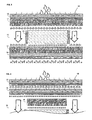
- FIG. 1 shows the structure of a cover blanket 1A according to the invention, which has a filling 10 consisting for example of down, hydrophobic or weakly hydrophilic first textile layers 11, 12 adjoining it on both sides and markedly hydrophilic second textile layers 13, 14 adjacent thereto.
- a filling 10 consisting for example of down, hydrophobic or weakly hydrophilic first textile layers 11, 12 adjoining it on both sides and markedly hydrophilic second textile layers 13, 14 adjacent thereto.
- the transfer of moisture from top to bottom, ie starting from the upper second textile layer 13 is described, which is applied to the user when using the blanket (see FIG. 5 ).
- the substances used for the first textile layers 11, 12 are not absolutely hydrophobic, but relatively hydrophobic in relation to the fabrics of the second textile layers 13, 14.
- the upper second textile layer 13 of FIG. 1 which consists of a single or multi-layered hydrophilic fabric or laminate, water drops are shown, which are absorbed by the hydrophilic second textile layer 13 and distributed flat along the fibers of the fabric or laminate.
- the provided under the hydrophilic second textile layer 13 relatively hydrophobic first textile layer 11 prevents that larger amounts of moisture locally enter the hydrophilic filling 10 and strongly moisten the down there, which affect their properties during use and then make a longer venting or drying necessary , As in FIG. 1 shown, the moisture or water vapor is then distributed with greatly reduced density on the relatively hydrophobic first textile layer 11 and can penetrate through the numerous channels or pores and capillaries 111 provided therein and into the hydrophilic filling 10.
- a hydrophilic third textile layer 15 is fixedly or detachably connected to the first or second textile layer 11 or 13.
- the first and second textile layers 11, 13 and 12, 14 are detachably connected to each other or form, firmly joined together, a laminate, as in FIG. 3 is shown.
- FIG. 3 further shows the construction of a duvet 1B, which has two breathable zones 3, in which no filling 10 is provided. If stronger air movements occur in these areas, the water vapor is thereby rapidly led to the outside.
- These breathable zones 3 are preferably located outside the area 4, which is above the expected position of the body of the user. For example, the breathable zones 3 are placed in the outer thirds or quarters of the blanket. This prevents the breathable zones 3 from being covered by the body of the user, thereby obstructing the air exchange.
- the peripheral arrangement of the breathable zones 3 also avoids disturbing temperature gradients that occur because the insulation properties of the blanket in the area of the breathable zones is changed, the user's body is exposed to barely perceptible air currents and moisture evaporates on the user's skin or clothing can.
- breathable zones 3 are bounded laterally by the filling 10, which is trapped for example by means of the sewn together upper and lower first textile layers 11, 12. Above and / or below the breathable zone 3 is covered by means of the first and / or the second textile layer 11, 12 or 13, 14 and optionally with an insulating third textile layer 15, through which the insulation value of the blanket in the breathable zones 3 largely is kept constant.
- the breathable zones 3 are covered on both sides by the first and second textile layers 11, 13 and 12, 14.
- the breathable zones 3 are covered on both sides by the hydrophilic second textile layer 13 and a hydrophilic, breathable third textile layer 15.
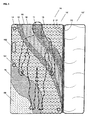
- FIG. 5 shows the over a symbolically illustrated user designed duvet 1A with a ceiling center part 1A 'and ceiling side panels 1A''on.
- the textile layers 11, ..., 15 of the ceiling middle part 1A ' are shown cut open.
- Shown is also a seam 18, by means of which the two relatively hydrophobic first textile layers 11, 12 are connected to one another. Further, a linen cover 99 is shown.
- the duvet 1A is therefore separable into individual parts, which can be easily stored in a washing machine and washed, which is particularly important in the use of hydrophilic substances.
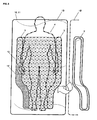
- FIG. 6 shows the blanket 1B with the hydrophilic second textile layer 13, which is disposed within the area 4, which lies above the expected position of the body of the user and on both sides outside this area 4 lying breathable zones covered 3, Also shown is an insulating third textile layer 15 ' which only covers the breathable zones 3 and harmonizes the insulation properties. The moisture is therefore removed from the body area of the user and discharged laterally over the breathable zones 3.
- a closure piece 3 ' is shown by means of which one of the breathable zones 3 can be locked.
- the end piece 3 ' can be used individually, or be provided on a ceiling part 1B', which is connectable at its edges, for example by means of zipper or Velcro closures with the ceiling part 1B, so that the two ceiling parts 1B, 1B 'one above the other or next to each other.
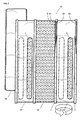
- FIG. 7 shows the duvet 1A with a ceiling middle part 1A ', which is connected on both sides by means of zippers 2 with two cover side parts 1A'', 1A "'
- the zippers 21 consisting of two parts 21, 22 are covered by insulating tabs 7, the two sides are arranged on the ceiling side parts 1A '', 1A '''and connected to one another at their ends, so that they receive the associated zip fastener 2 in a pocket-like manner and surround it in a ring-like manner
- Ceiling middle part 1A 'replaceable which has a different room climate adapted insulation properties.
- the breathable zones 3 are arranged eccentrically, so that these, depending on the mounting of the ceiling side parts 1A '', 1A '' ', more or less spaced apart and thus adapted to the needs, possibly the body dimensions of the user can.
- the insulating tabs 7 are provided on both sides of the ceiling side parts 1A ", 1A" ', causes the zippers 2 are always reliably covered.
- the bed cover can be extended to a four-part cover by means of the additional ceiling middle part 1A', provided the ceiling side parts 1A ", 1A '' 'are provided on one side only with a portion 22 of the zipper 2, the insulating tabs 7 are preferably only on the central part 1 A' provided.
- the inventive blanket has been described and illustrated in preferred embodiments. On the basis of the teaching according to the invention, however, further expert designs can be realized. Especially Different dimensions of the duvet and the ceiling parts can be selected. Furthermore, various natural and synthetic substances and filling materials can be used. Furthermore, any other shapes and dimensions of the breathable zones 3 can be realized. It is also possible to use differently configured, possibly interlocking, filled or unfilled Isolierlappen. To connect the items and textile layers of the blanket also various types of connection devices, such as zippers, buttons, snaps, Velcro or cords are used.
Landscapes
- Bedding Items (AREA)
- Preparation Of Compounds By Using Micro-Organisms (AREA)
- Superconductors And Manufacturing Methods Therefor (AREA)
- Diaphragms For Electromechanical Transducers (AREA)
Description
- Die Erfindung betrifft eine ein- oder mehrteilige Bettdecke, insbesondere eine mit abgesteppten Kammern versehene Steppdecke oder Duvetdecke, nach dem Oberbegriff des Patentanspruchs 1.
- Aufgrund geänderter Schlafgewohnheiten hat die Bettdecke, insbesondere deren Art und Qualität, für das Wohlbefinden des Benutzers während dessen Ruhephasen eine zentrale Bedeutung gewonnen. Durch den heute üblichen Verzicht auf Leintücher wird das Bettklima primär durch die Bettdecke bestimmt. Wesentlich für die Bettdecke sind dabei deren Isolationseigenschaften, insbesondere die Fähigkeit zur Temperatur- und Feuchtigkeitsregulierung, sowie die Freiheit von Staubpartikeln und organischen Allergenen.
- Gemäss [1],
Patentschrift EP 0 594 798 B1 (=WO-A-93 22959 - In der
DE-A-196 54 798 und der FP-A-0 323 116 sind Decken beschrieben die eine Hülle aufweisen, welche es erlauben, allergische Erscheinungen bei Allergikern wirksam zu bekämpfen. Zur Lösung dieser Aufgabe wird vorgeschlagen, Innenhüllenmaterial zu verwenden, das einerseits in hohem Masse luftdurchlässig und andererseits in hohem Masse einfangaktiv für Kleinteilchen ist. In derDE-A-196 54 798 wird zudem vorgeschlagen, nebst dieser Innenhülle eine Aussenhülle zu verwenden, die Eigenschaften aufweist, z.B. mechanische Strukturfestigkeit, welche bei der innenhülle nicht vorgesehen sind. - Zur Realisierung der gewünschten Isolationseigenschaften der Bettdecke werden vorzugsweise Füllmaterialien bestehend aus Daunen von Enten und Gänsen verwendet. Daunen, die typischerweise in Mengen von 150-350 g/m2 in die Bettdecken eingefüllt werden, sind dabei in der Lage, grössere Feuchtigkeitsmengen aufzunehmen, so dass eine vorteilhafte Regulierung der Feuchtigkeit des Bettklimas resultiert.
- Die Fähigkeit zur Aufnahme von Feuchtigkeit ist jedoch auch bei Daunenmaterialien begrenzt. Grössere Feuchtigkeitsmengen, die typischerweise lokal im Bereich bestimmter Körperpartien des Anwenders auftreten, können meist nicht genügend schnell absorbiert werden. Nachteilig ist zudem, dass sich die Isolationseigenschaften der Bettdecke nach längerem Feuchtigkeitstransfer bzw. nach Aufnahme grösserer Feuchtigkeitsmengen in den Bereichen erhöhter Feuchtigkeit ungünstig verändern.
- Erhöhte Feuchtigkeitsmengen können bekanntlich durch Zufuhr trockener Luft beseitigt werden. Dazu kann die Decke mit Öffnungen versehen werden, die mit atmungsaktiven Stoffen abgeschlossen werden und durch die ein Austausch trockener und feuchter Luft erfolgen kann. Beispielsweise wird die Decke schachbrettartig in Felder mit erhöhtem und Felder mit reduziertem Luft- und Feuchtigkeitsdurchlass aufgeteilt. Nachteilig bei dieser Lösung ist, dass die Körperbereiche des Schläfers nicht gleichmässig gegen die von aussen an die Decke anstossende Aussenluft isoliert sind. Im Körperbereich können daher störende Temperaturgradienten auftreten. Gegebenenfalls werden empfindliche Körperbereiche nicht unmittelbar spürbar, jedoch über längere Zeit einer tieferen Temperatur ausgesetzt. Möglich ist ferner, dass beim Einkuscheln in die Decke die mit feuchtigkeitsdurchlässigen Stoffen abgedeckten Öffnungen geschlossen werden, so dass ein Feuchtigkeitsstau resultiert. Möglich ist ferner, dass störende Feuchtigkeitsgradienten entstehen.
- Der vorliegenden Erfindung liegt daher die Aufgabe zugrunde, eine verbesserte Bettdecke zu schaffen. Insbesondere ist eine Bettdecke zu schaffen, mittels der während der gesamten Benutzungsdauer ein angenehmeres Bettklima mit tiefen Feuchtigkeitswerten realisierbar ist.
- Insbesondere ist eine Bettedecke zu schaffen, bei der störende Temperatur- und Feuchtigkeitsgradienten vermieden werden.
- Diese Aufgabe wird mit einer Bettdecke gelöst, welche die in Anspruch 1 angegebenen Merkmale aufweist. Vorteilhafte Ausgestaltungen der Erfindung sind in weiteren Ansprüchen angegeben.
- Die erfindungsgemässe Bettdecke, insbesondere eine ein- oder mehrteilige Stepp- oder Duvetdecke, weist eine wärmeisolierende, hydrophile Füllung auf, die zwischen zwei ersten Textillagen in einer oder mehreren Kammern gefangen ist. Erfindungsgemäss bestehen vorzugsweise beide ersten Textillagen aus einem relativ hydrophoben ersten Stoff, der dem Transport von Wasserdampf dienende Poren und Kapillaren aufweist und der zumindest teilweise mit einer ein- oder mehrschichtigen zweiten Textillage abgedeckt ist, die aus einem ausgeprägt hydrophilen und wasserdampfdurchlässigen zweiten Stoff besteht.
- Von der zweiten Textillage wird die vom Anwender abgegebene Feuchtigkeit durch Absorption oder Adsorption/Desorption rasch aufgenommen, flächig verteilt und über die Poren der relativ hydrophoben ersten Textillage an die hydrophile, vorzugsweise aus Daunen bestehende Füllung abgegeben, welche eine hohe Kapazität für die Aufnahme von Wasserdampf aufweist. Durch die relativ hydrophobe erste Textillage wird bewirkt, dass sich die vom Anwender abgegebene und durch die gegebenenfalls vorhandene Bettwäsche hindurch getretene Feuchtigkeit über die hydrophile zweite Textillage rasch ausbreitet, wonach, aufgrund der resultierende Differenz der Dampfdrücke auf beiden Seiten der ersten Textillage, der in der hydrophilen zweiten Textillage gespeicherte Wasserdampf durch die relativ hydrophobe erste Textillage transferiert und von der hydrophilen Füllung absorbiert wird. Von der hydrophilen Füllung wird die Feuchtigkeit anschliessend durch die gegenüberliegende relativ hydrophobe erste Textillage und sofern vorhanden, die daran anschliessende hydrophile zweite Textillage abgegeben. Dadurch resultiert eine gleichmässige Feuchtigkeitsverteilung an der dem Anwender zugewandten Seite der Bettdecke, wobei ein Eindringen von Wasser durch die relativ hydrophobe erste Textillage in die hydrophile Füllung weitgehend verhindert wird und die Bettdecke durch Wenden oder Auslüften jeweils rasch getrocknet werden kann. Durch Verwendung der erfindungsgemässen Decke resultiert daher ein rascher Feuchtigkeitstransfer und somit ein trockenes Bettklima, wobei störende Feuchtigkeitsgradienten vermieden werden. Durch Vermeidung von grösseren Öffnungen für den Feuchtigkeitstransfer werden ferner Temperatur- und Druckgradienten vermieden, die vom Anwender als unangenehm wahrgenommen werden könnten. Die Lösung der gestellten Aufgabe gelingt daher nicht durch das lokale Entfernen von Materialien, wodurch partiell eine erhöhte Atmungsaktivität erzielt wird, sondern durch den grossflächigen Einsatz einer weiteren Textillage. Besonders wesentlich ist dabei, dass die Feuchtigkeit nicht auf der Haut des Anwenders verdampft, wodurch eine partielle Abkühlung der Hautoberfläche resultiert, sondern zuerst durch die angrenzenden Textilien aufgenommen wird.
- (Die Eigenschaften hydrophiler und hydrophober Stoffe sowie der Transport von Wasserdampf in porösen Materialien sind in [2], Marten Janz, METHODS OF MEASURING THE MOISTURE DIFFUSIVITY AT HIGH MOISTURE LEVELS, UNIVERSITY OF LUND, LUND INSTITUTE OF TECHNOLOGY, Division of Building Materials, Report TVBM-3076, Lund 1997, Kapitel 2, Seiten 2 bis 13 beschrieben.)
- Wesentlich bei der Erfindung ist dabei nicht der Absolutwert der Hydrophobie der ersten Textillagen, sondern die relativen Unterschiede der Wasseraufnahmeeigenschaften der ersten und zweiten Textillagen. Dabei werden bei der Stoffwahl bereits gute Resultate erzielt, wenn die Zeitdauer zur Absorption eines Wassertropfens durch den Stoff der beiden ersten Textillagen wenigstens doppelt so gross war, wie die Zeitdauer zur Absorption eines Wassertropfens, unter gleichen Bedingungen, durch den Stoff der beiden zweiten Textillagen. Sehr gute Resultate wurden bei einem Faktor 5 erzielt. Verfahren zur Bestimmung der Hydrophobie von Geweben sind ferner in [3], Bong Tae Kim, Grundlegende Untersuchungen zur Hydrophobierung von Textilien mit Polyorganosiloxanen, Inaugural-Dissertation, Bergische Universität-Gesamthochschule, Wuppertal 2001, auf Seiten 28-29 beschrieben.
- Der Stoff der beiden zweiten Textillagen weist ferner vorzugsweise einen Wasserdampfdurchgangswiderstand Ret gemäss ISO-Norm 11092 von maximal 20 m2/Pa/W, vorzugsweise etwa 5 m2/Pa/W, auf. Wasserdampfdurchgangswiderstände von Textilien sind beispielsweise mittels den nach den Normen ISO 11092 and ASTM F-1868 arbeitenden Messgeräten, Modell SGHP-8.2 und Modell SGHP-10.5 der Firma Measurement Technology Northwest, Seattle, WA 98199, messbar.
- Für die zweiten Textillagen sind ferner ausgeprägt hydrophile atmungsaktive Stoffe verwendbar, bei denen der Wasserdampftransfer nicht primär durch Adsorption und Desorption erfolgt. Dazu wird vorzugsweise ein Stoff verwendet der grobe Maschen oder Poren aufweist, deren Durchmesser wenigstens doppelt so gross ist wie der Durchmesser der Maschen oder Poren des Stoffes der beiden ersten Textillagen. Bei der Verwendung grossporiger Stoffe ist jedoch der gänzliche oder teilweise Entfall der Milbendichtigkeit zu beachten.
- Für den Transfer der Feuchtigkeit zwischen den verschiedenen Textillagen ist ferner die Verwendung so genannt weicher Stoffe vorteilhaft. Die zweite Textillage soll sich dabei möglichst optimal an die ein- oder beidseitig daran anliegenden Textillagen anschmiegen. Vorzugsweise werden für die zweite Textillage Stoffe gewählt, deren Schersteifigkeit maximal halb so gross ist, wie die Schersteifigkeit des Stoffes der beiden ersten Textillagen. Hierbei zeigt sich, dass die Messung der Schersteifigkeit sehr gut mit der subjektiven Griffbeurteilung korreliert. Zur Bestimmung der Schersteifigkeit wird beispielsweise die Kraft gemessen, die nötig ist, um einen waagerecht eingespannten Textilstreifen einer parallelen Verschiebung zu unterwerfen. Weitere Messverfahren sind aus [3], Seite 30 bekannt.
- Die hydrophile zweite Textillage wird mit Verbindungsmitteln wie Nähten, Klettverschlüssen, Knöpfen oder Reissverschlüssen fest oder durch den Anwender lösbar mit der zugeordneten relativ hydrophoben ersten Textillage verbunden. Möglich ist ferner, mit den hydrophilen zweiten Textillagen eine Hülle zu bilden, die zur Aufnahme einer aus den ersten Textillagen und der Füllung gebildeten Duvetdecke geeignet ist.
- Durch Verwendung der zweiten Textillage resultiert ferner eine verbesserte Isolation, so dass eine dünnere Daunen-Füllung vorgesehen werden kann. In kälteren Jahreszeiten kann wenigstens auf einer Seite der Bettdecke, unter oder über der zweiten Textillage, ganzflächig eine dritte, wärmeisolierende Textillage vorgesehen werden, die vorzugsweise ebenfalls aus einem hydrophilen Stoff gefertigt ist, wodurch der laterale Transfer der Feuchtigkeit noch spürbar verbessert wird.
- Die hydrophile zweite Textillage deckt die relativ hydrophobe erste Textillage vollständig ab oder wird vorzugsweise nur in dem Bereich vorgesehen, der über der zu erwartenden Position des Körpers des Anwenders liegt.
- In einer weiteren vorzugsweisen Ausgestaltung wird ausserhalb des Bereichs der Bettdecke, der über der zu erwartenden Position des Körpers des Benutzers liegt, wenigstens eine atmungsaktive Zone vorgesehen, die keine hydrophile Füllung aufweist und die einen Luftaustausch zwischen dem Bettklima und dem Raumklima erlaubt. Durch die Bewegungen des Anwenders resultieren dabei Pumpvorgänge, mittels derer trockene Raumluft angesaugt und feuchte Luft ausgestossen wird. Der Anwender bildet daher eine Art Antrieb, durch den der Regulationsprozess automatisch angetrieben und gesteuert wird. Bei einem Anwender, der unter Fieber leidet, treten meist grössere Feuchtigkeitsmengen auf. Durch den normalerweise unruhigen Schlaf und die daraus resultierenden Bewegungen erfolgt jedoch gleichzeitig ein erhöhter Feuchtigkeitsausstoss, so dass das Bettklima innerhalb akzeptablen Schranken reguliert bzw. stabilisiert wird. Da die atmungsaktiven Zonen nicht über dem Anwender liegen, werden störende Temperatur- und Druckgradienten vermieden. Es wird daher verhindert, dass der Körper des Anwenders partiell abgekühlt wird. Ferner werden die atmungsaktiven Zonen nicht durch den Körper des Anwenders abgedeckt, so dass der Luftaustausch nicht behindert wird.
- Vorzugsweise sind schlangenförmig oder schmal rechteckförmig ausgestaltete atmungsaktive Zonen beidseits des Bereichs vorgesehen, der über der zu erwartenden Position des Körpers des Benutzers liegt, so dass nur ein kleiner und gleichmässiger, für den Anwender durchaus angenehmer Wärmeabfluss resultieren kann. Die atmungsaktiven Zonen sind dabei durch die erste und/oder die zweite Textillage; oder alternativ durch die erste und/oder die zweite Textillage und wenigstens eine wärmeisolierende dritte Textillage abgedeckt; so dass störende Luftbewegungen und Isolationslücken vermieden werden.
- In einer weiteren vorzugsweisen Ausgestaltung sind die innerhalb und/oder ausserhalb des Körperbereichs vorgesehenen atmungsaktiven Zonen abschliessbar, so dass eine Anpassung der Decke an die saisonalen Klimaverhältnisse möglich ist. Dazu können einzelne Abschlussstücke vorgesehen werden, die mittels Klettverschlüssen, Knöpfen oder Reissverschlüssen an den Rändern der atmungsaktiven Zonen befestigbar sind. Dies verursacht jedoch insbesondere bei der Montage der einzelnen Abschlussstücke einen erheblichen Aufwand. Ferner ist die Lagerung der einzelnen Abschlussstücke eher unvorteilhaftrealisierbar. Erfindungsgemäss werden daher zwei zueinander komplementäre und mittels Nähten, Klettverschlüssen, Knöpfen oder Reissverschlüssen miteinander verbindbare Deckenteile vorgesehen, von denen das erste mit den atmungsaktiven Zonen und das zweite mit entsprechend angeordneten Abschlussstücken versehen ist. Die beiden Deckenteile können daher in der Art von LEGO®-Bausteinen rasch miteinander verbunden oder voneinander getrennt werden. Die Lagerung des komplementären ersten oder zweiten Deckenteils ist viel einfacher möglich als die Lagerung der einzelnen Abschlussstücke. Besonders vorteilhaft bei dieser Lösung ist zudem, dass drei Bettdeckenarten realisierbar sind. Beispielswiese kann im Sommer nur das mit den atmungsaktiven Zonen versehene erste Deckenteil verwendet werden. In den Übergangszeiten, im Frühling und im Herbst kann das leichte zweite mit den Abschlussstücken versehene Deckenteil verwendet werden und im Winter wird die Kombination beider Deckenteile verwendet. Ferner können die beiden Deckenteile notfalls auch separat verwendbar sind. Möglich ist die Verwendung von zwei zueinander nur teilweise komplementären Deckenteilen, bei deren Verbindung die atmungsaktiven Zonen nicht oder nur teilweise gefüllt werden.
- Die ausgeprägt hydrophile zweite Textillage kann ein ein- oder mehrlagiges, grobmaschiges, feinmaschiges oder mikroporöses Gewebe, ein Gestrick, ein Gewirke oder ein Vliesstoff aus Chemie- und/oder Naturfasern sein. Vorteilhaft verwendbar sind beispielsweise Baumwolle, Nylon oder Polyamid.
- Möglich ist beispielsweise die Verwendung eines Mikrofaser-Textils auf Spinnvliesbasis. Produkte dieser Art sind beispielsweise unter dem Warenzeichen EVOLON® bekannt. Synthetische Textilien, also auch Vliesstoffe, wurden in jüngster Zeit stark verbessert, so dass sich deren Eigenschaften denjenigen von Naturprodukten, beispielsweise Baumwolle, stark angenähert haben. Synthetische Textilien verfügen zudem über eine hohe Variabilität, die es erlaubt, den Stoff für die vorliegende Anwendung zu optimieren. Synthetische Textilien weisen ferner eine gute mechanische Festigkeit hinsichtlich Abrieb, Einreißen und Weiterreißen, eine hohe Atmungsaktivität, isotrope Eigenschaften (nach allen Richtungen gleich belastbar mit den Vorteilen traditioneller Gewebe und Gewirke), einen textilen Griff, guten Faltenwurf und einen hohen Anwendungskomfort auf.
- Vorzugsweise werden Milben- und allergendichte zweite Textillagen mit einer Porengrösse von maximal 0,5 µm verwendet, die ausgeprägt hydrophile Eigenschaften aufweisen und gleichzeitig das Eindringen von Milben verhindern.
- In weiteren vorzugsweisen Ausgestaltungen besteht die Bettdecke aus mehreren Teilen, vorzugsweise einem Decken-Mittelteil, das mittels Verbindungsvorrichtungen, beispielsweise Reissverschlüssen, ein- oder beidseitig mit Decken-Seitenteilen verbindbar bzw. verbunden ist. Die atmungsaktiven Zonen für die Regulierung des Bettklimas können dabei im Decken-Mittelteil oder in den Decken-Seitenteilen vorgesehen sein.
- Auf Decken-Seitenteilen, die beidseitig mit einem Teil der Verbindungsvorrichtung versehen sind, werden die atmungsaktiven Zonen vorzugsweise exzentrisch vorgesehen, so dass jedes Decken-Seitenteil in einer ersten und einer zweiten Textillage mit dem Decken-Mittelteil verbindbar ist, sofern es beidseitig entsprechende Teile der Verbindungsvorrichtung aufweist. Anwender mit grösserem Körperumfang können die Decken-Seitenteile daher derart montieren, dass ein grösserer Abstand zwischen den atmungsaktiven Zonen resultiert. Für schmalere Anwender oder ruhigere Schläfer dürfte ein geringerer Abstand zwischen den Öffnungen zu bevorzugen sein.
- Die Verbindungsvorrichtungen werden vorzugsweise mittels Isolierlappen abgedeckt, so dass sie nicht direkt am Körper des Benutzers anliegen und störende Wärmebrücken bilden können. Die Isolierlappen werden vorzugsweise mit dem Decken-Mittelteil verbunden, so dass sie, vom Anwender abgewandt, nach aussen gerichtet sind. Möglich ist die Verwendung von ein oder mehrwandigen, gegebenenfalls mit Isolationsmaterial gefüllten Isolierlappen, die einseitig oder beidseitig an der Bettdecke angeordnet sind, die Verbindungsvorrichtungen vorzugsweise vollständig überdecken und gegebenenfalls ringförmig umschliessen. Sofern die Decken-Seitenteile beidseitig mit Teilen der Verbindungsvorrichtung versehen sind, werden Isolierlappen vorzugsweise beidseitig an den Decken-Seitenteilen vorgesehen, so dass verhindert wird, dass Teile der Verbindungsvorrichtung freiliegen können.
- In einer weiteren vorzugsweisen Ausgestaltung ist jede Bettdecke mit zwei gegeneinander austauschbaren Decken-Mittelteilen versehen, mittels denen der Anwender die Bettdecke an die jeweiligen Bedürfnisse, beispielsweise dessen Gesundheitszustand, und die gegebenenfalls von der Jahreszeit abhängigen Raumverhältnisse anpassen kann.
- Nachfolgend wird die Erfindung anhand von Zeichnungen näher erläutert. Dabei zeigt:
- Figur 1
- den Aufbau einer erfindungsgemässen Bettdecke 1A, die eine hydrophile Füllung 10, beidseits daran anschliessende relativ hydrophobe erste Textillagen 11, 12 und aussen liegende hydrophile zweite Textillagen 13, 14 aufweist;
- Figur 2
- die Bettdecke 1A von
Figur 1 mit einer wärmeisolierenden und hydrophilen dritten Textillage 15, die oberhalb der Füllung 10 zwischen der dortigen ersten und der zweiten Textillage 11 bzw. 13 angeordnet ist; - Figur 3
- den Aufbau einer erfindungsgemässen Bettdecke 1B mit zwei atmungsaktiven Zonen 3, bei der die erste und die zweite Textillage 11, 13 bzw. 12, 14 ein Laminat bilden;
- Figur 4
- die Bettdecke 1B von
Figur 3 mit zwei atmungsaktiven Zonen 3, die seitlich durch die Füllung 10 und oben nur durch hydrophile zweite und dritte Textillagen 13, 15 begrenzt sind; - Figur 5
- die Bettdecke 1A mit Mitteln 18, 191, 192 zur Verbindung der einzelnen Textillagen 11, ..., 15;
- Figur 6
- die Bettdecke 1B mit atmungsaktiven Zonen 3, die ausserhalb des Bereichs 4 angeordnet sind, der über der zu erwartenden Position des Körpers des Anwenders liegt; und
- Figur 7
- die Bettdecke 1A mit einem Decken-Mittelteil 1A', das mit zwei Decken-Seitenteilen 1A'', 1A" ' verbunden ist.
-
Figur 1 zeigt den Aufbau einer erfindungsgemässen Bettdecke 1A, die eine beispielsweise aus Daunen bestehende Füllung 10, beidseits daran anschliessende hydrophobe oder schwach hydrophile erste Textillagen 11, 12 und daran aussen anliegende ausgeprägt hydrophile zweite Textillagen 13, 14 aufweist. Der Einfachheit halber wird der Transfer von Feuchtigkeit von oben nach unten, d.h. ausgehend von der oberen zweiten Textillage 13 beschrieben, die beim Einsatz der Bettdecke am Anwender anliegt (sieheFigur 5 ). Oben wurde angegeben, dass die für die ersten Textillagen 11, 12 verwendeten Stoffe nicht absolut hydrophob, sondern im Verhältnis zu den Stoffen der zweiten Textillagen 13, 14 relativ hydrophob sind. - Über der oberen zweiten Textillage 13 von
Figur 1 , die aus einem ein- oder mehrschichtigen hydrophilen Stoff oder Laminat besteht, sind Wassertropfen gezeigt, die von der hydrophilen zweiten Textillage 13 absorbiert und entlang den Fasern des Stoffs oder Laminats flächig verteilt werden. Die unter der hydrophilen zweiten Textillage 13 vorgesehene relativ hydrophobe erste Textillage 11 verhindert dabei, dass grössere Feuchtigkeitsmengen lokal in die hydrophile Füllung 10 eintreten und die dortigen Daunen stark befeuchten, was während des Gebrauchs deren Eigenschaften beeinträchtigen und anschliessend ein längeres Auslüften oder Austrocknen notwendig machen würde. Wie inFigur 1 gezeigt, liegt die Feuchtigkeit bzw. der Wasserdampf anschliessend mit stark reduzierter Dichte flächig verteilt an der relativ hydrophoben ersten Textillage 11 an und kann durch die darin vorgesehenen zahlreichen Kanäle bzw. Poren und Kapillaren 111 durch diese hindurch und in die hydrophile Füllung 10 eintreten. Dieser Prozess wird durch den Unterschied von Dampfdruck und Temperatur beidseits der relativ hydrophoben ersten Textillage 11 angetrieben und beschleunigt. Durch den derartigen Aufbau einer höheren durchschnittlichen Dampfdruckdifferenz über grössere Flächen resultiert daher ein rascherer Feuchtigkeitstransfer und somit ein trockeneres und angenehmeres Bettklima. Die der hydrophilen Füllung 10 auf einer Seite zugeführte Feuchtigkeit wird auf der andern Seite durch die dortige relativ hydrophobe Textillage 12 hindurch geführt und von der dortigen hydrophilen zweiten Textillage 14 absorbiert und an die Raum- oder Aussenluft abgegeben. - In
Figur 2 ist eine hydrophile dritte Textillage 15 fest oder lösbar mit der ersten oder zweiten Textillage 11 bzw. 13 verbunden. Durch die hydrophile dritte Textillage 15, beispielsweise ein Schicht aus Naturfasern wie Baumwolle, erfolgt eine weitere flächige Verteilung der Feuchtigkeit und Reduktion der lokalen Wasserdampfdichte. Ferner resultiert eine bessere Wärmeisolation. Der Anwender kann daher für die Wintermonate die dritte Textillage 15 lösbar mit der ersten oder zweiten Textillage 11 bzw. 13 verbinden, um die Eigenschaften der Bettdecke 1A einem veränderten Klima anzupassen. - Die erste und die zweite Textillage 11, 13 bzw. 12, 14 sind lösbar miteinander verbunden oder bilden, fest miteinander verbunden, ein Laminat, wie dies in
Figur 3 gezeigt ist. -
Figur 3 zeigt ferner den Aufbau einer Bettdecke 1B, die zwei atmungsaktive Zonen 3 aufweist, in denen keine Füllung 10 vorgesehen ist. Sofern in diesen Bereichen stärkere Luftbewegungen auftreten, wird der Wasserdampf dadurch rasch nach aussen geführt. Diese atmungsaktiven Zonen 3 sind vorzugsweise ausserhalb des Bereichs 4 angeordnet, der über der zu erwartenden Position des Körpers des Anwenders liegt. Beispielsweise werden die atmungsaktiven Zonen 3 in den äussern Dritteln oder Vierteln der Bettdecke angeordnet. Dadurch wird verhindert, dass die atmungsaktiven Zonen 3 durch den Körper des Anwenders abgedeckt werden, wodurch der Luftaustausch behindert würde. Durch die periphere Anordnung der atmungsaktiven Zonen 3 werden ferner störende Temperaturgradienten vermieden, die auftreten, weil die Isolationseigenschaften der Bettdecke im Bereich der atmungsaktiven Zonen verändert ist, der Körper des Anwenders kaum wahrnehmbaren Luftströmen ausgesetzt ist und Feuchtigkeit auf der Haut oder der Bekleidung des Anwenders verdampfen kann. Zudem resultiert in den atmungsaktiven Zonen 3, aufgrund der fehlenden Füllung 10, ein reduzierter Druck, so dass die Bettdecke am Körper nicht gleichmässig andrücken würde, was als störend empfunden werden kann. - Die in
Figur 3 gezeigten atmungsaktiven Zonen 3 sind seitlich durch die Füllung 10 begrenzt, die beispielsweise mittels der miteinander vernähten oberen und unteren ersten Textillagen 11, 12 gefangen ist. Oben und/oder unten ist die atmungsaktive Zone 3 mittels der ersten und/oder der zweiten Textillage 11, 12 bzw. 13, 14 und gegebenenfalls mit einer isolierenden dritten Textillage 15 abgedeckt, durch die der Isolationswert der Bettdecke auch in den atmungsaktiven Zonen 3 weitgehend konstant gehalten wird. - In
Figur 3 sind die atmungsaktiven Zonen 3 beidseitig durch die ersten und zweiten Textillagen 11, 13 und 12, 14 überdeckt. - In
Figur 4 sind die atmungsaktiven Zonen 3 beidseitig durch die hydrophile zweite Textillage 13 und eine hydrophile, atmungsaktive dritte Textillage 15 überdeckt. -
Figur 5 zeigt die über einem symbolisch dargestellten Anwender ausgelegte Bettdecke 1A mit einem Decken-Mittelteil 1A' und Decken-Seitenteilen 1A' ' auf. Die Textillagen 11, ..., 15 des Decken-Mittelteils 1A' sind aufgeschnitten dargestellt. Gezeigt sind ferner Verbindungsmittel, Knöpfe 191 und Klettverschlüsse 192, mittels denen die hydrophile zweite Textillage 13 und eine aussen liegende dritte Textillage 15 mit der relativ hydrophoben ersten Textillage 11 verbunden sind. Gezeigt ist zudem eine Naht 18, mittels der die beiden relativ hydrophoben ersten Textillagen 11, 12 miteinander verbunden sind. Ferner ist ein Bettwäscheüberzug 99 gezeigt. - Die Bettdecke 1A ist daher in Einzelteile zerlegbar, die problemlos in einer Waschmaschine verstaut und gewaschen werden können, was bei der Verwendung hydrophiler Stoffe besonders wichtig ist.
-
Figur 6 zeigt die Bettdecke 1B mit der hydrophilen zweiten Textillage 13, die innerhalb des Bereichs 4 angeordnet, der über der zu erwartenden Position des Körpers des Anwenders liegt und beidseitig ausserhalb dieses Bereichs 4 liegende atmungsaktive Zonen 3 überdeckt, Gezeigt ist ferner eine isolierende dritte Textillage 15', welche nur die atmungsaktiven Zonen 3 überdeckt und die Isolationseigenschaften harmonisiert. Die Feuchtigkeit wird daher aus dem Körperbereich des Anwenders entfernt und seitlich über die atmungsaktiven Zonen 3 abgegeben. - In
Figur 6 ist ferner ein Abschlussstück 3' gezeigt mittels dessen eine der atmungsaktiven Zonen 3 abschliessbar ist. Die Abschlussstück 3' können einzeln verwendet werden, oder auf einem Deckenteil 1B' vorgesehen sein, welches an dessen Rändern beispielsweise mittels Reiss- oder Klettverschlüssen mit dem Deckenteil 1B verbindbar ist, so dass die beiden Deckenteile 1B, 1B' übereinander oder nebeneinander liegen. -
Figur 7 zeigt die Bettdecke 1A mit einem Decken-Mittelteil 1A', das beidseitig mittels Reissverschlüssen 2 mit zwei Decken-Seitenteilen 1A'', 1A"' verbunden ist. Die aus zwei Teilen 21, 22 bestehenden Reissverschlüsse 2 sind mittels Isolierlappen 7 abgedeckt, die beidseitig an den Decken-Seitenteilen 1A'', 1A''' angeordnet und an deren Enden miteinander verbunden sind, so dass sie den zugehörigen Reissverschluss 2 taschenartig aufnehmen und ringförmig umschliessen. Das für den Anwender besonders wichtige Decken-Mittelteil 1A' ist durch ein zweites Decken-Mittelteil 1A' ersetzbar, welches einem anderen Raumklima angepasste Isolationseigenschaften aufweist. - Auf den Decken-Seitenteilen sind die atmungsaktiven Zonen 3 exzentrisch angeordnet, so dass diese, je nach Montage der Decken-Seitenteile 1A'', 1A''', mehr oder weniger voneinander beabstandet und somit den Bedürfnissen, gegebenenfalls den Körperabmessungen des Benutzers angepasst werden können. Indem die Isolierlappen 7 beidseitig an den Decken-Seitenteilen 1A" , 1A"' vorgesehen sind, wird bewirkt, dass die Reissverschlüsse 2 stets zuverlässig abgedeckt sind. Da die Decken-Seitenteile 1A'', 1A"' an einer Seite jeweils ein freies Reissverschlussteil 22 aufweisen, kann die Bettdecke mittels des zusätzlichen Decken-Mittelteils 1A' zu einer vierteiligen Bettdecke erweitert werden. Sofern die Decken-Seitenteile 1A'', 1A''' nur einseitig mit einem Teil 22 des Reissverschlusses 2 versehen sind, werden die Isolierlappen 7 vorzugsweise nur am Mittelteil 1A' vorgesehen.
- Die erfindungsgemässe Bettdecke wurde in bevorzugten Ausgestaltungen beschrieben und dargestellt. Anhand der erfindungsgemässen Lehre sind jedoch weitere fachmännische Ausgestaltungen realisierbar. Insbesondere sind verschiedene Abmessungen der Bettdecke und der Deckenteile wählbar. Ferner sind verschiedenartige natürliche und synthetische Stoffe und Füllmaterialien verwendbar. Ferner sind beliebige weitere Formen und Abmessungen der atmungsaktiven Zonen 3 realisierbar. Möglich ist ferner die Verwendung von anders ausgestalteten, gegebenenfalls ineinander greifenden, gefüllten oder nicht gefüllten Isolierlappen. Zur Verbindung der Einzelteile und Textillagen der Bettdecke sind zudem verschiedenartige Verbindungsvorrichtungen, wie Reissverschlüsse, Knöpfe, Druckknöpfe, Klettverschlüsse oder Schnüre einsetzbar.
-
- [1] Patentschrift
EP 0 594 798 B1 - [2] Marten Janz, METHODS OF MEASURING THE MOISTURE DIFFUSIVITY AT HIGH MOISTURE LEVELS, UNIVERSITY OF LUND, LUND INSTITUTE OF TECHNOLOGY, Division of Building Materials, Report TVBM-3076, Lund 1997
- [3] Bong Tae Kim, Grundlegende Untersuchungen zur Hydrophobierung von Textilien mit Polyorganosiloxanen, Inaugural-Dissertation, Bergische Universität-Gesamthochschule, Wuppertal 2001
Claims (1)
- Bettdecke (1A; 1B) insbesondere mit abgesteppten Kammern, insbesondere ein- oder mehrteilige Stepp- oder Duvetdecke, mit einer wärmeisolierenden, hydrophilen Füllung (10), die zwischen zwei ersten Textillagen (11; 12) in einer oder mehreren Kammern gefangen ist, wobei die ersten Textillagen (11; 12) je mit einer zweiten Textillage (13; 14) abgedeckt sind, dadurch gekennzeichnet, dass die beiden ersten Textillagen (11; 12) aus einem relativ hydrophoben ersten Stoff bestehen, der dem Transport von Wasserdampf dienende Kapillaren aufweist, und dass die zweiten Textillagen (13; 14) aus einem, im Vergleich zum ersten Stoff, ausgeprägt hydrophilen und wasserdampfdurchlässigen zweiten Stoff bestehen, wobei das Verhältnis der Zeitdauer zur Absorption eines Wassertropfens durch den Stoff der beiden ersten Textillagen (11; 12) zur Zeitdauer zur Absorption eines Wassertropfens durch den Stoff der beiden zweiten Textillagen (13, 14) bei einem Faktor 5 liegt.
Applications Claiming Priority (2)
| Application Number | Priority Date | Filing Date | Title |
|---|---|---|---|
| CH19602003 | 2003-11-15 | ||
| CH19602003 | 2003-11-15 |
Publications (3)
| Publication Number | Publication Date |
|---|---|
| EP1530934A1 EP1530934A1 (de) | 2005-05-18 |
| EP1530934B1 EP1530934B1 (de) | 2007-02-28 |
| EP1530934B2 true EP1530934B2 (de) | 2012-07-04 |
Family
ID=34427765
Family Applications (1)
| Application Number | Title | Priority Date | Filing Date |
|---|---|---|---|
| EP04405701A Expired - Lifetime EP1530934B2 (de) | 2003-11-15 | 2004-11-12 | Bettdecke |
Country Status (3)
| Country | Link |
|---|---|
| EP (1) | EP1530934B2 (de) |
| AT (1) | ATE354998T1 (de) |
| DE (1) | DE502004003017D1 (de) |
Families Citing this family (4)
| Publication number | Priority date | Publication date | Assignee | Title |
|---|---|---|---|---|
| CH696923A5 (de) * | 2004-12-24 | 2008-02-15 | Bss Downia Ag | Bettware und Verfahren zu deren Herstellung. |
| IT1397239B1 (it) * | 2009-12-01 | 2013-01-04 | Zecca | Sistema per accogliere un utente seduto o sdraiato. |
| US20230042399A1 (en) * | 2021-08-06 | 2023-02-09 | Misa Amano | Duvet cover having window opening and bedding set including such duvet cover |
| CN115517516A (zh) * | 2022-06-29 | 2022-12-27 | 江苏斯得福纺织股份有限公司 | 一种排湿透气羽绒被及其制备方法 |
Family Cites Families (4)
| Publication number | Priority date | Publication date | Assignee | Title |
|---|---|---|---|---|
| GB8730252D0 (en) * | 1987-12-29 | 1988-02-03 | Woodcock A | Bedding system |
| CH682977A5 (de) * | 1992-05-12 | 1993-12-31 | Albis Ag Bettwaren | Duvet-Decke. |
| DE19654798A1 (de) * | 1996-12-31 | 1998-07-02 | Kirchhoff International Gmbh M | Zellenkonstruktion für Bettmaterial und dgl. |
| UA76855C2 (uk) * | 2002-05-02 | 2006-09-15 | Сандерс Гмбх | Покривало |
-
2004
- 2004-11-12 DE DE502004003017T patent/DE502004003017D1/de not_active Expired - Lifetime
- 2004-11-12 EP EP04405701A patent/EP1530934B2/de not_active Expired - Lifetime
- 2004-11-12 AT AT04405701T patent/ATE354998T1/de active
Also Published As
| Publication number | Publication date |
|---|---|
| ATE354998T1 (de) | 2006-03-15 |
| DE502004003017D1 (de) | 2007-04-12 |
| EP1530934B1 (de) | 2007-02-28 |
| EP1530934A1 (de) | 2005-05-18 |
Similar Documents
| Publication | Publication Date | Title |
|---|---|---|
| DE69410963T2 (de) | Klimageregelte Bettdecke | |
| DE3609095C2 (de) | ||
| EP2303072A2 (de) | Decke und verwandte produkte, sowie herstellung derselben | |
| EP1499221A1 (de) | Zudecke | |
| DE19542210A1 (de) | Polsterteil, insbesondere Sitzpolster | |
| EP1280440B1 (de) | Flächige wärmeisoliereinrichtung, insbesondere für den menschlichen körper | |
| EP1530934B1 (de) | Bettdecke | |
| DE102009005783B4 (de) | Verfahren zur Herstellung eines Kassettensteppbettes und Kassettensteppbett | |
| DE10019370A1 (de) | Sitzkomfortsystem, insbesondere für ein Kraftfahrzeug | |
| EP2465390A1 (de) | Decke, Schlafsack, Bekleidung, Kissen mit Wärme- und Feuchtigkeit abführender sowie Körper angepasster Struktur und Herstellung dieser Produkte | |
| EP2670281A2 (de) | Zudecke, insbesondere für betten | |
| CH698864B1 (de) | Bettdecke. | |
| AT504387B1 (de) | Isolationsmaterial | |
| DE102011016231B4 (de) | Betteinlage mit Hohlfasern | |
| DE19828218A1 (de) | Bettdecke mit längskammerartigen Kassetteneinsätzen | |
| EP1350452A1 (de) | Wärme und Feuchte regulierende Bettware | |
| AT391256B (de) | Zudecke mit einer fuellung aus naturfasern, federn und/oder synthetischen fuellmaterialien | |
| AT526776B1 (de) | Gewebe | |
| CH696923A5 (de) | Bettware und Verfahren zu deren Herstellung. | |
| DE20209709U1 (de) | Vliesstoffgewirke mit hohem stehenden Faseranteil | |
| DE3135165A1 (de) | "stoff-florschichtgebilde mit zwei klimazonen" | |
| AT7972U1 (de) | Materialzusammensetzung für bettwaren und sitzmöbel | |
| WO2005116545A1 (de) | Kühlvorrichtung zur kühlung von oberflächen | |
| DE202012101005U1 (de) | Schmiegsames Wärmegerät | |
| DE2441527A1 (de) | Verbundstoffstueck |
Legal Events
| Date | Code | Title | Description |
|---|---|---|---|
| PUAI | Public reference made under article 153(3) epc to a published international application that has entered the european phase |
Free format text: ORIGINAL CODE: 0009012 |
|
| AK | Designated contracting states |
Kind code of ref document: A1 Designated state(s): AT BE BG CH CY CZ DE DK EE ES FI FR GB GR HU IE IS IT LI LU MC NL PL PT RO SE SI SK TR |
|
| AX | Request for extension of the european patent |
Extension state: AL HR LT LV MK YU |
|
| 17P | Request for examination filed |
Effective date: 20051118 |
|
| AKX | Designation fees paid |
Designated state(s): AT BE BG CH CY CZ DE DK EE ES FI FR GB GR HU IE IS IT LI LU MC NL PL PT RO SE SI SK TR |
|
| GRAP | Despatch of communication of intention to grant a patent |
Free format text: ORIGINAL CODE: EPIDOSNIGR1 |
|
| GRAS | Grant fee paid |
Free format text: ORIGINAL CODE: EPIDOSNIGR3 |
|
| GRAA | (expected) grant |
Free format text: ORIGINAL CODE: 0009210 |
|
| AK | Designated contracting states |
Kind code of ref document: B1 Designated state(s): AT BE BG CH CY CZ DE DK EE ES FI FR GB GR HU IE IS IT LI LU MC NL PL PT RO SE SI SK TR |
|
| PG25 | Lapsed in a contracting state [announced via postgrant information from national office to epo] |
Ref country code: FI Free format text: LAPSE BECAUSE OF FAILURE TO SUBMIT A TRANSLATION OF THE DESCRIPTION OR TO PAY THE FEE WITHIN THE PRESCRIBED TIME-LIMIT Effective date: 20070228 Ref country code: PL Free format text: LAPSE BECAUSE OF FAILURE TO SUBMIT A TRANSLATION OF THE DESCRIPTION OR TO PAY THE FEE WITHIN THE PRESCRIBED TIME-LIMIT Effective date: 20070228 Ref country code: SI Free format text: LAPSE BECAUSE OF FAILURE TO SUBMIT A TRANSLATION OF THE DESCRIPTION OR TO PAY THE FEE WITHIN THE PRESCRIBED TIME-LIMIT Effective date: 20070228 Ref country code: DK Free format text: LAPSE BECAUSE OF FAILURE TO SUBMIT A TRANSLATION OF THE DESCRIPTION OR TO PAY THE FEE WITHIN THE PRESCRIBED TIME-LIMIT Effective date: 20070228 |
|
| REG | Reference to a national code |
Ref country code: GB Ref legal event code: FG4D Free format text: NOT ENGLISH |
|
| REG | Reference to a national code |
Ref country code: CH Ref legal event code: EP |
|
| REF | Corresponds to: |
Ref document number: 502004003017 Country of ref document: DE Date of ref document: 20070412 Kind code of ref document: P |
|
| REG | Reference to a national code |
Ref country code: IE Ref legal event code: FG4D Free format text: LANGUAGE OF EP DOCUMENT: GERMAN |
|
| PG25 | Lapsed in a contracting state [announced via postgrant information from national office to epo] |
Ref country code: BG Free format text: LAPSE BECAUSE OF FAILURE TO SUBMIT A TRANSLATION OF THE DESCRIPTION OR TO PAY THE FEE WITHIN THE PRESCRIBED TIME-LIMIT Effective date: 20070528 |
|
| PG25 | Lapsed in a contracting state [announced via postgrant information from national office to epo] |
Ref country code: SE Free format text: LAPSE BECAUSE OF FAILURE TO SUBMIT A TRANSLATION OF THE DESCRIPTION OR TO PAY THE FEE WITHIN THE PRESCRIBED TIME-LIMIT Effective date: 20070531 |
|
| PG25 | Lapsed in a contracting state [announced via postgrant information from national office to epo] |
Ref country code: ES Free format text: LAPSE BECAUSE OF FAILURE TO SUBMIT A TRANSLATION OF THE DESCRIPTION OR TO PAY THE FEE WITHIN THE PRESCRIBED TIME-LIMIT Effective date: 20070608 |
|
| REG | Reference to a national code |
Ref country code: CH Ref legal event code: NV Representative=s name: PETER RUTZ |
|
| PG25 | Lapsed in a contracting state [announced via postgrant information from national office to epo] |
Ref country code: IS Free format text: LAPSE BECAUSE OF FAILURE TO SUBMIT A TRANSLATION OF THE DESCRIPTION OR TO PAY THE FEE WITHIN THE PRESCRIBED TIME-LIMIT Effective date: 20070628 |
|
| GBT | Gb: translation of ep patent filed (gb section 77(6)(a)/1977) |
Effective date: 20070618 |
|
| PG25 | Lapsed in a contracting state [announced via postgrant information from national office to epo] |
Ref country code: PT Free format text: LAPSE BECAUSE OF FAILURE TO SUBMIT A TRANSLATION OF THE DESCRIPTION OR TO PAY THE FEE WITHIN THE PRESCRIBED TIME-LIMIT Effective date: 20070730 |
|
| ET | Fr: translation filed | ||
| PG25 | Lapsed in a contracting state [announced via postgrant information from national office to epo] |
Ref country code: SK Free format text: LAPSE BECAUSE OF FAILURE TO SUBMIT A TRANSLATION OF THE DESCRIPTION OR TO PAY THE FEE WITHIN THE PRESCRIBED TIME-LIMIT Effective date: 20070228 |
|
| REG | Reference to a national code |
Ref country code: IE Ref legal event code: FD4D |
|
| PLBI | Opposition filed |
Free format text: ORIGINAL CODE: 0009260 |
|
| 26 | Opposition filed |
Opponent name: GEBRUEDER SANDERS GMBH & CO. KG Effective date: 20071126 |
|
| PG25 | Lapsed in a contracting state [announced via postgrant information from national office to epo] |
Ref country code: CZ Free format text: LAPSE BECAUSE OF FAILURE TO SUBMIT A TRANSLATION OF THE DESCRIPTION OR TO PAY THE FEE WITHIN THE PRESCRIBED TIME-LIMIT Effective date: 20070228 Ref country code: RO Free format text: LAPSE BECAUSE OF FAILURE TO SUBMIT A TRANSLATION OF THE DESCRIPTION OR TO PAY THE FEE WITHIN THE PRESCRIBED TIME-LIMIT Effective date: 20070228 |
|
| PLAX | Notice of opposition and request to file observation + time limit sent |
Free format text: ORIGINAL CODE: EPIDOSNOBS2 |
|
| PG25 | Lapsed in a contracting state [announced via postgrant information from national office to epo] |
Ref country code: IE Free format text: LAPSE BECAUSE OF FAILURE TO SUBMIT A TRANSLATION OF THE DESCRIPTION OR TO PAY THE FEE WITHIN THE PRESCRIBED TIME-LIMIT Effective date: 20070228 |
|
| NLR1 | Nl: opposition has been filed with the epo |
Opponent name: GEBRUEDER SANDERS GMBH & CO. KG |
|
| PG25 | Lapsed in a contracting state [announced via postgrant information from national office to epo] |
Ref country code: GR Free format text: LAPSE BECAUSE OF FAILURE TO SUBMIT A TRANSLATION OF THE DESCRIPTION OR TO PAY THE FEE WITHIN THE PRESCRIBED TIME-LIMIT Effective date: 20070529 |
|
| PLAF | Information modified related to communication of a notice of opposition and request to file observations + time limit |
Free format text: ORIGINAL CODE: EPIDOSCOBS2 |
|
| BERE | Be: lapsed |
Owner name: ALBIS BETTWARENFABRIK A.G. Effective date: 20071130 |
|
| PG25 | Lapsed in a contracting state [announced via postgrant information from national office to epo] |
Ref country code: MC Free format text: LAPSE BECAUSE OF NON-PAYMENT OF DUE FEES Effective date: 20071130 |
|
| PLBB | Reply of patent proprietor to notice(s) of opposition received |
Free format text: ORIGINAL CODE: EPIDOSNOBS3 |
|
| PG25 | Lapsed in a contracting state [announced via postgrant information from national office to epo] |
Ref country code: BE Free format text: LAPSE BECAUSE OF NON-PAYMENT OF DUE FEES Effective date: 20071130 |
|
| PG25 | Lapsed in a contracting state [announced via postgrant information from national office to epo] |
Ref country code: EE Free format text: LAPSE BECAUSE OF FAILURE TO SUBMIT A TRANSLATION OF THE DESCRIPTION OR TO PAY THE FEE WITHIN THE PRESCRIBED TIME-LIMIT Effective date: 20070228 |
|
| PG25 | Lapsed in a contracting state [announced via postgrant information from national office to epo] |
Ref country code: CY Free format text: LAPSE BECAUSE OF FAILURE TO SUBMIT A TRANSLATION OF THE DESCRIPTION OR TO PAY THE FEE WITHIN THE PRESCRIBED TIME-LIMIT Effective date: 20070228 |
|
| PG25 | Lapsed in a contracting state [announced via postgrant information from national office to epo] |
Ref country code: LU Free format text: LAPSE BECAUSE OF NON-PAYMENT OF DUE FEES Effective date: 20071112 |
|
| PG25 | Lapsed in a contracting state [announced via postgrant information from national office to epo] |
Ref country code: HU Free format text: LAPSE BECAUSE OF FAILURE TO SUBMIT A TRANSLATION OF THE DESCRIPTION OR TO PAY THE FEE WITHIN THE PRESCRIBED TIME-LIMIT Effective date: 20070901 Ref country code: TR Free format text: LAPSE BECAUSE OF FAILURE TO SUBMIT A TRANSLATION OF THE DESCRIPTION OR TO PAY THE FEE WITHIN THE PRESCRIBED TIME-LIMIT Effective date: 20070228 |
|
| PGFP | Annual fee paid to national office [announced via postgrant information from national office to epo] |
Ref country code: AT Payment date: 20101122 Year of fee payment: 7 Ref country code: FR Payment date: 20101221 Year of fee payment: 7 Ref country code: NL Payment date: 20101122 Year of fee payment: 7 |
|
| PGFP | Annual fee paid to national office [announced via postgrant information from national office to epo] |
Ref country code: GB Payment date: 20101118 Year of fee payment: 7 Ref country code: IT Payment date: 20101125 Year of fee payment: 7 |
|
| PLBP | Opposition withdrawn |
Free format text: ORIGINAL CODE: 0009264 |
|
| PLAY | Examination report in opposition despatched + time limit |
Free format text: ORIGINAL CODE: EPIDOSNORE2 |
|
| PLBC | Reply to examination report in opposition received |
Free format text: ORIGINAL CODE: EPIDOSNORE3 |
|
| PLAY | Examination report in opposition despatched + time limit |
Free format text: ORIGINAL CODE: EPIDOSNORE2 |
|
| PLBC | Reply to examination report in opposition received |
Free format text: ORIGINAL CODE: EPIDOSNORE3 |
|
| PLAB | Opposition data, opponent's data or that of the opponent's representative modified |
Free format text: ORIGINAL CODE: 0009299OPPO |
|
| PUAH | Patent maintained in amended form |
Free format text: ORIGINAL CODE: 0009272 |
|
| STAA | Information on the status of an ep patent application or granted ep patent |
Free format text: STATUS: PATENT MAINTAINED AS AMENDED |
|
| REG | Reference to a national code |
Ref country code: NL Ref legal event code: V1 Effective date: 20120601 |
|
| 27A | Patent maintained in amended form |
Effective date: 20120704 |
|
| AK | Designated contracting states |
Kind code of ref document: B2 Designated state(s): AT BE BG CH CY CZ DE DK EE ES FI FR GB GR HU IE IS IT LI LU MC NL PL PT RO SE SI SK TR |
|
| REG | Reference to a national code |
Ref country code: CH Ref legal event code: AEN Free format text: AUFRECHTERHALTUNG DES PATENTES IN GEAENDERTER FORM |
|
| GBPC | Gb: european patent ceased through non-payment of renewal fee |
Effective date: 20111112 |
|
| PG25 | Lapsed in a contracting state [announced via postgrant information from national office to epo] |
Ref country code: NL Free format text: LAPSE BECAUSE OF NON-PAYMENT OF DUE FEES Effective date: 20120601 |
|
| REG | Reference to a national code |
Ref country code: FR Ref legal event code: ST Effective date: 20120731 |
|
| REG | Reference to a national code |
Ref country code: DE Ref legal event code: R102 Ref document number: 502004003017 Country of ref document: DE Effective date: 20120704 |
|
| PG25 | Lapsed in a contracting state [announced via postgrant information from national office to epo] |
Ref country code: IT Free format text: LAPSE BECAUSE OF NON-PAYMENT OF DUE FEES Effective date: 20111112 |
|
| PG25 | Lapsed in a contracting state [announced via postgrant information from national office to epo] |
Ref country code: GB Free format text: LAPSE BECAUSE OF NON-PAYMENT OF DUE FEES Effective date: 20111112 |
|
| REG | Reference to a national code |
Ref country code: AT Ref legal event code: MM01 Ref document number: 354998 Country of ref document: AT Kind code of ref document: T Effective date: 20111112 |
|
| PG25 | Lapsed in a contracting state [announced via postgrant information from national office to epo] |
Ref country code: FR Free format text: LAPSE BECAUSE OF NON-PAYMENT OF DUE FEES Effective date: 20111130 |
|
| PG25 | Lapsed in a contracting state [announced via postgrant information from national office to epo] |
Ref country code: AT Free format text: LAPSE BECAUSE OF NON-PAYMENT OF DUE FEES Effective date: 20111112 |
|
| PGFP | Annual fee paid to national office [announced via postgrant information from national office to epo] |
Ref country code: DE Payment date: 20161121 Year of fee payment: 13 |
|
| REG | Reference to a national code |
Ref country code: DE Ref legal event code: R119 Ref document number: 502004003017 Country of ref document: DE |
|
| REG | Reference to a national code |
Ref country code: CH Ref legal event code: PCAR Free format text: NEW ADDRESS: ALPENSTRASSE 14 POSTFACH 7627, 6302 ZUG (CH) |
|
| PG25 | Lapsed in a contracting state [announced via postgrant information from national office to epo] |
Ref country code: DE Free format text: LAPSE BECAUSE OF NON-PAYMENT OF DUE FEES Effective date: 20180602 |
|
| PGFP | Annual fee paid to national office [announced via postgrant information from national office to epo] |
Ref country code: CH Payment date: 20231201 Year of fee payment: 20 |
|
| REG | Reference to a national code |
Ref country code: CH Ref legal event code: PL |