EP1528560A1 - Adaptive equalizer decoding device and error detecting device - Google Patents
Adaptive equalizer decoding device and error detecting device Download PDFInfo
- Publication number
- EP1528560A1 EP1528560A1 EP04292566A EP04292566A EP1528560A1 EP 1528560 A1 EP1528560 A1 EP 1528560A1 EP 04292566 A EP04292566 A EP 04292566A EP 04292566 A EP04292566 A EP 04292566A EP 1528560 A1 EP1528560 A1 EP 1528560A1
- Authority
- EP
- European Patent Office
- Prior art keywords
- feed
- response
- waveform
- equalization
- inter
- Prior art date
- Legal status (The legal status is an assumption and is not a legal conclusion. Google has not performed a legal analysis and makes no representation as to the accuracy of the status listed.)
- Withdrawn
Links
Images






Classifications
-
- G—PHYSICS
- G11—INFORMATION STORAGE
- G11B—INFORMATION STORAGE BASED ON RELATIVE MOVEMENT BETWEEN RECORD CARRIER AND TRANSDUCER
- G11B20/00—Signal processing not specific to the method of recording or reproducing; Circuits therefor
- G11B20/10—Digital recording or reproducing
-
- G—PHYSICS
- G11—INFORMATION STORAGE
- G11B—INFORMATION STORAGE BASED ON RELATIVE MOVEMENT BETWEEN RECORD CARRIER AND TRANSDUCER
- G11B20/00—Signal processing not specific to the method of recording or reproducing; Circuits therefor
- G11B20/10—Digital recording or reproducing
- G11B20/10009—Improvement or modification of read or write signals
-
- G—PHYSICS
- G11—INFORMATION STORAGE
- G11B—INFORMATION STORAGE BASED ON RELATIVE MOVEMENT BETWEEN RECORD CARRIER AND TRANSDUCER
- G11B20/00—Signal processing not specific to the method of recording or reproducing; Circuits therefor
- G11B20/10—Digital recording or reproducing
- G11B20/10009—Improvement or modification of read or write signals
- G11B20/10046—Improvement or modification of read or write signals filtering or equalising, e.g. setting the tap weights of an FIR filter
- G11B20/10055—Improvement or modification of read or write signals filtering or equalising, e.g. setting the tap weights of an FIR filter using partial response filtering when writing the signal to the medium or reading it therefrom
Definitions
- the present invention relates to an adaptive equalizer for equalizing a reproduction waveform to a partial response (PR) in an optical recording apparatus or magnetic recording apparatus, a decoding device using the adaptive equalization, and an error detecting device.
- PR partial response
- An FDTS/DFE that is, an decision feedback equalizer (DFE) that uses fixed delay tree search (FDTS) as signal-determining means is also known from, for example, J. Moon and L. R. Carley, "Performance comparison of detection methods in magnetic recording", IEEE Transaction on magnetics, Vol. 26, No. 6, November 1990, pp. 3155-3172.
- DFE decision feedback equalizer
- FDTS fixed delay tree search
- phase locked loop PLL
- AGC auto gain control
- a feed-forward filter needs to equalize an input waveform to a waveform that satisfies causality.
- leading-edge inter-symbol interference ISI
- the DFE structure cannot remove trailing-edge ISI (i.e., a portion subsequent to the leading-edge ISI).
- equalization error resulting from the leading-edge ISI cannot be removed.
- equalization error resulting from the leading-edge ISI leads to an increase in error rate.
- FFFs are provided with a noise-whitening function. This is intended to allow the FDTS to improve the determination performance based on noise whitening.
- noise-whitening function This is intended to allow the FDTS to improve the determination performance based on noise whitening.
- an object of the present invention is to provide an adaptive equalizer that is capable of performing adequate equalization processing using an FDTS/DFE or the like, a decoding device, and an error detecting device.
- the adaptive equalizer includes a feed-forward filter (FFF) for equalizing a waveform and an equalization circuit for performing response according to a partial-response (PR) scheme on only a leading-edge portion of inter-symbol interference (ISI) of the waveform equalized by the feed-forward filter and for performing equalization that does not consider trailing-edge inter-symbol interference subsequent to the leading-edge portion.
- the equalization circuit has a configuration of a decision feedback equalizer (DFE).
- DFE decision feedback equalizer
- the adaptive equalizer further includes a feed-back filter (FBF) for generating a response for the trailing-edge inter-symbol interference.
- the equalization circuit subtracts the response generated by the feed-back filter from a response provided by the feed-forward filter so that a result of the subtraction provides a partial response.
- the present invention provides a decoding device.
- the decoding device includes a feed-forward filter (FFF) for equalizing a waveform and an equalization circuit for performing response according to a partial-response (PR) scheme on only a leading-edge portion of inter-symbol interference (ISI) of the waveform equalized by the feed-forward filter and for performing equalization that does not consider trailing-edge inter-symbol interference subsequent to the leading-edge portion.
- the equalization circuit has a configuration of a decision feedback equalizer (DFE) having a feed-back loop.
- DFE decision feedback equalizer
- the decoding device further includes a feed-back filter (FBF) for generating a response for the trailing-edge inter-symbol interference, a noise predictor provided in the feedback loop, and a decoder for performing noise-predictive maximum-likelihood decoding on a signal output from the noise predictor.
- the equalization circuit subtracts the response generated by the feed-back filter from a response provided by the feed-forward filter so that a result of the subtraction provides a partial response.
- the present invention further provides an error detecting device.
- the error detecting device includes a feed-forward filter (FFF) for equalizing a waveform and an equalization circuit for performing response according to a partial-response (PR) scheme on only a leading-edge portion of inter-symbol interference (ISI) of the waveform equalized by the feed-forward filter and for performing equalization that does not consider trailing-edge inter-symbol interference subsequent to the leading-edge portion.
- the equalization circuit has a configuration of a decision feedback equalizer (DFE).
- the error detecting device further includes a feed-back filter (FBF) for generating a response for the trailing-edge inter-symbol interference, a noise predictor provided in the feedback loop, and an error detection circuit.
- FFF feed-forward filter
- PR partial-response
- the equalization circuit includes a determination circuit using a fixed delay tree search (FDTS) and subtracts the response generated by the feed-back filter from a response provided by the feed-forward filter so that a result of the subtraction provides a partial response, and the error detection circuit detects error information to be fed back to at least one of automatic gain control and a phase-locked loop by using a determination value provided by the fixed delay tree search.
- FDTS fixed delay tree search
- the present invention further provides an adaptive equalization method.
- the method includes a step of causing an equalization circuit to perform response according to a partial-response (PR) scheme on only a leading-edge portion of inter-symbol interference (ISI) of a waveform equalized by a feed-forward filter (FFF) and to perform equalization that does not consider trailing-edge inter-symbol interference subsequent to the leading-edge portion, a step of causing a feed-back filter (FBF) to generate a response for the trailing-edge inter-symbol interference, and a step of subtracting the generated response for the trailing-edge inter-symbol interference from a response provided by the feed-back filter so that a result of the subtraction provides a partial response.
- PR partial-response
- ISI inter-symbol interference
- FFF feed-forward filter
- the decoding device, and the error detecting device partial response is performed on only a first portion of ISI of a waveform equalized by the upstream FFF and equalization that does not consider trailing-edge ISI subsequent to the first portion is performed.
- the FBF generates a response for the trailing-edge ISI and the DFE structure subtracts the generated response from a response provided by the FFF so that a result becomes a PR response.
- the present invention allows appropriate equalization processing using FDTS/DFE and so on while performing PR equalization. Further, the present invention can be applied to effective decode processing and error detection.
- a feed-forward filter for a communication apparatus, a magnetic recording apparatus, or an optical recording/reproducing apparatus
- DFE decision feedback equalizer
- FDTS/DFE fixed delay tree search/decision feedback equalizer
- PR Partial response
- PR Partial response
- PR is performed on only a first portion of inter-symbol interference (ISI) of a waveform equalized by the FFF and equalization that does not consider subsequent response (herein after referred to as "trailing-edge ISI”) is performed.
- a feed-back filter (FBF) generates a response for the trailing-edge ISI and the DFE structure subtracts the generated response from a response provided by the FFF so that a result becomes a partial response.
- FIG. 1 is a block diagram showing a basic configuration of an optical recording apparatus or a magnetic recording apparatus according to an embodiment of the present invention.
- the apparatus includes a modulation circuit 10, a recording control circuit 20 for controlling recording current for a recording laser or a magnetic head in accordance with a modulation signal, a laser pickup or magnetic head 30 for recording/reproducing various types of data to/from a medium 100, a reproduction amplifier 40, an automatic gain control (AGC) 50, a phase-locked loop (PLL) 60, a partial-response (PR) equalizer 70, a maximum-likelihood decoder 80, and a demodulation circuit 90.
- AGC automatic gain control
- PLL phase-locked loop
- PR partial-response
- FIG. 2 is a block diagram showing details of the PR equalizer 70 shown in FIG. 1.
- the PR equalizer 70 includes a feed-forward filter (FFF) 110, a least-mean-square feed-forward filter (LMS-FFF) 111, a least-mean-square feed-back filter (LMS-FBF) 112, an FBF 113, a Feed Back Whitener (FBW) 114, a fixed delay tree search (FDTS) unit 115, a delay unit 116, an LMS predictor 117, and a predictor 118.
- FFF feed-forward filter
- LMS-FFF least-mean-square feed-forward filter
- LMS-FBF least-mean-square feed-back filter
- FDTS fixed delay tree search
- the PLL 60 samples discrete data so that a reproduction input waveform is produced at the timing of a PR detecting point and supplies the discrete data to the FFF 110 based on a clock. All the blocks shown in FIG. 2 are digital circuits that operate based on the clock.
- a sampled readout waveform as indicated by waveform (a) in FIG. 3, is input to the FFF 110 shown in FIG. 2.
- waveform (b) an output having an equalized waveform as indicated by waveform (b) shown in FIG. 3 is obtained.
- the FFF 110 is a digital filter for performing the calculation:
- the FFF 110 has a configuration in which delay units 120, multipliers 121, and adders 122 are connected as shown.
- Coefficients fi and hi are defined by values supplied from an LMS block (described below) for the FFF 110.
- Delay elements corresponding to an FDTS tree length ("2" in this case) are provided in order to obtain x(n-N1-2) and y0(n-N2-2), respectively. These values are irrelevant to the above-noted digital filter calculation but are required for calculation of the LMS block (described below) for the FFF 110.
- the FBF 113 is a digital filter for calculating the following:
- the FBF 113 has a configuration in which delay units 140, multipliers 141, and adders 142 are connected as shown in FIG. 5.
- Coefficients fi and hi (i is an integer) are defined by values supplied from the LMS block (described below) for the FFF 110.
- Delay elements corresponding to the FDTS tree length ("2" in this case) are also provided in order to obtain a(n-2-L1-2) and y1(n-L2-2). These values are irrelevant to the above-noted digital filter calculation but are required for calculation (described below) of an FBF LMS block.
- Data a(n-2), i.e., 0 or 1, which is an FDTS determination result, is input to the FBF 113.
- the determination result is then subtracted from the FFF equalized waveform (i.e., waveform (a) shown in FIG. 3) by a subtractor and the resulting waveform is shaped to have waveform PR(11) in waveform (c) shown in FIG. 3.
- the predictor 118 is a digital filter for calculating the following:
- the predictor 118 has a configuration in which delay units 150, multipliers 151, and an adder 152 are connected as shown in FIG. 6.
- P(D) p 1 ⁇ D + p 2 ⁇ D 2 + ⁇ + p N ⁇ D N
- G(D) (1 + D ) ⁇ (1 - P ( D )) ⁇ 1- g 1 ⁇ D ⁇ - g N +1 ⁇ D N +1
- This coefficient gi is calculated by a G(D) calculation block in the LMS predictor 117, which is described below and shown in FIG. 16.
- Branch metric for time n is given by:
- the FBW unit 114 in the DFE structure uses a provisional determination value to calculate the following:
- the FBW includes delay units 160, multipliers 161, and an adder 162, as shown in FIG. 8.
- ⁇ n ( y 4 n + a n -1 ⁇ g 1 - a n ) 2
- the internal structure of the FDTS calculation unit is shown in FIG. 9.
- the FDTS calculation device includes path-metric calculation blocks 161 and 162, branch metric calculation units 163 to 166, adders 167 to 170, minimum-value selection circuits 171 and 172, and a comparator circuit 173.
- FIG. 10 is an internal block diagram of the LMS-FFF 111.
- the LMS-FFF 111 includes a finite-impulse-response (FIR) coefficient update unit 181 and an infinite-impulse-response (IIR) coefficient update unit 182.
- FIR finite-impulse-response
- IIR infinite-impulse-response
- the results of coefficient updates are output to corresponding FIR and IIR tap-coefficient terminals.
- filter coefficients are controlled so as to minimize square error.
- ⁇ ⁇ f i F ( n -2) 2 ⁇ y 2 n -2 -( a n -2 + a n -3 ) ⁇ x n -2- i
- FIG. 11 is a detailed block diagram illustrating the i-th tap coefficient fi in the FIR-coefficient update unit 181 shown in FIG. 10.
- FIR coefficient update sections (only one of which is shown in FIG. 11) are provided such that the number thereof is equal to the number of tap coefficients, i.e., N1+1, an example of the i-th tap coefficient is described since all the structures of the FIR coefficient update sections are the same.
- the FIR coefficient update section includes an FIR partial-differential calculation unit 191 and a moving average calculation unit 192, a multiplier 193, a subtractor 194, and a delay unit 195.
- the above-noted partial differentiation is performed by the FIR partial-differential calculation unit 191.
- the result of the partial differentiation is used to perform moving-average calculation with respect to moving averages M0 provided by the moving average calculation unit 192.
- the result is then multiplied by an update coefficient ⁇ 0 and the resulting value is subtracted from fi obtained during the previous clock cycle, thereby performing update.
- ⁇ ⁇ h i F ( n -2) 2 ⁇ y 2 n -2 -( a n -2 + a n -3 ) ⁇ ( -y 0 n -2- i )
- This calculation is performed by the IIR coefficient update unit 182 shown in FIG. 10.
- FIG. 12 is a detailed block diagram illustrating the i-th tap coefficient hi in the IIR-coefficient update unit 182 shown in FIG. 10.
- IIR coefficient update sections (only one of which is shown in FIG. 12) are provided such that the number thereof is equal to the number of tap coefficients, i.e., N2+1, an example of the i-th tap coefficient is described since all the structures of the IIR coefficient update sections are the same.
- the IIR coefficient update section includes an IIR coefficient calculation unit 201, a moving average calculation unit 202, a multiplier 203, a subtractor 204, and a delay unit 205.
- the above-noted partial differentiation is performed by the IIR partial-differential calculation unit 201.
- the result of the partial differentiation is used to perform moving-average calculation with respect to moving averages M1 provided by the moving average calculation unit 192.
- the result is then multiplied by an update coefficient ⁇ 1 and the resulting value is subtracted from hi obtained during the previous clock cycle, thereby performing update.
- FIG. 13 is a block diagram of the internal configuration of the LMS-FBF 112. As shown, the LMS-FBF 112 includes an FIR coefficient update unit 211 and an IIR coefficient update unit 212. The results of coefficient updates are output to corresponding FIR and IIR tap-coefficient terminals.
- ⁇ ⁇ b i F ( n ) 2 ⁇ y 2 n - ( a n + a n -1 ) ⁇ (- a n -2- i )
- ⁇ ⁇ b i F ( n -2) 2 ⁇ y 2 n -2 -( a n -2 + a n -3 ) ⁇ (- a n -4- i )
- This calculation is performed internally by the FIR coefficient update unit 211.
- FIG. 14 is a detailed block diagram illustrating the i-th tap coefficient bi in the FIR-coefficient update unit 211.
- FIR coefficient update sections shown in FIG. 14 are provided such that the number thereof is equal to the number of tap coefficients, i.e., L1+1, an example of the i-th tap coefficient is described since all the structures of the FIR coefficient update sections are the same.
- the FIR coefficient update section includes an FIR partial-differential calculation unit 221 and a moving average calculation unit 222, a multiplier 223, a subtractor 224, and a delay unit 225.
- the above-noted partial differentiation is performed by the FIR partial-differential calculation unit 221.
- the result of the partial differentiation is used to perform moving-average calculation with respect to moving averages M2 provided by the moving average calculation unit 222.
- the result is then multiplied by an update coefficient ⁇ 2 and the resulting value is subtracted from bi obtained during the previous clock cycle, thereby performing update.
- This calculation is performed by the IIR coefficient update unit 212.
- ⁇ ⁇ c i F ( n -2) 2 ⁇ y 2 n -2 - ( a n -2 -( a n -2 + a n -3 ) ⁇ y1 n -2- i
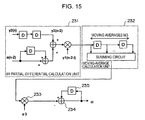
- FIG. 15 is a detailed block diagram illustrating the i-th tap coefficient ci in the IIR coefficient update unit 212.
- FIR coefficient update sections (only one of which is shown in FIG. 15) are provided such that the number thereof is equal to the number of tap coefficients, i.e., L2+1, an example of the i-th tap coefficient is described since all the structures of the FIR coefficient update sections are the same.
- the IIR coefficient update section includes an IIR partial-differential calculation unit 231 and a moving average calculation unit 232, a multiplier 233, a subtractor 234, and a delay unit 235.
- the above-noted partial differentiation is performed by the IIR partial-differential calculation unit 231.
- the result of the partial differentiation is used to perform moving-average calculation with respect to moving averages M3 provided by the moving average calculation unit 232.
- the result is then multiplied by an update coefficient ⁇ 3 and the resulting value is subtracted from ci obtained during the previous clock cycle, thereby performing update.
- the LMS predictor 117 will be described next.
- FIG. 16 is an internal block diagram of the LMS predictor 117.
- e 2 (n) is considered as a predictor evaluation function. where n indicates current time.
- FIG. 17 is a detailed block diagram illustrating the i-th tap coefficient pi in the coefficient update unit 241.
- coefficient update sections (only one is shown in FIG. 17) are provided such that the number thereof is equal to the number of tap coefficients, i.e., N, an example of the i-th tap coefficient is described since all the structures of the coefficient update sections are the same.
- the coefficient update section includes a partial-differential calculation unit 251 and a moving average calculation unit 252, a multiplier 253, a subtractor 254, and a delay unit 255.
- the above-noted partial differentiation is performed by the partial-differential calculation unit 251.
- the result of the partial differentiation is used to perform moving-average calculation with respect to moving averages M4 provided by the moving average calculation unit 252.
- the result is then multiplied by an update coefficient ⁇ 4 and the resulting value is subtracted from pi obtained during the previous clock cycle, thereby performing update.
- the PR(11) adaptive equalizer has the hybrid configuration of the FFF and the FDTS/DFE.
- Rotating phase ⁇ means, when viewed along a frequency axis, multiplication of phase ⁇ by a characteristic as shown in FIG. 19.
- the character, fs, represents a sampling frequency.
- an FIR having a tap coefficient obtained by performing Inverse Discrete Fourier Transform (IDFT) on the frequency characteristic shown in FIG. 19 is defined as a phase shifter.
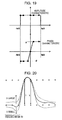
- FIG. 20 shows a waveform obtained by passing an equalized waveform through the phase shifter.
- FIG. 21 is a block diagram showing an entire system incorporating the block of the phase shifter.
- this system further includes a phase shifter 261, a phase controller 262, a level error detector 263, and a timing error detector 264.
- the phase controller 262 calculates ⁇ and supplies it to the phase shifter 261 and the phase shifter 261 then rotates the phase of an input waveform by ⁇ .
- the overshoot shown in FIG. 20 will appear as interference with the leading-edge ISI at a waveform detecting point.
- ⁇ is large as shown in FIG. 20
- error at a detecting point increases in a positive direction
- ⁇ is small
- error at a detecting point increases in a negative direction.
- the phase controller 262 is a block that uses the above-noted calculation to update ⁇ .
- FIG. 22 is a detailed block diagram of the phase controller 262.
- the phase controller 262 has a ⁇ calculation unit 271, a moving average calculation unit 272, a multiplier 273, a subtractor 274, and a delay unit 275.
- the ⁇ calculation unit 271 performs the above-noted calculation.
- a moving average among M5 is determined by the moving average calculation unit 272 and is multiplied by an update coefficient ⁇ 5, and the resulting value is subtracted from ⁇ obtained during the previous clock cycle.
- FIG. 23 is a block diagram of the configuration of the level error detector 263.
- the level error detector 263 has a configuration in which delay units 281, adders 282, and a multiplier 283 are connected as shown in FIG. 23.
- the level error detector 263 calculates a level error by using the following expression.
- FIG. 24 is a block diagram of the configuration of the timing error detector 264.
- the timing error detector 264 has a configuration in which delay units 291, adders 292, and multipliers 293 are connected as shown in FIG. 24.
- the timing error detector 264 calculates timing error by using the following expression. - y 2 n • ( a n -1 + a n -2 ) + y 2 n -1 • ( a n + a n -1 )
- the embodiment having the above-described configuration can provide a determination value based on FDTS with an improved performance compared to a case in which a threshold determining unit is used, while performing PR equalization.
- Performing partial response on a first response of a waveform output from the FFF allows a maximum-likelihood decoder suitable for, for example, Viterbi decoding PR, to be arranged at a subsequent stage.
- a combination with the noise predictor improves the determination performance of the FDTS.
- supplying an output of the noise predictor to the NPML decoder allows for NPML decoding for a waveform having decreased ISI.
- level error and phase error can be detected from a waveform having a decreased ISI, through the use of a determination provided by the FDTS having an improved determination performance.
Landscapes
- Engineering & Computer Science (AREA)
- Signal Processing (AREA)
- Signal Processing For Digital Recording And Reproducing (AREA)
- Cable Transmission Systems, Equalization Of Radio And Reduction Of Echo (AREA)
- Filters That Use Time-Delay Elements (AREA)
- Error Detection And Correction (AREA)
Applications Claiming Priority (2)
| Application Number | Priority Date | Filing Date | Title |
|---|---|---|---|
| JP2003371112A JP2005135532A (ja) | 2003-10-30 | 2003-10-30 | 適応等化装置、復号装置、及び誤差検出装置 |
| JP2003371112 | 2003-10-30 |
Publications (1)
| Publication Number | Publication Date |
|---|---|
| EP1528560A1 true EP1528560A1 (en) | 2005-05-04 |
Family
ID=34420216
Family Applications (1)
| Application Number | Title | Priority Date | Filing Date |
|---|---|---|---|
| EP04292566A Withdrawn EP1528560A1 (en) | 2003-10-30 | 2004-10-29 | Adaptive equalizer decoding device and error detecting device |
Country Status (6)
| Country | Link |
|---|---|
| US (1) | US20050135472A1 (https=) |
| EP (1) | EP1528560A1 (https=) |
| JP (1) | JP2005135532A (https=) |
| KR (1) | KR20050041969A (https=) |
| CN (1) | CN1612477A (https=) |
| TW (1) | TWI273770B (https=) |
Cited By (1)
| Publication number | Priority date | Publication date | Assignee | Title |
|---|---|---|---|---|
| CN102243880A (zh) * | 2011-03-16 | 2011-11-16 | 中国科学院上海光学精密机械研究所 | 变参数自适应prml数据接收器及其数据处理方法 |
Families Citing this family (25)
| Publication number | Priority date | Publication date | Assignee | Title |
|---|---|---|---|---|
| US7545862B2 (en) | 2004-02-16 | 2009-06-09 | Sony Corporation | Adaptive equalizer, decoding device, and error detecting device |
| US7515665B2 (en) * | 2005-05-31 | 2009-04-07 | Skyworks Solutions, Inc. | GFSK/GMSK detector with enhanced performance in co-channel interference and AWGN channels |
| US7702011B2 (en) * | 2005-08-03 | 2010-04-20 | Altera Corporation | High-speed serial data receiver architecture |
| KR100677915B1 (ko) | 2005-08-05 | 2007-02-05 | 삼성탈레스 주식회사 | 잡음 예측 결정 궤환 등화기 |
| US7889818B2 (en) * | 2006-11-14 | 2011-02-15 | Samsung Electronics Co., Ltd. | Method and apparatus for controlling sampling of signals produced in relation to stored data |
| CN101743591B (zh) * | 2007-12-21 | 2013-03-06 | Lsi公司 | 用于记录通道中自适应均衡的系统和方法 |
| TWI392296B (zh) | 2009-06-15 | 2013-04-01 | Realtek Semiconductor Corp | 通訊信號接收器及其訊號處理方法 |
| CN101958857B (zh) * | 2009-07-17 | 2013-04-24 | 瑞昱半导体股份有限公司 | 通讯信号接收器及其信号处理方法 |
| US9225562B2 (en) * | 2012-02-27 | 2015-12-29 | Intel Deutschland Gmbh | Digital wideband closed loop phase modulator with modulation gain calibration |
| US8559496B1 (en) | 2012-06-20 | 2013-10-15 | MagnaCom Ltd. | Signal reception using non-linearity-compensated, partial response feedback |
| CN104769875B (zh) | 2012-06-20 | 2018-07-06 | 安华高科技通用Ip(新加坡)公司 | 采用正交频分复用的高频谱效率传输 |
| US8781008B2 (en) | 2012-06-20 | 2014-07-15 | MagnaCom Ltd. | Highly-spectrally-efficient transmission using orthogonal frequency division multiplexing |
| US8982984B2 (en) | 2012-06-20 | 2015-03-17 | MagnaCom Ltd. | Dynamic filter adjustment for highly-spectrally-efficient communications |
| US8811548B2 (en) | 2012-11-14 | 2014-08-19 | MagnaCom, Ltd. | Hypotheses generation based on multidimensional slicing |
| US9088400B2 (en) | 2012-11-14 | 2015-07-21 | MagnaCom Ltd. | Hypotheses generation based on multidimensional slicing |
| US9118519B2 (en) | 2013-11-01 | 2015-08-25 | MagnaCom Ltd. | Reception of inter-symbol-correlated signals using symbol-by-symbol soft-output demodulator |
| US8804879B1 (en) | 2013-11-13 | 2014-08-12 | MagnaCom Ltd. | Hypotheses generation based on multidimensional slicing |
| US9130637B2 (en) | 2014-01-21 | 2015-09-08 | MagnaCom Ltd. | Communication methods and systems for nonlinear multi-user environments |
| US9496900B2 (en) | 2014-05-06 | 2016-11-15 | MagnaCom Ltd. | Signal acquisition in a multimode environment |
| US8891701B1 (en) | 2014-06-06 | 2014-11-18 | MagnaCom Ltd. | Nonlinearity compensation for reception of OFDM signals |
| US9246523B1 (en) | 2014-08-27 | 2016-01-26 | MagnaCom Ltd. | Transmitter signal shaping |
| US9276619B1 (en) | 2014-12-08 | 2016-03-01 | MagnaCom Ltd. | Dynamic configuration of modulation and demodulation |
| US9191247B1 (en) | 2014-12-09 | 2015-11-17 | MagnaCom Ltd. | High-performance sequence estimation system and method of operation |
| CN112910809B (zh) * | 2019-11-19 | 2023-12-15 | 瑞昱半导体股份有限公司 | 信号均衡装置及方法 |
| US12117566B2 (en) | 2021-03-29 | 2024-10-15 | Beijing Voyager Technology Co., Ltd. | Feed-forward equalization for enhanced distance resolution |
Family Cites Families (4)
| Publication number | Priority date | Publication date | Assignee | Title |
|---|---|---|---|---|
| US6144697A (en) * | 1998-02-02 | 2000-11-07 | Purdue Research Foundation | Equalization techniques to reduce intersymbol interference |
| US6094316A (en) * | 1998-03-27 | 2000-07-25 | Samsung Electronics Co., Ltd. | Method and apparatus for providing thermal asperity compensation in a fixed delay tree search detector |
| JP3749889B2 (ja) * | 2002-10-17 | 2006-03-01 | 株式会社東芝 | Prml検出を適用する信号処理デバイス、同デバイスを備えたディスク記憶装置、及び同装置におけるフィードバック制御のための信号処理方法 |
| US7286595B2 (en) * | 2003-10-10 | 2007-10-23 | Hitachi Global Storage Technologies Netherlands B.V. | Apparatus using a lengthened equalization target filter with a matched filter metric in a viterbi detector |
-
2003
- 2003-10-30 JP JP2003371112A patent/JP2005135532A/ja not_active Abandoned
-
2004
- 2004-10-28 US US10/974,836 patent/US20050135472A1/en not_active Abandoned
- 2004-10-29 CN CNA2004100880309A patent/CN1612477A/zh active Pending
- 2004-10-29 EP EP04292566A patent/EP1528560A1/en not_active Withdrawn
- 2004-10-29 TW TW093132870A patent/TWI273770B/zh not_active IP Right Cessation
- 2004-10-29 KR KR1020040087322A patent/KR20050041969A/ko not_active Withdrawn
Non-Patent Citations (3)
| Title |
|---|
| BROWN J E C ET AL: "A CMOS ADAPTIVE CONTINOUS-TIME FORWARD EQUALIZER, LPF, AND RAM-DFE FOR MAGNETIC RECORDING", IEEE JOURNAL OF SOLID-STATE CIRCUITS, IEEE INC. NEW YORK, US, vol. 34, no. 2, February 1999 (1999-02-01), pages 162 - 169, XP000893505, ISSN: 0018-9200 * |
| ELEFTHERIOU E ET AL INSTITUTE OF ELECTRICAL & ELECTRONICS ENGINEERS: "NOISE-PREDICTIVE MAXIMUM-LIKELIHOOD (NPML) DETECTION FOR THE MAGNETIC RECORDING CHANNEL", 1996 IEEE INTERNATIONAL CONFERENCE ON COMMUNICATIONS (ICC). CONVERGING TECHNOLOGIES FOR TOMORROW'S APPLICATIONS. DALLAS, JUNE 23 - 27, 1996, IEEE INTERNATIONAL CONFERENCE ON COMMUNICATIONS (ICC), NEW YORK, IEEE, US, vol. VOL. 1, 23 June 1996 (1996-06-23), pages 556 - 560, XP000625733, ISBN: 0-7803-3251-2 * |
| MOON J ET AL: "PERFORMANCE COMPARISON OF DETECTION METHODS IN MAGNETIC RECORDING", IEEE TRANSACTIONS ON MAGNETICS, IEEE INC. NEW YORK, US, vol. 26, no. 6, November 1990 (1990-11-01), pages 3155 - 3172, XP000200747, ISSN: 0018-9464 * |
Cited By (2)
| Publication number | Priority date | Publication date | Assignee | Title |
|---|---|---|---|---|
| CN102243880A (zh) * | 2011-03-16 | 2011-11-16 | 中国科学院上海光学精密机械研究所 | 变参数自适应prml数据接收器及其数据处理方法 |
| CN102243880B (zh) * | 2011-03-16 | 2015-02-18 | 中国科学院上海光学精密机械研究所 | 变参数自适应prml数据接收器及其数据处理方法 |
Also Published As
| Publication number | Publication date |
|---|---|
| JP2005135532A (ja) | 2005-05-26 |
| CN1612477A (zh) | 2005-05-04 |
| TW200527813A (en) | 2005-08-16 |
| US20050135472A1 (en) | 2005-06-23 |
| KR20050041969A (ko) | 2005-05-04 |
| TWI273770B (en) | 2007-02-11 |
Similar Documents
| Publication | Publication Date | Title |
|---|---|---|
| EP1528560A1 (en) | Adaptive equalizer decoding device and error detecting device | |
| JP3638093B2 (ja) | 光ディスクの復号装置 | |
| KR100244767B1 (ko) | 디지탈 자기 기록/재생 시스템의 선택적 동기/비동기 부분 응답 채널 데이터 검출 장치 | |
| CN100559488C (zh) | 用于提供动态均衡器最优化的设备 | |
| US5917855A (en) | Method and apparatus for detecting an original signal from a data storage device | |
| US6791776B2 (en) | Apparatus for information recording and reproducing | |
| JP3428329B2 (ja) | 波形等化回路 | |
| US7545862B2 (en) | Adaptive equalizer, decoding device, and error detecting device | |
| JP4199907B2 (ja) | 垂直磁気記録再生装置および信号処理回路 | |
| JP3428376B2 (ja) | 自動等化システム | |
| WO2005024822A1 (ja) | 再生信号処理装置、及び再生信号処理方法 | |
| JP4027444B2 (ja) | 信号再生方法及び信号再生装置 | |
| US20090129229A1 (en) | Method and apparatus for reproducing data | |
| CN101286322B (zh) | 控制根据存储数据产生的信号的采样的方法和设备 | |
| JP2005085461A (ja) | データ再生装置及び方法 | |
| US7415067B2 (en) | Fixed delay tree search/decision feedback equalizer using absolute value calculation and data restoring method using the same | |
| JP2005267840A (ja) | 適応等化装置、復号装置、及び誤差検出装置 | |
| JP4189747B2 (ja) | 信号処理装置 | |
| JPH09330564A (ja) | ディジタル情報再生装置 | |
| KR100335616B1 (ko) | 데이타저장기기에 있어서신호검출방법및장치 | |
| JP4200113B2 (ja) | 等化器および磁気記録再生装置 | |
| KR20040066667A (ko) | 광기록/재생장치용 등화장치 및 그의 등화방법 | |
| JP4727310B2 (ja) | 波形等化装置、情報再生装置、波形等化方法、波形等化プログラムおよび記録媒体 | |
| JP3994987B2 (ja) | 再生装置 | |
| KR20000034470A (ko) | 디브이디 재생장치의 적응 등화기 |
Legal Events
| Date | Code | Title | Description |
|---|---|---|---|
| PUAI | Public reference made under article 153(3) epc to a published international application that has entered the european phase |
Free format text: ORIGINAL CODE: 0009012 |
|
| AK | Designated contracting states |
Kind code of ref document: A1 Designated state(s): AT BE BG CH CY CZ DE DK EE ES FI FR GB GR HU IE IT LI LU MC NL PL PT RO SE SI SK TR |
|
| AX | Request for extension of the european patent |
Extension state: AL HR LT LV MK |
|
| 17P | Request for examination filed |
Effective date: 20051103 |
|
| AKX | Designation fees paid |
Designated state(s): DE FR GB |
|
| 17Q | First examination report despatched |
Effective date: 20060707 |
|
| 17Q | First examination report despatched |
Effective date: 20060707 |
|
| STAA | Information on the status of an ep patent application or granted ep patent |
Free format text: STATUS: THE APPLICATION IS DEEMED TO BE WITHDRAWN |
|
| 18D | Application deemed to be withdrawn |
Effective date: 20100504 |