EP1528131B1 - Toile d'Isolation thermique - Google Patents
Toile d'Isolation thermique Download PDFInfo
- Publication number
- EP1528131B1 EP1528131B1 EP04100194A EP04100194A EP1528131B1 EP 1528131 B1 EP1528131 B1 EP 1528131B1 EP 04100194 A EP04100194 A EP 04100194A EP 04100194 A EP04100194 A EP 04100194A EP 1528131 B1 EP1528131 B1 EP 1528131B1
- Authority
- EP
- European Patent Office
- Prior art keywords
- thermal insulation
- reflecting
- fabric according
- insulation fabric
- knit
- Prior art date
- Legal status (The legal status is an assumption and is not a legal conclusion. Google has not performed a legal analysis and makes no representation as to the accuracy of the status listed.)
- Expired - Lifetime
Links
Images
Classifications
-
- D—TEXTILES; PAPER
- D04—BRAIDING; LACE-MAKING; KNITTING; TRIMMINGS; NON-WOVEN FABRICS
- D04B—KNITTING
- D04B21/00—Warp knitting processes for the production of fabrics or articles not dependent on the use of particular machines; Fabrics or articles defined by such processes
- D04B21/14—Fabrics characterised by the incorporation by knitting, in one or more thread, fleece, or fabric layers, of reinforcing, binding, or decorative threads; Fabrics incorporating small auxiliary elements, e.g. for decorative purposes
- D04B21/16—Fabrics characterised by the incorporation by knitting, in one or more thread, fleece, or fabric layers, of reinforcing, binding, or decorative threads; Fabrics incorporating small auxiliary elements, e.g. for decorative purposes incorporating synthetic threads
-
- A—HUMAN NECESSITIES
- A01—AGRICULTURE; FORESTRY; ANIMAL HUSBANDRY; HUNTING; TRAPPING; FISHING
- A01G—HORTICULTURE; CULTIVATION OF VEGETABLES, FLOWERS, RICE, FRUIT, VINES, HOPS OR SEAWEED; FORESTRY; WATERING
- A01G9/00—Cultivation in receptacles, forcing-frames or greenhouses; Edging for beds, lawn or the like
- A01G9/22—Shades or blinds for greenhouses, or the like
-
- D—TEXTILES; PAPER
- D10—INDEXING SCHEME ASSOCIATED WITH SUBLASSES OF SECTION D, RELATING TO TEXTILES
- D10B—INDEXING SCHEME ASSOCIATED WITH SUBLASSES OF SECTION D, RELATING TO TEXTILES
- D10B2403/00—Details of fabric structure established in the fabric forming process
- D10B2403/01—Surface features
- D10B2403/011—Dissimilar front and back faces
- D10B2403/0114—Dissimilar front and back faces with one or more yarns appearing predominantly on one face, e.g. plated or paralleled yarns
-
- D—TEXTILES; PAPER
- D10—INDEXING SCHEME ASSOCIATED WITH SUBLASSES OF SECTION D, RELATING TO TEXTILES
- D10B—INDEXING SCHEME ASSOCIATED WITH SUBLASSES OF SECTION D, RELATING TO TEXTILES
- D10B2403/00—Details of fabric structure established in the fabric forming process
- D10B2403/02—Cross-sectional features
- D10B2403/024—Fabric incorporating additional compounds
- D10B2403/0241—Fabric incorporating additional compounds enhancing mechanical properties
- D10B2403/02412—Fabric incorporating additional compounds enhancing mechanical properties including several arrays of unbent yarn, e.g. multiaxial fabrics
-
- D—TEXTILES; PAPER
- D10—INDEXING SCHEME ASSOCIATED WITH SUBLASSES OF SECTION D, RELATING TO TEXTILES
- D10B—INDEXING SCHEME ASSOCIATED WITH SUBLASSES OF SECTION D, RELATING TO TEXTILES
- D10B2403/00—Details of fabric structure established in the fabric forming process
- D10B2403/02—Cross-sectional features
- D10B2403/024—Fabric incorporating additional compounds
- D10B2403/0243—Fabric incorporating additional compounds enhancing functional properties
-
- D—TEXTILES; PAPER
- D10—INDEXING SCHEME ASSOCIATED WITH SUBLASSES OF SECTION D, RELATING TO TEXTILES
- D10B—INDEXING SCHEME ASSOCIATED WITH SUBLASSES OF SECTION D, RELATING TO TEXTILES
- D10B2503/00—Domestic or personal
- D10B2503/03—Inside roller shades or blinds
-
- Y—GENERAL TAGGING OF NEW TECHNOLOGICAL DEVELOPMENTS; GENERAL TAGGING OF CROSS-SECTIONAL TECHNOLOGIES SPANNING OVER SEVERAL SECTIONS OF THE IPC; TECHNICAL SUBJECTS COVERED BY FORMER USPC CROSS-REFERENCE ART COLLECTIONS [XRACs] AND DIGESTS
- Y02—TECHNOLOGIES OR APPLICATIONS FOR MITIGATION OR ADAPTATION AGAINST CLIMATE CHANGE
- Y02A—TECHNOLOGIES FOR ADAPTATION TO CLIMATE CHANGE
- Y02A40/00—Adaptation technologies in agriculture, forestry, livestock or agroalimentary production
- Y02A40/10—Adaptation technologies in agriculture, forestry, livestock or agroalimentary production in agriculture
- Y02A40/25—Greenhouse technology, e.g. cooling systems therefor
Definitions
- the invention relates to a thermal insulation fabric, more particularly intended to be implemented at the level of verandas, and in general of any building with glass roofs or windows, and that it is desired to isolate removably, thermally and also on the bright plane.
- a reflective material suitable for reflection, at least in large part, the light rays received, in addition to infrared radiation - heat source.
- a reflective material may be of any kind, however, aluminum is frequently used, considering first of all its high reflectivity, secondly, its relatively low cost, and finally its relative ease of handling.
- these screens are of the textile type, possibly provided with a glossy face obtained by treatment, and therefore generally having a limited durability, besides a relative efficiency.
- strips made of a reflective material, typically made of aluminum, which are woven either in one direction or in two directions, and integrated in a resin, in order to give cohesion to the whole (see FIG. for example DE 100 61 010 A ).
- the invention aims a thermal insulation fabric, fulfilling its primary function of reflection of light rays, visible and infrared, and may, in addition, to take a decorative appearance inside the glazed enclosure within which is set up such a canvas.
- a non-symmetrical textile material also called double-face
- double-face is produced which has a glossy face with very high reflectivity, and a " textile " face, which is capable of giving the product a pleasant and aesthetic appearance.
- Such a fabric incorporates strips of aluminum within a textile structure, but the flatness of said strips is not necessarily sought, and there are observed tendrils or twists, inherent in particular to the mechanical properties of aluminum, and further to the method of making such webs.
- the invention makes it possible to overcome these defects, and to obtain a perfect flatness strips reflective material, including aluminum, to cancel these defects.
- the textile face can be dyed or impregnated at the choice of the end user, thus conferring the aesthetic appearance particularly sought after.
- reflective lamellae are made from any material with high reflectivity, including aluminum.
- the resulting fabric is advantageously impregnated with a resin, for example polyurethane, intended to give it mechanical strength and the drop.
- a resin for example polyurethane
- Said fabric may also be impregnated with a flame retardant resin, which may give it the fire classification M1 or M0.
- the constituent yarns of the knit are made of polyester yarn, or other, such as in particular fiberglass, or glass-PVC composite yarn.
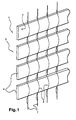
- the figure 1 is a schematic representation of the reflective face-up canvas.
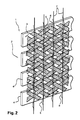
- the figure 2 is a schematic representation of the fabric seen face textile.
- the thermal insulation fabric (1) according to the present invention is therefore in the form of a flat structure, having on one (2) of its faces, said reflective face, reflective strips (4) juxtaposed side side by side in the width direction, and held together by a network of son (5), referred to as binding son.
- Reflective slats (4) consist of aluminum strips. They can advantageously be coated on both sides with a thin polyester film, so as to be able to handle them without difficulty, at the knitting machine used for the realization of said structure.
- this polyester layer avoids the oxidation phenomena to which aluminum is subjected in usual atmosphere.
- the binding threads (5) mesh around the slats (4), and thus create the spacing between said slats. However, insofar as it is desired to achieve a maximum reflection capacity, it is sought to reduce this spacing as much as possible.
- the binding son (5) for example made of polyester, are very thin.
- the yarn network (5) is constituted by a knit made on a weft knit loom with front insertion of weft, and this according to a weave mesh with additional weft insertion insertion, it is to say in an armor that allows to obtain an uninterrupted juxtaposition of the reflective lamellae, advantageously maintained at regular intervals by vertical son (7) (that is to say parallel to the direction of production of the canvas), shown in broken lines on the figures.
- the knitting machine used is a trade available from KARL MAYER or the company LIBA, of a type known per se.
- the other side of the fabric hereinafter referred to as the textile face (3) or cover face, for decorative purposes, is made by knitting on the same loom. We choose to do this a suitable frame, to create a maximum of coverage.
- Such armor is for example a double knit and satin long piers.
- This face is linked to the reflecting face (2) by the binding son network (5).
- the constituent yarns of this textile face (3) may be polyester, advantageously swelling, ie having a certain volume.
- This swelling appearance can in particular be obtained, in known manner, by texturing. It makes it possible to obtain a good coverage of the reflecting face, in order to conceal or obscure the reflecting face (2) when viewing said fabric on the side of the textile face.
- the implementation of such son allows to perform subsequent to the production of the fabric, a dyeing or printing of the textile side, to give it an aesthetic or decorative appearance. This dyeing or printing is carried out according to the methods usually used with traditional textile structures.
- the constituent yarns of said textile face (3) may also consist of glass fibers, or glass-PVC composite yarns.
- a third wire (7) not forming a mesh is incorporated, but which is simply trapped at the inside of the knitted structure, constituting the textile face of the structure, as can be seen in the figures.
- the assembly thus obtained may undergo a standard impregnation of resin, for example polyurethane, using for example a scarf + rasp device, capable of giving it holding and falling, and further promoting the subsequent cutting , especially in the case of vertical blinds.
- resin for example polyurethane
- This resin can also be flame retardant, then allowing the fabric as a result of being compatible with fire classification M1 or M0.
- an asymmetric textile structure is practically indeformable, both lengthwise and widthwise, and adapted to be used, like a curtain, as an insulation fabric. thermal at any glazed enclosure, porch type, and other structures or architectures in glass or transparent material, or simply simply windows.
Landscapes
- Engineering & Computer Science (AREA)
- Textile Engineering (AREA)
- Life Sciences & Earth Sciences (AREA)
- Environmental Sciences (AREA)
- Laminated Bodies (AREA)
- Insulated Conductors (AREA)
- Curtains And Furnishings For Windows Or Doors (AREA)
- Blinds (AREA)
- Thermal Insulation (AREA)
- Knitting Of Fabric (AREA)
- Woven Fabrics (AREA)
Description
- L'invention concerne une toile d'isolation thermique, plus particulièrement destinée à être mise en place au niveau de vérandas, et de manière générale de tout bâtiment comportant des verrières ou des baies vitrées, et que l'on souhaite isoler de manière amovible, thermiquement et également sur le plan lumineux.
- Afin de limiter le rayonnement solaire au sein d'une structure vitrée, et par voie de conséquence, isoler thermiquement l'intérieur d'une telle enceinte, il est connu de positionner sous la paroi en verre, un matériau réfléchissant, propre à réfléchir, à tout le moins en grande partie, les rayons lumineux reçus, outre partie du rayonnement infrarouge - source de chaleur. Un tel matériau réfléchissant peut être de toute nature, cependant, il est fréquemment fait appel à l'aluminium, compte-tenu tout d'abord de son haut pouvoir réfléchissant, d'autre part, de son coût relativement réduit, et enfin de sa relative facilité de manutention.
- Traditionnellement, ces écrans sont de type textile, éventuellement muni d'une face brillante obtenue par traitement, et donc généralement présentant une durabilité limitée, outre une efficacité toute relative.
- Il est également connu de mettre en oeuvre des bandelettes, en un matériau réfléchissant, typiquement en aluminium, qui sont tissées soit dans une direction soit dans deux directions, et intégrées dans une résine, afin de donner de la cohésion à l'ensemble (voir par exemple
DE 100 61 010 A ). - Quelle que soit la technique mise en oeuvre, si l'on aboutit certes à un pouvoir de réflexion plus ou moins satisfaisant, en revanche, l'aspect esthétique, de plus en plus recherchée, notamment à l'intérieur de l'enceinte vitrée, est des plus médiocres.
- Or, l'invention vise une toile d'isolation thermique, remplissant sa fonction première de réflexion des rayons lumineux, visibles et infrarouges, et susceptible, en outre, de revêtir un aspect décoratif à l'intérieur de l'enceinte vitrée au sein de laquelle est mise en place une telle toile.
- Ainsi, la toile d'isolation thermique conforme à l'invention (voir revendication 1), comprend une face réfléchissant le rayonnement lumineux, voire le rayonnement infrarouge, et une face textile proprement dite, et se caractérise de plus :
- en ce que la face réfléchissante est constituée de lamelles réfléchissantes, rigoureusement planes, juxtaposées côte à côte dans le sens de la largeur de la toile, et maintenues entre elles par un réseau de fils ;
- et en ce que le réseau de fils est constitué par un tricot, réalisé sur un métier à tricoter à mailles jetées, à insertion frontale de trame selon une armure du type mailles jetées bloquées avec insertion de trame supplémentaire, propre à constituer sur la face non réfléchissante un support textile uniforme ;
- lesdites lamelles réfléchissantes étant tramées sur toute la largeur du tricot.
- Ce faisant, on réalise un matériau textile dissymétrique, également dénommé double-face, présentant une face brillante à très fort pouvoir de réflexion, et une face « textile », laquelle est susceptible de conférer un aspect agréable et esthétique au produit.
- Si la mise en oeuvre de bandelettes d'aluminium, et de manière générale de tout matériau réfléchissant au sein d'une structure textile n'est certes pas nouveau, en revanche, le maintien de ces bandelettes sous forme rigoureusement plane, au sein d'une structure textile, est nouveau, et en l'espèce est impératif pour les raisons suivantes.
- En effet, il est connu, par exemple dans les serres, de mettre en place un matériau réfléchissant en fonction de l'éclairement, afin de maintenir une température sensiblement constante, et surtout, afin d'éviter de trop importantes déperditions de chaleur à l'intérieur de la serre, en vue de réaliser des économies d'énergie.
- Une telle toile intègre des bandelettes d'aluminium au sein d'une structure textile, mais, la planéité desdites bandelettes n'est pas nécessairement recherchée, et l'on observe des vrilles ou torsions, inhérentes notamment aux propriétés mécaniques de l'aluminium, et en outre au procédé de réalisation de telles toiles.
- Si ces défauts sont de moindre importance pour une serre, en revanche, par transparence, ils sont nettement visibles de l'intérieur, c'est à dire face envers, et il ne peut être question de mettre en oeuvre de telles toiles au sein d'un habitat, et notamment d'une véranda.
- Or, l'invention permet justement de s'affranchir de ces défauts, et d'obtenir une planéité parfaite des bandelettes de matériau réfléchissant, et notamment d'aluminium, permettant d'annuler ces défauts.
- Qui plus est, la face textile peut être teinte ou imprégnée au choix de l'utilisateur final, conférant ainsi l'aspect esthétique tout particulièrement recherché.
- Comme déjà, les lamelles réfléchissantes sont réalisées à base de tout matériau à fort pouvoir réfléchissant, notamment l'aluminium.
- La toile en résultant est avantageusement imprégnée d'une résine, par exemple polyuréthane, destinée à lui conférer de la tenue mécanique et du tombant.
- Ladite toile peut également être imprégnée d'une résine ignifugeante, susceptible de lui conférer le classement anti-feu M1 voire M0.
- Qui plus est, la mise en oeuvre d'une telle résine permet de favoriser les opérations de découpe de la toile aux dimensions souhaitées.
- Selon une caractéristique de l'invention, les fils constitutifs du tricot sont réalisés en fil polyester, ou autre, tel que notamment en fibre de verre, ou encore en fil composite verre - PVC.
- La manière de réaliser l'invention et les avantages qui en découlent ressortiront mieux de l'exemple de réalisation qui suit donné à titre indicatif et non limitatif à l'appui des figures annexées.
- La
figure 1 est une représentation schématique de la toile vue face réfléchissante.
Lafigure 2 est une représentation schématique de la toile vue face textile. - La toile d'isolation thermique (1) conforme à la présente invention se présente donc sous la forme d'une structure plane, présentant sur l'une (2) de ses faces, dite face réfléchissante, des lamelles réfléchissantes (4) juxtaposées côte à côte dans le sens de la largeur, et maintenues entre elles par un réseau de fils (5), dénommés fils de liage.
- Les lamelles réfléchissantes (4) sont constituées de bandelettes d'aluminium. Elles peuvent avantageusement être revêtues sur leurs deux faces d'un film mince de polyester, de telle sorte à pouvoir les manipuler sans difficulté, au niveau du métier à tricoter mis en oeuvre pour la réalisation de ladite structure.
- Qui plus est, cette couche polyester permet d'éviter les phénomènes d'oxydation auxquels est soumis l'aluminium en atmosphère habituelle.
- Les fils de liage (5) maillent autour des lamelles (4), et créent ainsi l'espacement entre lesdites lamelles. Cependant, dans la mesure où l'on souhaite aboutir à une capacité de réflexion maximum, on cherche à réduire le plus possible cet espacement. De fait, les fils de liage (5), par exemple réalisés en polyester, sont très fins.
- Selon l'invention, le réseau de fils (5) est constitué par un tricot réalisé sur un métier à tricoter à mailles jetées à insertion frontale de trame, et ce selon une armure à mailles jetées avec insertion de trame supplémentaire, c'est à dire selon une armure qui permet d'obtenir une juxtaposition sans interruption des lamelles réfléchissantes, avantageusement maintenues à intervalles réguliers par des fils verticaux (7) (c'est à dire parallèles au sens de production de la toile), représentés en traits discontinus sur les figures.
- Typiquement, le métier à tricoter utilisé est un métier disponible auprès de la société KARL MAYER ou de la société LIBA, d'un type en soi connu.
- L'autre face de la toile, ci-après dénommée face textile (3) ou face de couverture, à vocation décorative, est réalisée par tricotage sur le même métier. On choisit pour ce faire une armature appropriée, afin de créer un maximum de couverture. Une telle armure est par exemple un double tricot et satin de longues jetées.
- Cette face est liée à la face réfléchissante (2) par le réseau de fils de liage (5).
- Les fils constitutifs de cette face textile (3) peuvent être du polyester, avantageusement gonflant, c'est à dire présentant un certain volume. Cet aspect gonflant peut notamment être obtenu, de manière connue, par texturation. Il permet d'obtenir une bonne couverture de la face réfléchissante, dans l'objectif de cacher ou d'occulter la face réfléchissante (2) lorsque l'on regarde ladite toile du coté de la face textile. Qui plus est, la mise en oeuvre de tels fils permet d'effectuer postérieurement à la réalisation de la toile, une teinture ou une impression de la face textile, propre à lui conférer un aspect esthétique ou décoratif. Cette teinture ou cette impression est réalisée selon les procédés habituellement mis en oeuvre avec les structures textiles traditionnelles.
- Les fils constitutifs de ladite face textile (3) peuvent également être constitués de fibres de verre, ou de fils composite verre-PVC.
- Afin d'améliorer la résistance dans le sens de la longueur, et notamment maîtriser le resserrement des lamelles réfléchissantes, et ainsi que déjà précisé précédemment, on incorpore un troisième fil (7) ne formant pas de maille, mais qui se trouve simplement emprisonné à l'intérieur de la structure tricotée, constitutive de la face textile de la structure, tel qu'on peut l'observer sur les figures.
- L'ensemble ainsi obtenu peut subir une imprégnation standard de résine, par exemple de polyuréthane, à l'aide par exemple d'un dispositif foulard + râcle, susceptible de lui conférer de la tenue et du tombant, et favorisant en outre la découpe ultérieure, en particulier dans le cas des stores à lamelles verticales.
- Cette résine peut également être ignifugeante, permettrant alors à la toile en résultat d'être compatible avec le classement anti-feu M1 voire M0.
- On dispose de fait, d'une structure textile dissymétrique, pratiquement indéformable, tant dans le sens de la longueur que dans le sens de la largeur, et adaptée pour être utilisée, à l'instar d'un rideau, comme toile d'isolation thermique au niveau de toute enceinte vitrée, de type véranda, et autres structures ou architectures en verre ou en matériau transparent, voire simplement des baies vitrées.
Claims (9)
- Toile d'isolation thermique comprenant une face (2) réfléchissant le rayonnement lumineux, voire le rayonnement infrarouge, caractérisée :- en ce que la face réfléchissante (2) est associée à une face textile (3),- en ce que la face réfléchissante (2) est constituée de lamelles réfléchissantes (4), rigoureusement planes, juxtaposées côte à côte dans le sens de la largeur de la toile, et maintenues entre elles par un réseau de fils de liage (5) ;- et en ce que le réseau de fils (5) est constitué par un tricot, réalisé sur un métier à tricoter à mailles jetées, à insertion frontale de trame selon une armure du type à mailles jetées avec insertion de trame supplémentaire, propre à constituer sur la face non réfléchissante un support textile uniforme ;lesdites lamelles réfléchissantes (4) étant tramées sur toute la largeur du tricot.
- Toile d'isolation thermique selon la revendication 1, caractérisée en ce que les lamelles réfléchissantes (4) sont réalisées à base de tout matériau à fort pouvoir réfléchissant.
- Toile d'isolation thermique selon la revendication 2, caractérisée en ce que le matériau choisi est l'aluminium.
- Toile d'isolation thermique selon l'une des revendications 1 à 3, caractérisée en que la face textile (3) est teinte ou imprimée.
- Toile d'isolation thermique selon l'une des revendications 1 à 4, caractérisée en ce qu'elle est imprégnée d'une résine, destinée à lui conférer de la tenue mécanique et du tombant.
- Toile d'isolation thermique selon l'une des revendications 1 à 4, caractérisée en ce qu'elle est imprégnée d'une résine ignifugeante, destinée à lui conférer le classement anti-feu.
- Toile d'isolation thermique selon l'une des revendications 1 à 6, caractérisée en ce que les fils constitutifs du tricot sont réalisés en polyester, notamment texturé.
- Toile d'isolation thermique selon la revendication 7, caractérisée en ce que les fils constitutifs du tricot sont réalisés en composite verre - PVC ;
- Toile d'isolation thermique selon l'une des revendications 2 à 8, caractérisée en ce que les lamelles réfléchissantes (4) sont réalisées en aluminium, et en ce qu'elles sont revêtues sur leur deux faces de résine polyester.
Applications Claiming Priority (2)
| Application Number | Priority Date | Filing Date | Title |
|---|---|---|---|
| FR0302385 | 2003-02-27 | ||
| FR0302385A FR2851775B1 (fr) | 2003-02-27 | 2003-02-27 | Toile d'isolation thermique |
Publications (2)
| Publication Number | Publication Date |
|---|---|
| EP1528131A1 EP1528131A1 (fr) | 2005-05-04 |
| EP1528131B1 true EP1528131B1 (fr) | 2008-06-18 |
Family
ID=32843021
Family Applications (1)
| Application Number | Title | Priority Date | Filing Date |
|---|---|---|---|
| EP04100194A Expired - Lifetime EP1528131B1 (fr) | 2003-02-27 | 2004-01-22 | Toile d'Isolation thermique |
Country Status (5)
| Country | Link |
|---|---|
| EP (1) | EP1528131B1 (fr) |
| AT (1) | ATE398696T1 (fr) |
| DE (1) | DE602004014457D1 (fr) |
| ES (1) | ES2308108T3 (fr) |
| FR (1) | FR2851775B1 (fr) |
Family Cites Families (4)
| Publication number | Priority date | Publication date | Assignee | Title |
|---|---|---|---|---|
| US4399671A (en) * | 1979-11-19 | 1983-08-23 | Ludvig Svensson (Holland) B.V. | Green-house curtain |
| SE503105C2 (sv) * | 1994-07-18 | 1996-03-25 | Svensson Ludvig Int | Växtskyddsanordning med vikbar, vattentät växtskyddsgardin |
| FR2786062B1 (fr) * | 1998-11-19 | 2001-01-26 | Mdb Texinov Sa | Materiau reflechissant la lumiere solaire utilisable dans le domaine de l'agriculture et procede pour son obtention |
| DE10061010A1 (de) * | 2000-12-08 | 2002-07-04 | Felix Heescher Gmbh | Wandbehang zur Beeinflussung eines Raumklimas |
-
2003
- 2003-02-27 FR FR0302385A patent/FR2851775B1/fr not_active Expired - Fee Related
-
2004
- 2004-01-22 EP EP04100194A patent/EP1528131B1/fr not_active Expired - Lifetime
- 2004-01-22 DE DE602004014457T patent/DE602004014457D1/de not_active Expired - Fee Related
- 2004-01-22 ES ES04100194T patent/ES2308108T3/es not_active Expired - Lifetime
- 2004-01-22 AT AT04100194T patent/ATE398696T1/de not_active IP Right Cessation
Also Published As
| Publication number | Publication date |
|---|---|
| EP1528131A1 (fr) | 2005-05-04 |
| DE602004014457D1 (de) | 2008-07-31 |
| FR2851775B1 (fr) | 2005-04-01 |
| ES2308108T3 (es) | 2008-12-01 |
| FR2851775A1 (fr) | 2004-09-03 |
| ATE398696T1 (de) | 2008-07-15 |
Similar Documents
| Publication | Publication Date | Title |
|---|---|---|
| CA2270904C (fr) | Structure textile tricotee a double peau et fils de liaison orientable et son procede de fabrication | |
| EP0456651A1 (fr) | Ecran d'ombrage et d'isolation garni de fils textiles hydrophiles. | |
| EP1827151B1 (fr) | Materiau multicouches pour vetements de protection contre la chaleur | |
| EP2087278A1 (fr) | Complexe éclairant comportant une source lumineuse présentant une nappe de fibres optiques | |
| EP0979322B1 (fr) | Systeme d'ecran alternateur de lumiere comprenant un reseau a facteur d'ouverture variable | |
| AU2014336160B2 (en) | Light-directing system | |
| CA2804571C (fr) | Isolant phonique | |
| CA2600255A1 (fr) | Tissu de protection contre le feu | |
| EP2086309B1 (fr) | Ecran d'isolation thermique, notamment pour serres horticoles et maraîchères | |
| FR2851775A1 (fr) | Toile d'isolation thermique | |
| WO2009016200A1 (fr) | Textile architectural et procédé de mise en oeuvre d'un tel textile architectural | |
| KR20120066615A (ko) | 개폐종방실 작동이 가능한 차양부 양면지를 갖는 입체 커튼지 | |
| FR2975709A1 (fr) | Nappe textile lumineuse et procede de fabrication d'une telle nappe textile lumineuse | |
| KR101796499B1 (ko) | 랜덤 웨이브 패턴을 갖는 블라인드용 원단 및 랜덤 웨이브 패턴을 갖는 블라인드용 원단의 제직 방법 | |
| KR101966007B1 (ko) | 불규칙 빛샘부를 갖는 원단 제직 방법 및 이에 의해 제직된 원단 | |
| PL226049B1 (pl) | Ustroj gazowej i radiacyjnej izolacji termicznej szyb zespolonych | |
| EP3362595B1 (fr) | Grille textile tricotee | |
| WO1998035082A1 (fr) | Revetement a aspect textile pour l'habillage de panneaux en forme | |
| JP4788638B2 (ja) | バーチカルブラインド用基材 | |
| FR2871407A1 (fr) | Toile d'isolation, notamment thermique | |
| KR102564493B1 (ko) | 차광율이 향상되어 퓨어 화이트 컬러를 구현하는 콤비형 암막 블라인드 직물 | |
| FR2494313A1 (fr) | Tissu pour stores ou similaires et materiau pour son obtention | |
| JP2019138134A (ja) | スクリーン及びスクリーン装置 | |
| FR2889238A1 (fr) | Store rideau isolant ajoure pour la protection contre les rayonnements | |
| FR2877368A1 (fr) | Complexes de protections solaires decoratifs au travers ou en dessous desquels les gens ou les choses ne soient ni trop a l'ombre, ni eblouis, ni surchauffes mais proteges des intemperies legeres |
Legal Events
| Date | Code | Title | Description |
|---|---|---|---|
| PUAI | Public reference made under article 153(3) epc to a published international application that has entered the european phase |
Free format text: ORIGINAL CODE: 0009012 |
|
| AK | Designated contracting states |
Kind code of ref document: A1 Designated state(s): AT BE BG CH CY CZ DE DK EE ES FI FR GB GR HU IE IT LI LU MC NL PT RO SE SI SK TR |
|
| AX | Request for extension of the european patent |
Extension state: AL LT LV MK |
|
| 17P | Request for examination filed |
Effective date: 20050901 |
|
| AKX | Designation fees paid |
Designated state(s): AT BE BG CH CY CZ DE DK EE ES FI FR GB GR HU IE IT LI LU MC NL PT RO SE SI SK TR |
|
| 17Q | First examination report despatched |
Effective date: 20070801 |
|
| GRAP | Despatch of communication of intention to grant a patent |
Free format text: ORIGINAL CODE: EPIDOSNIGR1 |
|
| GRAS | Grant fee paid |
Free format text: ORIGINAL CODE: EPIDOSNIGR3 |
|
| GRAA | (expected) grant |
Free format text: ORIGINAL CODE: 0009210 |
|
| AK | Designated contracting states |
Kind code of ref document: B1 Designated state(s): AT BE BG CH CY CZ DE DK EE ES FI FR GB GR HU IE IT LI LU MC NL PT RO SE SI SK TR |
|
| REG | Reference to a national code |
Ref country code: GB Ref legal event code: FG4D Free format text: NOT ENGLISH |
|
| REF | Corresponds to: |
Ref document number: 602004014457 Country of ref document: DE Date of ref document: 20080731 Kind code of ref document: P |
|
| REG | Reference to a national code |
Ref country code: CH Ref legal event code: EP |
|
| REG | Reference to a national code |
Ref country code: IE Ref legal event code: FG4D Free format text: LANGUAGE OF EP DOCUMENT: FRENCH |
|
| PG25 | Lapsed in a contracting state [announced via postgrant information from national office to epo] |
Ref country code: SI Free format text: LAPSE BECAUSE OF FAILURE TO SUBMIT A TRANSLATION OF THE DESCRIPTION OR TO PAY THE FEE WITHIN THE PRESCRIBED TIME-LIMIT Effective date: 20080618 Ref country code: FI Free format text: LAPSE BECAUSE OF FAILURE TO SUBMIT A TRANSLATION OF THE DESCRIPTION OR TO PAY THE FEE WITHIN THE PRESCRIBED TIME-LIMIT Effective date: 20080618 |
|
| PG25 | Lapsed in a contracting state [announced via postgrant information from national office to epo] |
Ref country code: AT Free format text: LAPSE BECAUSE OF FAILURE TO SUBMIT A TRANSLATION OF THE DESCRIPTION OR TO PAY THE FEE WITHIN THE PRESCRIBED TIME-LIMIT Effective date: 20080618 Ref country code: NL Free format text: LAPSE BECAUSE OF FAILURE TO SUBMIT A TRANSLATION OF THE DESCRIPTION OR TO PAY THE FEE WITHIN THE PRESCRIBED TIME-LIMIT Effective date: 20080618 |
|
| REG | Reference to a national code |
Ref country code: ES Ref legal event code: FG2A Ref document number: 2308108 Country of ref document: ES Kind code of ref document: T3 |
|
| NLV1 | Nl: lapsed or annulled due to failure to fulfill the requirements of art. 29p and 29m of the patents act | ||
| PG25 | Lapsed in a contracting state [announced via postgrant information from national office to epo] |
Ref country code: CZ Free format text: LAPSE BECAUSE OF FAILURE TO SUBMIT A TRANSLATION OF THE DESCRIPTION OR TO PAY THE FEE WITHIN THE PRESCRIBED TIME-LIMIT Effective date: 20080618 Ref country code: PT Free format text: LAPSE BECAUSE OF FAILURE TO SUBMIT A TRANSLATION OF THE DESCRIPTION OR TO PAY THE FEE WITHIN THE PRESCRIBED TIME-LIMIT Effective date: 20081118 Ref country code: SE Free format text: LAPSE BECAUSE OF FAILURE TO SUBMIT A TRANSLATION OF THE DESCRIPTION OR TO PAY THE FEE WITHIN THE PRESCRIBED TIME-LIMIT Effective date: 20080918 |
|
| REG | Reference to a national code |
Ref country code: IE Ref legal event code: FD4D |
|
| PG25 | Lapsed in a contracting state [announced via postgrant information from national office to epo] |
Ref country code: SK Free format text: LAPSE BECAUSE OF FAILURE TO SUBMIT A TRANSLATION OF THE DESCRIPTION OR TO PAY THE FEE WITHIN THE PRESCRIBED TIME-LIMIT Effective date: 20080618 Ref country code: RO Free format text: LAPSE BECAUSE OF FAILURE TO SUBMIT A TRANSLATION OF THE DESCRIPTION OR TO PAY THE FEE WITHIN THE PRESCRIBED TIME-LIMIT Effective date: 20080618 |
|
| PLBE | No opposition filed within time limit |
Free format text: ORIGINAL CODE: 0009261 |
|
| STAA | Information on the status of an ep patent application or granted ep patent |
Free format text: STATUS: NO OPPOSITION FILED WITHIN TIME LIMIT |
|
| PG25 | Lapsed in a contracting state [announced via postgrant information from national office to epo] |
Ref country code: EE Free format text: LAPSE BECAUSE OF FAILURE TO SUBMIT A TRANSLATION OF THE DESCRIPTION OR TO PAY THE FEE WITHIN THE PRESCRIBED TIME-LIMIT Effective date: 20080618 Ref country code: BG Free format text: LAPSE BECAUSE OF FAILURE TO SUBMIT A TRANSLATION OF THE DESCRIPTION OR TO PAY THE FEE WITHIN THE PRESCRIBED TIME-LIMIT Effective date: 20080918 Ref country code: DK Free format text: LAPSE BECAUSE OF FAILURE TO SUBMIT A TRANSLATION OF THE DESCRIPTION OR TO PAY THE FEE WITHIN THE PRESCRIBED TIME-LIMIT Effective date: 20080618 Ref country code: IE Free format text: LAPSE BECAUSE OF FAILURE TO SUBMIT A TRANSLATION OF THE DESCRIPTION OR TO PAY THE FEE WITHIN THE PRESCRIBED TIME-LIMIT Effective date: 20080618 |
|
| PGFP | Annual fee paid to national office [announced via postgrant information from national office to epo] |
Ref country code: ES Payment date: 20090122 Year of fee payment: 6 |
|
| 26N | No opposition filed |
Effective date: 20090319 |
|
| PGFP | Annual fee paid to national office [announced via postgrant information from national office to epo] |
Ref country code: DE Payment date: 20090112 Year of fee payment: 6 |
|
| PG25 | Lapsed in a contracting state [announced via postgrant information from national office to epo] |
Ref country code: MC Free format text: LAPSE BECAUSE OF NON-PAYMENT OF DUE FEES Effective date: 20090131 Ref country code: IT Free format text: LAPSE BECAUSE OF FAILURE TO SUBMIT A TRANSLATION OF THE DESCRIPTION OR TO PAY THE FEE WITHIN THE PRESCRIBED TIME-LIMIT Effective date: 20080618 |
|
| REG | Reference to a national code |
Ref country code: CH Ref legal event code: PL |
|
| GBPC | Gb: european patent ceased through non-payment of renewal fee |
Effective date: 20090122 |
|
| PG25 | Lapsed in a contracting state [announced via postgrant information from national office to epo] |
Ref country code: LI Free format text: LAPSE BECAUSE OF NON-PAYMENT OF DUE FEES Effective date: 20090131 Ref country code: CH Free format text: LAPSE BECAUSE OF NON-PAYMENT OF DUE FEES Effective date: 20090131 |
|
| PG25 | Lapsed in a contracting state [announced via postgrant information from national office to epo] |
Ref country code: GB Free format text: LAPSE BECAUSE OF NON-PAYMENT OF DUE FEES Effective date: 20090122 |
|
| PG25 | Lapsed in a contracting state [announced via postgrant information from national office to epo] |
Ref country code: BE Free format text: LAPSE BECAUSE OF NON-PAYMENT OF DUE FEES Effective date: 20090131 |
|
| PG25 | Lapsed in a contracting state [announced via postgrant information from national office to epo] |
Ref country code: GR Free format text: LAPSE BECAUSE OF FAILURE TO SUBMIT A TRANSLATION OF THE DESCRIPTION OR TO PAY THE FEE WITHIN THE PRESCRIBED TIME-LIMIT Effective date: 20080919 |
|
| PG25 | Lapsed in a contracting state [announced via postgrant information from national office to epo] |
Ref country code: DE Free format text: LAPSE BECAUSE OF NON-PAYMENT OF DUE FEES Effective date: 20100803 |
|
| REG | Reference to a national code |
Ref country code: ES Ref legal event code: FD2A Effective date: 20110325 |
|
| PG25 | Lapsed in a contracting state [announced via postgrant information from national office to epo] |
Ref country code: LU Free format text: LAPSE BECAUSE OF NON-PAYMENT OF DUE FEES Effective date: 20090122 |
|
| PGFP | Annual fee paid to national office [announced via postgrant information from national office to epo] |
Ref country code: FR Payment date: 20110216 Year of fee payment: 8 |
|
| PG25 | Lapsed in a contracting state [announced via postgrant information from national office to epo] |
Ref country code: HU Free format text: LAPSE BECAUSE OF FAILURE TO SUBMIT A TRANSLATION OF THE DESCRIPTION OR TO PAY THE FEE WITHIN THE PRESCRIBED TIME-LIMIT Effective date: 20081219 |
|
| PG25 | Lapsed in a contracting state [announced via postgrant information from national office to epo] |
Ref country code: ES Free format text: LAPSE BECAUSE OF NON-PAYMENT OF DUE FEES Effective date: 20110314 |
|
| PG25 | Lapsed in a contracting state [announced via postgrant information from national office to epo] |
Ref country code: TR Free format text: LAPSE BECAUSE OF FAILURE TO SUBMIT A TRANSLATION OF THE DESCRIPTION OR TO PAY THE FEE WITHIN THE PRESCRIBED TIME-LIMIT Effective date: 20080618 |
|
| PG25 | Lapsed in a contracting state [announced via postgrant information from national office to epo] |
Ref country code: ES Free format text: LAPSE BECAUSE OF NON-PAYMENT OF DUE FEES Effective date: 20100123 Ref country code: CY Free format text: LAPSE BECAUSE OF FAILURE TO SUBMIT A TRANSLATION OF THE DESCRIPTION OR TO PAY THE FEE WITHIN THE PRESCRIBED TIME-LIMIT Effective date: 20080618 |
|
| REG | Reference to a national code |
Ref country code: FR Ref legal event code: ST Effective date: 20120928 |
|
| PG25 | Lapsed in a contracting state [announced via postgrant information from national office to epo] |
Ref country code: FR Free format text: LAPSE BECAUSE OF NON-PAYMENT OF DUE FEES Effective date: 20120131 |