EP1527803A1 - Skiausrüstung mit Harscheisen - Google Patents
Skiausrüstung mit Harscheisen Download PDFInfo
- Publication number
- EP1527803A1 EP1527803A1 EP03405782A EP03405782A EP1527803A1 EP 1527803 A1 EP1527803 A1 EP 1527803A1 EP 03405782 A EP03405782 A EP 03405782A EP 03405782 A EP03405782 A EP 03405782A EP 1527803 A1 EP1527803 A1 EP 1527803A1
- Authority
- EP
- European Patent Office
- Prior art keywords
- ski
- crampon
- pivot axis
- ski boot
- binding
- Prior art date
- Legal status (The legal status is an assumption and is not a legal conclusion. Google has not performed a legal analysis and makes no representation as to the accuracy of the status listed.)
- Granted
Links
- 235000000396 iron Nutrition 0.000 title 1
- 230000027455 binding Effects 0.000 claims abstract description 128
- 238000009739 binding Methods 0.000 claims abstract description 128
- 241000909536 Gobiesocidae Species 0.000 claims description 192
- XEEYBQQBJWHFJM-UHFFFAOYSA-N Iron Chemical compound [Fe] XEEYBQQBJWHFJM-UHFFFAOYSA-N 0.000 claims description 21
- 238000003780 insertion Methods 0.000 claims description 17
- 230000037431 insertion Effects 0.000 claims description 17
- 229910052742 iron Inorganic materials 0.000 claims description 10
- 230000015572 biosynthetic process Effects 0.000 claims 1
- 238000010276 construction Methods 0.000 description 2
- 230000009194 climbing Effects 0.000 description 1
- 210000004744 fore-foot Anatomy 0.000 description 1
- 238000002955 isolation Methods 0.000 description 1
- 238000000465 moulding Methods 0.000 description 1
- 230000000284 resting effect Effects 0.000 description 1
Images


Classifications
-
- A—HUMAN NECESSITIES
- A63—SPORTS; GAMES; AMUSEMENTS
- A63C—SKATES; SKIS; ROLLER SKATES; DESIGN OR LAYOUT OF COURTS, RINKS OR THE LIKE
- A63C7/00—Devices preventing skis from slipping back; Ski-stoppers or ski-brakes
- A63C7/12—Ski crampons preventing lateral slipping
-
- A—HUMAN NECESSITIES
- A63—SPORTS; GAMES; AMUSEMENTS
- A63C—SKATES; SKIS; ROLLER SKATES; DESIGN OR LAYOUT OF COURTS, RINKS OR THE LIKE
- A63C9/00—Ski bindings
- A63C9/08—Ski bindings yieldable or self-releasing in the event of an accident, i.e. safety bindings
- A63C9/0807—Ski bindings yieldable or self-releasing in the event of an accident, i.e. safety bindings for both towing and downhill skiing
Definitions
- the invention relates to a ski equipment, a crampon and a ski binding according the preamble of the independent claims.
- crampons From ski touring runners, crampons have long been used to assist in the upgrade Skis on hard, icy snow pads usually stop with skins provided skis on the snow to improve and in particular a lateral Prevent slipping. Most crampons on the market will be by the skier as additional equipment in the backpack carried. Once the snow pad icy and the terrain is steep, the crampons either on the skis or on strapped the ski bindings to bring them into their operational position. In the The deployment of the crampons are the typically serrated blades the crampons down beyond the ski treads and reach into the snow. This improves the grip of the skis on the snow. on the other hand However, the crampons attached to the skis or ski bindings hinder this Moving forwards the skis.
- the crampons will be back as soon as possible Skis unbolt when the terrain becomes flatter and / or the snow softens.
- the Anund Unstrapping the crampons is tedious and usually requires a disembarkation the skier from the ski binding or at least tedious manipulations on Harscheisen and at the ski binding.
- the object of the invention is to provide a technical field mentioned above to create ski equipment with a crampon that fits comfortably between its insertion position and its standby position is adjustable and a compact Construction has.
- a ski equipment includes a ski, one on the ski Mounted, trained to hold a ski boot ski binding and a crampon.
- the Crampons can be attached or attached to the ski or to the ski binding. It points at least one blade, which can be jagged.
- the blade In a ski or on The condition of the horseshoe attached to the ski binding is the blade around one Crampon swivel axis pivotable with respect to the ski or the ski binding, to selectively adjust the crampon to a deployment position in which the blade extends laterally from the ski down and at least partially down over one through the Skirting defined plane out protrudes, and in a standby position, in which the blade is located above this plane and projects upwards.
- the Harscheisen is designed and in his on the ski or on the ski binding attached state arranged such that the crampons pivot axis with respect on the ski longitudinal direction between one provided for the ski boot tip Longitudinal position and provided for the ski boot heel longitudinal position is arranged.
- the Crampon pivot axis In attached to the ski or the ski binding state of the harscheisen can the Crampon pivot axis in particular transversely to the ski longitudinal direction and substantially be arranged parallel to the ski run.
- the crampon pivot axis with respect to the ski longitudinal direction i.e., in a longitudinal direction parallel direction
- the crampon pivot axis with respect to the ski longitudinal direction in at least one position predetermined by the ski binding Ski boot between a provided for the ski boot tip longitudinal position and a for arranged the ski boot heel provided longitudinal position.
- the crampon swivel axis is always between that for the ski boot top provided longitudinal position and provided for the ski boot heel longitudinal position arranged.
- the pivoting of the ski boot with respect to the ski around a horizontal transverse axis (ski binding pivot axis) around allows the crampon pivot axis at least in a ski boot position, in which the ski boot sole is arranged substantially parallel to the ski upper side, between the intended for the ski boot tip longitudinal position and for the Ski boot heel provided longitudinal position arranged.
- a geometric axis or pivot axis i.e. an axis in the mathematical sense.
- the axis of rotation can actually be realized by means of a mechanical pivot or rotation axis be. But it can also be by means of a shaft, a hinge, one or more Spigots that interact with corresponding journal bearings or other appropriate Swivel or pivot means be realized.
- the Harscheisenblade can in particular via a swivel joint with only a single (rotational) Degree of freedom on the ski, be articulated on a skifesten base part or on the ski binding, this pivot joint defines the (geometric) crampon pivot axis.
- the crampon pivot axis with respect to the ski longitudinal direction between a for the ski boot top provided longitudinal position and one for the ski boot heel provided longitudinal position can in the operating position of the harscheiser optimal loading of the crampon blade can be achieved below the ski boot, although the crampon can still be compactly constructed, since no long ones Swing levers are required to adjust the harisle of his Use position in his ready position the harscheisenblade over a long time Pan away from the binding area.
- the crampon is such trained and attached in his on the ski or on the ski binding state such arranged that in the operating position of the harscheisen the blade in front of substantially (with respect to the ski longitudinal direction) of the crampon pivot axis is arranged, while in the stand-by position of the crampon the blade is essentially behind (With respect to the ski longitudinal direction) of the crampon pivot axis is arranged.
- the blade in the area of their rear At the end of the crampon swivel axis pivotable with the ski or the ski binding is connected so that then the blade is essentially closer to the Ski tip is arranged as the crampons pivot axis.
- the blade in the area of its front end articulated with the ski respectively connected to the ski binding, so that the blade is essentially closer at the end of the ski is arranged as the crampons pivot axis. Because of the Longitudinal area between the ski boot heel and the ski boot tip arranged Harscheisen swivel axis, the blade is then in the use position near the Ski boot lace arranged. This is particularly advantageous in the case of a harsche iron, which is attached to a binding part which is around one in the area of the ski boot tip arranged ski binding pivot axis is pivotable around.
- the blade near the ski boot top ensures that even when using a climbing aid, which prevents that in the course of a step up the Skischuhferse is completely pivoted down to the top of the ski, the Harscheisenklinge enough in the snow attacks.
- the crampons and vice versa to the Swivel axis pivotally pivotally connected to the ski or the binding, so that the blade is in the deployed position behind and in the ready position in front of the Crampon pivot axis is arranged.
- the crampon is formed and in his on the ski or at the Ski binding attached state arranged such that the crampons pivot axis with respect to the ski longitudinal direction in a longitudinal area approximately midway between the intended for the ski boot tip longitudinal position and that for the ski boot heel provided longitudinal position is arranged.
- This will be a particularly compact Construction allows.
- the blade can then essentially below one of the front or rear half of the ski boot (in the case of the above-mentioned preferred embodiment of the invention under the front) while in the ready position, the blade substantially below the other of the front or rear half of the ski boot can be arranged (in the case of the above-mentioned preferred embodiment of the invention under the rear).
- the crampons can in particular be provided with two substantially planar, lateral blades, wherein the two blade planes substantially parallel to each other and parallel to Ski longitudinal direction and are arranged perpendicular to the ski running surface, and wherein the Distance between the two blades is smaller than the shoe width in the front Shoe half (i.e., in the forefoot area), but slightly larger than the shoe width in the back half of the shoe.
- the blades In the ready position, the blades can then laterally next to the shoe (in the area of the rear half of the shoe) while standing in the Inserted position below the shoe (in the front half of the shoe) are. This allows a comparatively narrow and compact design of the Harscheisen realize.
- the crampon is such trained and attached in his on the ski or on the ski binding state such arranged that the crampons pivot axis with respect to the ski longitudinal direction in a longitudinal region is arranged, which provided by the ski boot tip Longitudinal position by about one third of the shoe sole length towards the for the Skischuhferse provided longitudinal position is offset back.
- the length the crampon blade about one third of the shoe sole length.
- the harscheisenklinge in the deployment position essentially below the foremost third and in the Standby position substantially below the middle third of the shoe sole arranged.
- the crampon is such formed that the blade for adjusting the harscheisen between his Deployment position and its standby position essentially on the shoe opposite side to the crampon pivot axis (between the insert and the Ready position of the harscheiser) is pivotable back and forth.
- the blade In terms of one plane defined by the shoe sole (plane on which the shoe sole rests), which Defines two half spaces, the blade is then during the pivoting in Essentially moved in the hemisphere free of the shoe. This means that in case of a substantially horizontally arranged shoe sole the pivotal movement about the Harscheisen pivot axis in the half space below the crampon pivot axis is carried out.
- This variant of the invention proves to be particularly advantageous in Related to a ski binding, which has a ski boot carrier, with respect to the ski is pivotable about a ski boot carrier pivot axis, wherein the crampons optionally releasably attachable to the ski boot carrier is.
- variants of the invention are possible in which the blade for Adjusting the crampon between its position of use and his Ready position on the side facing the shoe towards the crampon swivel axis is pivotable back and forth.
- Such variants of the invention are suitable especially for crampons that are not in the position of use at one with respect to the ski pivotable ski boot straps are attached.
- a further advantageous variant of the invention is characterized in that the Harscheisen is provided with connecting means, which can be either re-releasable Attaching the harscheisen are formed on the ski or on the ski binding.
- the Connecting means are advantageously designed such that the crampons of Hand (i.e., without the aid of a tool) on the ski or on the ski binding attachable and by hand again from the ski or the ski binding is solvable. This will ensures that the crampons can be easily removed from the ski during a ski tour removed the ski binding and stowed in a backpack and when needed back out of the Removed backpack and can be attached to the ski or on the ski binding.
- the connecting means may be designed such that they can be released again optionally directly to the ski or the ski binding are connectable to the crampons optional releasably attachable to the ski or to the ski binding. In this case are none Crampons keep available specific to keeping the harness at the ski respectively formed on the ski binding.
- the ski or the ski binding with Harscheisenhaltestoffn be provided, which are designed and arranged such that the crampon by means of the connecting means and the crampon holding means optionally detachably attachable to the ski or to the ski binding.
- you can the crampon holding means and the connecting means are designed such that they optionally releasably connectable to each other, thereby enabling the Crampons indirectly via the lanyards and crampons releasably attachable to the ski or to the ski binding.
- a ski binding which is provided with a ski boot carrier, to which a to Holding the ski boot in the area of the ski boot top trained toe and a for holding the ski boot in the area of the ski boot heel trained heel cheeks are attached
- the ski boot carrier with respect to the ski to a crampon swivel axis essentially parallel ski boot support pivot axis is pivotable
- a harscheisen which with connecting means for selectively releasable Attaching the Harscheisens is provided on Skischuhong
- the Connecting means be designed such that by means of them the crampon either detachably attachable to the ski boot carrier is.
- the connecting means further configured such that in a mounted on the ski boot carrier state of the Harscheisen the harscheisen pivot axis is fixed with respect to the ski boot carrier, wherein the crampons pivot axis with respect to a ski boot carrier longitudinal direction is arranged between the toe and heel cheeks.
- This will both a comfortable ascent with the crampon in its operational position as well as a comfortable adjustment of the crampon between its operating position and its Standby position allows, with the crampons also on demand of the Ski binding removable and stowable in a backpack.
- the crampon is directly on the ski or Attached or attached to a skifesten base part such that the crampons pivot axis in a ski-mounted state of the crampons relative to the ski Ski is fixed. This means that then the crampon swivel axis and swivel is immovable with respect to the ski, even during the ascent with the Ski.
- the crampon pivot axis is in relation to the ski longitudinal between a trained for holding the ski boot in the ski boot tip front Ski shoe holder (eg a toe or a front sole holder of the Ski binding) and one for holding the ski boot in the area of the ski boot heel formed rear ski boot part (eg, a heel bake or a back Sohlenniederhalter the ski binding) arranged.
- the skifeste base part can a Be binding part or a separate component. But it can also be an integral part to be the ski.
- a crampon with lanyard for optional again releasably attaching the harscheisen is provided on a ski or on a ski binding and the ski respectively the ski binding with crampons to hold the Harscheisen is equipped, in particular the Harscheisenhaltesch as Skifestes base part be formed.
- a crampon for use in a ski equipment according to the invention is characterized in that it is attachable or attached to the ski or to the ski binding and at least one blade attached to the ski or ski binding State of the harscheisen to the crampon swivel axis swiveled optionally in the deployment position and in the ready position is adjustable, the crampons is designed such that mounted in his on the ski or on the ski binding Condition the crampon pivot axis with respect to the ski longitudinal direction between the for the ski boot top provided longitudinal position and that for the ski boot heel provided longitudinal position is arranged.
- the blade or a blade connected to the operating part of the Harscheisen provided with a recess which is formed and dimensioned, that the tip of a ski pole can be inserted into the recess, in order to adjust the Harsche iron between its insertion position and its ready position by means of To enable ski pole.
- This is a particularly simple and convenient adjustment the harscheisen possible.
- the crampon for use in a ski equipment can be two Blades comprise and a connecting web connecting the two blades together.
- the two blades and the connecting bar can together as one piece Be formed molding that mounted in a ski or on the ski binding State of the harscheisen is pivotable about the crampon pivot axis.
- a crampon can be used for an inventive Ski equipment, however, be designed in several parts. It can also be two separate blades each independently about a crampon pivot axis pivotally attachable to the ski or to the ski binding or are attached.
- the connecting means may comprise a connecting part, wherein the Blade about the crampon pivot axis pivotally hinged to the connecting part connected is.
- Such a crampon can be comparatively easy for one Majority of different skis or ski bindings are used.
- the connecting part may be designed such that it is in the ski or on the Ski binding attached state of the crampons (i.e., with respect to the ski respectively the ski binding immovable and unverschwenkbar) with the ski respectively connected to the ski binding.
- the connecting part may also be such be trained that it is in the state attached to the ski or to the ski binding Harsche iron pivotable about another pivot axis and optionally again releasably articulated with the ski or with the ski binding is connected.
- the other pivot axis also with respect to the ski longitudinal direction between a for the ski boot top provided longitudinal position and that for the ski boot heel arranged longitudinal position.
- the other pivot axis also before for the ski boot tip provided longitudinal position (especially even in front of a Toe piece) or behind the longitudinal position provided for the ski boot heel (In particular, even behind a heel cheek) be arranged.
- a crampon is e.g. in Advantageously, together with a ski binding used, the front jaw with Pivot pin is provided, which for articulated connection with a ski boot are formed, which correspond to the hinge pin in the ski boot tip Joint bushings is equipped.
- the pivoting device for pivoting the harscheisenklinge than Form part of the ski binding, ski or crampons keepers that on the ski binding or are arranged on the ski and the optional detachable hold serve the harscheisen.
- a preferred embodiment of the invention is one for a Inventive ski equipment suitable ski binding with a ski boot carrier at which one for holding the ski boot in the area of the ski boot tip trained toe and one for holding the ski boot in the area Skischuhferse trained heel cheeks are attached, the ski boot carrier with respect to the ski at a substantially parallel to the crampon pivot axis Skibooter pivot axis (also referred to as ski binding pivot axis) is pivotable.
- the ski binding pivot axis can in particular transversely to Ski longitudinal direction and be arranged parallel to the ski running surface.
- the crampon is on Skischuhbmw mounted so that the crampons pivot axis with respect to the Ski boot carrier longitudinal direction between the toe and heel cheeks is arranged. This will make both a comfortable ascent with the crampons in his employment position as well as a comfortable adjustment of the harscheisen between his Insert position and its ready position allows.
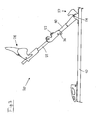
- ski 10 shown on which a ski binding 20 of WO 96/23559 (Fritschi) described type is mounted.
- the ski binding is designed for ski touring Ski touring binding. It includes an elongated ski boot carrier 22, which is parallel to one another to the ski running surface and transverse to the ski longitudinal direction arranged pivot axis 24th (hereinafter referred to as ski boot carrier pivot axis 24) pivotally on a Skifesten base part 26 is hinged.
- the ski boot carrier 22 is essentially as elongated hollow profile rail 22 is formed, which in the in the figures 1 and 2 shown binding position approximately centrally above the ski 10 parallel to Ski longitudinal direction extends.
- the ski binding is in a binding position in which the ski boot carrier 22 is substantially parallel to the ski running surface 12 and is arranged parallel to the ski longitudinal direction, wherein the heel jaw 28 in Essentially rests on the top of the ski. This binding position is during the Departure and in certain phases during a climb step during the Ascend with the ski binding 20 shown in Fig. 1-3 taken.
- Fig. 1 the ski boot carrier 22 is substantially parallel to the ski running surface 12 and is arranged parallel to the ski longitudinal direction, wherein the heel jaw 28 in Essentially rests on the top of the ski.
- FIG. 3 is the Ski binding 20 shown in a binding position in which the ski boot carrier 22 um the ski boot carrier pivot axis 24 is pivoted about the ski 10, wherein the ski boot carrier 22 in its rear area together with the heel jaw 28 of the Skioberseite is swinging away.
- This binding position is in certain phases during an ascent step during ascent with that shown in Figs. 1-3 Ski binding 20 taken.
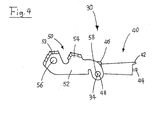
- a crampon 30 is optionally releasably attached, the in Fig. 4 is shown in isolation.
- the crampon 30 is essentially in two parts formed and includes a connecting part 40 and a blade member 50th
- the connecting part 40 of the harscheiser 30 is used for optional detachable Attaching the Harscheisens 30 on Skischuhla 22.
- the connecting member 40 has in Essentially the shape of an elongated cuboid, in the top of which is above the entire cuboid length extending channel (not shown) is formed.
- the am Skischuhong 22 attached state of the harscheisen 30 as shown in Figures 1-3 is shown, extend the channel and the longitudinal direction of the cuboid Connecting part 40 parallel to the defined by the hollow profile rail 22 Ski boot carrier longitudinal direction.
- At the front upper edge of the connecting part 40 are two formed forward projecting front lips 42. Next up are about up half the height of the front side of the connecting part two forward extending hooks 44 molded.
- the connecting part 40 In the vicinity of the rear edge of the connecting part 40 are on the Formed on top two rear lips 46, the top of two opposite sides project something over the canal.
- the channel walls on which the two rear lips 46 are formed elastically yielding resilient.
- the lips 46 can be pushed slightly outwards, so that - like described later - the connecting member 40 is pushed onto the ski boot carrier 22 can be that the ski boot carrier 22 is received in the channel, wherein the spring above the ski boot carrier 22 mecanicschnappenden lips 46, the connecting part 40 am Hold ski boot carrier 22.
- the channel and the snapper-like Rear lips 46 may also be other suitable connection means for optional be again releasable connection of the harsche with the ski boot carrier be provided.
- Such connecting means can pivotable and / or sliding latch pieces, Fastening straps, fastening straps and the like include.
- connecting part 40 (as well as the blade part 50 and thus the entire crampons 30) with respect to a longitudinal direction of the connecting part 40 (and thus in the longitudinal direction of the harscheiser 30) extending vertical center plane formed symmetrically.
- each journal 48 is further provided with two cams, the offset by about 180 ° with respect to the journal axis at the respective journal 48th are formed. These two cams set two offset by about 180 ° Detent positions for the pivotal movement of the blade member 50 with respect to Connecting part 40 fixed, these two locking positions of the insertion position or the Ready position of the crampon 30 correspond.
- the blade portion 50 of the harscheissens 30 shown in Figures 1-4 comprises two in the Substantially planar blades 52 which are substantially parallel to each other and parallel to the two side walls of the connecting part 40 are arranged.
- the blade longitudinal direction (or the Harscheisenlnaturescardi) middle area are the two blades 52 by a flat connecting web (not shown) with each other connected, which is perpendicular to the two blades 52 and each along a blade edge (in the illustration of Fig. 1 the upper edge of the blades) with the both blades 52 is connected.
- the two blades 52 of the blade part 50 are each with two Zacken 53, 54 provided, which at the edge remote from the connecting web of Blades 52 are arranged.
- each of the two blades 52 is in the vicinity of the edge, the front in the insertion position is arranged down, a recess 56 is formed, which is dimensioned such that the Tip of a ski pole can be inserted into the recess.
- the two blades 52 each have one above the through the connecting web defined plane protruding holding plate, as an extension of the Sound levels are formed.
- these two holding plates is ever a the Diameter of the axle 48 of the connecting part 40 corresponding hole 58th formed, these two holes 58 as a sliding bearing for the articulated connection serve between the connecting part 40 and the blade member 50.
- the two stub axles 48 are received such that the Connecting part 40 with the blade member 50 to the by the journals 48 and holes 58 defined crampon pivot axis 34 pivotally connected together are.
- the integrally formed blade member 50 has a substantially U-shaped Cross-section.
- the connecting web is substantially parallel to the defined by the hollow profile rail 22 Skischuhalijnsraum and parallel arranged to the ski area 12.
- the two blades 52 extend from the Side edges of the connecting web at right angles to the connecting web down and run substantially parallel to the ski boot carrier longitudinal direction.
- the distance between the two blades 52 of the blade member 50 is greater than the width of the connecting part 40.
- ski binding 20 also as buckles of the Harscheisens 30 at the ski binding 20 denotes
- the crampon 30 is arranged with respect to the ski boot carrier 22 such that the channel in the top of the connecting part 40 immediately below the bottom of the Ski boot carrier hollow profile rail 22 is located in the front area.
- the connecting part 40 in its rear area against the strong Hollow profile rail 22 is pressed high and thereby attached to this.
- the channel is dimensioned such that the connecting part 40 so on the ski boot carrier hollow profile rail 22 can be plugged that a front longitudinal portion of the hollow profile rail 22 in the channel is received and is closely enclosed on three sides by the connecting part 40, wherein the Connecting part 40 is clamped to the hollow profile rail 22 is clamped.
- the rear lips 46 are first after pressed outside, so that the connecting part 40 together with the rear lips 46 on the Hollow profile rail 22 can be pushed.
- the connecting part 40 is now fixed on all sides and immovably mounted or held on the ski boot carrier 22.
- the crampon pivot axis 34 is approximately in the middle between the toe 27 and the Heel cheeks 28 arranged.
- the connecting part 40 and thus the crampon pivot axis 34 are now fixed with respect to the ski boot carrier 22. Movements of the Connecting parts 40 with respect to the ski boot carrier 22 upwards or to the side are prevented by the channel bottom or the channel walls, which at the Hollow profile rail 22 abut. Shifts forward are caused by the on Front jaw 27 abutting front wall of the connecting part 40 prevents while Shifts backwards through the hooks 44 can be prevented. A shift Finally, the connecting part 40 downwards is prevented by the lips 46, 42, which rest either on the hollow profile 22 or on the toe 27.
- the ski boot carrier 22 can now turn around the ski boot carrier pivot axis 24 again be pivoted down until the binding and shown in Fig. 2 Harscheisenwolf is reached. In this position can again a ski boot in the Binding 20 are used, which also as getting into the ski binding 20 or as Buckles of the ski 10 is called. Thereafter, the bond 20 again for Upgrades are used with the skis 10, now the crampons 30 at the Ski binding 20 is attached.
- the crampon 30 is shown in its standby position.
- the blade member 50 is in relation to the connecting part 40 in the through the first cam the axle journal 48 fixed first detent position locked.
- the blades 52 of the Blade part 50 extends rearwardly from the crampon pivot axis 34, in FIG Towards the heel cup 28, and the serrations 53, 54 of the blades 52 protrude above.
- the blade member 50 in the ready position, is behind the Harscheisen pivot axis 34 and the connecting part 40 in front of the crampon pivot axis 34 arranged.
- the binding position shown in Fig. 2 with on the Skisberseite resting heel cheek 28 is the crampon pivot axis 34th arranged directly above the ski upper side.
- the holding plates of the blade portion 50 is the entire crampon 30 above the Skioberseite arranged so that it slides forward in its standby position of ski 10 barely obstructed in the snow.
- the crampon is 30 in his Standby position with respect to the ski boot carrier longitudinal direction completely between the foremost part of the front jaw 27 and the rearmost part of the heel jaw 28, and in particular completely between that provided for the ski boot tip Longitudinal position and provided for the ski boot heel longitudinal position.
- the blade part 50 from the first Detent position disengaged.
- the pivotal movement of the blade member 40 continues until After about 180 degrees, the blade member 50 in the through the second cam of the axle 48th fixed second detent position engages and the deployment position of the harscheis 30th is reached.
- the connecting web of the blade member 50 abuts from below forth at the bottom of the connecting part 40 at.
- the blade part 50 is now also in Essentially arranged in front of the crampon pivot axis 34 and located in Essentially under the connecting part 40. Altogether the crampon has 30 in its wolf a folded around the crampon swivel axis shape, so that the total length of the harscheiser 30 is substantially smaller in its operating position as in his readiness position.
- the crampons 30 on the ski boot sole (and the ski boot free) side of the ski boot carrier 22 is pivoted, can the adjustment of the harscheis 30 from its standby position in his Deployment position (and also the reverse adjustment back to his Standby position) easily with ski boot 20 inserted in the ski binding be performed.
- the skiboot 22 must for adjusting the harscheiser 30 between the ready position and the Use position only so far from the ski 10 away to be swung up, between the Skischuhango 22 and the ski top enough space to swing through the Connecting web of the blade member 50 is present.
- the blade member 50 In the insertion position of the harscheiser 30 shown in Fig. 1, the blade member 50 is in Essentially before the crampon pivot axis 34 and below the connecting part 50, wherein the connecting web of the blade member 50 between the ski upper side and the connecting part 40 is arranged. The removed from the connecting bridge, with the Tines 53, 54 provided edges of the blades 52 are down over the ski running surface 12 out before. Also in the operating position, the crampon 30 in relation to the Ski boot straps longitudinally completely between the foremost part of the Front jaw 27 and the rearmost portion of the heel cup 28, and in particular completely between the intended for the ski boot tip longitudinal position and for arranged the ski boot heel provided longitudinal position.
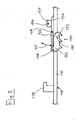
- FIG. 5 is a simplified, schematic partial view of a ski equipment with a ski 110, a ski binding and a crampon 130 according to a second preferred embodiment of the invention shown.
- the ski 110 is with a tread 112 provided.
- the ski binding is designed for ski touring Ski touring binding. It comprises a for holding a ski boot (not shown) in The area of the ski boot tip formed toe jaws 127, with respect to the ski 110 firmly and unverschwenkbar on a skifesten base part 126 is mounted, as well as a for Holding the ski boot in the area of the ski boot heel trained heel cheeks 128, the Also with respect to the ski 110 firmly and unverschenkbar mounted on the ski upper side is.
- the front jaw 127 is provided with two laterally projecting support cheeks provided on each of which an inwardly projecting pivot pin (not shown) formed is. These pivot pins are for articulated connection with corresponding Joint bushes formed near the ski boot tip on both longitudinal sides of the Ski boot soles are arranged. By means of the pivot pin and the joint bushings is the Ski boot in the area of the ski boot tip about a parallel to the ski area 112 running Transverse axis 124 pivotally articulated to the front jaw 127.
- the crampon 130 shown in Fig. 5 is optionally releasably on skifesten Base part 126 of the ski binding shown in Fig. 5 attached, wherein the crampons 130 in its attached to the ski binding state to the other parallel to Skilauf phenomenon 112 extending transverse axis 144 pivotally connected to the skifesten base part 126th connected is.
- the crampon 130 is formed substantially in two parts and comprises a connecting part 140 and a blade part 150.
- the connecting part 140 has an elongated shape and used for selectively releasable attaching the harscheisen 130 on the base part 126. Zuderderst on the connecting part 140 are two journals formed.
- a recess 156 is formed, which is dimensioned such that the tip a ski pole can be inserted into the recess.
- the connecting part 140 together with the him to the crampon pivot axis 134th pivotally hinged blade member 150 about the further hinge axis 144 with respect to Ski 110 pivoted, both in the deployment position and in the Ready position of the crampon 130.
- a spring presses the Connector 140 (and with it the entire crampon 130) about the hinge axis 144th around from the ski upwards against the underside of the ski binding used Ski boot. This causes the crampon 150 to move at each ascent step the articulated axle 144 is pivoted upwards following the ski boot sole.
- the blades 152 of the blade part 150 at least partially away from the snow base above the level of the ski area Swung out so they do not push the ski 110 on the snow more hindering.
- a ski equipment with a crampon is created, the comfortable between a deployment position and a Standby position is adjustable and has a compact design.
Landscapes
- Footwear And Its Accessory, Manufacturing Method And Apparatuses (AREA)
- Analysing Materials By The Use Of Radiation (AREA)
- Diaphragms For Electromechanical Transducers (AREA)
Abstract
Description
- Fig. 1
- Eine Skiausrüstung mit einem Harscheisen gemäss einer ersten bevorzugten Ausführungsart der Erfindung in einer vereinfachten Teilansicht von der Seite, mit dem Harscheisen in seiner Einsatzstellung;
- Fig. 2
- in einer der Fig. 1 entsprechenden Darstellung die Skiausrüstung aus Fig. 1, mit dem Harscheisen in seiner Bereitschaftsstellung;
- Fig. 3
- in einer der Fig. 1 entsprechenden Darstellung die Skiausrüstung aus Fig. 1, mit der Skibindung in einer Bindungsstellung mit hochgeschwenktem Skischuhträger;
- Fig. 4
- das Harscheisen aus Fig. 1 in einer vereinfachten Ansicht von der Seite;
- Fig. 5
- eine Skiausrüstung mit einem Harscheisen gemäss einer zweiten bevorzugten Ausführungsart der Erfindung in einer vereinfachten, schematischen Teilansicht von der Seite, mit dem Harscheisen in seiner Einsatzstellung.
Claims (14)
- Skiausrüstung mit einem Ski (10, 110), einer auf dem Ski (10, 110) montierten, zum Halten eines Skischuhs ausgebildeten Skibindung (20) und einem Harscheisen (30, 130), das am Ski (10, 110) oder an der Skibindung (20) anbringbar ist oder angebracht ist und wenigstens eine Klinge (52, 152) hat, die in einem am Ski (10, 110) oder an der Skibindung (20) angebrachten Zustand um eine Harscheisen-Schwenkachse (34, 134) herum schwenkbar wahlweisedadurch gekennzeichnet, dass das Harscheisen (30, 130) derart ausgebildet und angeordnet ist, dass die Harscheisen-Schwenkachse (34, 134) in Bezug auf eine Skilängsrichtung zwischen einer für eine Skischuhspitze vorgesehenen Längsposition und einer für eine Skischuhferse vorgesehenen Längsposition angeordnet ist.in eine Einsatzstellung verstellbar ist, in welcher die Klinge (52, 152) wenigstens teilweise nach unten über eine durch eine Skilauffläche (12, 112) definierte Ebene hinaus vorsteht, undin eine Bereitschaftsstellung, in welcher die Klinge oberhalb dieser Ebene angeordnet ist und nach oben ragt,
- Skiausrüstung nach Anspruch 1, dadurch gekennzeichnet, dass das Harscheisen (30, 130) derart ausgebildet und angeordnet ist, dass in der Einsatzstellung die Klinge (52, 152) im Wesentlichen vor der Harscheisen-Schwenkachse (34, 134) angeordnet ist, während in der Bereitschaftsstellung die Klinge (52, 152) im Wesentlichen hinter der Harscheisen-Schwenkachse (34, 134) angeordnet ist.
- Skiausrüstung nach Anspruch 1 oder 2, dadurch gekennzeichnet, dass das Harscheisen (30, 130) derart ausgebildet und in seinem am Ski (10, 110) oder an der Skibindung (20) angebrachten Zustand derart angeordnet ist, dass die Harscheisen-Schwenkachse (34, 134) in Bezug auf die Skilängsrichtung in einem Längsbereich ungefähr in der Mitte zwischen der für die Skischuhspitze vorgesehenen Längsposition und der für die Skischuhferse vorgesehenen Längsposition angeordnet ist.
- Skiausrüstung nach einem der Ansprüche 1 bis 3, gekennzeichnet durch eine Ausbildung des Harscheisens (30, 130) derart, dass die Klinge (52, 152) zum Verstellen des Harscheisens (30, 130) zwischen seiner Einsatzstellung und seiner Bereitschaftsstellung im Wesentlichen auf einer vom Schuh abgewandten Seite um die Harscheisen-Schwenkachse (34, 134) schwenkbar ist.
- Skiausrüstung nach einem der Ansprüche 1 bis 4, dadurch gekennzeichnet, dass das Harscheisen (30, 130) mit Verbindungsmitteln (40, 42, 44, 46, 140) versehen ist, welche zum wahlweise wieder lösbaren Anbringen des Harscheisens (30, 130) am Ski oder an der Skibindung (20) ausgebildet sind.
- Skiausrüstung nach Anspruch 5, dadurch gekennzeichnet, dass der Ski (110) oder die Skibindung mit Harscheisenhaltemitteln versehen ist, die derart ausgebildet und angeordnet sind, dass das Harscheisen (130) mittels der Verbindungsmittel (140) und der Harscheisenhaltemittel wahlweise wieder lösbar am Ski (110) respektive an der Skibindung anbringbar sind.
- Skiausrüstung nach Anspruch 5 oder 6, mit einer Skibindung (20), die mit einem Skischuhträger (22) versehen ist, an welchem ein zum Halten des Skischuhs im Bereich der Skischuhspitze ausgebildeter Vorderbacken (27) und ein zum Halten des Skischuhs im Bereich der Skischuhferse ausgebildeter Fersenbacken (28) angebracht sind, wobei der Skischuhträger (22) bezüglich dem Ski (10) um eine zur Harscheisen-Schwenkachse (34) im Wesentlichen parallele Skischuhträger-Schwenkachse (24) schwenkbar ist, dadurch gekennzeichnet, dass die Verbindungsmittel derart ausgebildet sind, dass mittels ihnen das Harscheisen (30) wahlweise wieder lösbar am Skischuhträger (22) anbringbar ist, wobei in einem am Skischuhträger (22) angebrachten Zustand des Harscheisens (30) die Harscheisen-Schwenkachse (34) bezüglich dem Skischuhträger (22) fixiert und die Harscheisen-Schwenkachse (34) in Bezug auf eine Skischuhträgerlängsrichtung zwischen dem Vorderbacken (27) und dem Fersenbacken (28) angeordnet ist.
- Skiausrüstung nach einem der Ansprüche 1 bis 6, dadurch gekennzeichnet, dass das Harscheisen unmittelbar am Ski oder an einem skifesten Basisteil derart anbringbar ist oder angebracht ist, dass die Harscheisen-Schwenkachse bezüglich dem Ski fixiert ist, wobei die Harscheisen-Schwenkachse in Bezug auf die Skilängsrichtung zwischen einem zum Halten des Skischuhs im Bereich der Skischuhspitze ausgebildeten vorderen Skischuhhalteteil der Skibindung und einem zum Halten des Skischuhs im Bereich der Skischuhferse ausgebildeten hinteren Skischuhhalteteil der Skibindung angeordnet ist.
- Harscheisen (30, 130) zur Verwendung für eine Skiausrüstung nach einem der Ansprüche 1 bis 8, das am Ski (10, 110) oder an der Skibindung (20) anbringbar ist oder angebracht ist und wenigstens eine Klinge (52, 152) hat, die in einem am Ski oder an der Skibindung angebrachten Zustand des Harscheisens (30, 130) um die Harscheisen-Schwenkachse (34, 134) schwenkbar wahlweise in die Einsatzstellung und in die Bereitschaftsstellung verstellbar ist, gekennzeichnet durch eine Ausbildung des Harscheisens (30, 130) derart, dass in seinem am Ski (10, 110) oder an der Skibindung (20) angebrachten Zustand die Harscheisen-Schwenkachse (34, 134) in Bezug auf die Skilängsrichtung zwischen der für die Skischuhspitze vorgesehenen Längsposition und der für die Skischuhferse vorgesehenen Längsposition angeordnet ist.
- Harscheisen (30, 130) nach Anspruch 9, dadurch gekennzeichnet, dass die Klinge (52, 152) oder ein mit der Klinge (52, 152) verbundenes Bedienteil mit einer Ausnehmung (56, 156) versehen ist, die derart ausgebildet und bemessen ist, dass die Spitze eines Skistocks in die Ausnehmung (56, 156) einsteckbar ist, um ein Verstellen des Harscheisens (30, 130) zwischen seiner Einsatzstellung und seiner Bereitschaftsstellung mittels dem Skistock zu ermöglichen.
- Harscheisen (30, 130) nach Anspruch 9 oder 10, dadurch gekennzeichnet, dass es eine weitere Klinge und einen die beiden Klingen (52, 152) miteinander verbindenden Verbindungssteg umfasst, wobei die beiden Klingen (52, 152) und der Verbindungssteg zusammen als einstückiges Formteil ausgebildet sind, das in einem am Ski (10, 110) oder an der Skibindung (20) angebrachten Zustand des Harscheisens (30, 130) um die Harscheisen-Schwenkachse (34, 34) herum schwenkbar ist.
- Harscheisen (30, 130) nach einem der Ansprüche 9 bis 11 für eine Skiausrüstung nach Anspruch 5 oder 6, dadurch gekennzeichnet, dass die Verbindungsmittel (40, 42, 44, 46, 140) ein Verbindungsteil (40, 140) umfassen, wobei die Klinge (52, 152) um die Harscheisen-Schwenkachse (34, 134) herum schwenkbar gelenkig mit dem Verbindungsteil (40, 140) verbunden ist.
- Harscheisen (130) nach Anspruch 12, gekennzeichnet durch eine Ausbildung des Verbindungsteils (140) derart, dass es im am Ski (110) oder an der Skibindung angebrachten Zustand des Harscheisens (130) um eine weitere Schwenkachse (144) herum schwenkbar und wahlweise wieder lösbar gelenkig mit dem Ski (110) respektive mit der Skibindung verbunden ist.
- Skibindung für eine Skiausrüstung nach einem der Ansprüche 1 bis 4, mit einem Skischuhträger, an welchem ein zum Halten des Skischuhs im Bereich der Skischuhspitze ausgebildeter Vorderbacken und ein zum Halten des Skischuhs im Bereich der Skischuhferse ausgebildeter Fersenbacken angebracht sind, wobei der Skischuhträger bezüglich dem Ski um eine zur Harscheisen-Schwenkachse im Wesentlichen parallele Skischuhträger-Schwenkachse schwenkbar ist, dadurch gekennzeichnet, dass das Harscheisen am Skischuhträger derart angebracht ist, dass die Harscheisen-Schwenkachse bezüglich dem Skischuhträger fixiert ist, wobei die Harscheisen-Schwenkachse in Bezug auf eine Skischuhträgerlängsrichtung zwischen dem Vorderbacken und dem Fersenbacken angeordnet ist.
Priority Applications (3)
| Application Number | Priority Date | Filing Date | Title |
|---|---|---|---|
| AT03405782T ATE403474T1 (de) | 2003-10-30 | 2003-10-30 | Skiausrüstung mit harscheisen |
| EP03405782A EP1527803B1 (de) | 2003-10-30 | 2003-10-30 | Skiausrüstung mit Harscheisen |
| DE50310286T DE50310286D1 (de) | 2003-10-30 | 2003-10-30 | Skiausrüstung mit Harscheisen |
Applications Claiming Priority (1)
| Application Number | Priority Date | Filing Date | Title |
|---|---|---|---|
| EP03405782A EP1527803B1 (de) | 2003-10-30 | 2003-10-30 | Skiausrüstung mit Harscheisen |
Publications (2)
| Publication Number | Publication Date |
|---|---|
| EP1527803A1 true EP1527803A1 (de) | 2005-05-04 |
| EP1527803B1 EP1527803B1 (de) | 2008-08-06 |
Family
ID=34400627
Family Applications (1)
| Application Number | Title | Priority Date | Filing Date |
|---|---|---|---|
| EP03405782A Expired - Lifetime EP1527803B1 (de) | 2003-10-30 | 2003-10-30 | Skiausrüstung mit Harscheisen |
Country Status (3)
| Country | Link |
|---|---|
| EP (1) | EP1527803B1 (de) |
| AT (1) | ATE403474T1 (de) |
| DE (1) | DE50310286D1 (de) |
Cited By (1)
| Publication number | Priority date | Publication date | Assignee | Title |
|---|---|---|---|---|
| AT510854B1 (de) * | 2011-08-10 | 2012-07-15 | Tyrolia Technology Gmbh | Harscheisen |
Citations (6)
| Publication number | Priority date | Publication date | Assignee | Title |
|---|---|---|---|---|
| DE292861C (de) * | ||||
| AT63927B (de) * | 1913-02-10 | 1914-03-10 | Karl Grubeck | Gleitsicherung an Schneeschuhen. |
| AT137700B (de) * | 1933-01-02 | 1934-05-25 | Hugo Hoyer | Abnehmbare Steigvorrichtung für Schneeschuhe. |
| FR2508805A1 (fr) * | 1981-07-06 | 1983-01-07 | Blanchemain Alain | Talonniere de ski a couteaux pivotants imperdables comportant des courroies ejectables |
| DE8500241U1 (de) * | 1985-01-07 | 1986-01-09 | Hauser, Joachim, 7251 Weissach | An einem Ski befestigbare Vorrichtung zum Verhindern des Wegrutschens beim Auf- und Abstieg |
| WO1996023559A1 (de) * | 1995-02-01 | 1996-08-08 | Fritschi Ag Apparatebau | Schibindung |
-
2003
- 2003-10-30 DE DE50310286T patent/DE50310286D1/de not_active Expired - Lifetime
- 2003-10-30 AT AT03405782T patent/ATE403474T1/de active
- 2003-10-30 EP EP03405782A patent/EP1527803B1/de not_active Expired - Lifetime
Patent Citations (6)
| Publication number | Priority date | Publication date | Assignee | Title |
|---|---|---|---|---|
| DE292861C (de) * | ||||
| AT63927B (de) * | 1913-02-10 | 1914-03-10 | Karl Grubeck | Gleitsicherung an Schneeschuhen. |
| AT137700B (de) * | 1933-01-02 | 1934-05-25 | Hugo Hoyer | Abnehmbare Steigvorrichtung für Schneeschuhe. |
| FR2508805A1 (fr) * | 1981-07-06 | 1983-01-07 | Blanchemain Alain | Talonniere de ski a couteaux pivotants imperdables comportant des courroies ejectables |
| DE8500241U1 (de) * | 1985-01-07 | 1986-01-09 | Hauser, Joachim, 7251 Weissach | An einem Ski befestigbare Vorrichtung zum Verhindern des Wegrutschens beim Auf- und Abstieg |
| WO1996023559A1 (de) * | 1995-02-01 | 1996-08-08 | Fritschi Ag Apparatebau | Schibindung |
Cited By (3)
| Publication number | Priority date | Publication date | Assignee | Title |
|---|---|---|---|---|
| AT510854B1 (de) * | 2011-08-10 | 2012-07-15 | Tyrolia Technology Gmbh | Harscheisen |
| AT510854A4 (de) * | 2011-08-10 | 2012-07-15 | Tyrolia Technology Gmbh | Harscheisen |
| EP2556865A1 (de) | 2011-08-10 | 2013-02-13 | Tyrolia Technology GmbH | Harscheisen |
Also Published As
| Publication number | Publication date |
|---|---|
| DE50310286D1 (de) | 2008-09-18 |
| ATE403474T1 (de) | 2008-08-15 |
| EP1527803B1 (de) | 2008-08-06 |
Similar Documents
| Publication | Publication Date | Title |
|---|---|---|
| AT514518B1 (de) | Skibindungsferseneinheit | |
| DE102008050044B4 (de) | Skibindung | |
| DE202009019109U1 (de) | Ferseneinheit für Tourenskibindung | |
| DE202009019128U1 (de) | Zeheneinheit für Tourenskibindung | |
| DE102010006218A1 (de) | Skibindung mit Steighilfe | |
| DE69919439T2 (de) | Trägerplatte zwischen Schuh und Snowboard | |
| DE3707116A1 (de) | Anordnung zum festhalten eines ski-schuhs auf einem langlauf- oder touren-ski | |
| EP1527803B1 (de) | Skiausrüstung mit Harscheisen | |
| WO1992019117A2 (de) | Sportschuh | |
| EP3197572B1 (de) | Kombiski für aufstieg und abfahrt | |
| EP2349510B1 (de) | Schneeschuh mit zwischenelement und kopplungseinrichtung | |
| EP1022037A1 (de) | Telemark-Skibindung | |
| EP2754469A1 (de) | Harscheisen | |
| EP2667953B1 (de) | Kombiski für aufstieg und abfahrt | |
| AT407610B (de) | Kombinierte, teilbare aufstiegshilfe für snowboarder zum tourengehen | |
| EP4173682B1 (de) | Skibindung, insbesondere tourenskibindung | |
| EP0966995A2 (de) | Bindungssystem für ein Snowboard | |
| EP3714951A1 (de) | Skibindung | |
| DE2652654A1 (de) | Gehhilfe fuer skischuhe | |
| DE202012001536U1 (de) | Schneeschuh | |
| EP1181959A1 (de) | Skibindung | |
| AT504900B1 (de) | Wintersportgerät | |
| DE2731561B2 (de) | Langlaufbindung | |
| DE2661062C2 (de) | Langlaufbindung | |
| DE3431884C1 (de) | Langlauf-Schuh- und Bindungskombination |
Legal Events
| Date | Code | Title | Description |
|---|---|---|---|
| PUAI | Public reference made under article 153(3) epc to a published international application that has entered the european phase |
Free format text: ORIGINAL CODE: 0009012 |
|
| AK | Designated contracting states |
Kind code of ref document: A1 Designated state(s): AT BE BG CH CY CZ DE DK EE ES FI FR GB GR HU IE IT LI LU MC NL PT RO SE SI SK TR |
|
| AX | Request for extension of the european patent |
Extension state: AL LT LV MK |
|
| 17P | Request for examination filed |
Effective date: 20051028 |
|
| AKX | Designation fees paid |
Designated state(s): AT CH DE FR IT LI |
|
| GRAP | Despatch of communication of intention to grant a patent |
Free format text: ORIGINAL CODE: EPIDOSNIGR1 |
|
| GRAS | Grant fee paid |
Free format text: ORIGINAL CODE: EPIDOSNIGR3 |
|
| GRAA | (expected) grant |
Free format text: ORIGINAL CODE: 0009210 |
|
| AK | Designated contracting states |
Kind code of ref document: B1 Designated state(s): AT CH DE FR IT LI |
|
| REG | Reference to a national code |
Ref country code: CH Ref legal event code: NV Representative=s name: KELLER & PARTNER PATENTANWAELTE AG Ref country code: CH Ref legal event code: EP |
|
| REF | Corresponds to: |
Ref document number: 50310286 Country of ref document: DE Date of ref document: 20080918 Kind code of ref document: P |
|
| PLBE | No opposition filed within time limit |
Free format text: ORIGINAL CODE: 0009261 |
|
| STAA | Information on the status of an ep patent application or granted ep patent |
Free format text: STATUS: NO OPPOSITION FILED WITHIN TIME LIMIT |
|
| 26N | No opposition filed |
Effective date: 20090507 |
|
| PG25 | Lapsed in a contracting state [announced via postgrant information from national office to epo] |
Ref country code: IT Free format text: LAPSE BECAUSE OF NON-PAYMENT OF DUE FEES Effective date: 20081030 |
|
| PGRI | Patent reinstated in contracting state [announced from national office to epo] |
Ref country code: IT Effective date: 20110616 |
|
| REG | Reference to a national code |
Ref country code: CH Ref legal event code: PCAR Free format text: NEW ADDRESS: EIGERSTRASSE 2 POSTFACH, 3000 BERN 14 (CH) |
|
| REG | Reference to a national code |
Ref country code: FR Ref legal event code: PLFP Year of fee payment: 13 |
|
| REG | Reference to a national code |
Ref country code: FR Ref legal event code: PLFP Year of fee payment: 14 |
|
| REG | Reference to a national code |
Ref country code: FR Ref legal event code: PLFP Year of fee payment: 15 |
|
| PGFP | Annual fee paid to national office [announced via postgrant information from national office to epo] |
Ref country code: FR Payment date: 20170927 Year of fee payment: 15 |
|
| PGFP | Annual fee paid to national office [announced via postgrant information from national office to epo] |
Ref country code: IT Payment date: 20171023 Year of fee payment: 15 |
|
| PG25 | Lapsed in a contracting state [announced via postgrant information from national office to epo] |
Ref country code: FR Free format text: LAPSE BECAUSE OF NON-PAYMENT OF DUE FEES Effective date: 20181031 |
|
| PG25 | Lapsed in a contracting state [announced via postgrant information from national office to epo] |
Ref country code: IT Free format text: LAPSE BECAUSE OF NON-PAYMENT OF DUE FEES Effective date: 20181030 |
|
| PGFP | Annual fee paid to national office [announced via postgrant information from national office to epo] |
Ref country code: CH Payment date: 20190919 Year of fee payment: 17 Ref country code: DE Payment date: 20191121 Year of fee payment: 17 |
|
| PGFP | Annual fee paid to national office [announced via postgrant information from national office to epo] |
Ref country code: AT Payment date: 20191009 Year of fee payment: 17 |
|
| REG | Reference to a national code |
Ref country code: CH Ref legal event code: PFA Owner name: FRITSCHI AG - SWISS BINDINGS, CH Free format text: FORMER OWNER: FRITSCHI AG - SWISS BINDINGS, CH |
|
| REG | Reference to a national code |
Ref country code: DE Ref legal event code: R119 Ref document number: 50310286 Country of ref document: DE |
|
| REG | Reference to a national code |
Ref country code: CH Ref legal event code: PL |
|
| REG | Reference to a national code |
Ref country code: AT Ref legal event code: MM01 Ref document number: 403474 Country of ref document: AT Kind code of ref document: T Effective date: 20201030 |
|
| PG25 | Lapsed in a contracting state [announced via postgrant information from national office to epo] |
Ref country code: DE Free format text: LAPSE BECAUSE OF NON-PAYMENT OF DUE FEES Effective date: 20210501 |
|
| PG25 | Lapsed in a contracting state [announced via postgrant information from national office to epo] |
Ref country code: AT Free format text: LAPSE BECAUSE OF NON-PAYMENT OF DUE FEES Effective date: 20201030 Ref country code: CH Free format text: LAPSE BECAUSE OF NON-PAYMENT OF DUE FEES Effective date: 20201031 Ref country code: LI Free format text: LAPSE BECAUSE OF NON-PAYMENT OF DUE FEES Effective date: 20201031 |