EP1523360B1 - Medizinische nadelanordnung - Google Patents
Medizinische nadelanordnung Download PDFInfo
- Publication number
- EP1523360B1 EP1523360B1 EP03760811.4A EP03760811A EP1523360B1 EP 1523360 B1 EP1523360 B1 EP 1523360B1 EP 03760811 A EP03760811 A EP 03760811A EP 1523360 B1 EP1523360 B1 EP 1523360B1
- Authority
- EP
- European Patent Office
- Prior art keywords
- sleeve
- blocking member
- needle
- safety arrangement
- support
- Prior art date
- Legal status (The legal status is an assumption and is not a legal conclusion. Google has not performed a legal analysis and makes no representation as to the accuracy of the status listed.)
- Expired - Lifetime
Links
- 239000003814 drug Substances 0.000 claims abstract description 22
- 230000000903 blocking effect Effects 0.000 claims description 190
- 238000002347 injection Methods 0.000 claims description 31
- 239000007924 injection Substances 0.000 claims description 31
- 230000009471 action Effects 0.000 claims description 18
- 230000001154 acute effect Effects 0.000 claims description 3
- 238000012163 sequencing technique Methods 0.000 abstract 1
- 230000035515 penetration Effects 0.000 description 10
- 229940079593 drug Drugs 0.000 description 8
- 238000000034 method Methods 0.000 description 7
- 208000012266 Needlestick injury Diseases 0.000 description 6
- NOESYZHRGYRDHS-UHFFFAOYSA-N insulin Chemical compound N1C(=O)C(NC(=O)C(CCC(N)=O)NC(=O)C(CCC(O)=O)NC(=O)C(C(C)C)NC(=O)C(NC(=O)CN)C(C)CC)CSSCC(C(NC(CO)C(=O)NC(CC(C)C)C(=O)NC(CC=2C=CC(O)=CC=2)C(=O)NC(CCC(N)=O)C(=O)NC(CC(C)C)C(=O)NC(CCC(O)=O)C(=O)NC(CC(N)=O)C(=O)NC(CC=2C=CC(O)=CC=2)C(=O)NC(CSSCC(NC(=O)C(C(C)C)NC(=O)C(CC(C)C)NC(=O)C(CC=2C=CC(O)=CC=2)NC(=O)C(CC(C)C)NC(=O)C(C)NC(=O)C(CCC(O)=O)NC(=O)C(C(C)C)NC(=O)C(CC(C)C)NC(=O)C(CC=2NC=NC=2)NC(=O)C(CO)NC(=O)CNC2=O)C(=O)NCC(=O)NC(CCC(O)=O)C(=O)NC(CCCNC(N)=N)C(=O)NCC(=O)NC(CC=3C=CC=CC=3)C(=O)NC(CC=3C=CC=CC=3)C(=O)NC(CC=3C=CC(O)=CC=3)C(=O)NC(C(C)O)C(=O)N3C(CCC3)C(=O)NC(CCCCN)C(=O)NC(C)C(O)=O)C(=O)NC(CC(N)=O)C(O)=O)=O)NC(=O)C(C(C)CC)NC(=O)C(CO)NC(=O)C(C(C)O)NC(=O)C1CSSCC2NC(=O)C(CC(C)C)NC(=O)C(NC(=O)C(CCC(N)=O)NC(=O)C(CC(N)=O)NC(=O)C(NC(=O)C(N)CC=1C=CC=CC=1)C(C)C)CC1=CN=CN1 NOESYZHRGYRDHS-UHFFFAOYSA-N 0.000 description 6
- 239000012530 fluid Substances 0.000 description 5
- 239000012528 membrane Substances 0.000 description 5
- 230000008901 benefit Effects 0.000 description 4
- 230000006378 damage Effects 0.000 description 4
- 230000000694 effects Effects 0.000 description 4
- 239000000463 material Substances 0.000 description 4
- 230000007246 mechanism Effects 0.000 description 4
- 102000004877 Insulin Human genes 0.000 description 3
- 108090001061 Insulin Proteins 0.000 description 3
- 229940125396 insulin Drugs 0.000 description 3
- 238000004519 manufacturing process Methods 0.000 description 3
- 238000004806 packaging method and process Methods 0.000 description 3
- 239000004033 plastic Substances 0.000 description 3
- 229920003023 plastic Polymers 0.000 description 3
- 241001465754 Metazoa Species 0.000 description 2
- 239000003708 ampul Substances 0.000 description 2
- 239000008280 blood Substances 0.000 description 2
- 210000004369 blood Anatomy 0.000 description 2
- 230000006835 compression Effects 0.000 description 2
- 238000007906 compression Methods 0.000 description 2
- 239000011888 foil Substances 0.000 description 2
- 238000003780 insertion Methods 0.000 description 2
- 230000037431 insertion Effects 0.000 description 2
- 239000007788 liquid Substances 0.000 description 2
- 229940071643 prefilled syringe Drugs 0.000 description 2
- 238000003825 pressing Methods 0.000 description 2
- 230000001681 protective effect Effects 0.000 description 2
- 230000009467 reduction Effects 0.000 description 2
- 238000009877 rendering Methods 0.000 description 2
- 238000000926 separation method Methods 0.000 description 2
- 208000027418 Wounds and injury Diseases 0.000 description 1
- 230000004308 accommodation Effects 0.000 description 1
- 239000011324 bead Substances 0.000 description 1
- 238000003339 best practice Methods 0.000 description 1
- 210000001124 body fluid Anatomy 0.000 description 1
- 239000010839 body fluid Substances 0.000 description 1
- 230000008859 change Effects 0.000 description 1
- 239000000549 coloured material Substances 0.000 description 1
- 238000010276 construction Methods 0.000 description 1
- 230000000881 depressing effect Effects 0.000 description 1
- 230000000994 depressogenic effect Effects 0.000 description 1
- 238000007599 discharging Methods 0.000 description 1
- 238000000605 extraction Methods 0.000 description 1
- 230000012953 feeding on blood of other organism Effects 0.000 description 1
- 231100001261 hazardous Toxicity 0.000 description 1
- 208000014674 injury Diseases 0.000 description 1
- 238000007689 inspection Methods 0.000 description 1
- 238000001990 intravenous administration Methods 0.000 description 1
- 230000004048 modification Effects 0.000 description 1
- 238000012986 modification Methods 0.000 description 1
- 239000002991 molded plastic Substances 0.000 description 1
- 239000000902 placebo Substances 0.000 description 1
- 229940068196 placebo Drugs 0.000 description 1
- 238000012827 research and development Methods 0.000 description 1
- 230000007704 transition Effects 0.000 description 1
- 230000000007 visual effect Effects 0.000 description 1
- 239000002699 waste material Substances 0.000 description 1
Images










Classifications
-
- A—HUMAN NECESSITIES
- A61—MEDICAL OR VETERINARY SCIENCE; HYGIENE
- A61M—DEVICES FOR INTRODUCING MEDIA INTO, OR ONTO, THE BODY; DEVICES FOR TRANSDUCING BODY MEDIA OR FOR TAKING MEDIA FROM THE BODY; DEVICES FOR PRODUCING OR ENDING SLEEP OR STUPOR
- A61M5/00—Devices for bringing media into the body in a subcutaneous, intra-vascular or intramuscular way; Accessories therefor, e.g. filling or cleaning devices, arm-rests
- A61M5/178—Syringes
- A61M5/31—Details
- A61M5/315—Pistons; Piston-rods; Guiding, blocking or restricting the movement of the rod or piston; Appliances on the rod for facilitating dosing ; Dosing mechanisms
- A61M5/31501—Means for blocking or restricting the movement of the rod or piston
-
- A—HUMAN NECESSITIES
- A61—MEDICAL OR VETERINARY SCIENCE; HYGIENE
- A61M—DEVICES FOR INTRODUCING MEDIA INTO, OR ONTO, THE BODY; DEVICES FOR TRANSDUCING BODY MEDIA OR FOR TAKING MEDIA FROM THE BODY; DEVICES FOR PRODUCING OR ENDING SLEEP OR STUPOR
- A61M5/00—Devices for bringing media into the body in a subcutaneous, intra-vascular or intramuscular way; Accessories therefor, e.g. filling or cleaning devices, arm-rests
- A61M5/178—Syringes
- A61M5/31—Details
- A61M5/32—Needles; Details of needles pertaining to their connection with syringe or hub; Accessories for bringing the needle into, or holding the needle on, the body; Devices for protection of needles
- A61M5/3205—Apparatus for removing or disposing of used needles or syringes, e.g. containers; Means for protection against accidental injuries from used needles
- A61M5/321—Means for protection against accidental injuries by used needles
- A61M5/3243—Means for protection against accidental injuries by used needles being axially-extensible, e.g. protective sleeves coaxially slidable on the syringe barrel
- A61M5/326—Fully automatic sleeve extension, i.e. in which triggering of the sleeve does not require a deliberate action by the user
-
- A—HUMAN NECESSITIES
- A61—MEDICAL OR VETERINARY SCIENCE; HYGIENE
- A61M—DEVICES FOR INTRODUCING MEDIA INTO, OR ONTO, THE BODY; DEVICES FOR TRANSDUCING BODY MEDIA OR FOR TAKING MEDIA FROM THE BODY; DEVICES FOR PRODUCING OR ENDING SLEEP OR STUPOR
- A61M5/00—Devices for bringing media into the body in a subcutaneous, intra-vascular or intramuscular way; Accessories therefor, e.g. filling or cleaning devices, arm-rests
- A61M5/178—Syringes
- A61M5/31—Details
- A61M5/315—Pistons; Piston-rods; Guiding, blocking or restricting the movement of the rod or piston; Appliances on the rod for facilitating dosing ; Dosing mechanisms
- A61M5/31501—Means for blocking or restricting the movement of the rod or piston
- A61M2005/31508—Means for blocking or restricting the movement of the rod or piston provided on the piston-rod
-
- A—HUMAN NECESSITIES
- A61—MEDICAL OR VETERINARY SCIENCE; HYGIENE
- A61M—DEVICES FOR INTRODUCING MEDIA INTO, OR ONTO, THE BODY; DEVICES FOR TRANSDUCING BODY MEDIA OR FOR TAKING MEDIA FROM THE BODY; DEVICES FOR PRODUCING OR ENDING SLEEP OR STUPOR
- A61M5/00—Devices for bringing media into the body in a subcutaneous, intra-vascular or intramuscular way; Accessories therefor, e.g. filling or cleaning devices, arm-rests
- A61M5/178—Syringes
- A61M5/31—Details
- A61M5/32—Needles; Details of needles pertaining to their connection with syringe or hub; Accessories for bringing the needle into, or holding the needle on, the body; Devices for protection of needles
- A61M5/3205—Apparatus for removing or disposing of used needles or syringes, e.g. containers; Means for protection against accidental injuries from used needles
- A61M5/321—Means for protection against accidental injuries by used needles
- A61M5/3243—Means for protection against accidental injuries by used needles being axially-extensible, e.g. protective sleeves coaxially slidable on the syringe barrel
- A61M5/3245—Constructional features thereof, e.g. to improve manipulation or functioning
- A61M2005/3247—Means to impede repositioning of protection sleeve from needle covering to needle uncovering position
-
- A—HUMAN NECESSITIES
- A61—MEDICAL OR VETERINARY SCIENCE; HYGIENE
- A61M—DEVICES FOR INTRODUCING MEDIA INTO, OR ONTO, THE BODY; DEVICES FOR TRANSDUCING BODY MEDIA OR FOR TAKING MEDIA FROM THE BODY; DEVICES FOR PRODUCING OR ENDING SLEEP OR STUPOR
- A61M5/00—Devices for bringing media into the body in a subcutaneous, intra-vascular or intramuscular way; Accessories therefor, e.g. filling or cleaning devices, arm-rests
- A61M5/178—Syringes
- A61M5/31—Details
- A61M5/32—Needles; Details of needles pertaining to their connection with syringe or hub; Accessories for bringing the needle into, or holding the needle on, the body; Devices for protection of needles
- A61M5/3205—Apparatus for removing or disposing of used needles or syringes, e.g. containers; Means for protection against accidental injuries from used needles
- A61M5/321—Means for protection against accidental injuries by used needles
- A61M5/3243—Means for protection against accidental injuries by used needles being axially-extensible, e.g. protective sleeves coaxially slidable on the syringe barrel
- A61M5/326—Fully automatic sleeve extension, i.e. in which triggering of the sleeve does not require a deliberate action by the user
- A61M2005/3267—Biased sleeves where the needle is uncovered by insertion of the needle into a patient's body
-
- A—HUMAN NECESSITIES
- A61—MEDICAL OR VETERINARY SCIENCE; HYGIENE
- A61M—DEVICES FOR INTRODUCING MEDIA INTO, OR ONTO, THE BODY; DEVICES FOR TRANSDUCING BODY MEDIA OR FOR TAKING MEDIA FROM THE BODY; DEVICES FOR PRODUCING OR ENDING SLEEP OR STUPOR
- A61M5/00—Devices for bringing media into the body in a subcutaneous, intra-vascular or intramuscular way; Accessories therefor, e.g. filling or cleaning devices, arm-rests
- A61M5/002—Packages specially adapted therefor, e.g. for syringes or needles, kits for diabetics
-
- A—HUMAN NECESSITIES
- A61—MEDICAL OR VETERINARY SCIENCE; HYGIENE
- A61M—DEVICES FOR INTRODUCING MEDIA INTO, OR ONTO, THE BODY; DEVICES FOR TRANSDUCING BODY MEDIA OR FOR TAKING MEDIA FROM THE BODY; DEVICES FOR PRODUCING OR ENDING SLEEP OR STUPOR
- A61M5/00—Devices for bringing media into the body in a subcutaneous, intra-vascular or intramuscular way; Accessories therefor, e.g. filling or cleaning devices, arm-rests
- A61M5/178—Syringes
- A61M5/1782—Devices aiding filling of syringes in situ
-
- A—HUMAN NECESSITIES
- A61—MEDICAL OR VETERINARY SCIENCE; HYGIENE
- A61M—DEVICES FOR INTRODUCING MEDIA INTO, OR ONTO, THE BODY; DEVICES FOR TRANSDUCING BODY MEDIA OR FOR TAKING MEDIA FROM THE BODY; DEVICES FOR PRODUCING OR ENDING SLEEP OR STUPOR
- A61M5/00—Devices for bringing media into the body in a subcutaneous, intra-vascular or intramuscular way; Accessories therefor, e.g. filling or cleaning devices, arm-rests
- A61M5/178—Syringes
- A61M5/31—Details
- A61M5/315—Pistons; Piston-rods; Guiding, blocking or restricting the movement of the rod or piston; Appliances on the rod for facilitating dosing ; Dosing mechanisms
- A61M5/31511—Piston or piston-rod constructions, e.g. connection of piston with piston-rod
-
- A—HUMAN NECESSITIES
- A61—MEDICAL OR VETERINARY SCIENCE; HYGIENE
- A61M—DEVICES FOR INTRODUCING MEDIA INTO, OR ONTO, THE BODY; DEVICES FOR TRANSDUCING BODY MEDIA OR FOR TAKING MEDIA FROM THE BODY; DEVICES FOR PRODUCING OR ENDING SLEEP OR STUPOR
- A61M5/00—Devices for bringing media into the body in a subcutaneous, intra-vascular or intramuscular way; Accessories therefor, e.g. filling or cleaning devices, arm-rests
- A61M5/178—Syringes
- A61M5/31—Details
- A61M5/32—Needles; Details of needles pertaining to their connection with syringe or hub; Accessories for bringing the needle into, or holding the needle on, the body; Devices for protection of needles
- A61M5/3205—Apparatus for removing or disposing of used needles or syringes, e.g. containers; Means for protection against accidental injuries from used needles
-
- A—HUMAN NECESSITIES
- A61—MEDICAL OR VETERINARY SCIENCE; HYGIENE
- A61M—DEVICES FOR INTRODUCING MEDIA INTO, OR ONTO, THE BODY; DEVICES FOR TRANSDUCING BODY MEDIA OR FOR TAKING MEDIA FROM THE BODY; DEVICES FOR PRODUCING OR ENDING SLEEP OR STUPOR
- A61M5/00—Devices for bringing media into the body in a subcutaneous, intra-vascular or intramuscular way; Accessories therefor, e.g. filling or cleaning devices, arm-rests
- A61M5/178—Syringes
- A61M5/31—Details
- A61M5/32—Needles; Details of needles pertaining to their connection with syringe or hub; Accessories for bringing the needle into, or holding the needle on, the body; Devices for protection of needles
- A61M5/3287—Accessories for bringing the needle into the body; Automatic needle insertion
Definitions
- This invention relates to a safety arrangement for a medical needle having a mount end and a sharp tip, intended for penetration of a human or animal body, or for other medical uses such as the penetration of a pierceable membrane of an intravenous medication system.
- the invention further relates to a safety arrangement including a medical needle as aforesaid, ready for use.
- a medical needle as aforesaid, ready for use.
- Fluids of various kinds may be administered to a human or animal body by means of a hollow needle in conjunction with a source of the required fluid.
- a needle may be used in conjunction with a syringe holding a liquid drug, the needle being used to penetrate the body at the site at which the drug is to be received.
- body fluids may be withdrawn by using a hollow needle which is used to penetrate the body until the tip is located at the site from which fluid is to be withdrawn.
- a recognised hazard for clinicians and other persons using medical needles for the above described purposes is the risk of a so-called needle-stick injury - that is to say the accidental penetration of the clinician's skin by the needle.
- needle-stick injury Prior to the use of the needle to supply a fluid to or to withdraw fluid from a body, this rarely presents much of a problem, though once the needle has been used on a body, there is a very much higher risk of a serious consequence for the clinician.
- the needle is likely to become contaminated with various organisms and should a needle-stick injury occur, these could infect the clinician.
- a protective device for use with a needle, and which allows a clinician to use the needle in much the same way as is done with an unprotected needle, but which can be manufactured economically and which provides a high degree of protection against needle-stick injury.
- the device operates fully automatically, without intervention by the clinician, to give a degree of protection to the needle tip before use, and after use wholly prevents access to the needle tip other than by a determined attempt to override the protection. In this way, protection may be afforded not just to the clinician, but also to others who could come into a risky situation with used needles, such as waste disposal operators, cleaners, and so on.
- a device which protects a needle tip without an operator having to perform any extra step on withdrawing the needle from a body is usually referred to as a passive protection device.
- a passive protection device This may be contrasted with an active protection device, where an operator is required to perform an extra step in order to protect a needle, following the withdrawal of the needle from a body.
- the requirement to perform an extra step leaves the needle unprotected for a longer period than with a passive protection device and further the performance of that extra step exposes the operator to a potentially hazardous situation, where needle-stick accidents can occur.
- the present invention has evolved, to provide various forms of needle protection devices having enhanced characteristics, but all employing the same underlying passive protection concept.
- this invention provides a safety arrangement for a medical needle having a mount end and a sharp tip, which arrangement comprises:
- the safety arrangement of this invention may be provided with an integral medical needle, or may be adapted to receive a medical needle shortly before being used to undertake penetration of a body. Either way, a needle is initially protected at least to some extent, though preferably wholly, by the sleeve, which extends from the assembly support to overlie at least the greater part of the needle projecting from the support.
- the control member serves to hold the blocking member in such a position that the sleeve may be moved with light pressure on its tip to its retracted position, where that part of the needle projecting beyond the housing is exposed.
- Such pressure may be exerted by the skin of a patient or the pierceable membrane of a medical apparatus as a clinician pushes the needle into a body and so the movement of the sleeve to its retracted position requires no separate action by the clinician.
- the safety arrangement On withdrawing the needle from a body, the safety arrangement operates fully automatically and without the need for any operator intervention (i.e. it operates passively), to furnish a sleeve over the exposed part of a needle and to block that sleeve in a fully protecting position, from which the sleeve cannot be withdrawn short of destroying the safety arrangement.
- an operator is automatically and effectively protected against needle-stick injuries, following the completion of a medical procedure using the needle, when equipped with the safety arrangement.
- the support may define a connector for a cylindrical body such as a syringe, to extend co-axially with the needle.
- the cylindrical body may serve slidably to support the sleeve when the support has been connected to the body.
- the support may be defined by a rear wall of a tubular housing for the assembly and on or within which the sleeve is slidably carried.
- the control means may include a releasable connection between two components which are relatively movable along the axis of a needle carried by the support, such that sufficient force releases the connection and then allows the blocking member to move to its blocking position, when the sleeve has moved to its protecting position.
- a control member mounted within the sleeve and the releasable connection is formed between the sleeve and the control member.
- the releasable connection is formed between a housing for the assembly and the blocking member, movement of the sleeve towards its retracted position releasing that connection to permit the blocking member to move towards the support, thereafter to perform the blocking action on movement of the sleeve to its protecting position.
- the assembly includes a tubular housing having a rear wall which forms the needle support, the housing being open at its opposed end so that a supported needle may extend from the rear wall and project out of the opposed end.
- the sleeve may be slidably mounted within the housing to surround a supported needle, the sleeve having a rear end nearer the rear wall of the housing and there being means to prevent the sleeve sliding off the housing.
- the blocking member may have a base disposed between the rear end of the sleeve and the rear wall of the housing and a blocking section which extends from the base generally parallel to the length of the sleeve and co-operable with the sleeve.
- a spring should be arranged to urge apart the sleeve and the blocking member.
- control means includes a control member which is located within the sleeve, when the sleeve is in its initial position.
- a releasable connection between the control member and the sleeve may comprise inter-engaged stops on both the outer surface of the control member and the internal surface of the sleeve, which stops will override each other on the application of sufficient axial force thereto.
- a simple frictional connection may be provided between the sleeve and the control member, whereby the control member will stay at any position within the sleeve unless a sufficient axial force is applied thereto.
- the spring may act between the control member and an internal flange formed within the tubular blocking member and so will act indirectly on the sleeve.
- the spring may be external to the blocking member and act directly on the sleeve.
- the sleeve is translucent and the control member is of a high visibility material.
- the control member can also act as a visual indicator so that a user may readily see whether the assembly has been used and so should be discarded, because the control member will be visible at the forward end of the sleeve.
- the base of the blocking member is circular and has a central hole through which the needle projects.
- the rearwardly directed face of that base may lie at an angle of a few degrees to the true radial plane and is opposed to a surface of the support, which surface lies in the true radial plane.
- the spring is arranged to urge the blocking member rearwardly, but so long as the blocking member is constrained by the control member or the sleeve to lie co-axial with or extending parallel to the axis of the needle, said rearwardly directed face of the base will not lie flat against the radial surface of the support.
- the spring urges the rearwardly directed face of the base to lie flat against the surface of the support, thus inclining the blocking member to the axis of the needle.
- the blocking member is thus able to perform its blocking function, to prevent the sleeve moving away from its protecting position.
- This invention extends to an assembly of this invention as described above, in combination with a medical needle having a mount end and a tip, the mount end of the needle being carried by the support, to extend therefrom, through the blocking member and the sleeve.
- Advantages possessed by various embodiments of the present invention are that they afford wholly aseptic operations, a pre-requisite concerning the introduction of a hollow-bore needle into a body.
- the initial position and protecting position of the sleeve are the same, and so the needle tip is at all times covered other than when the needle is within a body, there is no possibility of the needle being touched accidentally, either by a clinician or by some other component. If the sleeve unintentionally touches some other body to an extent sufficient to expose the needle tip, return of the sleeve to its fully forward position will lock the sleeve, so preventing use of the needle to perform an injection.
- front, forward, and so on are used to refer to that end of the needle assembly whereat the sharp tip of the needle is located and also to the direction of insertion of the needle into a body.
- rear, rearwardly and so on are used to refer to the other end of the needle assembly, to which is connected other equipment such as a syringe or a blood collection system, and also to the direction of removal of a needle from a body.
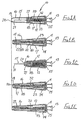
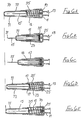
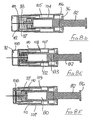
- the first embodiment of needle assembly of this invention shown in Figures1 A to 1G comprises a tubular housing 10 assembled from a rear part 11 and a front part 12, permanently secured together.
- the rear part 11 includes a tapered socket 13 for receiving the hub of a syringe in the manner of a conventional taper-slip lock, thereby permitting the assembly to be mounted on a syringe ready for use.
- the rear part 11 has a boss 14 which carries the mount end of a needle 15, in a manner well known in the art.
- the syringe with which the embodiment is to be used may be a pre-filled syringe, such that pre-attachment of the needle assembly immediately renders the syringe ready for use.
- a threaded connector such as a Luer lock may be employed.
- the rear part may be configured for use with known forms of phlebotomy devices for collecting blood.
- a tubular sleeve 16 Slidably mounted in the forward region of the front part 12 is a tubular sleeve 16, the rear end of the sleeve having an external flange 17 which engages a shoulder 18 formed internally within the front part 12.
- the sleeve is thus constrained against further forward movement from the position shown in Figures 1A and 1E , but may slide rearwardly as shown in Figures 1B and 1C .
- the forward end 19 of the sleeve 16 has an in-turned lip 20 and the sleeve is of a sufficient length such that when its flange 17 engages shoulder 18, the lip 20 is disposed beyond the sharp tip 21 of the needle.
- a tubular blocking member 23 surrounds the boss 14 and has a flange 24 at its rear end and disposed adjacent a radial wall 25 of the rear part 11 of the housing.
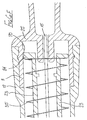
- the rearward facing surface of the flange 24 is non-radial with respect to the axis of the blocking member and so that face does not lie flat against the radial wall 25, as shown in Figure 1 G.
- the blocking member is slightly shorter than the distance between the radial wall 25 and the rear end of the sleeve, when the sleeve is fully forward, as shown in Figure 1A .
- a control member 27 is located within the sleeve 16 and has a rear portion 28 which is receivable within the forward part of the blocking member 23, the control member being profiled to limit rearward movement thereof into the blocking member.
- a releasable connection is formed between the control member 27 and the internal surface of the sleeve 16, shown in more detail in Figure 1 F , whereby the control member is held against movement forwardly within the sleeve 16 until sufficient force is applied to the sleeve in the rearward direction while the control member 27 is held stationary by abutting the forward end of the blocking member and the flange 24 of the blocking member 23 abuts the rear wall 25 of the housing 10.
- the releasable connection comprises an internal annular rib 29 engaged with an external preferably segmented annular rib 30 on the control member, or conversely the rib 29 could be segmented and the rib 30 continuous. Sufficient force on the sleeve will break the connection by causing the sleeve rib 29 to ride over the control member rib 30 whereafter the control member may slide freely within the sleeve between the internal face of lip 20 and the sleeve rib 29.
- a helical compression spring 32 is disposed within the blocking member 23 and acts between the rear face of the control member 27 and an annular abutment 33 formed within the blocking member, just forward of the boss 14.
- the force exerted by the spring 32 is insufficient to break the connection between the control member and the sleeve when the assembly is in its initial position as shown in Figure 1A .
- the rearward projection of rear portion 28 of the control member 27 is visible in Figure 1G ; this extended projection is intended to support the spring 32 to remain essentially co-axial with the needle.
- the control member During initial rearward movement of the sleeve 16, for example by being pressed against a body, the control member is maintained stationary by the blocking member 23, in contact with the rear wall 25. If sufficient force is applied to the sleeve 16 to break the connection, the sleeve will slide on to the blocking member 23. In addition, the control member is released to move forwardly under the action of the spring, until the control member engages the internal face of the sleeve lip 20. The spring thus continues to urge the sleeve forwardly through the control member, but a force applied rearwardly to the sleeve greater than the spring force will allow continued progress of the sleeve, rearwardly.
- Figure 1C shows the sleeve in its extreme rearward position, with the needle 15 projecting to its fullest extent, from the housing 10.
- the rear portion 28 of the control member has once more entered the blocking member and the flange 17 of the sleeve abuts the flange 24 of the blocking member.
- Sufficient reduction on the rearward force on the sleeve (for example, by withdrawing the assembly away from a body) will allow the sleeve to move forwards under the action of the spring, as shown in Figure 1D .
- the blocking member 23 On the sleeve moving to its protecting position shown in Figure 1 E , the blocking member 23 is free of the sleeve and so moves to the position shown in that Figure, by virtue of the non-radial face of its flange 24 engaging the radial wall 25 of the housing rear part 11, under the action of spring 32. When in its non-axial position, the blocking member blocks rearward movement of the sleeve away from its protecting position, so rendering safe the needle.
- the assembly is used in conjunction with a syringe to undertake drug draw-up from a phial or ampoule into the syringe, this particular assembly must be discarded and a second assembly fitted to the syringe, to perform an injection. This is in fact the preferred clinical procedure since a lubricated and uncontaminated new needle should be used for body penetration. As well as protecting the needle, the assembly has the advantage of enforcing the "new-needle" clinical procedure, even should a clinician be disinclined to follow the specified procedure.
- the control member 27 is preferably made from a highly visible (e.g. strongly-coloured) plastics material, whereas the sleeve 16 is preferably made of a translucent plastics material.
- a simple inspection of the assembly will show whether it has been used, because the control member can be seen at the forward end of the sleeve, or whether it is ready for use, because the control member is not present within that part of the sleeve, beyond the front part 12 of the housing 10 and irrespective of the position of the control member.
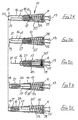
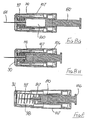
- the second embodiment of Figures 2A to 2E is generally similar to that of Figures 1A to 1E , except that the connection between the control member 27 and the sleeve 16 is differently configured, and a larger spring 35 is employed, external to the blocking member 23.
- the spring acts between the flange 24 of the blocking member and the rear face of the sleeve 16, so directly urging the sleeve forwardly, irrespective of the sleeve position with respect to the housing 10.
- a simple friction connection is employed between the control member 27 and the sleeve 16, with sufficient friction to ensure the control member remains stationary within the sleeve until sufficient force is applied to the sleeve to overcome that friction. Then, the sleeve will move rearwardly while the control member 27 is held stationary by the blocking member and so is advanced relatively, within the sleeve. Subsequently, on forward movement of the sleeve under the action of the spring 35, the control member moves forward with the sleeve and so comes free of the blocking member. Thereafter, this permits the blocking member to perform its locking action as described with reference to Figure 1 .
- the amount of rearward movement of the sleeve needed subsequently to result in the disengagement of the blocking member 23 from the control member may be controlled by appropriate selection of the length of the rear portion 28 of the control member 27. With a short rear portion, only small rearward movement of the sleeve will result in an earlier disengagement of the blocking member. Conversely, with a long rear portion, a much greater rearward movement of the sleeve is required before subsequent forward movement of the sleeve disengages the control member from the blocking member.
- the action with a long rear portion 28 may be advantageous where the assembly is to be used to perform drug draw-up from a phial or ampoule, before the same assembly is to be used to perform an injection, where procedures permit the same needle to be used for draw-up and subsequent injection into a body - for example with the delivery of insulin.
- the sleeve may appropriately be marked to show its maximum movement before locking will occur on subsequent release of the sleeve and provided that movement is not exceeded, then the assembly may be used firstly to undertake drug draw-up and secondly to perform an injection, fully inserting the needle to its correct depth, whereafter the assembly will be rendered safe.
- the embodiment of Figure 2 may be employed to give multiple injections, for example if one patient requires a plurality of intradermal injections all in the same general area.
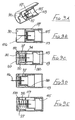
- This can be achieved by using a tubular adapter 38 as shown in Figure 3 , in conjunction with the assembly of Figure 2 (or Figure 1 ) together with a syringe 39 having a syringe body 40 and a plunger 41.
- the needle assembly is fitted to the spigot 42 at the front of the syringe body 40 and the adapter is then slipped over the needle assembly and the syringe body ( Figure 3A ).
- the adapter has a nose profile 43 to receive the front of the sleeve 16 and, at its other end, outwardly projecting finger grips 44.
- Figure 3 The arrangement of Figure 3 is used by the clinician holding the finger grips 44 together with the head 45 of the plunger 41 and moving the syringe body 40 deeper into the adapter 38, until the sleeve is fully retracted, as shown in Figure 3D . So long as pressure is maintained between the finger grips 44 and the plunger head 45, the adapter 38 will hold the sleeve 16 in its retracted position. An increased force will be required to drive the plunger 41 into the syringe 39 to deliver a drug into the body. A reduction in that increased force should maintain the sleeve in its retracted position, so allowing the re-siting of the needle to another part of the body, for further injections. On releasing all pressure, spring 32 will move the sleeve 16 forwardly so fully protecting the needle before the syringe is removed from the adapter 38.
- This embodiment is a modified form of the second embodiment shown in Figures 2A to 2E .
- the modification is solely to the control member, which is differently profiled as shown in Figure 4A .
- the control member 50 is provided with a counter-bore 51 at its forward end and the rear portion 52 tapers towards its free end. Such a control member 50 allows resetting of the assembly to a ready-to-use condition, from a locked condition.
- Figure 4A shows the assembly in its protecting (locked) condition, this corresponding to the setting of Figure 2E .
- the mechanism may be reset by means of a tool having a fine tubular shaft 53, receivable through the lip 20 of the sleeve 16 and into the counter-bore 51 of control member 50.
- the control member 50 may be pushed rearwardly, overcoming the friction between the control member 50 and the sleeve 16, until the control member re-enters the blocking member 23.
- the tapered profile of the rear portion 52 lifts the control member out of its locking position ( Figure 4B ) and continued rearward movement of the control member will bring the blocking member co-axial with the needle, as shown in Figure 4C . Removal of the shaft 53 leaves the assembly reset, ready for use.
- FIG. 5A to 5E A fourth embodiment of this invention is shown in Figures 5A to 5E .
- This embodiment has a support wall 55 provided with a socket 56 to permit the assembly to be mounted on the hub 57 of a conventional syringe 58, the hub and socket together forming a conventional taper slip lock.
- a conventional Luer lock could be used, instead.
- the syringe has a cylindrical body 59 within which is mounted a plunger 60, to permit charging of the syringe and discharging of a drug, through a needle 15 supported on wall 55.
- a sleeve 62 has a forward portion 63 corresponding to sleeve 16 of the previous embodiments and a rearward portion 64 formed integrally with the forward portion 63.
- the rearward portion has a sufficient diameter to fit over the cylindrical body 59 of the syringe and is provided with an annular bead 65 at its free end, to stop the sleeve 62 coming off the wall 55.
- the arrangement is essentially the same as that of the embodiment of Figure 2 , and so includes a blocking member 23, a control member 27 and a spring 35 external of the blocking member.
- the control member 27 is a frictional fit within the forward portion 63 of the sleeve 62 and so may be slid forwardly within the forward portion, as the sleeve 62 is moved rearwardly. As previously, sufficient forward movement of the control member within the forward portion 63 allows the blocking member 23 to move to its inclined position shown in Figure 5E once the sleeve 62 has moved to its protecting position, so thereafter preventing retracting movement of the sleeve.
- Figures 1 to 5 all employ a separate and movable control member such as member 27 of Figure 1 , whereas the embodiments of Figures 6 to 13 have no such control member. Rather, control of movement of the blocking member is achieved by alternative means, as will be described.
- the fifth embodiment is shown in Figures 6A to 6F .
- This does not include a control member, but otherwise is similar to the second embodiment, shown in Figures 2A to 2E .
- at least one stop 70 is formed internally within the rear part 11 of the housing 10, adjacent but spaced from the inner face of the radial wall 25.
- the sleeve 71 though generally similar to sleeve 16, has a shoulder 72 part way therealong, for engaging the blocking member 23 once the sleeve has been moved sufficiently, rearwardly.
- the or each such stop 70 is appropriately configured to hold the blocking member 23 away from the radial wall 25.
- the blocking member 23 has such a length that when it bears on the stops 70 and the sleeve 71 is in its initial position, the blocking member is located within the rear end of the sleeve 71, as shown in Figure 5A . In this position, the force exerted by the spring 35 is insufficient to move the flange 24 of the blocking member over the or each stop 70.
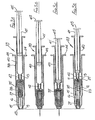
- the sixth embodiment is shown in Figures 7A to 7J .
- the safety arrangement is intended for use with a syringe having a body 80 fitted with a needle 81 in the course of manufacture.
- the syringe has a plunger 82 with a piston 83 within the bore of the syringe, so that liquid may be drawn into the syringe through the needle 81 by withdrawing the plunger 82 from its fully inserted position, the medicament subsequently being expelled through the needle 81 by depressing that plunger.
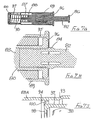
- the plunger 82 has an X-shaped cross-section and differs from the plunger of a conventional syringe in that the outer edge of each arm of the X-shaped cross-section is provided with a protuberance 84, disposed approximately one quarter of the way along the length of the plunger, from the piston end. In the region of each protuberance, the respective arm has a through-slot 85 to enable radially inward movement of the protuberances.
- the protuberances 84 define a stop position for the plunger on being moved into the bore by the application of axial pressure to the remote end 86 of the plunger. When the protuberances reach the rear end of the syringe body, an increased force is momentarily required to move the plunger deeper into the syringe body.
- the safety arrangement for use with the syringe described above comprises a tubular support 87 having a bore in which the syringe body 80 is snugly received.
- the needle is thus indirectly carried by the support, through the syringe itself.
- Formed within that bore is an internal rib 88 which limits the movement of the syringe body into the bore.
- the part of the support 87 which overlies the syringe body has a greater wall thickness and slidably carries a sleeve 89.
- the forward end 89A of the sleeve has an internal radial flange 90 formed with a central hole 91 through which the needle 81 may project, the flange being provided with an upstand 92 which projects internally of the sleeve towards the syringe, the upstand having a relatively small arcuate extent, typically of only a few degrees.
- an annular shoulder 93 is formed by a change in the internal and external diameters of the sleeve and between that shoulder 93 and the flange 90, there is formed an inwardly-projecting annular rib 94 ( Figure 7J ).
- a further internal rib 95 ( Figure 7H ) is formed at the rearward end of the sleeve, over which an out-turned flange 96 at the rear end of the syringe body must ride to permit the sleeve to slide rearwardly from that position shown in Figures 7A, 7B and 7J .
- a tubular blocking member 97 is slidably carried on the forward end portion of the support 87 and is urged forwardly by a helical compression spring 98, acting between the internal rib 88 of the support and an internal flange 99 formed at the forward end of the blocking member 97.
- the blocking member 97 has at its forward end an outwardly-projecting flexible lip 100 slidable within the smaller diameter portion of the sleeve 89 but movable over the internal rib 94 of the sleeve only when an increased force is applied to the sleeve, relative to the blocking member. This is shown on an enlarged scale in Figure 7K.
- the nose part of a phial (not shown) of medicament is inserted into the hole 91 at the forward end of the sleeve 89 and is pushed gently on to the needle 81, moving the sleeve rearwardly with respect to the syringe by riding the further rib 95 of the sleeve over the out-turned flange 96 of the syringe body 80. During this, the blocking member 97 moves rearwardly, simultaneously with the sleeve, against the action of spring 96.
- the combined force of the spring 96 acting on the blocking member 95 and the force required to ride the further rib 95 over the out-turned flange 96 should be less than that required to move the lip 100 of the blocking member 97 over the rib 94 of the sleeve. As such, during the phial-filling operation, the blocking member 97 remains with its lip 100 rearward of rib 94 of the sleeve ( Figure 7C ).
- the mechanism is ready for performing an injection.
- the operator applies a gentle force on the remote end 86 of the plunger by applying a reaction to the sleeve 89 and this has the effect of moving the plunger forwardly until the protuberances 84 are about to enter the syringe body, and also of pulling the sleeve rearwardly, to cause the needle 81 to project from the forward end of the sleeve.
- this can be achieved only by having the lip 100 of the blocking member 97 ride over the rib 94 of the sleeve 89 and so moving forwardly towards the flange 90 of the sleeve, as shown in Figure 7D .
- Rearward movement of the sleeve may continue until the shoulder 93 engages that part of the support having a thickened wall thickness as shown in Figure 7E .
- the needle 81 is then projecting beyond the flange 90 to its greatest possible extent.
- the assembly is used in this condition to perform an injection, firstly by pushing the needle 81 into a body at the injection site and then pushing the plunger fully forwardly, the protuberances 84 moving inwardly to permit this, as shown in Figure 7F .
- the condition of Figure 7E could instead be achieved by using the syringe with the connected assembly to perform a stabbing motion against a body, so that the engagement of the flange 90 at the forward end of the sleeve moves the sleeve rearwardly with respect to the syringe.
- the spring 98 On removing the syringe assembly from a body, by pulling rearwardly on the plunger and releasing the sleeve, or by pulling on the sleeve and releasing the plunger, the spring 98 will cause relative separation of the forward end of the sleeve and the support 87, the spring acting on the flange 99 of the blocking member 97 to maintain contact between the forward end of the blocking member and upstand 92. Eventually, the separation will be so great that the blocking member comes free of the support 87 and the spring force acting on the blocking member will allow it to cant over so that its axis lies at an acute angle to the axis of the sleeve and support member - Figure 7G . When in this position, the blocking member 97 lies between the flange 90 of the sleeve and the forward end of the support 87 and so physically blocks subsequent rearward movement of the sleeve 89, with respect to the support and syringe.
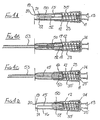
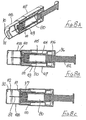
- the seventh embodiment is shown in Figures 8A to 8H .
- This seventh embodiment is generally similar to the sixth embodiment of Figures 7A to 7J and like parts are given like reference numbers and will not be described again in detail.
- the seventh embodiment differs from the sixth embodiment in that the part of the support 104 surrounding the syringe 80 does not have a significantly increased wall thickness, though a step 105 is formed between forward and rearward parts of that support, in order to serve as a backstop for movement of the blocking member 97.
- the support 104 has an increased internal diameter portion 106, to permit the accommodation therein of the out-turned flange 96 of a syringe, which may have an entirely conventional plunger not including the protuberances 84 of the sixth embodiment.
- That increased diameter part 106 supports a tube 107 projecting forwardly coaxial with the support itself but with an annular space between the tube and the support.
- a sleeve 108 is slidably mounted within the tube 107, forward movement of the sleeve being limited by an external rib 109 around the rear end of the sleeve and an internal shoulder 110 formed within the tube 107.
- the sleeve has two axially-spaced internal ribs 111 and 112, each of which can interact with the lip 100 of the blocking member 98 in a generally similar manner to that described with respect to the sixth embodiment.
- Figures 8A and 8B show the initial position, with a slight clearance between the rearward end of the blocking member 97 and the step 105 of the support 104.
- the sleeve moves rearwardly until the rear end face of the blocking member engages the step 105 ( Figure 8C ) and continued rearward pressure on the sleeve then allows the lip 100 of the blocking member to ride over the first rib 111, then to move forwardly to engage the second rib 112 ( Figure 8D ).
- the syringe may be filled from a phial and on releasing the phial from the syringe, the sleeve and blocking member will together move forwardly to the position shown in Figure 8E , so covering the needle once more.
- the syringe assembly is used to make an injection in the course of which the blocking member 97 moves fully forwardly ( Figure 8F ) and then further rearward movement of the sleeve allows the needle to project to its greatest possible extent ( Figure 8G ), as the plunger is depressed ( Figure 8H ).
- the sleeve 108 is moved forwardly under the action of the spring bearing on the blocking member; finally the blocking member 97 comes free of the support 104 and is canted over (Figure 8J) so as to provide a physical block between the support and the flange of the sleeve, as described above.
- the eighth embodiment is shown in Figures 9A to 9E and is a modified form of the sixth embodiment ( Figures 7A to 7J ) intended for use with an injection device adapted to receive a cartridge of medicament.
- the safety assembly of this eighth embodiment may be employed with a medicament-dispensing "pen" intended for dispensing a pre-selected but variable dose of insulin, for self-injection.
- a support 115 directly carries a needle 116 the rear end of which projects into the space within the support 115, so that on fitting the support to an injection device carrying a cartridge of medicament, the rear end of the needle will penetrate a membrane at the forward end of the cartridge.
- the needle 116 so thus communicates with the interior of the cartridge, for dispensing of the medicament.
- a sleeve 117 is slidably mounted on the rearward part 118 of the support 115 and has an in-turned lip 119 to prevent the sleeve moving forwardly with respect to the support, from the position shown in Figures 9A and 9B .
- the forward end of the sleeve, its rib 94 and the blocking member 97 are all as described with respect to the sixth embodiment and are given like reference characters; these components will not be described further here.
- the safety arrangement is mounted on the front end of an injection pen, the appropriate dose is set and then the pen is used to perform a stabbing motion on the selected body site.
- the flange 90 at the forward end of the sleeve 117 serves to ensure that the needle 116 enters the body essentially perpendicularly and the impact force on the body of the flange 90 at the forward end of the sleeve 117 serves to cause rib 94 to ride over lip 100 of the blocking member. This allows the blocking member 97 to move forwardly under the action of spring 98, as shown in Figure 9C . From there, the operation is essentially as described above with reference to the sixth embodiment of Figure 7 .
- the injection is performed with the assembly set as shown in Figure 9D and, following withdrawal of the needle, the sleeve is blocked in its protecting position as shown in Figure 9E .
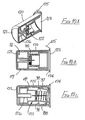
- Packaging for the eighth embodiment of Figure 9 is illustrated in Figures 10A to 10C .
- the safety device itself shown in these Figures is identical to that of Figures 9A to 9E and will not be described again. Further, the same reference numbers are used to designate the same components.
- the packaging comprises a moulded plastics cylindrical tube 120 closed at one end by wall 121, and shaped to receive the safety assembly 122 of Figures 9A and 9B in its initial condition as shown in Figures 10A and 10B .
- the tube 120 containing the assembly 122 may be rendered sterile, using known techniques, and then sealed by a cover foil 123 heat-sealed to a flange 124 around the open end of the tube 120. That foil has a flap 125 to enable easy opening of the tube, when the assembly 122 is to be used.
- a cylindrical projection 126 upstands axially from the end wall 121 of the tube 120. That projection has such a length that when the assembly 122 is fully received in the tube 120, the inner end of the projection engages the blocking member 97 of the assembly and so prevents that blocking member moving forwardly under the action of spring 98, notwithstanding the interengagement of the lip 100 with rib 94 of the sleeve 117.
- the injection pen After opening the tube, the injection pen is pressed on to the assembly 122 while still in the tube 120 and then the tube is pulled free of the assembly.
- the sleeve protects the needle as the blocking member prevents the sleeve being withdrawn to expose the needle, as shown in Figure 11C .
- the assembly may then be inserted into the tube 120 but the other way round (that is, with the needle pointing towards the open end of the tube) and, having regard to the draw of the tube, as the assembly is pushed fully home it forms a tight frictional fit within the tube. As such, it will be extremely difficult to withdraw the assembly once more and the needle is fully protected, for disposal.
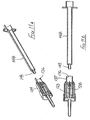
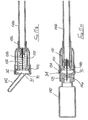
- the ninth embodiment is shown in Figures 11A to 11M .
- This safety arrangement is intended for use with a single-use luer-slip or luer-lock syringe having a syringe body 148 moulded from a plastics material and provided with a luer-lock taper spigot 149 at its forward end, for receiving a correspondingly profiled needle hub.
- syringes are well known in the art and are very widely used; following use of the syringe, it is thrown away with the needle still connected to the syringe.
- the safety arrangement of this ninth embodiment has a support 128 provided with a needle 129, the support defining a socket to receive the luer-lock spigot 149 at the forward end of the syringe 148.
- the support 128 defines an outer cylindrical surface 130 on which a blocking member 131 is slidably carried, a spring 132 acting between the support 128 and the forward end of the blocking member 131.
- a two-part sleeve 134 surrounds the support 128 and the blocking member 131, the rearward end portion 135 of the sleeve defining a cylindrical bore 136 within which the outer surface of the syringe body 148 is slidably receivable.
- the forward end portion 139 of the sleeve 134 has an enlarged diameter and carries a front sleeve part 140 configured similarly to the front part of the sleeve of the sixth and eighth embodiments.
- this front part 140 has a flange 90 at its forward end together with an upstand 92 on that flange, and an annular rib 94 is formed internally, spaced rearwardly from the flange 90.
- the forward end of the blocking member 131 has a lip 100 to co-act with the rib 94, again as described above.
- a protective tubular cap 142 is moulded integrally with the front part 140 but is connected to the front part by relatively weak ribs around the hole 91 in the flange 90.
- the cap projects internally into the sleeve by a small distance, as shown.
- the central hole in the flange 99 of the blocking member is sufficiently large to permit the internally projecting part of the cap 142 to pass therethrough, and the blocking member has an internal abutment 143 spaced rearwardly from the front face of that member.
- the initial position of the safety assembly is as shown in Figures 11 A and 11B. It is connected to a syringe body 148 by inserting the forward end of the syringe into the bore 136 of the sleeve 134 and engaging the spigot 149 with the support 128. As the syringe body moves deeper into the sleeve 134, the support 128 is also moved forwardly as shown in Figure 11C , commencing the engagement of the luer-lock.
- the syringe is filled with an appropriate quantity of medicament by gently pressing a phial 145 on to the flange 90 at the forward end of the sleeve 134, so permitting the syringe and connected needle to move deeper into the safety assembly.
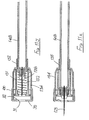
- the needle penetrates the pierceable membrane 146 of the phial, to permit the extraction of medicament therefrom by withdrawing the syringe plunger. Only light pressure is required to achieve this penetration, and so the lip 100 of the blocking member 131 remains rearwardly of the rib 94 within the front part 140 of the sleeve ( Figure 11 H) .
- the operation of the safety assembly is much as has been described above with reference to the previous embodiments.
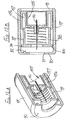
- the sleeve 134 On performing a stabbing action to effect needle penetration into a body, the sleeve 134 initially moves rearwardly with respect to the support 128, taking the blocking member 131 with it until the support engages the annular abutment 143 within the blocking member 131 ( Figure 11K ).
- the lip 100 Continued rearward movement of the sleeve causes the lip 100 to ride over the rib 94 until maximum projection of the needle is achieved ( Figure 11 L) , where the front of the blocking member 131 engages the upstand 92 on the flange 90 of the sleeve 134.
- the sleeve moves forwardly with respect to the syringe body, under the action of the spring 132 bearing on the blocking member.
- the flange 99 of the blocking member remains in engagement with the flange 90 of the sleeve 134 so that when the sleeve has moved fully forwardly with respect to the syringe and connected support 128, the blocking member is free to cant over and fulfil its blocking function ( Figure 11 M) .
- Figures 12A and 12B show a modified form of the eighth embodiment, of Figure 9 .
- This modified form has a shorter overall length, achieved by providing a two-part support 155 the outer part 156 of which is folded back on itself in order to provide a surrounding annular space 157 within which the blocking member is slidably received.
- the rib 94 of the sleeve 117 is correspondingly nearer its flange 90.
- the blocking member is disposed forward of the front end of the support 155 and so the spring is not fully compressed. Further, the distance the blocking member may move before engaging the upstand 92 is much reduced.
- FIGS 13A to 13C illustrate a tenth embodiment of this invention which, while generally similar to that of the eighth embodiment ( Figure 9 ) differs in one important detail. However, like parts with those of Figures 9A to 9E are given like reference numbers.
- Figures 13A to 13C does not include a rib 94 within the sleeve 89, so that the blocking member is held by spring 98 in a fully forward position, when the assembly is in its initial setting ( Figures 13A and 13B ).
- the blocking member is maintained coaxial with the support 115 and sleeve 117 by means of a slip ring 159, slidably carried but a light frictional fit on the support 115.
- the rearward end of the blocking member 97 is received within a counter-bore in the slip ring 159.
- the sleeve 117 On performing an injection, the sleeve 117 is moved rearwardly, taking the slip ring 159 with it. Then, following completion of the injection, the sleeve and blocking member move forwardly once more but the slip ring 159 remains in its rearmost position, on the support 115. Thus, on the sleeve and blocking member moving fully forwardly, the blocking member moves to its blocking position as shown in Figure 13C , thus rendering the assembly safe with the sleeve blocked against movement away from its protecting position.
- the respective sleeves may be made transparent, translucent or provided with a transparent or translucent window.
Landscapes
- Health & Medical Sciences (AREA)
- Engineering & Computer Science (AREA)
- Heart & Thoracic Surgery (AREA)
- Vascular Medicine (AREA)
- Anesthesiology (AREA)
- Biomedical Technology (AREA)
- Hematology (AREA)
- Life Sciences & Earth Sciences (AREA)
- Animal Behavior & Ethology (AREA)
- General Health & Medical Sciences (AREA)
- Public Health (AREA)
- Veterinary Medicine (AREA)
- Environmental & Geological Engineering (AREA)
- Infusion, Injection, And Reservoir Apparatuses (AREA)
- Surgical Instruments (AREA)
Claims (35)
- Sicherungseinrichtung für eine medizinische Nadel (15) mit einem Halteende und einer scharfen Spitze (21), wobei die Einrichtung aufweist:- eine Halterung (11), die direkt oder indirekt zum Aufnehmen des Halteendes einer Nadel (15) ausgebildet ist, so dass die Nadel einen Teil hat, der sich von diesem nach vorne weg erstreckt;- eine Hülse (16), die direkt oder indirekt an der Halterung befestigt ist und in Bezug zu dieser aus einer Ausgangsposition, in der die Hülse den sich nach vorne erstreckenden Teil einer aufgenommenen Nadel vollständig abdeckt, in eine eingefahrene Position, in der die Spitze (21) einer aufgenommenen Nadel und ein Teil der Nadel hinter der Spitze frei gelegt ist, und dann in eine Schutzposition entsprechend der Ausgangsposition verschiebbar ist, in der die Hülse (16) den sich nach vorne erstreckenden Teil der Nadel wieder abdeckt und die Schutzposition der Hülse relativ zu der Spitze der Nadel zu der Ausgangsposition der Hülse relativ zu der Spitze korrespondiert;- ein elastisches Mittel (32), das zum Drängen der Hülse (16) in Richtung seiner Schutzposition angeordnet ist;- ein Blockierelement (23), von dem sich mindestens ein Teil von der Halterung nach vorne erstreckt, wobei dem Blockierelement eine nicht blockierende Position zugeordnet ist, in der sich das Blockierelement im Wesentlichen parallel zu der Nadelachse erstreckt und die Hülse in die eingefahrene Position verschiebbar ist, und dem Blockierelement eine blockierende Position zugeordnet ist, in der das Blockierelement in einem spitzen Winkel zu der Nadelachse liegt und das Blockierelement zwischen der Halterung (11) und einem Teil der Hülse (16) angeordnet ist, wodurch das Blockierelement eine Bewegung der Hülse aus der Schutzposition heraus blockiert; und- ein Steuermittel (27), das das Blockierelement (23) zum Bewegen aus seiner nicht blockierenden Position in seine blockierende Position aufgrund einer Bewegung der Hülse (16) aus seiner Ausgangsposition in Richtung seiner eingefahrene Position frei gibt, so dass bei einer nachfolgenden Bewegung der Hülse in ihre Schutzposition das Blockierelement danach eine Bewegung der Hülse aus ihrer Schutzposition blockieren wird.
- Sicherungseinrichtung nach Anspruch 1, dadurch gekennzeichnet, dass das Blockierelement (23) rohrförmig und in seiner nicht blockierenden Position im Wesentlichen koaxial zu der Hülse (16) und der Nadel (15) ist.
- Sicherungseinrichtung nach Anspruch 1 oder 2, dadurch gekennzeichnet, dass ein Ende des Blockierelementes (23) in seiner blockierenden Position mit einem Wandteil (25) der Halterung oder der Hülse zum Anlegen eines Drehmomentes an das Blockierelement um eine Achse quer zur Länge der Hülse (16) zusammenwirkt, wodurch das zweite Ende des Blockierelementes zum Blockieren einer Einfahrbewegung der Hülse bewegt wird.
- Sicherungseinrichtung nach Anspruch 3, dadurch gekennzeichnet, dass ein Ende des Blockierelementes (23) einen aufgesetzten Vorsatz hat, der sich in Richtung des benachbarten Wandteils (25) der Halterung oder der Hülse erstreckt, wobei an das eine Ende des Blockierelementes, das in Richtung des benachbarten Wandteils gedrängt wird, der aufgesetzten Vorsatz das Drehmoment an das Blockierelement anlegt.
- Sicherungseinrichtung nach Anspruch 3, dadurch gekennzeichnet, dass das Wandteil (25) einen aufgesetzten Vorsatz hat, der sich in Richtung des benachbarten Endes des Blockierelementes (23) erstreckt, wobei an das eine Ende des Blockierelementes, das in Richtung des Wandteils gedrängt wird, der aufgesetzte Vorsprung das Drehmoment an das Blockierelement anlegt.
- Sicherungseinrichtung nach Anspruch 3, dadurch gekennzeichnet, dass ein Ende des Blockierelements (23) eine nicht-radiale Fläche (24) in Bezug auf das benachbarten Wandteil der Halterung oder der Hülse aufweist, wobei an das eine Ende des Blockierelementes, das in Richtung des benachbarten Wandteils gedrängt wird, die nicht-radiale Fläche das Drehmoment an das Blockierelement anlegt.
- Sicherungseinrichtung nach Anspruch 3, dadurch gekennzeichnet, dass das Wandteil (25) dem benachbarten Ende des Blockierelementes (23) zugewandt eine nicht radiale Fläche aufweist, wobei an das eine Ende des Blockierelementes, das in Richtung des benachbarten Wandteils gedrängt wird, die nicht-radiale Fläche das Drehmoment an das Blockierelement anlegt.
- Sicherungseinrichtung nach einem der vorhergehenden Ansprüche, dadurch gekennzeichnet, dass der Halterung (87) eine Bohrung umfasst, in der eine Injektionsspritze (80) aufnehmbar ist, die an deren vorderem Ende die Nadel (81) hat, so dass die Nadle sich nach vorne in die Hülse (89) erstreckt, wenn die Spritze (80) in der Bohrung aufgenommen ist.
- Sicherungseinrichtung nach Anspruch 8, dadurch gekennzeichnet, dass die Hülse (89) außerhalb auf der Halterung (87) verschiebbar gehalten ist.
- Sicherungseinrichtung nach Anspruch 8, dadurch gekennzeichnet, dass die Hülse (108) verschiebbar in einem rohrförmigen Träger (107) aufgenommen ist, und der Träger (107) an der Halterung (104) befestigt ist.
- Sicherungseinrichtung nach Anspruch 9 oder 10, dadurch gekennzeichnet, dass das vordere Ende der Hülse (108) einen im Wesentlichen radial nach innen gerichteten Flansch (90) hat, der eine zentrale Öffnung (91) aufweist, durch die die Spitze der Nadel (81) heraus treten kann, wenn die Hülse in ihrer zurück gezogenen Position ist.
- Sicherungseinrichtung nach einem der Ansprüche 8 bis 11, dadurch gekennzeichnet, dass das Blockierelement (97) verschiebbar an der Hülse (89, 109) gehalten ist, jedoch unter Einwirkung des elastischen Mittels von der Hülse gleitet, um sich in seine Blockierposition zu bewegen, wenn es aufgrund des Steuermittels (94, 100) frei gegeben ist.
- Sicherungseinrichtung nach einem der Ansprüche 1 bis 7 zur Verwendung mit einer Injektionsspritze (58) mit einem zylindrischen Körper (59), der einen Zapfen (57) an dessen vorderem Ende zum Aufnehmen einer Nadel (15) mit einer Haltenabe an ihrem hinteren Ende aufweist, wobei die Halterung (55) eine Buchse (56) zum Aufnehmen des Zapfens (57) einer Injektionsspritze umfasst, die Halterung weist eine Nadel (15) auf, die sich von einer befestigten Spritze nach vorne erstreckt, wobei die Nadel in Verbindung mit dem Zapfen (57) ist und die Hülse (62) auf der Außenseite des Spritzenkörpers (69) verschiebbar ist.
- Sicherungseinrichtung nach Anspruch 13, dadurch gekennzeichnet, dass die Halterung (128) einen größeren Durchmesser als der Außendurchmesser des Spritzenkörpers (148) hat und das Blockierelement (131) über den Außendurchmesser der Halterung verschiebbar ist.
- Sicherungseinrichtung nach einem der Ansprüche 1 bis 7 für die Verwendung mit einer Injektionsvorrichtung, die zum Halten einer Medikamentenkartusche ausgebildet ist, die Vorrichtung weist einen zylindrischen Körper mit einem Zapfen an seinem vorderem Ende auf, wobei die Halterung (155) eine Buchse zum Aufnehmen des Zapfens der Vorrichtung umfasst, die Halterung weist eine Nadel (116) auf, die sich von dem Zapfen nach vorne erstreckt, wobei das hintere Ende der Nadel in Verbindung mit der von der Vorrichtung getragenen Kartusche ist, die Halterung hat eine Außenwand (156) auf der die Hülse (117) verschiebbar geführt ist.
- Sicherungseinrichtung nach Anspruch 13, dadurch gekennzeichnet, dass die Halterung (115) eine nach Vorne gerichtete zylindrische Fläche mit einem kleineren Durchmesser als die Außenwand hat, auf der die Hülse (119) verschiebbar ist, das Blockierelement (97) wird verschiebbar auf der zylindrischen Flächen geführt.
- Sicherungseinrichtung nach einem der vorhergehenden Ansprüche, dadurch gekennzeichnet, dass das Steuermittel eine lösbare Verbindung (94, 100; 97, 159) zwischen der Hülse und dem Blockierelement aufweist.
- Sicherungseinrichtung nach Anspruch 17, dadurch gekennzeichnet, dass eine Bewegung der Hülse in Richtung ihrer eingefahrenen Position die Verbindung (94, 100; 97, 159) löst, um eine Bewegung des Blockierelementes (97) in Richtung seiner Blockierposition zu ermöglichen.
- Sicherungseinrichtung nach Anspruch 18, dadurch gekennzeichnet, dass eine zusätzliche lösbare Verbindung (70) zwischen der Hülse (71) und dem Blockierelement (23) vorgesehen ist, die axial von der zuerst genannten lösbaren Verbindung (70) beabstandet ist, die zusätzliche lösbare Verbindung wird aufgrund einer ersten Bewegung der Hülse in Richtung ihrer zurück gezogenen Position aufgelöst, und die zuerst genannte lösbare Verbindung wird durch eine weitere Bewegung der Hülse in Richtung der zurück gezogenen Position gelöst, wodurch das Blockierelement (23) zum Bewegen in seine Blockierposition freigegeben wird.
- Sicherungseinrichtung nach einem der Ansprüche 17 bis 19, dadurch gekennzeichnet, dass die lösbare Verbindung ineinander greifende Haltepunkte (100, 94) auf den aufeinander liegenden Gleitflächen des Blockierelementes (97) beziehungsweise der Hülse (89A) aufweisen, wobei die Haltepunkte bei einer Anwendung einer hinreichenden axialen Kraft einander überwinden.
- Sicherungseinrichtung nach einem der Ansprüche 1 bis 7, dadurch gekennzeichnet, dass ein in der Hülse (16) aufnehmbares Steuerelement (27) vorgesehen ist, das anfangs das Blockierelement (23) zum im Wesentlichen koaxialen Ausrichten zur Hülse stützt, wobei eine lösbare Verbindung (29, 30) zwischen der Hülse und dem Steuerelement vorgesehen ist, die, wenn diese aufgrund einer Bewegung der Hülse aus ihrer Ausgangsposition heraus gelöst ist, dem Blockierelement eine Bewegung in seine Blockierposition bei einer Bewegung der Hülse in ihre Schutzposition ermöglicht.
- Sicherungseinrichtung nach Anspruch 21, dadurch gekennzeichnet, dass das Steuerelement (27) teilweise innerhalb der Hülse (16) und teilweise innerhalb des Blockierelementes (23) angeordnet ist, wenn die Hülse in ihrer Ausgangsposition ist.
- Sicherungseinrichtung nach Anspruch 22, dadurch gekennzeichnet, dass die lösbare Verbindung (29, 30) unmittelbar zwischen der Außenfläche des Steuerelementes (27) und der Innenfläche der Hülse (16) gebildet ist.
- Sicherungseinrichtung nach einem der Ansprüche 21 bis 23, dadurch gekennzeichnet, dass die lösbare Verbindung (29, 30) ineinander greifende Haltepunkte sowohl auf der Außenfläche des Steuerelementes (27) als auch auf der Innenfläche der Hülse (16) aufweist, wobei die Haltepunkte bei einer Anwendung einer hinreichenden axialen Kraft einander überwinden.
- Sicherungseinrichtung nach Anspruch 24, dadurch gekennzeichnet, dass das elastische Mittel (32) zwischen dem Steuerelement (27) und einem innerhalb des Blockierelementes (23) gebildeten Innenflansch (33) und so indirekt auf die Hülse (16) durch die lösbare Verbindung (29, 30) wirkt.
- Sicherungseinrichtung nach Anspruch 25, dadurch gekennzeichnet, dass die Hülse mit einem inneren Haltepunkt (20) an ihrem vorderen Ende (19) gebildet ist, das Steuerelement (27) innerhalb der Hülse (16) frei verschiebbar ist, und wenn die lösbare Verbindung gelöst ist, das Steuerelement unter Einwirkung des elastischen Mittels nach Vorne zum in Eingriff bringen mit dem inneren Haltepunkt bewegt wird.
- Sicherungseinrichtung nach einem der Ansprüche 21 bis 23, dadurch gekennzeichnet, dass die lösbare Verbindung durch das Steuerelement (27) gebildet ist, das in einer reibschlüssigen Weise in der Hülse (16) eingepasst ist.
- Sicherungseinrichtung nach Anspruch 27, dadurch gekennzeichnet, dass das elastische Mittel (35) das Blockierelement (23) umgibt, um direkt zwischen dem einen Ende (17) der Hülse und dem Blockierelement zu wirken.
- Sicherungseinrichtung nach Anspruch 27 oder 28, dadurch gekennzeichnet, dass das Steuerelement (50) einen axialen Vorsprung (52) umfasst, der in dem Blockierelement (23) aufgenommen ist und daraus aufgrund einer Bewegung der Hülse in Richtung Nadelspitze heraus gezogen ist, wobei das Steuerelement mit dieser mit gezogen wird.
- Sicherungseinrichtung nach Anspruch 29, dadurch gekennzeichnet, dass die Länge des axialen Vorsprungs (52) zum Steuern der maximal möglichen Bewegung der Hülse (16) in Richtung ihrer eingefahrenen Position gewählt ist, bevor eine nachfolgende Bewegung der Hülse in die entgegen gesetzte Richtung die Hülse gegen eine Bewegung in Richtung einer eingefahrenen Position sperrt.
- Sicherungseinrichtung nach einem der Ansprüche 21 bis 30, dadurch gekennzeichnet, dass die Halterung (115) einen Verbinder für einen zylindrischen Körper bildet, um sich koaxial zu der hiermit verbundenen Nadel (116) zu verlängern.
- Sicherungseinrichtung nach Anspruch 31, dadurch gekennzeichnet, dass ein verbundener zylindrischer Körper verschiebbar zum Stützen Hülse (117) dient, die aus ihrer Ausgangsposition bewegt ist.
- Sicherungseinrichtung nach Anspruch 31, dadurch gekennzeichnet, dass die Halterung durch eine Rückwand (118) eines rohrförmigen Gehäuses gebildet ist, auf oder in dem die Hülse (117) verschiebbar gehalten ist.
- Sicherungseinrichtung nach einem der vorhergehenden Ansprüche, dadurch gekennzeichnet, dass das elastische Mittel (35, 98) eine Schraubenfeder aufweist.
- Sicherungseinrichtung nach einem der vorhergehenden Ansprüche und in Kombination mit einer Nadel (15), wobei das Halteende der Nadel an der Halterung (11) gesichert ist, um sich hiervon nach vorne zu erstrecken.
Priority Applications (1)
| Application Number | Priority Date | Filing Date | Title |
|---|---|---|---|
| EP09156072A EP2067496B1 (de) | 2002-06-22 | 2003-06-23 | Medizinisches Injektionsgerät |
Applications Claiming Priority (5)
| Application Number | Priority Date | Filing Date | Title |
|---|---|---|---|
| GB0214452 | 2002-06-22 | ||
| GBGB0214452.5A GB0214452D0 (en) | 2002-06-22 | 2002-06-22 | Medical needle assemblies |
| GBGB0302393.4A GB0302393D0 (en) | 2002-06-22 | 2003-02-03 | Medical needle assemblies |
| GB0302393 | 2003-02-03 | ||
| PCT/GB2003/002689 WO2004000397A1 (en) | 2002-06-22 | 2003-06-23 | Medical needle assemblies |
Related Child Applications (2)
| Application Number | Title | Priority Date | Filing Date |
|---|---|---|---|
| EP09156072A Division EP2067496B1 (de) | 2002-06-22 | 2003-06-23 | Medizinisches Injektionsgerät |
| EP09156072.2 Division-Into | 2009-03-24 |
Publications (2)
| Publication Number | Publication Date |
|---|---|
| EP1523360A1 EP1523360A1 (de) | 2005-04-20 |
| EP1523360B1 true EP1523360B1 (de) | 2013-09-18 |
Family
ID=30001974
Family Applications (2)
| Application Number | Title | Priority Date | Filing Date |
|---|---|---|---|
| EP09156072A Revoked EP2067496B1 (de) | 2002-06-22 | 2003-06-23 | Medizinisches Injektionsgerät |
| EP03760811.4A Expired - Lifetime EP1523360B1 (de) | 2002-06-22 | 2003-06-23 | Medizinische nadelanordnung |
Family Applications Before (1)
| Application Number | Title | Priority Date | Filing Date |
|---|---|---|---|
| EP09156072A Revoked EP2067496B1 (de) | 2002-06-22 | 2003-06-23 | Medizinisches Injektionsgerät |
Country Status (9)
| Country | Link |
|---|---|
| US (1) | US7699813B2 (de) |
| EP (2) | EP2067496B1 (de) |
| JP (1) | JP2005530597A (de) |
| AT (1) | ATE506981T1 (de) |
| AU (1) | AU2003250376B2 (de) |
| CA (1) | CA2490315C (de) |
| DE (1) | DE60336940D1 (de) |
| GB (2) | GB0214452D0 (de) |
| WO (1) | WO2004000397A1 (de) |
Cited By (6)
| Publication number | Priority date | Publication date | Assignee | Title |
|---|---|---|---|---|
| US8636704B2 (en) | 2009-04-29 | 2014-01-28 | Abbvie Biotechnology Ltd | Automatic injection device |
| US8679061B2 (en) | 2006-06-30 | 2014-03-25 | Abbvie Biotechnology Ltd | Automatic injection device |
| US8708968B2 (en) | 2011-01-24 | 2014-04-29 | Abbvie Biotechnology Ltd. | Removal of needle shields from syringes and automatic injection devices |
| US8758301B2 (en) | 2009-12-15 | 2014-06-24 | Abbvie Biotechnology Ltd | Firing button for automatic injection device |
| US9180244B2 (en) | 2010-04-21 | 2015-11-10 | Abbvie Biotechnology Ltd | Wearable automatic injection device for controlled delivery of therapeutic agents |
| US9265887B2 (en) | 2011-01-24 | 2016-02-23 | Abbvie Biotechnology Ltd. | Automatic injection devices having overmolded gripping surfaces |
Families Citing this family (76)
| Publication number | Priority date | Publication date | Assignee | Title |
|---|---|---|---|---|
| US7413562B2 (en) | 2001-03-15 | 2008-08-19 | Specialized Health Products, Inc. | Safety shield for medical needles |
| US20100160869A1 (en) * | 2002-06-22 | 2010-06-24 | Barry Peter Liversidge | Medical Needle Assemblies |
| MXPA05008537A (es) | 2003-02-11 | 2006-04-18 | Terence Edward Weston | Aguja de seguridad. |
| AU2011250802B2 (en) * | 2004-06-23 | 2014-02-06 | Abbvie Biotechnology Ltd | Improvements relating to automatic injection devices |
| GB0414054D0 (en) * | 2004-06-23 | 2004-07-28 | Owen Mumford Ltd | Improvements relating to automatic injection devices |
| GB0418389D0 (en) | 2004-08-18 | 2004-09-22 | Liversidge Barry P | Injection apparatus |
| US7297136B2 (en) | 2004-12-06 | 2007-11-20 | Wyrick Ronald E | Medicine injection devices and methods |
| US8827961B2 (en) | 2005-02-03 | 2014-09-09 | West Pharmaceutical Services, Inc. | Safety needle |
| US8597255B2 (en) | 2005-02-03 | 2013-12-03 | Salvus Technology Limited | Safety needle |
| CN101193674B (zh) | 2005-02-03 | 2011-09-14 | 赛尔伏斯科技有限公司 | 一种安全针 |
| WO2006090118A1 (en) | 2005-02-25 | 2006-08-31 | Salvus Technology Limited | Safety needle accessory |
| WO2006113542A1 (en) * | 2005-04-15 | 2006-10-26 | Specialized Health Products, Inc. | Medical needle systems with reset devices for medical needle shield apparatus |
| FR2889436B1 (fr) * | 2005-08-08 | 2008-05-16 | Alain Orlu | Dispositif de prelevement de fluide corporel ou de perfusion a moyen de protection. |
| GB0517699D0 (en) | 2005-09-01 | 2005-10-05 | Owen Mumford Ltd | Needle shroud assembly |
| GB0600351D0 (en) * | 2006-01-10 | 2006-02-15 | Weston Terence E | Safe hypodermic needle |
| FR2930161B1 (fr) | 2008-04-16 | 2011-05-13 | Becton Dickinson France | Ensemble de protection d'aiguille comportant un element de verrouillage mobile radialement. |
| DE102006053055A1 (de) * | 2006-09-01 | 2008-04-17 | Tecpharma Licensing Ag | Nadelschutzvorrichtung mit blockierter Schutzposition |
| DE102006042236A1 (de) | 2006-09-06 | 2008-03-27 | Tecpharma Licensing Ag | Nadelschutzvorrichtung mit blockierter Schutzposition |
| GB0621310D0 (en) * | 2006-10-27 | 2006-12-06 | Liversidge Barry P | Medical needle safety devices |
| EP2092887A4 (de) * | 2006-12-13 | 2010-01-20 | Terumo Corp | Punktionsinstrument |
| DE102007009340A1 (de) * | 2007-02-27 | 2008-08-28 | Tecpharma Licensing Ag | Nadelschutzvorrichtung mit integrierter Nadelträgerentfernungsvorrichtung zum Entfernen eines Nadelträgers von einem Injektionsgerät |
| SG147319A1 (en) * | 2007-04-11 | 2008-11-28 | Agency Science Tech & Res | Safety guard for syringe needle |
| NZ555327A (en) | 2007-05-21 | 2009-09-25 | Simcro Tech Ltd | An applicator which has a two stage interlock that protects from æneedle stickÆ injuries by covering the needle with a shield which also needs to be retracted before a dose can be administered |
| JP5256200B2 (ja) * | 2007-07-23 | 2013-08-07 | テルモ株式会社 | 薬液注入器具 |
| US9173997B2 (en) | 2007-10-02 | 2015-11-03 | Medimop Medical Projects Ltd. | External drug pump |
| US9656019B2 (en) | 2007-10-02 | 2017-05-23 | Medimop Medical Projects Ltd. | Apparatuses for securing components of a drug delivery system during transport and methods of using same |
| US10420880B2 (en) | 2007-10-02 | 2019-09-24 | West Pharma. Services IL, Ltd. | Key for securing components of a drug delivery system during assembly and/or transport and methods of using same |
| US8801673B2 (en) | 2008-03-13 | 2014-08-12 | Becton Dickinson & Company | Safety pen needle assembly having shield for non-patient end |
| ES2615954T3 (es) | 2008-03-13 | 2017-06-08 | Becton, Dickinson And Company | Conjunto de seguridad de aguja para pluma con protección de los extremos para el paciente y no para el paciente |
| CA2719110C (en) | 2008-03-13 | 2017-07-25 | Becton, Dickinson And Company | Safety needle assembly |
| FR2930160B1 (fr) | 2008-04-16 | 2011-05-13 | Becton Dickinson France | Ensemble de protection d'aiguille. |
| CA2721477A1 (en) * | 2008-04-18 | 2009-12-03 | Kuros Biosurgery Ag | Dispensing device, kit containing the device, and method of operating the device |
| EP2296735A4 (de) * | 2008-05-14 | 2013-05-29 | John Stephens | Nadelschutzvorrichtung |
| US7811261B2 (en) | 2008-06-02 | 2010-10-12 | Sta-Med, Llc | Needle cover assembly for a syringe |
| GB2463034B (en) * | 2008-08-28 | 2012-11-07 | Owen Mumford Ltd | Autoinjection devices |
| GB0815748D0 (en) * | 2008-08-29 | 2008-10-08 | Liversidge Barry P | Medical needle assembly |
| CA2990646C (en) * | 2009-02-06 | 2021-10-05 | Becton, Dickinson And Company | Disposable pen needle with re-use prevention features |
| US8366682B2 (en) | 2009-03-04 | 2013-02-05 | Washington Biotech Corporation | Medicine injection apparatuses |
| DK2424599T3 (da) * | 2009-04-27 | 2020-08-24 | Shl Medical Ag | Sikkerhedspenkanyleindretning |
| US9526846B2 (en) | 2009-08-19 | 2016-12-27 | Safety Syringes, Inc. | Patient-contact activated needle stick safety device |
| US20110046559A1 (en) | 2009-08-21 | 2011-02-24 | Becton Dickinson France S.A.S. | Syringe Assembly Having a Flexible or Slidable Flange |
| US9233213B2 (en) | 2009-10-16 | 2016-01-12 | Janssen Biotech, Inc. | Palm activated drug delivery device |
| GB201001506D0 (en) * | 2010-02-01 | 2010-03-17 | Liversidge Barry P | Medical needle safety device |
| US8162882B2 (en) | 2010-06-23 | 2012-04-24 | Sta-Med, Llc | Automatic-locking safety needle covers and methods of use and manufacture |
| EP2462969A1 (de) | 2010-12-13 | 2012-06-13 | Sanofi-Aventis Deutschland GmbH | Injektionsstützvorrichtung für eine Spritze und Injektionsvorrichtung |
| MX336571B (es) | 2011-01-24 | 2016-01-25 | Elcam Medical Agricultural Cooperative Ass Ltd | Inyector. |
| WO2012166746A1 (en) | 2011-05-31 | 2012-12-06 | Sta-Med, Llc | Blood collection safety devices and methods of use and manufacture |
| EP2747811A4 (de) * | 2011-08-23 | 2015-03-25 | Itech Jv Dev Company Llc | Systeme und verfahren zur durchführung einer injektion |
| EP2578258A1 (de) * | 2011-10-06 | 2013-04-10 | Sanofi-Aventis Deutschland GmbH | Nadelsicherheitsvorrichtung |
| US10004854B2 (en) | 2012-03-07 | 2018-06-26 | West Pharmaceutical Services, Inc. | Low radial profile needle safety device |
| WO2013134465A1 (en) | 2012-03-07 | 2013-09-12 | West Pharmaceutical Services, Inc. | Low radial profile needle safety device |
| WO2014045405A1 (ja) * | 2012-09-21 | 2014-03-27 | テルモ株式会社 | 薬剤投与器具 |
| AU2013366011A1 (en) | 2012-11-09 | 2015-05-28 | Iinjec Technologies Inc. | Fluid delivery device and method |
| CN104127938B (zh) * | 2013-04-30 | 2018-03-27 | 麦迪莫普医疗工程有限公司 | 药物输送系统的组件及其使用方法和运输方法 |
| WO2014186800A1 (en) * | 2013-05-17 | 2014-11-20 | Carrtech Llc | Filtering needle cap |
| ES2598061T3 (es) | 2013-12-10 | 2017-01-25 | Becton, Dickinson And Company | Conjunto pasivo de seguridad de la aguja de jeringa tipo pluma |
| US9649452B2 (en) | 2013-12-10 | 2017-05-16 | Becton, Dickinson And Company | Active safety pen needle assembly |
| EP3092019B1 (de) | 2014-01-06 | 2018-07-18 | Novo Nordisk A/S | Schutzmechanismus für eine injektionsvorrichtung |
| CN104338215B (zh) * | 2014-11-04 | 2017-02-01 | 贝普医疗科技有限公司 | 一次性使用安全自毁胰岛素针 |
| US10149943B2 (en) | 2015-05-29 | 2018-12-11 | West Pharma. Services IL, Ltd. | Linear rotation stabilizer for a telescoping syringe stopper driverdriving assembly |
| US10086145B2 (en) | 2015-09-22 | 2018-10-02 | West Pharma Services Il, Ltd. | Rotation resistant friction adapter for plunger driver of drug delivery device |
| US10576207B2 (en) | 2015-10-09 | 2020-03-03 | West Pharma. Services IL, Ltd. | Angled syringe patch injector |
| US9987432B2 (en) | 2015-09-22 | 2018-06-05 | West Pharma. Services IL, Ltd. | Rotation resistant friction adapter for plunger driver of drug delivery device |
| JP7017512B2 (ja) | 2015-10-09 | 2022-02-08 | ウェスト ファーマ サービシーズ イスラエル リミテッド | 充填済流体容器の屈曲流体路型付属物 |
| JP6542481B2 (ja) | 2016-01-21 | 2019-07-10 | ウェスト ファーマ サービシーズ イスラエル リミテッド | システム |
| EP3711793B1 (de) | 2016-01-21 | 2021-12-01 | West Pharma Services IL, Ltd. | Verfahren zur verbindung einer patrone mit einem automatischen injektor |
| US11311674B2 (en) | 2016-01-21 | 2022-04-26 | West Pharma. Services IL, Ltd. | Medicament delivery device comprising a visual indicator |
| US11389597B2 (en) | 2016-03-16 | 2022-07-19 | West Pharma. Services IL, Ltd. | Staged telescopic screw assembly having different visual indicators |
| US10376647B2 (en) | 2016-03-18 | 2019-08-13 | West Pharma. Services IL, Ltd. | Anti-rotation mechanism for telescopic screw assembly |
| EP3978047B1 (de) | 2016-08-01 | 2023-08-23 | West Pharma Services IL, Ltd | Feder zur verhinderung von teilweisem türverschluss |
| EP3490643B1 (de) | 2016-08-01 | 2021-10-27 | West Pharma. Services Il, Ltd. | Verdrehsicherungsstift |
| EP3630226B1 (de) | 2017-05-30 | 2025-10-22 | West Pharma. Services Il, Ltd. | Modularer antriebsstrang für am körper tragbaren injektor |
| GB2605203B (en) * | 2021-03-26 | 2023-10-04 | Tip Top Com Ltd | Needle safety assembly |
| IT202200003977A1 (it) * | 2022-03-03 | 2023-09-03 | Ferrotto Design S R L | Siringa ipodermica sicura |
| KR20250084158A (ko) | 2022-10-01 | 2025-06-10 | 카테크 코프 | 씰 플러그가 있는 필터링 니들 어셈블리 |
| KR102939039B1 (ko) * | 2025-06-26 | 2026-03-12 | 장홍민 | 내시경용 안전 주사기구 |
Family Cites Families (22)
| Publication number | Priority date | Publication date | Assignee | Title |
|---|---|---|---|---|
| DE902776C (de) | 1949-08-17 | 1954-01-28 | August Rooseboom | Selbsttaetiger Injektionsapparat mit Ampulle |
| US3055362A (en) | 1956-05-16 | 1962-09-25 | Auguste Rooseboom | Hypodermic injection apparatus |
| BE755224A (fr) | 1969-08-25 | 1971-02-24 | Philips Nv | Seringue d'injection |
| BE795162A (fr) | 1972-02-10 | 1973-08-08 | Philips Nv | Injektie-inrichting |
| US5013305A (en) * | 1988-06-29 | 1991-05-07 | Opie Eric A | Needle safety system and method |
| US4955866A (en) * | 1988-10-19 | 1990-09-11 | University Of Florida | Hypodermic needle recapping device |
| US4894055A (en) * | 1988-12-28 | 1990-01-16 | Sudnak Paul J | Needle guard assembly for use with hypodermic syringes and the like |
| WO1991011212A1 (en) * | 1990-02-02 | 1991-08-08 | Gerard Philip Gilliland | A retractable sharp |
| GB9111600D0 (en) * | 1991-05-30 | 1991-07-24 | Owen Mumford Ltd | Improvements relating to injection devices |
| US5195983A (en) | 1991-08-27 | 1993-03-23 | Penta Associates | Syringe guard and disposal system |
| AT398037B (de) * | 1992-01-10 | 1994-08-25 | Med Plastic Ag | Vorrichtung zur selbst-injektion |
| US5298024A (en) * | 1992-12-28 | 1994-03-29 | Frank Richmond | Multi-liquid medicament delivery system with reflex valves |
| US5795336A (en) * | 1993-02-11 | 1998-08-18 | Beech Medical Products, Inc. | Automatic needle protector having features for facilitating assembly |
| US5658259A (en) | 1995-10-19 | 1997-08-19 | Meridian Medical Technologies, Inc. | Dental cartridge assembly auto-injector with protective needle cover |
| GB9714948D0 (en) | 1997-07-16 | 1997-09-17 | Owen Mumford Ltd | Improvements relating to injection devices |
| ES2243459T3 (es) * | 2000-02-23 | 2005-12-01 | Hospira, Inc. | Jeringas y dispositivos de jeringas para administrar de forma selectiva dosis controladas de un sustancia terapeutica. |
| DE10009814B4 (de) * | 2000-03-01 | 2008-03-06 | Tecpharma Licensing Ag | Einweg-Injektorkappe |
| GB0119520D0 (en) | 2001-08-10 | 2001-10-03 | Owen Mumford Ltd | Improvements relating to injection devices |
| GB2388033A (en) | 2002-05-02 | 2003-11-05 | Pa Consulting Services | Automatic injection device |
| GB0211294D0 (en) | 2002-05-17 | 2002-06-26 | Owen Mumford Ltd | Improvements relating to injection devices |
| GB2396816A (en) * | 2002-12-17 | 2004-07-07 | Pa Consulting Services | Injection device |
| GB0315600D0 (en) | 2003-07-04 | 2003-08-13 | Owen Mumford Ltd | Improvements relating to automatic injection devices |
-
2002
- 2002-06-22 GB GBGB0214452.5A patent/GB0214452D0/en not_active Ceased
-
2003
- 2003-02-03 GB GBGB0302393.4A patent/GB0302393D0/en not_active Ceased
- 2003-06-23 US US10/518,950 patent/US7699813B2/en not_active Expired - Fee Related
- 2003-06-23 CA CA2490315A patent/CA2490315C/en not_active Expired - Fee Related
- 2003-06-23 WO PCT/GB2003/002689 patent/WO2004000397A1/en not_active Ceased
- 2003-06-23 AU AU2003250376A patent/AU2003250376B2/en not_active Ceased
- 2003-06-23 EP EP09156072A patent/EP2067496B1/de not_active Revoked
- 2003-06-23 EP EP03760811.4A patent/EP1523360B1/de not_active Expired - Lifetime
- 2003-06-23 JP JP2004530916A patent/JP2005530597A/ja active Pending
- 2003-06-23 DE DE60336940T patent/DE60336940D1/de not_active Expired - Lifetime
- 2003-06-23 AT AT09156072T patent/ATE506981T1/de not_active IP Right Cessation
Cited By (6)
| Publication number | Priority date | Publication date | Assignee | Title |
|---|---|---|---|---|
| US8679061B2 (en) | 2006-06-30 | 2014-03-25 | Abbvie Biotechnology Ltd | Automatic injection device |
| US8636704B2 (en) | 2009-04-29 | 2014-01-28 | Abbvie Biotechnology Ltd | Automatic injection device |
| US8758301B2 (en) | 2009-12-15 | 2014-06-24 | Abbvie Biotechnology Ltd | Firing button for automatic injection device |
| US9180244B2 (en) | 2010-04-21 | 2015-11-10 | Abbvie Biotechnology Ltd | Wearable automatic injection device for controlled delivery of therapeutic agents |
| US8708968B2 (en) | 2011-01-24 | 2014-04-29 | Abbvie Biotechnology Ltd. | Removal of needle shields from syringes and automatic injection devices |
| US9265887B2 (en) | 2011-01-24 | 2016-02-23 | Abbvie Biotechnology Ltd. | Automatic injection devices having overmolded gripping surfaces |
Also Published As
| Publication number | Publication date |
|---|---|
| WO2004000397A1 (en) | 2003-12-31 |
| GB0214452D0 (en) | 2002-07-31 |
| EP2067496A1 (de) | 2009-06-10 |
| AU2003250376A1 (en) | 2004-01-06 |
| US7699813B2 (en) | 2010-04-20 |
| EP2067496B1 (de) | 2011-04-27 |
| ATE506981T1 (de) | 2011-05-15 |
| DE60336940D1 (de) | 2011-06-09 |
| AU2003250376B2 (en) | 2009-06-04 |
| CA2490315A1 (en) | 2003-12-31 |
| EP1523360A1 (de) | 2005-04-20 |
| US20050277893A1 (en) | 2005-12-15 |
| JP2005530597A (ja) | 2005-10-13 |
| GB0302393D0 (en) | 2003-03-05 |
| CA2490315C (en) | 2011-11-22 |
Similar Documents
| Publication | Publication Date | Title |
|---|---|---|
| US7699813B2 (en) | Medical needle assemblies | |
| US8328766B2 (en) | Medical needle safety devices | |
| US8968241B2 (en) | Medical needle safety device | |
| US7828778B2 (en) | Medical injector handling device | |
| US8617119B2 (en) | Medical needle safety device | |
| US8172810B2 (en) | Medical needle safety devices | |
| US9028452B2 (en) | Safety needle pack | |
| EP2853277B1 (de) | Vorgefüllte Sicherheitsstiftnadel | |
| US20090204076A1 (en) | Medical Injector | |
| US20200215272A1 (en) | Safety Needle Device | |
| IL261724A (en) | Hand-operated medication device | |
| US20100160869A1 (en) | Medical Needle Assemblies | |
| CA3046933C (en) | Safety needle device | |
| EP2258423B1 (de) | Mehrwegspritze mit austauschbarer Ampulle und zurückziehbarer Nadel | |
| AU2015201430A1 (en) | Palm activated drug delivery device |
Legal Events
| Date | Code | Title | Description |
|---|---|---|---|
| PUAI | Public reference made under article 153(3) epc to a published international application that has entered the european phase |
Free format text: ORIGINAL CODE: 0009012 |
|
| 17P | Request for examination filed |
Effective date: 20050119 |
|
| AK | Designated contracting states |
Kind code of ref document: A1 Designated state(s): AT BE BG CH CY CZ DE DK EE ES FI FR GB GR HU IE IT LI LU MC NL PT RO SE SI SK TR |
|
| AX | Request for extension of the european patent |
Extension state: AL LT LV MK |
|
| DAX | Request for extension of the european patent (deleted) | ||
| 17Q | First examination report despatched |
Effective date: 20101210 |
|
| GRAP | Despatch of communication of intention to grant a patent |
Free format text: ORIGINAL CODE: EPIDOSNIGR1 |
|
| INTG | Intention to grant announced |
Effective date: 20130411 |
|
| GRAS | Grant fee paid |
Free format text: ORIGINAL CODE: EPIDOSNIGR3 |
|
| GRAA | (expected) grant |
Free format text: ORIGINAL CODE: 0009210 |
|
| AK | Designated contracting states |
Kind code of ref document: B1 Designated state(s): AT BE BG CH CY CZ DE DK EE ES FI FR GB GR HU IE IT LI LU MC NL PT RO SE SI SK TR |
|
| REG | Reference to a national code |
Ref country code: GB Ref legal event code: FG4D |
|
| REG | Reference to a national code |
Ref country code: CH Ref legal event code: EP |
|
| REG | Reference to a national code |
Ref country code: IE Ref legal event code: FG4D |
|
| REG | Reference to a national code |
Ref country code: AT Ref legal event code: REF Ref document number: 632397 Country of ref document: AT Kind code of ref document: T Effective date: 20131015 |
|
| REG | Reference to a national code |
Ref country code: DE Ref legal event code: R096 Ref document number: 60344954 Country of ref document: DE Effective date: 20131114 |
|
| PG25 | Lapsed in a contracting state [announced via postgrant information from national office to epo] |
Ref country code: CY Free format text: LAPSE BECAUSE OF FAILURE TO SUBMIT A TRANSLATION OF THE DESCRIPTION OR TO PAY THE FEE WITHIN THE PRESCRIBED TIME-LIMIT Effective date: 20130703 Ref country code: SE Free format text: LAPSE BECAUSE OF FAILURE TO SUBMIT A TRANSLATION OF THE DESCRIPTION OR TO PAY THE FEE WITHIN THE PRESCRIBED TIME-LIMIT Effective date: 20130918 |
|
| REG | Reference to a national code |
Ref country code: NL Ref legal event code: VDEP Effective date: 20130918 |
|
| REG | Reference to a national code |
Ref country code: AT Ref legal event code: MK05 Ref document number: 632397 Country of ref document: AT Kind code of ref document: T Effective date: 20130918 |
|
| PG25 | Lapsed in a contracting state [announced via postgrant information from national office to epo] |
Ref country code: SI Free format text: LAPSE BECAUSE OF FAILURE TO SUBMIT A TRANSLATION OF THE DESCRIPTION OR TO PAY THE FEE WITHIN THE PRESCRIBED TIME-LIMIT Effective date: 20130918 Ref country code: GR Free format text: LAPSE BECAUSE OF FAILURE TO SUBMIT A TRANSLATION OF THE DESCRIPTION OR TO PAY THE FEE WITHIN THE PRESCRIBED TIME-LIMIT Effective date: 20131219 Ref country code: FI Free format text: LAPSE BECAUSE OF FAILURE TO SUBMIT A TRANSLATION OF THE DESCRIPTION OR TO PAY THE FEE WITHIN THE PRESCRIBED TIME-LIMIT Effective date: 20130918 |
|
| PG25 | Lapsed in a contracting state [announced via postgrant information from national office to epo] |
Ref country code: BE Free format text: LAPSE BECAUSE OF FAILURE TO SUBMIT A TRANSLATION OF THE DESCRIPTION OR TO PAY THE FEE WITHIN THE PRESCRIBED TIME-LIMIT Effective date: 20130918 Ref country code: CY Free format text: LAPSE BECAUSE OF FAILURE TO SUBMIT A TRANSLATION OF THE DESCRIPTION OR TO PAY THE FEE WITHIN THE PRESCRIBED TIME-LIMIT Effective date: 20130918 |
|
| PG25 | Lapsed in a contracting state [announced via postgrant information from national office to epo] |
Ref country code: EE Free format text: LAPSE BECAUSE OF FAILURE TO SUBMIT A TRANSLATION OF THE DESCRIPTION OR TO PAY THE FEE WITHIN THE PRESCRIBED TIME-LIMIT Effective date: 20130918 Ref country code: RO Free format text: LAPSE BECAUSE OF FAILURE TO SUBMIT A TRANSLATION OF THE DESCRIPTION OR TO PAY THE FEE WITHIN THE PRESCRIBED TIME-LIMIT Effective date: 20130918 Ref country code: NL Free format text: LAPSE BECAUSE OF FAILURE TO SUBMIT A TRANSLATION OF THE DESCRIPTION OR TO PAY THE FEE WITHIN THE PRESCRIBED TIME-LIMIT Effective date: 20130918 Ref country code: CZ Free format text: LAPSE BECAUSE OF FAILURE TO SUBMIT A TRANSLATION OF THE DESCRIPTION OR TO PAY THE FEE WITHIN THE PRESCRIBED TIME-LIMIT Effective date: 20130918 Ref country code: SK Free format text: LAPSE BECAUSE OF FAILURE TO SUBMIT A TRANSLATION OF THE DESCRIPTION OR TO PAY THE FEE WITHIN THE PRESCRIBED TIME-LIMIT Effective date: 20130918 |
|
| PG25 | Lapsed in a contracting state [announced via postgrant information from national office to epo] |
Ref country code: ES Free format text: LAPSE BECAUSE OF FAILURE TO SUBMIT A TRANSLATION OF THE DESCRIPTION OR TO PAY THE FEE WITHIN THE PRESCRIBED TIME-LIMIT Effective date: 20130918 Ref country code: AT Free format text: LAPSE BECAUSE OF FAILURE TO SUBMIT A TRANSLATION OF THE DESCRIPTION OR TO PAY THE FEE WITHIN THE PRESCRIBED TIME-LIMIT Effective date: 20130918 |
|
| REG | Reference to a national code |
Ref country code: DE Ref legal event code: R097 Ref document number: 60344954 Country of ref document: DE |
|
| PG25 | Lapsed in a contracting state [announced via postgrant information from national office to epo] |
Ref country code: PT Free format text: LAPSE BECAUSE OF FAILURE TO SUBMIT A TRANSLATION OF THE DESCRIPTION OR TO PAY THE FEE WITHIN THE PRESCRIBED TIME-LIMIT Effective date: 20140120 |
|
| PLBE | No opposition filed within time limit |
Free format text: ORIGINAL CODE: 0009261 |
|
| STAA | Information on the status of an ep patent application or granted ep patent |
Free format text: STATUS: NO OPPOSITION FILED WITHIN TIME LIMIT |
|
| 26N | No opposition filed |
Effective date: 20140619 |
|
| PG25 | Lapsed in a contracting state [announced via postgrant information from national office to epo] |
Ref country code: IT Free format text: LAPSE BECAUSE OF FAILURE TO SUBMIT A TRANSLATION OF THE DESCRIPTION OR TO PAY THE FEE WITHIN THE PRESCRIBED TIME-LIMIT Effective date: 20130918 |
|
| PG25 | Lapsed in a contracting state [announced via postgrant information from national office to epo] |
Ref country code: DK Free format text: LAPSE BECAUSE OF FAILURE TO SUBMIT A TRANSLATION OF THE DESCRIPTION OR TO PAY THE FEE WITHIN THE PRESCRIBED TIME-LIMIT Effective date: 20130918 |
|
| REG | Reference to a national code |
Ref country code: DE Ref legal event code: R097 Ref document number: 60344954 Country of ref document: DE Effective date: 20140619 |
|
| PG25 | Lapsed in a contracting state [announced via postgrant information from national office to epo] |
Ref country code: MC Free format text: LAPSE BECAUSE OF FAILURE TO SUBMIT A TRANSLATION OF THE DESCRIPTION OR TO PAY THE FEE WITHIN THE PRESCRIBED TIME-LIMIT Effective date: 20130918 Ref country code: LU Free format text: LAPSE BECAUSE OF FAILURE TO SUBMIT A TRANSLATION OF THE DESCRIPTION OR TO PAY THE FEE WITHIN THE PRESCRIBED TIME-LIMIT Effective date: 20140623 |
|
| REG | Reference to a national code |
Ref country code: CH Ref legal event code: PL |
|
| REG | Reference to a national code |
Ref country code: IE Ref legal event code: MM4A |
|
| PG25 | Lapsed in a contracting state [announced via postgrant information from national office to epo] |
Ref country code: IE Free format text: LAPSE BECAUSE OF NON-PAYMENT OF DUE FEES Effective date: 20140623 Ref country code: LI Free format text: LAPSE BECAUSE OF NON-PAYMENT OF DUE FEES Effective date: 20140630 Ref country code: CH Free format text: LAPSE BECAUSE OF NON-PAYMENT OF DUE FEES Effective date: 20140630 |
|
| REG | Reference to a national code |
Ref country code: FR Ref legal event code: PLFP Year of fee payment: 13 |
|
| REG | Reference to a national code |
Ref country code: DE Ref legal event code: R082 Ref document number: 60344954 Country of ref document: DE Representative=s name: THIELKING & ELBERTZHAGEN PATENTANWAELTE, DE Ref country code: DE Ref legal event code: R082 Ref document number: 60344954 Country of ref document: DE Representative=s name: THIELKING & ELBERTZHAGEN PATENTANWAELTE PARTNE, DE |
|
| PG25 | Lapsed in a contracting state [announced via postgrant information from national office to epo] |
Ref country code: BG Free format text: LAPSE BECAUSE OF FAILURE TO SUBMIT A TRANSLATION OF THE DESCRIPTION OR TO PAY THE FEE WITHIN THE PRESCRIBED TIME-LIMIT Effective date: 20130918 |
|
| REG | Reference to a national code |
Ref country code: FR Ref legal event code: PLFP Year of fee payment: 14 |
|
| PG25 | Lapsed in a contracting state [announced via postgrant information from national office to epo] |
Ref country code: HU Free format text: LAPSE BECAUSE OF FAILURE TO SUBMIT A TRANSLATION OF THE DESCRIPTION OR TO PAY THE FEE WITHIN THE PRESCRIBED TIME-LIMIT; INVALID AB INITIO Effective date: 20030623 Ref country code: TR Free format text: LAPSE BECAUSE OF FAILURE TO SUBMIT A TRANSLATION OF THE DESCRIPTION OR TO PAY THE FEE WITHIN THE PRESCRIBED TIME-LIMIT Effective date: 20130918 |
|
| PGFP | Annual fee paid to national office [announced via postgrant information from national office to epo] |
Ref country code: GB Payment date: 20160603 Year of fee payment: 14 |
|
| PGFP | Annual fee paid to national office [announced via postgrant information from national office to epo] |
Ref country code: FR Payment date: 20160628 Year of fee payment: 14 |
|
| PGFP | Annual fee paid to national office [announced via postgrant information from national office to epo] |
Ref country code: DE Payment date: 20160630 Year of fee payment: 14 |
|
| REG | Reference to a national code |
Ref country code: DE Ref legal event code: R119 Ref document number: 60344954 Country of ref document: DE |
|
| GBPC | Gb: european patent ceased through non-payment of renewal fee |
Effective date: 20170623 |
|
| REG | Reference to a national code |
Ref country code: FR Ref legal event code: ST Effective date: 20180228 |
|
| PG25 | Lapsed in a contracting state [announced via postgrant information from national office to epo] |
Ref country code: DE Free format text: LAPSE BECAUSE OF NON-PAYMENT OF DUE FEES Effective date: 20180103 Ref country code: GB Free format text: LAPSE BECAUSE OF NON-PAYMENT OF DUE FEES Effective date: 20170623 |
|
| PG25 | Lapsed in a contracting state [announced via postgrant information from national office to epo] |
Ref country code: FR Free format text: LAPSE BECAUSE OF NON-PAYMENT OF DUE FEES Effective date: 20170630 |