EP1523052B1 - Matière électrochimiquement active pour électrode positive de générateur électrochimique rechargeable au lithium - Google Patents
Matière électrochimiquement active pour électrode positive de générateur électrochimique rechargeable au lithium Download PDFInfo
- Publication number
- EP1523052B1 EP1523052B1 EP04292397.9A EP04292397A EP1523052B1 EP 1523052 B1 EP1523052 B1 EP 1523052B1 EP 04292397 A EP04292397 A EP 04292397A EP 1523052 B1 EP1523052 B1 EP 1523052B1
- Authority
- EP
- European Patent Office
- Prior art keywords
- active material
- lithium
- active
- positive electrode
- electrochemically
- Prior art date
- Legal status (The legal status is an assumption and is not a legal conclusion. Google has not performed a legal analysis and makes no representation as to the accuracy of the status listed.)
- Expired - Lifetime
Links
Images

Classifications
-
- H—ELECTRICITY
- H01—ELECTRIC ELEMENTS
- H01M—PROCESSES OR MEANS, e.g. BATTERIES, FOR THE DIRECT CONVERSION OF CHEMICAL ENERGY INTO ELECTRICAL ENERGY
- H01M4/00—Electrodes
- H01M4/02—Electrodes composed of, or comprising, active material
- H01M4/36—Selection of substances as active materials, active masses, active liquids
- H01M4/48—Selection of substances as active materials, active masses, active liquids of inorganic oxides or hydroxides
- H01M4/52—Selection of substances as active materials, active masses, active liquids of inorganic oxides or hydroxides of nickel, cobalt or iron
- H01M4/525—Selection of substances as active materials, active masses, active liquids of inorganic oxides or hydroxides of nickel, cobalt or iron of mixed oxides or hydroxides containing iron, cobalt or nickel for inserting or intercalating light metals, e.g. LiNiO2, LiCoO2 or LiCoOxFy
-
- H—ELECTRICITY
- H01—ELECTRIC ELEMENTS
- H01M—PROCESSES OR MEANS, e.g. BATTERIES, FOR THE DIRECT CONVERSION OF CHEMICAL ENERGY INTO ELECTRICAL ENERGY
- H01M10/00—Secondary cells; Manufacture thereof
- H01M10/05—Accumulators with non-aqueous electrolyte
- H01M10/052—Li-accumulators
- H01M10/0525—Rocking-chair batteries, i.e. batteries with lithium insertion or intercalation in both electrodes; Lithium-ion batteries
-
- H—ELECTRICITY
- H01—ELECTRIC ELEMENTS
- H01M—PROCESSES OR MEANS, e.g. BATTERIES, FOR THE DIRECT CONVERSION OF CHEMICAL ENERGY INTO ELECTRICAL ENERGY
- H01M4/00—Electrodes
- H01M4/02—Electrodes composed of, or comprising, active material
- H01M4/13—Electrodes for accumulators with non-aqueous electrolyte, e.g. for lithium-accumulators; Processes of manufacture thereof
- H01M4/131—Electrodes based on mixed oxides or hydroxides, or on mixtures of oxides or hydroxides, e.g. LiCoOx
-
- H—ELECTRICITY
- H01—ELECTRIC ELEMENTS
- H01M—PROCESSES OR MEANS, e.g. BATTERIES, FOR THE DIRECT CONVERSION OF CHEMICAL ENERGY INTO ELECTRICAL ENERGY
- H01M4/00—Electrodes
- H01M4/02—Electrodes composed of, or comprising, active material
- H01M4/36—Selection of substances as active materials, active masses, active liquids
- H01M4/48—Selection of substances as active materials, active masses, active liquids of inorganic oxides or hydroxides
- H01M4/483—Selection of substances as active materials, active masses, active liquids of inorganic oxides or hydroxides for non-aqueous cells
-
- H—ELECTRICITY
- H01—ELECTRIC ELEMENTS
- H01M—PROCESSES OR MEANS, e.g. BATTERIES, FOR THE DIRECT CONVERSION OF CHEMICAL ENERGY INTO ELECTRICAL ENERGY
- H01M4/00—Electrodes
- H01M4/02—Electrodes composed of, or comprising, active material
- H01M4/36—Selection of substances as active materials, active masses, active liquids
- H01M4/48—Selection of substances as active materials, active masses, active liquids of inorganic oxides or hydroxides
- H01M4/50—Selection of substances as active materials, active masses, active liquids of inorganic oxides or hydroxides of manganese
- H01M4/505—Selection of substances as active materials, active masses, active liquids of inorganic oxides or hydroxides of manganese of mixed oxides or hydroxides containing manganese for inserting or intercalating light metals, e.g. LiMn2O4 or LiMn2OxFy
-
- H—ELECTRICITY
- H01—ELECTRIC ELEMENTS
- H01M—PROCESSES OR MEANS, e.g. BATTERIES, FOR THE DIRECT CONVERSION OF CHEMICAL ENERGY INTO ELECTRICAL ENERGY
- H01M4/00—Electrodes
- H01M4/02—Electrodes composed of, or comprising, active material
- H01M4/36—Selection of substances as active materials, active masses, active liquids
- H01M4/58—Selection of substances as active materials, active masses, active liquids of inorganic compounds other than oxides or hydroxides, e.g. sulfides, selenides, tellurides, halogenides or LiCoFy; of polyanionic structures, e.g. phosphates, silicates or borates
- H01M4/583—Carbonaceous material, e.g. graphite-intercalation compounds or CFx
- H01M4/587—Carbonaceous material, e.g. graphite-intercalation compounds or CFx for inserting or intercalating light metals
-
- H—ELECTRICITY
- H01—ELECTRIC ELEMENTS
- H01M—PROCESSES OR MEANS, e.g. BATTERIES, FOR THE DIRECT CONVERSION OF CHEMICAL ENERGY INTO ELECTRICAL ENERGY
- H01M2300/00—Electrolytes
- H01M2300/0017—Non-aqueous electrolytes
- H01M2300/0025—Organic electrolyte
- H01M2300/0028—Organic electrolyte characterised by the solvent
- H01M2300/0037—Mixture of solvents
- H01M2300/004—Three solvents
-
- H—ELECTRICITY
- H01—ELECTRIC ELEMENTS
- H01M—PROCESSES OR MEANS, e.g. BATTERIES, FOR THE DIRECT CONVERSION OF CHEMICAL ENERGY INTO ELECTRICAL ENERGY
- H01M4/00—Electrodes
- H01M4/02—Electrodes composed of, or comprising, active material
- H01M4/13—Electrodes for accumulators with non-aqueous electrolyte, e.g. for lithium-accumulators; Processes of manufacture thereof
- H01M4/139—Processes of manufacture
- H01M4/1391—Processes of manufacture of electrodes based on mixed oxides or hydroxides, or on mixtures of oxides or hydroxides, e.g. LiCoOx
-
- Y—GENERAL TAGGING OF NEW TECHNOLOGICAL DEVELOPMENTS; GENERAL TAGGING OF CROSS-SECTIONAL TECHNOLOGIES SPANNING OVER SEVERAL SECTIONS OF THE IPC; TECHNICAL SUBJECTS COVERED BY FORMER USPC CROSS-REFERENCE ART COLLECTIONS [XRACs] AND DIGESTS
- Y02—TECHNOLOGIES OR APPLICATIONS FOR MITIGATION OR ADAPTATION AGAINST CLIMATE CHANGE
- Y02E—REDUCTION OF GREENHOUSE GAS [GHG] EMISSIONS, RELATED TO ENERGY GENERATION, TRANSMISSION OR DISTRIBUTION
- Y02E60/00—Enabling technologies; Technologies with a potential or indirect contribution to GHG emissions mitigation
- Y02E60/10—Energy storage using batteries
Definitions
- the present invention relates to an electrochemically active material for use in the positive electrode of a rechargeable lithium electrochemical generator.
- the invention also relates to the positive electrode containing such an active material and the lithium generator comprising this electrode.
- Lithiated oxides of transition metals are known as cathodic active material for use in lithium generators, and more particularly LiNiO 2 which appears to be very promising because of its long life and high capacity at an acceptable cost.
- Many studies have focused on improving the characteristics of the cathodic active ingredient LiNiO 2 which has a high thermal instability, which poses a significant risk for the safety of the user.
- the substitution of a part of the nickel by other less reactive elements is the one that has been most frequently retained.
- a cathodic active material is proposed by the document EP-0 782 206 which is based on the substitution of LiNiO 2 by Al and possibly Co and / or Mn. But the active ingredient thus obtained has a low capacity which decreases significantly with the increase in the Mn level.
- the overall initial oxidation state of Ni, Co, and M metals is (4-y). Between the initial state and the overloaded state, the metal can therefore exchange electrons. AT the overloaded state, then there will be more lithium, and the structure of the active ingredient will become very unstable in case of overload.
- the document US 6040090 discloses a positive electrode active material whose cycling charge / discharge characteristics and initial capacitance are improved.
- This active ingredient has the formula: Li a Co b Mn c (M) of Ni 1- (b + c + d) O 2 with 0 ⁇ a ⁇ 1.2; 0.01 ⁇ b ⁇ 0.5; 0.05 ⁇ c ⁇ 0.4; 0.01 ⁇ d ⁇ 0.4 and 0.15 ⁇ b + c ⁇ 0.5 and wherein M is at least one element selected from B, Al, Si, Fe, V, Cr, Cu, Zn, Ga, and W.
- This document describes an active material which contains at least Ni, Co and Mn and which has an X-ray diffraction peak at 18.71 ° ⁇ 0.25 ° with a half-height line width of 0.22 ° or less, and a ratio of intensity lines [003] and [104]: I [003] / I [104] ⁇ 0.8.
- the disadvantage of these materials is that they are able to load heavily during overload. As a result, the amount of residual lithium in these overloaded materials is very low, making them very thermally unstable.
- the document EP-1,189,296 describes a single-phase cathodic active material of formula: Li [Li x Co y (Ni 1 -z Mn z ) 1-xy ] O 2 with 0 ⁇ x ⁇ 0.16, 0.1 ⁇ y ⁇ 0.3 and 0.40 ⁇ z ⁇ 0.65.
- the document WO 02/073 718 discloses a positive electrode active material whose cycling / fast charging / discharging characteristics are improved.
- An electrode active material is also described in the document US2003022063 . All currently known active ingredients therefore have a thermal stability still insufficient to ensure the safety of the user. Although satisfying most tests performed under abusive conditions (external short-circuit test, nail test, ...), generators containing such active materials do not resist overheating caused by overloading. Indeed during the overload, there is a sudden and significant rise in temperature due to an exothermic reaction of the active electrode material with the electrolyte. Since most materials have a very unstable structure, overheating leads to degradation of these active ingredients.
- the present invention aims to provide a rechargeable electrochemical generator offering the user increased security in case of accidental overload compared to known generators, while presenting the performance expected by the user, including a high reversible capacitance and a long life cycle.
- the aim of the invention is to propose an electrochemically active material whose thermal stability, in particular overload at high speed, is improved so as to minimize the reaction between the active ingredient and the electrolyte and to limit thermal runaway which results.
- the object of the present invention is an insertion compound, used as electrode electrochemically active material, resulting from the substitution of a nickel portion of a LiNiO 2 type mixed nickel-lithium oxide.
- the active ingredient according to the invention must have in combination the following two characteristics.
- n Li , n MA and d ox are measured on a positive electrode washed as follows. After disassembly of the electrochemical generator, the electrode is washed in an inert atmosphere in a glove box in a dimethylcarbonate solution (DMC) in large excess for 12 hours to remove lithium from the salt of the electrolyte. Lithium still present after washing is therefore that contained in the active ingredient.
- DMC dimethylcarbonate solution
- Ni, Mn, Co and M are obtained by Inductively Coupled Plasma (ICP) assay as follows. 100 to 200 mg of active material powder are placed in a tight Teflon container of about 10 cc into which a solution of hydrochloric acid (HCl) at a concentration of 6 mol / l containing 400 mg of potassium iodide K1 is poured. The container is then closed in a sealed manner, the whole operation taking place in an inert atmosphere (argon). The container is then placed in an oven at 40 ° C for 12 hours. All the metals in the oxidized state have been reduced by consuming I - ions. An assay with a titrated solution of thiosulfate makes it possible to measure the amount of ion I - reacted and calculate the degree of oxidation of the active ingredient.
- ICP Inductively Coupled Plasma
- the principle of the invention is to reduce the total chargeable capacity thus allowing to keep a quantity of lithium in the structure sufficient to avoid excessive thermal destabilization.
- the relation R corresponds, for the given formula, the number of electrons that can be delivered during the charge. This number of electrons is conditioned by the difference in the degree of oxidation of the metals represented by M 1 between the final state and the initial state.
- the initial degree of oxidation is 3 and the degree of oxidation in the overloaded state (that is to say when the active substance has undergone a load with a much higher capacity its theoretical capacity, for example a charge of 320 mAh / g) is 4.
- the overloaded state this active substance therefore has NiO 2 composition.
- This state is extremely unstable because there is no longer any atom in the interplanar plane of the crystallographic structure.
- This active material therefore has a thermal behavior in the overloaded state which is not satisfactory.
- the present invention provides lamellar oxide compositions such that the positive electrode active material has a very low overchargeable capacity.
- a, b, c, x, y and z satisfy the following condition: 3 - 3 x + 4 there + 4 z * 1 - at - b - vs - at + 2 b + 3 vs / 1 - x - there - z * 1 - at - b - vs > 2
- This formula corresponds to the degree of oxidation of nickel which must be greater than 2 for the single-phase material to exist.
- c is not zero and satisfies the condition: 0 ⁇ c.
- M 4 is titanium Ti and z is not zero and satisfies the condition: 0 ⁇ z ⁇ 0.20.
- M 4 is Si and z is not zero and satisfies the condition: 0 ⁇ z ⁇ 0.20.
- M 2 is Mg and b is not zero and satisfies the condition: 0 ⁇ b ⁇ 0.20.
- the present invention also relates to a positive electrode electrochemical rechargeable lithium electrode comprising a conductive support covered with an active layer containing the active ingredient described above.
- the active layer may further contain a binder and / or a conductive material.
- the present invention also relates to a lithium rechargeable electrochemical generator comprising at least one electrode containing the active ingredient described above.
- the electrochemical generator comprises the positive electrode described above.
- the electrochemical generator further comprises a negative electrode whose active material is selected from lithium metal and a material capable of inserting lithium into its structure.
- the active material of the negative electrode is a carbonaceous material capable of inserting lithium into its structure.
- the carbonaceous material is preferably selected from graphite, coke, carbon black and vitreous carbon.
- the electrochemically active material according to the present invention which verifies the relationship R has a much lower overloading capacity, which makes it possible to minimize the destabilization of the active material and to minimize the formation of lithium.
- the thermal behavior of the generators using such an active material is thus improved, in particular during high-speed overload tests (greater than Ic which is the theoretical theoretical current needed to discharge the generator in one hour).
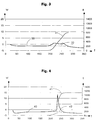
- the thermal power W in W / g of active material is given on the left ordinate, the cumulative thermal energy E in J / g of active material on the right ordinate, and on the abscissa the temperature T in ° C.
- the materials were synthesized from a mixture of metal salts in stoichiometric proportions to which was added a carbonated promoter, such as for example hydrogen carbonate. After reaction, the precipitate obtained is filtered and dried. Lithium carbonate is then used as a lithiation agent which is mechanically mechanically mixed with the carbonated promoter in stoichiometric proportions. A treatment The heat is then carried out in an oven under oxygen circulation at 900 ° C. for 24 hours.
- a carbonated promoter such as for example hydrogen carbonate.
- Table 2 gives, for each of the compositions of Table 1, the values of a, b, c, x, y, z, n Li , n MA and ox , that of the relation R, and the amount of residual lithium at overloaded state.
- the active ingredients in Tables 1 and 2 were analyzed by X-ray diffraction using Ka-line of copper.
- Table 3 gives the values of line widths at mid-height and the intensity ratio lines [003] and [104].
- the active ingredients of Examples 1 to 12 are almost single-phase. An example of the spectrum obtained is shown by the figure 1 , on which curve 10 represents the X-ray diffraction spectrum of the active ingredient of Example 8.
- Table 5 gives for each of the compositions of Table 4 the values of a, b, c, x, y, z, n Li , n MA and ox , that of the relation R, and the amount of residual lithium at overloaded state.
- a rechargeable lithium generator positive electrode is made in the following manner.
- a paste is prepared by mixing 86% by weight of electrochemically active material, 6% by weight of polyvinylidene fluoride (PVDF), and 8% by weight of a carbonaceous conductive material, preferably a mixture of 4% soot and 4% graphite, in N-methylpyrrolidone (NMP).
- PVDF polyvinylidene fluoride
- NMP N-methylpyrrolidone
- the previously prepared positive electrode is used to make a button-type rechargeable electrochemical generator.
- the negative electrode consists of a sheet of lithium metal.
- the separator used is a polyethylene (PE) membrane marketed by the company "CELGARD”.
- the accumulator is impregnated with an electrolyte which is a mixture of propylene carbonate, ethylene carbonate and dimethyl carbonate PC / EC / DMC in the proportions by volume 1/1/3, and containing hexafluorophosphate of LiPF 6 lithium at 1M concentration.
- the assembly of the generator and its filling electrolyte are carried out in glove box under argon atmosphere free of moisture.
- Electrochemically evaluated generators made previously containing the active ingredients of Examples 1 to 12 on the one hand, and those of Comparative Examples 1 to 17 on the other hand.
- the first load is carried out at Ic / 20 (where Ic is the theoretical current required to discharge the rated capacity Cn of the generator in one hour) up to 4.3V, followed by a discharge at Ic / 20 up to 3V .
- the second charge takes place in two phases.
- the first phase consists of a load at Ic / 20 up to 4.3V.
- the second phase consists of charging at Ic / 5 for 5 hours.
- the derivative of the generator voltage is plotted against the time dU / dt as a function of the charged capacitor C2 during the second phase.
- An example is a curve 20 obtained where the overloaded capacity Cs is indicated.
- Curve 20 In the second phase, when the material no longer accepts the charge, the voltage stabilizes at a certain value corresponding to the oxidation of the electrolyte. Curve 20 therefore has a plateau corresponding to the decomposition of the electrolyte. When the voltage stabilizes, the derivative thus becomes close to 0.
- the overloaded capacitor Cs corresponds to the capacity charged from the beginning of the second phase to the start of the plateau.
- the total capacity loadable by the active ingredient is estimated by adding the capacity loaded during the first phase C1 to the overloaded capacity Cs thus determined.
- Tables 7 and 8 below give, respectively for Examples 1 to 12 and for Comparative Examples 1 to 17, the capacitor C1 charged during the first phase; the overloaded capacity Cs, as well as the total capacity Ct (sum of capacities C1 and Cs), expressed in mAh / g of active material.
- the capacitor C1 charged during the first charge is less than or equal to 115 mAh / g.
- the capacity C1 is greater than or equal to 134 mAh / g.
- the electrochemical generators containing active substances according to the present invention simultaneously have on the one hand a charged capacity C1 during the first phase which is high, and secondly an overchargeable capacitor Cs and a total capacitance to the capacitor. overloaded state and much lower than the active materials not forming part of the invention. Therefore, the active materials according to the present invention provide the generator with improved overload characteristics over known active materials.
- D.S.C differential scanning calorimetry
- Differential Scanning Calorimetry is a technique that determines the variation of heat flow in a sample subjected to temperature programming. When a material is heated or cooled, its structure evolves and transformations are realized with heat exchange. In the present case, an exothermic reaction is observed between the oxygen released by the positive material and the electrolyte.
- the analysis "D.S.C.” provides information on the transformation temperature (endothermic peak or exothermic peak) and on the heat energy required for the transformation (peak area).
- An electrode impregnated with an electrolyte of volume composition PC / EC / DMC 1/1/3, 1M LiPF 6 is used .
- 3 mg of active material is collected in the charged state on the positive electrode impregnated with electrolyte.
- the sample of active material is placed in a crucible which is then crimped under argon.
- the sample of active ingredient is heated to 20 ° C at 500 ° C at a rate of 10 ° C / min under argon.
- the DSC analysis provides information on the thermal stability in the charged state of the active substance, thus on the behavior of the electrode with respect to the electrolyte.
- the figure 3 represents, as a function of the temperature T, a thermal power curve W, a total thermal energy curve E, and a curve representing the baseline used for the calculation of the energy E which are derived from the test DSC of an electrode comprising as active material the insertion compound Li [Ni 0.38 Co 0.12 Mn 0.35 Li 0.13 Al 0.02 ] O 2 of Example 6 according to the invention.
- the figure 4 represents, as a function of the temperature T, a curve 40 of thermal power W, a curve 41 of total thermal energy E, and a curve 32 representing the baseline used for the calculation of the energy E which are derived from the test DSC of an electrode comprising as active material the insertion compound Li [(Ni 0.54 Co 0.15 Mn 0.30 Al 0.01 ] O 2 of Comparative Example C1.
- the results of the DSC test show that the active ingredient of Example 6 has a higher thermal stability than the active ingredient of Comparative Example C1 which does not form part of the invention.
- the comparative active ingredient C1 has a thermal power amplitude of the order of 15W / g with a cumulative thermal energy of 1200J / g while the active ingredient of Example 6 has a thermal power of less than 5W / g and a cumulative thermal energy of less than 800J / g.
- the active material according to the present invention of Example 6 thus has very improved thermal stability characteristics compared to the activated material of Comparative Example C1.
Landscapes
- Chemical & Material Sciences (AREA)
- Chemical Kinetics & Catalysis (AREA)
- Electrochemistry (AREA)
- General Chemical & Material Sciences (AREA)
- Inorganic Chemistry (AREA)
- Engineering & Computer Science (AREA)
- Materials Engineering (AREA)
- Manufacturing & Machinery (AREA)
- Battery Electrode And Active Subsutance (AREA)
- Secondary Cells (AREA)
- Inorganic Compounds Of Heavy Metals (AREA)
Applications Claiming Priority (2)
| Application Number | Priority Date | Filing Date | Title |
|---|---|---|---|
| FR0311866A FR2860922B1 (fr) | 2003-10-10 | 2003-10-10 | Matiere electrochimiquement active pour electrode positive de generateur electrochimique rechargeable au lithium |
| FR0311866 | 2003-10-10 |
Publications (3)
| Publication Number | Publication Date |
|---|---|
| EP1523052A2 EP1523052A2 (fr) | 2005-04-13 |
| EP1523052A3 EP1523052A3 (fr) | 2009-01-07 |
| EP1523052B1 true EP1523052B1 (fr) | 2018-05-09 |
Family
ID=34307522
Family Applications (1)
| Application Number | Title | Priority Date | Filing Date |
|---|---|---|---|
| EP04292397.9A Expired - Lifetime EP1523052B1 (fr) | 2003-10-10 | 2004-10-08 | Matière électrochimiquement active pour électrode positive de générateur électrochimique rechargeable au lithium |
Country Status (4)
| Country | Link |
|---|---|
| US (1) | US7285357B2 (enExample) |
| EP (1) | EP1523052B1 (enExample) |
| JP (1) | JP4965068B2 (enExample) |
| FR (1) | FR2860922B1 (enExample) |
Families Citing this family (37)
| Publication number | Priority date | Publication date | Assignee | Title |
|---|---|---|---|---|
| US6623886B2 (en) * | 1999-12-29 | 2003-09-23 | Kimberly-Clark Worldwide, Inc. | Nickel-rich quaternary metal oxide materials as cathodes for lithium-ion and lithium-ion polymer batteries |
| JP4625733B2 (ja) * | 2005-07-26 | 2011-02-02 | 株式会社東芝 | 非水電解質二次電池及び電池パック |
| JP4625744B2 (ja) | 2005-09-29 | 2011-02-02 | 株式会社東芝 | 非水電解質電池および電池パック |
| KR20080108222A (ko) | 2006-04-07 | 2008-12-12 | 미쓰비시 가가꾸 가부시키가이샤 | 리튬 이차 전지 정극 재료용 리튬 천이 금속계 화합물분체, 그 제조 방법, 그 분무 건조체 및 그 소성 전구체,그리고, 그것을 사용한 리튬 이차 전지용 정극 및 리튬이차 전지 |
| JP5013508B2 (ja) * | 2006-07-05 | 2012-08-29 | 日立マクセルエナジー株式会社 | 非水電解液二次電池 |
| US20080280205A1 (en) * | 2007-05-07 | 2008-11-13 | 3M Innovative Properties Company | Lithium mixed metal oxide cathode compositions and lithium-ion electrochemical cells incorporating same |
| CN102769130A (zh) | 2007-09-04 | 2012-11-07 | 三菱化学株式会社 | 锂过渡金属类化合物粉末 |
| KR20110076955A (ko) * | 2008-09-30 | 2011-07-06 | 엔비아 시스템즈 인코포레이티드 | 비용량이 높은 불소 도핑된 리튬 풍부 금속 산화물 양극 배터리 재료 및 상당하는 배터리 |
| US8389160B2 (en) * | 2008-10-07 | 2013-03-05 | Envia Systems, Inc. | Positive electrode materials for lithium ion batteries having a high specific discharge capacity and processes for the synthesis of these materials |
| FR2937633B1 (fr) | 2008-10-24 | 2010-11-19 | Saft Groupe Sa | Materiau d'electrode positive pour accumulateur lithium-ion |
| KR101190226B1 (ko) | 2008-11-19 | 2012-10-11 | 코스모신소재 주식회사 | 리튬 이차전지용 양극활물질, 그의 제조방법 및 이를 포함한 리튬 이차전지 |
| US8465873B2 (en) | 2008-12-11 | 2013-06-18 | Envia Systems, Inc. | Positive electrode materials for high discharge capacity lithium ion batteries |
| JP2013503449A (ja) * | 2009-08-27 | 2013-01-31 | エンビア・システムズ・インコーポレイテッド | 金属酸化物でコーティングされたリチウム系電池用正極材料 |
| KR20120089845A (ko) | 2009-08-27 | 2012-08-14 | 엔비아 시스템즈 인코포레이티드 | 높은 비용량과 우수한 사이클링을 갖는 층-층 리튬-리치 복합 금속 산화물 |
| US9843041B2 (en) * | 2009-11-11 | 2017-12-12 | Zenlabs Energy, Inc. | Coated positive electrode materials for lithium ion batteries |
| WO2011114534A1 (ja) * | 2010-03-19 | 2011-09-22 | トヨタ自動車株式会社 | リチウム二次電池および該リチウム二次電池用正極活物質 |
| CN104701525B (zh) * | 2010-03-19 | 2017-04-26 | 丰田自动车株式会社 | 锂二次电池和该锂二次电池用正极活性物质 |
| US8741484B2 (en) | 2010-04-02 | 2014-06-03 | Envia Systems, Inc. | Doped positive electrode active materials and lithium ion secondary battery constructed therefrom |
| US8928286B2 (en) | 2010-09-03 | 2015-01-06 | Envia Systems, Inc. | Very long cycling of lithium ion batteries with lithium rich cathode materials |
| US8663849B2 (en) | 2010-09-22 | 2014-03-04 | Envia Systems, Inc. | Metal halide coatings on lithium ion battery positive electrode materials and corresponding batteries |
| CN102157733A (zh) * | 2011-03-10 | 2011-08-17 | 江苏科捷锂电池有限公司 | 锰基层状晶体结构锂电池正极材料及其制备方法 |
| WO2013090263A1 (en) | 2011-12-12 | 2013-06-20 | Envia Systems, Inc. | Lithium metal oxides with multiple phases and stable high energy electrochemical cycling |
| US9070489B2 (en) | 2012-02-07 | 2015-06-30 | Envia Systems, Inc. | Mixed phase lithium metal oxide compositions with desirable battery performance |
| CN102623688A (zh) * | 2012-03-23 | 2012-08-01 | 江苏科捷锂电池有限公司 | 纳米层状富锂材料的制备方法及表面修饰方法 |
| US9552901B2 (en) | 2012-08-17 | 2017-01-24 | Envia Systems, Inc. | Lithium ion batteries with high energy density, excellent cycling capability and low internal impedance |
| US10115962B2 (en) | 2012-12-20 | 2018-10-30 | Envia Systems, Inc. | High capacity cathode material with stabilizing nanocoatings |
| KR101785262B1 (ko) * | 2013-07-08 | 2017-10-16 | 삼성에스디아이 주식회사 | 양극 활물질, 그 제조방법, 이를 채용한 양극 및 리튬이차전지 |
| JP6406049B2 (ja) | 2014-03-26 | 2018-10-17 | 株式会社デンソー | 正極材料,非水電解質二次電池用正極及び非水電解質二次電池 |
| KR102358438B1 (ko) * | 2014-12-30 | 2022-02-04 | 삼성전자주식회사 | 복합 양극 활물질, 그 제조방법, 이를 포함하는 양극 및 리튬이차전지 |
| GB2566473B (en) | 2017-09-14 | 2020-03-04 | Dyson Technology Ltd | Magnesium salts |
| GB2566472B (en) | 2017-09-14 | 2020-03-04 | Dyson Technology Ltd | Magnesium salts |
| GB2569387B (en) | 2017-12-18 | 2022-02-02 | Dyson Technology Ltd | Electrode |
| GB2569388B (en) | 2017-12-18 | 2022-02-02 | Dyson Technology Ltd | Compound |
| GB2569392B (en) | 2017-12-18 | 2022-01-26 | Dyson Technology Ltd | Use of aluminium in a cathode material |
| GB2569390A (en) | 2017-12-18 | 2019-06-19 | Dyson Technology Ltd | Compound |
| GB2569389B (en) * | 2017-12-18 | 2022-02-09 | Dyson Technology Ltd | Compound |
| WO2021260900A1 (ja) * | 2020-06-25 | 2021-12-30 | TeraWatt Technology株式会社 | リチウム2次電池、及びその使用方法 |
Citations (1)
| Publication number | Priority date | Publication date | Assignee | Title |
|---|---|---|---|---|
| US20030022063A1 (en) * | 2000-09-14 | 2003-01-30 | Paulsen Jens Martin | Lithiated oxide materials and methods of manufacture |
Family Cites Families (9)
| Publication number | Priority date | Publication date | Assignee | Title |
|---|---|---|---|---|
| JPH0878009A (ja) * | 1994-09-07 | 1996-03-22 | Yuasa Corp | リチウム二次電池 |
| JP3624663B2 (ja) * | 1996-12-24 | 2005-03-02 | 株式会社日立製作所 | 電池 |
| JPH11307094A (ja) * | 1998-04-20 | 1999-11-05 | Chuo Denki Kogyo Co Ltd | リチウム二次電池用正極活物質とリチウム二次電池 |
| JP2002124261A (ja) * | 1999-11-29 | 2002-04-26 | Mitsui Chemicals Inc | リチウム二次電池用正極活物質および電池 |
| US6680143B2 (en) * | 2000-06-22 | 2004-01-20 | The University Of Chicago | Lithium metal oxide electrodes for lithium cells and batteries |
| JP4635386B2 (ja) * | 2001-07-13 | 2011-02-23 | 株式会社Gsユアサ | 正極活物質およびこれを用いた非水電解質二次電池 |
| JP4109847B2 (ja) * | 2001-08-24 | 2008-07-02 | Agcセイミケミカル株式会社 | リチウム含有遷移金属複合酸化物およびその製造方法 |
| KR100420034B1 (ko) * | 2001-10-17 | 2004-02-25 | 삼성에스디아이 주식회사 | 리튬 이차 전지용 양극 활물질의 제조방법 |
| EP2367224B1 (en) * | 2002-03-25 | 2013-01-09 | Sumitomo Chemical Company, Limited | Method for preparing positive electrode active material for non-aqueous secondary battery |
-
2003
- 2003-10-10 FR FR0311866A patent/FR2860922B1/fr not_active Expired - Fee Related
-
2004
- 2004-10-08 EP EP04292397.9A patent/EP1523052B1/fr not_active Expired - Lifetime
- 2004-10-08 JP JP2004295689A patent/JP4965068B2/ja not_active Expired - Lifetime
- 2004-10-08 US US10/960,066 patent/US7285357B2/en not_active Expired - Lifetime
Patent Citations (1)
| Publication number | Priority date | Publication date | Assignee | Title |
|---|---|---|---|---|
| US20030022063A1 (en) * | 2000-09-14 | 2003-01-30 | Paulsen Jens Martin | Lithiated oxide materials and methods of manufacture |
Also Published As
| Publication number | Publication date |
|---|---|
| US20050112466A1 (en) | 2005-05-26 |
| FR2860922B1 (fr) | 2009-07-31 |
| JP4965068B2 (ja) | 2012-07-04 |
| JP2005150093A (ja) | 2005-06-09 |
| EP1523052A2 (fr) | 2005-04-13 |
| US7285357B2 (en) | 2007-10-23 |
| FR2860922A1 (fr) | 2005-04-15 |
| EP1523052A3 (fr) | 2009-01-07 |
Similar Documents
| Publication | Publication Date | Title |
|---|---|---|
| EP1523052A2 (fr) | Matière électrochimiquement active pour électrode positive de générateur électrochimique rechargeable au lithium | |
| JP7454502B2 (ja) | 高容量、高エネルギー密度及び長期サイクル寿命性能を達成する、リチウムイオンセルのための酸化ケイ素活性材料を用いた電極 | |
| Kim et al. | The insertion mechanism of lithium into Mg2Si anode material for Li‐ion batteries | |
| EP1734601B1 (en) | Nonaqueous electrolyte secondary battery | |
| EP1917691B1 (fr) | Materiau d'electrode positive haute tension de structure spinelle a base de nickel et de manganese pour accumulateurs au lithium | |
| CA2428090C (fr) | Particules a base de li4ti5o12, de li(4-.alpha.)z.alpha.ti5o12, ou li4z.beta.ti(5-.beta.)o12, leurs procedes d'obtention et leur utilisation dans des dispositifs electrochimiques | |
| EP3703174B1 (fr) | Composition d'électrolyte pour élément électrochimique lithium-ion | |
| US11973178B2 (en) | Lithium ion cells with high performance electrolyte and silicon oxide active materials achieving very long cycle life performance | |
| US20100154206A1 (en) | Process for making composite lithium powders for batteries | |
| EP3905405A1 (en) | Battery | |
| JP7614122B2 (ja) | 非常に長いサイクル寿命性能を達成する、高性能電解質及び酸化ケイ素活性材料を有するリチウムイオンセル | |
| FR2873496A1 (fr) | Electrode pour accumulateur au lithium, procede de fabrication d'une telle electrode et accumulateur au lithium comportant une telle electrode | |
| JP4879226B2 (ja) | リチウム二次電池用正極活物質及びその製造方法 | |
| EP1531506B1 (fr) | Matière électrochimiquement active pour électrode positive de générateur électrochimique rechargeable au lithium | |
| EP2179968A1 (fr) | Materiau d'electrode positive pour accumulateur lithium-ion | |
| FR2775124A1 (fr) | Accumulateur au lithium, composition cathodique et cathode pour accumulateur au lithium | |
| US10615408B1 (en) | Hybrid primary lithium battery | |
| EP1548861A1 (fr) | Matière électrochimiquement active pour électrode positive de générateur électrochimique rechargeable au lithium | |
| US11264612B2 (en) | Positive electrode composition for non-aqueous secondary battery comprising titanium boride particles | |
| US20100159324A1 (en) | Lithium powders for batteries | |
| EP1860713B1 (fr) | Composé d'insertion du lithium utilisable comme matière active cathodique d'un générateur électrochimique rechargeable au lithium | |
| EP2895428B1 (fr) | Materiau d'electrode positive pour accumulateur lithium-ion | |
| CN114586194B (zh) | 锂离子电池以及用于制造锂离子电池的方法 | |
| JP2023506031A (ja) | リチウムイオン電池およびリチウムイオン電池の製造方法 | |
| CN100438199C (zh) | 电池 |
Legal Events
| Date | Code | Title | Description |
|---|---|---|---|
| PUAI | Public reference made under article 153(3) epc to a published international application that has entered the european phase |
Free format text: ORIGINAL CODE: 0009012 |
|
| AK | Designated contracting states |
Kind code of ref document: A2 Designated state(s): AT BE BG CH CY CZ DE DK EE ES FI FR GB GR HU IE IT LI LU MC NL PL PT RO SE SI SK TR |
|
| AX | Request for extension of the european patent |
Extension state: AL HR LT LV MK |
|
| RIN1 | Information on inventor provided before grant (corrected) |
Inventor name: JORDY, CHRISTIAN Inventor name: BIENSAN, PHILIPPE Inventor name: BOEUVE, JEAN-PIERRE Inventor name: AUDRY, CLAUDETTE Inventor name: LECERF, ANDRE |
|
| RTI1 | Title (correction) |
Free format text: ELECTROCHEMICAL ACTIVE MATERIAL FOR POSITIVE ELECTRODE OF LITHIUM RECHARGEABLE ELECTROCHEMICAL GENERATOR |
|
| PUAL | Search report despatched |
Free format text: ORIGINAL CODE: 0009013 |
|
| AK | Designated contracting states |
Kind code of ref document: A3 Designated state(s): AT BE BG CH CY CZ DE DK EE ES FI FR GB GR HU IE IT LI LU MC NL PL PT RO SE SI SK TR |
|
| AX | Request for extension of the european patent |
Extension state: AL HR LT LV MK |
|
| 17P | Request for examination filed |
Effective date: 20090707 |
|
| 17Q | First examination report despatched |
Effective date: 20090729 |
|
| AKX | Designation fees paid |
Designated state(s): DE FR GB |
|
| RIC1 | Information provided on ipc code assigned before grant |
Ipc: H01M 4/587 20100101ALN20170927BHEP Ipc: H01M 4/525 20100101ALI20170927BHEP Ipc: H01M 4/1391 20100101ALN20170927BHEP Ipc: H01M 4/505 20100101ALI20170927BHEP Ipc: H01M 4/131 20100101AFI20170927BHEP |
|
| REG | Reference to a national code |
Ref country code: DE Ref legal event code: R079 Ref document number: 602004052684 Country of ref document: DE Free format text: PREVIOUS MAIN CLASS: H01M0004480000 Ipc: H01M0004131000 |
|
| RIC1 | Information provided on ipc code assigned before grant |
Ipc: H01M 4/587 20100101ALI20171023BHEP Ipc: H01M 4/525 20100101ALI20171023BHEP Ipc: H01M 4/1391 20100101ALN20171023BHEP Ipc: H01M 4/131 20100101AFI20171023BHEP Ipc: H01M 4/48 20100101ALI20171023BHEP Ipc: H01M 10/0525 20100101ALI20171023BHEP Ipc: H01M 4/505 20100101ALI20171023BHEP |
|
| GRAP | Despatch of communication of intention to grant a patent |
Free format text: ORIGINAL CODE: EPIDOSNIGR1 |
|
| INTG | Intention to grant announced |
Effective date: 20171208 |
|
| RIC1 | Information provided on ipc code assigned before grant |
Ipc: H01M 4/1391 20100101ALN20171128BHEP Ipc: H01M 4/587 20100101ALI20171128BHEP Ipc: H01M 4/48 20100101ALI20171128BHEP Ipc: H01M 10/0525 20100101ALI20171128BHEP Ipc: H01M 4/525 20100101ALI20171128BHEP Ipc: H01M 4/505 20100101ALI20171128BHEP Ipc: H01M 4/131 20100101AFI20171128BHEP |
|
| GRAS | Grant fee paid |
Free format text: ORIGINAL CODE: EPIDOSNIGR3 |
|
| GRAA | (expected) grant |
Free format text: ORIGINAL CODE: 0009210 |
|
| AK | Designated contracting states |
Kind code of ref document: B1 Designated state(s): DE FR GB |
|
| REG | Reference to a national code |
Ref country code: GB Ref legal event code: FG4D Free format text: NOT ENGLISH |
|
| REG | Reference to a national code |
Ref country code: DE Ref legal event code: R096 Ref document number: 602004052684 Country of ref document: DE |
|
| REG | Reference to a national code |
Ref country code: FR Ref legal event code: PLFP Year of fee payment: 15 |
|
| REG | Reference to a national code |
Ref country code: DE Ref legal event code: R097 Ref document number: 602004052684 Country of ref document: DE |
|
| PGFP | Annual fee paid to national office [announced via postgrant information from national office to epo] |
Ref country code: CH Payment date: 20181204 Year of fee payment: 11 |
|
| PLBE | No opposition filed within time limit |
Free format text: ORIGINAL CODE: 0009261 |
|
| STAA | Information on the status of an ep patent application or granted ep patent |
Free format text: STATUS: NO OPPOSITION FILED WITHIN TIME LIMIT |
|
| 26N | No opposition filed |
Effective date: 20190212 |
|
| PGFP | Annual fee paid to national office [announced via postgrant information from national office to epo] |
Ref country code: DE Payment date: 20191029 Year of fee payment: 16 |
|
| GBPC | Gb: european patent ceased through non-payment of renewal fee |
Effective date: 20191008 |
|
| PG25 | Lapsed in a contracting state [announced via postgrant information from national office to epo] |
Ref country code: GB Free format text: LAPSE BECAUSE OF NON-PAYMENT OF DUE FEES Effective date: 20191008 |
|
| REG | Reference to a national code |
Ref country code: DE Ref legal event code: R119 Ref document number: 602004052684 Country of ref document: DE |
|
| PG25 | Lapsed in a contracting state [announced via postgrant information from national office to epo] |
Ref country code: DE Free format text: LAPSE BECAUSE OF NON-PAYMENT OF DUE FEES Effective date: 20210501 |
|
| PGFP | Annual fee paid to national office [announced via postgrant information from national office to epo] |
Ref country code: FR Payment date: 20221005 Year of fee payment: 19 |
|
| PG25 | Lapsed in a contracting state [announced via postgrant information from national office to epo] |
Ref country code: FR Free format text: LAPSE BECAUSE OF NON-PAYMENT OF DUE FEES Effective date: 20231031 |