EP1520917A2 - Faser und dessen Herstellungsverfahren aus hochmodularem extrudierbaren Polyethylen - Google Patents
Faser und dessen Herstellungsverfahren aus hochmodularem extrudierbaren Polyethylen Download PDFInfo
- Publication number
- EP1520917A2 EP1520917A2 EP04256125A EP04256125A EP1520917A2 EP 1520917 A2 EP1520917 A2 EP 1520917A2 EP 04256125 A EP04256125 A EP 04256125A EP 04256125 A EP04256125 A EP 04256125A EP 1520917 A2 EP1520917 A2 EP 1520917A2
- Authority
- EP
- European Patent Office
- Prior art keywords
- fiber
- polyethylene
- modulus
- tenacity
- extrudable
- Prior art date
- Legal status (The legal status is an assumption and is not a legal conclusion. Google has not performed a legal analysis and makes no representation as to the accuracy of the status listed.)
- Granted
Links
- 239000000835 fiber Substances 0.000 title claims abstract description 85
- 229920000573 polyethylene Polymers 0.000 title claims abstract description 74
- 238000000034 method Methods 0.000 title claims abstract description 52
- 239000004698 Polyethylene Substances 0.000 claims abstract description 76
- -1 polyethylene Polymers 0.000 claims abstract description 76
- 229920000785 ultra high molecular weight polyethylene Polymers 0.000 claims abstract description 17
- 238000010438 heat treatment Methods 0.000 claims abstract description 7
- 239000003960 organic solvent Substances 0.000 claims abstract description 7
- 238000001816 cooling Methods 0.000 claims abstract description 6
- TWRXJAOTZQYOKJ-UHFFFAOYSA-L Magnesium chloride Chemical compound [Mg+2].[Cl-].[Cl-] TWRXJAOTZQYOKJ-UHFFFAOYSA-L 0.000 claims description 40
- VGGSQFUCUMXWEO-UHFFFAOYSA-N Ethene Chemical compound C=C VGGSQFUCUMXWEO-UHFFFAOYSA-N 0.000 claims description 32
- 239000005977 Ethylene Substances 0.000 claims description 32
- PNEYBMLMFCGWSK-UHFFFAOYSA-N aluminium oxide Inorganic materials [O-2].[O-2].[O-2].[Al+3].[Al+3] PNEYBMLMFCGWSK-UHFFFAOYSA-N 0.000 claims description 24
- 229910001629 magnesium chloride Inorganic materials 0.000 claims description 20
- 239000003054 catalyst Substances 0.000 claims description 17
- 238000006116 polymerization reaction Methods 0.000 claims description 17
- 238000006243 chemical reaction Methods 0.000 claims description 9
- 239000011148 porous material Substances 0.000 claims description 8
- 239000000203 mixture Substances 0.000 claims description 6
- FYYHWMGAXLPEAU-UHFFFAOYSA-N Magnesium Chemical compound [Mg] FYYHWMGAXLPEAU-UHFFFAOYSA-N 0.000 claims description 4
- 229910052749 magnesium Inorganic materials 0.000 claims description 4
- 239000011777 magnesium Substances 0.000 claims description 4
- 239000003426 co-catalyst Substances 0.000 claims description 3
- 238000004090 dissolution Methods 0.000 claims description 2
- 239000003701 inert diluent Substances 0.000 claims description 2
- ZMZGFLUUZLELNE-UHFFFAOYSA-N 2,3,5-triiodobenzoic acid Chemical compound OC(=O)C1=CC(I)=CC(I)=C1I ZMZGFLUUZLELNE-UHFFFAOYSA-N 0.000 claims 1
- 238000001035 drying Methods 0.000 claims 1
- 230000007928 solubilization Effects 0.000 abstract 1
- 238000005063 solubilization Methods 0.000 abstract 1
- 238000001125 extrusion Methods 0.000 description 20
- 229920000642 polymer Polymers 0.000 description 19
- 239000000047 product Substances 0.000 description 13
- 239000004699 Ultra-high molecular weight polyethylene Substances 0.000 description 11
- UFHFLCQGNIYNRP-UHFFFAOYSA-N Hydrogen Chemical compound [H][H] UFHFLCQGNIYNRP-UHFFFAOYSA-N 0.000 description 9
- 238000001891 gel spinning Methods 0.000 description 9
- 239000001257 hydrogen Substances 0.000 description 9
- 229910052739 hydrogen Inorganic materials 0.000 description 9
- VLKZOEOYAKHREP-UHFFFAOYSA-N n-Hexane Chemical compound CCCCCC VLKZOEOYAKHREP-UHFFFAOYSA-N 0.000 description 8
- VOITXYVAKOUIBA-UHFFFAOYSA-N triethylaluminium Chemical compound CC[Al](CC)CC VOITXYVAKOUIBA-UHFFFAOYSA-N 0.000 description 8
- 239000000463 material Substances 0.000 description 7
- 238000002360 preparation method Methods 0.000 description 7
- 239000002904 solvent Substances 0.000 description 7
- 238000009826 distribution Methods 0.000 description 6
- 238000005516 engineering process Methods 0.000 description 6
- ATRRKUHOCOJYRX-UHFFFAOYSA-N Ammonium bicarbonate Chemical compound [NH4+].OC([O-])=O ATRRKUHOCOJYRX-UHFFFAOYSA-N 0.000 description 5
- 239000001099 ammonium carbonate Substances 0.000 description 5
- 238000004519 manufacturing process Methods 0.000 description 5
- 238000002844 melting Methods 0.000 description 5
- 230000008018 melting Effects 0.000 description 5
- 229920000728 polyester Polymers 0.000 description 5
- 229920000098 polyolefin Polymers 0.000 description 5
- 239000000243 solution Substances 0.000 description 5
- 239000010936 titanium Substances 0.000 description 5
- XJDNKRIXUMDJCW-UHFFFAOYSA-J titanium tetrachloride Chemical compound Cl[Ti](Cl)(Cl)Cl XJDNKRIXUMDJCW-UHFFFAOYSA-J 0.000 description 5
- XLYOFNOQVPJJNP-UHFFFAOYSA-N water Substances O XLYOFNOQVPJJNP-UHFFFAOYSA-N 0.000 description 5
- VCNTUJWBXWAWEJ-UHFFFAOYSA-J aluminum;sodium;dicarbonate Chemical compound [Na+].[Al+3].[O-]C([O-])=O.[O-]C([O-])=O VCNTUJWBXWAWEJ-UHFFFAOYSA-J 0.000 description 4
- 229910001647 dawsonite Inorganic materials 0.000 description 4
- NNBZCPXTIHJBJL-UHFFFAOYSA-N decalin Chemical compound C1CCCC2CCCCC21 NNBZCPXTIHJBJL-UHFFFAOYSA-N 0.000 description 4
- MTZQAGJQAFMTAQ-UHFFFAOYSA-N ethyl benzoate Chemical compound CCOC(=O)C1=CC=CC=C1 MTZQAGJQAFMTAQ-UHFFFAOYSA-N 0.000 description 4
- 229910000013 Ammonium bicarbonate Inorganic materials 0.000 description 3
- VHUUQVKOLVNVRT-UHFFFAOYSA-N Ammonium hydroxide Chemical compound [NH4+].[OH-] VHUUQVKOLVNVRT-UHFFFAOYSA-N 0.000 description 3
- 239000004743 Polypropylene Substances 0.000 description 3
- 229910003074 TiCl4 Inorganic materials 0.000 description 3
- 238000005299 abrasion Methods 0.000 description 3
- DIZPMCHEQGEION-UHFFFAOYSA-H aluminium sulfate (anhydrous) Chemical compound [Al+3].[Al+3].[O-]S([O-])(=O)=O.[O-]S([O-])(=O)=O.[O-]S([O-])(=O)=O DIZPMCHEQGEION-UHFFFAOYSA-H 0.000 description 3
- 235000012538 ammonium bicarbonate Nutrition 0.000 description 3
- 239000000908 ammonium hydroxide Substances 0.000 description 3
- 238000001354 calcination Methods 0.000 description 3
- 239000000725 suspension Substances 0.000 description 3
- QGZKDVFQNNGYKY-UHFFFAOYSA-O Ammonium Chemical compound [NH4+] QGZKDVFQNNGYKY-UHFFFAOYSA-O 0.000 description 2
- XKRFYHLGVUSROY-UHFFFAOYSA-N Argon Chemical compound [Ar] XKRFYHLGVUSROY-UHFFFAOYSA-N 0.000 description 2
- RTAQQCXQSZGOHL-UHFFFAOYSA-N Titanium Chemical compound [Ti] RTAQQCXQSZGOHL-UHFFFAOYSA-N 0.000 description 2
- 239000011954 Ziegler–Natta catalyst Substances 0.000 description 2
- XAGFODPZIPBFFR-UHFFFAOYSA-N aluminium Chemical compound [Al] XAGFODPZIPBFFR-UHFFFAOYSA-N 0.000 description 2
- 229910052782 aluminium Inorganic materials 0.000 description 2
- 235000012501 ammonium carbonate Nutrition 0.000 description 2
- 239000002657 fibrous material Substances 0.000 description 2
- 239000000178 monomer Substances 0.000 description 2
- 229920001155 polypropylene Polymers 0.000 description 2
- 229910052719 titanium Inorganic materials 0.000 description 2
- MCULRUJILOGHCJ-UHFFFAOYSA-N triisobutylaluminium Chemical compound CC(C)C[Al](CC(C)C)CC(C)C MCULRUJILOGHCJ-UHFFFAOYSA-N 0.000 description 2
- PXXNTAGJWPJAGM-UHFFFAOYSA-N vertaline Natural products C1C2C=3C=C(OC)C(OC)=CC=3OC(C=C3)=CC=C3CCC(=O)OC1CC1N2CCCC1 PXXNTAGJWPJAGM-UHFFFAOYSA-N 0.000 description 2
- 229910002651 NO3 Inorganic materials 0.000 description 1
- NHNBFGGVMKEFGY-UHFFFAOYSA-N Nitrate Chemical compound [O-][N+]([O-])=O NHNBFGGVMKEFGY-UHFFFAOYSA-N 0.000 description 1
- XONJGPTWRYHOJS-UHFFFAOYSA-J [Pb+2].[Cl-].[Mg+2].[Cl-].[Cl-].[Cl-] Chemical compound [Pb+2].[Cl-].[Mg+2].[Cl-].[Cl-].[Cl-] XONJGPTWRYHOJS-UHFFFAOYSA-J 0.000 description 1
- 230000004308 accommodation Effects 0.000 description 1
- 230000003213 activating effect Effects 0.000 description 1
- 229910052786 argon Inorganic materials 0.000 description 1
- 239000007853 buffer solution Substances 0.000 description 1
- 230000003197 catalytic effect Effects 0.000 description 1
- 239000007795 chemical reaction product Substances 0.000 description 1
- 239000002131 composite material Substances 0.000 description 1
- 150000001875 compounds Chemical class 0.000 description 1
- 229920001577 copolymer Polymers 0.000 description 1
- 239000008367 deionised water Substances 0.000 description 1
- 229910021641 deionized water Inorganic materials 0.000 description 1
- 239000003085 diluting agent Substances 0.000 description 1
- 238000005553 drilling Methods 0.000 description 1
- 230000000694 effects Effects 0.000 description 1
- 230000007613 environmental effect Effects 0.000 description 1
- 238000007380 fibre production Methods 0.000 description 1
- 238000001914 filtration Methods 0.000 description 1
- 231100001261 hazardous Toxicity 0.000 description 1
- 229920006158 high molecular weight polymer Polymers 0.000 description 1
- 238000009863 impact test Methods 0.000 description 1
- 238000005470 impregnation Methods 0.000 description 1
- 239000011261 inert gas Substances 0.000 description 1
- 229920002521 macromolecule Polymers 0.000 description 1
- 239000000155 melt Substances 0.000 description 1
- 238000003801 milling Methods 0.000 description 1
- 238000002156 mixing Methods 0.000 description 1
- 238000005457 optimization Methods 0.000 description 1
- 239000002245 particle Substances 0.000 description 1
- 239000003208 petroleum Substances 0.000 description 1
- 229920013716 polyethylene resin Polymers 0.000 description 1
- 229920005594 polymer fiber Polymers 0.000 description 1
- 238000010094 polymer processing Methods 0.000 description 1
- 239000002952 polymeric resin Substances 0.000 description 1
- 229920005672 polyolefin resin Polymers 0.000 description 1
- 239000000843 powder Substances 0.000 description 1
- 239000002244 precipitate Substances 0.000 description 1
- 238000001556 precipitation Methods 0.000 description 1
- 239000002243 precursor Substances 0.000 description 1
- 238000003672 processing method Methods 0.000 description 1
- 238000011084 recovery Methods 0.000 description 1
- 238000009877 rendering Methods 0.000 description 1
- 230000000630 rising effect Effects 0.000 description 1
- 238000000935 solvent evaporation Methods 0.000 description 1
- 238000009987 spinning Methods 0.000 description 1
- 230000008961 swelling Effects 0.000 description 1
- 229920003002 synthetic resin Polymers 0.000 description 1
- 239000004753 textile Substances 0.000 description 1
- 238000007669 thermal treatment Methods 0.000 description 1
- 231100000331 toxic Toxicity 0.000 description 1
- 230000002588 toxic effect Effects 0.000 description 1
Images
Classifications
-
- D—TEXTILES; PAPER
- D01—NATURAL OR MAN-MADE THREADS OR FIBRES; SPINNING
- D01F—CHEMICAL FEATURES IN THE MANUFACTURE OF ARTIFICIAL FILAMENTS, THREADS, FIBRES, BRISTLES OR RIBBONS; APPARATUS SPECIALLY ADAPTED FOR THE MANUFACTURE OF CARBON FILAMENTS
- D01F6/00—Monocomponent artificial filaments or the like of synthetic polymers; Manufacture thereof
- D01F6/02—Monocomponent artificial filaments or the like of synthetic polymers; Manufacture thereof from homopolymers obtained by reactions only involving carbon-to-carbon unsaturated bonds
- D01F6/04—Monocomponent artificial filaments or the like of synthetic polymers; Manufacture thereof from homopolymers obtained by reactions only involving carbon-to-carbon unsaturated bonds from polyolefins
-
- C—CHEMISTRY; METALLURGY
- C08—ORGANIC MACROMOLECULAR COMPOUNDS; THEIR PREPARATION OR CHEMICAL WORKING-UP; COMPOSITIONS BASED THEREON
- C08F—MACROMOLECULAR COMPOUNDS OBTAINED BY REACTIONS ONLY INVOLVING CARBON-TO-CARBON UNSATURATED BONDS
- C08F110/00—Homopolymers of unsaturated aliphatic hydrocarbons having only one carbon-to-carbon double bond
- C08F110/02—Ethene
-
- Y—GENERAL TAGGING OF NEW TECHNOLOGICAL DEVELOPMENTS; GENERAL TAGGING OF CROSS-SECTIONAL TECHNOLOGIES SPANNING OVER SEVERAL SECTIONS OF THE IPC; TECHNICAL SUBJECTS COVERED BY FORMER USPC CROSS-REFERENCE ART COLLECTIONS [XRACs] AND DIGESTS
- Y10—TECHNICAL SUBJECTS COVERED BY FORMER USPC
- Y10T—TECHNICAL SUBJECTS COVERED BY FORMER US CLASSIFICATION
- Y10T428/00—Stock material or miscellaneous articles
- Y10T428/29—Coated or structually defined flake, particle, cell, strand, strand portion, rod, filament, macroscopic fiber or mass thereof
- Y10T428/2904—Staple length fiber
-
- Y—GENERAL TAGGING OF NEW TECHNOLOGICAL DEVELOPMENTS; GENERAL TAGGING OF CROSS-SECTIONAL TECHNOLOGIES SPANNING OVER SEVERAL SECTIONS OF THE IPC; TECHNICAL SUBJECTS COVERED BY FORMER USPC CROSS-REFERENCE ART COLLECTIONS [XRACs] AND DIGESTS
- Y10—TECHNICAL SUBJECTS COVERED BY FORMER USPC
- Y10T—TECHNICAL SUBJECTS COVERED BY FORMER US CLASSIFICATION
- Y10T428/00—Stock material or miscellaneous articles
- Y10T428/29—Coated or structually defined flake, particle, cell, strand, strand portion, rod, filament, macroscopic fiber or mass thereof
- Y10T428/2913—Rod, strand, filament or fiber
-
- Y—GENERAL TAGGING OF NEW TECHNOLOGICAL DEVELOPMENTS; GENERAL TAGGING OF CROSS-SECTIONAL TECHNOLOGIES SPANNING OVER SEVERAL SECTIONS OF THE IPC; TECHNICAL SUBJECTS COVERED BY FORMER USPC CROSS-REFERENCE ART COLLECTIONS [XRACs] AND DIGESTS
- Y10—TECHNICAL SUBJECTS COVERED BY FORMER USPC
- Y10T—TECHNICAL SUBJECTS COVERED BY FORMER US CLASSIFICATION
- Y10T428/00—Stock material or miscellaneous articles
- Y10T428/29—Coated or structually defined flake, particle, cell, strand, strand portion, rod, filament, macroscopic fiber or mass thereof
- Y10T428/2913—Rod, strand, filament or fiber
- Y10T428/298—Physical dimension
Definitions
- the present invention relates to a fiber and to a process for obtaining same from high-modulus, extrudable polyethylene through the extrusion of said polyethylene in the absence of any added organic solvents. More specifically, the process for obtaining the said fiber comprises melting and stretching in state-of-the-art equipment a polyethylene obtained through ethylene polymerization in the presence of a Ziegler-Natta catalyst on a mixed alumina-magnesium chloride support where the magnesium chloride amounts vary between 15% and 60% by weight, and the H 2 /ethylene ratio, between 6.0 and 1.2, the variation of these two parameters leading to polyethylene grades having different molecular weight (M w ) distributions, especially the amount of 10 5 ⁇ M w ⁇ 10 6 and M w >10 6 fractions, and different melt indices MI 21 .
- Grades having MI 21 melt index (test at 21.6 kg ) in the range of 0.5 to 8.0 g/10 min are able to be processed into high modulus fibers.
- the so-obtained alumina has a high pore volume while combining high surface area and high purity.
- features such as specific area, pore dimension and pore volume distribution in alumina are deeply linked to the catalytic activity of these particles.
- Alumina as described in the cited PI BR 8005302 has pore volume in excess of 1.0 cm 3 /g and surface area between 200 m 2 /g and 500 m 2 /g.
- the so-prepared alumina was used by the Applicant in the development of several processes for preparing polyethylene of varying characteristics, including ultra-high molecular weight polyethylene, a polymer the molecular weight M w of which is higher than 10 6 and MI 21 is zero.
- Pressure levels are 3 bar hydrogen and 6 bar ethylene, at temperatures between 80°C and 90°C, during one hour or more.
- the molecular weight distribution (Mw) of the obtained polyethylene products is in the range of 3.5 to 6.5 % by weight of the total chains having Mw higher than 10 6 and from 35 to 55 % by weight of the total chains having M w between 10 5 and 10 6 , with MI 21 between 0.32 and 0.10 g/10 minutes.
- polyester cables do not float in water, this being a drawback to the user.
- Gel spinning involves dissolving the polymer resin in an organic solvent such as decalin, a toxic and expensive product, and then processing the obtained solution into a fiber, with solvent evaporation/recovery.
- organic solvent such as decalin
- the overall process is of high cost and requires special measures related to hazards to humans and the environment caused by the solvents used.
- the gel spinning process is generally described in US patent 4,344,908, where it is taught a process for making polymer filaments of high tensile strength and high modulus through stretching of a polymer filament containing a substantial amount, at least 25wt %, of a solvent for the polymer at a temperature between the polymer swelling and melting points.
- This technology uses polymer filaments of various kinds, including polyolefins, of high and ultra high molecular weight, without specifying the kind of polyolefin or the preparation of a specific polyolefin.
- US patent 5,256,358 describes a method for preparing filaments from a commercial, ultra-high molecular weight polyethylene through extrusion and stretching. Based on a polyethylene of intrinsic viscosity of at least 3.5 dl/g, filaments are obtained having outer diameter between 0.1 and up to 10 mm and tensile strength of up to 100 kg/mm 2 . Also described is an extruder having a grooved cylinder having an extrusion orifice of L/D ratio of up to 100, such equipment allowing the extrusion of the polyethylene as threads or filaments. After extrusion, the polymer is drawn or stretched at draw ratios between 1.2/1.0 and 30/1, and the polymer is obtained as filaments.
- the polyethylene useful for the purposes of said patent is a commercial, ultra-high molecular weight polyethylene having intrinsic viscosity of up to 16.5 dl/g, melt index lower than 0.01 g/10 minutes, melting point 136°C and bulk density 0.45 g/cm 3 .
- US patent 5,256,358 describes therefore a non-conventional extrusion equipment as well as a processing method that make possible to process ultra-high molecular weight polyethylene commercial samples into threads or extrudable filaments, having a diameter of up to 10 mm.
- the obtained filaments are not exactly fibers, that normally have a lower diameter and where the tensile strength is expressed in linear density (tenacity).
- linear density tenacity
- US patent 5,246,657 teaches a process for obtaining ultra-high molecular weight polyethylene fibers from a mixture of two olefin resins, one of them being polyethylene and the other one, a copolymer of PE and PP, in the presence of a wax diluent to facilitate extrusion.
- the polyolefin mixture is extruded and stretched at a draw ratio of at least 10.
- the literature points out the polyethylene production technology yielding products of acceptable mechanical properties but which do not necessarily render these polyethylene products suitable for fiber manufacture and on the other hand, the polyethylene fiber production technology based on ultra-high molecular weight materials that can be extruded only when dissolved in organic solvents according to the gel spinning process.
- the technique still needs a process for obtaining fibers from high-modulus, extrudable polyethylene by extrusion and stretching in state-of-the-art equipment, where said polyethylene is obtained by an ethylene polymerization process where the control of the ethylene/hydrogen ratio during polymerization as well as process features such as the catalyst being supported on varying amounts of mixed alumina and magnesium chloride lead to polyethylene grades having such a molecular weight distribution Mw and melt index MI 21 values typical of high-modulus materials that are at the same time extrudable into fibers in the absence of any added solvents, such fibers and process for obtaining same being described and claimed in the present invention.
- the present invention deals with fibers and a process for obtaining same from high-modulus, extrudable polyethylene by extrusion and stretching in state-of-the-art equipment, in the absence of any added solvents, said polyethylene having tensile strength of at least 250 kgf/cm 2 .
- Such polyethylene is obtained by ethylene polymerization in the presence of a catalyst prepared from alumina admixed with magnesium chloride amounts between 15% and 60% by mass based on the total support mass, and where the ethylene/hydrogen ratio varies between 6.0 and 1.2, the variation of these two parameters leading to polyethylene grades having different molecular weight Mw distributions, especially the amount of 10 5 ⁇ M w ⁇ 10 6 and M w >10 6 fractions, and, consequently, having different melt indices.
- Grades having melt index MI 21 values in the range of 0.5 to 8.0 g/10 min are suitable for being processed into fibers useful in the naval and offshore industry.
- the process for obtaining the fibers from high-modulus, extrudable polyethylene comprises the following steps:
- the invention relates to so-obtained polyethylene fibers.
- the invention provides a process for obtaining fibers from high-modulus, extrudable polyethylene by extrusion and stretching of said extrudable polyethylene in state-of-the-art equipment.
- the invention also provides a process for obtaining fibers from high-modulus, extrudable polyethylene that dispenses with the previous dissolution of the polyethylene in any kind of organic solvent.
- the invention also provides a process for obtaining fibers from high-modulus, extrudable polyethylene, said polyethylene being obtained by ethylene polymerization in the presence of a catalyst based on a mixed alumina and magnesium chloride support in amounts between 15% and 60% by mass, and where the ethylene/hydrogen ratio varies between 6.0 and 1.2.
- the invention provides further the fibers from said high-modulus polyethylene, useful for offshore applications.
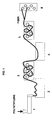
- FIGURE 1 attached is a flowsheet of the extrusion and stretching system adopted for obtaining fibers according to the invention.
- One aspect of the present invention is a process for obtaining fibers from high-modulus, extrudable polyethylene through extrusion and stretching in state-of-the-art equipment.
- the polyethylene useful for the process for obtaining fibers according to the invention should have tensile strength of at least 250 kgf/cm 2 .
- the polyethylene fibers of the invention are prepared by polyethylene processing, in the absence of any added organic solvent, in state-of-the-art polyethylene processing equipment.
- One useful equipment is a Brabender double screw extruder, with a temperature profile of 160-180-200-200°C.
- Haake extruder can be used, at a temperature profile of 150-240-280-295-290°C, screw velocity from 25 to 50 RPM, and orifice diameter 2.0 mm.
- an industrial extruder can be used having a temperature profile of 223-288-309-258-289°C, screw velocity 35.9 RPM, and orifice diameter 1.2 mm.
- the polyethylene resin is introduced in a state-of-the-art extruder 1 and after the extrusion carried out under the conditions outlined above, an extrudate is obtained.
- the extruded polyethylene or extrudate is then submitted to a stretching step.
- the process for obtaining the fiber from a high-modulus polyethylene comprises introducing the polymer into a state-of-the-art extruder 1 , and extruding said polyethylene under the extrusion conditions outlined above so as to obtain an extrudate.
- the so-obtained extrudate is then directed to a cooling bath 2 to be cooled, and once cooled, the same is directed to a first stretcher 3 to be stretched or drawn at a first velocity v 1 so as to obtain a fiber.
- the fiber is then heated in a heating bath 4 at a temperature close to 90°C and then directed to a second stretcher 5 where it is stretched or drawn at a final velocity v 2 , where v 1 ⁇ v 2 .
- the final fiber is recovered.
- stretchers 3 and 5 the fiber tenacity is increased.
- the ratio between the v 1 and v 2 velocities defines the so-called draw ratio.
- useful draw ratio values extend over a wide range, from values as low as 2/1 and up to 65/1, according to the particular features of the extruded material. Typical values are between 4/1 to 20/1.
- the purpose of the stretching is to cause orientation of the macromolecules' chains, this leading to a rise in fiber tenacity.
- the different stretching velocities v 1 and v 2 as well as the intermediate thermal treatment in heating bath 4 contribute to the tenacity rise caused by stretching and chain orientation, this rising the fiber tenacity.
- the heating step close to 90°C in heating bath 4 to which is submitted the fiber between the two stretching steps is designed to provide an accommodation of the partially oriented chains.
- the fiber product leaving stretchers 3 and 5 is stored in reels 6.
- the process according to the invention for obtaining fibers from a high-modulus, extrudable polyethylene is based on a Ziegler-type polymerization process where ethylene is polymerized under low-pressure conditions, in the presence of a catalyst prepared according to the teachings of the above-cited US patents 6,018,006 and US 6,133,188.
- ethylene/H 2 ratio is varied between 1.2 and 6.0.
- the ammonium dawsonite precursor of the alumina support is prepared.
- an ammonium bicarbonate buffer solution at pH 8.0 and concentration 23% by mass is slowly added to a 25% by mass aluminum sulfate solution, the pH being kept between 7.5 and 7.7 by means of a 1:1 ammonium hydroxide solution.
- the molar ratio of ammonium bicarbonate and aluminum sulfate is between 3.0 and 4.0.
- a basic aluminum and ammonium carbonate is obtained.
- the same compound can be also obtained through a variable pH process, without the addition of ammonium hydroxide to control pH.
- the gel-like precipitate is separated by filtration and washed with deionized water in order to be dried at 120°C and calcined at several temperatures, yielding then a gamma-alumina.
- the following calcination conditions were used: a fixed, horizontal bed; period, from 4 to 7 hours; temperature between 600°C to 600°C, under a slight flow of an inert gas such as argon.
- the alumina support pore volume and BET surface area properties are between 0.5 cm 3 /g and 1.5 cm 3 /g and 200 m 2 /g and 400 m 2 /g, respectively.
- a support suspension in 5 to 7.5 times by volume/TiCl 4 mass is prepared so that the final Ti content deposited is between 1.0 and 2.0 by mass based on the total mass.
- the excess TiCl 4 is washed off with n-hexane at 60°C.
- the ethylene polymerization reaction is carried out in a 4-liter capacity Parr reaction vessel containing an inert diluent such as n-hexane, a co-catalyst such as triethyl aluminum (TEA) or triisobutyl aluminum (TIBA), at Al/Ti ratios of from 10/1 up to 100/1 or 40/1 up to 100/1 respectively.
- Ethylene pressure varies between 6 and 8 bar while the H 2 pressure varies between 1.5 and 5 bar, so that the ethylene/H 2 ratio varies between 6.0 and 1.2.
- the temperature is kept between 75-95°C for one hour.
- the pressure in the reaction vessel is alleviated and the polymer is recovered as a n-hexane-suspended powder that is then decanted and oven-dried.
- the Applicant found that not only the variation of the MgCl 2 amount in the MgCl 2 /alumina mixture but also the variation of the ethylene/H 2 ratio influence the molecular weight distribution M w , so that some polyethylene grades have high-modulus features while at the same time being extrudable in state-of-the-art equipment, being thus useful for the preparation of fibers designed for offshore applications.
- the MI 21 (ASTM D-1238) test assesses, for the tested polymer under a mass of 21.6 kg, the melt flow index in g/10 minutes.
- MI 21 can vary, according to the invention, of from 0.5 up to 6.0 and even 8.0 g/10 minutes.
- the preparation of one or other grade will depend exclusively on the desired application of the end product.
- some specific grades for example, two grades having MI 21 of 1.6 and 0.9 g/10 minutes, are suitable for being processed into high-modulus fibers, having tenacity values that are respectively comparable to those of state-of-the-art polyethylene or polypropylene fibers, to be used in naval applications, or situated between those of polyester fibers and ultra-high molecular weight polyethylene used as offshore cables.
- Table 1 summarizes process variables for the preparation of the catalyst support in terms of magnesium chloride in the overall support, ethylene/hydrogen ratio, properties of the obtained polyethylene as well as the main fiber properties in processing, such as productivity and melt flow index MI 21 .
- Another aspect of the invention is the polyethylene fiber obtained.
- average tenacity figures in cited Examples are 5.0 gf/den for commercial polyethylene and polypropylene, 9.0 gf/den for polyester and 30.0 gf/den for ultra-high molecular weight polyethylene.
- One advantage of the present invention is the possibility of obtaining fibers having tenacity values around 14.0 gf/den, this range being unknown in commercial products. Consequently, the fiber product obtained herein leads to a wide range of new, unexplored applications.
- Catalyst Polymerization Mechanical Properties Processing MgCl 2 % mass P ET /PH 2 ET/H 2 Ratio Tensile Strength (kgf/cm 2 ) Izod Imapct (kgcm/cm) Productivity (g POL /min) MI 21 (g/10min) 8/3 2.7 312 No 3.9 3.0 - 11.0 6/3 2.0 260 No 5.4 3.0 - 11.0 15 8/6 1.3 249 18 13.6 30.0- 40.0 6/5 1.2 252 14 12.3 30.0- 40.0 6/1 6.0 >300 No 0.1 - 0.4 6/1,5 4.0 >300 No 0.9 - 1.5 30 6/2 3.0 >300 No 5.5 2.0 - 2.6 8/3 2.7 321 No 4.9 6/3 2.0 288
- the 14.0 gf/den value does not represent the upper tenacity limit allowed by the process for preparing fibers according to the invention, since the operation conditions herein described can be the object of optimizations and improvements in the fiber processing that can lead to higher tenacity values, such as for example 20 gf/den or higher.
- a 4-liter capacity reaction vessel To a 4-liter capacity reaction vessel are added 2 liters of n-hexane. The system is heated to 50°C and then 0.8 mL of a 0.9M triethylaluminum (TEA) solution and 1.8 mL of a suspension of catalyst supported on a mixture of 30% by mass magnesium chloride/70% by mass alumina are added, containing 1.2% by mass titanium. Then, the temperature is raised to 70°C and hydrogen is introduced at a pressure of 2.0 bar. Ethylene monomer is then continuously fed at a 6.0 bar pressure, for 1 hour. The temperature is raised to 85°C by the polymerization reaction exotherm and is kept at this level by cooling with external water.
- TSA triethylaluminum
- the polyethylene product obtained has the following properties:
- Such polymer is then submitted to extrusion in an industrial, state-of-the-art extruder provided with a head having a orifice diameter of 1.2 mm, screw velocity 35.9 RPM, using as temperature profile 223-288-309-258-289°C with a productivity of 5.3 g/min.
- the so-produced extrudates are stretched at a 13/1 draw ratio, with the resulting fibers having 1170 denier and 5.5 gf/den tenacity.
- a polyethylene prepared as in Example 1 is submitted to extrusion in an industrial, state-of-the-art extruder provided with a head having an orifice diameter of 1.2 mm, screw velocity 35.9 RPM, using as temperature profile 220-230-250-255-260°C, with a productivity of 5.2 g/min.
- the extrudates are stretched at a 64/1 draw ratio, the fibers having 1305 denier and 4.2 gf/den tenacity.
- a 4-liter capacity reaction vessel To a 4-liter capacity reaction vessel are added 2 liters of n-hexane. The system is heated to 50°C and then 1.2 mL of a 0.9M triethylaluminum (TEA) solution and 1.6 mL of a suspension of catalyst supported on a mixture of 30% mass magnesium chloride/70% mass alumina are added, containing 1.5% mass titanium. Then, the temperature is raised to 70°C and hydrogen is introduced at a pressure of 1.5 bar. Ethylene monomer is then continuously fed at a 6.0 bar pressure, for 1 hour. The temperature is raised to 85°C by the polymerization reaction exotherm and is kept at this level by cooling with external water.
- TSA triethylaluminum
- the polyethylene product obtained has the following properties:
- Such polymer is then submitted to extrusion in an industrial, state-of-the-art Haake extruder provided with a head having a orifice diameter of 2.0 mm, screw velocity 25 RPM, and temperature profile150-240-280-295-290°C with a productivity of 5.0 g/min.
- the so-produced extrudates are stretched at a 8/1 draw ratio, with the resulting fibers having 430 denier and 14.0 gf/den tenacity.
- the tenacity levels indicate that the fibers obtained using the inventive process based on the extrudable polyethylene are suitable for offshore applications and therefore are fit to advantageously replace polyester for these applications.
- inventive fibers can advantageously replace most of the ultra-high MW polymers that have necessarily to be solubilized in organic, hazardous solvents for processing into fibers.
Landscapes
- Chemical & Material Sciences (AREA)
- Chemical Kinetics & Catalysis (AREA)
- General Chemical & Material Sciences (AREA)
- Engineering & Computer Science (AREA)
- Textile Engineering (AREA)
- Artificial Filaments (AREA)
- Transition And Organic Metals Composition Catalysts For Addition Polymerization (AREA)
- Polymerization Catalysts (AREA)
- Addition Polymer Or Copolymer, Post-Treatments, Or Chemical Modifications (AREA)
Applications Claiming Priority (2)
| Application Number | Priority Date | Filing Date | Title |
|---|---|---|---|
| BRPI0304322-3B1A BR0304322B1 (pt) | 2003-10-03 | 2003-10-03 | processo de obtenção de fibra de polietileno de alto módulo, extrusável, e fibra assim obtida |
| BR0304322 | 2003-10-03 |
Publications (3)
| Publication Number | Publication Date |
|---|---|
| EP1520917A2 true EP1520917A2 (de) | 2005-04-06 |
| EP1520917A3 EP1520917A3 (de) | 2010-01-06 |
| EP1520917B1 EP1520917B1 (de) | 2014-04-30 |
Family
ID=34280673
Family Applications (1)
| Application Number | Title | Priority Date | Filing Date |
|---|---|---|---|
| EP04256125.8A Expired - Lifetime EP1520917B1 (de) | 2003-10-03 | 2004-10-04 | Faser und dessen Herstellungsverfahren aus hochmodularem extrudierbaren Polyethylen |
Country Status (6)
| Country | Link |
|---|---|
| US (2) | US7435370B2 (de) |
| EP (1) | EP1520917B1 (de) |
| JP (1) | JP4628057B2 (de) |
| BR (1) | BR0304322B1 (de) |
| ES (1) | ES2486271T3 (de) |
| PT (1) | PT1520917E (de) |
Families Citing this family (4)
| Publication number | Priority date | Publication date | Assignee | Title |
|---|---|---|---|---|
| KR101139937B1 (ko) | 2009-09-24 | 2012-05-17 | 디에스알 주식회사 | 메탈로센 촉매를 사용하여 중합한 폴리에틸렌을 이용하는 로프용 섬유의 제조방법 |
| CN108368656B (zh) | 2015-12-11 | 2022-08-12 | 金伯利-克拉克环球有限公司 | 用于形成多孔纤维的方法 |
| EP3387173B1 (de) | 2015-12-11 | 2021-02-03 | Kimberly-Clark Worldwide, Inc. | Mehrstufige zeichentechnik zur bildung von porösen fasern |
| US20210246576A1 (en) * | 2020-02-10 | 2021-08-12 | Red Bank Technologies Llc | Stretched polymers, products containing stretched polymers and their method of manufacture |
Citations (2)
| Publication number | Priority date | Publication date | Assignee | Title |
|---|---|---|---|---|
| US4504432A (en) | 1981-09-04 | 1985-03-12 | Showa Denko Kabushiki Kaisha | Process for producing a monofilament having high tenacity |
| US6133188A (en) | 1987-07-31 | 2000-10-17 | Petroleo Brasileiro S.A. - Petrobras | Process for preparing an ethylene polymerization catalyst and ethylene polymerization process |
Family Cites Families (15)
| Publication number | Priority date | Publication date | Assignee | Title |
|---|---|---|---|---|
| JPS54134122A (en) * | 1978-04-11 | 1979-10-18 | Showa Yuka Kk | Production of high tensile monofilament |
| NL177759B (nl) * | 1979-06-27 | 1985-06-17 | Stamicarbon | Werkwijze ter vervaardiging van een polyetheendraad, en de aldus verkregen polyetheendraad. |
| US4413110A (en) * | 1981-04-30 | 1983-11-01 | Allied Corporation | High tenacity, high modulus polyethylene and polypropylene fibers and intermediates therefore |
| US4501856A (en) * | 1982-03-19 | 1985-02-26 | Allied Corporation | Composite containing polyolefin fiber and polyolefin polymer matrix |
| EP0115192B2 (de) * | 1982-12-28 | 1992-07-22 | Mitsui Petrochemical Industries, Ltd. | Verfahren zur Herstellung von verstreckten Filamenten aus Polyethylen mit sehr hohem Molekulargewicht |
| US4663101A (en) * | 1985-01-11 | 1987-05-05 | Allied Corporation | Shaped polyethylene articles of intermediate molecular weight and high modulus |
| US5256358A (en) * | 1985-01-29 | 1993-10-26 | Mitsui Petrochemical Industries, Ltd. | Method of making stretched filaments of ultra-high-molecular weight polyethylene |
| EP0205960B1 (de) * | 1985-06-17 | 1990-10-24 | AlliedSignal Inc. | Polyolefinfaser mit hoher Festigkeit, niedrigem Schrumpfen, ultrahohem Modul, sehr niedrigem Kriechen und mit guter Festigkeitserhaltung bei hoher Temperatur sowie Verfahren zu deren Herstellung |
| US5246657A (en) * | 1987-12-03 | 1993-09-21 | Mitsui Petrochemical Industries, Ltd. | Process of making polyolefin fiber |
| DK695688D0 (da) * | 1988-12-14 | 1988-12-14 | Danaklon As | Fibre og materiale indeholdende samme |
| US5176862A (en) * | 1989-05-19 | 1993-01-05 | Dsm N.V. | Process for the manufacture of stretched rope |
| JPH05230732A (ja) * | 1992-02-17 | 1993-09-07 | Mitsui Petrochem Ind Ltd | 高分子量ポリオレフィンの多段延伸方法及び延伸装置 |
| FI93865C (fi) * | 1992-05-29 | 1995-06-12 | Borealis Holding As | Sulakehrätty luja polyeteenikuitu |
| NL1000598C2 (nl) * | 1995-06-20 | 1996-12-23 | Dsm Nv | Antiballistisch vormdeel en een werkwijze voor de vervaardiging van het vormdeel. |
| JP4389143B2 (ja) * | 2001-09-25 | 2009-12-24 | 東洋紡績株式会社 | 高強度ポリオレフィン繊維の製造方法 |
-
2003
- 2003-10-03 BR BRPI0304322-3B1A patent/BR0304322B1/pt active IP Right Grant
-
2004
- 2004-10-01 US US10/954,215 patent/US7435370B2/en not_active Expired - Lifetime
- 2004-10-04 EP EP04256125.8A patent/EP1520917B1/de not_active Expired - Lifetime
- 2004-10-04 ES ES04256125.8T patent/ES2486271T3/es not_active Expired - Lifetime
- 2004-10-04 PT PT42561258T patent/PT1520917E/pt unknown
- 2004-10-04 JP JP2004291430A patent/JP4628057B2/ja not_active Expired - Lifetime
-
2008
- 2008-01-07 US US11/970,183 patent/US7718747B2/en not_active Expired - Lifetime
Patent Citations (2)
| Publication number | Priority date | Publication date | Assignee | Title |
|---|---|---|---|---|
| US4504432A (en) | 1981-09-04 | 1985-03-12 | Showa Denko Kabushiki Kaisha | Process for producing a monofilament having high tenacity |
| US6133188A (en) | 1987-07-31 | 2000-10-17 | Petroleo Brasileiro S.A. - Petrobras | Process for preparing an ethylene polymerization catalyst and ethylene polymerization process |
Also Published As
| Publication number | Publication date |
|---|---|
| JP2005133281A (ja) | 2005-05-26 |
| US7435370B2 (en) | 2008-10-14 |
| PT1520917E (pt) | 2014-06-12 |
| BR0304322A (pt) | 2005-06-14 |
| JP4628057B2 (ja) | 2011-02-09 |
| EP1520917B1 (de) | 2014-04-30 |
| ES2486271T3 (es) | 2014-08-18 |
| US7718747B2 (en) | 2010-05-18 |
| BR0304322B1 (pt) | 2013-09-24 |
| US20060019095A1 (en) | 2006-01-26 |
| EP1520917A3 (de) | 2010-01-06 |
| US20080108764A1 (en) | 2008-05-08 |
Similar Documents
| Publication | Publication Date | Title |
|---|---|---|
| US20090163679A1 (en) | Suspension polymerization process for manufacturing ultra high molecular weight polyethylene, a multimodal ultra high molecular weight polyethylene homopolymeric or copolymeric composition, a ultra high molecular weight polyethylene, and their uses | |
| KR100699697B1 (ko) | 선형 저밀도 폴리에틸렌 조성물의 제조방법 | |
| US9428594B2 (en) | High molecular weight polyethylene | |
| CN102304784B (zh) | 高强度聚乙烯纤维及其制造方法 | |
| DE60005692T2 (de) | Behälter und verfahren zu seiner herstellung | |
| US7718747B2 (en) | Fiber and process for obtaining same from high-modulus, extrudable polyethylene | |
| JPH08504891A (ja) | 溶融紡糸された高強度ポリエチレン繊維 | |
| JP2013525623A (ja) | 高強度uhmw−pe繊維の方法及び生成物 | |
| CN113831436A (zh) | 一类特高至超高分子量聚乙烯制造用催化剂 | |
| EP1812629B1 (de) | Verstreckte bänder, fasern und filamente aus einem multimodalen polyethylenharz | |
| CN108864523B (zh) | 聚乙烯粉末、以及其成型体、纤维 | |
| CN107987201A (zh) | 一种透明lldpe薄膜树脂及其薄膜 | |
| CN101087905B (zh) | 具有弹性的纤维 | |
| KR20260004468A (ko) | 내크리프성 고성능 폴리에틸렌 섬유 및 그 제조와 응용 | |
| JP5497255B2 (ja) | 高強度ポリエチレン繊維およびその製造方法 | |
| US11845816B2 (en) | Drawn articles of low MTI metallocene polypropylene and process to produce such drawn articles | |
| CN112341557A (zh) | 一种无规共聚聚丙烯基料及其制备方法、包含其的聚丙烯纤维材料 | |
| KR102872903B1 (ko) | 고연신 및 고강도 폴리프로필렌 수지 조성물 및 그 제조방법 | |
| CA3033012C (en) | High performances multimodal ultra high molecular weight polyethylene | |
| JP2023133974A (ja) | ポリプロピレン繊維、および、その製造方法 | |
| JPS6225108A (ja) | オレフインの連続重合法 | |
| KR20230029899A (ko) | 치글러나타(ziegler-natta) 촉매 시스템 및 이를 이용한 중합 공정 | |
| CN110714231A (zh) | 乙烯聚合物纤维 | |
| CA3033012A1 (en) | High performances multimodal ultra high molecular weight polyethylene |
Legal Events
| Date | Code | Title | Description |
|---|---|---|---|
| PUAI | Public reference made under article 153(3) epc to a published international application that has entered the european phase |
Free format text: ORIGINAL CODE: 0009012 |
|
| AK | Designated contracting states |
Kind code of ref document: A2 Designated state(s): AT BE BG CH CY CZ DE DK EE ES FI FR GB GR HU IE IT LI LU MC NL PL PT RO SE SI SK TR |
|
| AX | Request for extension of the european patent |
Extension state: AL HR LT LV MK |
|
| PUAL | Search report despatched |
Free format text: ORIGINAL CODE: 0009013 |
|
| AK | Designated contracting states |
Kind code of ref document: A3 Designated state(s): AT BE BG CH CY CZ DE DK EE ES FI FR GB GR HU IE IT LI LU MC NL PL PT RO SE SI SK TR |
|
| AX | Request for extension of the european patent |
Extension state: AL HR LT LV MK |
|
| 17P | Request for examination filed |
Effective date: 20100618 |
|
| AKX | Designation fees paid |
Designated state(s): AT BE BG CH CY CZ DE DK EE ES FI FR GB GR HU IE IT LI LU MC NL PL PT RO SE SI SK TR |
|
| 17Q | First examination report despatched |
Effective date: 20110926 |
|
| REG | Reference to a national code |
Ref country code: DE Ref legal event code: R079 Ref document number: 602004044945 Country of ref document: DE Free format text: PREVIOUS MAIN CLASS: D01F0006040000 Ipc: C08F0110020000 |
|
| GRAP | Despatch of communication of intention to grant a patent |
Free format text: ORIGINAL CODE: EPIDOSNIGR1 |
|
| RIC1 | Information provided on ipc code assigned before grant |
Ipc: C08F 110/02 20060101AFI20131021BHEP Ipc: D01F 6/04 20060101ALI20131021BHEP |
|
| INTG | Intention to grant announced |
Effective date: 20131118 |
|
| GRAS | Grant fee paid |
Free format text: ORIGINAL CODE: EPIDOSNIGR3 |
|
| GRAA | (expected) grant |
Free format text: ORIGINAL CODE: 0009210 |
|
| AK | Designated contracting states |
Kind code of ref document: B1 Designated state(s): AT BE BG CH CY CZ DE DK EE ES FI FR GB GR HU IE IT LI LU MC NL PL PT RO SE SI SK TR |
|
| REG | Reference to a national code |
Ref country code: GB Ref legal event code: FG4D Ref country code: CH Ref legal event code: EP |
|
| REG | Reference to a national code |
Ref country code: AT Ref legal event code: REF Ref document number: 665094 Country of ref document: AT Kind code of ref document: T Effective date: 20140515 |
|
| REG | Reference to a national code |
Ref country code: IE Ref legal event code: FG4D |
|
| REG | Reference to a national code |
Ref country code: PT Ref legal event code: SC4A Free format text: AVAILABILITY OF NATIONAL TRANSLATION Effective date: 20140603 Ref country code: DE Ref legal event code: R096 Ref document number: 602004044945 Country of ref document: DE Effective date: 20140612 |
|
| REG | Reference to a national code |
Ref country code: ES Ref legal event code: FG2A Ref document number: 2486271 Country of ref document: ES Kind code of ref document: T3 Effective date: 20140818 |
|
| REG | Reference to a national code |
Ref country code: AT Ref legal event code: MK05 Ref document number: 665094 Country of ref document: AT Kind code of ref document: T Effective date: 20140430 |
|
| REG | Reference to a national code |
Ref country code: NL Ref legal event code: VDEP Effective date: 20140430 |
|
| PG25 | Lapsed in a contracting state [announced via postgrant information from national office to epo] |
Ref country code: CY Free format text: LAPSE BECAUSE OF FAILURE TO SUBMIT A TRANSLATION OF THE DESCRIPTION OR TO PAY THE FEE WITHIN THE PRESCRIBED TIME-LIMIT Effective date: 20140430 Ref country code: BG Free format text: LAPSE BECAUSE OF FAILURE TO SUBMIT A TRANSLATION OF THE DESCRIPTION OR TO PAY THE FEE WITHIN THE PRESCRIBED TIME-LIMIT Effective date: 20140730 Ref country code: GR Free format text: LAPSE BECAUSE OF FAILURE TO SUBMIT A TRANSLATION OF THE DESCRIPTION OR TO PAY THE FEE WITHIN THE PRESCRIBED TIME-LIMIT Effective date: 20140731 Ref country code: FI Free format text: LAPSE BECAUSE OF FAILURE TO SUBMIT A TRANSLATION OF THE DESCRIPTION OR TO PAY THE FEE WITHIN THE PRESCRIBED TIME-LIMIT Effective date: 20140430 Ref country code: NL Free format text: LAPSE BECAUSE OF FAILURE TO SUBMIT A TRANSLATION OF THE DESCRIPTION OR TO PAY THE FEE WITHIN THE PRESCRIBED TIME-LIMIT Effective date: 20140430 |
|
| PG25 | Lapsed in a contracting state [announced via postgrant information from national office to epo] |
Ref country code: SE Free format text: LAPSE BECAUSE OF FAILURE TO SUBMIT A TRANSLATION OF THE DESCRIPTION OR TO PAY THE FEE WITHIN THE PRESCRIBED TIME-LIMIT Effective date: 20140430 Ref country code: PL Free format text: LAPSE BECAUSE OF FAILURE TO SUBMIT A TRANSLATION OF THE DESCRIPTION OR TO PAY THE FEE WITHIN THE PRESCRIBED TIME-LIMIT Effective date: 20140430 Ref country code: AT Free format text: LAPSE BECAUSE OF FAILURE TO SUBMIT A TRANSLATION OF THE DESCRIPTION OR TO PAY THE FEE WITHIN THE PRESCRIBED TIME-LIMIT Effective date: 20140430 |
|
| PG25 | Lapsed in a contracting state [announced via postgrant information from national office to epo] |
Ref country code: CZ Free format text: LAPSE BECAUSE OF FAILURE TO SUBMIT A TRANSLATION OF THE DESCRIPTION OR TO PAY THE FEE WITHIN THE PRESCRIBED TIME-LIMIT Effective date: 20140430 Ref country code: EE Free format text: LAPSE BECAUSE OF FAILURE TO SUBMIT A TRANSLATION OF THE DESCRIPTION OR TO PAY THE FEE WITHIN THE PRESCRIBED TIME-LIMIT Effective date: 20140430 Ref country code: DK Free format text: LAPSE BECAUSE OF FAILURE TO SUBMIT A TRANSLATION OF THE DESCRIPTION OR TO PAY THE FEE WITHIN THE PRESCRIBED TIME-LIMIT Effective date: 20140430 Ref country code: BE Free format text: LAPSE BECAUSE OF FAILURE TO SUBMIT A TRANSLATION OF THE DESCRIPTION OR TO PAY THE FEE WITHIN THE PRESCRIBED TIME-LIMIT Effective date: 20140430 Ref country code: RO Free format text: LAPSE BECAUSE OF FAILURE TO SUBMIT A TRANSLATION OF THE DESCRIPTION OR TO PAY THE FEE WITHIN THE PRESCRIBED TIME-LIMIT Effective date: 20140430 Ref country code: SK Free format text: LAPSE BECAUSE OF FAILURE TO SUBMIT A TRANSLATION OF THE DESCRIPTION OR TO PAY THE FEE WITHIN THE PRESCRIBED TIME-LIMIT Effective date: 20140430 |
|
| REG | Reference to a national code |
Ref country code: DE Ref legal event code: R097 Ref document number: 602004044945 Country of ref document: DE |
|
| PLBE | No opposition filed within time limit |
Free format text: ORIGINAL CODE: 0009261 |
|
| STAA | Information on the status of an ep patent application or granted ep patent |
Free format text: STATUS: NO OPPOSITION FILED WITHIN TIME LIMIT |
|
| 26N | No opposition filed |
Effective date: 20150202 |
|
| REG | Reference to a national code |
Ref country code: DE Ref legal event code: R119 Ref document number: 602004044945 Country of ref document: DE |
|
| REG | Reference to a national code |
Ref country code: DE Ref legal event code: R097 Ref document number: 602004044945 Country of ref document: DE Effective date: 20150202 |
|
| PG25 | Lapsed in a contracting state [announced via postgrant information from national office to epo] |
Ref country code: MC Free format text: LAPSE BECAUSE OF FAILURE TO SUBMIT A TRANSLATION OF THE DESCRIPTION OR TO PAY THE FEE WITHIN THE PRESCRIBED TIME-LIMIT Effective date: 20140430 Ref country code: LU Free format text: LAPSE BECAUSE OF FAILURE TO SUBMIT A TRANSLATION OF THE DESCRIPTION OR TO PAY THE FEE WITHIN THE PRESCRIBED TIME-LIMIT Effective date: 20141004 |
|
| REG | Reference to a national code |
Ref country code: CH Ref legal event code: PL |
|
| REG | Reference to a national code |
Ref country code: IE Ref legal event code: MM4A |
|
| PG25 | Lapsed in a contracting state [announced via postgrant information from national office to epo] |
Ref country code: CH Free format text: LAPSE BECAUSE OF NON-PAYMENT OF DUE FEES Effective date: 20141031 Ref country code: LI Free format text: LAPSE BECAUSE OF NON-PAYMENT OF DUE FEES Effective date: 20141031 Ref country code: DE Free format text: LAPSE BECAUSE OF NON-PAYMENT OF DUE FEES Effective date: 20150501 Ref country code: SI Free format text: LAPSE BECAUSE OF FAILURE TO SUBMIT A TRANSLATION OF THE DESCRIPTION OR TO PAY THE FEE WITHIN THE PRESCRIBED TIME-LIMIT Effective date: 20140430 |
|
| REG | Reference to a national code |
Ref country code: FR Ref legal event code: ST Effective date: 20150630 |
|
| PG25 | Lapsed in a contracting state [announced via postgrant information from national office to epo] |
Ref country code: FR Free format text: LAPSE BECAUSE OF NON-PAYMENT OF DUE FEES Effective date: 20141031 |
|
| PG25 | Lapsed in a contracting state [announced via postgrant information from national office to epo] |
Ref country code: IE Free format text: LAPSE BECAUSE OF NON-PAYMENT OF DUE FEES Effective date: 20141004 |
|
| PG25 | Lapsed in a contracting state [announced via postgrant information from national office to epo] |
Ref country code: TR Free format text: LAPSE BECAUSE OF FAILURE TO SUBMIT A TRANSLATION OF THE DESCRIPTION OR TO PAY THE FEE WITHIN THE PRESCRIBED TIME-LIMIT Effective date: 20140430 Ref country code: HU Free format text: LAPSE BECAUSE OF FAILURE TO SUBMIT A TRANSLATION OF THE DESCRIPTION OR TO PAY THE FEE WITHIN THE PRESCRIBED TIME-LIMIT; INVALID AB INITIO Effective date: 20041004 |
|
| P01 | Opt-out of the competence of the unified patent court (upc) registered |
Effective date: 20230623 |
|
| PGFP | Annual fee paid to national office [announced via postgrant information from national office to epo] |
Ref country code: IT Payment date: 20230913 Year of fee payment: 20 Ref country code: GB Payment date: 20230821 Year of fee payment: 20 |
|
| PGFP | Annual fee paid to national office [announced via postgrant information from national office to epo] |
Ref country code: PT Payment date: 20230802 Year of fee payment: 20 |
|
| PGFP | Annual fee paid to national office [announced via postgrant information from national office to epo] |
Ref country code: ES Payment date: 20240607 Year of fee payment: 20 |
|
| REG | Reference to a national code |
Ref country code: GB Ref legal event code: PE20 Expiry date: 20241003 |
|
| REG | Reference to a national code |
Ref country code: ES Ref legal event code: FD2A Effective date: 20241031 |
|
| PG25 | Lapsed in a contracting state [announced via postgrant information from national office to epo] |
Ref country code: PT Free format text: LAPSE BECAUSE OF EXPIRATION OF PROTECTION Effective date: 20241015 |
|
| PG25 | Lapsed in a contracting state [announced via postgrant information from national office to epo] |
Ref country code: PT Free format text: LAPSE BECAUSE OF EXPIRATION OF PROTECTION Effective date: 20241015 |
|
| PG25 | Lapsed in a contracting state [announced via postgrant information from national office to epo] |
Ref country code: GB Free format text: LAPSE BECAUSE OF EXPIRATION OF PROTECTION Effective date: 20241003 |
|
| PG25 | Lapsed in a contracting state [announced via postgrant information from national office to epo] |
Ref country code: ES Free format text: LAPSE BECAUSE OF EXPIRATION OF PROTECTION Effective date: 20241005 |
|
| PG25 | Lapsed in a contracting state [announced via postgrant information from national office to epo] |
Ref country code: GB Free format text: LAPSE BECAUSE OF EXPIRATION OF PROTECTION Effective date: 20241003 Ref country code: ES Free format text: LAPSE BECAUSE OF EXPIRATION OF PROTECTION Effective date: 20241005 |