EP1519089B1 - Soupape et méthode pour le montage d'un tiroir dans un boitier de manière étanche et faible-friction - Google Patents
Soupape et méthode pour le montage d'un tiroir dans un boitier de manière étanche et faible-friction Download PDFInfo
- Publication number
- EP1519089B1 EP1519089B1 EP20040104635 EP04104635A EP1519089B1 EP 1519089 B1 EP1519089 B1 EP 1519089B1 EP 20040104635 EP20040104635 EP 20040104635 EP 04104635 A EP04104635 A EP 04104635A EP 1519089 B1 EP1519089 B1 EP 1519089B1
- Authority
- EP
- European Patent Office
- Prior art keywords
- valve
- valve housing
- spool
- adjacent
- housing
- Prior art date
- Legal status (The legal status is an assumption and is not a legal conclusion. Google has not performed a legal analysis and makes no representation as to the accuracy of the status listed.)
- Expired - Lifetime
Links
- 238000000034 method Methods 0.000 title claims description 13
- 239000000463 material Substances 0.000 claims description 64
- 238000001816 cooling Methods 0.000 claims description 11
- 238000010438 heat treatment Methods 0.000 claims description 8
- 238000001746 injection moulding Methods 0.000 claims description 5
- 238000004519 manufacturing process Methods 0.000 claims description 4
- 239000007769 metal material Substances 0.000 claims description 3
- 239000012815 thermoplastic material Substances 0.000 claims description 3
- 238000007789 sealing Methods 0.000 description 3
- 239000004033 plastic Substances 0.000 description 2
- 238000003825 pressing Methods 0.000 description 2
- 238000005245 sintering Methods 0.000 description 2
- 238000013459 approach Methods 0.000 description 1
- 230000001419 dependent effect Effects 0.000 description 1
- 230000003993 interaction Effects 0.000 description 1
- 239000002184 metal Substances 0.000 description 1
- 238000005498 polishing Methods 0.000 description 1
- 239000000243 solution Substances 0.000 description 1
- 238000005507 spraying Methods 0.000 description 1
Images
Classifications
-
- F—MECHANICAL ENGINEERING; LIGHTING; HEATING; WEAPONS; BLASTING
- F16—ENGINEERING ELEMENTS AND UNITS; GENERAL MEASURES FOR PRODUCING AND MAINTAINING EFFECTIVE FUNCTIONING OF MACHINES OR INSTALLATIONS; THERMAL INSULATION IN GENERAL
- F16K—VALVES; TAPS; COCKS; ACTUATING-FLOATS; DEVICES FOR VENTING OR AERATING
- F16K27/00—Construction of housing; Use of materials therefor
- F16K27/04—Construction of housing; Use of materials therefor of sliding valves
- F16K27/041—Construction of housing; Use of materials therefor of sliding valves cylindrical slide valves
-
- F—MECHANICAL ENGINEERING; LIGHTING; HEATING; WEAPONS; BLASTING
- F16—ENGINEERING ELEMENTS AND UNITS; GENERAL MEASURES FOR PRODUCING AND MAINTAINING EFFECTIVE FUNCTIONING OF MACHINES OR INSTALLATIONS; THERMAL INSULATION IN GENERAL
- F16K—VALVES; TAPS; COCKS; ACTUATING-FLOATS; DEVICES FOR VENTING OR AERATING
- F16K11/00—Multiple-way valves, e.g. mixing valves; Pipe fittings incorporating such valves
- F16K11/02—Multiple-way valves, e.g. mixing valves; Pipe fittings incorporating such valves with all movable sealing faces moving as one unit
- F16K11/06—Multiple-way valves, e.g. mixing valves; Pipe fittings incorporating such valves with all movable sealing faces moving as one unit comprising only sliding valves, i.e. sliding closure elements
- F16K11/065—Multiple-way valves, e.g. mixing valves; Pipe fittings incorporating such valves with all movable sealing faces moving as one unit comprising only sliding valves, i.e. sliding closure elements with linearly sliding closure members
- F16K11/07—Multiple-way valves, e.g. mixing valves; Pipe fittings incorporating such valves with all movable sealing faces moving as one unit comprising only sliding valves, i.e. sliding closure elements with linearly sliding closure members with cylindrical slides
Definitions
- the application relates to a valve and a method for a pressure-tight, low-friction arrangement of an associated valve slide in a housing according to the preamble of claim 1 and 12, respectively.
- valves In the field of gate valves of interest, there are two types of valves with respect to the gasket, namely valves which have a sealing ring (which may either be mounted on the valve gate or on the sealing housing) and valves in which no sealing ring is provided.
- valves of the latter type it is of eminent importance that the valve spool and the interior of the valve spool surrounding valve housing must be as accurate as possible, since the friction and the pressure tightness of a spool valve are then essentially dependent on the gap between the housing and slide.
- a valve according to the invention comprises a valve spool and a valve housing surrounding the valve spool in the assembled state with a tubular inner recess, wherein the Valve spool material has a lower modulus of elasticity and a higher coefficient of thermal expansion at least in the areas adjacent to the valve housing in the assembled state as the valve housing material adjacent to the inner recess of the valve housing, and is provided by that according to the characterizing part of claim 1.
- the valve housing material adjoining the inner recess of the valve housing preferably has a modulus of elasticity of ⁇ 0.5 ⁇ 10 -5 N / mm 2 to ⁇ 10 ⁇ 10 5 N / mm 2 , more preferably 0.75 ⁇ 10 -5 N / mm 2 to ⁇ 7.5 x 10 -5 N / mm 2, more preferably from ⁇ 1 x 10 -5 N / mm 2 to ⁇ 5 x 10 -5 N / mm 2, more preferably from ⁇ 1.25 x 10 - 5 N / mm 2 to ⁇ 3 x 10 -5 N / mm 2, and most preferably from ⁇ 1.5 x 10 -5 N / mm 2 to ⁇ 2.5 x 10 -5 N / mm 2 .
- the valve spool material preferably has a Young's modulus of elastic modulus of ⁇ 0.25 x 10 3 N / mm 2 to ⁇ 10 x 10 3 N / mm 2 , more preferably ⁇ 0.35 x, at least in the regions adjacent to the valve housing in the assembled state 10 3 N / mm 2 to ⁇ 7.5 ⁇ 10 3 N / mm 2 , more preferably from ⁇ 0.5 ⁇ 10 3 N / mm 2 to ⁇ 5 ⁇ 10 3 N / mm 2 , more preferably from ⁇ 0, 6 x 10 3 N / mm 2 to ⁇ 3 x 10 3 N / mm 2 and most preferably from ⁇ 0.75 x 10 3 N / mm 2 to ⁇ 2.5 x 10 3 N / mm 2 .
- the ratio of modulus of elasticity of the valve spool material at least in the elastic modulus adjacent to the valve housing in the assembled state to the valve housing material is preferably from ⁇ 1: 10 to ⁇ 1: 1000, more preferably from ⁇ 1: 25 to ⁇ 1 : 750, more preferably from ⁇ 1: 50 to ⁇ 1: 500, more preferably from ⁇ 1: 75 to ⁇ 1: 300, and most preferably from ⁇ 1: 100 to ⁇ 1: 200.
- the valve housing material adjoining the inner recess of the valve housing preferably has a thermal expansion coefficient of ⁇ 1 ⁇ 10 -6 1 / K to ⁇ 100 ⁇ 10 -6 1 / K, still preferably from ⁇ 2.5 x 10 -6 1 / K to ⁇ 75 x 10 -6 1 / K, more preferably from ⁇ 5 x 10 -6 N / mm 2 to ⁇ 50 x 10 -6 1 / K, still preferably from ⁇ 10 x 10 -6 1 / K to ⁇ 25 x 10 -5 1 / K, and most preferably from ⁇ 12 x 10 -6 1 / K to ⁇ 20 x 10 -6 1 / K.
- the valve slide material preferably has a coefficient of thermal expansion of at least den 1 ⁇ 10 -5 1 / K to ⁇ 100 ⁇ 10 -5 1 / K, more preferably 2.5 ⁇ 10 -5 1, at least in the regions adjoining the valve housing in the assembled state / K to ⁇ 75 x 10 -5 1 / K, more preferably from ⁇ 5 x 10 -5 N / mm 2 to ⁇ 60 x 10 -5 1 / K, more preferably from ⁇ 10 x 10 -5 1 / K to ⁇ 40 x 10 -5 1 / K and most preferably from ⁇ 12 x 10 -5 1 / K to ⁇ 30 x 10 -5 1 / K.
- the ratio of the coefficient of thermal expansion of the valve housing material adjacent to the inner recess of the valve housing to the coefficient of thermal expansion of the valve slide material at least in the areas adjacent to the valve housing in the assembled state is preferably from> 1: 1 to ⁇ 1: 100, more preferably from ⁇ 1: 2 to ⁇ 1 : 75, more preferably from ⁇ 1: 5 to ⁇ 150, more preferably from ⁇ 1: 7.5 to ⁇ 1: 25, and most preferably from ⁇ 1: 10 to ⁇ 1: 15.
- the housing consists of a metallic material, which is preferably produced in a sintering process.
- valve slide at least in some areas of a thermoplastic material, which is preferably formed by injection molding.
- valve spool is only in the areas adjacent to the valve housing in the assembled state of a material which has a lower modulus of elasticity and a higher coefficient of thermal expansion than the adjacent to the inner recess of the valve housing valve housing material in the remaining areas but of a similar or the same material as the valve housing material adjacent to the inner recess of the valve housing.
- the former areas are applied to the valve body (i.e., the remaining portions of the valve spool), preferably sprayed or snapped on.
- the amount of heat supplied in step (b) and / or the time period of the heating are dimensioned such that, after cooling, a desired gap dimension is established between valve slide and valve housing.
- valve spool When pressing the valve spool whose material has a lower modulus of elasticity and a higher coefficient of thermal expansion at least in the areas adjacent to the valve housing in the assembled state than the valve housing material adjacent to the inner recess of the valve housing, these areas are put under tension.
- valve spool and valve housing are now heated until the yield stress (generated by the different thermal expansion coefficients of the two materials) is achieved and there is a plastic deformation in the prestressed areas of the slide.
- a residual elastic bias remains in the heated state.
- the above areas of the valve spool have a higher coefficient of thermal expansion than the adjacent areas of the valve housing, they will undergo a greater change in material heat during cooling, whereby the voltage between the valve spool and valve housing can be substantially eliminated.
- a fitting of the valve spool is achieved in the valve housing.
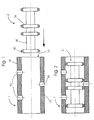
- a valve according to the invention comprises a valve housing 1 and a valve slide 2.
- additional components of the valve which are known per se have been omitted.
- the valve housing 1 is preferably made of a metallic material 10 and has a plurality of control channels 40, which are controllable by the valve spool 2, and a tubular inner recess (inner channel) 50 on.
- the valve housing by a metal injection molding (MIM) method can be produced.
- MIM metal injection molding
- the valve housing 1 is made of a uniform material 10, but the valve housing may also consist of two or more layers or areas of different material.
- at least the region of the valve housing which adjoins the inner channel 50 is made of a uniform material 10.
- the valve spool 2 consists of a valve body 20 which comprises one or more (four in this embodiment) valve seat surfaces 25.
- a layer 30 of a second material which has a smaller modulus of elasticity but a greater thermal expansion than the valve body material 10.
- the second material is preferably a thermoplastic material. It is preferably applied by spraying or snapping onto the valve body 20.
- the region of the valve spool 30, which in the assembled state adjoins the valve housing 1 consists of a different material than the valve main body 20 and the valve seat faces 25.
- valve body 20 and Slider seat surfaces 25 of the same or a similar material as the valve housing 10.
- the entire valve spool may consist of a uniform material, or for the Valve body 20 and / or the slider seating surfaces 25 may also be different materials - also different from the valve housing material 10 - are selected.
- valve spool 2 in the initial state has a larger maximum outer diameter than the inner diameter of the inner channel 50.
- valve spool 2 in the valve housing now takes place as follows, that first of the valve spool 2, as indicated in the arrow direction in Fig. 1 indicated in the valve housing 1 is pressed.
- the material 30 of valve spool 2 adjacent to the valve housing is under tension because it has a smaller modulus of elasticity than housing material 10 (interference fit).
- Valve body 1 and valve spool 2 are now heated until the yield stresses of the spool material 30 are reached and thus plastic deformation occurs; however, not all stresses within the material 30 are eliminated.
- the spool material 30 pulls back more than the material of the valve housing 10, since it has a larger thermal expansion coefficient.
- the cooling is preferably carried out under control of the cooling rate and / or duration.
- valve spool After cooling, the valve spool is thus pressure-tight and fitted with low friction into the valve housing, as can be seen in FIG.
- valves of this type can be used in all areas Find application in which a quick and accurate fitting of a spool in a housing is needed.
Landscapes
- Engineering & Computer Science (AREA)
- General Engineering & Computer Science (AREA)
- Mechanical Engineering (AREA)
- Multiple-Way Valves (AREA)
- Sliding Valves (AREA)
Claims (14)
- Valve comportant un tiroir de valve (2) et un boîtier de valve (1) qui, dans l'état assemblé, entoure le tiroir de valve et est pourvu d'une échancrure intérieure (50) s'étendant en forme tubulaire,
dans laquelle, en vue d'une intégration ajustée améliorée étanche à la pression et à faible friction du tiroir de valve (2) dans le boîtier de valve (1), le matériau du tiroir de valve (2) présente, au moins dans la zone ou les zones (30) adjacente(s) au boîtier de valve dans l'état assemblée, un module d'élasticité plus faible et un coefficient de dilatation thermique plus élevé que le matériau (10) du boîtier de valve (1), qui est adjacent à l'échancrure intérieure du boîtier de valve,
caractérisée en ce que
dans l'état de départ, le tiroir de valve (2) présente un diamètre maximal radial supérieur au diamètre de l'échancrure intérieure (50) du boîtier de valve (1) et est susceptible d'être intégré de façon ajustée dans le boîtier de valve (1) par enfoncement à la presse dans le boîtier de valve, par échauffement au-dessus du point de fluage du matériau de la zone (30) du tiroir de valve, qui, dans l'état assemblé, est adjacent au boîtier de valve, ainsi que par refroidissement successif. - Valve selon la revendication 1, caractérisée en ce qu'au moins le matériau de boîtier de valve adjacent à l'échancrure intérieure du boîtier de valve présente un module d'élasticité de ≥ 0,5 x 10⁵ N/mm2 à ≤ 10 x 105 N/mm2, de préférence de ≥ 0,75 x 10⁵ N/mm2 à ≤ 7,5 x 10⁵ N/mm2, de préférence particulière de ≥ 1 x 10⁵ N/mm2 à ≤ 5 x 10⁵ N/mm2, de façon encore plus préférée de ≥ 1,25 x 10⁵ N/mm2 à ≤ 3 x 10⁵ N/mm2, et de la façon la plus préférée de ≥ 1,5 x 10⁵ N/mm2 à ≤ 2,5 x 10⁵ N/mm2.
- Valve selon l'une ou l'autre des revendications 1 et 2, caractérisée en ce qu'au moins le matériau de tiroir de valve dans les zones adjacentes au boîtier de valve, dans l'état assemblé, présente un module d'élasticité de ≥ 0,25 x 10³ N/mm2 à ≤ 10 x 103 N/mm2, de préférence de ≥ 0,35 x 10³ N/mm2 à ≤ 7,5 x 10³ N/mm2, de préférence particulière de ≥ 0,5 x 10³ N/mm2 à ≤ 5 x 10³ N/mm2, de façon encore plus préférée de ≥ 0,6 x 10³ N/mm2 à ≤ 3 x 10³ N/mm2, et de la façon la plus préférée de ≥ 0,75 x 10³ N/mm2 à ≤ 2,5 x 10³ N/mm2.
- Valve selon l'une des revendications 1 à 3, caractérisée en ce que le rapport entre le module d'élasticité du matériau de tiroir de valve, au moins dans les zones adjacentes au boîtier de valve dans l'état assemblé, et le module d'élasticité au moins du matériau de boîtier de valve adjacent à l'échancrure intérieure du boîtier de valve est de ≥ 1:10 à ≤ 1:1000, de préférence de ≥ 1:25 à ≤ 1:750, de préférence particulière de ≥ 1:50 à ≤ 1:500, de façon encore plus préférée de ≥ 1:75 à ≤ 1:300, et de la façon la plus préférée de ≥ 1:100 à ≤ 1:200.
- Valve selon l'une des revendications 1 à 4, caractérisée en ce qu'au moins le matériau de boîtier de valve adjacent à l'échancrure intérieure du boîtier de valve présente un coefficient de dilatation thermique de ≥ 1 x 10⁻⁶ 1/K à ≤ 100 x 10-6 1/K, de préférence de ≥ 2,5 x 10⁻⁶ 1/K à ≤ 75 x 10-6 1/K, de préférence particulière de ≥ 5 x 10⁻⁶ 1/K à ≤ 50 x 10-6 1/K, de façon encore plus préférée de ≥ 10 x 10-6 1/K à ≤ 25 x 10-6 1/K, et de la façon la plus préférée de ≥ 12 x 10-6 1/K à ≤ 20 x 10-6 1/K.
- Valve selon l'une des revendications 1 à 5, caractérisée en ce qu'au moins le matériau de tiroir de valve présente, au moins dans les zones adjacentes au boîtier de valve dans l'état assemblé, un coefficient de dilatation thermique de ≥ 1 x 10⁻⁵ 1/K à ≤ 100 x 10-5 1/K, de préférence de ≥ 2,5 x 10⁻⁵ 1/K à ≤ 75 x 10-5 1/K, de préférence particulière de ≥ 5 x 10⁻⁵ 1/K à ≤ 60 x 10-5 1/K, de façon encore plus préférée de ≥ 10 x 10-5 1/K à ≤ 40 x 10-5 1/K, et de la façon la plus préférée de ≥ 12 x 10-5 1/K à ≤ 30 x 10-5 1/K.
- Valve selon l'une des revendications 1 à 6, caractérisée en ce que le rapport entre le coefficient de dilatation thermique au moins du matériau de boîtier de valve adjacent à l'échancrure intérieure du boîtier de valve et le coefficient de dilatation thermique du matériau de tiroir de valve au moins dans les zones adjacentes au boîtier de valve dans l'état assemblé est de ≥ 1:1 à ≤ 1:100, de préférence de ≥ 1:2 à ≤ 1:75, de préférence particulière de ≥ 1:5 à ≤ 1:50, de façon encore plus préférée de ≥ 1:7,5 à ≤ 1:25, et de la façon la plus préférée de ≥ 1:10 à ≤ 1:15.
- Valve selon l'une des revendications 1 à 7, caractérisée en ce que le boîtier de valve (1) est constitué d'un matériau métallique qui est réalisé de préférence par un procédé de moulage par injection de métal (Metal-Injection-Moulding, MIM).
- Valve selon l'une des revendications 1 à 8, caractérisée en ce que le tiroir de valve (2) est constitué, au moins dans des zones partielles (30), d'un matériau thermoplastique qui est de préférence moulé par injection.
- Valve selon l'une des revendications 1 à 9, caractérisée en ce que le matériau du tiroir de valve (2) présente dans les zones (30) adjacentes au boîtier de valve dans l'état assemblé un module d'élasticité plus faible et un coefficient de dilatation thermique plus élevé que le matériau (10) du boîtier de valve (1) adjacent à l'échancrure intérieure (50) du boîtier de valve (1), mais dans les zones restantes (20, 25) il est constitué d'un matériau similaire, de préférence du même matériau que le matériau de boîtier de valve (10) adjacent à l'échancrure intérieure (50) du boîtier de valve (1).
- Valve selon la revendication 10, caractérisée en ce que les zones qui sont constituées d'un matériau similaire, de préférence du même matériau que le matériau de boîtier de valve (10) adjacent à l'échancrure intérieure (50) du boîtier de valve (1) forment un corps de base de valve (20, 25), et les zones (30) qui sont constituées d'un matériau présentant un module d'élasticité plus faible et un coefficient de dilatation thermique plus élevé que le matériau (10) du boîtier de valve adjacent à l'échancrure intérieure (50) du boîtier de valve (1) sont appliquées, de préférence par projection ou par encliquetage, sur ce corps de base de valve (20, 25).
- Procédé pour l'agencement étanche à la pression et de faible friction d'un tiroir de valve dans un boîtier d'une valve selon l'une des revendications 1 à 11, comprenant les étapes suivantes :(a) enfoncement du tiroir de valve (2) dans l'échancrure intérieure (50) du boîtier de valve (1) en formant un ajustement à la presse,(b) échauffement au moins du tiroir de valve (2) et du boîtier de valve (1) au-dessus du point de fluage du matériau de tiroir au moins de la zone (30) du tiroir de valve (2) adjacente au boîtier de valve (1) dans l'état assemblé,(c) refroidissement.
- Procédé selon la revendication 12, dans lequel la quantité de chaleur apportée dans l'étape (b) et/ou la durée temporelle de l'échauffement est choisie de telle sorte qu'après le refroidissement un intervalle d'une dimension désirée s'établit entre le tiroir de valve et le boîtier de valve.
- Procédé pour réaliser un tiroir de valve (2) selon l'une des revendications 1 à 11 et/ou pour l'utilisation dans un procédé selon l'une ou l'autre des revendications 12 et 13, dans lequel le tiroir de valve est constitué par un corps de base de valve (20, 25),
caractérisé en ce que sur le corps de base de valve (20, 25), en particulier sur la ou les surfaces de portée de tiroir (25), on applique au moins une couche (30) d'un matériau, en particulier par projection et/ou par encliquetage, qui présente un module d'élasticité plus faible et un coefficient de dilatation thermique plus élevé que le matériau de boîtier de valve (10) adjacent à l'échancrure intérieure (50) du boîtier de valve (1).
Applications Claiming Priority (2)
| Application Number | Priority Date | Filing Date | Title |
|---|---|---|---|
| DE2003144407 DE10344407B4 (de) | 2003-09-25 | 2003-09-25 | Ventil und Verfahren zu einer druckdichten, reibungsarmen Anordnung eines dazugehörigen Ventilschiebers in einem Gehäuse |
| DE10344407 | 2003-09-25 |
Publications (2)
| Publication Number | Publication Date |
|---|---|
| EP1519089A1 EP1519089A1 (fr) | 2005-03-30 |
| EP1519089B1 true EP1519089B1 (fr) | 2006-07-05 |
Family
ID=34177935
Family Applications (1)
| Application Number | Title | Priority Date | Filing Date |
|---|---|---|---|
| EP20040104635 Expired - Lifetime EP1519089B1 (fr) | 2003-09-25 | 2004-09-23 | Soupape et méthode pour le montage d'un tiroir dans un boitier de manière étanche et faible-friction |
Country Status (2)
| Country | Link |
|---|---|
| EP (1) | EP1519089B1 (fr) |
| DE (2) | DE10344407B4 (fr) |
Families Citing this family (1)
| Publication number | Priority date | Publication date | Assignee | Title |
|---|---|---|---|---|
| US7703475B2 (en) | 2005-06-06 | 2010-04-27 | I.D.E. Technologies Ltd. | Piston for a linear spool valve |
Family Cites Families (9)
| Publication number | Priority date | Publication date | Assignee | Title |
|---|---|---|---|---|
| US3958792A (en) * | 1974-05-17 | 1976-05-25 | Barkelew Richard C | Valve with radially expansive valve plug |
| FR2587779B1 (fr) * | 1985-09-20 | 1989-06-16 | Joint Francais | Dispositif d'etancheite pour piston flottant |
| US5098061A (en) * | 1988-09-02 | 1992-03-24 | The B. F. Goodrich Company | Cascaded pneumatic impulse separation system and valves therefor |
| FR2681397B1 (fr) * | 1991-09-12 | 1994-06-17 | Volkswagen Ag | Tiroir pour une soupape a tiroir et procede permettant sa realisation. |
| DE19509578B4 (de) * | 1995-03-16 | 2005-12-22 | Robert Bosch Gmbh | Pneumatisches Wegeventil |
| DE19802311A1 (de) * | 1998-01-22 | 1999-08-05 | Bosch Gmbh Robert | Wegeventil |
| DE19813981C2 (de) * | 1998-03-28 | 2001-12-06 | Bosch Gmbh Robert | Schiebergesteuertes Wegeventil |
| DE19837558A1 (de) * | 1998-08-19 | 2000-03-09 | Bosch Gmbh Robert | Ventilschieber |
| JP3576055B2 (ja) * | 1999-11-15 | 2004-10-13 | 有限会社コーキ・エンジニアリング | シリンジ用ピストンの摺動部材の製造方法 |
-
2003
- 2003-09-25 DE DE2003144407 patent/DE10344407B4/de not_active Expired - Fee Related
-
2004
- 2004-09-23 EP EP20040104635 patent/EP1519089B1/fr not_active Expired - Lifetime
- 2004-09-23 DE DE200450000910 patent/DE502004000910D1/de not_active Expired - Lifetime
Also Published As
| Publication number | Publication date |
|---|---|
| DE10344407B4 (de) | 2006-06-08 |
| DE502004000910D1 (de) | 2006-08-17 |
| DE10344407A1 (de) | 2005-04-28 |
| EP1519089A1 (fr) | 2005-03-30 |
Similar Documents
| Publication | Publication Date | Title |
|---|---|---|
| DE69520776T2 (de) | Verfahren zum Formen eines mit Kunststoff überzogenen Gegenstandes | |
| DE19535930C1 (de) | Vorrichtung zur veränderlichen Begrenzung eines flachen Fließkanals und Verfahren zum Austragen einer Massebahn mit veränderlicher Geometrie | |
| DE3738877A1 (de) | Elektromagnetisches kraftstoffeinspritzventil | |
| DE2110065A1 (de) | Ventil und Verfahren zu dessen Herstellung | |
| DE102012025039A1 (de) | Verfahren und Vorrichtung zur Herstellung von Spritzgießteilen in Zwei-Komponenten-Spritzgießtechnik sowie Spritzgießteil | |
| DE102021133059A1 (de) | Mahlwerksbaugruppe, insbesondere Mahlringbaugruppe, für verbesserte Mahl-Reproduzierbarkeit | |
| DE10321198A1 (de) | Kraftstoffeinspritzventil | |
| DE3106571A1 (de) | Schwimmende dichtscheibe und verfahren zur herstellung derselben | |
| DE2759091A1 (de) | Vorrichtung zum regulieren des durchflusses eines fluids | |
| DE10221100C1 (de) | Elektrisch leitfähige Dichtung sowie Verfahren und Vorrichtung zu deren Herstellung | |
| DE2732490A1 (de) | Spritzform zum strangpressen und verfahren zum herstellen eines formteils | |
| EP1519089B1 (fr) | Soupape et méthode pour le montage d'un tiroir dans un boitier de manière étanche et faible-friction | |
| EP3235620B1 (fr) | Procédé de fabrication d'une courroie de transmission continue | |
| DE3729255C1 (de) | Kugelkueken | |
| DE3852493T2 (de) | Herstellungsverfahren für eine Lochplatte für Brennstoff-Einspritzventile. | |
| DE3151175C2 (de) | Spritzgieß-Verfahren zum Erzeugen eines Elektrodenkörpers mit eingebettetem elektrischen Leiter | |
| DE10353168A1 (de) | Verfahren und Vorrichtung zum hydroerosiven Verrunden von Bohrungsübergängen | |
| DE3206979A1 (de) | Verbund-ventilsitz | |
| DE69000591T2 (de) | Kraftstoffeinspritzduese. | |
| DE4235611C2 (de) | Kunststoff-Lagergehäuse | |
| DE2227335A1 (de) | Treibriemen und verfahren zu seiner herstellung | |
| DE69215684T2 (de) | Ein durchflussventil und ein verfahren zur herstellung eines ventilsitz oder eines ventilkoerper | |
| DE19820498C2 (de) | Verfahren zum Herstellen einer Hülse, insbesondere für die Druckindustrie | |
| EP0757364B1 (fr) | Transformateur | |
| DE102005036950A1 (de) | Verfahren zur Herstellung eines metallischen Bauteils und metallisches Bauteil, insbesondere Ventilsitzbauteil |
Legal Events
| Date | Code | Title | Description |
|---|---|---|---|
| PUAI | Public reference made under article 153(3) epc to a published international application that has entered the european phase |
Free format text: ORIGINAL CODE: 0009012 |
|
| AK | Designated contracting states |
Kind code of ref document: A1 Designated state(s): AT BE BG CH CY CZ DE DK EE ES FI FR GB GR HU IE IT LI LU MC NL PL PT RO SE SI SK TR |
|
| AX | Request for extension of the european patent |
Extension state: AL HR LT LV MK |
|
| 17P | Request for examination filed |
Effective date: 20050702 |
|
| GRAP | Despatch of communication of intention to grant a patent |
Free format text: ORIGINAL CODE: EPIDOSNIGR1 |
|
| GRAS | Grant fee paid |
Free format text: ORIGINAL CODE: EPIDOSNIGR3 |
|
| AKX | Designation fees paid |
Designated state(s): DE FR GB IT SE |
|
| GRAA | (expected) grant |
Free format text: ORIGINAL CODE: 0009210 |
|
| AK | Designated contracting states |
Kind code of ref document: B1 Designated state(s): DE FR GB IT SE |
|
| REG | Reference to a national code |
Ref country code: GB Ref legal event code: FG4D Free format text: NOT ENGLISH |
|
| REF | Corresponds to: |
Ref document number: 502004000910 Country of ref document: DE Date of ref document: 20060817 Kind code of ref document: P |
|
| REG | Reference to a national code |
Ref country code: SE Ref legal event code: TRGR |
|
| GBT | Gb: translation of ep patent filed (gb section 77(6)(a)/1977) |
Effective date: 20061004 |
|
| ET | Fr: translation filed | ||
| PLBE | No opposition filed within time limit |
Free format text: ORIGINAL CODE: 0009261 |
|
| STAA | Information on the status of an ep patent application or granted ep patent |
Free format text: STATUS: NO OPPOSITION FILED WITHIN TIME LIMIT |
|
| 26N | No opposition filed |
Effective date: 20070410 |
|
| PGFP | Annual fee paid to national office [announced via postgrant information from national office to epo] |
Ref country code: FR Payment date: 20100930 Year of fee payment: 7 Ref country code: SE Payment date: 20100921 Year of fee payment: 7 |
|
| PGFP | Annual fee paid to national office [announced via postgrant information from national office to epo] |
Ref country code: GB Payment date: 20100924 Year of fee payment: 7 |
|
| PGFP | Annual fee paid to national office [announced via postgrant information from national office to epo] |
Ref country code: IT Payment date: 20100928 Year of fee payment: 7 |
|
| GBPC | Gb: european patent ceased through non-payment of renewal fee |
Effective date: 20110923 |
|
| PG25 | Lapsed in a contracting state [announced via postgrant information from national office to epo] |
Ref country code: IT Free format text: LAPSE BECAUSE OF NON-PAYMENT OF DUE FEES Effective date: 20110923 |
|
| REG | Reference to a national code |
Ref country code: FR Ref legal event code: ST Effective date: 20120531 |
|
| REG | Reference to a national code |
Ref country code: SE Ref legal event code: EUG |
|
| PG25 | Lapsed in a contracting state [announced via postgrant information from national office to epo] |
Ref country code: FR Free format text: LAPSE BECAUSE OF NON-PAYMENT OF DUE FEES Effective date: 20110930 Ref country code: GB Free format text: LAPSE BECAUSE OF NON-PAYMENT OF DUE FEES Effective date: 20110923 |
|
| PG25 | Lapsed in a contracting state [announced via postgrant information from national office to epo] |
Ref country code: SE Free format text: LAPSE BECAUSE OF NON-PAYMENT OF DUE FEES Effective date: 20110924 |
|
| PGFP | Annual fee paid to national office [announced via postgrant information from national office to epo] |
Ref country code: DE Payment date: 20140922 Year of fee payment: 11 |
|
| REG | Reference to a national code |
Ref country code: DE Ref legal event code: R119 Ref document number: 502004000910 Country of ref document: DE |
|
| PG25 | Lapsed in a contracting state [announced via postgrant information from national office to epo] |
Ref country code: DE Free format text: LAPSE BECAUSE OF NON-PAYMENT OF DUE FEES Effective date: 20160401 |