EP1518851A1 - Verfahren zur Herstellung flüssigkristalliner Ether - Google Patents
Verfahren zur Herstellung flüssigkristalliner Ether Download PDFInfo
- Publication number
- EP1518851A1 EP1518851A1 EP04022005A EP04022005A EP1518851A1 EP 1518851 A1 EP1518851 A1 EP 1518851A1 EP 04022005 A EP04022005 A EP 04022005A EP 04022005 A EP04022005 A EP 04022005A EP 1518851 A1 EP1518851 A1 EP 1518851A1
- Authority
- EP
- European Patent Office
- Prior art keywords
- independently
- alkyl
- hydrogen
- radical
- formula
- Prior art date
- Legal status (The legal status is an assumption and is not a legal conclusion. Google has not performed a legal analysis and makes no representation as to the accuracy of the status listed.)
- Granted
Links
- 238000002360 preparation method Methods 0.000 title claims abstract description 21
- 150000002170 ethers Chemical class 0.000 title claims abstract description 11
- 238000000034 method Methods 0.000 title claims description 38
- 230000008569 process Effects 0.000 title claims description 12
- 239000007788 liquid Substances 0.000 title 1
- 150000003254 radicals Chemical group 0.000 claims abstract description 43
- -1 cyclohexylmethyl ethers Chemical class 0.000 claims abstract description 35
- 238000006243 chemical reaction Methods 0.000 claims abstract description 26
- 125000000217 alkyl group Chemical group 0.000 claims abstract description 20
- 239000002904 solvent Substances 0.000 claims abstract description 20
- 125000000113 cyclohexyl group Chemical group [H]C1([H])C([H])([H])C([H])([H])C([H])(*)C([H])([H])C1([H])[H] 0.000 claims abstract description 13
- 229910052736 halogen Inorganic materials 0.000 claims abstract description 11
- 150000002367 halogens Chemical class 0.000 claims abstract description 11
- 125000003545 alkoxy group Chemical group 0.000 claims abstract description 9
- 125000002496 methyl group Chemical group [H]C([H])([H])* 0.000 claims abstract description 9
- 125000001511 cyclopentyl group Chemical group [H]C1([H])C([H])([H])C([H])([H])C([H])(*)C1([H])[H] 0.000 claims abstract description 7
- 125000001997 phenyl group Chemical group [H]C1=C([H])C([H])=C(*)C([H])=C1[H] 0.000 claims abstract description 7
- 125000004430 oxygen atom Chemical group O* 0.000 claims abstract description 5
- 150000001875 compounds Chemical class 0.000 claims description 24
- PXBRQCKWGAHEHS-UHFFFAOYSA-N dichlorodifluoromethane Chemical compound FC(F)(Cl)Cl PXBRQCKWGAHEHS-UHFFFAOYSA-N 0.000 claims description 24
- 125000004432 carbon atom Chemical group C* 0.000 claims description 22
- 229910052739 hydrogen Inorganic materials 0.000 claims description 22
- 239000001257 hydrogen Substances 0.000 claims description 22
- UFHFLCQGNIYNRP-UHFFFAOYSA-N Hydrogen Chemical compound [H][H] UFHFLCQGNIYNRP-UHFFFAOYSA-N 0.000 claims description 21
- CYRMSUTZVYGINF-UHFFFAOYSA-N trichlorofluoromethane Chemical compound FC(Cl)(Cl)Cl CYRMSUTZVYGINF-UHFFFAOYSA-N 0.000 claims description 18
- ZAMOUSCENKQFHK-UHFFFAOYSA-N Chlorine atom Chemical compound [Cl] ZAMOUSCENKQFHK-UHFFFAOYSA-N 0.000 claims description 14
- 230000009467 reduction Effects 0.000 claims description 13
- 239000000460 chlorine Substances 0.000 claims description 12
- 229910052801 chlorine Inorganic materials 0.000 claims description 10
- 239000003999 initiator Substances 0.000 claims description 9
- 125000004093 cyano group Chemical group *C#N 0.000 claims description 8
- 150000002431 hydrogen Chemical class 0.000 claims description 8
- 239000000203 mixture Substances 0.000 claims description 6
- 150000001733 carboxylic acid esters Chemical class 0.000 claims description 5
- BLRPTPMANUNPDV-UHFFFAOYSA-N Silane Chemical compound [SiH4] BLRPTPMANUNPDV-UHFFFAOYSA-N 0.000 claims description 4
- 238000000354 decomposition reaction Methods 0.000 claims description 4
- 125000001867 hydroperoxy group Chemical group [*]OO[H] 0.000 claims description 4
- 229910000077 silane Inorganic materials 0.000 claims description 4
- 230000005855 radiation Effects 0.000 claims description 3
- 150000008280 chlorinated hydrocarbons Chemical class 0.000 claims description 2
- 229930195733 hydrocarbon Natural products 0.000 claims description 2
- 150000002430 hydrocarbons Chemical class 0.000 claims description 2
- 230000001960 triggered effect Effects 0.000 claims description 2
- 125000004435 hydrogen atom Chemical group [H]* 0.000 claims 1
- 125000002887 hydroxy group Chemical group [H]O* 0.000 claims 1
- 239000012442 inert solvent Substances 0.000 claims 1
- QQOJAXYDCRDWRX-UHFFFAOYSA-N cyclobutan-1,3-diyl Chemical group [CH]1C[CH]C1 QQOJAXYDCRDWRX-UHFFFAOYSA-N 0.000 abstract description 3
- 125000005843 halogen group Chemical group 0.000 abstract 1
- WYURNTSHIVDZCO-UHFFFAOYSA-N Tetrahydrofuran Chemical compound C1CCOC1 WYURNTSHIVDZCO-UHFFFAOYSA-N 0.000 description 28
- 239000000243 solution Substances 0.000 description 18
- 125000001436 propyl group Chemical group [H]C([*])([H])C([H])([H])C([H])([H])[H] 0.000 description 17
- RTZKZFJDLAIYFH-UHFFFAOYSA-N Diethyl ether Chemical group CCOCC RTZKZFJDLAIYFH-UHFFFAOYSA-N 0.000 description 13
- HEMHJVSKTPXQMS-UHFFFAOYSA-M Sodium hydroxide Chemical compound [OH-].[Na+] HEMHJVSKTPXQMS-UHFFFAOYSA-M 0.000 description 12
- YLQBMQCUIZJEEH-UHFFFAOYSA-N tetrahydrofuran Natural products C=1C=COC=1 YLQBMQCUIZJEEH-UHFFFAOYSA-N 0.000 description 12
- LSXWFXONGKSEMY-UHFFFAOYSA-N di-tert-butyl peroxide Chemical compound CC(C)(C)OOC(C)(C)C LSXWFXONGKSEMY-UHFFFAOYSA-N 0.000 description 10
- 125000001147 pentyl group Chemical group C(CCCC)* 0.000 description 10
- BZLVMXJERCGZMT-UHFFFAOYSA-N Methyl tert-butyl ether Chemical compound COC(C)(C)C BZLVMXJERCGZMT-UHFFFAOYSA-N 0.000 description 9
- 239000007858 starting material Substances 0.000 description 8
- ZDHXKXAHOVTTAH-UHFFFAOYSA-N trichlorosilane Chemical compound Cl[SiH](Cl)Cl ZDHXKXAHOVTTAH-UHFFFAOYSA-N 0.000 description 7
- 238000004458 analytical method Methods 0.000 description 6
- 239000012043 crude product Substances 0.000 description 6
- 150000002148 esters Chemical class 0.000 description 6
- 239000012074 organic phase Substances 0.000 description 6
- 239000005052 trichlorosilane Substances 0.000 description 6
- 230000015572 biosynthetic process Effects 0.000 description 5
- 150000004756 silanes Chemical class 0.000 description 5
- PMZURENOXWZQFD-UHFFFAOYSA-L Sodium Sulfate Chemical compound [Na+].[Na+].[O-]S([O-])(=O)=O PMZURENOXWZQFD-UHFFFAOYSA-L 0.000 description 4
- FAPWRFPIFSIZLT-UHFFFAOYSA-M Sodium chloride Chemical class [Na+].[Cl-] FAPWRFPIFSIZLT-UHFFFAOYSA-M 0.000 description 4
- 239000002253 acid Substances 0.000 description 4
- 230000000052 comparative effect Effects 0.000 description 4
- 239000005457 ice water Substances 0.000 description 4
- 239000000376 reactant Substances 0.000 description 4
- 229910052938 sodium sulfate Inorganic materials 0.000 description 4
- 235000011152 sodium sulphate Nutrition 0.000 description 4
- YMWUJEATGCHHMB-UHFFFAOYSA-N Dichloromethane Chemical compound ClCCl YMWUJEATGCHHMB-UHFFFAOYSA-N 0.000 description 3
- 150000001298 alcohols Chemical class 0.000 description 3
- 238000009835 boiling Methods 0.000 description 3
- 230000000977 initiatory effect Effects 0.000 description 3
- VLKZOEOYAKHREP-UHFFFAOYSA-N n-Hexane Chemical compound CCCCCC VLKZOEOYAKHREP-UHFFFAOYSA-N 0.000 description 3
- 239000000047 product Substances 0.000 description 3
- 230000035484 reaction time Effects 0.000 description 3
- 238000003756 stirring Methods 0.000 description 3
- 238000003786 synthesis reaction Methods 0.000 description 3
- 230000009466 transformation Effects 0.000 description 3
- OZAIFHULBGXAKX-UHFFFAOYSA-N 2-(2-cyanopropan-2-yldiazenyl)-2-methylpropanenitrile Chemical compound N#CC(C)(C)N=NC(C)(C)C#N OZAIFHULBGXAKX-UHFFFAOYSA-N 0.000 description 2
- YVPZFPKENDZQEJ-UHFFFAOYSA-N 4-propylcyclohexan-1-ol Chemical compound CCCC1CCC(O)CC1 YVPZFPKENDZQEJ-UHFFFAOYSA-N 0.000 description 2
- ZOXJGFHDIHLPTG-UHFFFAOYSA-N Boron Chemical compound [B] ZOXJGFHDIHLPTG-UHFFFAOYSA-N 0.000 description 2
- FNUWTRXUMODLEK-MGCOHNPYSA-N CCC[C@H]1CC[C@H](CBr)CC1 Chemical compound CCC[C@H]1CC[C@H](CBr)CC1 FNUWTRXUMODLEK-MGCOHNPYSA-N 0.000 description 2
- XDTMQSROBMDMFD-UHFFFAOYSA-N Cyclohexane Chemical compound C1CCCCC1 XDTMQSROBMDMFD-UHFFFAOYSA-N 0.000 description 2
- VZWGRQBCURJOMT-UHFFFAOYSA-N Dodecyl acetate Chemical compound CCCCCCCCCCCCOC(C)=O VZWGRQBCURJOMT-UHFFFAOYSA-N 0.000 description 2
- LFQSCWFLJHTTHZ-UHFFFAOYSA-N Ethanol Chemical compound CCO LFQSCWFLJHTTHZ-UHFFFAOYSA-N 0.000 description 2
- IMNFDUFMRHMDMM-UHFFFAOYSA-N N-Heptane Chemical compound CCCCCCC IMNFDUFMRHMDMM-UHFFFAOYSA-N 0.000 description 2
- 238000006959 Williamson synthesis reaction Methods 0.000 description 2
- ORILYTVJVMAKLC-UHFFFAOYSA-N adamantane Chemical compound C1C(C2)CC3CC1CC2C3 ORILYTVJVMAKLC-UHFFFAOYSA-N 0.000 description 2
- VSCWAEJMTAWNJL-UHFFFAOYSA-K aluminium trichloride Chemical compound Cl[Al](Cl)Cl VSCWAEJMTAWNJL-UHFFFAOYSA-K 0.000 description 2
- 239000008346 aqueous phase Substances 0.000 description 2
- 229910052796 boron Inorganic materials 0.000 description 2
- 150000001639 boron compounds Chemical class 0.000 description 2
- YUKZTICWNSSDIL-UHFFFAOYSA-N dichloro(cyclohexyl)silane Chemical compound Cl[SiH](Cl)C1CCCCC1 YUKZTICWNSSDIL-UHFFFAOYSA-N 0.000 description 2
- VIRVTHOOZABTPR-UHFFFAOYSA-N dichloro(phenyl)silane Chemical compound Cl[SiH](Cl)C1=CC=CC=C1 VIRVTHOOZABTPR-UHFFFAOYSA-N 0.000 description 2
- SBZXBUIDTXKZTM-UHFFFAOYSA-N diglyme Chemical compound COCCOCCOC SBZXBUIDTXKZTM-UHFFFAOYSA-N 0.000 description 2
- 230000009189 diving Effects 0.000 description 2
- LYCAIKOWRPUZTN-UHFFFAOYSA-N ethylene glycol Natural products OCCO LYCAIKOWRPUZTN-UHFFFAOYSA-N 0.000 description 2
- 125000000524 functional group Chemical group 0.000 description 2
- 239000004973 liquid crystal related substance Substances 0.000 description 2
- ZQMHJBXHRFJKOT-UHFFFAOYSA-N methyl 2-[(1-methoxy-2-methyl-1-oxopropan-2-yl)diazenyl]-2-methylpropanoate Chemical compound COC(=O)C(C)(C)N=NC(C)(C)C(=O)OC ZQMHJBXHRFJKOT-UHFFFAOYSA-N 0.000 description 2
- UAEPNZWRGJTJPN-UHFFFAOYSA-N methylcyclohexane Chemical compound CC1CCCCC1 UAEPNZWRGJTJPN-UHFFFAOYSA-N 0.000 description 2
- 239000010453 quartz Substances 0.000 description 2
- 239000011541 reaction mixture Substances 0.000 description 2
- 238000010992 reflux Methods 0.000 description 2
- VYPSYNLAJGMNEJ-UHFFFAOYSA-N silicon dioxide Inorganic materials O=[Si]=O VYPSYNLAJGMNEJ-UHFFFAOYSA-N 0.000 description 2
- 239000012279 sodium borohydride Substances 0.000 description 2
- 229910000033 sodium borohydride Inorganic materials 0.000 description 2
- 239000000725 suspension Substances 0.000 description 2
- CIHOLLKRGTVIJN-UHFFFAOYSA-N tert‐butyl hydroperoxide Chemical compound CC(C)(C)OO CIHOLLKRGTVIJN-UHFFFAOYSA-N 0.000 description 2
- 238000000844 transformation Methods 0.000 description 2
- RIOQSEWOXXDEQQ-UHFFFAOYSA-N triphenylphosphine Chemical compound C1=CC=CC=C1P(C=1C=CC=CC=1)C1=CC=CC=C1 RIOQSEWOXXDEQQ-UHFFFAOYSA-N 0.000 description 2
- IMYCVFRTNVMHAD-UHFFFAOYSA-N 1,1-bis(2-methylbutan-2-ylperoxy)cyclohexane Chemical compound CCC(C)(C)OOC1(OOC(C)(C)CC)CCCCC1 IMYCVFRTNVMHAD-UHFFFAOYSA-N 0.000 description 1
- HSLFISVKRDQEBY-UHFFFAOYSA-N 1,1-bis(tert-butylperoxy)cyclohexane Chemical compound CC(C)(C)OOC1(OOC(C)(C)C)CCCCC1 HSLFISVKRDQEBY-UHFFFAOYSA-N 0.000 description 1
- RYHBNJHYFVUHQT-UHFFFAOYSA-N 1,4-Dioxane Chemical compound C1COCCO1 RYHBNJHYFVUHQT-UHFFFAOYSA-N 0.000 description 1
- CHHASAIQKXOAOX-UHFFFAOYSA-N 1-(2,2-dimethylpropoxy)-2,2-dimethylpropane Chemical compound CC(C)(C)COCC(C)(C)C CHHASAIQKXOAOX-UHFFFAOYSA-N 0.000 description 1
- ZYLRDAOEBRPIGT-UHFFFAOYSA-N 1-adamantyl acetate Chemical compound C1C(C2)CC3CC2CC1(OC(=O)C)C3 ZYLRDAOEBRPIGT-UHFFFAOYSA-N 0.000 description 1
- HQOVXPHOJANJBR-UHFFFAOYSA-N 2,2-bis(tert-butylperoxy)butane Chemical compound CC(C)(C)OOC(C)(CC)OOC(C)(C)C HQOVXPHOJANJBR-UHFFFAOYSA-N 0.000 description 1
- XMNIXWIUMCBBBL-UHFFFAOYSA-N 2-(2-phenylpropan-2-ylperoxy)propan-2-ylbenzene Chemical compound C=1C=CC=CC=1C(C)(C)OOC(C)(C)C1=CC=CC=C1 XMNIXWIUMCBBBL-UHFFFAOYSA-N 0.000 description 1
- JJRDRFZYKKFYMO-UHFFFAOYSA-N 2-methyl-2-(2-methylbutan-2-ylperoxy)butane Chemical compound CCC(C)(C)OOC(C)(C)CC JJRDRFZYKKFYMO-UHFFFAOYSA-N 0.000 description 1
- JWUJQDFVADABEY-UHFFFAOYSA-N 2-methyltetrahydrofuran Chemical compound CC1CCCO1 JWUJQDFVADABEY-UHFFFAOYSA-N 0.000 description 1
- YMEQAWPBOXAFHJ-UHFFFAOYSA-N C1CCCCCCCCCCC1.C(C)(=O)O Chemical compound C1CCCCCCCCCCC1.C(C)(=O)O YMEQAWPBOXAFHJ-UHFFFAOYSA-N 0.000 description 1
- 239000005046 Chlorosilane Substances 0.000 description 1
- 229910020308 Cl3SiH Inorganic materials 0.000 description 1
- 239000005698 Dodecyl acetate Substances 0.000 description 1
- NHTMVDHEPJAVLT-UHFFFAOYSA-N Isooctane Chemical compound CC(C)CC(C)(C)C NHTMVDHEPJAVLT-UHFFFAOYSA-N 0.000 description 1
- 229910010082 LiAlH Inorganic materials 0.000 description 1
- 229910010084 LiAlH4 Inorganic materials 0.000 description 1
- 229910019020 PtO2 Inorganic materials 0.000 description 1
- KEAYESYHFKHZAL-UHFFFAOYSA-N Sodium Chemical compound [Na] KEAYESYHFKHZAL-UHFFFAOYSA-N 0.000 description 1
- 239000007877 V-601 Substances 0.000 description 1
- 150000007513 acids Chemical class 0.000 description 1
- YKIOKAURTKXMSB-UHFFFAOYSA-N adams's catalyst Chemical compound O=[Pt]=O YKIOKAURTKXMSB-UHFFFAOYSA-N 0.000 description 1
- 230000000712 assembly Effects 0.000 description 1
- 238000000429 assembly Methods 0.000 description 1
- 230000008901 benefit Effects 0.000 description 1
- 125000005997 bromomethyl group Chemical group 0.000 description 1
- 229910052799 carbon Inorganic materials 0.000 description 1
- 239000003638 chemical reducing agent Substances 0.000 description 1
- YCITZMJNBYYMJO-UHFFFAOYSA-N chloro(diphenyl)silicon Chemical compound C=1C=CC=CC=1[Si](Cl)C1=CC=CC=C1 YCITZMJNBYYMJO-UHFFFAOYSA-N 0.000 description 1
- YGHUUVGIRWMJGE-UHFFFAOYSA-N chlorodimethylsilane Chemical compound C[SiH](C)Cl YGHUUVGIRWMJGE-UHFFFAOYSA-N 0.000 description 1
- 238000004140 cleaning Methods 0.000 description 1
- 239000000470 constituent Substances 0.000 description 1
- 125000004122 cyclic group Chemical group 0.000 description 1
- 150000001934 cyclohexanes Chemical class 0.000 description 1
- WVIIMZNLDWSIRH-UHFFFAOYSA-N cyclohexylcyclohexane Chemical group C1CCCCC1C1CCCCC1 WVIIMZNLDWSIRH-UHFFFAOYSA-N 0.000 description 1
- PFMKUUJQLUQKHT-UHFFFAOYSA-N dichloro(ethyl)silicon Chemical compound CC[Si](Cl)Cl PFMKUUJQLUQKHT-UHFFFAOYSA-N 0.000 description 1
- 238000010790 dilution Methods 0.000 description 1
- 239000012895 dilution Substances 0.000 description 1
- JVSWJIKNEAIKJW-UHFFFAOYSA-N dimethyl-hexane Natural products CCCCCC(C)C JVSWJIKNEAIKJW-UHFFFAOYSA-N 0.000 description 1
- 125000001033 ether group Chemical group 0.000 description 1
- FDNPVQXLGFNHGX-UHFFFAOYSA-N ethoxycyclododecane Chemical compound CCOC1CCCCCCCCCCC1 FDNPVQXLGFNHGX-UHFFFAOYSA-N 0.000 description 1
- 125000001495 ethyl group Chemical group [H]C([H])([H])C([H])([H])* 0.000 description 1
- 238000011156 evaluation Methods 0.000 description 1
- 230000004992 fission Effects 0.000 description 1
- 238000004817 gas chromatography Methods 0.000 description 1
- 150000002432 hydroperoxides Chemical class 0.000 description 1
- 125000004356 hydroxy functional group Chemical group O* 0.000 description 1
- 125000004029 hydroxymethyl group Chemical group [H]OC([H])([H])* 0.000 description 1
- 230000006872 improvement Effects 0.000 description 1
- 239000012535 impurity Substances 0.000 description 1
- 238000009413 insulation Methods 0.000 description 1
- 239000000543 intermediate Substances 0.000 description 1
- 125000000959 isobutyl group Chemical group [H]C([H])([H])C([H])(C([H])([H])[H])C([H])([H])* 0.000 description 1
- 238000002955 isolation Methods 0.000 description 1
- 239000012280 lithium aluminium hydride Substances 0.000 description 1
- 238000004519 manufacturing process Methods 0.000 description 1
- 229910052987 metal hydride Inorganic materials 0.000 description 1
- 150000004681 metal hydrides Chemical class 0.000 description 1
- GYNNXHKOJHMOHS-UHFFFAOYSA-N methyl-cycloheptane Natural products CC1CCCCCC1 GYNNXHKOJHMOHS-UHFFFAOYSA-N 0.000 description 1
- 238000005457 optimization Methods 0.000 description 1
- 150000002978 peroxides Chemical class 0.000 description 1
- 239000000546 pharmaceutical excipient Substances 0.000 description 1
- 239000012071 phase Substances 0.000 description 1
- PARWUHTVGZSQPD-UHFFFAOYSA-N phenylsilane Chemical compound [SiH3]C1=CC=CC=C1 PARWUHTVGZSQPD-UHFFFAOYSA-N 0.000 description 1
- 229950010765 pivalate Drugs 0.000 description 1
- IUGYQRQAERSCNH-UHFFFAOYSA-N pivalic acid Chemical compound CC(C)(C)C(O)=O IUGYQRQAERSCNH-UHFFFAOYSA-N 0.000 description 1
- 238000011403 purification operation Methods 0.000 description 1
- 239000002994 raw material Substances 0.000 description 1
- 239000012429 reaction media Substances 0.000 description 1
- 238000011946 reduction process Methods 0.000 description 1
- 238000003431 reductive deoxygenation reaction Methods 0.000 description 1
- 230000002829 reductive effect Effects 0.000 description 1
- 238000013341 scale-up Methods 0.000 description 1
- 238000007086 side reaction Methods 0.000 description 1
- 239000012312 sodium hydride Substances 0.000 description 1
- 229910000104 sodium hydride Inorganic materials 0.000 description 1
- 125000000999 tert-butyl group Chemical group [H]C([H])([H])C(*)(C([H])([H])[H])C([H])([H])[H] 0.000 description 1
- PPDADIYYMSXQJK-UHFFFAOYSA-N trichlorosilicon Chemical compound Cl[Si](Cl)Cl PPDADIYYMSXQJK-UHFFFAOYSA-N 0.000 description 1
Classifications
-
- C—CHEMISTRY; METALLURGY
- C09—DYES; PAINTS; POLISHES; NATURAL RESINS; ADHESIVES; COMPOSITIONS NOT OTHERWISE PROVIDED FOR; APPLICATIONS OF MATERIALS NOT OTHERWISE PROVIDED FOR
- C09K—MATERIALS FOR MISCELLANEOUS APPLICATIONS, NOT PROVIDED FOR ELSEWHERE
- C09K19/00—Liquid crystal materials
- C09K19/04—Liquid crystal materials characterised by the chemical structure of the liquid crystal components, e.g. by a specific unit
- C09K19/06—Non-steroidal liquid crystal compounds
- C09K19/08—Non-steroidal liquid crystal compounds containing at least two non-condensed rings
- C09K19/30—Non-steroidal liquid crystal compounds containing at least two non-condensed rings containing saturated or unsaturated non-aromatic rings, e.g. cyclohexane rings
- C09K19/3001—Cyclohexane rings
- C09K19/3066—Cyclohexane rings in which the rings are linked by a chain containing carbon and oxygen atoms, e.g. esters or ethers
-
- C—CHEMISTRY; METALLURGY
- C07—ORGANIC CHEMISTRY
- C07C—ACYCLIC OR CARBOCYCLIC COMPOUNDS
- C07C41/00—Preparation of ethers; Preparation of compounds having groups, groups or groups
- C07C41/01—Preparation of ethers
- C07C41/18—Preparation of ethers by reactions not forming ether-oxygen bonds
-
- C—CHEMISTRY; METALLURGY
- C07—ORGANIC CHEMISTRY
- C07C—ACYCLIC OR CARBOCYCLIC COMPOUNDS
- C07C43/00—Ethers; Compounds having groups, groups or groups
- C07C43/02—Ethers
- C07C43/18—Ethers having an ether-oxygen atom bound to a carbon atom of a ring other than a six-membered aromatic ring
- C07C43/184—Ethers having an ether-oxygen atom bound to a carbon atom of a ring other than a six-membered aromatic ring to a carbon atom of a non-condensed ring
-
- C—CHEMISTRY; METALLURGY
- C07—ORGANIC CHEMISTRY
- C07C—ACYCLIC OR CARBOCYCLIC COMPOUNDS
- C07C2601/00—Systems containing only non-condensed rings
- C07C2601/12—Systems containing only non-condensed rings with a six-membered ring
- C07C2601/14—The ring being saturated
Definitions
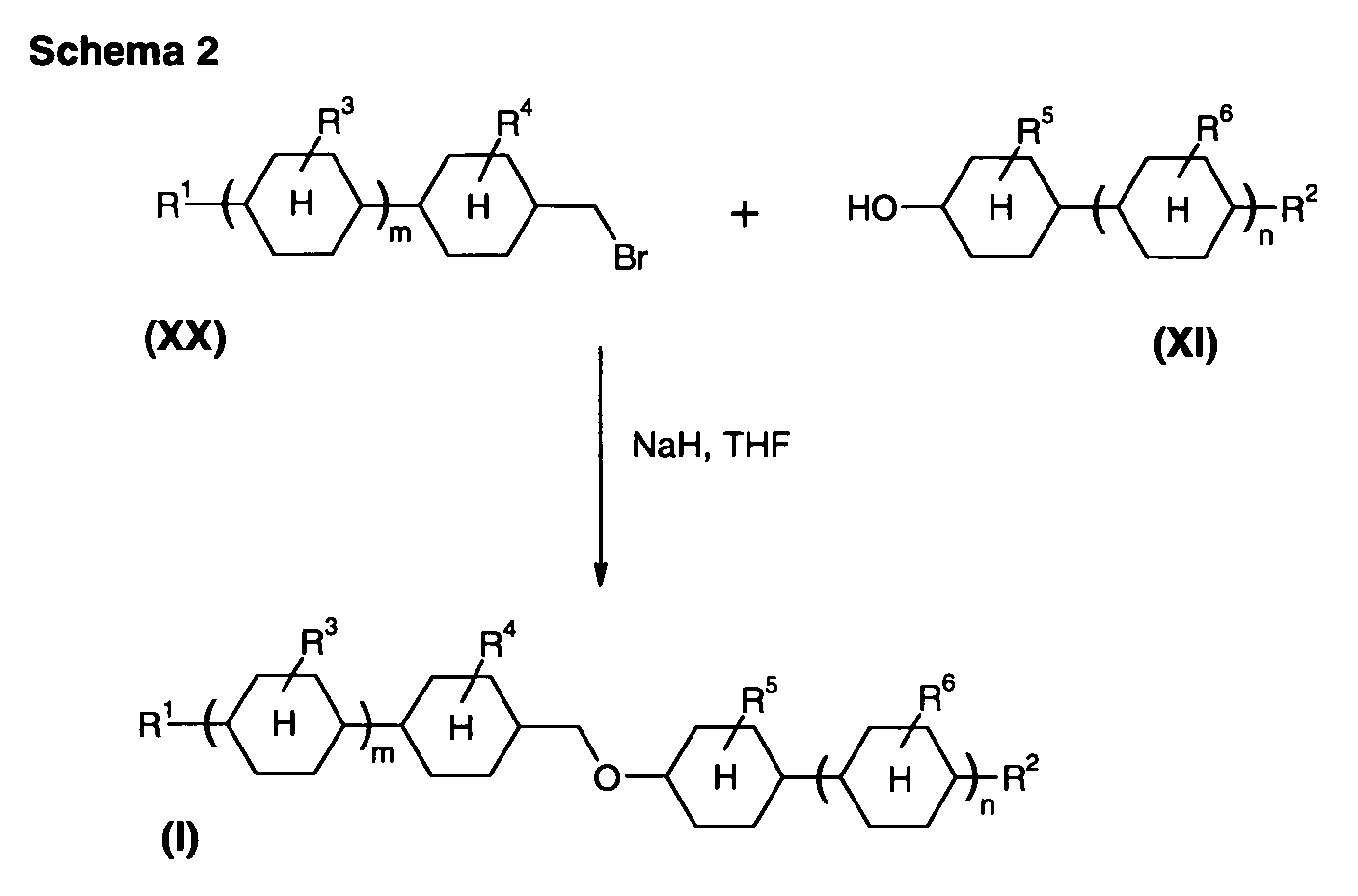
- the compounds of type (XX) must first be prepared by reacting the corresponding 4-alkylcyclohexanecarboxylic acids or, analogously, the 4'-alkyl-1,1'-bicyclohexane-4-carboxylic acids by reduction with metal hydrides to the respective hydroxymethyl compounds [US 4,361,494, p. 7, (A)], which is subsequently used in a further reaction stage [US Pat. No. 4,361,494, p. 8, (C)] give the corresponding bromomethyl compounds (XX). Yield losses over three synthetic steps as well as three synthetic steps per se (with the need for isolation of intermediates, additional purification operations, etc.) also make this process uneconomical.
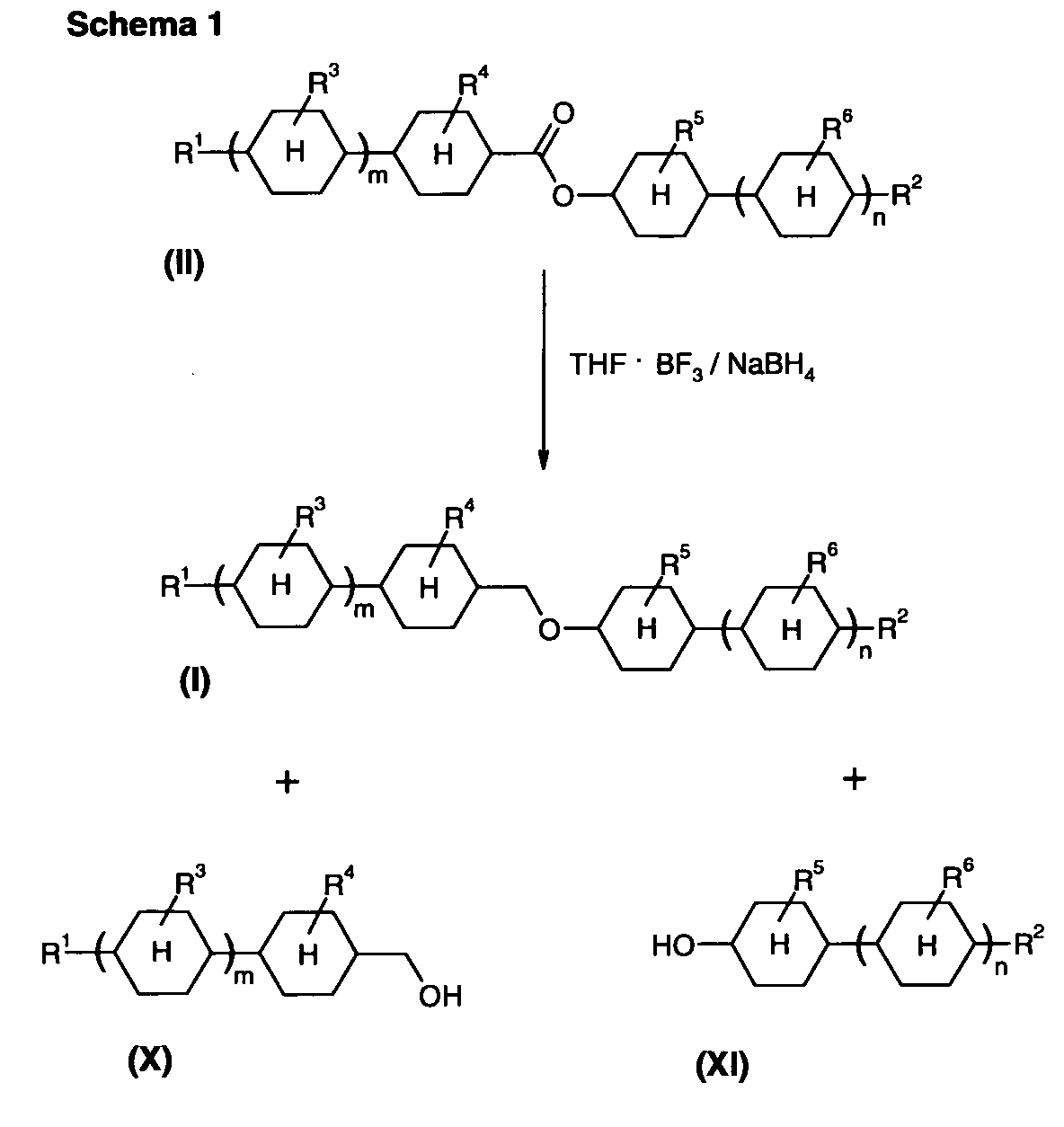
- esters of the formula (II) - in which alcohol and acid component contain a cyclohexane radical - with silanes (III) under radical conditions leads to high yields of ethers (I), wherein the reaction characterized by high concentrations and short reaction times and consequently by a very high space-time yield.
- the ratio of the molar equivalents of (II): (III) is preferably in the range of 1: 2 to 1: 5.
- the radical chain reaction is preferably triggered by free radicals, which in the Reaction by decomposition of radical starters, by actinic radiation or a Combination of which are formed.
- radical initiators can be used which decompose thermally and / or photochemically to form free radicals.
- R 1 and R 2 are each independently preferably C 2-7 alkyl, especially C 3-5 alkyl.
- the alkyl radicals may be branched or preferably linear.
- radicals R 3 , R 4 , R 5 and R 6 are preferably independently of one another hydrogen or halogen.
- the sum of n and m is 0 or 1, i. either m has the value 0 and n the Value 1, or m has the value 1 and n has the value zero.
- the process of the invention according to Scheme 3 employs the readily available (cf., EP-A-1 061 113) esters of the formula (II) which are reacted in a radical chain reaction with silanes of the formula (III).
- R 11 and R 12 are preferably chlorine.
- the presence of radicals can be effected by radical starter or actinic (eg, ⁇ ) radiation. If radical initiators, for example of the formulas (IV) or (V), are used, the initiation of the radical chain reaction (by decomposition of the radical initiator) can take place by supplying thermal or photochemical energy. As a side reaction, the so-called “reductive deoxygenation" can be observed leading to compounds of the type (X) and (XII).
- the irradiation of photochemical energy can by means of diving lamps within the Reaction vessel or by a transparent for the selected wavelength opening in Reaction vessel from the outside. Dive lamps are preferably used.
- silanes (III) may be preferably used: trichlorosilane, dichloroalkyl-silanes, cyclohexyldichlorosilane, chloro-dialkylsilanes, chloro-alkyl-cyclohexylsilane, dichloro-phenylsilane, diphenyl-chloro-silane, alkoxy-dichlorosilanes, dialkoxy-chloro-silanes.
- trichlorosilane Preference is given to trichlorosilane, dichloroalkylsilanes, cyclohexyldichlorosilane and dichloro-phenylsilane, of the alkyl radicals C 1-6 -alkyl, in particular methyl and ethyl, being preferred. Very particular preference is given to trichlorosilane.
- free radical initiator (IV) commercially available (e.g., trade names Trigonox or Luperox) hydroperoxides and peroxides are used, which are soluble in the reaction medium and themselves or in the form of their by radical decay resulting fission products compared to (II), (III) and (I) are chemically active only to a minor extent.
- Examples are: tert-butyl hydroperoxide; 1-hydroperoxy-1'-hydroxydicyclohexylperoxid; Diterbutylperoxide; Di-tert-amyl peroxide; 2,2-di- (tert-butylperoxy) butane; 1,1-bis (tertamylperoxy) cyclohexane; 1,1-di (tert-butylperoxy) cyclohexane; 1,1-bis (tert-butyl) -3,3,5-trimethylcyclohexanperoxid; 3,6,9-triethyl-3,6,9-trimethyl-1,4,7-triperoxynonan.
- V free radical initiator
- azo-bis-isobutyronitrile dimethyl-2,2'azobisisobutyrate (Trade name V-601).
- Solvents that are suitable for carrying out the reaction have to be compared to Reactants are inert and have a good solubility for the reactants.
- Suitable solvents for this purpose are ethers, such as tetrahydrofuran, 2-methyltetrahydrofuran, 1,4-dioxane, ethylene glycol dialkyl ether, tert-butyl methyl ether or Hydrocarbons such as cyclohexane, methylcyclohexane, hexane, heptane, isooctane or Chlorinated hydrocarbons such as dichloromethane. Preference is given to tetrahydrofuran.
- the reaction can be carried out in wide temperature ranges, optionally under Application of pressure if the reaction temperature is above the boiling point of the lowest boiling component lies. Preference is given to a reaction temperature between -5 and 30 ° C, more preferably between 10 and 25 ° C, in the case of photochemical Initiation of radical formation.
- the Reaction temperature or the pressure to be chosen so that the decomposition of the radical initiator in significant extent at a temperature below the boiling point of the solvent.
- the reaction can be carried out in wide concentration ranges; is preferred with the saturation concentration of (I) in the respective solvent at a Temperature of up to 10K below the reaction temperature worked.
- the inventive method has in addition the advantage that silanes, especially trichlorosilane, cost-effective large-scale products are. Furthermore, due to short reaction times and high concentrations (good Solubility of starting material and product e.g. in THF) high space-time yields can be achieved. The sum of all three conditions makes the inventive method for a technical implementation particularly suitable.
- Example 1 The procedure is as in Example 1, but with a ratio (II): (III) of 1: 2.5 compared to 1: 4 in Example 1.
- Example 1 The procedure is as in Example 1, but with a ratio (II) / (III) of 1: 2.95 versus 1: 4 in Example 1, a ratio (III): (IV) of 12: 1 vs. 8: 1 in Example 1 and a scale magnification of 8.
- reaction mixture is poured onto 300 ml of ice water, 70 ml of 32% sodium hydroxide solution are added, and it is extracted with 100 ml of tert-butyl methyl ether.
- the aqueous phase is extracted twice more with 100 ml of tert-butyl methyl ether.
- the organic phases are combined and the solvents are distilled off in vacuo.
- the crude product is subjected to analysis by GC.
- the mixture is cooled to 2 l of ice-cold 5% sodium hydroxide solution extracted, extracted three times with 100 ml of tert-butyl methyl ether, the organic phases are combined, washed with saturated sodium chloride solution, dried with sodium sulfate, the solvents are distilled off in vacuo and the crude product is subjected to analysis by GC.
- the solvent is distilled off in vacuo, the residue is added to ice-water and extracted three times with 100 ml of diethyl ether.
- the combined organic phases are washed with saturated sodium chloride solution and dried with sodium sulfate; the solvents are distilled off in vacuo.
- the crude product is subjected to analysis by GC.
- the mixture is then stirred for a further 4 h at 20 ° C. It is poured onto 3 l of ice cold 5% sodium hydroxide solution, extracted three times with 150 ml of tert-butyl methyl ether, the organic phases are combined, washed with saturated sodium chloride solution, dried with sodium sulfate, and the solvents are distilled off in vacuo. The crude product is subjected to analysis by GC.
- Tab.1 uses the comparison values ⁇ Examples 1-4 vs. V1-V2; Example 6 vs. V3-4 at Application to another compound ⁇ that with the method according to the invention Higher levels of the target compound (I) can be obtained while being comparable or higher raw mass, so that the yield of (I) [i. Gross mass x salary] significantly higher is than in the comparison method.
- Example 5 shows for the same target molecule as in Examples 1 - 4, the invariance of the method in terms of scale-up.
- Tab. 2 uses the comparison values ⁇ Examples 1-5. V1-V2; Example 6 vs. V3-4 at Application to another compound; ⁇ , that with the method according to the invention higher space-time yields can be achieved, resulting in a significant improvement in the Economics of the procedure corresponds.
Landscapes
- Chemical & Material Sciences (AREA)
- Organic Chemistry (AREA)
- Crystallography & Structural Chemistry (AREA)
- Engineering & Computer Science (AREA)
- Materials Engineering (AREA)
- Chemical Kinetics & Catalysis (AREA)
Abstract
Description
Auch Verfahren zur Herstellung dieser Verbindungen werden dort genannt, insbesondere die Reduktion von Carbonsäureestern mit Borverbindungen ( EP-A-1 061 113, S. 6, Schema 1 und S.27, Beispiel 1, Schritt 1.2; US 4,361,494, p. 6, example 2) sowie die Ethersynthese nach Williamson (US 4,361,494, p.8, (C) ).
Da zur Erzielung der flüssigkristallinen Eigenschaften bei Cyclohexanderivaten die trans-Anordnung erforderlich ist, scheiden Verfahren aus, bei denen nicht ein hoher Anteil an trans-Verbindungen erzielt wird oder - bei Einsatz von trans-Derivaten als Ausgangsmaterialien- beibehalten werden kann. Insofern ist davon auszugehen, dass die in EP-A-1 061 113 bzw. US 4,361,494 genannten Syntheseverfahren bereits eine Optimierung hinsichtlich dieser bei Flüssigkristallen mit Cyclohexan-Baugruppen gegebenen Notwendigkeit darstellen (z.B. eine dementsprechende engere Auswahl: R.C.Larock, Comprehensive Organic Transformations: A Guide to Functional Group Preparations, VCH Publ., N.Y., 1989, ISBN 0-89573-710-8, pp. 446-448, 471; J. March, Advanced Organic Chemistry, McGraw-Hill, ed.,1977, ISBN 0-07-040247-7; pp. 357-358, 1122).
Bei der Ethersynthese nach Williamson (US 4,361,494) gemäß Schema 2 wird ebenfalls eine geringe Ausbeute an (I) erhalten. Zusätzlich müssen gemäß US 4,361,494 die Verbindungen des Typs (XX) erst hergestellt werden, indem die entsprechenden 4-Alkylcyclohexancarbonsäuren bzw. analog die 4'-Alkyl-1,1'-bicyclohexan-4-carbonsäuren durch Reduktion mit Metallhydriden zu den jeweiligen Hydroxymethylverbindungen umgesetzt werden [US 4,361,494, p. 7, (A)], die anschließend in einer weiteren Reaktionsstufe [US 4,361,494, p. 8, (C)] die entsprechenden Brommethylverbindungen (XX) ergeben. Ausbeuteverluste über drei Synthesestufen sowie drei Synthesestufen an sich (mit der Notwendigkeit der Isolation von Zwischenstufen, zusätzlicher Reinigungsoperationen etc.) machen dieses Verfahren ebenfalls unökonomisch.
Einige der in der Literatur beschriebenen Verfahren sind jedoch nur für cyclische Ester geeignet, z.B. die Reduktion mit

- R3, R4, R5, R6 jeweils unabhängig voneinander Wasserstoff, Halogen, Methyl oder Cyano
- R11, R12, R13 jeweils unabhängig voneinander Wasserstoff, Chlor, Alkyl mit 1 bis 8 C-Atomen, Alkyloxy mit 1 bis 8 C-Atomen, Cyclohexyl, Methylcyclohexyl, Cyclopentyl, Phenyl, oder R11 und R12 zusammen die Gruppierung -(CH2)p- mit der Maßgabe, dass mindestens eines von R11, R12, R13 Chlor bedeutet,
- m, n jeweils unabhängig voneinander Null oder 1,
- p 4 oder 5.
R21 , R22 Wasserstoff oder ein (gegebenenfalls durch Alkylperoxy- oder Hydroperoxy-Gruppen substituierter) Alkyl- oder Alkandiyl-Rest mit 1 bis 8 C-Atomen oder ein (gegebenenfalls durch Alkyl- und/oder Alkylperoxy- und/oder Hydroxy- und/oder Hydroperoxy-Gruppen substituierter) Cyclohexanring, mit der Maßgabe, dass nur eines von R21, R 22 Wasserstoff bedeuten kann
R31 , R32 jeweils unabhängig voneinander R41R42C(X), worin R41, R42 unabhängig voneinander eine Alkyl- oder Alkyloxygruppe mit 1-8 C-Atomen und X -CN oder -C(=O)OR43 bedeutet, mit R43=Alkylgruppe mit 1 bis 8 C-Atomen.

Um die verschiedenen Verfahren mit ihren unterschiedlichen Verunreinigungsprofilen - und folglich unterschiedlichen, auch in ihrer Effizienz unterschiedlichen Isolationstechniken und Reinigungsverfahren - besser vergleichen zu können, wurde die Bewertung der Verfahren anhand der Kennzahlen Rohmasse und Gehalt per GC (für alle Verfahren einheitlich), bestimmt an der Rohware nach Entfernung der Reaktionspartner und der Hilfsstoffe, vorgenommen.

| Versuch | Volumen Lösemittel [l] | Reaktionsszeit [h] | max.Ausb. [g] | Raum-Zeit-ausbeute [gl-1h-1] |
| 1 | 0,13 | 3 | 18,4 | 47,2 |
| 2 | 0,13 | 3 | 17,9 | 45,9 |
| 3 | 0,13 | 9 | 17,7 | 15,1 |
| 4 | 0,13 | 6 | 17,9 | 22,9 |
| V1 | 0,45 | 5 | 12,7 | 5,6 |
| V2 | 0,11 | 16 | 5,8 | 3,3 |
| 5 | 1,04 | 3 | 147,7 | 47,3 |
| 6 | 0,05 | 4 | 22,0 | 110 |
| V3 | 0,53 | 5 | 14,1 | 1,7 |
| V4 | 0,11 | 16 | 8,5 | 4,8 |
Claims (10)
- Verfahren zur Herstellung von Ether-Verbindungen der Formel (I)durch Reduktion von Carbonsäure-Estern der Formel (II),
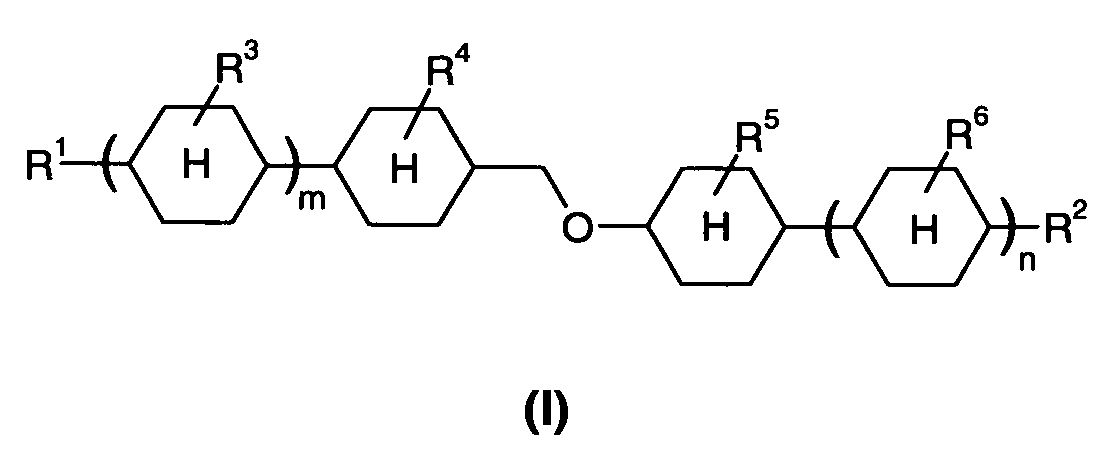 dadurch gekennzeichnet, dass 1 Mol-Äquivalent einer Verbindung der Formel (II) mit 2 bis 6 Mol-Äquivalenten eines Silans der Formel (III),
 R1, R2 : jeweils unabhängig voneinander Wasserstoff oder einen unsubstituierten oder einfach durch CN oder CF3 oder mindestens einfach durch Halogen substituierten Alkyl-Rest mit 1 bis 12 C-Atomen oder Alkenyl-Rest mit 2 bis 12 C-Atomen, wobei in diesen Resten auch eine oder mehrere -CH2-Gruppen jeweils unabhängig voneinander durch -O-, -S-, Cyclopropan-1,2-diyl, Cyclobutan-1,3-diyl so ersetzt sein können, dass O-Atome nicht direkt miteinander verknüpft sind, mit der Maßgabe, dass von R1, R2 nur eines Wasserstoff sein darfR3, R4 , R5, R6 jeweils unabhängig voneinander Wasserstoff, Halogen, Methyl oder CyanoR11, R12, R13 jeweils unabhängig voneinander Wasserstoff, Chlor, Alkyl mit 1 bis 8 C-Atomen, Alkyloxy mit 1 bis 8 C-Atomen, Cyclohexyl, Methylcyclohexyl, Cyclopentyl, Phenyl, oder R11 und R12 zusammen die Gruppierung -(CH2)p- ,mit der Maßgabe, dass mindestens eines von R11, R12, R13 Chlor bedeutet,m, n jeweils unabhängig voneinander Null oder 1,p 4 oder 5.
 - Verfahren nach Anspruch 1, dadurch gekennzeichnet, dass das Verhältnis der Mol-Äquivalente von (II) : (III) im Bereich von 1:2 bis 1: 5 liegt.
- Verfahren nach Anspruch 1 oder 2, dadurch gekennzeichnet, dass die Radikalkettenreaktion durch freie Radikale ausgelöst wird, die bei der Umsetzung durch Zerfall von Radikalstartern, durch aktinische Strahlung oder eine Kombination davon, gebildet werden.
- Verfahren nach Anspruch 3, dadurch gekennzeichnet, dass Radikalstarter eingesetzt werden, die thermisch und/oder photochemisch unter Bildung freier Radikale zerfallen.
- Verfahren nach Anspruch 4, dadurch gekennzeichnet, dass Radikalstarter der Formeln (IV) bzw. (V) eingesetzt werden
R21 , R22 Wasserstoff oder ein (gegebenenfalls durch Alkylperoxy- oder Hydroperoxy-Gruppen substituierter) Alkyl- oder Alkandiyl-Rest mit 1 bis 8 C-Atomen oder ein (gegebenenfalls durch Alkyl- und/oder Alkylperoxy- und/oder Hydroxy- und/oder Hydroperoxy-Gruppen substituierter) Cyclohexanring, mit der Maßgabe, dass nur eines von R21 , R 22 Wasserstoff bedeuten kann
R31 , R32 jeweils unabhängig voneinander R41R42C(X), worin R41, R42 unabhängig voneinander eine Alkyl- oder Alkyloxygruppe mit 1 bis 8 C-Atomen und X -CN oder -C(=O)OR43 bedeutet, mit R43 = Alkylgruppe mit 1 bis 8 C-Atomen. - Verfahren nach einem der Ansprüche 1 bis 5, dadurch gekennzeichnet, dass im Silan der Formel (III) R11 und R12 Chlor bedeuten.
- Verfahren nach einem der Ansprüche 1 bis 6, dadurch gekennzeichnet, dass die Umsetzung in einem inerten Lösungsmittel, ausgewählt aus Ethern, Kohlenwasserstoffen, Chlorkohlenwasserstoffen oder Gemischen davon, durchgeführt wird.
- Verfahren nach einem der Ansprüche 1 bis 7, dadurch gekennzeichnet, dass in den Verbindungen der Formeln (I) bzw. (II) R1 und R2 C2-7-Alkyl und R3, R4, R5, R6 unabhängig voneinander Wasserstoff oder Halogen bedeuten.
- Verfahren nach einem der Ansprüche 1 bis 8, dadurch gekennzeichnet, dass in den Verbindungen der Formeln (I) bzw. (II) m + n Null oder 1 bedeutet.
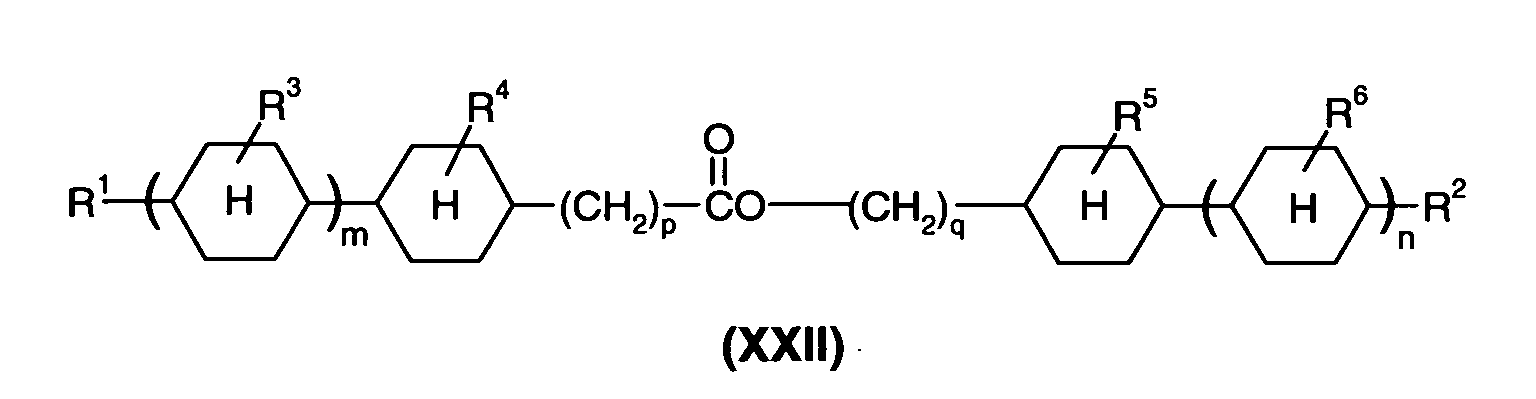
- Verfahren zur Herstellung von Ether-Verbindungen der Formel (XXI)durch Reduktion von Carbonsäure-Estern der Formel (XXII),
 dadurch gekennzeichnet, dass 1 Mol-Äquivalent einer Verbindung der Formel (XXII) mit 2 bis 6 Mol-Äquivalenten eines Silans der Formel (III)
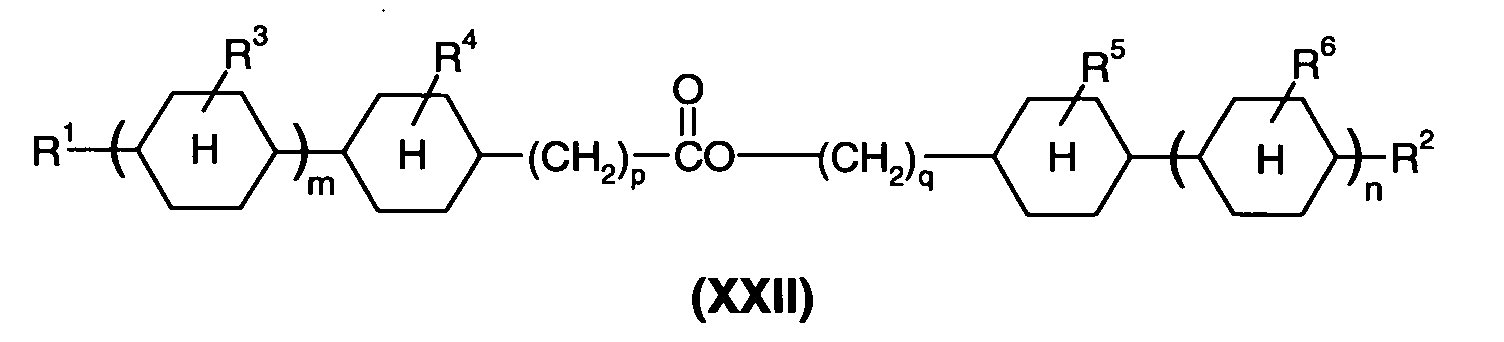 R1, R2 : jeweils unabhängig voneinander Wasserstoff oder einen unsubstituierten oder einfach durch CN oder CF3 oder mindestens einfach durch Halogen substituierten Alkyl-Rest mit 1 bis 12 C-Atomen oder Alkenyl-Rest mit 2 bis 12 C-Atomen, wobei in diesen Resten auch eine oder mehrere -CH2-Gruppen jeweils unabhängig voneinander durch -O-, -S-, Cyclopropan-1,2-diyl, Cyclobutan-1,3-diyl so ersetzt sein können, dass O-Atome nicht direkt miteinander verknüpft sind, mit der Maßgabe, dass von R1, R2 nur eines Wasserstoff sein darfR3, R4 , R5, R6 jeweils unabhängig voneinander Wasserstoff, Halogen, Methyl oder CyanoR11, R12, R13 jeweils unabhängig voneinander Wasserstoff, Chlor, Alkyl mit 1 bis 8 C-Atomen, Alkyloxy mit 1 bis 8 C-Atomen, Cyclohexyl, Methylcyclohexyl, Cyclopentyl, Phenyl, oder R11 und R12 zusammen die Gruppierung -(CH2)p-,mit der Maßgabe, dass mindestens eines von R11, R12, R13 Chlor bedeutet,m, n jeweils unabhängig voneinander Null oder 1,p und q jeweils unabhängig voneinander 0, 1, 2 oder 3, die Summe p+q 1, 2 oder 3.
Priority Applications (1)
| Application Number | Priority Date | Filing Date | Title |
|---|---|---|---|
| EP04022005A EP1518851B1 (de) | 2003-09-25 | 2004-09-16 | Verfahren zur Herstellung flüssigkristalliner Ether |
Applications Claiming Priority (3)
| Application Number | Priority Date | Filing Date | Title |
|---|---|---|---|
| EP03021634 | 2003-09-25 | ||
| EP03021634 | 2003-09-25 | ||
| EP04022005A EP1518851B1 (de) | 2003-09-25 | 2004-09-16 | Verfahren zur Herstellung flüssigkristalliner Ether |
Publications (2)
| Publication Number | Publication Date |
|---|---|
| EP1518851A1 true EP1518851A1 (de) | 2005-03-30 |
| EP1518851B1 EP1518851B1 (de) | 2006-11-22 |
Family
ID=34196141
Family Applications (1)
| Application Number | Title | Priority Date | Filing Date |
|---|---|---|---|
| EP04022005A Expired - Lifetime EP1518851B1 (de) | 2003-09-25 | 2004-09-16 | Verfahren zur Herstellung flüssigkristalliner Ether |
Country Status (1)
| Country | Link |
|---|---|
| EP (1) | EP1518851B1 (de) |
Cited By (1)
| Publication number | Priority date | Publication date | Assignee | Title |
|---|---|---|---|---|
| CN104844427A (zh) * | 2015-04-14 | 2015-08-19 | 哈尔滨工业大学 | 一种苄醚类化合物的合成方法 |
Citations (3)
| Publication number | Priority date | Publication date | Assignee | Title |
|---|---|---|---|---|
| JPS5031126B1 (de) * | 1968-12-16 | 1975-10-07 | ||
| EP0030761A1 (de) * | 1979-12-17 | 1981-06-24 | MERCK PATENT GmbH | Anisotrope Cyclohexyläther |
| EP1061113A1 (de) * | 1999-06-18 | 2000-12-20 | MERCK PATENT GmbH | Flüssigkristallines Medium |
-
2004
- 2004-09-16 EP EP04022005A patent/EP1518851B1/de not_active Expired - Lifetime
Patent Citations (3)
| Publication number | Priority date | Publication date | Assignee | Title |
|---|---|---|---|---|
| JPS5031126B1 (de) * | 1968-12-16 | 1975-10-07 | ||
| EP0030761A1 (de) * | 1979-12-17 | 1981-06-24 | MERCK PATENT GmbH | Anisotrope Cyclohexyläther |
| EP1061113A1 (de) * | 1999-06-18 | 2000-12-20 | MERCK PATENT GmbH | Flüssigkristallines Medium |
Non-Patent Citations (6)
| Title |
|---|
| DATABASE WPI Section Ch Week 197544, Derwent World Patents Index; Class E17, AN 1975-73448W, XP002270420 * |
| KUNIO OKA ET AL.: "Gamma ray induced reduction of sterically hindered alkyl carboxylates with trichlorosilane in the presence of hydrogen chloride", JOURNAL OF ORGANOMETALLIC CHEMISTRY., vol. 362, 1989, ELSEVIER-SEQUOIA S.A. LAUSANNE., CH, pages 31 - 35, XP002270418, ISSN: 0022-328X * |
| NAKAO R ET AL: "REDUCTION WITH TRICHLOROSILANE. III CYCLIC ETHER FROM LACTONE", JOURNAL OF ORGANIC CHEMISTRY, AMERICAN CHEMICAL SOCIETY. EASTON, US, vol. 37, no. 1, 14 January 1972 (1972-01-14), pages 76 - 78, XP000569711, ISSN: 0022-3263 * |
| S.W. BALDWIN ET AL.: "Reductive deoxygenation of esters with trichlorosilane.", JOURNAL OF ORGANIC CHEMISTRY., vol. 40, no. 26, 1975, EASTON US, pages 3885 - 3887, XP002270417 * |
| TSURUGI, JITSUO ET AL.: "A novel gamma induced reduction with trichlorosilane. Dialkyl ether from alkyl aliphatic carboxylate", JOURNAL OF THE AMERICAN CHEMICAL SOCIETY., vol. 91, no. 16, 1969, USAMERICAN CHEMICAL SOCIETY, WASHINGTON, DC., pages 4587 - 4588, XP002299574 * |
| ZHIBIAO MAO ET AL.: "Catalytic hydrosilation of organic esters using manganese carbonyl acetyl complexes, (L)(CO)4MnC(O)CH3 (L = CO, PPh3)", JOURNAL OF THE AMERICAN CHEMICAL SOCIETY., vol. 117, no. 40, 1995, DC US, pages 10139 - 10140, XP002270419 * |
Cited By (1)
| Publication number | Priority date | Publication date | Assignee | Title |
|---|---|---|---|---|
| CN104844427A (zh) * | 2015-04-14 | 2015-08-19 | 哈尔滨工业大学 | 一种苄醚类化合物的合成方法 |
Also Published As
| Publication number | Publication date |
|---|---|
| EP1518851B1 (de) | 2006-11-22 |
Similar Documents
| Publication | Publication Date | Title |
|---|---|---|
| EP0438563B1 (de) | Phenylcyclohexane und flüssigkristallines medium | |
| EP0633258A1 (de) | Verbessertes Verfahren zur Herstellung von Astaxanthin, neue Zwischenprodukte hierfür sowie ein Verfahren zu deren Herstellung | |
| DE19742315A1 (de) | Bisalkenylbicyclohexane und flüssigkristallines Medium | |
| DE69412588T2 (de) | Optisch aktive beta-aminoalkoxyborankomplexe | |
| DE3609152A1 (de) | Verfahren zur herstellung des (-)-antipoden des (e)-1-cyclohexyl-4,4-dimethyl- 3-hydroxy-2-(1,2,4-triazol-1-yl)-pent-1-ens | |
| DE2418715C2 (de) | Allensäureester | |
| EP1518851B1 (de) | Verfahren zur Herstellung flüssigkristalliner Ether | |
| DE10344661B3 (de) | Verfahren zur Herstellung flüssigkristalliner Ether | |
| DE112009004304T5 (de) | Flüssigkristallverbindungen und Verfahren zu deren Herstellung | |
| WO2006125526A1 (de) | Verfahren zur herstellung von 2,5-substituierten tetrahydropyran-derivaten durch reduktive eliminierung des entsprechenden 4-halogen-derivats | |
| DE2950490A1 (de) | Verfahren zur herstellung von phenylfluoracrylat und dabei verwendetes natriumfluoracrylat | |
| DE102007045759A1 (de) | Difluorbenzol-Derivat und Herstellungsverfahren dafür | |
| EP1019356B1 (de) | Verfahren zur herstellung von 3-hydroxy-2-methylbenzoesäure | |
| DE10220549A1 (de) | Verfahren zur Herstellung von ringverknüpften Verbindungen | |
| DE2508831A1 (de) | Thiophan-derivate, verfahren zu ihrer herstellung und ihre verwendung | |
| DE566033C (de) | Verfahren zur Herstellung von Alkyl- bzw. Aryloxyaethylidenestern und Acetalen | |
| DE2457555C3 (de) | Verfahren zur Herstellung von 1,2disubstituierten trans-Olefinen | |
| DE3820230C2 (de) | Verfahren zur Herstellung von (trans)-4-Phenyl-L-prolin-Derivaten | |
| DE60034129T2 (de) | Synthese von Alken-2-onen | |
| EP0285109B1 (de) | Verfahren zur Herstellung von 2-Amino-4-acylaminophenylethern | |
| DE2504930C2 (de) | Verfahren zur Herstellung von 2,6,6- Trimethyl-cyclohex-2-en-1-on | |
| WO2006125527A1 (de) | Verfahren zur herstellung von tetrahydropyran-derivaten | |
| DE3309158A1 (de) | Verbessertes verfahren zur herstellung von (alpha)-tocopherol | |
| EP0010165A1 (de) | Verfahren zur Herstellung von 6-Hydroxypyrid-2-onen | |
| WO2007051758A1 (de) | VERFAHREN ZUR HERSTELLUNG VON α-BISABOLOL AUS FARNESOL ODER NEROLIDOL |
Legal Events
| Date | Code | Title | Description |
|---|---|---|---|
| PUAI | Public reference made under article 153(3) epc to a published international application that has entered the european phase |
Free format text: ORIGINAL CODE: 0009012 |
|
| AK | Designated contracting states |
Kind code of ref document: A1 Designated state(s): AT BE BG CH CY CZ DE DK EE ES FI FR GB GR HU IE IT LI LU MC NL PL PT RO SE SI SK TR |
|
| AX | Request for extension of the european patent |
Extension state: AL HR LT LV MK |
|
| 17P | Request for examination filed |
Effective date: 20050822 |
|
| AKX | Designation fees paid |
Designated state(s): AT BE BG CH CY CZ DE DK EE ES FI FR GB GR HU IE IT LI LU MC NL PL PT RO SE SI SK TR |
|
| GRAP | Despatch of communication of intention to grant a patent |
Free format text: ORIGINAL CODE: EPIDOSNIGR1 |
|
| RAP1 | Party data changed (applicant data changed or rights of an application transferred) |
Owner name: AZ ELECTRONIC MATERIALS (GERMANY) GMBH |
|
| GRAS | Grant fee paid |
Free format text: ORIGINAL CODE: EPIDOSNIGR3 |
|
| GRAA | (expected) grant |
Free format text: ORIGINAL CODE: 0009210 |
|
| AK | Designated contracting states |
Kind code of ref document: B1 Designated state(s): AT BE BG CH CY CZ DE DK EE ES FI FR GB GR HU IE IT LI LU MC NL PL PT RO SE SI SK TR |
|
| PG25 | Lapsed in a contracting state [announced via postgrant information from national office to epo] |
Ref country code: IT Free format text: LAPSE BECAUSE OF FAILURE TO SUBMIT A TRANSLATION OF THE DESCRIPTION OR TO PAY THE FEE WITHIN THE PRESCRIBED TIME-LIMIT;WARNING: LAPSES OF ITALIAN PATENTS WITH EFFECTIVE DATE BEFORE 2007 MAY HAVE OCCURRED AT ANY TIME BEFORE 2007. THE CORRECT EFFECTIVE DATE MAY BE DIFFERENT FROM THE ONE RECORDED. Effective date: 20061122 Ref country code: CZ Free format text: LAPSE BECAUSE OF FAILURE TO SUBMIT A TRANSLATION OF THE DESCRIPTION OR TO PAY THE FEE WITHIN THE PRESCRIBED TIME-LIMIT Effective date: 20061122 Ref country code: SK Free format text: LAPSE BECAUSE OF FAILURE TO SUBMIT A TRANSLATION OF THE DESCRIPTION OR TO PAY THE FEE WITHIN THE PRESCRIBED TIME-LIMIT Effective date: 20061122 Ref country code: FI Free format text: LAPSE BECAUSE OF FAILURE TO SUBMIT A TRANSLATION OF THE DESCRIPTION OR TO PAY THE FEE WITHIN THE PRESCRIBED TIME-LIMIT Effective date: 20061122 Ref country code: SI Free format text: LAPSE BECAUSE OF FAILURE TO SUBMIT A TRANSLATION OF THE DESCRIPTION OR TO PAY THE FEE WITHIN THE PRESCRIBED TIME-LIMIT Effective date: 20061122 Ref country code: IE Free format text: LAPSE BECAUSE OF FAILURE TO SUBMIT A TRANSLATION OF THE DESCRIPTION OR TO PAY THE FEE WITHIN THE PRESCRIBED TIME-LIMIT Effective date: 20061122 Ref country code: PL Free format text: LAPSE BECAUSE OF FAILURE TO SUBMIT A TRANSLATION OF THE DESCRIPTION OR TO PAY THE FEE WITHIN THE PRESCRIBED TIME-LIMIT Effective date: 20061122 Ref country code: NL Free format text: LAPSE BECAUSE OF FAILURE TO SUBMIT A TRANSLATION OF THE DESCRIPTION OR TO PAY THE FEE WITHIN THE PRESCRIBED TIME-LIMIT Effective date: 20061122 Ref country code: RO Free format text: LAPSE BECAUSE OF FAILURE TO SUBMIT A TRANSLATION OF THE DESCRIPTION OR TO PAY THE FEE WITHIN THE PRESCRIBED TIME-LIMIT Effective date: 20061122 |
|
| REG | Reference to a national code |
Ref country code: GB Ref legal event code: FG4D Free format text: NOT ENGLISH |
|
| REG | Reference to a national code |
Ref country code: CH Ref legal event code: EP |
|
| REG | Reference to a national code |
Ref country code: IE Ref legal event code: FG4D Free format text: LANGUAGE OF EP DOCUMENT: GERMAN |
|
| REF | Corresponds to: |
Ref document number: 502004002065 Country of ref document: DE Date of ref document: 20070104 Kind code of ref document: P |
|
| PG25 | Lapsed in a contracting state [announced via postgrant information from national office to epo] |
Ref country code: DK Free format text: LAPSE BECAUSE OF FAILURE TO SUBMIT A TRANSLATION OF THE DESCRIPTION OR TO PAY THE FEE WITHIN THE PRESCRIBED TIME-LIMIT Effective date: 20070222 Ref country code: BG Free format text: LAPSE BECAUSE OF FAILURE TO SUBMIT A TRANSLATION OF THE DESCRIPTION OR TO PAY THE FEE WITHIN THE PRESCRIBED TIME-LIMIT Effective date: 20070222 Ref country code: SE Free format text: LAPSE BECAUSE OF FAILURE TO SUBMIT A TRANSLATION OF THE DESCRIPTION OR TO PAY THE FEE WITHIN THE PRESCRIBED TIME-LIMIT Effective date: 20070222 |
|
| PG25 | Lapsed in a contracting state [announced via postgrant information from national office to epo] |
Ref country code: ES Free format text: LAPSE BECAUSE OF FAILURE TO SUBMIT A TRANSLATION OF THE DESCRIPTION OR TO PAY THE FEE WITHIN THE PRESCRIBED TIME-LIMIT Effective date: 20070305 |
|
| GBT | Gb: translation of ep patent filed (gb section 77(6)(a)/1977) |
Effective date: 20070228 |
|
| PG25 | Lapsed in a contracting state [announced via postgrant information from national office to epo] |
Ref country code: PT Free format text: LAPSE BECAUSE OF FAILURE TO SUBMIT A TRANSLATION OF THE DESCRIPTION OR TO PAY THE FEE WITHIN THE PRESCRIBED TIME-LIMIT Effective date: 20070423 |
|
| NLV1 | Nl: lapsed or annulled due to failure to fulfill the requirements of art. 29p and 29m of the patents act | ||
| ET | Fr: translation filed | ||
| REG | Reference to a national code |
Ref country code: IE Ref legal event code: FD4D |
|
| PLBE | No opposition filed within time limit |
Free format text: ORIGINAL CODE: 0009261 |
|
| STAA | Information on the status of an ep patent application or granted ep patent |
Free format text: STATUS: NO OPPOSITION FILED WITHIN TIME LIMIT |
|
| 26N | No opposition filed |
Effective date: 20070823 |
|
| BERE | Be: lapsed |
Owner name: AZ ELECTRONIC MATERIALS (GERMANY) G.M.B.H. Effective date: 20070930 |
|
| PG25 | Lapsed in a contracting state [announced via postgrant information from national office to epo] |
Ref country code: MC Free format text: LAPSE BECAUSE OF NON-PAYMENT OF DUE FEES Effective date: 20070930 Ref country code: GR Free format text: LAPSE BECAUSE OF FAILURE TO SUBMIT A TRANSLATION OF THE DESCRIPTION OR TO PAY THE FEE WITHIN THE PRESCRIBED TIME-LIMIT Effective date: 20070223 |
|
| PG25 | Lapsed in a contracting state [announced via postgrant information from national office to epo] |
Ref country code: DE Free format text: LAPSE BECAUSE OF NON-PAYMENT OF DUE FEES Effective date: 20080401 |
|
| PG25 | Lapsed in a contracting state [announced via postgrant information from national office to epo] |
Ref country code: BE Free format text: LAPSE BECAUSE OF NON-PAYMENT OF DUE FEES Effective date: 20070930 |
|
| PG25 | Lapsed in a contracting state [announced via postgrant information from national office to epo] |
Ref country code: AT Free format text: LAPSE BECAUSE OF NON-PAYMENT OF DUE FEES Effective date: 20070916 |
|
| PG25 | Lapsed in a contracting state [announced via postgrant information from national office to epo] |
Ref country code: EE Free format text: LAPSE BECAUSE OF FAILURE TO SUBMIT A TRANSLATION OF THE DESCRIPTION OR TO PAY THE FEE WITHIN THE PRESCRIBED TIME-LIMIT Effective date: 20061122 |
|
| REG | Reference to a national code |
Ref country code: CH Ref legal event code: PL |
|
| PG25 | Lapsed in a contracting state [announced via postgrant information from national office to epo] |
Ref country code: LI Free format text: LAPSE BECAUSE OF NON-PAYMENT OF DUE FEES Effective date: 20070930 Ref country code: CH Free format text: LAPSE BECAUSE OF NON-PAYMENT OF DUE FEES Effective date: 20070930 |
|
| PG25 | Lapsed in a contracting state [announced via postgrant information from national office to epo] |
Ref country code: LU Free format text: LAPSE BECAUSE OF NON-PAYMENT OF DUE FEES Effective date: 20070916 Ref country code: CY Free format text: LAPSE BECAUSE OF FAILURE TO SUBMIT A TRANSLATION OF THE DESCRIPTION OR TO PAY THE FEE WITHIN THE PRESCRIBED TIME-LIMIT Effective date: 20061122 |
|
| PG25 | Lapsed in a contracting state [announced via postgrant information from national office to epo] |
Ref country code: TR Free format text: LAPSE BECAUSE OF FAILURE TO SUBMIT A TRANSLATION OF THE DESCRIPTION OR TO PAY THE FEE WITHIN THE PRESCRIBED TIME-LIMIT Effective date: 20061122 Ref country code: HU Free format text: LAPSE BECAUSE OF FAILURE TO SUBMIT A TRANSLATION OF THE DESCRIPTION OR TO PAY THE FEE WITHIN THE PRESCRIBED TIME-LIMIT Effective date: 20070523 |
|
| PG25 | Lapsed in a contracting state [announced via postgrant information from national office to epo] |
Ref country code: CH Free format text: LAPSE BECAUSE OF NON-PAYMENT OF DUE FEES Effective date: 20080930 Ref country code: LI Free format text: LAPSE BECAUSE OF NON-PAYMENT OF DUE FEES Effective date: 20080930 |
|
| PGFP | Annual fee paid to national office [announced via postgrant information from national office to epo] |
Ref country code: FR Payment date: 20110922 Year of fee payment: 8 Ref country code: GB Payment date: 20110914 Year of fee payment: 8 |
|
| GBPC | Gb: european patent ceased through non-payment of renewal fee |
Effective date: 20120916 |
|
| REG | Reference to a national code |
Ref country code: FR Ref legal event code: ST Effective date: 20130531 |
|
| PG25 | Lapsed in a contracting state [announced via postgrant information from national office to epo] |
Ref country code: GB Free format text: LAPSE BECAUSE OF NON-PAYMENT OF DUE FEES Effective date: 20120916 |
|
| PG25 | Lapsed in a contracting state [announced via postgrant information from national office to epo] |
Ref country code: FR Free format text: LAPSE BECAUSE OF NON-PAYMENT OF DUE FEES Effective date: 20121001 |