EP1505120A1 - Resin compositions containing ionic or ionizable groups with small domain sizes and improved conductivity - Google Patents
Resin compositions containing ionic or ionizable groups with small domain sizes and improved conductivity Download PDFInfo
- Publication number
- EP1505120A1 EP1505120A1 EP04291935A EP04291935A EP1505120A1 EP 1505120 A1 EP1505120 A1 EP 1505120A1 EP 04291935 A EP04291935 A EP 04291935A EP 04291935 A EP04291935 A EP 04291935A EP 1505120 A1 EP1505120 A1 EP 1505120A1
- Authority
- EP
- European Patent Office
- Prior art keywords
- polymer
- membrane
- present
- ionic
- polyelectrolyte
- Prior art date
- Legal status (The legal status is an assumption and is not a legal conclusion. Google has not performed a legal analysis and makes no representation as to the accuracy of the status listed.)
- Ceased
Links
- 239000011342 resin composition Substances 0.000 title 1
- 239000012528 membrane Substances 0.000 claims abstract description 160
- 229920000642 polymer Polymers 0.000 claims abstract description 133
- 239000011347 resin Substances 0.000 claims abstract description 66
- 229920005989 resin Polymers 0.000 claims abstract description 66
- 125000000391 vinyl group Chemical group [H]C([*])=C([H])[H] 0.000 claims abstract description 65
- 239000000446 fuel Substances 0.000 claims abstract description 62
- 229920002554 vinyl polymer Polymers 0.000 claims abstract description 61
- OKKJLVBELUTLKV-UHFFFAOYSA-N Methanol Chemical compound OC OKKJLVBELUTLKV-UHFFFAOYSA-N 0.000 claims description 102
- 229920000867 polyelectrolyte Polymers 0.000 claims description 73
- NIXOWILDQLNWCW-UHFFFAOYSA-N acrylic acid group Chemical group C(C=C)(=O)O NIXOWILDQLNWCW-UHFFFAOYSA-N 0.000 claims description 54
- 229920002313 fluoropolymer Polymers 0.000 claims description 47
- 239000004811 fluoropolymer Substances 0.000 claims description 46
- QGZKDVFQNNGYKY-UHFFFAOYSA-O Ammonium Chemical compound [NH4+] QGZKDVFQNNGYKY-UHFFFAOYSA-O 0.000 claims description 27
- 239000007788 liquid Substances 0.000 claims description 14
- XYFCBTPGUUZFHI-UHFFFAOYSA-O phosphonium Chemical compound [PH4+] XYFCBTPGUUZFHI-UHFFFAOYSA-O 0.000 claims description 13
- 239000004215 Carbon black (E152) Substances 0.000 claims description 3
- 229930195733 hydrocarbon Natural products 0.000 claims description 3
- 150000002430 hydrocarbons Chemical class 0.000 claims description 3
- 229920002959 polymer blend Polymers 0.000 abstract description 37
- 238000000034 method Methods 0.000 abstract description 36
- 229920000178 Acrylic resin Polymers 0.000 abstract description 31
- 239000004925 Acrylic resin Substances 0.000 abstract description 31
- 230000015572 biosynthetic process Effects 0.000 abstract description 13
- 239000000178 monomer Substances 0.000 description 65
- 239000000203 mixture Substances 0.000 description 62
- -1 polytetrafluoroethylenes Polymers 0.000 description 58
- 239000010410 layer Substances 0.000 description 52
- 239000000243 solution Substances 0.000 description 50
- SECXISVLQFMRJM-UHFFFAOYSA-N N-Methylpyrrolidone Chemical compound CN1CCCC1=O SECXISVLQFMRJM-UHFFFAOYSA-N 0.000 description 37
- 238000002156 mixing Methods 0.000 description 34
- 239000010408 film Substances 0.000 description 31
- 239000002904 solvent Substances 0.000 description 28
- LPSKDVINWQNWFE-UHFFFAOYSA-M tetrapropylazanium;hydroxide Chemical compound [OH-].CCC[N+](CCC)(CCC)CCC LPSKDVINWQNWFE-UHFFFAOYSA-M 0.000 description 23
- PPBRXRYQALVLMV-UHFFFAOYSA-N Styrene Chemical compound C=CC1=CC=CC=C1 PPBRXRYQALVLMV-UHFFFAOYSA-N 0.000 description 17
- 239000002253 acid Substances 0.000 description 17
- 239000000126 substance Substances 0.000 description 17
- 229920000557 Nafion® Polymers 0.000 description 16
- 238000004132 cross linking Methods 0.000 description 16
- 229920000554 ionomer Polymers 0.000 description 16
- XLYOFNOQVPJJNP-UHFFFAOYSA-N water Substances O XLYOFNOQVPJJNP-UHFFFAOYSA-N 0.000 description 16
- 238000002360 preparation method Methods 0.000 description 15
- 238000006116 polymerization reaction Methods 0.000 description 14
- 239000006185 dispersion Substances 0.000 description 13
- 150000002500 ions Chemical group 0.000 description 12
- 150000003839 salts Chemical class 0.000 description 12
- BQCIDUSAKPWEOX-UHFFFAOYSA-N 1,1-Difluoroethene Chemical compound FC(F)=C BQCIDUSAKPWEOX-UHFFFAOYSA-N 0.000 description 11
- 239000004816 latex Substances 0.000 description 10
- 229920000126 latex Polymers 0.000 description 10
- WGTYBPLFGIVFAS-UHFFFAOYSA-M tetramethylammonium hydroxide Chemical compound [OH-].C[N+](C)(C)C WGTYBPLFGIVFAS-UHFFFAOYSA-M 0.000 description 10
- 229920001169 thermoplastic Polymers 0.000 description 10
- 229920006370 Kynar Polymers 0.000 description 9
- 150000003863 ammonium salts Chemical class 0.000 description 9
- 239000003014 ion exchange membrane Substances 0.000 description 9
- 239000002245 particle Substances 0.000 description 9
- QAOWNCQODCNURD-UHFFFAOYSA-N sulfuric acid group Chemical group S(O)(O)(=O)=O QAOWNCQODCNURD-UHFFFAOYSA-N 0.000 description 9
- 239000004416 thermosoftening plastic Substances 0.000 description 9
- 125000002348 vinylic group Chemical group 0.000 description 9
- 239000004971 Cross linker Substances 0.000 description 8
- 238000006243 chemical reaction Methods 0.000 description 8
- 239000000463 material Substances 0.000 description 8
- 239000011159 matrix material Substances 0.000 description 8
- 238000006277 sulfonation reaction Methods 0.000 description 8
- VZGDMQKNWNREIO-UHFFFAOYSA-N tetrachloromethane Chemical compound ClC(Cl)(Cl)Cl VZGDMQKNWNREIO-UHFFFAOYSA-N 0.000 description 8
- 150000003868 ammonium compounds Chemical class 0.000 description 7
- 239000003999 initiator Substances 0.000 description 7
- 238000005259 measurement Methods 0.000 description 7
- 239000005518 polymer electrolyte Substances 0.000 description 7
- 229920001343 polytetrafluoroethylene Polymers 0.000 description 7
- 239000000843 powder Substances 0.000 description 7
- 230000008569 process Effects 0.000 description 7
- IAZDPXIOMUYVGZ-UHFFFAOYSA-N Dimethylsulphoxide Chemical compound CS(C)=O IAZDPXIOMUYVGZ-UHFFFAOYSA-N 0.000 description 6
- ZMXDDKWLCZADIW-UHFFFAOYSA-N N,N-Dimethylformamide Chemical compound CN(C)C=O ZMXDDKWLCZADIW-UHFFFAOYSA-N 0.000 description 6
- HEMHJVSKTPXQMS-UHFFFAOYSA-M Sodium hydroxide Chemical compound [OH-].[Na+] HEMHJVSKTPXQMS-UHFFFAOYSA-M 0.000 description 6
- UKLDJPRMSDWDSL-UHFFFAOYSA-L [dibutyl(dodecanoyloxy)stannyl] dodecanoate Chemical compound CCCCCCCCCCCC(=O)O[Sn](CCCC)(CCCC)OC(=O)CCCCCCCCCCC UKLDJPRMSDWDSL-UHFFFAOYSA-L 0.000 description 6
- 125000005210 alkyl ammonium group Chemical group 0.000 description 6
- 239000003054 catalyst Substances 0.000 description 6
- 239000012975 dibutyltin dilaurate Substances 0.000 description 6
- 238000007720 emulsion polymerization reaction Methods 0.000 description 6
- 238000009472 formulation Methods 0.000 description 6
- 239000012948 isocyanate Substances 0.000 description 6
- 150000002513 isocyanates Chemical class 0.000 description 6
- 239000004810 polytetrafluoroethylene Substances 0.000 description 6
- 229920002981 polyvinylidene fluoride Polymers 0.000 description 6
- 238000011282 treatment Methods 0.000 description 6
- CSCPPACGZOOCGX-UHFFFAOYSA-N Acetone Chemical compound CC(C)=O CSCPPACGZOOCGX-UHFFFAOYSA-N 0.000 description 5
- 229920003934 Aciplex® Polymers 0.000 description 5
- WOBHKFSMXKNTIM-UHFFFAOYSA-N Hydroxyethyl methacrylate Chemical compound CC(=C)C(=O)OCCO WOBHKFSMXKNTIM-UHFFFAOYSA-N 0.000 description 5
- VVQNEPGJFQJSBK-UHFFFAOYSA-N Methyl methacrylate Chemical compound COC(=O)C(C)=C VVQNEPGJFQJSBK-UHFFFAOYSA-N 0.000 description 5
- 125000003118 aryl group Chemical group 0.000 description 5
- 238000009792 diffusion process Methods 0.000 description 5
- 238000000157 electrochemical-induced impedance spectroscopy Methods 0.000 description 5
- 238000005516 engineering process Methods 0.000 description 5
- 238000001125 extrusion Methods 0.000 description 5
- 229910052731 fluorine Inorganic materials 0.000 description 5
- 239000011521 glass Substances 0.000 description 5
- 238000005342 ion exchange Methods 0.000 description 5
- 239000002609 medium Substances 0.000 description 5
- 229920003936 perfluorinated ionomer Polymers 0.000 description 5
- 150000004714 phosphonium salts Chemical class 0.000 description 5
- 239000011734 sodium Substances 0.000 description 5
- 229910052708 sodium Inorganic materials 0.000 description 5
- 159000000000 sodium salts Chemical class 0.000 description 5
- 239000007787 solid Substances 0.000 description 5
- 239000004094 surface-active agent Substances 0.000 description 5
- MYRTYDVEIRVNKP-UHFFFAOYSA-N 1,2-Divinylbenzene Chemical compound C=CC1=CC=CC=C1C=C MYRTYDVEIRVNKP-UHFFFAOYSA-N 0.000 description 4
- SMZOUWXMTYCWNB-UHFFFAOYSA-N 2-(2-methoxy-5-methylphenyl)ethanamine Chemical compound COC1=CC=C(C)C=C1CCN SMZOUWXMTYCWNB-UHFFFAOYSA-N 0.000 description 4
- 229920003171 Poly (ethylene oxide) Polymers 0.000 description 4
- 230000004888 barrier function Effects 0.000 description 4
- 150000001768 cations Chemical class 0.000 description 4
- 239000003795 chemical substances by application Substances 0.000 description 4
- 239000008367 deionised water Substances 0.000 description 4
- 229910021641 deionized water Inorganic materials 0.000 description 4
- 238000003682 fluorination reaction Methods 0.000 description 4
- 230000006872 improvement Effects 0.000 description 4
- 229920003303 ion-exchange polymer Polymers 0.000 description 4
- 229920005548 perfluoropolymer Polymers 0.000 description 4
- 229920000058 polyacrylate Polymers 0.000 description 4
- 239000000376 reactant Substances 0.000 description 4
- VDZOOKBUILJEDG-UHFFFAOYSA-M tetrabutylammonium hydroxide Chemical compound [OH-].CCCC[N+](CCCC)(CCCC)CCCC VDZOOKBUILJEDG-UHFFFAOYSA-M 0.000 description 4
- ZWEHNKRNPOVVGH-UHFFFAOYSA-N 2-Butanone Chemical compound CCC(C)=O ZWEHNKRNPOVVGH-UHFFFAOYSA-N 0.000 description 3
- KAKZBPTYRLMSJV-UHFFFAOYSA-N Butadiene Chemical compound C=CC=C KAKZBPTYRLMSJV-UHFFFAOYSA-N 0.000 description 3
- 102100026735 Coagulation factor VIII Human genes 0.000 description 3
- YCKRFDGAMUMZLT-UHFFFAOYSA-N Fluorine atom Chemical compound [F] YCKRFDGAMUMZLT-UHFFFAOYSA-N 0.000 description 3
- 101000911390 Homo sapiens Coagulation factor VIII Proteins 0.000 description 3
- DGAQECJNVWCQMB-PUAWFVPOSA-M Ilexoside XXIX Chemical compound C[C@@H]1CC[C@@]2(CC[C@@]3(C(=CC[C@H]4[C@]3(CC[C@@H]5[C@@]4(CC[C@@H](C5(C)C)OS(=O)(=O)[O-])C)C)[C@@H]2[C@]1(C)O)C)C(=O)O[C@H]6[C@@H]([C@H]([C@@H]([C@H](O6)CO)O)O)O.[Na+] DGAQECJNVWCQMB-PUAWFVPOSA-M 0.000 description 3
- 239000002033 PVDF binder Substances 0.000 description 3
- YXFVVABEGXRONW-UHFFFAOYSA-N Toluene Chemical compound CC1=CC=CC=C1 YXFVVABEGXRONW-UHFFFAOYSA-N 0.000 description 3
- 230000002378 acidificating effect Effects 0.000 description 3
- 150000007513 acids Chemical class 0.000 description 3
- 230000008901 benefit Effects 0.000 description 3
- 229910052799 carbon Inorganic materials 0.000 description 3
- 238000007796 conventional method Methods 0.000 description 3
- 238000007334 copolymerization reaction Methods 0.000 description 3
- 239000003431 cross linking reagent Substances 0.000 description 3
- 230000007423 decrease Effects 0.000 description 3
- 238000004090 dissolution Methods 0.000 description 3
- 238000009826 distribution Methods 0.000 description 3
- 239000011737 fluorine Substances 0.000 description 3
- 125000001153 fluoro group Chemical group F* 0.000 description 3
- VOZRXNHHFUQHIL-UHFFFAOYSA-N glycidyl methacrylate Chemical compound CC(=C)C(=O)OCC1CO1 VOZRXNHHFUQHIL-UHFFFAOYSA-N 0.000 description 3
- 229920001519 homopolymer Polymers 0.000 description 3
- 239000003456 ion exchange resin Substances 0.000 description 3
- 125000003010 ionic group Chemical group 0.000 description 3
- 239000003002 pH adjusting agent Substances 0.000 description 3
- 229920005597 polymer membrane Polymers 0.000 description 3
- 230000005855 radiation Effects 0.000 description 3
- 238000003786 synthesis reaction Methods 0.000 description 3
- 238000012360 testing method Methods 0.000 description 3
- 229920002818 (Hydroxyethyl)methacrylate Polymers 0.000 description 2
- NWUYHJFMYQTDRP-UHFFFAOYSA-N 1,2-bis(ethenyl)benzene;1-ethenyl-2-ethylbenzene;styrene Chemical compound C=CC1=CC=CC=C1.CCC1=CC=CC=C1C=C.C=CC1=CC=CC=C1C=C NWUYHJFMYQTDRP-UHFFFAOYSA-N 0.000 description 2
- OZAIFHULBGXAKX-UHFFFAOYSA-N 2-(2-cyanopropan-2-yldiazenyl)-2-methylpropanenitrile Chemical compound N#CC(C)(C)N=NC(C)(C)C#N OZAIFHULBGXAKX-UHFFFAOYSA-N 0.000 description 2
- PRAMZQXXPOLCIY-UHFFFAOYSA-N 2-(2-methylprop-2-enoyloxy)ethanesulfonic acid Chemical compound CC(=C)C(=O)OCCS(O)(=O)=O PRAMZQXXPOLCIY-UHFFFAOYSA-N 0.000 description 2
- XFCMNSHQOZQILR-UHFFFAOYSA-N 2-[2-(2-methylprop-2-enoyloxy)ethoxy]ethyl 2-methylprop-2-enoate Chemical compound CC(=C)C(=O)OCCOCCOC(=O)C(C)=C XFCMNSHQOZQILR-UHFFFAOYSA-N 0.000 description 2
- RCEJCSULJQNRQQ-UHFFFAOYSA-N 2-methylbutanenitrile Chemical compound CCC(C)C#N RCEJCSULJQNRQQ-UHFFFAOYSA-N 0.000 description 2
- HGINCPLSRVDWNT-UHFFFAOYSA-N Acrolein Chemical compound C=CC=O HGINCPLSRVDWNT-UHFFFAOYSA-N 0.000 description 2
- HRPVXLWXLXDGHG-UHFFFAOYSA-N Acrylamide Chemical compound NC(=O)C=C HRPVXLWXLXDGHG-UHFFFAOYSA-N 0.000 description 2
- NLHHRLWOUZZQLW-UHFFFAOYSA-N Acrylonitrile Chemical compound C=CC#N NLHHRLWOUZZQLW-UHFFFAOYSA-N 0.000 description 2
- SOGAXMICEFXMKE-UHFFFAOYSA-N Butylmethacrylate Chemical compound CCCCOC(=O)C(C)=C SOGAXMICEFXMKE-UHFFFAOYSA-N 0.000 description 2
- HEDRZPFGACZZDS-UHFFFAOYSA-N Chloroform Chemical compound ClC(Cl)Cl HEDRZPFGACZZDS-UHFFFAOYSA-N 0.000 description 2
- RWSOTUBLDIXVET-UHFFFAOYSA-N Dihydrogen sulfide Chemical class S RWSOTUBLDIXVET-UHFFFAOYSA-N 0.000 description 2
- LFQSCWFLJHTTHZ-UHFFFAOYSA-N Ethanol Chemical compound CCO LFQSCWFLJHTTHZ-UHFFFAOYSA-N 0.000 description 2
- 229920003935 Flemion® Polymers 0.000 description 2
- VZCYOOQTPOCHFL-OWOJBTEDSA-N Fumaric acid Chemical compound OC(=O)\C=C\C(O)=O VZCYOOQTPOCHFL-OWOJBTEDSA-N 0.000 description 2
- VEXZGXHMUGYJMC-UHFFFAOYSA-N Hydrochloric acid Chemical compound Cl VEXZGXHMUGYJMC-UHFFFAOYSA-N 0.000 description 2
- MHAJPDPJQMAIIY-UHFFFAOYSA-N Hydrogen peroxide Chemical compound OO MHAJPDPJQMAIIY-UHFFFAOYSA-N 0.000 description 2
- RRHGJUQNOFWUDK-UHFFFAOYSA-N Isoprene Chemical compound CC(=C)C=C RRHGJUQNOFWUDK-UHFFFAOYSA-N 0.000 description 2
- KFZMGEQAYNKOFK-UHFFFAOYSA-N Isopropanol Chemical compound CC(C)O KFZMGEQAYNKOFK-UHFFFAOYSA-N 0.000 description 2
- CERQOIWHTDAKMF-UHFFFAOYSA-M Methacrylate Chemical compound CC(=C)C([O-])=O CERQOIWHTDAKMF-UHFFFAOYSA-M 0.000 description 2
- BAPJBEWLBFYGME-UHFFFAOYSA-N Methyl acrylate Chemical compound COC(=O)C=C BAPJBEWLBFYGME-UHFFFAOYSA-N 0.000 description 2
- VYPSYNLAJGMNEJ-UHFFFAOYSA-N Silicium dioxide Chemical compound O=[Si]=O VYPSYNLAJGMNEJ-UHFFFAOYSA-N 0.000 description 2
- CDBYLPFSWZWCQE-UHFFFAOYSA-L Sodium Carbonate Chemical compound [Na+].[Na+].[O-]C([O-])=O CDBYLPFSWZWCQE-UHFFFAOYSA-L 0.000 description 2
- KYIKRXIYLAGAKQ-UHFFFAOYSA-N abcn Chemical compound C1CCCCC1(C#N)N=NC1(C#N)CCCCC1 KYIKRXIYLAGAKQ-UHFFFAOYSA-N 0.000 description 2
- 150000001253 acrylic acids Chemical class 0.000 description 2
- 239000000654 additive Substances 0.000 description 2
- 229910001860 alkaline earth metal hydroxide Inorganic materials 0.000 description 2
- 125000005907 alkyl ester group Chemical group 0.000 description 2
- 239000002280 amphoteric surfactant Substances 0.000 description 2
- 239000007864 aqueous solution Substances 0.000 description 2
- 125000002091 cationic group Chemical group 0.000 description 2
- 239000012986 chain transfer agent Substances 0.000 description 2
- 238000000576 coating method Methods 0.000 description 2
- 239000002131 composite material Substances 0.000 description 2
- 238000009833 condensation Methods 0.000 description 2
- 229920001577 copolymer Polymers 0.000 description 2
- 238000006297 dehydration reaction Methods 0.000 description 2
- 238000013461 design Methods 0.000 description 2
- 230000000694 effects Effects 0.000 description 2
- 125000003700 epoxy group Chemical group 0.000 description 2
- 150000002148 esters Chemical class 0.000 description 2
- 239000000945 filler Substances 0.000 description 2
- 230000004907 flux Effects 0.000 description 2
- 125000000524 functional group Chemical group 0.000 description 2
- 239000012456 homogeneous solution Substances 0.000 description 2
- 125000004435 hydrogen atom Chemical group [H]* 0.000 description 2
- 238000004519 manufacturing process Methods 0.000 description 2
- 239000002184 metal Substances 0.000 description 2
- 229910021645 metal ion Inorganic materials 0.000 description 2
- FQPSGWSUVKBHSU-UHFFFAOYSA-N methacrylamide Chemical compound CC(=C)C(N)=O FQPSGWSUVKBHSU-UHFFFAOYSA-N 0.000 description 2
- 125000005395 methacrylic acid group Chemical class 0.000 description 2
- QYZFTMMPKCOTAN-UHFFFAOYSA-N n-[2-(2-hydroxyethylamino)ethyl]-2-[[1-[2-(2-hydroxyethylamino)ethylamino]-2-methyl-1-oxopropan-2-yl]diazenyl]-2-methylpropanamide Chemical compound OCCNCCNC(=O)C(C)(C)N=NC(C)(C)C(=O)NCCNCCO QYZFTMMPKCOTAN-UHFFFAOYSA-N 0.000 description 2
- 238000006386 neutralization reaction Methods 0.000 description 2
- 239000002736 nonionic surfactant Substances 0.000 description 2
- 229920001484 poly(alkylene) Polymers 0.000 description 2
- 239000002952 polymeric resin Substances 0.000 description 2
- 239000003505 polymerization initiator Substances 0.000 description 2
- BWHMMNNQKKPAPP-UHFFFAOYSA-L potassium carbonate Chemical compound [K+].[K+].[O-]C([O-])=O BWHMMNNQKKPAPP-UHFFFAOYSA-L 0.000 description 2
- 150000003242 quaternary ammonium salts Chemical class 0.000 description 2
- 239000000523 sample Substances 0.000 description 2
- 238000003756 stirring Methods 0.000 description 2
- KDYFGRWQOYBRFD-UHFFFAOYSA-N succinic acid Chemical class OC(=O)CCC(O)=O KDYFGRWQOYBRFD-UHFFFAOYSA-N 0.000 description 2
- 235000011044 succinic acid Nutrition 0.000 description 2
- 150000003460 sulfonic acids Chemical class 0.000 description 2
- 229920003002 synthetic resin Polymers 0.000 description 2
- 229920001897 terpolymer Polymers 0.000 description 2
- DZLFLBLQUQXARW-UHFFFAOYSA-N tetrabutylammonium Chemical compound CCCC[N+](CCCC)(CCCC)CCCC DZLFLBLQUQXARW-UHFFFAOYSA-N 0.000 description 2
- 238000012546 transfer Methods 0.000 description 2
- 229920001567 vinyl ester resin Polymers 0.000 description 2
- 125000000923 (C1-C30) alkyl group Chemical group 0.000 description 1
- 125000004169 (C1-C6) alkyl group Chemical group 0.000 description 1
- KEQGZUUPPQEDPF-UHFFFAOYSA-N 1,3-dichloro-5,5-dimethylimidazolidine-2,4-dione Chemical compound CC1(C)N(Cl)C(=O)N(Cl)C1=O KEQGZUUPPQEDPF-UHFFFAOYSA-N 0.000 description 1
- FTALTLPZDVFJSS-UHFFFAOYSA-N 2-(2-ethoxyethoxy)ethyl prop-2-enoate Chemical compound CCOCCOCCOC(=O)C=C FTALTLPZDVFJSS-UHFFFAOYSA-N 0.000 description 1
- JAHNSTQSQJOJLO-UHFFFAOYSA-N 2-(3-fluorophenyl)-1h-imidazole Chemical compound FC1=CC=CC(C=2NC=CN=2)=C1 JAHNSTQSQJOJLO-UHFFFAOYSA-N 0.000 description 1
- GOXQRTZXKQZDDN-UHFFFAOYSA-N 2-Ethylhexyl acrylate Chemical compound CCCCC(CC)COC(=O)C=C GOXQRTZXKQZDDN-UHFFFAOYSA-N 0.000 description 1
- WDQMWEYDKDCEHT-UHFFFAOYSA-N 2-ethylhexyl 2-methylprop-2-enoate Chemical compound CCCCC(CC)COC(=O)C(C)=C WDQMWEYDKDCEHT-UHFFFAOYSA-N 0.000 description 1
- OMIGHNLMNHATMP-UHFFFAOYSA-N 2-hydroxyethyl prop-2-enoate Chemical compound OCCOC(=O)C=C OMIGHNLMNHATMP-UHFFFAOYSA-N 0.000 description 1
- RQAVKYPVSDCFJQ-UHFFFAOYSA-N 2-methyl-n-(2-methylpropoxy)prop-2-enamide Chemical compound CC(C)CONC(=O)C(C)=C RQAVKYPVSDCFJQ-UHFFFAOYSA-N 0.000 description 1
- FRFUQJFVJRYYDZ-UHFFFAOYSA-N 2-methyl-n-(2-methylpropyl)prop-2-enamide Chemical compound CC(C)CNC(=O)C(C)=C FRFUQJFVJRYYDZ-UHFFFAOYSA-N 0.000 description 1
- RUMACXVDVNRZJZ-UHFFFAOYSA-N 2-methylpropyl 2-methylprop-2-enoate Chemical compound CC(C)COC(=O)C(C)=C RUMACXVDVNRZJZ-UHFFFAOYSA-N 0.000 description 1
- CFVWNXQPGQOHRJ-UHFFFAOYSA-N 2-methylpropyl prop-2-enoate Chemical compound CC(C)COC(=O)C=C CFVWNXQPGQOHRJ-UHFFFAOYSA-N 0.000 description 1
- KGIGUEBEKRSTEW-UHFFFAOYSA-N 2-vinylpyridine Chemical compound C=CC1=CC=CC=N1 KGIGUEBEKRSTEW-UHFFFAOYSA-N 0.000 description 1
- FRIBMENBGGCKPD-UHFFFAOYSA-N 3-(2,3-dimethoxyphenyl)prop-2-enal Chemical compound COC1=CC=CC(C=CC=O)=C1OC FRIBMENBGGCKPD-UHFFFAOYSA-N 0.000 description 1
- KFNGWPXYNSJXOP-UHFFFAOYSA-N 3-(2-methylprop-2-enoyloxy)propane-1-sulfonic acid Chemical compound CC(=C)C(=O)OCCCS(O)(=O)=O KFNGWPXYNSJXOP-UHFFFAOYSA-N 0.000 description 1
- GNSFRPWPOGYVLO-UHFFFAOYSA-N 3-hydroxypropyl 2-methylprop-2-enoate Chemical compound CC(=C)C(=O)OCCCO GNSFRPWPOGYVLO-UHFFFAOYSA-N 0.000 description 1
- QZPSOSOOLFHYRR-UHFFFAOYSA-N 3-hydroxypropyl prop-2-enoate Chemical compound OCCCOC(=O)C=C QZPSOSOOLFHYRR-UHFFFAOYSA-N 0.000 description 1
- KFDVPJUYSDEJTH-UHFFFAOYSA-N 4-ethenylpyridine Chemical compound C=CC1=CC=NC=C1 KFDVPJUYSDEJTH-UHFFFAOYSA-N 0.000 description 1
- QGZKDVFQNNGYKY-UHFFFAOYSA-N Ammonia Chemical compound N QGZKDVFQNNGYKY-UHFFFAOYSA-N 0.000 description 1
- 241000408939 Atalopedes campestris Species 0.000 description 1
- 239000004342 Benzoyl peroxide Substances 0.000 description 1
- OMPJBNCRMGITSC-UHFFFAOYSA-N Benzoylperoxide Chemical compound C=1C=CC=CC=1C(=O)OOC(=O)C1=CC=CC=C1 OMPJBNCRMGITSC-UHFFFAOYSA-N 0.000 description 1
- BVKZGUZCCUSVTD-UHFFFAOYSA-M Bicarbonate Chemical compound OC([O-])=O BVKZGUZCCUSVTD-UHFFFAOYSA-M 0.000 description 1
- LSNNMFCWUKXFEE-UHFFFAOYSA-M Bisulfite Chemical compound OS([O-])=O LSNNMFCWUKXFEE-UHFFFAOYSA-M 0.000 description 1
- WXNOGBYAKIIZTE-UHFFFAOYSA-N CC(=C)C(O)=O.CO[SiH](OC)OC Chemical compound CC(=C)C(O)=O.CO[SiH](OC)OC WXNOGBYAKIIZTE-UHFFFAOYSA-N 0.000 description 1
- VEXZGXHMUGYJMC-UHFFFAOYSA-M Chloride anion Chemical compound [Cl-] VEXZGXHMUGYJMC-UHFFFAOYSA-M 0.000 description 1
- BWGNESOTFCXPMA-UHFFFAOYSA-N Dihydrogen disulfide Chemical compound SS BWGNESOTFCXPMA-UHFFFAOYSA-N 0.000 description 1
- FVCPXLWAKNJIKK-UHFFFAOYSA-N Dimexano Chemical compound COC(=S)SSC(=S)OC FVCPXLWAKNJIKK-UHFFFAOYSA-N 0.000 description 1
- 239000004593 Epoxy Substances 0.000 description 1
- JIGUQPWFLRLWPJ-UHFFFAOYSA-N Ethyl acrylate Chemical compound CCOC(=O)C=C JIGUQPWFLRLWPJ-UHFFFAOYSA-N 0.000 description 1
- 239000005057 Hexamethylene diisocyanate Substances 0.000 description 1
- HBBGRARXTFLTSG-UHFFFAOYSA-N Lithium ion Chemical group [Li+] HBBGRARXTFLTSG-UHFFFAOYSA-N 0.000 description 1
- 229920000877 Melamine resin Polymers 0.000 description 1
- CERQOIWHTDAKMF-UHFFFAOYSA-N Methacrylic acid Chemical compound CC(=C)C(O)=O CERQOIWHTDAKMF-UHFFFAOYSA-N 0.000 description 1
- GYCMBHHDWRMZGG-UHFFFAOYSA-N Methylacrylonitrile Chemical compound CC(=C)C#N GYCMBHHDWRMZGG-UHFFFAOYSA-N 0.000 description 1
- CNCOEDDPFOAUMB-UHFFFAOYSA-N N-Methylolacrylamide Chemical compound OCNC(=O)C=C CNCOEDDPFOAUMB-UHFFFAOYSA-N 0.000 description 1
- 239000004793 Polystyrene Substances 0.000 description 1
- 229910006069 SO3H Inorganic materials 0.000 description 1
- WYURNTSHIVDZCO-UHFFFAOYSA-N Tetrahydrofuran Chemical compound C1CCOC1 WYURNTSHIVDZCO-UHFFFAOYSA-N 0.000 description 1
- XTXRWKRVRITETP-UHFFFAOYSA-N Vinyl acetate Chemical compound CC(=O)OC=C XTXRWKRVRITETP-UHFFFAOYSA-N 0.000 description 1
- QYKIQEUNHZKYBP-UHFFFAOYSA-N Vinyl ether Chemical class C=COC=C QYKIQEUNHZKYBP-UHFFFAOYSA-N 0.000 description 1
- 150000008360 acrylonitriles Chemical class 0.000 description 1
- 230000000996 additive effect Effects 0.000 description 1
- 150000001298 alcohols Chemical class 0.000 description 1
- 150000001299 aldehydes Chemical class 0.000 description 1
- 150000001335 aliphatic alkanes Chemical class 0.000 description 1
- 229910052783 alkali metal Inorganic materials 0.000 description 1
- 150000001340 alkali metals Chemical class 0.000 description 1
- 125000000217 alkyl group Chemical group 0.000 description 1
- 125000005037 alkyl phenyl group Chemical group 0.000 description 1
- XYLMUPLGERFSHI-UHFFFAOYSA-N alpha-Methylstyrene Chemical compound CC(=C)C1=CC=CC=C1 XYLMUPLGERFSHI-UHFFFAOYSA-N 0.000 description 1
- 150000001412 amines Chemical class 0.000 description 1
- 125000000129 anionic group Chemical group 0.000 description 1
- 239000003945 anionic surfactant Substances 0.000 description 1
- 239000000010 aprotic solvent Substances 0.000 description 1
- 239000011260 aqueous acid Substances 0.000 description 1
- 239000012736 aqueous medium Substances 0.000 description 1
- 125000003710 aryl alkyl group Chemical group 0.000 description 1
- 238000000429 assembly Methods 0.000 description 1
- 230000000712 assembly Effects 0.000 description 1
- 150000001541 aziridines Chemical class 0.000 description 1
- 239000002585 base Substances 0.000 description 1
- 230000009286 beneficial effect Effects 0.000 description 1
- 235000019400 benzoyl peroxide Nutrition 0.000 description 1
- VBQDSLGFSUGBBE-UHFFFAOYSA-N benzyl(triethyl)azanium Chemical compound CC[N+](CC)(CC)CC1=CC=CC=C1 VBQDSLGFSUGBBE-UHFFFAOYSA-N 0.000 description 1
- YOUGRGFIHBUKRS-UHFFFAOYSA-N benzyl(trimethyl)azanium Chemical compound C[N+](C)(C)CC1=CC=CC=C1 YOUGRGFIHBUKRS-UHFFFAOYSA-N 0.000 description 1
- 238000009835 boiling Methods 0.000 description 1
- 239000000872 buffer Substances 0.000 description 1
- SIIVGPQREKVCOP-UHFFFAOYSA-N but-1-en-1-ol Chemical compound CCC=CO SIIVGPQREKVCOP-UHFFFAOYSA-N 0.000 description 1
- CQEYYJKEWSMYFG-UHFFFAOYSA-N butyl acrylate Chemical compound CCCCOC(=O)C=C CQEYYJKEWSMYFG-UHFFFAOYSA-N 0.000 description 1
- 150000001718 carbodiimides Chemical class 0.000 description 1
- 125000004432 carbon atom Chemical group C* 0.000 description 1
- 150000007942 carboxylates Chemical class 0.000 description 1
- 150000001735 carboxylic acids Chemical class 0.000 description 1
- 238000005266 casting Methods 0.000 description 1
- 239000003093 cationic surfactant Substances 0.000 description 1
- RLGQACBPNDBWTB-UHFFFAOYSA-N cetyltrimethylammonium ion Chemical compound CCCCCCCCCCCCCCCC[N+](C)(C)C RLGQACBPNDBWTB-UHFFFAOYSA-N 0.000 description 1
- 230000008859 change Effects 0.000 description 1
- 239000002738 chelating agent Substances 0.000 description 1
- 239000003638 chemical reducing agent Substances 0.000 description 1
- XTHPWXDJESJLNJ-UHFFFAOYSA-N chlorosulfonic acid Substances OS(Cl)(=O)=O XTHPWXDJESJLNJ-UHFFFAOYSA-N 0.000 description 1
- UUAGAQFQZIEFAH-UHFFFAOYSA-N chlorotrifluoroethylene Chemical group FC(F)=C(F)Cl UUAGAQFQZIEFAH-UHFFFAOYSA-N 0.000 description 1
- 239000011248 coating agent Substances 0.000 description 1
- 230000000052 comparative effect Effects 0.000 description 1
- 150000001875 compounds Chemical class 0.000 description 1
- 230000005494 condensation Effects 0.000 description 1
- 238000010276 construction Methods 0.000 description 1
- 238000005336 cracking Methods 0.000 description 1
- LDHQCZJRKDOVOX-NSCUHMNNSA-N crotonic acid Chemical compound C\C=C\C(O)=O LDHQCZJRKDOVOX-NSCUHMNNSA-N 0.000 description 1
- YQHLDYVWEZKEOX-UHFFFAOYSA-N cumene hydroperoxide Chemical compound OOC(C)(C)C1=CC=CC=C1 YQHLDYVWEZKEOX-UHFFFAOYSA-N 0.000 description 1
- 230000001351 cycling effect Effects 0.000 description 1
- 125000000753 cycloalkyl group Chemical group 0.000 description 1
- 229950000405 decamethonium Drugs 0.000 description 1
- 238000000354 decomposition reaction Methods 0.000 description 1
- 230000003247 decreasing effect Effects 0.000 description 1
- RKMJXTWHATWGNX-UHFFFAOYSA-N decyltrimethylammonium ion Chemical compound CCCCCCCCCC[N+](C)(C)C RKMJXTWHATWGNX-UHFFFAOYSA-N 0.000 description 1
- 150000001993 dienes Chemical class 0.000 description 1
- USIUVYZYUHIAEV-UHFFFAOYSA-N diphenyl ether Natural products C=1C=CC=CC=1OC1=CC=CC=C1 USIUVYZYUHIAEV-UHFFFAOYSA-N 0.000 description 1
- 239000004815 dispersion polymer Substances 0.000 description 1
- WNAHIZMDSQCWRP-UHFFFAOYSA-N dodecane-1-thiol Chemical compound CCCCCCCCCCCCS WNAHIZMDSQCWRP-UHFFFAOYSA-N 0.000 description 1
- VICYBMUVWHJEFT-UHFFFAOYSA-N dodecyltrimethylammonium ion Chemical compound CCCCCCCCCCCC[N+](C)(C)C VICYBMUVWHJEFT-UHFFFAOYSA-N 0.000 description 1
- 230000005518 electrochemistry Effects 0.000 description 1
- 238000005868 electrolysis reaction Methods 0.000 description 1
- 238000010894 electron beam technology Methods 0.000 description 1
- 239000003995 emulsifying agent Substances 0.000 description 1
- 239000000839 emulsion Substances 0.000 description 1
- 230000007613 environmental effect Effects 0.000 description 1
- YCUBDDIKWLELPD-UHFFFAOYSA-N ethenyl 2,2-dimethylpropanoate Chemical compound CC(C)(C)C(=O)OC=C YCUBDDIKWLELPD-UHFFFAOYSA-N 0.000 description 1
- AFSIMBWBBOJPJG-UHFFFAOYSA-N ethenyl octadecanoate Chemical compound CCCCCCCCCCCCCCCCCC(=O)OC=C AFSIMBWBBOJPJG-UHFFFAOYSA-N 0.000 description 1
- UIWXSTHGICQLQT-UHFFFAOYSA-N ethenyl propanoate Chemical compound CCC(=O)OC=C UIWXSTHGICQLQT-UHFFFAOYSA-N 0.000 description 1
- SUPCQIBBMFXVTL-UHFFFAOYSA-N ethyl 2-methylprop-2-enoate Chemical compound CCOC(=O)C(C)=C SUPCQIBBMFXVTL-UHFFFAOYSA-N 0.000 description 1
- 238000002474 experimental method Methods 0.000 description 1
- XUCNUKMRBVNAPB-UHFFFAOYSA-N fluoroethene Chemical compound FC=C XUCNUKMRBVNAPB-UHFFFAOYSA-N 0.000 description 1
- UQSQSQZYBQSBJZ-UHFFFAOYSA-N fluorosulfonic acid Chemical compound OS(F)(=O)=O UQSQSQZYBQSBJZ-UHFFFAOYSA-N 0.000 description 1
- 239000001530 fumaric acid Substances 0.000 description 1
- 229920001002 functional polymer Polymers 0.000 description 1
- 239000007789 gas Substances 0.000 description 1
- 150000002314 glycerols Chemical class 0.000 description 1
- 150000008282 halocarbons Chemical class 0.000 description 1
- 229950002932 hexamethonium Drugs 0.000 description 1
- RRAMGCGOFNQTLD-UHFFFAOYSA-N hexamethylene diisocyanate Chemical compound O=C=NCCCCCCN=C=O RRAMGCGOFNQTLD-UHFFFAOYSA-N 0.000 description 1
- LNCPIMCVTKXXOY-UHFFFAOYSA-N hexyl 2-methylprop-2-enoate Chemical compound CCCCCCOC(=O)C(C)=C LNCPIMCVTKXXOY-UHFFFAOYSA-N 0.000 description 1
- LNMQRPPRQDGUDR-UHFFFAOYSA-N hexyl prop-2-enoate Chemical compound CCCCCCOC(=O)C=C LNMQRPPRQDGUDR-UHFFFAOYSA-N 0.000 description 1
- 125000002887 hydroxy group Chemical group [H]O* 0.000 description 1
- 230000001771 impaired effect Effects 0.000 description 1
- 239000004615 ingredient Substances 0.000 description 1
- 230000003993 interaction Effects 0.000 description 1
- 230000002427 irreversible effect Effects 0.000 description 1
- 238000003475 lamination Methods 0.000 description 1
- 229940094506 lauryl betaine Drugs 0.000 description 1
- 229920002521 macromolecule Polymers 0.000 description 1
- FPYJFEHAWHCUMM-UHFFFAOYSA-N maleic anhydride Chemical compound O=C1OC(=O)C=C1 FPYJFEHAWHCUMM-UHFFFAOYSA-N 0.000 description 1
- 150000007974 melamines Chemical class 0.000 description 1
- 229910052751 metal Inorganic materials 0.000 description 1
- 229910000000 metal hydroxide Inorganic materials 0.000 description 1
- LVHBHZANLOWSRM-UHFFFAOYSA-N methylenebutanedioic acid Natural products OC(=O)CC(=C)C(O)=O LVHBHZANLOWSRM-UHFFFAOYSA-N 0.000 description 1
- 238000004377 microelectronic Methods 0.000 description 1
- WFKDPJRCBCBQNT-UHFFFAOYSA-N n,2-dimethylprop-2-enamide Chemical compound CNC(=O)C(C)=C WFKDPJRCBCBQNT-UHFFFAOYSA-N 0.000 description 1
- DNTMQTKDNSEIFO-UHFFFAOYSA-N n-(hydroxymethyl)-2-methylprop-2-enamide Chemical compound CC(=C)C(=O)NCO DNTMQTKDNSEIFO-UHFFFAOYSA-N 0.000 description 1
- WHIVNJATOVLWBW-UHFFFAOYSA-N n-butan-2-ylidenehydroxylamine Chemical compound CCC(C)=NO WHIVNJATOVLWBW-UHFFFAOYSA-N 0.000 description 1
- DVEKCXOJTLDBFE-UHFFFAOYSA-N n-dodecyl-n,n-dimethylglycinate Chemical compound CCCCCCCCCCCC[N+](C)(C)CC([O-])=O DVEKCXOJTLDBFE-UHFFFAOYSA-N 0.000 description 1
- 230000003472 neutralizing effect Effects 0.000 description 1
- KZCOBXFFBQJQHH-UHFFFAOYSA-N octane-1-thiol Chemical compound CCCCCCCCS KZCOBXFFBQJQHH-UHFFFAOYSA-N 0.000 description 1
- 125000000962 organic group Chemical group 0.000 description 1
- 230000001590 oxidative effect Effects 0.000 description 1
- RPQRDASANLAFCM-UHFFFAOYSA-N oxiran-2-ylmethyl prop-2-enoate Chemical compound C=CC(=O)OCC1CO1 RPQRDASANLAFCM-UHFFFAOYSA-N 0.000 description 1
- 239000008188 pellet Substances 0.000 description 1
- GYDSPAVLTMAXHT-UHFFFAOYSA-N pentyl 2-methylprop-2-enoate Chemical compound CCCCCOC(=O)C(C)=C GYDSPAVLTMAXHT-UHFFFAOYSA-N 0.000 description 1
- ULDDEWDFUNBUCM-UHFFFAOYSA-N pentyl prop-2-enoate Chemical compound CCCCCOC(=O)C=C ULDDEWDFUNBUCM-UHFFFAOYSA-N 0.000 description 1
- PNJWIWWMYCMZRO-UHFFFAOYSA-N pent‐4‐en‐2‐one Natural products CC(=O)CC=C PNJWIWWMYCMZRO-UHFFFAOYSA-N 0.000 description 1
- 230000035699 permeability Effects 0.000 description 1
- JRKICGRDRMAZLK-UHFFFAOYSA-L persulfate group Chemical group S(=O)(=O)([O-])OOS(=O)(=O)[O-] JRKICGRDRMAZLK-UHFFFAOYSA-L 0.000 description 1
- 238000005373 pervaporation Methods 0.000 description 1
- UEZVMMHDMIWARA-UHFFFAOYSA-M phosphonate Chemical compound [O-]P(=O)=O UEZVMMHDMIWARA-UHFFFAOYSA-M 0.000 description 1
- 239000004014 plasticizer Substances 0.000 description 1
- 231100000572 poisoning Toxicity 0.000 description 1
- 230000000607 poisoning effect Effects 0.000 description 1
- 229920002852 poly(2,6-dimethyl-1,4-phenylene oxide) polymer Polymers 0.000 description 1
- 229920000172 poly(styrenesulfonic acid) Polymers 0.000 description 1
- 229920000647 polyepoxide Polymers 0.000 description 1
- 229920006254 polymer film Polymers 0.000 description 1
- 230000000379 polymerizing effect Effects 0.000 description 1
- 229920000098 polyolefin Polymers 0.000 description 1
- 229920001296 polysiloxane Polymers 0.000 description 1
- 229920002223 polystyrene Polymers 0.000 description 1
- 229940005642 polystyrene sulfonic acid Drugs 0.000 description 1
- 229920002620 polyvinyl fluoride Polymers 0.000 description 1
- 239000011148 porous material Substances 0.000 description 1
- 229910000027 potassium carbonate Inorganic materials 0.000 description 1
- 230000002265 prevention Effects 0.000 description 1
- RGBXDEHYFWDBKD-UHFFFAOYSA-N propan-2-yl propan-2-yloxy carbonate Chemical compound CC(C)OOC(=O)OC(C)C RGBXDEHYFWDBKD-UHFFFAOYSA-N 0.000 description 1
- AAYRWMCIKCRHIN-UHFFFAOYSA-N propane-1-sulfonic acid;prop-2-enamide Chemical compound NC(=O)C=C.CCCS(O)(=O)=O AAYRWMCIKCRHIN-UHFFFAOYSA-N 0.000 description 1
- NHARPDSAXCBDDR-UHFFFAOYSA-N propyl 2-methylprop-2-enoate Chemical compound CCCOC(=O)C(C)=C NHARPDSAXCBDDR-UHFFFAOYSA-N 0.000 description 1
- PNXMTCDJUBJHQJ-UHFFFAOYSA-N propyl prop-2-enoate Chemical compound CCCOC(=O)C=C PNXMTCDJUBJHQJ-UHFFFAOYSA-N 0.000 description 1
- 238000000746 purification Methods 0.000 description 1
- 150000003856 quaternary ammonium compounds Chemical class 0.000 description 1
- 238000010526 radical polymerization reaction Methods 0.000 description 1
- 150000003254 radicals Chemical class 0.000 description 1
- 239000002994 raw material Substances 0.000 description 1
- 238000011084 recovery Methods 0.000 description 1
- 238000000926 separation method Methods 0.000 description 1
- 150000004819 silanols Chemical class 0.000 description 1
- 239000000377 silicon dioxide Substances 0.000 description 1
- 239000002356 single layer Substances 0.000 description 1
- 229910000029 sodium carbonate Inorganic materials 0.000 description 1
- AKHNMLFCWUSKQB-UHFFFAOYSA-L sodium thiosulfate Chemical compound [Na+].[Na+].[O-]S([O-])(=O)=S AKHNMLFCWUSKQB-UHFFFAOYSA-L 0.000 description 1
- 235000019345 sodium thiosulphate Nutrition 0.000 description 1
- MNCGMVDMOKPCSQ-UHFFFAOYSA-M sodium;2-phenylethenesulfonate Chemical compound [Na+].[O-]S(=O)(=O)C=CC1=CC=CC=C1 MNCGMVDMOKPCSQ-UHFFFAOYSA-M 0.000 description 1
- WGRULTCAYDOGQK-UHFFFAOYSA-M sodium;sodium;hydroxide Chemical compound [OH-].[Na].[Na+] WGRULTCAYDOGQK-UHFFFAOYSA-M 0.000 description 1
- 238000001179 sorption measurement Methods 0.000 description 1
- 238000010561 standard procedure Methods 0.000 description 1
- 239000000758 substrate Substances 0.000 description 1
- 239000001384 succinic acid Substances 0.000 description 1
- 150000003444 succinic acids Chemical class 0.000 description 1
- 150000004763 sulfides Chemical class 0.000 description 1
- BDHFUVZGWQCTTF-UHFFFAOYSA-M sulfonate Chemical compound [O-]S(=O)=O BDHFUVZGWQCTTF-UHFFFAOYSA-M 0.000 description 1
- 150000003871 sulfonates Chemical class 0.000 description 1
- 125000000472 sulfonyl group Chemical group *S(*)(=O)=O 0.000 description 1
- OBTWBSRJZRCYQV-UHFFFAOYSA-N sulfuryl difluoride Chemical class FS(F)(=O)=O OBTWBSRJZRCYQV-UHFFFAOYSA-N 0.000 description 1
- 150000008053 sultones Chemical class 0.000 description 1
- 238000010557 suspension polymerization reaction Methods 0.000 description 1
- 230000008961 swelling Effects 0.000 description 1
- 125000005207 tetraalkylammonium group Chemical group 0.000 description 1
- 150000005621 tetraalkylammonium salts Chemical class 0.000 description 1
- 125000005497 tetraalkylphosphonium group Chemical group 0.000 description 1
- CBXCPBUEXACCNR-UHFFFAOYSA-N tetraethylammonium Chemical compound CC[N+](CC)(CC)CC CBXCPBUEXACCNR-UHFFFAOYSA-N 0.000 description 1
- TXEYQDLBPFQVAA-UHFFFAOYSA-N tetrafluoromethane Chemical compound FC(F)(F)F TXEYQDLBPFQVAA-UHFFFAOYSA-N 0.000 description 1
- DTIFFPXSSXFQCJ-UHFFFAOYSA-N tetrahexylazanium Chemical compound CCCCCC[N+](CCCCCC)(CCCCCC)CCCCCC DTIFFPXSSXFQCJ-UHFFFAOYSA-N 0.000 description 1
- GJSGYPDDPQRWPK-UHFFFAOYSA-N tetrapentylammonium Chemical compound CCCCC[N+](CCCCC)(CCCCC)CCCCC GJSGYPDDPQRWPK-UHFFFAOYSA-N 0.000 description 1
- OSBSFAARYOCBHB-UHFFFAOYSA-N tetrapropylammonium Chemical compound CCC[N+](CCC)(CCC)CCC OSBSFAARYOCBHB-UHFFFAOYSA-N 0.000 description 1
- 239000010409 thin film Substances 0.000 description 1
- VZCYOOQTPOCHFL-UHFFFAOYSA-N trans-butenedioic acid Natural products OC(=O)C=CC(O)=O VZCYOOQTPOCHFL-UHFFFAOYSA-N 0.000 description 1
- LDHQCZJRKDOVOX-UHFFFAOYSA-N trans-crotonic acid Natural products CC=CC(O)=O LDHQCZJRKDOVOX-UHFFFAOYSA-N 0.000 description 1
- HJHUXWBTVVFLQI-UHFFFAOYSA-N tributyl(methyl)azanium Chemical compound CCCC[N+](C)(CCCC)CCCC HJHUXWBTVVFLQI-UHFFFAOYSA-N 0.000 description 1
- HLXQFVXURMXRPU-UHFFFAOYSA-L trimethyl-[10-(trimethylazaniumyl)decyl]azanium;dibromide Chemical compound [Br-].[Br-].C[N+](C)(C)CCCCCCCCCC[N+](C)(C)C HLXQFVXURMXRPU-UHFFFAOYSA-L 0.000 description 1
- PYIHTIJNCRKDBV-UHFFFAOYSA-L trimethyl-[6-(trimethylazaniumyl)hexyl]azanium;dichloride Chemical compound [Cl-].[Cl-].C[N+](C)(C)CCCCCC[N+](C)(C)C PYIHTIJNCRKDBV-UHFFFAOYSA-L 0.000 description 1
- KOZCZZVUFDCZGG-UHFFFAOYSA-N vinyl benzoate Chemical compound C=COC(=O)C1=CC=CC=C1 KOZCZZVUFDCZGG-UHFFFAOYSA-N 0.000 description 1
- ZTWTYVWXUKTLCP-UHFFFAOYSA-N vinylphosphonic acid Chemical compound OP(O)(=O)C=C ZTWTYVWXUKTLCP-UHFFFAOYSA-N 0.000 description 1
- NLVXSWCKKBEXTG-UHFFFAOYSA-N vinylsulfonic acid Chemical compound OS(=O)(=O)C=C NLVXSWCKKBEXTG-UHFFFAOYSA-N 0.000 description 1
- 230000000007 visual effect Effects 0.000 description 1
- 239000003643 water by type Substances 0.000 description 1
- 150000007934 α,β-unsaturated carboxylic acids Chemical class 0.000 description 1
Images
Classifications
-
- H—ELECTRICITY
- H01—ELECTRIC ELEMENTS
- H01B—CABLES; CONDUCTORS; INSULATORS; SELECTION OF MATERIALS FOR THEIR CONDUCTIVE, INSULATING OR DIELECTRIC PROPERTIES
- H01B1/00—Conductors or conductive bodies characterised by the conductive materials; Selection of materials as conductors
- H01B1/06—Conductors or conductive bodies characterised by the conductive materials; Selection of materials as conductors mainly consisting of other non-metallic substances
- H01B1/12—Conductors or conductive bodies characterised by the conductive materials; Selection of materials as conductors mainly consisting of other non-metallic substances organic substances
- H01B1/122—Ionic conductors
-
- H—ELECTRICITY
- H01—ELECTRIC ELEMENTS
- H01M—PROCESSES OR MEANS, e.g. BATTERIES, FOR THE DIRECT CONVERSION OF CHEMICAL ENERGY INTO ELECTRICAL ENERGY
- H01M8/00—Fuel cells; Manufacture thereof
- H01M8/10—Fuel cells with solid electrolytes
-
- C—CHEMISTRY; METALLURGY
- C08—ORGANIC MACROMOLECULAR COMPOUNDS; THEIR PREPARATION OR CHEMICAL WORKING-UP; COMPOSITIONS BASED THEREON
- C08G—MACROMOLECULAR COMPOUNDS OBTAINED OTHERWISE THAN BY REACTIONS ONLY INVOLVING UNSATURATED CARBON-TO-CARBON BONDS
- C08G18/00—Polymeric products of isocyanates or isothiocyanates
- C08G18/06—Polymeric products of isocyanates or isothiocyanates with compounds having active hydrogen
- C08G18/08—Processes
- C08G18/0804—Manufacture of polymers containing ionic or ionogenic groups
- C08G18/0819—Manufacture of polymers containing ionic or ionogenic groups containing anionic or anionogenic groups
- C08G18/0828—Manufacture of polymers containing ionic or ionogenic groups containing anionic or anionogenic groups containing sulfonate groups or groups forming them
-
- C—CHEMISTRY; METALLURGY
- C08—ORGANIC MACROMOLECULAR COMPOUNDS; THEIR PREPARATION OR CHEMICAL WORKING-UP; COMPOSITIONS BASED THEREON
- C08G—MACROMOLECULAR COMPOUNDS OBTAINED OTHERWISE THAN BY REACTIONS ONLY INVOLVING UNSATURATED CARBON-TO-CARBON BONDS
- C08G18/00—Polymeric products of isocyanates or isothiocyanates
- C08G18/06—Polymeric products of isocyanates or isothiocyanates with compounds having active hydrogen
- C08G18/28—Polymeric products of isocyanates or isothiocyanates with compounds having active hydrogen characterised by the compounds used containing active hydrogen
- C08G18/40—High-molecular-weight compounds
- C08G18/62—Polymers of compounds having carbon-to-carbon double bonds
- C08G18/6287—Polymers of sulfur containing compounds having carbon-to-carbon double bonds
-
- C—CHEMISTRY; METALLURGY
- C08—ORGANIC MACROMOLECULAR COMPOUNDS; THEIR PREPARATION OR CHEMICAL WORKING-UP; COMPOSITIONS BASED THEREON
- C08G—MACROMOLECULAR COMPOUNDS OBTAINED OTHERWISE THAN BY REACTIONS ONLY INVOLVING UNSATURATED CARBON-TO-CARBON BONDS
- C08G18/00—Polymeric products of isocyanates or isothiocyanates
- C08G18/06—Polymeric products of isocyanates or isothiocyanates with compounds having active hydrogen
- C08G18/70—Polymeric products of isocyanates or isothiocyanates with compounds having active hydrogen characterised by the isocyanates or isothiocyanates used
- C08G18/72—Polyisocyanates or polyisothiocyanates
- C08G18/77—Polyisocyanates or polyisothiocyanates having heteroatoms in addition to the isocyanate or isothiocyanate nitrogen and oxygen or sulfur
- C08G18/78—Nitrogen
- C08G18/79—Nitrogen characterised by the polyisocyanates used, these having groups formed by oligomerisation of isocyanates or isothiocyanates
- C08G18/791—Nitrogen characterised by the polyisocyanates used, these having groups formed by oligomerisation of isocyanates or isothiocyanates containing isocyanurate groups
- C08G18/792—Nitrogen characterised by the polyisocyanates used, these having groups formed by oligomerisation of isocyanates or isothiocyanates containing isocyanurate groups formed by oligomerisation of aliphatic and/or cycloaliphatic isocyanates or isothiocyanates
-
- C—CHEMISTRY; METALLURGY
- C08—ORGANIC MACROMOLECULAR COMPOUNDS; THEIR PREPARATION OR CHEMICAL WORKING-UP; COMPOSITIONS BASED THEREON
- C08G—MACROMOLECULAR COMPOUNDS OBTAINED OTHERWISE THAN BY REACTIONS ONLY INVOLVING UNSATURATED CARBON-TO-CARBON BONDS
- C08G18/00—Polymeric products of isocyanates or isothiocyanates
- C08G18/06—Polymeric products of isocyanates or isothiocyanates with compounds having active hydrogen
- C08G18/70—Polymeric products of isocyanates or isothiocyanates with compounds having active hydrogen characterised by the isocyanates or isothiocyanates used
- C08G18/72—Polyisocyanates or polyisothiocyanates
- C08G18/80—Masked polyisocyanates
- C08G18/8061—Masked polyisocyanates masked with compounds having only one group containing active hydrogen
- C08G18/807—Masked polyisocyanates masked with compounds having only one group containing active hydrogen with nitrogen containing compounds
- C08G18/8077—Oximes
-
- C—CHEMISTRY; METALLURGY
- C08—ORGANIC MACROMOLECULAR COMPOUNDS; THEIR PREPARATION OR CHEMICAL WORKING-UP; COMPOSITIONS BASED THEREON
- C08J—WORKING-UP; GENERAL PROCESSES OF COMPOUNDING; AFTER-TREATMENT NOT COVERED BY SUBCLASSES C08B, C08C, C08F, C08G or C08H
- C08J5/00—Manufacture of articles or shaped materials containing macromolecular substances
- C08J5/20—Manufacture of shaped structures of ion-exchange resins
- C08J5/22—Films, membranes or diaphragms
- C08J5/2206—Films, membranes or diaphragms based on organic and/or inorganic macromolecular compounds
- C08J5/2218—Synthetic macromolecular compounds
- C08J5/2231—Synthetic macromolecular compounds based on macromolecular compounds obtained by reactions involving unsaturated carbon-to-carbon bonds
-
- C—CHEMISTRY; METALLURGY
- C08—ORGANIC MACROMOLECULAR COMPOUNDS; THEIR PREPARATION OR CHEMICAL WORKING-UP; COMPOSITIONS BASED THEREON
- C08J—WORKING-UP; GENERAL PROCESSES OF COMPOUNDING; AFTER-TREATMENT NOT COVERED BY SUBCLASSES C08B, C08C, C08F, C08G or C08H
- C08J5/00—Manufacture of articles or shaped materials containing macromolecular substances
- C08J5/20—Manufacture of shaped structures of ion-exchange resins
- C08J5/22—Films, membranes or diaphragms
- C08J5/2206—Films, membranes or diaphragms based on organic and/or inorganic macromolecular compounds
- C08J5/2218—Synthetic macromolecular compounds
- C08J5/2231—Synthetic macromolecular compounds based on macromolecular compounds obtained by reactions involving unsaturated carbon-to-carbon bonds
- C08J5/2237—Synthetic macromolecular compounds based on macromolecular compounds obtained by reactions involving unsaturated carbon-to-carbon bonds containing fluorine
-
- C—CHEMISTRY; METALLURGY
- C08—ORGANIC MACROMOLECULAR COMPOUNDS; THEIR PREPARATION OR CHEMICAL WORKING-UP; COMPOSITIONS BASED THEREON
- C08L—COMPOSITIONS OF MACROMOLECULAR COMPOUNDS
- C08L27/00—Compositions of homopolymers or copolymers of compounds having one or more unsaturated aliphatic radicals, each having only one carbon-to-carbon double bond, and at least one being terminated by a halogen; Compositions of derivatives of such polymers
- C08L27/02—Compositions of homopolymers or copolymers of compounds having one or more unsaturated aliphatic radicals, each having only one carbon-to-carbon double bond, and at least one being terminated by a halogen; Compositions of derivatives of such polymers not modified by chemical after-treatment
- C08L27/12—Compositions of homopolymers or copolymers of compounds having one or more unsaturated aliphatic radicals, each having only one carbon-to-carbon double bond, and at least one being terminated by a halogen; Compositions of derivatives of such polymers not modified by chemical after-treatment containing fluorine atoms
- C08L27/16—Homopolymers or copolymers or vinylidene fluoride
-
- C—CHEMISTRY; METALLURGY
- C08—ORGANIC MACROMOLECULAR COMPOUNDS; THEIR PREPARATION OR CHEMICAL WORKING-UP; COMPOSITIONS BASED THEREON
- C08L—COMPOSITIONS OF MACROMOLECULAR COMPOUNDS
- C08L75/00—Compositions of polyureas or polyurethanes; Compositions of derivatives of such polymers
- C08L75/04—Polyurethanes
-
- H—ELECTRICITY
- H01—ELECTRIC ELEMENTS
- H01M—PROCESSES OR MEANS, e.g. BATTERIES, FOR THE DIRECT CONVERSION OF CHEMICAL ENERGY INTO ELECTRICAL ENERGY
- H01M8/00—Fuel cells; Manufacture thereof
- H01M8/02—Details
-
- H—ELECTRICITY
- H01—ELECTRIC ELEMENTS
- H01M—PROCESSES OR MEANS, e.g. BATTERIES, FOR THE DIRECT CONVERSION OF CHEMICAL ENERGY INTO ELECTRICAL ENERGY
- H01M8/00—Fuel cells; Manufacture thereof
- H01M8/10—Fuel cells with solid electrolytes
- H01M8/1016—Fuel cells with solid electrolytes characterised by the electrolyte material
- H01M8/1018—Polymeric electrolyte materials
- H01M8/102—Polymeric electrolyte materials characterised by the chemical structure of the main chain of the ion-conducting polymer
- H01M8/1023—Polymeric electrolyte materials characterised by the chemical structure of the main chain of the ion-conducting polymer having only carbon, e.g. polyarylenes, polystyrenes or polybutadiene-styrenes
-
- H—ELECTRICITY
- H01—ELECTRIC ELEMENTS
- H01M—PROCESSES OR MEANS, e.g. BATTERIES, FOR THE DIRECT CONVERSION OF CHEMICAL ENERGY INTO ELECTRICAL ENERGY
- H01M8/00—Fuel cells; Manufacture thereof
- H01M8/10—Fuel cells with solid electrolytes
- H01M8/1016—Fuel cells with solid electrolytes characterised by the electrolyte material
- H01M8/1018—Polymeric electrolyte materials
- H01M8/1039—Polymeric electrolyte materials halogenated, e.g. sulfonated polyvinylidene fluorides
-
- H—ELECTRICITY
- H01—ELECTRIC ELEMENTS
- H01M—PROCESSES OR MEANS, e.g. BATTERIES, FOR THE DIRECT CONVERSION OF CHEMICAL ENERGY INTO ELECTRICAL ENERGY
- H01M8/00—Fuel cells; Manufacture thereof
- H01M8/10—Fuel cells with solid electrolytes
- H01M8/1016—Fuel cells with solid electrolytes characterised by the electrolyte material
- H01M8/1018—Polymeric electrolyte materials
- H01M8/1041—Polymer electrolyte composites, mixtures or blends
- H01M8/1053—Polymer electrolyte composites, mixtures or blends consisting of layers of polymers with at least one layer being ionically conductive
-
- H—ELECTRICITY
- H01—ELECTRIC ELEMENTS
- H01M—PROCESSES OR MEANS, e.g. BATTERIES, FOR THE DIRECT CONVERSION OF CHEMICAL ENERGY INTO ELECTRICAL ENERGY
- H01M8/00—Fuel cells; Manufacture thereof
- H01M8/10—Fuel cells with solid electrolytes
- H01M8/1016—Fuel cells with solid electrolytes characterised by the electrolyte material
- H01M8/1018—Polymeric electrolyte materials
- H01M8/1067—Polymeric electrolyte materials characterised by their physical properties, e.g. porosity, ionic conductivity or thickness
-
- C—CHEMISTRY; METALLURGY
- C08—ORGANIC MACROMOLECULAR COMPOUNDS; THEIR PREPARATION OR CHEMICAL WORKING-UP; COMPOSITIONS BASED THEREON
- C08J—WORKING-UP; GENERAL PROCESSES OF COMPOUNDING; AFTER-TREATMENT NOT COVERED BY SUBCLASSES C08B, C08C, C08F, C08G or C08H
- C08J2327/00—Characterised by the use of homopolymers or copolymers of compounds having one or more unsaturated aliphatic radicals, each having only one carbon-to-carbon double bond, and at least one being terminated by a halogen; Derivatives of such polymers
- C08J2327/02—Characterised by the use of homopolymers or copolymers of compounds having one or more unsaturated aliphatic radicals, each having only one carbon-to-carbon double bond, and at least one being terminated by a halogen; Derivatives of such polymers not modified by chemical after-treatment
- C08J2327/12—Characterised by the use of homopolymers or copolymers of compounds having one or more unsaturated aliphatic radicals, each having only one carbon-to-carbon double bond, and at least one being terminated by a halogen; Derivatives of such polymers not modified by chemical after-treatment containing fluorine atoms
- C08J2327/16—Homopolymers or copolymers of vinylidene fluoride
-
- C—CHEMISTRY; METALLURGY
- C08—ORGANIC MACROMOLECULAR COMPOUNDS; THEIR PREPARATION OR CHEMICAL WORKING-UP; COMPOSITIONS BASED THEREON
- C08J—WORKING-UP; GENERAL PROCESSES OF COMPOUNDING; AFTER-TREATMENT NOT COVERED BY SUBCLASSES C08B, C08C, C08F, C08G or C08H
- C08J2375/00—Characterised by the use of polyureas or polyurethanes; Derivatives of such polymers
- C08J2375/04—Polyurethanes
-
- H—ELECTRICITY
- H01—ELECTRIC ELEMENTS
- H01M—PROCESSES OR MEANS, e.g. BATTERIES, FOR THE DIRECT CONVERSION OF CHEMICAL ENERGY INTO ELECTRICAL ENERGY
- H01M2300/00—Electrolytes
- H01M2300/0017—Non-aqueous electrolytes
- H01M2300/0065—Solid electrolytes
- H01M2300/0082—Organic polymers
-
- H—ELECTRICITY
- H01—ELECTRIC ELEMENTS
- H01M—PROCESSES OR MEANS, e.g. BATTERIES, FOR THE DIRECT CONVERSION OF CHEMICAL ENERGY INTO ELECTRICAL ENERGY
- H01M2300/00—Electrolytes
- H01M2300/0088—Composites
- H01M2300/0094—Composites in the form of layered products, e.g. coatings
-
- H—ELECTRICITY
- H01—ELECTRIC ELEMENTS
- H01M—PROCESSES OR MEANS, e.g. BATTERIES, FOR THE DIRECT CONVERSION OF CHEMICAL ENERGY INTO ELECTRICAL ENERGY
- H01M8/00—Fuel cells; Manufacture thereof
- H01M8/10—Fuel cells with solid electrolytes
- H01M8/1004—Fuel cells with solid electrolytes characterised by membrane-electrode assemblies [MEA]
-
- H—ELECTRICITY
- H01—ELECTRIC ELEMENTS
- H01M—PROCESSES OR MEANS, e.g. BATTERIES, FOR THE DIRECT CONVERSION OF CHEMICAL ENERGY INTO ELECTRICAL ENERGY
- H01M8/00—Fuel cells; Manufacture thereof
- H01M8/10—Fuel cells with solid electrolytes
- H01M8/1009—Fuel cells with solid electrolytes with one of the reactants being liquid, solid or liquid-charged
-
- Y—GENERAL TAGGING OF NEW TECHNOLOGICAL DEVELOPMENTS; GENERAL TAGGING OF CROSS-SECTIONAL TECHNOLOGIES SPANNING OVER SEVERAL SECTIONS OF THE IPC; TECHNICAL SUBJECTS COVERED BY FORMER USPC CROSS-REFERENCE ART COLLECTIONS [XRACs] AND DIGESTS
- Y02—TECHNOLOGIES OR APPLICATIONS FOR MITIGATION OR ADAPTATION AGAINST CLIMATE CHANGE
- Y02E—REDUCTION OF GREENHOUSE GAS [GHG] EMISSIONS, RELATED TO ENERGY GENERATION, TRANSMISSION OR DISTRIBUTION
- Y02E60/00—Enabling technologies; Technologies with a potential or indirect contribution to GHG emissions mitigation
- Y02E60/30—Hydrogen technology
- Y02E60/50—Fuel cells
-
- Y—GENERAL TAGGING OF NEW TECHNOLOGICAL DEVELOPMENTS; GENERAL TAGGING OF CROSS-SECTIONAL TECHNOLOGIES SPANNING OVER SEVERAL SECTIONS OF THE IPC; TECHNICAL SUBJECTS COVERED BY FORMER USPC CROSS-REFERENCE ART COLLECTIONS [XRACs] AND DIGESTS
- Y02—TECHNOLOGIES OR APPLICATIONS FOR MITIGATION OR ADAPTATION AGAINST CLIMATE CHANGE
- Y02P—CLIMATE CHANGE MITIGATION TECHNOLOGIES IN THE PRODUCTION OR PROCESSING OF GOODS
- Y02P70/00—Climate change mitigation technologies in the production process for final industrial or consumer products
- Y02P70/50—Manufacturing or production processes characterised by the final manufactured product
Definitions
- the present invention relates to polymeric resins, for instance and more specifically to fluoropolymer and non-perfluorinated polymeric resins containing ionic and/or ionizable groups (also referred to as a "polyelectrolyte"), which are useful in a variety of products such as polyelectrolyte membranes and other thermoplastic articles.
- the present invention further relates to methods of making these resins as well as using these resins.
- Perfluorocarbon ionic exchange membranes provide high cation transport, and have been extensively used as ionic exchange membranes.
- Polymeric ion exchange membranes can be referred to as solid polymer electrolytes or polymer exchange membranes (PEM).
- PEM polymer exchange membranes
- the membrane is often subjected to high differential pressure, hydration-dehydration cycles, as well as other stressful conditions. Also, mechanical strength becomes important when the membrane is very thin such as less than 50 microns. Further, when used with fuel cells or battery applications, the membrane sits in a very acidic medium at temperatures that can reach 200°C, in an oxidizing and/or reducing environment due to the presence of metal ions and sometimes the presence of solvents. This environment requires that the membrane be chemically and electrochemically resistant, as well as thermally stable.
- U.S. Patent No. 4,295,952 to de Nora et al. relates to cationic membranes which have partly sulfonated tripolymers of styrene, divinylbenzene, and at least one of 2-vinylpyridine, 4-vinylpyridine, and/or acrylic acid.
- U.S. Patent No. 5,679,482 to Ehrenberg et al. relates to fuel cells incorporating an ion-conducting membrane having ionic groups.
- the polymer forming the membrane contains styrene which has been sulfonated using a sulfonation agent. The sulfonation can take place with the monomer or polymer.
- U.S. Patent No. 5,795,668 describes a fuel cell containing a MEA with a reinforced polymeric ion exchange membrane (PEM) using Nafion® type polymers.
- the PEM is based on a fluorinated porous support layer and a reinforced ion exchange membrane with an equivalent weight of about 500 to 2000 and a preferred ion exchange capacity of from 0.5 to 2 meq/g dry resin.
- the porous support layer is made of certain PTFE and PTFE copolymers.
- the membrane is a perfluorinated polymer with side chains containing -CF 2 CF 2 SO 3 H. It is known from the literature that Nafion® type polymers can have mechanical failure in methanol fuel cells as well as problems with liquid crossover.
- WO 97/41168 to Rusch relates to a multi-layered ion-exchange composite membrane having ionic exchange resins, such as fluorinated or non-fluorinated polystyrene based sulfonates and sulfonated polytetrafluoroethylenes.
- ionic exchange resins such as fluorinated or non-fluorinated polystyrene based sulfonates and sulfonated polytetrafluoroethylenes.
- WO 98/20573 A1 describes a fuel cell containing a highly fluorinated lithium ion exchange polymer electrolyte membrane (PEM).
- PEM lithium ion exchange polymer electrolyte membrane
- the PEM is based on an ion exchange membrane which is imbibed with an aprotic solvent.
- WO 98/22989 describes a polymeric membrane containing polystyrene sulfonic acid and poly(vinylidene fluoride), which provides reduced methanol crossover in direct methanol fuel cell (DMFC) use.
- DMFC direct methanol fuel cell
- U.S. Patent No. 6,252,000 relates to a blend of fluorinated ion exchange/non-functional polymers. Specific examples include perfluorinated sulfonyl fluoride polymer/poly(CTFE-co-perfluorodioxolane) blends.
- WO 99/67304 relates to an aromatic perfluorinated ionomer prepared by the copolymerization of sulfonated aromatic perfluorinated monomer with acrylic monomers.
- the sulfonated group that is present is in the fluorinated aromatic chain of the polymer.
- U.S. Patent No. 6,025,092 relates to a perfluorinated ionomer wherein a VDF monomer is polymerized with a sulfonated monomer.
- Boucher-Sharma et al. (J. Appl. Polym. Sci., 1999, 74, 47), describes the application of pervaporation of aqueous butenol solutions using a thin film composite composed of PVDF coated with a sulfonated poly(2,6-dimethyl-1,4-phenylene oxide) polymer. The polymer is then ion exchanged with quaternary ammonium cations having aliphatic substituents of varying chain lengths.
- U.S. Patent No. 6,011,074 relates to use of quaternary ammonium cations to enhance the ion-exchange properties of perfluorosulfonated ionomers.
- Pastemac et al. (J. Polym. Sci., A: Polym. Chem., 1991, 29(6), 915) relates to the application of pervaporative membranes for C 2 -C 4 alkanes, and demonstrates that when Nafion®-117 is treated with tetraalkyl ammonium bromides, the separation factor increases with increasing counterion organic chain length.
- a feature of the present invention is to provide polyelectrolytes with higher conductivities.
- a further feature is to provide polyelectrolytes wherein the acrylic and/or vinyl resin is uniformly distributed in a second polymer, such as fluoropolymer, such that the clusters or domains are very small and preferably hardly detectable.
- a second polymer such as fluoropolymer
- Another feature of the present invention is to provide polyelectrolytes having ionic functionalities.
- An additional feature of the present invention is to provide a polyelectrolyte membrane having high chemical resistance and/or mechanical strength.
- Another feature of the present invention is to provide polymers that can be formed as a component in polyelectrolyte membranes that avoid one or more of the shortcomings described above, such as avoiding a high liquid crossover through the membrane.
- a further feature of the present invention is to provide membranes that can be made directly from a dispersion or solution of a polymer.
- Another feature of the present invention is to provide polyelectrolyte without separate sulfonation steps.
- An additional feature of the present invention is to provide a polyelectrolyte membrane as well as the fuel cell using the membrane which preferably has reduced fuel crossover and/or reduced areal resistance.
- a further feature of the present invention is to provide a membrane which has a reduced thickness and yet achieves improved reduced fuel crossover and/or reduced areal resistance.
- the present invention relates to a polymer or polymer blend containing at least one acrylic resin and/or vinyl resin, wherein the acrylic and/or vinyl resin has at least one ionic or ionizable group, such as a sulfonated group.
- the domain size of the acrylic resin and/or vinyl resin in the polymer or polymer blend is preferably 500 nm or less.
- the polymer preferably has an equivalent weight (EW) of from about 200 to about 8,000.
- the present invention further relates to a polymer or polymer blend containing at least one acrylic resin and/or vinyl resin, wherein the acrylic and/or vinyl resin has at least one ionic or ionizable group.
- the polymer or polymer blend when formed into a film preferably has a conductivity of 20 mS/cm or greater, and more preferably a conductivity of 50 mS/cm or greater, such as from about 50 mS/cm to about 200 mS/cm.
- the present invention also relates to a method of controlling the polyelectrolyte phase nodule size in the fluoropolymer matrix, and/or the proton conductivity of the membrane through, in part, the use of an ammonium salt in preparing the polyelectrolyte.
- the amount and type of the ammonium salt can affect the morphology of the polyelectrolyte membrane and its homogeneity.
- the present invention also relates to a composition that includes the polymer product of blending: a) at least one polymer having acrylic and/or vinyl units and at least one ionic or ionizable group; and b) at least one additional polymer, wherein a) and b) are different.
- the additional polymer can be any compatible polymer, such as a thermoplastic polymer (e.g., a thermoplastic non-perfluoropolymer or fluoropolymer).
- the domain size of the acrylic resin and/or vinyl resin in the polymer or polymer blend is preferably about 500 nm or less.
- the composition when formed into a film, has a conductivity of 20 mS/cm or greater.
- the present invention further relates to a composition
- a composition comprising the polymer product of a) at least one polymerizable acrylic and/or vinyl containing monomer(s) and at least one monomer comprising at least one ionic or ionizable group, or both; in the presence of a dispersing medium.
- the polymer preferably has an EW of from about 200 to about 8,000, and preferably from about 900 to about 1,400.
- the domain size of the acrylic resin and/or vinyl resin in the polymer or polymer blend is preferably 500 nm or less.
- the composition when formed into a film, has a conductivity of 20 mS/cm or greater.
- the present invention relates to a preferred method of making the above-described compositions, involving conducting a polymerization of at least one polymerizable acrylic and/or vinyl containing monomer and at least one monomer containing at least one ionic or ionizable group in a dispersing medium.
- the process includes contacting the acrylic and/or vinyl containing polymer with an ammonium compound or phosphonium compound to form ammonium or phosphonium counterions to the ionic or ionizable group.
- the process can further include blending the polymer having acrylic and/or vinyl units and at least one ionic or ionizable group with at least one additional polymer, preferably a fluoropolymer.
- the treatment with the ammonium compound (e.g., ammonium salt) or the phosphonium compound (e.g., phosphonium salt) can occur prior to blending, during blending, and/or after blending with the additional polymer.
- the ammonium or phosphonium counterions can then be removed from the ionic or ionizable group.
- the membrane can then be subjected to cross-linking in order to crosslink the polymer having acrylic and/or vinyl units and at least one ionic or ionizable group with the additional polymer to any cross-linking degree.
- the cross-linking, if used, is preferably done before removal of the ammonium or phosphonium counterions.
- the present invention relates to a polymer or polymer blend containing at least one acrylic resin and/or vinyl resin, wherein the acrylic and/or vinyl resin has at least one ionic or ionizable group having at least one ammonium and/or phosphonium counterion, such as an alkyl ammonium or alkyl phosphonium counterion.
- at least one additional polymer such as a fluoropolymer or non-fluoropolymer, are additionally present to form the blend.
- the present invention also relates to a composition that includes the polymer product of blending at least one polymer having acrylic and/or vinyl units and at least one ionic or ionizable group having at least one ammonium counterion or phosphonium counterion, such as an alkyl ammonium counterion and b) at least one additional polymer, wherein a) and b) are different.
- the present invention relates to a polyelectrolyte membrane that includes at least one acrylic and/or vinyl resin or both having at least one ionic or ionizable group, and at least one additional polymer.
- the ionic or ionizable group is preferably present in an amount of from about 200 to about 2,500 EW.
- the polyelectrolyte membrane preferably has a methanol crossover rate of 5X10 -16 mol/cm 2 /s or lower and/or has a areal resistance of 0.3 ⁇ cm 2 or lower.
- the thickness of the polyelectrolyte membrane can be about 10 mils or less and more preferably from about 0.5 to about 5 mils.
- the present invention further relates to a polyelectrolyte membrane containing the polymers or compositions of the present invention and also relates to a fuel cell, battery, or other devices containing the membrane of the present invention.
- the present invention relates to a membrane electrode assembly including the above-mentioned membrane, and relates to a fuel cell using this membrane electrode assembly.
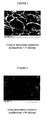
- Figure 1 is a SEM photo of a polymer blend of an acrylic resin or vinyl resin having at least one ionic or ionizable group and at least one thermoplastic fluoropolymer. This polymer blend was made using previous techniques and shows domain sizes which are over 1,000 nm.
- Figure 2 is a SEM photo of a polymer blend of the present invention which shows domain sizes below 500 nm and shows domain sizes which are barely detectable.
- Perfluorinated polyelectrolyte membranes are used to provide high cation transport, and have been extensively used as ion exchange membranes.
- Polymeric ion exchange membranes are referred to as solid polymer electrolytes or polymer exchange membrane (PEM).
- membranes The most commonly used membrane, and commercially available, are Nafion® and Aciplex®. However, there are very few non-perfluorinated polyelectrolyte membranes described in the literature. This is due to the fact that the membrane's chemical resistance, electrochemical resistance and mechanical strength are important properties for a fuel cell application. Indeed, the membrane is often subject to high differential pressure. In addition, mechanical strength becomes important when the membrane is very thin (less than 50 microns). When used for fuel cell or battery application, the membrane sits in a very acidic medium at temperatures that could reach 200°C, and in the presence of metal ions, solvents, and the like, thus requiring high chemical resistance as well as electrochemical resistance.
- the present invention is an improvement over the invention described in U.S. Patent Application Publication No. US 2003/0064267 A1 which describes a polymer blend containing at least one acrylic resin or vinyl resin having at least one ionic or ionizable group and at least one thermoplastic fluoropolymer. Furthermore, the present invention is an improvement over U.S. Patent Application No. 10/383,026, filed March 6, 2003, which describes a polymer blend containing at least one acrylic resin or vinyl resin having at least one ionic or ionizable group and at least one non-perfluoropolymer which can include partial fluorination or no fluorination at all. Both of these applications are incorporated in their entirety by reference herein and form a part of the present application.
- the present invention provides a polymer blend which is far more intimate wherein domain sizes of the acrylic resin or vinyl resin present in the polymer blend are below 1,000 nm, such as below 500 nm and preferably below 100 nm, and even more preferably below 50 nm in size.
- domain sizes of the acrylic resin or vinyl resin present in the polymer blend are below 1,000 nm, such as below 500 nm and preferably below 100 nm, and even more preferably below 50 nm in size.
- the domain sizes are practically not detectable and provide a significant improvement in this technology.
- the conductivity of a film formed using the polymer blends of the present invention is significantly improved as will be discussed in more detail below.
- the present invention relates to a polyelectrolyte which contains at least one acrylic and/or vinyl resin or polymer which bears at least one ionic or ionizable group, such as a sulfonated and/or phosphonated group.
- at least one additional polymer can be present with the acrylic and/or vinyl resin to form a polymer blend.
- This additional polymer can be a fluoropolymer (perfluoro or non-perfluoro) or a non-fluoropolymer.
- the additional polymer is at least one thermoplastic fluoropolymer.
- the polymer or blend thereof does not contain any perfluoropolymer or as an option no fluoropolymers.
- the polyelectrolyte is non-perfluorinated and can be present with no other polymers (i.e., it is not present as a blend, or put another way, the non-perfluorinated polyelectrolyte is used alone).
- the polyelectrolyte is non-perfluorinated and is present with one or more other polymers, for instance, as a blend, such as with thermoplastic non-perfluoropolymers.
- perfluoro it is to be understood that all hydrogens that are attached to carbon atoms are completely replaced with fluorine.
- some of the hydrogens can be replaced with fluorine or all of them. Thus, partial fluorination is possible or no fluorination at all.
- the present invention also relates to the resulting product from blending a) a polyelectrolyte having acrylic or vinyl units or both and at least one ionic or ionizable group and b) at least one additional polymer wherein a) and b) are different from one another.
- the present invention further relates to a composition
- a composition comprising the polymer product of at least one polymerizable vinyl and/or acrylic containing monomer and at least one monomer comprising at least one ionic or ionizable group or both, wherein the polymerization preferably occurs in the presence of an aqueous dispersion.
- the domain size of the acrylic resin and/or vinyl resin or polymer in the polymer or polymer blend is preferably about 500 nm or less, more preferably about 100 nm or less or about 75 nm or less, even more preferably about 50 nm or less.
- the domain sizes discussed herein are with respect to maximum domain sizes and/or average domain sizes. In a preferred embodiment, the domain sizes recited are the maximum domain sizes, but can be the average domain sizes.
- suitable domain size ranges include, but are not limited to, from about 1 nm to about 500 nm, from about 1 nm to about 100 nm, from about 1 nm to about 75 nm, from about 1 nm to about 50 nm, from about 10 nm to about 100 nm, from about 10 nm to about 75 nm, or from about 10 nm to about 50 nm, or from about 1 nm to about 25 nm, or any values or ranges in between these various sizes.
- these domain sizes are with respect to maximum domain sizes and/or average domain sizes. These domain sizes are preferably the case where the blend is formed into a film, layer, or membrane.
- the polymer or polymer blends of the present invention when formed into a film or membrane preferably have a conductivity of 20 mS/cm or greater, more preferably 50 mS/cm or greater, even more preferably 75 mS/cm or greater, or 100 mS/cm or greater, or from about 20 mS/cm to about 300 mS/cm.
- conductivity ranges include, but are not limited to, from about 50 mS/cm to about 200 mS/cm, from about 75 mS/cm to about 200 mS/cm, from about 80 mS/cm to about 180 mS/cm, from about 90 mS/cm to about 175 mS/cm, from about 100 mS/cm to about 180 mS/cm and any values or ranges in between these various amounts.
- the polymer or polymer blends of the present invention can have these desirable conductivities alone or in combination with the domain sizes described herein.
- the polymer or polymer blends of the present invention have both the preferred domain sizes and conductivities described herein.
- the polymer blend of the present invention can be any type of mixture of the two polymers described above and throughout this application.
- the polymer blend is an intimate blend of the two polymers.
- the polymer blend can be a polymer blend wherein one of the polymers at least partially coats onto the other polymer.
- the fluoropolymer is coated by the acrylic or vinyl resin or the polymer formed from at least one polymerized vinyl or acrylic containing monomer and at least one monomer comprising at least one ionic or ionizable group or both is the shell.
- the acrylic or vinyl resin can partially coat or fully coat the fluoropolymer in the preferred embodiment.
- the attachment between the acrylic resin and the fluoropolymer is a physical attachment though attachments other than physical attachments are within the bounds of the present invention including chemical attachments.
- the particle typically has a particle size of from about 90 to about 500 nm, and more preferably from about 50 to about 300 nm.
- the amount of fluoropolymer can be from about 5 to about 95 weight % and the amount of the acrylic or vinyl resin can be from about 95 to about 5 weight %.
- the fluoropolymer is present in an amount of from about 40% to about 80 weight % and the amount of acrylic or vinyl resin is from about 20 to about 60 weight %.
- this fluoropolymer can be a homopolymer or other type of polymer, and can be a mixture of fluoropolymers or a mixture of fluoropolymer with a non-fluoropolymer.
- a thermoplastic fluoropolymer is used.
- this fluoropolymer or mixtures of fluoropolymers can be any fluoropolymer(s) which can form a polymer blend with the other components, including other polymers present.
- the fluoropolymer is a poly(vinylidene fluoride) polymer such as a poly(vinylidene fluoride) homopolymer.
- fluoropolymers include, but are not limited to, a poly(alkylene) containing at least one fluorine atom, such as polyhexafluoropropylene, polytetrafluoroethylene, poly(vinyl fluoride), or combinations thereof. More preferably, the fluoropolymer is a polymeric composition containing from about 30% to about 100 weight % of vinylidene fluoride and from 0% to about 70 weight % of at least one poly(alkylene) containing at least one fluorine atom, such as, hexafluoropropylene, tetrafluoroethylene, trifluoroethylene (VF3), chlorotrifluoroethylene, and/or vinyl fluoride.
- a poly(alkylene) containing at least one fluorine atom such as polyhexafluoropropylene, polytetrafluoroethylene, poly(vinyl fluoride), or combinations thereof. More preferably, the fluoropolymer is a polymeric
- the molecular weight of the fluoropolymer which can include homopolymers, copolymers, terpolymers, oligomers, and other types of polymers is from about 80,000 MW to about 1,000,000 MW and, more preferably from about 100,000 MW to about 500,000 MW.
- the fluoropolymers can be prepared using the techniques described in U.S. Patent Nos. 3,051,677; 3,178,399; 3,475,396; 3,857,827; and 5,093,427, all incorporated herein in their entirety by reference.
- this polymer or resin preferably contains or bears one or more ionic or ionizable groups.
- acrylic resins include polymers (including copolymers, terpolymers, oligomers, and the like) of acrylic acids, methacrylic acids, esters of these acids, or acrylonitrile.
- the acrylic resin can also contain other repeating units as well as combinations of different acrylic acid alkyl esters, methacrylic acid alkyl esters, acrylic acids, methacrylic acids, and acrylonitriles.
- the acrylic resin can include other polymerized monomers or can be a mixture of two or more different acrylic resins or can additionally include non-acrylic resins, such as vinyl monomers and styrenic monomers.
- the at least one vinyl monomer or resin does not include an aromatic group.
- the vinyl monomer, resin or polymer is a nonaromatic vinyl resin.
- the vinyl resin preferably does not include styrene.
- the polyelectrolyte contains at least one ionic (e.g., sulfonate or phosphonate) or ionizable group such as a sulfonated or phosphonated group or sulfonyl groups.
- An ionizable group is a group capable of forming an ionic group, such as cyclic amino acids, sultones, maleic anhydride, mercaptans, sulfides, phosphalanes, and the like. These groups can be part of the polyelectrolyte by any means such as blending an acrylic and/or vinylic resin in the presence of one or more monomers containing an ionic or ionizable group.
- one or more of the monomers used to form the polyelectrolyte can contain the ionic or ionizable group.
- the ionic or ionizable group is not the acid portion of acrylic acid or a vinyl resin if used.
- the ionic or ionizable group is a group in addition to any acrylic acid that may be present especially from the acrylic resin or polymer described above.
- the acrylic and/or vinylic resin can further contain or be formed in the additional presence of one or more additional monomers optionally with any type of functional group as long as these monomers are compatible with the overall formation of the acrylic and/or vinylic resin.
- the acrylic and/or vinylic resin is the result of the polymerization of several monomers, one of which contains the ionic or ionizable group, and the other which contains the acrylic and/or vinylic units of the acrylic and/or vinylic resin. More preferably, the acrylic and/or vinylic resin is formed from polymerizing (1) acrylic acid alkyl esters, (2) methacrylic acid alkyl esters, (3) one or more co-polymerizable monomers which are different from (1) and (2), (4) one or more monomers having at least one functional group, (5) a monomer containing ionic or ionizable groups, such as a sulfonated or phosphonated monomer.
- acrylic acid alkyl ester (1) examples include, for example, ethyl acrylate, methyl acrylate, butyl acrylate, propyl acrylate, isobutyl acrylate, amyl acrylate, 2-ethylhexyl acrylate, hexyl acrylate, fluoroalkyl acrylates, and combinations thereof
- copolymerizable monomers (3) examples include, for example, conjugated dienes (e.g., 1,3-butadiene, isoprene), aromatic alkenyl compounds (e.g., styrene, ⁇ methylstyrene, styrene halides), divinyl hydrocarbon compounds (e.g., divinyl benzene), and combinations thereof.
- conjugated dienes e.g., 1,3-butadiene, isoprene
- aromatic alkenyl compounds e.g., styrene, ⁇ methylstyrene, styrene halides
- divinyl hydrocarbon compounds e.g., divinyl benzene
- methacrylic acid alkyl ester (2) examples include, for example, ethyl methacrylate, methyl methacrylate, butyl methacrylate, propyl methacrylate, isobutyl methacrylate, amyl methacrylate, 2-ethylhexyl methacrylate, hexyl methacrylate, fluoroalkylmethacrylate, and combinations thereof.
- Examples of the functional monomer (4) include, but are not limited to, ⁇ , ⁇ unsaturated carboxylic acids (e.g., acrylic acid, methacrylic acid, fumaric acid, crotonic acid, itaconic acid); vinyl ester compounds, amide compounds (e.g., acrylamide, methacrylamide, N-methylmethacrylamide, N-methylolmethacrylamide, N-alkylacrylamide, N-alkylacryl methamide, N-dialkyl methacrylamide, N-dialkyl acrylamide); monomers containing hydroxyl group (e.g., hydroxyethyl methacrylate, hydroxyethyl acrylate, hydroxypropyl acrylate, hydroxypropyl methacrylate, diethylene glycol ethyl ether acrylate); monomers containing epoxy groups (e.g., glycidyl acrylate, glycidyl methacrylate), monomers containing silanols (e.g.
- the monomers included in (4) can be capable of crosslinking.
- Examples of copolymerizable monomers capable of crosslinking include isobutyl methacrylamide, glycidyl methacrylate, diethylene glycol dimethacrylate, and trimethyloxysilane methacrylate.
- Crosslinking might be desirable for improved mechanical properties and solvent resistance.
- low molecular weight copolymerizable polymers or oligomers can be used.
- acrylic acid alkyl ester (1) and methacrylic acid alkyl ester (2) are used, their ratio could be suitably adjusted to achieve the desired properties.
- Examples of the monomer containing at least one ionic or ionizable group (5) include, but are not limited to, acrylamid propyl sulfonate, vinyl phosphonic acid, vinyl sulfonic acid, sulfopropyl methacrylate, sulfoethyl methacrylate. These monomers can preferably be used either in their acid form or as a salt derivative. For example, in a seeded emulsion polymerization, the sulfonated monomer can be incorporated in either the first stage or the second stage or both stages.
- the amount of the ionic group is preferably from about 200 to about 2500 EW, and more preferably from about 200 to about 1100 EW, wherein EW is equivalent weight and is the number of grams of polymer per sulfonated unit. Other amounts can be used.
- the polymer of the present invention which contains at least one acrylic or vinyl resin or both having at least one ionic or ionizable group can have an equivalent weight with respect to the acrylic or vinyl resin of from about 200 to about 8,000, such as from about 900 to about 1,400. This equivalent range can provide preferred properties with respect to membrane formation and the ability to avoid the need for fluoropolymers, as an option.
- the polymer of the present invention can optionally be formed as a blend.
- the polymer of the present invention is crosslinked using conventional crosslinking techniques.
- Crosslinking can be done via conventional methods including, but not limited to, self-condensation, addition of a secondary crosslinker, or radiation crosslinking. These are well described in the literature and well known in the art. Examples of monomers able to undergo self condensation crosslinking include N-methylol acrylamide, isobutoxy methacrylamide, N-methylenebisacrylamide, and glycidyl methacrylate. Examples of secondary crosslinkers include free and blocked isocyanates, melamines, epoxies, carboxylates, carboxylic acids, alkoxy silanes, silicones, aziridines, and carbodiimides. Catalysts which can be chosen for the specific crosslinking chemistry and would include organotins, sulfonic acids, or amines. Examples of radiation crosslinking include electron beam, ultraviolet, and gamma radiation.
- the polymerization of the mixture of polymerizable vinyl and/or acrylic containing monomers can be carried out separately and then blended with one or more polymer(s), or polymerized in the presence of one or more polymers.
- the polymerization of the vinyl and/or acrylic containing monomers can be prepared by solution, bulk, emulsion polymerizations, or any other known polymerization methods.
- the blending can be carried out through various conventional ways including, but not limited to, solution blending, extrusion blending, latex blending, and the like.
- solution blending the polymer can be dissolved or dispersed in a solvent.
- the solvent used for the polymer can be similar or different than the solvent used for the acrylic/vinyl ionic containing polymer.
- the blending could involve two solvent solutions/dispersions, or a powder added to a solvent solution/dispersion, or the two polymers in the same solvent, or any other combination.
- Typical solvents used include tetrahydrofurane, acetone, dimethylsulfoxide, dimethylformamide, N-methyl pyrrolidinone.
- typical extrusion temperatures range between about 100° C to about 300° C, preferably from about 150° C to about 250° C.
- the material could be extruded such as in the shape of pellets or films.
- latex blending the mixing can take place under various conventional ways: the acrylic/vinyl latex can be mixed with the polymer latex, or the acrylic/vinyl polymer can be dispersed or dissolved in the polymer latex, or any other known mixing. The mixing could involve more than two latexes.
- each latex is adjusted in such a way that the physical and chemical properties expected are obtained, and the expected EW is obtained.
- the particle size and solids content of one or more latexes can be tailored to the desired properties.
- the polymerization can take place using conventional techniques.
- the solvent used for the polymer blend can be similar or different than the solvent used for the acrylic/vinyl polymer.
- the blending could involve two solvent solutions/dispersions, or a powder added to a solvent solution/dispersion, or the two polymers in the same solvent, or any other combination.
- Typical solvents used include dimethylsulfoxide, dimethylformamide, N-methyl pyrrolidinone, isopropanol, methanol, and the like.
- the emulsion polymerization can be carried out under the same conditions as for conventional emulsion polymerizations.
- a surfactant, a polymerization initiator, a chain transfer agent, a pH regulator, and eventually a solvent and a chelating agent, are preferably added to the seed latex, and the reaction is carried out under suitable reaction conditions of sufficient pressure, temperature, and time, such as under atmospheric pressure, from about 0.5 to about 6 hours at temperatures typically of from about 20 to about 150°C, more preferably from about 40 to about 80° C.
- the particle can have a particle size of from about 90 or less to about 500 nm or more, and more preferably from about 50 to about 300 nm, wherein the amount of polymer is from about 5 to about 95 weight % and the amount of the acrylic or vinyl resin is from about 95 to about 5 weight %.
- the emulsion polymerization can be performed according to standard methods: batch polymerization using the monomer dispersion from the beginning; semi-continuous polymerization, wherein part of the monomer mixture is fed continuously or in batches; and continuous polymerization wherein the monomer mixture is fed continuously or in batches in the aqueous polymer dispersion during the reaction.
- the surfactant can be anionic, cationic, and/or non-ionic surfactants, and/or amphoteric surfactants.
- the surfactant can be used separately or in combination with two or more.
- the anionic surfactant include esters of higher alcohol sulfates (e.g., sodium salts of alkyl sulfonic acids, sodium salts of alkyl benzenesulfonic acids, sodium salts of succinic acids, sodium salts of succinic acid dialkyl ester sulfonic acids, sodium salts of alkyl diphenylether disulfonic acids).
- the cationic surfactant include an alkyl pyridinium chloride or an alkylammonium chloride.
- non-ionic surfactant examples include polyoxyethylene alkylphenyl ethers, polyoxyethylene alkyl esters, polyoxyethylene alkyl esters, polyoxyethylene alkylphenyl esters, glycerol esters, sorbitan alkylesters, and derivatives thereof.
- amphoteric surfactant examples include lauryl betaine.
- Reactive emulsifiers which are able to copolymerize with the above-mentioned monomers, can also be used (e.g., sodium styrene sulfonate, sodium alkylsulfonate, sodium aryl alkylsulfonate and the like).
- the amount of surfactant usually used is from about 0.05 to about 5 parts by weight per 100 parts by weight of total polymer particles, though other amounts can be used.
- Any kind of initiator which produces radicals suitable for free radical polymerization in aqueous media, preferably for temperatures from about 20 to about 100°C, can be used as the polymerization initiator. They can be used alone or in combination with a reducing agent (e.g., sodium hydrogenobisulfite, sodium thiosulfate, sodium hydrogenosulfite).
- a reducing agent e.g., sodium hydrogenobisulfite, sodium thiosulfate, sodium hydrogenosulfite.
- persulfates and hydrogen peroxide can be used as water-soluble initiators, and cumene hydroperoxide, diisopropyl peroxy carbonate, benzoyl peroxide, 2,2'-azobis methylbutanenitrile, 2,2'-azobisisobutyronitrile, 1,1'-azobiscyclohexane-1-carbonitrile, isopropylbenzenehydroperoxide can be used as oil-soluble initiators.
- Preferred initiators include 2,2'-azobis methylbutanenitrile and 1,1'-azobiscyclohexane-1-carbonitrile.
- the oil-soluble initiator is preferably dissolved in the monomer mixture or in a small quantity of solvent.
- the amount of initiator used is preferably from about 0.1 to about 2 parts by weight per 100 parts by weight of the monomer mixture added.
- chain transfer agents can be used, and preferably one that does not considerably slow down the reaction.
- the chain transfer agents that can be used include, for example, mercaptans (e.g., dodecyl mercaptan, octylmercaptan), halogenated hydrocarbon (e.g., carbon tetrachloride, chloroform), xanthogen (e.g., dimethylxanthogen disulfide), and the like.
- the quantity of chain transfer agent used is usually from about 0 to about 5 parts by weight per 100 parts by weight of the monomer mixture added.
- pH adjusting agents can be used.
- the pH adjusting agents that can be used include, for example, sodium carbonate, potassium carbonate, and sodium hydrogenocarbonate, and the like.
- the quantity of pH adjusting agent used is usually from about 0 to about 2 parts by weight per 100 parts by weight of the monomer mixture added.
- a small quantity of solvent can be added during the reaction, for instance, in order to help the seed particle swelling (if this is used) by the monomer (and therefore, increase the mixing at a molecular level) and improve film formation.
- the quantity of solvent added should be in such ranges that workability, environmental safety, production safety, and/or fire hazard prevention are not impaired.
- the solvents used include for example, acetone, methylethyl ketone, N-methyl pyrrolidone, toluene, dimethylsulfoxide, and the like.
- One advantage of the present invention is the introduction of at least one ionic or ionizable moiety, such as a sulfonated moiety, to the polymer by copolymerization of a monomer containing the ionic or ionizable group, optionally with other monomers, in the presence of a polymer aqueous dispersion. Consequently, in the present invention, the ionic or ionizable functionality is chemically bonded to the polymer chain via polymerization thus avoiding grafting techniques.
- at least one ionic or ionizable moiety such as a sulfonated moiety
- the present invention optionally permits an intimate blending of two or more polymers in the dispersion (e.g., aqueous dispersion), preferably through the use of the seeded polymerization method or methods.
- the resulting resin can be an intimate blend of at least one polymer and at least one polymer bearing the ionic or ionizable group.
- the need for grafting techniques can be avoided as well as the need to use environmentally unfriendly solvent solutions.
- the ionic or ionizable group is preferably polymerized, its distribution along the polymer chain is easily controlled by conventional means known in the art such as shot addition, continuous feed, late addition, and the like. Consequently, the resulting ionic or ionizable group distribution in a membrane formed from the polymer blend can be more easily controlled than previously. Accordingly, the tailoring of various properties, such as homogeneous, random, heterogeneous, and the like, can be achieved.
- One way to achieve this improvement is to form the acrylic resin or vinyl resin having the at least one ionic or ionizable group as described above and to then treat this acrylic resin or vinyl resin in order to have an ammonium counterion and/or phosphonium counterion associated with the ionic or ionizable groups.
- the ionic or ionizable group that is present with respect to the acrylic resin or vinyl resin is in the form of an acid or salt.
- the acid form is neutralized to form a salt.
- ammonium compound e.g., that will generate an ammonium ion
- phosphonium compound e.g., that will generate a phosphonium ion
- the amount of the ammonium compound or phosphonium compound can be any amount sufficient to achieve the desired level of ionic exchange or salt formation.
- the ammonium or phosphonium compound can be added to neutralize from about 40% or less to about 100% and more preferably from 70% to about 95% by wt. of the ionic or ionizable groups.
- the ammonium or phosphonium compound can be added in any fashion such as simply mixing in the ammonium or phosphonium compound with the acrylic resin or vinyl resin.
- the ammonium or phosphonium compound can be in any form, and is preferably in the form of a solid or liquid and more preferably a liquid.
- the ionic exchange or treatment can occur prior to, during, and/or after blending with the additional polymer.
- the salt can then be converted back to its original state, which as stated above, in most instances is an acid form. This can be achieved by introducing an acid, which is preferably a strong acid, such as sulfuric acid, to the polymer blend which will then cause the reformation of the acid (e.g., protonated).
- An alkali metal, alkaline earth metal hydroxide, an aqueous solution, diluted H 2 SO 4 , diluted HCl, and the like can be used instead of a strong acid.
- the reformation can be done to completely remove or substantially remove (e.g., 95% by wt. or higher removal) the ammonium or phosphonium salt or can be partially removed to any degree desired.
- the film or membrane can then be washed using various techniques to remove the ammonium and/or phosphonium compound as well as any acid residue. This can simply be done by using water such as deionized water and the like.
- the film or membrane can be cross-linked before or after the ammonium or phosphonium compound (e.g., salt) has been removed.
- the film or membrane is preferably cross-linked using any conventional cross-linking technique, such as those exemplified above.
- This cross-linking may aid in ensuring that the acrylic resin or vinyl resin is locked into place with respect to the polymer blend. This permits improved conductivity and ensures that the phase compatability between the polymers is maintained, especially over time.
- the removal of the ammonium and/or phosphonium counterion preferably occurs after formation of the film or membrane. In lieu of these counterions, any counterions that permit the same effect can be used.
- the present invention permits a more uniform dispersion of the polymer blend and provides greatly improved conductivity and greatly improved smaller domain sizes as described above. In the art, domain sizes are also sometimes referred to as clusters or ionic clusters. In either case, the present invention permits these domains or clusters to be greatly minimized or reduced in size such that they are about 500 nm or less and are preferably barely detectable in preferred embodiments as shown in Figure 2.
- the ammonium compound preferably, as described above, forms a counterion to the ionic or ionizable group.
- This counterion is considered an ammonium counterion and more preferably an alkyl ammonium counterion and even more preferably an alkyl quaternary ammonium counterion.
- the alkyl groups of the ammonium counterion are C 1 -C 6 alkyl group though other alkyl ammoniums can be used.
- more than one different type of counterion can be formed such as two or more different types of ammonium counterions.
- the phosphonium counterions This can be accomplished by using two or more different ammonium and/or phosphonium materials to form different ions or a mixture of various ions.
- the sulfonated or phosphonated resins in either acid or salt form can be mixed with the ammonium compound (e.g., salt), such as an organic quaternary ammonium compound to thereby convert the resin to an ammonium salt.
- the ammonium compound e.g., salt
- This step can be repeated several times to achieve satisfactory conversion of the resin to the ammonium salt.
- ammonium salts include: tetramethylammmonium, tetraethylammonium, tetrapropylammonium, tetrabutylammonium, tetrapentylammonium, tetrahexylammonium, benzyltrimethylammonium, benzyltriethylammonium, hexamethonium, decamethonium, cetyltrimethylammonium, decyltrimethylammonium, dodecyltrimethylammonium, and methyltributylammonium.
- the ammonium salt has a molecular weight of at least 186.
- ammonium salts can be utilized in the process.
- the ammonium can contain organic groups in a quaternary ammonium salt of the formula N R 1 R 2 R 3 R 4 + , wherein R 1 -R 4 are independently selected from C 1 -C 30 alkyl, aryl, aralkyl or cycloalkyl groups.
- R 1 -R 4 are independently selected from C 1 -C 30 alkyl, aryl, aralkyl or cycloalkyl groups.
- the phosphonium analogs of the ammonium salts can also be used, such as tetraalkyl phosphonium salts and like.
- the ammonium or phosphonium salt containing resin can be processed using conventional methods to prepare a film or polymer membrane.
- the film or polymer membrane can then preferably be processed to remove all or most of the ammonium and/or phosphonium cation and convert the film or membrane back to its original form (e.g., acid or salt form).
- This step can be achieved by exposing the film or polymer membrane to a solution of an alkaline metal or alkaline earth metal hydroxide or an aqueous acid solution, such as sulfuric acid or hydrochloric acid. In some cases this step can be repeated to achieve satisfactory conversion of the ammonium or phosphonium salt back to the acid or salt form or other desirable form.
- the applications of the present invention can include, but are not limited to, films, membranes, fuel cells, coatings, ion exchange resins, oil recovery, biological membranes, batteries, and the like.
- a polymeric ion membrane or polyelectrolyte membrane can be made from the polymers of the present invention.
- the polymeric ion membrane can be prepared from conventional film preparation methods, such as melt extrusion, solvent cast, latex cast, and the like.
- Membrane electrode assemblies can be made from the membranes of the present invention and fuel cells using this membrane electrode assembly can be prepared.
- the polymer can have any equivalent weight and preferably has an equivalent weight of from about 200 to about 8,000, and preferably from about 200 to about 1,500 and even more preferably from about 200 to about 1,400, with respect to the ionic acrylic or vinyl resin present in the polymer.
- compositions of the present invention are especially useful in fuel cells, batteries, and the like.
- the design and components used in the fuel cell and batteries would be the same as in conventional fuel cells and batteries except using the compositions of the present invention in the formation of the polymeric ionic exchange membrane. Accordingly, the designs and manners of making the fuel cells and batteries as described in U.S. Patent No. 5,795,668, EP 1 202 365 A1, PCT Publication No. WO 98/22989, WO 02/075835, and WO 98/20573, Lin et al., Journal of Applied Polymer Science, Vol. 70, 121-127 (1998) can be used in the present invention and are fully incorporated herein in their entireties by reference.
- the membrane can be used alone or with conventional fillers, such as silica and the like.
- the fuel cell may use a liquid or gaseous fuel such as a liquid hydrocarbon like methanol.
- the fuel cell of the present invention is capable of operating at a wide range of operating conditions.
- the fuel cell of the present invention can have a porous support layer and an ion exchange resin wherein the ion exchange resin is supported on at least one side of the porous support layer.
- the present invention can be useful in direct methanol fuel cells or other fuel cells.
- the fuel cells of the present invention have low fuel crossover, high electric conductivity, and/or high mechanical strength.
- the thickness of the membrane can be conventional but is preferably from about 0.5 to about 10 mils and more preferably from about 1 mil to about 5 mils.
- the membrane preferably has an equivalent weight of from about 200 to about 2500, and more preferably about 200 to about 1400.
- the porous support layer can be made from any conventional material such as a fluoro-containing polymer or other hydrocarbon containing polymers such as polyolefin.
- the porous support layer has conventional parameters with respect to pore diameter, porosity, and thickness.
- the fuel cells of the present invention preferably have excellent electrical properties and relatively low electrical resistance.
- polymeric ion exchange membranes are well known in the field for providing high cation transport, and have been extensively used as ion exchange membranes.
- Polymeric ion exchange membranes are referred to as solid polymer electrolytes or polymer exchange membrane (PEM).
- PFSI perfluorinated sulfonated ionomers
- the membrane When used for fuel cell or battery applications, the membrane sits in a very acidic medium at temperatures that could reach 150 °C, and in presence electrochemical environment, solvents and the like, thus requiring high chemical and electrochemical resistance. Those requirements are often met when a perfluorinated membrane is used because perfluorinated materials have inherent chemical and electrochemical resistance. However, there are very few non-perfluorinated polymer electrolyte membranes described in the literature that meet these requirements.
- the barrier properties of the mebrane toward that fuel are critical.
- the fuel in direct methanol fuel cell, can be a dilute (1M to 4 M) methanol aqueous solution. Very few membranes can meet the needed barrier properties.
- the membrane's mechanical strength is an important property for battery, chloralkali cell, and fuel cell applications. Indeed the membrane is often subject to high differential pressures. In addition, the mechanical strength becomes critical when the membrane is very thin (less than 100 microns). However, the commercially available PFSI membranes show limited mechanical properties and often fail or crack during cell operation leading to irreversible damage. There are many ways to overcome this problem. By blending the ionomer in a polymer matrix that has good mechanical strength, it is possible to prepare a membrane with high proton conductivity and good overall mechanical properties.
- the polymer blend allows for copolymerizing a functional monomer with the ionomer, or adding a crosslinkable polymer or monomer to the blend. This leads to an easy way of crosslinking if required.
- a novel polymer electrolyte membrane was developed in which:
- the present invention can have a direct control of the ionic (e.g., sulfonated) group location (unlike sulfonation by grafting techniques) and the present invention can use commercially available monomers, thus avoiding very complex steps to prepare "sulfoned perfluorinated ionomers".
- the resulting process is also very simple as opposed to processes used to prepared perfluorinated sulfonated ionomers such as Nafion® or Aciplex ®.
- the polyelectrolyte membrane is formed from a composition that contains at least one acrylic and/or vinyl resin or both having at least one ionic or ionizable group.
- at least one ammonium counterion and/or phosphonium counterion is also present with the at least one ionic or ionizable group.
- at least one additional polymer is also present.
- the at least one ionic or ionizable group is present in an amount of from about 200 to about 2,500 EW.
- the counterion is removed (e.g., converted back to acid form).
- the polyelectrolyte membrane is quite useful with fuel cells including fuel cells powered by direct fuel such as direct methanol fuel cells or polymer electrolyte fuel cells.
- the present invention preferably provides an improved reduced fuel crossover such as reduced methanol crossover.
- the present invention further provides a membrane that has a reduced areal resistance.
- the thickness of the membrane can be significantly reduced by way of the present invention and yet achieve reduced fuel crossover and/or reduced areal resistance.
- the membrane can have one layer or multiple layers. Each layer can be the same or different from the other layers.
- fuel e.g., methanol
- Each layer can have the same or different chemical composition, thickness, or be formed with different amounts and types of an ammonium and/or phosphonium counterion.
- reduced fuel crossover can even be more improved.
- the multi-layer membrane of the present invention can be prepared any number of ways. Each individual layer can first be prepared as described above using conventional casting or other layer forming techniques. These layers can then be combined to form a multi-layer membrane structure. The layers can be adhered together or attached together by other means commonly used to form laminate structures. In addition, one layer can be formed and then a second layer can be casted onto the previously layer to form the second layer and so on to form the desired number of layers.
- the multi-layer structure of the present invention can have two layers, three layers, four layers or more. Each layer of the multi-layer polyelectrolyte membrane can be formed in the same manner or by different manners.
- each layer of the multi-layer polyelectrolyte membrane can be formed by extrusion, solvent cast, latex cast, or other film preparation techniques.
- One layer can be extruded, for instance, and another layer can be casted as so on.
- any lamination technique of combining polymeric layers can be used to form each layer. Accordingly, any combination of formation of layers can be used in the present invention to form the multi-layer structure.
- the multi-layer polyelectrolyte membrane of the present invention can have one or more layers which contain the polyelectrolyte of the present invention. Also, an option, one or more layers of this multi-layer membrane can contain other polyelectrolytes that are commercially available such as Nafion®, Flemion® and Aciplex® polymers or other perfluoronated materials. For purposes of the present invention, at least one of the layers contains the polyelectrolyte of the present invention.
- the polyelectrolyte membranes of the present invention achieve a methanol crossover, when used in a fuel cell, of 5X10 -16 mol/cm 2 /s or lower and more preferably 3X10 -16 mol/cm 2 /s or lower, and even more preferably 1X10 -16 mol/cm 2 /s or lower.
- Suitable ranges can include from about 0.01X10 -16 mol/cm 2 /s to about 3X10 -16 mol/cm 2 /s. Other ranges are possible.
- the polyelectrolyte membranes of the present invention when used in a fuel cell can have an areal resistance of about 0.3 ⁇ /cm 2 or less and preferably about 0.1 ⁇ /cm 2 or lower. Suitable ranges include from about 0.1 to about 0.3 ⁇ /cm 2 .
- fuel cells, batteries, and the like can be used and incorporate the polyelectrolyte compositions of the present invention in the form of a membrane or other shape.
- the methanol concentration is monitored continuously using a differential refractometer Waters 410.
- the flow rate used was 2mL/min.
- the methanol aqueous concentration used was generally 1mol/L.
- a membrane diaphragm cell (E.L. Cussler, Diffusion, 2 nd ed., Cambridge University Press, Cambridge, 1997) was used to measure methanol diffusion coefficient.
- the membrane methanol diffusion coefficient D is expressed as: Where ⁇ (cm -2 ): diaphragm-cell constant, t; time (s), C A / 0 and C B / 0: initial methanol concentrations in both compartments (mol/L), C A / t and C B / t: methanol concentrations in both compartments at t (mol/L), V A and V B : volumes of the two cell compartments (cm 3 ).
- compositions of the present invention were made using the following materials and reaction conditions:
- the films were cast on glass substrates using a blade type applicator and cured in an oven at temperatures ranging from 150 °C to 200 °C, for 1 to 15 minutes.
- Desmodur BL-3175A is a hexamethylene diisocyanate oligomer blocked with methyl ethyl ketoxime, and is a product of Bayer Corp.
- the solution was poured on a glass plate, spread with a doctor knife and baked for 7 minutes at 177°C.
- the film membrane was protonated by treatments with one molar hydrochloric (HCl) and sulfuric (H 2 SO 4 ) acids for 2 hours each at 65 °C, then rinsed with deionized water.
- the proton conductivity of the membrane, measured by AC impedance, was 30 mS/cm and the areal resistance at 25 °C is 0.15 ⁇ /cm 2 .
- a NMP solution of polyelectrolyte in TBA form was prepared as follows: to 6428g of a 25 wt% solution of polyelectrolyte in NMP, 2204 g TBAOH (55% in water) were added and the water removed. Then 4445 g NMP were added. To 6051 g of this solution were added 1878 g Kynar 2801 and 7149 g of NMP and stirred until dissolution. To 41.05 g of the polyelectrolyte/Kynar solution in NMP described above, 0.39g of Desmodur N3300 isocyanate cross-linker (Bayer) were added with mixing.
- the solution was poured on a glass plate, spread with a doctor knife and baked for 7 minutes at 177 °C.
- the membrane was protonated by treatments with one molar hydrochloric (HCl) and sulfuric (H 2 SO 4 ) acids for 2 hours each at 65 °C, then rinsed with deionized water.
- the proton conductivity of the membrane, measured by AC impedance, was 60 mS/cm and the areal resistance at 25 °C is 0.06 ⁇ /cm 2 .
- Example 8 Same as Example 8 above but without addition of an isocyanate crosslinker.
- the membrane was protonated by treatments with one molar hydrochloric (HCl) and sulfuric (H 2 SO 4 ) acids for 2 hours each at 65 °C, then rinsed with deionized water.
- Conductivity measurements were performed with a four probe configuration by Electrochemical Impedance Spectroscopy. The measurements were carried out between 5X10 5 and 1 Hz with a Gamry instrument (Potensiostat - Galvanostat ZRAPC4/750 and EIS 300 software). The values presented here have been obtained under immersed conditions at room temperature.
- the conductivity of the polyelectrolyte membranes of the present invention as shown in examples 1-10 and 14, for instance, are greatly higher than the conductivity set forth in examples 11 and 13 which are comparative examples.
- the resistance, as shown in Tables 3 and 4 was also greatly reduced using the techniques and polymers of the present invention.
- crosslinking agent was Desmodur BL3175A isocyanate cross-linker from Bayer.
- the catayst was dibutyltin dilaurate (DBTDL) catalyst from Atofina.
- DBTDL dibutyltin dilaurate
- Formulations F4 and F5 were prepared from solutions S4 and S5 which were exchanged with a blend of 2 counter ions: TPAOH and TMAOH
- Formulations F6 was prepared from solutions S6, which was exchanged with a blend of 2 counter ions: TBAOH and TPAOH
- Formulations F9 was prepared from solutions S9, which was exchanged with a blend of 2 counter ions: TPAOH and TEAOH
- Formulations F7 were prepared from solutions S7, which were neutralized with which was neutralized with the same level of TPAOH usually used but prepared with a higher fluoropolymer/ polyelectrolyte ratio.
- Formulations F 15 to F 18 were prepared from solutions S 15 to S18 respectively, and were neutralized with the same level of TPAOH usually used but prepared with various fluoropolymer / polyelectrolyte ratios.
- Table 7 sets forth the various ingredients and amounts. Unless stated otherwise, the same procedures as described above in previous examples were followed. Preparation of polyelectrolyte solutions All polyelectrolytes P1, P2 and P3 were added as 25 wt % solution in NMP Polyelectrolyte P1, P2 and P3 are of similar composition but different batches. Polyelectrolyte Counter ion Solvent Ex.
- Table 8 sets forth the preparation of the polyelectrolyte using the solutions of Table 7 Preparation of polyelectrolyte / fluoropolymer blend solutions
- the fluoropolymer used in these examples was Kynar 2800 fluoropolymer.
- a powder
- b 15 wt % solution in NMP Polyelectrolyte fluoropolymer Crosslinking Agent Catalyst Ex.
- Table 10 sets forth the properties of the membranes that were prepared.
- the present invention made membranes which had excellent low areal resistance and/or low crossover.
- the properties provided by the present invention one can obtain a balance of properties with respect to thickness, areal resistance, and methanol crossover.
- the methanol crossover was quite lower for many embodiments of the present invention compared to the membranes formed from Nafion® and provided comparable areal resistance. This is all the more impressive considering that the embodiments of the present invention are generally non-perfluoronated polymers.
Landscapes
- Chemical & Material Sciences (AREA)
- Chemical Kinetics & Catalysis (AREA)
- Engineering & Computer Science (AREA)
- Manufacturing & Machinery (AREA)
- Organic Chemistry (AREA)
- Polymers & Plastics (AREA)
- Health & Medical Sciences (AREA)
- Medicinal Chemistry (AREA)
- Sustainable Energy (AREA)
- Sustainable Development (AREA)
- Electrochemistry (AREA)
- General Chemical & Material Sciences (AREA)
- Life Sciences & Earth Sciences (AREA)
- Materials Engineering (AREA)
- Inorganic Chemistry (AREA)
- Composite Materials (AREA)
- Physics & Mathematics (AREA)
- Spectroscopy & Molecular Physics (AREA)
- Crystallography & Structural Chemistry (AREA)
- Compositions Of Macromolecular Compounds (AREA)
- Conductive Materials (AREA)
- Fuel Cell (AREA)
- Manufacture Of Macromolecular Shaped Articles (AREA)
Applications Claiming Priority (4)
| Application Number | Priority Date | Filing Date | Title |
|---|---|---|---|
| US49100503P | 2003-07-30 | 2003-07-30 | |
| US491005P | 2003-07-30 | ||
| US891463 | 2004-07-14 | ||
| US10/891,463 US7449111B2 (en) | 2003-07-30 | 2004-07-14 | Resins containing ionic or ionizable groups with small domain sizes and improved conductivity |
Publications (1)
| Publication Number | Publication Date |
|---|---|
| EP1505120A1 true EP1505120A1 (en) | 2005-02-09 |
Family
ID=33555786
Family Applications (1)
| Application Number | Title | Priority Date | Filing Date |
|---|---|---|---|
| EP04291935A Ceased EP1505120A1 (en) | 2003-07-30 | 2004-07-29 | Resin compositions containing ionic or ionizable groups with small domain sizes and improved conductivity |
Country Status (7)
| Country | Link |
|---|---|
| US (1) | US7449111B2 (https=) |
| EP (1) | EP1505120A1 (https=) |
| JP (1) | JP4979188B2 (https=) |
| KR (1) | KR101130984B1 (https=) |
| CN (1) | CN100384925C (https=) |
| CA (1) | CA2475964C (https=) |
| TW (1) | TWI377227B (https=) |
Cited By (4)
| Publication number | Priority date | Publication date | Assignee | Title |
|---|---|---|---|---|
| US7368200B2 (en) | 2005-12-30 | 2008-05-06 | Tekion, Inc. | Composite polymer electrolyte membranes and electrode assemblies for reducing fuel crossover in direct liquid feed fuel cells |
| US7396880B2 (en) | 2005-05-24 | 2008-07-08 | Arkema Inc. | Blend of ionic (co)polymer resins and matrix (co)polymers |
| EP2053673A4 (en) * | 2006-08-07 | 2011-07-06 | Mitsubishi Gas Chemical Co | ELECTRODE FOR A FUEL CELL, MANUFACTURING METHOD AND FUEL CELL |
| FR3155532A1 (fr) * | 2023-11-21 | 2025-05-23 | Compagnie Generale Des Etablissements Michelin | Procédé de fabrication d’un film par enduction d’un ionomère polymère à blocs |
Families Citing this family (27)
| Publication number | Priority date | Publication date | Assignee | Title |
|---|---|---|---|---|
| US7557164B2 (en) * | 2003-08-19 | 2009-07-07 | E. I. Du Pont De Nemours And Company | Membranes of fluorinated ionomer blended with nonionomeric fluoropolymers for electrochemical cells |
| EP1792919B1 (en) * | 2004-08-06 | 2014-11-12 | Daikin Industries, Ltd. | Method for producing homopolymer of vinylidene fluoride having i type crystal structure and thin film |
| JP4526352B2 (ja) * | 2004-11-08 | 2010-08-18 | 日東電工株式会社 | 電池用セパレータのための反応性ポリマー担持多孔質フィルムとそれを用いた電池の製造方法 |
| US20070119302A1 (en) * | 2005-11-14 | 2007-05-31 | Maciej Radosz | Polymers containing ionic groups for gas separation and storage |
| JP4514718B2 (ja) | 2006-01-20 | 2010-07-28 | 株式会社豊田中央研究所 | 膜電極接合体及び固体高分子型燃料電池 |
| JP5266617B2 (ja) * | 2006-03-20 | 2013-08-21 | 株式会社豊田中央研究所 | 電解質/非電解質ブレンド膜及びその製造方法 |
| CN101473470A (zh) * | 2006-05-30 | 2009-07-01 | Utc电力公司 | 使用水合的非全氟化碳氢化合物离子交换膜的燃料电池 |
| US8574462B2 (en) * | 2006-12-14 | 2013-11-05 | Arkema Inc. | High temperature stable polyelectrolytes having backbone aromatic groups |
| US20100104918A1 (en) * | 2007-04-13 | 2010-04-29 | Michigan Molecular Institute | Improved fuel cell proton exchange membranes |
| KR100986493B1 (ko) * | 2008-05-08 | 2010-10-08 | 주식회사 동진쎄미켐 | 연료전지용 고분자 전해질 막 |
| CN102459455B (zh) | 2009-06-15 | 2014-12-31 | 阿科玛股份有限公司 | 带有纳米颗粒的聚合物电介质共混物的有机/无机的复合的共混物薄膜组合物 |
| ES2748340T3 (es) | 2009-08-26 | 2020-03-16 | Evoqua Water Tech Pte Ltd | Membranas de intercambio iónico |
| JP5244148B2 (ja) * | 2010-04-14 | 2013-07-24 | 株式会社豊田中央研究所 | 膜電極接合体及び固体高分子型燃料電池 |
| WO2011136029A1 (ja) * | 2010-04-28 | 2011-11-03 | 国立大学法人神戸大学 | 複合半透膜 |
| US9708254B2 (en) * | 2010-08-06 | 2017-07-18 | Arkema Inc. | Superacid functional compounds |
| SG189894A1 (en) | 2010-10-15 | 2013-06-28 | Siemens Industry Inc | Process for making a monomer solution for making cation exchange membranes |
| JP2013545595A (ja) | 2010-10-15 | 2013-12-26 | シーメンス インダストリー インコーポレイテッド | アニオン交換膜及び製造方法 |
| EP2572736A1 (en) * | 2011-09-23 | 2013-03-27 | Spago Imaging AB | Nanostructures comprising manganese |
| CN104247112A (zh) * | 2012-04-13 | 2014-12-24 | 株式会社Uacj | 集电体、电极结构体、非水电解质电池及蓄电零部件 |
| US20150315042A1 (en) | 2012-10-04 | 2015-11-05 | Evoqua Water Technologies Llc | High-Performance Anion Exchange Membranes and Methods of Making Same |
| US9540261B2 (en) | 2012-10-11 | 2017-01-10 | Evoqua Water Technologies Llc | Coated ion exchange membranes |
| US10722743B2 (en) * | 2015-05-15 | 2020-07-28 | Rutgers, The State University Of New Jersey | Multicatalyst polyelectrolyte membranes and materials and methods utilizing the same |
| CN106299163A (zh) * | 2016-08-22 | 2017-01-04 | 无锡华盈锂能新材有限公司 | 锂离子电池软包装用内层共挤膜及其制备方法 |
| CN112752789A (zh) | 2018-09-25 | 2021-05-04 | 懿华水处理技术有限责任公司 | 通过uv引发的聚合的离子交换膜 |
| EP3900099A1 (en) * | 2018-12-21 | 2021-10-27 | Solvay Sa | Fluorinated gel polymer electrolyte for a lithium electrochemical cell |
| WO2020263808A1 (en) * | 2019-06-25 | 2020-12-30 | Arkema Inc. | Crosslinked binder composition |
| CN119505168B (zh) * | 2024-11-13 | 2025-08-15 | 惠州市振有新材料科技有限公司 | Tpu抗静电母粒配方及方法 |
Citations (4)
| Publication number | Priority date | Publication date | Assignee | Title |
|---|---|---|---|---|
| EP0240586A1 (en) * | 1986-04-09 | 1987-10-14 | Harry P. Gregor | Post-cross-linked polymeric gels |
| WO2001060872A1 (en) * | 2000-02-15 | 2001-08-23 | Atofina Chemicals, Inc. | Fluoropolymer resins containing ionic or ionizable groups and products containing the same |
| US6492431B1 (en) * | 1998-02-20 | 2002-12-10 | Lynntech, Inc. | Process of making a composite membrane |
| EP1455407A2 (en) * | 2003-03-06 | 2004-09-08 | Atofina Chemicals, Inc. | Non-perfluoropolymer resins containing ionic or ionizable groups and products containing the same |
Family Cites Families (42)
| Publication number | Priority date | Publication date | Assignee | Title |
|---|---|---|---|---|
| DE1078329B (de) * | 1955-04-27 | 1960-03-24 | Du Pont | Verfahren zur Herstellung eines elastischen Mischpolymerisats aus Vinylidenfluorid und einem anderen Fluorolefin |
| US3178399A (en) * | 1961-08-10 | 1965-04-13 | Minnesota Mining & Mfg | Fluorine-containing polymers and preparation thereof |
| US3475396A (en) * | 1966-07-06 | 1969-10-28 | Diamond Shamrock Corp | Process for polymerizing vinylidene fluoride |
| US3857827A (en) * | 1974-01-25 | 1974-12-31 | Pennwalt Corp | Method of preparing high-quality vinylidene fluoride polymer in aqueous emulsion |
| FR2268094B1 (https=) * | 1974-04-16 | 1976-10-08 | Rhone Poulenc Textile | |
| US4189369A (en) * | 1975-05-20 | 1980-02-19 | E. I. Du Pont De Nemours And Company | Diaphragm of hydrophilic fluoropolymers |
| JPS52107045A (en) * | 1976-03-05 | 1977-09-08 | Japan Exlan Co Ltd | Stable aqueous emulsions of acrylonitrile polymers, their preparation, and dyeability improvers therefrom |
| IT1166581B (it) * | 1979-01-17 | 1987-05-05 | Oronzio De Nora Impianti | Membrane cationiche a base di copolimeri solfonati di stirene divinilbenzene e 2- o 4-vinilpiridina o acido acrilico, procedimento per la loro preparazione ed uso in celle di elettrolisi |
| JPS6024812B2 (ja) | 1979-11-09 | 1985-06-14 | 呉羽化学工業株式会社 | 塩化ビニリデン系樹脂ケ−シング |
| US4596858A (en) * | 1981-11-27 | 1986-06-24 | Gregor Harry P | Solid state cross-linked polymer |
| GB8331860D0 (en) | 1983-11-29 | 1984-01-04 | Ici Plc | Exchange membrane |
| US4569978A (en) * | 1984-07-25 | 1986-02-11 | Pennwalt Corporation | Emulsion polymerization of vinylidene fluoride polymers in the presence of trichlorofluoromethane as chain transfer agent |
| US5306539A (en) * | 1988-08-05 | 1994-04-26 | Masonite Corporation | Scored fiberboard having improved moldability |
| US5093427A (en) * | 1990-05-10 | 1992-03-03 | Atochem North America, Inc. | Copolymers of vinylidene fluoride and hexafluoropropylene and process for preparing the same |
| US5272186A (en) * | 1992-05-01 | 1993-12-21 | E. I. Du Pont De Nemours And Company | Concentration of fluoropolymer dispersions using acrylic polymers of high acid content |
| DE4243995C2 (de) * | 1992-12-23 | 1996-07-25 | Gore W L & Ass Gmbh | Permanente hydrophile Modifizierung für Fluorpolymere und Verfahren zur Erzeugung der Modifizierung |
| DE4326130A1 (de) * | 1993-08-04 | 1995-02-09 | Huels Chemische Werke Ag | Thermoplastische Mehrschichtverbunde |
| DE4410148A1 (de) * | 1994-03-24 | 1995-09-28 | Huels Chemische Werke Ag | Mehrschichtiges Kunststoffrohr |
| US5468574A (en) * | 1994-05-23 | 1995-11-21 | Dais Corporation | Fuel cell incorporating novel ion-conducting membrane |
| US5795668A (en) * | 1994-11-10 | 1998-08-18 | E. I. Du Pont De Nemours And Company | Fuel cell incorporating a reinforced membrane |
| US5880204A (en) * | 1995-09-27 | 1999-03-09 | Alliedsignal Inc. | Room temperature coalescable aqueous fluoropolymer dispersions and method for their manufacture |
| DE69725715D1 (de) | 1996-04-30 | 2003-11-27 | Gore & Ass | Integral mehrschichtige zusammengesetzte ionenaustauschmembranen |
| US5962140A (en) * | 1996-06-25 | 1999-10-05 | Acushnet Company | Golf ball comprising fluoropolymer |
| US6033804A (en) | 1996-11-01 | 2000-03-07 | E. I. Du Pont De Nemours And Company | Highly conductive ion exchange polymer and process |
| US6444343B1 (en) | 1996-11-18 | 2002-09-03 | University Of Southern California | Polymer electrolyte membranes for use in fuel cells |
| US5747546A (en) * | 1996-12-31 | 1998-05-05 | The Dow Chemical Company | Ion-exchange polymers having an expanded microstructure |
| US6218534B1 (en) * | 1997-10-06 | 2001-04-17 | Dupont Pharmaceuticals Company | Preparation of asymmetric cyclic ureas through a monoacylated diamine intermediate |
| US6294612B1 (en) * | 1998-02-02 | 2001-09-25 | E. I. Du Pont De Nemours And Company | Highly fluorinated ion exchange/nonfunctional polymer blends |
| US6025092A (en) * | 1998-02-13 | 2000-02-15 | E. I. Du Pont De Nemours And Company | Fluorinated ionomers and their uses |
| EP1095071B1 (en) | 1998-06-25 | 2004-06-16 | E.I. Dupont De Nemours And Company | Aromatic polymers with pendant fluorinated ionic groups |
| US6783937B1 (en) * | 1999-02-25 | 2004-08-31 | Pall Corporation | Negatively charged membrane |
| WO2000054351A1 (en) | 1999-03-08 | 2000-09-14 | Center For Advanced Science And Technology Incubation, Ltd. | Electrolytic membrane for fuel cell and its manufacturing method, and fuel cell and its manufacturing method |
| US6680357B1 (en) * | 1999-07-14 | 2004-01-20 | Atofina Chemicals, Inc. | Crosslinkable aqueous fluoropolymer based dispersions |
| IT1317834B1 (it) * | 2000-02-15 | 2003-07-15 | Ausimont Spa | Fluoropolimeri termoplastici. |
| US6803446B2 (en) * | 2000-07-13 | 2004-10-12 | The Board Of Governors For Higher Education, State Of Rhode Island And Providence Plantations | Functionalized and processable conducting polymers |
| ITMI20010384A1 (it) * | 2001-02-26 | 2002-08-26 | Ausimont Spa | Membrane idrofiliche porose |
| US7303830B2 (en) | 2001-03-21 | 2007-12-04 | Victrex Manufacturing Limited | Fuel cell |
| JP2003059512A (ja) * | 2001-08-22 | 2003-02-28 | Asahi Glass Co Ltd | 固体高分子型燃料電池用電解質膜の製造方法 |
| US6833414B2 (en) * | 2002-02-12 | 2004-12-21 | Arkema Inc. | Cross-linkable aqueous fluoropolymer based dispersions containing silanes |
| DE10240797A1 (de) * | 2002-08-30 | 2004-03-11 | Stockhausen Gmbh & Co. Kg | Kationische Polyelektrolyte mit guter Umweltverträglichkeit |
| US20040175498A1 (en) * | 2003-03-06 | 2004-09-09 | Lotfi Hedhli | Method for preparing membrane electrode assemblies |
| JP2004319353A (ja) * | 2003-04-18 | 2004-11-11 | Toray Ind Inc | 固体電解質およびそれを用いた燃料電池 |
-
2004
- 2004-07-14 US US10/891,463 patent/US7449111B2/en not_active Expired - Lifetime
- 2004-07-29 TW TW093122781A patent/TWI377227B/zh not_active IP Right Cessation
- 2004-07-29 CA CA2475964A patent/CA2475964C/en not_active Expired - Lifetime
- 2004-07-29 EP EP04291935A patent/EP1505120A1/en not_active Ceased
- 2004-07-29 JP JP2004221735A patent/JP4979188B2/ja not_active Expired - Lifetime
- 2004-07-29 CN CNB200410055705XA patent/CN100384925C/zh not_active Expired - Lifetime
- 2004-07-30 KR KR1020040060566A patent/KR101130984B1/ko not_active Expired - Lifetime
Patent Citations (4)
| Publication number | Priority date | Publication date | Assignee | Title |
|---|---|---|---|---|
| EP0240586A1 (en) * | 1986-04-09 | 1987-10-14 | Harry P. Gregor | Post-cross-linked polymeric gels |
| US6492431B1 (en) * | 1998-02-20 | 2002-12-10 | Lynntech, Inc. | Process of making a composite membrane |
| WO2001060872A1 (en) * | 2000-02-15 | 2001-08-23 | Atofina Chemicals, Inc. | Fluoropolymer resins containing ionic or ionizable groups and products containing the same |
| EP1455407A2 (en) * | 2003-03-06 | 2004-09-08 | Atofina Chemicals, Inc. | Non-perfluoropolymer resins containing ionic or ionizable groups and products containing the same |
Cited By (4)
| Publication number | Priority date | Publication date | Assignee | Title |
|---|---|---|---|---|
| US7396880B2 (en) | 2005-05-24 | 2008-07-08 | Arkema Inc. | Blend of ionic (co)polymer resins and matrix (co)polymers |
| US7368200B2 (en) | 2005-12-30 | 2008-05-06 | Tekion, Inc. | Composite polymer electrolyte membranes and electrode assemblies for reducing fuel crossover in direct liquid feed fuel cells |
| EP2053673A4 (en) * | 2006-08-07 | 2011-07-06 | Mitsubishi Gas Chemical Co | ELECTRODE FOR A FUEL CELL, MANUFACTURING METHOD AND FUEL CELL |
| FR3155532A1 (fr) * | 2023-11-21 | 2025-05-23 | Compagnie Generale Des Etablissements Michelin | Procédé de fabrication d’un film par enduction d’un ionomère polymère à blocs |
Also Published As
| Publication number | Publication date |
|---|---|
| US7449111B2 (en) | 2008-11-11 |
| KR20050014763A (ko) | 2005-02-07 |
| JP2005050816A (ja) | 2005-02-24 |
| TW200524980A (en) | 2005-08-01 |
| CN1590448A (zh) | 2005-03-09 |
| US20050077233A1 (en) | 2005-04-14 |
| CN100384925C (zh) | 2008-04-30 |
| CA2475964A1 (en) | 2005-01-30 |
| JP4979188B2 (ja) | 2012-07-18 |
| KR101130984B1 (ko) | 2012-03-28 |
| CA2475964C (en) | 2010-09-21 |
| TWI377227B (en) | 2012-11-21 |
Similar Documents
| Publication | Publication Date | Title |
|---|---|---|
| US7449111B2 (en) | Resins containing ionic or ionizable groups with small domain sizes and improved conductivity | |
| US20070259240A1 (en) | Non-Perfluorinated Resins Containing Ionic or Ionizable Groups and Products Containing the Same | |
| US6872781B2 (en) | Fluoropolymer resins containing ionic or ionizable groups and products containing the same | |
| US8003732B2 (en) | Gradient reinforced proton exchange membrane | |
| CN109478667B (zh) | 电解质材料、包含其的液体组合物及其用途 | |
| CA2450346C (en) | Electrode structure for solid polymer fuel cell, its production method, and solid polymer fuel cell | |
| JP7556359B2 (ja) | フルオロスルホニル基含有含フッ素ポリマーおよびその製造方法、スルホン酸基含有含フッ素ポリマーおよびその製造方法、固体高分子電解質膜、膜電極接合体ならびに固体高分子形燃料電池 | |
| EP1794823B1 (en) | Multi-layer polyelectrolyte membrane | |
| US9172099B2 (en) | Nano-fibers for electrical power generation | |
| EP1806371A1 (en) | Electrolyte material, electrolyte membrane and membrane electrode assembly for solid polymer fuel cell | |
| US7976730B2 (en) | Blends of low equivalent molecular weight PFSA ionomers with Kynar 2751 | |
| US20140045094A1 (en) | PPS Membrane Reinforcing Material | |
| Holdcroft | 1, 3 Yunsong Yang¹³. Ana Siu¹4. Timothy J. Peckham¹, 2. Steven Holdcroft1, 2 () ¹Present address (Steven Holdcroft): Department of Chemistry, Simon Fraser University, 8888 University Drive, Burnaby, BC V5A 1S6, Canada |
Legal Events
| Date | Code | Title | Description |
|---|---|---|---|
| PUAI | Public reference made under article 153(3) epc to a published international application that has entered the european phase |
Free format text: ORIGINAL CODE: 0009012 |
|
| 17P | Request for examination filed |
Effective date: 20040803 |
|
| AK | Designated contracting states |
Kind code of ref document: A1 Designated state(s): AT BE BG CH CY CZ DE DK EE ES FI FR GB GR HU IE IT LI LU MC NL PL PT RO SE SI SK TR |
|
| AX | Request for extension of the european patent |
Extension state: AL HR LT LV MK |
|
| RAP1 | Party data changed (applicant data changed or rights of an application transferred) |
Owner name: ARKEMA INC. |
|
| AKX | Designation fees paid |
Designated state(s): AT BE BG CH CY CZ DE DK EE ES FI FR GB GR HU IE IT LI LU MC NL PL PT RO SE SI SK TR |
|
| 17Q | First examination report despatched |
Effective date: 20090507 |
|
| STAA | Information on the status of an ep patent application or granted ep patent |
Free format text: STATUS: THE APPLICATION HAS BEEN REFUSED |
|
| 18R | Application refused |
Effective date: 20120806 |