EP1500639B1 - Pyrotechnisches Material und Verfahren zu deren Herstellung - Google Patents
Pyrotechnisches Material und Verfahren zu deren Herstellung Download PDFInfo
- Publication number
- EP1500639B1 EP1500639B1 EP04291798.9A EP04291798A EP1500639B1 EP 1500639 B1 EP1500639 B1 EP 1500639B1 EP 04291798 A EP04291798 A EP 04291798A EP 1500639 B1 EP1500639 B1 EP 1500639B1
- Authority
- EP
- European Patent Office
- Prior art keywords
- mass
- pyrotechnic
- nanometric
- binder
- pulverulent
- Prior art date
- Legal status (The legal status is an assumption and is not a legal conclusion. Google has not performed a legal analysis and makes no representation as to the accuracy of the status listed.)
- Expired - Lifetime
Links
Images
Classifications
-
- C—CHEMISTRY; METALLURGY
- C06—EXPLOSIVES; MATCHES
- C06B—EXPLOSIVES OR THERMIC COMPOSITIONS; MANUFACTURE THEREOF; USE OF SINGLE SUBSTANCES AS EXPLOSIVES
- C06B21/00—Apparatus or methods for working-up explosives, e.g. forming, cutting, drying
- C06B21/0083—Treatment of solid structures, e.g. for coating or impregnating with a modifier
-
- B—PERFORMING OPERATIONS; TRANSPORTING
- B22—CASTING; POWDER METALLURGY
- B22F—WORKING METALLIC POWDER; MANUFACTURE OF ARTICLES FROM METALLIC POWDER; MAKING METALLIC POWDER; APPARATUS OR DEVICES SPECIALLY ADAPTED FOR METALLIC POWDER
- B22F1/00—Metallic powder; Treatment of metallic powder, e.g. to facilitate working or to improve properties
- B22F1/18—Non-metallic particles coated with metal
-
- C—CHEMISTRY; METALLURGY
- C06—EXPLOSIVES; MATCHES
- C06B—EXPLOSIVES OR THERMIC COMPOSITIONS; MANUFACTURE THEREOF; USE OF SINGLE SUBSTANCES AS EXPLOSIVES
- C06B45/00—Compositions or products which are defined by structure or arrangement of component of product
- C06B45/18—Compositions or products which are defined by structure or arrangement of component of product comprising a coated component
- C06B45/20—Compositions or products which are defined by structure or arrangement of component of product comprising a coated component the component base containing an organic explosive or an organic thermic component
-
- C—CHEMISTRY; METALLURGY
- C06—EXPLOSIVES; MATCHES
- C06B—EXPLOSIVES OR THERMIC COMPOSITIONS; MANUFACTURE THEREOF; USE OF SINGLE SUBSTANCES AS EXPLOSIVES
- C06B45/00—Compositions or products which are defined by structure or arrangement of component of product
- C06B45/18—Compositions or products which are defined by structure or arrangement of component of product comprising a coated component
- C06B45/30—Compositions or products which are defined by structure or arrangement of component of product comprising a coated component the component base containing an inorganic explosive or an inorganic thermic component
-
- C—CHEMISTRY; METALLURGY
- C06—EXPLOSIVES; MATCHES
- C06C—DETONATING OR PRIMING DEVICES; FUSES; CHEMICAL LIGHTERS; PYROPHORIC COMPOSITIONS
- C06C7/00—Non-electric detonators; Blasting caps; Primers
Definitions
- the technical field of the invention is that of pulverulent substances and more particularly pyrotechnic substances incorporating a primary explosive.
- Such pyrotechnic substances are commonly used for the manufacture of primers or detonators.
- the patent FR2599361 thus describes an initiator substance combining 40 to 70% by weight of lead trinitroresorcinate and 60 to 30% of aluminum with less than 1% of a binder formed by gum arabic.
- Aluminum has the function in this component to allow the evacuation of the calories generated by the heating of the primer filament under the effect of electromagnetic fields. This prevents untimely heating that can lead to the initiation of the composition and thus increases the safety of the component.
- the explosive and aluminum powders are combined in the form of a homogeneous mixture maintained by a binder.
- the particle sizes of the primary explosive and the aluminum powder are of the same order of magnitude and less than 40 micrometers.
- This pyrotechnic substance has the disadvantage of requiring a significant amount of aluminum to reduce the susceptibility of the component to electromagnetic radiation.
- the relative percentage of primary explosive is correspondingly reduced and the detonation efficiency of the component is thus also reduced, except to increase the mass of primary explosive and therefore the volume of the component.
- the homogeneity of the explosive / aluminum mixture is difficult to ensure in a reproducible manner. This results in variable performance from one batch to another from the point of view of sensitivity to electrostatic discharge or friction.
- the object of the invention is to propose a pulverulent substance having processing properties (especially improved flowability).
- the invention is more particularly to provide a pyrotechnic substance that retains its effectiveness while having a reduced sensitivity, including electrical discharges and friction.
- the subject of the invention is a powdery substance and in particular a pyrotechnic substance which is characterized in that it comprises at least a first material formed of grains coated by a layer of binder incorporating granules of a second material of nanometric particle size.
- the second material is aluminum.
- Nanometric materials and in particular aluminum are known. It has already been proposed to use them in pyrotechnic components.
- the patent US5717159 thus proposes a primer comprising 45% by weight of nanometric aluminum and 55% by mass of nanoscale trioxide of molybdenum.
- the invention proposes on the contrary to associate a material, in particular a pyrotechnic material, with a conventional micrometric particle size (of the order of 100 micrometers) with a material having a nanometric particle size (from 0.05 to 0.1 micrometers).
- the granules of nanometric material surround the grains of the micrometric material.
- a binder binds the granules and grains.
- each grain of the micrometric material has its outer surface substantially covered (more than 90%) by nanoscale granules. There is more segregation of materials despite their very different grain sizes and the micrometric material is protected.
- the coating of a pyrotechnic material with a nanometric metal, in particular aluminum makes all the pyrotechnic substance made conductive, both heat and electricity, which makes it possible to evacuate more easily calories and therefore increases the resistance of the pyrotechnic substance to self-ignition.
- This pyrotechnic substance also has its sensitivities to electrostatic discharges and reduced friction, which makes the industrial implementation of the pyrotechnic substance safer.
- the binder may be chosen from the following materials: nitrocellulose, polyvinylidene fluoride (PVDF), vinyl chloroacetate copolymer (CVA), chlorofluoroethylene copolymer, polytetrafluoroethylene, polyvinyl alcohol (better known under the trademark "Rhodoviol”).
- PVDF polyvinylidene fluoride
- CVA vinyl chloroacetate copolymer
- chlorofluoroethylene copolymer chlorofluoroethylene copolymer
- polytetrafluoroethylene polyvinyl alcohol (better known under the trademark "Rhodoviol”).
- Nitrocellulose has the advantage of being an active binder that will participate in the pyrotechnic reaction by providing energy.
- the other binders mentioned are inert binders.
- the proportion chosen for the binder will preferably be less than 3% of the overall mass (that of the coated material plus that of the nanometric material).
- a pyrotechnic powdery substance comprising from 95% to 60% by weight of a first pyrotechnic material, from 5% to 40% by mass of nanometric aluminum and a binder in a proportion of 0.5% to 3% of the overall mass of the pyrotechnic material / nanometric aluminum mixture.
- the first pyrotechnic material may be a secondary explosive (such as Octogen, or Hexogen).
- a secondary explosive is an explosive that requires significant activation energy to detonate (energy provided for example by a primary explosive).
- the first pyrotechnic material may also be a detonating or explosive primary explosive.
- a so-called primary explosive is an explosive material that is characterized by a high sensitivity under at least one of the following stresses: shock, friction, flame, electric spark.
- Primary detonating explosives have a decomposition regime that is very quickly detonated even without containment. Explosive primary explosives have a decomposition regime that only detonates under certain confinement or initiation conditions.
- the first primary explosive pyrotechnic material from the following materials: dinitrobenzofuroxane salts, lead azide, silver azide, diazodinitrophenol (DDNP), lead styphnate.
- KDNBF potassium salt
- RbDNBF the salts of Rubidium
- NaDNBF Sodium
- CsDNBF cesium
- BaDNBF barium
- KDNBF potassium dinitrobenzofuroxane
- the invention also relates to a method for preparing a powdery pyrotechnic substance, comprising at least a first material formed of grains coated with a binder layer incorporating granules of a second nanoscale material.
- the process according to the invention makes it possible to prepare such a substance easily and safely.
- the carrier liquid may be the silicone oil, the binder is nitrocellulose and the first solvent is methyl ethyl ketone.
- the surfactant may be a sugar ester.
- the first micrometric material may then be a detonating or explosive primary explosive and the second nanoscale material is aluminum.
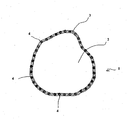
- This particle 1 is formed by a grain 2 of a first material which is coated with a layer of binder 3 incorporating granules 4 of a second material of nanometric particle size.
- Nanoscale materials are readily available commercially. These materials can be obtained, for example, from Technanogy (2146 Michelson Drive Irvine California USA).
- nanometric material having a particle size of between 50 and 100 nanometers (ie between 0.05 micrometers and 0.1 micrometers).
- the granules 4 thus surround substantially all the outer surface of the grains 2 of the first material.
- the various particles 1 thus formed and which form the powdery substance are therefore always in mutual contact with one another via the granules 4.
- the contact between the granules makes the pyrotechnic substance conductive.
- the first material coated with aluminum may be a pyrotechnic material such as a primary explosive.
- the starting pyrotechnic powdery substance obtained will have an improved behavior. In particular, it will be more resistant to electrostatic discharges, friction and heating.
- the first pyrotechnic material may be a secondary explosive such as hexogen or octogen.
- the coating of the grains of explosives may, in addition to the conductivity of the composition, provide a complementary blast effect to the explosive charge that will be made with such a substance.
- a coating of a micrometric material with nanometric silica will improve the flowability of the powdery substance.
- the coating of the grains of a material of micrometric granulometry with nanoscale granules is a priori delicate operation.
- the very fine granules are dispersed in suspension in the air during a dry implementation. They can also charge static electricity and stick to the loading tools.
- the nanometer aluminum powder reacts strongly in the presence of moisture and is therefore dangerous to handle.
- the invention also aims to provide a method for ensuring a safe and reproducible manner this coating.
- the material according to the invention is thus produced by an emulsion coating process.
- the first micrometric material and the second nanometric material are suspended in a carrier liquid.
- the first solvent is then extracted by adding a second solvent to the emulsion.
- a second solvent is chosen so that the first solvent has a greater affinity with it than it has for the binder material.
- This operation has the effect of removing the solvent from the binder, so to harden it that traps the granules nanoscale around the grains of the first micrometric material.
- the substance obtained will be used in a conventional manner in a pyrotechnic component, for example a hot wire, exploded wire or percussion component.
- the first pyrotechnic material is a secondary explosive it will be implemented later using conventional loading techniques (casting, compression, polymerization).
- a surfactant is added to the solvent / binder emulsion in the carrier liquid a surfactant to stabilize it.
- the surfactant molecules make it possible to reduce the surface tensions between two liquids.
- the surfactant will have the role of creating binder / solvent bubbles of equivalent volume.
- each element thereof when stopping the agitation of an emulsion, each element thereof has a strong tendency to recover its equilibrium state. After a while there is a separation of the two liquid phases. It is therefore not possible in this case to precisely control the size of the grains produced.
- the surfactant makes it possible to stabilize this stage before the hardening of the grains by the addition of the second solvent.
- This control also makes it possible to control the quantity of granules of nanometric material present in each bubble of binder / solvent, thus also to control coating the grains of the first material with the nanometric material.
- the choice of the surfactant will depend on the nature of the solvents present as well as that of the carrier liquid.
- a surfactant having a polar head that is soluble in the first solvent and a fatty carbon chain that is soluble in the support liquid will be chosen.
- the advantage of the process according to the invention is that it avoids the dry mixing of the powders. This increases the security of implementation. If the first material is a primary explosive, it is phlegmatized by the carrier liquid. Moreover, nanometric aluminum which is highly reactive in the open air (because of the humidity of the air) is mixed safely in the carrier liquid (for example silicone oil).
- the carrier liquid for example silicone oil
- the binder will be chosen according to the nature of the material to be coated and so that it is not miscible in the carrier liquid.
- the first solvent will then be selected according to the nature of the binder chosen and finally the second solvent depending on the nature of the first solvent.
- a binder such as nitrocellulose
- methyl ethyl ketone will be used as the first solvent and heptane will be adopted as the second solvent for hardening the grains.
- the carrier liquid chosen is silicone oil and the appropriate surfactant is a sugar ester.
- Such an ester has a long carbon chain which has more affinity with silicone oil than with methyl ethyl ketone. It comprises a polar head formed by numerous OH groups which form hydrogen bonds with the CO of methyl ethyl ketone.
- the sugar ester therefore has the interphase between the first solvent and silicone oil, ensuring the stabilization of the droplets.
- PVDF polyvinyl formamide
- polyvinyl alcohol may be chosen as the first solvent acetone.
- the method according to the invention can also be used to coat a non-pyrotechnic material with nanoscale granules.
- the skilled person will easily choose different solvents depending on the materials used.
- a powdery pyrotechnic substance comprising 78% of potassium dinitrobenzofuroxane (KDNBF) (mean particle size 85 microns), 19% of nanometric aluminum (particle size of between 50 nanometers and 100 nanometers) and 3% of nitrocellulose has been produced. .
- KDNBF potassium dinitrobenzofuroxane
- a solution of the binder in a first solvent is first prepared.
- 0.1 g and 0.25 g of nitrocellulose are mixed in 40 to 60 ml of methyl ethyl ketone.
- thermostatic beaker is introduced between 150 and 300 ml of silicone oil.
- the temperature of the silicone oil bath is maintained between 18 ° C and 30 ° C.
- An agitator is present in the beaker.
- the powder of pyrotechnic material is allowed to partition into the beaker, and then 2 to 4 g of nanometric aluminum are introduced.
- the mixture is stirred for 5 minutes.
- the binder solution previously prepared is then introduced into the beaker and then 1 to 5 ml of a solution of surfactant (sugar ester) is added.
- Tests were carried out making it possible to compare the pyrotechnic substance thus obtained with KDNBF alone, and with a composition coated and associating KDNBF with micrometric aluminum (particle size between 40 microns and 80 microns).
- This latter composition was prepared using the same method as that described above.
- the composition obtained is rather close to a dry mixture of the two products in which there are no conductive paths through the aluminum particles.
- capacitive discharges have been performed using a combination of capacitance and resistance.
- This conventional test is conducted according to the following procedure: a quantity of pyrotechnic substance of about 15 mm 3 is placed in a conductive cup. A needle is placed above the substance (without contact). Between the bucket containing the pyrotechnic substance and the needle is discharged a capacitor with a capacity of 1000 ⁇ F charged at 25 kV with a resistance of 10 kilo Ohms in series.
- the pyrotechnic substance according to the invention has a higher initiation threshold. Its sensitivity to electric shocks is therefore lower.
- the pyrotechnic substance using micrometric aluminum is not homogeneous from one batch to another. The results are not reproducible for such a substance.
- the threshold varies from 2.88 kV (KDNBF only) to non-initiation (aluminum only).
- a sample of the order of 10 mg of the pyrotechnic substance to be tested is deposited in the form of a small pile in the middle of a rough ceramic plate. This plate is then fixed on the mobile carriage of the device which can print a linear movement of reproducible speed and amplitude.
- the pyrotechnic substance according to the invention is much more resistant to friction than the KDNBF alone. Indeed it takes effort greater than 1.2 kg to get the initiation. Such behavior is due to an improvement of the outer surface of the grain (smoothing provided by the nanoscale material).
- compositions associating :
Landscapes
- Chemical & Material Sciences (AREA)
- Organic Chemistry (AREA)
- Crystallography & Structural Chemistry (AREA)
- Inorganic Chemistry (AREA)
- Powder Metallurgy (AREA)
- Air Bags (AREA)
- Glanulating (AREA)
Claims (16)
- Pulverisierte, pyrotechnische Substanz, dadurch gekennzeichnet, dass sie wenigstens 95% bis 60% in Masse eines ersten pyrotechnischen Materials umfasst, welches von Körnern (2) gebildet wird, welche von einer Bindemittelschicht (3) eingehüllt werden, die Körnchen (4) eines zweiten Materials enthält, welches von Aluminium mit Nano-Körngröße gebildet wird, welche zwischen 50 und 100 Nanometer in einem Verhältnis von 5 bis 40% in Masse liegt, wobei das Bindemittel im Gesamtverhältnis von 0,5 bis 3% der Gesamtmasse des Gemenges vorliegt, welches vom ersten und zweiten Material gebildet wird.
- Pulverisierte, pyrotechnische Substanz nach Anspruch 1, dadurch gekennzeichnet, dass das Bindemittel aus den folgenden Materialien ausgewählt wird: Nitrozellulose, Polyvinylidenfluorid (PVDF), Polyvinylalkohol, Kopolymer von Chlorfluorethylen, Polytetrafluorethylen, Kopolymer von Chlorazetatvinyl (CVA).
- Pulverisierte, pyrotechnische Substanz nach Anspruch 1 oder 2, dadurch gekennzeichnet, dass das erste pyrotechnische Material ein Sekundärsprengstoff ist.
- Pulverisierte, pyrotechnische Substanz nach einem der Ansprüche 1 bis 3, dadurch gekennzeichnet, dass das erste pyrotechnische Material ein Primärsprengstoff ist.
- Pulverisierte, pyrotechnische Substanz nach Anspruch 4, dadurch gekennzeichnet, dass das erste pyrotechnische Material aus den folgenden Materialien ausgewählt wird: Salze von Dinitrobenzofuroxan (Salze von Natrium, von Kalium, von Zäsium, von Barium oder von Rubidium), Bleiazid, Silberazid, Diazodinitrophenol, Bleistyphnat.
- Pulverisierte, pyrotechnische Substanz nach Anspruch 5, dadurch gekennzeichnet, dass sie umfasst:- 60 bis 95% in Masse Kalium-Dinitrobenzofuroxan (KDNBF),- 5 bis 40% in Masse Nano-Aluminium,- ein Bindemittel in einem Verhältnis von 0,5 bis 3% der Gesamtmasse des Gemenges pyrotechnisches Material/Nano-Aluminium.
- Pulverisierte, pyrotechnische Substanz nach Anspruch 6, dadurch gekennzeichnet, dass sie umfasst:- 79% in Masse Kalium-Dinitrobenzofuroxan (KDNBF),- 18% in Masse Nano-Aluminium,- 3% in Masse Nitrozellulose.
- Pulverisierte, pyrotechnische Substanz nach Anspruch 5, dadurch gekennzeichnet, dass sie umfasst:- 60 bis 95% in Masse Silberazid,- 5 bis 40% Nano-Aluminium,- ein Bindemittel in einem Verhältnis von 0,5 bis 3% der Gesamtmasse des Gemenges pyrotechnisches Material/Nano-Aluminium.
- Pulverisierte, pyrotechnische Substanz nach Anspruch 8, dadurch gekennzeichnet, dass sie umfasst:- 80% in Masse Silberazid,- 20% Nano-Aluminium,- Nitrozellulose in einem Verhältnis von 3% der Gesamtmasse des Gemenges pyrotechnisches Material/Nano-Aluminium.
- Pulverisierte, pyrotechnische Substanz nach Anspruch 5, dadurch gekennzeichnet, dass sie umfasst:- 60 bis 95% in Masse Bleistyphnat,- 5 bis 40% Nano-Aluminium,- ein Bindemittel in einem Verhältnis von 0,5 bis 3% der Gesamtmasse des Gemenges pyrotechnisches Material/Nano-Aluminium.
- Pulverisierte, pyrotechnische Substanz nach Anspruch 10, dadurch gekennzeichnet, dass sie umfasst:- 70% in Masse Bleistyphnat,- 30% Nano-Aluminium,- Nitrozellulose in einem Verhältnis von 3% der Gesamtmasse des Gemenges pyrotechnisches Material/Nano-Aluminium.
- Verfahren zur Bereitung einer pulverisierten, pyrotechnischen Substanz nach einem der Ansprüche 1 bis 11, umfassend wenigstens ein erstes Material, welches von Körnern gebildet wird, welche von einer Bindemittelschicht eingehüllt sind, welche Körnchen eines zweiten Materials von Nano-Korngröße enthält, wobei das Verfahren durch die folgenden Schritte gekennzeichnet ist:- es wird eine Lösung des Bindemittels in einem ersten Lösungsmittel dieses Letzteren bereitet,- es wird außerdem ein Bad von Trägerflüssigkeit bereitet, die nicht mit dem ersten Lösungsmittel mischbar ist,- es wird in das Bad ein erstes einzuhüllendes Material eingebracht, wobei noch alles bewegt wird, um eine homogene Verteilung des Körner dieses Materials in dem Bad zu gewährleisten,- es wird ein zweites Material mit Nano-Korngröße in das Bad eingebracht, wobei noch die Bewegung beibehalten wird,- es wird die Lösung des Bindemittels in das Bad eingebracht,- es wird ein Tensid in das Bad eingebracht,- nach der Bewegung wird wenigstens ein Mal mit einem zweiten Lösungsmittel gewaschen, welches dafür geeignet ist, um zu ermöglichen, das erste Lösungsmittel des Bindemittels zu eliminieren.- die erhaltene pulverisierte Substanz wird geschleudert und/oder getrocknet.
- Verfahren zur Bereitung nach Anspruch 12, dadurch gekennzeichnet, dass die Trägerflüssigkeit Silikonöl ist, das Bindemittel Nitrozellulose und das erste Lösungsmittel Butanon ist.
- Verfahren zur Bereitung nach Anspruch 13, dadurch gekennzeichnet, dass das Tensid ein Zuckerester ist.
- Verfahren zur Bereitung nach einem der Ansprüche 12 bis 14, dadurch gekennzeichnet, dass das erste Material ein detonierender oder verpuffender Primärsprengstoff ist.
- Verfahren zur Bereitung nach einem der Ansprüche 12 bis 15, dadurch gekennzeichnet, dass das zweite Nano-Material von Aluminium gebildet wird.
Applications Claiming Priority (2)
| Application Number | Priority Date | Filing Date | Title |
|---|---|---|---|
| FR0309260 | 2003-07-25 | ||
| FR0309260A FR2857963B1 (fr) | 2003-07-25 | 2003-07-25 | Substance pulverulente et procede de fabrication d'une telle substance. |
Publications (3)
| Publication Number | Publication Date |
|---|---|
| EP1500639A2 EP1500639A2 (de) | 2005-01-26 |
| EP1500639A3 EP1500639A3 (de) | 2011-11-30 |
| EP1500639B1 true EP1500639B1 (de) | 2014-03-26 |
Family
ID=33484710
Family Applications (1)
| Application Number | Title | Priority Date | Filing Date |
|---|---|---|---|
| EP04291798.9A Expired - Lifetime EP1500639B1 (de) | 2003-07-25 | 2004-07-15 | Pyrotechnisches Material und Verfahren zu deren Herstellung |
Country Status (2)
| Country | Link |
|---|---|
| EP (1) | EP1500639B1 (de) |
| FR (1) | FR2857963B1 (de) |
Cited By (1)
| Publication number | Priority date | Publication date | Assignee | Title |
|---|---|---|---|---|
| WO2019143865A1 (en) * | 2018-01-18 | 2019-07-25 | Armtec Defense Products Co. | Method for making pyrotechnic material and related technology |
Families Citing this family (2)
| Publication number | Priority date | Publication date | Assignee | Title |
|---|---|---|---|---|
| FR2905882B1 (fr) * | 2006-09-14 | 2008-10-31 | Saint Louis Inst | Procede de fabrication de micro et/ou nanothermites et nanothermites associees. |
| FR2925488B1 (fr) * | 2007-12-19 | 2011-12-23 | Snpe Materiaux Energetiques | Desensibilisation par enrobage de cristaux de substances energetiques explosives ; cristaux de telles substances enrobes, materiaux energetiques. |
Family Cites Families (14)
| Publication number | Priority date | Publication date | Assignee | Title |
|---|---|---|---|---|
| DE1105784B (de) * | 1960-02-06 | 1961-04-27 | Deutsch Franz Forsch Inst | Verfahren zur Herstellung leitfaehiger Initialsprengstoffe fuer elektrische Zuender |
| FR2031677A5 (en) * | 1969-02-04 | 1970-11-20 | France Etat | Explosive mixtures contg metals prepn |
| US3652350A (en) * | 1969-06-23 | 1972-03-28 | Hi Shear Corp | Method of blending pyrotechnic mixtures |
| AU5250073A (en) * | 1972-03-10 | 1974-08-22 | Ici Australia Ltd | Compositions of matter |
| IN165908B (de) * | 1985-10-25 | 1990-02-10 | Merck Patent Gmbh | |
| US4994125A (en) * | 1989-05-08 | 1991-02-19 | Olin Corporation | Electric primer with intrinsic conductive mix |
| JP2875600B2 (ja) * | 1990-07-06 | 1999-03-31 | ポーラ化成工業株式会社 | 被覆力に優れた着色基剤を配合して成る化粧料 |
| DE4117718C1 (en) * | 1991-05-30 | 1992-07-02 | Dynamit Nobel Ag, 5210 Troisdorf, De | Surface coating prim. and/or sec. explosives with flame extinguishable material - by homogeneously treating with nonionic surfactant liq., contacting with material and blending |
| JP2998633B2 (ja) * | 1996-04-01 | 2000-01-11 | 富士ゼロックス株式会社 | 静電潜像現像剤用キャリア、その製造方法、静電潜像現像剤、画像形成方法及び画像形成装置 |
| US5750921A (en) * | 1997-07-07 | 1998-05-12 | Chan; May L. | Waste-free method of making molding powder |
| US5879079A (en) * | 1997-08-20 | 1999-03-09 | The United States Of America As Represented By The Administrator, Of The National Aeronautics And Space Administration | Automated propellant blending |
| AU4639600A (en) * | 1999-01-29 | 2000-08-18 | Cordant Technologies, Inc. | Water-free preparation of igniter granules for waterless extrusion processes |
| US6503350B2 (en) * | 1999-11-23 | 2003-01-07 | Technanogy, Llc | Variable burn-rate propellant |
| US6605167B1 (en) * | 2000-09-01 | 2003-08-12 | Trw Inc. | Autoignition material for a vehicle occupant protection apparatus |
-
2003
- 2003-07-25 FR FR0309260A patent/FR2857963B1/fr not_active Expired - Fee Related
-
2004
- 2004-07-15 EP EP04291798.9A patent/EP1500639B1/de not_active Expired - Lifetime
Cited By (3)
| Publication number | Priority date | Publication date | Assignee | Title |
|---|---|---|---|---|
| WO2019143865A1 (en) * | 2018-01-18 | 2019-07-25 | Armtec Defense Products Co. | Method for making pyrotechnic material and related technology |
| US11167346B2 (en) | 2018-01-18 | 2021-11-09 | Armtec Defense Products Co. | Method for making pyrotechnic material and related technology |
| US12545632B2 (en) | 2018-01-18 | 2026-02-10 | Armtec Defense Products Co. | Method for making pyrotechnic material and related technology |
Also Published As
| Publication number | Publication date |
|---|---|
| FR2857963A1 (fr) | 2005-01-28 |
| EP1500639A3 (de) | 2011-11-30 |
| FR2857963B1 (fr) | 2006-09-08 |
| EP1500639A2 (de) | 2005-01-26 |
Similar Documents
| Publication | Publication Date | Title |
|---|---|---|
| EP0210881B1 (de) | Verwendung von 5-Oxo-3-nitro-1,2,4-triazol als Sekundär-Sprengstoff und 5-Oxo-3-nitro-1,2,4-triazol enthaltende pyrotechnische Zusammensetzungen | |
| US6315847B1 (en) | Water-free preparation of igniter granules for waterless extrusion processes | |
| US3181463A (en) | Explosive device containing charge of elongated crystals and an exploding bridgewire | |
| EP2794518B1 (de) | Verarbeitung von explosivstoffen | |
| EP0180488A1 (de) | Ultraschneller Gaserzeuger mit erhöhter Sicherheit | |
| CA2413014C (fr) | Procede de realisation d'un initiateur electro-pyrotechnique par emploi d'une colle aqueuse | |
| FR2545478A1 (fr) | Composition explosive moulable a froid et son procede de preparation | |
| EP2819776A1 (de) | Verfahren zur herstellung von nanopartikeln mittels detonation | |
| FR2480933A1 (fr) | Procede pour amorcer une cartouche a amorce peripherique | |
| FR2857963A1 (fr) | Substance pulverulente et procede de fabrication d'une telle substance. | |
| EP0010009B1 (de) | Zersplitterbare Ladungen von mit Polyvinylnitrat bekleidetem Treibpulver und Verfahren zu deren Herstellung | |
| FR2954308A1 (fr) | Composition explosive fusible/coulable et a vulnerabilite reduite | |
| FR2665894A1 (fr) | Alpha- et beta-octogenes sous forme granulee et stabilisee. | |
| CA2689318A1 (fr) | Procede de determination du caractere sensible ou insensible d'un hexogene | |
| FR2938837A1 (fr) | Composition composite pour propergol solide comprenant un derive ferrocenique et une charge d'aluminium submicronique, propergol solide et chargement | |
| EP1101076B1 (de) | Herstellungsverfahren für einen pyrotechnischen satz und ein mittels dieses verfahren hergestellter, pyrotechnischer zünder | |
| WO2009081048A2 (fr) | Desensibilisation par enrobage de cristaux de substances energetiques explosives; cristaux de telles substances enrobes; materiaux energetiques. | |
| RU2637016C1 (ru) | Способ изготовления термостойких светочувствительных взрывчатых составов и светодетонатор на их основе | |
| FR2536065A1 (en) | Propellants based on plastics foam | |
| EP1584610A2 (de) | Sprengstoffzusammensetzung | |
| WO2023156729A1 (fr) | Procede d'obtention de pates d'allumage en melangeur a resonance acoustique. | |
| FR2936795A1 (fr) | Compositions explosives denses, chargements explosifs denses et munitions les comprenant | |
| RU2235085C1 (ru) | Состав пиротехнический механоактивированный | |
| FR2841156A1 (fr) | Nouvelles particules magnetiques fluorescentes,ainsi que les conjugues de telles particules et les compositions diagnostiques , therapeutiques ou prophylactiques les contenant | |
| EP0036810B1 (de) | Verfahren zum Füllen eines pyrotechnischen Verzögerungssatzes |
Legal Events
| Date | Code | Title | Description |
|---|---|---|---|
| PUAI | Public reference made under article 153(3) epc to a published international application that has entered the european phase |
Free format text: ORIGINAL CODE: 0009012 |
|
| AK | Designated contracting states |
Kind code of ref document: A2 Designated state(s): AT BE BG CH CY CZ DE DK EE ES FI FR GB GR HU IE IT LI LU MC NL PL PT RO SE SI SK TR |
|
| AX | Request for extension of the european patent |
Extension state: AL HR LT LV MK |
|
| 17P | Request for examination filed |
Effective date: 20050525 |
|
| RAP1 | Party data changed (applicant data changed or rights of an application transferred) |
Owner name: NEXTER MUNITIONS |
|
| PUAL | Search report despatched |
Free format text: ORIGINAL CODE: 0009013 |
|
| AK | Designated contracting states |
Kind code of ref document: A3 Designated state(s): AT BE BG CH CY CZ DE DK EE ES FI FR GB GR HU IE IT LI LU MC NL PL PT RO SE SI SK TR |
|
| AX | Request for extension of the european patent |
Extension state: AL HR LT LV MK |
|
| RIC1 | Information provided on ipc code assigned before grant |
Ipc: C06B 45/30 20060101ALI20111025BHEP Ipc: C06B 21/00 20060101ALI20111025BHEP Ipc: C06B 45/20 20060101AFI20111025BHEP Ipc: C06C 7/00 20060101ALI20111025BHEP |
|
| AKX | Designation fees paid |
Designated state(s): AT BE BG CH CY CZ DE DK EE ES FI FR GB GR HU IE IT LI LU MC NL PL PT RO SE SI SK TR |
|
| 17Q | First examination report despatched |
Effective date: 20130516 |
|
| GRAP | Despatch of communication of intention to grant a patent |
Free format text: ORIGINAL CODE: EPIDOSNIGR1 |
|
| INTG | Intention to grant announced |
Effective date: 20131018 |
|
| GRAS | Grant fee paid |
Free format text: ORIGINAL CODE: EPIDOSNIGR3 |
|
| GRAA | (expected) grant |
Free format text: ORIGINAL CODE: 0009210 |
|
| AK | Designated contracting states |
Kind code of ref document: B1 Designated state(s): AT BE BG CH CY CZ DE DK EE ES FI FR GB GR HU IE IT LI LU MC NL PL PT RO SE SI SK TR |
|
| REG | Reference to a national code |
Ref country code: GB Ref legal event code: FG4D Free format text: NOT ENGLISH |
|
| REG | Reference to a national code |
Ref country code: CH Ref legal event code: EP |
|
| REG | Reference to a national code |
Ref country code: AT Ref legal event code: REF Ref document number: 658882 Country of ref document: AT Kind code of ref document: T Effective date: 20140415 |
|
| REG | Reference to a national code |
Ref country code: IE Ref legal event code: FG4D Free format text: LANGUAGE OF EP DOCUMENT: FRENCH |
|
| REG | Reference to a national code |
Ref country code: DE Ref legal event code: R096 Ref document number: 602004044675 Country of ref document: DE Effective date: 20140508 |
|
| REG | Reference to a national code |
Ref country code: AT Ref legal event code: MK05 Ref document number: 658882 Country of ref document: AT Kind code of ref document: T Effective date: 20140326 |
|
| REG | Reference to a national code |
Ref country code: NL Ref legal event code: VDEP Effective date: 20140326 |
|
| PG25 | Lapsed in a contracting state [announced via postgrant information from national office to epo] |
Ref country code: FI Free format text: LAPSE BECAUSE OF FAILURE TO SUBMIT A TRANSLATION OF THE DESCRIPTION OR TO PAY THE FEE WITHIN THE PRESCRIBED TIME-LIMIT Effective date: 20140326 Ref country code: SE Free format text: LAPSE BECAUSE OF FAILURE TO SUBMIT A TRANSLATION OF THE DESCRIPTION OR TO PAY THE FEE WITHIN THE PRESCRIBED TIME-LIMIT Effective date: 20140326 |
|
| PG25 | Lapsed in a contracting state [announced via postgrant information from national office to epo] |
Ref country code: NL Free format text: LAPSE BECAUSE OF FAILURE TO SUBMIT A TRANSLATION OF THE DESCRIPTION OR TO PAY THE FEE WITHIN THE PRESCRIBED TIME-LIMIT Effective date: 20140326 Ref country code: CY Free format text: LAPSE BECAUSE OF FAILURE TO SUBMIT A TRANSLATION OF THE DESCRIPTION OR TO PAY THE FEE WITHIN THE PRESCRIBED TIME-LIMIT Effective date: 20140326 Ref country code: EE Free format text: LAPSE BECAUSE OF FAILURE TO SUBMIT A TRANSLATION OF THE DESCRIPTION OR TO PAY THE FEE WITHIN THE PRESCRIBED TIME-LIMIT Effective date: 20140326 Ref country code: RO Free format text: LAPSE BECAUSE OF FAILURE TO SUBMIT A TRANSLATION OF THE DESCRIPTION OR TO PAY THE FEE WITHIN THE PRESCRIBED TIME-LIMIT Effective date: 20140326 Ref country code: BG Free format text: LAPSE BECAUSE OF FAILURE TO SUBMIT A TRANSLATION OF THE DESCRIPTION OR TO PAY THE FEE WITHIN THE PRESCRIBED TIME-LIMIT Effective date: 20140626 |
|
| PG25 | Lapsed in a contracting state [announced via postgrant information from national office to epo] |
Ref country code: SK Free format text: LAPSE BECAUSE OF FAILURE TO SUBMIT A TRANSLATION OF THE DESCRIPTION OR TO PAY THE FEE WITHIN THE PRESCRIBED TIME-LIMIT Effective date: 20140326 Ref country code: ES Free format text: LAPSE BECAUSE OF FAILURE TO SUBMIT A TRANSLATION OF THE DESCRIPTION OR TO PAY THE FEE WITHIN THE PRESCRIBED TIME-LIMIT Effective date: 20140326 Ref country code: AT Free format text: LAPSE BECAUSE OF FAILURE TO SUBMIT A TRANSLATION OF THE DESCRIPTION OR TO PAY THE FEE WITHIN THE PRESCRIBED TIME-LIMIT Effective date: 20140326 Ref country code: PL Free format text: LAPSE BECAUSE OF FAILURE TO SUBMIT A TRANSLATION OF THE DESCRIPTION OR TO PAY THE FEE WITHIN THE PRESCRIBED TIME-LIMIT Effective date: 20140326 |
|
| PG25 | Lapsed in a contracting state [announced via postgrant information from national office to epo] |
Ref country code: PT Free format text: LAPSE BECAUSE OF FAILURE TO SUBMIT A TRANSLATION OF THE DESCRIPTION OR TO PAY THE FEE WITHIN THE PRESCRIBED TIME-LIMIT Effective date: 20140728 |
|
| REG | Reference to a national code |
Ref country code: DE Ref legal event code: R097 Ref document number: 602004044675 Country of ref document: DE |
|
| PG25 | Lapsed in a contracting state [announced via postgrant information from national office to epo] |
Ref country code: DK Free format text: LAPSE BECAUSE OF FAILURE TO SUBMIT A TRANSLATION OF THE DESCRIPTION OR TO PAY THE FEE WITHIN THE PRESCRIBED TIME-LIMIT Effective date: 20140326 |
|
| PLBE | No opposition filed within time limit |
Free format text: ORIGINAL CODE: 0009261 |
|
| STAA | Information on the status of an ep patent application or granted ep patent |
Free format text: STATUS: NO OPPOSITION FILED WITHIN TIME LIMIT |
|
| PG25 | Lapsed in a contracting state [announced via postgrant information from national office to epo] |
Ref country code: LU Free format text: LAPSE BECAUSE OF FAILURE TO SUBMIT A TRANSLATION OF THE DESCRIPTION OR TO PAY THE FEE WITHIN THE PRESCRIBED TIME-LIMIT Effective date: 20140715 |
|
| 26N | No opposition filed |
Effective date: 20150106 |
|
| PG25 | Lapsed in a contracting state [announced via postgrant information from national office to epo] |
Ref country code: IT Free format text: LAPSE BECAUSE OF FAILURE TO SUBMIT A TRANSLATION OF THE DESCRIPTION OR TO PAY THE FEE WITHIN THE PRESCRIBED TIME-LIMIT Effective date: 20140326 |
|
| REG | Reference to a national code |
Ref country code: DE Ref legal event code: R097 Ref document number: 602004044675 Country of ref document: DE Effective date: 20150106 |
|
| REG | Reference to a national code |
Ref country code: IE Ref legal event code: MM4A |
|
| PG25 | Lapsed in a contracting state [announced via postgrant information from national office to epo] |
Ref country code: SI Free format text: LAPSE BECAUSE OF FAILURE TO SUBMIT A TRANSLATION OF THE DESCRIPTION OR TO PAY THE FEE WITHIN THE PRESCRIBED TIME-LIMIT Effective date: 20140326 |
|
| PG25 | Lapsed in a contracting state [announced via postgrant information from national office to epo] |
Ref country code: IE Free format text: LAPSE BECAUSE OF NON-PAYMENT OF DUE FEES Effective date: 20140715 |
|
| PG25 | Lapsed in a contracting state [announced via postgrant information from national office to epo] |
Ref country code: MC Free format text: LAPSE BECAUSE OF FAILURE TO SUBMIT A TRANSLATION OF THE DESCRIPTION OR TO PAY THE FEE WITHIN THE PRESCRIBED TIME-LIMIT Effective date: 20140326 |
|
| PG25 | Lapsed in a contracting state [announced via postgrant information from national office to epo] |
Ref country code: GR Free format text: LAPSE BECAUSE OF FAILURE TO SUBMIT A TRANSLATION OF THE DESCRIPTION OR TO PAY THE FEE WITHIN THE PRESCRIBED TIME-LIMIT Effective date: 20140627 |
|
| REG | Reference to a national code |
Ref country code: FR Ref legal event code: PLFP Year of fee payment: 13 |
|
| PG25 | Lapsed in a contracting state [announced via postgrant information from national office to epo] |
Ref country code: BE Free format text: LAPSE BECAUSE OF FAILURE TO SUBMIT A TRANSLATION OF THE DESCRIPTION OR TO PAY THE FEE WITHIN THE PRESCRIBED TIME-LIMIT Effective date: 20140731 Ref country code: HU Free format text: LAPSE BECAUSE OF FAILURE TO SUBMIT A TRANSLATION OF THE DESCRIPTION OR TO PAY THE FEE WITHIN THE PRESCRIBED TIME-LIMIT; INVALID AB INITIO Effective date: 20040715 Ref country code: TR Free format text: LAPSE BECAUSE OF FAILURE TO SUBMIT A TRANSLATION OF THE DESCRIPTION OR TO PAY THE FEE WITHIN THE PRESCRIBED TIME-LIMIT Effective date: 20140326 |
|
| REG | Reference to a national code |
Ref country code: FR Ref legal event code: PLFP Year of fee payment: 14 |
|
| REG | Reference to a national code |
Ref country code: FR Ref legal event code: PLFP Year of fee payment: 15 |
|
| PGFP | Annual fee paid to national office [announced via postgrant information from national office to epo] |
Ref country code: FR Payment date: 20200623 Year of fee payment: 17 Ref country code: CH Payment date: 20200623 Year of fee payment: 17 Ref country code: CZ Payment date: 20200626 Year of fee payment: 17 |
|
| PGFP | Annual fee paid to national office [announced via postgrant information from national office to epo] |
Ref country code: GB Payment date: 20200624 Year of fee payment: 17 |
|
| PGFP | Annual fee paid to national office [announced via postgrant information from national office to epo] |
Ref country code: DE Payment date: 20200622 Year of fee payment: 17 |
|
| REG | Reference to a national code |
Ref country code: DE Ref legal event code: R119 Ref document number: 602004044675 Country of ref document: DE |
|
| REG | Reference to a national code |
Ref country code: CH Ref legal event code: PL |
|
| GBPC | Gb: european patent ceased through non-payment of renewal fee |
Effective date: 20210715 |
|
| PG25 | Lapsed in a contracting state [announced via postgrant information from national office to epo] |
Ref country code: LI Free format text: LAPSE BECAUSE OF NON-PAYMENT OF DUE FEES Effective date: 20210731 Ref country code: GB Free format text: LAPSE BECAUSE OF NON-PAYMENT OF DUE FEES Effective date: 20210715 Ref country code: DE Free format text: LAPSE BECAUSE OF NON-PAYMENT OF DUE FEES Effective date: 20220201 Ref country code: CH Free format text: LAPSE BECAUSE OF NON-PAYMENT OF DUE FEES Effective date: 20210731 |
|
| PG25 | Lapsed in a contracting state [announced via postgrant information from national office to epo] |
Ref country code: FR Free format text: LAPSE BECAUSE OF NON-PAYMENT OF DUE FEES Effective date: 20210731 Ref country code: CZ Free format text: LAPSE BECAUSE OF NON-PAYMENT OF DUE FEES Effective date: 20210715 |