EP1495270B1 - Atmospheric control within a building - Google Patents
Atmospheric control within a building Download PDFInfo
- Publication number
- EP1495270B1 EP1495270B1 EP03724032A EP03724032A EP1495270B1 EP 1495270 B1 EP1495270 B1 EP 1495270B1 EP 03724032 A EP03724032 A EP 03724032A EP 03724032 A EP03724032 A EP 03724032A EP 1495270 B1 EP1495270 B1 EP 1495270B1
- Authority
- EP
- European Patent Office
- Prior art keywords
- data center
- cooling
- temperature
- thermal map
- atmospheric
- Prior art date
- Legal status (The legal status is an assumption and is not a legal conclusion. Google has not performed a legal analysis and makes no representation as to the accuracy of the status listed.)
- Expired - Lifetime
Links
- 238000001816 cooling Methods 0.000 claims description 46
- 238000000034 method Methods 0.000 claims description 22
- 239000012809 cooling fluid Substances 0.000 claims description 17
- 230000001143 conditioned effect Effects 0.000 claims description 12
- 230000009471 action Effects 0.000 claims description 6
- 239000012530 fluid Substances 0.000 description 8
- 238000004378 air conditioning Methods 0.000 description 6
- 230000008859 change Effects 0.000 description 4
- 230000001276 controlling effect Effects 0.000 description 4
- 230000003247 decreasing effect Effects 0.000 description 3
- 238000003909 pattern recognition Methods 0.000 description 3
- 238000012545 processing Methods 0.000 description 3
- 230000009467 reduction Effects 0.000 description 3
- 230000003466 anti-cipated effect Effects 0.000 description 2
- 230000001419 dependent effect Effects 0.000 description 2
- 238000005265 energy consumption Methods 0.000 description 2
- 238000013507 mapping Methods 0.000 description 2
- 238000005457 optimization Methods 0.000 description 2
- 230000002829 reductive effect Effects 0.000 description 2
- 239000004065 semiconductor Substances 0.000 description 2
- 238000013528 artificial neural network Methods 0.000 description 1
- 238000009529 body temperature measurement Methods 0.000 description 1
- 238000011217 control strategy Methods 0.000 description 1
- 230000002596 correlated effect Effects 0.000 description 1
- 238000013461 design Methods 0.000 description 1
- 238000001514 detection method Methods 0.000 description 1
- 230000008030 elimination Effects 0.000 description 1
- 238000003379 elimination reaction Methods 0.000 description 1
- 238000005516 engineering process Methods 0.000 description 1
- 238000001914 filtration Methods 0.000 description 1
- 229940085861 flovent Drugs 0.000 description 1
- WMWTYOKRWGGJOA-CENSZEJFSA-N fluticasone propionate Chemical compound C1([C@@H](F)C2)=CC(=O)C=C[C@]1(C)[C@]1(F)[C@@H]2[C@@H]2C[C@@H](C)[C@@](C(=O)SCF)(OC(=O)CC)[C@@]2(C)C[C@@H]1O WMWTYOKRWGGJOA-CENSZEJFSA-N 0.000 description 1
- 230000006870 function Effects 0.000 description 1
- 230000017525 heat dissipation Effects 0.000 description 1
- 238000010438 heat treatment Methods 0.000 description 1
- 230000002427 irreversible effect Effects 0.000 description 1
- 230000000670 limiting effect Effects 0.000 description 1
- 230000000873 masking effect Effects 0.000 description 1
- 230000015654 memory Effects 0.000 description 1
- 238000012544 monitoring process Methods 0.000 description 1
- 238000013021 overheating Methods 0.000 description 1
- 239000002245 particle Substances 0.000 description 1
- 230000008569 process Effects 0.000 description 1
- 238000005057 refrigeration Methods 0.000 description 1
- 230000004044 response Effects 0.000 description 1
- 230000002441 reversible effect Effects 0.000 description 1
- 238000005070 sampling Methods 0.000 description 1
- 239000000779 smoke Substances 0.000 description 1
- 230000003068 static effect Effects 0.000 description 1
- 238000006467 substitution reaction Methods 0.000 description 1
- 230000001629 suppression Effects 0.000 description 1
- 238000001931 thermography Methods 0.000 description 1
- 238000009423 ventilation Methods 0.000 description 1
- 230000000007 visual effect Effects 0.000 description 1
Images

Classifications
-
- F—MECHANICAL ENGINEERING; LIGHTING; HEATING; WEAPONS; BLASTING
- F24—HEATING; RANGES; VENTILATING
- F24F—AIR-CONDITIONING; AIR-HUMIDIFICATION; VENTILATION; USE OF AIR CURRENTS FOR SCREENING
- F24F11/00—Control or safety arrangements
- F24F11/30—Control or safety arrangements for purposes related to the operation of the system, e.g. for safety or monitoring
-
- F—MECHANICAL ENGINEERING; LIGHTING; HEATING; WEAPONS; BLASTING
- F24—HEATING; RANGES; VENTILATING
- F24F—AIR-CONDITIONING; AIR-HUMIDIFICATION; VENTILATION; USE OF AIR CURRENTS FOR SCREENING
- F24F11/00—Control or safety arrangements
- F24F11/62—Control or safety arrangements characterised by the type of control or by internal processing, e.g. using fuzzy logic, adaptive control or estimation of values
-
- F—MECHANICAL ENGINEERING; LIGHTING; HEATING; WEAPONS; BLASTING
- F24—HEATING; RANGES; VENTILATING
- F24F—AIR-CONDITIONING; AIR-HUMIDIFICATION; VENTILATION; USE OF AIR CURRENTS FOR SCREENING
- F24F11/00—Control or safety arrangements
- F24F11/70—Control systems characterised by their outputs; Constructional details thereof
- F24F11/72—Control systems characterised by their outputs; Constructional details thereof for controlling the supply of treated air, e.g. its pressure
- F24F11/74—Control systems characterised by their outputs; Constructional details thereof for controlling the supply of treated air, e.g. its pressure for controlling air flow rate or air velocity
Definitions
- the present invention is related to the following pending applications: Ser. No. 09/970,707, filed October 5, 2001 , and entitled “SMART COOLING OF DATA CENTERS", by Patel et al.; Ser. No. XX/XXX,XXX, filed February 19, 2002, and entitled “DESIGNING LAYOUT FOR INTERNET DATACENTER COOLING", by Nakagawa et al; and Ser. No. XX/XXX,XXX, filed Month DD, YYYY, and entitled “DATA CENTER ENERGY MANAGEMENT", by Friedrich et al.
- Each of the above listed cross-references is assigned to the assignee of the present invention and is incorporated by reference herein.
- the present invention relates to controlling atmospheric conditions within a building.
- a rack may be defined as an Electronics Industry Association (EIA) enclosure and may be configured to house a number of personal computer (PC) boards.
- the PC boards typically include a number of electronic packages, such as processors, micro-controllers, high speed video cards, memories, semi-conductor devices, and the like. These electronic packages dissipate relatively significant amounts of heat during the operation of the respective components. For example, a typical PC board comprising multiple microprocessors may dissipate approximately 250 W of power. Thus, a rack containing forty (40) PC boards of this type may dissipate approximately 10 KW of power.
- the power required to remove the heat dissipated by the electronic packages in a given rack is generally equal to about 10 percent of the power needed to operate the packages.
- the power required to remove the heat dissipated by a plurality of racks in a data center is generally equal to about 50 percent of the power needed to operate the packages in the racks.
- the disparity in the amount of power required to dissipate the various heat loads between racks of data centers stems from the additional thermodynamic work needed in the data center to cool the air.
- Racks are typically cooled with fans that operate to move cooling fluid, such as air, across the heat dissipating components, whereas data centers often use reverse power cycle to cool heated return air.
- Data centers are typically cooled by operation of one or more air conditioning units.
- the compressors of the air conditioning units typically require a minimum of about thirty (30) percent of the required cooling capacity to sufficiently cool the data centers.
- the other components such as condensers, air movers (fans), etc., typically require an additional twenty (20) percent of the required cooling capacity.
- a high density data center with 100 racks, each rack having a maximum power dissipation of 10KW generally requires 1 MW of cooling capacity.
- Air conditioning units with a capacity of 1 MW of heat removal generally require a minimum of 300 KW input compressor power in addition to the power needed to drive the air moving devices, e.g., fans, blowers, etc.
- Conventional data center air conditioning units do not vary their cooling output based on the distributed, location-specific needs of the data center.
- the distribution of work among the operating electronic components in the data center is random and is not controlled. Because of work distribution, some components in one location of the data center may be operating at a maximum capacity, while other components in another location of the data center may be operating at various power levels below a maximum capacity.
- conventional cooling systems typically operate at 100 percent of capacity on a continuous basis, thereby cooling all electronic packages, regardless of need.
- data centers are air conditioned on an overall, room-level basis, thereby yielding unnecessarily high operating expenses to sufficiently cool the heat generating components contained in the racks of data centers.
- prior art attempts at cooling use relatively inaccurate and unsophisticated methods of monitoring and adjusting temperature distribution that result in less than optimal data center cooling efficiency.
- US 5,769,315 presents a pressure-dependent variable air volume control strategy according to which supply air temperature disturbances are minimized by controlling individual zone air dampers in an appropriate way dependent on associated ones of thermostats with one-to-one association between the thermostats and the zone air dampers.
- a method of controlling atmospheric conditions within a building includes the steps of supplying a conditioned fluid inside of the building and sensing one or more atmospheric parameters in various locations inside of the building. From the results of the sensing step, an empirical atmospheric map is then generated and compared to a template atmospheric map. Pattern differentials are identified between the empirical and template atmospheric maps, and corrective action is determined to reduce the pattern differentials. Finally, one-or more of the quantity, quality, and distribution of the conditioned fluid is varied.
- the present invention is not limited in its application to the details of any particular arrangement described or shown, since the present invention is capable of multitudes of embodiments without departing from the spirit and scope of the present invention.
- First, the principles of the present invention are described by referring to only a limited number of embodiments for simplicity and illustrative purposes. Although only a limited number of embodiments of the invention are particularly disclosed herein, one of ordinary skill in the art would readily recognize that the same principles are equally applicable to, and can be implemented in all types of atmospheric control systems. Furthermore, numerous specific details are set forth to convey with reasonable clarity the inventor's possession of the present invention, how to make and/or use the present invention, and the best mode in carrying out the present invention known to the inventor at the time of application.
- a method is configured to control one or more atmospheric conditions within a building. More specifically, the method is configured to adjust one or more of the quantity, quality, and distribution of a conditioned fluid throughout a data center. The method is configured to accomplish such control based upon atmospheric mapping and pattern recognition; using as input, one or more atmospheric parameters measured at various, discrete sensor locations throughout the data center.
- the amount of energy typically required to cool a data center may be relatively reduced by strategically distributing cooling fluid, or conditioned air, within the data center by substantially favoring or increasing the cooling fluid flow to locations within the data center having racks that dissipate greater amounts of heat, and by substantially disfavoring or decreasing the cooling fluid flow to locations having racks that dissipate lesser amounts of heat
- those devices may be operated according to the actual location and area specific cooling needs.
- the racks may be positioned throughout the data center according to their anticipated heat loads to thereby enable computer room air conditioning (CRAC) units located at various positions throughout the data center to operate in a more efficient manner.
- CRAC computer room air conditioning
- the positioning of the racks and cooling strategy may be determined through implementation of modeling and metrology of the cooling fluid flow throughout the data center.
- the numerical modeling may be implemented to determine the volume flow rate and velocity of the cooling fluid flow through the data center.
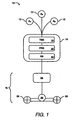
- FIG. 1 a schematic view of the system 10 that may be used in accordance with the present invention.
- the system 10 generally includes atmospheric sensors 12, a central processing unit (CPU) 14, and an atmospheric control system 16.
- the atmospheric control system 16 can be a smart cooling system, exemplified by co-pending U.S. Patent Application Ser. No. 09/970,707, filed on October 5, 2001, by Patel et al ., assigned to the assignee hereof, and incorporated by reference herein in its entirety.
- any type of system directed at controlling atmospheric conditions could be employed, including air-conditioner systems, humidifier systems, filtering systems, fire suppression systems, etc.
- the atmospheric sensors 12 are used for measuring one or more atmospheric parameter and encompass temperature sensors, such as thermocouples, temperature transducers, thermistors, or the like.
- the atmospheric sensors 12 could also include humidity sensors, barometric or pressure sensors, fluid velocity sensors, particle sensors, smoke sensors, and the like.
- the atmospheric sensors 12 are located throughout the portions of a data center type of building (not shown) that are desired to be atmospherically controlled.
- the atmospheric sensors 12 can be positioned in a variety of ways.
- the atmospheric sensors 12 could be dispersed randomly in various locations and elevations, or aligned according to a predetermined coordinate grid, or placed in alignment with locations of vents and/or racks, or placed in accordance with the recommendations from a computational fluid dynamics model.
- the CPU 14 can be a stand-alone personal computer, a computer board or boards docked within one of the racks in the data center, a computer chip, etc., regardless, the CPU 14 includes various software that is loaded thereto.
- the CPU 14 includes software for generating maps of atmospheric conditions, such as thermal mapping software 18.
- Thermal mapping software 18 is capable of processing thousands of input data points, such as thousands of sensor signals, and outputting map-like information.
- a thermal map is composed of temperature contours that define various isothermal regions, or isotherms, of distinct temperatures. The most severe of these isotherms are commonly known as "hot spots". Hot spots may not necessarily correspond in exact location to any given temperature sensor, but may be located between various temperature sensors.
- thermal mapping software can extrapolate or triangulate the location of the actual hot spot from the known locations of the temperature sensors. So, if temperature sensors are located in a range of elevations in various latitudinal and longitudinal coordinate positions of a data center, the thermal mapping software can triangulate not only the coordinate position of a hot spot, but also the elevation thereof.
- the temperature sensor readings provide temperature data and data for calculating temperature gradients, which are used to create a thermal map.
- temperature gradients can be used to locate hot spots in the data center by mathematical optimization techniques like steepest gradient, etc.
- triangulation presents a relatively accurate and efficient approximation technique and, thus, it is possible to use fewer, more sparsely distributed temperature sensors to save on equipment expense and failure modes if desired.
- the CPU 14 includes software for recognizing pattern differentials in such maps, more commonly known as pattern recognition software 20. Such software basically involves a decoding process in which discriminations in patterns are made without human intervention.
- pattern recognition software 20 Such software basically involves a decoding process in which discriminations in patterns are made without human intervention.
- strategic software 22 is loaded on the CPU 14 and is used to determine a course of corrective action to minimize or eliminate the pattern differentials by accepting output of the mapping software 18, processing it, and outputting commands to the cooling system 16. It is contemplated that commercial, general purpose mathematical optimization software like MATLAB could be adapted to generate thermal maps and identify hot spots by pattern recognition. It is also contemplated at this time that application-specific neural network algorithms can also be used to do the same.
- the cooling system 16 is used to vary one or more of the quantity, quality, and distribution of the cooling fluid used to cool the data center.
- the cooling system 16 encompasses a chiller unit 24, but those skilled in the art will recognize that multitudes of other types of cooling systems are generally well-known and available for use with the present invention including, for example, refrigeration systems, cooling tower systems, cooler-condenser systems, and the like.
- the cooling system 16 also includes one or more variable-speed air movers or blowers 26, and one or more remotely controlled dampers or vents 28.
- HVAC Heating, Ventilating, and Air Conditioning
- chiller cycle can be increased or decreased between 0% and 100% of operating capacity to change the cooling quality of the cooling fluid, i.e. temperature, humidity, particulate count, etc.
- the speed and/or baffling of the blower 26 can be adjusted, and the percentage opening of the vents 28 can be varied, either individually or collectively.
- the vents 28 include individual blowers (not shown), such blowers could also be adjusted in speed.
- one or more of multiple chillers, blowers, and vents can be strategically adjusted to target one or more hot spot locations within the data center. For example, if one corner of the data center is demanding the most significant portion of the cooling needs of the entire data center, then the most proximate chiller(s), blower(s), and vent(s) can be selected, while the other, relatively distant chiller(s), blower(s), and vent(s) can be deactivated or reduced. It is contemplated that any other reasonably foreseen atmospheric control system control variables could also be adjusted.
- a method of the present invention involves cooperation of the CPU between the temperature sensors and the cooling system.
- the method of the present invention could also be practiced using other systems besides the one disclosed herein, and thus is not limited thereby.
- the system disclosed herein is simply one of many possible physical manifestations of the method
- the cooling system supplies a cooling fluid within the data center to cool the equipment within the data center, as shown in block 100.
- the temperature within the data center is sensed in various locations and is communicated to the CPU.
- the thermal mapping software converts the point-specific temperature sensor data into information by generating an empirical thermal map therefrom, as depicted in block 104.
- a thermal map can triangulate hot spots from discrete sensor locations based on mathematical optimization techniques. Hot spots are known to arise in several situations, for example, where electronic packages in a given rack draw exceptional amounts of power due to exceptionally high usage of those packages, and the data center cooling system cannot supply enough conditioned fluid to alleviate the overheating. Hot spots may also arise when racks output normal amounts of heat, but the data center cooling system is malfunctioning in a specific location, or in general.
- the thermal mapping step may be executed on an instantaneous, snapshot, or sampling basis but, alternatively, this step may be done on a real-time basis. It is also contemplated that the thermal map could be generated directly, without discrete temperature sensors, using thermography technology, based on infrared detection of heat that is emitted by the equipment in the data center. It is further contemplated that the thermal map could be generated by estimating temperature as a function of the power draw to the electronic packages and/or racks within the data center. Thus, the temperature sensing and map generating steps could be accomplished with thermographic equipment and software, or inferring temperature from power draw.
- the thermal map also provides a powerful visual tool for a data center operator.
- a typical data center is a highly thermally interdependent environment where thermal performance of each electronic package of each rack affects performance of neighboring packages and racks to various orders of magnitude.
- a thermal map also provides a pictorially informative way of identifying the thermal interdependencies across the data center landscape.
- the pattern recognition software compares the empirical thermal map to a template thermal map.
- the template thermal map could also be termed a master, or model thermal map.
- the template basically represents a thermal map of an optimally operating data center cooling system.
- the template can be dynamic, generated either in real-time from current operating conditions, or can be static, generated prior to the comparing step 106.
- Computational fluid dynamics (CFD) software tools such as FLOVENT/AIRPACK, are widely available and known to those skilled in the art.
- the CFD tool accepts various inputs for modeling, including heat loads from the racks within the data center, velocity of the cooling fluid flowing throughout the data center, temperature, pressure, and the like in the data center.
- CFD modeling can be used in the design and layout of a data center, suggesting locations for racks and vents.
- CFD modeling can be used to output a master, template, or model thermal map to be emulated by adjusting cooling system variables.
- Instructive in this regard is U.S. Patent Application Ser. No. XXIXXX,XXX, filed on February 19, 2002, and entitled "DESIGNING LAYOUT FOR INTERNET DATACENTER COOLING", by Nakagawa et al., assigned to the assignee hereof and incorporated by reference herein in its entirety.
- the pattern recognition software is also applied to recognize pattern differentials therebetween, as depicted in block 108.
- Pattern recognition is also commonly referred to as template matching, masking, etc.
- thermal hot spots can be identified Once identified, an initial classification step occurs as depicted by block 110. Certain isotherms may exceed a predetermined range of temperature, size, etc., and thus can be targeted for elimination or reduction. Alternatively, if all isotherms are within the predetermined range of temperature, size, etc., then the cooling system simply maintains current operating conditions and settings, as depicted in block 112.
- the strategic software is used to determine the corrective action required to eliminate or at least reduce pattern differentials within the data center, as depicted in block 114.
- Control variable data such as the location of the vents, the capacity of the blower, and the capacity of the chiller, are used to determine how most efficiently to cool the data center.
- the thermal map data is also used, such as the location, size, and intensity of the isotherms. Specifically, the above-mentioned data sets are correlated to develop an optimally efficient course of corrective action.
- one or more of the quantity, quality, and distribution of the conditioned fluid of the cooling system is varied. For example, if the size and/or intensity of an hot spot isotherm is relatively small, then the cooling system can merely adjust the opening size of the vent closest to the location of the isotherm. If, on the other hand, the size and/or intensity of an isotherm is relatively large, then multiple vents can be adjusted in addition to increasing the chiller cycle. Similarly, if the cooling system included multiple chillers, the chiller most proximate the isotherm could be increased in cycle. In general, the quantity and/or quality of the cooling fluid can be decreased, or maintained, for locations of the data center that exhibit pattern differentials within a predetermined acceptable range.
- the quantity and/or quality of the cooling fluid may be increased for locations of the data center that exhibit pattern differentials outside of a predetermined acceptable range.
- the present invention is capable of substantially reducing the energy consumption associated with cooling a data center, by virtue of using directed, location-specific cooling instead of diffused, room-level cooling. More particularly, the cooling system can be operated relatively more efficiently compared to the prior art by virtue of a more precise method of tracking and using actual temperature measurement as an input to cooling system control.
- the present invention provides methodology for extracting a large amount of discrete, location-specific temperature data points and converting same into more continuous, fluid-like information in the form of a thermal map.
- the present invention is suited for use with applications requiring thousands of sensors, or even just a few well-placed sensors.
- the present invention enables use of the spaces between the sensor locations to be included in assessing or triangulating the locations, size, and intensity of hot spots, resulting in more accurate hot spot reduction than the prior art allows for. Therefore, compared to the prior art and for a given size data center, the present invention presents a more accurate and efficient cooling method, thus requiring fewer and smaller cooling devices and less energy consumption.
Landscapes
- Engineering & Computer Science (AREA)
- Chemical & Material Sciences (AREA)
- Combustion & Propulsion (AREA)
- Mechanical Engineering (AREA)
- General Engineering & Computer Science (AREA)
- Physics & Mathematics (AREA)
- Fluid Mechanics (AREA)
- Fuzzy Systems (AREA)
- Mathematical Physics (AREA)
- Signal Processing (AREA)
- Air Conditioning Control Device (AREA)
Applications Claiming Priority (3)
| Application Number | Priority Date | Filing Date | Title |
|---|---|---|---|
| US123403 | 2002-04-17 | ||
| US10/123,403 US6718277B2 (en) | 2002-04-17 | 2002-04-17 | Atmospheric control within a building |
| PCT/US2003/011545 WO2003089845A1 (en) | 2002-04-17 | 2003-04-16 | Atmospheric control within a building |
Publications (2)
| Publication Number | Publication Date |
|---|---|
| EP1495270A1 EP1495270A1 (en) | 2005-01-12 |
| EP1495270B1 true EP1495270B1 (en) | 2008-03-12 |
Family
ID=29214485
Family Applications (1)
| Application Number | Title | Priority Date | Filing Date |
|---|---|---|---|
| EP03724032A Expired - Lifetime EP1495270B1 (en) | 2002-04-17 | 2003-04-16 | Atmospheric control within a building |
Country Status (6)
| Country | Link |
|---|---|
| US (1) | US6718277B2 (https=) |
| EP (1) | EP1495270B1 (https=) |
| JP (1) | JP4616558B2 (https=) |
| CN (1) | CN1328554C (https=) |
| DE (1) | DE60319688T2 (https=) |
| WO (1) | WO2003089845A1 (https=) |
Families Citing this family (92)
| Publication number | Priority date | Publication date | Assignee | Title |
|---|---|---|---|---|
| US6775997B2 (en) * | 2002-10-03 | 2004-08-17 | Hewlett-Packard Development Company, L.P. | Cooling of data centers |
| JP2006523383A (ja) * | 2003-03-04 | 2006-10-12 | ピクセリジェント・テクノロジーズ・エルエルシー | フォトリソグラフィ用のナノサイズ半導体粒子の応用 |
| US7057506B2 (en) * | 2004-01-16 | 2006-06-06 | Hewlett-Packard Development Company, L.P. | Cooling fluid provisioning with location aware sensors |
| US7248942B2 (en) * | 2004-02-19 | 2007-07-24 | Hewlett-Packard Development Company, L.P. | Airflow detection system having an airflow indicating device |
| AT7319U3 (de) * | 2004-08-19 | 2005-12-15 | Roman Wagner & Partner Gmbh | Verfahren zur bewertung der raumqualität |
| US20060168975A1 (en) * | 2005-01-28 | 2006-08-03 | Hewlett-Packard Development Company, L.P. | Thermal and power management apparatus |
| US7881910B2 (en) * | 2005-05-02 | 2011-02-01 | American Power Conversion Corporation | Methods and systems for managing facility power and cooling |
| EP1877950B1 (en) * | 2005-05-02 | 2018-11-28 | Schneider Electric IT Corporation | Methods and systems for managing facility power and cooling |
| US7596476B2 (en) * | 2005-05-02 | 2009-09-29 | American Power Conversion Corporation | Methods and systems for managing facility power and cooling |
| US7885795B2 (en) * | 2005-05-02 | 2011-02-08 | American Power Conversion Corporation | Methods and systems for managing facility power and cooling |
| US8051671B2 (en) * | 2005-10-03 | 2011-11-08 | Hewlett-Packard Development Company, L.P. | System and method for cooling computers |
| US7726144B2 (en) * | 2005-10-25 | 2010-06-01 | Hewlett-Packard Development Company, L.P. | Thermal management using stored field replaceable unit thermal information |
| US7365973B2 (en) * | 2006-01-19 | 2008-04-29 | American Power Conversion Corporation | Cooling system and method |
| US20070260417A1 (en) * | 2006-03-22 | 2007-11-08 | Cisco Technology, Inc. | System and method for selectively affecting a computing environment based on sensed data |
| US9568206B2 (en) | 2006-08-15 | 2017-02-14 | Schneider Electric It Corporation | Method and apparatus for cooling |
| US8327656B2 (en) | 2006-08-15 | 2012-12-11 | American Power Conversion Corporation | Method and apparatus for cooling |
| US8322155B2 (en) | 2006-08-15 | 2012-12-04 | American Power Conversion Corporation | Method and apparatus for cooling |
| US7716939B1 (en) | 2006-09-26 | 2010-05-18 | Amazon Technologies, Inc. | Method and apparatus for cooling electronic components |
| US8684802B1 (en) * | 2006-10-27 | 2014-04-01 | Oracle America, Inc. | Method and apparatus for balancing thermal variations across a set of computer systems |
| US7681404B2 (en) | 2006-12-18 | 2010-03-23 | American Power Conversion Corporation | Modular ice storage for uninterruptible chilled water |
| US8425287B2 (en) | 2007-01-23 | 2013-04-23 | Schneider Electric It Corporation | In-row air containment and cooling system and method |
| JP5479112B2 (ja) | 2007-01-24 | 2014-04-23 | シュナイダー エレクトリック アイティー コーポレーション | 装置ラックの冷却性能を評価するためのシステムおよび方法 |
| US7857214B2 (en) * | 2007-04-26 | 2010-12-28 | Liebert Corporation | Intelligent track system for mounting electronic equipment |
| JP5559040B2 (ja) * | 2007-05-15 | 2014-07-23 | シュナイダー エレクトリック アイティー コーポレーション | 設備の電力及び冷却を管理するための方法及びシステム |
| US20090030554A1 (en) * | 2007-07-26 | 2009-01-29 | Bean Jr John H | Cooling control device and method |
| US8533601B2 (en) * | 2007-09-06 | 2013-09-10 | Oracle International Corporation | System and method for monitoring servers of a data center |
| EP2245516B1 (en) * | 2007-12-21 | 2014-02-12 | Hewlett-Packard Development Company, L.P. | Moisture content control system |
| US8224489B2 (en) * | 2008-03-03 | 2012-07-17 | Federspiel, Corporation | Method and apparatus for coordinating the control of HVAC units |
| US7883266B2 (en) * | 2008-03-24 | 2011-02-08 | International Business Machines Corporation | Method and apparatus for defect detection in a cold plate |
| US7472558B1 (en) | 2008-04-15 | 2009-01-06 | International Business Machines (Ibm) Corporation | Method of determining optimal air conditioner control |
| US8849630B2 (en) * | 2008-06-26 | 2014-09-30 | International Business Machines Corporation | Techniques to predict three-dimensional thermal distributions in real-time |
| CA2979772C (en) * | 2008-09-03 | 2020-12-22 | Siemens Industry, Inc. | Wireless building management system and method using a building model |
| US8983675B2 (en) * | 2008-09-29 | 2015-03-17 | International Business Machines Corporation | System and method to dynamically change data center partitions |
| US8473265B2 (en) * | 2008-10-27 | 2013-06-25 | Schneider Electric It Corporation | Method for designing raised floor and dropped ceiling in computing facilities |
| BRPI0921635A2 (pt) | 2008-10-31 | 2016-01-05 | Optimum Energy Llc | sistemas e métodos para controlar a eficiência de consumo de energia |
| US8209056B2 (en) | 2008-11-25 | 2012-06-26 | American Power Conversion Corporation | System and method for assessing and managing data center airflow and energy usage |
| US9778718B2 (en) * | 2009-02-13 | 2017-10-03 | Schneider Electric It Corporation | Power supply and data center control |
| US9519517B2 (en) | 2009-02-13 | 2016-12-13 | Schneider Electtic It Corporation | Data center control |
| US20100219259A1 (en) * | 2009-02-27 | 2010-09-02 | Mario Starcic | Hvac disinfection and aromatization system |
| US20100219258A1 (en) * | 2009-02-27 | 2010-09-02 | Mario Starcic | Hvac disinfection and aromatization system |
| US9904331B2 (en) * | 2009-04-01 | 2018-02-27 | Schneider Electric It Corporation | Method for computing cooling redundancy at the rack level |
| US8355890B2 (en) * | 2009-05-08 | 2013-01-15 | American Power Conversion Corporation | System and method for predicting maximum cooler and rack capacities in a data center |
| US8249825B2 (en) * | 2009-05-08 | 2012-08-21 | American Power Conversion Corporation | System and method for predicting cooling performance of arrangements of equipment in a data center |
| US8219362B2 (en) * | 2009-05-08 | 2012-07-10 | American Power Conversion Corporation | System and method for arranging equipment in a data center |
| JP5218276B2 (ja) * | 2009-05-19 | 2013-06-26 | 富士通株式会社 | 空調制御システム、空調制御方法および空調制御プログラム |
| JP5402306B2 (ja) | 2009-06-25 | 2014-01-29 | 富士通株式会社 | 空調システム、空調制御方法および空調制御プログラム |
| US8397088B1 (en) | 2009-07-21 | 2013-03-12 | The Research Foundation Of State University Of New York | Apparatus and method for efficient estimation of the energy dissipation of processor based systems |
| WO2011022696A1 (en) * | 2009-08-21 | 2011-02-24 | Federspiel Corporation | Method and apparatus for efficiently coordinating data center cooling units |
| US8738185B2 (en) * | 2009-12-11 | 2014-05-27 | Carrier Corporation | Altitude adjustment for heating, ventilating and air conditioning systems |
| JP5533155B2 (ja) | 2010-04-02 | 2014-06-25 | 富士通株式会社 | 空調システムおよび空調制御方法 |
| US8972217B2 (en) | 2010-06-08 | 2015-03-03 | Schneider Electric It Corporation | System and method for predicting temperature values in a data center |
| US8509959B2 (en) | 2010-08-12 | 2013-08-13 | Schneider Electric It Corporation | System and method for predicting transient cooling performance for a data center |
| US8855963B2 (en) | 2010-08-18 | 2014-10-07 | International Business Machines Corporation | Discovering thermal relationships in data processing environments |
| US8457807B2 (en) | 2010-08-18 | 2013-06-04 | International Business Machines Corporation | Thermal relationships based workload planning |
| WO2012024692A2 (en) | 2010-08-20 | 2012-02-23 | Federspiel Clifford C | Energy-optimal control decisions for hvac systems |
| US8996180B2 (en) | 2010-09-17 | 2015-03-31 | Schneider Electric It Corporation | System and method for predicting perforated tile airflow in a data center |
| US9658662B2 (en) * | 2010-10-12 | 2017-05-23 | Hewlett Packard Enterprise Development Lp | Resource management for data centers |
| US8676397B2 (en) * | 2010-12-20 | 2014-03-18 | International Business Machines Corporation | Regulating the temperature of a datacenter |
| US20120160469A1 (en) * | 2010-12-22 | 2012-06-28 | Alcate-Lucent Canada Inc. | Adaptive cooling using power monitoring |
| US8688413B2 (en) | 2010-12-30 | 2014-04-01 | Christopher M. Healey | System and method for sequential placement of cooling resources within data center layouts |
| US8744630B2 (en) * | 2010-12-30 | 2014-06-03 | Schneider Electric USA, Inc. | System and method for measuring atmospheric parameters in enclosed spaces |
| US9223905B2 (en) | 2011-03-25 | 2015-12-29 | Schneider Electric It Corporation | Systems and methods for predicting fluid dynamics in a data center |
| US8744812B2 (en) * | 2011-05-27 | 2014-06-03 | International Business Machines Corporation | Computational fluid dynamics modeling of a bounded domain |
| US8725307B2 (en) | 2011-06-28 | 2014-05-13 | Schneider Electric It Corporation | System and method for measurement aided prediction of temperature and airflow values in a data center |
| US8809788B2 (en) | 2011-10-26 | 2014-08-19 | Redwood Systems, Inc. | Rotating sensor for occupancy detection |
| EP2769210B1 (en) | 2011-11-22 | 2021-08-25 | Siemens Healthcare Diagnostics Inc. | Interdigitated array and method of manufacture |
| JP6313217B2 (ja) | 2011-12-12 | 2018-04-18 | ヴィジレント コーポレイションVigilent Corporation | Hvacユニットの気温制御 |
| EP2796025A4 (en) | 2011-12-22 | 2016-06-29 | Schneider Electric It Corp | SYSTEM AND METHOD FOR PREDICTING TEMPERATURE VALUES IN AN ELECTRONIC SYSTEM |
| AU2011384046A1 (en) | 2011-12-22 | 2014-07-17 | Schneider Electric It Corporation | Analysis of effect of transient events on temperature in a data center |
| US9477287B1 (en) * | 2012-06-28 | 2016-10-25 | Amazon Technologies, Inc. | Optimizing computing resources |
| EP2898376A4 (en) | 2012-09-21 | 2016-05-18 | Schneider Electric It Corp | METHOD AND DEVICE FOR CHARACTERIZING A HEAT TRANSFER PERFORMANCE |
| US10157245B2 (en) | 2012-10-31 | 2018-12-18 | Schneider Electric It Corporation | System and method for fluid dynamics prediction with an enhanced potential flow model |
| JP5958323B2 (ja) * | 2012-12-18 | 2016-07-27 | 富士通株式会社 | 温度センサ設置位置決定方法及び温度センサ設置位置決定装置 |
| EP2939176A4 (en) | 2012-12-27 | 2016-07-27 | Schneider Electric It Corp | Systems and methods of visualizing airflow |
| JP6247746B2 (ja) | 2013-05-08 | 2017-12-13 | ヴィジレント コーポレイションVigilent Corporation | 環境に管理されるシステムにおける影響の学習 |
| US20140365017A1 (en) * | 2013-06-05 | 2014-12-11 | Jason Hanna | Methods and systems for optimized hvac operation |
| US9883009B2 (en) * | 2013-12-27 | 2018-01-30 | International Business Machines Corporation | Automatic computer room air conditioning control method |
| RU2687854C2 (ru) * | 2014-02-28 | 2019-05-16 | Юмикор АГ унд Ко. КГ | Способ очистки выхлопного газа двигателя с воспламенением от сжатия |
| EP2919078A1 (en) * | 2014-03-10 | 2015-09-16 | Nederlandse Organisatie voor toegepast- natuurwetenschappelijk onderzoek TNO | Navier-Stokes based indoor climate control |
| WO2015171624A1 (en) | 2014-05-05 | 2015-11-12 | Vigilent Corporation | Point-based risk score for managing environmental systems |
| US20150362408A1 (en) * | 2014-06-17 | 2015-12-17 | Entic, Llc | Control optimization for energy consuming systems |
| US20150363714A1 (en) * | 2014-06-17 | 2015-12-17 | Entic, Llc | Business intelligence and analytics of energy consuming systems |
| US10126009B2 (en) | 2014-06-20 | 2018-11-13 | Honeywell International Inc. | HVAC zoning devices, systems, and methods |
| US10473348B2 (en) * | 2014-11-10 | 2019-11-12 | Internal Air Flow Dynamics, Llc | Method and system for eliminating air stratification via ductless devices |
| US10001761B2 (en) | 2014-12-30 | 2018-06-19 | Schneider Electric It Corporation | Power consumption model for cooling equipment |
| US10102313B2 (en) | 2014-12-30 | 2018-10-16 | Schneider Electric It Corporation | Raised floor plenum tool |
| US10726060B1 (en) * | 2015-06-24 | 2020-07-28 | Amazon Technologies, Inc. | Classification accuracy estimation |
| US11076509B2 (en) | 2017-01-24 | 2021-07-27 | The Research Foundation for the State University | Control systems and prediction methods for it cooling performance in containment |
| JP6983020B2 (ja) * | 2017-09-25 | 2021-12-17 | 日本電信電話株式会社 | 空調制御装置、空調制御方法、およびプログラム |
| CN109508052A (zh) * | 2018-11-22 | 2019-03-22 | 北京中热信息科技有限公司 | 一种液冷源空调系统 |
| US11997833B2 (en) | 2020-12-04 | 2024-05-28 | Schneider Electric It Corporation | IT-room-cooling-performance assessment |
| US20230289272A1 (en) * | 2022-03-08 | 2023-09-14 | Hewlett-Packard Development Company, L.P. | Device suitability determinations |
Family Cites Families (25)
| Publication number | Priority date | Publication date | Assignee | Title |
|---|---|---|---|---|
| US2991405A (en) | 1960-02-19 | 1961-07-04 | Gen Motors Corp | Transistorized motor control system responsive to temperature |
| US5177972A (en) | 1983-12-27 | 1993-01-12 | Liebert Corporation | Energy efficient air conditioning system utilizing a variable speed compressor and integrally-related expansion valves |
| US4737917A (en) | 1986-07-15 | 1988-04-12 | Emhart Industries, Inc. | Method and apparatus for generating isotherms in a forehearth temperature control system |
| US4823290A (en) | 1987-07-21 | 1989-04-18 | Honeywell Bull Inc. | Method and apparatus for monitoring the operating environment of a computer system |
| US5074137A (en) * | 1989-01-24 | 1991-12-24 | Harris Ronald J | Programmable atmospheric stabilizer |
| US5290200A (en) * | 1991-03-06 | 1994-03-01 | Professional Supply, Inc. | Detection and evacuation of atmospheric pollutants from a confined work place |
| CN1056225C (zh) | 1992-03-07 | 2000-09-06 | 三星电子株式会社 | 空调系统 |
| WO1993018494A1 (en) | 1992-03-11 | 1993-09-16 | The Boeing Company | Thermal condition sensor system for monitoring equipment operation |
| US5249741A (en) | 1992-05-04 | 1993-10-05 | International Business Machines Corporation | Automatic fan speed control |
| US5326028A (en) | 1992-08-24 | 1994-07-05 | Sanyo Electric Co., Ltd. | System for detecting indoor conditions and air conditioner incorporating same |
| US5355305A (en) | 1992-10-29 | 1994-10-11 | Johnson Service Company | Pattern recognition adaptive controller |
| JPH06201175A (ja) * | 1992-12-28 | 1994-07-19 | Toshiba Corp | 空気調和装置の室内ユニット |
| KR0161063B1 (ko) | 1993-06-14 | 1999-01-15 | 윤종용 | 공기조화기의 운전제어장치 및 그 방법 |
| GB2284261B (en) * | 1993-11-29 | 1997-03-05 | Bicc Plc | Thermal management of electronics equipment |
| EP0676688A3 (en) | 1994-04-08 | 1997-06-18 | Sun Microsystems Inc | Line-saving device and methods for computers. |
| JP3180592B2 (ja) * | 1994-12-15 | 2001-06-25 | ダイキン工業株式会社 | 空気調和装置の伝送装置 |
| JPH0926176A (ja) | 1995-07-07 | 1997-01-28 | Canon Inc | 処理システムとこれを用いたデバイス生産方法 |
| US5709263A (en) * | 1995-10-19 | 1998-01-20 | Silicon Graphics, Inc. | High performance sinusoidal heat sink for heat removal from electronic equipment |
| JPH09236297A (ja) | 1996-02-29 | 1997-09-09 | Sanyo Electric Co Ltd | 分散配置型空調装置 |
| SE508807C2 (sv) | 1996-04-01 | 1998-11-09 | Flaekt Ab | Anordning för tillförsel av luft till renrum indelat i zoner med olika klimatkrav |
| US5709100A (en) | 1996-08-29 | 1998-01-20 | Liebert Corporation | Air conditioning for communications stations |
| US5769315A (en) * | 1997-07-08 | 1998-06-23 | Johnson Service Co. | Pressure dependent variable air volume control strategy |
| JP2000283526A (ja) | 1999-03-25 | 2000-10-13 | Internatl Business Mach Corp <Ibm> | エア・コンデイショニング・システム及び方法 |
| US6296193B1 (en) | 1999-09-30 | 2001-10-02 | Johnson Controls Technology Co. | Controller for operating a dual duct variable air volume terminal unit of an environmental control system |
| US6574104B2 (en) * | 2001-10-05 | 2003-06-03 | Hewlett-Packard Development Company L.P. | Smart cooling of data centers |
-
2002
- 2002-04-17 US US10/123,403 patent/US6718277B2/en not_active Expired - Lifetime
-
2003
- 2003-04-16 DE DE60319688T patent/DE60319688T2/de not_active Expired - Lifetime
- 2003-04-16 JP JP2003586537A patent/JP4616558B2/ja not_active Expired - Fee Related
- 2003-04-16 EP EP03724032A patent/EP1495270B1/en not_active Expired - Lifetime
- 2003-04-16 WO PCT/US2003/011545 patent/WO2003089845A1/en not_active Ceased
- 2003-04-16 CN CNB038141949A patent/CN1328554C/zh not_active Expired - Fee Related
Also Published As
| Publication number | Publication date |
|---|---|
| WO2003089845A1 (en) | 2003-10-30 |
| JP2006504919A (ja) | 2006-02-09 |
| EP1495270A1 (en) | 2005-01-12 |
| CN1328554C (zh) | 2007-07-25 |
| US20030200050A1 (en) | 2003-10-23 |
| JP4616558B2 (ja) | 2011-01-19 |
| CN1662776A (zh) | 2005-08-31 |
| DE60319688T2 (de) | 2009-03-26 |
| DE60319688D1 (de) | 2008-04-24 |
| US6718277B2 (en) | 2004-04-06 |
Similar Documents
| Publication | Publication Date | Title |
|---|---|---|
| EP1495270B1 (en) | Atmospheric control within a building | |
| US6775997B2 (en) | Cooling of data centers | |
| US6817199B2 (en) | Cooling system | |
| US6862179B2 (en) | Partition for varying the supply of cooling fluid | |
| US6747872B1 (en) | Pressure control of cooling fluid within a plenum | |
| US6574104B2 (en) | Smart cooling of data centers | |
| US7031870B2 (en) | Data center evaluation using an air re-circulation index | |
| US10212855B2 (en) | Data center heat removal systems and methods | |
| US7669431B2 (en) | Cooling provisioning for heat generating devices | |
| US6977587B2 (en) | Location aware device | |
| EP1627559B1 (en) | Air re-circulation index | |
| US7117129B1 (en) | Commissioning of sensors | |
| US20040020226A1 (en) | Cooling system with evaporators distributed in series | |
| US7596431B1 (en) | Method for assessing electronic devices | |
| US20230255001A1 (en) | Heat removal systems and methods |
Legal Events
| Date | Code | Title | Description |
|---|---|---|---|
| PUAI | Public reference made under article 153(3) epc to a published international application that has entered the european phase |
Free format text: ORIGINAL CODE: 0009012 |
|
| 17P | Request for examination filed |
Effective date: 20041015 |
|
| AK | Designated contracting states |
Kind code of ref document: A1 Designated state(s): AT BE BG CH CY CZ DE DK EE ES FI FR GB GR HU IE IT LI LU MC NL PT RO SE SI SK TR |
|
| RIN1 | Information on inventor provided before grant (corrected) |
Inventor name: SHARMA, RATNESH |
|
| GRAP | Despatch of communication of intention to grant a patent |
Free format text: ORIGINAL CODE: EPIDOSNIGR1 |
|
| GRAS | Grant fee paid |
Free format text: ORIGINAL CODE: EPIDOSNIGR3 |
|
| GRAA | (expected) grant |
Free format text: ORIGINAL CODE: 0009210 |
|
| AK | Designated contracting states |
Kind code of ref document: B1 Designated state(s): DE FR GB |
|
| REG | Reference to a national code |
Ref country code: GB Ref legal event code: FG4D |
|
| REF | Corresponds to: |
Ref document number: 60319688 Country of ref document: DE Date of ref document: 20080424 Kind code of ref document: P |
|
| ET | Fr: translation filed | ||
| PLBE | No opposition filed within time limit |
Free format text: ORIGINAL CODE: 0009261 |
|
| STAA | Information on the status of an ep patent application or granted ep patent |
Free format text: STATUS: NO OPPOSITION FILED WITHIN TIME LIMIT |
|
| 26N | No opposition filed |
Effective date: 20081215 |
|
| PGFP | Annual fee paid to national office [announced via postgrant information from national office to epo] |
Ref country code: GB Payment date: 20140327 Year of fee payment: 12 |
|
| PGFP | Annual fee paid to national office [announced via postgrant information from national office to epo] |
Ref country code: FR Payment date: 20140422 Year of fee payment: 12 Ref country code: DE Payment date: 20140321 Year of fee payment: 12 |
|
| REG | Reference to a national code |
Ref country code: DE Ref legal event code: R119 Ref document number: 60319688 Country of ref document: DE |
|
| GBPC | Gb: european patent ceased through non-payment of renewal fee |
Effective date: 20150416 |
|
| PG25 | Lapsed in a contracting state [announced via postgrant information from national office to epo] |
Ref country code: DE Free format text: LAPSE BECAUSE OF NON-PAYMENT OF DUE FEES Effective date: 20151103 Ref country code: GB Free format text: LAPSE BECAUSE OF NON-PAYMENT OF DUE FEES Effective date: 20150416 |
|
| REG | Reference to a national code |
Ref country code: FR Ref legal event code: ST Effective date: 20151231 |
|
| PG25 | Lapsed in a contracting state [announced via postgrant information from national office to epo] |
Ref country code: FR Free format text: LAPSE BECAUSE OF NON-PAYMENT OF DUE FEES Effective date: 20150430 |
|
| REG | Reference to a national code |
Ref country code: GB Ref legal event code: 732E Free format text: REGISTERED BETWEEN 20160616 AND 20160622 |
|
| REG | Reference to a national code |
Ref country code: FR Ref legal event code: TP Owner name: HEWLETT PACKARD ENTREPRISE DEVELOPMENT LP, US Effective date: 20160819 |