EP1491074B1 - Phosphorescent dendrimers for use in light-emitting devices - Google Patents
Phosphorescent dendrimers for use in light-emitting devices Download PDFInfo
- Publication number
- EP1491074B1 EP1491074B1 EP03709993.4A EP03709993A EP1491074B1 EP 1491074 B1 EP1491074 B1 EP 1491074B1 EP 03709993 A EP03709993 A EP 03709993A EP 1491074 B1 EP1491074 B1 EP 1491074B1
- Authority
- EP
- European Patent Office
- Prior art keywords
- aryl
- groups
- dendron
- group
- attached
- Prior art date
- Legal status (The legal status is an assumption and is not a legal conclusion. Google has not performed a legal analysis and makes no representation as to the accuracy of the status listed.)
- Expired - Lifetime
Links
Images




Classifications
-
- C—CHEMISTRY; METALLURGY
- C07—ORGANIC CHEMISTRY
- C07F—ACYCLIC, CARBOCYCLIC OR HETEROCYCLIC COMPOUNDS CONTAINING ELEMENTS OTHER THAN CARBON, HYDROGEN, HALOGEN, OXYGEN, NITROGEN, SULFUR, SELENIUM OR TELLURIUM
- C07F15/00—Compounds containing elements of Groups 8, 9, 10 or 18 of the Periodic Table
- C07F15/0006—Compounds containing elements of Groups 8, 9, 10 or 18 of the Periodic Table compounds of the platinum group
- C07F15/0033—Iridium compounds
-
- C—CHEMISTRY; METALLURGY
- C09—DYES; PAINTS; POLISHES; NATURAL RESINS; ADHESIVES; COMPOSITIONS NOT OTHERWISE PROVIDED FOR; APPLICATIONS OF MATERIALS NOT OTHERWISE PROVIDED FOR
- C09K—MATERIALS FOR MISCELLANEOUS APPLICATIONS, NOT PROVIDED FOR ELSEWHERE
- C09K11/00—Luminescent materials, e.g. electroluminescent or chemiluminescent
- C09K11/06—Luminescent materials, e.g. electroluminescent or chemiluminescent containing organic luminescent materials
-
- H—ELECTRICITY
- H10—SEMICONDUCTOR DEVICES; ELECTRIC SOLID-STATE DEVICES NOT OTHERWISE PROVIDED FOR
- H10K—ORGANIC ELECTRIC SOLID-STATE DEVICES
- H10K85/00—Organic materials used in the body or electrodes of devices covered by this subclass
- H10K85/30—Coordination compounds
- H10K85/341—Transition metal complexes, e.g. Ru(II)polypyridine complexes
-
- H—ELECTRICITY
- H10—SEMICONDUCTOR DEVICES; ELECTRIC SOLID-STATE DEVICES NOT OTHERWISE PROVIDED FOR
- H10K—ORGANIC ELECTRIC SOLID-STATE DEVICES
- H10K85/00—Organic materials used in the body or electrodes of devices covered by this subclass
- H10K85/30—Coordination compounds
- H10K85/341—Transition metal complexes, e.g. Ru(II)polypyridine complexes
- H10K85/342—Transition metal complexes, e.g. Ru(II)polypyridine complexes comprising iridium
-
- H—ELECTRICITY
- H10—SEMICONDUCTOR DEVICES; ELECTRIC SOLID-STATE DEVICES NOT OTHERWISE PROVIDED FOR
- H10K—ORGANIC ELECTRIC SOLID-STATE DEVICES
- H10K85/00—Organic materials used in the body or electrodes of devices covered by this subclass
- H10K85/60—Organic compounds having low molecular weight
- H10K85/649—Aromatic compounds comprising a hetero atom
- H10K85/657—Polycyclic condensed heteroaromatic hydrocarbons
- H10K85/6572—Polycyclic condensed heteroaromatic hydrocarbons comprising only nitrogen in the heteroaromatic polycondensed ring system, e.g. phenanthroline or carbazole
-
- H—ELECTRICITY
- H10—SEMICONDUCTOR DEVICES; ELECTRIC SOLID-STATE DEVICES NOT OTHERWISE PROVIDED FOR
- H10K—ORGANIC ELECTRIC SOLID-STATE DEVICES
- H10K85/00—Organic materials used in the body or electrodes of devices covered by this subclass
- H10K85/791—Starburst compounds
-
- C—CHEMISTRY; METALLURGY
- C09—DYES; PAINTS; POLISHES; NATURAL RESINS; ADHESIVES; COMPOSITIONS NOT OTHERWISE PROVIDED FOR; APPLICATIONS OF MATERIALS NOT OTHERWISE PROVIDED FOR
- C09K—MATERIALS FOR MISCELLANEOUS APPLICATIONS, NOT PROVIDED FOR ELSEWHERE
- C09K2211/00—Chemical nature of organic luminescent or tenebrescent compounds
- C09K2211/10—Non-macromolecular compounds
- C09K2211/1003—Carbocyclic compounds
- C09K2211/1007—Non-condensed systems
-
- C—CHEMISTRY; METALLURGY
- C09—DYES; PAINTS; POLISHES; NATURAL RESINS; ADHESIVES; COMPOSITIONS NOT OTHERWISE PROVIDED FOR; APPLICATIONS OF MATERIALS NOT OTHERWISE PROVIDED FOR
- C09K—MATERIALS FOR MISCELLANEOUS APPLICATIONS, NOT PROVIDED FOR ELSEWHERE
- C09K2211/00—Chemical nature of organic luminescent or tenebrescent compounds
- C09K2211/10—Non-macromolecular compounds
- C09K2211/1003—Carbocyclic compounds
- C09K2211/1011—Condensed systems
-
- C—CHEMISTRY; METALLURGY
- C09—DYES; PAINTS; POLISHES; NATURAL RESINS; ADHESIVES; COMPOSITIONS NOT OTHERWISE PROVIDED FOR; APPLICATIONS OF MATERIALS NOT OTHERWISE PROVIDED FOR
- C09K—MATERIALS FOR MISCELLANEOUS APPLICATIONS, NOT PROVIDED FOR ELSEWHERE
- C09K2211/00—Chemical nature of organic luminescent or tenebrescent compounds
- C09K2211/10—Non-macromolecular compounds
- C09K2211/1018—Heterocyclic compounds
- C09K2211/1025—Heterocyclic compounds characterised by ligands
- C09K2211/1029—Heterocyclic compounds characterised by ligands containing one nitrogen atom as the heteroatom
-
- C—CHEMISTRY; METALLURGY
- C09—DYES; PAINTS; POLISHES; NATURAL RESINS; ADHESIVES; COMPOSITIONS NOT OTHERWISE PROVIDED FOR; APPLICATIONS OF MATERIALS NOT OTHERWISE PROVIDED FOR
- C09K—MATERIALS FOR MISCELLANEOUS APPLICATIONS, NOT PROVIDED FOR ELSEWHERE
- C09K2211/00—Chemical nature of organic luminescent or tenebrescent compounds
- C09K2211/10—Non-macromolecular compounds
- C09K2211/1018—Heterocyclic compounds
- C09K2211/1025—Heterocyclic compounds characterised by ligands
- C09K2211/1044—Heterocyclic compounds characterised by ligands containing two nitrogen atoms as heteroatoms
-
- C—CHEMISTRY; METALLURGY
- C09—DYES; PAINTS; POLISHES; NATURAL RESINS; ADHESIVES; COMPOSITIONS NOT OTHERWISE PROVIDED FOR; APPLICATIONS OF MATERIALS NOT OTHERWISE PROVIDED FOR
- C09K—MATERIALS FOR MISCELLANEOUS APPLICATIONS, NOT PROVIDED FOR ELSEWHERE
- C09K2211/00—Chemical nature of organic luminescent or tenebrescent compounds
- C09K2211/18—Metal complexes
- C09K2211/185—Metal complexes of the platinum group, i.e. Os, Ir, Pt, Ru, Rh or Pd
-
- H—ELECTRICITY
- H10—SEMICONDUCTOR DEVICES; ELECTRIC SOLID-STATE DEVICES NOT OTHERWISE PROVIDED FOR
- H10K—ORGANIC ELECTRIC SOLID-STATE DEVICES
- H10K30/00—Organic devices sensitive to infrared radiation, light, electromagnetic radiation of shorter wavelength or corpuscular radiation
-
- H—ELECTRICITY
- H10—SEMICONDUCTOR DEVICES; ELECTRIC SOLID-STATE DEVICES NOT OTHERWISE PROVIDED FOR
- H10K—ORGANIC ELECTRIC SOLID-STATE DEVICES
- H10K30/00—Organic devices sensitive to infrared radiation, light, electromagnetic radiation of shorter wavelength or corpuscular radiation
- H10K30/50—Photovoltaic [PV] devices
-
- H—ELECTRICITY
- H10—SEMICONDUCTOR DEVICES; ELECTRIC SOLID-STATE DEVICES NOT OTHERWISE PROVIDED FOR
- H10K—ORGANIC ELECTRIC SOLID-STATE DEVICES
- H10K50/00—Organic light-emitting devices
-
- H—ELECTRICITY
- H10—SEMICONDUCTOR DEVICES; ELECTRIC SOLID-STATE DEVICES NOT OTHERWISE PROVIDED FOR
- H10K—ORGANIC ELECTRIC SOLID-STATE DEVICES
- H10K50/00—Organic light-emitting devices
- H10K50/10—OLEDs or polymer light-emitting diodes [PLED]
- H10K50/11—OLEDs or polymer light-emitting diodes [PLED] characterised by the electroluminescent [EL] layers
-
- H—ELECTRICITY
- H10—SEMICONDUCTOR DEVICES; ELECTRIC SOLID-STATE DEVICES NOT OTHERWISE PROVIDED FOR
- H10K—ORGANIC ELECTRIC SOLID-STATE DEVICES
- H10K85/00—Organic materials used in the body or electrodes of devices covered by this subclass
- H10K85/30—Coordination compounds
- H10K85/361—Polynuclear complexes, i.e. complexes comprising two or more metal centers
-
- H—ELECTRICITY
- H10—SEMICONDUCTOR DEVICES; ELECTRIC SOLID-STATE DEVICES NOT OTHERWISE PROVIDED FOR
- H10K—ORGANIC ELECTRIC SOLID-STATE DEVICES
- H10K85/00—Organic materials used in the body or electrodes of devices covered by this subclass
- H10K85/60—Organic compounds having low molecular weight
- H10K85/631—Amine compounds having at least two aryl rest on at least one amine-nitrogen atom, e.g. triphenylamine
-
- Y—GENERAL TAGGING OF NEW TECHNOLOGICAL DEVELOPMENTS; GENERAL TAGGING OF CROSS-SECTIONAL TECHNOLOGIES SPANNING OVER SEVERAL SECTIONS OF THE IPC; TECHNICAL SUBJECTS COVERED BY FORMER USPC CROSS-REFERENCE ART COLLECTIONS [XRACs] AND DIGESTS
- Y02—TECHNOLOGIES OR APPLICATIONS FOR MITIGATION OR ADAPTATION AGAINST CLIMATE CHANGE
- Y02E—REDUCTION OF GREENHOUSE GAS [GHG] EMISSIONS, RELATED TO ENERGY GENERATION, TRANSMISSION OR DISTRIBUTION
- Y02E10/00—Energy generation through renewable energy sources
- Y02E10/50—Photovoltaic [PV] energy
- Y02E10/549—Organic PV cells
-
- Y—GENERAL TAGGING OF NEW TECHNOLOGICAL DEVELOPMENTS; GENERAL TAGGING OF CROSS-SECTIONAL TECHNOLOGIES SPANNING OVER SEVERAL SECTIONS OF THE IPC; TECHNICAL SUBJECTS COVERED BY FORMER USPC CROSS-REFERENCE ART COLLECTIONS [XRACs] AND DIGESTS
- Y10—TECHNICAL SUBJECTS COVERED BY FORMER USPC
- Y10S—TECHNICAL SUBJECTS COVERED BY FORMER USPC CROSS-REFERENCE ART COLLECTIONS [XRACs] AND DIGESTS
- Y10S428/00—Stock material or miscellaneous articles
- Y10S428/917—Electroluminescent
Definitions
- This invention relates to metal-containing phosphorescent dendrimers with at least one dendron that comprises one or more units that contain a nitrogen atom and light-emitting devices containing them.
- a wide range of luminescent low molecular weight metal complexes are known and have been demonstrated as both light emitting and charge transporting materials in light emitting devices, in particular light-emitting diodes (LEDs) also known as electroluminscent (EL) devices.
- LEDs light-emitting diodes
- EL electroluminscent
- For fluorescent molecules a simple analysis of spin statistics associated with the injection of oppositely charged carriers which pair to form excitons shows that only 25% of the excitons formed in the LED are in the singlet state with the remainder forming triplets assuming 100% capture of the charged species.
- the barrier of 25% for singlet excitons may be exceeded for fluorescent polymers but it is still known to be far from 100%.
- phosphorescent guest metallic complexes are generally used in a blend with an organic host.
- the organic host plays an important role as it is involved in charge transport but also acts as a triplet source, i.e. it transfers the excited state to the metal complex for emission.
- the main type of hosts used are based on carbazoles, e.g., CBP (4,4'-N,N'-dicarbazole-biphenyl) ( H.Z/ Xie et al, Adv.
- TCTA 4,4',4"-tris-(carbazol-9-yl) triphenylamine
- the metal complexes used to date have been designed to be volatile so that layers can be deposited by thermal evaporation.
- the guest and host are co-evaporated, but this is a difficult process to control accurately, that is to get the correct ratio of guest to host.
- Co-evaporated layers may also lead to the greater probability of having two phosphorescent emitters closer together than in layers deposited from spin-coating a homogeneous solution of the two components.
- solution processing would be preferable to evaporation, but the current molecular materials do not form good films when deposited by solution processing.
- Dendrimers are branched macromolecules in which branched dendrons (also called dendrites) are attached to a core.
- branched dendrons also called dendrites
- the properties of the dendrimers make them ideal for solution processing and allow incorporation of metal complex chromophores, which have been demonstrated to be effective in light emitting devices (LEDs), into a solution processable system.
- Phosphorescent guest-host emissive layers that are produced by solution processing from a homogeneous solution should have the advantage that the phosphorescent guest is evenly distributed throughout the formed film, assuming of course that there is no phase separation.
- the present invention provides a light emitting device and, in particular, a light emitting diode, which comprises at least one layer that contains a phosphorescent organometallic dendrimer with a metal cation and two or more coordinating groups as part of its core wherein said metal is iridium, rhenium, rhodium or platinium and wherein at least two of said coordinating groups each have a dendron attached, at least one of which dendrons comprises at least one nitrogen atom which forms part of an aromatic ring system or is directly bonded to at least two aromatic groups, wherein each dendron is inherently at least partly conjugated and comprises branching units and, optionally, linking units, wherein each branching unit is independently selected from aryl, heteroaryl and nitrogen, which aryl or heteroaryl is optionally fused, and wherein each linking unit is independently selected from one or more aryl, vinyl or acetylenyl groups, as well as the dendrimers used therein.
- said phosphorescent dendrimer is located between an anode and a cathode.
- the dendrimers typically have the formula (I): CORE [DENDRON] n (I) in which CORE represents a group containing a metal cation wherein said metal is iridium, rhenium, rhodium or platinum, n represents an integer of 2 or more, each DENDRON, which may be the same or different, represents a dendritic molecular structure comprising at least one nitrogen atom which forms part of an aromatic ring system or is directly attached to at least two aromatic groups such that two or more coordinating groups have different DENDRON attached, wherein each DENDRON is inherently at least partly conjugated and comprises branching units and, optionally, linking units, wherein each branching unit is independently selected from aryl, heteroaryl and nitrogen, which aryl or heteroaryl is optionally fused, and wherein each linking unit is independently selected from one or more aryl, vinyl or acetylenyl groups, CORE terminating in the single bond to the first nitrogen atom or aromatic ring to which more than one den
- the CORE moiety is typically an organometallic moiety.
- an "organometallic” compound or an “organometallic” moiety is a metal-containing compound or moiety.
- Preferred “organometallic” compounds and “organometallic” moieties are compounds and moieties in which a ligand is attached to a metal via a carbon-metal bond.
- Dendrons are comprised of branching units and, optionally, linking units.
- the generation of a dendron is defined by the number of sets of branching units in the dendron.
- there is a first branching unit and each of the branches stemming from that first branching unit then branches again ("the second branching units").
- each of the branches stemming from the second branching units would themselves branch again, and so on for higher generation dendrons.
- Each branching unit is independently selected from aryl and heteroaryl, which can be fused, and N. It should be noted that a N-containing fused heteroaryl ring such as carbazole can be considered a branching point.
- the links between branching points include bonding combinations such as aryl-aryl, aryl-vinyl-aryl, aryl-acetylenyl-aryl, aryl-aryl'-aryl (where aryl' may be different from aryl), N-aryl and N-aryl'-N where aryl and N are branching units.
- Preferred linking units include phenyl and fluorenyl.
- An individual dendron may contain one or more of each type of branching point.
- aryl-vinyl-aryl and aryl-acetylenyl-aryl linkages within the dendron there may be one or more aryl- vinyl or aryl-acetylenyl link between the branching points. Indeed there may be more than one vinyl or acetylenyl or aryl moiety between two aryl branching units but preferably no more than three. Further, there can be advantages in using an asymmetric dendrimer i.e. where the dendrons are not all the same.
- At least one dendron is at least second generation.
- dendrons Inherently at least partially conjugated dendrons (dendrites) indicate that they are made up of alternating double and single bonds or N lone pairs, apart from the surface groups. However this does not mean that the ⁇ system is fully delocalised. The delocalisation of the ⁇ system is dependent on the regiochemistry of the attachments. In an inherently at least partially conjugated dendron any branching nitrogen will be attached to 3 (hetero)aryl groups. The dendrons are inherently at least partially conjugated.
- the terms aryl, vinyl, acetylenyl etc. refer to such groups that are divalent, trivalent or multivalent as appropriate.
- the dendrons are conjugated.
- at least one dendron comprises a nitrogen atom which forms part of an aromatic ring system.
- at least one dendron is at least second generation and comprises a nitrogen atom which is directly attached to at least two aromatic groups.
- the core or CORE is attached to a nitrogen atom within the dendron which forms part of an aromatic ring system or is attached to two other (hetero) aryl groups.
- the nitrogen atom forms part of an aromatic ring system, especially a carbazole group or is attached to two aromatic groups, preferably phenyl groups or substituted fluorenyl groups such that the nitrogen atom forms part of a di- or tri- arylamine group.
- aromatic groups preferably phenyl groups or substituted fluorenyl groups such that the nitrogen atom forms part of a di- or tri- arylamine group.
- at least two dendrons possess such a nitrogen-containing aromatic ring system.
- the first single bond is attached to an aryl group, preferably a phenyl group.
- the aryl group is attached to at least one carbazole group.
- the N-containing units within the dendron are carbazole units.
- the branching points are carbazole units attached through the N, 3 and 6 positions.
- the carbazole branching points are directly linked whilst in another they are separated by an aryl group, preferably phenyl.
- the dendrons have the nitrogen only included in a carbazole moiety, and all the dendrons attached to the core are of this type.
- nitrogen atom can be part of an electron-transport or hole-transport or bipolar moiety.
- bipolar properties carbazole units are preferred, for hole-transporting (HT) properties triarylamines are preferred and for electron-transporting (ET) properties either oxadiazole, benzamidazole, quinoxaline or triazole groups are preferred.
- R 1 is typically substituted by one or more surface groups, e.g. 3,5-di-tertiary butyl.
- R 2 is phenyl, which is preferred, or alkyl, for example of 1 to 15 carbon atoms such as methyl or ethyl; these can be substituted, for example when R 2 is phenyl then it can be substituted with, for example, one or more alkyl, alkoxy or halo substituents.
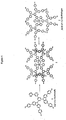
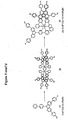
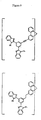
- Specific examples of dendrimers with such a dendron are shown in Figure 9 . It will be appreciated that the dendrons in a dendrimer can contain mixtures of ET, HT and bipolar components, and these are preferably in separate dendrons so that they are not in conjugation with each other.
- the last branching unit in a dendron is a triarylamine then the distal aryl groups possess one or more surface groups that are not hydrogen atoms.
- the dendrons are at least inherently partially conjugated.
- DENDRON comprises in part an aromatic unit which contains a nitrogen atom.
- This nitrogen atom either forms part of an aromatic ring system or is directly attached to two or three aromatic groups.
- the nitrogen is part of a ring system, it is preferably in a carbazole group, and when it is attached to aromatic groups, the aromatic groups are preferably phenyl or substituted fluorenyl or heteroaryl groups.
- the dendrimer comprises a dendron having a plurality of nitrogen atoms. More preferably, said dendron has a plurality of nitrogen atoms, each being part of a carbazole group. Further, all the nitrogen atoms in said dendron are preferably part of carbazole groups.
- the dendrimer comprises 3-21 carbazole units.
- the host which often contains carbazole units can transfer its energy to the phosphorescent guest for emission.
- the host In the case of green and red emission the host has been reported to have higher energy levels than the guest and for blue emission the energy levels of the host are reported to be lower than the guest.
- the dendron singlet or triplet energy should preferably be such that it can, if formed, be transferred to the core for emission. Therefore whilst the singlet or triplet energy of the dendrons is normally greater than the emission energy of the core it can be below that of the core providing the energy difference is small enough to allow the transfer of energy to the core. To aid this it is preferred that the triplet excited states of the dendrons must be longer lived than the emissive state of the core.
- the dendrimers of the invention are preferably luminescent in the solid state.
- the luminescent moiety may be partially or wholly within the core itself.
- the luminescence is preferably from the metal cation containing core.
- Suitable surface groups for the dendrimers which are preferably present, and are attached to the distal (hetero)aryl group include branched and unbranched alkyl, especially t-butyl, branched and unbranched alkoxy, for example 2-ethylhexyloxy, hydroxy, alkylsilane, carboxy, carbalkoxy, and vinyl.
- a more comprehensive list include a further-reactable alkene, (meth)acrylate, sulphur-containing, or silicon-containing group; sulphonyl group; polyether group; C 1 -to-C 15 alkyl (preferably t-butyl) group; amine group; mono-, di- or tri-C 1 -to-C 15 alkyl amine group; -COOR group wherein R is hydrogen or C 1 -to-C 15 alkyl; -OR group wherein R is hydrogen, aryl, or C 1 -to-C 15 alkyl or alkenyl; -O 2 SR group wherein R is C 1 -to-C 15 alkyl or alkenyl; -SR group wherein R is aryl, or C 1 -to-C 15 alkyl or alkenyl; -SiR 3 group wherein the R groups are the same or different and are hydrogen, C 1 -to-C 15 alkyl or alkenyl, or -SR' group
- t -butyl and alkoxy groups are used. Different surface groups may be present on different dendrons or different distal groups of a dendron. In one embodiment, there are surface groups present on the dendron which comprises the N atom which forms part of an aromatic group or is attached to at least two aromatic groups. It is preferred that the dendrimer is solution processable i.e. the surface groups are such that the dendrimer can be dissolved in a solvent.
- the surface group can be chosen such that the dendrimer can be processed to the required form, for example a thin film for an OLED.
- the surface groups are groups which contain at least two carbon atoms, for example C 2 -C 15 alkyl or OR where R is aryl or C 2 -C 15 alkyl or alkenyl. More preferably, the surface groups will contain 4 or more carbons for example tert -butyl .
- the surface group can be chosen such that the dendrimer can be patterned.
- a cross-linkable group is present which can be cross-linked upon irradiation or by chemical reaction.
- the surface group comprises a protecting group which can be removed to leave a group which can be cross-linked.
- the surface groups are selected so the dendrimers are soluble in solvents suitable for solution processing.
- the aryl groups within the dendrons can be typically benzene, napthalene, biphenyl (in which case an aryl group is present in the link between adjacent branching points) anthracene, fluorene, pyridine, oxadiazole, triazole, triazine, thiophene, carbazole, quinoxaline and where appropriate substituted variations.
- Typical substituents include C, to C 15 alkyl or alkoxy groups.
- the aryl groups at the branching points are preferably benzene rings, preferably coupled at ring positions 1, 3 and 5, triazinyl or carbazole rings. These groups may optionally be substituted.
- the carbazole units are typically connected at the 3-, 6- and N positions.
- the dendrons can be of the same or different generation (generation level is determined by the number of sets of branching points). It may be advantageous for at least one dendron to be of the second, or higher, generation to provide the required solution processing properties. Second, or higher, generation dendrons are particularly useful in the cases when the nitrogen atom is attached to aryl groups and the nitrogen atom acts as the branching unit in the dendron, e.g. the nitrogen atom is directly attached to 2 or 3 aryl groups and the dendron containing the nitrogen atom is of second, or higher, generation.
- the dendrons are relatively small (that is incorporate a relatively small number of atoms) compared to a dendron in which the branching unit is an aromatic ring incorporating a nitrogen atom (e.g. carbazole). Larger dendrons can improve film forming properties and increase the spacing of the luminescent cores.
- the cores typically comprise a metal cation wherein the metal is iridium, rhenium, rhodium or platinum, and attached ligands; the metal is central in the core and the core is luminescent.
- the core normally comprises the metal cation and the aryl and heteroaryl units directly attached to the metal.
- the heteroaryl and aryl can also form a branching point, e.g. if a second dendron is attached to the aryl or heteroaryl unit that is connected to the metal cation.
- the dendrons attached to the (hetero)aryl unit that is bound to the metal cation must themselves contain at least one nitrogen atom which forms part of an aromatic ring system or is directly bonded to at least two aromatic groups.
- metal ion or "metal cation”, as used herein, describes the charge state the metal would have without ligands attached (the oxidation state).
- metal cation describes the charge state the metal would have without ligands attached (the oxidation state).
- the overall charge of the dendrimer is neutral and the metal-ligand bonding will have more or less covalent character depending on the metal and ligand involved.
- the core comprises said metal cation and attached ligands it is typically a complex of the metal cation and two or more coordinating groups, at least two of the coordinating groups being bound to dendrons.
- CORE is typically a complex of a metal cation and two or more coordinating groups, at least one and preferably two or more of the said groups each being bound to a DENDRON moiety as defined in formula (I) by the single bond in which CORE in this formula terminates.
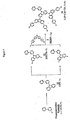
- dendrons, in particular DENDRONS are attached to all of the coordinating groups forming part of the CORE. For example in the iridium dendrimer Examples ( 5, 7, 25 see below) DENDRONS are attached to all three coordinating groups.
- CORE may be represented as a complex of the following formula (II): M [X-] q Y r (II) wherein M is a metal cation, wherein the metal is iridium, rhenium, rhodium or platinum, each [X-], which are the same or different, is a coordinating group X attached to a single bond in which CORE terminates, each Y, which may be the same or different, is a coordinating group, q is an integer of 2 or more and r is 0 or an integer, the sum of (a.q) + (b.r) being equal to the number of coordination sites available on M, wherein a is the number of coordination sites on [X-] and b is the number of coordination sites on Y.
- formula (II) M [X-] q Y r (II) wherein M is a metal cation, wherein the metal is iridium, rhenium, rhodium or platinum, each [X-], which
- the single bond to the branching group may be directly from the co-ordinating group or via an intervening group, typically an ethylene, substituted ethylene, vinylene, substituted vinylene or acetylethyl group.
- the single bond in the or each [X-] moiety being a bond in which CORE terminates, connects to a dendron.
- a dendron Preferably there are at least two dendrons in a dendrimer, in which case q in formula (II) is an integer of 2 or more.
- the said two or more dendrons typically have the structures represented by DENDRON as defined above.
- the coordinating groups Y when present, are neutral or charged chelated ligands which are not attached to dendrons and which serve to fulfil the coordination requirements of the metal cation. Suitable Y include arylpyridines and heteroaryl pyridines and substituted variants.
- Y ligands include ⁇ -diketonates, 2-carboxylpyridines, such as picolinic acid, triarylphosphines, such as triphenylphosphine, trialkylphosphines, ethylenediamine, cyanide, carbon monoxide and carbon monosulfide.
- Suitable metals are iridium, rhenium, rhodium and platinum.
- These second or third row transition metals form organometallic complexes with carbon or nitrogen donors.
- These can include for example porphyrin and arylpyridines.
- the nitrogen donor is generally part of a heteroaromatic ring, such as pyridine or substituted pyridine, and the aryl is a phenyl, fused aryl, or more than one aromatic ring, or a heteroaryl, or a substituted equivalent.
- the dendron can be attached to either of the rings.
- the two rings of the "ligand" are normally in conjugation, so that the metal forms a 5 membered cyclometallated ring.
- the rings can be attached in such a way that they can form a 6-membered cyclometallated ring with the metal cation. It is preferred that the at least two said dendrons are attached to ligands that are bonded to the metal by at least a carbon-metal bond. It is further preferred that the carbon-metal bond forms part of a cyclometallated ring.
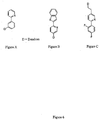
- the emission colour is governed by the lowest energy ligand. For green emission a suitable ligand and dendron attachment is shown in figure A of Figure 6 . For red emission it is appropriate to have 3 coordinating ligands each with a dendron attached to pyridine, for example as in Figure B.
- red emission there could be one ligand as in Figure B and two dendritic ligands as in Figure A and the Figure B type ligand may or may not have a dendron attached.
- blue emission it is suitable to have 3 coordinating ligands each with a dendron attached to the pyridine via say an ethylene link with, for example, fluoro groups on the phenyl, as shown in Figure C.
- the dendrimers can be built in a convergent or divergent route, but a convergent route is preferred.
- the dendrons are,attached to the appropriate ligands and these are subsequently attached to the metal cation to form the dendritic metal complex.
- the synthetic route allows other non-dendritic ligands can subsequently be attached to said complex.
- a ligand with a suitably reactive functional group can be complexed to the metal ion, and then reacted with appropriately functionalised dendrons. In this latter method, not all ligands have to have the reactive functional groups, and thus this method allows the attachment of dendrons to some but not all of the ligands complexed to the metal.
- a key property of the dendrons is to impart solution processibility to the metal complex and therefore allow the formation of good quality thin films suitable for use in light-emitting diodes.
- the dendritic metal complexes may be homoleptic or contain more than one type of dendritic ligand, as discussed above.
- the metal complex may contain two or preferably more than two, e.g. 3, dendritic ligands plus one or more non-dendritic ligands.
- dendritic phenylpyridine ligands it is possible to have two dendritic phenylpyridine ligands with the third ligand a non-dendritic arylpyridine ligand. It is desirable that the number and/or generation of dendritic ligands is sufficient to provide the required solution processing.
- the method of preparation may give rise to a statistical mixture of all complex types. This is not necessarily disadvantageous providing that the optical, electronic, and processing properties are satisfactory.
- the moieties forming the attachment point to metal are all the same or have similar binding constants.
- at least one should desirably be a conjugated dendron.
- the conjugated dendrons can be comprised of a number of different types of branching units, as discussed above.
- the surface groups and dendrites can be varied so the dendrimers are soluble in solvents, such as toluene, THF, water and alcoholic solvents such as methanol, suitable for the solution processing technique of choice. Typically t-butyl and alkoxy groups have been used.
- the choice of dendron and/or surface group can allow the formation of blends with dendrimers (organic or organometallic), polymer or molecular compounds.
- the other blend component can be a charge transport material. If it is blended with another component the dendrimer of the current invention is preferably the major component in the blend by either weight % and/or mole %. If the dendrimer is blended with a polymer it is preferred that the polymer is a conjugated polymer or itself contains N as part of an aromatic ring or directly bonded to at least 2 aromatic rings.
- the organometallic dendrimer can be incorporated into a light emitting diode as either a homogeneous layer or as a blend with at least one dendrimer (organic or organometallic), polymer or molecular compound.
- an organic light emitting or electroluminescent device can be formed from a light emitting layer sandwiched between two electrodes, at least one of which must be transparent to the emitted light.
- a transparent substrate layer sandwiched between two electrodes, at least one of which must be transparent to the emitted light.
- Such a device can have a conventional arrangement comprising a transparent substrate layer, a transparent electrode layer, a light emitting layer and a back electrode.
- the standard materials can be used.
- the transparent substrate layer is typically made of glass although other transparent materials such as PET, can be used.
- the anode which is generally transparent is preferably made from indium tin oxide (ITO) although other similar materials including indium oxide/tin oxide, tin oxide/antimony, zinc oxide/aluminum, gold and platinum can also be used.
- ITO indium tin oxide
- Conducting polymers such as PANI (polyaniline) or PEDOT can also be used.
- the cathode is normally made of a low work function metal or alloy such as Al, Ca, Mg, Li, or MgAl or optionally with an additional layer of LiF.
- a low work function metal or alloy such as Al, Ca, Mg, Li, or MgAl or optionally with an additional layer of LiF.
- other layers may also be present, including a hole transporting material and/or an electron transporting material.
- a hole-blocking/electron-transporting layer between the light emitting dendrimer layer and the cathode.
- the substrate may be an opaque material such as silicon and the light is emitted through the opposing electrode.
- An advantage of the present invention is that the layer containing the dendrimer can be deposited from solution.
- Conventional solution processing techniques such as spin coating, ink-jet printing, printing, and dip-coating can be used to deposit the dendrimer layer.
- a solution containing the dendrimer is applied over the transparent electrode layer, the solvent evaporated, and then subsequent layers applied.
- the film thickness is typically 10nm to 1000nm, preferably less than 200nm, more preferably 30-120nm.
- GO-BX 2 was prepared as follows:
- Tris(dibenzylideneacetone)di-palladium (0) [Pd 2 (dba) 3 ] (60 mg, 0.066 mmol) and tri- tert -butylphosphine (10% in hexane, 1.0 cm 3 ) were added to a degassed (Schlenk line, evacuated and back-filled with argon) mixture of carbazolyl compound 1 (3.55 g, 6.17 mmol), 2-[3'-(3",5"-dibromophenyl)phenyl]pyridine, DBPPh-Py see below; (1.00 g, 2.57 mmol), sodium tert -butoxide (988 mg, 10.3 mmol), and freshly distilled toluene (from sodium under nitrogen) (15 cm 3 ).
- DBPPh-Py was prepared as follows:
- the mixture was then stirred at room temperature for further 20 h before being quenched with H 2 O (30 cm 3 ). The two layers were separated. The aqueous layer was extracted with ether (3 x 40 cm 3 ). To the aqueous layer, NaCHO 3(sat) (40 cm 3 ) was added and the aqueous layer was further extracted with ether (2 X 40 cm 3 ). The organic layer and the ether extracts were combined and dried over anhydrous sodium sulfate, filtered and the solvents removed.
- Tris(dibenzylideneacetone)di-palladium (0) [Pd 2 (dba) 3 ] (125 mg, 0.137 mmol) and tri- tert -butylphosphine (10% in hexane, 0.5 cm 3 ) were added to a degassed (Schlenk line, evacuated and back-Flled with argon) mixture of carbazolyl compound 1 [Example 1] (3.14 g, 5.45 mmol), 1,4-dibromobenzene (12.3 g, 52.2 mmol), sodium tert -butoxide (1.00 g, 10.4 mmol), and distilled xylenes (15 cm 3 ).
- the mixture was degassed again before being heated (with bath temperature of 135 °C) under argon for 115 h.
- the mixture was allowed to cool to ambient temperature and quenched with H 2 O (0.5 cm 3 ).
- the mixture was purified by column chromatography over silica using light petroleum as eluent to give 1.46 g (37%) of 8 ; (Found: C, 76.1; H, 7.1, N, 2.1.
- Tris(dibenzylideneacetone)di-palladium (0) [Pd 2 (dba) 3 ] (25 mg, 0.027 mmol) and tri- tert -butylphosphine (10% in hexane, 0.1 cm 3 ) were added to a degassed (Schlenk line, evacuated and back-filled with argon) mixture of carbazolyl compound 1 [Example 1] (628 mg, 1.09 mmol), 1-bromo-4-iodobenzene (1.54 g, 5.45 mmol), sodium tert- butoxide (200 mg, 2.08 mmol), and distilled xylenes (3 cm 3 ).
- the mixture was degassed again before being heated (with bath temperature of 131 °C) under argon for 27 h.
- the resultant was allowed to cool to room temperature and quenched with H 2 O (0.5 cm 3 ).
- the mixture was purified by column chromatography over silica using DCM-light petroleum (0:1 to 1:20) as eluent to give 476 mg (60%) of 8 as an oil; characterization data as above.
- Tris(dibenzylideneacetone)di-palladium (0) [Pd 2 (dba) 3 ] (2.2 mg, 0.002 mmol) and tri- tert -butylphosphine (10% in hexane, 0.05 cm 3 ) were added to a degassed (Schlenk line, evacuated and back-filled with argon) mixture of carbazolyl compound 10 (339 mg, 0.231 mmol), 2-[3'-(3,5-dibromophenyl)phenyl]pyridine DBPPh-Py ) (37.5 mg, 0.096 mmol), sodium tert -butoxide (37 mg, 0.385 mmol), and distilled xylenes (0.9 cm 3 ).
- Tris(dibenzylideneacetone)di-palladium (0) [Pd 2 (dba) 3 ] (60 mg, 0.066 mmol) and tri- tert -butylphosphine (10% in hexane, 0.3 cm 3 ) were added to a degassed (Schlenk line, evacuated and back-filled with argon) mixture of carbazole (1.31 g, 7.82 mmol), 2-(3'-bromophenyl)pyridine (2-(3'-BrPh)Py) (610 mg, 2.61 mmol), sodium tert -butoxide (1.00 g, 10.4 mmol), and distilled toluene (15 cm 3 ).
- the mixture was degassed again before being heated (with bath temperature of 135 °C) under argon for 118 h.
- the mixture was allowed to cool to ambient temperature and quenched with H 2 O (0.5 cm 3 ).
- the mixture was purified by column chromatography over silica using DCM-light petroleum (0:1 to 1:30) and then ethyl acetate-light petroleum (1:20) as eluent to give 835 mg (100%) of 12 ; ⁇ H (200 MHz; CDCl 3 ) 7.21-7.92 (11 H, m, PyH, CarH & ArH), 8.12-8.33 (4 H, m, PyH, CarH & ArH), and 8.75 (1 H, m, PyH); m / z [APCI + ] 321, 322, 323 (MH + ).
- the residue was purified by column chromatography over silica with DCM-light petroleum (1:30 to 0:1) as eluent to give 244 mg of the excess ligand 2 and 110 mg of the desired dichloro-bridged dimer 4 .
- the orange solid was purified by column chromatography over silica with DCM-light petroleum (0:1 to 1:0) as eluent to give 1.02 g of 4 .
- the yellow solid was dissolved into 5 cm 3 of DCM and purified by column chromatography over silica using DCM-light petroleum (0:1 to 1:4) as eluent to give 85.2 mg (27 %) of a brown yellow solid as the dichloro-bridged dimer 6 ; m / z [MALDI] 2949 (broad) (C 194 H 212 IrN 6 O 8 -Cl + ). Moreover, a light yellow-brown solid was isolated (589 mg, 80%) as the excess ligand 3 .
- Tris(dibenzylideneacetone)di-palladium (0) [Pd 2 (dba) 3 ] (114 mg, 0.124 mmol) and tri- tert -butylphosphine (10% in hexane, 0.7 cm 3 ) were added to a degassed (Schlenk line, evacuated and back-filled with argon) mixture of DEHP-Car 1 [Example 1] (3.27 g, 5.68 mmol), 2-(4'-bromophenyl)pyridine 2(4'-BrPh)Py (2.66 g, 11.4 mmol) M.
- Tris(dibenzylideneacetone)di-palladium (0) [Pd 2 (dba) 3 ] (50 mg, 0.055 mmol) and tri- tert -butylphosphine (10% in hexane, 0.8 cm 3 ) were added to a degassed (Schlenk line, evacuated and back-filled with argon) mixture of DEHP-Car ( 1 ) (1.90 g, 3.30 mmol), Br-btp ( 22 ) (300 mg, 1.03 mmol), sodium tert -butoxide (348 mg, 3.62 mmol), and distilled toluene (from sodium under nitrogen) (2.0 cm 3 ).
- the dichloro-bridged dimer 24 can then be used to form the dendrimer 25.
- Peak efficiency (PE) (cd/A) Voltage at PE Brightness at PE (cd/m 2 ) Max brightness and voltage Turn on voltage (V) ( ⁇ 10%) cd/m 2 at V 5 G1-IrppyCarb ITO/ 5 (45 nm)/Ca (20 nm)/Al (100 nm) 9.8 6.8 472 6130 at 11.8 3.6 5 G1-IrppyCarb ITO/ 5 (45 nm)/TPBI (45 nm)/LiF (0.6 nm)/Ca (20 nm)/Al (100 nm) 12.9 4.8 156 11730 at 13.8 3 7 G2-IrppyCarb ITO/ 7 (45 nm)/Ca (20 mn)/Al (100 nm) 22 13 10910 11990 at 13.4 5.4 7 G2-IrppyCarb ITO/ 7 (45 nm)/TPBI (45 nm)/LiF (0.6 nm)/
- the device was prepared as follows:
- the table shows the performance of devices made with two types of dendrimer according to the current invention (compounds 5 and 7 ) and a comparative example for a device made with an Ir-cored dendrimer (Ir-G1) that does not have N atoms as part of units in the dendrons.
- Ir-G2 is fac tris ⁇ 2-[3'-(3",5"-di ⁇ 3''',5'''-di[4''''-2''''-ethylhexyloxy)phenyl]phenyl ⁇ phenyl)
- Ir-G1 is fac tris [2-(3 ⁇ 3",5"-di[4'''-(2''''-ethylhexyloxy)phenyl]phenyl ⁇ phenyl)pyridine]iridium (III) which is a first generation dendrimer. (The synthesis of these dendrimers is given in the PCT application claiming priority from GB 0104175.5 ).
- the efficiency of a device containing a neat layer of the second generation dendrimer 7 is greater than that of a device containing a neat layer of the first generation dendrimer 5.
- Both of the devices based on the new dendrimers show better efficiency than the comparative example.
- a device with a neat layer of Ir-G1 has a lower efficiency than a device with a neat layer of Ir-G2.
- Compound 5 undergoes a number of chemically reversible electrochemically quasi-reversible oxidations in dry inert conditions, whereas under the same conditions both fac tris(2-phenylpyridine) iridium (III) and the dendrimer Ir-G1 each only undergo one chemically reversible electrochemically quasi-reversible oxidation.
- the reduction behaviour of 5 is very similar to the behaviour of the non-carbazole-type first generation iridium dendrimer Ir-G1.
- G1-Ir-Carbazole (5) of Example 11 and G2-Ir-Carbazole (7) of Example 12 were used in single-layer OLED devices. They were obtained from a 15mg/ml solution in chloroform and spin coated at 2000rpm for 60 seconds to provide the structure ITO/Dendrimer/Ca/Al. The thickness of the layer of compound 5 was about 45 nm and that of compound 7 about 65nm.
- Tris(dibenzylideneacetone)di-palladium (0) [Pd 2 (dba) 3 ] (135 mg, 0.148 mmol) and tri- tert -butylphosphine (10% in hexane, 3 cm 3 ) were added to a deoxygenated (Schlenk line, evacuated and back-filled with argon) mixture of diphenylamine (1.40 g, 8.27 mmol), 2-[3'-(3",5"-dibromophenyl)phenyl]pyridine DBPPh-Py (1.15 g, 2.96 mmol), sodium tert- butoxide (1.14 g, 14.8 mmol), and anhydrous toluene (32 cm 3 ).
- the solid was purified by a silica gel column using DCM-light petroleum (1:10 to 1:4) as eluent to give the chloro-bridged dimer 32 (141 mg) as a yellow solid; d H (200 MHz; CDCl 3 ) 5.83 (4 H, m, ArH), 6.50- 7.85 (112 H, m, PyH & ArH), and 9.15 (4 H, m, PyH);_ m / z [MALDI] 1320,1321,1322,1323,1324,1325, (C 82 H 60 IrN 6 + ), 1356, 1357, 1358, 1359, 1360 (C 82 H 60 ClIrN 6 )._
- Single-layer OLED devices were made with dendrimer 33 using the procedure described in Example 16, except that at step 5 the oxygen plasma treatment was for 4 minutes at 70 W.
- the concentration of the solution for spin-coating was 20 mg/ml of 33 in CHCl 3 and it was spun at 1800 rpm for 60 sec.
- the device structure was ITO / 33 / Ca (20 nm) / Al (60 nm).
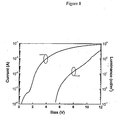
- the device passed a relatively large current (see figure 8 ) showing the dendrimer has good charge transporting properties, but in this simple device structure charge recombination was inefficient leading to a relatively low efficiency of 0.01 cd/A at 100 cd/m 2 and 10.5 V.
- Bi-layer OLED devices were made with a light emitting layer containing dendrimer 33 and an evaporated electron transporting layer of 2,2 ' ,2 " -(1,3,5-phenylene)tris[1-phenyl-1H-benzimidazolyl) (TPBI).
- the devices were fabricated following the method described in example 16, except that the oxygen plasma treatment was for 4 min at 70 watts, and there was the additional step of vacuum depositing a layer of TPBI prior to deposition of the cathode layers.
- the concentration of the solutions of light emitting material was 10 mg/ml in CHCl 3 and the spin speed was 2300 rpm for 60 sec.
- the structures of the two types of devices are shown below in which 33 was used as a neat layer, and 33 was blended with 4,4'-N,N'-dicarbazole-biphenyl (CBP), respectively.
- CBP 4,4'-N,N'-dicarbazole-biphenyl
- the peak efficiency was 0.4 cd/A at 6 V and ⁇ 1000 cd/m 2 for the neat bi-layer device.
- the peak efficiency was 9 cd/A at 7.9 V and ⁇ 7000 cd/m 2 for the 33 :CBP blended bi-layer device. Neither of these device structures had been optimised for efficiency.
Landscapes
- Chemical & Material Sciences (AREA)
- Engineering & Computer Science (AREA)
- Materials Engineering (AREA)
- Organic Chemistry (AREA)
- Crystallography & Structural Chemistry (AREA)
- Inorganic Chemistry (AREA)
- Physics & Mathematics (AREA)
- Spectroscopy & Molecular Physics (AREA)
- Electroluminescent Light Sources (AREA)
Applications Claiming Priority (7)
| Application Number | Priority Date | Filing Date | Title |
|---|---|---|---|
| GB0206356A GB0206356D0 (en) | 2002-03-18 | 2002-03-18 | Phosphorescent dendrimers |
| GB0206356 | 2002-03-18 | ||
| GB0220091 | 2002-08-29 | ||
| GB0220091A GB0220091D0 (en) | 2002-08-29 | 2002-08-29 | Phosphorescent dendrimers |
| GBGB0220092.1A GB0220092D0 (en) | 2002-08-29 | 2002-08-29 | Reactive dendrimers |
| GB0220092 | 2002-08-29 | ||
| PCT/GB2003/001132 WO2003079736A1 (en) | 2002-03-18 | 2003-03-18 | Phosphorescent dendrimers for use in light-emitting devices |
Publications (2)
| Publication Number | Publication Date |
|---|---|
| EP1491074A1 EP1491074A1 (en) | 2004-12-29 |
| EP1491074B1 true EP1491074B1 (en) | 2017-07-26 |
Family
ID=28045960
Family Applications (1)
| Application Number | Title | Priority Date | Filing Date |
|---|---|---|---|
| EP03709993.4A Expired - Lifetime EP1491074B1 (en) | 2002-03-18 | 2003-03-18 | Phosphorescent dendrimers for use in light-emitting devices |
Country Status (6)
| Country | Link |
|---|---|
| US (1) | US7641986B2 (https=) |
| EP (1) | EP1491074B1 (https=) |
| JP (1) | JP4424996B2 (https=) |
| CN (1) | CN100530746C (https=) |
| AU (1) | AU2003214421A1 (https=) |
| WO (1) | WO2003079736A1 (https=) |
Families Citing this family (59)
| Publication number | Priority date | Publication date | Assignee | Title |
|---|---|---|---|---|
| GB0104176D0 (en) * | 2001-02-20 | 2001-04-11 | Isis Innovation | Asymmetric dendrimers |
| GB0104177D0 (en) | 2001-02-20 | 2001-04-11 | Isis Innovation | Aryl-aryl dendrimers |
| EP1366113B1 (en) * | 2001-02-20 | 2011-04-13 | Isis Innovation Limited | Metal-containing dendrimers |
| GB0220092D0 (en) | 2002-08-29 | 2002-10-09 | Isis Innovation | Reactive dendrimers |
| EP1489155A4 (en) * | 2002-03-22 | 2006-02-01 | Idemitsu Kosan Co | MATERIAL FOR ORGANIC ELECTROLUMINESCENT DEVICES AND THE EQUIVALENT DEVICES |
| TWI277617B (en) | 2002-03-26 | 2007-04-01 | Sumitomo Chemical Co | Metal complexes and organic electro luminescence elements |
| JP4496709B2 (ja) * | 2002-03-26 | 2010-07-07 | 住友化学株式会社 | 金属錯体化合物、高分子化合物および有機エレクトロルミネッセンス素子 |
| DE10238903A1 (de) * | 2002-08-24 | 2004-03-04 | Covion Organic Semiconductors Gmbh | Rhodium- und Iridium-Komplexe |
| GB0219987D0 (en) | 2002-08-28 | 2002-10-09 | Isis Innovation | Intramolecular interactions in organometallics |
| JP4427947B2 (ja) * | 2002-11-18 | 2010-03-10 | コニカミノルタホールディングス株式会社 | 有機エレクトロルミネッセンス素子及び表示装置 |
| GB0311234D0 (en) | 2003-05-16 | 2003-06-18 | Isis Innovation | Organic phosphorescent material and organic optoelectronic device |
| TWI354011B (en) | 2003-05-16 | 2011-12-11 | Semiconductor Energy Lab | Carbazole derivative, organic semiconductor elemen |
| JP2004355899A (ja) * | 2003-05-28 | 2004-12-16 | Konica Minolta Holdings Inc | 有機エレクトロルミネッセンス素子、照明装置および表示装置 |
| JP4762514B2 (ja) * | 2003-09-05 | 2011-08-31 | 株式会社リコー | 3,6−ジフェニルカルバゾール誘導体 |
| DE102004006622A1 (de) * | 2004-02-10 | 2005-08-25 | Covion Organic Semiconductors Gmbh | Phosporeszierendes Elektrolumineszenzelement |
| US7790890B2 (en) * | 2004-03-31 | 2010-09-07 | Konica Minolta Holdings, Inc. | Organic electroluminescence element material, organic electroluminescence element, display device and illumination device |
| JP4934035B2 (ja) * | 2004-06-09 | 2012-05-16 | イー・アイ・デュポン・ドウ・ヌムール・アンド・カンパニー | 有機金属化合物およびかかる化合物で形成された素子 |
| DE102004032527A1 (de) | 2004-07-06 | 2006-02-02 | Covion Organic Semiconductors Gmbh | Elektrolumineszierende Polymere |
| TWI479008B (zh) * | 2004-07-07 | 2015-04-01 | Universal Display Corp | 穩定且有效之電致發光材料 |
| WO2006025554A1 (en) * | 2004-08-31 | 2006-03-09 | Dai Nippon Printing Co., Ltd. | Organic electroluminescent device and method for producing the same |
| TWI385193B (zh) * | 2004-12-07 | 2013-02-11 | Sumitomo Chemical Co | 高分子材料及使用該高分子材料之元件 |
| US9078330B2 (en) | 2005-03-15 | 2015-07-07 | Isis Innovation Limited | Highly branched dendrimers |
| KR100611885B1 (ko) * | 2005-04-21 | 2006-08-11 | 삼성에스디아이 주식회사 | 호스트용 화합물과 도판트용 화합물이 연결된 유기 금속화합물, 이를 이용한 유기 전계 발광 소자 및 그의제조방법 |
| KR100732823B1 (ko) * | 2005-04-21 | 2007-06-27 | 삼성에스디아이 주식회사 | 호스트용 화합물과 도판트용 화합물이 연결된 유기 금속화합물, 이를 이용한 유기 전계 발광 소자 및 그의제조방법 |
| GB0511294D0 (en) | 2005-06-03 | 2005-07-13 | Univ St Andrews | Dendrimer laser |
| TWI393705B (zh) | 2005-12-12 | 2013-04-21 | Hodogaya Chemical Co Ltd | Compounds containing m-carbazole phenyl and their use |
| JP5151031B2 (ja) * | 2006-01-05 | 2013-02-27 | コニカミノルタホールディングス株式会社 | 有機エレクトロルミネッセンス素子、表示装置及び照明装置 |
| TWI586673B (zh) * | 2006-12-08 | 2017-06-11 | 環球展覽公司 | 可交聯之銥錯合物及使用其之有機發光裝置 |
| US8119255B2 (en) * | 2006-12-08 | 2012-02-21 | Universal Display Corporation | Cross-linkable iridium complexes and organic light-emitting devices using the same |
| US7851579B2 (en) * | 2006-12-11 | 2010-12-14 | General Electric Company | Carbazolyl polymers for organic electronic devices |
| US7635777B2 (en) * | 2006-12-11 | 2009-12-22 | General Electric Company | Carbazolyl monomers and polymers |
| US7381985B1 (en) | 2006-12-13 | 2008-06-03 | General Electric Company | Bis-carbazole monomers and polymers |
| DE102007002714A1 (de) * | 2007-01-18 | 2008-07-31 | Merck Patent Gmbh | Neue Materialien für organische Elektrolumineszenzvorrichtungen |
| US7723722B2 (en) | 2007-03-23 | 2010-05-25 | Semiconductor Energy Laboratory Co., Ltd. | Organic compound, anthracene derivative, and light-emitting element, light-emitting device, and electronic device using anthracene derivative |
| US7993763B2 (en) * | 2007-05-10 | 2011-08-09 | Universal Display Corporation | Organometallic compounds having host and dopant functionalities |
| US8533180B2 (en) * | 2007-06-13 | 2013-09-10 | The Boeing Company | Method and apparatus for enhancing a geographic information system database with operational data |
| JP5385903B2 (ja) * | 2007-07-05 | 2014-01-08 | 日東電工株式会社 | 発光素子および発光組成物 |
| WO2009060779A1 (ja) * | 2007-11-08 | 2009-05-14 | Konica Minolta Holdings, Inc. | 有機エレクトロルミネッセンス素子材料、有機エレクトロルミネッセンス素子、表示装置及び照明装置 |
| US8815411B2 (en) * | 2007-11-09 | 2014-08-26 | The Regents Of The University Of Michigan | Stable blue phosphorescent organic light emitting devices |
| JP5481385B2 (ja) | 2007-11-15 | 2014-04-23 | 日東電工株式会社 | 発光素子および発光組成物 |
| JP4830126B2 (ja) * | 2008-03-22 | 2011-12-07 | コニカミノルタホールディングス株式会社 | 有機エレクトロルミネッセンス素子及び表示装置 |
| JP4830127B2 (ja) * | 2008-03-22 | 2011-12-07 | コニカミノルタホールディングス株式会社 | 有機エレクトロルミネッセンス素子及び表示装置 |
| JP2012505298A (ja) | 2008-10-13 | 2012-03-01 | 日東電工株式会社 | 印刷可能な発光組成物 |
| US8993754B2 (en) | 2009-08-27 | 2015-03-31 | National Institute Of Advanced Industrial Science And Technology | Iridium complex and light emitting material formed from same |
| EP2471889A4 (en) | 2009-08-27 | 2013-06-26 | Sumitomo Chemical Co | METAL COMPLEX COMPOSITION AND COMPLEX POLYMER |
| DE102009041414A1 (de) | 2009-09-16 | 2011-03-17 | Merck Patent Gmbh | Metallkomplexe |
| US9029558B2 (en) | 2011-08-18 | 2015-05-12 | Semiconductor Energy Laboratory Co., Ltd. | Carbazole compound, light-emitting element, light-emitting device, electronic device, and lighting device |
| EP2803671B1 (en) | 2012-01-13 | 2019-05-01 | Mitsubishi Chemical Corporation | Iridium complex compound, solution composition containing iridium complex compound, organic electroluminescent element, display device, and lighting device |
| KR101627748B1 (ko) * | 2013-05-27 | 2016-06-07 | 제일모직 주식회사 | 화합물, 이를 포함하는 유기발광소자 및 상기 유기발광소자를 포함하는 표시장치 |
| US9929359B2 (en) | 2013-07-17 | 2018-03-27 | Sumitomo Chemical Company, Limited | Composition and light emitting device using the same |
| JP6372204B2 (ja) * | 2013-09-25 | 2018-08-15 | 住友化学株式会社 | 金属錯体およびそれを用いた発光素子 |
| KR102326217B1 (ko) | 2014-01-08 | 2021-11-15 | 스미또모 가가꾸 가부시키가이샤 | 금속 착체 및 그것을 사용한 발광 소자 |
| EP3410828B1 (en) | 2016-01-28 | 2021-02-24 | Sumitomo Chemical Company Limited | Method for producing film |
| JP6570037B2 (ja) | 2016-06-24 | 2019-09-04 | 国立研究開発法人産業技術総合研究所 | イリジウム化合物及び該イリジウム化合物を用いたイリジウム錯体の製造方法 |
| JP6617967B2 (ja) | 2016-06-24 | 2019-12-11 | 国立研究開発法人産業技術総合研究所 | シクロメタル化イリジウム錯体の製造方法、及び、当該方法に好適に用いられる新規なイリジウム化合物 |
| JP6617966B2 (ja) | 2016-06-24 | 2019-12-11 | 国立研究開発法人産業技術総合研究所 | ハロゲン架橋イリジウムダイマーの製造方法 |
| JP6703222B2 (ja) | 2016-10-24 | 2020-06-03 | 国立研究開発法人産業技術総合研究所 | シクロメタル化イリジウム錯体の製造方法、及び、有機イリジウム材料からなるシクロメタル化イリジウム錯体の前駆体 |
| JP6978784B2 (ja) | 2016-12-21 | 2021-12-08 | 国立研究開発法人産業技術総合研究所 | シクロメタル化イリジウム錯体の製造方法 |
| US10862046B2 (en) | 2017-03-30 | 2020-12-08 | Universal Display Corporation | Organic electroluminescent materials and devices |
Family Cites Families (12)
| Publication number | Priority date | Publication date | Assignee | Title |
|---|---|---|---|---|
| NL9102112A (nl) | 1991-12-18 | 1993-07-16 | Dsm Nv | Werkwijze voor het bereiden van een aminonitril door het partieel hydrogeneren van een nitrilverbinding met twee of meer nitrilgroepen. |
| BE1007260A3 (nl) | 1993-07-08 | 1995-05-02 | Dsm Nv | Werkwijze voor het bereiden van een dendritisch macromolekuul. |
| NL1001977C2 (nl) | 1995-12-22 | 1997-06-24 | Dsm Nv | Werkwijze voor de bereiding van een macromolekuul. |
| US6565992B1 (en) * | 1996-05-03 | 2003-05-20 | Ian Manners | Phosphorescent oxygen sensors |
| CN1208366C (zh) * | 1997-10-23 | 2005-06-29 | Isis创新有限公司 | 发光树枝状分子及装置 |
| DE19812881A1 (de) | 1998-03-24 | 1999-10-07 | Bayer Ag | Neue dendrimere Verbindungen, ein Verfahren zu deren Herstellung sowie deren Verwendung als Katalysatoren |
| US6821645B2 (en) | 1999-12-27 | 2004-11-23 | Fuji Photo Film Co., Ltd. | Light-emitting material comprising orthometalated iridium complex, light-emitting device, high efficiency red light-emitting device, and novel iridium complex |
| GB0002936D0 (en) | 2000-02-09 | 2000-03-29 | Isis Innovation | Improved dendrimers |
| US6759098B2 (en) * | 2000-03-20 | 2004-07-06 | Axcelis Technologies, Inc. | Plasma curing of MSQ-based porous low-k film materials |
| EP1366113B1 (en) | 2001-02-20 | 2011-04-13 | Isis Innovation Limited | Metal-containing dendrimers |
| DE10116962A1 (de) | 2001-04-05 | 2002-10-10 | Covion Organic Semiconductors | Rhodium- und Iridium-Komplexe |
| US6699597B2 (en) * | 2001-08-16 | 2004-03-02 | 3M Innovative Properties Company | Method and materials for patterning of an amorphous, non-polymeric, organic matrix with electrically active material disposed therein |
-
2003
- 2003-03-18 AU AU2003214421A patent/AU2003214421A1/en not_active Abandoned
- 2003-03-18 WO PCT/GB2003/001132 patent/WO2003079736A1/en not_active Ceased
- 2003-03-18 EP EP03709993.4A patent/EP1491074B1/en not_active Expired - Lifetime
- 2003-03-18 CN CNB038113767A patent/CN100530746C/zh not_active Expired - Fee Related
- 2003-03-18 JP JP2003577583A patent/JP4424996B2/ja not_active Expired - Fee Related
- 2003-03-18 US US10/508,061 patent/US7641986B2/en not_active Expired - Lifetime
Non-Patent Citations (1)
| Title |
|---|
| None * |
Also Published As
| Publication number | Publication date |
|---|---|
| WO2003079736A1 (en) | 2003-09-25 |
| CN1653857A (zh) | 2005-08-10 |
| EP1491074A1 (en) | 2004-12-29 |
| CN100530746C (zh) | 2009-08-19 |
| AU2003214421A1 (en) | 2003-09-29 |
| JP4424996B2 (ja) | 2010-03-03 |
| US20050116622A1 (en) | 2005-06-02 |
| US7641986B2 (en) | 2010-01-05 |
| JP2005521210A (ja) | 2005-07-14 |
Similar Documents
| Publication | Publication Date | Title |
|---|---|---|
| EP1491074B1 (en) | Phosphorescent dendrimers for use in light-emitting devices | |
| Hsu et al. | Phosphine-oxide-containing bipolar host material for blue electrophosphorescent devices | |
| Lo et al. | A light‐blue phosphorescent dendrimer for efficient solution‐processed light‐emitting diodes | |
| JP5030798B2 (ja) | 溶液加工した有機金属錯体および電界発光素子における溶液加工した有機金属錯体の使用 | |
| JP5836894B2 (ja) | 溶液処理可能な燐光物質の製造方法 | |
| EP1532158B1 (en) | Neutral metallic dendrimer complexes | |
| US9187689B2 (en) | Organometallic complex and light-emitting element, light-emitting device, and electronic device using the same | |
| TWI357925B (en) | Improved electroluminescent stability | |
| He et al. | Nonconjugated carbazoles: a series of novel host materials for highly efficient blue electrophosphorescent OLEDs | |
| US20050214576A1 (en) | Organometallic compounds and emission-shifting organic electrophosphorescence | |
| US20080309222A1 (en) | Materials and structures for enhancing the performance of organic light emitting devices | |
| Wang et al. | Self-host blue-emitting iridium dendrimer containing bipolar dendrons for nondoped electrophosphorescent devices with superior high-brightness performance | |
| WO2004095598A2 (en) | Organic light emitting devices with wide gap host materials | |
| Sun et al. | Solution-processed blue/deep blue and white phosphorescent organic light-emitting diodes (PhOLEDs) hosted by a polysiloxane derivative with pendant mCP (1, 3-bis (9-carbazolyl) benzene) | |
| JP2003515897A (ja) | 有機led用燐光性ドーパントとしての式l2mxの錯体 | |
| KR20080007570A (ko) | 안정성 유기 발광 장치 물질 및 안정성이 개선된 장치 | |
| CN103797086A (zh) | 发光聚合物和器件 | |
| EP2496590B1 (en) | Ion-pairing soft salts based on organometallic complexes and their applications in organic light emitting diodes | |
| US7652136B2 (en) | Diarylaminofluorene-based organometallic phosphors and organic light-emitting devices made with such compounds | |
| WO2004029134A1 (en) | Fluorene-containing dendrimers | |
| WO2018113782A1 (zh) | 金属有机配合物、高聚物、混合物、组合物及有机电子器件 | |
| US7429662B2 (en) | Red-emitting electrophosphorescent devices | |
| Djurovich et al. | Synthesis and Characterization of Phosphorescent Cyclometalated Platinum Complexes | |
| KR20070112823A (ko) | 용액 처리된 유기 금속 착물 및 이를 전기 발광 소자에이용하는 방법 | |
| KR100696467B1 (ko) | 전이금속 배위 화합물 및 이를 이용한 유기 전계 발광 소자 |
Legal Events
| Date | Code | Title | Description |
|---|---|---|---|
| PUAI | Public reference made under article 153(3) epc to a published international application that has entered the european phase |
Free format text: ORIGINAL CODE: 0009012 |
|
| 17P | Request for examination filed |
Effective date: 20041004 |
|
| AK | Designated contracting states |
Kind code of ref document: A1 Designated state(s): AT BE BG CH CY CZ DE DK EE ES FI FR GB GR HU IE IT LI LU MC NL PT RO SE SI SK TR |
|
| AX | Request for extension of the european patent |
Extension state: AL LT LV MK |
|
| REG | Reference to a national code |
Ref country code: HK Ref legal event code: DE Ref document number: 1073046 Country of ref document: HK |
|
| RAP1 | Party data changed (applicant data changed or rights of an application transferred) |
Owner name: OXFORD UNIVERSITY INNOVATION LIMITED Owner name: THE UNIVERSITY COURT OF THE UNIVERSITY OF ST. ANDR |
|
| GRAP | Despatch of communication of intention to grant a patent |
Free format text: ORIGINAL CODE: EPIDOSNIGR1 |
|
| STAA | Information on the status of an ep patent application or granted ep patent |
Free format text: STATUS: GRANT OF PATENT IS INTENDED |
|
| RAP1 | Party data changed (applicant data changed or rights of an application transferred) |
Owner name: OXFORD UNIVERSITY INNOVATION LIMITED Owner name: THE UNIVERSITY COURT OF THE UNIVERSITY OF ST. ANDR |
|
| RIC1 | Information provided on ipc code assigned before grant |
Ipc: H01L 51/50 20060101ALI20170203BHEP Ipc: C09K 11/06 20060101ALI20170203BHEP Ipc: H01L 51/30 20060101ALI20170203BHEP Ipc: C07F 15/00 20060101ALI20170203BHEP Ipc: H05B 33/14 20060101AFI20170203BHEP |
|
| INTG | Intention to grant announced |
Effective date: 20170224 |
|
| GRAS | Grant fee paid |
Free format text: ORIGINAL CODE: EPIDOSNIGR3 |
|
| GRAA | (expected) grant |
Free format text: ORIGINAL CODE: 0009210 |
|
| STAA | Information on the status of an ep patent application or granted ep patent |
Free format text: STATUS: THE PATENT HAS BEEN GRANTED |
|
| AK | Designated contracting states |
Kind code of ref document: B1 Designated state(s): AT BE BG CH CY CZ DE DK EE ES FI FR GB GR HU IE IT LI LU MC NL PT RO SE SI SK TR |
|
| REG | Reference to a national code |
Ref country code: GB Ref legal event code: FG4D |
|
| REG | Reference to a national code |
Ref country code: DE Ref legal event code: R081 Ref document number: 60350434 Country of ref document: DE Owner name: CAMBRIDGE DISPLAY TECHNOLOGY LIMITED, GODMANCH, GB Free format text: FORMER OWNERS: ISIS INNOVATION LTD., SUMMERTOWN, OXFORD, GB; THE UNIVERSITY COURT OF THE UNIVERSITY OF ST. ANDREWS, ST. ANDREWS, GB |
|
| REG | Reference to a national code |
Ref country code: CH Ref legal event code: EP |
|
| REG | Reference to a national code |
Ref country code: AT Ref legal event code: REF Ref document number: 913390 Country of ref document: AT Kind code of ref document: T Effective date: 20170815 |
|
| REG | Reference to a national code |
Ref country code: IE Ref legal event code: FG4D |
|
| REG | Reference to a national code |
Ref country code: DE Ref legal event code: R096 Ref document number: 60350434 Country of ref document: DE |
|
| REG | Reference to a national code |
Ref country code: NL Ref legal event code: MP Effective date: 20170726 |
|
| REG | Reference to a national code |
Ref country code: AT Ref legal event code: MK05 Ref document number: 913390 Country of ref document: AT Kind code of ref document: T Effective date: 20170726 |
|
| PG25 | Lapsed in a contracting state [announced via postgrant information from national office to epo] |
Ref country code: SE Free format text: LAPSE BECAUSE OF FAILURE TO SUBMIT A TRANSLATION OF THE DESCRIPTION OR TO PAY THE FEE WITHIN THE PRESCRIBED TIME-LIMIT Effective date: 20170726 Ref country code: AT Free format text: LAPSE BECAUSE OF FAILURE TO SUBMIT A TRANSLATION OF THE DESCRIPTION OR TO PAY THE FEE WITHIN THE PRESCRIBED TIME-LIMIT Effective date: 20170726 Ref country code: FI Free format text: LAPSE BECAUSE OF FAILURE TO SUBMIT A TRANSLATION OF THE DESCRIPTION OR TO PAY THE FEE WITHIN THE PRESCRIBED TIME-LIMIT Effective date: 20170726 Ref country code: NL Free format text: LAPSE BECAUSE OF FAILURE TO SUBMIT A TRANSLATION OF THE DESCRIPTION OR TO PAY THE FEE WITHIN THE PRESCRIBED TIME-LIMIT Effective date: 20170726 |
|
| PG25 | Lapsed in a contracting state [announced via postgrant information from national office to epo] |
Ref country code: BG Free format text: LAPSE BECAUSE OF FAILURE TO SUBMIT A TRANSLATION OF THE DESCRIPTION OR TO PAY THE FEE WITHIN THE PRESCRIBED TIME-LIMIT Effective date: 20171026 Ref country code: GR Free format text: LAPSE BECAUSE OF FAILURE TO SUBMIT A TRANSLATION OF THE DESCRIPTION OR TO PAY THE FEE WITHIN THE PRESCRIBED TIME-LIMIT Effective date: 20171027 |
|
| PG25 | Lapsed in a contracting state [announced via postgrant information from national office to epo] |
Ref country code: DK Free format text: LAPSE BECAUSE OF FAILURE TO SUBMIT A TRANSLATION OF THE DESCRIPTION OR TO PAY THE FEE WITHIN THE PRESCRIBED TIME-LIMIT Effective date: 20170726 Ref country code: RO Free format text: LAPSE BECAUSE OF FAILURE TO SUBMIT A TRANSLATION OF THE DESCRIPTION OR TO PAY THE FEE WITHIN THE PRESCRIBED TIME-LIMIT Effective date: 20170726 Ref country code: CZ Free format text: LAPSE BECAUSE OF FAILURE TO SUBMIT A TRANSLATION OF THE DESCRIPTION OR TO PAY THE FEE WITHIN THE PRESCRIBED TIME-LIMIT Effective date: 20170726 |
|
| REG | Reference to a national code |
Ref country code: DE Ref legal event code: R097 Ref document number: 60350434 Country of ref document: DE |
|
| PG25 | Lapsed in a contracting state [announced via postgrant information from national office to epo] |
Ref country code: SK Free format text: LAPSE BECAUSE OF FAILURE TO SUBMIT A TRANSLATION OF THE DESCRIPTION OR TO PAY THE FEE WITHIN THE PRESCRIBED TIME-LIMIT Effective date: 20170726 Ref country code: IT Free format text: LAPSE BECAUSE OF FAILURE TO SUBMIT A TRANSLATION OF THE DESCRIPTION OR TO PAY THE FEE WITHIN THE PRESCRIBED TIME-LIMIT Effective date: 20170726 Ref country code: EE Free format text: LAPSE BECAUSE OF FAILURE TO SUBMIT A TRANSLATION OF THE DESCRIPTION OR TO PAY THE FEE WITHIN THE PRESCRIBED TIME-LIMIT Effective date: 20170726 |
|
| PLBE | No opposition filed within time limit |
Free format text: ORIGINAL CODE: 0009261 |
|
| STAA | Information on the status of an ep patent application or granted ep patent |
Free format text: STATUS: NO OPPOSITION FILED WITHIN TIME LIMIT |
|
| 26N | No opposition filed |
Effective date: 20180430 |
|
| PG25 | Lapsed in a contracting state [announced via postgrant information from national office to epo] |
Ref country code: SI Free format text: LAPSE BECAUSE OF FAILURE TO SUBMIT A TRANSLATION OF THE DESCRIPTION OR TO PAY THE FEE WITHIN THE PRESCRIBED TIME-LIMIT Effective date: 20170726 |
|
| REG | Reference to a national code |
Ref country code: HK Ref legal event code: WD Ref document number: 1073046 Country of ref document: HK |
|
| REG | Reference to a national code |
Ref country code: DE Ref legal event code: R082 Ref document number: 60350434 Country of ref document: DE Representative=s name: GRUENECKER PATENT- UND RECHTSANWAELTE PARTG MB, DE Ref country code: DE Ref legal event code: R081 Ref document number: 60350434 Country of ref document: DE Owner name: CAMBRIDGE DISPLAY TECHNOLOGY LIMITED, GODMANCH, GB Free format text: FORMER OWNERS: OXFORD UNIVERSITY INNOVATION LIMITED, OXFORD, OXFORDSHIRE, GB; THE UNIVERSITY COURT OF THE UNIVERSITY OF ST. ANDREWS, ST. ANDREWS, GB Ref country code: DE Ref legal event code: R081 Ref document number: 60350434 Country of ref document: DE Owner name: CAMBRIDGE DISPLAY TECHNOLOGY LIMITED, GODMANCH, GB Free format text: FORMER OWNERS: OXFORD UNIVERSITY INNOVATION LIMITED, OXFORD, GB; THE UNIVERSITY COURT OF THE UNIVERSITY OF ST. ANDREWS, ST. ANDREWS, GB |
|
| REG | Reference to a national code |
Ref country code: CH Ref legal event code: PL |
|
| PG25 | Lapsed in a contracting state [announced via postgrant information from national office to epo] |
Ref country code: MC Free format text: LAPSE BECAUSE OF FAILURE TO SUBMIT A TRANSLATION OF THE DESCRIPTION OR TO PAY THE FEE WITHIN THE PRESCRIBED TIME-LIMIT Effective date: 20170726 |
|
| REG | Reference to a national code |
Ref country code: BE Ref legal event code: MM Effective date: 20180331 |
|
| REG | Reference to a national code |
Ref country code: IE Ref legal event code: MM4A |
|
| PG25 | Lapsed in a contracting state [announced via postgrant information from national office to epo] |
Ref country code: LU Free format text: LAPSE BECAUSE OF NON-PAYMENT OF DUE FEES Effective date: 20180318 |
|
| PG25 | Lapsed in a contracting state [announced via postgrant information from national office to epo] |
Ref country code: IE Free format text: LAPSE BECAUSE OF NON-PAYMENT OF DUE FEES Effective date: 20180318 |
|
| PG25 | Lapsed in a contracting state [announced via postgrant information from national office to epo] |
Ref country code: CH Free format text: LAPSE BECAUSE OF NON-PAYMENT OF DUE FEES Effective date: 20180331 Ref country code: LI Free format text: LAPSE BECAUSE OF NON-PAYMENT OF DUE FEES Effective date: 20180331 Ref country code: BE Free format text: LAPSE BECAUSE OF NON-PAYMENT OF DUE FEES Effective date: 20180331 |
|
| PG25 | Lapsed in a contracting state [announced via postgrant information from national office to epo] |
Ref country code: FR Free format text: LAPSE BECAUSE OF NON-PAYMENT OF DUE FEES Effective date: 20180331 |
|
| PGFP | Annual fee paid to national office [announced via postgrant information from national office to epo] |
Ref country code: FR Payment date: 20190325 Year of fee payment: 17 |
|
| PG25 | Lapsed in a contracting state [announced via postgrant information from national office to epo] |
Ref country code: ES Free format text: LAPSE BECAUSE OF FAILURE TO SUBMIT A TRANSLATION OF THE DESCRIPTION OR TO PAY THE FEE WITHIN THE PRESCRIBED TIME-LIMIT Effective date: 20170726 |
|
| PG25 | Lapsed in a contracting state [announced via postgrant information from national office to epo] |
Ref country code: TR Free format text: LAPSE BECAUSE OF FAILURE TO SUBMIT A TRANSLATION OF THE DESCRIPTION OR TO PAY THE FEE WITHIN THE PRESCRIBED TIME-LIMIT Effective date: 20170726 |
|
| PG25 | Lapsed in a contracting state [announced via postgrant information from national office to epo] |
Ref country code: HU Free format text: LAPSE BECAUSE OF FAILURE TO SUBMIT A TRANSLATION OF THE DESCRIPTION OR TO PAY THE FEE WITHIN THE PRESCRIBED TIME-LIMIT; INVALID AB INITIO Effective date: 20030318 Ref country code: PT Free format text: LAPSE BECAUSE OF FAILURE TO SUBMIT A TRANSLATION OF THE DESCRIPTION OR TO PAY THE FEE WITHIN THE PRESCRIBED TIME-LIMIT Effective date: 20170726 |
|
| PG25 | Lapsed in a contracting state [announced via postgrant information from national office to epo] |
Ref country code: CY Free format text: LAPSE BECAUSE OF FAILURE TO SUBMIT A TRANSLATION OF THE DESCRIPTION OR TO PAY THE FEE WITHIN THE PRESCRIBED TIME-LIMIT Effective date: 20170726 |
|
| GBPC | Gb: european patent ceased through non-payment of renewal fee |
Effective date: 20200318 |
|
| PG25 | Lapsed in a contracting state [announced via postgrant information from national office to epo] |
Ref country code: GB Free format text: LAPSE BECAUSE OF NON-PAYMENT OF DUE FEES Effective date: 20200318 |
|
| PGFP | Annual fee paid to national office [announced via postgrant information from national office to epo] |
Ref country code: DE Payment date: 20210210 Year of fee payment: 19 |
|
| REG | Reference to a national code |
Ref country code: DE Ref legal event code: R119 Ref document number: 60350434 Country of ref document: DE |
|
| PG25 | Lapsed in a contracting state [announced via postgrant information from national office to epo] |
Ref country code: DE Free format text: LAPSE BECAUSE OF NON-PAYMENT OF DUE FEES Effective date: 20221001 |