EP1483949B1 - Flame retardant, electrically conductive emi shielding materials amd methods of making the same - Google Patents
Flame retardant, electrically conductive emi shielding materials amd methods of making the same Download PDFInfo
- Publication number
- EP1483949B1 EP1483949B1 EP20030713954 EP03713954A EP1483949B1 EP 1483949 B1 EP1483949 B1 EP 1483949B1 EP 20030713954 EP20030713954 EP 20030713954 EP 03713954 A EP03713954 A EP 03713954A EP 1483949 B1 EP1483949 B1 EP 1483949B1
- Authority
- EP
- European Patent Office
- Prior art keywords
- shielding material
- flame retardant
- interstices
- shielding
- flame
- Prior art date
- Legal status (The legal status is an assumption and is not a legal conclusion. Google has not performed a legal analysis and makes no representation as to the accuracy of the status listed.)
- Expired - Lifetime
Links
- 239000000463 material Substances 0.000 title claims abstract description 141
- 239000003063 flame retardant Substances 0.000 title claims abstract description 123
- RNFJDJUURJAICM-UHFFFAOYSA-N 2,2,4,4,6,6-hexaphenoxy-1,3,5-triaza-2$l^{5},4$l^{5},6$l^{5}-triphosphacyclohexa-1,3,5-triene Chemical compound N=1P(OC=2C=CC=CC=2)(OC=2C=CC=CC=2)=NP(OC=2C=CC=CC=2)(OC=2C=CC=CC=2)=NP=1(OC=1C=CC=CC=1)OC1=CC=CC=C1 RNFJDJUURJAICM-UHFFFAOYSA-N 0.000 title claims abstract description 113
- 238000000034 method Methods 0.000 title claims abstract description 24
- 239000006260 foam Substances 0.000 claims description 45
- 239000011148 porous material Substances 0.000 claims description 41
- 238000000576 coating method Methods 0.000 claims description 33
- 239000011248 coating agent Substances 0.000 claims description 32
- 239000000203 mixture Substances 0.000 claims description 21
- 229920000642 polymer Polymers 0.000 claims description 15
- PXHVJJICTQNCMI-UHFFFAOYSA-N Nickel Chemical compound [Ni] PXHVJJICTQNCMI-UHFFFAOYSA-N 0.000 claims description 13
- 229910052751 metal Inorganic materials 0.000 claims description 11
- 239000002184 metal Substances 0.000 claims description 11
- KDLHZDBZIXYQEI-UHFFFAOYSA-N Palladium Chemical compound [Pd] KDLHZDBZIXYQEI-UHFFFAOYSA-N 0.000 claims description 8
- BASFCYQUMIYNBI-UHFFFAOYSA-N platinum Chemical compound [Pt] BASFCYQUMIYNBI-UHFFFAOYSA-N 0.000 claims description 8
- 229910052709 silver Inorganic materials 0.000 claims description 8
- 239000004332 silver Substances 0.000 claims description 8
- 229910052736 halogen Inorganic materials 0.000 claims description 5
- 229910052759 nickel Inorganic materials 0.000 claims description 5
- RYGMFSIKBFXOCR-UHFFFAOYSA-N Copper Chemical group [Cu] RYGMFSIKBFXOCR-UHFFFAOYSA-N 0.000 claims description 4
- 229920005830 Polyurethane Foam Polymers 0.000 claims description 4
- BQCADISMDOOEFD-UHFFFAOYSA-N Silver Chemical compound [Ag] BQCADISMDOOEFD-UHFFFAOYSA-N 0.000 claims description 4
- ATJFFYVFTNAWJD-UHFFFAOYSA-N Tin Chemical compound [Sn] ATJFFYVFTNAWJD-UHFFFAOYSA-N 0.000 claims description 4
- 229910045601 alloy Inorganic materials 0.000 claims description 4
- 239000000956 alloy Substances 0.000 claims description 4
- 229910052782 aluminium Inorganic materials 0.000 claims description 4
- XAGFODPZIPBFFR-UHFFFAOYSA-N aluminium Chemical compound [Al] XAGFODPZIPBFFR-UHFFFAOYSA-N 0.000 claims description 4
- ZRIUUUJAJJNDSS-UHFFFAOYSA-N ammonium phosphates Chemical group [NH4+].[NH4+].[NH4+].[O-]P([O-])([O-])=O ZRIUUUJAJJNDSS-UHFFFAOYSA-N 0.000 claims description 4
- 229910052802 copper Inorganic materials 0.000 claims description 4
- 239000010949 copper Substances 0.000 claims description 4
- 229910052763 palladium Inorganic materials 0.000 claims description 4
- 229910052697 platinum Inorganic materials 0.000 claims description 4
- 239000011496 polyurethane foam Substances 0.000 claims description 4
- 229910052718 tin Inorganic materials 0.000 claims description 4
- BHEPBYXIRTUNPN-UHFFFAOYSA-N hydridophosphorus(.) (triplet) Chemical group [PH] BHEPBYXIRTUNPN-UHFFFAOYSA-N 0.000 claims description 3
- 125000005843 halogen group Chemical group 0.000 claims 1
- 230000014759 maintenance of location Effects 0.000 abstract description 3
- JOYRKODLDBILNP-UHFFFAOYSA-N Ethyl urethane Chemical compound CCOC(N)=O JOYRKODLDBILNP-UHFFFAOYSA-N 0.000 description 16
- -1 poly(phenylene vinylene) Polymers 0.000 description 16
- 238000012360 testing method Methods 0.000 description 15
- 239000007788 liquid Substances 0.000 description 8
- XLYOFNOQVPJJNP-UHFFFAOYSA-N water Substances O XLYOFNOQVPJJNP-UHFFFAOYSA-N 0.000 description 8
- 239000004744 fabric Substances 0.000 description 7
- 238000001625 only para-hydrogen spectroscopy Methods 0.000 description 7
- 239000000523 sample Substances 0.000 description 6
- 229910019142 PO4 Inorganic materials 0.000 description 5
- 235000021317 phosphate Nutrition 0.000 description 5
- 239000000126 substance Substances 0.000 description 5
- 230000007423 decrease Effects 0.000 description 4
- 230000009977 dual effect Effects 0.000 description 4
- 150000002367 halogens Chemical group 0.000 description 4
- 239000003960 organic solvent Substances 0.000 description 4
- NBIIXXVUZAFLBC-UHFFFAOYSA-K phosphate Chemical compound [O-]P([O-])([O-])=O NBIIXXVUZAFLBC-UHFFFAOYSA-K 0.000 description 4
- 239000010452 phosphate Substances 0.000 description 4
- 239000000080 wetting agent Substances 0.000 description 4
- OKTJSMMVPCPJKN-UHFFFAOYSA-N Carbon Chemical compound [C] OKTJSMMVPCPJKN-UHFFFAOYSA-N 0.000 description 3
- LFVGISIMTYGQHF-UHFFFAOYSA-N ammonium dihydrogen phosphate Chemical compound [NH4+].OP(O)([O-])=O LFVGISIMTYGQHF-UHFFFAOYSA-N 0.000 description 3
- 230000006835 compression Effects 0.000 description 3
- 238000007906 compression Methods 0.000 description 3
- 229920001971 elastomer Polymers 0.000 description 3
- 238000005516 engineering process Methods 0.000 description 3
- 239000006261 foam material Substances 0.000 description 3
- 229920003023 plastic Polymers 0.000 description 3
- 239000004033 plastic Substances 0.000 description 3
- 239000000047 product Substances 0.000 description 3
- 239000002904 solvent Substances 0.000 description 3
- 239000004114 Ammonium polyphosphate Substances 0.000 description 2
- ABLZXFCXXLZCGV-UHFFFAOYSA-N Phosphorous acid Chemical class OP(O)=O ABLZXFCXXLZCGV-UHFFFAOYSA-N 0.000 description 2
- PPBRXRYQALVLMV-UHFFFAOYSA-N Styrene Chemical compound C=CC1=CC=CC=C1 PPBRXRYQALVLMV-UHFFFAOYSA-N 0.000 description 2
- 229910000387 ammonium dihydrogen phosphate Inorganic materials 0.000 description 2
- 235000019826 ammonium polyphosphate Nutrition 0.000 description 2
- 229920001276 ammonium polyphosphate Polymers 0.000 description 2
- ADCOVFLJGNWWNZ-UHFFFAOYSA-N antimony trioxide Chemical compound O=[Sb]O[Sb]=O ADCOVFLJGNWWNZ-UHFFFAOYSA-N 0.000 description 2
- 230000015572 biosynthetic process Effects 0.000 description 2
- 229910052799 carbon Inorganic materials 0.000 description 2
- 239000011231 conductive filler Substances 0.000 description 2
- 239000004020 conductor Substances 0.000 description 2
- 229920001577 copolymer Polymers 0.000 description 2
- WHHGLZMJPXIBIX-UHFFFAOYSA-N decabromodiphenyl ether Chemical compound BrC1=C(Br)C(Br)=C(Br)C(Br)=C1OC1=C(Br)C(Br)=C(Br)C(Br)=C1Br WHHGLZMJPXIBIX-UHFFFAOYSA-N 0.000 description 2
- 238000009792 diffusion process Methods 0.000 description 2
- 239000000945 filler Substances 0.000 description 2
- 150000002739 metals Chemical class 0.000 description 2
- 235000019837 monoammonium phosphate Nutrition 0.000 description 2
- 230000035515 penetration Effects 0.000 description 2
- 229920001084 poly(chloroprene) Polymers 0.000 description 2
- DEIGXXQKDWULML-UHFFFAOYSA-N 1,2,5,6,9,10-hexabromocyclododecane Chemical compound BrC1CCC(Br)C(Br)CCC(Br)C(Br)CCC1Br DEIGXXQKDWULML-UHFFFAOYSA-N 0.000 description 1
- DYIZJUDNMOIZQO-UHFFFAOYSA-N 4,5,6,7-tetrabromo-2-[2-(4,5,6,7-tetrabromo-1,3-dioxoisoindol-2-yl)ethyl]isoindole-1,3-dione Chemical compound O=C1C(C(=C(Br)C(Br)=C2Br)Br)=C2C(=O)N1CCN1C(=O)C2=C(Br)C(Br)=C(Br)C(Br)=C2C1=O DYIZJUDNMOIZQO-UHFFFAOYSA-N 0.000 description 1
- 239000004254 Ammonium phosphate Substances 0.000 description 1
- 239000005696 Diammonium phosphate Substances 0.000 description 1
- 229920000877 Melamine resin Polymers 0.000 description 1
- HCHKCACWOHOZIP-UHFFFAOYSA-N Zinc Chemical compound [Zn] HCHKCACWOHOZIP-UHFFFAOYSA-N 0.000 description 1
- 238000005299 abrasion Methods 0.000 description 1
- 238000007754 air knife coating Methods 0.000 description 1
- 229920013820 alkyl cellulose Polymers 0.000 description 1
- RREGISFBPQOLTM-UHFFFAOYSA-N alumane;trihydrate Chemical compound O.O.O.[AlH3] RREGISFBPQOLTM-UHFFFAOYSA-N 0.000 description 1
- 235000019289 ammonium phosphates Nutrition 0.000 description 1
- 125000000129 anionic group Chemical group 0.000 description 1
- 230000009286 beneficial effect Effects 0.000 description 1
- 230000033228 biological regulation Effects 0.000 description 1
- 239000000969 carrier Substances 0.000 description 1
- 230000015556 catabolic process Effects 0.000 description 1
- 125000002091 cationic group Chemical group 0.000 description 1
- 239000008199 coating composition Substances 0.000 description 1
- 238000004891 communication Methods 0.000 description 1
- 229920001940 conductive polymer Polymers 0.000 description 1
- 239000013068 control sample Substances 0.000 description 1
- UGQQAJOWXNCOPY-UHFFFAOYSA-N dechlorane plus Chemical compound C12CCC3C(C4(Cl)Cl)(Cl)C(Cl)=C(Cl)C4(Cl)C3CCC2C2(Cl)C(Cl)=C(Cl)C1(Cl)C2(Cl)Cl UGQQAJOWXNCOPY-UHFFFAOYSA-N 0.000 description 1
- 230000003247 decreasing effect Effects 0.000 description 1
- 238000006731 degradation reaction Methods 0.000 description 1
- 230000001419 dependent effect Effects 0.000 description 1
- 238000000151 deposition Methods 0.000 description 1
- 238000011161 development Methods 0.000 description 1
- MNNHAPBLZZVQHP-UHFFFAOYSA-N diammonium hydrogen phosphate Chemical compound [NH4+].[NH4+].OP([O-])([O-])=O MNNHAPBLZZVQHP-UHFFFAOYSA-N 0.000 description 1
- 229910000388 diammonium phosphate Inorganic materials 0.000 description 1
- 235000019838 diammonium phosphate Nutrition 0.000 description 1
- 230000003292 diminished effect Effects 0.000 description 1
- 238000001035 drying Methods 0.000 description 1
- 230000000694 effects Effects 0.000 description 1
- 230000005670 electromagnetic radiation Effects 0.000 description 1
- 239000003822 epoxy resin Substances 0.000 description 1
- 150000002148 esters Chemical class 0.000 description 1
- 238000001125 extrusion Methods 0.000 description 1
- 239000010439 graphite Substances 0.000 description 1
- 229910002804 graphite Inorganic materials 0.000 description 1
- LNEPOXFFQSENCJ-UHFFFAOYSA-N haloperidol Chemical compound C1CC(O)(C=2C=CC(Cl)=CC=2)CCN1CCCC(=O)C1=CC=C(F)C=C1 LNEPOXFFQSENCJ-UHFFFAOYSA-N 0.000 description 1
- 229920001519 homopolymer Polymers 0.000 description 1
- VTHJTEIRLNZDEV-UHFFFAOYSA-L magnesium dihydroxide Chemical compound [OH-].[OH-].[Mg+2] VTHJTEIRLNZDEV-UHFFFAOYSA-L 0.000 description 1
- 239000000347 magnesium hydroxide Substances 0.000 description 1
- 229910001862 magnesium hydroxide Inorganic materials 0.000 description 1
- FPYJFEHAWHCUMM-UHFFFAOYSA-N maleic anhydride Chemical compound O=C1OC(=O)C=C1 FPYJFEHAWHCUMM-UHFFFAOYSA-N 0.000 description 1
- 239000007769 metal material Substances 0.000 description 1
- 238000007760 metering rod coating Methods 0.000 description 1
- 229910052755 nonmetal Inorganic materials 0.000 description 1
- 239000002245 particle Substances 0.000 description 1
- 239000012466 permeate Substances 0.000 description 1
- UEZVMMHDMIWARA-UHFFFAOYSA-M phosphonate Chemical compound [O-]P(=O)=O UEZVMMHDMIWARA-UHFFFAOYSA-M 0.000 description 1
- 238000007747 plating Methods 0.000 description 1
- 229920000553 poly(phenylenevinylene) Polymers 0.000 description 1
- 229920001197 polyacetylene Polymers 0.000 description 1
- 229920002239 polyacrylonitrile Polymers 0.000 description 1
- 229920000767 polyaniline Polymers 0.000 description 1
- 229920000515 polycarbonate Polymers 0.000 description 1
- 239000004417 polycarbonate Substances 0.000 description 1
- 229920000647 polyepoxide Polymers 0.000 description 1
- 229920000139 polyethylene terephthalate Polymers 0.000 description 1
- 239000005020 polyethylene terephthalate Substances 0.000 description 1
- 229920002223 polystyrene Polymers 0.000 description 1
- 239000011118 polyvinyl acetate Substances 0.000 description 1
- 229920002689 polyvinyl acetate Polymers 0.000 description 1
- 229920000915 polyvinyl chloride Polymers 0.000 description 1
- 239000004800 polyvinyl chloride Substances 0.000 description 1
- 239000000843 powder Substances 0.000 description 1
- 230000005855 radiation Effects 0.000 description 1
- 238000007763 reverse roll coating Methods 0.000 description 1
- 238000005507 spraying Methods 0.000 description 1
- 238000004544 sputter deposition Methods 0.000 description 1
- 239000004094 surface-active agent Substances 0.000 description 1
- 230000008961 swelling Effects 0.000 description 1
- 229920002725 thermoplastic elastomer Polymers 0.000 description 1
- 238000012546 transfer Methods 0.000 description 1
- XZZNDPSIHUTMOC-UHFFFAOYSA-N triphenyl phosphate Chemical compound C=1C=CC=CC=1OP(OC=1C=CC=CC=1)(=O)OC1=CC=CC=C1 XZZNDPSIHUTMOC-UHFFFAOYSA-N 0.000 description 1
- ASLWPAWFJZFCKF-UHFFFAOYSA-N tris(1,3-dichloropropan-2-yl) phosphate Chemical compound ClCC(CCl)OP(=O)(OC(CCl)CCl)OC(CCl)CCl ASLWPAWFJZFCKF-UHFFFAOYSA-N 0.000 description 1
- BIKXLKXABVUSMH-UHFFFAOYSA-N trizinc;diborate Chemical compound [Zn+2].[Zn+2].[Zn+2].[O-]B([O-])[O-].[O-]B([O-])[O-] BIKXLKXABVUSMH-UHFFFAOYSA-N 0.000 description 1
- 150000003673 urethanes Chemical class 0.000 description 1
- 229910052725 zinc Inorganic materials 0.000 description 1
- 239000011701 zinc Substances 0.000 description 1
- DXZMANYCMVCPIM-UHFFFAOYSA-L zinc;diethylphosphinate Chemical compound [Zn+2].CCP([O-])(=O)CC.CCP([O-])(=O)CC DXZMANYCMVCPIM-UHFFFAOYSA-L 0.000 description 1
Images

Classifications
-
- H—ELECTRICITY
- H05—ELECTRIC TECHNIQUES NOT OTHERWISE PROVIDED FOR
- H05K—PRINTED CIRCUITS; CASINGS OR CONSTRUCTIONAL DETAILS OF ELECTRIC APPARATUS; MANUFACTURE OF ASSEMBLAGES OF ELECTRICAL COMPONENTS
- H05K9/00—Screening of apparatus or components against electric or magnetic fields
-
- H—ELECTRICITY
- H05—ELECTRIC TECHNIQUES NOT OTHERWISE PROVIDED FOR
- H05K—PRINTED CIRCUITS; CASINGS OR CONSTRUCTIONAL DETAILS OF ELECTRIC APPARATUS; MANUFACTURE OF ASSEMBLAGES OF ELECTRICAL COMPONENTS
- H05K9/00—Screening of apparatus or components against electric or magnetic fields
- H05K9/0073—Shielding materials
- H05K9/0081—Electromagnetic shielding materials, e.g. EMI, RFI shielding
- H05K9/0084—Electromagnetic shielding materials, e.g. EMI, RFI shielding comprising a single continuous metallic layer on an electrically insulating supporting structure, e.g. metal foil, film, plating coating, electro-deposition, vapour-deposition
-
- Y—GENERAL TAGGING OF NEW TECHNOLOGICAL DEVELOPMENTS; GENERAL TAGGING OF CROSS-SECTIONAL TECHNOLOGIES SPANNING OVER SEVERAL SECTIONS OF THE IPC; TECHNICAL SUBJECTS COVERED BY FORMER USPC CROSS-REFERENCE ART COLLECTIONS [XRACs] AND DIGESTS
- Y10—TECHNICAL SUBJECTS COVERED BY FORMER USPC
- Y10S—TECHNICAL SUBJECTS COVERED BY FORMER USPC CROSS-REFERENCE ART COLLECTIONS [XRACs] AND DIGESTS
- Y10S428/00—Stock material or miscellaneous articles
- Y10S428/92—Fire or heat protection feature
-
- Y—GENERAL TAGGING OF NEW TECHNOLOGICAL DEVELOPMENTS; GENERAL TAGGING OF CROSS-SECTIONAL TECHNOLOGIES SPANNING OVER SEVERAL SECTIONS OF THE IPC; TECHNICAL SUBJECTS COVERED BY FORMER USPC CROSS-REFERENCE ART COLLECTIONS [XRACs] AND DIGESTS
- Y10—TECHNICAL SUBJECTS COVERED BY FORMER USPC
- Y10T—TECHNICAL SUBJECTS COVERED BY FORMER US CLASSIFICATION
- Y10T428/00—Stock material or miscellaneous articles
- Y10T428/249921—Web or sheet containing structurally defined element or component
- Y10T428/249953—Composite having voids in a component [e.g., porous, cellular, etc.]
-
- Y—GENERAL TAGGING OF NEW TECHNOLOGICAL DEVELOPMENTS; GENERAL TAGGING OF CROSS-SECTIONAL TECHNOLOGIES SPANNING OVER SEVERAL SECTIONS OF THE IPC; TECHNICAL SUBJECTS COVERED BY FORMER USPC CROSS-REFERENCE ART COLLECTIONS [XRACs] AND DIGESTS
- Y10—TECHNICAL SUBJECTS COVERED BY FORMER USPC
- Y10T—TECHNICAL SUBJECTS COVERED BY FORMER US CLASSIFICATION
- Y10T428/00—Stock material or miscellaneous articles
- Y10T428/249921—Web or sheet containing structurally defined element or component
- Y10T428/249953—Composite having voids in a component [e.g., porous, cellular, etc.]
- Y10T428/249955—Void-containing component partially impregnated with adjacent component
-
- Y—GENERAL TAGGING OF NEW TECHNOLOGICAL DEVELOPMENTS; GENERAL TAGGING OF CROSS-SECTIONAL TECHNOLOGIES SPANNING OVER SEVERAL SECTIONS OF THE IPC; TECHNICAL SUBJECTS COVERED BY FORMER USPC CROSS-REFERENCE ART COLLECTIONS [XRACs] AND DIGESTS
- Y10—TECHNICAL SUBJECTS COVERED BY FORMER USPC
- Y10T—TECHNICAL SUBJECTS COVERED BY FORMER US CLASSIFICATION
- Y10T428/00—Stock material or miscellaneous articles
- Y10T428/249921—Web or sheet containing structurally defined element or component
- Y10T428/249953—Composite having voids in a component [e.g., porous, cellular, etc.]
- Y10T428/249955—Void-containing component partially impregnated with adjacent component
- Y10T428/249958—Void-containing component is synthetic resin or natural rubbers
-
- Y—GENERAL TAGGING OF NEW TECHNOLOGICAL DEVELOPMENTS; GENERAL TAGGING OF CROSS-SECTIONAL TECHNOLOGIES SPANNING OVER SEVERAL SECTIONS OF THE IPC; TECHNICAL SUBJECTS COVERED BY FORMER USPC CROSS-REFERENCE ART COLLECTIONS [XRACs] AND DIGESTS
- Y10—TECHNICAL SUBJECTS COVERED BY FORMER USPC
- Y10T—TECHNICAL SUBJECTS COVERED BY FORMER US CLASSIFICATION
- Y10T428/00—Stock material or miscellaneous articles
- Y10T428/249921—Web or sheet containing structurally defined element or component
- Y10T428/249953—Composite having voids in a component [e.g., porous, cellular, etc.]
- Y10T428/249967—Inorganic matrix in void-containing component
- Y10T428/24997—Of metal-containing material
-
- Y—GENERAL TAGGING OF NEW TECHNOLOGICAL DEVELOPMENTS; GENERAL TAGGING OF CROSS-SECTIONAL TECHNOLOGIES SPANNING OVER SEVERAL SECTIONS OF THE IPC; TECHNICAL SUBJECTS COVERED BY FORMER USPC CROSS-REFERENCE ART COLLECTIONS [XRACs] AND DIGESTS
- Y10—TECHNICAL SUBJECTS COVERED BY FORMER USPC
- Y10T—TECHNICAL SUBJECTS COVERED BY FORMER US CLASSIFICATION
- Y10T428/00—Stock material or miscellaneous articles
- Y10T428/249921—Web or sheet containing structurally defined element or component
- Y10T428/249953—Composite having voids in a component [e.g., porous, cellular, etc.]
- Y10T428/249978—Voids specified as micro
- Y10T428/249979—Specified thickness of void-containing component [absolute or relative] or numerical cell dimension
-
- Y—GENERAL TAGGING OF NEW TECHNOLOGICAL DEVELOPMENTS; GENERAL TAGGING OF CROSS-SECTIONAL TECHNOLOGIES SPANNING OVER SEVERAL SECTIONS OF THE IPC; TECHNICAL SUBJECTS COVERED BY FORMER USPC CROSS-REFERENCE ART COLLECTIONS [XRACs] AND DIGESTS
- Y10—TECHNICAL SUBJECTS COVERED BY FORMER USPC
- Y10T—TECHNICAL SUBJECTS COVERED BY FORMER US CLASSIFICATION
- Y10T428/00—Stock material or miscellaneous articles
- Y10T428/249921—Web or sheet containing structurally defined element or component
- Y10T428/249953—Composite having voids in a component [e.g., porous, cellular, etc.]
- Y10T428/249986—Void-containing component contains also a solid fiber or solid particle
-
- Y—GENERAL TAGGING OF NEW TECHNOLOGICAL DEVELOPMENTS; GENERAL TAGGING OF CROSS-SECTIONAL TECHNOLOGIES SPANNING OVER SEVERAL SECTIONS OF THE IPC; TECHNICAL SUBJECTS COVERED BY FORMER USPC CROSS-REFERENCE ART COLLECTIONS [XRACs] AND DIGESTS
- Y10—TECHNICAL SUBJECTS COVERED BY FORMER USPC
- Y10T—TECHNICAL SUBJECTS COVERED BY FORMER US CLASSIFICATION
- Y10T428/00—Stock material or miscellaneous articles
- Y10T428/25—Web or sheet containing structurally defined element or component and including a second component containing structurally defined particles
-
- Y—GENERAL TAGGING OF NEW TECHNOLOGICAL DEVELOPMENTS; GENERAL TAGGING OF CROSS-SECTIONAL TECHNOLOGIES SPANNING OVER SEVERAL SECTIONS OF THE IPC; TECHNICAL SUBJECTS COVERED BY FORMER USPC CROSS-REFERENCE ART COLLECTIONS [XRACs] AND DIGESTS
- Y10—TECHNICAL SUBJECTS COVERED BY FORMER USPC
- Y10T—TECHNICAL SUBJECTS COVERED BY FORMER US CLASSIFICATION
- Y10T428/00—Stock material or miscellaneous articles
- Y10T428/31504—Composite [nonstructural laminate]
- Y10T428/31551—Of polyamidoester [polyurethane, polyisocyanate, polycarbamate, etc.]
-
- Y—GENERAL TAGGING OF NEW TECHNOLOGICAL DEVELOPMENTS; GENERAL TAGGING OF CROSS-SECTIONAL TECHNOLOGIES SPANNING OVER SEVERAL SECTIONS OF THE IPC; TECHNICAL SUBJECTS COVERED BY FORMER USPC CROSS-REFERENCE ART COLLECTIONS [XRACs] AND DIGESTS
- Y10—TECHNICAL SUBJECTS COVERED BY FORMER USPC
- Y10T—TECHNICAL SUBJECTS COVERED BY FORMER US CLASSIFICATION
- Y10T428/00—Stock material or miscellaneous articles
- Y10T428/31504—Composite [nonstructural laminate]
- Y10T428/31678—Of metal
Definitions
- the present invention relates to flame retardant electrically conductive EMI shielding materials, and more particularly to flame retardant electrically conductive EMI shielding materials that exhibit improved retention of shielding properties.
- a common problem in the operation of electronic devices is the generation of electromagnetic radiation within the electronic circuitry of the equipment. Such radiation results in “electromagnetic interference” or “EMI” and thus interferes with the operation of other electronic devices with a certain proximity.
- EMI electromagnetic interference
- EMI shielding materials capable absorbing and/or reflecting EMI energy. These shielding materials are employed to localize EMI within its source, and to insulate other devices proximal to the EMI source. In fact, in the United States, EMI shielding materials must comply with the commercial Federal Communication Commission (FCC) EMC regulations to be sold as EMI shielding materials.
- FCC Federal Communication Commission
- EMI shielding materials need be made flame retardant, i.e., achieving a rating of V-0 under UL Std. No. 94, "Tests for Flammability of Plastic Materials for Parts in Devices and Appliances" (1991), without compromising the shielding properties necessary for meeting EMI shielding requirements.
- EMI shielding materials or gaskets
- an EMI gasket is provided with a distinct flame retardant layer through the use of a highly viscous flame retardant material which is subsequently cured.
- U.S. Patent No. 4,857,668 which is directed to a conductive fabric-on-foam EMI gasket discloses a distinct flame retardant urethane layer being disposed on the interior side of the conductive fabric.
- 6,248,393 which is also directed to a conductive fabric-on foam EMI gasket, discloses the formation of distinct flame retardant layer on the interior side of the conductive fabric by the delimited penetration of the fabric with a highly viscous flame retardant composition.
- the delimited penetration of the fabric allows the exterior of the gasket to remain substantially coating free and thus conductive.
- the coated portions of the fabric lose conductivity due to the flame retardant coating.
- these gasket materials exhibit surface resistivity, any z-axis conductivity or bulk resistivity exhibited by these materials will be drastically diminished due to the flame retardant.
- WO99/18765 and WO 01/62061 shows further examples of flame retardant EMI shielding materials.
- EMI shielding materials that are flame retardant and exhibit z-axis conductivity or bulk resistivity suitable for electromagnetic shielding applications. Accordingly, it is an object of the present invention provide flame retardant EMI shielding materials that exhibit z-axis conductivity or bulk resistivity and methods of producing these materials.
- the present invention provides a flame retardant electrically conductive EMI shielding material according to claim 1 which includes a porous material having internal interstices where the internal surfaces of the interstices are electrically conductive, and contain an effective amount of a flame-retardant.
- the surfaces of the interstices are electrically conductive due to at least one conductive layer being disposed on internal surfaces, with a metallized layer being more preferred.
- Metals for the metallized layer include copper, nickel, silver, palladium, platinum, nickel-plated-silver, aluminum, tin, and alloys thereof.
- the flame retardant is in the form of a particulate dispersed throughout the interstices of the shielding material.
- the particulate preferably occupies no more than about 30 % of the total internal surface area defined by the interstices, with no more than about 20 % being more preferable, and with no more than about 10 % being even more preferable.
- the flame-retardant is in the form of a coating on the internal surfaces of the interstices.
- the coating preferably has a thickness of about 12 microns or less, with about 5 microns or less being more preferable, and with about 2 microns or less being even more preferable.
- the shielding material is substantially free of occluded interstices.
- a preferred porous material is an open-cell foam having at least one metallized layer throughout, which can optionally include a porous scrim.
- An example of open-cell foam is a polyurethane foam.
- the shielding materials of the invention advantageously exhibit bulk resistance and flame retardance.
- the shielding material preferably has a bulk resistivity of about 20 ohm ⁇ cm or less, with about 1 ohm ⁇ cm or less being more preferable, and with about 0.5 ohm ⁇ cm or less.
- the effective amount of flame retardant preferably provide the shielding material with at least one of following UL94 flame ratings: at least HF-1; at least HB; at least V2; at least V1; or V0.
- An example of a flame retardant to be used is a phosphorous-based flame retardant such as an ammonium phosphate salt.
- the flame retardant is halogen free.
- the flame retardant can optionally include a polymeric carrier such as water-soluble or water-dispersible polymer.
- the shielding materials of the invention exhibit an average shielding effectiveness of at least about 65 decibels.
- the present invention also provides a method of producing the above described shielding materials according to the claim 21.
- the method includes impregnating a porous material having internal interstices, the internal surfaces of which are electrically conductive, with a flame retardant to provide an effective amount of the flame retardant on the internal surfaces of the interstices.
- the flame retardant is preferably in the form an aqueous composition, which can optionally include a polymeric carrier such as water-soluble or water-dispersible polymer.
- the solvent for the aqueous composition is water and water-miscible organic solvents and can optionally be free of a non-water-miscible organic solvent.
- the method preferably includes curing the impregnated shielding material.
- the method of providing an effective amount of the flame retardant results in no more than about a 10 fold increase in bulk resistivity, with no more than a 1 fold increase in bulk resistivity being more preferable.
- Other preferred embodiments are as described above.
- the present invention provides shielding materials that advantageously exhibit flame retardance and electrical properties previously unattainable.
- flame retardant electrically conductive EMI shielding materials are provided that exhibit flame retardance without a substantial decrease shielding capacity.
- conductive shielding materials can be rendered flame retardant without a substantial degradation of electrical properties which has been found to occur with the conventional application of flame retardants.
- the flame retardant shielding materials of the present invention include a porous material having internal interstices in which the internal surfaces of the interstices are electrically conductive and include an effective amount of a flame-retardant.
- Porous materials having internal interstices (or pores) with electrically conductive surfaces are well known in the art and are commonly used for EMI shielding applications.
- the internal surfaces of the interstices (or pores) define an "internal surface area" through an interconnected network of interstices or pores exhibited throughout the material.
- the porous material is an open cell polymeric foam, such as a foam made from a thermoplastic elastomer (e.g., a polyurethane foam).
- the polymeric foams are preferred due to their deformable nature which is beneficial for certain shielding applications.
- the internal surfaces of the porous materials are rendered electrically conductive by depositing at least one layer of a conductive material throughout the internal surface area of the material.
- electrically-conductive in shielding applications means a surface resistivity of about 300 ohm/square or less.
- the conductive material can be in the form of a conductive filler, a metal layer or a conductive non-metal layer. Examples of conductive fillers used in EMI shielding applications include, but are not limited to, carbon graphite, metal flakes, metal powder, metal wires, and metal plated particles, or combinations thereof.
- the porous material is impregnated with the filler to disperse the filler throughout the material.
- the metallized layers are typically applied by plating or sputtering which are well known in the art.
- Metals often used to render the porous materials electrically conductive include, but are not limited to, copper, nickel, silver, palladium, platinum, nickel-plated-silver, aluminum, tin, or an alloy thereof.
- non-metallic materials to render the internal surface area of the porous materials conductive include, but are not limited to, inherently conductive polymers such as d-polyacetylene, d-poly(phenylene vinylene), and d-polyaniline, and combinations thereof.
- the porous shielding materials of the invention can also include a scrim or outer fabric layer to provide abrasion resistance to the shielding material.
- the scrim can be in the form of woven, non-woven or knitted fabrics. In either case, the scrim is porous material.
- the porous shielding materials should preferably exhibit a high degree of shielding effectiveness.
- the shielding effectiveness of a shielding device is a measure of the attenuation of a signal transmitted through the material.
- the porous shielding material preferably exhibits an average shielding effectiveness of at least 65 decibels (dB) measured from 1 MHz to 1 GHz by a transfer impedance test. More preferable, the average shielding effectiveness (SE) is at least about 80 dB, with at least about 90 dB being more preferred.
- the porous material to be used in accordance with the invention is a metallized foam (i.e., a foam material in which the internal surface area of the foam has at least one metal layer deposited thereon.)
- metallized foams are commercially available from a variety of sources.
- One commercial provider is Eltech System Corp., located in Chardon, OH.
- Another commercial provider is Laird Technologies Inc., located St. Louis, MO.
- the internal surfaces of the porous material are provided with an effective amount of a flame retardant.
- the flamed retardant is dispersed throughout the material by being disposed on the surfaces of the interconnected interstices (or pores).
- an "effective amount” is an amount of the flame retardant that provides the shielding material with at least horizontal flame rating while at the same time retaining a z-axis conductivity or bulk resistivity sufficient for EMI shielding applications. Flame retardance is determined using the Underwriters Laboratories Standard. No. 94, " Tests for Flammability of Plastic Materials for Parts in Devices and Appliances" (1991 ).
- the effective amount provides the shielding material with a UL94 flame rating of at least HF-1 or HB. More preferable is a UL94 vertical flame rating of at least V1, V2 or V0.
- the shielding material preferably exhibits a bulk resistivity (in an uncompressed state) of about 20 ohms-centimeter ( ⁇ cm) or less, with about 1 ⁇ cm or less being more preferred, and about 0.05 ⁇ cm or less being even more preferred.
- One method of ascertaining bulk resistivity is by using the ASTM D991 standard.
- the actual amount of the flame retardant to be dispersed throughout the material is variable due to variety of factors.
- these parameters can be easily ascertained by one skilled in the art following the teachings of the invention.
- the flame retardant materials of the invention have the flame retardant disposed on the internal surfaces of the material in a variety of forms.
- the flame retardant is dispersed throughout the material as a relatively thin coating.
- the flame retardant is dispersed throughout the material as a particulate adhered to the internal surfaces. While not wishing to be limited by theory, it is believed that the property of the flame retardant shielding materials of the invention being substantially free of occluded interstices (or pores) due to the dispersed nature of the flame retardant facilitates a dramatic retention of the electrical properties of the shielding material. Electrical contact between the electrically conductive surfaces of the shielding material is thus allowed to occur especially during deformation.
- references to "substantially free" of occluded interstices (or pores) means that less than a majority of the interstices (or pores) of the porous material provided with the flame retardant are occluded or blocked. In a more preferred embodiment, less than about 25 percent of the interstices (or pores) are occluded, with less than about 10 percent being even more preferred.
- the flame retardant is in the form of particulate disposed on the internal surfaces.
- the particulate occupies about 30 percent or less of the total internal surface area of the shielding material provided with the flame retardant, with about 20 percent or less being preferred, and about less than 10 percent being more preferred.
- the flame retardant is in the form a thin coating having a thickness of about 12 microns or less, with about 5 microns or less being more preferred, and about 2 microns or less being even more preferred.
- Flame retardants to be used include any flame retardant such as halogen-based and non-halogen based flame retardants.
- a phosphate-based flame retardant is used.
- phosphate-based flame retardants to be used are ammonium phosphates, alkyl phosphates, phosphonate compounds, or a combination thereof.
- flame retardants to be used include, but are not limited to, decabromodiphenyloxide, decabromodiphenylether, antimony trioxide, hexabromocyclododecane, ethylenebis-(tetrabromophthalimide), bis(hexachlorocyclopentadieno)cyclooctane, chlorinated parrafin, aluminum trihydrate, magnesium hydroxide, zinc borate, zinc oxidetri-(1,3-dicholoroisopropyl) phosphate, phosphonic acid, oligomeric phosphonate, ammonium polyphosphate (APP), ammonium dihydrogen phosphate (ADP), triphenyl phosphate (TPP), diammonium and monoammonium phosphate salt or any mixture thereof.
- decabromodiphenyloxide decabromodiphenylether
- antimony trioxide hexabromocyclododecane
- the flame retardant is substantially free of halogens to provide a halogen-free flame retardant material.
- Particular examples of commercially available flame-retardants are sold by Apex Chemical Company located in Spartanburg, SC and Akzo Nobel located in Dobbs Ferry, NY.
- a polymeric coating is optionally disposed between the internal surface of the interstices (or pores) and the flame-retardant. It has been advantageously found that the shielding material may be provided with a polymeric coating without a substantial increase in flammability. The amount provided to the shielding material is any amount that does not substantially decrease the shielding effectiveness of the material while at the same time increasing flammability.
- polymeric materials to be used are homopolymers, copolymers, and mixtures thereof such as poly(ethylene), poly(phoshphazene), poly(acrylonitrile), poly(styrene), poly(butadiene), plasticized poly(vinyl chloride), polychloroprene (Neoprene), polycarbonate, poly(vinyl acetate), alkylcelluloses, poly(ethylene terephthalate), phosphate and polyphosphonate esters, epoxy resins, copolymers of styrene and maleic anhydride, melamine-formaldehyde resins, and urethanes.
- the polymeric material for the coating is a water-soluble or water-dispersible polymer.
- the internal surface area of the porous material is provided with a urethane polymer coating with a dried coating weight of less than about 1 ounce per square yard (opsy), with less than about 0.6 opsy being more preferred.
- opsy 1 ounce per square yard
- the actual amount of the polymeric coating is variable so long as the shielding effectiveness and flammability of the shielding material is not detrimentally affected.
- the flame retardant shielding materials of the invention are prepared by impregnating the above-described shielding materials with a flame retardant under conditions sufficient to dispose an effective amount of the flame retardant on the internal surfaces of the interstices.
- the porous materials are impregnated using any technique known in the art.
- the porous material can be immersed in a liquid composition containing the flame retardant.
- Other methods of impregnating the porous materials with flame retardant include spraying, air knife coating, top and bottom direct coating, slot die (extrusion) coating, knife over roll (gap) coating, metering rod coating, and dual reverse roll coating.
- the porous material is impregnated by immersing the material in a liquid flame retardant composition of sufficient viscosity and for a time sufficient for the composition to diffuse throughout the material.
- the excess flame retardant is removed (e.g., by nipping the impregnated material) to minimize the occurrence of occlusions, after which the impregnated material is cured by any technique known in the art.
- an aqueous composition is used for impregnating a polymeric foam to minimize potential swelling of the foam material.
- aqueous means that the majority of the solvent for the liquid composition is water or a combination of water and water-miscible organic solvents.
- the solvent is free of non-water miscible organic solvents.
- curing is effected by drying the material (e.g., at ambient temperature or with an oven).
- drying the material e.g., at ambient temperature or with an oven.
- the choice of curing means is dependent on the components contained in the composition.
- Liquid flame retardant compositions to be used for impregnating the foam material are readily available from variety of suppliers such as Apex Chemical Company and Akzo Nobel, which are described above.
- the viscosity of the liquid composition should be sufficiently low to readily diffuse (i.e., permeate) through the porous material.
- the liquid flame retardant composition should have a viscosity of about 1 Pa.s (1000 centipoise per second (cps)) or less, with about 500 cps or less being more preferred, and about 100 cps or less being even more preferred.
- the viscosity of the commercially available flame retardants may be adjusted to facilitate diffusion throughout the porous material in addition to altering coating weights.
- liquid composition can also include a wetting agent to facilitate diffusion of flame retardant composition.
- Wetting agents to be used includes, but are not limited to, surfactants (e.g., cationic, anionic, non-ionic and zwitterionic).
- the wetting agent can be incorporated in the composition in an amount of about 10 percent by weight (wt.%) or less, with about 4 wt.% or less being preferred, and about 2 wt.% or less being even more preferred.
- the liquid flame retardant compositions also include a polymeric carrier to facilitate the formation of a thin flame retardant coating on the internal surfaces of the interstices (or pores) of the porous shielding material.
- Polymeric carriers to be used include the polymeric materials described above, with water-soluble or water-dispersible polymers being preferred.
- a water-based urethane polymer composition is utilized.
- the ratio of flame retardant to polymeric carrier should range from about 1:1 to about 5:1 on a dried weight basis, with ratio of about 2:1 to about 3:1 on a dried weight basis being more preferred.
- the shielding materials can be optionally provided with a polymeric coating without increasing the flammability of the shielding material.
- the shielding material is first impregnated with the polymeric coating composition. The excess polymeric coating material is removed from impregnated shielding material to minimize occluded interstices and optionally cured (e.g., dried) prior to the application of the flame retardant.
- the step of impregnating the porous shielding material with the flame retardant results in the flame retardant being dispersed throughout the material.
- One significant advantage of the method of the present invention is that equivalent or greater quantities of flame retardant can be disposed in the material as compared prior methods in which only a distinct portion of the material is provided with a flame retardant.
- the distinct layers of flame retardant produced with prior methods significantly reduces the z-axis conductivity or bulk resistivity of the material.
- the method of providing the shielding material with the flame retardant should result in no more than a 10 fold increase in bulk resistivity for the shielding material, with no more than about a 1 fold increase in bulk resistivity being preferred, and no more than a 0.1 fold increase being even more preferred.
- the average shielding effectiveness of the shielding material once provided with the flame retardant preferably decreases by no more than 30 percent, with 20 percent or less being more preferred, and 10 percent or less being even more preferred.
- the coated foam sheets were dried in an oven at 110 degrees Celsius for approximately 25 minutes. The coated foam sheets were visually observed to be free of occluded pores.
- the coating weights of the Apex 911 were determined to be 4.34 opsy for the 3.2 mm material, and 1.76 opsy for the 1.0 mm material. Specimens were cut into 5" x 1 ⁇ 2" bar samples and subjected to the UL94 Vertical Burn (V) test. The burn test results are listed in Table 1.
- Samples of 1.75 mm thick conductive foam commercially available from Eltech Systems Corp. of Chardron, OH were obtained and treated in accordance with the invention.
- the conductive foams were carbon coated polyurethane foam plated with 30 grams/square meter of nickel, which is sold under the product code number 2620.
- the foam sheets were then nipped with a dual rubber nip roller at 10 psi.
- a water-based urethane coating Solucote 1024-4C by Soluol Chemical Co.
- the specimens were also analyzed for coating weights, surface resistivities (4-point), shielding effectiveness (SE), and force resistance characteristics.
- the coating weights and surface resistivities are listed in Table 3.
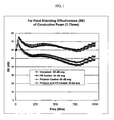
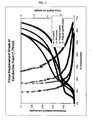
- the shielding effectiveness and force resistance characteristics i.e., bulk resistance as a function of compression are graphically depicted in FIGS. 1 and 2 , respectively.
- FIGS. 1 and 2 show that foam shielding materials provided with a dispersed flame retardant exhibited properties substantially unchanged from the control.
- FIG. 1 shielding effectiveness of the materials decreased by no more 23 percent.
- FIG. 2 shows that the force resistance patterns of the control and flame retardants samples were similar.
- Samples of a wholly conductive fabric-on-foam shielding material as in Example 1 having a thickness of 1.5 mm were impregnated with undiluted Apex 911 (with and without urethane) and with urethane alone.
- the material was obtained from a line run of Laird Technologies fabric-on-foam product CF0060-4.
- the samples of the material were impregnated following the procedure described above with the exception that the 911 flame retardant included 0.2 wt.% Pentrapex 1924.
- the coated samples were visually observed to be free of occluded pores.
- a specimen of sample 3 (urethane coating + 911 coating) was also examined under an electron microscope to evaluate the dispersed nature of the flame retardant.
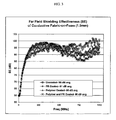
- FIGS. 3 and 4 show that fabric-on-foam shielding materials provided with the flame retardant exhibited shielding capabilities substantially unchanged from the control.
- the control sample exhibited an average shielding effectiveness of 95 dB while the samples with flame retardant alone and with a urethane precoating in addition to the flame retardant exhibited 91 and 90 dB, respectively, which is less than a 10 percent decrease in shielding effectiveness.
- FIG. 4 shows that the force resistance patterns of the control and flame retardant samples are substantially similar.
Landscapes
- Engineering & Computer Science (AREA)
- Microelectronics & Electronic Packaging (AREA)
- Physics & Mathematics (AREA)
- Electromagnetism (AREA)
- Shielding Devices Or Components To Electric Or Magnetic Fields (AREA)
- Compositions Of Macromolecular Compounds (AREA)
- Manufacture Of Porous Articles, And Recovery And Treatment Of Waste Products (AREA)
- Laminated Bodies (AREA)
- Glass Compositions (AREA)
- Conductive Materials (AREA)
- Fireproofing Substances (AREA)
Applications Claiming Priority (3)
| Application Number | Priority Date | Filing Date | Title |
|---|---|---|---|
| US10/093,667 US7060348B2 (en) | 2002-03-08 | 2002-03-08 | Flame retardant, electrically conductive shielding materials and methods of making the same |
| US93667 | 2002-03-08 | ||
| PCT/US2003/006965 WO2003077627A1 (en) | 2002-03-08 | 2003-03-07 | Flame retardant, electrically conductive emi shielding materials amd methods of making the same |
Publications (2)
| Publication Number | Publication Date |
|---|---|
| EP1483949A1 EP1483949A1 (en) | 2004-12-08 |
| EP1483949B1 true EP1483949B1 (en) | 2011-05-04 |
Family
ID=27804219
Family Applications (1)
| Application Number | Title | Priority Date | Filing Date |
|---|---|---|---|
| EP20030713954 Expired - Lifetime EP1483949B1 (en) | 2002-03-08 | 2003-03-07 | Flame retardant, electrically conductive emi shielding materials amd methods of making the same |
Country Status (10)
| Country | Link |
|---|---|
| US (2) | US7060348B2 (enExample) |
| EP (1) | EP1483949B1 (enExample) |
| JP (2) | JP4289669B2 (enExample) |
| KR (1) | KR100885012B1 (enExample) |
| CN (1) | CN100393188C (enExample) |
| AT (1) | ATE508623T1 (enExample) |
| AU (1) | AU2003217977A1 (enExample) |
| DE (1) | DE60336990D1 (enExample) |
| TW (1) | TWI339561B (enExample) |
| WO (1) | WO2003077627A1 (enExample) |
Families Citing this family (28)
| Publication number | Priority date | Publication date | Assignee | Title |
|---|---|---|---|---|
| US20030036326A1 (en) * | 2001-08-13 | 2003-02-20 | Seiren Co. Ltd. | Flame retardant conductive material and producing method thereof |
| US7129422B2 (en) * | 2003-06-19 | 2006-10-31 | Wavezero, Inc. | EMI absorbing shielding for a printed circuit board |
| US20100258344A1 (en) * | 2005-02-09 | 2010-10-14 | Laird Technologies, Inc. | Flame retardant emi shields |
| US8545974B2 (en) * | 2005-02-09 | 2013-10-01 | Laird Technologies, Inc. | Flame retardant EMI shields |
| US20060180348A1 (en) * | 2005-02-16 | 2006-08-17 | Cloutier Bryan R | Flame retardant EMI shielding gasket |
| WO2006104873A2 (en) * | 2005-03-30 | 2006-10-05 | Parker-Hannifin Corporation | Flame retardant foam for emi shielding gaskets |
| US7935411B2 (en) * | 2006-04-19 | 2011-05-03 | Furio Orologio | Metallized polymeric film reflective insulation material |
| US7935410B2 (en) * | 2006-04-19 | 2011-05-03 | Furio Orologio | Metallized polymeric film reflective insulation material |
| US20080157915A1 (en) * | 2007-01-03 | 2008-07-03 | Ethan Lin | Flame retardant, electrically-conductive pressure sensitive adhesive materials and methods of making the same |
| US20090084599A1 (en) * | 2007-10-02 | 2009-04-02 | Parker Hannifin Corporation | Nano inks for imparting emi shielding to windows |
| CN102127269B (zh) * | 2010-01-12 | 2014-01-29 | 盛亚军 | 一种阻燃聚合物泡沫材料及其制备方法 |
| US8838022B2 (en) * | 2010-04-13 | 2014-09-16 | Radeum, Inc. | System and method for securely pairing a wireless device using wireless communication |
| US20130133942A1 (en) * | 2010-07-26 | 2013-05-30 | Laird Technologies, Inc. | Process for the fabrication of highly electrically-conductive polymer foams with controlled compression set suitable for use in emi shielding applications |
| CN101955246B (zh) * | 2010-08-31 | 2012-04-18 | 中国矿业大学(北京) | 电化学氧化法处理污水专用三维电极材料的制备方法及电化学氧化系统 |
| GB2491414B (en) * | 2011-06-03 | 2017-11-01 | Acell Ind Ltd | Composite Open-Cell Foam Insulating Panels |
| WO2014022125A1 (en) | 2012-07-28 | 2014-02-06 | Laird Technologies, Inc. | Metallized film-over-foam contacts |
| CN103963365B (zh) | 2013-01-31 | 2017-03-01 | 莱尔德技术股份有限公司 | 导电多孔材料组件及其制造方法 |
| WO2014139126A1 (en) | 2013-03-14 | 2014-09-18 | Laird Technologies, Inc. | Flame-retardant electrically-conductive adhesive material and method of making the same |
| JP2015076526A (ja) * | 2013-10-09 | 2015-04-20 | 旭化成せんい株式会社 | ノイズ抑制シート |
| US9357683B2 (en) * | 2014-09-26 | 2016-05-31 | Laird Technologies, Inc. | Electromagnetic interference (EMI) shielding apparatus including electrically-conductive foam |
| CN107027254B (zh) * | 2016-02-02 | 2020-12-25 | 3M创新有限公司 | 可压缩衬垫、其制备方法和包含其的电子产品 |
| JP6926416B2 (ja) * | 2016-08-25 | 2021-08-25 | コニカミノルタ株式会社 | 樹脂成形体および樹脂成形体の製造方法 |
| CN112094492B (zh) * | 2019-06-17 | 2021-09-24 | 四川大学 | 一种兼具优异阻燃和电磁屏蔽性能的柔性聚氨酯基复合材料及其制备方法 |
| US11064636B2 (en) | 2019-09-27 | 2021-07-13 | Laird Technologies, Inc. | EMI shields including electrically-conductive foam |
| KR102734208B1 (ko) * | 2020-01-20 | 2024-11-25 | 주식회사 엘지화학 | 복합재의 제조 방법 |
| CN114230853B (zh) * | 2022-01-06 | 2023-01-17 | 常德力元新材料有限责任公司 | 一种孔洞型阻燃导电屏蔽材料和制备方法 |
| CN114213791B (zh) * | 2022-01-06 | 2022-12-13 | 常德力元新材料有限责任公司 | 一种阻燃剂、阻燃导电屏蔽材料和制备方法 |
| CN114388174B (zh) * | 2022-01-24 | 2023-12-05 | 苏州迪玛科电子科技有限公司 | 一种多层导电泡棉 |
Family Cites Families (22)
| Publication number | Priority date | Publication date | Assignee | Title |
|---|---|---|---|---|
| JPS5451971U (enExample) * | 1978-07-27 | 1979-04-10 | ||
| JPS59227920A (ja) * | 1983-06-10 | 1984-12-21 | Hayakawa Rubber Co Ltd | 電磁波吸収用ポリウレタンフオ−ム |
| US4857668A (en) | 1988-04-15 | 1989-08-15 | Schlegel Corporation | Multi-function gasket |
| US4965296A (en) * | 1989-03-15 | 1990-10-23 | No Fire Engineering, Inc. | Intumescent fire-retardant and electrically-conductive coating material |
| CA2033114C (en) * | 1990-12-24 | 2001-10-23 | James A. Wheat | Flame retardant foam material |
| JPH07123196B2 (ja) * | 1992-07-29 | 1995-12-25 | 栃木県 | 電磁波シ−ルド材及びその製造方法 |
| US6303180B1 (en) * | 1993-09-10 | 2001-10-16 | Parker-Hannifin Corporation | Form-in-place EMI gaskets |
| US5910524A (en) | 1995-01-20 | 1999-06-08 | Parker-Hannifin Corporation | Corrosion-resistant, form-in-place EMI shielding gasket |
| EP0917419B1 (en) | 1996-08-05 | 2003-07-16 | Seiren Co., Ltd | Conductive gasket material and method of manufacture thereof |
| JP4065045B2 (ja) * | 1998-01-30 | 2008-03-19 | セーレン株式会社 | 電磁波シールド用ガスケット材料の製造法 |
| US6248393B1 (en) | 1998-02-27 | 2001-06-19 | Parker-Hannifin Corporation | Flame retardant EMI shielding materials and method of manufacture |
| JP4638966B2 (ja) * | 1998-09-30 | 2011-02-23 | セーレン株式会社 | 難燃性金属被覆布帛 |
| US6346491B1 (en) * | 1999-05-28 | 2002-02-12 | Milliken & Company | Felt having conductivity gradient |
| AU5453200A (en) * | 1999-06-09 | 2000-12-28 | Laird Technologies, Inc. | Electrically conductive polymeric foam and method of preparation thereof |
| JP4328413B2 (ja) | 1999-06-25 | 2009-09-09 | セーレン株式会社 | 難燃性金属被覆布帛 |
| US6646199B2 (en) * | 1999-10-20 | 2003-11-11 | Chemque, Inc. | Polymeric foam gaskets and seals |
| US6670545B2 (en) | 1999-10-20 | 2003-12-30 | Chemque, Inc. | Conductive coating on a non-conductive flexible substrate |
| WO2001062061A1 (en) | 2000-02-18 | 2001-08-23 | Parker-Hannifin Corporation | Manufacture of low closure force, form-in-place emi shielding gasket |
| JP5014529B2 (ja) * | 2000-07-18 | 2012-08-29 | 株式会社イノアックコーポレーション | 難燃性を有する導電性多孔体およびその製造方法 |
| JP2002275306A (ja) * | 2001-03-21 | 2002-09-25 | Bridgestone Corp | 導電性多孔質体及びその製造方法 |
| JP4112307B2 (ja) * | 2001-08-13 | 2008-07-02 | セーレン株式会社 | 難燃性を有する導電性材料及びその製造方法 |
| US20030036326A1 (en) | 2001-08-13 | 2003-02-20 | Seiren Co. Ltd. | Flame retardant conductive material and producing method thereof |
-
2002
- 2002-03-08 US US10/093,667 patent/US7060348B2/en not_active Expired - Lifetime
-
2003
- 2003-03-07 WO PCT/US2003/006965 patent/WO2003077627A1/en not_active Ceased
- 2003-03-07 EP EP20030713954 patent/EP1483949B1/en not_active Expired - Lifetime
- 2003-03-07 AU AU2003217977A patent/AU2003217977A1/en not_active Abandoned
- 2003-03-07 DE DE60336990T patent/DE60336990D1/de not_active Expired - Lifetime
- 2003-03-07 TW TW92104921A patent/TWI339561B/zh not_active IP Right Cessation
- 2003-03-07 CN CNB038103281A patent/CN100393188C/zh not_active Expired - Lifetime
- 2003-03-07 KR KR1020047014078A patent/KR100885012B1/ko not_active Expired - Fee Related
- 2003-03-07 AT AT03713954T patent/ATE508623T1/de not_active IP Right Cessation
- 2003-03-07 JP JP2003575688A patent/JP4289669B2/ja not_active Expired - Fee Related
-
2006
- 2006-03-24 US US11/389,301 patent/US20060182877A1/en not_active Abandoned
-
2008
- 2008-12-22 JP JP2008325895A patent/JP2009111408A/ja active Pending
Also Published As
| Publication number | Publication date |
|---|---|
| JP2009111408A (ja) | 2009-05-21 |
| CN100393188C (zh) | 2008-06-04 |
| AU2003217977A1 (en) | 2003-09-22 |
| DE60336990D1 (de) | 2011-06-16 |
| KR100885012B1 (ko) | 2009-02-20 |
| TWI339561B (en) | 2011-03-21 |
| EP1483949A1 (en) | 2004-12-08 |
| US20040157955A1 (en) | 2004-08-12 |
| US7060348B2 (en) | 2006-06-13 |
| TW200406143A (en) | 2004-04-16 |
| KR20040101278A (ko) | 2004-12-02 |
| WO2003077627A1 (en) | 2003-09-18 |
| CN1653877A (zh) | 2005-08-10 |
| JP4289669B2 (ja) | 2009-07-01 |
| JP2005520331A (ja) | 2005-07-07 |
| ATE508623T1 (de) | 2011-05-15 |
| US20060182877A1 (en) | 2006-08-17 |
Similar Documents
| Publication | Publication Date | Title |
|---|---|---|
| EP1483949B1 (en) | Flame retardant, electrically conductive emi shielding materials amd methods of making the same | |
| JP2005520331A5 (enExample) | ||
| EP1057387B1 (en) | Flame retardant emi shielding materials and method of manufacture | |
| EP1846493B1 (en) | Flame retardant emi shields | |
| EP2763520B1 (en) | Electrically conductive porous material assemblies and methods of making the same | |
| EP1873299B1 (en) | Flame-retardant metal-coated fabric and gasket comprising the same for electromagnetic-wave shielding | |
| EP1245720A1 (en) | Flame retardant corrosive resistant conductive fabric article and method of forming same | |
| US20140199904A1 (en) | Electrically Conductive Porous Material Assemblies and Methods of Making The Same | |
| WO2014117362A1 (en) | Electrically conductive porous material assemblies and methods of making the same |
Legal Events
| Date | Code | Title | Description |
|---|---|---|---|
| PUAI | Public reference made under article 153(3) epc to a published international application that has entered the european phase |
Free format text: ORIGINAL CODE: 0009012 |
|
| 17P | Request for examination filed |
Effective date: 20040920 |
|
| AK | Designated contracting states |
Kind code of ref document: A1 Designated state(s): AT BE BG CH CY CZ DE DK EE ES FI FR GB GR HU IE IT LI LU MC NL PT RO SE SI SK TR |
|
| AX | Request for extension of the european patent |
Extension state: AL LT LV MK |
|
| GRAP | Despatch of communication of intention to grant a patent |
Free format text: ORIGINAL CODE: EPIDOSNIGR1 |
|
| GRAS | Grant fee paid |
Free format text: ORIGINAL CODE: EPIDOSNIGR3 |
|
| GRAA | (expected) grant |
Free format text: ORIGINAL CODE: 0009210 |
|
| AK | Designated contracting states |
Kind code of ref document: B1 Designated state(s): AT BE BG CH CY CZ DE DK EE ES FI FR GB GR HU IE IT LI LU MC NL PT RO SE SI SK TR |
|
| REG | Reference to a national code |
Ref country code: GB Ref legal event code: FG4D |
|
| REG | Reference to a national code |
Ref country code: CH Ref legal event code: EP |
|
| REG | Reference to a national code |
Ref country code: IE Ref legal event code: FG4D |
|
| REF | Corresponds to: |
Ref document number: 60336990 Country of ref document: DE Date of ref document: 20110616 Kind code of ref document: P |
|
| REG | Reference to a national code |
Ref country code: DE Ref legal event code: R096 Ref document number: 60336990 Country of ref document: DE Effective date: 20110616 |
|
| REG | Reference to a national code |
Ref country code: NL Ref legal event code: VDEP Effective date: 20110504 |
|
| RAP2 | Party data changed (patent owner data changed or rights of a patent transferred) |
Owner name: LAIRD TECHNOLOGIES, LTD. |
|
| PG25 | Lapsed in a contracting state [announced via postgrant information from national office to epo] |
Ref country code: PT Free format text: LAPSE BECAUSE OF FAILURE TO SUBMIT A TRANSLATION OF THE DESCRIPTION OR TO PAY THE FEE WITHIN THE PRESCRIBED TIME-LIMIT Effective date: 20110905 Ref country code: SE Free format text: LAPSE BECAUSE OF FAILURE TO SUBMIT A TRANSLATION OF THE DESCRIPTION OR TO PAY THE FEE WITHIN THE PRESCRIBED TIME-LIMIT Effective date: 20110504 |
|
| PG25 | Lapsed in a contracting state [announced via postgrant information from national office to epo] |
Ref country code: GR Free format text: LAPSE BECAUSE OF FAILURE TO SUBMIT A TRANSLATION OF THE DESCRIPTION OR TO PAY THE FEE WITHIN THE PRESCRIBED TIME-LIMIT Effective date: 20110805 Ref country code: ES Free format text: LAPSE BECAUSE OF FAILURE TO SUBMIT A TRANSLATION OF THE DESCRIPTION OR TO PAY THE FEE WITHIN THE PRESCRIBED TIME-LIMIT Effective date: 20110815 Ref country code: AT Free format text: LAPSE BECAUSE OF FAILURE TO SUBMIT A TRANSLATION OF THE DESCRIPTION OR TO PAY THE FEE WITHIN THE PRESCRIBED TIME-LIMIT Effective date: 20110504 Ref country code: SI Free format text: LAPSE BECAUSE OF FAILURE TO SUBMIT A TRANSLATION OF THE DESCRIPTION OR TO PAY THE FEE WITHIN THE PRESCRIBED TIME-LIMIT Effective date: 20110504 Ref country code: BE Free format text: LAPSE BECAUSE OF FAILURE TO SUBMIT A TRANSLATION OF THE DESCRIPTION OR TO PAY THE FEE WITHIN THE PRESCRIBED TIME-LIMIT Effective date: 20110504 Ref country code: CY Free format text: LAPSE BECAUSE OF FAILURE TO SUBMIT A TRANSLATION OF THE DESCRIPTION OR TO PAY THE FEE WITHIN THE PRESCRIBED TIME-LIMIT Effective date: 20110504 Ref country code: FI Free format text: LAPSE BECAUSE OF FAILURE TO SUBMIT A TRANSLATION OF THE DESCRIPTION OR TO PAY THE FEE WITHIN THE PRESCRIBED TIME-LIMIT Effective date: 20110504 |
|
| PG25 | Lapsed in a contracting state [announced via postgrant information from national office to epo] |
Ref country code: NL Free format text: LAPSE BECAUSE OF FAILURE TO SUBMIT A TRANSLATION OF THE DESCRIPTION OR TO PAY THE FEE WITHIN THE PRESCRIBED TIME-LIMIT Effective date: 20110504 |
|
| PG25 | Lapsed in a contracting state [announced via postgrant information from national office to epo] |
Ref country code: EE Free format text: LAPSE BECAUSE OF FAILURE TO SUBMIT A TRANSLATION OF THE DESCRIPTION OR TO PAY THE FEE WITHIN THE PRESCRIBED TIME-LIMIT Effective date: 20110504 |
|
| PG25 | Lapsed in a contracting state [announced via postgrant information from national office to epo] |
Ref country code: SK Free format text: LAPSE BECAUSE OF FAILURE TO SUBMIT A TRANSLATION OF THE DESCRIPTION OR TO PAY THE FEE WITHIN THE PRESCRIBED TIME-LIMIT Effective date: 20110504 Ref country code: RO Free format text: LAPSE BECAUSE OF FAILURE TO SUBMIT A TRANSLATION OF THE DESCRIPTION OR TO PAY THE FEE WITHIN THE PRESCRIBED TIME-LIMIT Effective date: 20110504 Ref country code: DK Free format text: LAPSE BECAUSE OF FAILURE TO SUBMIT A TRANSLATION OF THE DESCRIPTION OR TO PAY THE FEE WITHIN THE PRESCRIBED TIME-LIMIT Effective date: 20110504 |
|
| PLBE | No opposition filed within time limit |
Free format text: ORIGINAL CODE: 0009261 |
|
| STAA | Information on the status of an ep patent application or granted ep patent |
Free format text: STATUS: NO OPPOSITION FILED WITHIN TIME LIMIT |
|
| 26N | No opposition filed |
Effective date: 20120207 |
|
| PG25 | Lapsed in a contracting state [announced via postgrant information from national office to epo] |
Ref country code: IT Free format text: LAPSE BECAUSE OF FAILURE TO SUBMIT A TRANSLATION OF THE DESCRIPTION OR TO PAY THE FEE WITHIN THE PRESCRIBED TIME-LIMIT Effective date: 20110504 |
|
| REG | Reference to a national code |
Ref country code: DE Ref legal event code: R097 Ref document number: 60336990 Country of ref document: DE Effective date: 20120207 |
|
| PG25 | Lapsed in a contracting state [announced via postgrant information from national office to epo] |
Ref country code: MC Free format text: LAPSE BECAUSE OF NON-PAYMENT OF DUE FEES Effective date: 20120331 |
|
| REG | Reference to a national code |
Ref country code: CH Ref legal event code: PL |
|
| GBPC | Gb: european patent ceased through non-payment of renewal fee |
Effective date: 20120307 |
|
| REG | Reference to a national code |
Ref country code: FR Ref legal event code: ST Effective date: 20121130 |
|
| REG | Reference to a national code |
Ref country code: IE Ref legal event code: MM4A |
|
| PG25 | Lapsed in a contracting state [announced via postgrant information from national office to epo] |
Ref country code: IE Free format text: LAPSE BECAUSE OF NON-PAYMENT OF DUE FEES Effective date: 20120307 Ref country code: LI Free format text: LAPSE BECAUSE OF NON-PAYMENT OF DUE FEES Effective date: 20120331 Ref country code: FR Free format text: LAPSE BECAUSE OF NON-PAYMENT OF DUE FEES Effective date: 20120402 Ref country code: CH Free format text: LAPSE BECAUSE OF NON-PAYMENT OF DUE FEES Effective date: 20120331 Ref country code: GB Free format text: LAPSE BECAUSE OF NON-PAYMENT OF DUE FEES Effective date: 20120307 |
|
| PG25 | Lapsed in a contracting state [announced via postgrant information from national office to epo] |
Ref country code: BG Free format text: LAPSE BECAUSE OF FAILURE TO SUBMIT A TRANSLATION OF THE DESCRIPTION OR TO PAY THE FEE WITHIN THE PRESCRIBED TIME-LIMIT Effective date: 20110804 |
|
| PG25 | Lapsed in a contracting state [announced via postgrant information from national office to epo] |
Ref country code: TR Free format text: LAPSE BECAUSE OF FAILURE TO SUBMIT A TRANSLATION OF THE DESCRIPTION OR TO PAY THE FEE WITHIN THE PRESCRIBED TIME-LIMIT Effective date: 20110504 |
|
| PG25 | Lapsed in a contracting state [announced via postgrant information from national office to epo] |
Ref country code: LU Free format text: LAPSE BECAUSE OF NON-PAYMENT OF DUE FEES Effective date: 20120307 |
|
| PG25 | Lapsed in a contracting state [announced via postgrant information from national office to epo] |
Ref country code: HU Free format text: LAPSE BECAUSE OF FAILURE TO SUBMIT A TRANSLATION OF THE DESCRIPTION OR TO PAY THE FEE WITHIN THE PRESCRIBED TIME-LIMIT Effective date: 20030307 |
|
| PGFP | Annual fee paid to national office [announced via postgrant information from national office to epo] |
Ref country code: CZ Payment date: 20210225 Year of fee payment: 19 |
|
| PGFP | Annual fee paid to national office [announced via postgrant information from national office to epo] |
Ref country code: DE Payment date: 20210224 Year of fee payment: 19 |
|
| REG | Reference to a national code |
Ref country code: DE Ref legal event code: R119 Ref document number: 60336990 Country of ref document: DE |
|
| PG25 | Lapsed in a contracting state [announced via postgrant information from national office to epo] |
Ref country code: CZ Free format text: LAPSE BECAUSE OF NON-PAYMENT OF DUE FEES Effective date: 20220307 |
|
| PG25 | Lapsed in a contracting state [announced via postgrant information from national office to epo] |
Ref country code: DE Free format text: LAPSE BECAUSE OF NON-PAYMENT OF DUE FEES Effective date: 20221001 |