EP1465725B1 - Herstellungsverfahren von Zeolith/SiC-Verbundmaterialien, die nach diesem Verfahren erhaltenen Verbundmaterialien und deren Verwendung als Katalysator - Google Patents
Herstellungsverfahren von Zeolith/SiC-Verbundmaterialien, die nach diesem Verfahren erhaltenen Verbundmaterialien und deren Verwendung als Katalysator Download PDFInfo
- Publication number
- EP1465725B1 EP1465725B1 EP03712236A EP03712236A EP1465725B1 EP 1465725 B1 EP1465725 B1 EP 1465725B1 EP 03712236 A EP03712236 A EP 03712236A EP 03712236 A EP03712236 A EP 03712236A EP 1465725 B1 EP1465725 B1 EP 1465725B1
- Authority
- EP
- European Patent Office
- Prior art keywords
- zeolite
- support
- catalyst
- sic
- composite
- Prior art date
- Legal status (The legal status is an assumption and is not a legal conclusion. Google has not performed a legal analysis and makes no representation as to the accuracy of the status listed.)
- Expired - Lifetime
Links
Images




Classifications
-
- B—PERFORMING OPERATIONS; TRANSPORTING
- B01—PHYSICAL OR CHEMICAL PROCESSES OR APPARATUS IN GENERAL
- B01J—CHEMICAL OR PHYSICAL PROCESSES, e.g. CATALYSIS OR COLLOID CHEMISTRY; THEIR RELEVANT APPARATUS
- B01J29/00—Catalysts comprising molecular sieves
- B01J29/04—Catalysts comprising molecular sieves having base-exchange properties, e.g. crystalline zeolites
- B01J29/06—Crystalline aluminosilicate zeolites; Isomorphous compounds thereof
-
- B—PERFORMING OPERATIONS; TRANSPORTING
- B01—PHYSICAL OR CHEMICAL PROCESSES OR APPARATUS IN GENERAL
- B01J—CHEMICAL OR PHYSICAL PROCESSES, e.g. CATALYSIS OR COLLOID CHEMISTRY; THEIR RELEVANT APPARATUS
- B01J29/00—Catalysts comprising molecular sieves
- B01J29/04—Catalysts comprising molecular sieves having base-exchange properties, e.g. crystalline zeolites
- B01J29/06—Crystalline aluminosilicate zeolites; Isomorphous compounds thereof
- B01J29/40—Crystalline aluminosilicate zeolites; Isomorphous compounds thereof of the pentasil type, e.g. types ZSM-5, ZSM-8 or ZSM-11, as exemplified by patent documents US3702886, GB1334243 and US3709979, respectively
-
- B—PERFORMING OPERATIONS; TRANSPORTING
- B01—PHYSICAL OR CHEMICAL PROCESSES OR APPARATUS IN GENERAL
- B01J—CHEMICAL OR PHYSICAL PROCESSES, e.g. CATALYSIS OR COLLOID CHEMISTRY; THEIR RELEVANT APPARATUS
- B01J37/00—Processes, in general, for preparing catalysts; Processes, in general, for activation of catalysts
- B01J37/02—Impregnation, coating or precipitation
- B01J37/024—Multiple impregnation or coating
- B01J37/0246—Coatings comprising a zeolite
-
- B—PERFORMING OPERATIONS; TRANSPORTING
- B01—PHYSICAL OR CHEMICAL PROCESSES OR APPARATUS IN GENERAL
- B01J—CHEMICAL OR PHYSICAL PROCESSES, e.g. CATALYSIS OR COLLOID CHEMISTRY; THEIR RELEVANT APPARATUS
- B01J2229/00—Aspects of molecular sieve catalysts not covered by B01J29/00
- B01J2229/30—After treatment, characterised by the means used
- B01J2229/42—Addition of matrix or binder particles
-
- B—PERFORMING OPERATIONS; TRANSPORTING
- B01—PHYSICAL OR CHEMICAL PROCESSES OR APPARATUS IN GENERAL
- B01J—CHEMICAL OR PHYSICAL PROCESSES, e.g. CATALYSIS OR COLLOID CHEMISTRY; THEIR RELEVANT APPARATUS
- B01J2229/00—Aspects of molecular sieve catalysts not covered by B01J29/00
- B01J2229/60—Synthesis on support
- B01J2229/64—Synthesis on support in or on refractory materials
-
- B—PERFORMING OPERATIONS; TRANSPORTING
- B01—PHYSICAL OR CHEMICAL PROCESSES OR APPARATUS IN GENERAL
- B01J—CHEMICAL OR PHYSICAL PROCESSES, e.g. CATALYSIS OR COLLOID CHEMISTRY; THEIR RELEVANT APPARATUS
- B01J27/00—Catalysts comprising the elements or compounds of halogens, sulfur, selenium, tellurium, phosphorus or nitrogen; Catalysts comprising carbon compounds
- B01J27/20—Carbon compounds
- B01J27/22—Carbides
- B01J27/224—Silicon carbide
-
- B—PERFORMING OPERATIONS; TRANSPORTING
- B01—PHYSICAL OR CHEMICAL PROCESSES OR APPARATUS IN GENERAL
- B01J—CHEMICAL OR PHYSICAL PROCESSES, e.g. CATALYSIS OR COLLOID CHEMISTRY; THEIR RELEVANT APPARATUS
- B01J29/00—Catalysts comprising molecular sieves
- B01J29/04—Catalysts comprising molecular sieves having base-exchange properties, e.g. crystalline zeolites
- B01J29/06—Crystalline aluminosilicate zeolites; Isomorphous compounds thereof
- B01J29/70—Crystalline aluminosilicate zeolites; Isomorphous compounds thereof of types characterised by their specific structure not provided for in groups B01J29/08 - B01J29/65
- B01J29/7007—Zeolite Beta
-
- B—PERFORMING OPERATIONS; TRANSPORTING
- B01—PHYSICAL OR CHEMICAL PROCESSES OR APPARATUS IN GENERAL
- B01J—CHEMICAL OR PHYSICAL PROCESSES, e.g. CATALYSIS OR COLLOID CHEMISTRY; THEIR RELEVANT APPARATUS
- B01J35/00—Catalysts, in general, characterised by their form or physical properties
- B01J35/60—Catalysts, in general, characterised by their form or physical properties characterised by their surface properties or porosity
Definitions
- the present invention relates to the preparation of zeolite / SiC composites and their use as catalyst or catalyst support for chemical reactions in the gas or liquid phase.
- the solution commonly adopted is to add a binder, usually silicon oxide or aluminum oxide, and to prepare extruded bodies.
- a binder usually silicon oxide or aluminum oxide
- This method has the disadvantage that the binder is not chemically inert. As a result, spurious reactions can occur under the conditions of use of the catalyst.
- the binder may make part of the zeolite inaccessible to the reagents.
- Seijger et al (see the previously cited article) manage to deposit an important zeolite load on a SiC / Al 2 O 3 ceramic foam.
- the support is weakened during the synthesis and the composite thus synthesized is brittle.
- the patent application JP 06182214 A discusses another method of calcining SiC at high temperature to form a layer of SiO 2 on its surface. Subsequently, bringing the support thus prepared into contact with an aqueous solution containing an aluminum source, under hydrothermal conditions, makes it possible to transform this silica layer into a zeolite. This composite is then used as a catalyst support for carrying out combustion reactions. Although this method leads to a strong interaction between the zeolite and the support, the zeolite load remains low since only the surface layer, consisting of SiO 2 , can be transformed.
- the patent application WO 98/06495 presents another method of preparation of the support which consists in putting it in the presence of a solution containing a structurant of the same nature as that used to prepare the synthesis gel of the zeolite. Subsequent to this preparation, the support is brought into the presence of the synthesis gel in hydrothermal conditions. This method makes it possible to obtain a good anchoring of the zeolite on an ⁇ -Al 2 O 3 support .
- the problem that the applicant has sought to solve by the present invention is to provide a composite material comprising a zeolite and a rigid support, which avoids the disadvantages of existing products. More particularly, it is desirable that the support has in particular good mechanical strength under the conditions of use of the composite as catalyst, allows easy shaping, has good chemical resistance, especially in basic medium (to allow synthesis zeolites hydrothermally), and shows a low catalytic activity under the conditions of use of the composite as a catalyst (to avoid parasitic reactions). It is also desirable that the support shows good adhesion for the zeolite. Furthermore, it is desirable for the support to have a specific surface area greater than 5 m 2 / g in order to allow the deposit of a large quantity of zeolite.
- the specific surface area of a catalyst is an important parameter in catalysis, particularly for catalytic reactions in the gas phase, it is desirable for the composite to be completely covered with zeolite, even in the pores of the support, in a homogeneous manner, without forming a thick layer, so that the reagents can access all of said zeolite when using the composite in catalytic reactions.
- the support must have a strong interaction with the zeolite, so that it does not detach from said support during post-synthesis processing operations and when using the composite as a catalyst.
- a first object of the present invention is a method for preparing a composite formed of a zeolite according to claims 1 to 6, and a composite obtainable by this method.
- the support is a ⁇ -SiC foam with a specific surface area of between 10 and 400 m 2 / g.
- the zeolite is advantageously selected from zeolite ZSM-5, zeolite- ⁇ and silicalite.
- a second object of the present invention is the use of a composite obtainable by the process according to any one of claims 1 to 6 as catalyst or catalyst support for chemical reactions in a gaseous or liquid medium.
- the Applicant has found that the use of a silicon carbide support structure ⁇ ( ⁇ -SiC) overcomes the disadvantages of the prior art. Surprisingly, the Applicant has found that the materials having a zeolite structure show excellent adhesion to a silicon carbide support structure ⁇ . In the context of the present invention, it is desirable to have a support characterized by a BET specific surface area greater than the traditional supports (silica, alumina) which have a specific surface area of the order of 0.1 to 5 m 2 / boy Wut.
- the silicon carbide may be selected from different SiC-based materials.
- the silicon carbide support has a BET specific surface area greater than 5 m 2 / g, but supports with a specific surface area of between 5 and 600 m 2 / g, preferably between 10 and 600 m 2 / g, are preferred. preferably between 10 and 400 m 2 / g, more preferably between even 20 and 400 m 2 / g, and most preferably between 20 and 200 m 2 / g.
- the preferred support is a ⁇ -SiC support with a specific surface area of the order of 10 to 100 m 2 / g.
- the Applicant has used SiC foams or grains or extruded SiC.
- Such materials can be prepared, for example, according to the synthetic methods described in the following patents: EP 0 313 480 , EP 0 440 569 , US 5,217,930 , EP 0 511 919 , EP 0 543 751 and EP 0 543 752 . According to these methods, it is possible to synthesize materials of various sizes and shapes, that is to say for example in the form of rods, monoliths, extrusions, grains or tubes. These types and forms of ⁇ -SiC give good results, but other sizes and shapes of SiC can also be used in the context of the present invention.
- the composites according to the invention may comprise any material having a zeolitic type structure.
- Zeolites are materials having a three-dimensional structure whose framework consists of a sequence of TO 4 tetrahedra, where T represents a silicon atom or, optionally, aluminum.
- T represents a silicon atom or, optionally, aluminum.
- zeolite is commonly used only in the case of aluminosilicates, it is known to those skilled in the art that some or all of the silicon and aluminum atoms may be replaced by others. elements.
- silicon may be replaced by other tetravalent elements such as, but not limited to, tin, germanium, phosphorus or a mixture thereof
- aluminum may be substituted by other trivalent elements such as, but not limited to, boron, titanium, gallium, indium or a mixture thereof. Therefore, the applicant uses in the context of this patent the terms "zeolite”, “zeolites”, “zeolite material” to define any material having a zeolite type structure and known to those skilled in the art, without being limited to materials containing only silicon and aluminum.
- aluminosilicates This includes, but is not limited to, aluminosilicates, metallosilicates (such as, but not limited to, gallosilicates, chromosilicates, borosilicates, ferrisilicates, titanosilicates), silicoaluminophosphates (SAPOs), metalloaluminophosphates (MeAPO), aluminophosphates (ALPO) and metallophosphates.
- SAPOs silicoaluminophosphates
- MeAPO metalloaluminophosphates
- APO aluminophosphates
- aluminosilicic zeolite to refer to zeolites containing only silicon and aluminum as framework atoms.
- the zeolite / SiC composites may comprise zeolites of structural type AEL, BEA, CHA, CLO, ERI, EUO, FAU, IRON, HEU, LTA, LTL, MAZ, MEI. MEL, MFI, MOR, MTT, MTW, MWW, OFF, PHI, SOD, TON, or a mixture of zeolites of these different structural types.
- zeolites are described in "Atlas Of Zeolite Structure Types", WM Meier and DH Olson, Butterworth-Heinemann, 3rd Edition, 1992. This book necessarily known to the skilled person also defined standard nomenclature zeolites.
- the Applicant prefers zeolite ZSM-5, which is used industrially as an isomerization catalyst and as an additive for cracking, zeolite- ⁇ and silicalite.
- the zeolite is deposited by hydrothermal route according to the techniques known to those skilled in the art.
- the ⁇ -SiC support is calcined at 900 ° C. for approximately 2 hours in order to transform the surface layer (typically 3 nm) of oxide and oxycarbide of the support into silica.
- This surface layer of silica has a thickness of between 1 nm and 10 nm.
- the outer layer thus formed is not converted into zeolite as is the case in the patent JP 06182214 cited earlier, but acts as an anchor point for it. If the silica layer is too thin, the anchoring of the zeolite layer becomes worse. If the silica layer is too thick, it partially dissolves in the synthesis medium of the zeolite.
- the thickness of this layer can be determined by XPS (X-Ray Photoelectron Spectroscopy). An area of particularly advantageous thickness for the silica layer is between 1.5 nm and 5 nm.
- the composite is synthesized in situ in the presence of the pretreated support.
- the synthesis of said composite consists in preparing a synthesis gel whose composition and method of preparation is known to those skilled in the art. After a period of ripening, the support is added to the gel and the mixture is transferred to a container suitable for hydrothermal syntheses, for example a Teflon lined autoclave. The hydrothermal synthesis is then carried out under conditions known to those skilled in the art. The recovery of the composite as well as any post-synthesis treatments are carried out according to known methods.
- the industrial application of the composites according to the invention is particularly in the field of chemistry and petrochemistry.
- the composites according to the invention can be advantageously used as a catalyst for chemical reactions in the gaseous or liquid phase. They can also be used as a catalyst support, that is to say that an active phase (for example a metal compound which is optionally reduced) is applied to said composites in order to form a gas phase chemical reaction catalyst. or liquid.
- an active phase for example a metal compound which is optionally reduced
- the composites according to the invention can be used as catalyst or catalyst support in the cracking, acylation, alkylation or isomerization reactions of hydrocarbons.
- zeolite H-ZSM-5 (SC) a commercially available product, catalyzes the synthesis of xylene from toluene and methanol (see the article "Use of isotropic labeling for mechanistic studies of the methanol-to-hydrocarbon reaction. Methylation of toluene with methanol over H-ZSM-5, H-mordenite and H-beta "by ⁇ . Mikkelsen et al, published in the journal Microporous and Mesoporous Materials, Vol 40, p. 95 - 113 (2000) )), but without any selectivity for the para-xylene isomer: the para / meta / ortho distribution is 39% / 38% / 23%.
- the composites according to the invention can catalyze this reaction with a good selectivity in favor of para-xylene.
- para-xylene is the most interesting product because it can be converted by oxidation into terephthalic acid, a compound used in the manufacture of polyester fibers and films.
- the composites according to the invention it is possible to obtain a selectivity of para-xylene with respect to all the xylenes greater than 60%.
- the stability of the composites according to the invention is at least comparable to that of known zeolites.
- the Friedel-Crafts reaction (which can be performed in the form for example, alkylation or acylation) is often used in processes in the perfume industry and in the pharmaceutical industry. This reaction allows for example the synthesis of aromatic ketones, very important intermediates in the synthesis of drugs.
- Catalysts commonly employed industrially are metal halides, such as FeBr 3 , AlCl 3 or SbCl 5 . In addition to the environmental problems that their use generates, these catalysts also have a low selectivity and a short life. It is for these various disadvantages that they are gradually replaced by solid acid catalysts, and more specifically by zeolites.
- the Applicant has used the composite according to the invention as catalyst or catalyst support for the alkylation and acylation of Friedel-Crafts.
- the Applicant has used the composite according to the invention for the synthesis of para-alkoxyacetophenone by Friedel-Crafts reaction.
- the selectivity of the para isomer exceeds 90% and even 95%.
- it has obtained para-methoxyacetophenone from anisole and acetic anhydride with a selectivity greater than 99%.
- Another example is the synthesis of p-methoxybenzophenone by Friedel-Crafts acylation.
- Another application of the composites according to the invention is the purification or decontamination of exhaust gases from combustion engines, more particularly the oxidation of carbon monoxide to carbon dioxide, as well as the reduction of nitrogen oxides to nitrogen. .
- the initial operating procedure is as follows: 24 g of water, 7.5 g of tetrapropylammonium hydroxide and 5.16 g of tetraethoxysilane are placed in a polypropylene bottle and stirred magnetically. In another flask, 0.28 g of aluminum nitrate nonahydrate is dissolved in 24 g of distilled water. The aluminum source is then added to the first bottle. The ripening of the gel is carried out with stirring for 50 minutes, at the end of which the support (as the case may be, 1 g of extrudates or 3 g of grain size between 250 and 425 ⁇ m, previously calcined at 900 ° C. for 2 hours ) is added.
- the mixture is transferred to a Teflon jacketed autoclave. This is then placed in the oven at 150 ° C for 7 hours. After 7 hours of crystallization under autogenous pressure, the autoclave is cooled and the material is filtered, washed extensively with distilled water and dried in an oven at 100 ° C for several hours. The solid obtained is calcined under air at 550 ° C. for 10 hours in order to decompose the organic structurant. The composite is brought into contact with a solution of 1M NH 4 Cl and the mixture is refluxed for 16 hours according to a known technique in order to obtain the ammonium form of the zeolite. The composite is then washed extensively with distilled water, dried and calcined at 550 ° C for 10 hours to obtain the acid form of the zeolite and the final shape of the composite.
- the synthesis was carried out on supports of different nature type: ⁇ -Al 2 O 3 and extruded ⁇ -SiC.
- the total initial and microporous specific surfaces are respectively 22.86 m 2 / g and 0.00 m 2 / g in the case of extruded SiC, and 4.94 m 2 / g and 0.62 m 2 / g for extruded alumina.
- X-ray diffraction patterns ( figure 1 ) were performed on ZSM-5 / SiC composite powders using a Siemens D5000 diffractometer using non-monochromatic Cu K ⁇ radiation. Peak indexation was performed using the Joint Committee of Powder Diffraction Standards (JCPDS) database. The diagram only includes peaks corresponding to the ⁇ -SIC substrate and the zeolite ZSM-5.
- JCPDS Joint Committee of Powder Diffraction Standards
- ZSM-5 on the surface of the support is also confirmed by the appearance of micropores during the measurement of specific surfaces and porous volumes by nitrogen adsorption at the temperature of liquid nitrogen according to the BET method (see Article "Surface area and pore texture of catalysis" G. Leofanti et al, published in the journal Catalysis Today, vol 41, p. 207 - 219 (1998) )).
- Table 1 presents the values obtained before and after synthesis for the extrudates and the grains of SiC: Table 1: Specific surface determined by nitrogen adsorption at the temperature of liquid nitrogen according to the BET method Sample Specific surface area [m 2 / g] total micropores Extruded SiC 22.86 0.00 Composite ZSM-5 on SiC extrudes 28.82 3.59 SiC grains 18.67 0.00 Composite ZSM-5 on SiC Grains 50.99 20.97
- Example 2 Successive deposition of several layers of ZSM-5 on SiC
- the figure 5 presents the evolution of the total and microporous specific surfaces according to the number of successive syntheses. It can be seen that both total and microporous specific surfaces increase almost linearly.
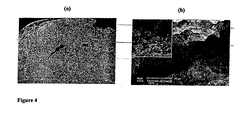
- Scanning electron microscopy (SEM) images of the obtained ZSM-5 / SiC composites show that the support surface is homogeneously covered by zeolite crystals of different sizes ranging from a few tens of nanometers to a few micrometers.
- the medium magnification images show that the amount of crystals deposited increases with the number of syntheses, according to the measurements of specific surfaces. However, they show also that the amount of nanocrystals tends to decrease in favor of microcrystals of ZSM-5. The most probable hypothesis is that the nanocrystals act as germs, thus favoring the crystalline growth step during the following syntheses.
- the toluene methylation reaction for which ZSM-5 is used industrially, was used to characterize the catalytic activity of the ZSM-5 composites on SiC grains prepared according to Example 2, after a step of synthesis of the zeolite (sample A), two synthesis steps (sample B) and three synthesis steps (sample C).
- an unsupported zeolite ZSM-5 synthesized from the same synthetic gel and under the same conditions as the composite, was also studied.
- the reaction consists of reacting methanol with toluene (molar ratio 1: 1) in the presence of the catalyst according to the invention. It gives a mixture of the three isomers (ortho, meta and para) of xylene. The selectivity of the synthesis with respect to para-xylene is determined.
- the test was carried out as follows: An equimolar methanol / toluene mixture is sent using an HPLC pump with a flow rate of 40 ⁇ l / min to a "T". The mixture is then vaporized and washed away by a stream of helium (Air Liquide, helium N55, flow rate 20 cc / min) to the reactor.
- helium Air Liquide, helium N55, flow rate 20 cc / min
- This consists of a quartz tube in U, provided with a sinter on which are deposited 500 mg of catalyst.
- the reactor is located in an oven that provides heating by Joule effect. The temperature is controlled and regulated using a thermocouple located outside the tube at the height of the catalyst bed.
- a sampling septum placed between the outlet of the reactor and the wind makes it possible to analyze the reaction products.
- All lines are maintained at about 150 ° C by heating wires insulated with braided silica wool so that unreacted products and reagents do not condense.
- the chromatograph used is a Varian 3800 model equipped with a Chrompack CP-WAX 52CB column (length 25 m, internal diameter 0.53 mm) and a FID detector (Flame Ionization Detector).
- a computer equipped with software provided by Varian allows to control the temperature program and to process the signal sent by the detector (integration of the peaks).
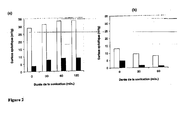
- the results of the catalytic tests are given on the figure 8 .
- the figure 8a gives the evolution of toluene conversion for composites A, B and C, as well as for unsupported ZSM-5. Note that the conversion increases with the number of successive syntheses, and therefore with the amount of ZSM-5 deposited. In the case of A, the conversion drops rapidly before gradually stabilizing at 5%. That of B is relatively stable during the first 60 minutes under flow but finally drops to reach a conversion of the order of 11%. The conversion, in the case of C, remains stable for a long time at around 20% and only decreases by 3 to 4% after 3 hours under flow. The increase in conversion for unsupported ZSM-5 can be attributed to coke formation on the zeolite.
- the figure 8b highlights different reactivities for the three composites. It shows the para-xylene selectivity with respect to the sum of the reaction products.
- the important initial selectivity of the order of 60%, drops rapidly to reach 45% after 60 minutes under flow. The selectivity then drops more slowly to approximately 5% per hour.
- Sample B has an initial para-xylene selectivity lower than A, of the order of 54% but remains stable during the first 60 minutes under flow. The selectivity then decreases at a rate of the order of 8 to 9% per hour.
- the para-xylene selectivity in the case of C is stable at about 50% over the entire duration of the catalytic test. A small amount of ethyltoluene or trimethylbenzene is found.
- the figure 8c shows the corresponding results for the para-xylene selectivity with respect to the three ortho, meta and para isomers.
- the para-xylene selectivity with respect to the total amount of xylene is stabilized at 61% for catalyst C, the conversion-toluene level is stabilized at about 20%, the yield of xylenes at 16%. %, and WHSV (Weight Hourly Space Velocity) value at 4.8 h -1 . This value of WHSV was calculated on the total mass of the composite used as catalyst, whereas the active phase represented only about 15% of this total mass of the composite.
- the unsupported ZSM-5 exhibits identical stability but has a selectivity much lower than C, of the order of 30%.
- the composite corresponding to sample C comprises about 15% of zeolite.
- Aerosil 200 are dissolved in 7.07 g of water and 10.13 g of TEAOH (35% by weight aqueous solution of TEAOH) at 50 ° C. with magnetic stirring in a beaker made of polypropylene.
- TEAOH 5% by weight aqueous solution of TEAOH
- 0.067 g of aluminum metal is dissolved in 5.65 g of TEAOH at 50 ° C. with magnetic stirring.
- the two liquids are mixed, still at 50 ° C. and with magnetic stirring, until a gel is obtained which is allowed to mature under the same temperature and stirring conditions for 50 minutes. .
- the structurant is decomposed by calcining the zeolite at 550 ° C for 12 hours in air.
- the NH 4 -Beta / SiC form is formed after cationic exchange of the composite by NH 4 Cl (1M, 150ml) in aqueous solution.
- the acidic form, H-Beta / SiC is obtained.
- the percentage of zeolite Beta on the support, determined by treatment with hydrofluoric acid (40% aqueous HF), is 10% by weight.
- Aerosil ® 200 silica used for the preparation of the gel is, according to the information provided by its supplier, the company Degussa AG, a hydrophilic silica with a surface area of about 200 m 2 / g and an average particle size of 12 nm.
- the catalytic activity of the Beta / SiC composite obtained according to Example 4 is investigated using the acetylation reaction of anisole.
- This reaction allows the synthesis of methoxyacetophenone by reacting acetic anhydride on the anisole in the presence of the catalyst according to the invention.
- the products of the reaction consist of an ortho, meta, para mixture of methoxyacetophenone.
- the selectivity is determined relative to the para isomer.
- the chromatograph is a Varian 3400cx model equipped with an HP-Pona column (length 50 m, internal diameter 0.5 ⁇ m) and a FID detector (Flame Ionization Detector), controlled by a computer equipped with software provided by Varian, allowing the interpretation of the signals sent by the detector.
- Beta / SiC zeolite The shape selectivity of the Beta / SiC zeolite is responsible for the high selectivity of the reaction to the disubstituted form of para methoxyacetophenone. Only the para isomer was detected, the concentration of the other two isomers was below the detection threshold of the device. It can be deduced that the selectivity towards the para isomer was almost 100%.
- beta zeolite supported on silicon carbide ⁇ is a very good catalyst.
Landscapes
- Chemical & Material Sciences (AREA)
- Engineering & Computer Science (AREA)
- Materials Engineering (AREA)
- Organic Chemistry (AREA)
- Chemical Kinetics & Catalysis (AREA)
- Crystallography & Structural Chemistry (AREA)
- Catalysts (AREA)
- Organic Low-Molecular-Weight Compounds And Preparation Thereof (AREA)
- Silicates, Zeolites, And Molecular Sieves (AREA)
Claims (16)
- Verfahren zur Herstellung eines Verbundmaterials, gebildet aus einem Zeolith, abgeschieden auf einem starren Träger aus Beta-Siliziumcarbid (β-SiC) mit einer spezifischen BET-Oberfläche von mehr als 5 m2/g, wobei(a) der Träger unter Bedingungen kalziniert wird, die es ermöglichen, auf dem Träger eine Oberflächenschicht aus Siliziumoxid zu bilden, die eine Dicke zwischen 1 und 10 nm aufweist, gemessen durch XPS-Spektroskopie(b) der vorbehandelte Träger in Kontakt mit einem zuvor ausgereiften Gel gebracht wird,(c) eine hydrothermale Synthese des Zeoliths durchgeführt wird.
- Verfahren nach Anspruch 1, dadurch gekennzeichnet, dass der Träger ein Schaum aus β-SiC ist.
- Verfahren nach Anspruch 1 oder 2, dadurch gekennzeichnet, dass der Träger eine spezifische BET-Oberfläche im Bereich von 10 bis 100 m2/g aufweist.
- Verfahren nach einem der Ansprüche 1 bis 3, dadurch gekennzeichnet, dass die Kalzinierung bei 900 °C während 2 Stunden erfolgt.
- Verfahren nach einem der Ansprüche 1 bis 4, dadurch gekennzeichnet, dass die Schicht aus Siliziumoxid eine Dicke zwischen 1,5 und 5 mm aufweist.
- Verfahren nach einem der Ansprüche 1 bis 5, dadurch gekennzeichnet, dass das Gel Tetraethoxysilan, Aluminiumnitratnonahydrat, Tetrapropylammoniumhydroxid und Wasser enthält.
- Verbundmaterial, das durch das Verfahren nach einem der Ansprüche 1 bis 6 erhalten werden kann.
- Verwendung eines Verbundmaterials, das nach einem der Ansprüche 1 bis 6 erhalten werden kann, als Katalysator oder Katalysatorträger für chemische Reaktionen in gasförmigem oder flüssigem Medium.
- Verwendung eines Verbundmaterials, das nach einem der Ansprüche 1 bis 6 erhalten werden kann, als Katalysator oder Katalysatorträger bei den Krack-, Alkylierungs-, Acylierungs- oder Isomerisierungsreaktionen der Kohlenwasserstoffe.
- Verwendung eines Verbundmaterials, das nach einem der Ansprüche 1 bis 6 erhalten werden kann, als Katalysator für die Methylierung von Toluen.
- Verwendung nach Anspruch 10, dadurch gekennzeichnet, dass die Reaktion zu einer Selektivität von mindestens 60% Paraxylen bezüglich der Gesamtmenge von Xylen, gemessen nach einer Reaktionsdauer von drei Stunden, führt.
- Verwendung eines Verbundmaterials, das nach einem der Ansprüche 1 bis 6 erhalten werden kann, als Katalysator oder Katalysatorträger für die Reinigung von Abgasen von Verbrennungsmotoren.
- Verwendung eines Verbundmaterials, das nach einem der Ansprüche 1 bis 6 erhalten werden kann, als Katalysator für die Friedel-Crafts-Alkylierung oder Acylierung.
- Verwendung nach Anspruch 13 für die Synthese von Paraalkoxyacetophenonen.
- Verwendung nach Anspruch 14, dadurch gekennzeichnet, dass das Paraalkoxyacetophenon das Paramethoxyacetophenon ist.
- Verwendung nach einem der Ansprüche 14 oder 15, dadurch gekennzeichnet, dass die Selektivität des Isomers Para höher als 90% ist, vorzugsweise höher als 95%.
Applications Claiming Priority (3)
| Application Number | Priority Date | Filing Date | Title |
|---|---|---|---|
| FR0200541 | 2002-01-17 | ||
| FR0200541A FR2834655B1 (fr) | 2002-01-17 | 2002-01-17 | COMPOSITES ZEOLITHE/SiC ET LEUR UTILISATION EN CATALYSE |
| PCT/FR2003/000091 WO2003059509A1 (fr) | 2002-01-17 | 2003-01-14 | COMPOSITES ZEOLITHE/SiC ET LEUR UTILISATION EN CATALYSE |
Publications (3)
| Publication Number | Publication Date |
|---|---|
| EP1465725A1 EP1465725A1 (de) | 2004-10-13 |
| EP1465725B1 true EP1465725B1 (de) | 2011-10-05 |
| EP1465725B9 EP1465725B9 (de) | 2012-03-07 |
Family
ID=8871325
Family Applications (1)
| Application Number | Title | Priority Date | Filing Date |
|---|---|---|---|
| EP03712236A Expired - Lifetime EP1465725B9 (de) | 2002-01-17 | 2003-01-14 | Herstellungsverfahren von Zeolith/SiC-Verbundmaterialien, die nach diesem Verfahren erhaltenen Verbundmaterialien und deren Verwendung als Katalysator |
Country Status (7)
| Country | Link |
|---|---|
| US (1) | US7179764B2 (de) |
| EP (1) | EP1465725B9 (de) |
| AT (1) | ATE527058T1 (de) |
| AU (1) | AU2003216717A1 (de) |
| DE (1) | DE03712236T1 (de) |
| FR (1) | FR2834655B1 (de) |
| WO (1) | WO2003059509A1 (de) |
Families Citing this family (19)
| Publication number | Priority date | Publication date | Assignee | Title |
|---|---|---|---|---|
| DE10126516A1 (de) * | 2001-05-30 | 2002-12-05 | Schuemann Sasol Gmbh | Verfahren zur Herstellung von mikrokristallinen Paraffinen |
| KR100727288B1 (ko) * | 2005-10-14 | 2007-06-13 | 한국과학기술원 | 메조다공성 골격을 갖는 미세다공성 결정성 분자체의제조방법 |
| FR2909666B1 (fr) * | 2006-12-08 | 2009-03-06 | Centre Nat Rech Scient | Deshydratation du methanol en dimethyl ether employant des catalyseurs a base d'une zeolithe supportee sur du carbure de silicium |
| US20090275791A1 (en) * | 2008-05-05 | 2009-11-05 | Saudi Arabian Oil Company | Ceramic foam catalyst support for gasoline alkylation |
| EP2412427B1 (de) * | 2009-03-24 | 2018-09-26 | Mitsubishi Chemical Corporation | Zeolithmembran, trennmembran und deren verwendung |
| WO2010148534A1 (en) * | 2009-06-23 | 2010-12-29 | Dalian Institute Of Chemical Physics, Chinese Academy Of Sciences | Supported mesoporous and microporous material, and process for producing the same |
| WO2011041184A2 (en) * | 2009-09-30 | 2011-04-07 | Exxonmobil Chemical Patents Inc. | Production of aromatics from methane |
| FR2950824B1 (fr) * | 2009-10-06 | 2012-09-21 | Inst Francais Du Petrole | Catalyseur composite a base de carbure de silicium et de zeolite y |
| FR2950896B1 (fr) * | 2009-10-06 | 2013-01-04 | Inst Francais Du Petrole | Procede de production de distillats moyens par hydroisomerisation et hydrocraquage de charges issues du procede fischer-tropsch mettant en oeuvre un catalyseur a base de carbure de silicium |
| FR2950897B1 (fr) * | 2009-10-06 | 2012-12-07 | Inst Francais Du Petrole | Procede d'hydrocraquage classique de charges hydrocarbonees mettant en oeuvre un catalyseur a base de carbure de silicium |
| FR2950895B1 (fr) * | 2009-10-06 | 2012-02-17 | Inst Francais Du Petrole | Procede d'hydrotraitement et d'hydroisomerisation de charges issues de source renouvelable mettant en oeuvre un catalyseur a base de carbure de silicium |
| US20120215046A1 (en) * | 2011-02-18 | 2012-08-23 | Fina Technology, Inc. | Alkylation Process and Catalysts for Use Therein |
| FR2974801B1 (fr) * | 2011-05-04 | 2013-04-26 | IFP Energies Nouvelles | Procede d'isomerisation d'une coupe c8 aromatique en presence d'un catalyseur specifique constitue par un composite de type zeolithe/carbure de silicium et d'une fonction hydro-deshydrogenante |
| CN103252253B (zh) * | 2013-05-07 | 2014-12-10 | 中国科学院金属研究所 | 一种多孔碳化硅载体表面梯度孔隙分子筛涂层及制备方法 |
| CN105521817B (zh) * | 2014-10-24 | 2017-09-29 | 中国石油化工股份有限公司 | 一种具有加氢异构化作用的催化剂及其制备方法和应用以及一种生产润滑油基础油的方法 |
| US10525448B2 (en) | 2015-07-22 | 2020-01-07 | Basf Corporation | High geometric surface area catalysts for vinyl acetate monomer production |
| WO2017072546A1 (en) * | 2015-10-29 | 2017-05-04 | Volvo Truck Corporation | Reactive filter for motor vehicle |
| GB201608643D0 (en) * | 2016-05-17 | 2016-06-29 | Thermo Fisher Scient Bremen | Elemental analysis system and method |
| RU2725586C1 (ru) * | 2020-02-25 | 2020-07-02 | федеральное государственное автономное образовательное учреждение высшего образования "Российский государственный университет нефти и газа (национальный исследовательский университет) имени И.М. Губкина" | Способ получения композита на основе микропористого цеолита и карбида кремния |
Family Cites Families (4)
| Publication number | Priority date | Publication date | Assignee | Title |
|---|---|---|---|---|
| JP2847007B2 (ja) * | 1992-12-21 | 1999-01-13 | 三菱重工業株式会社 | 触媒基材及び燃焼触媒 |
| US5763347A (en) * | 1994-07-08 | 1998-06-09 | Exxon Research And Engineering Company | In-situ crystallized zeolite containing composition (LAI-ISC) |
| JPH0857305A (ja) * | 1994-08-15 | 1996-03-05 | Tokai Carbon Co Ltd | 再生質吸湿材 |
| NL1003778C2 (nl) * | 1996-08-09 | 1998-02-12 | Univ Delft Tech | Werkwijze ter vervaardiging van een composiet-katalysator. |
-
2002
- 2002-01-17 FR FR0200541A patent/FR2834655B1/fr not_active Expired - Fee Related
-
2003
- 2003-01-14 AU AU2003216717A patent/AU2003216717A1/en not_active Abandoned
- 2003-01-14 DE DE03712236T patent/DE03712236T1/de active Pending
- 2003-01-14 EP EP03712236A patent/EP1465725B9/de not_active Expired - Lifetime
- 2003-01-14 WO PCT/FR2003/000091 patent/WO2003059509A1/fr not_active Ceased
- 2003-01-14 AT AT03712236T patent/ATE527058T1/de not_active IP Right Cessation
- 2003-01-16 US US10/345,417 patent/US7179764B2/en not_active Expired - Fee Related
Non-Patent Citations (1)
| Title |
|---|
| MARC J LEDOUX AND CUONG PHAM-HUU: "Silicon carbide: a novel catalyst support for heterogeneous catalysis", CATTECH, BALTZER SCIENCE PUBLISHERS, AMSTERDAM, NL, vol. 5, no. 4, 1 January 2001 (2001-01-01), pages 226 - 246, XP007917065, ISSN: 1384-6566, DOI: DOI:10.1023/A:1014092930183 * |
Also Published As
| Publication number | Publication date |
|---|---|
| ATE527058T1 (de) | 2011-10-15 |
| US7179764B2 (en) | 2007-02-20 |
| EP1465725B9 (de) | 2012-03-07 |
| FR2834655B1 (fr) | 2004-12-03 |
| FR2834655A1 (fr) | 2003-07-18 |
| US20030162649A1 (en) | 2003-08-28 |
| DE03712236T1 (de) | 2005-03-31 |
| AU2003216717A1 (en) | 2003-07-30 |
| EP1465725A1 (de) | 2004-10-13 |
| WO2003059509A1 (fr) | 2003-07-24 |
Similar Documents
| Publication | Publication Date | Title |
|---|---|---|
| EP1465725B9 (de) | Herstellungsverfahren von Zeolith/SiC-Verbundmaterialien, die nach diesem Verfahren erhaltenen Verbundmaterialien und deren Verwendung als Katalysator | |
| FR2894850A1 (fr) | Procede de preparation d'un catalyseur contenant une zeolithe modifiee et son utilisation en oligomerisation des olefines legeres | |
| AU2001281976B2 (en) | A shell metal catalyst and a precursor thereof, a process for their preparation and the use of the catalyst | |
| EP2094631B1 (de) | Dehydrierung von methanol zu dimethylether über katalysatoren mit einem zeolith auf einem siliciumcarbid-substrat | |
| FR2931818A1 (fr) | Procede d'oligomerisation des olefines legeres utilisant un catalyseur a base d'un materiau amorphe a porosite hierarchisee et organisee | |
| EP3655363B1 (de) | Direkte synthese eines mikroporösen aluminiumsilikatmaterials mit afx-struktur und kupfer sowie verwendung des materials | |
| FR2931708A1 (fr) | Catalyseur a base d'un materiau cristallise a porosite hierarchisee et organisee et son utilisation en oligomerisation des olefines legeres | |
| FR2988717A1 (fr) | Procede de deshydratation et d'isomerisation d'alcools utilisant un catalyseur a base d'un materiau mesostructure comprenant du silicium | |
| FR2719238A1 (fr) | Matériau inorganique composite poreux, notamment sous forme de membrane, et procédé d'obtention d'un tel matériau. | |
| WO2007029464A1 (ja) | ゼオライト分離膜及びその製造方法 | |
| FR3099389A1 (fr) | Catalyseur comprenant une phase active de nickel soufre repartie en croute | |
| EP1899269B1 (de) | Verfahren zur oligomerisierung einer olefin charge | |
| FR3067020A1 (fr) | Synthese directe d'un materiau sapo de structure afx comprenant du cuivre et utilisation de ce materiau | |
| FR2934962A1 (fr) | Catalyseurs zeolithiques, leur procede de preparation et leurs applications | |
| EP1713580B1 (de) | Katalysator in form von körnern mit einem von einer einheitlichen aussenschicht umgebenen sauren porösen kern | |
| EP2831020B1 (de) | Verfahren zur entwässerung und isomerisierung von alkoholen unter verwendung eines zeolithfreien aluminosilikatfeststoffes | |
| EP0939673A1 (de) | Dealuminierter nu-86-typ zeolith und dessen verwendung bei der umsetzung von kohlenwasserstoffverbindungen | |
| CA2035566C (fr) | Procede d'isomerisation de paraffines normales en presence d'au moins un catalyseur a base d'une zeolithe omega particuliere | |
| FR2920423A1 (fr) | Preparation d'un materiau composite poreux a base de zeolithe eu-1 et sa mise en oeuvre en isomerisation des aromatiques en c8. | |
| EP0350367B1 (de) | Umwandlungsverfahren von Durene zu einer Kohlenwasserstoffmischung mit einem Siedepunkt zwischen 30 und 300 Grad C | |
| FR2660578A1 (fr) | Catalyseur a base d'une faujasite de haut rapport si:al de synthese et son application aux reactions de catalyse acide realisees sur des charges hydrocarbonees. | |
| NL1003778C2 (nl) | Werkwijze ter vervaardiging van een composiet-katalysator. | |
| WO2018108749A1 (fr) | Procede de preparation de cristaux de zeolithe beta se presentant sous forme de boite creuse contenant un metal dans sa paroi zeolithique et sur sa surface externe | |
| FR2765236A1 (fr) | Procede pour l'amelioration du point d'ecoulement de charges contenant des paraffines avec un catalyseur a base de zeolithe nu-87 modifiee | |
| FR2752568A1 (fr) | Zeolithe desaluminee de type structural nes, et son utilisation en dismutation et/ou transalkylation d'hydrocarbures alkylaromatiques |
Legal Events
| Date | Code | Title | Description |
|---|---|---|---|
| PUAI | Public reference made under article 153(3) epc to a published international application that has entered the european phase |
Free format text: ORIGINAL CODE: 0009012 |
|
| 17P | Request for examination filed |
Effective date: 20040707 |
|
| AK | Designated contracting states |
Kind code of ref document: A1 Designated state(s): AT BE BG CH CY CZ DE DK EE ES FI FR GB GR HU IE IT LI LU MC NL PT SE SI SK TR |
|
| AX | Request for extension of the european patent |
Extension state: AL LT LV MK RO |
|
| GBC | Gb: translation of claims filed (gb section 78(7)/1977) | ||
| DET | De: translation of patent claims | ||
| 17Q | First examination report despatched |
Effective date: 20070802 |
|
| GRAP | Despatch of communication of intention to grant a patent |
Free format text: ORIGINAL CODE: EPIDOSNIGR1 |
|
| RTI1 | Title (correction) |
Free format text: PREPARATION OF ZEOLITE/SIC COMPOSITES, COMPOSITES OBTAINED BY THE PROCESS AND THE USE THEREOF AS A CATALYST |
|
| GRAS | Grant fee paid |
Free format text: ORIGINAL CODE: EPIDOSNIGR3 |
|
| GRAA | (expected) grant |
Free format text: ORIGINAL CODE: 0009210 |
|
| AK | Designated contracting states |
Kind code of ref document: B1 Designated state(s): AT BE BG CH CY CZ DE DK EE ES FI FR GB GR HU IE IT LI LU MC NL PT SE SI SK TR |
|
| REG | Reference to a national code |
Ref country code: GB Ref legal event code: FG4D Free format text: NOT ENGLISH |
|
| REG | Reference to a national code |
Ref country code: CH Ref legal event code: EP |
|
| REG | Reference to a national code |
Ref country code: IE Ref legal event code: FG4D |
|
| REG | Reference to a national code |
Ref country code: DE Ref legal event code: R096 Ref document number: 60338618 Country of ref document: DE Effective date: 20111215 |
|
| REG | Reference to a national code |
Ref country code: NL Ref legal event code: T3 |
|
| PG25 | Lapsed in a contracting state [announced via postgrant information from national office to epo] |
Ref country code: SI Free format text: LAPSE BECAUSE OF FAILURE TO SUBMIT A TRANSLATION OF THE DESCRIPTION OR TO PAY THE FEE WITHIN THE PRESCRIBED TIME-LIMIT Effective date: 20111005 |
|
| REG | Reference to a national code |
Ref country code: AT Ref legal event code: MK05 Ref document number: 527058 Country of ref document: AT Kind code of ref document: T Effective date: 20111005 |
|
| REG | Reference to a national code |
Ref country code: IE Ref legal event code: FD4D |
|
| PG25 | Lapsed in a contracting state [announced via postgrant information from national office to epo] |
Ref country code: SE Free format text: LAPSE BECAUSE OF FAILURE TO SUBMIT A TRANSLATION OF THE DESCRIPTION OR TO PAY THE FEE WITHIN THE PRESCRIBED TIME-LIMIT Effective date: 20111005 Ref country code: GR Free format text: LAPSE BECAUSE OF FAILURE TO SUBMIT A TRANSLATION OF THE DESCRIPTION OR TO PAY THE FEE WITHIN THE PRESCRIBED TIME-LIMIT Effective date: 20120106 Ref country code: PT Free format text: LAPSE BECAUSE OF FAILURE TO SUBMIT A TRANSLATION OF THE DESCRIPTION OR TO PAY THE FEE WITHIN THE PRESCRIBED TIME-LIMIT Effective date: 20120206 |
|
| PG25 | Lapsed in a contracting state [announced via postgrant information from national office to epo] |
Ref country code: CY Free format text: LAPSE BECAUSE OF FAILURE TO SUBMIT A TRANSLATION OF THE DESCRIPTION OR TO PAY THE FEE WITHIN THE PRESCRIBED TIME-LIMIT Effective date: 20111005 |
|
| PG25 | Lapsed in a contracting state [announced via postgrant information from national office to epo] |
Ref country code: IE Free format text: LAPSE BECAUSE OF FAILURE TO SUBMIT A TRANSLATION OF THE DESCRIPTION OR TO PAY THE FEE WITHIN THE PRESCRIBED TIME-LIMIT Effective date: 20111005 Ref country code: DK Free format text: LAPSE BECAUSE OF FAILURE TO SUBMIT A TRANSLATION OF THE DESCRIPTION OR TO PAY THE FEE WITHIN THE PRESCRIBED TIME-LIMIT Effective date: 20111005 Ref country code: SK Free format text: LAPSE BECAUSE OF FAILURE TO SUBMIT A TRANSLATION OF THE DESCRIPTION OR TO PAY THE FEE WITHIN THE PRESCRIBED TIME-LIMIT Effective date: 20111005 Ref country code: EE Free format text: LAPSE BECAUSE OF FAILURE TO SUBMIT A TRANSLATION OF THE DESCRIPTION OR TO PAY THE FEE WITHIN THE PRESCRIBED TIME-LIMIT Effective date: 20111005 Ref country code: CZ Free format text: LAPSE BECAUSE OF FAILURE TO SUBMIT A TRANSLATION OF THE DESCRIPTION OR TO PAY THE FEE WITHIN THE PRESCRIBED TIME-LIMIT Effective date: 20111005 |
|
| PLBE | No opposition filed within time limit |
Free format text: ORIGINAL CODE: 0009261 |
|
| STAA | Information on the status of an ep patent application or granted ep patent |
Free format text: STATUS: NO OPPOSITION FILED WITHIN TIME LIMIT |
|
| PG25 | Lapsed in a contracting state [announced via postgrant information from national office to epo] |
Ref country code: MC Free format text: LAPSE BECAUSE OF NON-PAYMENT OF DUE FEES Effective date: 20120131 |
|
| 26N | No opposition filed |
Effective date: 20120706 |
|
| REG | Reference to a national code |
Ref country code: DE Ref legal event code: R097 Ref document number: 60338618 Country of ref document: DE Effective date: 20120706 |
|
| PG25 | Lapsed in a contracting state [announced via postgrant information from national office to epo] |
Ref country code: AT Free format text: LAPSE BECAUSE OF FAILURE TO SUBMIT A TRANSLATION OF THE DESCRIPTION OR TO PAY THE FEE WITHIN THE PRESCRIBED TIME-LIMIT Effective date: 20111005 |
|
| PG25 | Lapsed in a contracting state [announced via postgrant information from national office to epo] |
Ref country code: ES Free format text: LAPSE BECAUSE OF FAILURE TO SUBMIT A TRANSLATION OF THE DESCRIPTION OR TO PAY THE FEE WITHIN THE PRESCRIBED TIME-LIMIT Effective date: 20120116 |
|
| PGFP | Annual fee paid to national office [announced via postgrant information from national office to epo] |
Ref country code: FR Payment date: 20130131 Year of fee payment: 11 |
|
| PG25 | Lapsed in a contracting state [announced via postgrant information from national office to epo] |
Ref country code: BG Free format text: LAPSE BECAUSE OF FAILURE TO SUBMIT A TRANSLATION OF THE DESCRIPTION OR TO PAY THE FEE WITHIN THE PRESCRIBED TIME-LIMIT Effective date: 20120105 Ref country code: FI Free format text: LAPSE BECAUSE OF FAILURE TO SUBMIT A TRANSLATION OF THE DESCRIPTION OR TO PAY THE FEE WITHIN THE PRESCRIBED TIME-LIMIT Effective date: 20111005 |
|
| PG25 | Lapsed in a contracting state [announced via postgrant information from national office to epo] |
Ref country code: TR Free format text: LAPSE BECAUSE OF FAILURE TO SUBMIT A TRANSLATION OF THE DESCRIPTION OR TO PAY THE FEE WITHIN THE PRESCRIBED TIME-LIMIT Effective date: 20111005 |
|
| PG25 | Lapsed in a contracting state [announced via postgrant information from national office to epo] |
Ref country code: LU Free format text: LAPSE BECAUSE OF NON-PAYMENT OF DUE FEES Effective date: 20120114 |
|
| PG25 | Lapsed in a contracting state [announced via postgrant information from national office to epo] |
Ref country code: HU Free format text: LAPSE BECAUSE OF FAILURE TO SUBMIT A TRANSLATION OF THE DESCRIPTION OR TO PAY THE FEE WITHIN THE PRESCRIBED TIME-LIMIT Effective date: 20030114 |
|
| REG | Reference to a national code |
Ref country code: FR Ref legal event code: ST Effective date: 20140930 |
|
| PG25 | Lapsed in a contracting state [announced via postgrant information from national office to epo] |
Ref country code: FR Free format text: LAPSE BECAUSE OF NON-PAYMENT OF DUE FEES Effective date: 20140131 |
|
| PGFP | Annual fee paid to national office [announced via postgrant information from national office to epo] |
Ref country code: CH Payment date: 20141223 Year of fee payment: 13 Ref country code: GB Payment date: 20141219 Year of fee payment: 13 |
|
| PGFP | Annual fee paid to national office [announced via postgrant information from national office to epo] |
Ref country code: NL Payment date: 20141217 Year of fee payment: 13 |
|
| PGFP | Annual fee paid to national office [announced via postgrant information from national office to epo] |
Ref country code: IT Payment date: 20141219 Year of fee payment: 13 |
|
| PGFP | Annual fee paid to national office [announced via postgrant information from national office to epo] |
Ref country code: BE Payment date: 20141217 Year of fee payment: 13 |
|
| PG25 | Lapsed in a contracting state [announced via postgrant information from national office to epo] |
Ref country code: BE Free format text: LAPSE BECAUSE OF NON-PAYMENT OF DUE FEES Effective date: 20160131 |
|
| REG | Reference to a national code |
Ref country code: CH Ref legal event code: PL |
|
| GBPC | Gb: european patent ceased through non-payment of renewal fee |
Effective date: 20160114 |
|
| REG | Reference to a national code |
Ref country code: NL Ref legal event code: MM Effective date: 20160201 |
|
| PG25 | Lapsed in a contracting state [announced via postgrant information from national office to epo] |
Ref country code: GB Free format text: LAPSE BECAUSE OF NON-PAYMENT OF DUE FEES Effective date: 20160114 Ref country code: CH Free format text: LAPSE BECAUSE OF NON-PAYMENT OF DUE FEES Effective date: 20160131 Ref country code: LI Free format text: LAPSE BECAUSE OF NON-PAYMENT OF DUE FEES Effective date: 20160131 |
|
| PG25 | Lapsed in a contracting state [announced via postgrant information from national office to epo] |
Ref country code: NL Free format text: LAPSE BECAUSE OF NON-PAYMENT OF DUE FEES Effective date: 20160201 |
|
| PG25 | Lapsed in a contracting state [announced via postgrant information from national office to epo] |
Ref country code: IT Free format text: LAPSE BECAUSE OF NON-PAYMENT OF DUE FEES Effective date: 20160114 |
|
| PGFP | Annual fee paid to national office [announced via postgrant information from national office to epo] |
Ref country code: DE Payment date: 20170131 Year of fee payment: 15 |
|
| REG | Reference to a national code |
Ref country code: DE Ref legal event code: R119 Ref document number: 60338618 Country of ref document: DE |
|
| PG25 | Lapsed in a contracting state [announced via postgrant information from national office to epo] |
Ref country code: DE Free format text: LAPSE BECAUSE OF NON-PAYMENT OF DUE FEES Effective date: 20180801 |