EP1459923A2 - Verbindung eines Fensters mit einem Wagenkasten, insbesondere eines Schienenfahrzeuges - Google Patents
Verbindung eines Fensters mit einem Wagenkasten, insbesondere eines Schienenfahrzeuges Download PDFInfo
- Publication number
- EP1459923A2 EP1459923A2 EP04005183A EP04005183A EP1459923A2 EP 1459923 A2 EP1459923 A2 EP 1459923A2 EP 04005183 A EP04005183 A EP 04005183A EP 04005183 A EP04005183 A EP 04005183A EP 1459923 A2 EP1459923 A2 EP 1459923A2
- Authority
- EP
- European Patent Office
- Prior art keywords
- window
- hollow profile
- car body
- section
- connection according
- Prior art date
- Legal status (The legal status is an assumption and is not a legal conclusion. Google has not performed a legal analysis and makes no representation as to the accuracy of the status listed.)
- Granted
Links
Images
Classifications
-
- B—PERFORMING OPERATIONS; TRANSPORTING
- B60—VEHICLES IN GENERAL
- B60J—WINDOWS, WINDSCREENS, NON-FIXED ROOFS, DOORS, OR SIMILAR DEVICES FOR VEHICLES; REMOVABLE EXTERNAL PROTECTIVE COVERINGS SPECIALLY ADAPTED FOR VEHICLES
- B60J1/00—Windows; Windscreens; Accessories therefor
- B60J1/001—Double glazing for vehicles
-
- B—PERFORMING OPERATIONS; TRANSPORTING
- B60—VEHICLES IN GENERAL
- B60J—WINDOWS, WINDSCREENS, NON-FIXED ROOFS, DOORS, OR SIMILAR DEVICES FOR VEHICLES; REMOVABLE EXTERNAL PROTECTIVE COVERINGS SPECIALLY ADAPTED FOR VEHICLES
- B60J10/00—Sealing arrangements
- B60J10/20—Sealing arrangements characterised by the shape
- B60J10/24—Sealing arrangements characterised by the shape having tubular parts
- B60J10/244—Sealing arrangements characterised by the shape having tubular parts inflatable or deflatable
-
- B—PERFORMING OPERATIONS; TRANSPORTING
- B61—RAILWAYS
- B61D—BODY DETAILS OR KINDS OF RAILWAY VEHICLES
- B61D25/00—Window arrangements peculiar to rail vehicles
Definitions
- the invention relates to a connection of a window to a car body, in particular a rail vehicle, the window having at least one glass pane and the car body containing a window cutout.
- Windows of rail vehicles are often damaged during driving or through vandalism. If a window is severely damaged, passenger safety is no longer guaranteed. In this case the window must be replaced. Replacing a window usually requires a lot of time, during which time the vehicle is not ready for operation. A window replacement can therefore cause high costs. Rail vehicle operators therefore aim to reduce the time it takes to replace a window.
- the invention is therefore based on the object of designing the connection of a window to a car body in such a way that the window can be installed or removed in a simple, reproducible manner and within a short time.
- this object is achieved in that a hollow profile is attached all around to the glass pane, the shape of which is enlarged by filling a medium to the outside in such a way that a section of the hollow profile engages in a force-transmitting manner in an encircling bedding at the window cutout.
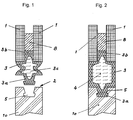
- the window has two panes 1, preferably made of laminated safety glass, and a spacer 8 arranged in between, which is surmounted by the pane edges.
- the glass panes 1 are enclosed in a frame shape by a hollow profile 3.
- One leg 3b of the hollow profile 3 is inserted along the entire window circumference into the groove formed by the spacer 8 between the two panes 1.
- the hollow profile 3 can be fixed to the disks 1 by gluing.
- the hollow profile 3 consists of an elastic plastic. The ends of the hollow profile 3, not shown here, butt together and are tightly connected to one another, depending on the material, for example by gluing, vulcanizing or welding.
- the hollow profile 3 contains a chamber 3c which - similar to a bicycle tube - via a valve 6 with a medium 4 can be filled.
- a self-curing plastic is preferably used, e.g. B. an elastomer with low Shore hardness.
- the shape of the hollow profile 3 increases towards the outside until finally a section 3a engages in a force-transmitting manner in a bedding 5 encircling the window cutout 2 of the car body.
- the cross section of the bed 5 is designed in such a way that there is a form-fitting interaction with the section 3 a of the hollow profile 3 via the contour.
- the assembly of the window is completed after the filled medium 4 has hardened. An expansion of the window is easily possible by cutting the hollow profile 3.
- the bedding 5 can be integrated in vehicle carriers 10 which surround the window cutout 2 of the car body.
- separate profiles 7 are provided in the area of the window section 2, which contain the bedding 5.
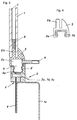
- each of these profiles 7 can consist of three elements 7a, 7b and 7c, which are combined by screws or rivets and at the same time are anchored to a holding plate 9 of the car body.
- the two outer elements 7a and 7c are identical.
- a window with only one glass pane 1 can of course also be installed.
- a corresponding arrangement results, for example, from FIG. 3 by omitting the glass pane 1 on the left in the plane of the drawing and the spacer 8.
Landscapes
- Engineering & Computer Science (AREA)
- Mechanical Engineering (AREA)
- Window Of Vehicle (AREA)
Abstract
Description
- Die Erfindung betrifft eine Verbindung eines Fensters mit einem Wagenkasten, insbesondere eines Schienenfahrzeuges, wobei das Fenster wenigstens eine Glasscheibe aufweist und der Wagenkasten einen Fensterausschnitt enthält.
- Fenster von Schienenfahrzeugen werden häufig im Fahrbetrieb oder durch Vandalismus beschädigt. Bei starker Beschädigung eines Fensters ist die Sicherheit der Fahrgäste nicht mehr gewährleistet. In diesem Fall ist das Fenster auszutauschen. Der Austausch eines Fensters erfordert in der Regel einen hohen Zeitaufwand, wobei das Fahrzeug in dieser Zeit nicht betriebsbereit ist. Somit kann ein Fenstertausch hohe Kosten verursachen. Ziel der Betreiber von Schienenfahrzeugen ist es deshalb, den Zeitaufwand für den Austausch eines Fensters zu reduzieren.
- Bei modernen Schienenfahrzeugen ist es üblich, die Fenster allein durch Kleben oder durch Schrauben und Kleben mit der Rohbaustruktur des Wagenkastens zu verbinden. Solche Verbindungen müssen beim Austausch eines Fensters durch zeitaufwändige Arbeitschritte neu hergestellt werden. Außerdem ist die derzeitige Praxis beim Kleben von Fenstern kein reproduzierbarer Prozess, weil beispielsweise bei der Güte der Klebeflächenvorbereitung, der Menge des aufgetragenen Klebstoffs und bei den klimatischen Bedingungen während der Aushärtung des Klebstoffs (Temperatur, Luftfeuchtigkeit) Schwankungen auftreten können.
- Der Erfindung liegt daher die Aufgabe zugrunde, die Verbindung eines Fensters mit einem Wagenkasten so zu gestalten, dass ein Einbau bzw. ein Ausbau des Fensters in einfacher, reproduzierbarer Weise und innerhalb kurzer Zeit möglich ist.
- Diese Aufgabe wird erfindungsgemäß dadurch gelöst, dass an der Glasscheibe rundum ein Hohlprofil befestigt ist, dessen Gestalt durch Einfüllen eines Mediums nach außen hin derart vergrößert wird, dass ein Abschnitt des Hohlprofils in eine am Fensterausschnitt umlaufende Bettung kraftübertragend eingreift.
- Vorteilhafte Ausgestaltungen der Erfindung sind in den Unteransprüchen angegeben.
- Die mit dem Gegenstand nach der Erfindung erzielbaren Vorteile sind insbesondere:
- Zeiteinsparung beim Einbau von Fenstern, speziell im Vergleich zum Einbau durch Kleben,
- reproduzierbarer Einbau-Prozess; die Prozessparameter wie z. B. der Fülldruck, die eingebrachte Menge an Füllmedium und die Aushärtungszeit können exakt gesteuert werden,
- vereinfachter Prozess, verbunden mit einem geringeren Schulungsaufwand beim Wartungspersonal,
- Einbau von Fenstern an beliebigen Orten und bei jeder Witterung möglich, sogar auf offener Strecke, verbunden mit höherer Verfügbarkeit der Fahrzeuge und Zeiteinsparung, da keine Rückführung von Fahrzeugen in Ausbesserungswerke erforderlich ist.
- Im weiteren wird die Erfindung anhand von zwei Ausführungsbeispielen näher beschrieben, die in der Zeichnung prinzipartig dargestellt sind. Es zeigen
- Fig. 1
- als erstes Ausführungsbeispiel einen Teilbereich eines Fahrzeugfensters und eines Wagenkastens im Querschnitt, in nicht montiertem Zustand,
- Fig. 2
- das Beispiel nach Fig. 1 in montiertem Zustand,
- Fig. 3
- als zweites Ausführungsbeispiel einen Teilbereich eines Fahrzeugfensters und eines Wagenkastens im Querschnitt, in montiertem Zustand,
- Fig. 4
- das in Fig. 1 enthaltene, jedoch nicht befüllte Kunststoffprofil.
- Wie ersichtlich, hat das Fenster zwei Scheiben 1 aus vorzugsweise Verbundsicherheitsglas und einen dazwischen angeordneten Abstandhalter 8, der von den Scheibenrändern überragt wird. Die Glasscheiben 1 sind durch ein Hohlprofil 3 rahmenförmig umschlossen. Ein Schenkel 3b des Hohlprofils 3 ist entlang des gesamten Fensterumfangs in die vom Abstandhalter 8 gebildete Nut zwischen den beiden Scheiben 1 eingeschoben. Zusätzlich kann das Hohlprofil 3 durch Kleben an den Scheiben 1 fixiert sein. Das Hohlprofil 3 besteht aus einem elastischen Kunststoff. Die hier nicht dargestellten Enden des Hohlprofils 3 stoßen stumpf zusammen und sind dicht miteinander verbunden, je nach Material beispielsweise durch Kleben, Vulkanisieren oder Schweißen.
- Das Hohlprofil 3 enthält eine Kammer 3c, die - ähnlich wie ein Fahrradschlauch - über ein Ventil 6 mit einem Medium 4 befüllt werden kann. Als Medium 4 eignen sich prinzipiell alle Gase und Flüssigkeiten, bevorzugt wird jedoch ein selbstaushärtender Kunststoff verwendet, z. B. ein Elastomer mit niedriger Shore-Härte. Durch das Befüllen vergrößert sich die Gestalt des Hohlprofils 3 nach außen hin bis letztlich ein Abschnitt 3a in eine am Fensterausschnitt 2 des Wagenkastens umlaufende Bettung 5 kraftübertragend eingreift. Für die gewollte feste Halterung des Fensters ist im übrigen die Bettung 5 in ihrem Querschnitt so ausgebildet, dass über die Kontur ein formschlüssiges Zusammenwirken mit dem Abschnitt 3a des Hohlprofils 3 besteht. Die Montage des Fensters ist nach dem Aushärten des eingefüllten Mediums 4 abgeschlossen. Ein Ausbau des Fensters ist durch Zerschneiden des Hohlprofils 3 leicht möglich.
- Nach dem Ausführungsbeispiel der Fig. 1 und 2 kann die Bettung 5 in Fahrzeugträgern 10 integriert sein, die den Fensterausschnitt 2 des Wagenkastens umgeben. Alternativ sind gemäß Fig. 3 im Bereich des Fensterausschnitts 2 gesonderte Profile 7 vorgesehen, welche die Bettung 5 enthalten. Jedes dieser Profile 7 kann der Einfachheit halber aus drei Elementen 7a, 7b und 7c bestehen, die durch Schrauben oder Niete vereinigt und zugleich an einem Halteblech 9 des Wagenkastens verankert sind. Die beiden äußeren Elemente 7a und 7c sind identisch ausgebildet.
- Mit Hilfe des befüllbaren Hohlprofils 3 kann natürlich auch ein Fenster mit nur einer Glasscheibe 1 eingebaut werden. Eine entsprechende Anordnung ergibt sich beispielsweise aus Fig. 3 durch Weglassen der in Zeichnungsebene linken Glasscheibe 1 und des Abstandhalters 8.
Claims (6)
- Verbindung eines Fensters mit einem Wagenkasten, insbesondere eines Schienenfahrzeuges, wobei das Fenster wenigstens eine Glasscheibe (1) aufweist und der Wagenkasten einen Fensterausschnitt (2) enthält, dadurch gekennzeichnet, dass an der Glasscheibe (1) rundum ein Hohlprofil (3) befestigt ist, dessen Gestalt durch Einfüllen eines Mediums (4) nach außen hin derart vergrößert wird, dass ein Abschnitt (3a) des Hohlprofils (3) in eine am Fensterausschnitt (2) umlaufende Bettung (5) kraftübertragend eingreift.
- Verbindung nach Anspruch 1, dadurch gekennzeichnet, dass das Hohlprofil (3) aus einem elastischem Kunststoff besteht.
- Verbindung nach Anspruch 1 oder 2, dadurch gekennzeichnet, dass als einfüllbares Medium (4) ein selbstaushärtender Kunststoff vorgesehen ist.
- Verbindung nach einem der Ansprüche 1 bis 3, dadurch gekennzeichnet, dass das Hohlprofil (3) ein Füllventil (6) aufweist.
- Verbindung nach einem der Ansprüche 1 bis 4, dadurch gekennzeichnet, dass im Bereich des Fensterausschnitts (2) die Bettung (5) enthaltende Profile (7) vorgesehen sind.
- Verbindung nach einem der Ansprüche 1 bis 5, dadurch gekennzeichnet, dass die Bettung (5) in ihrem Querschnitt so ausgebildet ist, dass ein formschlüssiges Zusammenwirken mit dem Abschnitt (3a) des Hohlprofils (3) besteht.
Applications Claiming Priority (2)
| Application Number | Priority Date | Filing Date | Title |
|---|---|---|---|
| DE10312741A DE10312741A1 (de) | 2003-03-21 | 2003-03-21 | Verbindung eines Fensters mit einem Wagenkasten, insbesondere eines Schienenfahrzeuges |
| DE10312741 | 2003-03-21 |
Publications (3)
| Publication Number | Publication Date |
|---|---|
| EP1459923A2 true EP1459923A2 (de) | 2004-09-22 |
| EP1459923A3 EP1459923A3 (de) | 2006-12-27 |
| EP1459923B1 EP1459923B1 (de) | 2009-10-28 |
Family
ID=32798031
Family Applications (1)
| Application Number | Title | Priority Date | Filing Date |
|---|---|---|---|
| EP04005183A Expired - Lifetime EP1459923B1 (de) | 2003-03-21 | 2004-03-04 | Verbindung eines Fensters mit einem Wagenkasten, insbesondere eines Schienenfahrzeuges |
Country Status (3)
| Country | Link |
|---|---|
| EP (1) | EP1459923B1 (de) |
| AT (1) | ATE446871T1 (de) |
| DE (2) | DE10312741A1 (de) |
Families Citing this family (1)
| Publication number | Priority date | Publication date | Assignee | Title |
|---|---|---|---|---|
| DE102019104162A1 (de) * | 2019-02-19 | 2020-08-20 | Seitz Gmbh | Fahrzeug- oder Containerfenster und Fensterscheibe |
Family Cites Families (7)
| Publication number | Priority date | Publication date | Assignee | Title |
|---|---|---|---|---|
| GB260115A (en) * | 1925-11-20 | 1926-10-28 | William Raleigh Kerr Gandell | Improvements in or relating to anti-rattling devices for doors and windows |
| US2700196A (en) * | 1950-12-28 | 1955-01-25 | Panhard & Levassor | Inflatable weather strip for mounting vehicle windows in frames |
| US3159884A (en) * | 1962-07-25 | 1964-12-08 | John H Hankey | Inflatable weatherstripping |
| DE2009239A1 (de) * | 1970-02-27 | 1971-09-16 | Klockner Humboldt Deutz AG, 5000KoIn Deutz | Fenster fur Fahrzeuge, insbesondere Omnibusse |
| JPS58126216A (ja) * | 1982-01-18 | 1983-07-27 | Nissan Motor Co Ltd | ウインドまわりのシ−ル構造 |
| CH658107A5 (de) * | 1983-03-25 | 1986-10-15 | Peter Mueller | Verfahren und vorrichtung zum abdichten von zwei teilen eines bewegten koerpers. |
| GB2253659A (en) * | 1991-03-09 | 1992-09-16 | Robert Jackson | A sealing device |
-
2003
- 2003-03-21 DE DE10312741A patent/DE10312741A1/de not_active Ceased
-
2004
- 2004-03-04 AT AT04005183T patent/ATE446871T1/de not_active IP Right Cessation
- 2004-03-04 EP EP04005183A patent/EP1459923B1/de not_active Expired - Lifetime
- 2004-03-04 DE DE502004010283T patent/DE502004010283D1/de not_active Expired - Lifetime
Also Published As
| Publication number | Publication date |
|---|---|
| DE10312741A1 (de) | 2004-10-21 |
| ATE446871T1 (de) | 2009-11-15 |
| EP1459923A3 (de) | 2006-12-27 |
| EP1459923B1 (de) | 2009-10-28 |
| DE502004010283D1 (de) | 2009-12-10 |
Similar Documents
| Publication | Publication Date | Title |
|---|---|---|
| DE19954296C2 (de) | Fahrzeug | |
| DE102014104920B4 (de) | Karosseriestruktur mit Dach-Reling | |
| EP0908356B1 (de) | Stossfänger für ein Fahrzeug | |
| EP0222990A2 (de) | Türsystem für Kraftfahrzeuge | |
| AT13113U1 (de) | Montageverfahren für ein Fenster eines Schienenfahrzeugs und Schienenfahrzeug | |
| DE102004057664A1 (de) | Montageplattform für Kraftfahrzeuge | |
| WO2000003121A1 (de) | Dichtanordnung | |
| EP3625100B1 (de) | Hilfsrahmen zum einsetzen in einen unlösbar mit einer aussenwand verbundenen fensterrahmen, schienenfahrzeug mit einem fenstersystem | |
| EP1459923A2 (de) | Verbindung eines Fensters mit einem Wagenkasten, insbesondere eines Schienenfahrzeuges | |
| DE1257190B (de) | Vorrichtung zum Abstuetzen des Pufferbalkens gegenueber dem Rahmenkopftraeger von Schienenfahrzeugen | |
| EP0598203A1 (de) | Isolierverglasung für eine Fensteröffnung eines Kraftfahrzeuges | |
| DE102016218302A1 (de) | Lagereinrichtung für eine Blattfederanordnung einer Radaufhängung | |
| DE102011119168A1 (de) | Frontspoiler | |
| EP1595761B1 (de) | Höhenverstellbare Stütze für Sattelauflieger oder dergleichen | |
| DE894815C (de) | Verbindung des aus Leichtmetallprofiltraegern bestehenden Traggerippes mit der aus einem anderen Werkstoff bestehenden Aussenhaut von Wagenkasten, insbesondere fuer Kraftfahrzeuge | |
| DE102011011321A1 (de) | Fahrzeugschiebedach und Verfahren zur Fixierung eines Schiebedaches | |
| DE4228881A1 (de) | Karosseriefenster | |
| DE102012205967A1 (de) | Verfahren zum Herstellen einer Fahrwerks- oder Tragstrukturbaugruppe für ein Kraftfahrzeug sowie Einzelkomponente für eine nach diesem Verfahren herzustellende Fahrwerks- oder Tragstrukturbaugruppe | |
| EP2284041A1 (de) | Tritthalterung | |
| DE10325201B4 (de) | Vorrichtung und Verfahren zum Beplanken von Seitenwänden von Fahrzeugen | |
| EP1707466B1 (de) | Befestigungselemente für die Anlenkung eines Drehgestelles an der Bodengruppe eines Niederflur-Schienenfahrzeuges | |
| DE102017110924A1 (de) | Verfahren zum Herstellen einer Fahrzeugtür und Fahrzeugtürsystem | |
| DE202007002585U1 (de) | Wagenkasten für Magnetschwebefahrzeug | |
| DE19700068C2 (de) | Stirnwandabdichtung für Personenübergänge an schienengebundenen Reisezugwagen | |
| DE2615238C2 (de) | Elektrische Grenztastschaltvorrichtung |
Legal Events
| Date | Code | Title | Description |
|---|---|---|---|
| PUAI | Public reference made under article 153(3) epc to a published international application that has entered the european phase |
Free format text: ORIGINAL CODE: 0009012 |
|
| AK | Designated contracting states |
Kind code of ref document: A2 Designated state(s): AT BE BG CH CY CZ DE DK EE ES FI FR GB GR HU IE IT LI LU MC NL PL PT RO SE SI SK TR |
|
| AX | Request for extension of the european patent |
Extension state: AL LT LV MK |
|
| PUAL | Search report despatched |
Free format text: ORIGINAL CODE: 0009013 |
|
| AK | Designated contracting states |
Kind code of ref document: A3 Designated state(s): AT BE BG CH CY CZ DE DK EE ES FI FR GB GR HU IE IT LI LU MC NL PL PT RO SE SI SK TR |
|
| AX | Request for extension of the european patent |
Extension state: AL LT LV MK |
|
| 17P | Request for examination filed |
Effective date: 20070625 |
|
| AKX | Designation fees paid |
Designated state(s): AT BE BG CH CY CZ DE DK EE ES FI FR GB GR HU IE IT LI LU MC NL PL PT RO SE SI SK TR |
|
| 17Q | First examination report despatched |
Effective date: 20071213 |
|
| R17C | First examination report despatched (corrected) |
Effective date: 20080124 |
|
| GRAP | Despatch of communication of intention to grant a patent |
Free format text: ORIGINAL CODE: EPIDOSNIGR1 |
|
| GRAS | Grant fee paid |
Free format text: ORIGINAL CODE: EPIDOSNIGR3 |
|
| GRAA | (expected) grant |
Free format text: ORIGINAL CODE: 0009210 |
|
| AK | Designated contracting states |
Kind code of ref document: B1 Designated state(s): AT BE BG CH CY CZ DE DK EE ES FI FR GB GR HU IE IT LI LU MC NL PL PT RO SE SI SK TR |
|
| REG | Reference to a national code |
Ref country code: GB Ref legal event code: FG4D Free format text: NOT ENGLISH |
|
| REG | Reference to a national code |
Ref country code: CH Ref legal event code: EP Ref country code: CH Ref legal event code: NV Representative=s name: SIEMENS SCHWEIZ AG |
|
| REG | Reference to a national code |
Ref country code: IE Ref legal event code: FG4D |
|
| REF | Corresponds to: |
Ref document number: 502004010283 Country of ref document: DE Date of ref document: 20091210 Kind code of ref document: P |
|
| NLV1 | Nl: lapsed or annulled due to failure to fulfill the requirements of art. 29p and 29m of the patents act | ||
| PG25 | Lapsed in a contracting state [announced via postgrant information from national office to epo] |
Ref country code: PT Free format text: LAPSE BECAUSE OF FAILURE TO SUBMIT A TRANSLATION OF THE DESCRIPTION OR TO PAY THE FEE WITHIN THE PRESCRIBED TIME-LIMIT Effective date: 20100301 Ref country code: ES Free format text: LAPSE BECAUSE OF FAILURE TO SUBMIT A TRANSLATION OF THE DESCRIPTION OR TO PAY THE FEE WITHIN THE PRESCRIBED TIME-LIMIT Effective date: 20100208 Ref country code: FI Free format text: LAPSE BECAUSE OF FAILURE TO SUBMIT A TRANSLATION OF THE DESCRIPTION OR TO PAY THE FEE WITHIN THE PRESCRIBED TIME-LIMIT Effective date: 20091028 Ref country code: SE Free format text: LAPSE BECAUSE OF FAILURE TO SUBMIT A TRANSLATION OF THE DESCRIPTION OR TO PAY THE FEE WITHIN THE PRESCRIBED TIME-LIMIT Effective date: 20091028 |
|
| REG | Reference to a national code |
Ref country code: IE Ref legal event code: FD4D |
|
| PG25 | Lapsed in a contracting state [announced via postgrant information from national office to epo] |
Ref country code: SI Free format text: LAPSE BECAUSE OF FAILURE TO SUBMIT A TRANSLATION OF THE DESCRIPTION OR TO PAY THE FEE WITHIN THE PRESCRIBED TIME-LIMIT Effective date: 20091028 Ref country code: PL Free format text: LAPSE BECAUSE OF FAILURE TO SUBMIT A TRANSLATION OF THE DESCRIPTION OR TO PAY THE FEE WITHIN THE PRESCRIBED TIME-LIMIT Effective date: 20091028 Ref country code: CY Free format text: LAPSE BECAUSE OF FAILURE TO SUBMIT A TRANSLATION OF THE DESCRIPTION OR TO PAY THE FEE WITHIN THE PRESCRIBED TIME-LIMIT Effective date: 20091028 |
|
| PGFP | Annual fee paid to national office [announced via postgrant information from national office to epo] |
Ref country code: FR Payment date: 20100325 Year of fee payment: 7 |
|
| PGFP | Annual fee paid to national office [announced via postgrant information from national office to epo] |
Ref country code: AT Payment date: 20100210 Year of fee payment: 7 Ref country code: GB Payment date: 20100311 Year of fee payment: 7 |
|
| PG25 | Lapsed in a contracting state [announced via postgrant information from national office to epo] |
Ref country code: EE Free format text: LAPSE BECAUSE OF FAILURE TO SUBMIT A TRANSLATION OF THE DESCRIPTION OR TO PAY THE FEE WITHIN THE PRESCRIBED TIME-LIMIT Effective date: 20091028 Ref country code: DK Free format text: LAPSE BECAUSE OF FAILURE TO SUBMIT A TRANSLATION OF THE DESCRIPTION OR TO PAY THE FEE WITHIN THE PRESCRIBED TIME-LIMIT Effective date: 20091028 Ref country code: RO Free format text: LAPSE BECAUSE OF FAILURE TO SUBMIT A TRANSLATION OF THE DESCRIPTION OR TO PAY THE FEE WITHIN THE PRESCRIBED TIME-LIMIT Effective date: 20091028 Ref country code: IE Free format text: LAPSE BECAUSE OF FAILURE TO SUBMIT A TRANSLATION OF THE DESCRIPTION OR TO PAY THE FEE WITHIN THE PRESCRIBED TIME-LIMIT Effective date: 20091028 Ref country code: BG Free format text: LAPSE BECAUSE OF FAILURE TO SUBMIT A TRANSLATION OF THE DESCRIPTION OR TO PAY THE FEE WITHIN THE PRESCRIBED TIME-LIMIT Effective date: 20100128 |
|
| PG25 | Lapsed in a contracting state [announced via postgrant information from national office to epo] |
Ref country code: CZ Free format text: LAPSE BECAUSE OF FAILURE TO SUBMIT A TRANSLATION OF THE DESCRIPTION OR TO PAY THE FEE WITHIN THE PRESCRIBED TIME-LIMIT Effective date: 20091028 Ref country code: SK Free format text: LAPSE BECAUSE OF FAILURE TO SUBMIT A TRANSLATION OF THE DESCRIPTION OR TO PAY THE FEE WITHIN THE PRESCRIBED TIME-LIMIT Effective date: 20091028 |
|
| PLBE | No opposition filed within time limit |
Free format text: ORIGINAL CODE: 0009261 |
|
| STAA | Information on the status of an ep patent application or granted ep patent |
Free format text: STATUS: NO OPPOSITION FILED WITHIN TIME LIMIT |
|
| BERE | Be: lapsed |
Owner name: SIEMENS A.G. Effective date: 20100331 |
|
| 26N | No opposition filed |
Effective date: 20100729 |
|
| PG25 | Lapsed in a contracting state [announced via postgrant information from national office to epo] |
Ref country code: MC Free format text: LAPSE BECAUSE OF NON-PAYMENT OF DUE FEES Effective date: 20100331 Ref country code: GR Free format text: LAPSE BECAUSE OF FAILURE TO SUBMIT A TRANSLATION OF THE DESCRIPTION OR TO PAY THE FEE WITHIN THE PRESCRIBED TIME-LIMIT Effective date: 20100129 |
|
| REG | Reference to a national code |
Ref country code: CH Ref legal event code: PL |
|
| PG25 | Lapsed in a contracting state [announced via postgrant information from national office to epo] |
Ref country code: CH Free format text: LAPSE BECAUSE OF NON-PAYMENT OF DUE FEES Effective date: 20100331 Ref country code: BE Free format text: LAPSE BECAUSE OF NON-PAYMENT OF DUE FEES Effective date: 20100331 Ref country code: LI Free format text: LAPSE BECAUSE OF NON-PAYMENT OF DUE FEES Effective date: 20100331 |
|
| PG25 | Lapsed in a contracting state [announced via postgrant information from national office to epo] |
Ref country code: IT Free format text: LAPSE BECAUSE OF FAILURE TO SUBMIT A TRANSLATION OF THE DESCRIPTION OR TO PAY THE FEE WITHIN THE PRESCRIBED TIME-LIMIT Effective date: 20091028 |
|
| GBPC | Gb: european patent ceased through non-payment of renewal fee |
Effective date: 20110304 |
|
| PG25 | Lapsed in a contracting state [announced via postgrant information from national office to epo] |
Ref country code: AT Free format text: LAPSE BECAUSE OF NON-PAYMENT OF DUE FEES Effective date: 20110304 |
|
| REG | Reference to a national code |
Ref country code: FR Ref legal event code: ST Effective date: 20111130 |
|
| PG25 | Lapsed in a contracting state [announced via postgrant information from national office to epo] |
Ref country code: FR Free format text: LAPSE BECAUSE OF NON-PAYMENT OF DUE FEES Effective date: 20110331 Ref country code: DE Free format text: LAPSE BECAUSE OF NON-PAYMENT OF DUE FEES Effective date: 20111001 |
|
| PG25 | Lapsed in a contracting state [announced via postgrant information from national office to epo] |
Ref country code: GB Free format text: LAPSE BECAUSE OF NON-PAYMENT OF DUE FEES Effective date: 20110304 |
|
| PGFP | Annual fee paid to national office [announced via postgrant information from national office to epo] |
Ref country code: DE Payment date: 20110520 Year of fee payment: 8 |
|
| PG25 | Lapsed in a contracting state [announced via postgrant information from national office to epo] |
Ref country code: HU Free format text: LAPSE BECAUSE OF FAILURE TO SUBMIT A TRANSLATION OF THE DESCRIPTION OR TO PAY THE FEE WITHIN THE PRESCRIBED TIME-LIMIT Effective date: 20100429 Ref country code: LU Free format text: LAPSE BECAUSE OF NON-PAYMENT OF DUE FEES Effective date: 20100304 Ref country code: NL Free format text: LAPSE BECAUSE OF FAILURE TO SUBMIT A TRANSLATION OF THE DESCRIPTION OR TO PAY THE FEE WITHIN THE PRESCRIBED TIME-LIMIT Effective date: 20091028 |
|
| PG25 | Lapsed in a contracting state [announced via postgrant information from national office to epo] |
Ref country code: TR Free format text: LAPSE BECAUSE OF FAILURE TO SUBMIT A TRANSLATION OF THE DESCRIPTION OR TO PAY THE FEE WITHIN THE PRESCRIBED TIME-LIMIT Effective date: 20091028 |
|
| REG | Reference to a national code |
Ref country code: DE Ref legal event code: R119 Ref document number: 502004010283 Country of ref document: DE Effective date: 20121002 |