EP1455000B1 - Matériau métallique dont la surface est modifiée, son procédé de préparation et utilisation du matériau modifié - Google Patents
Matériau métallique dont la surface est modifiée, son procédé de préparation et utilisation du matériau modifié Download PDFInfo
- Publication number
- EP1455000B1 EP1455000B1 EP04004352A EP04004352A EP1455000B1 EP 1455000 B1 EP1455000 B1 EP 1455000B1 EP 04004352 A EP04004352 A EP 04004352A EP 04004352 A EP04004352 A EP 04004352A EP 1455000 B1 EP1455000 B1 EP 1455000B1
- Authority
- EP
- European Patent Office
- Prior art keywords
- metallic material
- group
- diazonium salt
- groups
- diazonium
- Prior art date
- Legal status (The legal status is an assumption and is not a legal conclusion. Google has not performed a legal analysis and makes no representation as to the accuracy of the status listed.)
- Expired - Lifetime
Links
Images










Classifications
-
- C—CHEMISTRY; METALLURGY
- C23—COATING METALLIC MATERIAL; COATING MATERIAL WITH METALLIC MATERIAL; CHEMICAL SURFACE TREATMENT; DIFFUSION TREATMENT OF METALLIC MATERIAL; COATING BY VACUUM EVAPORATION, BY SPUTTERING, BY ION IMPLANTATION OR BY CHEMICAL VAPOUR DEPOSITION, IN GENERAL; INHIBITING CORROSION OF METALLIC MATERIAL OR INCRUSTATION IN GENERAL
- C23C—COATING METALLIC MATERIAL; COATING MATERIAL WITH METALLIC MATERIAL; SURFACE TREATMENT OF METALLIC MATERIAL BY DIFFUSION INTO THE SURFACE, BY CHEMICAL CONVERSION OR SUBSTITUTION; COATING BY VACUUM EVAPORATION, BY SPUTTERING, BY ION IMPLANTATION OR BY CHEMICAL VAPOUR DEPOSITION, IN GENERAL
- C23C22/00—Chemical surface treatment of metallic material by reaction of the surface with a reactive liquid, leaving reaction products of surface material in the coating, e.g. conversion coatings, passivation of metals
- C23C22/05—Chemical surface treatment of metallic material by reaction of the surface with a reactive liquid, leaving reaction products of surface material in the coating, e.g. conversion coatings, passivation of metals using aqueous solutions
- C23C22/06—Chemical surface treatment of metallic material by reaction of the surface with a reactive liquid, leaving reaction products of surface material in the coating, e.g. conversion coatings, passivation of metals using aqueous solutions using aqueous acidic solutions with pH less than 6
- C23C22/48—Chemical surface treatment of metallic material by reaction of the surface with a reactive liquid, leaving reaction products of surface material in the coating, e.g. conversion coatings, passivation of metals using aqueous solutions using aqueous acidic solutions with pH less than 6 not containing phosphates, hexavalent chromium compounds, fluorides or complex fluorides, molybdates, tungstates, vanadates or oxalates
-
- C—CHEMISTRY; METALLURGY
- C09—DYES; PAINTS; POLISHES; NATURAL RESINS; ADHESIVES; COMPOSITIONS NOT OTHERWISE PROVIDED FOR; APPLICATIONS OF MATERIALS NOT OTHERWISE PROVIDED FOR
- C09D—COATING COMPOSITIONS, e.g. PAINTS, VARNISHES OR LACQUERS; FILLING PASTES; CHEMICAL PAINT OR INK REMOVERS; INKS; CORRECTING FLUIDS; WOODSTAINS; PASTES OR SOLIDS FOR COLOURING OR PRINTING; USE OF MATERIALS THEREFOR
- C09D5/00—Coating compositions, e.g. paints, varnishes or lacquers, characterised by their physical nature or the effects produced; Filling pastes
- C09D5/44—Coating compositions, e.g. paints, varnishes or lacquers, characterised by their physical nature or the effects produced; Filling pastes for electrophoretic applications
- C09D5/4476—Coating compositions, e.g. paints, varnishes or lacquers, characterised by their physical nature or the effects produced; Filling pastes for electrophoretic applications comprising polymerisation in situ
-
- C—CHEMISTRY; METALLURGY
- C23—COATING METALLIC MATERIAL; COATING MATERIAL WITH METALLIC MATERIAL; CHEMICAL SURFACE TREATMENT; DIFFUSION TREATMENT OF METALLIC MATERIAL; COATING BY VACUUM EVAPORATION, BY SPUTTERING, BY ION IMPLANTATION OR BY CHEMICAL VAPOUR DEPOSITION, IN GENERAL; INHIBITING CORROSION OF METALLIC MATERIAL OR INCRUSTATION IN GENERAL
- C23C—COATING METALLIC MATERIAL; COATING MATERIAL WITH METALLIC MATERIAL; SURFACE TREATMENT OF METALLIC MATERIAL BY DIFFUSION INTO THE SURFACE, BY CHEMICAL CONVERSION OR SUBSTITUTION; COATING BY VACUUM EVAPORATION, BY SPUTTERING, BY ION IMPLANTATION OR BY CHEMICAL VAPOUR DEPOSITION, IN GENERAL
- C23C22/00—Chemical surface treatment of metallic material by reaction of the surface with a reactive liquid, leaving reaction products of surface material in the coating, e.g. conversion coatings, passivation of metals
- C23C22/02—Chemical surface treatment of metallic material by reaction of the surface with a reactive liquid, leaving reaction products of surface material in the coating, e.g. conversion coatings, passivation of metals using non-aqueous solutions
-
- C—CHEMISTRY; METALLURGY
- C25—ELECTROLYTIC OR ELECTROPHORETIC PROCESSES; APPARATUS THEREFOR
- C25D—PROCESSES FOR THE ELECTROLYTIC OR ELECTROPHORETIC PRODUCTION OF COATINGS; ELECTROFORMING; APPARATUS THEREFOR
- C25D11/00—Electrolytic coating by surface reaction, i.e. forming conversion layers
-
- C—CHEMISTRY; METALLURGY
- C25—ELECTROLYTIC OR ELECTROPHORETIC PROCESSES; APPARATUS THEREFOR
- C25D—PROCESSES FOR THE ELECTROLYTIC OR ELECTROPHORETIC PRODUCTION OF COATINGS; ELECTROFORMING; APPARATUS THEREFOR
- C25D9/00—Electrolytic coating other than with metals
- C25D9/02—Electrolytic coating other than with metals with organic materials
-
- Y—GENERAL TAGGING OF NEW TECHNOLOGICAL DEVELOPMENTS; GENERAL TAGGING OF CROSS-SECTIONAL TECHNOLOGIES SPANNING OVER SEVERAL SECTIONS OF THE IPC; TECHNICAL SUBJECTS COVERED BY FORMER USPC CROSS-REFERENCE ART COLLECTIONS [XRACs] AND DIGESTS
- Y10—TECHNICAL SUBJECTS COVERED BY FORMER USPC
- Y10T—TECHNICAL SUBJECTS COVERED BY FORMER US CLASSIFICATION
- Y10T428/00—Stock material or miscellaneous articles
- Y10T428/31504—Composite [nonstructural laminate]
- Y10T428/31536—Including interfacial reaction product of adjacent layers
-
- Y—GENERAL TAGGING OF NEW TECHNOLOGICAL DEVELOPMENTS; GENERAL TAGGING OF CROSS-SECTIONAL TECHNOLOGIES SPANNING OVER SEVERAL SECTIONS OF THE IPC; TECHNICAL SUBJECTS COVERED BY FORMER USPC CROSS-REFERENCE ART COLLECTIONS [XRACs] AND DIGESTS
- Y10—TECHNICAL SUBJECTS COVERED BY FORMER USPC
- Y10T—TECHNICAL SUBJECTS COVERED BY FORMER US CLASSIFICATION
- Y10T428/00—Stock material or miscellaneous articles
- Y10T428/31504—Composite [nonstructural laminate]
- Y10T428/31678—Of metal
Definitions
- the subject of the invention is a metal material whose surface is modified, its method of preparation and the use of the modified material.
- the monolayers obtained with a large diversity of diazonium salts were characterized by different methods: cyclic voltammetry, photoelectron spectroscopy (XPS), vibrational spectroscopy (PMIRRAS -Polarization Modulation InfraRed Reflexion Absorption Spectroscopy- and Raman spectroscopy [2] ) , Rutherford backscattering spectroscopy (RBS).
- XPS photoelectron spectroscopy
- PMIRRAS -Polarization Modulation InfraRed Reflexion Absorption Spectroscopy- and Raman spectroscopy [2] ) Rutherford backscattering spectroscopy (RBS).
- the grafting takes place on the pendent bonds of vitreous carbon, but also on the basic plane of Highly Oriented Pyrolytic Graphite (HOPG) (that is to say on sp 2 carbons).
- HOPG Highly Oriented Pyrolytic Graphite
- the invention particularly relates to the grafting of aromatic groups on the surface of metallic material.
- the invention particularly relates to the stable grafting over time of aromatic groups on the surface of a metallic material.
- the subject of the invention is a metallic material whose surface is modified by linking aromatic groups to said surface, optionally substituted with functional groups.
- aromatic group means a radical derived from a cyclic compound comprising one or more independent or fused benzene rings, and / or one or more complex nuclei derived from benzene.
- This radical can of course also comprise heterocyclic rings and / or various substituents as well as hydrocarbon chains optionally comprising heteroatoms such as N, O and S.
- metal material whose surface is modified by aromatic group bonds to said surface means that on the surface of the metallic material is grafted a layer which may have a minimum thickness of approximately 10 ⁇ , ie be a monolayer.
- the grafted layers on the surface of the metallic material according to the invention have a thickness ranging from about 10 ⁇ to about 1 mm.
- the nature of the bond between the surface and the aromatic groups which modify it is a carbon-metal bond of the covalent type, and is in particular such that it withstands ultrasonic washing.
- covalent carbon-metal means a strong non-ionic bond obtained by overlapping the orbitals of carbon and metal.
- the aromatic group is a C 6 -C 14 aromatic residue, optionally substituted by one or more functional substituents or a heteroaromatic residue of 4 to 14 atoms, optionally substituted. by one or more functional substituents, comprising one or more heteroatoms selected from oxygen, nitrogen, sulfur or phosphorus.
- the metallic material according to the invention is such that the aromatic group comprises one or more substituents capable of reacting directly with a substrate, or one or more precursor substituents which, after transformation, are capable of reacting with a substrate, said substrate being selected in the group consisting of organic resins, biological molecules, chemical molecules or complexing agents.
- the aromatic group comprises one or more substituents capable of reacting directly with a biological molecule and chosen from the group consisting of (CH 2 ) n -COOH, (CH 2 ) n -NH 2 , n being an integer between 0 and 10, or one or more precursor substituents capable of reacting after transformation with a biological molecule and selected from the group consisting of NO 2 , N 2 + , (CH 2 ) n -CN, (CH 2 ) n -CHO, (CH 2 ) n -COOPr, Pr being a protecting group, n being an integer from 0 to 10.
- the aromatic group comprises one or more substituents capable of reacting directly with functional organic molecules and chosen from the group consisting of NO 2 , (CH 2 ) n -CONH 2 , (CH 2 ) n -CN, (CH 2 ) n -CHO, (CH 2 ) n -COOH, (CH 2 ) n -CH 2 OH, (CH 2 ) n -NH 2 , n being an integer between 0 and 10, SO 2 H, SO 3 H, SO 2 R, SO 3 R, R being an aliphatic or aromatic carbon chain of 1 to 20 carbon atoms, or one or more precursor substituents capable of reacting after transformation with organic molecules that are functional and selected from the group consisting of NO 2 , (CH 2 ) n -CONH 2 , (CH 2 ) n -COOPr, Pr being a protecting group, (CH 2 ) n -NHP'r, (CH 2 ) n -
- diazonium salts will be identified by their number, as indicated as above.
- the metal is chosen from pure metals or alloys, and in particular iron, nickel, platinum, gold, copper, zinc, cobalt, titanium, chromium, silver, stainless steels, titanium alloys, cobalt chromium alloys, molybdenum, manganese, vanadium.
- the metallic material In order to prepare the metallic material according to the invention, it is possible to use a process consisting in fixing on the surface of this material an aromatic group, by electrochemical reduction of a diazonium salt comprising this aromatic group, by bringing the material into contact with one another. metal with a solution of the diazonium salt in a solvent and negatively polarizing the metallic material with respect to an anode also in contact with the solution of the diazonium salt, the anode and the cathode being optionally separated from one of the other, for example by a diaphragm or a membrane.
- the electrochemical reduction of the diazonium cation ArN + 2 corresponds to the following reaction scheme: ArN + 2 + 1e - ⁇ ArN 2 • ⁇ Ar • + N 2
- the reduction of the diazonium cation releases the aromatic group from the diazonium salt as a free radical which can attack the surface of the metal material to attach to it.
- diazonium salts are based on the fact that they are more easily reducible than the radical to which they give rise. According to the invention, it is therefore necessary that the reduction potential of the diazonium salt used is less negative than the reduction potential of the free radical Ar • corresponding to the aromatic group of this diazonium salt.
- the anode and the cathode are not separated.
- the cathode plunge into the solution containing the diazonium salt.
- Two electrodes are enough to work in intentiostatic mode.
- a reference electrode must be added plunging into the same solution if working in potentiostatic mode.
- the anode and the cathode are separated, for example by a diaphragm or a membrane.
- the invention also relates to a method in which the electrochemical reduction takes place in the presence of an electrolyte, the anode and cathode compartment being optionally separated, the anode compartment comprising the solvent and the electrolyte, the cathode compartment comprising the solvent, the electrolyte and the diazonium salt.
- the electrochemical reduction can take place in the presence of an electrolyte.
- the anode and the cathode may not be separated.
- the anode and the cathode can be separated by a membrane or a diaphragm.
- Two electrodes are sufficient in intentiostatic mode.
- potentiostatic mode it is necessary to add a reference electrode in the cathode compartment.
- the diazonium salt corresponds to the formula ArN 2 + X - , in which Ar represents the aromatic group and X represents an anion and in that this diazonium salt has a reduction potential less negative than the reduction potential of the free radical Ar ° corresponding to the aromatic group of the diazonium salt, the anion X - of the diazonium salt being advantageously chosen from halogens, sulphates, phosphates, perchlorates, tetrafluoroborates, carboxylates, hexafluorophosphates.
- the reduction is carried out by repetitive cyclic voltammetry in a potential range where the diazonium salts are reduced or by electrolysis at a more negative potential than the reduction potential of the sodium salt. diazonium, or constant current (intentiostatic mode).
- Successive scans are performed between a less negative potential than the reduction wave of the diazonium salt and a more negative potential than the reduction wave.
- the potential of the cathode is then set at the diazonium salt reduction wave or at a more negative potential than the potential of the diazonium salt reduction wave.
- the electrolysis current is fixed at a value such that only the diazonium salt is reduced.
- the concentration of diazonium salts is between 10 -3 and 10 -1 mol / l.
- the aromatic diazonium salt is substituted with a nitro radical and the electrochemical reduction. is maintained until the reduction of the nitro radical to amino radical in the aqueous acidic medium.
- the electrochemical reduction of the diazonium salt takes place in an aprotic solvent, in particular chosen from the group comprising acetonitrile, dimethylformamide, dimethylsulfoxide and benzonitrile.
- the solution of the diazonium salt comprises a support electrolyte consisting of a quaternary ammonium salt or a lithium salt, especially a tetralkylammonium tetrafluoborate.
- the electrochemical reduction of the organic diazonium salt can take place in a protic solvent in an acid medium.
- the protic solvent is chosen from the group consisting of water, methanol, ethanol or their mixtures, or in that the protic solvent is in a mixture with an aprotic solvent being understood that the resulting mixture has the characteristics of a protic solvent.
- the acid is chosen from sulfuric, hydrochloric, nitric, nitrous, phosphoric or tetrafluoroboric acids.
- the pH of the solution is less than 2.
- the invention also relates to a metallic material as obtained by carrying out the method described above.
- the metallic material according to the invention can be characterized in that the bond between its surface and the aromatic groups which modify it is such that, when an anodic scanning is carried out starting from the corrosion potential of the metal forming the surface of the material metal, there is at least one potential responsible for the dissolution of a detectable amount of the above metal but which does not destroy the aforesaid connection.
- the metallic material according to the invention can also be characterized in that the nature of the bond between its surface and the aromatic groups which modify it is such that, when an anodic scanning ranging from the corrosion potential to a higher potential is applied. anodic about 75 mV, the metal material whose surface is modified, there is no breakage of the aforesaid connection, but dissolution of a detectable amount of the metal forming the surface of the metal material.
- the diazonium salt is either prepared independently and before its addition, in a reactor, for the purpose of modifying the surface of the metallic material, or is prepared in situ , by bringing together, in a reactor, the components necessary for its formation, according to the conventional methods of the prior art.
- ACN comes from Merck (Uvasol), H 2 SO 4 from Prolabo (Tritrinorm) and NBu 4 BF 4 from Fluka (puriss.).
- the diazonium salts: 1 and 11 are of commercial origin (Aldrich), the synthesis of 3 has been described [1c] ; 2, 3-6, 9, 10 were obtained from commercial amines by standard methods. [27] .
- the diazonium salts are stored in a refrigerator.
- the electrodes were prepared from metal wire for example, wire of diameter 1mm (Johnson-Matthey 99.99%) sealed in epoxy resin or from soft iron buttons of 3mm in diameter held in a greenhouse in Teflon. Mild steel plates (containing Fe: 95.68%; C: 0.31%; Mn: 2.03%; P: 0.05%; S: 0.13%; N: 0.56%; Si: 0.10%; Cu: 0.07%; 0.18%, Cr: 0.30%, Sn: 0.01%, Al: 0.58%) were donated by Sollac.
- Electrochemical equipment Electrochemical curves were obtained using a laboratory-built potentiostat or an EGG Versastat II system. Impedance measurements were obtained with an EGG 263A potentiostat and a 5210 EGG lock-in amplifier. The frequencies explored ranged from 0.001 Hz to 20 kHz and the corrosion currents were obtained from the Tafel lines with EGG corrosion software.
- Electrochemical evidence of grafting The grafting reaction was studied both in aprotic medium [Acetonitrile (ACN) + 0.1M NBu 4 BF 4 ] and in aqueous acidic medium (the diazonium salts are not stable in aqueous medium above pH 2) .
- ACN + 0.1M NBu 4 BF 4 an iron electrode has an electroactivity range which is between -0.1 and -2.3V / ECS; in diluted sulfuric acid (0.1 N) this area is reduced to nothing.
- the potential in open circuit (potential of corrosion) [10] is located at -0.58 V / ECS it corresponds to a mixed potential since the reactions of reduction and oxidation are different.
- the anodic or cathodic partial current flowing at this potential is called the corrosion current (I corr ).
- the corrosion current As soon as potential is shifted to positive potentials, the iron oxidation current predominates while it is the reduction of protons or oxygen that predominates when the potential is shifted to negative values [11] . It must be remembered that even at the corrosion potential, where the current is zero, the phenomena of iron oxidation and proton reduction and / or oxygen take place simultaneously. At the corrosion potential the two currents are equal.
- the field of electroactivity is therefore quite different from that of a carbon electrode and it is not always possible, as we have described previously, [1] to observe the wave of reduction of diazonium salts. located near 0 V / ECS.
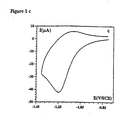
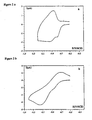
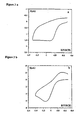
- FIGS 2a, 2b show the results obtained with the diazonium salt 11 which is a commercial diazonium salt of anthraquinone.
- This voltammogram (FIG. 3) is similar to that of anthraquinone in ACN + 0.1 M NBu 4 BF 4 on an iron electrode previously held in a 0.1 N H 2 SO 4 solution for five minutes.
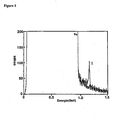
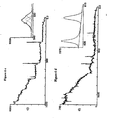
- Vibration spectra of the organic layer As in the case of organic monolayers on carbon it is difficult to obtain infrared spectra of monolayers by reflection. However, this can be achieved by PMIRRAS (Polarization Modulation InfraRed Absorption Spectroscopy [12] ) Spectra were recorded on mild steel plates (industrial material that is interesting to protect against corrosion). Before grafting, the plates were carefully polished and rinsed in the absence of oxygen in an ultrasonic tank. An ungrafted plate has absorptions at 1050-1100 cm -1 which are characteristic of oxides as well as absorptions at 1400 and 1600-1700 cm -1 which correspond to carbonates and hydrogen carbonates (which probably come from reaction with carbon dioxide after grafting) ( Figure 4a).
- the analysis shows that the grafting is homogeneous over the entire surface of the sample and remains stable under the ion beam.
- the optimum value of the potential is -0.75 V / SCE corresponding to a maximum surface concentration; at more positive potentials grafting competes with surface oxidation and with the reduction of protons to more negative potentials. The surface concentrations will be discussed later.
- Photoelectron X Spectroscopy (XPS): It should be noted that the RBS and XPS spectroscopies are complementary surface analysis methods since the sampling depth of the former is about two orders of magnitude lower than that of the second.
- Figures 6a, 6b, 6c, 6d show the full spectrum of a mild steel plate ( Figure 6a) and plates grafted with 4-nitrophenyl ( Figure 6b), 4-carboxyphenyl ( Figure 6c) and 4- iodophenyl ( Figure 6d). All these general spectra show peaks C [1s] , O [1s] , F [2p] at energies of 285, 530 and 710 eV.
- Figure 6b clearly shows the grafting of diazonium salt 1 after electrochemical treatment.
- This grafting results in a marked increase in the relative intensity of the peak C [1s] and a small peak at about 400eV.
- the enlargement of this region shows two peaks centered at 400 and 406 eV, the latter corresponding to the nitro group, while the former may be due to either contamination or reduction products of the nitro group.
- the peak O [1s] was adjusted with a component at 533 eV, a characteristic energy of the oxygen of a nitro group [14] , together with a component with lower binding energy due to iron oxides.
- the mild steel plate is modified with 4-iodophenyl groups, the signal of the iodine atom can be observed at 621 eV (4.2%) ( Figure 6d).
- the C / I ratio of 6.25 is close to what can be expected for an iodophenyl group.
- the same mild steel plate polished and cleaned as before has been soaked in a solution of the sodium salt.
- diazonium 2 in ACN + 0.1M NBu 4 BF 4 Under these conditions, a weak signal corresponding to iodine (0.45%) is observed. This weak signal may be due to a spontaneous reaction of the diazonium salt 2 with iron as explained above.
- XPS spectra were also used to verify that the grafting took place on the surface of the iron and not on the oxide that may still be present on the surface.
- Two plates were passivated in H 2 SO 4 1N by sweeping the potential up to + 1V / ECS (a potential located in the iron passivation zone); passivation by the oxide layer can then be observed by increasing the oxygen peak from about 20% to about 40%).
- One of them is soaked in a solution of the diazonium salt 2 in ACN + 0.1 M NBu 4 BF 4 while the other was grafted as previously in the same solution. In both cases, only a weak signal of iodine corresponding to 0.3 and 0.4% is observed. These signals are much smaller than those observed (4.2%) on a polished plate and previously cleaned and then grafted as above. This clearly indicates that the grafting of the aryl groups takes place on the iron and not on the oxide layer.
- Electrode Capability Attaching an organic layer to the surface of the electrode should decrease the capacitance of this electrode by adding an additional insulating layer in series with the dual layer.
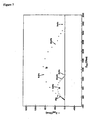
- the capacity can be measured by an impedance method; we recorded the Nyquist diagram (Z Im vs Z Re ) ( Figure 7 ). It is then possible from the frequency of the maximum to obtain C d [15] .
- the capacity of a pure iron electrode of 3mm diameter in H 2 SO 4 0.1N is 207 ⁇ F / cm 2 . After modification of the electrode with 4-hexadecyloxyphenyl groups (by reduction of the diazonium salt 8 in H 2 SO 4 0.1N) the capacity falls to 122 ⁇ F / cm 2.
- the second method is based on the integration of the RBS spectra, in this case, it must be certain that only the grafted area of the electrode is included in the beam and that the surface is stable under the ion beam. Both methods provide values that are relative to the geometric surface (i.e., 1cm 2 for a 1cm x 1cm plate) of the electrode previously polished with 1 ⁇ m diamond paste.
- the surface concentrations are higher than the values obtained in H 2 SO 4 0.1N, this can be due to the oxidation of the surface in the sulfuric acid which decreases the available surface for grafting aryl groups, or to hydrogen atoms formed on the surface or having penetrated the metal [16] and changing the properties of the surface would make the electrochemical reaction more difficult.
- the surface concentrations of Table 1 can be compared with those previously measured on carbon and in particular on HOPG (the geometric surface of which is very close to the real surface).
- the surface concentration of 4-nitrophenyl groups is 12 to 18 10 -10 mol / cm 2 [1,2] on HOPG, but on vitreous carbon, polished under the same conditions as iron plates, a value of 40 10 - 10 mol / cm 2 was obtained by reduction of the diazonium salt 1 . There is therefore a good agreement between the values obtained for steel and carbon.
- the first transition time corresponds to the reduction of the diazonium function. Virtually identical transition times were measured for carbon and iron.
- the effect of the organic layer was estimated by measuring two parameters: the polarization resistance R p and the corrosion current corr .
- the iron or mild steel electrodes were carefully polished and etched with constant cathodic current in HClO 4 [17] and then allowed to stabilize in the measuring medium for about three hours at open circuit potential whose value may change over time [17] .
- the polarization resistances were obtained either from the slope of the curve obtained by anodically and cathodically sweeping the potentials at 0.1 mV / s using the method of Stem and Geary [18,19] or from the impedance diagrams .
- the rate of corrosion is slowed down both in an acid environment where protons are the main oxidizing species and in a neutral medium where oxygen is responsible for corrosion.
- acidic medium the potential for corrosion is shifting towards cathodic potentials, which can be attributed to predominant cathodic inhibition [23] .
- the potential of corrosion moves anodically indicating that the organic film makes the oxidation of iron more difficult.
- anodic scan of 75 mV corresponds to the consumption of 9.8 mC, ie 5 10 -8 moles of dissolved iron (which was verified by assaying the solution by atomic absorption spectroscopy. ). This shows that during anodic scanning the organic groups are detached from the surface at the same time as iron atoms.
- the results of the invention can also be compared with the adsorption on iron of the long-chain alkanethiols (C 12 , C 18 ) subjected to the action of octyltriethoxysilane so as to increase the length of the chains and at the same time to ensure a lateral connection between the chains.
- the transfer resistance increases about 4 times, and about 4.5 times after reaction with octyltriethoxysilane.
- the major disadvantage of this process is that the thiol is slowly desorbed from the surface. This modification of the surface is not stable.
- the organic layer is not solidly grafted and can be removed in an ultrasonic tank, while the graft layer according to the method of the invention is resistant.
- the metal surfaces have also been covalently modified by electrochemical reduction of vinyl monomers such as acrylonitrile, methacrylonitrile or butenenitrile.
- Thin polymer films ( ⁇ 10 to 50 nm) covalently bonded to the surface have been carefully studied [24,25] and have proved effective in protecting against corrosion. [26] .
- the grafted layer is of the alkyl type, the first carbon bonded to the metal is an aliphatic saturated carbon, whereas according to the invention it is an aromatic carbon which is related to the metal.
- the invention makes it possible to graft unpolymerized monolayers while the organic layer obtained from vinyl monomers is necessarily a polymer; b) the process using the vinyl monomers involves the use of a monomer that polymerizes, while the invention allows to preform the polymer (allowing all structural variations), put it in solution and then attach it by chemical reaction on an organic layer previously grafted to the surface of the metal c) the invention makes it possible to preform a polymer having aminophenyl groups, transforming these amine functional groups into diazonium salts and then grafting the polymer thus functionalized, which is impossible in the case the use of vinyl monomers.
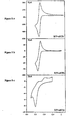
- Figures 8a, 8b, 8c show the voltamogram of anthracene (in ACN + 0.1M NBu 4 BF 4 ) on a carbon electrode (8a), on a zinc electrode (8b) and finally an electrode grafted to -1.1 V / ECS in a 2mM solution of 10 in ACN + 0.1M NBu 4 BF 4 , carefully rinsed in an ultrasonic tank and transferred to a solution containing only acetonitrile and bottom salt (8c).
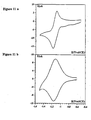
- FIGS. 10a, 10b and 11a, 11b show a copper electrode in a solution of anthraquinone and nitrobenzene respectively and the same electrode grafted with anthraquinone and nitrophenyl groups. The similarity of the potentials of the reversible systems testifies to the grafting of copper.
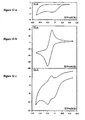
- FIGS. 12a, 12b similar to FIGS. 11a, 11b on copper, show the grafting on a surface of nickel (there is observed on the grafted electrode a prevagus at a less negative potential than the wave of the 4-nitrophenyl group). The similarity of the potentials of the reversible systems indicates that on nickel, the grafting takes place.
- the XPS spectrum of the surface confirms the grafting of the surface by 4-nitrophenyl groups.
- Table 4 XPS spectra of a titanium surface grafted with 4-nitrophenyl groups. Ti% 459 and 464 eV VS% O% NOT% Polished titanium plate 33.5 23.0 42.6 533 eV 2.7 401 eV 1.0 406 eV 0 Grafted titanium plate 14.9 42.0 38.4 533eV 15.3 401eV 1.6 406 eV 3.3
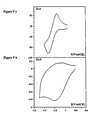
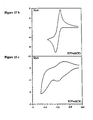
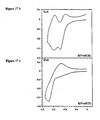
- FIGS. 17a, 17b, 17c similarly show the voltammogram of 1 on a 316 stainless steel electrode (FIG. 17a), 4-nitrophenyl groups electrolytically grafted in ACN + 0.1M NBu 4 BF 4 + 2 mM 1 at -0.2 V / ECS (FIG. 17b) and nitrobenzene in the same solution (FIG. 17c).
- the XPS spectrum confirms the grafting. Table 5.
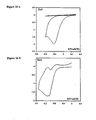
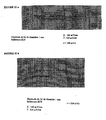
- Figure 19 is obtained by scanning the iron electrode between -0.6V and -1.8 V in the presence of nitrobenzene (1 mM concentration) in a solution of acetonitrile + salt (0.1 MN 4 BuF 4 ). Twenty scans are then performed between the same potentials. The method used is the same as that used to graft the diazonium salts.
- Figure 21B is obtained by sweeping the iron electrode between -0.6V and -1.6 V in the presence of p-nitrophenol (1 mM concentration) in a solution of acetonitrile + bottom salt (0.1 MN 4 BuF 4 ) . Twenty scans are then performed between the same potentials. The method used is the same as that used to graft the diazonium salts. (Figure 21A is the white of the electrode).
Landscapes
- Chemical & Material Sciences (AREA)
- Engineering & Computer Science (AREA)
- Materials Engineering (AREA)
- Organic Chemistry (AREA)
- Metallurgy (AREA)
- Chemical Kinetics & Catalysis (AREA)
- Electrochemistry (AREA)
- Mechanical Engineering (AREA)
- Life Sciences & Earth Sciences (AREA)
- General Chemical & Material Sciences (AREA)
- Health & Medical Sciences (AREA)
- Molecular Biology (AREA)
- Wood Science & Technology (AREA)
- Organic Low-Molecular-Weight Compounds And Preparation Thereof (AREA)
- Chemically Coating (AREA)
- Electrolytic Production Of Non-Metals, Compounds, Apparatuses Therefor (AREA)
- Chemical Treatment Of Metals (AREA)
- Carbon And Carbon Compounds (AREA)
- Laminated Bodies (AREA)
Applications Claiming Priority (3)
| Application Number | Priority Date | Filing Date | Title |
|---|---|---|---|
| FR0001716A FR2804973B1 (fr) | 2000-02-11 | 2000-02-11 | Materiau metallique dont la surface est modifiee, son procede de preparation et utilisation du materiau modifie |
| FR0001716 | 2000-02-11 | ||
| EP01907754A EP1255877A1 (fr) | 2000-02-11 | 2001-02-09 | Materiau metallique dont la surface est modifiee, son procede de preparation et utilisation du materiau modifie |
Related Parent Applications (1)
| Application Number | Title | Priority Date | Filing Date |
|---|---|---|---|
| EP01907754A Division EP1255877A1 (fr) | 2000-02-11 | 2001-02-09 | Materiau metallique dont la surface est modifiee, son procede de preparation et utilisation du materiau modifie |
Publications (3)
| Publication Number | Publication Date |
|---|---|
| EP1455000A2 EP1455000A2 (fr) | 2004-09-08 |
| EP1455000A3 EP1455000A3 (fr) | 2005-07-27 |
| EP1455000B1 true EP1455000B1 (fr) | 2006-10-25 |
Family
ID=8846904
Family Applications (2)
| Application Number | Title | Priority Date | Filing Date |
|---|---|---|---|
| EP04004352A Expired - Lifetime EP1455000B1 (fr) | 2000-02-11 | 2001-02-09 | Matériau métallique dont la surface est modifiée, son procédé de préparation et utilisation du matériau modifié |
| EP01907754A Withdrawn EP1255877A1 (fr) | 2000-02-11 | 2001-02-09 | Materiau metallique dont la surface est modifiee, son procede de preparation et utilisation du materiau modifie |
Family Applications After (1)
| Application Number | Title | Priority Date | Filing Date |
|---|---|---|---|
| EP01907754A Withdrawn EP1255877A1 (fr) | 2000-02-11 | 2001-02-09 | Materiau metallique dont la surface est modifiee, son procede de preparation et utilisation du materiau modifie |
Country Status (12)
| Country | Link |
|---|---|
| US (2) | US7182822B2 (enExample) |
| EP (2) | EP1455000B1 (enExample) |
| JP (1) | JP4733330B2 (enExample) |
| AT (1) | ATE343662T1 (enExample) |
| AU (1) | AU2001235645A1 (enExample) |
| CA (1) | CA2398236C (enExample) |
| DE (1) | DE60124153T2 (enExample) |
| DK (1) | DK1455000T3 (enExample) |
| ES (1) | ES2273106T3 (enExample) |
| FR (1) | FR2804973B1 (enExample) |
| IL (1) | IL150839A (enExample) |
| WO (1) | WO2001059178A1 (enExample) |
Families Citing this family (20)
| Publication number | Priority date | Publication date | Assignee | Title |
|---|---|---|---|---|
| FR2829046B1 (fr) * | 2001-08-28 | 2005-01-14 | Commissariat Energie Atomique | Procede de greffage et de croissance d'un film organique conducteur sur une surface |
| FR2837842B1 (fr) * | 2002-03-26 | 2004-06-18 | Commissariat Energie Atomique | Procede de fixation de macro-objets sur une surface conductrice ou semi-conductrice de l'electricite par electro-greffage, surfaces obtenues et applications |
| FR2889206B1 (fr) * | 2005-07-26 | 2007-10-12 | Commissariat Energie Atomique | Materiau conducteur ou semi-conducteur modifie par greffage electrochimique de films polymeres |
| FR2892325B1 (fr) * | 2005-10-26 | 2008-01-18 | Alchimer Sa | Procede de modification de surfaces isolantes, semi-conductrices ou metalliques, et produits tels qu'obtenus |
| EP1994101B1 (en) | 2006-02-28 | 2014-12-31 | Alchimer | Formation of organic electro-grafted films on the surface of electrically conductive or semi-conductive surfaces |
| FR2897876B1 (fr) * | 2006-02-28 | 2008-04-18 | Commissariat Energie Atomique | Procede de formation de films organiques sur des surfaces conductrices ou semi-conductrices de l'electricite a partir de solutions aqueuses |
| EP1989345B1 (fr) * | 2006-02-28 | 2015-03-11 | Commissariat à l'Énergie Atomique et aux Énergies Alternatives | Procede de formation de films organiques sur des surfaces conductrices ou semi-conductrices de l'electricite a partir de solutions aqueuses |
| US8152986B2 (en) * | 2006-02-28 | 2012-04-10 | Commissariat A L'energie Atomique | Process for forming organic films on electrically conductive or semi-conductive surfaces using aqueous solutions |
| FR2907131B1 (fr) | 2006-10-12 | 2008-11-21 | Commissariat Energie Atomique | Procede de formation de films organiques sur des surfaces conductrices ou semi-conductrices de l'electricite a partir de solutions aqueuses en deux etapes |
| US9725602B2 (en) * | 2006-12-19 | 2017-08-08 | Commissariat A L'energie Atomique Et Aux Energies Alternatives | Method for preparing an organic film at the surface of a solid support under non-electrochemical conditions, solid support thus obtained and preparation kit |
| WO2008090554A2 (en) * | 2007-01-22 | 2008-07-31 | Elutex Ltd. | Modified conductive surfaces prepared by electrografting of diazonium salts |
| WO2009029871A1 (en) * | 2007-08-31 | 2009-03-05 | Zettacore, Inc. | Methods of treating a surface to promote binding of molecule(s) of interest, coatings and devices formed therefrom |
| FR2930785B1 (fr) * | 2008-05-05 | 2010-06-11 | Alchimer | Composition d'electrodeposition et procede de revetement d'un substrat semi-conducteur utilisant ladite composition |
| FR2933425B1 (fr) * | 2008-07-01 | 2010-09-10 | Alchimer | Procede de preparation d'un film isolant electrique et application pour la metallisation de vias traversants |
| EP2674173A1 (en) * | 2012-06-15 | 2013-12-18 | Commissariat A L'energie Atomique Et Aux Energies Alternatives | Implantable material grafted with a cell antiproliferative and/or antibacterial film and process of grafting thereof |
| FR2998585B1 (fr) | 2012-11-26 | 2014-12-19 | Univ Rennes | Procede de revetement d'un materiau organique ou metallique par des composes organiques par reduction electrochimique des ions diazonium desdits composes organiques, en courant pulse |
| EP2813249A1 (en) | 2013-06-14 | 2014-12-17 | Biowintech | Implantable material grafted with a cell antiproliferative and/or antibacterial film synthetized from a bifunctional molecule |
| FR3088936B1 (fr) * | 2018-11-28 | 2021-05-28 | Commissariat Energie Atomique | Procédé de traitement d’une piece metallique specifique en vue d’ameliorer sa resistance a la corrosion et ses proprietes d’adhesion a une composition de revetement, telle qu’une peinture |
| CN110029383B (zh) * | 2019-03-15 | 2020-08-18 | 浙江工贸职业技术学院 | 一种可降解锌铜泡沫生物材料 |
| HUE068831T2 (hu) * | 2019-05-30 | 2025-01-28 | Acondicionamiento Tarrasense | Funkcionalizált lítium anód akkumulátorokhoz |
Family Cites Families (17)
| Publication number | Priority date | Publication date | Assignee | Title |
|---|---|---|---|---|
| FR645095A (fr) * | 1927-12-03 | 1928-10-19 | Pont A Mousson Fond | Procédé chimique de protection des métaux ferreux contre la rouille et la corrosion |
| US3293075A (en) * | 1962-12-31 | 1966-12-20 | Monsanto Co | Thin films of metal polyphthalocyanines on substrates and coating process |
| FR1412137A (fr) * | 1963-12-20 | 1965-09-24 | Continental Oil Co | Revêtement protecteur de métaux |
| US3671476A (en) * | 1969-03-01 | 1972-06-20 | Sumitomo Light Metal Ind | Electrodeposition color coating composition and method for electrodeposition color coating of metal therewith |
| US3615889A (en) * | 1969-09-04 | 1971-10-26 | American Cyanamid Co | Chemical treatment of metal |
| US3852256A (en) * | 1972-07-18 | 1974-12-03 | Western Litho Plate & Supply | Photopolymers |
| AU550412B2 (en) * | 1981-03-20 | 1986-03-20 | Goodyear Tire And Rubber Company, The | Tyre cord |
| IT1174205B (it) * | 1984-06-19 | 1987-07-01 | Montedison Spa | Fluoroplieteri contenenti gruppi terminali dotati di proprieta' ancoranti |
| WO1988005473A1 (en) * | 1987-01-27 | 1988-07-28 | Dynamic Disk, Inc. | Metal surface coating |
| EP0391365B1 (en) * | 1989-04-03 | 1995-01-18 | Fuji Photo Film Co., Ltd. | Process for treating metal surface |
| FR2672307B1 (fr) * | 1991-02-01 | 1993-06-04 | Centre Nat Rech Scient | Procede de modification de la surface de materiaux carbones par reduction electrochimique de sels de diazonium, notamment de fibres de carbone pour materiaux composites, materiaux carbones ainsi modifies. |
| JPH07173675A (ja) * | 1993-12-21 | 1995-07-11 | Nikko Kinzoku Kk | 錫又は錫−鉛合金めっき材の表面処理液及び方法 |
| US5554739A (en) * | 1994-12-15 | 1996-09-10 | Cabot Corporation | Process for preparing carbon materials with diazonium salts and resultant carbon products |
| US6322904B1 (en) * | 1996-06-17 | 2001-11-27 | Mitsui Mining & Smelting Co., Ltd. | Copper foil for printed circuit boards |
| US5951377A (en) * | 1996-08-01 | 1999-09-14 | Radtec, Inc. | Microfinishing machine |
| FR2761377B1 (fr) * | 1997-03-27 | 1999-05-07 | Centre Nat Rech Scient | Procede de realisation par voie electrochimique d'un materiau carbone dont la surface est modifiee par des groupes organiques, utilisation du materiau modifie |
| GB2336378A (en) * | 1998-04-17 | 1999-10-20 | Ibm | Protective treatment of a zinc or zinc alloy surface with an alcoholic solution of an azole |
-
2000
- 2000-02-11 FR FR0001716A patent/FR2804973B1/fr not_active Expired - Lifetime
-
2001
- 2001-02-09 EP EP04004352A patent/EP1455000B1/fr not_active Expired - Lifetime
- 2001-02-09 DE DE60124153T patent/DE60124153T2/de not_active Expired - Lifetime
- 2001-02-09 WO PCT/FR2001/000388 patent/WO2001059178A1/fr not_active Ceased
- 2001-02-09 DK DK04004352T patent/DK1455000T3/da active
- 2001-02-09 JP JP2001558508A patent/JP4733330B2/ja not_active Expired - Lifetime
- 2001-02-09 US US10/203,376 patent/US7182822B2/en not_active Expired - Lifetime
- 2001-02-09 EP EP01907754A patent/EP1255877A1/fr not_active Withdrawn
- 2001-02-09 AT AT04004352T patent/ATE343662T1/de not_active IP Right Cessation
- 2001-02-09 AU AU2001235645A patent/AU2001235645A1/en not_active Abandoned
- 2001-02-09 ES ES04004352T patent/ES2273106T3/es not_active Expired - Lifetime
- 2001-02-09 CA CA002398236A patent/CA2398236C/fr not_active Expired - Lifetime
-
2002
- 2002-07-21 IL IL150839A patent/IL150839A/en active IP Right Grant
-
2005
- 2005-05-03 US US11/119,754 patent/US7364648B2/en not_active Expired - Lifetime
Also Published As
| Publication number | Publication date |
|---|---|
| ATE343662T1 (de) | 2006-11-15 |
| CA2398236A1 (fr) | 2001-08-16 |
| ES2273106T3 (es) | 2007-05-01 |
| AU2001235645A1 (en) | 2001-08-20 |
| FR2804973B1 (fr) | 2002-09-20 |
| DE60124153T2 (de) | 2007-02-15 |
| HK1072082A1 (en) | 2005-08-12 |
| DE60124153D1 (de) | 2006-12-07 |
| EP1455000A3 (fr) | 2005-07-27 |
| CA2398236C (fr) | 2009-11-17 |
| JP2003522832A (ja) | 2003-07-29 |
| US7182822B2 (en) | 2007-02-27 |
| EP1255877A1 (fr) | 2002-11-13 |
| IL150839A (en) | 2007-07-24 |
| WO2001059178A1 (fr) | 2001-08-16 |
| US7364648B2 (en) | 2008-04-29 |
| US20050202166A1 (en) | 2005-09-15 |
| FR2804973A1 (fr) | 2001-08-17 |
| US20030162039A1 (en) | 2003-08-28 |
| DK1455000T3 (da) | 2007-02-26 |
| JP4733330B2 (ja) | 2011-07-27 |
| EP1455000A2 (fr) | 2004-09-08 |
Similar Documents
| Publication | Publication Date | Title |
|---|---|---|
| CA2398236C (fr) | Materiau metallique dont la surface est modifiee, son procede de preparation et utilisation du materiau modifie | |
| EP0569503B1 (fr) | Procede de modification de la surface de materiaux carbones par reduction electrochimique de sels de diazonium, utilisable notamment pour des fibres de carbone destinees a la realisation de materiaux composites, et materiaux carbones ainsi modifies | |
| Cao et al. | Comparative study of inhibition effects of benzotriazole for metals in neutral solutions as observed with surface-enhanced Raman spectroscopy | |
| CN101213264B (zh) | 在导电或半导电表面上生成有机电接枝薄膜 | |
| Stockhausen et al. | Grafting oligothiophenes on surfaces by diazonium electroreduction: A step toward ultrathin junction with well-defined metal/oligomer interface | |
| EP1425108A2 (fr) | Procede de greffage et de croissance d'un film organique conducteur sur une surface | |
| Ghilane et al. | Oxidative and stepwise grafting of dopamine inner-sphere redox couple onto electrode material: Electron transfer activation of dopamine | |
| Ghilane et al. | Indirect reduction of aryldiazonium salts onto cathodically activated platinum surfaces: Formation of metal− organic structures | |
| EP2922987B1 (fr) | Procédé de revêtement de la surface d'un matériau organique ou métallique par des composés organiques particuliers par réduction électrochimique des ions diazonium desdits composés organiques, en courant pulsé | |
| Actis et al. | Functionalization of glassy carbon with diazonium salts in ionic liquids | |
| Liu et al. | Electrochemical preparation and characterization of silicotungstic heteropolyanion monolayer electrostatically linked aminophenyl on carbon electrode surface | |
| JP5236503B2 (ja) | 水溶液から導電性または半導電性表面上に有機フィルムを形成する方法 | |
| JP2003522832A5 (enExample) | ||
| Kumar et al. | Strengthening adhesion of polycarbazole films on ITO surface by covalent electrografting of monomer | |
| EP0963462B2 (fr) | Procede de realisation par voie electrochimique d'un materiau carbone dont la surface est modifiee par des groupes fonctionnalises, nouveau materiau carbone modifie en surface et application de ce materiau | |
| EP1227135B1 (fr) | Procédé et bain électrolytique pour l' obtention par électropolymérisation d' un revêtement homogène et adhérent du polypyrrole sur des surfaces de métaux oxydables | |
| Malmos et al. | Grafting of thin organic films by electrooxidation of arylhydrazines | |
| HK1072082B (en) | Surface modified metallic material, method for preparing it and use of said material | |
| Chen et al. | Electrochemical Preparation of Poly (acriflavine) Film‐Modified Electrode and Its Electrolcatalytic Properties Towards NADH, Nitrite and Sulfur Oxoanions | |
| EP4202083B1 (fr) | Préparation et activation d'électrodes à base de carbone amorphe dlc par traitement électrochimique | |
| FR2698380A1 (fr) | Procédé de préparation d'un revêtement adhérent d'un polypyrrole sur un substrat métallique à base de zinc par électropolymérisation. | |
| RU2151826C1 (ru) | Электролит для нанесения хромовых покрытий | |
| EP2262866B1 (fr) | Procede d'électrogreffage localisé sur des substrats conducteurs ou semi-conducteurs en présence d'une microélectrode | |
| FR2698379A1 (fr) | Procédé de préparation d'un revêtement adhérent d'un polypyrrole sur un substrat métallique à base de fer par électropolymérisation. | |
| Zainoldin et al. | Passive thin film coating through electrodeposition of salicylideneaniline |
Legal Events
| Date | Code | Title | Description |
|---|---|---|---|
| PUAI | Public reference made under article 153(3) epc to a published international application that has entered the european phase |
Free format text: ORIGINAL CODE: 0009012 |
|
| AC | Divisional application: reference to earlier application |
Ref document number: 1255877 Country of ref document: EP Kind code of ref document: P |
|
| AK | Designated contracting states |
Kind code of ref document: A2 Designated state(s): AT BE CH CY DE DK ES FI FR GB GR IE IT LI LU MC NL PT SE TR |
|
| 17P | Request for examination filed |
Effective date: 20050301 |
|
| PUAL | Search report despatched |
Free format text: ORIGINAL CODE: 0009013 |
|
| AK | Designated contracting states |
Kind code of ref document: A3 Designated state(s): AT BE CH CY DE DK ES FI FR GB GR IE IT LI LU MC NL PT SE TR |
|
| REG | Reference to a national code |
Ref country code: HK Ref legal event code: DE Ref document number: 1072082 Country of ref document: HK |
|
| 111L | Licence recorded |
Free format text: 0100 ALCHIMER S.A. Effective date: 20050630 |
|
| AKX | Designation fees paid |
Designated state(s): AT BE CH CY DE DK ES FI FR GB GR IE IT LI LU MC NL PT SE TR |
|
| GRAP | Despatch of communication of intention to grant a patent |
Free format text: ORIGINAL CODE: EPIDOSNIGR1 |
|
| GRAS | Grant fee paid |
Free format text: ORIGINAL CODE: EPIDOSNIGR3 |
|
| GRAA | (expected) grant |
Free format text: ORIGINAL CODE: 0009210 |
|
| AC | Divisional application: reference to earlier application |
Ref document number: 1255877 Country of ref document: EP Kind code of ref document: P |
|
| AK | Designated contracting states |
Kind code of ref document: B1 Designated state(s): AT BE CH CY DE DK ES FI FR GB GR IE IT LI LU MC NL PT SE TR |
|
| PG25 | Lapsed in a contracting state [announced via postgrant information from national office to epo] |
Ref country code: AT Free format text: LAPSE BECAUSE OF FAILURE TO SUBMIT A TRANSLATION OF THE DESCRIPTION OR TO PAY THE FEE WITHIN THE PRESCRIBED TIME-LIMIT Effective date: 20061025 |
|
| REG | Reference to a national code |
Ref country code: GB Ref legal event code: FG4D Free format text: NOT ENGLISH |
|
| GBT | Gb: translation of ep patent filed (gb section 77(6)(a)/1977) |
Effective date: 20061025 |
|
| REG | Reference to a national code |
Ref country code: CH Ref legal event code: NV Representative=s name: ABREMA AGENCE BREVETS ET MARQUES GANGUILLET & HUMP Ref country code: CH Ref legal event code: EP |
|
| REG | Reference to a national code |
Ref country code: IE Ref legal event code: FG4D Free format text: LANGUAGE OF EP DOCUMENT: FRENCH |
|
| REF | Corresponds to: |
Ref document number: 60124153 Country of ref document: DE Date of ref document: 20061207 Kind code of ref document: P |
|
| REG | Reference to a national code |
Ref country code: SE Ref legal event code: TRGR |
|
| REG | Reference to a national code |
Ref country code: DK Ref legal event code: T3 |
|
| PG25 | Lapsed in a contracting state [announced via postgrant information from national office to epo] |
Ref country code: MC Free format text: LAPSE BECAUSE OF NON-PAYMENT OF DUE FEES Effective date: 20070228 |
|
| PG25 | Lapsed in a contracting state [announced via postgrant information from national office to epo] |
Ref country code: PT Free format text: LAPSE BECAUSE OF FAILURE TO SUBMIT A TRANSLATION OF THE DESCRIPTION OR TO PAY THE FEE WITHIN THE PRESCRIBED TIME-LIMIT Effective date: 20070326 |
|
| REG | Reference to a national code |
Ref country code: ES Ref legal event code: FG2A Ref document number: 2273106 Country of ref document: ES Kind code of ref document: T3 |
|
| REG | Reference to a national code |
Ref country code: HK Ref legal event code: WD Ref document number: 1072082 Country of ref document: HK |
|
| REG | Reference to a national code |
Ref country code: HK Ref legal event code: GR Ref document number: 1072082 Country of ref document: HK |
|
| PLBE | No opposition filed within time limit |
Free format text: ORIGINAL CODE: 0009261 |
|
| STAA | Information on the status of an ep patent application or granted ep patent |
Free format text: STATUS: NO OPPOSITION FILED WITHIN TIME LIMIT |
|
| 26N | No opposition filed |
Effective date: 20070726 |
|
| PG25 | Lapsed in a contracting state [announced via postgrant information from national office to epo] |
Ref country code: GR Free format text: LAPSE BECAUSE OF FAILURE TO SUBMIT A TRANSLATION OF THE DESCRIPTION OR TO PAY THE FEE WITHIN THE PRESCRIBED TIME-LIMIT Effective date: 20070126 |
|
| PG25 | Lapsed in a contracting state [announced via postgrant information from national office to epo] |
Ref country code: CY Free format text: LAPSE BECAUSE OF FAILURE TO SUBMIT A TRANSLATION OF THE DESCRIPTION OR TO PAY THE FEE WITHIN THE PRESCRIBED TIME-LIMIT Effective date: 20061025 Ref country code: LU Free format text: LAPSE BECAUSE OF NON-PAYMENT OF DUE FEES Effective date: 20070209 |
|
| PG25 | Lapsed in a contracting state [announced via postgrant information from national office to epo] |
Ref country code: TR Free format text: LAPSE BECAUSE OF FAILURE TO SUBMIT A TRANSLATION OF THE DESCRIPTION OR TO PAY THE FEE WITHIN THE PRESCRIBED TIME-LIMIT Effective date: 20061025 |
|
| PGFP | Annual fee paid to national office [announced via postgrant information from national office to epo] |
Ref country code: DK Payment date: 20110210 Year of fee payment: 11 |
|
| PGFP | Annual fee paid to national office [announced via postgrant information from national office to epo] |
Ref country code: SE Payment date: 20110225 Year of fee payment: 11 Ref country code: NL Payment date: 20110303 Year of fee payment: 11 |
|
| PGFP | Annual fee paid to national office [announced via postgrant information from national office to epo] |
Ref country code: BE Payment date: 20120228 Year of fee payment: 12 Ref country code: FI Payment date: 20120227 Year of fee payment: 12 |
|
| REG | Reference to a national code |
Ref country code: NL Ref legal event code: V1 Effective date: 20120901 |
|
| PG25 | Lapsed in a contracting state [announced via postgrant information from national office to epo] |
Ref country code: SE Free format text: LAPSE BECAUSE OF NON-PAYMENT OF DUE FEES Effective date: 20120210 |
|
| REG | Reference to a national code |
Ref country code: DK Ref legal event code: EBP |
|
| PG25 | Lapsed in a contracting state [announced via postgrant information from national office to epo] |
Ref country code: NL Free format text: LAPSE BECAUSE OF NON-PAYMENT OF DUE FEES Effective date: 20120901 |
|
| BERE | Be: lapsed |
Owner name: UNIVERSITE PARIS 7 - DENIS DIDEROT Effective date: 20130228 |
|
| PG25 | Lapsed in a contracting state [announced via postgrant information from national office to epo] |
Ref country code: FI Free format text: LAPSE BECAUSE OF NON-PAYMENT OF DUE FEES Effective date: 20130209 Ref country code: DK Free format text: LAPSE BECAUSE OF NON-PAYMENT OF DUE FEES Effective date: 20120229 |
|
| PG25 | Lapsed in a contracting state [announced via postgrant information from national office to epo] |
Ref country code: BE Free format text: LAPSE BECAUSE OF NON-PAYMENT OF DUE FEES Effective date: 20130228 |
|
| REG | Reference to a national code |
Ref country code: FR Ref legal event code: PLFP Year of fee payment: 16 |
|
| REG | Reference to a national code |
Ref country code: FR Ref legal event code: PLFP Year of fee payment: 17 |
|
| REG | Reference to a national code |
Ref country code: FR Ref legal event code: PLFP Year of fee payment: 18 |
|
| REG | Reference to a national code |
Ref country code: CH Ref legal event code: PFA Owner name: UNIVERSITE PARIS 7 - DENIS DIDEROT, FR Free format text: FORMER OWNER: UNIVERSITE PARIS 7 - DENIS DIDEROT, FR |
|
| PGFP | Annual fee paid to national office [announced via postgrant information from national office to epo] |
Ref country code: DE Payment date: 20200129 Year of fee payment: 20 Ref country code: IT Payment date: 20200227 Year of fee payment: 20 Ref country code: IE Payment date: 20200124 Year of fee payment: 20 Ref country code: GB Payment date: 20200210 Year of fee payment: 20 Ref country code: ES Payment date: 20200302 Year of fee payment: 20 |
|
| PGFP | Annual fee paid to national office [announced via postgrant information from national office to epo] |
Ref country code: CH Payment date: 20200302 Year of fee payment: 20 |
|
| PGFP | Annual fee paid to national office [announced via postgrant information from national office to epo] |
Ref country code: FR Payment date: 20200221 Year of fee payment: 20 |
|
| REG | Reference to a national code |
Ref country code: CH Ref legal event code: PFUS Owner name: UNIVERSITE PARIS 7 - DENIS DIDEROT, FR Free format text: FORMER OWNER: UNIVERSITE PARIS 7 - DENIS DIDEROT, FR |
|
| REG | Reference to a national code |
Ref country code: DE Ref legal event code: R071 Ref document number: 60124153 Country of ref document: DE |
|
| REG | Reference to a national code |
Ref country code: CH Ref legal event code: PL |
|
| REG | Reference to a national code |
Ref country code: GB Ref legal event code: PE20 Expiry date: 20210208 |
|
| REG | Reference to a national code |
Ref country code: IE Ref legal event code: MK9A |
|
| PG25 | Lapsed in a contracting state [announced via postgrant information from national office to epo] |
Ref country code: IE Free format text: LAPSE BECAUSE OF EXPIRATION OF PROTECTION Effective date: 20210209 Ref country code: GB Free format text: LAPSE BECAUSE OF EXPIRATION OF PROTECTION Effective date: 20210208 |
|
| REG | Reference to a national code |
Ref country code: ES Ref legal event code: FD2A Effective date: 20211105 |
|
| PG25 | Lapsed in a contracting state [announced via postgrant information from national office to epo] |
Ref country code: ES Free format text: LAPSE BECAUSE OF EXPIRATION OF PROTECTION Effective date: 20210210 |
|
| REG | Reference to a national code |
Ref country code: CH Ref legal event code: PK Free format text: COMPLEMENT D'ENREGISTREMENT DE LICENCE: LICENCE NON-EXCLUSIVE |