EP1454008B1 - Method of separating colouring agents, particularly printing ink,from recycled fibre material - Google Patents
Method of separating colouring agents, particularly printing ink,from recycled fibre material Download PDFInfo
- Publication number
- EP1454008B1 EP1454008B1 EP02767512A EP02767512A EP1454008B1 EP 1454008 B1 EP1454008 B1 EP 1454008B1 EP 02767512 A EP02767512 A EP 02767512A EP 02767512 A EP02767512 A EP 02767512A EP 1454008 B1 EP1454008 B1 EP 1454008B1
- Authority
- EP
- European Patent Office
- Prior art keywords
- fibre material
- recycled fibre
- double
- impact mill
- action
- Prior art date
- Legal status (The legal status is an assumption and is not a legal conclusion. Google has not performed a legal analysis and makes no representation as to the accuracy of the status listed.)
- Expired - Lifetime
Links
- 239000000463 material Substances 0.000 title claims abstract description 73
- 239000000835 fiber Substances 0.000 title claims abstract description 68
- 238000000034 method Methods 0.000 title claims abstract description 46
- 239000004150 EU approved colour Substances 0.000 title claims abstract description 11
- 229940006093 opthalmologic coloring agent diagnostic Drugs 0.000 title claims abstract description 11
- 239000003795 chemical substances by application Substances 0.000 claims abstract description 25
- 238000004040 coloring Methods 0.000 claims abstract description 23
- 239000007788 liquid Substances 0.000 claims abstract description 13
- 239000000126 substance Substances 0.000 claims description 23
- 239000007789 gas Substances 0.000 claims description 17
- 238000000926 separation method Methods 0.000 claims description 11
- 239000000203 mixture Substances 0.000 claims description 9
- 239000000725 suspension Substances 0.000 claims description 9
- MHAJPDPJQMAIIY-UHFFFAOYSA-N Hydrogen peroxide Chemical compound OO MHAJPDPJQMAIIY-UHFFFAOYSA-N 0.000 claims description 6
- HEMHJVSKTPXQMS-UHFFFAOYSA-M Sodium hydroxide Chemical compound [OH-].[Na+] HEMHJVSKTPXQMS-UHFFFAOYSA-M 0.000 claims description 6
- XLYOFNOQVPJJNP-UHFFFAOYSA-N water Substances O XLYOFNOQVPJJNP-UHFFFAOYSA-N 0.000 claims description 6
- 230000002708 enhancing effect Effects 0.000 claims description 5
- 239000000344 soap Substances 0.000 claims description 5
- 239000003513 alkali Substances 0.000 claims description 3
- 239000000109 continuous material Substances 0.000 claims description 3
- 238000004898 kneading Methods 0.000 claims description 3
- 235000019353 potassium silicate Nutrition 0.000 claims description 3
- NTHWMYGWWRZVTN-UHFFFAOYSA-N sodium silicate Chemical compound [Na+].[Na+].[O-][Si]([O-])=O NTHWMYGWWRZVTN-UHFFFAOYSA-N 0.000 claims description 3
- 239000002245 particle Substances 0.000 description 13
- 238000004537 pulping Methods 0.000 description 8
- 239000000654 additive Substances 0.000 description 6
- 239000002761 deinking Substances 0.000 description 5
- 238000005188 flotation Methods 0.000 description 5
- 239000012535 impurity Substances 0.000 description 5
- 239000003570 air Substances 0.000 description 4
- 230000000694 effects Effects 0.000 description 4
- 230000000996 additive effect Effects 0.000 description 3
- 239000000123 paper Substances 0.000 description 3
- 238000005054 agglomeration Methods 0.000 description 2
- 230000002776 aggregation Effects 0.000 description 2
- 230000002209 hydrophobic effect Effects 0.000 description 2
- 239000001993 wax Substances 0.000 description 2
- 238000009825 accumulation Methods 0.000 description 1
- 230000006835 compression Effects 0.000 description 1
- 238000007906 compression Methods 0.000 description 1
- 230000007423 decrease Effects 0.000 description 1
- 238000010586 diagram Methods 0.000 description 1
- 239000010432 diamond Substances 0.000 description 1
- 238000007865 diluting Methods 0.000 description 1
- 230000003292 diminished effect Effects 0.000 description 1
- 238000009826 distribution Methods 0.000 description 1
- 239000002657 fibrous material Substances 0.000 description 1
- 239000000945 filler Substances 0.000 description 1
- 238000001914 filtration Methods 0.000 description 1
- 239000003292 glue Substances 0.000 description 1
- 239000008233 hard water Substances 0.000 description 1
- 238000009533 lab test Methods 0.000 description 1
- 230000007774 longterm Effects 0.000 description 1
- 238000004519 manufacturing process Methods 0.000 description 1
- 239000010899 old newspaper Substances 0.000 description 1
- 239000011087 paperboard Substances 0.000 description 1
- 238000005086 pumping Methods 0.000 description 1
- 239000008234 soft water Substances 0.000 description 1
- 230000008961 swelling Effects 0.000 description 1
- 230000001052 transient effect Effects 0.000 description 1
Images
Classifications
-
- D—TEXTILES; PAPER
- D21—PAPER-MAKING; PRODUCTION OF CELLULOSE
- D21D—TREATMENT OF THE MATERIALS BEFORE PASSING TO THE PAPER-MAKING MACHINE
- D21D1/00—Methods of beating or refining; Beaters of the Hollander type
- D21D1/20—Methods of refining
- D21D1/34—Other mills or refiners
-
- D—TEXTILES; PAPER
- D21—PAPER-MAKING; PRODUCTION OF CELLULOSE
- D21B—FIBROUS RAW MATERIALS OR THEIR MECHANICAL TREATMENT
- D21B1/00—Fibrous raw materials or their mechanical treatment
- D21B1/04—Fibrous raw materials or their mechanical treatment by dividing raw materials into small particles, e.g. fibres
- D21B1/12—Fibrous raw materials or their mechanical treatment by dividing raw materials into small particles, e.g. fibres by wet methods, by the use of steam
- D21B1/30—Defibrating by other means
- D21B1/32—Defibrating by other means of waste paper
-
- Y—GENERAL TAGGING OF NEW TECHNOLOGICAL DEVELOPMENTS; GENERAL TAGGING OF CROSS-SECTIONAL TECHNOLOGIES SPANNING OVER SEVERAL SECTIONS OF THE IPC; TECHNICAL SUBJECTS COVERED BY FORMER USPC CROSS-REFERENCE ART COLLECTIONS [XRACs] AND DIGESTS
- Y02—TECHNOLOGIES OR APPLICATIONS FOR MITIGATION OR ADAPTATION AGAINST CLIMATE CHANGE
- Y02W—CLIMATE CHANGE MITIGATION TECHNOLOGIES RELATED TO WASTEWATER TREATMENT OR WASTE MANAGEMENT
- Y02W30/00—Technologies for solid waste management
- Y02W30/50—Reuse, recycling or recovery technologies
- Y02W30/64—Paper recycling
Definitions
- the invention relates to a method of separating colouring agents, particularly printing ink, from recycled fibre material, in which method the recycled fibre material containing a colouring agent is defibered using a liquid, preferably water containing auxiliary chemicals, so that colouring agent contained in the recycled fibre material is separated from the recycled fibre during the defibration, (see for example document WO-A-9 954 045).
- Recycled fibre material usually contains different printed matter and other material containing colouring agents, i.e. printing ink or toner, adhering to the recycled fibre material.
- colouring agents i.e. printing ink or toner
- recycled fibre material has to be defibered on the one hand, and, on the other hand, colouring agents impeding or preventing the reuse of the recycled fibre, various fillers, wax and glue have to be separated from it to be removed later.
- Such agents are added during the manufacturing process of paper or paperboard to the surface of the completed web either when making the web, during printing or in another finishing step, or in copying machines and printers.
- recycled fibre material is pulped with water into fibres and, at the same time, colouring agents and other agents are separated from it by generating mechanical impulses in the mixture of water and the recycled material.
- chemicals and, to some degree, heat are used to remove impurities and to affect the separation of certain impurities and the removal of separated impurities in the operational step following the pulping.
- a problem in known solutions is that colouring agents are very difficult to be separated from fibres, which diminishes the brightness of the pulp obtained in the defibration.
- the separation cannot either be significantly enhanced by lengthening the treatment time, since it has been found that a long pulping time (more than 15 minutes) and chemical conditions under which colour is separated diminish the brightness of the pulp.
- the brightness is diminished partly because the colour particles become too small and penetrate the fibres.
- collector chemicals by the action of which the colour particles form agglomerates, makes the brightness increase after a few minutes of pulping.
- the brightness of the pulp continues to increase further as the pulping time increases, but a long pulping time results in the colour agglomerates growing too much, whereby they become visible.
- the visible colour agglomerates that are not removed in the different steps of the deinking process generally have to be kneaded again into invisibly small particles.
- the object of the present invention is to provide a method for achieving a more efficient separation of colouring agents than before, and, as a result, a brighter recycled pulp after the removal of the impurities than before.
- the method of the invention is characterized in that the recycled fibre material and liquid are first applied to a separate pre-breaker, such as a pulper or the like for pre-kneading the recycled fibre material, that the pre-kneaded recycled fibre material together with liquid and gas or a gas mixture, such as air, are applied to a double-action impact mill comprising at least two concentrically rotating rings having impact surfaces and radial openings, such that adjacent rings rotate in opposite directions relative to one another, that the recycled fibre material, the liquid and the gas or the gas mixture are applied in the middle of the rings, from where they are thrown from one impact surface to another, and, by the action of centrifugal force, radially outwards from the middle in such a manner that the substantially continuous material flow applied to the double-action impact mill is broken in the gas
- An essential idea of the invention is to apply the pre-kneaded recycled fibre material into a double-action impact mill comprising at least two rings that rotate simultaneously and concentrically relative to one another and comprise impact surfaces and radial openings through which the recycled fibre material is conveyed from the middle of the rings radially outwards from the device. It is a further essential idea of the invention that the total treatment time of the recycled fibre material in the device is only seconds, at its maximum at most two seconds, preferably less than one second.
- chemicals such as an alkali, e.g. sodium hydroxide, soap, water-glass and hydrogen peroxide, for enhancing the separation of the colouring agent and/or its remaining separated and/or for enhancing further processing are applied to the double-action impact mill simultaneously together with the recycled fibre material and the liquid and the gas.
- an alkali e.g. sodium hydroxide, soap, water-glass and hydrogen peroxide
- a further advantage of the method of the invention is that, after the rapid separation step, the colouring agents and the fibre are not subjected to the long-time mixing and kneading taking place in prior art pulpers, and they are not forced by hydraulic pressure into tight gaps, and they thus remain well separated from each other, allowing the colouring agents to be efficiently removed in the separation step after the double-action impact mill by means of flotation or in some other suitable way.
- the advantage of a preferred embodiment of the method of the invention is that as suitable chemicals are applied to the double-action impact mill simultaneously with the recycled fibre material, they are immediately extremely efficiently mixed with the rest of the material and liquid, and thus immediately affect both the separation of the colouring agent and the accumulation of the separated colouring agent particles into larger agglomerates.
- a further advantage is that the use of the method of the invention allows the same or even a more efficient effect of chemicals on the separation of the colouring agent and its staying separated to be achieved with significantly smaller chemical amounts than in prior art solutions.
- an advantage of the method of the invention is that, in this way, the energy fed into the double-action impact mill can efficiently and in a short time be directed to the disintegrated mass flow, whereby it is subjected to transient strong energy pulses, as a result of which the colouring agent is effectively separated from the fibres, but, because of the short treatment time, is not subjected to a long-term energy effect and thus easily remains separate from the fibre.
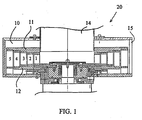
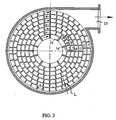
- Fig. 1 and Fig. 2 are a side view and a cross-sectional top view, respectively, of a double-action impact mill suitable for implementing the method of the invention
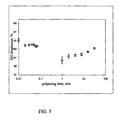
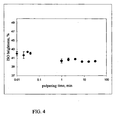
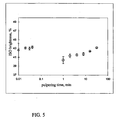
- Fig.3 to Fig. 5 show the results obtained in laboratory tests performed
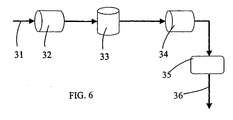
- Fig. 6 shows a schematic process for treating recycled fibre material using the method of the invention.
- Fig. 1 and Fig. 2 are a side view and a cross-sectional top view, respectively, of a double-action impact mill suitable for implementing the method of the invention.
- Fig. 1 is a vertical section of a double-action impact mill 20 used in the method of the invention and comprising a housing 10, inside which is arranged a rotor 11 provided with impact surfaces 1a, 1b..., 3a, 3b... etc.
- Figure 2 shows the individual impact surfaces in detail.
- the second rotor 12 is also provided with impact surfaces 2a, 2b..., 4a, 4b..., etc.
- the impact surfaces 1a, 1b..., 2a, 2b..., 3a, 3b... of the first rotor 11 and the second rotor 12 are arranged in concentric rings 1, 2, and 3... such that the rings 1, 3, 5 of the first rotor 11 and the rings 2, 4 of the second rotor 12 overlap. This allows the rotors 11 and 12 and their impact surfaces to freely rotate concentrically in different directions.
- the end of the housing is provided with a hole 14 that opens into the centre of the rotors 11 and 12 and acts as a feed inlet for pre-kneaded recycled fibre material.
- the wall of the housing is provided with an opening hole 15 acting as an outlet opening tangentially to the outermost impact surface ring.
- the second rotor 12 may also be replaced with a stator provided with impact surfaces, but a solution comprising two rotors is preferable.
- the rotors, rotating in opposite directions, produce strong centrifugal forces, which efficiently maintain the material flow in motion, which a stator/rotor system does not equally efficiently achieve.
- Fig. 2 showing the device of the type of Fig. 1 as a horizontal cross-section (modified such that both rotors 11, 12 have one ring more than the device of Figure 1), shows the directions of rotation of the rotors.
- both rotors may also rotate in the opposite direction, as long as the outermost ring rotates in the direction of the tangentially arranged outlet opening.
- the horizontal distance L between the rings 1, 2, 3... is about 3 mm and the same between all rings.
- the device is built or adjusted such that the distance L between adjacent rings decreases towards the outermost ring 7 of the device.
- the distance L between the outermost rings 6 and 7 is preferably about 0.2 mm.
- the device is built such that the distance S between the impact surfaces of the outermost rings is less than the distance between the impact surfaces of the inner rings.
- the above measures ensure that coarser fibrous material can also be applied to the device, and nevertheless achieve sufficiently defibrated pulp.
- the essential advantage is that the number of impact surfaces in the rotor rings and the distances (tightness) between the rings are selected according to the need. The distance between the rings and the distance between the impact surfaces in the rings can be arranged to become smaller towards the outer ring. In this way, the dispersing coarse recycled fibre material, when being kneaded, preferably ends up in a tighter space before being discharged from the device.
- an essential idea of the invention is not to force the recycled fibre material into very tight gaps and compression, but to make the double-action impact mill operate fundamentally such that the recycled fibre material hits the impact surfaces and is thrown from the radial openings forward and finally out from the device.
- the ring wall of the housing of the double-action impact mill does not have to be in the immediate vicinity of a rotor pair, correspondingly rotor/stator, but may be located further from there, i.e. the housing can be quite loose.
- the function of the housing is mainly to act as a receiver for the pulp suspension produced.
- the splitting of the recycled fibre material flow into small parts that are thrown through the double-action impact mill from one impact surface to another results in that energy efficiently affects the fibres and the colouring agent particles, whereby the entire recycled fibre material is subjected to a substantially equal amount of energy and a similar treatment as it is thrown from one impact surface of the double-action impact mill to another, and further, out from the double-action impact mill.
- This is a substantially significant difference as compared with prior art, where the energy pulses in the pulp mixture circulating in a large keeve are very unevenly and randomly directed to the material being defibered and, as a result, the colouring agent is poorly separated and disintegrated into unnecessarily small particles thus impairing the brightness of the obtained pulp.
- the treatment time of recycled fibre material in a double-action impact mill is at most two seconds, preferably at most one second. This treatment time is the time from the feeding of the material to the double-action impact mill to the time when the material is thrown from the outermost rotor ring outside thereof.
- Fig. 3 to Fig. 5 show the test results obtained by the method of the invention using a Lamort type of laboratory pulper in the comparison.
- 17-days old newspaper paper was pulped using a Lamort pulper, from which reference values were obtained, and the test run was carried out the next day by the method of the invention.
- the consistency was at first 8%, and was lowered to 4% for pumping in order for the pulp to be pumped, since the first treatment made the pulp swell strongly.
- the temperature in the test was 55°C and the pH 10.3.
- the test run included two test series, in the first of which the pre-kneaded pulp mixture was run seven times through a double-action impact mill comprising four rings at nearly maximum rotations and the second run was carried out using a speed of 1 ⁇ 4 (40 1/s) from the first test series and without the outermost ring of the double-action impact mill.
- Sheets were made from the pulp by diluting the pulp first in the ratio 1:30 and by filtering it in a Buhner funnel on a wire onto filter paper. The filtered sheets were rolled onto gloss plates, allowing the size distribution of the ink particles to be determined.
- the ISO brightness of the sheets was measured with an Elrepho 2000 device.
- Fig. 3 shows the brightness of super-washed pulps as a function of treatment time, treated by means of the method of the invention and with a reference pulper (Lamort), respectively.
- the diamonds present the results obtained by the method of the invention using a double-action impact mill and the round circles, in turn, present the average results obtained with a reference pulper.
- the double-action impact mill was used at a high operating speed (about 160 1/s) including all rotors, i.e. two pairs of rotors rotating in opposite directions, adjacent rotors rotating in opposite directions.
- the treatment time with the double-action impact mill is presented as the number of treatment times, since the passing time during each treatment time was the same and, consequently, the total treatment time is directly proportional to the number of treatment times.
- the treatment time with the reference pulper (Lamort) is directly presented on a time line segment.
- the brightness of super-washed sheets obtained by the method of the invention is higher than any brightness value obtained with the reference pulper.
- the highest brightness value was obtained by the method of the invention using the shortest time, i.e. one treatment time of about one second. In the next treatment times, i.e. as the treatment time became longer, the brightness value fell by the method of the invention although it still remained clearly higher than any value obtained with the reference pulper.
- Fig. 4 shows the brightness values obtained with the method of the invention and the brightness values obtained with the reference pulper when a slow (40 1/s) operating speed was used without the outermost ring.
- the reason for this was that as the first test showed that too much energy was used, the aim was to find circumstances under which the result would be even slightly imperfect.
- the process again involved repeating the feed of test material through the double-action impact mill, whereby the energy applied per pulp unit increased each time by the amount of energy required by one pass.
- the recycled fibre material was not yet fully defibered, but bits could still be found therein. The remaining bits were not defibered until during the third and fourth treatment.
- Fig. 6 schematically shows a process for treating recycled fibre material using the method of the invention.
- the figure shows a process diagram wherein recycled fibre material, water and air, optionally with chemicals, are applied into a pulper 32 in the manner shown by arrow 31.
- the pulper 32 may be any pulper known per se, which in this example is schematically shown as a drum pulper. From the pulper 32, the pre-kneaded recycled fibre material and the liquid with the substances therein are conveyed to a double-action impact mill 33, where colouring agent is separated from the recycled fibre material.
- the recycled fibre material is conveyed into an agglomeration device 34, which may be of the drum type or any other suitable device for treating the pulp suspension produced in order for the colouring agent to be agglomerated into particles of a suitable size.
- an agglomeration device 34 which may be of the drum type or any other suitable device for treating the pulp suspension produced in order for the colouring agent to be agglomerated into particles of a suitable size.
- the pulp suspension is conveyed forward to flotation 35, wherein ink is separated and removed from the pulp suspension in a manner completely known per se by means of air or some gas, after which the pulp suspension obtained is conveyed forward in the manner shown by arrow 36 to be used in a suitable manner.
- the method of the invention may be enhanced by adding suitable auxiliary chemicals into the double-action impact mill together with the recycled fibre material, which act on the recycled fibre material and the colouring agent therein at the same time as the recycled fibre material is subjected to mechanical separation in the double-action impact mill.
- suitable auxiliary chemicals into the double-action impact mill together with the recycled fibre material, which act on the recycled fibre material and the colouring agent therein at the same time as the recycled fibre material is subjected to mechanical separation in the double-action impact mill.
- an alkali to the recycled fibre material as an additive makes the action on the fibres, such as swelling and deinking, take place as advantageously as possible.
- a collector chemical such as soap
- soap as an additive enhances deinking in soft water, but the addition of soap in hard water causes an opposite reaction, wherefore the use of soap always depends on the circumstances.
- water-glass or hydrogen peroxide may be preferably used as an additive, by the action of which the colouring agent separated can be better made remain separate from the fibres.
- the chemicals may naturally also include various chemicals typically used in finishing and required for flotation, whereby the energy amounts required for their use are simultaneously obtained in connection with separating the colour particles.
- the pulp suspension produced in the double-action impact mill may be discharged as foamed and thus better suited to finishing. It is advantageous to apply these additives together with the pre-kneaded recycled fibre material dissolved in water in order for their effect on the process to be as efficient as possible as the recycled fibre material is thrown from one impact surface of the double-action impact mill to another.
- gas and/or steam may also be applied to maintain a sufficient amount of gas/steam inside the double-action impact mill to break the continuous flow into small loose pulp flow parts, wherein the separated colour particles also better remain separated from the fibres.
- the invention is described only by way of example, and is in no way restricted to it. It is essential to apply the pre-kneaded recycled fibre material into a double-action impact mill which comprises at least two rings provided with impact surfaces and radial openings and rotating in opposite directions and which contains gas or steam so as to make the recycled fibre material hit the impact surfaces and be thrown radially outward to be discharged from the double-action impact mill, so that its total treatment time in the double-action impact mill is at most two seconds.
Landscapes
- Engineering & Computer Science (AREA)
- Life Sciences & Earth Sciences (AREA)
- Wood Science & Technology (AREA)
- Mechanical Engineering (AREA)
- Paper (AREA)
- Pigments, Carbon Blacks, Or Wood Stains (AREA)
- Separation, Recovery Or Treatment Of Waste Materials Containing Plastics (AREA)
- Coloring (AREA)
Applications Claiming Priority (3)
| Application Number | Priority Date | Filing Date | Title |
|---|---|---|---|
| FI20011973 | 2001-10-10 | ||
| FI20011973A FI112805B (fi) | 2001-10-10 | 2001-10-10 | Menetelmä väriaineiden, erityisesti painovärin irrottamiseksi kierrätyskuitumateriaalista |
| PCT/FI2002/000792 WO2003031717A1 (en) | 2001-10-10 | 2002-10-09 | Method of separating colouring agents, particularly printing ink,from recycled fibre material |
Publications (2)
| Publication Number | Publication Date |
|---|---|
| EP1454008A1 EP1454008A1 (en) | 2004-09-08 |
| EP1454008B1 true EP1454008B1 (en) | 2006-08-30 |
Family
ID=8562033
Family Applications (1)
| Application Number | Title | Priority Date | Filing Date |
|---|---|---|---|
| EP02767512A Expired - Lifetime EP1454008B1 (en) | 2001-10-10 | 2002-10-09 | Method of separating colouring agents, particularly printing ink,from recycled fibre material |
Country Status (10)
| Country | Link |
|---|---|
| US (1) | US20040188480A1 (enExample) |
| EP (1) | EP1454008B1 (enExample) |
| JP (1) | JP2005504903A (enExample) |
| CN (1) | CN1289752C (enExample) |
| AT (1) | ATE338157T1 (enExample) |
| CA (1) | CA2462813A1 (enExample) |
| DE (1) | DE60214421T2 (enExample) |
| ES (1) | ES2271334T3 (enExample) |
| FI (1) | FI112805B (enExample) |
| WO (1) | WO2003031717A1 (enExample) |
Families Citing this family (9)
| Publication number | Priority date | Publication date | Assignee | Title |
|---|---|---|---|---|
| FI119563B (fi) | 2003-07-15 | 2008-12-31 | Fp Pigments Oy | Menetelmä ja laite paperin-, kartongin- tai muun vastaavan valmistuksessa käytettävän kuitumateriaalin esikäsittelemiseksi |
| FI117711B (fi) * | 2004-10-13 | 2007-01-31 | Fractivator Oy | Menetelmä ja laitteisto materiaalien tai materiaaliseosten käsittelemiseksi |
| FI119467B (fi) | 2007-04-10 | 2008-11-28 | Fractivator Oy | Parannettu vastaiskumylly |
| FI120733B (fi) * | 2008-11-14 | 2010-02-15 | Fractivator Oy | Menetelmä ja laite hienojakoisen kalsiumhydroksidin valmistamiseksi |
| FI123269B (fi) * | 2010-07-02 | 2013-01-31 | Haarla Oy | Menetelmä ja järjestely |
| CN102532942B (zh) * | 2012-01-15 | 2013-07-10 | 山西大学 | 一种玄武岩纤维或玻璃纤维的着色剂及其制备方法 |
| WO2018173850A1 (ja) * | 2017-03-23 | 2018-09-27 | セイコーエプソン株式会社 | 分離装置、分離方法、シート製造装置 |
| CN116856191A (zh) * | 2023-08-13 | 2023-10-10 | 维达北方纸业(北京)有限公司 | 造纸用制浆设备 |
| DK182152B1 (en) * | 2024-05-29 | 2025-09-17 | Andritz Dan Web As | Method of dry defibrating pulp sheets, intermediate product, and system therefore |
Family Cites Families (40)
| Publication number | Priority date | Publication date | Assignee | Title |
|---|---|---|---|---|
| US1833852A (en) * | 1929-01-23 | 1931-11-24 | Ko Watanabe | Manufacture of paper making material |
| US1833804A (en) * | 1929-02-23 | 1931-11-24 | Watanabe Ko | Manufacture of paper making material |
| US1833805A (en) * | 1929-02-23 | 1931-11-24 | Watanabe Ko | Manufacture of paper making material |
| US3354027A (en) * | 1963-09-11 | 1967-11-21 | Abitibi Power & Paper Co | Deinking of waste paper |
| AT375417B (de) * | 1980-11-25 | 1984-08-10 | Escher Wyss Gmbh | Dispergiervorrichtung fuer die aufbereitung von altpapierstoff |
| IT1155310B (it) * | 1982-04-19 | 1987-01-28 | Jean Marie Clement | Procedimento per il trattamento di riciclaggio di carta stampata da macero |
| NO159494C (no) * | 1986-10-23 | 1989-01-04 | Kvaerner Eureka As | Fremgangsmaate ved bleking av cellulosemasse eller fraksjon derav, anlegg til bruk ved gjennomfoeringen av fremgangsmaaten. |
| SE461919B (sv) * | 1988-08-30 | 1990-04-09 | Cellwood Machinery Ab | Saett vid behandling av traefibermassa, saerskilt innehaallande returpapper, samt disperger foer genomfoerande av foerfarandet |
| US5059280A (en) * | 1989-07-31 | 1991-10-22 | Kimberly-Clark Corporation | Method for removing agglomerated particles after dry fiberizing wastepaper |
| US5061370A (en) * | 1990-03-20 | 1991-10-29 | Quebec And Ontario Paper Company Ltd. | Screening device for slurries with improved rotor and hub design |
| FI94441B (fi) * | 1990-08-14 | 1995-05-31 | Ahlstroem Oy | Menetelmä ja sovitelma massa- ja/tai lietesuspensioiden käsittelemiseksi |
| US5316621A (en) * | 1990-10-19 | 1994-05-31 | Kanzaki Paper Mfg. Co., Ltd. | Method of pulping waste pressure-sensitive adhesive paper |
| US5518580A (en) * | 1991-09-20 | 1996-05-21 | J.M. Voith Gmbh | Method of processing printed waste matter |
| NZ247276A (en) * | 1992-04-06 | 1994-12-22 | Westvaco Corp | Production of papermaking fibre of low lignin content from recycled high lignin waste paper; mixtures with fresh pulp and products produced therefrom |
| US5518581A (en) * | 1993-06-04 | 1996-05-21 | Nicca Chemical Co., Ltd. | Deinking agent for regeneration of waste paper |
| FI93753C (fi) * | 1993-07-28 | 1995-05-26 | Ahlstroem Oy | Menetelmä ja laitteisto täyteainepitoisen materiaalin, kuten kierrätyskuidun käsittelyyn |
| US5582681A (en) * | 1994-06-29 | 1996-12-10 | Kimberly-Clark Corporation | Production of soft paper products from old newspaper |
| US5512133A (en) * | 1994-08-01 | 1996-04-30 | International Paper Company | Method for deinking recycled paper using a low flow elongated open top flotation vessel |
| US5762756A (en) * | 1994-11-21 | 1998-06-09 | The Black Clawson Company | Methods and apparatus for pulping and deinking |
| FR2736660B1 (fr) * | 1995-07-13 | 1997-08-22 | Lamort E & M | Procede de separation des fibres de papier et des contaminants et appareil pour la mise en oeuvre de ce procede |
| DE19541891A1 (de) * | 1995-11-10 | 1997-05-22 | Voith Sulzer Stoffaufbereitung | Vorrichtung zur Behandlung von hochkonsistentem Faserstoff |
| US6083350A (en) * | 1996-03-01 | 2000-07-04 | Voith Sulzer Stoffaufbereitung Gmbh | System for treatment of waste paper having a pulping drum and a perforated sorting area |
| DE19614947B4 (de) * | 1996-04-16 | 2004-04-08 | Voith Paper Fiber Systems Gmbh & Co. Kg | Verfahren zur Erhöhung des Weißgrades von Papierfaserstoff |
| FI105112B (fi) * | 1997-01-03 | 2000-06-15 | Megatrex Oy | Menetelmä ja laite kuitupitoisen materiaalin kuiduttamiseksi |
| DE19728393C2 (de) * | 1997-07-03 | 1999-08-05 | Voith Sulzer Stoffaufbereitung | Verfahren und Anlage zur Entfernung von Störstoffen aus einer wässrigen Faserstoffsuspension |
| US5880077A (en) * | 1997-08-29 | 1999-03-09 | High Point Chemical Corporation | Wastepaper reclaiming deinking agent |
| ATE237023T1 (de) * | 1998-01-23 | 2003-04-15 | Voith Paper Patent Gmbh | Verfahren zur entfernung von feinen verunreinigungen aus einer faserstoffsuspension |
| WO1999054045A1 (en) * | 1998-04-16 | 1999-10-28 | Megatrex Oy | Method and apparatus for processing pulp stock derived from a pulp or paper mill |
| KR100288123B1 (ko) * | 1998-06-27 | 2001-05-02 | 김충섭 | 부상부유 및 니딩 처리를 이용한 골판지 고지의 재생방법 |
| SE513596C2 (sv) * | 1999-02-22 | 2000-10-09 | Stora Kopparbergs Bergslags Ab | Metod vid tillverkning av papper eller kartong |
| US6419787B2 (en) * | 1999-12-17 | 2002-07-16 | Kimberly-Clark Worldwide, Inc. | Process for recycling paper broke containing wet strength additives |
| DE10000181A1 (de) * | 2000-01-05 | 2001-07-12 | Voith Paper Patent Gmbh | Verfahren zur Auflösung von Altpapier |
| US6458240B1 (en) * | 2000-01-14 | 2002-10-01 | Georgia-Pacific Corporation | Method for removing contaminants from fibers in recycle fiber pulping |
| US6416622B2 (en) * | 2000-02-04 | 2002-07-09 | Georgia-Pacific Corporation | Hybrid multistage forward cleaner system with flotation cell |
| US6899790B2 (en) * | 2000-03-06 | 2005-05-31 | Georgia-Pacific Corporation | Method of providing papermaking fibers with durable curl |
| GB0217197D0 (en) * | 2002-07-24 | 2002-09-04 | Dow Corning | Method of deinking |
| US7169257B2 (en) * | 2003-11-12 | 2007-01-30 | Kemira Chemicals, Inc. | Method of deinking waste paper using a reduced alkali system |
| US20050115690A1 (en) * | 2003-11-25 | 2005-06-02 | Casella Waste Systems, Inc. | Methods for producing recycled pulp from waste paper |
| US7377993B2 (en) * | 2004-03-03 | 2008-05-27 | Tanya Smith Richardson | Methods for reducing fluorescence in pulp and paper |
| US7282113B2 (en) * | 2004-11-17 | 2007-10-16 | Tritexco, Inc. | Method for enzymatic deinking of waste papers, the waste papers so treated and the treating composition |
-
2001
- 2001-10-10 FI FI20011973A patent/FI112805B/fi active
-
2002
- 2002-10-09 ES ES02767512T patent/ES2271334T3/es not_active Expired - Lifetime
- 2002-10-09 EP EP02767512A patent/EP1454008B1/en not_active Expired - Lifetime
- 2002-10-09 CN CNB028200306A patent/CN1289752C/zh not_active Expired - Fee Related
- 2002-10-09 DE DE2002614421 patent/DE60214421T2/de not_active Expired - Fee Related
- 2002-10-09 AT AT02767512T patent/ATE338157T1/de not_active IP Right Cessation
- 2002-10-09 JP JP2003534677A patent/JP2005504903A/ja active Pending
- 2002-10-09 CA CA 2462813 patent/CA2462813A1/en not_active Abandoned
- 2002-10-09 WO PCT/FI2002/000792 patent/WO2003031717A1/en not_active Ceased
-
2004
- 2004-04-09 US US10/820,738 patent/US20040188480A1/en not_active Abandoned
Also Published As
| Publication number | Publication date |
|---|---|
| JP2005504903A (ja) | 2005-02-17 |
| DE60214421T2 (de) | 2007-08-30 |
| DE60214421D1 (de) | 2006-10-12 |
| FI20011973A0 (fi) | 2001-10-10 |
| US20040188480A1 (en) | 2004-09-30 |
| CA2462813A1 (en) | 2003-04-17 |
| WO2003031717A1 (en) | 2003-04-17 |
| ATE338157T1 (de) | 2006-09-15 |
| CN1289752C (zh) | 2006-12-13 |
| FI20011973L (fi) | 2003-04-11 |
| EP1454008A1 (en) | 2004-09-08 |
| ES2271334T3 (es) | 2007-04-16 |
| CN1568387A (zh) | 2005-01-19 |
| FI112805B (fi) | 2004-01-15 |
Similar Documents
| Publication | Publication Date | Title |
|---|---|---|
| CA2133630C (en) | Method and apparatus for screening waste paper pulp | |
| US6202946B1 (en) | Method and apparatus of defibrating a fibre-containing material | |
| JP5895834B2 (ja) | 微細セルロース繊維の製造方法 | |
| US5453159A (en) | Deinking of recycled pulp | |
| DK2788544T3 (en) | Procedure for processing old paper. | |
| EP1454008B1 (en) | Method of separating colouring agents, particularly printing ink,from recycled fibre material | |
| FI123000B (fi) | Rumpupulpperi, pulpperijärjestelmä ja menetelmä kuitumateriaalin hajottamiseksi | |
| JP2005504903A5 (enExample) | ||
| JP5807632B2 (ja) | 微細セルロース繊維の製造方法 | |
| JP2014125689A (ja) | 微細セルロース繊維の製造方法 | |
| KR100827311B1 (ko) | 비표백크라프트펄프의 회수설비 및 이를 이용한 회수방법 | |
| US20130206877A1 (en) | Method and arrangement | |
| FI67579C (fi) | Foerfarande och anordning foer fibrering och pumpning av cellulosamassa och returpapper | |
| JP4577065B2 (ja) | スクリーン装置およびこれを用いた再生パルプの製造方法 | |
| US7534322B2 (en) | Method of deinking recycled paper employing centrifigal cleaners | |
| FI105699B (fi) | Menetelmä ja käyttö massa- tai paperitehtaan massasulpun käsittelemiseksi | |
| JP2000336588A (ja) | プラスチック被覆紙原料から良質のセルロース繊維を取り出す方法 | |
| WO2024243495A1 (en) | Pulper with deflaking element | |
| CN115418878A (zh) | 物料筛分系统及筛分方法 | |
| KR20220113827A (ko) | 종이 펄프의 제조 방법, 및 재생 아라미드지의 제조 방법 | |
| JPH08209571A (ja) | 磁気記録古紙から再生パルプを製造する方法 |
Legal Events
| Date | Code | Title | Description |
|---|---|---|---|
| PUAI | Public reference made under article 153(3) epc to a published international application that has entered the european phase |
Free format text: ORIGINAL CODE: 0009012 |
|
| 17P | Request for examination filed |
Effective date: 20040506 |
|
| AK | Designated contracting states |
Kind code of ref document: A1 Designated state(s): AT BE BG CH CY CZ DE DK EE ES FI FR GB GR IE IT LI LU MC NL PT SE SK TR |
|
| AX | Request for extension of the european patent |
Extension state: AL LT LV MK RO SI |
|
| GRAP | Despatch of communication of intention to grant a patent |
Free format text: ORIGINAL CODE: EPIDOSNIGR1 |
|
| GRAS | Grant fee paid |
Free format text: ORIGINAL CODE: EPIDOSNIGR3 |
|
| GRAA | (expected) grant |
Free format text: ORIGINAL CODE: 0009210 |
|
| AK | Designated contracting states |
Kind code of ref document: B1 Designated state(s): AT BE BG CH CY CZ DE DK EE ES FI FR GB GR IE IT LI LU MC NL PT SE SK TR |
|
| PG25 | Lapsed in a contracting state [announced via postgrant information from national office to epo] |
Ref country code: IT Free format text: LAPSE BECAUSE OF FAILURE TO SUBMIT A TRANSLATION OF THE DESCRIPTION OR TO PAY THE FEE WITHIN THE PRESCRIBED TIME-LIMIT;WARNING: LAPSES OF ITALIAN PATENTS WITH EFFECTIVE DATE BEFORE 2007 MAY HAVE OCCURRED AT ANY TIME BEFORE 2007. THE CORRECT EFFECTIVE DATE MAY BE DIFFERENT FROM THE ONE RECORDED. Effective date: 20060830 Ref country code: SK Free format text: LAPSE BECAUSE OF FAILURE TO SUBMIT A TRANSLATION OF THE DESCRIPTION OR TO PAY THE FEE WITHIN THE PRESCRIBED TIME-LIMIT Effective date: 20060830 Ref country code: CH Free format text: LAPSE BECAUSE OF FAILURE TO SUBMIT A TRANSLATION OF THE DESCRIPTION OR TO PAY THE FEE WITHIN THE PRESCRIBED TIME-LIMIT Effective date: 20060830 Ref country code: FI Free format text: LAPSE BECAUSE OF FAILURE TO SUBMIT A TRANSLATION OF THE DESCRIPTION OR TO PAY THE FEE WITHIN THE PRESCRIBED TIME-LIMIT Effective date: 20060830 Ref country code: AT Free format text: LAPSE BECAUSE OF FAILURE TO SUBMIT A TRANSLATION OF THE DESCRIPTION OR TO PAY THE FEE WITHIN THE PRESCRIBED TIME-LIMIT Effective date: 20060830 Ref country code: CZ Free format text: LAPSE BECAUSE OF FAILURE TO SUBMIT A TRANSLATION OF THE DESCRIPTION OR TO PAY THE FEE WITHIN THE PRESCRIBED TIME-LIMIT Effective date: 20060830 Ref country code: NL Free format text: LAPSE BECAUSE OF FAILURE TO SUBMIT A TRANSLATION OF THE DESCRIPTION OR TO PAY THE FEE WITHIN THE PRESCRIBED TIME-LIMIT Effective date: 20060830 Ref country code: LI Free format text: LAPSE BECAUSE OF FAILURE TO SUBMIT A TRANSLATION OF THE DESCRIPTION OR TO PAY THE FEE WITHIN THE PRESCRIBED TIME-LIMIT Effective date: 20060830 |
|
| REG | Reference to a national code |
Ref country code: GB Ref legal event code: FG4D |
|
| REG | Reference to a national code |
Ref country code: CH Ref legal event code: EP |
|
| REG | Reference to a national code |
Ref country code: IE Ref legal event code: FG4D |
|
| PG25 | Lapsed in a contracting state [announced via postgrant information from national office to epo] |
Ref country code: IE Free format text: LAPSE BECAUSE OF NON-PAYMENT OF DUE FEES Effective date: 20061009 |
|
| PGFP | Annual fee paid to national office [announced via postgrant information from national office to epo] |
Ref country code: SE Payment date: 20061009 Year of fee payment: 5 |
|
| REF | Corresponds to: |
Ref document number: 60214421 Country of ref document: DE Date of ref document: 20061012 Kind code of ref document: P |
|
| PGFP | Annual fee paid to national office [announced via postgrant information from national office to epo] |
Ref country code: ES Payment date: 20061023 Year of fee payment: 5 Ref country code: GB Payment date: 20061023 Year of fee payment: 5 |
|
| PGFP | Annual fee paid to national office [announced via postgrant information from national office to epo] |
Ref country code: BE Payment date: 20061024 Year of fee payment: 5 |
|
| PG25 | Lapsed in a contracting state [announced via postgrant information from national office to epo] |
Ref country code: MC Free format text: LAPSE BECAUSE OF NON-PAYMENT OF DUE FEES Effective date: 20061031 |
|
| PGFP | Annual fee paid to national office [announced via postgrant information from national office to epo] |
Ref country code: IT Payment date: 20061031 Year of fee payment: 5 |
|
| PG25 | Lapsed in a contracting state [announced via postgrant information from national office to epo] |
Ref country code: BG Free format text: LAPSE BECAUSE OF FAILURE TO SUBMIT A TRANSLATION OF THE DESCRIPTION OR TO PAY THE FEE WITHIN THE PRESCRIBED TIME-LIMIT Effective date: 20061130 Ref country code: DK Free format text: LAPSE BECAUSE OF FAILURE TO SUBMIT A TRANSLATION OF THE DESCRIPTION OR TO PAY THE FEE WITHIN THE PRESCRIBED TIME-LIMIT Effective date: 20061130 |
|
| REG | Reference to a national code |
Ref country code: SE Ref legal event code: TRGR |
|
| PG25 | Lapsed in a contracting state [announced via postgrant information from national office to epo] |
Ref country code: PT Free format text: LAPSE BECAUSE OF FAILURE TO SUBMIT A TRANSLATION OF THE DESCRIPTION OR TO PAY THE FEE WITHIN THE PRESCRIBED TIME-LIMIT Effective date: 20070212 |
|
| ET | Fr: translation filed | ||
| REG | Reference to a national code |
Ref country code: CH Ref legal event code: PL |
|
| NLV1 | Nl: lapsed or annulled due to failure to fulfill the requirements of art. 29p and 29m of the patents act | ||
| REG | Reference to a national code |
Ref country code: ES Ref legal event code: FG2A Ref document number: 2271334 Country of ref document: ES Kind code of ref document: T3 |
|
| PLBE | No opposition filed within time limit |
Free format text: ORIGINAL CODE: 0009261 |
|
| STAA | Information on the status of an ep patent application or granted ep patent |
Free format text: STATUS: NO OPPOSITION FILED WITHIN TIME LIMIT |
|
| 26N | No opposition filed |
Effective date: 20070531 |
|
| PGFP | Annual fee paid to national office [announced via postgrant information from national office to epo] |
Ref country code: DE Payment date: 20071023 Year of fee payment: 6 |
|
| BERE | Be: lapsed |
Owner name: *MEGATREX OY Effective date: 20071031 |
|
| PG25 | Lapsed in a contracting state [announced via postgrant information from national office to epo] |
Ref country code: GR Free format text: LAPSE BECAUSE OF FAILURE TO SUBMIT A TRANSLATION OF THE DESCRIPTION OR TO PAY THE FEE WITHIN THE PRESCRIBED TIME-LIMIT Effective date: 20061201 |
|
| EUG | Se: european patent has lapsed | ||
| GBPC | Gb: european patent ceased through non-payment of renewal fee |
Effective date: 20071009 |
|
| PG25 | Lapsed in a contracting state [announced via postgrant information from national office to epo] |
Ref country code: EE Free format text: LAPSE BECAUSE OF FAILURE TO SUBMIT A TRANSLATION OF THE DESCRIPTION OR TO PAY THE FEE WITHIN THE PRESCRIBED TIME-LIMIT Effective date: 20060830 |
|
| PG25 | Lapsed in a contracting state [announced via postgrant information from national office to epo] |
Ref country code: TR Free format text: LAPSE BECAUSE OF FAILURE TO SUBMIT A TRANSLATION OF THE DESCRIPTION OR TO PAY THE FEE WITHIN THE PRESCRIBED TIME-LIMIT Effective date: 20060830 Ref country code: LU Free format text: LAPSE BECAUSE OF NON-PAYMENT OF DUE FEES Effective date: 20061009 |
|
| PG25 | Lapsed in a contracting state [announced via postgrant information from national office to epo] |
Ref country code: BE Free format text: LAPSE BECAUSE OF NON-PAYMENT OF DUE FEES Effective date: 20071031 |
|
| REG | Reference to a national code |
Ref country code: FR Ref legal event code: ST Effective date: 20080630 |
|
| PG25 | Lapsed in a contracting state [announced via postgrant information from national office to epo] |
Ref country code: SE Free format text: LAPSE BECAUSE OF NON-PAYMENT OF DUE FEES Effective date: 20071010 |
|
| PGFP | Annual fee paid to national office [announced via postgrant information from national office to epo] |
Ref country code: FR Payment date: 20060929 Year of fee payment: 5 |
|
| PG25 | Lapsed in a contracting state [announced via postgrant information from national office to epo] |
Ref country code: CY Free format text: LAPSE BECAUSE OF FAILURE TO SUBMIT A TRANSLATION OF THE DESCRIPTION OR TO PAY THE FEE WITHIN THE PRESCRIBED TIME-LIMIT Effective date: 20060830 Ref country code: GB Free format text: LAPSE BECAUSE OF NON-PAYMENT OF DUE FEES Effective date: 20071009 |
|
| REG | Reference to a national code |
Ref country code: ES Ref legal event code: FD2A Effective date: 20071010 |
|
| PG25 | Lapsed in a contracting state [announced via postgrant information from national office to epo] |
Ref country code: ES Free format text: LAPSE BECAUSE OF NON-PAYMENT OF DUE FEES Effective date: 20071010 Ref country code: FR Free format text: LAPSE BECAUSE OF NON-PAYMENT OF DUE FEES Effective date: 20071031 |
|
| PG25 | Lapsed in a contracting state [announced via postgrant information from national office to epo] |
Ref country code: DE Free format text: LAPSE BECAUSE OF NON-PAYMENT OF DUE FEES Effective date: 20090501 Ref country code: IT Free format text: LAPSE BECAUSE OF NON-PAYMENT OF DUE FEES Effective date: 20071009 |