EP1449872A1 - Stabilisierung polymerer Materialien - Google Patents
Stabilisierung polymerer Materialien Download PDFInfo
- Publication number
- EP1449872A1 EP1449872A1 EP03003939A EP03003939A EP1449872A1 EP 1449872 A1 EP1449872 A1 EP 1449872A1 EP 03003939 A EP03003939 A EP 03003939A EP 03003939 A EP03003939 A EP 03003939A EP 1449872 A1 EP1449872 A1 EP 1449872A1
- Authority
- EP
- European Patent Office
- Prior art keywords
- acid
- alkyl
- cycloaliphatic
- aromatic
- tetramethyl
- Prior art date
- Legal status (The legal status is an assumption and is not a legal conclusion. Google has not performed a legal analysis and makes no representation as to the accuracy of the status listed.)
- Withdrawn
Links
Classifications
-
- C—CHEMISTRY; METALLURGY
- C08—ORGANIC MACROMOLECULAR COMPOUNDS; THEIR PREPARATION OR CHEMICAL WORKING-UP; COMPOSITIONS BASED THEREON
- C08K—Use of inorganic or non-macromolecular organic substances as compounding ingredients
- C08K5/00—Use of organic ingredients
- C08K5/16—Nitrogen-containing compounds
- C08K5/34—Heterocyclic compounds having nitrogen in the ring
- C08K5/3412—Heterocyclic compounds having nitrogen in the ring having one nitrogen atom in the ring
- C08K5/3432—Six-membered rings
- C08K5/3435—Piperidines
-
- C—CHEMISTRY; METALLURGY
- C08—ORGANIC MACROMOLECULAR COMPOUNDS; THEIR PREPARATION OR CHEMICAL WORKING-UP; COMPOSITIONS BASED THEREON
- C08G—MACROMOLECULAR COMPOUNDS OBTAINED OTHERWISE THAN BY REACTIONS ONLY INVOLVING UNSATURATED CARBON-TO-CARBON BONDS
- C08G63/00—Macromolecular compounds obtained by reactions forming a carboxylic ester link in the main chain of the macromolecule
- C08G63/91—Polymers modified by chemical after-treatment
-
- C—CHEMISTRY; METALLURGY
- C08—ORGANIC MACROMOLECULAR COMPOUNDS; THEIR PREPARATION OR CHEMICAL WORKING-UP; COMPOSITIONS BASED THEREON
- C08G—MACROMOLECULAR COMPOUNDS OBTAINED OTHERWISE THAN BY REACTIONS ONLY INVOLVING UNSATURATED CARBON-TO-CARBON BONDS
- C08G69/00—Macromolecular compounds obtained by reactions forming a carboxylic amide link in the main chain of the macromolecule
- C08G69/48—Polymers modified by chemical after-treatment
-
- C—CHEMISTRY; METALLURGY
- C08—ORGANIC MACROMOLECULAR COMPOUNDS; THEIR PREPARATION OR CHEMICAL WORKING-UP; COMPOSITIONS BASED THEREON
- C08K—Use of inorganic or non-macromolecular organic substances as compounding ingredients
- C08K5/00—Use of organic ingredients
- C08K5/04—Oxygen-containing compounds
- C08K5/09—Carboxylic acids; Metal salts thereof; Anhydrides thereof
-
- C—CHEMISTRY; METALLURGY
- C08—ORGANIC MACROMOLECULAR COMPOUNDS; THEIR PREPARATION OR CHEMICAL WORKING-UP; COMPOSITIONS BASED THEREON
- C08K—Use of inorganic or non-macromolecular organic substances as compounding ingredients
- C08K5/00—Use of organic ingredients
- C08K5/16—Nitrogen-containing compounds
- C08K5/34—Heterocyclic compounds having nitrogen in the ring
- C08K5/35—Heterocyclic compounds having nitrogen in the ring having also oxygen in the ring
- C08K5/353—Five-membered rings
Definitions
- the present invention relates to new, salt-like reaction products or Prefabricated mixtures of compounds from the group of sterically hindered amines containing light stabilizers (HALS compounds) and carboxylic acids, Carboxylic acid derivatives and organo-substituted phosphorus or sulfur-based Acids, hereinafter collectively called organic acids.
- HALS compounds sterically hindered amines containing light stabilizers
- carboxylic acids Carboxylic acid derivatives and organo-substituted phosphorus or sulfur-based Acids, hereinafter collectively called organic acids.
- the salt-like products or mixtures are suitable for stabilizing polymeric ones Materials against degradation by heat and / or light and are also suitable for Improvement of processability and long-term stability of polymers.
- HALS compounds As is known to those skilled in the art, the stabilizing effect of HALS compounds upon exposure to mineral acid compounds, e.g. in the Exposure to acid rain or also by degradation products of biocides or Flame retardants can arise, their effectiveness drastically reduced. This is mainly due to the formation of salt-like products of the HALS compounds Mineral acids recycled.
- the products according to the invention although they also have a salt-like character, to stabilize Polymers, especially polar polymers, such as polyamides or polyesters are suitable.
- polar polymers such as polyamides or polyesters are suitable.
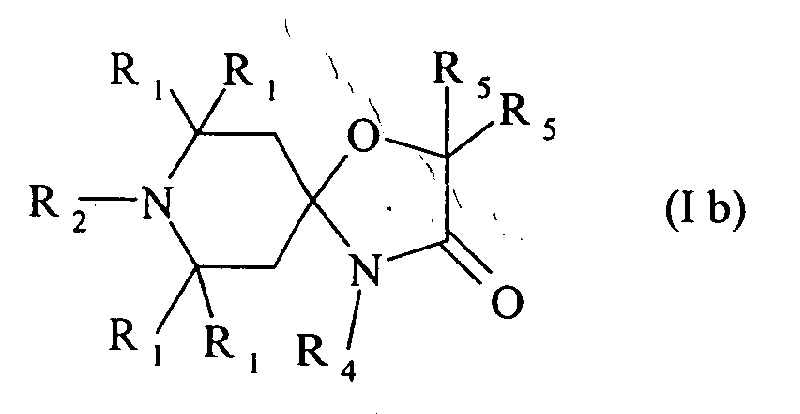
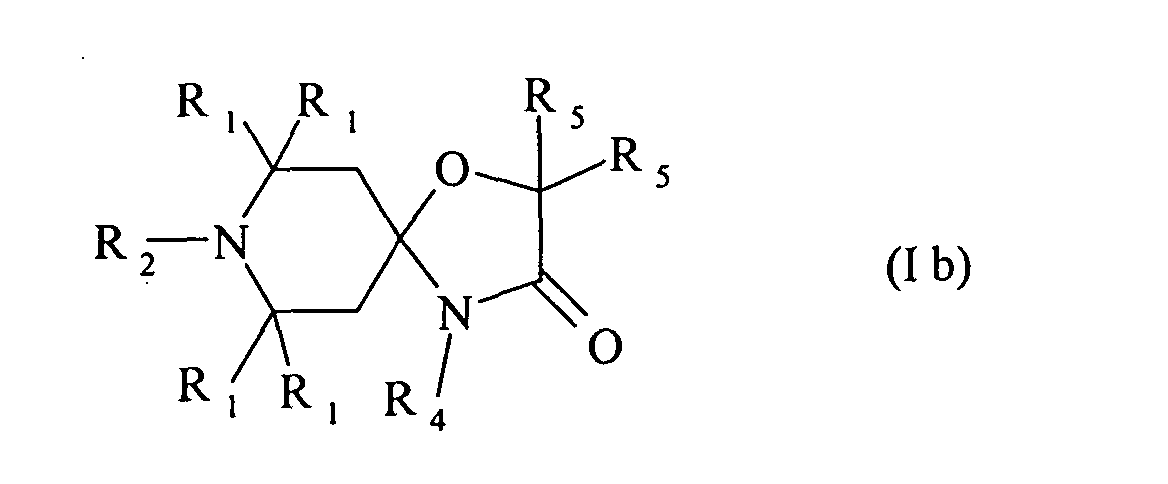
- HALS compounds are generally understood to mean compounds which contain one or more groups of the formula (Ia) - (Ic).
- Preferred groups R ' are H, methyl or one of the groups
- R 1 are methyl or in each case two R 1 bonded to the common carbon atom are a C 4 -C 6 cycloalkyl radical.
- R 2 are H, C 1 -C 12 alkyl or benzyl.
- R 4 are C 1 -C 12 alkyl, -C (O) -C 1 -C 16 alkyl or -C 1 -C 4 alkyl-C (O) OC 1 -C 16 alkyl;
- R 5 are C 1 -C 8 alkyl or in each case two R 5 bonded to the same carbon atom form a radical which forms a C 6 -C 8 cycloalkyl;
- R 6 are C 1 -C 18 alkyl, C 1 -C 18 alkylene, C 5 -C 12 cycloalkyl, C 5 -C 12 cycloalkylene, C 6 -C 18 aryl, C 6 -C 18 Arylene, C 5 -C 18 heteroaryl, C 5 -C 18 heteroarylene, C 6 -C 36 arylalkyl, C 6 -C 36 arylalkylene, C 6 -C 36 alkylaryl, C 6 -C 36 alkylarylene ;
- Preferred groups R 7 are H, C 1 -C 18 alkyl, C 1 -C 18 alkylene, C 5 -C 12 cycloalkyl, C 5 -C 12 cycloalkylene, C 6 -C 18 aryl, C 6 - C 18 arylene, C 5 -C 18 heteroaryl, C 5 -C 18 heteroarylene, C 6 -C 36 arylalkyl, C 6 -C 36 arylalkylene, C 6 -C 36 alkylaryl, C 6 -C 36 -Alkylarylene, -OR 9 ; and preferred groups R 8 are H, C 1 -C 18 alkyl, C 1 -C 18 alkylene, C 5 -C 12 cycloalkyl, C 5 -C 12 cycloalkylene, C 6 -C 18 aryl, C 6 -C 18 arylene, C 5 -C 18 heteroaryl, C 5 -C 18 heteroarylene, C 6 -C 36 ary
- Preferred groups R 9 are H, C 1 -C 36 alkyl, C 5 -C 12 cycloalkyl, C 6 -C 18 aryl, C 5 -C 18 heteroaryl, C 6 -C 36 arylalkyl, C 6 - C 36 alkylaryl;
- R 10 are C 1 -C 18 alkyl, C 1 -C 18 alkylene, C 5 -C 12 cycloalkyl, C 5 -C 12 cycloalkylene, C 6 -C 18 aryl, C 6 -C 18 Arylene, C 5 -C 18 heteroaryl, C 5 -C 18 heteroarylene, C 6 -C 36 arylalkyl, C 6 -C 36 arylalkylene, C 6 -C 36 alkylaryl, C 6 -C 36 alkylarylene ;
- R 12 are C 1 -C 36 alkyl, C 5 -C 12 cycloalkyl, C 6 -C 18 aryl, C 5 -C 18 heteroaryl, C 6 -C 36 arylalkyl, C 6 -C 36 alkylaryl;
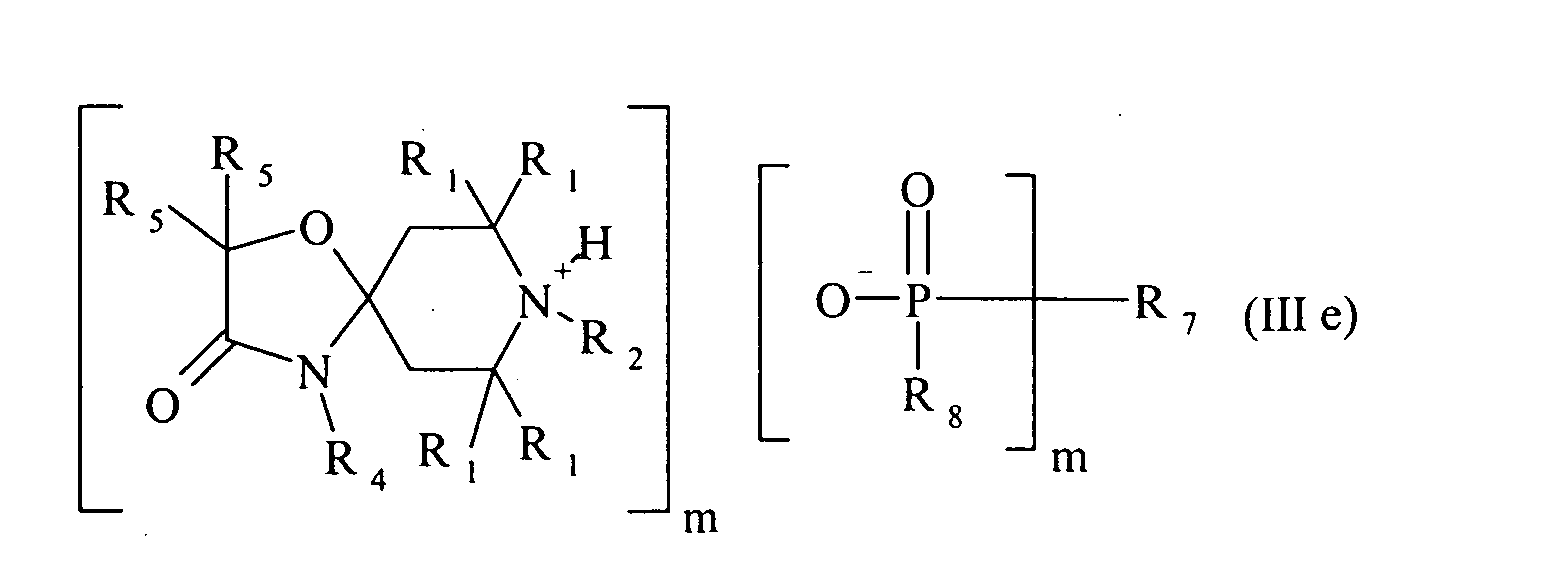
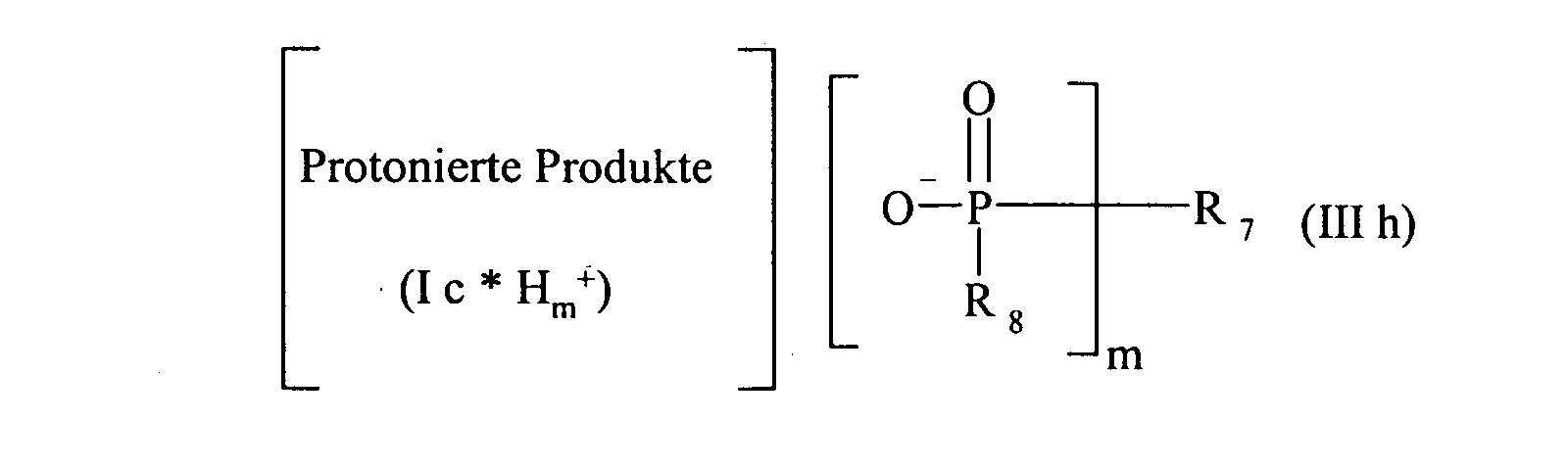
- a preferred subject of the invention are salt-like compounds of the general formula (III a) - (III i) where n and m are identical and greater than zero and the other substituents are as defined above.
- Such compounds of the formula (III a) - (III i) may contain further groups of the formula (I a) and / or (II a) - (II c) in the case of polyvalent substituents R 3 , R 6 , R 7 and R 10 ,
- These new compounds according to the invention can be reacted by a or more HALS compounds with one or more organic acids produce, depending on the molar ratios of the reactants and Reaction conditions, complete or partial amine salts of the organic acids be formed. These salts have one compared to the starting compounds sometimes considerably higher water solubility or solubility in lower alcohols on.
- polycondensation polymers such as polyamide 6.6, PET or comparable types, which consist of a di-acid and a di-amine or Diol component are particularly advantageous because they are due to their z.T. good solubility easily and during the ongoing polycondensation reaction Allow homogeneous distribution in the reaction medium.
- the HALS connections themselves are on the other hand, due to their hydrophobic character, they are not very soluble and are therefore difficult to incorporate homogeneously.
- Another object of the invention are pre-made mixtures - called “blends” in the plastics industry - consisting of the two components I and II in the desired molar ratios.
- the salts of the invention Formula III can already partially or completely in the assembly step are formed, or when entering the polymer mass, or their Raw materials are created.
- the latter can e.g. ⁇ -caprolactam (for PA6), AH salt solution (with PA6.6) or precondensates from di-acids and diols (polyester).
- the pre-made blends of this invention are certain ones with Considered in selected molar ratios, using large-scale processes prepared mixtures, which depending on the process conditions already partially salts Formula III included, and have been designed so that with these "blends” the desired amounts of components I and II added to the polycondensates become.
- These pre-made mixtures can be shaped from the melt (Drip granulation, prilling, extrusion, etc.), compaction (roll compaction, Tableting, briquetting, press granulation, etc.) or granulation process (Spraying, fluidized bed granulation, drums, rounding, etc.) can be obtained.
- HALS compounds as well as the organic acids or their derivatives can are each mono- or oligo-functional, but HALS compounds are preferred with a HALS group and difunctional organic acids, HALS compounds with two or more HALS groups and difunctional organic acids or HALS compounds with two or more HALS groups and monofunctional organic Acids used.
- the molar ratio between HALS groups and groups of organic acids vary between 1:99 and 99: 1, preferred but are ratios from 40:60 to 60:40, especially 45:55 to 55:45 and above all equimolar ratios (50:50).
- Preferred carboxylic acids of formula (II a) are C 1 -C 80 alkyl carboxylic acids, C 1 -C 18 -Alkylendicarbonklaren, C 5 -C 18 cycloalkane carboxylic acids, C 5 -C 18 Cycloalkylendicarbonklaren, C 6 -C 19 aryl carboxylic acids, C 6 -C 20 Arylene dicarboxylic acids, C 2 -C 12 alkyl carboxylic acid anhydrides, C 7-18 aryl carboxylic acid anhydrides or C 6 -C 18 lactams.
- Preferred organophosphoric acids of the formula (II b) are C 1 -C 18 alkylphosphinic acids, di (C 1 -C 18 alkyl) phosphinic acids, C 5 -C 18 cycloalkylphosphinic acids, di (C 5 -C 18 cyctoalkyt) phosphinic acids, C 6 (aryl C 6 -C 18) phosphinic -C 18 Arylphosphin Acid, Di, (C 7 -C 36 alkylaryl) phosphinic C 7 -C 36 Alkylarylphosphin Acid, C 7 -C 36 Arylalkylphosphin Acid, di, di (C 7 -C 36 arylalkyl ) phosphinic acids, C 1 -C bisphosphin Acid alkylene-18, C 1 -C 18 alkyl phosphonic acids, C 1 -C 18 alkyl phosphonic acid monoester, C 5 -C 18 cyclo
- Preferred sulfur-organic acids of formula (II c) are C 1 -C 18 alkyl sulfonic acids, sulfinic acids, C 1 -C 18, C 5 -C 18 Cycloalkylsulfonklaren, C 5 -C 18 cycloalkylsulfinklaren, C 6 -C 18 aryl sulfonic acids, C 6 - C 18 arylsulfinic acids, C 7 -C 36 alkylarylsulfonic acids, C 7 -C 36 alkylarylsulfinic acids.
- Carboxylic acids or carboxylic acid derivatives are C 1 -C 60 alkyl carboxylic acids, C 1 -C 60 alkylene dicarboxylic acids, C 6 -C 12 cycloalkane carboxylic acids, C 6 -C 12 Cycloalkylendicarbonklaren, C 6-12 aryl carboxylic acids, C 6-12 Arylene dicarboxylic acids, caprolactam, laurolactam, C 1 -C 6 alkyl carboxylic acid anhydrides or C 6 -C 18 aryl carboxylic acid anhydrides.
- organophosphorus acids of the formula (II b) are C 1 -C 12 alkylphosphinic acids, di (C 1 -C 12 alkyl) phosphinic acids, C 6 -C 12 cycloalkylphosphinic acids, di (C 6 -C 12 cycloalkyl) phosphinic acids, C 6 -C 12 arylphosphinic acids, di (C 6 -C 12 aryl) phosphinic acids, C 7 -C 18 alkylarylphosphinic acids, di (C 7 -C 18 alkylaryl) phosphinic acids, C 1 -C 12 alkylene bisphosphinic acids, C 1 -C 12 alkyl phosphonic acids, C 1 -C 12 Alkylphosphonklaremonoester, C 6 -C 12 Cycloalkylphosphonklaren, C 6 -C 12 Cycloalkylphosphonklar, C 6 -C 12 aryl
- Particularly preferred organic sulfur acids of the formula (II c) are C 1 -C 18 alkylsulfonic acids, C 6 -C 18 arylsulfonic acids, C 7 -C 36 alkylarylsulfonic acids.
- a particularly preferred HALS compound of the formula (I a) is 1,3-benzenedicarboxamide, N, N'-bis (2,2,6,6-tetramethyl-4-piperidinyl) (Nylostab® S-EED®), of the formula (I b) 2,2,4,4-tetramethyl-7-oxa-3,20-diazadispiro [5.1.11.2] heneicosan-21-one and the formula (I c) is poly [[6 - [(1,1,3,3-tetramethylbutyl) amino] -1,3,5-trazin-2,4-diyl] [(2,2,6,6-tetramethyl -4-piperidinyl) imino] -1,6-hexanediyl - [(2,2,6,6-tetramethyl-4-piperidinyl) imino]], as well as the reaction product from Hostavin® N 20 and Epichlorohydrin (Hostavin® N 30).
- carboxylic acids of the formula (II a) are adipic acid, terephthalic acid, Isophthalic acid, phthalic acid, benzoic acid and acetic acid.
- organophosphorus acids of the formula (II b) are Methylphosphinic acid, dimethylphosphinic acid, methylethylphosphinic acid, ethylphosphinic acid, Diethylphosphinic acid, propylphosphinic acid, di-propylphosphinic acid, Butylphosphinic acid, dibutylphosphinic acid, hexylphosphinic acid, dihexylphosphinic acid, Octylphosphinic acid, dioctylphosphinic acid, cyclohexylphosphinic acid, Dicyclohexylphosphinic acid, phenylphosphinic acid, diphenylphosphinic acid, tolylphosphinic acid, Ditolylphosphinic acid, xylylphosphinic acid, dixylylphosphinic acid, Biphenylphosphinic acid, di-biphenylphosphin
- Particularly preferred organic sulfur acids of the formula (II c) are Methanesulfonic acid, ethanesulfonic acid, benzenesulfonic acid and toluenesulfonic acid.
- Preferred polymers for using the products according to the invention are Polyamides, such as polyamide 6, polyamide 11, polyamide 12, polyamide 4.6, polyamide 6.6, Polyamide 6.9, polyamide 6.10, polyamide 6.12, polyamide 12.12, and polyester such as Terephthalic acid / alkyldiol based polyesters (e.g. PET, PBT), aliphatic polyesters, aromatic polyesters, liquid crystalline polyesters, polyether esters, and polycarbonates as well as their blends and copolymers.
- Polyamides such as polyamide 6, polyamide 11, polyamide 12, polyamide 4.6, polyamide 6.6, Polyamide 6.9, polyamide 6.10, polyamide 6.12, polyamide 12.12
- polyester such as Terephthalic acid / alkyldiol based polyesters (e.g. PET, PBT), aliphatic polyesters, aromatic polyesters, liquid crystalline polyesters, polyether esters, and polycarbonates as well as their blends and copolymers.
- Particularly preferred polymers are polyamide 4.6, polyamide 6.6, polyamide 6, Polyamide 11, polyamide 12, polyethylene terephthalate (PET), polybutylene terephthalate (PBT), polycarbonate, their copolymers and blends.
- the compounds according to the invention can be added either before or during the polymer formation reaction or afterwards in further processing steps respectively.
- the products can be used as a solid (as a powder or in a packaged form) Form), in solution (in inert or reactive solvents), in the case of non-decomposable fusible materials Compounds also added as a melt, as a masterbatch or as a concentrate become.
- additives possibly also as a blend with inventive Compounds are added.
- additives are Light stabilizers (other HALS compounds, UV absorbers, Ni quenchers), Process stabilizers based on phosphorus or sulfur, antioxidants (phenol or Amine based), antistatic agents, nucleating agents, flame retardants, reinforcing agents (e.g. mineral fillers, glass fibers, hollow glass spheres, carbon fibers, nanoparticles Reinforcing agents (e.g. nanoclays, carbon nanotubes), lubricants, anti-blocking agents, Colorants (pigments and dyes) etc.
- Light stabilizers other HALS compounds, UV absorbers, Ni quenchers
- Process stabilizers based on phosphorus or sulfur antioxidants (phenol or Amine based)
- antistatic agents e.g. mineral fillers, glass fibers, hollow glass spheres, carbon fibers, nanoparticles Reinforcing agents (e.g. nanoclays, carbon nanotubes), lubricants, anti-blocking agents,
- a powder mixture of 30% Nylostab S-EED and 70% terephthalic acid is made up a Bepex roller compactor to a stable, colorless and free flowing Shaped granules.
- a powder mixture of 30% Nylostab S-EED and 70% adipic acid is made on one Bepex roller compactor for stable, colorless and free-flowing granules shaped.
- the compounds according to the invention are used together with the polyamide powder and possibly other additives on a Collin single screw extruder at the predetermined processing temperature homogenized.
- the so Polymer strands obtained are pelleted and as described below on.
- Reduced power consumption and / or increased throughput are commercial important sizes, since they directly influence the manufacturing costs.
- a constant pressure on the nozzle indicates good intake and delivery behavior and is for the reproducible manufacturability of final articles, e.g. for injection molded articles or very uniform fibers, important.
- a higher pressure indicates one less damage to the polyamide due to chain degradation during processing; in this case the added additive contributes to polymer stabilization.
- the polymer granules from Example 15-18 as described above are processed in an Arburg Allrounder injection molding machine to form 100 x 100 x 1 mm 3 plates.
- the machine parameters remain unchanged for each type of polymer.
- the plates thus obtained are examined for the light and heat stabilization by the compound according to the invention from Example 1.
Landscapes
- Chemical & Material Sciences (AREA)
- Health & Medical Sciences (AREA)
- Chemical Kinetics & Catalysis (AREA)
- Medicinal Chemistry (AREA)
- Polymers & Plastics (AREA)
- Organic Chemistry (AREA)
- General Chemical & Material Sciences (AREA)
- Compositions Of Macromolecular Compounds (AREA)
- Processes Of Treating Macromolecular Substances (AREA)
- Polyamides (AREA)
- Hydrogenated Pyridines (AREA)
- Luminescent Compositions (AREA)
- Pyridine Compounds (AREA)
- Addition Polymer Or Copolymer, Post-Treatments, Or Chemical Modifications (AREA)
- Polymers With Sulfur, Phosphorus Or Metals In The Main Chain (AREA)
Abstract
Gegenstand der Erfindung sind salzartige Reaktionsprodukte bzw. vorgefertigte
Mischungen aus Verbindungen, die eine oder mehrere Gruppen der Formeln (Ia)-(Ic)
enthalten,

Reaktionsprodukte aus
 und organischen Säuren bzw. deren Derivaten, die eine oder mehrere Gruppen der
Formel (IIa)-(IIc) enthalten,
und organischen Säuren bzw. deren Derivaten, die eine oder mehrere Gruppen der
Formel (IIa)-(IIc) enthalten,
Description
Die vorliegende Erfindung betrifft neue, salzartige Reaktionsprodukte bzw.
vorgefertigte Mischungen aus Verbindungen der Gruppe der sterisch gehinderte Amine
enthaltenden Lichtstabilisatoren (HALS-Verbindungen) und Carbonsäuren,
Carbonsäurederivaten sowie organosubstituierter phosphor- oder schwefelbasierter
Säuren, im nachfolgenden zusammenfassend organische Säuren genannt. Die
salzartigen Produkte bzw. Mischungen eignen sich zur Stabilisierung polymerer
Materialien gegen den Abbau durch Wärme und/oder Licht und eignen sich auch zur
Verbesserung der Verarbeitbarkeit und Langzeitstabilität von Polymeren.
Wie dem Fachmann bekannt ist, wird die Stabilisierungswirkung von HALS-Verbindungen
bei der Exposition mit mineralsauren Verbindungen, wie sie z.B. bei der
Einwirkung sauren Regens oder auch durch Abbauprodukte von Bioziden oder
Flammschutzmitteln entstehen können, in ihrer Wirksamkeit drastisch herabgesetzt.
Dies wird vor allem auf die Bildung salzartiger Produkte der HALS-Verbindungen mit
Mineralsäuren zurückgeführt.
Überraschenderweise wurde nun gefunden, dass die erfindungsgemässen Produkte,
obwohl sie ebenfalls einen salzartigen Charakter aufweisen, zur Stabilisierung von
Polymeren, insbesonders von polaren Polymeren, wie Polyamiden oder Polyestern
geeignet sind. Darüberhinaus kann mit den erfindungsgemässen Produkten eine
Verbesserung der Verarbeitungseigenschaften, wie Fliessverhalten während der
Extrusion oder bei der Spritzgussverarbeitung, eine Verbesserung des Glanzes, der
Oberflächengüte und/oder der mechanischen Eigenschaften der Endprodukte erreicht
werden.
Unter HALS Verbindungen werden im folgenden allgemein Verbindungen, die eine
oder mehrere Gruppen der Formel (Ia) - (Ic) enthalten, verstanden.

Reaktionsprodukte aus
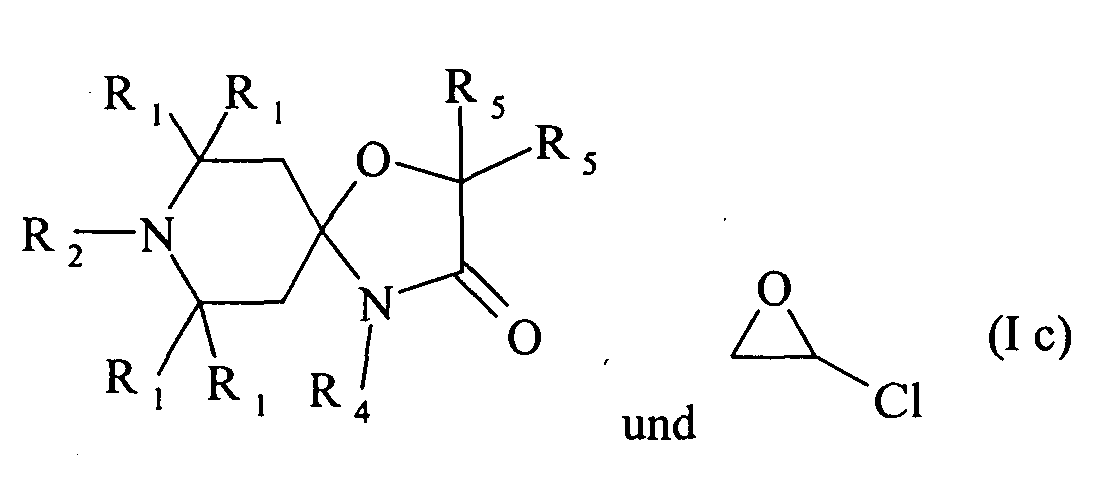 worin jeweils unabhängig voneinander
- A
- -O- oder -NR'-,
- R'
- H, C1-C18-Alkyl oder eine der Gruppen
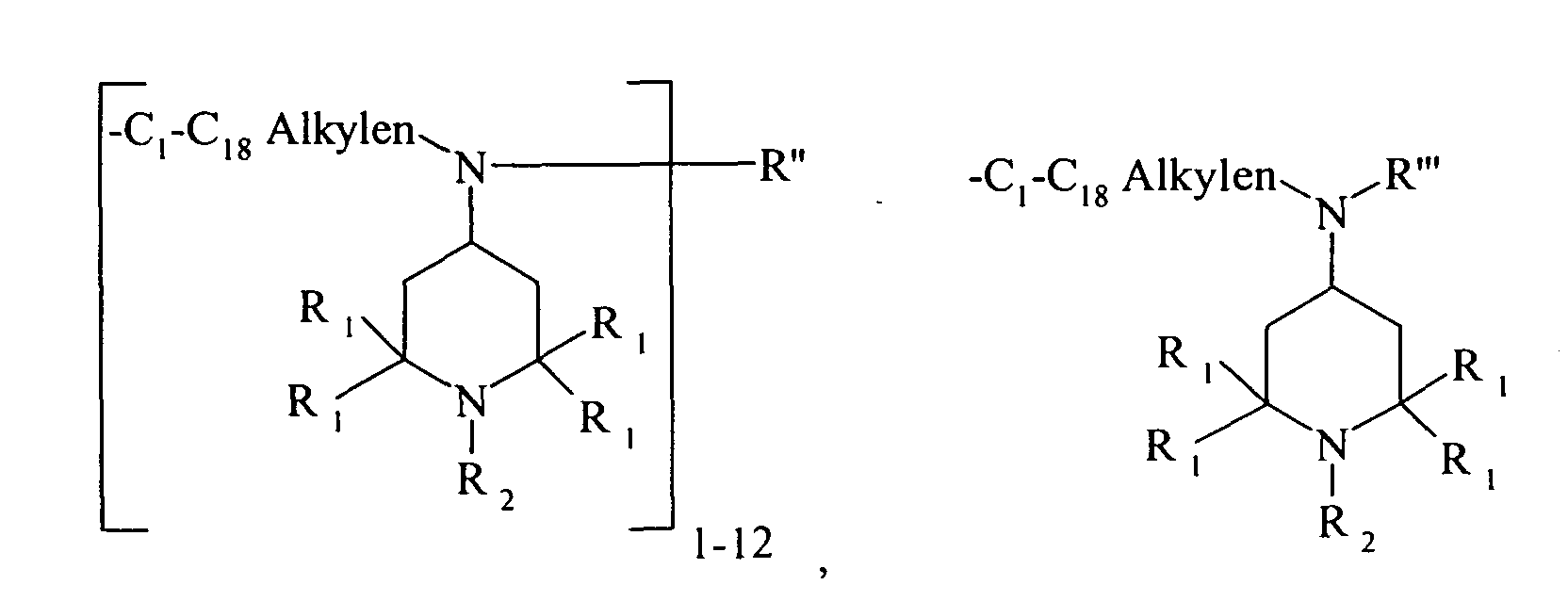
- R"
- H, C1-C18-Alkyl,
- R"'
- H, einen aliphatischen, cycloaliphatischen, aromatischen oder heteroaromatischen Rest,
- R1
- C1-C18-Alkyl, oder jeweils zwei an dem gemeinsamen Kohlenstoffatom gebundene R1 einen C4-C8-Cycloalkyl Rest,
- R2
- H oder C1-C18-Alkyl, C7-C18-Alkylaryl,
- R3
- H, einen n-wertigen aliphatischen, cycloaliphatischen, aromatischen oder heteroaromatischen Rest,
- R4
- C1-C18-Alkyl, -C(O)-C1-C18-Alkyl oder -C1-C8-Alkyl -C(O)O-C1-C18-Alkyl;
- R5
- H, C1-C18-Alkyl, C4-C18-Cycloalkyl oder jeweils zwei an dem gleichen Kohlenstoffatom gebundene R5 einen C4-C18-Cycloalkyl Rest,
- n
- eine ganze Zahl > 0
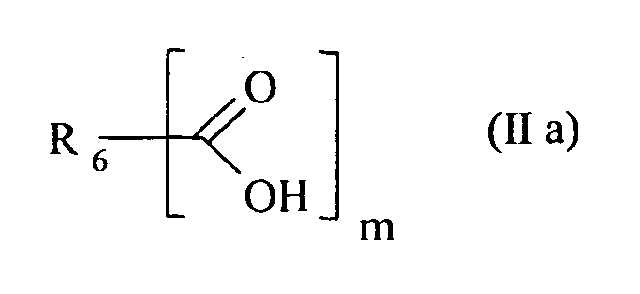
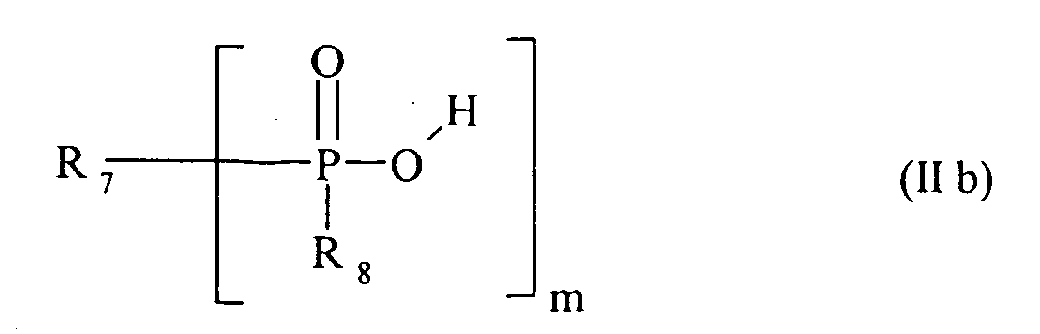
Die oben genannten organischen Säuren lassen sich durch folgende Strukturen (II a)-(II
c) charakterisieren:
Unter Carbonsäuren und deren Derivaten werden im folgenden allgemein
Verbindungen, die eine oder mehrere Gruppen der Formel (II a) enthalten,
 worin jeweils unabhängig voneinander
- R6
- H, einen m-wertigen aliphatischen, cycloaliphatischen, aromatischen oder heteroaromatischen Rest,
- m
- eine ganze Zahl > 0
Erfindungsgemässe phosphororganische Säuren sind Verbindungen der Formel (II b),
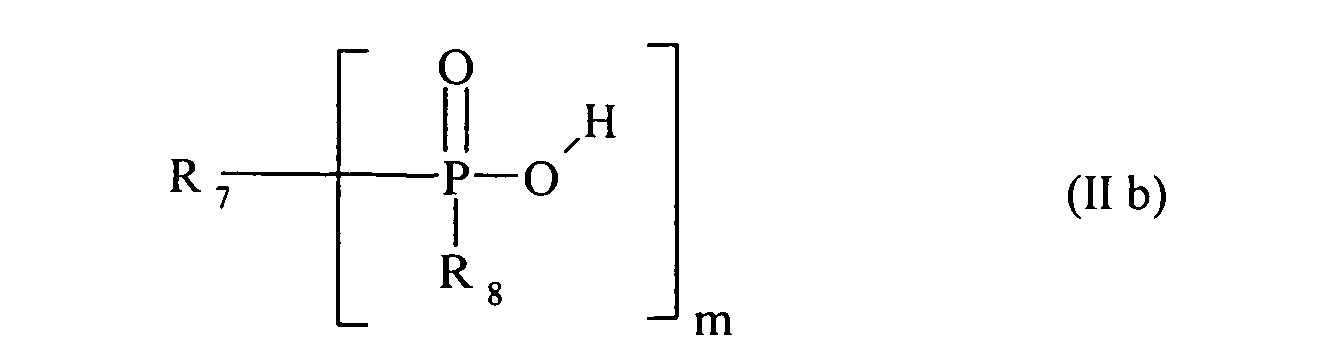 worin jeweils unabhängig voneinander
- R7
- H, einen m-wertigen aliphatischen, cycloaliphatischen, aromatischen, heteroaromatischen Rest oder einen Rest -OR9 ;
- R8
- H, einen aliphatischen, cycloaliphatischen, aromatischen, heteroaromatischen Rest oder einen Rest -OR9;
- R9
- H, einen aliphatischen, cycloaliphatischen, aromatischen, oder heteroaromatischen Rest
- m
- eine ganze Zahl > 0
Erfindungsgemässe schwefelorganische Säuren sind Verbindungen der Formel (II c),
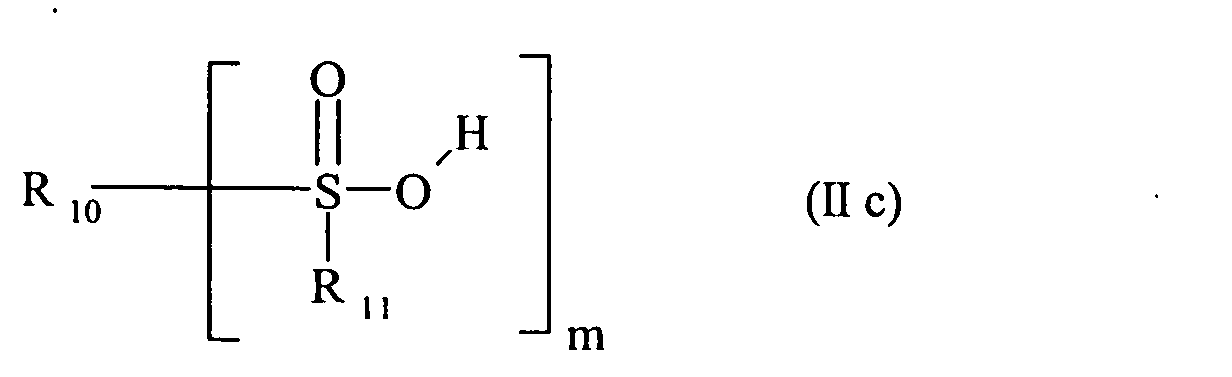 worin jeweils unabhängig voneinander
- R10
- einen m-wertigen aliphatischen, cycloaliphatischen, aromatischen, oder heteroaromatischen Rest oder einen Rest -OR12;
- R11
- ein Elektronenpaar oder =O;
- R12
- einen aliphatischen, cycloaliphatischen, aromatischen, oder heteroaromatischen Rest
- m
- eine ganze Zahl > 0
Bevorzugte Gruppen R' sind H, Methyl oder eine der Gruppen

Bevorzugte Gruppen R" sind H, C1-C8-Alkyl.
Bevorzugte Gruppen R"' stellen die folgenden Reste
- R"'
- C1-C18-Alkyl, C1-C18-Alkylen, C5-C12-Cycloalkyl, C5-C12-Cycloalkylen, C6-C18-Aryl,
C6-C18-Arylen, C5-C18-Heteroaryl, C5-C18-Hetetoarylen, C6-C36-Arylalkyl,
C6-C36-Arylalkylen, C6-C36-Alkylaryl,C6-C36-Alkylarylen und der Rest
worin p eine ganze Zahl von 1-4 bedeutet,

Bevorzugte Gruppen R1 sind Methyl oder jeweils zwei an dem gemeinsamen
Kohlenstoffatom gebundene R1 einen C4-C6-Cycloalkylrest.
Bevorzugte Gruppen R2 sind H, C1-C12-Alkyl oder Benzyl.
Bevorzugte Gruppen R3 stellen die folgenden Reste
- R3
- C1-C18-Alkyl, C1-C18-Alkylen, C5-C12-Cycloalkyl, C5-C12-Cycloalkylen, C6-C18-Aryl,
C6-C18-Arylen, C5-C18-Heteroaryl, C5-C18-Heteroarylen, C6-C36-Arylalkyl,
C6-C36-Arylalkylen, C6-C36-Alkylaryl,C6-C36-Alkylarylen und der Rest
worin p eine ganze Zahl von 1-4 bedeutet,
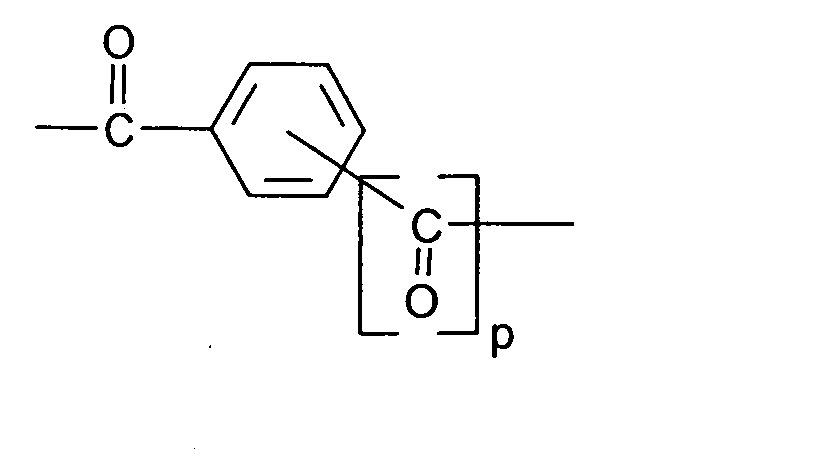
Bevorzugte Gruppen R4 sind C1-C12-Alkyl, -C(O)-C1-C16-Alkyl oder -C1-C4-Alkyl-C(O)O-C1-C16-Alkyl;
Bevorzugte Gruppen R5 sind C1-C8-Alkyl oder jeweils zwei an dem gleichen
Kohlenstoffatom gebundene R5 einen C6-C8-Cycloalkyl bildenden Rest;
Bevorzugte Gruppen R6 sind C1-C18-Alkyl, C1-C18-Alkylen, C5-C12-Cycloalkyl, C5-C12-Cycloalkylen,
C6-C18-Aryl, C6-C18-Arylen, C5-C18-Heteroaryl, C5-C18-Heteroarylen, C6-C36-Arylalkyl,
C6-C36-Arylalkylen, C6-C36-Alkylaryl,C6-C36-Alkylarylen;
Bevorzugte Gruppen R7 sind H, C1-C18-Alkyl, C1-C18-Alkylen, C5-C12-Cycloalkyl, C5-C12-Cycloalkylen,
C6-C18-Aryl, C6-C18-Arylen, C5-C18-Heteroaryl, C5-C18-Heteroarylen,
C6-C36-Arylalkyl, C6-C36-Arylalkylen, C6-C36-Alkylaryl,C6-C36-Alkylarylen, -OR9;
und bevorzugte Gruppen R8 sind H, C1-C18-Alkyl, C1-C18-Alkylen, C5-C12-Cycloalkyl, C5-C12-Cycloalkylen, C6-C18-Aryl, C6-C18-Arylen, C5-C18-Heteroaryl, C5-C18-Heteroarylen, C6-C36-Arylalkyl, C6-C36-Arylalkylen, C6-C36-Alkylaryl,C6-C36-Alkylarylen, -OR9;
und bevorzugte Gruppen R8 sind H, C1-C18-Alkyl, C1-C18-Alkylen, C5-C12-Cycloalkyl, C5-C12-Cycloalkylen, C6-C18-Aryl, C6-C18-Arylen, C5-C18-Heteroaryl, C5-C18-Heteroarylen, C6-C36-Arylalkyl, C6-C36-Arylalkylen, C6-C36-Alkylaryl,C6-C36-Alkylarylen, -OR9;
Bevorzugte Gruppen R9 sind H, C1-C36-Alkyl, C5-C12-Cycloalkyl, C6-C18-Aryl, C5-C18-Heteroaryl,
C6-C36-Arylalkyl, C6-C36-Alkylaryl;
Bevorzugte Gruppen R10 sind C1-C18-Alkyl, C1-C18-Alkylen, C5-C12-Cycloalkyl, C5-C12-Cycloalkylen,
C6-C18-Aryl, C6-C18-Arylen, C5-C18-Heteroaryl, C5-C18-Heteroarylen,
C6-C36-Arylalkyl, C6-C36-Arylalkylen, C6-C36-Alkylaryl,C6-C36-Alkylarylen;
Bevorzugte Gruppe R11 ist =O;
Bevorzugte Gruppen R12 sind C1-C36-Alkyl, C5-C12-Cycloalkyl, C6-C18-Aryl, C5-C18-Heteroaryl,
C6-C36-Arylalkyl, C6-C36-Alkylaryl;
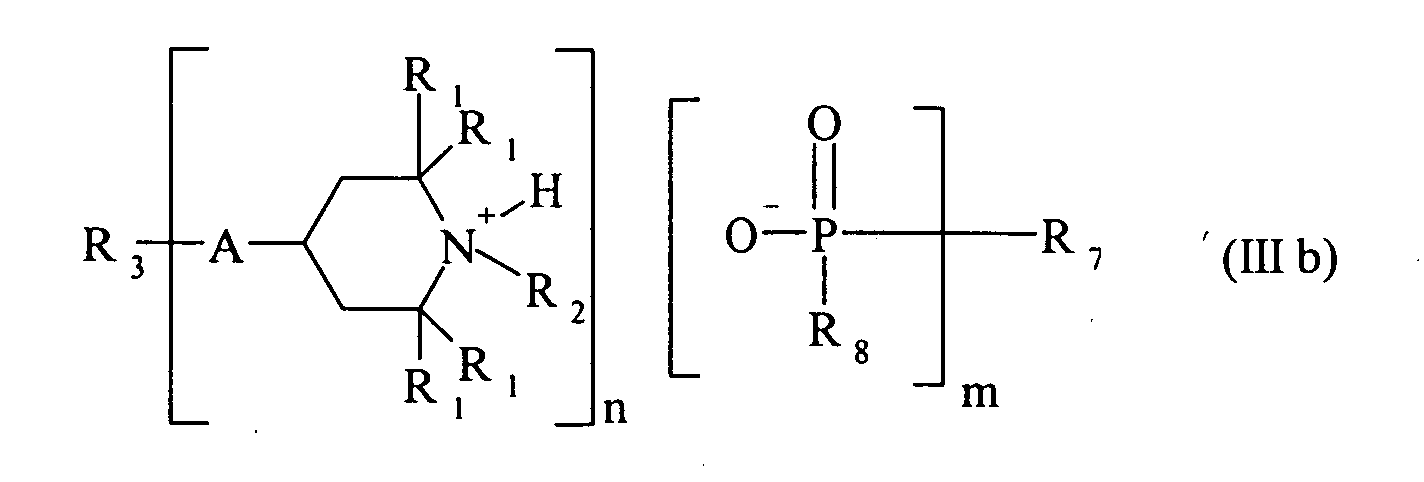
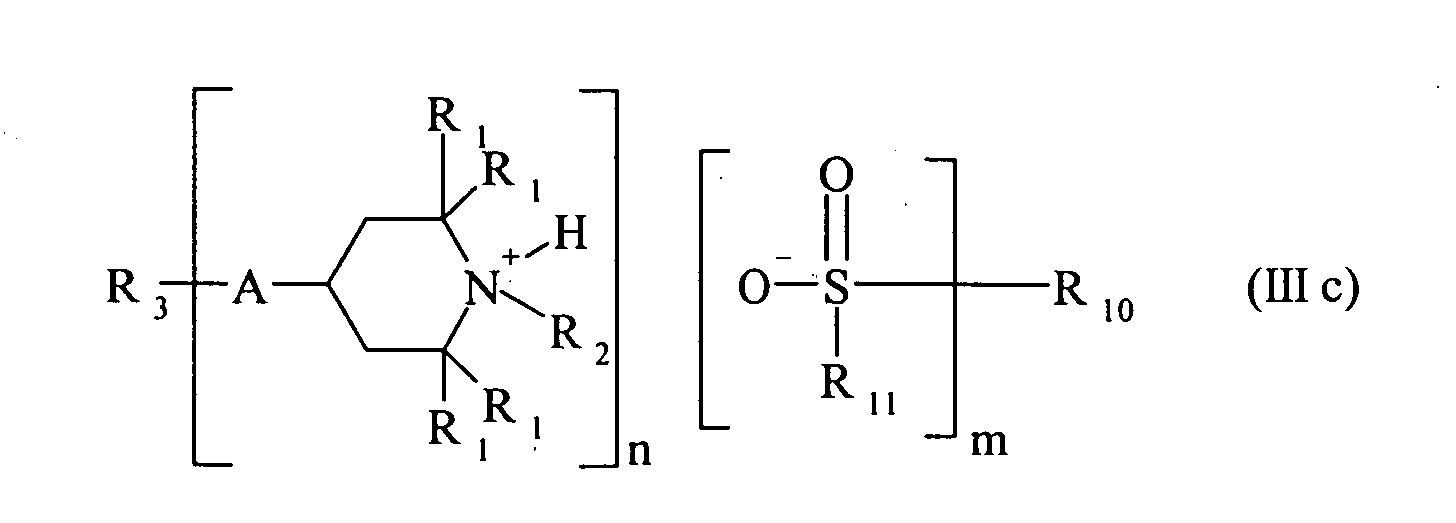
Ein bevorzugter Gegenstand der Erfindung sind salzartige Verbindungen der
allgemeinen Formel (III a) - (III i)

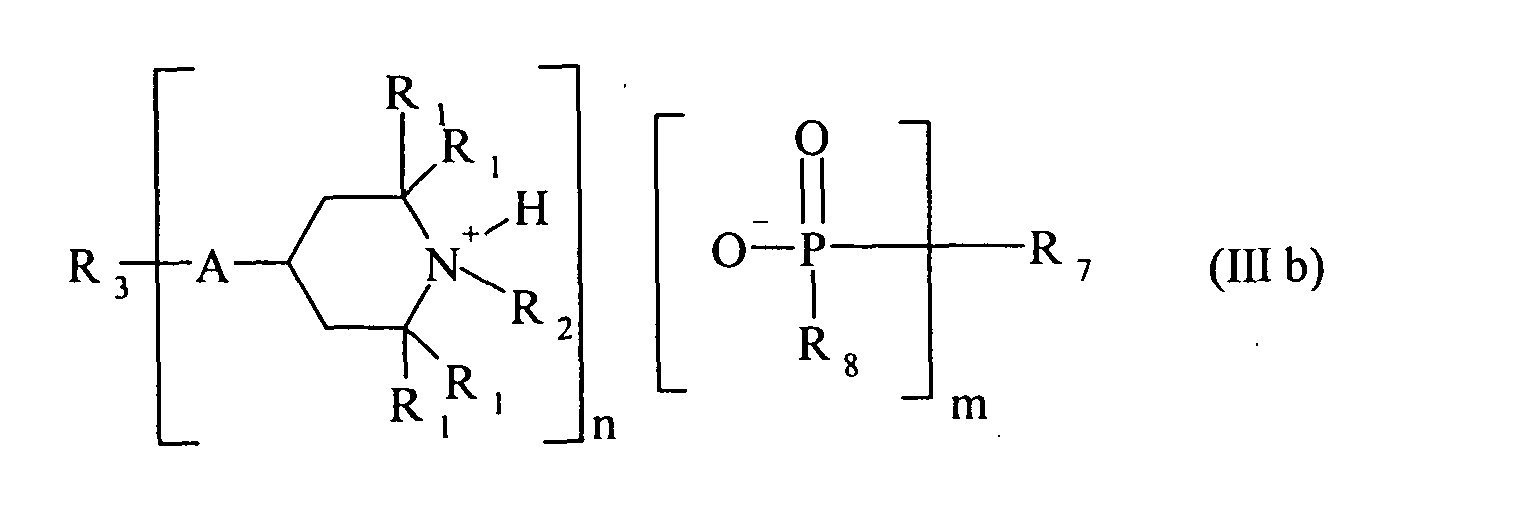

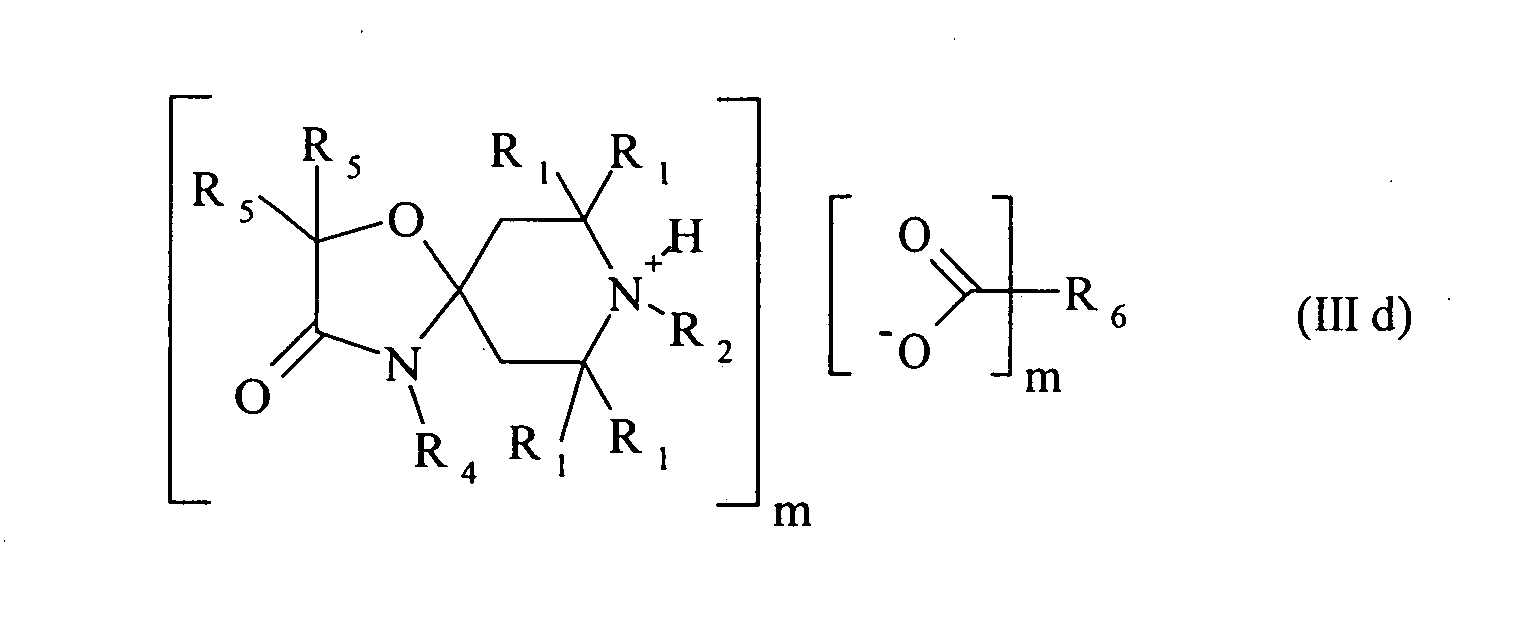


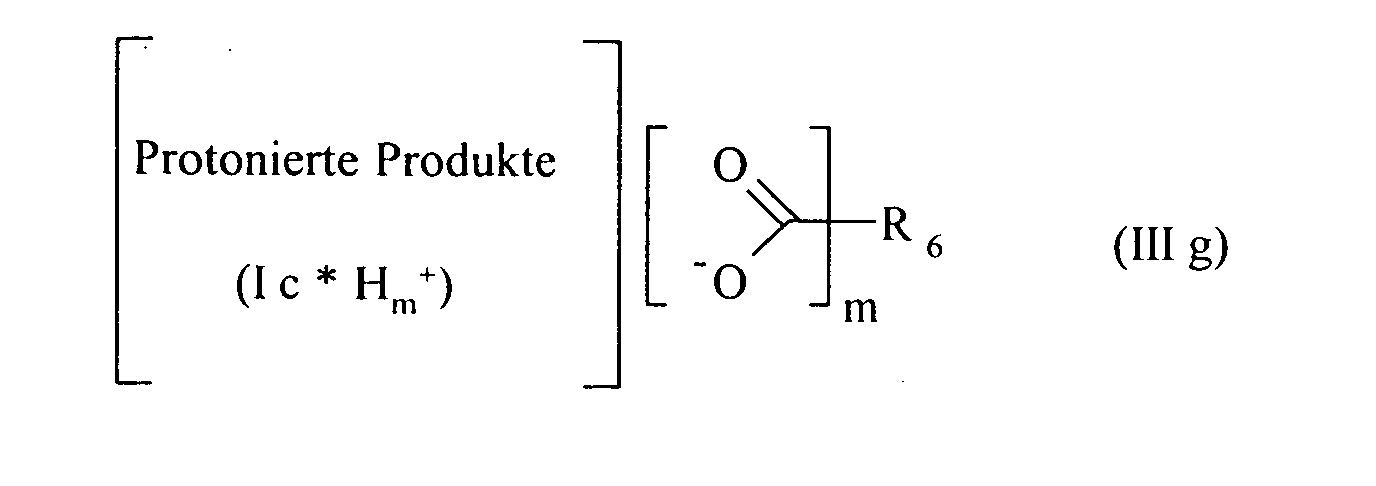

 worin n und m identisch und grösser als Null sind und die anderen Substituenten wie
oben definiert sind.
worin n und m identisch und grösser als Null sind und die anderen Substituenten wie
oben definiert sind.
Solche Verbindungen der Formel (III a) - (III i) können bei polyvalenten Substituenten
R3, R6, R7 und R10 noch weitere Gruppen der Formel (I a) und/oder (II a) -(II c)
enthalten.
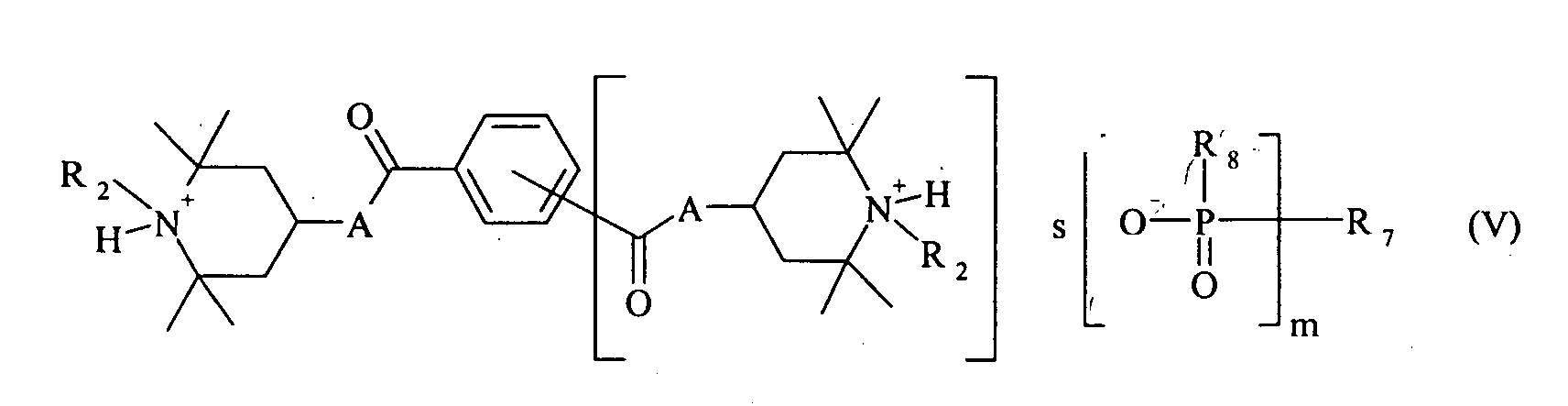
Ebenfalls Gegenstand der Erfindung sind die neuen Verbindungen der Formel (IV)-(VI),

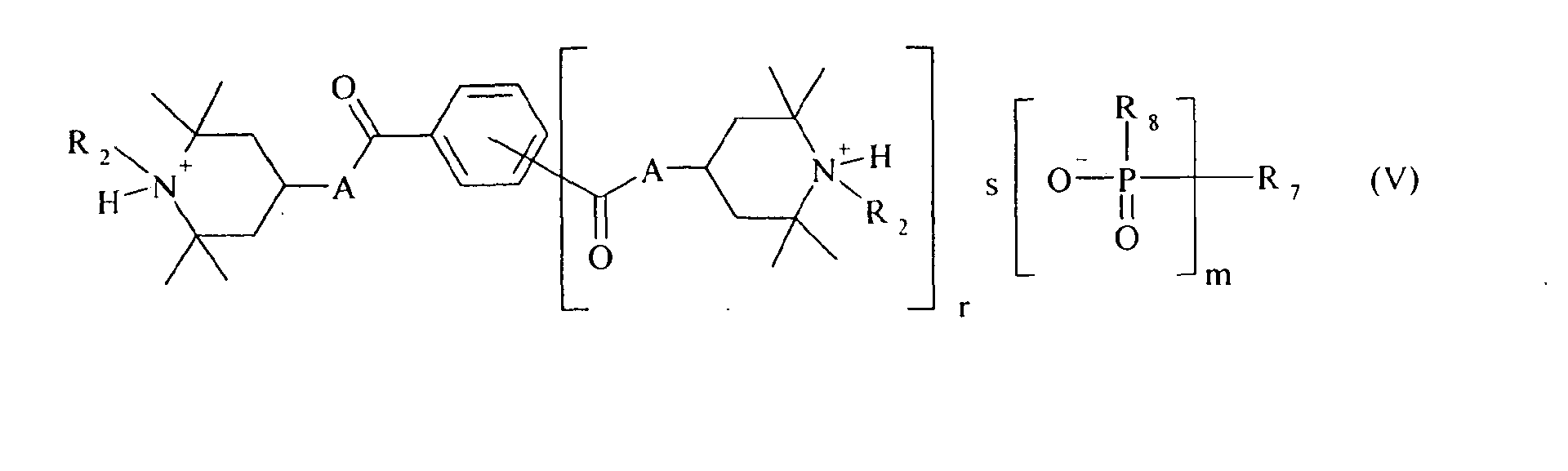
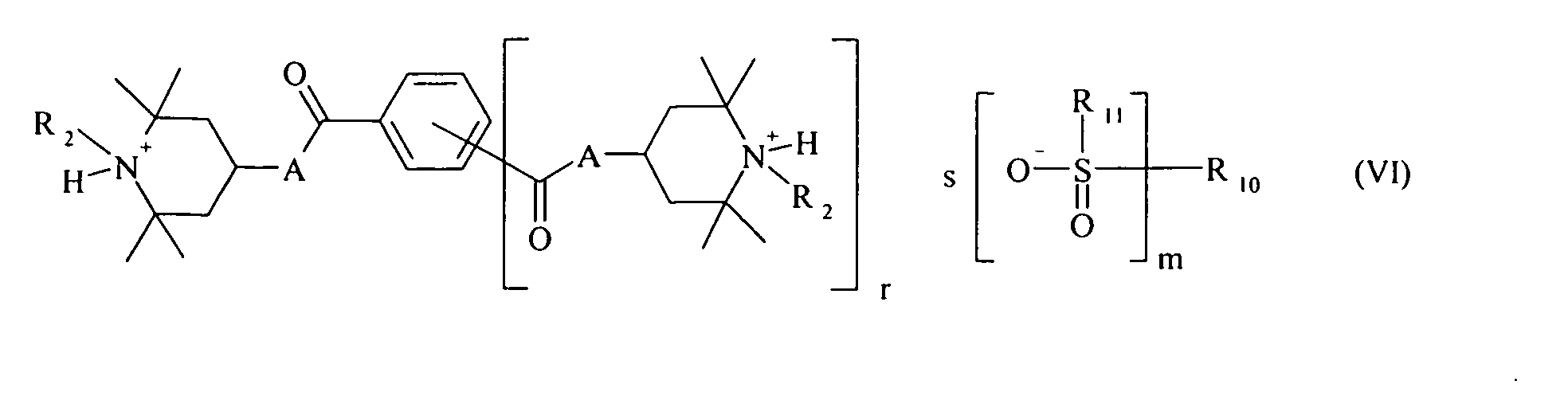 wobei
wobei
- r
- eine ganze Zahl zwischen 0 und 3,
- s
- (r+1 )/m bedeuten und
- m
- wie oben definiert ist,
Diese neuen, erfindungsgemässen Verbindungen lassen sich durch Reaktion von einer
oder mehreren HALS-Verbindungen mit einer oder mehreren organischer Säuren
herstellen, wobei, je nach molaren Verhältnissen der Reaktionspartner und der
Reaktionsbedingungen, vollständig oder teilweise Aminsalze der organischen Säuren
gebildet werden. Diese Salze weisen gegenüber den Ausgangsverbindungen eine
teilweise beträchtlich höhere Wasserlöslichkeit oder Löslichkeit in niederen Alkoholen
auf.
Diese erfindungsgemässen Verbindungen lassen sich in Lösungsmitteln, ggf. bevorzugt
in Wasser oder niederen Alkoholen, aber auch in der Schmelze herstellen. Die
erhaltenen Lösungen können einerseits direkt eingesetzt werden oder die Verbindungen
werden zuvor durch Entfernen des Lösungsmittels isoliert und die resultierenden
Feststoffe, gegebenenfalls nach einer weiteren Konfektionierung, verwendet.
Die Anwendung solcher Verbindungen in Polykondensationspolymeren wie Polyamid
6.6, PET oder vergleichbaren Typen, die aus einer Di-Säure- und einer Di-Amin- bzw.
Diolkomponente hergestellt werden, ist besonders vorteilhaft, da sie sich aufgrund ihrer
z.T. guten Löslichkeit während der ablaufenden Polykondensationsreaktion leicht und
homogen im Reaktionsmedium verteilen lassen. Die HALS-Verbindungen selbst sind
dagegen aufgrund ihres hydrophoben Charakters wenig löslich und sind daher
schwieriger homogen einzuarbeiten.
Andere Vertreter dieser erfindungsgemässen Verbindungen sind dagegen aufgrund
geringerer Polarität besser zur Einarbeitung in eine Polymerschmelze geeignet. Es
wurde gefunden, dass sich die jeweils bevorzugten Eigenschaften durch Wahl der
Komponenten in weiten Grenzen beeinflussen lassen.
Ein weiterer Gegenstand der Erfindung sind vorgefertigte -konfektionierte- Mischungen
- in der Kunststoffindustrie "Blends" genannt - bestehend aus den beiden Komponenten
I und II in den gewünschten molaren Verhältnissen. Die erfindungsgemässen Salze der
Formel III können dabei schon teilweise oder vollständig im Konfektionierungschritt
gebildet werden, oder aber auch beim Eintragen in die Polymermasse, bzw. deren
Rohstoffe entstehen. Letztere können z.B. ε-Caprolactam (bei PA6), AH-Salz-Lösung
(bei PA6.6) oder Präkondensate aus Di-Säuren und Diolen (Polyester) sein.
Wie der Fachmann weiss, können solche Salze bzw. Mischungen bei der Anwendung
von HALS-Verbindungen während der Polykondensation entstehen und bei
fortgesetzter Polykondensation wieder verschwinden.
Die vorgefertigten Mischungen dieser Erfindung sind jedoch bestimmte, mit
Vorbedacht in ausgewählten molaren Verhältnissen, nach grosstechnischen Verfahren
hergestellten Mischungen, die je nach Verfahrensbedingungen bereits teilweise Salze
der Formel III enthalten, und so konzipiert worden sind, dass mit diesen "Blends" die
gewünschten Mengen der Komponenten I und II zu den Polykondensaten gegeben
werden. Diese vorgefertigten Mischungen können durch Formgebung aus der Schmelze
(Tropfgranulation, Prilling, Extrusion, etc.), Kompaktierung (Rollenkompaktierung,
Tablettierung, Brikettierung, Pressgranulation, etc.) oder Granulationsverfahren
(Sprühen, Wirbelschichtgranulation, Trommeln, Rondieren, etc.) erhalten werden.
Die HALS-Verbindungen, als auch die organischen Säuren bzw. deren Derivate können
jeweils mono- oder oligofunktional sein, bevorzugt werden aber HALS-Verbindungen
mit einer HALS-Gruppe und difunktionale organische Säuren, HALS-Verbindungen
mit zwei oder mehr HALS-Gruppen und difunktionale organische Säuren oder HALS-Verbindungen
mit zwei oder mehr HALS-Gruppen und monofunktionale organische
Säuren eingesetzt. Je nach Anforderung kann das molare Verhältnis zwischen HALS-Gruppen
und Gruppen organischer Säuren zwischen 1:99 und 99:1 variieren, bevorzugt
sind aber Verhältnisse von 40:60 bis 60:40, insbesonders 45:55 bis 55:45 und vor allem
äquimolare Verhältnisse (50:50).
Bevorzugte Carbonsäuren der Formel (II a) sind C1-C80Alkylcarbonsäuren, C1-C18-Alkylendicarbonsäuren,
C5-C18Cycloalkancarbonsäuren, C5-C18Cycloalkylendicarbonsäuren,
C6-C19Arylcarbonsäuren, C6-C20Arylendicarbonsäuren, C2-C12-Alkylcarbonsäureanhydride,
C7-18Arylcarbonsäureanhydride oder C6-C18Lactame.
Bevorzugte phosphororganische Säuren der Formel (II b) sind C1-C18Alkylphosphinsäuren,
Di(C1-C18Alkyl)phosphinsäuren, C5-C18Cycloalkyl-phosphinsäuren,
Di(C5-C 18cyctoalkyt)phosphinsäuren, C6-C18Arylphosphinsäuren, Di(C6-C18aryl)-phosphinsäuren,
C7-C36Alkylarylphosphinsäuren, C7-C36Arylalkylphosphinsäuren,
Di(C7-C36alkylaryl)phosphinsäuren, Di(C7-C36arylalkyl)phosphinsäuren, C1-C18-Alkylen-bisphosphinsäuren,
C1-C18Alkylphosphonsäuren, C1-C18Alkylphosphonsäure
monoester, C5-C18Cycloalkyl-phosphonsäuren, C5-C18cycloalkylphosphonsäure
monoester, C6-C18Arylphosphonsäuren, C6-C18Arylphosphonsäure monoester, C7-C36-Alkylarylphosphonsäuren,
C7-C36Alkylarylphosphonsäure monoester, C1-C18Alkylenbisphosphonsäuren,
saure Phosphatester des Typs (OR9)-P(O)(OH)2 oder
(OR9)2-P(O)OH.
Bevorzugte schwefelorganische Säuren der Formel (II c) sind C1-C18Alkyl-sulfonsäuren,
C1-C18Sulfinsäuren, C5-C18Cycloalkylsulfonsäuren, C5-C18cycloalkylsulfinsäuren,
C6-C18Arylsulfonsäuren, C6-C18Arylsulfinsäuren, C7-C36Alkylarylsulfonsäuren,
C7-C36Alkylarylsulfinsäuren.
Besonders bevorzugte Carbonsäuren oder Carbonsäurederivate der Formel (II a) sind
C1-C60Alkylcarbonsäuren, C1-C60Alkylendicarbonsäuren, C6-C12Cycloalkancarbonsäuren,
C6-C12Cycloalkylendicarbonsäuren, C6-12Arylcarbonsäuren, C6-12Arylendicarbonsäuren,
Caprolactam, Laurinlactam, C1-C6Alkylcarbonsäureanhydride oder
C6-C18 Arylcarbonsäureanhydride.
Besonders bevorzugte phosphororganische Säuren der Formel (II b) sind C1-C12 Alkylphosphinsäuren,
Di(C1-C12Alkyl)phosphinsäuren, C6-C12Cycloalkyl-phosphinsäuren,
Di(C6-C12cycloalkyl)phosphinsäuren, C6-C12Arylphosphinsäuren, Di(C6-C12aryl)-phosphinsäuren,
C7-C18Alkylarylphosphinsäuren, Di(C7-C18alkylaryl)phosphinsäuren,
C1-C12Alkylen-bisphosphinsäuren, C1-C12Alkylphosphonsäuren, C1-C12Alkylphosphonsäuremonoester,
C6-C12Cycloalkylphosphonsäuren, C6-C12Cycloalkylphosphonsäuremonoester,
C6-C12Arylphosphonsäuren, C6-C12Arylphosphonsäuremonoester, C7-C18-Alkylarylphosphonsäuren,
C7-C18Alkylarylphosphonsäure monoester, C1-C12Alkylenbisphosphonsäuren,
saure Phosphatester des Typs (OR9)-P(O)(OH)2 oder
(OR9)2-P(O)OH.
Besonders bevorzugte schwefelorganische Säuren der Formel (II c) sind C1-C18Alkyl-sulfonsäuren,
C6-C18Arylsulfonsäuren, C7-C36Alkylarylsulfonsäuren.
Speziell bevorzugte HALS-Verbindung der Formel (I a) ist 1,3-Benzoldicarboxamid,
N,N'-bis(2,2,6,6-tetramethyl-4-piperidinyl) (Nylostab® S-EED® ), der Formel (I b) sind
2,2,4,4-Tetramethyl-7-oxa-3,20-diazadispiro[5.1.11.2]heneicosan-21-on und der Formel
(I c) ist Poly[[6-[(1,1,3,3-tetramethylbutyl)amino]-1,3,5-trazin-2,4-diyl][(2,2,6,6-tetramethyl-4-piperidinyl)imino]-1,6-hexandiyl-[(2,2,6,6-tetramethyl-4-piperidinyl)imino]],
sowie das Reaktionsprodukt aus Hostavin® N 20 und
Epichlorhydrin (Hostavin® N 30).
Speziell bevorzugte Carbonsäuren der Formel (II a) sind Adipinsäure, Terephthalsäure,
Isophthalsäure, Phthalsäure, Benzoesäure und Essigsäure.
Speziell bevorzugte phosphororganische Säuren der Formel (II b) sind
Methylphosphinsäure, Dimethylphosphinsäure, Methylethylphosphinsäure, Ethylphosphinsäure,
Diethylphosphinsäure, Propylphosphinsäure, Di-propylphosphinsäure,
Butylphosphinsäure, Dibutylphosphinsäure, Hexylphosphinsäure, Dihexylphosphinsäure,
Octylphosphinsäure, Dioctylphosphinsäure, Cyclohexylphosphinsäure,
Dicyclohexylphosphinsäure, Phenylphosphinsäure, Diphenylphosphinsäure, Tolylphosphinsäure,
Ditolylphosphinsäure, Xylylphosphinsäure, Dixylylphosphinsäure,
Biphenylphosphinsäure, Di-biphenylphosphinsäure, Methylenbisphosphinsäure,
Ethylenbisphosphinsäure, 1,2-Diethyl-ethylenbisphosphinsäure, Phenylethylphosphinsäure,
Di(phenyl-ethyl)phosphinsäure, Methylphosphonsäure, Ethylphosphonsäure,
Methylendiphosphonsäure, Ethylendiphosphonsäure.
Speziell bevorzugte schwefelorganische Säuren der Formel (II c) sind
Methansulfonsäure, Ethansulfonsäure, Benzolsulfonsäure und Toluolsulfonsäure.
Nichtlimitierende Beispiele für die HALS-Verbindungen bzw. organischer Säuren sind
in den folgenden Tabellen aufgelistet. Dabei kann jede Verbindung der einen Gruppe
(organische Säure), mit den Verbindungen der anderen Gruppe (HALS-Verbindung) zur
Reaktion gebracht bzw. gemischt werden.
- Fettsäure-(C16C18)-ester des 2,2,6,6-Tetramethyl-piperidinol (Hostavin® 845)
- 3-Dodecenyl-1-(2,2,6,6-tetramethyl-4-piperidyl)pyrrolidin-2,5-dion (Sanduvor® 3055)
- 2,2,4,4-Tetramethyl-7-oxa-3,20-diaza-dispiro[5.1.11.2]-heneicosan-21-on (Hostavin® N 20)
- 2,2,4,4-Tetramethyl-20(ß-Myristyl/lauryl-oxycarbonyl)-ethyl-7-oxa-3,20-diaza-dispiro[5.1.11.2]-heneicosan-21-on (Hostavin® N 24)
- 4-Hydroxy-2,2,6,6-tetramethylpiperidin
- 4-Amino-2,2,6,6-tetramethylpiperidin
- 4-Hydroxy-1,2,2,6,6-pentamethylpiperidin
- 4-Amino-1,2,2,6,6-pentamethylpiperidin
- 4-N-Butyl-amino-2,2,6,6-tetramethylpiperidin
- N-Hydroxyethyl-4-hydroxy-2,2,6,6-tetramethylpiperidin
- 1,3-Benzoldicarboxamid,N,N'-bis(2,2,6,6-tetramethyl-4-piperidinyl) (Nylostab® S-EED® )
- Propandionsäure, [(4-methoxyphenyl)-methylen)-bis(1,2,2,6,6-pentamethyl-4-piperidinyl)ester (Hostavin® PR-31)
- Bis(2,2,6,6-tetramethyl-4-piperidinyl) Sebacinsäureester (Tinuvin® 770)
- 1,6-Hexamethylen-bis(4-amino-2,2,6,6-tetramethylpiperidin)
- Mischung aus Bis( 1,2,2,6,6-pentamethyl-4-piperidinyl)sebacate und Methyl(1,2,2,6,6-pentamethyl-4-piperidinyl)sebacate (Tinuvin® 292)
- (1,2,2,6,6-pentamethyl-4-piperidinyl)-[[3,5-bis(1,1-dimethylethyl)-4-hydroxyphenyl]methyl]butylmalonate (Tinuvin® 144)
- Poly[[6-[(1,1,3,3-tetramethylbutyl)amino]-1,3,5-trazin-2,4-diyl][(2,2,6,6-tetramethyl-4-piperidinyl)imino]- 1,6-hexandiyl-[(2,2,6,6-tetramethyl-4-piperidinyl)imino]] (Chimassorb® 944)
- Polymer aus 2,2,4,4-Tetramethyl-7-oxa-3,20-diaza-dispiro[5.1.11.2]-heneicosan-21-on und Epichlorhydrin (Hostavin® N 30)
- 1,3,5-Triazine-2,4,6-Triamine, N,N"'-[1,2-ethandiyl-bis[[[4,6-bis[butyl(1,2,2,6,6-pentamethyl-4-piperidinyl)amino]-1,3,5-triazine-2-yl]-3,1-propanediyl]]bis[N',N"-dibutyl-N',N"-bis(1,2,2,6,6-pentamethyl-4-piperidinyl)- (Chimassorb® 119)
- 1,6-Hexandiamin, N, N'-bis(2,2,6,6-tetramethyl-4-piperidinyl)-polymer mit 2,4,6-trichloro-1,3,5-triazin, Reaktionsprodukte mit N-butyl-1-butanamin und N-butyl-2,2,6,6-tetramethyl-4-piperidinamin (Chimassorb® 2020)
- Polymer aus Butandisäure und 4-Hydroxy-2,2,5,5-tetramethyl-1-piperidinethanol (Tinuvin® 622)
- Maleinsäure
- Fumarsäure
- C1-C40-Alkylen-dicarbonsäuren
- Phthalsäure
- Isophthalsäure
- Terephthalsäure
- Naphthoe-disäuren, ggf. substituiert
- C1-C18-Alkylen-bisphosphinsäuren
- C1-C18-Alkylen-bisphosphonsäuren
- C1-C40-Alkylcarbonsäuren
- Benzoesäure, ggf. Substituiert
- Naphthoesäure, ggf. Substituiert
- Diphenylphosphinsäure
- Phenylphosphinsäure
- Diethylphosphinsäure
- Ethylphosphinsäure
- Laurinlactam
- ε-Caprolactam
Bevorzugte Polymere zur Anwendung der erfindungsgemässen Produkte sind
Polyamide, wie Polyamid 6, Polyamid 11, Polyamid 12, Polyamid 4.6, Polyamid 6.6,
Polyamid 6.9, Polyamid 6.10, Polyamid 6.12, Polyamid 12.12, und Polyester wie z.B.
Terephthalsäure/Alkyldiol basierte Polyester (z.B. PET, PBT), aliphatische Polyester,
aromatische Polyester, flüssigkristalline Polyester, Polyetherester, und Polycarbonate
sowie deren Blends und Copolymere.
Besonders bevorzugte Polymere sind Polyamid 4.6, Polyamid 6.6, Polyamid 6,
Polyamid 11, Polyamid 12, Polyethylenterepthalat (PET), Polybutylenterephthalat
(PBT), Polycarbonat, deren Copolymere und Blends.
Die Zugabe der erfindungsgemässen Verbindungen kann entweder vor oder während
der Polymerbildungsreaktion oder aber auch nachher in weiteren Verarbeitungschritten
erfolgen. Die Produkte können dabei als Feststoff (als Pulver oder in konfektionierter
Form), in Lösung (in inerten oder Reaktivlösungsmitteln), bei unzersetzt schmelzbaren
Verbindungen auch als Schmelze, als Masterbatch oder als Konzentrat zugesetzt
werden.
Besonders vorteilhaft ist die Zugabe in freifliessender Konfektionierungsform, wie sie
z.B. durch Formgebung aus der Schmelze (Tropfgranulation, Prilling, Extrusion, etc.),
Kompaktierung (Rollenkompaktierung, Tablettierung, Brikettierung, Pressgranulation,
etc.) oder Granulationsverfahren (Sprühen, Wirbelschichtgranulation, Trommeln,
Rondieren, etc.) erhalten werden kann. Diese Konfektionierungsformen umfassen dabei
auch Gemische der erfindungsgemässen Komponenten oder auch Mischungen mit
weiteren Additiven (Blends).
Neben den erfindungsgemässen Additiven können zuvor, zeitgleich oder anschliessend
noch weitere Additive oder Farbmittel, ggf. auch als Blend mit erfindungsgemässen
Verbindungen, zugegeben werden. Beispiele solcher weiteren Additive sind
Lichtschutzmittel (weitere HALS-Verbindungen, UV-Absorber, Ni-Quencher),
Prozessstabilisatoren auf Phosphor- oder Schwefelbasis, Antioxidantien (Phenol- oder
Aminbasiert), Antistatika, Nukleiermittel, Flammschutzmittel, Verstärkungsmittel (z.B.
mineralische Füller, Glasfasern, Glashohlkugeln, Kohlefasern, nanoteilige
Verstärkungsmittel (z.B. Nanoclays, Kohlenstoffnanoröhren)), Gleitmittel, Anti-Block-Mittel,
Farbmittel (Pigmente und Farbstoffe) etc.
Die Herstellung und Anwendung der erfindungsgemässen Verbindungen soll durch die
nachfolgenden, nicht limitierenden Beispiele gezeigt werden:
Zu einer Suspension von 75.3 g Nylostab® S-EED® in 250 ml Wasser werden 24.8 g
Adipinsäure zugegeben und bei 80°C solange gerührt, bis eine klare Lösung entstanden
ist. Das Wasser wird im Vakuum abgezogen und der farblose, kristalline Rückstand bei
80°C im Vakuum getrocknet.
Analog zu Beispiel 1 aus 72,7 g Nylostab® S-EED® und 27.3 g Terephthalsäure.
Analog zu Beispiel 1 aus 64.2 g Nylostab® S-EED® und 35.4 g Benzoesäure.
Analog zu Beispiel 1 aus 78.4 g Nylostab® S-EED® und 21.2 g Essigsäure.
Zu einer Suspension von 87.4 g Hostavin® N 20 in 400 ml Wasser werden 19.0 g
Adipinsäure zugegeben und die Mischung 48 h refluxiert. Nach dem Abkühlen wird der
farblose Niederschlag abfiltriert und im Vakuum bei 80°C getrocknet.
Analog zu Beispiel 5 aus 87.4 g Hostavin® N 20 und 21.6 g Terephthalsäure.
Analog zu Beispiel 5 aus 87.4 g Hostavin® N 20 und 31.7 g Benzoesäure.
Analog zu Beispiel 5 aus 87.4 g Hostavin® N 20 und 17.0 g Essigsäure.
Eine Mischung aus 86.3 g Chimassorb 944, 250 ml Wasser und 23.8 g Essigsäure
werden 8 h refluxiert. Das Wasser wir azeotrop mit Toluol entfernt und das
Lösungsmittel im Vakuum abgezogen. Man erhält eine weiche, beige Masse.
Eine Mischung aus 70.5 g Chimassorb 944, 500 ml Wasser/Ethanol (1:1) und 39.5 g
Benzoesäure werden 96 h refluxiert. Wasser und Ethanol werden azeotrop mit Toluol
entfernt und das Lösungsmittel im Vakuum abgezogen. Nach Trocknung bei 120°C im
Vakuum erhält man einen beigen Feststoff.
Eine Mischung aus 82.5 g Chimassorb 944, 500 ml Wasser/Ethanol (1:1) und 27.6 g
Adipinsäure werden 16 h refluxiert. Wasser und Ethanol werden azeotrop mit Toluol
entfernt und das Lösungsmittel im Vakuum abgezogen. Nach Trocknung bei 120°C im
Vakuum erhält man einen beigen, weichen Feststoff.
Eine Mischung aus 79.7 g Chimassorb 944, 500 ml Wasser/Ethanol (1:1) und 30.3 g
Terephthalsäure werden 36 h refluxiert. Wasser und Ethanol werden azeotrop mit
Toluol entfernt. Nach dem Abkühlen wird das beige Produkt abfiltriert und bei 120°C
im Vakuum getrocknet.
Eine Pulvermischung aus 30% Nylostab S-EED und 70% Terephthalsäure wird auf
einem Bepex-Rollenkompaktor zu einem stabilen, farblosen und frei fliessendem
Granulat geformt.
Eine Pulvermischung aus 30% Nylostab S-EED und 70% Adipinsäure wird auf einem
Bepex-Rollenkompaktor zu einem stabilen, farblosen und frei fliessendem Granulat
geformt.
Verarbeitung der erfindungsgemässen Verbindungen in Polyamiden
Die erfindungsgemässen Verbindungen werden zusammen mit dem Polyamidpulver
und ggf. weiteren Additiven auf einem Collin Einschneckenextruder bei der
vorgegebenen Verarbeitungstemperatur homogenisiert. Dabei werden die
Stromaufnahme des Extruders, der Druckverlauf an der Düse, die Massetemperatur
sowie der Durchsatz bei jeweils gleichen Maschineneinstellungen registriert. Die so
erhaltenen Polymerstränge werden pelletiert und wie unten beschrieben
weiterverwendet.
Eine verringerte Stromaufnahme und/oder ein erhöhter Durchsatz sind kommerziell
wichtige Grössen, da sie direkt die Herstellkosten beeinflussen. Ein konstanter Druck an
der Düse deutet auf ein gutes Einzugs- und Förderverhalten hin und ist für die
reproduzierbare Herstellbarkeit von Endartikeln, wie z.B. bei Spritzgussartikeln oder
sehr gleichförmiger Fasern, von Bedeutung. Ein höherer Druck deutet dabei auf eine
geringere Schädigung des Polyamides durch Kettenabau während der Verarbeitung hin;
das zugesetzte Additiv leistet in diesem Falle einen Beitrag zur Polymerstabilisierung.
Die erhaltenen Ergebnisse der verschiedenen Applikationen werden in der
nachstehenden Tabelle zusammengefasst.
| Beispiel | Verbindung | Konz. | Polymer | Verarbeitungstemperatur | Mittl. Strom- aufnahme [A] | Druck [bar] | Durchsatz [kg/h] |
| 15 | Keine | 0% | PA 6 | 250 | 4.7 ±0.2 | 50.8 ±1.4 | 5.45 |
| 16 | Beispiel 1 | 0.2% | PA 6 | 250 | 4.5 ±0.3 | 51.9 ±1.2 | 6.00 |
| 17 | Keine | 0% | PA 6.6 | 270 | 5.3 ±2.3 | 16.3 ±7.0 | 4.16 |
| 18 | Beispiel 1 | 0.2% | PA 6.6 | 270 | 3.8 ±0.6 | 21.7 ±1.2 | 5.00 |
Künstliche Bewitterung und Wärmealterung von Polyamiden, enthaltend den
erfindungsgemässen Stabilisator aus Beispiel 1:
Die wie oben beschriebenen Polymergranulate aus Beispiel 15-18 werden in einer
Arburg Allrounder Spritzgussmaschine zu 100 x 100 x 1 mm3 Platten verarbeitet Für
jede Polymersorte bleiben dabei die Maschinenparameter unverändert. Die so
erhaltenen Platten werden zur Untersuchung auf die Licht-und Wärmestabilisierung
durch die erfindungsgemässe Verbindung aus Beispiel 1 untersucht.
Farbänderung nach Exposition in Weatherometer nach ISO 11341 A (Nass-/Trockenbewitterung)
bzw. ISO 11341 C (Trockenbewitterung)
| Beispiel | Verbindung | Konz. | Polymer | ΔE* nach 2500 h (ISO 11341 A) | ΔE* nach 2500 h (ISO 11341 C) |
| 19 | Keine | 0% | PA 6 | 25.6 | 8.2 |
| 20 | Beispiel 1 | 0.2% | PA 6 | 10.4 | 1.6 |
| 21 | Keine | 0% | PA 6.6 | 12.86 | 4.4 |
| 22 | Beispiel 1 | 0.2% | PA 6.6 | 2.64 | 2.4 |
Vergilbung nach Ofenalterung bei 120°C
| Beispiel | Verbindung | Konz. | Polymer | b* nach 15 Tagen bei 120°C |
| 23 | Keine | 0% | PA 6 | 23.4 |
| 24 | Beispiel 1 | 0.2% | PA 6 | 18.2 |
| 25 | Keine | 0% | PA 6.6 | 26.2 |
| 26 | Beispiel 1 | 0.2% | PA 6.6 | 23.1 |
Claims (13)
- Salzartige Reaktionsprodukte bzw. vorgefertigte Mischungen aus Verbindungen, die eine oder mehrere Gruppen der Formeln (Ia)-(Ic) enthalten,
 Reaktionsprodukte aus
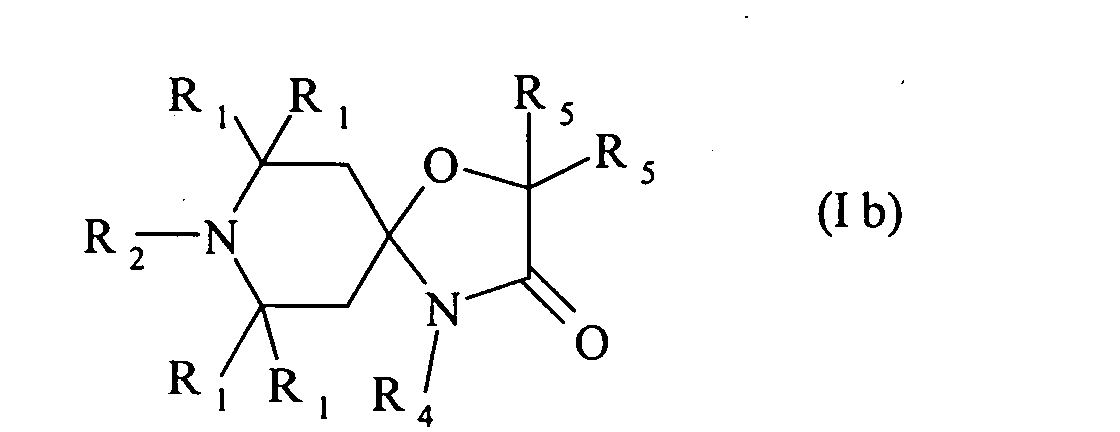 worin jeweils unabhängig voneinander
- A
- -O- oder -NR'-,
- R'
- H, C1-C18-Alkyl oder eine der Gruppen

- R"
- H, C1-C18-Alkyl,
- R"'
- H, einen aliphatischen, cycloaliphatischen, aromatischen oder heteroaromatischen Rest,
- R1
- C1-C18-Alkyl, oder jeweils zwei an dem gleichen Kohlenstoffatom gebundene R1 einen C4-C8-Cycloalkyl Rest,
- R2
- H, C1-C18-Alkyl oder C7-C18-Alkylaryl,
- R3
- H, einen n-wertigen aliphatischen, cycloaliphatischen, aromatischen oder heteroaromatischen Rest,
- R4
- C1-C18-Alkyl -C(O)-C1-C18-Alkyl oder -C1-C8-Alkyl -C(O)O-C1-C18-Alkyl;
- R5
- H, C1-C18-Alkyl, C4-C18-Cycloalkyl oder jeweils zwei an dem gleichen Kohlenstoffatom gebundene R5 einen C4-C18-Cycloalkyl Rest,
- n
- eine ganze Zahl > 0
organische Säuren bzw. deren Derivaten, die eine oder mehrere Gruppen der Formeln (IIa)-(IIc) enthalten,worin jeweils unabhängig voneinander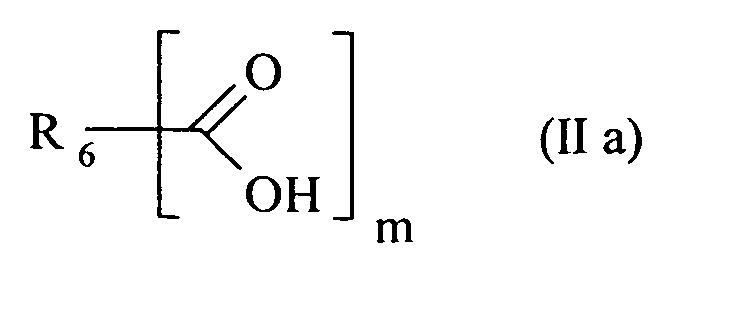
- R6
- H, einen m-wertigen aliphatischen, cycloaliphatischen, aromatischen oder heteroaromatischen Rest,
- m
- eine ganze Zahl > 0
worin jeweils unabhängig voneinander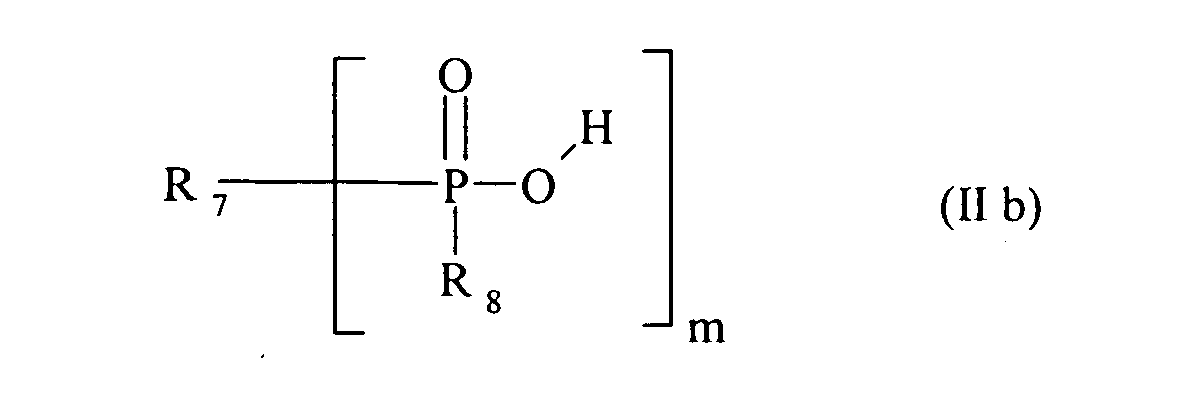
- R7
- einen m-wertigen aliphatischen, cycloaliphatischen, aromatischen, heteroaromatischen Rest oder einen Rest -OR9;
- R8
- H, einen aliphatischen, cycloaliphatischen, aromatischen, , heteroaromatischen Rest oder einen Rest -OR9;
- R9
- einen aliphatischen, cycloaliphatischen, aromatischen, oder heteroaromatischen Rest
- m
- eine ganze Zahl > 0
worin jeweils unabhängig voneinander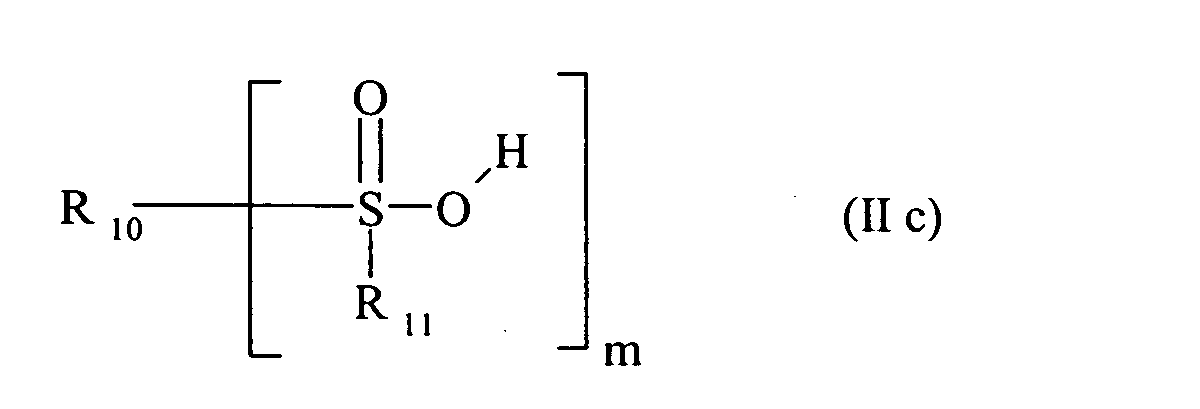
- R10
- einen m-wertigen aliphatischen, cycloaliphatischen, aromatischen, oder heteroaromatischen Rest oder einen Rest -OR12;
- R11
- ein Elektronenpaar oder =O;
- R12
- einen aliphatischen, cycloaliphatischen, aromatischen, oder heteroaromatischen Rest
- m
- eine ganze Zahl > 0
- Salzartige Reaktionsprodukte gemäss Anspruch 1 der allgemeinen Formel (III a)-(III i)




 worin n und m identisch und grösser als Null sind und die anderen Substituenten wie in Anspruch 1 definiert sind.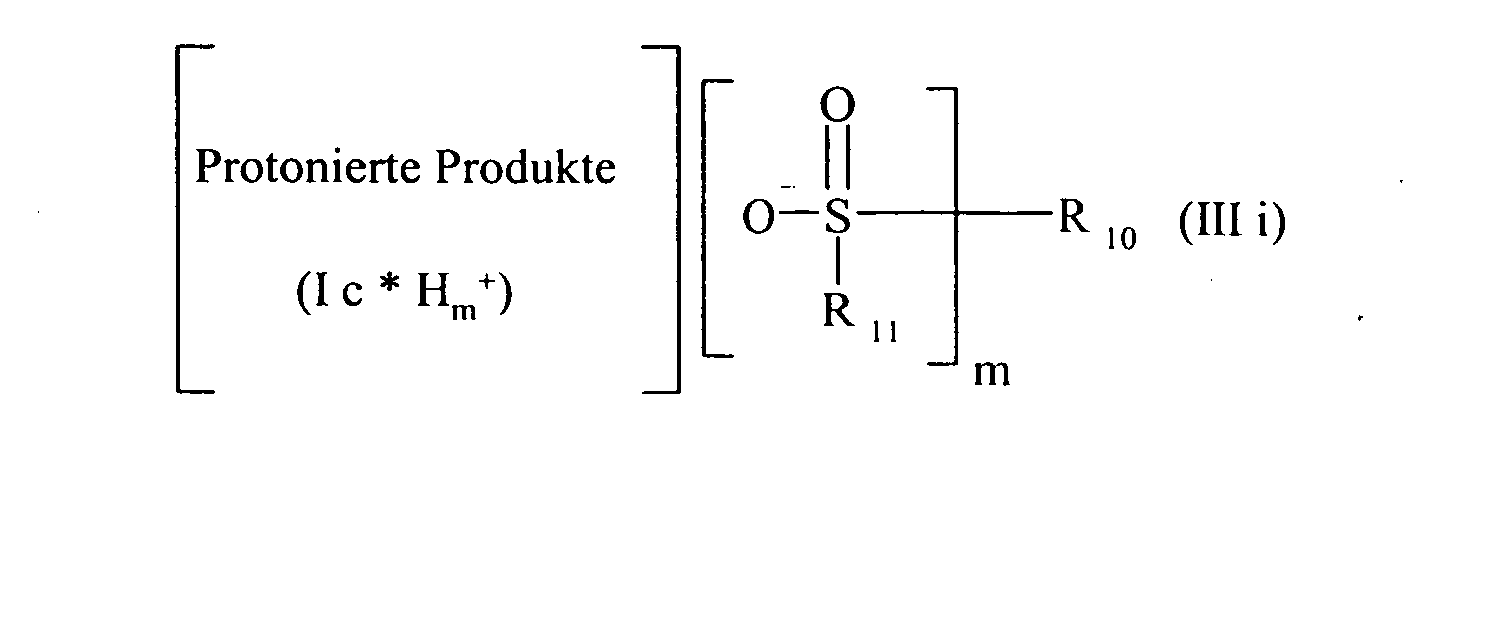
- Verbindungen der Formel (IV) - (VI)

 wobei
wobei
- r
- eine ganze Zahl zwischen 0 und 3,
- s
- (r+1 )/m bedeuten und m wie oben definiert ist.
- Vorgefertigte Mischungen gemäss Anspruch 1 bestehend aus den beiden Komponenten I und II in molaren Verhältnissen von 1:99 bis 99: 1, insbesonders von 45:55 bis 55:45, bevorzugt von 50:50.
- Verfahren zur Herstellung von salzartigen Reaktionsprodukten gemäss Anspruch 2 oder 3 durch Reaktion von einer oder mehreren HALS-Verbindungen der allgemeinen Formeln (Ia)-(Ic) mit einer oder mehreren organischen Säuren bzw. deren Derivaten der allgemeinen Formeln (IIa)-(IIc).
- Verfahren zur Herstellung der vorgefertigten Mischungen gemäss Anspruch 4 durch Formgebung aus der Schmelze (Tropfgranulation, Prilling, Extrusion, etc.), Kompaktierung (Rollenkompaktierung, Tablettierung, Brikettierung, Pressgranulation, etc.) oder Granulationsverfahren (Sprühen, Wirbelschichtgranulation, Trommeln, Rondieren, etc.).
- Salzartige Reaktionsprodukte gemäss Anspruch 1, 2 oder 3, dadurch gekennzeichnet, dass sie als HALS-Verbindung der Formeln (Ia)-(Ic) 1,3-Benzoldicarboxamid, N,N'-bis(2,2,6,6-tetramethyl-4-piperidinyl) (Nylostab® S-EED® ), 2,2,4,4-Tetramethyl-7-oxa-3,20-diazadispiro-[5.1.11.2]heneicosan-21-on (Hostavin® N 20), Poly[[6-[(1,1,3,3-tetramethylbutyl)amino]-1,3,5-trazin-2,4-diyl][(2,2,6,6-tetramethyl-4-piperidinyl)imino]-1,6-hexandiyl-[(2,2,6,6-tetramethyl-4-piperidinyl)imino]] oder das Reaktionsprodukt aus Hostavin® N 20 und Epichlorhydrin (Hostavin® N 30) enthalten.
- Vorgefertigte Mischungen gemäss Anspruch 1 oder 4, dadurch gekennzeichnet, dass sie als HALS-Verbindung der Formel (Ia)-(Ic) 1,3-Benzoldicarboxamid, N,N'-bis(2,2,6,6-tetramethyl-4-piperidinyl) (Nylostab® S-EED® ), 2,2,4,4-Tetramethyl-7-oxa-3,20-diazadispiro-[5.1.11.2]heneicosan-21-on (Hostavin® N 20), Poly[[6-[(1,1,3,3-tetramethylbutyl)amino]-1,3,5-trazin-2,4-diyl][(2,2,6,6-tetramethyl-4-piperidinyl)imino]-1,6-hexandiyl-[(2,2,6,6-tetramethyl-4-piperidinyl)imino]] oder das Reaktionsprodukt aus Hostavin® N 20 und Epichlorhydrin (Hostavin® N 30) enthalten.
- Salzartige Reaktionsprodukte gemäss Anspruch 1, 2 oder 3, dadurch gekennzeichnet, dass sie als organische Säuren der Formeln (IIa)-(IIc) Adipinsäure, Terephthalsäure, Isophthalsäure, Phthalsäure, Benzoesäure, Essigsäure, Methylphosphinsäure, Dimethylphosphinsäure, Methylethylphosphinsäure, Ethyl-phosphinsäure, Diethylphosphinsäure, Propylphosphinsäure, Di-propylphosphinsäure, Butylphosphinsäure, Dibutylphosphinsäure, Hexylphosphinsäure, Dihexylphosphinsäure, Octylphosphinsäure, Dioctylphosphinsäure, Cyclohexylphosphinsäure, Dicyclohexylphosphinsäure, Phenylphosphinsäure, Diphenylphosphinsäure, Tolylphosphinsäure, Ditolylphosphinsäure, Xylylphosphinsäure, Dixylylphosphinsäure, Biphenylphosphinsäure, Di-biphenylphosphinsäure, Methylenbisphosphinsäure, Ethylenbisphosphinsäure, 1,2-Diethyl-ethylenbisphosphinsäure, Phenylethylphosphinsäure, Di(phenylethyl)phosphinsäure, Methylphosphonsäure, Ethylphosphonsäure, Ethylendiphosphonsäure, Methylendiphosphonsäure, Methansulfonsäure, Ethansulfonsäure, Benzolsulfonsäure oder Toluolsulfonsäure enthalten.
- Vorgefertigte Mischungen gemäss Anspruch 1 oder 4, dadurch gekennzeichnet, dass sie als organische Säuren der Formeln (IIa)-(IIc) Adipinsäure, Terephthalsäure, Isophthalsäure, Phthalsäure, Benzoesäure, Essigsäure, Methylphosphinsäure, Dimethylphosphinsäure, Methylethylphosphinsäure, Ethyl-phosphinsäure, Diethylphosphinsäure, Propylphosphinsäure, Di-propylphosphinsäure, Butylphosphinsäure, Dibutylphosphinsäure, Hexylphosphinsäure, Dihexylphosphinsäure, Octylphosphinsäure, Dioctylphosphinsäure, Cyclohexylphosphinsäure, Dicyclohexylphosphinsäure, Phenylphosphinsäure, Diphenylphosphinsäure, Tolylphosphinsäure, Ditolylphosphinsäure, Xylylphosphinsäure, Dixylylphosphinsäure, Biphenylphosphinsäure, Di-biphenylphosphinsäure, Methylenbisphosphinsäure, Ethylenbisphosphinsäure, 1,2-Diethyl-ethylenbisphosphinsäure, Phenyl-ethylphosphinsäure, Di(phenyl-ethyl)phosphinsäure, Methylphosphonsäure, Ethylphosphonsäure, Ethylendiphosphonsäure, Methansulfonsäure, Ethansulfonsäure, Benzolsulfonsäure oder Toluolsulfonsäure enthalten.
- Kompaktierte, vorgefertigte Mischungen gemäss Anspruch 1 oder 4, dadurch gekennzeichnet, dass sie auf einem Walzen- oder Rollenkompaktor zu einem stabilen, farblosen und frei fließendem Granulat geformt wurden.
- Verwendung der salzartigen Reaktionsprodukte bzw. der vorgefertigten Mischungen gemäss Anspruch 1 zur Stabilisierung von Polymeren gegen Abbau durch Licht oder Hitze, insbesonders von polaren Polymeren wie Polyamiden und Polyestern.
- Verwendung der salzartigen Reaktionsprodukte bzw. der vorgefertigten Mischungen gemäss Anspruch 1 zur Verbesserung der Verarbeitungseigen-schaften, des Glanzes, der Oberflächengüte und der mechanischen Eigenschaften von Polymeren, insbesonders von polaren Polymeren wie Polyamiden und Polyestern.
Priority Applications (18)
| Application Number | Priority Date | Filing Date | Title |
|---|---|---|---|
| EP03003939A EP1449872A1 (de) | 2003-02-21 | 2003-02-21 | Stabilisierung polymerer Materialien |
| EP04712630A EP1597309A1 (de) | 2003-02-21 | 2004-02-19 | Salzartige reaktionsprodukte von hals-derivaten und carbonsäuren zur stabilisierung von polymeren materialien |
| CNA2004800046654A CN1751087A (zh) | 2003-02-21 | 2004-02-19 | 用于稳定聚合物材料的hals衍生物和羧酸的类似盐的反应产品 |
| TW093104031A TW200427752A (en) | 2003-02-21 | 2004-02-19 | Salt-like reaction products of HALS derivatives and phosphor-containing organic acids for the stabilisation of polymeric materials |
| KR1020057014908A KR20050101550A (ko) | 2003-02-21 | 2004-02-19 | 중합체 물질의 안정화용 장애 아민 광 안정제 유도체 및카복실산의 염 유사 반응 생성물 |
| ES04712633T ES2291855T3 (es) | 2003-02-21 | 2004-02-19 | Productos de reaccion de tipo sales de derivados de hals y acidos organicos que contienen fosforo para la estabilizacion de materiales polimericos. |
| PCT/IB2004/000508 WO2004074365A1 (en) | 2003-02-21 | 2004-02-19 | Salt-like reaction products of hals derivatives and phosphor-containing organic acids for the stabilisation of polymeric materials |
| TW093104032A TW200420643A (en) | 2003-02-21 | 2004-02-19 | Salt-like reaction products of HALS derivatives and carboxylic acids for the stabilisation of polymeric materials |
| US10/546,501 US20060217467A1 (en) | 2003-02-21 | 2004-02-19 | Salt-like reaction products of hals derivatives and carboxylic acids for the stabilisation of polymeric materials |
| EP04712633A EP1597311B1 (de) | 2003-02-21 | 2004-02-19 | Salzartige reaktionsprodukte von hals-derivaten und phosphorhaltigen carbonsäuren zur stabilisierung von polymeren materialien |
| JP2006502477A JP2006518407A (ja) | 2003-02-21 | 2004-02-19 | ポリマー材安定化のためのhals誘導体およびリン含有有機酸の塩様反応生成物 |
| DE602004008228T DE602004008228T2 (de) | 2003-02-21 | 2004-02-19 | Salzartige reaktionsprodukte von hals-derivaten und phosphorhaltigen carbonsäuren zur stabilisierung von polymeren materialien |
| CNA2004800046033A CN1751088A (zh) | 2003-02-21 | 2004-02-19 | 用于稳定聚合物材料的hals衍生物和含磷有机酸的类似盐的反应产品 |
| US10/546,503 US20060079610A1 (en) | 2003-02-21 | 2004-02-19 | Salt-like reaction products of hals derivatives and phosphor-cntaining organic acids for the stabilisation of polymeric materials |
| KR1020057014897A KR20050109487A (ko) | 2003-02-21 | 2004-02-19 | 중합체 물질의 안정화용 장애 아민 광 안정제 유도체 및 인함유 유기산의 염 유사 반응 생성물 |
| JP2006502478A JP2006518371A (ja) | 2003-02-21 | 2004-02-19 | 高分子材料を安定化させるための、hals誘導体とカルボン酸との塩様反応生成物 |
| AT04712633T ATE370190T1 (de) | 2003-02-21 | 2004-02-19 | Salzartige reaktionsprodukte von hals-derivaten und phosphorhaltigen carbonsäuren zur stabilisierung von polymeren materialien |
| PCT/IB2004/000509 WO2004074364A1 (en) | 2003-02-21 | 2004-02-19 | Salt-like reaction products of hals derivatives and carboxylic acids for the stabilisation of polymeric materials |
Applications Claiming Priority (1)
| Application Number | Priority Date | Filing Date | Title |
|---|---|---|---|
| EP03003939A EP1449872A1 (de) | 2003-02-21 | 2003-02-21 | Stabilisierung polymerer Materialien |
Publications (1)
| Publication Number | Publication Date |
|---|---|
| EP1449872A1 true EP1449872A1 (de) | 2004-08-25 |
Family
ID=32731562
Family Applications (3)
| Application Number | Title | Priority Date | Filing Date |
|---|---|---|---|
| EP03003939A Withdrawn EP1449872A1 (de) | 2003-02-21 | 2003-02-21 | Stabilisierung polymerer Materialien |
| EP04712630A Withdrawn EP1597309A1 (de) | 2003-02-21 | 2004-02-19 | Salzartige reaktionsprodukte von hals-derivaten und carbonsäuren zur stabilisierung von polymeren materialien |
| EP04712633A Expired - Lifetime EP1597311B1 (de) | 2003-02-21 | 2004-02-19 | Salzartige reaktionsprodukte von hals-derivaten und phosphorhaltigen carbonsäuren zur stabilisierung von polymeren materialien |
Family Applications After (2)
| Application Number | Title | Priority Date | Filing Date |
|---|---|---|---|
| EP04712630A Withdrawn EP1597309A1 (de) | 2003-02-21 | 2004-02-19 | Salzartige reaktionsprodukte von hals-derivaten und carbonsäuren zur stabilisierung von polymeren materialien |
| EP04712633A Expired - Lifetime EP1597311B1 (de) | 2003-02-21 | 2004-02-19 | Salzartige reaktionsprodukte von hals-derivaten und phosphorhaltigen carbonsäuren zur stabilisierung von polymeren materialien |
Country Status (10)
| Country | Link |
|---|---|
| US (2) | US20060079610A1 (de) |
| EP (3) | EP1449872A1 (de) |
| JP (2) | JP2006518407A (de) |
| KR (2) | KR20050109487A (de) |
| CN (2) | CN1751087A (de) |
| AT (1) | ATE370190T1 (de) |
| DE (1) | DE602004008228T2 (de) |
| ES (1) | ES2291855T3 (de) |
| TW (2) | TW200420643A (de) |
| WO (2) | WO2004074364A1 (de) |
Cited By (5)
| Publication number | Priority date | Publication date | Assignee | Title |
|---|---|---|---|---|
| WO2006002187A1 (en) * | 2004-06-22 | 2006-01-05 | Invista Technologies S.A R.L. | Solubilized additive composition comprising acidic and basic constituents |
| EP2128198A1 (de) * | 2008-05-30 | 2009-12-02 | Lurgi Zimmer GmbH | Verfahren zur Herstellung von Polyamiden unter Verwendung von Carbonsäuren und Amiden |
| WO2015177193A1 (en) * | 2014-05-21 | 2015-11-26 | Solvay Specialty Polymers Usa, Llc | Stabilizer compounds |
| WO2018217294A1 (en) * | 2017-05-22 | 2018-11-29 | Exxonmobil Chemical Patents Inc. | Halogenated elastomers with mooney viscosity stability and method for preparing same |
| RU2739354C1 (ru) * | 2017-05-22 | 2020-12-23 | Эксонмобил Кемикэл Пейтентс Инк. | Галогенированные эластомеры, обладающие стабильной вязкостью по муни, и способ их получения |
Families Citing this family (10)
| Publication number | Priority date | Publication date | Assignee | Title |
|---|---|---|---|---|
| EP1449872A1 (de) * | 2003-02-21 | 2004-08-25 | Clariant International Ltd. | Stabilisierung polymerer Materialien |
| JP4788865B2 (ja) * | 2004-10-04 | 2011-10-05 | 東洋紡績株式会社 | マスターバッチ用熱可塑性樹脂組成物およびその成形材料の製造方法およびそれらを用いた熱可塑性樹脂組成物およびその製造方法 |
| US8557950B2 (en) | 2005-06-16 | 2013-10-15 | Grupo Petrotemex, S.A. De C.V. | High intrinsic viscosity melt phase polyester polymers with acceptable acetaldehyde generation rates |
| US9267007B2 (en) | 2005-09-16 | 2016-02-23 | Grupo Petrotemex, S.A. De C.V. | Method for addition of additives into a polymer melt |
| US7838596B2 (en) | 2005-09-16 | 2010-11-23 | Eastman Chemical Company | Late addition to effect compositional modifications in condensation polymers |
| JP6107559B2 (ja) * | 2012-11-09 | 2017-04-05 | 豊田合成株式会社 | 発光装置 |
| TWI513762B (zh) * | 2014-04-09 | 2015-12-21 | Fdc Lees Chemical Industry Co | 雙官能型安定劑及其組成物 |
| TWI671121B (zh) * | 2014-07-29 | 2019-09-11 | 荷蘭商帝斯曼知識產權資產管理有限公司 | 用於製備聚醯胺的方法、用於該方法中的耐綸鹽及用於製造該鹽的方法 |
| US10889704B2 (en) | 2017-05-22 | 2021-01-12 | Exxonmobil Chemical Patents Inc. | Halogenated elastomers with Mooney viscosity stability and method for preparing same |
| CN112521659A (zh) * | 2020-12-07 | 2021-03-19 | 上海大学 | 一种改性紫外光稳定剂、制备方法及其应用 |
Citations (3)
| Publication number | Priority date | Publication date | Assignee | Title |
|---|---|---|---|---|
| US4263505A (en) * | 1979-03-27 | 1981-04-21 | Ciba-Geigy Corporation | Polyalkylpiperidine-spirooxazolones and their use as light stabilizers |
| US4619956A (en) * | 1985-05-03 | 1986-10-28 | American Cyanamid Co. | Stabilization of high solids coatings with synergistic combinations |
| FR2818985A1 (fr) * | 2000-12-29 | 2002-07-05 | Nylstar Sa | Procede de fabrication de compositions stabilisees a base de polyamide |
Family Cites Families (16)
| Publication number | Priority date | Publication date | Assignee | Title |
|---|---|---|---|---|
| US5976417A (en) * | 1909-01-07 | 1999-11-02 | Clariant Finance (Bvi) Limited | Mixtures of HALS compounds |
| JPS5263183A (en) * | 1975-11-19 | 1977-05-25 | Adeka Argus Chem Co Ltd | Stabilizer for organic materials |
| DE2862332D1 (en) * | 1977-12-30 | 1983-11-10 | Ciba Geigy Ag | Stabilisation of heat-curable metallic enamel paints against the action of light, humidity and oxygen by the addition of polyalkylpiperidine derivatives |
| JPS5962651A (ja) * | 1982-10-02 | 1984-04-10 | Adeka Argus Chem Co Ltd | 高分子材料用光安定剤 |
| US5721298A (en) * | 1989-12-26 | 1998-02-24 | Cytec Technology Corp. | Stabilization of high solids coatings with liquid compositions of triazine UV absorbers |
| IT1251687B (it) * | 1991-10-11 | 1995-05-19 | Mini Ricerca Scient Tecnolog | Sali di composti triazinici con acidi ossigenati del fosforo, e loro impiego in composizioni polimeriche autoestinguenti. |
| EP0559613B1 (de) * | 1992-03-05 | 1999-12-15 | Ciba SC Holding AG | Stabilisierung von organischen Pigmenten |
| US5616636A (en) * | 1992-03-11 | 1997-04-01 | Sandoz Ltd. | Phosphonite-hals and phosphite-hals compounds as stabilizers |
| FR2694761B1 (fr) * | 1992-08-17 | 1996-06-14 | Sandoz Sa | Amines steriquement encombrees, leur preparation et leur utilisation comme stabilisants des matieres polymeres. |
| TW237471B (de) * | 1992-09-03 | 1995-01-01 | Ciba Geigy | |
| GB9609742D0 (en) * | 1996-05-10 | 1996-07-17 | Clariant Int Ltd | Improvements in or relating to organic compounds |
| GB9615943D0 (en) * | 1996-07-30 | 1996-09-11 | Sandoz Ltd | Improvements in or relating to organic processes |
| US5969014A (en) * | 1997-09-23 | 1999-10-19 | Clariant Finance (Bvi) Limited | Synergistic polyamide stabilization method |
| DE19745099B4 (de) * | 1997-10-11 | 2014-11-06 | Lurgi Zimmer Gmbh | Verwendung eines Additivs mit kettenregelnden und stabilisierenden Eigenschaften bei der Herstellung von Polycaprolactam |
| US5965261A (en) * | 1998-11-16 | 1999-10-12 | Clariant Finance (Bvi) Limited | Polyester |
| EP1449872A1 (de) * | 2003-02-21 | 2004-08-25 | Clariant International Ltd. | Stabilisierung polymerer Materialien |
-
2003
- 2003-02-21 EP EP03003939A patent/EP1449872A1/de not_active Withdrawn
-
2004
- 2004-02-19 JP JP2006502477A patent/JP2006518407A/ja not_active Withdrawn
- 2004-02-19 US US10/546,503 patent/US20060079610A1/en not_active Abandoned
- 2004-02-19 DE DE602004008228T patent/DE602004008228T2/de not_active Expired - Fee Related
- 2004-02-19 EP EP04712630A patent/EP1597309A1/de not_active Withdrawn
- 2004-02-19 CN CNA2004800046654A patent/CN1751087A/zh active Pending
- 2004-02-19 US US10/546,501 patent/US20060217467A1/en not_active Abandoned
- 2004-02-19 AT AT04712633T patent/ATE370190T1/de not_active IP Right Cessation
- 2004-02-19 CN CNA2004800046033A patent/CN1751088A/zh active Pending
- 2004-02-19 ES ES04712633T patent/ES2291855T3/es not_active Expired - Lifetime
- 2004-02-19 TW TW093104032A patent/TW200420643A/zh unknown
- 2004-02-19 KR KR1020057014897A patent/KR20050109487A/ko not_active Withdrawn
- 2004-02-19 WO PCT/IB2004/000509 patent/WO2004074364A1/en not_active Ceased
- 2004-02-19 EP EP04712633A patent/EP1597311B1/de not_active Expired - Lifetime
- 2004-02-19 KR KR1020057014908A patent/KR20050101550A/ko not_active Withdrawn
- 2004-02-19 TW TW093104031A patent/TW200427752A/zh unknown
- 2004-02-19 WO PCT/IB2004/000508 patent/WO2004074365A1/en not_active Ceased
- 2004-02-19 JP JP2006502478A patent/JP2006518371A/ja not_active Withdrawn
Patent Citations (3)
| Publication number | Priority date | Publication date | Assignee | Title |
|---|---|---|---|---|
| US4263505A (en) * | 1979-03-27 | 1981-04-21 | Ciba-Geigy Corporation | Polyalkylpiperidine-spirooxazolones and their use as light stabilizers |
| US4619956A (en) * | 1985-05-03 | 1986-10-28 | American Cyanamid Co. | Stabilization of high solids coatings with synergistic combinations |
| FR2818985A1 (fr) * | 2000-12-29 | 2002-07-05 | Nylstar Sa | Procede de fabrication de compositions stabilisees a base de polyamide |
Cited By (10)
| Publication number | Priority date | Publication date | Assignee | Title |
|---|---|---|---|---|
| WO2006002187A1 (en) * | 2004-06-22 | 2006-01-05 | Invista Technologies S.A R.L. | Solubilized additive composition comprising acidic and basic constituents |
| EP2128198A1 (de) * | 2008-05-30 | 2009-12-02 | Lurgi Zimmer GmbH | Verfahren zur Herstellung von Polyamiden unter Verwendung von Carbonsäuren und Amiden |
| WO2009144044A1 (de) * | 2008-05-30 | 2009-12-03 | Lurgi Zimmer Gmbh | Verfahren zur herstellung von polyamiden unter verwendung von carbonsäuren und amiden |
| CN102037080A (zh) * | 2008-05-30 | 2011-04-27 | 鲁奇吉玛有限责任公司 | 一种使用羧酸和氨基化合物制造聚酰胺的方法 |
| CN102037080B (zh) * | 2008-05-30 | 2014-12-10 | 鲁奇吉玛有限责任公司 | 一种使用羧酸和氨基化合物制造聚酰胺的方法 |
| DE102008026075B4 (de) * | 2008-05-30 | 2015-04-30 | Lurgi Zimmer Gmbh | Verfahren zur Herstellung von Polyamiden unter Verwendung von Carbonsäuren und Amiden |
| WO2015177193A1 (en) * | 2014-05-21 | 2015-11-26 | Solvay Specialty Polymers Usa, Llc | Stabilizer compounds |
| US11111358B2 (en) | 2014-05-21 | 2021-09-07 | Solvay Specialty Polymers Usa, Llc | Stabilizer compounds |
| WO2018217294A1 (en) * | 2017-05-22 | 2018-11-29 | Exxonmobil Chemical Patents Inc. | Halogenated elastomers with mooney viscosity stability and method for preparing same |
| RU2739354C1 (ru) * | 2017-05-22 | 2020-12-23 | Эксонмобил Кемикэл Пейтентс Инк. | Галогенированные эластомеры, обладающие стабильной вязкостью по муни, и способ их получения |
Also Published As
| Publication number | Publication date |
|---|---|
| KR20050109487A (ko) | 2005-11-21 |
| WO2004074365A1 (en) | 2004-09-02 |
| ES2291855T3 (es) | 2008-03-01 |
| US20060217467A1 (en) | 2006-09-28 |
| KR20050101550A (ko) | 2005-10-24 |
| ATE370190T1 (de) | 2007-09-15 |
| EP1597311B1 (de) | 2007-08-15 |
| CN1751088A (zh) | 2006-03-22 |
| JP2006518371A (ja) | 2006-08-10 |
| DE602004008228D1 (de) | 2007-09-27 |
| WO2004074364A1 (en) | 2004-09-02 |
| TW200420643A (en) | 2004-10-16 |
| CN1751087A (zh) | 2006-03-22 |
| TW200427752A (en) | 2004-12-16 |
| JP2006518407A (ja) | 2006-08-10 |
| EP1597311A1 (de) | 2005-11-23 |
| US20060079610A1 (en) | 2006-04-13 |
| DE602004008228T2 (de) | 2008-05-15 |
| EP1597309A1 (de) | 2005-11-23 |
Similar Documents
| Publication | Publication Date | Title |
|---|---|---|
| EP1396524B1 (de) | Oberflächenmodifizierte Phosphinsäuresalze | |
| DE2719131C2 (de) | ||
| EP2025710B1 (de) | Flammschutzmittelmischung für thermoplastische Polymere sowie flammwidrige Polymere | |
| EP1479718B1 (de) | Titanhaltige Phosphinat-Flammschutzmittel | |
| DE602004008228T2 (de) | Salzartige reaktionsprodukte von hals-derivaten und phosphorhaltigen carbonsäuren zur stabilisierung von polymeren materialien | |
| EP1371656A1 (de) | Mischungen aus einem Phosphonit und anderen Komponenten | |
| DE69400136T2 (de) | Polyamide mit verbessertem farbverhalten und verbesserter verarbeitbarkeit und verfahren zu ihrer herstellung | |
| DE102015112592A1 (de) | Flammfestes Polyamid als Reaktionsprodukt eines Lactams, ein Verfahren zu dessen Herstellung sowie dessen Verwendung | |
| DE2543856A1 (de) | Benzotriazol-ortho-ester sowie verwendung derselben als uv-stabilisatoren | |
| TWI723159B (zh) | 樹脂組合物 | |
| DE3233949A1 (de) | Verwendung eines aminogruppen tragenden, niedermolekularen 1,3-butadienpolymerisates als stabilisierungsmittel fuer kunststoffe | |
| DE102015000124A1 (de) | Verfahren zur Stabilisierung von Polyamiden | |
| DE2158015A1 (de) | Stabilisierung von Polyamiden | |
| DE3131684A1 (de) | Polytriazinylalkohole, -ester und -urethane, ein verfahren zu ihrer herstellung und ihre verwendung als stabilisatoren | |
| DE4200931A1 (de) | Flammgeschuetzte thermoplastische polyesterformmasse und ihre verwendung | |
| WO2007057265A2 (de) | Triazinverbindungen mit aminogruppen- und carboxygruppen-haltigen substituenten | |
| EP0363628A1 (de) | Hochmolekulare (Co)Polyamide und Verfahren zu ihrer Herstellung | |
| EP2382258B1 (de) | Licht- und wärmestabilisierte polyamide und verfahren zu ihrer herstellung | |
| EP0044424B1 (de) | Flammfeste Polyamidformmassen und entsprechende Formkörper | |
| EP0060432B1 (de) | Flammfeste Polyamidformmassen | |
| DE602004004876T2 (de) | Verfahren zur herstellung eines gehinderten aminlichtstabilisatorensalzes | |
| EP0044419A1 (de) | Flammfeste Polyamidformmassen | |
| CH681542A5 (de) | ||
| DE60312901T2 (de) | Polyesterzusammensetzungen | |
| HK1087724A (en) | Salt-like reaction products of hals derivatives and phosphor-containing organic acids for the stabilization of polymeric materials |
Legal Events
| Date | Code | Title | Description |
|---|---|---|---|
| PUAI | Public reference made under article 153(3) epc to a published international application that has entered the european phase |
Free format text: ORIGINAL CODE: 0009012 |
|
| AK | Designated contracting states |
Kind code of ref document: A1 Designated state(s): AT BE BG CH CY CZ DE DK EE ES FI FR GB GR HU IE IT LI LU MC NL PT SE SI SK TR |
|
| AX | Request for extension of the european patent |
Extension state: AL LT LV MK RO |
|
| STAA | Information on the status of an ep patent application or granted ep patent |
Free format text: STATUS: THE APPLICATION HAS BEEN WITHDRAWN |
|
| 18W | Application withdrawn |
Effective date: 20040911 |