EP1433743B1 - Method for preparing cobalt-protein complex - Google Patents
Method for preparing cobalt-protein complex Download PDFInfo
- Publication number
- EP1433743B1 EP1433743B1 EP02772954A EP02772954A EP1433743B1 EP 1433743 B1 EP1433743 B1 EP 1433743B1 EP 02772954 A EP02772954 A EP 02772954A EP 02772954 A EP02772954 A EP 02772954A EP 1433743 B1 EP1433743 B1 EP 1433743B1
- Authority
- EP
- European Patent Office
- Prior art keywords
- apoferritin
- cobalt
- solution
- ions
- complexes
- Prior art date
- Legal status (The legal status is an assumption and is not a legal conclusion. Google has not performed a legal analysis and makes no representation as to the accuracy of the status listed.)
- Expired - Lifetime
Links
Images




Classifications
-
- C—CHEMISTRY; METALLURGY
- C07—ORGANIC CHEMISTRY
- C07K—PEPTIDES
- C07K14/00—Peptides having more than 20 amino acids; Gastrins; Somatostatins; Melanotropins; Derivatives thereof
- C07K14/435—Peptides having more than 20 amino acids; Gastrins; Somatostatins; Melanotropins; Derivatives thereof from animals; from humans
- C07K14/46—Peptides having more than 20 amino acids; Gastrins; Somatostatins; Melanotropins; Derivatives thereof from animals; from humans from vertebrates
- C07K14/47—Peptides having more than 20 amino acids; Gastrins; Somatostatins; Melanotropins; Derivatives thereof from animals; from humans from vertebrates from mammals
-
- H—ELECTRICITY
- H10—SEMICONDUCTOR DEVICES; ELECTRIC SOLID-STATE DEVICES NOT OTHERWISE PROVIDED FOR
- H10K—ORGANIC ELECTRIC SOLID-STATE DEVICES
- H10K85/00—Organic materials used in the body or electrodes of devices covered by this subclass
- H10K85/30—Coordination compounds
- H10K85/341—Transition metal complexes, e.g. Ru(II)polypyridine complexes
-
- H—ELECTRICITY
- H10—SEMICONDUCTOR DEVICES; ELECTRIC SOLID-STATE DEVICES NOT OTHERWISE PROVIDED FOR
- H10D—INORGANIC ELECTRIC SEMICONDUCTOR DEVICES
- H10D64/00—Electrodes of devices having potential barriers
- H10D64/01—Manufacture or treatment
- H10D64/031—Manufacture or treatment of data-storage electrodes
- H10D64/037—Manufacture or treatment of data-storage electrodes comprising charge-trapping insulators
Definitions
- the present invention relates to a method for producing particles, and more particularly related to a method for producing a cobalt-protein complex containing a cobalt particle and its related technologies.
- apoferritin which is a protein having the function of holding a metal compound, thereby producing particles having a uniform diameter at the nano-order level.
- V.M. D'souza et al. disclose in Biochemistry 2000, 39, 3817-3826 a study on aminopeptidase.
- US 6,180,389 B1 discloses avirion constained nanoparticle.
- WO91/02704 discloses ferritin analogs comprising an apoferritin stell and a core substantially devoid of ferrihydride.
- apoferritin is a protein which is extensively present in the biological world. It has the function of adjusting the amount of iron which is a necessary micronutrient element in a living body. A complex of iron or an iron compound with apoferritin is called "ferritin". When the amount of iron exceeds a necessary level in a living body, iron could be harmful. So, excessive iron is stored in a living body in the form of ferritin. Ferritin releases iron ions, when necessary, and then it becomes apoferritin again.
- FIG. 1 is a schematic view of the structure of apoferritin.
- apoferritin 1 is a globular protein in which 24 monomer subunits each being composed of a polypeptide chain assemble and form non-covalent bonds and which has a molecular weight of about 460,000.
- the globular protein has a diameter of about 12 nm and exhibits higher thermal stability and higher pH stability than normal proteins.
- the apoferritin 1 has a hollow-like holding portion 4 having a diameter of about 6 nm in the center. The holding portion 4 is connected to the outside via a channel 3 .
- ferric iron ions when ferric iron ions are incorporated into the apoferritin 1 , the iron ions enter the apoferritin 1 through the channel 3 and are oxidized in a portion called the ferrooxidase center in one of the subunits. Then, they reach the holding portion 4 and finally are condensed in a negative charge region located in the inside surface of the holding portion 4 . Then, 3000-4000 iron atoms assemble and are held in the holding portion 4 in the crystalline form of ferrihydride (5fe 2 O 3 ⁇ 9H 2 O). A particle containing metal atoms held in the holding portion 4 has the almost same diameter as that of the holding portion 4 , i.e., about 6 nm.
- apoferritin Using apoferritin, a compiex of apoferritin with particles artificially made to contain a metal other than iron or a metal compound is produced.
- Particles composed of any one of these metals or metal compounds have also about the same diameter as that of the holding portion 4 of apoferritin, i.e., about 6 nm.
- the present invention has been devised, and it is therefore an object of the present invention to provide a method for obtaining a cobalt- protein complex containing a cobalt particle having a uniform diameter. Therefore the present invention provides the method as defined in claim 1.
- the method for producing a cobalt-protein complex according to the present invention includes: the step a) of preparing a solution containing Co 2+ ions, a protein, a pH buffer agent and a Co 2+ associating agent; and the step b) of adding an oxidizing agent to the solution and thereby making the protein contain particles composed of cobalt, as defined in claim 1.
- Co 2+ associating agent With a Co 2+ associating agent, Co 2+ ions are condensed in the inside of a protein. Thus, a reaction of the Co 2+ ions and an oxidizing agent is preferentially occurs. At this time, by adjusting the pH of a solution to a desired level using a pH buffer agent, the reaction of the Co 2+ ions and the oxidizing agent is prevented from proceeding in the reverse direction, and thus elution of cobalt particles contained in the protein can be prevented. Accordingly, a cobalt-protein complex containing a cobalt particle having a uniform diameter can be obtained.
- each of the pH buffer agent and the Co 2+ associating agent is HEPES.
- HEPES has functions as a pH buffer agent and the Co 2+ associating agent. Therefore, it is not necessary to prepare a pH buffer agent and a Co 2+ associating agent separately.
- the protein is an apoferritin.
- the oxidizing agent may be H 2 O 2 .
- the method for producing a cobalt-protein complex includes: the step a) of preparing a solution containing Co 2+ ions, apoferritin and HEPES; and the step b) of adding H 2 O 2 to the solution and thereby making the apoferritin contain particles composed of cobalt.
- a reaction of Co 2+ ions and H 2 O 2 occurs in a HEPES solution.
- the pH of the solution is constant and elution of cobalt particles contained in apoferritin can be prevented. Accordingly, a cobalt-protein complex containing a cobalt particle having a uniform diameter can be obtained.
- NaOH is added thereto dropwise to control the pH of the apoferritin solution while a cobalt nitrate solution and a hydrogen peroxide solution are gradually added to an apoferritin solution by a very small amount at a time and the solution is briskly stirred by a stirrer.
- a first problem is in that pH is controlled by not using a buffer solution but by dropping NaOH to an apoferritin solution.
- the NaOH concentration abruptly rises in part of the apoferritin solution to which NaOH is dropped, locally, and then pH is increased. Therefore, the function of controlling pH may not be sufficient. Therefore, the direction of the chemical reaction represented by the reaction formula 1 may be reversed, resulting in elution of cobalt particles contained in cobalt-apoferritin complexes into the solution.
- a second problem is in that NaOH is used.
- NaOH is a strong protein denaturant.
- the NaOH concentration abruptly rises in part of the apoferritin solution to which NaOH is dropped, locally, and therefore apoferritin may be denatured. Accordingly, apoferritin may be in the state where it can not fully exhibit its original characteristics. In other words, apoferritin may not be able to fully hold cobalt particles.
- a third problem is in that it is difficult to perform the method on an industrial scale.
- NaOH is dropped to the apoferritin solution to control the pH thereof while a cobalt nitrate solution and a hydrogen peroxide solution are gradually added to an apoferritin solution by a very small amount at a time.
- the chemical reaction can be easily led.
- a reaction scale is enlarged to an industrial level, it will require a huge amount of time to add cobalt nitrate, a hydrogen peroxide solution and NaOH to an apoferritin solution.
- FIG. 2 is a flowchart illustrating a method for producing a cobalt-apoferitin complex according to this embodiment.
- a reaction solution is prepared by mixing a HEPES buffer solution, an apoferritin solution and Co 2+ ion solution (e.g., a cobalt nitrate solution) in this order, as shown in FIG. 2 .
- Step St2 an oxidizing agent (e.g., H 2 O 2 ) is added to the reaction solution, as shown in FIG. 2 .
- an oxidizing agent e.g., H 2 O 2
- cobalt hydroxide CoO(OH)
- Step St1 the pH of the reaction solution is adjusted to be in a range from about 8.0 to 8.8.
- the pH of the reaction solution is in a range from about 8.0 to 8.8.
- many amino acid residues with a negative charge are exposed on the inside surface of the holding portion 4 of the apoferritin 1 and thus Co 2+ ions are led to the holding portion 4 . Therefore, particles composed of cobalt hydroxide (CoO(OH)) can be easily formed in the holding portion 4 of the apoferritin 1 .
- the state of cobalt particles formed at each pH is shown in Table 1.
- HEPES is out of the range in which it can exhibit a high buffer capacity when the solution is in a pH range from about 8.0 to 8.8, the concentration of HEPES may be made to be at a high level.
- the HEPES concentration in the reaction solution may be at any level as long as the variation range of pH is sufficiently small, even though precipitates of cobalt hydroxide (CoO(OH)) appear.
- concentration of cobalt ions in the reaction solution is 3 mM
- a HEPES buffer solution containing HEPES at a concentration of 90 mM or more may be used.
- the concentration of apoferritin in the reaction solution is adjusted to be in a range from 0.1 to 1 mg/ml (about 0.2-2 ⁇ M). More specifically, it is preferably about 0.5 mg/ml (1 ⁇ M).
- the concentration of Co 2+ ion is adjusted according to the concentration of apoferritin.
- the Co 2+ ion concentration may be about 1000 to 5000 times more than that of the apoferritin concentration. More specifically, it is preferably about 2000 to 3000 more than that of the apoferritin concentration.
- Co 2+ ions may be added at a higher concentration than the above-described level. If Co 2+ ions are added at a high concentration, CoO(OH) is formed vigorously outside of the holding portion of the apoferritin and then cobalt-apoferritin complexes may be caught by the precipitates. Accordingly, a recovery rate of cobalt-apoferritin complexes may be reduced.
- Co 2+ ions are added at a concentration of 2-3 mM.
- any compound may be used to add Co 2+ ions, it is particularly preferable to use cobalt ammonium sulfate or cobalt nitrate. If cobalt ammonium sulfate or cobalt nitrate is used, Co 2+ -HEPES associated pairs which will be described later can be easily formed and a reaction will not proceed rapidly (i.e. mixed substances will not react explosively).
- the reaction solution is prepared so that the final concentration of HEPES is 30 mM (pH 8.8), the final concentration of apoferritin is 0.5 mg/ml (1 ⁇ M), and the final concentration of Co 2+ ion is 5 mM in Step St1 .
- a hydrogen peroxide solution of 0.01-3% in an equal quantity or a 1/2 quantity of that of cobalt ion is added to the reaction solution.
- concentration of Co 2+ ion is 2 mM
- H 2 O 2 is added to the reaction solution so that the final concentration of H 2 O 2 is in a range from 1 mM to 2 mM.
- a salt for example, Na 2 SO 4 can be used. However, other salts may be also used.
- Cl - ions may be an obstacle to the production (Cl - ions stabilize Co 2+ ions to inhibit the formation of CoO(OH)). Therefore, it is preferable to use a salt not including Cl.
- a salt may be added to the solution at a concentration of 10 mM or more. Test results also show that in the case of Na 2 SO 4 , it is sufficient for stabilization of apoferritin to add Na 2 SO 4 at a concentration of about 30-150 mM.
- Cl - ions come into the reaction solution during the process steps for preparing the reaction solution. More preferably, oxygen is exhausted from the reaction solution by bubbling nitrogen or other means
- the color of the reaction solution is pink, i.e., a color that Co 2+ ions exhibit in Step St1 .
- Step St2 when CoO(OH) is generated by the addition of a hydrogen peroxide solution, the color of the reaction solution turns to a color between brown and green, i.e., a color that Co 3+ exhibits. Measured by a spectrophotometer, CoO(OH) has become a hydroxide which has an absorption peak at around 350 nm.
- time required for the reaction is from several hours to several days.
- the temperature of the reaction solution may be increased to 40 C° to 70 C° to facilitate the reaction. By increasing the solution temperature, the reaction can be finished in several hours or over a night. Since apoferritin particles become unstable at a temperature over 70 C°, it is preferable to increase the temperature of the reaction solution to a temperature ranging from room temperature to 70 C°. More specifically, it is more preferable to increase the temperature of the reaction solution to 50-60 C°. As another option, if thermophile apoferritin is used, the temperature may be increased to about 80-100 C°. This is because the crystallinity of generated CoO(OH) under the above-described temperature conditions is improved in such a case.
- Na 2 SO 4 is added to the reaction solution so that the final concentration of H 2 O 2 is 2 mM and the final concentration of Na 2 SO 4 is 75 mM and the temperature of the reaction solution is increased to 50 C°, in Step St2 .
- a buffer solution should not influence a chemical substance in a solution.
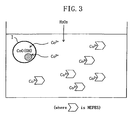
- HEPES buffer solution used in this invention, it is presumed that HEPES and Co 2+ ions interact with each other and then form Co 2+ -HEPES associated pairs.
- the reaction solution then may be in an equilibrium state represented by the following chemical reaction formula 2.
- the state of the reaction solution then is schematically shown in FIG. 3 .
- the holding portion 4 of the apoferritin 1 has a negative charge at around pH 8. Therefore, as shown in FIG. 3 , the concentration of Co 2+ ion at around pH 8 is higher than that of the outside of the apoferritin 1 . Accordingly, CoO(OH) is preferentially formed in the holding portion 4 of the apoferritin 1 . Furthermore, contact catalysis occurs on the surface of CoO(OH) and therefore the reaction is accelerated rapidly in the holding portion 4 .
- Co 2+ ions are supplied from the Co 2+ -HEPES associated pairs to the apoferritin 1 and then concentrated by the negative charge of holding portion 4 of the apoferritin 1.
- the formation of CoO(OH) is facilitated in the holding portion 4 so that a cobalt-apoferritin complex is formed.
- Step St2 operations subsequent to Step St2 will be described.
- the reaction solution obtained in Step St2 is put into a vessel and is centrifuged at a speed of 3000 rpm for 15-30 minutes by a centrifugal separator such that precipitates are removed. Subsequently, a supernatant liquid obtained after the removal of the precipitates is further centrifuged at a speed of 10000 rpm for 30 minutes such that an unnecessary bulk material in which cobalt-apoferritin complexes are condensed is precipitated and then removed. At this time, cobalt-apoferritin complexes are dispersed in the supernatant liquid.
- the cobalt-apoferritin complex solution is condensed by dialysis so that the concentration of cobalt-apoferritin complex with respect to the whole solution is an arbitrary concentration ranging from 1 to 10 mg/l.
- CdSO 4 is added to the solution so that the final concentration of CdSO 4 becomes 10 mM. In this manner, cobalt-apoferritin complexes are condensed.
- the cobalt-apoferritin complex solution is centrifuged at a speed of 3000 rpm for 20 minutes so that ferritin aggregates in the solution are precipitated. Thereafter, the solution is dialyzed such that buffering elements in the solution is replaced with a Tris buffer solution at pH 8.0 and of 10-50 containing NaCl of 150 mM.
- the cobalt-apoferritin solution is concentrated and then filtered using a gel filtration column to obtain cobalt-apoferritin complexes. Thereafter, the cobalt-apoferritin complexes are stored in a proper solution.
- pH adjustment is performed using a buffer solution and thereby the pH of the apoferritin solution can be set at a desired level.
- the reaction represented by the chemical reaction formula 1 it is possible to prevent the reaction represented by the chemical reaction formula 1 from proceeding in the reverse direction. Accordingly, elution of cobalt particles contained in the cobalt-apoferritin complexes into the solution can be prevented. Therefore, in this embodiment, a cobalt-apoferritin complex containing a cobalt particle having a uniform diameter can be obtained.
- apoferritin is not denatured. Therefore, it is possible to keep apoferritin being in the state of where it can exhibits its original characteristics, i.e., in the state where it can sufficiently hold cobalt particles.
- Co 2+ ions become CoO(OH) precipitates due to the addition of H 2 O 2 and therefore the number of Co 2+ ions in the whole solution is reduced.
- the Co 2+ -HEPES associated pairs are dessociated and Co 2+ ions are supplied.
- Co 2+ ions are condensed because of the negative charge of holding portion 4 of the apoferritin 1 .
- formation of CoO(OH) proceeds and cobalt-apoferritin complexes are formed.
- cobalt-apoferritin complexes can be formed only by adding an oxidizing agent without paying special attentions for uniformly dispersing the oxidizing agent (i.e., H 2 O 2 in this embodiment). Therefore, in the method for producing a cobalt-apoferritin complex of this embodiment, the process steps can be performed in an industrial scale in a relatively simple manner.
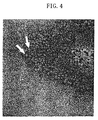
- FIG. 4 is an electron micrograph of cobalt-apoferritin complexes obtained in this embodiment.
- typical cobalt-apoferritin complexes in which CoO(OH) is incorporated into (the holding portion of) apoferritin are pointed by the arrows.
- FIG. 5 is an electron micrograph of apoferritin obtained by the production method of this embodiment in which a phosphoric acid buffer solution or a TAPS buffer solution is used instead of a HEPES buffer solution.
- FIGS. 4 and 5 are compared.
- CoO(OH) is not incorporated into (the holding portion of) apoferritin as shown by typical ones pointed by the arrows. More specifically, if a phosphoric acid buffer solution is used, formation of CoO(OH) does not occur in a holding portion of apoferritin.
- the present inventors also confirmed that in some other buffer solution (e.g., a Tris buffer solution, a TAPS buffer solution and an acetic acid buffer solution), formation of CoO(OH) does not occur in a holding portion of apoferritin.
- some other buffer solution e.g., a Tris buffer solution, a TAPS buffer solution and an acetic acid buffer solution
- formation of CoO(OH) does not occur in a holding portion of apoferritin.
- the results suggest that all Co 2+ ions have become CoO(OH) precipitates outside of apoferritin in the solution and therefore they could not be condensed in the holding portion. That is to say, it seems that in the case of a TAPS buffer solution, a Tris buffer solution, a phosphoric acidbuffer solution, an acetic acid buffer solution or the like, there is no equilibrium state like one represented by the chemical reaction formula 2 and shown in FIG. 3 between Co 2+ ions and phosphoric acid, acetic acid, or Tris.
- HEPES used in this embodiment is a buffer and also functions as an associating agent which associates with Co 2+ ions.
- H 2 O 2 is used as an oxidizing agent.
- other known oxidizing agents may be used.
- KMnO 4 , K 2 Cr 2 O 7 , HNO 3 , HClO, or NaClO may be used as an oxidizing agent instead of H 2 O 2 .
- nonvolatile memory cell including as a floating gate a dot body which is formed by utilizing a cobalt-apoferritin complex produced in Embodiment I will be described.
- FIGS. 6(a) through 6(d) are cross-sectional views illustrating respective process steps for fabricating a nonvolatile memory cell according to this embodiment.
- an isolation oxide film 102 is formed on a p-type Si substrate 101 so as to surround an active region by LOCOS, and then a gate oxide film 103 that functions as a tunnel insulating film is formed on the substrate by thermal oxidation.
- dot bodies 104 each including a metal or semiconductor particle having a diameter of about 6 nm are formed on the substrate. The process step of forming the dot bodies 104 will be described later.
- a SiO 2 film is deposited on the substrate by sputtering or CVD so that the dot bodies 104 are buried in the SiO 2 film.
- an Al film is deposited over the substrate.
- the SiO 2 film and the Al film are patterned to form a silicon oxide film 105 that is to be an inter-electrode insulating film and an Al electrode 106 that is to be a control gate electrode.
- part of the gate oxide film 103 which is not covered by the photoresist mask Pr1 is removed and thus some of the dot bodies 104 located thereon are also removed at the same time.
- ions of an impurity are injected thereto, thereby forming first and second n-type doped layers 107a and 107b .
- an interlevel insulating film 108 is formed, a contact hole 109 is formed so as to pass through to the interlevel insulating film 108, the contact hole 109 is filled with tungsten to form a tungsten plug 110 , and then first and second aluminum interconnects 111a and 111b are formed.
- a p-type Si substrate is used.
- an n-type Si substrate may be used.
- a substrate formed of a GaAs compound semiconductor, some other compound semiconductor, or some other semiconductor may be used.
- cobalt-apoferritin complexes (which will be herein referred to as "complexes") 150 obtained in Embodiment 1 are prepared and the complexes 150 are placed on the surface of a substrate 130 .
- a complex film in which the complexes 150 are arranged at high density with high precision is formed on the substrate 130 .
- the substrate 130 is a substrate obtained in the process step shown in FIG. 6(a) , by forming on a p-type Si substrate 101 using LOCOS an isolation oxide film 102 which surround an active region and then forming on the substrate through thermal oxidation a gate oxide film 103 which functions as a tunnel insulating film.
- the substrate 130 is a substrate obtained in the same manner as described here.
- protein molecules 140 in the complexes 150 are removed so that only cobalt particles 104a are left. In this manner, the dot bodies 104 are formed on the substrate 130 .
- a technique for arranging the complexes 150 at high density with high precision on the surface of the substrate 130 performed in the process step shown in FIG. 7(a) i.e., a method for arranging and immobilizing the complexes 150 two-dimensionally on the surface of the substrate 130 will be described.
- the method disclosed in Japanese Patent Publication No. 11-45990 will be described hereinafter with reference to FIG. 8 .
- a liquid 160 in which complexes 150 are dispersed is prepared (i.e., a solution obtained by dispersing cobalt-apoferritin complexes in a solution obtained by mixing in equal volumes a phosphorus acid buffer solution having a concentration of 40 mM and pH 5.3 and a sodium chloride solution having a concentration of 40 mM is prepared in this embodiment).
- PBLH poly-1-benzil-L-histidine
- an injector or the like is spread on the surface of the liquid 160 using an injector or the like.
- a polypeptide film 1700 of PBLH is formed on the surface of the liquid 160 .
- the pH of the liquid 160 is adjusted.
- the complexes 150 adhere to the polypeptide film 170 with the lapse of time and then two-dimensional crystals of the complexes 150 are formed. This is because the polypeptide film 170 has a positive charge while the complexes 150 have a negative charge.
- a substrate 130 is mounted (floated) on the polypeptide film 170 .
- the polypeptide film 170 is adhered to the substrate 130 .
- the substrate 130 is taken out to obtain the substrate 130 to which the two-dimensional crystals of the complexes 150 adhere with the polypeptide film 170 interposed therebetween
- protein molecules of the complexes 150 are removed by heat treatment. For example, if the substrate 130 is left to stand for about 1 hour in an inert gas such as nitrogen gas at a temperature of 400-500 C°, the protein molecules 140 and the polypeptide film 170 in Method 1 are burned out and then cobalt particles 104a are left on the substrate 130 as dot bodies 104 so as to be regularly arranged in a two-dimensional manner at high density with high precision.
- an inert gas such as nitrogen gas
- a memory cell 100 is a nonvolatile memory cell which includes an MOS transistor (memory transistor) having an Al electrode 106 which functions as a control gate, first and second n-type doped layers 107a and 107b which function as a source and a drain, respectiwely, and utilizes changes in the threshold voltage of the memory transistor according to the amount of an electric charge stored in the dot bodies 104 each of which functions as a floating gate.
- MOS transistor memory transistor
- the nonvolatile memory cell can function as a binary memory. However, it is also possible to achieve a multivalued-data storing memory which can store three- or more-valued data by controlling not only the presence of charges to be stored in the dot bodies 104 but also the total amount of stored charges therein.
- FN Low-Nordheim
- FN Fluorescent-Nordheim
- CHF channel hot electron
- the floating gate is formed of cobalt particles having a diameter as small as they can function as quantum dots and thus the amount of charges to be stored is small. Therefore, the amount of current flowing when date is written or erased can be reduced, and thus a low-power consumption nonvolatile memory cell can be achieved.
- the diameter of cobalt particles forming the floating gate is uniform.
- the characteristics of the cobalt particles when a charge is injected or removed are also uniform. Therefore, such an operation as injection or removal of a charge can be controlled in a simple manner.
- a cobalt-protein complex containing a cobalt particle having a uniform diameter can be obtained.
- a method for producing a cobalt-protein complex according to the present invention is applicable to fabrication of devices requiring hyperfine patterning, and more particularly applicable to fabrication of hyperfine electric devices such as a nonvolatile memory cell including a dot body as a floating gate.
Landscapes
- Chemical & Material Sciences (AREA)
- Health & Medical Sciences (AREA)
- Life Sciences & Earth Sciences (AREA)
- Organic Chemistry (AREA)
- Medicinal Chemistry (AREA)
- Toxicology (AREA)
- Biochemistry (AREA)
- Biophysics (AREA)
- General Health & Medical Sciences (AREA)
- Genetics & Genomics (AREA)
- Zoology (AREA)
- Molecular Biology (AREA)
- Proteomics, Peptides & Aminoacids (AREA)
- Gastroenterology & Hepatology (AREA)
- Crystallography & Structural Chemistry (AREA)
- Inorganic Chemistry (AREA)
- Engineering & Computer Science (AREA)
- Materials Engineering (AREA)
- Inorganic Compounds Of Heavy Metals (AREA)
- Peptides Or Proteins (AREA)
- Semiconductor Memories (AREA)
- Non-Volatile Memory (AREA)
- Preparation Of Compounds By Using Micro-Organisms (AREA)
Applications Claiming Priority (3)
| Application Number | Priority Date | Filing Date | Title |
|---|---|---|---|
| JP2001305273A JP3588602B2 (ja) | 2001-10-01 | 2001-10-01 | コバルト−タンパク質複合体の作製方法 |
| JP2001305273 | 2001-10-01 | ||
| PCT/JP2002/010127 WO2003031322A1 (en) | 2001-10-01 | 2002-09-27 | Method for preparing cobalt-protein complex |
Publications (3)
| Publication Number | Publication Date |
|---|---|
| EP1433743A1 EP1433743A1 (en) | 2004-06-30 |
| EP1433743A4 EP1433743A4 (en) | 2004-12-15 |
| EP1433743B1 true EP1433743B1 (en) | 2006-03-29 |
Family
ID=19125087
Family Applications (1)
| Application Number | Title | Priority Date | Filing Date |
|---|---|---|---|
| EP02772954A Expired - Lifetime EP1433743B1 (en) | 2001-10-01 | 2002-09-27 | Method for preparing cobalt-protein complex |
Country Status (6)
| Country | Link |
|---|---|
| US (1) | US7223847B2 (enExample) |
| EP (1) | EP1433743B1 (enExample) |
| JP (1) | JP3588602B2 (enExample) |
| AT (1) | ATE321731T1 (enExample) |
| DE (1) | DE60210311T2 (enExample) |
| WO (1) | WO2003031322A1 (enExample) |
Families Citing this family (4)
| Publication number | Priority date | Publication date | Assignee | Title |
|---|---|---|---|---|
| JP3999255B2 (ja) * | 2005-06-07 | 2007-10-31 | 松下電器産業株式会社 | 酸化亜鉛−タンパク質複合体の製造方法 |
| JP5071854B2 (ja) | 2005-09-12 | 2012-11-14 | 独立行政法人科学技術振興機構 | 微粒子−タンパク質複合体およびその作製方法、半導体装置、蛍光標識方法 |
| JP5989442B2 (ja) * | 2012-07-30 | 2016-09-07 | 京セラ株式会社 | 量子ドット粒子およびその製造方法、ならびに太陽電池 |
| KR102225790B1 (ko) * | 2016-07-08 | 2021-03-11 | 나가세 상교오 가부시키가이샤 | 금속 내포 바구니형 단백질의 제조 방법 |
Family Cites Families (3)
| Publication number | Priority date | Publication date | Assignee | Title |
|---|---|---|---|---|
| KR950002917B1 (ko) * | 1989-08-18 | 1995-03-28 | 몬산토 캄파니 | 페리틴 유사체 |
| US6180389B1 (en) * | 1997-01-03 | 2001-01-30 | The Research And Development Institute, Inc. | Virion-constrained nanoparticles comprising a plant virion coat protein shell and encapsulated guest molecules |
| ATE497927T1 (de) * | 2002-09-20 | 2011-02-15 | Panasonic Corp | Verfahren zur herstellung von nanoteilchen |
-
2001
- 2001-10-01 JP JP2001305273A patent/JP3588602B2/ja not_active Expired - Fee Related
-
2002
- 2002-09-27 WO PCT/JP2002/010127 patent/WO2003031322A1/ja not_active Ceased
- 2002-09-27 DE DE60210311T patent/DE60210311T2/de not_active Expired - Lifetime
- 2002-09-27 EP EP02772954A patent/EP1433743B1/en not_active Expired - Lifetime
- 2002-09-27 AT AT02772954T patent/ATE321731T1/de not_active IP Right Cessation
-
2003
- 2003-08-21 US US10/644,774 patent/US7223847B2/en not_active Expired - Lifetime
Also Published As
| Publication number | Publication date |
|---|---|
| WO2003031322A1 (en) | 2003-04-17 |
| DE60210311T2 (de) | 2006-08-24 |
| EP1433743A1 (en) | 2004-06-30 |
| US20040158047A1 (en) | 2004-08-12 |
| ATE321731T1 (de) | 2006-04-15 |
| EP1433743A4 (en) | 2004-12-15 |
| JP2003113198A (ja) | 2003-04-18 |
| US7223847B2 (en) | 2007-05-29 |
| JP3588602B2 (ja) | 2004-11-17 |
| DE60210311D1 (de) | 2006-05-18 |
Similar Documents
| Publication | Publication Date | Title |
|---|---|---|
| EP1550633B1 (en) | Method for preparing nano-particles | |
| US7129058B2 (en) | Method of production of a nanoparticle of a compound semiconductor in a cavity of protein | |
| US6303516B1 (en) | Method for forming dot element | |
| Tsukamoto et al. | Synthesis of Co3O4 nanoparticles using the cage-shaped protein, apoferritin | |
| US20140346442A1 (en) | Materials and methods for the preparation of nanocomposites | |
| US20070057255A1 (en) | Nanomaterials with tetrazole-based removable stabilizing agents | |
| US20060204754A1 (en) | Metal nano-particles coated with silicon oxide and manufacturing method thereof | |
| JP5071854B2 (ja) | 微粒子−タンパク質複合体およびその作製方法、半導体装置、蛍光標識方法 | |
| US7223847B2 (en) | Method for producing cobalt-protein complex | |
| KR20020087871A (ko) | 재조합 바구니형상 단백질, 그 제작방법, 귀금속-재조합바구니형상 단백질 복합체, 그 제작방법, 및 재조합디엔에이 | |
| KR20130013776A (ko) | 다기능성 바이오-메모리 디바이스 | |
| JP2006008436A (ja) | ナノ粒子−タンパク質複合体とその作製方法 | |
| Kamitake et al. | Floating gate memory with charge storage dots array formed by Dps protein modified with site-specific binding peptides | |
| US6881481B2 (en) | Composite fine particles and method for producing the same | |
| JP3756928B2 (ja) | 貴金属−組み換えタンパク質複合体を製造する方法 | |
| US7834160B2 (en) | Process for producing zinc oxide-protein complex | |
| JP2003033191A (ja) | 組み換えかご状タンパク質、その作製方法、貴金属−組み換えかご状タンパク質複合体、その作製方法、及び組み換えdna | |
| Moreno et al. | Conceptions and first results on the electrocrystallization behaviour of ferritin | |
| Bessolov et al. | Sulfide Passivation of III–V Seiconductors: Electrochemical Aspects | |
| JPWO2001068513A1 (ja) | 微小構造体の精密加工方法 |
Legal Events
| Date | Code | Title | Description |
|---|---|---|---|
| PUAI | Public reference made under article 153(3) epc to a published international application that has entered the european phase |
Free format text: ORIGINAL CODE: 0009012 |
|
| 17P | Request for examination filed |
Effective date: 20031127 |
|
| AK | Designated contracting states |
Kind code of ref document: A1 Designated state(s): AT BE BG CH CY CZ DE DK EE ES FI FR GB GR IE IT LI LU MC NL PT SE SK TR |
|
| AX | Request for extension of the european patent |
Extension state: AL LT LV MK RO SI |
|
| A4 | Supplementary search report drawn up and despatched |
Effective date: 20041102 |
|
| 17Q | First examination report despatched |
Effective date: 20041217 |
|
| GRAP | Despatch of communication of intention to grant a patent |
Free format text: ORIGINAL CODE: EPIDOSNIGR1 |
|
| RTI1 | Title (correction) |
Free format text: METHOD FOR PREPARING COBALT-PROTEIN COMPLEX |
|
| GRAS | Grant fee paid |
Free format text: ORIGINAL CODE: EPIDOSNIGR3 |
|
| GRAA | (expected) grant |
Free format text: ORIGINAL CODE: 0009210 |
|
| AK | Designated contracting states |
Kind code of ref document: B1 Designated state(s): AT BE BG CH CY CZ DE DK EE ES FI FR GB GR IE IT LI LU MC NL PT SE SK TR |
|
| PG25 | Lapsed in a contracting state [announced via postgrant information from national office to epo] |
Ref country code: AT Free format text: LAPSE BECAUSE OF FAILURE TO SUBMIT A TRANSLATION OF THE DESCRIPTION OR TO PAY THE FEE WITHIN THE PRESCRIBED TIME-LIMIT Effective date: 20060329 Ref country code: IT Free format text: LAPSE BECAUSE OF FAILURE TO SUBMIT A TRANSLATION OF THE DESCRIPTION OR TO PAY THE FEE WITHIN THE PRESCRIBED TIME-LIMIT;WARNING: LAPSES OF ITALIAN PATENTS WITH EFFECTIVE DATE BEFORE 2007 MAY HAVE OCCURRED AT ANY TIME BEFORE 2007. THE CORRECT EFFECTIVE DATE MAY BE DIFFERENT FROM THE ONE RECORDED. Effective date: 20060329 Ref country code: BE Free format text: LAPSE BECAUSE OF FAILURE TO SUBMIT A TRANSLATION OF THE DESCRIPTION OR TO PAY THE FEE WITHIN THE PRESCRIBED TIME-LIMIT Effective date: 20060329 Ref country code: NL Free format text: LAPSE BECAUSE OF FAILURE TO SUBMIT A TRANSLATION OF THE DESCRIPTION OR TO PAY THE FEE WITHIN THE PRESCRIBED TIME-LIMIT Effective date: 20060329 Ref country code: LI Free format text: LAPSE BECAUSE OF FAILURE TO SUBMIT A TRANSLATION OF THE DESCRIPTION OR TO PAY THE FEE WITHIN THE PRESCRIBED TIME-LIMIT Effective date: 20060329 Ref country code: SK Free format text: LAPSE BECAUSE OF FAILURE TO SUBMIT A TRANSLATION OF THE DESCRIPTION OR TO PAY THE FEE WITHIN THE PRESCRIBED TIME-LIMIT Effective date: 20060329 Ref country code: CH Free format text: LAPSE BECAUSE OF FAILURE TO SUBMIT A TRANSLATION OF THE DESCRIPTION OR TO PAY THE FEE WITHIN THE PRESCRIBED TIME-LIMIT Effective date: 20060329 |
|
| REG | Reference to a national code |
Ref country code: GB Ref legal event code: FG4D |
|
| REG | Reference to a national code |
Ref country code: CH Ref legal event code: EP |
|
| REG | Reference to a national code |
Ref country code: IE Ref legal event code: FG4D |
|
| REF | Corresponds to: |
Ref document number: 60210311 Country of ref document: DE Date of ref document: 20060518 Kind code of ref document: P |
|
| PG25 | Lapsed in a contracting state [announced via postgrant information from national office to epo] |
Ref country code: BG Free format text: LAPSE BECAUSE OF FAILURE TO SUBMIT A TRANSLATION OF THE DESCRIPTION OR TO PAY THE FEE WITHIN THE PRESCRIBED TIME-LIMIT Effective date: 20060629 Ref country code: DK Free format text: LAPSE BECAUSE OF FAILURE TO SUBMIT A TRANSLATION OF THE DESCRIPTION OR TO PAY THE FEE WITHIN THE PRESCRIBED TIME-LIMIT Effective date: 20060629 Ref country code: SE Free format text: LAPSE BECAUSE OF FAILURE TO SUBMIT A TRANSLATION OF THE DESCRIPTION OR TO PAY THE FEE WITHIN THE PRESCRIBED TIME-LIMIT Effective date: 20060629 |
|
| PG25 | Lapsed in a contracting state [announced via postgrant information from national office to epo] |
Ref country code: ES Free format text: LAPSE BECAUSE OF FAILURE TO SUBMIT A TRANSLATION OF THE DESCRIPTION OR TO PAY THE FEE WITHIN THE PRESCRIBED TIME-LIMIT Effective date: 20060710 |
|
| PG25 | Lapsed in a contracting state [announced via postgrant information from national office to epo] |
Ref country code: PT Free format text: LAPSE BECAUSE OF FAILURE TO SUBMIT A TRANSLATION OF THE DESCRIPTION OR TO PAY THE FEE WITHIN THE PRESCRIBED TIME-LIMIT Effective date: 20060829 |
|
| PG25 | Lapsed in a contracting state [announced via postgrant information from national office to epo] |
Ref country code: IE Free format text: LAPSE BECAUSE OF NON-PAYMENT OF DUE FEES Effective date: 20060927 |
|
| REG | Reference to a national code |
Ref country code: CH Ref legal event code: PL |
|
| PG25 | Lapsed in a contracting state [announced via postgrant information from national office to epo] |
Ref country code: MC Free format text: LAPSE BECAUSE OF NON-PAYMENT OF DUE FEES Effective date: 20060930 |
|
| NLV1 | Nl: lapsed or annulled due to failure to fulfill the requirements of art. 29p and 29m of the patents act | ||
| PLBE | No opposition filed within time limit |
Free format text: ORIGINAL CODE: 0009261 |
|
| STAA | Information on the status of an ep patent application or granted ep patent |
Free format text: STATUS: NO OPPOSITION FILED WITHIN TIME LIMIT |
|
| 26N | No opposition filed |
Effective date: 20070102 |
|
| EN | Fr: translation not filed | ||
| GBPC | Gb: european patent ceased through non-payment of renewal fee |
Effective date: 20060927 |
|
| PG25 | Lapsed in a contracting state [announced via postgrant information from national office to epo] |
Ref country code: GB Free format text: LAPSE BECAUSE OF NON-PAYMENT OF DUE FEES Effective date: 20060927 |
|
| PG25 | Lapsed in a contracting state [announced via postgrant information from national office to epo] |
Ref country code: CZ Free format text: LAPSE BECAUSE OF FAILURE TO SUBMIT A TRANSLATION OF THE DESCRIPTION OR TO PAY THE FEE WITHIN THE PRESCRIBED TIME-LIMIT Effective date: 20060329 Ref country code: FR Free format text: LAPSE BECAUSE OF FAILURE TO SUBMIT A TRANSLATION OF THE DESCRIPTION OR TO PAY THE FEE WITHIN THE PRESCRIBED TIME-LIMIT Effective date: 20070309 Ref country code: GR Free format text: LAPSE BECAUSE OF FAILURE TO SUBMIT A TRANSLATION OF THE DESCRIPTION OR TO PAY THE FEE WITHIN THE PRESCRIBED TIME-LIMIT Effective date: 20060630 |
|
| PG25 | Lapsed in a contracting state [announced via postgrant information from national office to epo] |
Ref country code: FI Free format text: LAPSE BECAUSE OF FAILURE TO SUBMIT A TRANSLATION OF THE DESCRIPTION OR TO PAY THE FEE WITHIN THE PRESCRIBED TIME-LIMIT Effective date: 20060329 Ref country code: EE Free format text: LAPSE BECAUSE OF FAILURE TO SUBMIT A TRANSLATION OF THE DESCRIPTION OR TO PAY THE FEE WITHIN THE PRESCRIBED TIME-LIMIT Effective date: 20060329 |
|
| PG25 | Lapsed in a contracting state [announced via postgrant information from national office to epo] |
Ref country code: TR Free format text: LAPSE BECAUSE OF FAILURE TO SUBMIT A TRANSLATION OF THE DESCRIPTION OR TO PAY THE FEE WITHIN THE PRESCRIBED TIME-LIMIT Effective date: 20060329 Ref country code: LU Free format text: LAPSE BECAUSE OF NON-PAYMENT OF DUE FEES Effective date: 20060927 |
|
| PG25 | Lapsed in a contracting state [announced via postgrant information from national office to epo] |
Ref country code: FR Free format text: LAPSE BECAUSE OF FAILURE TO SUBMIT A TRANSLATION OF THE DESCRIPTION OR TO PAY THE FEE WITHIN THE PRESCRIBED TIME-LIMIT Effective date: 20060329 Ref country code: CY Free format text: LAPSE BECAUSE OF FAILURE TO SUBMIT A TRANSLATION OF THE DESCRIPTION OR TO PAY THE FEE WITHIN THE PRESCRIBED TIME-LIMIT Effective date: 20060329 |
|
| PGFP | Annual fee paid to national office [announced via postgrant information from national office to epo] |
Ref country code: DE Payment date: 20120919 Year of fee payment: 11 |
|
| REG | Reference to a national code |
Ref country code: DE Ref legal event code: R119 Ref document number: 60210311 Country of ref document: DE Effective date: 20140401 |
|
| PG25 | Lapsed in a contracting state [announced via postgrant information from national office to epo] |
Ref country code: DE Free format text: LAPSE BECAUSE OF NON-PAYMENT OF DUE FEES Effective date: 20140401 |