EP1432745B1 - Wiederbeschreibbares optisches aufzeichnungsmaterial mit guter löslichkeit - Google Patents
Wiederbeschreibbares optisches aufzeichnungsmaterial mit guter löslichkeit Download PDFInfo
- Publication number
- EP1432745B1 EP1432745B1 EP02800091A EP02800091A EP1432745B1 EP 1432745 B1 EP1432745 B1 EP 1432745B1 EP 02800091 A EP02800091 A EP 02800091A EP 02800091 A EP02800091 A EP 02800091A EP 1432745 B1 EP1432745 B1 EP 1432745B1
- Authority
- EP
- European Patent Office
- Prior art keywords
- alkyl
- aryl
- hydrogen
- alkenyl
- cycloalkyl
- Prior art date
- Legal status (The legal status is an assumption and is not a legal conclusion. Google has not performed a legal analysis and makes no representation as to the accuracy of the status listed.)
- Expired - Lifetime
Links
- AOZKHLXGLGJNBD-RRPBDJRISA-N CC(C(OCCN(CCO)c(cc1)ccc1/N=N/c(cc1)c(C)cc1/N=N/c(cc1)ccc1C#N)=O)=C Chemical compound CC(C(OCCN(CCO)c(cc1)ccc1/N=N/c(cc1)c(C)cc1/N=N/c(cc1)ccc1C#N)=O)=C AOZKHLXGLGJNBD-RRPBDJRISA-N 0.000 description 1
- GJAWTTQOGQTHSJ-FMWAKIAMSA-N CC(C(OCCN(CCO)c(cc1)ccc1/N=N/c(cc1)ccc1/N=N/c(cc1)ccc1N(CCO)CCO)=O)=C Chemical compound CC(C(OCCN(CCO)c(cc1)ccc1/N=N/c(cc1)ccc1/N=N/c(cc1)ccc1N(CCO)CCO)=O)=C GJAWTTQOGQTHSJ-FMWAKIAMSA-N 0.000 description 1
- RXYPXQSKLGGKOL-UHFFFAOYSA-N CN1CCN(C)CC1 Chemical compound CN1CCN(C)CC1 RXYPXQSKLGGKOL-UHFFFAOYSA-N 0.000 description 1
- ZFELWKKEFVPBJQ-UHFFFAOYSA-N CN1CCN(CCOC)CC1 Chemical compound CN1CCN(CCOC)CC1 ZFELWKKEFVPBJQ-UHFFFAOYSA-N 0.000 description 1
Images


Classifications
-
- C—CHEMISTRY; METALLURGY
- C08—ORGANIC MACROMOLECULAR COMPOUNDS; THEIR PREPARATION OR CHEMICAL WORKING-UP; COMPOSITIONS BASED THEREON
- C08F—MACROMOLECULAR COMPOUNDS OBTAINED BY REACTIONS ONLY INVOLVING CARBON-TO-CARBON UNSATURATED BONDS
- C08F8/00—Chemical modification by after-treatment
- C08F8/30—Introducing nitrogen atoms or nitrogen-containing groups
-
- C—CHEMISTRY; METALLURGY
- C08—ORGANIC MACROMOLECULAR COMPOUNDS; THEIR PREPARATION OR CHEMICAL WORKING-UP; COMPOSITIONS BASED THEREON
- C08F—MACROMOLECULAR COMPOUNDS OBTAINED BY REACTIONS ONLY INVOLVING CARBON-TO-CARBON UNSATURATED BONDS
- C08F246/00—Copolymers in which the nature of only the monomers in minority is defined
-
- C—CHEMISTRY; METALLURGY
- C08—ORGANIC MACROMOLECULAR COMPOUNDS; THEIR PREPARATION OR CHEMICAL WORKING-UP; COMPOSITIONS BASED THEREON
- C08F—MACROMOLECULAR COMPOUNDS OBTAINED BY REACTIONS ONLY INVOLVING CARBON-TO-CARBON UNSATURATED BONDS
- C08F8/00—Chemical modification by after-treatment
- C08F8/34—Introducing sulfur atoms or sulfur-containing groups
-
- G—PHYSICS
- G11—INFORMATION STORAGE
- G11B—INFORMATION STORAGE BASED ON RELATIVE MOVEMENT BETWEEN RECORD CARRIER AND TRANSDUCER
- G11B7/00—Recording or reproducing by optical means, e.g. recording using a thermal beam of optical radiation by modifying optical properties or the physical structure, reproducing using an optical beam at lower power by sensing optical properties; Record carriers therefor
- G11B7/24—Record carriers characterised by shape, structure or physical properties, or by the selection of the material
- G11B7/241—Record carriers characterised by shape, structure or physical properties, or by the selection of the material characterised by the selection of the material
- G11B7/242—Record carriers characterised by shape, structure or physical properties, or by the selection of the material characterised by the selection of the material of recording layers
- G11B7/244—Record carriers characterised by shape, structure or physical properties, or by the selection of the material characterised by the selection of the material of recording layers comprising organic materials only
- G11B7/25—Record carriers characterised by shape, structure or physical properties, or by the selection of the material characterised by the selection of the material of recording layers comprising organic materials only containing liquid crystals
-
- Y—GENERAL TAGGING OF NEW TECHNOLOGICAL DEVELOPMENTS; GENERAL TAGGING OF CROSS-SECTIONAL TECHNOLOGIES SPANNING OVER SEVERAL SECTIONS OF THE IPC; TECHNICAL SUBJECTS COVERED BY FORMER USPC CROSS-REFERENCE ART COLLECTIONS [XRACs] AND DIGESTS
- Y10—TECHNICAL SUBJECTS COVERED BY FORMER USPC
- Y10S—TECHNICAL SUBJECTS COVERED BY FORMER USPC CROSS-REFERENCE ART COLLECTIONS [XRACs] AND DIGESTS
- Y10S430/00—Radiation imagery chemistry: process, composition, or product thereof
- Y10S430/146—Laser beam
Definitions
- the present invention relates to an optical recording material for binary and / or multi-bit and / or volume data storage, its production and use as a memory material.
- the azobenzenes incorporated in polymers exhibit directional orientation in the actinic light field if irradiated with polarized light of appropriate wavelength.
- the irradiation with linearly polarized light thus leads, for example, to an excess perpendicular to the direction of polarization of oriented azobenzenes. This can be exploited to build up a light-induced birefringence in the polymer.
- the orientation mechanisms of the azobenzenes are described several times in the literature. [ M. Eich; JH Wendorff; B. stretch; H. Ringsdorf; Makromol. Chem. Rapid Commun. 8, 59 (1987 )] [ YQ Shen; H. Rau, Macromol. Chem. 192, 945 (1991 )].
- EP-A 1 166 188 and DE-A 100 271 529 Several Amorphous and liquid-crystalline polymers as well as oligomers were synthesized and investigated in exposure experiments [ JJA Couture; RA Lessard, Appl. Opt. 27, 3368 (1988 )] [ M. Eich; J. Wendorff, J. Opt. Soc. At the. B, 7, 1428 (1990 )] [ A. Natansohn; P. Rochon; J. Gosselin; S. Xie; Macromolecules 25, 2268 (1992 )].
- DE 43 39 862 A1 describes sheetlike structures of a polymer having a main chain and side groups branching from the main chain.
- the present building block of group c) is not described. Furthermore, no indication is given of the solubility of the recording material.
- EP 0823 442 A2 describes photoaddressable side group polymers in which a high birefringence can be induced by irradiation.
- the polymers do not contain group c) as a building block. Solubility problems are not mentioned.
- WO 00/54112 describes a recording material for a holographic volume memory.
- the building block of group c) is not described.
- mesogens typically have a rod shape that is achieved by a stretched, rigid moiety.
- the length-to-width ratio, measured on the van der Waals radii, must be at least 4, preferably between 4 and 6.
- the shape anisotropy leads to anisotropy of the molecular polarizability. This type of molecule is described in the standard literature [ H. Kelker, R. Hatz “Handbook of Liquid Crystals", Verlag Chemie (1980 )] [ L. Bergmann; C. Schaefer “Textbook of Experimental Physics", Verlag de Gruyter, Volume 5 "Vielteilchensysteme” (1992) )].
- the absorption can be determined with the help of a spectrometer (eg Varian CARY 4G, UV-NIS spectrometer).
- the side-chain polymers which in addition to the azobenzenes still use formanisotropic components as side chains, are characterized by high light-inducible birefringence, because they can meet the above three requirements.
- solvents eg. As alcohols that are non-toxic or less toxic, therefore, are not suitable as a solvent.
- good solvents for such polymers are often toxic, carcinogenic and / or teratogenic. In many cases, the volatility is too high due to their low boiling point.
- An example is tetrahydrofuran (THF). The following describes why such solvents for the production of data storage, which should meet particularly high environmental standards in the production of disadvantage.
- polymers In order to use polymers as a functional layer in a data store, they must be prepared as homogeneous films. For the production of thin films, there are several casting, dripping or brushing methods. A standard method in large scale production e.g. Recordable Compact Discs "CD-R" and their successor formats, is spin coating. The dyes are dissolved and the solution is automatically dripped onto a rotating substrate (e.g., polycarbonate disk). After evaporation of the solvent, a thin film of the recording material remains. To trap toxicologically problematic evaporated solvent to protect the environment, the production lines for data storage would have to be encapsulated consuming, which is economically disadvantageous.
- a rotating substrate e.g., polycarbonate disk
- THF dissolves polycarbonate.
- An embossed groove structure of a polycarbonate substrate would thus be destroyed upon contact with THF.
- a THF-resistant cover layer would have to be applied to polycarbonate.
- Preferred is a material, wherein the main chain of the basic structures polyacrylate, polymethacrylate and polyacrylamide comes.
- the invention further provides a material as described above, wherein the groups a) and / or b) carry hydroxyethyl groups and the group c) may be contained.
- the polymers of the invention are usually below the clearing temperature in an amorphous state.
- the polymers and oligomers of the invention preferably have glass transition temperatures Tg of at least 40 ° C.
- the glass transition temperature can, for example after B. Vollmer, Grundriss of Macromolecular Chemistry, p. 406-410, Springer-Verlag, Heidelberg 1962 to be determined.
- the polymers and oligomers of the invention have a weight average molecular weight of 5,000 to 2,000,000 g / mol, preferably from 8,000 to 1,500,000 g / mol, determined by gel permeation chromatography (calibrated with polystyrene).
- azo dyes are covalently bonded as a side chain to the polymer main chain.
- the azo dyes interact with the electromagnetic radiation and thereby change their spatial orientation so that birefringence can be induced in the polymer by the action of light and can be extinguished again.
- the mesogens are usually attached in the same way as the azo dyes. They do not necessarily absorb the actinic light because they function as a passive molecular group. So you are not photoactive in the above sense. Their task is to increase the light-inducible birefringence and to stabilize it after exposure to light.
- the alkyl, cycloalkyl, alkenyl and aryl radicals may in turn be substituted by up to 3 radicals selected from halogen, cyano, nitro, C 1 - to C 20 -alkyl, C 1 - to C 20 -alkoxy, C 3 - to C 10 -cycloalkyl, C 2 - to C 20 -alkenyl or C 6 - to C 10 -aryl substituted and the alkyl and alkenyl radicals may be straight-chain or branched.
- halogen is meant fluorine, chlorine, bromine and iodine, in particular fluorine and chlorine.
- Azo dyes which have solubility-improving properties in the context of the invention are likewise to be described according to formula (I) incl.
- R 5 is C 2 - to C 10 -alkyl-OH, preferably C 2 - to C 4 -Alkyl-OH, or is CH 2 - (CH-OH) -CH 2 -OH.
- Preferred monomer units with azo dyes which carry a solubility-improving component at the binding site to the spacer and / or at the free site have the form:
- the alkyl, cycloalkyl, alkenyl and aryl radicals may in turn be substituted by up to 3 radicals from the group halogen, cyano, nitro, C 1 - to C 20 -alkyl, C 1 - to C 20 -alkoxy, C 3 to C 10 cycloalkyl, C 2 to C 20 alkenyl or C 6 to C 10 aryl and the alkyl and alkenyl radicals may be straight or branched.
- halogen is meant fluorine, chlorine, bromine and iodine, in particular fluorine and chlorine.
- Functional building blocks are monomer building blocks which either contain an azo group or contain a mesogenic unit. Both of these molecular types are involved in the process of photo-orientation of the corresponding polymer. That is, they are functional groups. These functional groups or building blocks must be distinguished from the “diluting building blocks”. "Diluting building blocks” are monomer building blocks that can not form orientable side chains. They are only part of the polymer backbone and reduce the proportion of functional building blocks in the polymer.
- the polymers according to the invention may also contain building blocks which serve primarily to lower the percentage content of functional building blocks, in particular to dye building blocks. Besides this task, they may also be responsible for other properties of the polymers, e.g. the glass transition temperature, liquid crystallinity, film forming property, etc.
- Polyacrylates, polymethacrylates and poly (meth) acrylates / poly (meth) acrylamides according to the invention then preferably contain as recurring units those of the formulas (VII), preferably those of the formulas (VII) and (VIII) or of the formulas (VII) and (IX ) or those of the formulas (VII), (VIII) or instead of the formula (VII), repeating units of the formulas (VIIa) or (VIIb) wherein the radicals have the meanings given above. It is also possible for a plurality of the repeating units of the formula (VII) and / or the repeating units of the formulas (VIII) and / or (IX) to be present. It is also possible for monomer units of the formula (VI) to be present in addition.
- the quantitative ratio between V, VI, VII, VIII and optionally (VI) is arbitrary.
- the concentration of VII is preferably between 1 and 99%, based on the particular mixture.
- the ratio between VII and VIII is between 1:99 and 99: 1, preferably between 10:90 and 90:10, most preferably between 60:40 and 40:60.
- the proportion V is 0 to 90%, preferably 20 to 80%, particularly preferably 30 to 70%, based on the respective mixture.
- the proportion VI is 0 to 90%, preferably 20 to 80%, particularly preferably 30 to 70%, based on the respective mixture.
- the intermolecular interactions of the structural elements of the formulas (VII) with one another or with formulas (VII) and (VIII) are mutually adjusted such that the formation of liquid-crystalline states of order is suppressed and optically isotropic, transparent non-scattering films, films, Plates or blocks, in particular films or coatings can be produced.
- the intermolecular interactions are nevertheless strong enough that upon irradiation with light and / or the action of static electric fields, a photochemically induced, cooperative, directed reorientation process of the light-active and non-light-active side groups is effected.
- the preparation of the polymers and oligomers can be carried out by literature methods, for example DD-A 276 297 . DE-A 3 808 430 . Macromolecular Chemistry 187, 1327-1334 (1984 ) SU-A 887 574 . Europ. Polym. 18, 561 (1982 ) and Liq. Cryst. 2, 195 (1987 ).
- Another method for producing the recording material or the polymer according to the invention comprises a process in which at least one monomer is polymerized without further solvent, preferably free-radically polymerized, and is particularly preferably initiated by free-radical initiators and / or UV light and / or thermally initiated.
- AIBN azoisobutyronitrile
- liquid monomer preferably liquid monomers at the reaction temperatures which are preferably olefinically unsaturated monomers, particularly preferably based on acrylic acid and methacrylic acid, very particularly preferably methyl methacrylate.
- N- (2,3-Dihydroxypropyl) -N- [2- (methacryloyloxy) ethyl] -aniline is prepared analogously to 1.1 from 3-bromo-1,2-propanediol and N- [2- (methacryloyloxy) ethyl] -aniline ,
- Monomer 1.2 is prepared analogously to 1.1 by diazotization of 4-amino-3-methyl-4'-cyanoazobenzene and coupling to N- (2,3-dihydroxypropyl) -N- [2- (methacryloyloxy) ethyl] -aniline.
- the x-monomer is functionalized with an azobenzene dye molecule.
- the y-monomer consists of dimethylacrylamide (DMAA).
- the molecular weights of the polymers were determined by gel permeation chromatography (GPC).
- GPC gel permeation chromatography
- DMAC N, N-dimethylacetamide
- the signals were evaluated on the basis of a calibration relationship valid for PMMA at 60 ° C. in DMAC.
- the values for the weight average were in the range 10500 and 13300 g / mol.
- the values for the number average were between 5500 and 6810 g / mol.
- the glass transition temperatures were determined by heat flow calorimetry. Device: Calorimeter DSC-2 from Perkin-Elmer. Two heaters were made from room temperature to 300 ° C at a heating rate of 20 K / min. Between heats, it was rapidly cooled to room temperature at 320 K / min, each with nitrogen purge (30 mL / min). The glass transition temperatures of polymers 1 to 6 were between 92 and 104 ° C. for the second heating process.
- TFP is a suitable solvent.
- These polymers contain at least 50 mol% or at least 18 wt .-% DMAA.
- Example 2b Comparative Example Not According to the Invention
- the monomer unit x corresponds to the polymer 6 (see Example 2a). It is contained at 20, 30, 40 and 50 mol%.
- the polymers are referred to in this order as polymer 2b, 3b, 4b, and 5b.
- the monomer unit y consists of acrylamide.
- the solubility-improving effect of the monomer unit y is low.
- the polymer must contain at least 80 mol% of the monomer unit y to completely dissolve in TFP. In the case of the polymer according to the invention (see Example 2a), however, only 50 mol% of dimethylacrylamide (DMAA) are necessary for the same effect.
- DMAA dimethylacrylamide
- Polymers have been prepared which contain azobenzene dyes as side chains which are responsible for the solubility-improving effect of the invention.
- the solubility enhancing hydroxyethyl groups are attached at the binding site to the spacer and / or at the free site of each azobenzene dye.
- the polymers produced carry the serial numbers 7 to 10:
- polymers 7 to 10 can be dissolved not only in THF, like polymer 6, but also in HMP (2% concentration).
- HMP 2% concentration
- polymer 7 dissolves incompletely in HMP
- polymers 8 and 9 dissolve almost completely and polymer 10 dissolves very well in HMP.
- polymers of the invention have been prepared which exhibit high light-inducible birefringence values as a thin film.
- the polymers 1 according to the invention to 5 (see Example 2) and 7 to 10 (see Example 3) were investigated in exposure experiments. The height of the light-induced birefringence values of originally isotropic polymer films was measured.
- a 1 mm thick glass substrate is provided with a thin polymer film. This is done with the help of spin coating technology ("spin coating").
- spin coating The polymer is dissolved at a typical concentration of 20 to 75 g / l in a suitable alcohol and the polymer solution is dropped onto the rotating at a rotational speed of 2000 min -1 substrate.
- the resulting polymer film typically has a thickness of 200 nm. Residues of the solvent are removed from the film by storage of the coated glass substrate for 2 hours at 60 ° C. in a vacuum oven.
- Each sample thus prepared is irradiated from the polymer side with polarized laser light in a vertical incidence (writing process).
- the light source is an argon ion laser (company Continuum) at a wavelength of 514 nm.
- the intensity of this so-called writing laser is 100 mW / cm 2 .
- trans - cis - trans isomerization cycles are induced, resulting in a net orientation of the side groups away from the polarization direction of the laser.
- This molecular dynamics is shown macroscopically in a birefringence ⁇ n in the polymer film plane. The dynamics take place at the given exposure parameters in the minute range.
- the time course of the induced birefringence at a wavelength of 633 nm is read with a helium-neon laser (typical intensity: 10 mW / cm 2 ).
- Leselasers occupies a fixed angle of 15 ° to the normal of the layer.
- Read and write light overlap on the polymer layer.
- the polarization direction of the Reading light occupies an angle of 45 ° to the polarization of the writing light in the polymer film plane. It is rotated while passing through the polymer layer, as long as the layer is birefringent.
- This rotation is accompanied by an increase in the reading light intensity I s after an analyzer, which is after the sample in the beam path and transmits light perpendicular to the original direction of polarization.
- I s increases, the intensity I p decreases.
- I p is defined as the transmitted intensity after an equally positioned analyzer, but which selects the original polarization direction of the read laser.
- the two components of the polarization direction are separated parallel and perpendicular to the original direction via a polarizing beam splitter and detected by means of two Si photodiodes.
- Films of the inventive polymers 1 to 5 described in Example 2a were prepared according to the procedure of Example 4, exposed over a period of 10 minutes and the birefringence structure was interrogated with a read laser.
- the birefringence ⁇ n reaches its maximum value within the exposure time and remains at this value.
- Four further write / erase processes are connected directly to the first one according to the same pattern. The result is:
- the temporal curve ⁇ n (t) remains almost unchanged for each cycle.
- the maximum achievable birefringence values are identical for each cycle (granted tolerance: 5%).
- the behavior of the polymers 1 to 5 can be classified in these write / erase cycles in a good approximation as reversible.
- FIG. 1 shows by way of example the birefringence curve of the polymer 4 during the five write / erase cycles.
- FIG. 2 shows the birefringence curve of the polymer 6 during the five write / erase cycles.
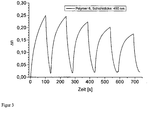
- FIG. 3 shows the birefringence curve associated with this experiment.
- the example of the polymer 4 illustrates that not only a green writing laser (examples 4 and 5), but for example also a blue writing laser comes into question.
- a laser exposure was made according to the principle described in Example 4.
- the writing laser had a light wavelength of 407 nm and an intensity of 100 mW / cm 2 .
- the result is:
- a maximum birefringence value of ⁇ n 0.2 could also be induced (measurement error approx. 10%).
Landscapes
- Chemical & Material Sciences (AREA)
- Health & Medical Sciences (AREA)
- Chemical Kinetics & Catalysis (AREA)
- Medicinal Chemistry (AREA)
- Polymers & Plastics (AREA)
- Organic Chemistry (AREA)
- General Chemical & Material Sciences (AREA)
- Crystallography & Structural Chemistry (AREA)
- Addition Polymer Or Copolymer, Post-Treatments, Or Chemical Modifications (AREA)
- Optical Record Carriers And Manufacture Thereof (AREA)
- Non-Silver Salt Photosensitive Materials And Non-Silver Salt Photography (AREA)
Applications Claiming Priority (5)
| Application Number | Priority Date | Filing Date | Title |
|---|---|---|---|
| DE10147723 | 2001-09-27 | ||
| DE10147723 | 2001-09-27 | ||
| DE10223648A DE10223648A1 (de) | 2001-09-27 | 2002-05-28 | Wiederbeschreibbares optisches Aufzeichnungsmaterial mit guter Löslichkeit |
| DE10223648 | 2002-05-28 | ||
| PCT/EP2002/010446 WO2003029311A1 (de) | 2001-09-27 | 2002-09-18 | Wiederbeschreibbares optisches aufzeichnungsmaterial mit guter löslichkeit |
Publications (2)
| Publication Number | Publication Date |
|---|---|
| EP1432745A1 EP1432745A1 (de) | 2004-06-30 |
| EP1432745B1 true EP1432745B1 (de) | 2011-01-05 |
Family
ID=26010239
Family Applications (1)
| Application Number | Title | Priority Date | Filing Date |
|---|---|---|---|
| EP02800091A Expired - Lifetime EP1432745B1 (de) | 2001-09-27 | 2002-09-18 | Wiederbeschreibbares optisches aufzeichnungsmaterial mit guter löslichkeit |
Country Status (5)
| Country | Link |
|---|---|
| US (1) | US7214451B2 (https=) |
| EP (1) | EP1432745B1 (https=) |
| JP (1) | JP4113123B2 (https=) |
| CA (1) | CA2461570C (https=) |
| WO (1) | WO2003029311A1 (https=) |
Families Citing this family (8)
| Publication number | Priority date | Publication date | Assignee | Title |
|---|---|---|---|---|
| JPH079534U (ja) * | 1993-07-08 | 1995-02-10 | 京進工業株式会社 | 拡管装置 |
| DE19914325C1 (de) * | 1999-03-30 | 2000-07-06 | Bayer Ag | Wiederbeschreibbares optisches Aufzeichnungsmaterial für blaue Laser |
| JP4139892B2 (ja) * | 2002-08-02 | 2008-08-27 | 独立行政法人産業技術総合研究所 | 光誘起表面レリーフに基づく情報記録方法 |
| DE102005028145A1 (de) * | 2005-06-17 | 2006-12-28 | Bayer Materialscience Ag | Optischer Datenspeicher, dessen Herstellung und Verwendung |
| CN100412094C (zh) * | 2006-11-01 | 2008-08-20 | 天津工业大学 | 一种紫外光响应型高分子水凝胶及其制备方法和用途 |
| GB2476275A (en) | 2009-12-17 | 2011-06-22 | Dublin Inst Of Technology | Photosensitive holographic recording medium comprising glycerol |
| WO2013018986A1 (ko) * | 2011-08-04 | 2013-02-07 | 주식회사 엘지화학 | 염료를 포함하는 고분자 화합물 및 이를 포함하는 경화성 수지 조성물 |
| US8999626B2 (en) | 2011-08-04 | 2015-04-07 | Lg Chem, Ltd. | Polymer compound comprising dye and curable resin composition comprising same |
Family Cites Families (29)
| Publication number | Priority date | Publication date | Assignee | Title |
|---|---|---|---|---|
| DE3211400A1 (de) * | 1982-03-27 | 1983-09-29 | Basf Ag, 6700 Ludwigshafen | Polymere mit mesogenen gruppen und farbstoffresten in den seitenketten |
| US5132365A (en) * | 1986-01-06 | 1992-07-21 | General Electric Co. | Polyphenylene ether polyamide blends |
| US4970272A (en) * | 1986-01-06 | 1990-11-13 | General Electric Company | Polyphenylene ether-polyamide compositions |
| EP0360457A3 (en) * | 1988-09-12 | 1991-07-24 | Sanyo Chemical Industries Ltd. | A liquid crystal information storage device |
| JPH02185553A (ja) * | 1989-01-12 | 1990-07-19 | Sumitomo Chem Co Ltd | 熱可塑性樹脂組成物 |
| DE3924554A1 (de) * | 1989-07-25 | 1991-01-31 | Roehm Gmbh | Anisotrope fluessigkristalline polymer-filme |
| WO1991007449A1 (en) * | 1989-11-15 | 1991-05-30 | Eastman Kodak Company | Polymers for photographic elements |
| US5036142A (en) * | 1989-12-26 | 1991-07-30 | Allied-Signal Inc. | Process for making electro-optically active polymers |
| US5087672A (en) * | 1990-06-13 | 1992-02-11 | Minnesota Mining And Manufacturing Company | Fluorine-containing acrylate and methacrylate side-chain liquid crystal monomers and polymers |
| US5212250A (en) * | 1991-09-17 | 1993-05-18 | Hoechst Celanese Corp. | Poly(maleic anhydride) copolymers with side chains exhibiting nonlinear optical response |
| US5620781A (en) * | 1991-10-23 | 1997-04-15 | Fuji Xerox Co., Ltd. | Erasable display medium |
| US5466496A (en) * | 1991-11-30 | 1995-11-14 | Samsung Electron Devices Co., Ltd. | Liquid crystal-dispersed polymeric film |
| DE4237639A1 (de) * | 1992-11-07 | 1994-05-11 | Basf Ag | Verfahren zur Herstellung von Polymeren mit NLO-aktiven Seitengruppen und deren Verwendung |
| DE4339862A1 (de) * | 1993-03-30 | 1994-10-06 | Agfa Gevaert Ag | Flächenhafte Gebilde aus Seitengruppenpolymeren |
| EP0622789B1 (de) * | 1993-03-30 | 2002-08-07 | Bayer Ag | Flächenhafte Gebilde aus Seitengruppenpolymeren |
| DE4339712A1 (de) * | 1993-11-22 | 1995-05-24 | Basf Ag | Thienothienylazoaniline in der nichtlinearen Optik |
| DE4431823A1 (de) * | 1994-09-07 | 1996-03-14 | Bayer Ag | Verfahren zur Verstärkung von Information in photoadressierbaren Seitenkettenpolymeren |
| ES2176739T3 (es) * | 1996-05-22 | 2002-12-01 | Bayer Ag | Sustratos rapidamente fotodireccionables, asi como polimeros con grupos laterales fotodireccionables con una elevada birrefringencia inducible. |
| DE19631864A1 (de) * | 1996-08-07 | 1998-02-12 | Bayer Ag | Photoadressierbare Seitengruppenpolymere hoher Empfindlichkeit |
| US6106948A (en) * | 1997-06-06 | 2000-08-22 | University Of Massachusetts | Nonlinear optical structure and methods of making |
| JP2939506B2 (ja) * | 1998-07-03 | 1999-08-25 | 富士ゼロックス株式会社 | 記録方法 |
| DE19910247A1 (de) | 1999-03-08 | 2000-09-28 | Bayer Ag | Neues holographisches Aufzeichnungsmaterial |
| DE19910248A1 (de) | 1999-03-08 | 2000-10-05 | Bayer Ag | Holographisches Aufzeichnungsmaterial |
| DE19914325C1 (de) | 1999-03-30 | 2000-07-06 | Bayer Ag | Wiederbeschreibbares optisches Aufzeichnungsmaterial für blaue Laser |
| US6469093B1 (en) * | 1999-11-12 | 2002-10-22 | General Electric Company | Conductive polyphenylene ether-polyamide blend |
| DE10027152A1 (de) | 2000-05-31 | 2001-12-13 | Bayer Ag | Moschpolymere zur optischen Datenspeicherung |
| DE10027153A1 (de) | 2000-05-31 | 2001-12-06 | Bayer Ag | Blockcopolymere zur optischen Datenspeicherung |
| CA2461908A1 (en) * | 2001-09-27 | 2003-04-10 | Bayer Aktiengesellschaft | Efficient non-linear optical polymers exhibiting high polarisation stability |
| DE10350526A1 (de) * | 2003-10-29 | 2005-06-09 | Bayer Technology Services Gmbh | Schichtstruktur und optischer Wellenleiter-Sensor basierend auf photoadressierbaren Polymeren |
-
2002
- 2002-09-18 JP JP2003532552A patent/JP4113123B2/ja not_active Expired - Fee Related
- 2002-09-18 EP EP02800091A patent/EP1432745B1/de not_active Expired - Lifetime
- 2002-09-18 CA CA2461570A patent/CA2461570C/en not_active Expired - Fee Related
- 2002-09-18 WO PCT/EP2002/010446 patent/WO2003029311A1/de not_active Ceased
- 2002-09-23 US US10/252,178 patent/US7214451B2/en not_active Expired - Fee Related
Also Published As
| Publication number | Publication date |
|---|---|
| US20030113664A1 (en) | 2003-06-19 |
| CA2461570C (en) | 2010-09-14 |
| US7214451B2 (en) | 2007-05-08 |
| JP2005504151A (ja) | 2005-02-10 |
| CA2461570A1 (en) | 2003-04-10 |
| WO2003029311A1 (de) | 2003-04-10 |
| EP1432745A1 (de) | 2004-06-30 |
| JP4113123B2 (ja) | 2008-07-09 |
Similar Documents
| Publication | Publication Date | Title |
|---|---|---|
| EP0900239B1 (de) | Schnell fotoadressierbare substrate sowie fotoadressierbare seitengruppenpolymere mit hoher induzierbarer doppelbrechung | |
| EP0704513B1 (de) | Seitengruppenpolymere und ihre Verwendung für optische Bauelemente | |
| EP0823442B1 (de) | Photoadressierbare Seitengruppenpolymere | |
| EP0622789A1 (de) | Flächenhafte Gebilde aus Seitengruppenpolymeren | |
| EP0335302A2 (de) | Vorrichtung zur reversiblen optischen Datenspeicherung | |
| EP1171877B1 (de) | Wiederbeschreibbares optisches aufzeichnungsmaterial für blaue laser | |
| EP1290047B1 (de) | Mischpolymere zur optischen datenspeicherung | |
| EP1432745B1 (de) | Wiederbeschreibbares optisches aufzeichnungsmaterial mit guter löslichkeit | |
| DE19910247A1 (de) | Neues holographisches Aufzeichnungsmaterial | |
| WO2003029895A9 (de) | Effiziente nichtlinear-optische polymere mit hoher polungsstabilität | |
| EP1266375B1 (de) | Optisches speicherverfahren für wiederbeschreibbare digitale datenträger | |
| EP0403971A2 (de) | Verfahren zur Herstellung optischer Komponenten (II) | |
| DE10223648A1 (de) | Wiederbeschreibbares optisches Aufzeichnungsmaterial mit guter Löslichkeit | |
| EP0541640B1 (de) | Verfahren zur lichtinduzierten orientierung flüssigkristalliner polymere zur reversiblen informationsspeicherung | |
| DE19910248A1 (de) | Holographisches Aufzeichnungsmaterial | |
| EP0856527A1 (de) | Photoadressierbare Seitengruppenpolymere mit hoher induzierbarer Doppelbrechung | |
| DE10119684A1 (de) | Neues Material für Flüssigkristall-Orientierungsschichten mit hoher Effizienz und Reversibilität | |
| DE19703132A1 (de) | Photoadressierbare Seitengruppenpolymere mit hoher induzierbarer Doppelbrechung | |
| DE10229779A1 (de) | Effiziente nichtlinear-optische Polymere mit hoher Polungsstabilität | |
| DE19706379A1 (de) | Photoadressierbare Seitengruppenpolymere mit hoher induzierbarer Doppelbrechung |
Legal Events
| Date | Code | Title | Description |
|---|---|---|---|
| PUAI | Public reference made under article 153(3) epc to a published international application that has entered the european phase |
Free format text: ORIGINAL CODE: 0009012 |
|
| 17P | Request for examination filed |
Effective date: 20040427 |
|
| AK | Designated contracting states |
Kind code of ref document: A1 Designated state(s): AT BE BG CH CY CZ DE DK EE ES FI FR GB GR IE IT LI LU MC NL PT SE SK TR |
|
| AX | Request for extension of the european patent |
Extension state: AL LT LV MK RO SI |
|
| RAP1 | Party data changed (applicant data changed or rights of an application transferred) |
Owner name: BAYER MATERIALSCIENCE AG |
|
| 17Q | First examination report despatched |
Effective date: 20080310 |
|
| GRAP | Despatch of communication of intention to grant a patent |
Free format text: ORIGINAL CODE: EPIDOSNIGR1 |
|
| GRAS | Grant fee paid |
Free format text: ORIGINAL CODE: EPIDOSNIGR3 |
|
| GRAA | (expected) grant |
Free format text: ORIGINAL CODE: 0009210 |
|
| AK | Designated contracting states |
Kind code of ref document: B1 Designated state(s): AT BE BG CH CY CZ DE DK EE ES FI FR GB GR IE IT LI LU MC NL PT SE SK TR |
|
| REG | Reference to a national code |
Ref country code: GB Ref legal event code: FG4D Free format text: NOT ENGLISH |
|
| REG | Reference to a national code |
Ref country code: CH Ref legal event code: EP |
|
| REG | Reference to a national code |
Ref country code: IE Ref legal event code: FG4D Free format text: LANGUAGE OF EP DOCUMENT: GERMAN |
|
| REF | Corresponds to: |
Ref document number: 50214852 Country of ref document: DE Date of ref document: 20110217 Kind code of ref document: P |
|
| REG | Reference to a national code |
Ref country code: DE Ref legal event code: R096 Ref document number: 50214852 Country of ref document: DE Effective date: 20110217 |
|
| REG | Reference to a national code |
Ref country code: NL Ref legal event code: VDEP Effective date: 20110105 |
|
| PG25 | Lapsed in a contracting state [announced via postgrant information from national office to epo] |
Ref country code: SE Free format text: LAPSE BECAUSE OF FAILURE TO SUBMIT A TRANSLATION OF THE DESCRIPTION OR TO PAY THE FEE WITHIN THE PRESCRIBED TIME-LIMIT Effective date: 20110105 Ref country code: PT Free format text: LAPSE BECAUSE OF FAILURE TO SUBMIT A TRANSLATION OF THE DESCRIPTION OR TO PAY THE FEE WITHIN THE PRESCRIBED TIME-LIMIT Effective date: 20110505 Ref country code: ES Free format text: LAPSE BECAUSE OF FAILURE TO SUBMIT A TRANSLATION OF THE DESCRIPTION OR TO PAY THE FEE WITHIN THE PRESCRIBED TIME-LIMIT Effective date: 20110416 Ref country code: GR Free format text: LAPSE BECAUSE OF FAILURE TO SUBMIT A TRANSLATION OF THE DESCRIPTION OR TO PAY THE FEE WITHIN THE PRESCRIBED TIME-LIMIT Effective date: 20110406 |
|
| REG | Reference to a national code |
Ref country code: IE Ref legal event code: FD4D |
|
| PG25 | Lapsed in a contracting state [announced via postgrant information from national office to epo] |
Ref country code: FI Free format text: LAPSE BECAUSE OF FAILURE TO SUBMIT A TRANSLATION OF THE DESCRIPTION OR TO PAY THE FEE WITHIN THE PRESCRIBED TIME-LIMIT Effective date: 20110105 Ref country code: CY Free format text: LAPSE BECAUSE OF FAILURE TO SUBMIT A TRANSLATION OF THE DESCRIPTION OR TO PAY THE FEE WITHIN THE PRESCRIBED TIME-LIMIT Effective date: 20110105 Ref country code: NL Free format text: LAPSE BECAUSE OF FAILURE TO SUBMIT A TRANSLATION OF THE DESCRIPTION OR TO PAY THE FEE WITHIN THE PRESCRIBED TIME-LIMIT Effective date: 20110105 Ref country code: BG Free format text: LAPSE BECAUSE OF FAILURE TO SUBMIT A TRANSLATION OF THE DESCRIPTION OR TO PAY THE FEE WITHIN THE PRESCRIBED TIME-LIMIT Effective date: 20110405 |
|
| PG25 | Lapsed in a contracting state [announced via postgrant information from national office to epo] |
Ref country code: EE Free format text: LAPSE BECAUSE OF FAILURE TO SUBMIT A TRANSLATION OF THE DESCRIPTION OR TO PAY THE FEE WITHIN THE PRESCRIBED TIME-LIMIT Effective date: 20110105 Ref country code: IE Free format text: LAPSE BECAUSE OF FAILURE TO SUBMIT A TRANSLATION OF THE DESCRIPTION OR TO PAY THE FEE WITHIN THE PRESCRIBED TIME-LIMIT Effective date: 20110105 Ref country code: DK Free format text: LAPSE BECAUSE OF FAILURE TO SUBMIT A TRANSLATION OF THE DESCRIPTION OR TO PAY THE FEE WITHIN THE PRESCRIBED TIME-LIMIT Effective date: 20110105 |
|
| PLBE | No opposition filed within time limit |
Free format text: ORIGINAL CODE: 0009261 |
|
| STAA | Information on the status of an ep patent application or granted ep patent |
Free format text: STATUS: NO OPPOSITION FILED WITHIN TIME LIMIT |
|
| PG25 | Lapsed in a contracting state [announced via postgrant information from national office to epo] |
Ref country code: SK Free format text: LAPSE BECAUSE OF FAILURE TO SUBMIT A TRANSLATION OF THE DESCRIPTION OR TO PAY THE FEE WITHIN THE PRESCRIBED TIME-LIMIT Effective date: 20110105 Ref country code: CZ Free format text: LAPSE BECAUSE OF FAILURE TO SUBMIT A TRANSLATION OF THE DESCRIPTION OR TO PAY THE FEE WITHIN THE PRESCRIBED TIME-LIMIT Effective date: 20110105 |
|
| 26N | No opposition filed |
Effective date: 20111006 |
|
| PG25 | Lapsed in a contracting state [announced via postgrant information from national office to epo] |
Ref country code: IT Free format text: LAPSE BECAUSE OF FAILURE TO SUBMIT A TRANSLATION OF THE DESCRIPTION OR TO PAY THE FEE WITHIN THE PRESCRIBED TIME-LIMIT Effective date: 20110105 |
|
| REG | Reference to a national code |
Ref country code: DE Ref legal event code: R097 Ref document number: 50214852 Country of ref document: DE Effective date: 20111006 |
|
| BERE | Be: lapsed |
Owner name: BAYER MATERIALSCIENCE A.G. Effective date: 20110930 |
|
| PG25 | Lapsed in a contracting state [announced via postgrant information from national office to epo] |
Ref country code: MC Free format text: LAPSE BECAUSE OF NON-PAYMENT OF DUE FEES Effective date: 20110930 |
|
| PG25 | Lapsed in a contracting state [announced via postgrant information from national office to epo] |
Ref country code: BE Free format text: LAPSE BECAUSE OF NON-PAYMENT OF DUE FEES Effective date: 20110930 |
|
| REG | Reference to a national code |
Ref country code: AT Ref legal event code: MM01 Ref document number: 494313 Country of ref document: AT Kind code of ref document: T Effective date: 20110918 |
|
| PG25 | Lapsed in a contracting state [announced via postgrant information from national office to epo] |
Ref country code: AT Free format text: LAPSE BECAUSE OF NON-PAYMENT OF DUE FEES Effective date: 20110918 |
|
| PG25 | Lapsed in a contracting state [announced via postgrant information from national office to epo] |
Ref country code: LU Free format text: LAPSE BECAUSE OF NON-PAYMENT OF DUE FEES Effective date: 20110918 |
|
| PG25 | Lapsed in a contracting state [announced via postgrant information from national office to epo] |
Ref country code: TR Free format text: LAPSE BECAUSE OF FAILURE TO SUBMIT A TRANSLATION OF THE DESCRIPTION OR TO PAY THE FEE WITHIN THE PRESCRIBED TIME-LIMIT Effective date: 20110105 |
|
| REG | Reference to a national code |
Ref country code: DE Ref legal event code: R081 Ref document number: 50214852 Country of ref document: DE Owner name: BAYER INTELLECTUAL PROPERTY GMBH, DE Free format text: FORMER OWNER: BAYER MATERIALSCIENCE AKTIENGESELLSCHAFT, 51373 LEVERKUSEN, DE Effective date: 20140526 Ref country code: DE Ref legal event code: R081 Ref document number: 50214852 Country of ref document: DE Owner name: COVESTRO DEUTSCHLAND AG, DE Free format text: FORMER OWNER: BAYER MATERIALSCIENCE AKTIENGESELLSCHAFT, 51373 LEVERKUSEN, DE Effective date: 20140526 |
|
| REG | Reference to a national code |
Ref country code: FR Ref legal event code: PLFP Year of fee payment: 14 |
|
| PGFP | Annual fee paid to national office [announced via postgrant information from national office to epo] |
Ref country code: CH Payment date: 20150911 Year of fee payment: 14 Ref country code: DE Payment date: 20150916 Year of fee payment: 14 Ref country code: GB Payment date: 20150916 Year of fee payment: 14 |
|
| PGFP | Annual fee paid to national office [announced via postgrant information from national office to epo] |
Ref country code: FR Payment date: 20150825 Year of fee payment: 14 |
|
| REG | Reference to a national code |
Ref country code: DE Ref legal event code: R081 Ref document number: 50214852 Country of ref document: DE Owner name: COVESTRO DEUTSCHLAND AG, DE Free format text: FORMER OWNER: BAYER INTELLECTUAL PROPERTY GMBH, 40789 MONHEIM, DE |
|
| REG | Reference to a national code |
Ref country code: DE Ref legal event code: R119 Ref document number: 50214852 Country of ref document: DE |
|
| REG | Reference to a national code |
Ref country code: CH Ref legal event code: PL |
|
| GBPC | Gb: european patent ceased through non-payment of renewal fee |
Effective date: 20160918 |
|
| REG | Reference to a national code |
Ref country code: FR Ref legal event code: ST Effective date: 20170531 |
|
| PG25 | Lapsed in a contracting state [announced via postgrant information from national office to epo] |
Ref country code: GB Free format text: LAPSE BECAUSE OF NON-PAYMENT OF DUE FEES Effective date: 20160918 Ref country code: FR Free format text: LAPSE BECAUSE OF NON-PAYMENT OF DUE FEES Effective date: 20160930 Ref country code: DE Free format text: LAPSE BECAUSE OF NON-PAYMENT OF DUE FEES Effective date: 20170401 Ref country code: CH Free format text: LAPSE BECAUSE OF NON-PAYMENT OF DUE FEES Effective date: 20160930 Ref country code: LI Free format text: LAPSE BECAUSE OF NON-PAYMENT OF DUE FEES Effective date: 20160930 |