EP1431208A1 - Barquette pour le conditionnement d'un article - Google Patents
Barquette pour le conditionnement d'un article Download PDFInfo
- Publication number
- EP1431208A1 EP1431208A1 EP03292884A EP03292884A EP1431208A1 EP 1431208 A1 EP1431208 A1 EP 1431208A1 EP 03292884 A EP03292884 A EP 03292884A EP 03292884 A EP03292884 A EP 03292884A EP 1431208 A1 EP1431208 A1 EP 1431208A1
- Authority
- EP
- European Patent Office
- Prior art keywords
- tray
- compartment
- article
- parts
- product
- Prior art date
- Legal status (The legal status is an assumption and is not a legal conclusion. Google has not performed a legal analysis and makes no representation as to the accuracy of the status listed.)
- Granted
Links
Images

Classifications
-
- B—PERFORMING OPERATIONS; TRANSPORTING
- B65—CONVEYING; PACKING; STORING; HANDLING THIN OR FILAMENTARY MATERIAL
- B65D—CONTAINERS FOR STORAGE OR TRANSPORT OF ARTICLES OR MATERIALS, e.g. BAGS, BARRELS, BOTTLES, BOXES, CANS, CARTONS, CRATES, DRUMS, JARS, TANKS, HOPPERS, FORWARDING CONTAINERS; ACCESSORIES, CLOSURES, OR FITTINGS THEREFOR; PACKAGING ELEMENTS; PACKAGES
- B65D75/00—Packages comprising articles or materials partially or wholly enclosed in strips, sheets, blanks, tubes or webs of flexible sheet material, e.g. in folded wrappers
- B65D75/04—Articles or materials wholly enclosed in single sheets or wrapper blanks
- B65D75/20—Articles or materials wholly enclosed in single sheets or wrapper blanks in sheets or blanks doubled around contents and having their opposed free margins united, e.g. by pressure-sensitive adhesive, crimping, heat-sealing, or welding
- B65D75/22—Articles or materials wholly enclosed in single sheets or wrapper blanks in sheets or blanks doubled around contents and having their opposed free margins united, e.g. by pressure-sensitive adhesive, crimping, heat-sealing, or welding the sheet or blank being recessed to accommodate contents
- B65D75/24—Articles or materials wholly enclosed in single sheets or wrapper blanks in sheets or blanks doubled around contents and having their opposed free margins united, e.g. by pressure-sensitive adhesive, crimping, heat-sealing, or welding the sheet or blank being recessed to accommodate contents and formed with several recesses to accommodate a series of articles or quantities of material
-
- B—PERFORMING OPERATIONS; TRANSPORTING
- B65—CONVEYING; PACKING; STORING; HANDLING THIN OR FILAMENTARY MATERIAL
- B65D—CONTAINERS FOR STORAGE OR TRANSPORT OF ARTICLES OR MATERIALS, e.g. BAGS, BARRELS, BOTTLES, BOXES, CANS, CARTONS, CRATES, DRUMS, JARS, TANKS, HOPPERS, FORWARDING CONTAINERS; ACCESSORIES, CLOSURES, OR FITTINGS THEREFOR; PACKAGING ELEMENTS; PACKAGES
- B65D75/00—Packages comprising articles or materials partially or wholly enclosed in strips, sheets, blanks, tubes or webs of flexible sheet material, e.g. in folded wrappers
- B65D75/04—Articles or materials wholly enclosed in single sheets or wrapper blanks
- B65D75/20—Articles or materials wholly enclosed in single sheets or wrapper blanks in sheets or blanks doubled around contents and having their opposed free margins united, e.g. by pressure-sensitive adhesive, crimping, heat-sealing, or welding
- B65D75/22—Articles or materials wholly enclosed in single sheets or wrapper blanks in sheets or blanks doubled around contents and having their opposed free margins united, e.g. by pressure-sensitive adhesive, crimping, heat-sealing, or welding the sheet or blank being recessed to accommodate contents
Definitions
- the present invention relates to a container for packaging of an article, in particular a tray intended to transport an article before filling it with product and after filling it.
- Some items need to be transported between the time they are manufactured and when they are filled with product, then when they are delivered at their point of sale. This is particularly the case for many articles containing cosmetic products, for example sticks containing a deodorant product, the sticks being produced at a first place of manufacture, filled with deodorant product in a second place, and finally sold on a even different point of sale. Between all these places, the sticks are transported and need to be protected in order to arrive at the point of sale in perfect condition.
- a tray intended for the packaging of at least one article, the tray comprising two parts connected to each other by an articulation zone allowing them to pivot relative to one another. around an axis X, a first part forming at least one open compartment; one of the two parts being provided with at least two attachment means capable of cooperating with two complementary attachment means formed on the other of the two parts so as to maintain the two parts in a first position in which the compartment formed by the first part defines with the second part a closed housing able to receive an article; one of the two parts being further provided with at least two recesses configured to, in a second position of the two parts, receive the means for hooking a second identical tray positioned opposite the first.
- the same tray can be used to condition at least one article, in two different positions, alone or in combination with a second tray.
- the recesses can be formed on the same part as the attachment means, each attachment means being aligned respectively with a recess along an axis parallel to the X axis.
- the attachment means can be in the form of a lug and the means additional attachment can be in the form of a configured cavity to tightly receive a lug.
- Cavities can for example have a circular section and the pins can have a square section. It is Obviously we will choose the shape and dimensions of the section transverse lugs and cavities so that they cooperate between them to form a relatively solid hanging means while being reversible.
- the recesses can be configured to receive loosely the means for attaching a second identical tray positioned next to the first. So when the items are delivered in being packaged between two trays, it is relatively easy to separate the two trays to take the articles. This is especially advantageous when the articles thus delivered are intended to supply a line during which the articles are modified, for example, in the deodorant sticks, filling them with product.
- the second part forms at least one open compartment, symmetrical about the X axis to the formed compartment by the first part, the two compartments being intended, in the first position, to delimit the closed housing for the article.
- Each compartment can for example have the shape of a half-cylinder. It is obvious that the compartments may have a different shape, the shape being chosen by depending on that of the article to be packaged in order to marry it as well as possible.
- the tray can be obtained by molding a thermoplastic material to from a single piece, for example by thermoforming or wall injection thin.
- the tray is for example made of a thermoplastic material chosen from polyvinyl chlorides, polypropylenes, polyethylenes, polystyrenes, or a complex of type materials polypropylene / ethylene-vinyl alcohol (EVOH) / polypropylene, polyethylene / polyethylene terephthalate, or polystyrene / EVOH / polyethylene.
- a thermoplastic material chosen from polyvinyl chlorides, polypropylenes, polyethylenes, polystyrenes, or a complex of type materials polypropylene / ethylene-vinyl alcohol (EVOH) / polypropylene, polyethylene / polyethylene terephthalate, or polystyrene / EVOH / polyethylene.
- the article may be in the form of a stick and may contain a cosmetic product, for example a deodorant or an antiperspirant.
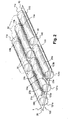
- the tray 1 comprises a body, of preferably thermoplastic, formed of two parts 10 and 20 connected together by an articulation zone 40, allowing them to pivot one relative to the other around an X axis.
- the tray can be obtained by thermoforming or by wall injection thin from a single piece of a thermoplastic material chosen from materials such as polyvinyl chlorides, polypropylenes, polyethylenes, polystyrenes, or a complex of type materials polypropylene / ethylene-vinyl alcohol (EVOH) / polypropylene, polyethylene / polyethylene terephthalate, or polystyrene / EVOH / polyethylene.
- a thermoplastic material chosen from materials such as polyvinyl chlorides, polypropylenes, polyethylenes, polystyrenes, or a complex of type materials polypropylene / ethylene-vinyl alcohol (EVOH) / polypropylene, polyethylene / polyethylene terephthalate, or polystyrene / EVOH / polyethylene.
- a thermoplastic material chosen from materials such as polyvinyl chlorides, polypropylenes, polyethylenes, polystyrenes, or a complex of type materials polyprop
- the first part 10 comprises three compartments 11a, 11b and 11c which each have the shape of a half-cylinder. These compartments each have an opening which extends in a plane P 1 , and are interconnected by a flange 12 also extending in the plane P 1 .
- the second part 20 also includes three compartments 21a, 21b and 21c which also each have the shape of a half-cylinder.
- the compartments 21 a to 21c and 11a to 11c are respectively symmetrical with respect to the axis X.
- the compartments 21a to 21c each have an opening extending in a plane P 2 , and are interconnected by a flange 22 s' also extending in the plane P 2 .
- Two recesses 13a and 13b are formed on the rim 12 of the first part 10, on either side of the central compartment 11b.
- the recesses 13a and 13b have by example a circular section.
- a first hollow 13a is formed at a first distance from the X axis and a second hollow 13b is formed at one second distance from the X axis so that they are not aligned along an axis parallel to the X axis.
- Two lugs 23a and 23b are formed on the rim 22 of the second part 20, on either side of the central compartment 21b, each lug being intended to cooperate with each recess 13a and 13b to form a fastening system.
- the lug 23a is formed at the same distance from the axis X as the hollow 13a and the lug 23b is formed at the same distance from the axis X as the hollow 13b so that they are symmetrical with respect to the 'axis X.
- the pins have a square section and they are intended to be housed over their entire height, in one of the recesses.
- the circle circumscribed to the cross section of the lug is substantially the same radius as the section of the recess, see substantially greater so that the lug fits into the recess tightly.
- the pins 23a and 23b extend on one side of the plane P 2 .
- Two recesses 24a and 24b are formed on the rim of the second part 20, on the other side of the plane P 2 relative to the pins.
- a first recess 24a is aligned with the lug 23b along an axis parallel to the axis X and with the lug 23a along an axis perpendicular to the axis X.
- the second recess 24b is aligned with the lug 23a along an axis parallel to the X axis and with the lug 23b along an axis perpendicular to the X axis.
- Each recess has a section large enough to be able to receive a lug from another device in a non-clamping manner.
- the recesses are in the form of a groove, but it is obvious that any other hollow shape can be used to loosely receive the lugs, by choosing a hollow shape with a cross section greater than the cross section of the lugs.
- Such a container makes it possible to package, for example, a shaped stick cylindrical of revolution intended to contain a deodorant product. It is obvious that the shape of each compartment will depend on the shape of the item to condition.
- the tray is used as follows. First of all, six empty sticks of product are placed in the six compartments of a first packaging container 1. The container 1 is in a first position, namely completely open, the planes P 1 and P 2 then being combined. A second tray 100, identical to the first is positioned opposite the latter, so that the edges 112 and 122 of the second tray 100 are in contact with the edges 12 and 22 of the first tray 1, the six compartments of the second tray 100 then being respectively opposite the six compartments of the first tray 1 so as to form two by two a closed housing for the sticks.
- the housings are configured so as to perfectly match the shape of the sticks and thus wedge them to avoid they do not move during transport. They are thus perfectly protected for their transport.
- the pins 23a and 23b of the first tray 1 are housed in the recesses 124b and 124a of the second tray 100 and the pins 123a and 123b of the second tray 100 are housed in the recesses 24b and 24a of the first tray 1.
- the sticks can then be filled with product by any method of known filling.
- the sticks contain product, they are re-conditioned to be transported to their point of sale.
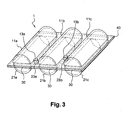
- the second part is rotated relative to the first part around the X axis so as to enclose the sticks in a housing closed as shown in Figure 3.
- the sticks are here again perfectly maintained because the compartments follow their shape and thus wedging them to prevent them from moving during transport.
- the pins 23a (123a) and 23b (123b) are tightly inserted in the cavities 13a (113a) and 13b (113b) so that each tray is perfectly maintained in this position.
- the trays can then be inserted into the cardboard boxes to be delivered to their point of sale.
- the trays are for example superimposed in a cardboard box being perfectly aligned the on top of each other.
Landscapes
- Engineering & Computer Science (AREA)
- Mechanical Engineering (AREA)
- Packages (AREA)
- Control And Other Processes For Unpacking Of Materials (AREA)
- Containers Having Bodies Formed In One Piece (AREA)
- Stackable Containers (AREA)
- Packaging Frangible Articles (AREA)
- Packaging Of Annular Or Rod-Shaped Articles, Wearing Apparel, Cassettes, Or The Like (AREA)
Abstract
Description
l'une des deux parties étant munie d'au moins deux moyens d'accrochage aptes à coopérer avec deux moyens d'accrochage complémentaires formés sur l'autre des deux parties de façon à maintenir les deux parties dans une première position dans laquelle le compartiment formé par la première partie délimite avec la seconde partie un logement fermé apte à recevoir un article ;
l'une des deux parties étant en outre munie d'au moins deux renfoncements configurés pour, dans une seconde position des deux parties, recevoir les moyens d'accrochage d'une deuxième barquette identique positionnée en regard de la première.
- fournir au moins deux articles, exempts de produit, dans un conditionnement formé par deux barquettes conformes à l'une quelconque des revendications précédentes, disposées en regard l'une de l'autre, chaque article étant logé à l'intérieur d'un logement fermé délimité par un compartiment de l'une des deux barquettes et par l'autre des deux barquettes,
- séparer les deux barquettes et retirer les articles ;
- remplir les articles de produit,
- placer un article rempli de produit dans un compartiment d'une des deux barquettes et l'autre article rempli de produit dans un compartiment de l'autre des deux barquettes ;
- faire pivoter les deux parties de chaque barquette dans leur première position afin que chaque barquette délimite un logement fermé contenant un article.
- la figure 1 illustre une vue en perspective d'une barquette selon l'invention ;
- la figure 2 représente la barquette de la figure 1 dans une première position de conditionnement ; et
- la figure 3 représente la barquette de la figure 1 dans une seconde position de conditionnement.
Claims (15)
- Barquette (1) destinée au conditionnement d'au moins un article (30), la barquette comportant deux parties (10 ; 20) reliées entre elles par une zone d'articulation (40) leur permettant de pivoter l'une par rapport à l'autre autour d'un axe X, une première partie (10) formant au moins un compartiment ouvert (11) ;
l'une des deux parties (10 ; 20) étant munie d'au moins deux moyens d'accrochage (23a ; 23b) aptes à coopérer avec deux moyens d'accrochage complémentaires (13a ; 13b) formés sur l'autre des deux parties de façon à maintenir les deux parties dans une première position dans laquelle le compartiment (11) formé par la première partie (10) délimite avec la seconde partie (20) un logement fermé apte à recevoir un article (30) ;
l'une des deux parties (10 ; 20) étant en outre munie d'au moins deux renfoncements (24a ; 24b) configurés pour, dans une seconde position des deux parties, recevoir les moyens d'accrochage (23b ; 23a) d'une deuxième barquette (100) identique positionnée en regard de la première. - Barquette selon la revendication 1, caractérisée en ce que les renfoncements (24a ; 24b) sont formés sur la même partie que les moyens d'accrochage (23a ; 23b), chaque moyen d'accrochage (23a ; 23b) étant aligné respectivement avec un renfoncement (24a ; 24b) selon un axe parallèle à l'axe X.
- Barquette selon l'une quelconque des revendications précédentes, caractérisée en ce que les moyens d'accrochage (23a ; 23b) sont sous forme d'ergot et les moyens d'accrochage complémentaires (13a ; 13b) sont sous forme de cavité configurée pour recevoir de façon serrante un ergot (23a, 23b).
- Barquette selon la revendication précédente, caractérisée en ce que les cavités ont une section circulaire.
- Barquette selon l'une quelconque des revendications 3 ou 4, caractérisée en ce que les ergots ont une section carrée.
- Barquette selon l'une quelconque des revendications précédentes, caractérisée en ce que les renfoncements (24a ; 24b) sont configurés pour recevoir de façon non-serrante les moyens d'accrochage (23b ; 23a) d'une deuxième barquette identique positionnée en regard de la première.
- Barquette selon l'une quelconque des revendications précédentes, caractérisée en ce que la seconde partie (20) forme au moins un compartiment ouvert (21), symétrique par rapport à l'axe X au compartiment (11) formé par la première partie, le compartiment (21) étant destiné, dans la première position, à délimiter avec le compartiment (11) de la première partie (10) le logement fermé pour l'article (30).
- Barquette selon la revendication précédente, caractérisée en ce que chaque compartiment (11 ; 21) a la forme d'un demi-cylindre.
- Barquette selon l'une quelconque des revendications précédentes, caractérisée en ce qu'elle est obtenue de moulage d'un matériau thermoplastique à partir d'une seule pièce.
- Barquette selon la revendication précédente, caractérisée en ce qu'elle est réalisée par thermoformage ou injection à parois minces.
- Barquette selon l'une quelconque des revendications précédentes, caractérisée en ce qu'elle est réalisée en un matériau thermoplastique choisi parmi les chlorures de polyvinyle, les polypropylènes, les polyéthylènes, les polystyrènes, ou d'un complexe de matériaux de type polypropylène/éthylène-vinyl alcool (EVOH)/polypropylène, polyéthylène/polyéthylène téréphtalate, ou polystyrène/EVOH/polyéthylène.
- Procédé de conditionnement d'articles destinés à contenir un produit, le procédé comprenant les étapes de :fournir au moins deux articles (30), exempts de produit, dans un conditionnement formé par deux barquettes (1 ; 100) conformes à l'une quelconque des revendications précédentes, disposées en regard l'une de l'autre, chaque article étant logé à l'intérieur d'un logement fermé délimité par un compartiment de l'une des deux barquettes et par l'autre des deux barquettes,séparer les deux barquettes et retirer les articles ;remplir les articles de produit,placer un article rempli de produit dans un compartiment d'une des deux barquettes et l'autre article rempli de produit dans un compartiment de l'autre des deux barquettes ;faire pivoter les deux parties de chaque barquette dans leur première position afin que chaque barquette délimite un logement fermé contenant un article.
- Procédé selon la revendication précédente, caractérisé en ce que l'article est sous forme de stick.
- Procédé selon l'une quelconque des revendications 12 ou 13, caractérisé en ce que le produit est un produit cosmétique.
- Procédé selon la revendication précédente, caractérisé en ce que le produit est un déodorant ou un anti-transpirant.
Applications Claiming Priority (2)
| Application Number | Priority Date | Filing Date | Title |
|---|---|---|---|
| FR0216386 | 2002-12-20 | ||
| FR0216386A FR2848987B1 (fr) | 2002-12-20 | 2002-12-20 | Barquette pour le conditionnement d'un article |
Publications (2)
| Publication Number | Publication Date |
|---|---|
| EP1431208A1 true EP1431208A1 (fr) | 2004-06-23 |
| EP1431208B1 EP1431208B1 (fr) | 2007-08-01 |
Family
ID=32338996
Family Applications (1)
| Application Number | Title | Priority Date | Filing Date |
|---|---|---|---|
| EP03292884A Expired - Lifetime EP1431208B1 (fr) | 2002-12-20 | 2003-11-20 | Barquette pour le conditionnement d'un article |
Country Status (5)
| Country | Link |
|---|---|
| EP (1) | EP1431208B1 (fr) |
| AT (1) | ATE368625T1 (fr) |
| DE (1) | DE60315244T2 (fr) |
| ES (1) | ES2290414T3 (fr) |
| FR (1) | FR2848987B1 (fr) |
Cited By (1)
| Publication number | Priority date | Publication date | Assignee | Title |
|---|---|---|---|---|
| WO2009000678A1 (fr) * | 2007-06-26 | 2008-12-31 | British American Tobacco Japan, Ltd. | Emballage blister pour articles de cigarettes |
Citations (2)
| Publication number | Priority date | Publication date | Assignee | Title |
|---|---|---|---|---|
| DE2557540A1 (de) * | 1975-12-19 | 1977-06-30 | Schneider Max | Transportbehaelter |
| EP0158429A1 (fr) * | 1984-03-01 | 1985-10-16 | Peter Leonard Smith | Emballage |
-
2002
- 2002-12-20 FR FR0216386A patent/FR2848987B1/fr not_active Expired - Fee Related
-
2003
- 2003-11-20 ES ES03292884T patent/ES2290414T3/es not_active Expired - Lifetime
- 2003-11-20 AT AT03292884T patent/ATE368625T1/de not_active IP Right Cessation
- 2003-11-20 DE DE60315244T patent/DE60315244T2/de not_active Expired - Lifetime
- 2003-11-20 EP EP03292884A patent/EP1431208B1/fr not_active Expired - Lifetime
Patent Citations (2)
| Publication number | Priority date | Publication date | Assignee | Title |
|---|---|---|---|---|
| DE2557540A1 (de) * | 1975-12-19 | 1977-06-30 | Schneider Max | Transportbehaelter |
| EP0158429A1 (fr) * | 1984-03-01 | 1985-10-16 | Peter Leonard Smith | Emballage |
Cited By (1)
| Publication number | Priority date | Publication date | Assignee | Title |
|---|---|---|---|---|
| WO2009000678A1 (fr) * | 2007-06-26 | 2008-12-31 | British American Tobacco Japan, Ltd. | Emballage blister pour articles de cigarettes |
Also Published As
| Publication number | Publication date |
|---|---|
| ATE368625T1 (de) | 2007-08-15 |
| EP1431208B1 (fr) | 2007-08-01 |
| FR2848987B1 (fr) | 2005-02-04 |
| DE60315244T2 (de) | 2008-04-17 |
| ES2290414T3 (es) | 2008-02-16 |
| FR2848987A1 (fr) | 2004-06-25 |
| DE60315244D1 (de) | 2007-09-13 |
Similar Documents
| Publication | Publication Date | Title |
|---|---|---|
| EP2155567B1 (fr) | Boite d'emballage pour flacons et decoupes correspondantes | |
| EP1188684B1 (fr) | Elément de recharge en substance alimentaire et dispositif destiné à recevoir un tel élément | |
| EP1990291A1 (fr) | Conteneur tubulaire clos comportant un dispositif de compensation pour le conditionnement de comprimés | |
| EP2989023B1 (fr) | Dispositif avec supports réutilisables pour l'emballage d'articles plats et emballage correspondant | |
| EP0288347A1 (fr) | Conditionnement pour lessives liquides et procédé pour son utilisation | |
| EP1431208B1 (fr) | Barquette pour le conditionnement d'un article | |
| FR3017374A1 (fr) | Barquette a opercule refermable | |
| FR2640239A1 (fr) | Conditionnement pour articles fragiles | |
| FR2785591A1 (fr) | Dispositif d'emballage compartimente | |
| WO2016083710A1 (fr) | Systeme de caisse de transport thermiquement isolante livrable en kit | |
| EP1512634A1 (fr) | Procédé de fabrication d'un emballage à partir d'un film en matière plastique et étirable | |
| FR2596736A1 (fr) | Emballage, notamment pour montre | |
| EP0580516B1 (fr) | Procédé de conditionnement et conditionnement correspondant | |
| FR2741607A1 (fr) | Dispositif de conditionnement d'au moins deux elements, tout particulierement d'etuis de mouchoirs en papier | |
| CH487043A (fr) | Emballage pour articles susceptibles de s'oxyder au contact de l'air | |
| EP1795451B1 (fr) | Conditionnement de produits, notamment alimentaires | |
| BE1003769A3 (fr) | Boite en carton comportant une poignee. | |
| EP4337557B1 (fr) | Colis a volume de stockage adaptable a un contenu | |
| FR2599715A1 (fr) | Emballage modulable pour la presentation d'objets | |
| FR2975977A1 (fr) | Ensemble d'emballage pour l'emballage d'une dose d'un produit a l'etat fluide et dose de produit a l'etat fluide ainsi emballe. | |
| EP4175892A1 (fr) | Dispositif de conditionnement pour former un pack | |
| FR2470735A1 (fr) | Paquet constitue par un accumulateur electrique a electrolyte liquide et par une boite d'emballage en carton et flan destine a la confection de cette boite | |
| EP0541762A1 (fr) | Emballage du type comprenant une poche interne souple et une enveloppe externe rigide et son procede de fabrication | |
| FR2666075A1 (fr) | Receptacle pour le conditionnement d'huitres. | |
| FR2496599A1 (fr) | Emballage fractionnable |
Legal Events
| Date | Code | Title | Description |
|---|---|---|---|
| PUAI | Public reference made under article 153(3) epc to a published international application that has entered the european phase |
Free format text: ORIGINAL CODE: 0009012 |
|
| AK | Designated contracting states |
Kind code of ref document: A1 Designated state(s): AT BE BG CH CY CZ DE DK EE ES FI FR GB GR HU IE IT LI LU MC NL PT RO SE SI SK TR |
|
| AX | Request for extension of the european patent |
Extension state: AL LT LV MK |
|
| 17P | Request for examination filed |
Effective date: 20041223 |
|
| AKX | Designation fees paid |
Designated state(s): AT BE BG CH CY CZ DE DK EE ES FI FR GB GR HU IE IT LI LU MC NL PT RO SE SI SK TR |
|
| GRAP | Despatch of communication of intention to grant a patent |
Free format text: ORIGINAL CODE: EPIDOSNIGR1 |
|
| GRAS | Grant fee paid |
Free format text: ORIGINAL CODE: EPIDOSNIGR3 |
|
| GRAA | (expected) grant |
Free format text: ORIGINAL CODE: 0009210 |
|
| AK | Designated contracting states |
Kind code of ref document: B1 Designated state(s): AT BE BG CH CY CZ DE DK EE ES FI FR GB GR HU IE IT LI LU MC NL PT RO SE SI SK TR |
|
| REG | Reference to a national code |
Ref country code: GB Ref legal event code: FG4D Free format text: NOT ENGLISH |
|
| REG | Reference to a national code |
Ref country code: CH Ref legal event code: EP |
|
| REG | Reference to a national code |
Ref country code: IE Ref legal event code: FG4D Free format text: LANGUAGE OF EP DOCUMENT: FRENCH |
|
| REF | Corresponds to: |
Ref document number: 60315244 Country of ref document: DE Date of ref document: 20070913 Kind code of ref document: P |
|
| GBT | Gb: translation of ep patent filed (gb section 77(6)(a)/1977) |
Effective date: 20071015 |
|
| PG25 | Lapsed in a contracting state [announced via postgrant information from national office to epo] |
Ref country code: NL Free format text: LAPSE BECAUSE OF FAILURE TO SUBMIT A TRANSLATION OF THE DESCRIPTION OR TO PAY THE FEE WITHIN THE PRESCRIBED TIME-LIMIT Effective date: 20070801 Ref country code: BG Free format text: LAPSE BECAUSE OF FAILURE TO SUBMIT A TRANSLATION OF THE DESCRIPTION OR TO PAY THE FEE WITHIN THE PRESCRIBED TIME-LIMIT Effective date: 20071101 Ref country code: FI Free format text: LAPSE BECAUSE OF FAILURE TO SUBMIT A TRANSLATION OF THE DESCRIPTION OR TO PAY THE FEE WITHIN THE PRESCRIBED TIME-LIMIT Effective date: 20070801 |
|
| NLV1 | Nl: lapsed or annulled due to failure to fulfill the requirements of art. 29p and 29m of the patents act | ||
| REG | Reference to a national code |
Ref country code: ES Ref legal event code: FG2A Ref document number: 2290414 Country of ref document: ES Kind code of ref document: T3 |
|
| PG25 | Lapsed in a contracting state [announced via postgrant information from national office to epo] |
Ref country code: AT Free format text: LAPSE BECAUSE OF FAILURE TO SUBMIT A TRANSLATION OF THE DESCRIPTION OR TO PAY THE FEE WITHIN THE PRESCRIBED TIME-LIMIT Effective date: 20070801 |
|
| REG | Reference to a national code |
Ref country code: IE Ref legal event code: FD4D |
|
| PG25 | Lapsed in a contracting state [announced via postgrant information from national office to epo] |
Ref country code: DK Free format text: LAPSE BECAUSE OF FAILURE TO SUBMIT A TRANSLATION OF THE DESCRIPTION OR TO PAY THE FEE WITHIN THE PRESCRIBED TIME-LIMIT Effective date: 20070801 Ref country code: GR Free format text: LAPSE BECAUSE OF FAILURE TO SUBMIT A TRANSLATION OF THE DESCRIPTION OR TO PAY THE FEE WITHIN THE PRESCRIBED TIME-LIMIT Effective date: 20071102 |
|
| PG25 | Lapsed in a contracting state [announced via postgrant information from national office to epo] |
Ref country code: SK Free format text: LAPSE BECAUSE OF FAILURE TO SUBMIT A TRANSLATION OF THE DESCRIPTION OR TO PAY THE FEE WITHIN THE PRESCRIBED TIME-LIMIT Effective date: 20070801 Ref country code: CZ Free format text: LAPSE BECAUSE OF FAILURE TO SUBMIT A TRANSLATION OF THE DESCRIPTION OR TO PAY THE FEE WITHIN THE PRESCRIBED TIME-LIMIT Effective date: 20070801 Ref country code: IE Free format text: LAPSE BECAUSE OF FAILURE TO SUBMIT A TRANSLATION OF THE DESCRIPTION OR TO PAY THE FEE WITHIN THE PRESCRIBED TIME-LIMIT Effective date: 20070801 Ref country code: PT Free format text: LAPSE BECAUSE OF FAILURE TO SUBMIT A TRANSLATION OF THE DESCRIPTION OR TO PAY THE FEE WITHIN THE PRESCRIBED TIME-LIMIT Effective date: 20080102 |
|
| BERE | Be: lapsed |
Owner name: L'OREAL Effective date: 20071130 |
|
| PLBE | No opposition filed within time limit |
Free format text: ORIGINAL CODE: 0009261 |
|
| STAA | Information on the status of an ep patent application or granted ep patent |
Free format text: STATUS: NO OPPOSITION FILED WITHIN TIME LIMIT |
|
| PG25 | Lapsed in a contracting state [announced via postgrant information from national office to epo] |
Ref country code: SE Free format text: LAPSE BECAUSE OF FAILURE TO SUBMIT A TRANSLATION OF THE DESCRIPTION OR TO PAY THE FEE WITHIN THE PRESCRIBED TIME-LIMIT Effective date: 20071101 Ref country code: MC Free format text: LAPSE BECAUSE OF NON-PAYMENT OF DUE FEES Effective date: 20071130 Ref country code: RO Free format text: LAPSE BECAUSE OF FAILURE TO SUBMIT A TRANSLATION OF THE DESCRIPTION OR TO PAY THE FEE WITHIN THE PRESCRIBED TIME-LIMIT Effective date: 20070801 |
|
| 26N | No opposition filed |
Effective date: 20080506 |
|
| PG25 | Lapsed in a contracting state [announced via postgrant information from national office to epo] |
Ref country code: LI Free format text: LAPSE BECAUSE OF NON-PAYMENT OF DUE FEES Effective date: 20071130 Ref country code: CH Free format text: LAPSE BECAUSE OF NON-PAYMENT OF DUE FEES Effective date: 20071130 |
|
| REG | Reference to a national code |
Ref country code: CH Ref legal event code: PL |
|
| PG25 | Lapsed in a contracting state [announced via postgrant information from national office to epo] |
Ref country code: BE Free format text: LAPSE BECAUSE OF NON-PAYMENT OF DUE FEES Effective date: 20071130 |
|
| PG25 | Lapsed in a contracting state [announced via postgrant information from national office to epo] |
Ref country code: EE Free format text: LAPSE BECAUSE OF FAILURE TO SUBMIT A TRANSLATION OF THE DESCRIPTION OR TO PAY THE FEE WITHIN THE PRESCRIBED TIME-LIMIT Effective date: 20070801 |
|
| PG25 | Lapsed in a contracting state [announced via postgrant information from national office to epo] |
Ref country code: SI Free format text: LAPSE BECAUSE OF FAILURE TO SUBMIT A TRANSLATION OF THE DESCRIPTION OR TO PAY THE FEE WITHIN THE PRESCRIBED TIME-LIMIT Effective date: 20070801 |
|
| PG25 | Lapsed in a contracting state [announced via postgrant information from national office to epo] |
Ref country code: CY Free format text: LAPSE BECAUSE OF FAILURE TO SUBMIT A TRANSLATION OF THE DESCRIPTION OR TO PAY THE FEE WITHIN THE PRESCRIBED TIME-LIMIT Effective date: 20070801 |
|
| PG25 | Lapsed in a contracting state [announced via postgrant information from national office to epo] |
Ref country code: LU Free format text: LAPSE BECAUSE OF NON-PAYMENT OF DUE FEES Effective date: 20071120 |
|
| PG25 | Lapsed in a contracting state [announced via postgrant information from national office to epo] |
Ref country code: TR Free format text: LAPSE BECAUSE OF FAILURE TO SUBMIT A TRANSLATION OF THE DESCRIPTION OR TO PAY THE FEE WITHIN THE PRESCRIBED TIME-LIMIT Effective date: 20070801 Ref country code: HU Free format text: LAPSE BECAUSE OF FAILURE TO SUBMIT A TRANSLATION OF THE DESCRIPTION OR TO PAY THE FEE WITHIN THE PRESCRIBED TIME-LIMIT Effective date: 20080202 |
|
| PGFP | Annual fee paid to national office [announced via postgrant information from national office to epo] |
Ref country code: DE Payment date: 20101117 Year of fee payment: 8 |
|
| PGFP | Annual fee paid to national office [announced via postgrant information from national office to epo] |
Ref country code: GB Payment date: 20101117 Year of fee payment: 8 Ref country code: IT Payment date: 20101113 Year of fee payment: 8 |
|
| PGFP | Annual fee paid to national office [announced via postgrant information from national office to epo] |
Ref country code: ES Payment date: 20111216 Year of fee payment: 9 Ref country code: FR Payment date: 20111118 Year of fee payment: 9 |
|
| GBPC | Gb: european patent ceased through non-payment of renewal fee |
Effective date: 20121120 |
|
| REG | Reference to a national code |
Ref country code: FR Ref legal event code: ST Effective date: 20130731 |
|
| PG25 | Lapsed in a contracting state [announced via postgrant information from national office to epo] |
Ref country code: IT Free format text: LAPSE BECAUSE OF NON-PAYMENT OF DUE FEES Effective date: 20121120 |
|
| REG | Reference to a national code |
Ref country code: DE Ref legal event code: R119 Ref document number: 60315244 Country of ref document: DE Effective date: 20130601 |
|
| PG25 | Lapsed in a contracting state [announced via postgrant information from national office to epo] |
Ref country code: DE Free format text: LAPSE BECAUSE OF NON-PAYMENT OF DUE FEES Effective date: 20130601 |
|
| PG25 | Lapsed in a contracting state [announced via postgrant information from national office to epo] |
Ref country code: GB Free format text: LAPSE BECAUSE OF NON-PAYMENT OF DUE FEES Effective date: 20121120 Ref country code: FR Free format text: LAPSE BECAUSE OF NON-PAYMENT OF DUE FEES Effective date: 20121130 |
|
| REG | Reference to a national code |
Ref country code: ES Ref legal event code: FD2A Effective date: 20140305 |
|
| PG25 | Lapsed in a contracting state [announced via postgrant information from national office to epo] |
Ref country code: ES Free format text: LAPSE BECAUSE OF NON-PAYMENT OF DUE FEES Effective date: 20121121 |