EP1430154B1 - Enzymamplifiziertes redox-mikroarray-nachweisverfahren - Google Patents
Enzymamplifiziertes redox-mikroarray-nachweisverfahren Download PDFInfo
- Publication number
- EP1430154B1 EP1430154B1 EP02775762.4A EP02775762A EP1430154B1 EP 1430154 B1 EP1430154 B1 EP 1430154B1 EP 02775762 A EP02775762 A EP 02775762A EP 1430154 B1 EP1430154 B1 EP 1430154B1
- Authority
- EP
- European Patent Office
- Prior art keywords
- molecules
- capture
- electrodes
- oxidation
- array
- Prior art date
- Legal status (The legal status is an assumption and is not a legal conclusion. Google has not performed a legal analysis and makes no representation as to the accuracy of the status listed.)
- Expired - Lifetime
Links
- 238000002493 microarray Methods 0.000 title claims description 50
- 238000000034 method Methods 0.000 title claims description 49
- 230000008569 process Effects 0.000 title claims description 23
- 238000001514 detection method Methods 0.000 title description 35
- 108091034117 Oligonucleotide Proteins 0.000 claims description 38
- 238000006243 chemical reaction Methods 0.000 claims description 37
- 229940088598 enzyme Drugs 0.000 claims description 37
- 102000004190 Enzymes Human genes 0.000 claims description 35
- 108090000790 Enzymes Proteins 0.000 claims description 35
- YBJHBAHKTGYVGT-ZKWXMUAHSA-N (+)-Biotin Chemical compound N1C(=O)N[C@@H]2[C@H](CCCCC(=O)O)SC[C@@H]21 YBJHBAHKTGYVGT-ZKWXMUAHSA-N 0.000 claims description 31
- 239000000523 sample Substances 0.000 claims description 31
- 238000007254 oxidation reaction Methods 0.000 claims description 29
- 230000003647 oxidation Effects 0.000 claims description 27
- 108010001336 Horseradish Peroxidase Proteins 0.000 claims description 26
- 230000009467 reduction Effects 0.000 claims description 26
- 230000027455 binding Effects 0.000 claims description 25
- 102000005936 beta-Galactosidase Human genes 0.000 claims description 22
- 108010005774 beta-Galactosidase Proteins 0.000 claims description 22
- 239000000758 substrate Substances 0.000 claims description 21
- 229960002685 biotin Drugs 0.000 claims description 20
- 239000011616 biotin Substances 0.000 claims description 20
- 238000011065 in-situ storage Methods 0.000 claims description 20
- JLCPHMBAVCMARE-UHFFFAOYSA-N [3-[[3-[[3-[[3-[[3-[[3-[[3-[[3-[[3-[[3-[[3-[[5-(2-amino-6-oxo-1H-purin-9-yl)-3-[[3-[[3-[[3-[[3-[[3-[[5-(2-amino-6-oxo-1H-purin-9-yl)-3-[[5-(2-amino-6-oxo-1H-purin-9-yl)-3-hydroxyoxolan-2-yl]methoxy-hydroxyphosphoryl]oxyoxolan-2-yl]methoxy-hydroxyphosphoryl]oxy-5-(5-methyl-2,4-dioxopyrimidin-1-yl)oxolan-2-yl]methoxy-hydroxyphosphoryl]oxy-5-(6-aminopurin-9-yl)oxolan-2-yl]methoxy-hydroxyphosphoryl]oxy-5-(6-aminopurin-9-yl)oxolan-2-yl]methoxy-hydroxyphosphoryl]oxy-5-(6-aminopurin-9-yl)oxolan-2-yl]methoxy-hydroxyphosphoryl]oxy-5-(6-aminopurin-9-yl)oxolan-2-yl]methoxy-hydroxyphosphoryl]oxyoxolan-2-yl]methoxy-hydroxyphosphoryl]oxy-5-(5-methyl-2,4-dioxopyrimidin-1-yl)oxolan-2-yl]methoxy-hydroxyphosphoryl]oxy-5-(4-amino-2-oxopyrimidin-1-yl)oxolan-2-yl]methoxy-hydroxyphosphoryl]oxy-5-(5-methyl-2,4-dioxopyrimidin-1-yl)oxolan-2-yl]methoxy-hydroxyphosphoryl]oxy-5-(5-methyl-2,4-dioxopyrimidin-1-yl)oxolan-2-yl]methoxy-hydroxyphosphoryl]oxy-5-(6-aminopurin-9-yl)oxolan-2-yl]methoxy-hydroxyphosphoryl]oxy-5-(6-aminopurin-9-yl)oxolan-2-yl]methoxy-hydroxyphosphoryl]oxy-5-(4-amino-2-oxopyrimidin-1-yl)oxolan-2-yl]methoxy-hydroxyphosphoryl]oxy-5-(4-amino-2-oxopyrimidin-1-yl)oxolan-2-yl]methoxy-hydroxyphosphoryl]oxy-5-(4-amino-2-oxopyrimidin-1-yl)oxolan-2-yl]methoxy-hydroxyphosphoryl]oxy-5-(6-aminopurin-9-yl)oxolan-2-yl]methoxy-hydroxyphosphoryl]oxy-5-(4-amino-2-oxopyrimidin-1-yl)oxolan-2-yl]methyl [5-(6-aminopurin-9-yl)-2-(hydroxymethyl)oxolan-3-yl] hydrogen phosphate Polymers Cc1cn(C2CC(OP(O)(=O)OCC3OC(CC3OP(O)(=O)OCC3OC(CC3O)n3cnc4c3nc(N)[nH]c4=O)n3cnc4c3nc(N)[nH]c4=O)C(COP(O)(=O)OC3CC(OC3COP(O)(=O)OC3CC(OC3COP(O)(=O)OC3CC(OC3COP(O)(=O)OC3CC(OC3COP(O)(=O)OC3CC(OC3COP(O)(=O)OC3CC(OC3COP(O)(=O)OC3CC(OC3COP(O)(=O)OC3CC(OC3COP(O)(=O)OC3CC(OC3COP(O)(=O)OC3CC(OC3COP(O)(=O)OC3CC(OC3COP(O)(=O)OC3CC(OC3COP(O)(=O)OC3CC(OC3COP(O)(=O)OC3CC(OC3COP(O)(=O)OC3CC(OC3COP(O)(=O)OC3CC(OC3COP(O)(=O)OC3CC(OC3CO)n3cnc4c(N)ncnc34)n3ccc(N)nc3=O)n3cnc4c(N)ncnc34)n3ccc(N)nc3=O)n3ccc(N)nc3=O)n3ccc(N)nc3=O)n3cnc4c(N)ncnc34)n3cnc4c(N)ncnc34)n3cc(C)c(=O)[nH]c3=O)n3cc(C)c(=O)[nH]c3=O)n3ccc(N)nc3=O)n3cc(C)c(=O)[nH]c3=O)n3cnc4c3nc(N)[nH]c4=O)n3cnc4c(N)ncnc34)n3cnc4c(N)ncnc34)n3cnc4c(N)ncnc34)n3cnc4c(N)ncnc34)O2)c(=O)[nH]c1=O JLCPHMBAVCMARE-UHFFFAOYSA-N 0.000 claims description 18
- 235000020958 biotin Nutrition 0.000 claims description 16
- 238000003786 synthesis reaction Methods 0.000 claims description 15
- 108010015776 Glucose oxidase Proteins 0.000 claims description 14
- 239000004366 Glucose oxidase Substances 0.000 claims description 14
- 230000015572 biosynthetic process Effects 0.000 claims description 14
- 229940116332 glucose oxidase Drugs 0.000 claims description 14
- 235000019420 glucose oxidase Nutrition 0.000 claims description 14
- 229920001184 polypeptide Polymers 0.000 claims description 13
- 102000004196 processed proteins & peptides Human genes 0.000 claims description 13
- 108090000765 processed proteins & peptides Proteins 0.000 claims description 13
- 239000003153 chemical reaction reagent Substances 0.000 claims description 12
- 108020004414 DNA Proteins 0.000 claims description 11
- 239000012528 membrane Substances 0.000 claims description 11
- 239000011521 glass Substances 0.000 claims description 10
- 239000004372 Polyvinyl alcohol Substances 0.000 claims description 9
- 229920002451 polyvinyl alcohol Polymers 0.000 claims description 9
- 108010090804 Streptavidin Proteins 0.000 claims description 8
- 230000002255 enzymatic effect Effects 0.000 claims description 7
- 239000000463 material Substances 0.000 claims description 7
- 108090000623 proteins and genes Proteins 0.000 claims description 7
- 230000001413 cellular effect Effects 0.000 claims description 6
- 229920002689 polyvinyl acetate Polymers 0.000 claims description 6
- 239000011118 polyvinyl acetate Substances 0.000 claims description 6
- 102000004169 proteins and genes Human genes 0.000 claims description 6
- 102000053602 DNA Human genes 0.000 claims description 5
- 108010029541 Laccase Proteins 0.000 claims description 5
- 108020004682 Single-Stranded DNA Proteins 0.000 claims description 5
- 150000004676 glycans Chemical class 0.000 claims description 5
- 229920001282 polysaccharide Polymers 0.000 claims description 5
- 239000005017 polysaccharide Substances 0.000 claims description 5
- QTBSBXVTEAMEQO-UHFFFAOYSA-M Acetate Chemical compound CC([O-])=O QTBSBXVTEAMEQO-UHFFFAOYSA-M 0.000 claims description 4
- 229920000936 Agarose Polymers 0.000 claims description 4
- 108090001008 Avidin Proteins 0.000 claims description 4
- 229920002307 Dextran Polymers 0.000 claims description 4
- 239000004810 polytetrafluoroethylene Substances 0.000 claims description 4
- 229920001343 polytetrafluoroethylene Polymers 0.000 claims description 4
- 229920002635 polyurethane Polymers 0.000 claims description 4
- 239000004814 polyurethane Substances 0.000 claims description 4
- 229920005989 resin Polymers 0.000 claims description 4
- 239000011347 resin Substances 0.000 claims description 4
- 108091032973 (ribonucleotides)n+m Proteins 0.000 claims description 3
- 102000002260 Alkaline Phosphatase Human genes 0.000 claims description 3
- 108020004774 Alkaline Phosphatase Proteins 0.000 claims description 3
- 108020005199 Dehydrogenases Proteins 0.000 claims description 3
- 239000004593 Epoxy Substances 0.000 claims description 3
- 108020005196 Mitochondrial DNA Proteins 0.000 claims description 3
- 230000003302 anti-idiotype Effects 0.000 claims description 3
- 230000000890 antigenic effect Effects 0.000 claims description 3
- 150000001768 cations Chemical class 0.000 claims description 3
- 229910021645 metal ion Inorganic materials 0.000 claims description 3
- 239000000178 monomer Substances 0.000 claims description 3
- 229920000642 polymer Polymers 0.000 claims description 3
- 108020004418 ribosomal RNA Proteins 0.000 claims description 3
- -1 salt anions Chemical class 0.000 claims description 3
- 238000004458 analytical method Methods 0.000 claims description 2
- 238000006722 reduction reaction Methods 0.000 description 21
- YCIMNLLNPGFGHC-UHFFFAOYSA-N catechol Chemical compound OC1=CC=CC=C1O YCIMNLLNPGFGHC-UHFFFAOYSA-N 0.000 description 18
- AZQWKYJCGOJGHM-UHFFFAOYSA-N 1,4-benzoquinone Chemical compound O=C1C=CC(=O)C=C1 AZQWKYJCGOJGHM-UHFFFAOYSA-N 0.000 description 12
- 239000010410 layer Substances 0.000 description 12
- 102000012404 Orosomucoid Human genes 0.000 description 11
- 108010061952 Orosomucoid Proteins 0.000 description 11
- 101150105104 Kras gene Proteins 0.000 description 10
- 241000283973 Oryctolagus cuniculus Species 0.000 description 10
- 238000003018 immunoassay Methods 0.000 description 10
- OPIFSICVWOWJMJ-AEOCFKNESA-N 5-bromo-4-chloro-3-indolyl beta-D-galactoside Chemical compound O[C@@H]1[C@@H](O)[C@@H](O)[C@@H](CO)O[C@H]1OC1=CNC2=CC=C(Br)C(Cl)=C12 OPIFSICVWOWJMJ-AEOCFKNESA-N 0.000 description 9
- 239000011159 matrix material Substances 0.000 description 9
- 230000000295 complement effect Effects 0.000 description 8
- 239000002773 nucleotide Substances 0.000 description 8
- 238000009396 hybridization Methods 0.000 description 7
- 125000003729 nucleotide group Chemical group 0.000 description 7
- RXGJTUSBYWCRBK-UHFFFAOYSA-M 5-methylphenazinium methyl sulfate Chemical compound COS([O-])(=O)=O.C1=CC=C2[N+](C)=C(C=CC=C3)C3=NC2=C1 RXGJTUSBYWCRBK-UHFFFAOYSA-M 0.000 description 6
- 241000283707 Capra Species 0.000 description 6
- 238000000835 electrochemical detection Methods 0.000 description 6
- 108020004707 nucleic acids Proteins 0.000 description 6
- 102000039446 nucleic acids Human genes 0.000 description 6
- 150000007523 nucleic acids Chemical class 0.000 description 6
- BASFCYQUMIYNBI-UHFFFAOYSA-N platinum Substances [Pt] BASFCYQUMIYNBI-UHFFFAOYSA-N 0.000 description 6
- 238000000018 DNA microarray Methods 0.000 description 5
- MHAJPDPJQMAIIY-UHFFFAOYSA-N Hydrogen peroxide Chemical compound OO MHAJPDPJQMAIIY-UHFFFAOYSA-N 0.000 description 5
- 238000009792 diffusion process Methods 0.000 description 5
- 238000002474 experimental method Methods 0.000 description 5
- GNBHRKFJIUUOQI-UHFFFAOYSA-N fluorescein Chemical compound O1C(=O)C2=CC=CC=C2C21C1=CC=C(O)C=C1OC1=CC(O)=CC=C21 GNBHRKFJIUUOQI-UHFFFAOYSA-N 0.000 description 5
- 239000000047 product Substances 0.000 description 5
- 239000012491 analyte Substances 0.000 description 4
- 238000003556 assay Methods 0.000 description 4
- 239000007850 fluorescent dye Substances 0.000 description 4
- 238000007641 inkjet printing Methods 0.000 description 4
- 102000003992 Peroxidases Human genes 0.000 description 3
- 239000000427 antigen Substances 0.000 description 3
- 108091007433 antigens Proteins 0.000 description 3
- 102000036639 antigens Human genes 0.000 description 3
- 238000003491 array Methods 0.000 description 3
- 239000000872 buffer Substances 0.000 description 3
- 108040007629 peroxidase activity proteins Proteins 0.000 description 3
- 239000008363 phosphate buffer Substances 0.000 description 3
- 238000000206 photolithography Methods 0.000 description 3
- XFXPMWWXUTWYJX-UHFFFAOYSA-N Cyanide Chemical compound N#[C-] XFXPMWWXUTWYJX-UHFFFAOYSA-N 0.000 description 2
- COHYTHOBJLSHDF-UHFFFAOYSA-N Indigo Chemical compound N1C2=CC=CC=C2C(=O)C1=C1C(=O)C2=CC=CC=C2N1 COHYTHOBJLSHDF-UHFFFAOYSA-N 0.000 description 2
- 239000007832 Na2SO4 Substances 0.000 description 2
- 230000010718 Oxidation Activity Effects 0.000 description 2
- 230000010757 Reduction Activity Effects 0.000 description 2
- 108010039491 Ricin Proteins 0.000 description 2
- PMZURENOXWZQFD-UHFFFAOYSA-L Sodium Sulfate Chemical compound [Na+].[Na+].[O-]S([O-])(=O)=O PMZURENOXWZQFD-UHFFFAOYSA-L 0.000 description 2
- 239000012062 aqueous buffer Substances 0.000 description 2
- 238000002820 assay format Methods 0.000 description 2
- 230000000903 blocking effect Effects 0.000 description 2
- 125000004122 cyclic group Chemical group 0.000 description 2
- 239000000975 dye Substances 0.000 description 2
- 230000005518 electrochemistry Effects 0.000 description 2
- 238000006911 enzymatic reaction Methods 0.000 description 2
- 238000011534 incubation Methods 0.000 description 2
- 238000002372 labelling Methods 0.000 description 2
- 108020004999 messenger RNA Proteins 0.000 description 2
- 150000002978 peroxides Chemical class 0.000 description 2
- 229910052697 platinum Inorganic materials 0.000 description 2
- 230000004044 response Effects 0.000 description 2
- 239000004065 semiconductor Substances 0.000 description 2
- 229910052938 sodium sulfate Inorganic materials 0.000 description 2
- 230000007306 turnover Effects 0.000 description 2
- 238000003260 vortexing Methods 0.000 description 2
- XLYOFNOQVPJJNP-UHFFFAOYSA-N water Substances O XLYOFNOQVPJJNP-UHFFFAOYSA-N 0.000 description 2
- GEYOCULIXLDCMW-UHFFFAOYSA-N 1,2-phenylenediamine Chemical compound NC1=CC=CC=C1N GEYOCULIXLDCMW-UHFFFAOYSA-N 0.000 description 1
- CDAWCLOXVUBKRW-UHFFFAOYSA-N 2-aminophenol Chemical class NC1=CC=CC=C1O CDAWCLOXVUBKRW-UHFFFAOYSA-N 0.000 description 1
- WQZGKKKJIJFFOK-GASJEMHNSA-N Glucose Natural products OC[C@H]1OC(O)[C@H](O)[C@@H](O)[C@@H]1O WQZGKKKJIJFFOK-GASJEMHNSA-N 0.000 description 1
- 102000003886 Glycoproteins Human genes 0.000 description 1
- 108090000288 Glycoproteins Proteins 0.000 description 1
- 108091028043 Nucleic acid sequence Proteins 0.000 description 1
- 108010038807 Oligopeptides Proteins 0.000 description 1
- 102000015636 Oligopeptides Human genes 0.000 description 1
- XUIMIQQOPSSXEZ-UHFFFAOYSA-N Silicon Chemical compound [Si] XUIMIQQOPSSXEZ-UHFFFAOYSA-N 0.000 description 1
- 229910021607 Silver chloride Inorganic materials 0.000 description 1
- 230000002378 acidificating effect Effects 0.000 description 1
- 239000008346 aqueous phase Substances 0.000 description 1
- 125000003118 aryl group Chemical group 0.000 description 1
- WQZGKKKJIJFFOK-FPRJBGLDSA-N beta-D-galactose Chemical group OC[C@H]1O[C@@H](O)[C@H](O)[C@@H](O)[C@H]1O WQZGKKKJIJFFOK-FPRJBGLDSA-N 0.000 description 1
- 150000001615 biotins Chemical class 0.000 description 1
- 230000000740 bleeding effect Effects 0.000 description 1
- 230000003139 buffering effect Effects 0.000 description 1
- 238000011088 calibration curve Methods 0.000 description 1
- 230000021615 conjugation Effects 0.000 description 1
- 238000000151 deposition Methods 0.000 description 1
- 238000013461 design Methods 0.000 description 1
- 150000004985 diamines Chemical class 0.000 description 1
- 229920001971 elastomer Polymers 0.000 description 1
- 230000005684 electric field Effects 0.000 description 1
- 238000005516 engineering process Methods 0.000 description 1
- YAGKRVSRTSUGEY-UHFFFAOYSA-N ferricyanide Chemical compound [Fe+3].N#[C-].N#[C-].N#[C-].N#[C-].N#[C-].N#[C-] YAGKRVSRTSUGEY-UHFFFAOYSA-N 0.000 description 1
- 238000001917 fluorescence detection Methods 0.000 description 1
- 239000012634 fragment Substances 0.000 description 1
- 125000000524 functional group Chemical group 0.000 description 1
- 230000007274 generation of a signal involved in cell-cell signaling Effects 0.000 description 1
- 230000002068 genetic effect Effects 0.000 description 1
- 239000003365 glass fiber Substances 0.000 description 1
- 239000008103 glucose Substances 0.000 description 1
- 125000003147 glycosyl group Chemical group 0.000 description 1
- 238000003384 imaging method Methods 0.000 description 1
- 230000000984 immunochemical effect Effects 0.000 description 1
- 125000001041 indolyl group Chemical group 0.000 description 1
- 238000013383 initial experiment Methods 0.000 description 1
- 238000011835 investigation Methods 0.000 description 1
- 238000005259 measurement Methods 0.000 description 1
- 229910052751 metal Inorganic materials 0.000 description 1
- 239000002184 metal Substances 0.000 description 1
- 229910044991 metal oxide Inorganic materials 0.000 description 1
- 150000004706 metal oxides Chemical class 0.000 description 1
- 238000000386 microscopy Methods 0.000 description 1
- 230000009149 molecular binding Effects 0.000 description 1
- 230000007935 neutral effect Effects 0.000 description 1
- 238000002515 oligonucleotide synthesis Methods 0.000 description 1
- 229920001542 oligosaccharide Polymers 0.000 description 1
- 150000002482 oligosaccharides Chemical class 0.000 description 1
- 238000006395 oxidase reaction Methods 0.000 description 1
- 230000033116 oxidation-reduction process Effects 0.000 description 1
- 229920000768 polyamine Polymers 0.000 description 1
- 102000054765 polymorphisms of proteins Human genes 0.000 description 1
- 239000002244 precipitate Substances 0.000 description 1
- 125000006239 protecting group Chemical group 0.000 description 1
- 239000000376 reactant Substances 0.000 description 1
- 125000006853 reporter group Chemical group 0.000 description 1
- 230000035945 sensitivity Effects 0.000 description 1
- 229910052710 silicon Inorganic materials 0.000 description 1
- 239000010703 silicon Substances 0.000 description 1
- 229910052709 silver Inorganic materials 0.000 description 1
- 239000004332 silver Substances 0.000 description 1
- HKZLPVFGJNLROG-UHFFFAOYSA-M silver monochloride Chemical compound [Cl-].[Ag+] HKZLPVFGJNLROG-UHFFFAOYSA-M 0.000 description 1
- 239000002356 single layer Substances 0.000 description 1
- 239000007787 solid Substances 0.000 description 1
- 239000007790 solid phase Substances 0.000 description 1
- 239000000126 substance Substances 0.000 description 1
- 230000002194 synthesizing effect Effects 0.000 description 1
- MPLHNVLQVRSVEE-UHFFFAOYSA-N texas red Chemical compound [O-]S(=O)(=O)C1=CC(S(Cl)(=O)=O)=CC=C1C(C1=CC=2CCCN3CCCC(C=23)=C1O1)=C2C1=C(CCC1)C3=[N+]1CCCC3=C2 MPLHNVLQVRSVEE-UHFFFAOYSA-N 0.000 description 1
- 238000010200 validation analysis Methods 0.000 description 1
- 238000012800 visualization Methods 0.000 description 1
Images







Classifications
-
- C—CHEMISTRY; METALLURGY
- C12—BIOCHEMISTRY; BEER; SPIRITS; WINE; VINEGAR; MICROBIOLOGY; ENZYMOLOGY; MUTATION OR GENETIC ENGINEERING
- C12Q—MEASURING OR TESTING PROCESSES INVOLVING ENZYMES, NUCLEIC ACIDS OR MICROORGANISMS; COMPOSITIONS OR TEST PAPERS THEREFOR; PROCESSES OF PREPARING SUCH COMPOSITIONS; CONDITION-RESPONSIVE CONTROL IN MICROBIOLOGICAL OR ENZYMOLOGICAL PROCESSES
- C12Q1/00—Measuring or testing processes involving enzymes, nucleic acids or microorganisms; Compositions therefor; Processes of preparing such compositions
- C12Q1/68—Measuring or testing processes involving enzymes, nucleic acids or microorganisms; Compositions therefor; Processes of preparing such compositions involving nucleic acids
- C12Q1/6813—Hybridisation assays
- C12Q1/6816—Hybridisation assays characterised by the detection means
- C12Q1/6825—Nucleic acid detection involving sensors
-
- G—PHYSICS
- G01—MEASURING; TESTING
- G01N—INVESTIGATING OR ANALYSING MATERIALS BY DETERMINING THEIR CHEMICAL OR PHYSICAL PROPERTIES
- G01N33/00—Investigating or analysing materials by specific methods not covered by groups G01N1/00 - G01N31/00
- G01N33/48—Biological material, e.g. blood, urine; Haemocytometers
- G01N33/50—Chemical analysis of biological material, e.g. blood, urine; Testing involving biospecific ligand binding methods; Immunological testing
- G01N33/53—Immunoassay; Biospecific binding assay; Materials therefor
- G01N33/543—Immunoassay; Biospecific binding assay; Materials therefor with an insoluble carrier for immobilising immunochemicals
- G01N33/54353—Immunoassay; Biospecific binding assay; Materials therefor with an insoluble carrier for immobilising immunochemicals with ligand attached to the carrier via a chemical coupling agent
-
- G—PHYSICS
- G01—MEASURING; TESTING
- G01N—INVESTIGATING OR ANALYSING MATERIALS BY DETERMINING THEIR CHEMICAL OR PHYSICAL PROPERTIES
- G01N33/00—Investigating or analysing materials by specific methods not covered by groups G01N1/00 - G01N31/00
- G01N33/48—Biological material, e.g. blood, urine; Haemocytometers
- G01N33/50—Chemical analysis of biological material, e.g. blood, urine; Testing involving biospecific ligand binding methods; Immunological testing
- G01N33/53—Immunoassay; Biospecific binding assay; Materials therefor
- G01N33/543—Immunoassay; Biospecific binding assay; Materials therefor with an insoluble carrier for immobilising immunochemicals
- G01N33/54366—Apparatus specially adapted for solid-phase testing
- G01N33/54373—Apparatus specially adapted for solid-phase testing involving physiochemical end-point determination, e.g. wave-guides, FETS, gratings
- G01N33/5438—Electrodes
-
- G—PHYSICS
- G01—MEASURING; TESTING
- G01N—INVESTIGATING OR ANALYSING MATERIALS BY DETERMINING THEIR CHEMICAL OR PHYSICAL PROPERTIES
- G01N33/00—Investigating or analysing materials by specific methods not covered by groups G01N1/00 - G01N31/00
- G01N33/48—Biological material, e.g. blood, urine; Haemocytometers
- G01N33/50—Chemical analysis of biological material, e.g. blood, urine; Testing involving biospecific ligand binding methods; Immunological testing
- G01N33/53—Immunoassay; Biospecific binding assay; Materials therefor
Definitions
- the present invention provides a process and an array for assaying for binding of target molecules to capture molecules on microarray devices, wherein the mircoarray devices contain electrodes.
- the present invention provides a binding (including nucleotide hybridization) process to detect binding on a microarray wherein the microarray contains electronically addressable electrode devices.
- the inventive detection process further provides for an enzymatically catalyzed oxidation/reduction reaction to take place within a "virtual flask" region of a microarray wherein the reaction is detected by current changes detected on the addressable electrode.
- microarrays In the world of microarrays or biochips, biological molecules (e.g ., oligonucleotides, polypeptides, oligopeptides and the like) are placed onto surfaces at defined locations for potential binding with target samples of nucleotides or receptors or other molecules.
- Microarrays are miniaturized arrays of biomolecules available or being developed on a variety of platforms. Much of the initial focus for these microarrays have been in genomics with an emphasis of single nucleotide polymorphisms (SNPs) and genomic DNA detection/validation, functional genomics and proteomics ( Wilgenbus and Lichter, J. Mol. Med. 77:761, 1999 ; Ashfari et al., Cancel Res.
- SNPs single nucleotide polymorphisms
- oligonucleotide microarrays There are, in general, three categories of microarrays (also called “biochips” and “DNA Arrays” and “Gene Chips” but this descriptive name has been attempted to be a trademark) having oligonucleotide content. Most often, the oligonucleotide microarrays have a solid surface, usually silicon-based and most often a glass microscopic slide. Oligonucleotide microarrays are often made by different techniques, including (1) “spotting” by depositing single nucleotides for in situ synthesis or completed oligonucleotides by physical means (ink jet printing and the like), (2) photolithographic techniques for in situ oligonucleotide synthesis (see, for example, Fodor U.S.
- Patent 5,445,934 and the additional patents that claim priority from this priority document, (3) electrochemical in situ synthesis based upon pH based removal of blocking chemical functional groups (see, for example, Montgomery U.S. Patent 6,093,302 and Southern, U.S. Patent 5,667,667 ), and (4) electric field attraction/repulsion of fully-formed oligonucleotides (see, for example, Hollis et al., U.S. Patent 5,653,939 and its duplicate Heller U.S. Patent 5,929,208 ).
- oligonucleotides in situ that are, building each oligonucleotide, nucleotide-by-nucleotide, on the microarray surface without placing or attracting fully formed oligonucleotides.
- oligonucleotides With regard to placing fully-formed oligonucleotides at specific locations, various micro-spotting techniques using computer-controlled plotters or even ink-jet printers have been developed to spot oligonucleotides at defined locations.
- One technique loads glass fibers having multiple capillaries drilled through then with different oligonucleotides loaded into each capillary tube.
- Microarray chips often simply glass microscope slides, are then stamped out much like a rubber stamp on each sheet of paper of glass slide. It is also possible to use "spotting" techniques to build oligonucleotides in situ.
- this involves "spotting" relevant single nucleotides at the exact location or region on a slide (preferably a glass slide) where a particular sequence of oligonucleotide is to be built. Therefore, irrespective of whether or not fully formed oligonucleotides or single nucleotides are added for in situ synthesis, spotting techniques involve the precise placement of materials at specific sites or regions using automated techniques.
- Another technique involves a photolithography process involving photomasks to build oligonucleotides in situ, base-by-base, by providing a series of precise photomasks coordinated with single nucleotide bases having light-cleavable blocking groups.
- This technique is described in Fodor et al. U.S. Patent 5,445,934 and it's various progeny patents. Essentially, this technique provides for "solid-phase chemistry, photolabile protecting groups, and photolithography... to achieve light-directed spatially-addressable parallel chemical synthesis.”
- Binary masks are used in the preferred embodiment
- the electrochemistry platform ( Montgomery U.S. Patent 6,093,302 ) provides a microarray based upon a semiconductor chip platform having a plurality of microelectrodes.
- This chip design uses Complimentary Metal Oxide Semiconductor (CMOS) technology to create high-density arrays of microelectrodes with parallel addressing for selecting and controlling individual microelectrodes within the array.
- CMOS Complimentary Metal Oxide Semiconductor
- the electrodes turned on with current flow generate electrochemical reagents (particularly acidic protons) to alter the pH in a small and defined "virtual flask" region or volume adjacent to the electrode.
- the microarray is coated with a porous matrix for a reaction layer material. Thickness and porosity of the material is carefully controlled and biomolecules are synthesized within volumes of the porous matrix whose pH has been altered through controlled diffusion of protons generated electrochemically and whose diffusion is limited by diffusion coefficients and the buffering capacities of solutions.
- WO9967628 discloses a multi sensor array containing capture probes and a plurality of electrodes for separate signal generation at each probe site.
- microarray systems have detection processes generally using some form of photon-based detection. That is, most detection processes use fluorescent probes (alternatively visible dyes or luminescent probes) attached to "target" DNA sequences to detect binding or hybridization to an oligonucleotide capture probe attached on a microarray. Depending upon the intensity of the signal, such microarrays having probes to show hybridization have to be read through laser confocal microscope-based system for microarrays configured in a monolayer (such as those microarrays made through high density spotting or photolithography techniques) or by a video-type camera (such as a CCD camera) for those microarrays having a three-dimensional matrix for each spot in high density formats.
- fluorescent probes alternatively visible dyes or luminescent probes
- a video-type camera such as a CCD camera
- the present invention was made to address this need and to provide a detection system that can generate a more objective "yes” or "no" answer for each site in high-density microarray detection.
- the present invention provides a process for reading microarray devices having addressable electrodes to determine binding between a capture probe and a target molecule, as defined in claim 1
- the array having a plurality of electrodes and capture molecules corresponding to the electrodes is generated by a technique selected from the group consisting of in situ synthesis with electrochemical techniques, spotting the capture molecules, ink-jet printing the capture molecules, and in situ synthesis through photolighography techniques.
- the array having a plurality of electrodes and capture molecules corresponding to the electrodes is formed by in situ synthesis with electrochemical techniques.
- the oxidation/reduction enzyme is selected from the group consisting of laccase, horseradish peroxidase, ⁇ -galactosidase, glucose oxidase, alkaline phosphatase, dehydrogenases, and combinations thereof.
- the oxidation/reduction enzyme is attached to the target molecule(s) through an antibody and anti-idiotype antibody combination or through a biotin and streptavidin (or avidin) binding combination.
- the array having a plurality of electrodes further comprises a porous reaction layer covering the electrodes, wherein the porous reaction layer has a thickness of from about 0.1 microns to about 10 microns and whereby the porous reaction layer functions to block diffusion of oxidation/reduction activity products such that there is little lateral signal being picked up at an adjacent electrode.
- the porous reaction layer is made from a polymeric material selected from the group consisting of polyvinyl alcohol, polyvinyl acetate, dextran, complex polysaccharides, epoxy-based polymers, tricellulose acetate, polyurethane, agarose, controlled porosity glass with a PTFE resin, and combinations thereof.
- the capture molecule is a molecule from the class of molecules selected from the group consisting of oligonucleotides, polypeptides, antibodies, glycosylated polypeptides, polysaccharides, and mixed molecules having monomers from a plurality of the foregoing molecules.
- the target molecule is one likely to bind to at least one of a plurality of capture molecules.
- a target molecule is from a class of molecules selected from the group consisting of DNA, RNA, single-stranded DNA, ribosomal RNA, mitochondrial DNA, cellular receptors (i.e., glycosylated or non-glycosylated membrane-bound proteins), polypeptides, glycosylated polypeptides, antibodies, cellular antigenic determinants, organic molecules, metal ions, salt anions and cations, and combinations thereof.
- the present invention further provides a mircoarray device for detecting binding of a target molecule to a capture probe, as defined in claim 2
- the array having a plurality of electrodes and capture molecules corresponding to the electrodes is generated by a technique selected from the group consisting of in situ synthesis with electrochemical techniques, spotting the capture molecules, ink-jet printing the capture molecules, and in situ synthesis through photolighography techniques.
- the array having a plurality of electrodes and capture molecules corresponding to the electrodes is formed by in situ synthesis with electrochemical techniques.
- the oxidation/reduction enzyme is selected from the group consisting of laccase, horseradish peroxidase, ⁇ -galactosidase, glucose oxidase, alkaline phosphatase, dehydrogenases, and combinations thereof.
- the oxidation/reduction enzyme is attached to the target molecule(s) through an antibody and anti-idiotype antibody combination or through a biotin and streptavidin (or avidin) binding combination.
- the array having a plurality of electrodes further comprises a porous reaction layer covering the electrodes, wherein the porous reaction layer has a thickness of from about 0.1 microns to about 10 microns and whereby the porous reaction layer functions to block diffusion of oxidation/reduction activity products such that there is little lateral signal being picked up at an adjacent electrode.
- the porous reaction layer is made from a polymeric material selected from the group consisting of polyvinyl alcohol, polyvinyl acetate, polyvinyl alcohol, tricellulose acetate, complex polysaccharides, polyurethane, agarose, controlled porosity glass with a PTFE resin, dextran, epoxy-based polymers, and combinations thereof.
- the capture molecule is a molecule from the class of molecules selected from the group consisting of oligonucleotides, polypeptides, antibodies, glycosylated polypeptides, polysaccharides, and mixed molecules having monomers from a plurality of the foregoing molecules.
- the target molecule is one likely to bind to at least one of a plurality of capture molecules.
- a target molecule is from a class of molecules selected from the group consisting of DNA, RNA, single-stranded DNA, ribosomal RNA, mitochondrial DNA, cellular receptors (i.e., glycosylated or non-glycosylated membrane-bound proteins), polypeptides, glycosylated polypeptides, antibodies, cellular antigenic determinants, organic molecules, metal ions, salt anions and cations, and combinations thereof.
- Electrode-based microarrays can be made with various oligomers attached to predefined regions, wherein each predefined region is defined by the presence of an addressable electrode.
- An addressable electrode is one where it can be electronically accessed to create a current or voltage.
- Electrode-based microarrays further and often comprise a porous matrix layer that holds the capture molecules and provides a three dimensional virtual flask (cylindrical in the case of a circular electrode).
- the porous matrix layer is a membrane, wherein the membrane material is selected from the group consisting of polyvinyl alcohol, polyvinyl acetate, polyvinyl alcohol, tricellulose acetate, polyurethane, agarose, controlled porosity glass with a PTFE resin, and combinations thereof.
- the microarray contains a plurality (on in rare cases only one) of capture molecules.
- the capture molecules are oligonucleotides than can bind to complementary sequence regions (or nearly complementary sequence regions depending upon the hybridization conditions) of DNA or mRNA from the target samples. The challenge next becomes how one can detect this binding event or hybridization event.
- sample labeling kits commercially available that cause the sample nucleic acid to become labeled with a fluorescent dye.
- the microarray is "read” through a common fluorometer arrangement with either microscopic magnification or imaging stitching and looking for fluorescence at the known locations where the capture molecule was spotted or synthesized.
- This common technique of fluorescent detection of microarrays using a standard fluorometer configuration with a microarray is the detection method universally used.
- the present inventive method uses electrochemical reagents generated locally within a porous reaction layer or membrane to only locally provide current or voltage to a nearby electrode, whose current or voltage signal can be detected at the nearby electrode and not "cross-talk" onto neighboring electrodes.
- Immunoassays are based generally upon antibody binding to another molecule, generally a protein sugar or glycoprotein.
- the problems of immunoassays are generally detection of this binding event.
- the sandwich based immunoassays are based upon the fact that one antibody has already been attached to the surface of the chip (the capture antibody; most often a monoclonal).
- the analyte is then bound to the antibody and a second antibody (usually polyclonal) is added for use as a reporter group.
- the second reporter antibody will generally contain a fluorophore or have an enzyme covalently attached.
- the reporter antibody may contain a biotin molecule. To this biotin molecule, a streptavidin-enzyme conjugate can be an attached.
- the inventive process can be constructed with immunoassays, even sandwich-type immunoassays by providing for the oxidation/reduction enzyme to be attached to a complex formed when binding to a capture molecule ( i.e ., first antibody) occurs.
- a capture molecule i.e ., first antibody
- the latter assay formats allows a host of generic assay format to be designed without performing the grueling task of providing (synthesizing) analyte-based individual antibody-enzyme conjugates. Examples of immunoassays in a sandwich configuration are shown in Figures 1 and 2 .
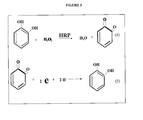
- HRP horse radish peroxidase reaction scheme with catechol as the substrate is shown in Figure 5 .
- HRP substrates include, for example, OPD (orthophenylene diamine), aminophenols and aromatic polyamines.
- the product (quinone) was detected amperometrically.
- the first assay was performed at -0.3 V versus Pt wire in 0.05 M Na-citrate-phosphate buffer pH 5.0 containing 0.2 M Na 2 SO 4 .
- Catechol and hydrogen peroxide in 1 mM concentration were used as an enzymatic substrate.
- a proper checkerboard pattern from the microarray showed that binding occurred at the proper locations without the presence of noise or cross talk bleeding over to neighboring electrode locations.
- ⁇ -Galactosidase reaction cleaves penultimate ⁇ -galactose residues from oligosaccharides or from glycosyl derivatives.
- the reaction scheme is shown in Figure 3 .
- the substrate used was X-Gal, which is an indolyl derivative of ⁇ -galactopyranoside. Biotinylated ⁇ -galactosidase was purchased for studies. The reactions were carried out at pH 7.0 in PBS buffer, 0.01 M. A given quantity of X-Gal was dissolved in DMF (very soluble) so that when it was added to the aqueous buffer, a substrate concentration of about 0.1 mM was achieved (saturation).
- the X-Gal/DMF solution was added while vigorously vortexing the aqueous phase because of the limited solubility of the X-Gal water. If the DMF/X-Gal solution is added without vigorous vortexing, the X-Gal would precipitate from solution. The instability of this solution requires that a fresh solution needs to be prepared daily.
- an organic substrate such as catechol
- the turnover rate for this enzyme is lower than that for other redox enzymes, but the enzyme is very stable at neutral pH.
- the X-Gal in itself does not interact well with glass or metal electrodes.
- an electron mediator is needed to shuttle electrons to the electrode surface.
- One such mediator is a ferri/ferro cyanide (50/50) solution.
- a ferri/ferro cyanide solution can be used at about a 10 mM concentration when using an amperometric reaction and higher or lower concentrations for potentiometric reactions or increasing proportionately with the concentration of the added substrate.
- the voltage settings used in these experiments were 0 Volts (platinum electrode) and 0.5V for the chip.
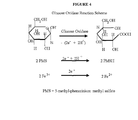
- the Glucose Oxidase reaction scheme is shown on Figure 4 .
- the reaction takes place at about pH 7.5 in a buffer, such as 0.01M PBS buffer.
- the substrate was glucose and it is extremely soluble in water.
- the enzyme was regenerated with PMS (5-methyl-phenazinium methyl sulfate), which in turn utilizes the ferro/ferri cyanide shuttle for detection.
- the potential in this case had the platinum electrode set to 0V and the chip electrode set to 0.5V.
- Results for beta-galactosidase immunoassay detection system are shown in Figure 6 .
- Microarray chips were electrochemically modified with a biotin-containing reagent. In one section of the chip represented by lanes 1-8, no biotin tag was placed. In lanes 9-16, biotinylated ⁇ -galactosidase was bound using a biotin-streptavidin-biotin complex. Redox reagents and substrates were added according to the reaction scheme in Figure 3 . These data show an amperometric response difference in the two parts of the chip, that is, lanes 1-8 versus lanes 9-16 containing ⁇ -galactosidase.
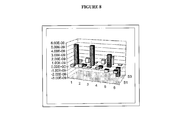
- Figure 6 shows a 3D plot of the amperometric reaction with beta-galactosidase.
- the negative values on this plot indicate that ⁇ -galactosidase is bound.
- the neighboring electrodes are used as counter electrodes in the synthesis process and do not contain any affinity tags.
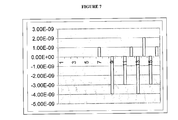
- Figure 7 shows this chip profile as a slice (row) of the 3D plot shown in Figure 6 . Electrodes 9, 11, 13, and 15 contain beta-galactosidase.
- the glucose oxidase enzymatic reaction has some advantages and drawbacks relative to beta-galactosidase enzymatic reaction.
- the advantages are that all components of this reaction are extremely soluble in aqueous buffer.
- an electron mediator is required, such as PMS.
- PMS tends to "air oxidize” over time and must be made up freshly or stored under appropriate inert conditions or it will give a higher background signal.
- biotin was attached to glucose oxidase. The enzyme was then captured on the upper portion of the chip containing streptavidin ( Figure 9 ). As with ⁇ -galactosidase above, the chip contained biotin.
- Electrodes 1-8 contained a first affinity tag (e.g ., biotin) and electrodes 9-16 contained a second affinity tag (e.g., streptavidin).
- the biotin complex allows the capture and detection of the enzyme system.
- Figure 9 shows a slice of a 3D plot created for the capture and detection of glucose oxidase.
- the glucose oxidase specific affinity tags are located in lanes 1-8.
- HRP is a redox enzyme that catalyses the reduction of peroxide.
- the enzyme is small ( ⁇ 36 kD) and the enzyme turnover is large.
- peroxide may damage certain polymeric porous matrices or membranes.
- the redox curve for the peroxidase reaction was monitored by a single 100 micron diameter electrode on a bare ( i.e ., no porous membrane or capture molecules synthesized thereon) electrode-containing microarray device and is shown in Figure 10 .
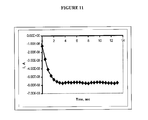
- the cyclic voltamogram like results indicate at a negative potential, the amperometric difference with and without HRP enzyme was substantial. Taking these data, an amperometric experiment was performed over a period of time ( Figure 11 ). It should be noted that the current flow leveled off after a period of time. Thus, the best time to begin these studies after about 2 minutes ( Figure 11 ).
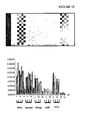
- Figure 12 shows amperometric detection of rabbit IgG bound to selected electrodes on a microarray biochip containing electrodes and a polyvinyl alcohol porous matrix (Combimatrix Corporation, Mukilteo, WA). HRP-tagged goat anti-Rb was used for the electrochemical detection.
- Samples are in S4 (1, 3, 5) and S5 (2, 4). The sign of the current flow has been changed for presentation of these data.
- Figure 13 shows detection of goat IgG bound to selected electrodes on a microarray biochip containing electrodes and a polyvinyl alcohol porous matrix (Combimatrix Corporation, Mukilteo, WA). HRP-tagged mouse monoclonal anti-goat antibody was used for the electrochemical detection. Samples are in S1 (1, 3, 5) and S2 (2, 4, 6). The sign of the current flow has been changed for presentation of these data. These data are in excellent agreement as to what would be expected based upon earlier work using fluorescent-tagged antibodies and standard fluorescence detection.
- Figure 14 shows a 3D plot for oligonucleotide hybridization electrochemical detection.
- rabbit and Kras oligonucleotide sequences were in situ synthesized on an electrode containing mircoarray device.
- the Kras sequence used was TACGCCTCCA GCTCC [SEQ ID NO 1].
- the rabbit sequence used was AGGCTACGAA GACTT [SEQ ID NO 2]. Therefore, the oligonucleotide capture molecules synthesized by in situ electrochemistry techniques has a sequence of GGAGCTGGTG GCGTA [SEQ ID NO 3] for Kras known locations and a sequence of AAGTCTTCGT CGTAGCCT [SEQ ID NO 4] for rabbit known locations.
- the chip was set up in an alternating electrode-counter electrode format having a checkerboard pattern of sites having a Kras (or rabbit) oligonucleotide capture probe sequence surrounded diagonally by counter electrodes without oligonucleotides synthesized thereon.
- Target Kras sample (Operon) was treated to form single-stranded DNA and biotinylated with Kras complement (Operon) according to manufacturers instructions.
- Streptavidin conjugated HRP was added to the biotinylated Kras sequence complement to form a target complex or complementary Kras affinity-bound to HARP.
- the target Kras sample complexed with HRP was added to the chip and each electrode was measured for current (amps).
- microarray devices to have synthesized many different capture molecules at different known locations allows for multiple analyte detection on a single chip.
- the sample or samples to be investigated is labeled with an oxidation/reduction enzyme through standard conjugation means. Multiple samples can be pooled so that all of the targets to be investigated can be found from a single pooled sample.
- samples of AGP, ricin and rabbit mRNA samples were pooled and investigated on a single chip using laccase as the oxidation/reduction enzyme. Only those known locations having the appropriate capture molecules detected target even though the group of targets were either protein or nucleic acids.
- the limits of detection were found to be 5 pg/ml for AGP and 300 pg/ml for ricin that translates to 2.5fM in a volume of 0.5 ml. Moreover, the dynamic detection range spanned four logs.
Landscapes
- Health & Medical Sciences (AREA)
- Life Sciences & Earth Sciences (AREA)
- Chemical & Material Sciences (AREA)
- Immunology (AREA)
- Engineering & Computer Science (AREA)
- Molecular Biology (AREA)
- Analytical Chemistry (AREA)
- Biomedical Technology (AREA)
- Hematology (AREA)
- Urology & Nephrology (AREA)
- Organic Chemistry (AREA)
- Physics & Mathematics (AREA)
- Biochemistry (AREA)
- Biotechnology (AREA)
- Microbiology (AREA)
- General Health & Medical Sciences (AREA)
- Zoology (AREA)
- Proteomics, Peptides & Aminoacids (AREA)
- Wood Science & Technology (AREA)
- Food Science & Technology (AREA)
- General Physics & Mathematics (AREA)
- Pathology (AREA)
- Cell Biology (AREA)
- Medicinal Chemistry (AREA)
- Biophysics (AREA)
- Bioinformatics & Cheminformatics (AREA)
- General Engineering & Computer Science (AREA)
- Genetics & Genomics (AREA)
- Apparatus Associated With Microorganisms And Enzymes (AREA)
- Measuring Or Testing Involving Enzymes Or Micro-Organisms (AREA)
Claims (7)
- Verfahren zum Auslesen von Mikroanordnungsvorrichtungen, die adressierbare Elektroden aufweisen, um eine Bindung zwischen einer Fängersonde und einem Zielmolekül zu bestimmen, wobei das Verfahren Folgendes umfasst:(a) Bereitstellen einer Anordnung, die eine Vielzahl adressierbarer Elektroden und eine Vielzahl von Fängermolekülen an Stellen aufweist, die den adressierbaren Elektroden entsprechen, wobei die Anordnung eine poröse Reaktionsschicht umfasst, die die adressierbaren Elektroden abdeckt, wobei Schritt (a) das Bilden der Fängermoleküle durch In-Situ-Synthese unter Verwendung von elektrochemischen Verfahren umfasst;(b) unspezifisches Anbringen einer enzymatischen Oxidations-/Reduktionseinheit an ein oder eine Vielzahl von Zielmolekülen;(c) Zuführen eines oder einer Vielzahl von Zielmolekülen zu der Anordnung und Binden von Zielmolekülen an Fängermoleküle;(d) Zugabe eines Substrats zu der Anordnung, das ein lokales Spannungs- oder Stromsignal erzeugt, wenn es durch das Oxidations-/Reduktionsenzym durch lokale Erzeugung von elektrochemischen Reagenzien katalysiert wird, wobei die poröse Reaktionsschicht ein Übersprechen des Spannungs- oder Stromsignals, das an jedem Standort erzeugt wird, auf benachbarte Elektroden verhindert; und(e) Messen des Vorhandenseins oder des Fehlens eines Spannungs- oder Stromsignals, das durch elektrochemische Reagenzien an jeder adressierbaren Elektrode lokal erzeugt wird.
- Mikroanordnungsvorrichtung, die adressierbare Elektroden zum Nachweisen der Bindung eines Zielmoleküls an eine Fängersonde aufweist, wobei die Vorrichtung Folgendes umfasst:(a) eine Anordnung, die eine Vielzahl adressierbarer Elektroden und eine Vielzahl von Fängermolekülen an Stellen aufweist, die den adressierbaren Elektroden entsprechen, wobei die Anordnung eine poröse Reaktionsschicht umfasst, die die adressierbaren Elektroden abdeckt und ein Übersprechen eines Spannungs- oder Stromsignals, das an jedem Standort erzeugt wird, auf benachbarte Elektroden verhindert; und wobei die Fängermoleküle durch In-Situ-Synthese unter Verwendung von elektrochemischen Verfahren gebildet werden;(b) eine enzymatische Oxidations-/Reduktionseinheit, die an ein oder eine Vielzahl von Zielmolekülen in einer Probe zur Analyse gebunden ist; wobei die enzymatische Oxidations-/Reduktionseinheit, die an die Zielmoleküle gebunden ist, mit den Fängermolekülen an der Anordnung inkubiert wird, so dass eine Bindung zwischen Fängermolekülen und bindenden Zielmolekülen auftritt,(c) ein Substratmolekül, das ein lokales Spannungs- oder Stromsignal erzeugt, wenn es durch das Oxidations-/Reduktionsenzym durch lokale Erzeugung von elektrochemischen Reagenzien katalysiert wird, und(d) eine Spannungs- oder Stromsignalmessvorrichtung, die mit jeder adressierbaren Elektrode an der Anordnung elektrisch verbunden ist.
- Verfahren nach Anspruch 1 oder Vorrichtung von Anspruch 2, wobei das Oxidations-/Reduktionsenzym aus der Gruppe ausgewählt wird, die aus Folgendem besteht: Laccase, Meerrettich-Peroxidase, β-Galactosidase, Glucoseoxidase, alkalische Phosphatase, Dehydrogenasen und Kombinationen davon.
- Verfahren nach Anspruch 1 oder Mikroanordnungsvorrichtung von Anspruch 2, wobei das Oxidations-/Reduktionsenzym an das bzw. die Zielmoleküle durch Folgendes angebracht ist: eine Kombination aus Antikörper und Anti-Idiotyp-Antikörper oder eine Biotin- und Streptavidin- oder Avidin-Bindungskombination.
- Verfahren nach Anspruch 1 oder Vorrichtung von Anspruch 2, wobei die poröse Reaktionsschicht aus einem polymeren Material hergestellt ist, das aus der Gruppe ausgewählt wird, die Folgendes umfasst: Polyvinylalkohol, Polyvinylacetat, Polyvinylalkohol, Tricelluloseacetat, Polyurethan, Agarose, Glas mit kontrollierter Porosität mit einem PTFE-Harz, Dextran, Epoxy-basierte Polymere und Kombinationen davon.
- Verfahren nach Anspruch 1 oder Vorrichtung von Anspruch 2, wobei das Fängermolekül ein Molekül aus der Klasse von Molekülen ist, die aus der Gruppe ausgewählt werden, die Folgendes umfasst: Oligonukleotide, Polypeptide, Antikörper, glykosylierte Polypeptide, Polysaccharide und gemischte Moleküle mit Monomeren aus einer Vielzahl der vorstehend genannten Moleküle.
- Verfahren nach Anspruch 1 oder Vorrichtung von Anspruch 2, wobei ein Zielmolekül aus der Klasse von Molekülen stammt, die aus der Gruppe ausgewählt werden, die Folgendes umfasst: DNA, RNA, einzelsträngige DNA, ribosomale RNA, mitochondriale DNA, zelluläre Rezeptoren, glycosylierte membrangebundene Proteine, nicht-glycosylierte membrangebundene Proteine, Polypeptide, glykosylierte Polypeptide, Antikörper, zelluläre Antigendeterminanten, organische Moleküle, Metallionen, Salzanionen und -kationen und Kombinationen davon.
Applications Claiming Priority (3)
| Application Number | Priority Date | Filing Date | Title |
|---|---|---|---|
| US944727 | 2001-08-30 | ||
| US09/944,727 US10539561B1 (en) | 2001-08-30 | 2001-08-30 | Enzyme-amplified redox microarray detection process |
| PCT/US2002/028399 WO2003019147A2 (en) | 2001-08-30 | 2002-08-27 | Enzyme-amplified redox microarray detection process |
Publications (3)
| Publication Number | Publication Date |
|---|---|
| EP1430154A2 EP1430154A2 (de) | 2004-06-23 |
| EP1430154A4 EP1430154A4 (de) | 2005-09-21 |
| EP1430154B1 true EP1430154B1 (de) | 2015-07-01 |
Family
ID=25481957
Family Applications (1)
| Application Number | Title | Priority Date | Filing Date |
|---|---|---|---|
| EP02775762.4A Expired - Lifetime EP1430154B1 (de) | 2001-08-30 | 2002-08-27 | Enzymamplifiziertes redox-mikroarray-nachweisverfahren |
Country Status (4)
| Country | Link |
|---|---|
| US (3) | US10539561B1 (de) |
| EP (1) | EP1430154B1 (de) |
| AU (1) | AU2002341612A1 (de) |
| WO (1) | WO2003019147A2 (de) |
Families Citing this family (24)
| Publication number | Priority date | Publication date | Assignee | Title |
|---|---|---|---|---|
| US20030152930A1 (en) * | 2002-02-11 | 2003-08-14 | Matsushita Electric Industrial Co., Ltd. | Method and apparatus for detecting DNA hybridization |
| US7723099B2 (en) * | 2003-09-10 | 2010-05-25 | Abbott Point Of Care Inc. | Immunoassay device with immuno-reference electrode |
| JP4007606B2 (ja) * | 2004-02-03 | 2007-11-14 | キヤノン株式会社 | センサおよび検出方法 |
| JP2007534961A (ja) * | 2004-04-29 | 2007-11-29 | エイジェンシー・フォー・サイエンス,テクノロジー・アンド・リサーチ | 核酸および/またはポリペプチドを検出するための方法および装置 |
| CN100396791C (zh) * | 2004-09-17 | 2008-06-25 | 北京大学 | 寡聚核苷酸嵌入染料荧光共振能量传递分子检测方法 |
| US20070231794A1 (en) * | 2005-09-21 | 2007-10-04 | Combimatrix Corporation | Process to detect binding events on an electrode microarray using enzymes |
| US8855955B2 (en) * | 2005-09-29 | 2014-10-07 | Custom Array, Inc. | Process and apparatus for measuring binding events on a microarray of electrodes |
| US7820394B2 (en) * | 2005-12-02 | 2010-10-26 | Catassays | Ultrasensitive bioanalytical assays based on the use of high-gain catalytic chemical amplification |
| DE102006051482A1 (de) * | 2006-07-31 | 2008-02-14 | Nikolaus Bartels | Anordnung zum Erfassen von Substanzen, Herstellung der Anordnung und ihre Verwendung |
| US8394590B2 (en) * | 2006-08-02 | 2013-03-12 | California Institute Of Technology | Capture agents and related methods and systems for detecting and/or sorting targets |
| US20090017455A1 (en) * | 2006-08-02 | 2009-01-15 | Kwong Gabriel A | Methods and systems for detecting and/or sorting targets |
| AU2008276027B2 (en) * | 2007-07-16 | 2014-09-04 | California Institute Of Technology | Arrays, substrates, devices, methods and systems for detecting target molecules |
| CN101241097B (zh) * | 2007-09-18 | 2011-08-03 | 中国科学院上海应用物理研究所 | 一种采用茎环结构检测探针的电化学dna检测方法及其试剂盒 |
| JP2011518553A (ja) * | 2008-04-09 | 2011-06-30 | カリフォルニア インスティチュート オブ テクノロジー | 標的を検出及び/又は分類する捕捉剤および関連する方法およびシステム |
| CN102183645B (zh) * | 2011-01-24 | 2013-12-11 | 中国科学院合肥物质科学研究院 | 一种食源性致病菌检测的免疫传感器及其制备方法 |
| WO2014031997A1 (en) | 2012-08-24 | 2014-02-27 | Yale University | System, device and method for high-throughput multi-plexed detection |
| CN112782140A (zh) | 2014-12-03 | 2021-05-11 | 伊索普莱西斯公司 | 细胞分泌特征的分析和筛选 |
| US11353448B2 (en) | 2015-02-13 | 2022-06-07 | California Institute Of Technology | Methods and compositions for quantifying metabolites and proteins from single cells |
| US20200166518A1 (en) | 2016-09-12 | 2020-05-28 | IsoPlexis Corporation | System and methods for multiplexed analysis of cellular and other immunotherapeutics |
| EP4036578A1 (de) | 2016-11-11 | 2022-08-03 | Isoplexis Corporation | Zusammensetzungen und verfahren zur gleichzeitigen genomischen, transkriptomischen und proteomischen analyse von einzelzellen |
| EP3545284A4 (de) | 2016-11-22 | 2020-07-01 | Isoplexis Corporation | Systeme, vorrichtungen und verfahren für die zellerfassung und verfahren zur herstellung davon |
| US20230384314A1 (en) * | 2020-10-16 | 2023-11-30 | Lmx Medtech Llc | Oxidative Mass Labeling |
| WO2022155380A1 (en) * | 2021-01-13 | 2022-07-21 | Virex Health, Inc. | Methods, assays and systems for detection of a target analyte |
| DE102022000897A1 (de) | 2022-03-15 | 2023-09-21 | Ruhr-Universität Bochum, Körperschaft des öffentlichen Rechts | Implantierbarer Biosensor |
Citations (1)
| Publication number | Priority date | Publication date | Assignee | Title |
|---|---|---|---|---|
| US6051380A (en) * | 1993-11-01 | 2000-04-18 | Nanogen, Inc. | Methods and procedures for molecular biological analysis and diagnostics |
Family Cites Families (90)
| Publication number | Priority date | Publication date | Assignee | Title |
|---|---|---|---|---|
| BE791653A (fr) | 1971-12-28 | 1973-05-21 | Texaco Development Corp | Procede electrolytique de preparation de l'acide |
| US3950357A (en) | 1974-11-25 | 1976-04-13 | Merck & Co., Inc. | Antibiotics |
| US4165320A (en) | 1977-01-17 | 1979-08-21 | E. R. Squibb & Sons, Inc. | Amino acid derivatives |
| US4563263A (en) | 1982-01-15 | 1986-01-07 | Terumo Corporation | Selectively permeable film and ion sensor |
| US4840893A (en) * | 1983-12-16 | 1989-06-20 | Medisense, Inc. | Electrochemical assay for nucleic acids and nucleic acid probes |
| US5268266A (en) * | 1984-05-07 | 1993-12-07 | Genetics Institute, Inc. | Process and nucleic acid construct for producing reagent complexes useful in determining target nucleotide sequences |
| US5912339A (en) | 1986-10-28 | 1999-06-15 | The Johns Hopkins University | Oligonucleoside alkyl or arylphosphonate derivatives capable of crosslinking with or cleaving nucleic acids |
| US5525464A (en) | 1987-04-01 | 1996-06-11 | Hyseq, Inc. | Method of sequencing by hybridization of oligonucleotide probes |
| US5540828A (en) | 1987-06-08 | 1996-07-30 | Yacynych; Alexander | Method for making electrochemical sensors and biosensors having a polymer modified surface |
| US5200051A (en) * | 1988-11-14 | 1993-04-06 | I-Stat Corporation | Wholly microfabricated biosensors and process for the manufacture and use thereof |
| US6306594B1 (en) | 1988-11-14 | 2001-10-23 | I-Stat Corporation | Methods for microdispensing patterened layers |
| US5143854A (en) | 1989-06-07 | 1992-09-01 | Affymax Technologies N.V. | Large scale photolithographic solid phase synthesis of polypeptides and receptor binding screening thereof |
| DE4003194A1 (de) * | 1990-02-03 | 1991-08-08 | Boehringer Mannheim Gmbh | Verfahren und sensorelektrodensystem zur elektrochemischen bestimmung eines analyts oder einer oxidoreduktase sowie verwendung hierfuer geeigneter verbindungen |
| DE69128077T2 (de) * | 1990-12-31 | 1998-02-26 | Promega Corp., Madison, Wis. | Nuklein-säure amplifikation mit dns abhängigen rns polymerasen aktivität von rns-replikasen |
| US6921636B1 (en) | 1991-09-04 | 2005-07-26 | Metrigen, Inc. | Method and apparatus for conducting an array of chemical reactions on a support surface |
| US5605662A (en) | 1993-11-01 | 1997-02-25 | Nanogen, Inc. | Active programmable electronic devices for molecular biological analysis and diagnostics |
| US5632957A (en) * | 1993-11-01 | 1997-05-27 | Nanogen | Molecular biological diagnostic systems including electrodes |
| US6017696A (en) | 1993-11-01 | 2000-01-25 | Nanogen, Inc. | Methods for electronic stringency control for molecular biological analysis and diagnostics |
| US5846708A (en) | 1991-11-19 | 1998-12-08 | Massachusetts Institiute Of Technology | Optical and electrical methods and apparatus for molecule detection |
| AU665990B2 (en) * | 1992-03-05 | 1996-01-25 | Edmund Bruce Mitchell | Antigen detection apparatus |
| US5667667A (en) | 1992-04-24 | 1997-09-16 | Isis Innovation Limited | Electrochemical treatment of surfaces |
| US5807999A (en) * | 1993-02-01 | 1998-09-15 | Mt. Sinai School Of Medicine Of The City University Of New York | Monoclonal antibody that distinguishes between phosphorylated and nonphosphorylated histone H1 and uses therefor |
| FR2707010B1 (de) * | 1993-06-25 | 1995-09-29 | Bio Merieux | |
| GB9315847D0 (en) | 1993-07-30 | 1993-09-15 | Isis Innovation | Tag reagent and assay method |
| US5824473A (en) * | 1993-12-10 | 1998-10-20 | California Institute Of Technology | Nucleic acid mediated electron transfer |
| US5928905A (en) | 1995-04-18 | 1999-07-27 | Glaxo Group Limited | End-complementary polymerase reaction |
| US5986076A (en) * | 1994-05-11 | 1999-11-16 | Trustees Of Boston University | Photocleavable agents and conjugates for the detection and isolation of biomolecules |
| WO1996003417A1 (en) | 1994-07-25 | 1996-02-08 | Hybridon, Inc. | Improved methods of detritylation for oligonucleotide synthesis |
| DE4427921C2 (de) * | 1994-08-06 | 2002-09-26 | Forschungszentrum Juelich Gmbh | Chemische Sensoren, insbesondere Biosensoren, auf Siliciumbasis |
| KR100449615B1 (ko) | 1995-03-10 | 2004-12-08 | 메소 스케일 테크놀러지즈, 엘엘시 | 다-배열,다-특이적전기화학발광시험법 |
| CA2215417A1 (en) | 1995-03-15 | 1996-09-19 | City Of Hope | Disposable reagent storage and delivery cartridge |
| FR2742543B1 (fr) * | 1995-12-19 | 1998-02-13 | Univ Geneve | Microcapteurs et microsystemes electrochimiques integres fiables pour l'analyse chimique directe de composes en milieux aqueux complexes |
| US6013440A (en) | 1996-03-11 | 2000-01-11 | Affymetrix, Inc. | Nucleic acid affinity columns |
| ZA975891B (en) | 1996-07-05 | 1998-07-23 | Combimatrix Corp | Electrochemical solid phase synthesis of polymers |
| US5953681A (en) | 1996-07-30 | 1999-09-14 | Bayer Corporation | Autonomous node for a test instrument system having a distributed logic nodal architecture |
| US6100045A (en) * | 1997-02-10 | 2000-08-08 | Dsm N.V. | Detection of analytes using electrochemistry |
| US6391558B1 (en) * | 1997-03-18 | 2002-05-21 | Andcare, Inc. | Electrochemical detection of nucleic acid sequences |
| EP1420252A3 (de) | 1997-12-30 | 2004-08-04 | Remacle, José | Methode zur Detektion und/oder Quantifizierung eines Zielmoleküls durch Binden an ein Bindungsmolekül, das auf eine Disc-Oberfläche fixiert ist |
| US20030050437A1 (en) | 1998-01-05 | 2003-03-13 | Montgomery Donald D. | Electrochemical solid phase synthesis |
| US6093302A (en) * | 1998-01-05 | 2000-07-25 | Combimatrix Corporation | Electrochemical solid phase synthesis |
| US6456942B1 (en) | 1998-01-25 | 2002-09-24 | Combimatrix Corporation | Network infrastructure for custom microarray synthesis and analysis |
| WO1999067628A1 (en) * | 1998-06-24 | 1999-12-29 | Therasense, Inc. | Multi-sensor array for electrochemical recognition of nucleotide sequences and methods |
| US6780582B1 (en) | 1998-07-14 | 2004-08-24 | Zyomyx, Inc. | Arrays of protein-capture agents and methods of use thereof |
| US6281006B1 (en) * | 1998-08-24 | 2001-08-28 | Therasense, Inc. | Electrochemical affinity assay |
| US6344333B2 (en) * | 1998-09-08 | 2002-02-05 | Synectig Corporation | Reagent-free immunoassay monitoring electrode assembly |
| ATE334197T1 (de) | 1999-02-19 | 2006-08-15 | Febit Biotech Gmbh | Verfahren zur herstellung von polymeren |
| AU4170100A (en) | 1999-03-01 | 2000-09-21 | Combimatrix Corporation | Combinatorial chelator array |
| EP1159285B1 (de) | 1999-03-08 | 2005-05-25 | Metrigen, Inc. | Syntheseverfahren zum ökonomischen aufbau langer dna-sequenzen und zusammensetzungen hierfür |
| CN1185492C (zh) * | 1999-03-15 | 2005-01-19 | 清华大学 | 可单点选通式微电磁单元阵列芯片、电磁生物芯片及应用 |
| WO2001023082A2 (en) | 1999-09-30 | 2001-04-05 | Nanogen, Inc. | Biomolecular attachment sites on microelectronic arrays |
| US6518024B2 (en) * | 1999-12-13 | 2003-02-11 | Motorola, Inc. | Electrochemical detection of single base extension |
| US6303082B1 (en) * | 1999-12-15 | 2001-10-16 | Nanogen, Inc. | Permeation layer attachment chemistry and method |
| JP4061801B2 (ja) | 2000-01-24 | 2008-03-19 | 住友化学株式会社 | 化学増幅型ポジ型レジスト組成物 |
| US6824669B1 (en) * | 2000-02-17 | 2004-11-30 | Motorola, Inc. | Protein and peptide sensors using electrical detection methods |
| US7019129B1 (en) | 2000-05-09 | 2006-03-28 | Biosearch Technologies, Inc. | Dark quenchers for donor-acceptor energy transfer |
| US6824988B2 (en) * | 2000-05-15 | 2004-11-30 | R.E.D. Laboratories, N.V. | Method and compositions for use in diagnosing and characterizing chronic immune disease |
| EP1348113B1 (de) | 2000-08-15 | 2008-07-30 | Bioforce Nanosciences, Inc. | Vorrichtung zur bildung von nanomolekularen netzwerken |
| AU2002230381A1 (en) | 2000-08-31 | 2002-04-22 | Motorola, Inc. | High density column and row addressable electrode arrays |
| DE10049901C2 (de) | 2000-10-10 | 2003-01-02 | Aventis Res & Tech Gmbh & Co | Vorrichtung und Verfahren zur elektrisch beschleunigten Immobilisierung und zur Detektion von Molekülen |
| WO2002042259A2 (en) | 2000-11-27 | 2002-05-30 | University Of Maryland, Baltimore | Methods of synthesizing and using derivatives of [2-(2-aminoethoxy)ethoxy] acetic acid |
| KR100672890B1 (ko) | 2000-12-07 | 2007-01-23 | 신에쓰 가가꾸 고교 가부시끼가이샤 | 아민 화합물, 레지스트 조성물 및 패턴 형성 방법 |
| WO2002079514A1 (en) | 2001-01-10 | 2002-10-10 | The Trustees Of Boston College | Dna-bridged carbon nanotube arrays |
| CA2442975A1 (en) | 2001-04-03 | 2002-11-14 | Combimatrix Corporation | Overlying electrode for electrochemical microarrays |
| US6320041B1 (en) | 2001-04-13 | 2001-11-20 | Trilink Biotechnologies, Inc. | Pre-activated carbonyl linkers for the modification of oligonucleotides |
| US20050040042A1 (en) | 2001-06-14 | 2005-02-24 | Yun Jae-Young | Method and device for electronic control of the spatial location of charged molecules |
| US20030022150A1 (en) * | 2001-07-24 | 2003-01-30 | Sampson Jeffrey R. | Methods for detecting a target molecule |
| GB0121155D0 (en) | 2001-08-31 | 2001-10-24 | Isis Innovation | Treatment of substrates |
| US7063946B2 (en) | 2001-09-10 | 2006-06-20 | Meso Scale Technologies, Llc. | Methods, reagents, kits and apparatus for protein function analysis |
| US6960298B2 (en) | 2001-12-10 | 2005-11-01 | Nanogen, Inc. | Mesoporous permeation layers for use on active electronic matrix devices |
| AU2002364070A1 (en) | 2001-12-17 | 2003-06-30 | Michael Strathmann | Combinatorial synthesis on arrays |
| CN1650030A (zh) | 2002-02-27 | 2005-08-03 | 第三次浪潮技术公司 | 表面修饰、接头附着和聚合方法 |
| US20030194709A1 (en) | 2002-04-10 | 2003-10-16 | Xing Yang | Hydrophobic zone device |
| US7563600B2 (en) | 2002-09-12 | 2009-07-21 | Combimatrix Corporation | Microarray synthesis and assembly of gene-length polynucleotides |
| US8346482B2 (en) | 2003-08-22 | 2013-01-01 | Fernandez Dennis S | Integrated biosensor and simulation system for diagnosis and therapy |
| JP4511162B2 (ja) | 2003-12-05 | 2010-07-28 | 株式会社チノー | 燃料電池の評価装置 |
| US7206012B2 (en) | 2004-03-24 | 2007-04-17 | Lexmark International, Inc. | Memory device on optical scanner and apparatus and method for storing characterizing information on the memory device |
| US20050239112A1 (en) | 2004-04-01 | 2005-10-27 | Migenix, Inc. | Methods and processes for attaching compounds to matrices |
| US20060102471A1 (en) | 2004-11-18 | 2006-05-18 | Karl Maurer | Electrode array device having an adsorbed porous reaction layer |
| US20060105355A1 (en) | 2004-11-18 | 2006-05-18 | Karl Maurer | Electrode array device having an adsorbed porous reaction layer having a linker moiety |
| US20080039342A1 (en) | 2005-01-07 | 2008-02-14 | Combimatrix Corporation | Process for transition metal-catalyzed electrochemical allylic alkylation on an electrode array device |
| US20060160100A1 (en) | 2005-01-19 | 2006-07-20 | Agency For Science, Technology And Research | Enzymatic electrochemical detection assay using protective monolayer and device therefor |
| US20070034513A1 (en) | 2005-03-25 | 2007-02-15 | Combimatrix Corporation | Electrochemical deblocking solution for electrochemical oligomer synthesis on an electrode array |
| US9394167B2 (en) | 2005-04-15 | 2016-07-19 | Customarray, Inc. | Neutralization and containment of redox species produced by circumferential electrodes |
| US20070292855A1 (en) | 2005-08-19 | 2007-12-20 | Intel Corporation | Method and CMOS-based device to analyze molecules and nanomaterials based on the electrical readout of specific binding events on functionalized electrodes |
| US20070065877A1 (en) | 2005-09-19 | 2007-03-22 | Combimatrix Corporation | Microarray having a base cleavable succinate linker |
| US7541314B2 (en) | 2006-02-24 | 2009-06-02 | Combimatrix Corporation | Microarray having a base cleavable sulfonyl linker |
| US20070231794A1 (en) | 2005-09-21 | 2007-10-04 | Combimatrix Corporation | Process to detect binding events on an electrode microarray using enzymes |
| US8855955B2 (en) | 2005-09-29 | 2014-10-07 | Custom Array, Inc. | Process and apparatus for measuring binding events on a microarray of electrodes |
| WO2007109228A1 (en) | 2006-03-17 | 2007-09-27 | The Government Of The United States Of America, As Represented By The Secretary, Department Of Health And Human Services | Apparatus for microarray binding sensors having biological probe materials using carbon nanotube transistors |
| US9927434B2 (en) | 2010-01-20 | 2018-03-27 | Customarray, Inc. | Multiplex microarray of serially deposited biomolecules on a microarray |
-
2001
- 2001-08-30 US US09/944,727 patent/US10539561B1/en not_active Expired - Fee Related
-
2002
- 2002-08-27 AU AU2002341612A patent/AU2002341612A1/en not_active Abandoned
- 2002-08-27 US US10/229,755 patent/US20030082601A1/en not_active Abandoned
- 2002-08-27 EP EP02775762.4A patent/EP1430154B1/de not_active Expired - Lifetime
- 2002-08-27 WO PCT/US2002/028399 patent/WO2003019147A2/en not_active Ceased
-
2019
- 2019-11-20 US US16/689,473 patent/US20200072823A1/en not_active Abandoned
Patent Citations (1)
| Publication number | Priority date | Publication date | Assignee | Title |
|---|---|---|---|---|
| US6051380A (en) * | 1993-11-01 | 2000-04-18 | Nanogen, Inc. | Methods and procedures for molecular biological analysis and diagnostics |
Also Published As
| Publication number | Publication date |
|---|---|
| WO2003019147A3 (en) | 2003-12-11 |
| US20200072823A1 (en) | 2020-03-05 |
| EP1430154A4 (de) | 2005-09-21 |
| EP1430154A2 (de) | 2004-06-23 |
| AU2002341612A1 (en) | 2003-03-10 |
| US10539561B1 (en) | 2020-01-21 |
| US20030082601A1 (en) | 2003-05-01 |
| WO2003019147A2 (en) | 2003-03-06 |
Similar Documents
| Publication | Publication Date | Title |
|---|---|---|
| US20030082601A1 (en) | Enzyme-amplified redox microarray detection process | |
| EP1951913B1 (de) | Verfahren zur erkennung von bindungsereignissen auf einem elektroden-mikroarray mithilfe von enzymen | |
| US8855955B2 (en) | Process and apparatus for measuring binding events on a microarray of electrodes | |
| Campas et al. | DNA biochip arraying, detection and amplification strategies | |
| Sassolas et al. | DNA biosensors and microarrays | |
| Dill et al. | Immunoassays based on electrochemical detection using microelectrode arrays | |
| Drummond et al. | Electrochemical DNA sensors | |
| EP1075656B1 (de) | Nachweis einer zielsubstanz in einer probe | |
| US7488607B2 (en) | Electronically readable microarray with electronic addressing function | |
| US20040023258A1 (en) | Method and system or detecting nucleic acids | |
| US20030203394A1 (en) | Detection of a target in a sample | |
| US20060105354A1 (en) | Real-time quantification of multiple targets on a micro-array | |
| Nunes Kirchner et al. | Scanning electrochemical microscopy (SECM) based detection of oligonucleotide hybridization and simultaneous determination of the surface concentration of immobilized oligonucleotides on gold | |
| US7655404B2 (en) | Method and device for detection of nucleic acids and/or polypeptides | |
| US20050069905A1 (en) | Detection of molecular binding events | |
| US20030186245A1 (en) | Biomolecular sensors and detection methods utilizing photoinduced charge separation | |
| Gębala et al. | Amplified detection of DNA hybridization using post-labelling with a biotin-modified intercalator | |
| US20050266455A1 (en) | Method and microelectronic device for multi-site molecule detection | |
| JP2003207505A (ja) | 生体分子の分析方法 | |
| DE102013000682B3 (de) | Verfahren zur Detektion von Molekülen | |
| US20040072223A1 (en) | Method for detecting macromolecular biopolymers by using at least one immobilization unit provided with a marked scavenger molecule | |
| Nakano | 3 Scanning Electrochemical Microscopy Imaging of DNA Arrays for High Throughput Analysis Applications |
Legal Events
| Date | Code | Title | Description |
|---|---|---|---|
| PUAI | Public reference made under article 153(3) epc to a published international application that has entered the european phase |
Free format text: ORIGINAL CODE: 0009012 |
|
| 17P | Request for examination filed |
Effective date: 20040329 |
|
| AK | Designated contracting states |
Kind code of ref document: A2 Designated state(s): AT BE BG CH CY CZ DE DK EE ES FI FR GB GR IE IT LI LU MC NL PT SE SK TR |
|
| REG | Reference to a national code |
Ref country code: HK Ref legal event code: DE Ref document number: 1067154 Country of ref document: HK |
|
| A4 | Supplementary search report drawn up and despatched |
Effective date: 20050809 |
|
| RIC1 | Information provided on ipc code assigned before grant |
Ipc: 7G 01N 27/327 B Ipc: 7B 01L 3/00 B Ipc: 7G 01N 33/543 B Ipc: 7B 01J 19/00 B Ipc: 7C 12Q 1/68 A |
|
| 17Q | First examination report despatched |
Effective date: 20070503 |
|
| RAP1 | Party data changed (applicant data changed or rights of an application transferred) |
Owner name: CUSTOMARRAY, INC. |
|
| RAP1 | Party data changed (applicant data changed or rights of an application transferred) |
Owner name: CUSTOMARRAY, INC. |
|
| REG | Reference to a national code |
Ref country code: HK Ref legal event code: WD Ref document number: 1067154 Country of ref document: HK |
|
| GRAJ | Information related to disapproval of communication of intention to grant by the applicant or resumption of examination proceedings by the epo deleted |
Free format text: ORIGINAL CODE: EPIDOSDIGR1 |
|
| GRAP | Despatch of communication of intention to grant a patent |
Free format text: ORIGINAL CODE: EPIDOSNIGR1 |
|
| INTG | Intention to grant announced |
Effective date: 20150318 |
|
| GRAS | Grant fee paid |
Free format text: ORIGINAL CODE: EPIDOSNIGR3 |
|
| GRAA | (expected) grant |
Free format text: ORIGINAL CODE: 0009210 |
|
| AK | Designated contracting states |
Kind code of ref document: B1 Designated state(s): AT BE BG CH CY CZ DE DK EE ES FI FR GB GR IE IT LI LU MC NL PT SE SK TR |
|
| REG | Reference to a national code |
Ref country code: GB Ref legal event code: FG4D |
|
| REG | Reference to a national code |
Ref country code: AT Ref legal event code: REF Ref document number: 734005 Country of ref document: AT Kind code of ref document: T Effective date: 20150715 Ref country code: CH Ref legal event code: EP |
|
| REG | Reference to a national code |
Ref country code: IE Ref legal event code: FG4D |
|
| REG | Reference to a national code |
Ref country code: DE Ref legal event code: R096 Ref document number: 60247285 Country of ref document: DE |
|
| REG | Reference to a national code |
Ref country code: AT Ref legal event code: MK05 Ref document number: 734005 Country of ref document: AT Kind code of ref document: T Effective date: 20150701 |
|
| REG | Reference to a national code |
Ref country code: NL Ref legal event code: MP Effective date: 20150701 |
|
| PG25 | Lapsed in a contracting state [announced via postgrant information from national office to epo] |
Ref country code: GR Free format text: LAPSE BECAUSE OF FAILURE TO SUBMIT A TRANSLATION OF THE DESCRIPTION OR TO PAY THE FEE WITHIN THE PRESCRIBED TIME-LIMIT Effective date: 20151002 Ref country code: FI Free format text: LAPSE BECAUSE OF FAILURE TO SUBMIT A TRANSLATION OF THE DESCRIPTION OR TO PAY THE FEE WITHIN THE PRESCRIBED TIME-LIMIT Effective date: 20150701 |
|
| PG25 | Lapsed in a contracting state [announced via postgrant information from national office to epo] |
Ref country code: AT Free format text: LAPSE BECAUSE OF FAILURE TO SUBMIT A TRANSLATION OF THE DESCRIPTION OR TO PAY THE FEE WITHIN THE PRESCRIBED TIME-LIMIT Effective date: 20150701 Ref country code: SE Free format text: LAPSE BECAUSE OF FAILURE TO SUBMIT A TRANSLATION OF THE DESCRIPTION OR TO PAY THE FEE WITHIN THE PRESCRIBED TIME-LIMIT Effective date: 20150701 Ref country code: ES Free format text: LAPSE BECAUSE OF FAILURE TO SUBMIT A TRANSLATION OF THE DESCRIPTION OR TO PAY THE FEE WITHIN THE PRESCRIBED TIME-LIMIT Effective date: 20150701 Ref country code: PT Free format text: LAPSE BECAUSE OF FAILURE TO SUBMIT A TRANSLATION OF THE DESCRIPTION OR TO PAY THE FEE WITHIN THE PRESCRIBED TIME-LIMIT Effective date: 20151102 |
|
| PG25 | Lapsed in a contracting state [announced via postgrant information from national office to epo] |
Ref country code: MC Free format text: LAPSE BECAUSE OF FAILURE TO SUBMIT A TRANSLATION OF THE DESCRIPTION OR TO PAY THE FEE WITHIN THE PRESCRIBED TIME-LIMIT Effective date: 20150701 |
|
| REG | Reference to a national code |
Ref country code: CH Ref legal event code: PL |
|
| REG | Reference to a national code |
Ref country code: DE Ref legal event code: R097 Ref document number: 60247285 Country of ref document: DE |
|
| PG25 | Lapsed in a contracting state [announced via postgrant information from national office to epo] |
Ref country code: CZ Free format text: LAPSE BECAUSE OF FAILURE TO SUBMIT A TRANSLATION OF THE DESCRIPTION OR TO PAY THE FEE WITHIN THE PRESCRIBED TIME-LIMIT Effective date: 20150701 Ref country code: CH Free format text: LAPSE BECAUSE OF NON-PAYMENT OF DUE FEES Effective date: 20150831 Ref country code: SK Free format text: LAPSE BECAUSE OF FAILURE TO SUBMIT A TRANSLATION OF THE DESCRIPTION OR TO PAY THE FEE WITHIN THE PRESCRIBED TIME-LIMIT Effective date: 20150701 Ref country code: LI Free format text: LAPSE BECAUSE OF NON-PAYMENT OF DUE FEES Effective date: 20150831 Ref country code: DK Free format text: LAPSE BECAUSE OF FAILURE TO SUBMIT A TRANSLATION OF THE DESCRIPTION OR TO PAY THE FEE WITHIN THE PRESCRIBED TIME-LIMIT Effective date: 20150701 Ref country code: EE Free format text: LAPSE BECAUSE OF FAILURE TO SUBMIT A TRANSLATION OF THE DESCRIPTION OR TO PAY THE FEE WITHIN THE PRESCRIBED TIME-LIMIT Effective date: 20150701 Ref country code: IT Free format text: LAPSE BECAUSE OF FAILURE TO SUBMIT A TRANSLATION OF THE DESCRIPTION OR TO PAY THE FEE WITHIN THE PRESCRIBED TIME-LIMIT Effective date: 20150701 |
|
| PLBE | No opposition filed within time limit |
Free format text: ORIGINAL CODE: 0009261 |
|
| STAA | Information on the status of an ep patent application or granted ep patent |
Free format text: STATUS: NO OPPOSITION FILED WITHIN TIME LIMIT |
|
| REG | Reference to a national code |
Ref country code: IE Ref legal event code: MM4A |
|
| REG | Reference to a national code |
Ref country code: FR Ref legal event code: ST Effective date: 20160429 |
|
| 26N | No opposition filed |
Effective date: 20160404 |
|
| PG25 | Lapsed in a contracting state [announced via postgrant information from national office to epo] |
Ref country code: IE Free format text: LAPSE BECAUSE OF NON-PAYMENT OF DUE FEES Effective date: 20150827 |
|
| PG25 | Lapsed in a contracting state [announced via postgrant information from national office to epo] |
Ref country code: FR Free format text: LAPSE BECAUSE OF NON-PAYMENT OF DUE FEES Effective date: 20150901 |
|
| REG | Reference to a national code |
Ref country code: DE Ref legal event code: R082 Ref document number: 60247285 Country of ref document: DE Representative=s name: HUBER & SCHUESSLER, DE |
|
| PG25 | Lapsed in a contracting state [announced via postgrant information from national office to epo] |
Ref country code: BG Free format text: LAPSE BECAUSE OF FAILURE TO SUBMIT A TRANSLATION OF THE DESCRIPTION OR TO PAY THE FEE WITHIN THE PRESCRIBED TIME-LIMIT Effective date: 20150701 |
|
| PG25 | Lapsed in a contracting state [announced via postgrant information from national office to epo] |
Ref country code: NL Free format text: LAPSE BECAUSE OF FAILURE TO SUBMIT A TRANSLATION OF THE DESCRIPTION OR TO PAY THE FEE WITHIN THE PRESCRIBED TIME-LIMIT Effective date: 20150701 Ref country code: CY Free format text: LAPSE BECAUSE OF FAILURE TO SUBMIT A TRANSLATION OF THE DESCRIPTION OR TO PAY THE FEE WITHIN THE PRESCRIBED TIME-LIMIT Effective date: 20150701 |
|
| PG25 | Lapsed in a contracting state [announced via postgrant information from national office to epo] |
Ref country code: BE Free format text: LAPSE BECAUSE OF NON-PAYMENT OF DUE FEES Effective date: 20150831 |
|
| PG25 | Lapsed in a contracting state [announced via postgrant information from national office to epo] |
Ref country code: TR Free format text: LAPSE BECAUSE OF FAILURE TO SUBMIT A TRANSLATION OF THE DESCRIPTION OR TO PAY THE FEE WITHIN THE PRESCRIBED TIME-LIMIT Effective date: 20150701 |
|
| PG25 | Lapsed in a contracting state [announced via postgrant information from national office to epo] |
Ref country code: LU Free format text: LAPSE BECAUSE OF NON-PAYMENT OF DUE FEES Effective date: 20150827 |
|
| PGFP | Annual fee paid to national office [announced via postgrant information from national office to epo] |
Ref country code: GB Payment date: 20210820 Year of fee payment: 20 Ref country code: DE Payment date: 20210819 Year of fee payment: 20 |
|
| REG | Reference to a national code |
Ref country code: DE Ref legal event code: R071 Ref document number: 60247285 Country of ref document: DE |
|
| REG | Reference to a national code |
Ref country code: GB Ref legal event code: PE20 Expiry date: 20220826 |
|
| PG25 | Lapsed in a contracting state [announced via postgrant information from national office to epo] |
Ref country code: GB Free format text: LAPSE BECAUSE OF EXPIRATION OF PROTECTION Effective date: 20220826 |