EP1422246A2 - Polyisobutenylether und -thioether - Google Patents
Polyisobutenylether und -thioether Download PDFInfo
- Publication number
- EP1422246A2 EP1422246A2 EP03026650A EP03026650A EP1422246A2 EP 1422246 A2 EP1422246 A2 EP 1422246A2 EP 03026650 A EP03026650 A EP 03026650A EP 03026650 A EP03026650 A EP 03026650A EP 1422246 A2 EP1422246 A2 EP 1422246A2
- Authority
- EP
- European Patent Office
- Prior art keywords
- polyisobutenyl
- polyisobutene
- epoxy
- poly
- epoxide
- Prior art date
- Legal status (The legal status is an assumption and is not a legal conclusion. Google has not performed a legal analysis and makes no representation as to the accuracy of the status listed.)
- Withdrawn
Links
Classifications
-
- C—CHEMISTRY; METALLURGY
- C08—ORGANIC MACROMOLECULAR COMPOUNDS; THEIR PREPARATION OR CHEMICAL WORKING-UP; COMPOSITIONS BASED THEREON
- C08G—MACROMOLECULAR COMPOUNDS OBTAINED OTHERWISE THAN BY REACTIONS ONLY INVOLVING UNSATURATED CARBON-TO-CARBON BONDS
- C08G81/00—Macromolecular compounds obtained by interreacting polymers in the absence of monomers, e.g. block polymers
- C08G81/02—Macromolecular compounds obtained by interreacting polymers in the absence of monomers, e.g. block polymers at least one of the polymers being obtained by reactions involving only carbon-to-carbon unsaturated bonds
- C08G81/021—Block or graft polymers containing only sequences of polymers of C08C or C08F
-
- C—CHEMISTRY; METALLURGY
- C08—ORGANIC MACROMOLECULAR COMPOUNDS; THEIR PREPARATION OR CHEMICAL WORKING-UP; COMPOSITIONS BASED THEREON
- C08F—MACROMOLECULAR COMPOUNDS OBTAINED BY REACTIONS ONLY INVOLVING CARBON-TO-CARBON UNSATURATED BONDS
- C08F8/00—Chemical modification by after-treatment
Definitions
- the present invention relates to a method for manufacturing of polyisobutenyl ethers and thioethers (hereinafter collectively referred to as "polyisobutenyl (thio) ether”) starting from one Polyisobutenyl epoxide and those obtainable by the process Polyisobutenyl (thio) ether.
- epoxides with nucleophiles such as amines, alcohols or thiols under acid catalysis usually run simply and exothermically, depending on the nucleophile chosen, hydroxyalkylamines, ether or thioether can be obtained. More substituted Epoxies such as polyisobutene epoxides are deposited under these However, conditions usually change to aldehyde.
- EP-A 0 476 485 describes the reaction of polyisobutenyl epoxides with amines or alkanolamines. This results in a nucleophilic Opening of the epoxy ring through the nitrogen atom of the amine or the alkanolamine and it becomes polyisobutenylamino alcohols receive.
- WO 00/63257 describes the conversion of polyisobutenyl epoxides to aldehydes using acidic catalysts such as zinc bromide or a mixture of sulfuric acid and phosphoric acid.
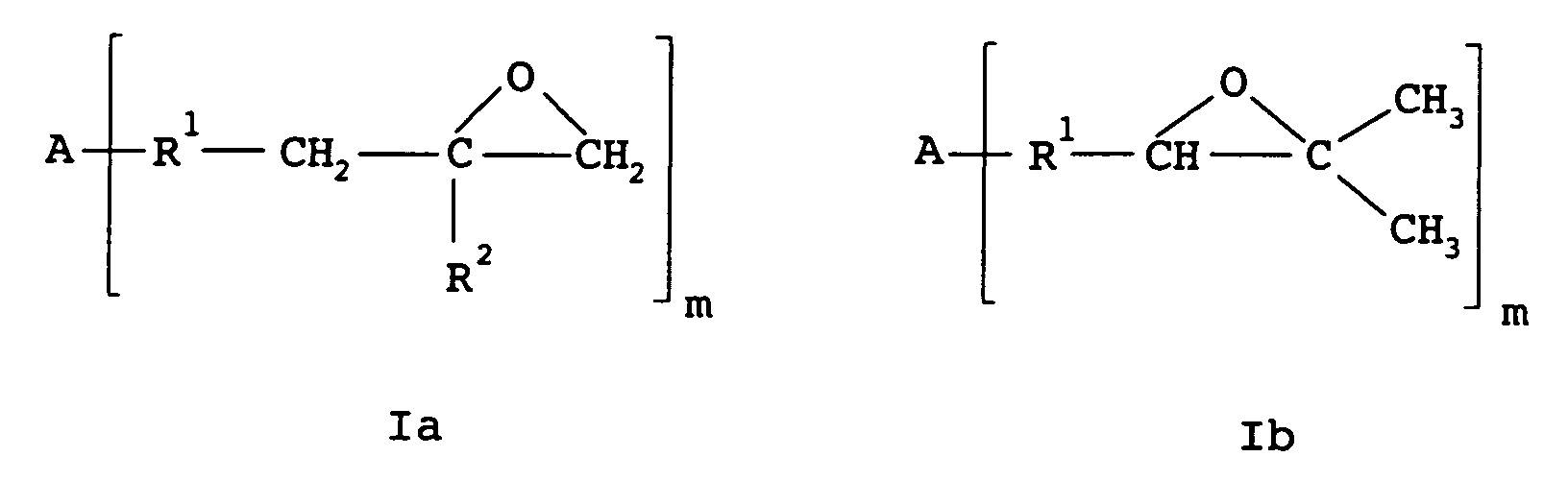
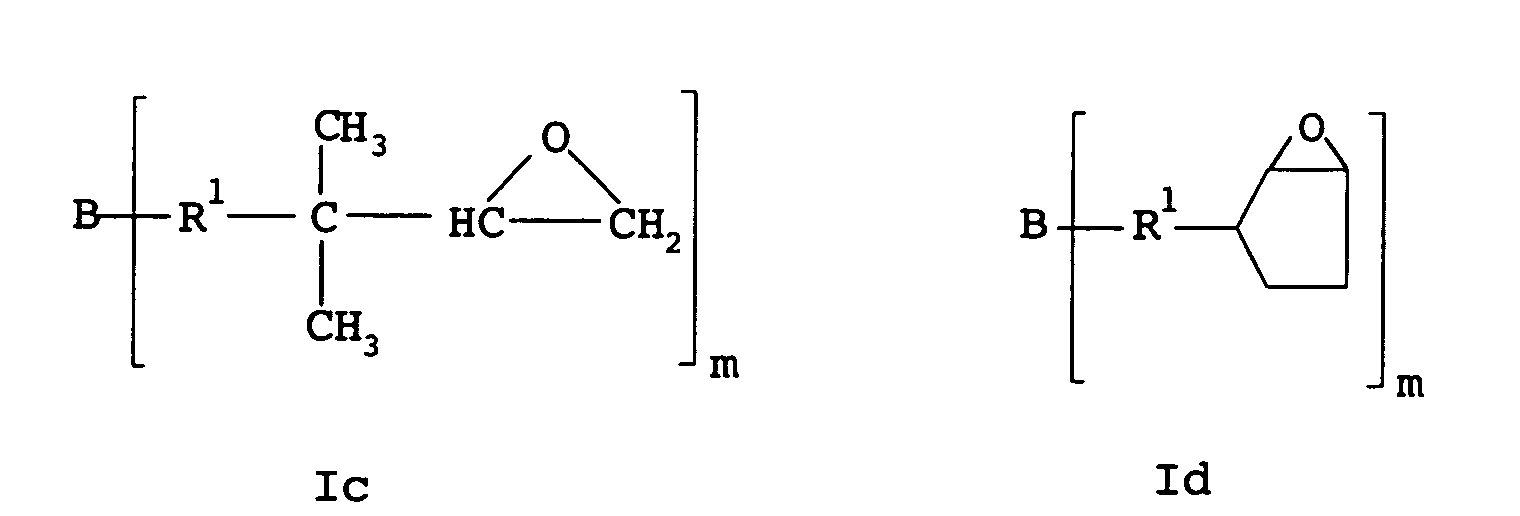
- the polyisobutene epoxide preferably has one of the formulas Ia to Id where A is hydrogen or the rest of an Inif molecule, B is chlorine or the rest of a coupling agent, R 1 is a chain containing isobutene units, R 2 is hydrogen or methyl and m is an integer from 1 to 6, preferably 1 , 2 or 3.
- the polyisobutene epoxide preferably has a molecular weight from 200 to 50,000, preferably 1,000 to 10,000.
- the invention also relates to the polyisobutenyl (thio) ether, which can be obtained by the above procedure.
- the method according to the invention can be used for a variety of purposes find, e.g. B. for networking telechelic or star-shaped Polyisobutene epoxides, either by direct reaction of the terminal ones Epoxy groups with one another and / or by reaction of the terminal epoxy groups with added poly (thiols); for functionalization or modification of cationically polymerizable Epoxy resins with polyisobutenyl radicals, where poly (thi) ole as Hardening agents may be present; or for the production of polyisobutenyl ether (thio) alcohols, the z. B. as a starter for production of polyoxyalkylene oxides.
- B. for networking telechelic or star-shaped Polyisobutene epoxides, either by direct reaction of the terminal ones Epoxy groups with one another and / or by reaction of the terminal epoxy groups with added poly (thiols); for functionalization or modification of cationically polymerizable Epoxy resins with polyisobuten
- the Lewis acidic compound is generally selected from halides and sulfonates such as triflates, boron, aluminum, gallium, antimony, titanium, tin, vanadium, iron and rare earth metals.
- halides and sulfonates such as triflates, boron, aluminum, gallium, antimony, titanium, tin, vanadium, iron and rare earth metals.
- aluminum the monoalkyl aluminum dichlorides or dialkyl aluminum chlorides are also suitable.
- Boron trifluoride, boron trichloride, aluminum chloride, iron trichloride and titanium tetrachloride are preferred.
- complexes of Lewis acids with ethers, phenols or alcohols for example BF 3 .2 C 6 H 5 OH or BF 3 .2 (C 2 H 5) 2 O, can be used.
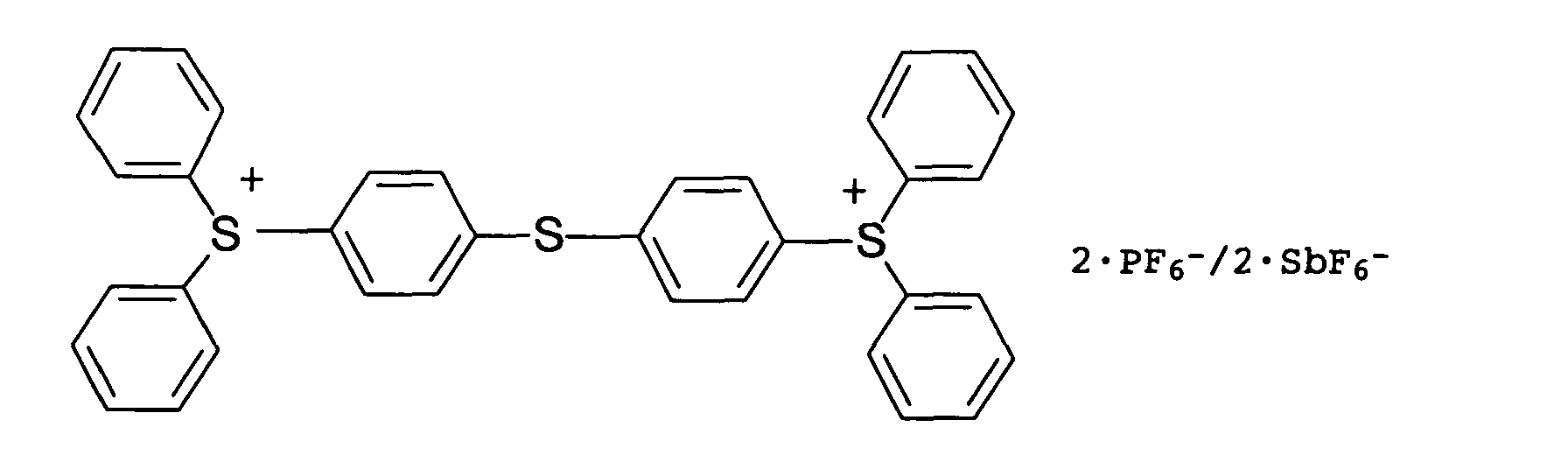
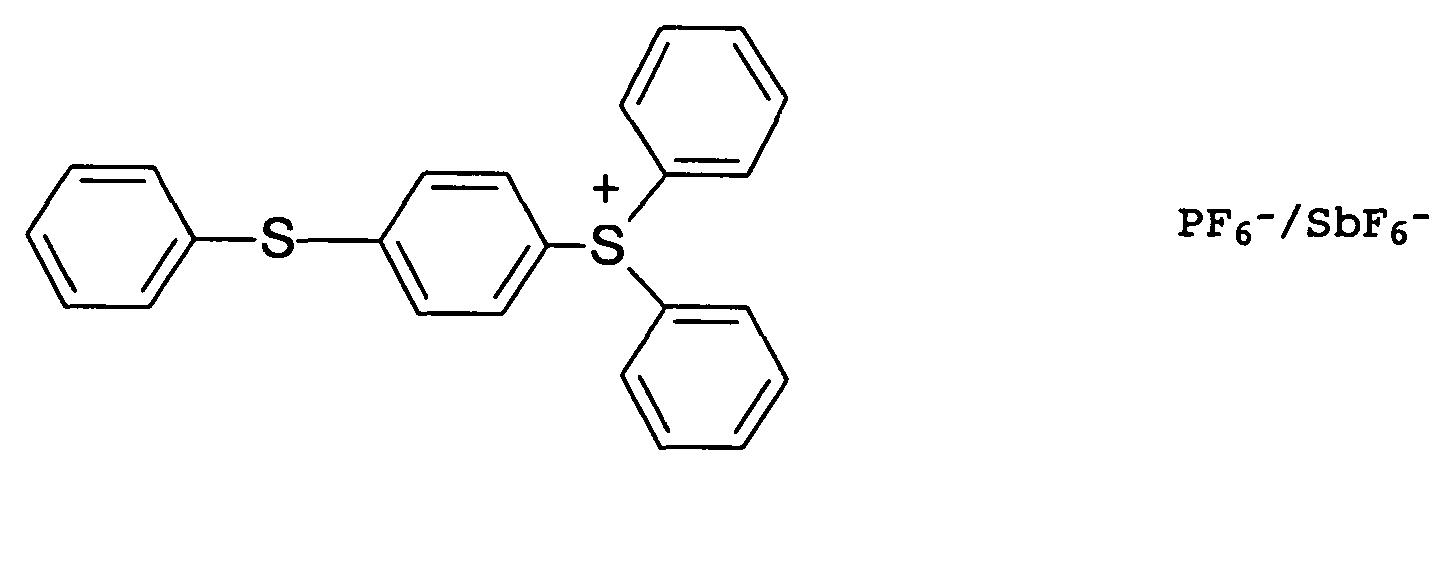
- Cationic photoinitiators are known and are e.g. B. used for curing epoxy resins.
- Typical cationic photoinitiators are onium salts, ferrocenium salts or diazonium salts.
- Preferred onium salts are selected from sulfonium and iodonium salts, e.g. B. triarylsulfonium salts or diaryliodonium salts.
- the counterions of the onium salts, ferrocenium salts or diazonium salts are non-nucleophilic anions, such as tetrafluoroborate, tetrakis (pentafluorophenyl) borate, hexafluorophosphate or hexafluoroantimonate.
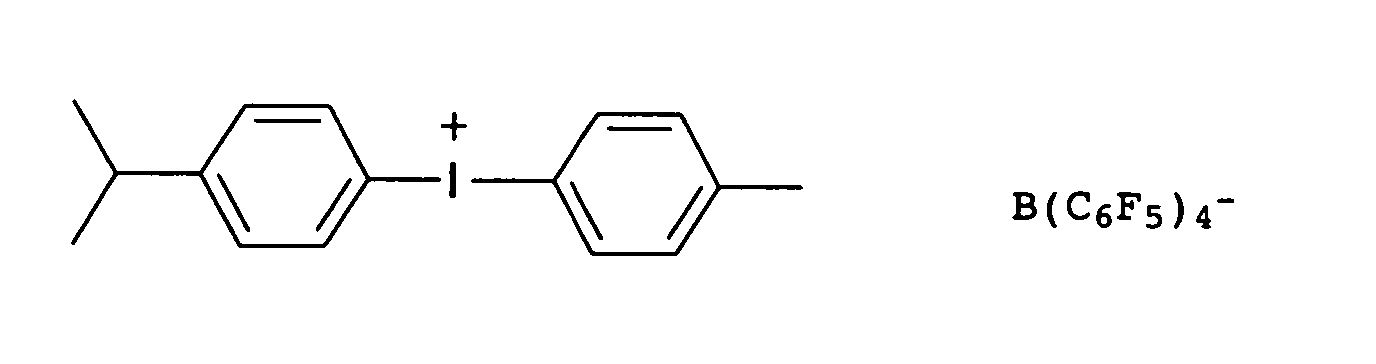
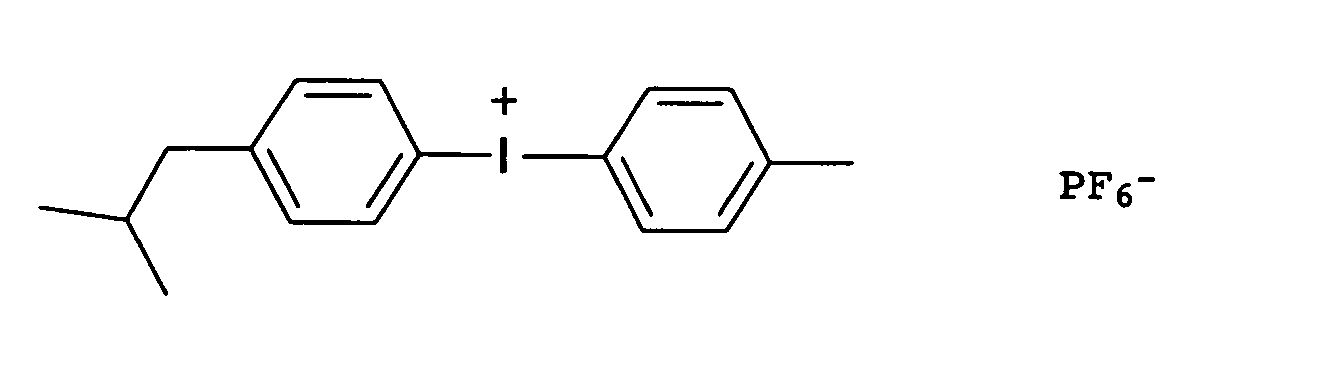
- Suitable commercially available cationic photoinitiators are e.g. B. the following
- the onium salts When exposed to light, the onium salts lead to the formation of superacids, which catalyze the ring opening of the polyisobutene epoxide.
- the exposure can be by means of UV light, visible light, electron beam or gamma radiation. Regarding the conditions are generally suitable for those who are cationic Polymerization of epoxy resins can be used.
- Polyisobutene epoxides with terminal epoxy groups are known. They are made by epoxidation of polyisobutenes via terminal olefinic double bonds (e.g. in the form of terminal Allyl, vinylidene, dimethylvinyl or cyclopentyl groups), using known epoxidation reagents, such as peracetic acid, m-chloroperbenzoic acid or hydroperoxides, and if necessary Epoxidation catalysts in an inert solvent or preserved in substance, cf. e.g. G. Dittius in Houbel-Weyl, Vol. 6/3, 4th edition, p. 385, G. Thieme Verlag Stuttgart 1965, or D.
- the polyisobutenes used can be obtained by known processes by cationic polymerization of isobutene, a double bond remaining in the monomer last incorporated after the polymer chain has been terminated, cf. z. B. DE-A 27 02 604 and EP-A 0 145 235.
- Terminal unsaturation polyisobutenes can also be prepared by living cationic polymerization of isobutene, such as that described in e.g. B. in "Carbocationic Macromolecular Engineering", Kennedy and Ivan, Hauser Publishers, 1992, or EP-A 713 883.
- the polymerization is carried out by suitable starter molecules (Inifer), usually organic tertiary halides such as. B. meta- or para-dicumyl chloride, and a Lewis acid such as. B. Titanium tetrachloride initiated.
- the inifer can be chosen so that polymer chains grow in one or more directions by the addition of isobutene molecules, so that linear or star-shaped polymers are obtained.
- the inifer is generally a molecule of the formula wherein Y is halogen, preferably chlorine or bromine, C 1 -C 6 alkoxy or C 1 -C 6 alkylcarbonyloxy and p is 1, 2 or 3.
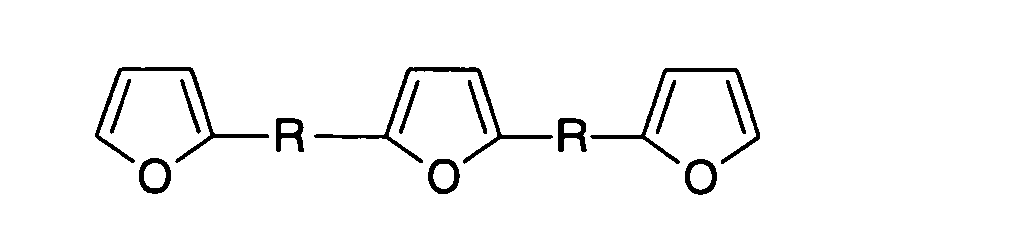
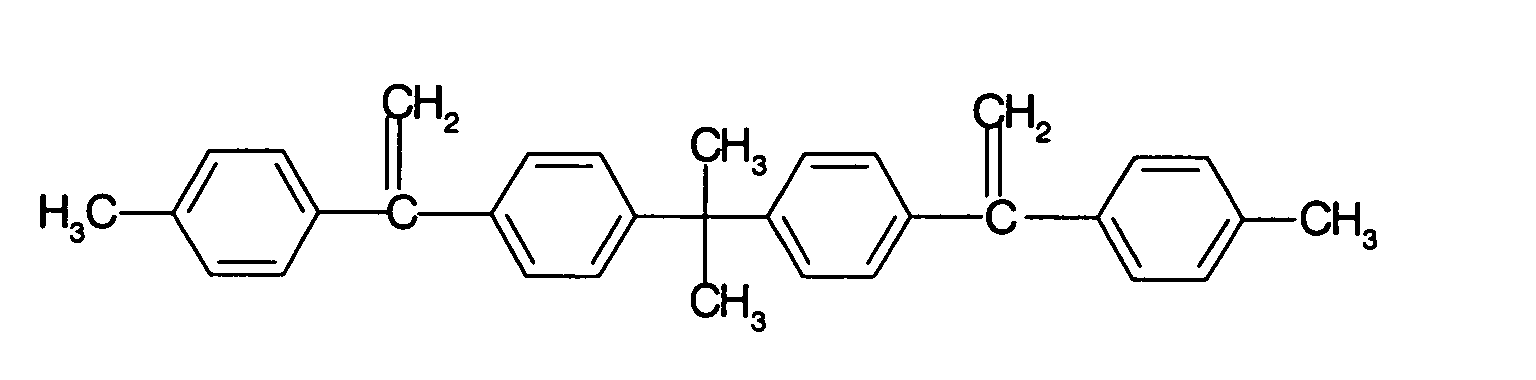
- Suitable coupling agents are e.g. B. the following: wherein R is methylene or 2,2-propanediyl; or
- the alcohol or thiol used is not subject to any particular restrictions, groups with nucleophilicity higher than those of the hydroxyl or mercapto group being generally absent or being suitably protected for the reaction with the polyisobutene epoxide.
- the alcohol or the thiol can have, for example, the general formulas R 3 -OH or R 3 -SH, where R 3 is C 1 -C 100 -alkyl, preferably C 1 -C 18 -alkyl, which may be replaced by one or more under O and S is interrupted selected groups, C 7 -C 18 aralkyl, C 3 -C 18 alkenyl, C 6 -C 12 aryl, C 5 -C 12 cycloalkyl, in which one or two carbon atoms are optionally substituted by O and / or S are replaced, are heterocyclyl or heterocyclyl-C 1 -C 8 -alkyl.
- the radicals mentioned can be one or more, usually one to three, substituents selected from hydroxy, C 1 -C 8 -alkoxy, phenoxy, halogens, nitro, cyano, C 1 -C 8 -alkylcarbonyl, C 1 -C 8 -alkyloxycarbonyl wear.
- Heterocyclyl is preferably a five- to six-membered heterocycle containing one to three oxygen, nitrogen and / or sulfur atoms, which is optionally benzanellated, such as furyl, thiophenyl, pyrryl, pyridyl, indolyl, benzoxazolyl, dioxolyl, dioxyl, benzimidazolyl, benzothiazolyl Dimethylpyridyl, methylquinolyl, dimethylpyrryl, methoxyfuryl, dimethoxypyridyl, difluoropyridyl.
- Heterocyclyl-C 1 -C 8 alkyl is, for example, furfuryl.
- Suitable alcohols are e.g. B. methanol, ethanol, isopropanol, Fatty alcohols, alkoxylated fatty alcohols, phenol, benzyl alcohol or furfuryl alcohol.
- Suitable thiols are e.g. B. thioglycolic acid esters, methylthiol, Ethyl thiol, n-propyl thiol, t-butyl thiol, cyclohexyl thiol. Further suitable thiols can be found in Ullmann's Encyclopedia of Industrial Chemistry in the chapter "Thiols and Organic Sulfides”.
- poly (thiols) are preferred, i.e. H. alcohols or thiols which have at least two hydroxyl and / or mercapto groups include, such as ethylene glycol, diethylene glycol, higher Poly (oxyethylene) glycols, propane-1,2-diol, poly (oxypropylene) glycols, Propane-1,3-diol, butane-1,4-diol, poly (oxytetramethylene) glycols, Pentane-1,5-diol, hexane-1,6-diol, hexane-2,4,6-triol, glycerin, 1,1,1-trimethylolpropane, pentaerythritol, sorbitol, polyalkoxylated Glycerin, polyalkoxylated trimethylolpropane or Reaction products of caprolactone and polyols, or polyvalent Phenols such as resorcino
- the alcohol or thiol is usually in an amount of 0.75 to 2.5 mol, calculated as hydroxyl or mercapto groups per mol epoxy groups of the polyisobutene epoxide, or in a higher one Excess used.
- the epoxy group can be one Polyisobutene epoxy molecule when treated with a Lewis acid Compound or preferably with a cationic photoinitiator under exposure to the epoxy groups of other polyisobutene epoxy molecules react.
- This mechanism can be used Crosslinking of telechelic or star-shaped polyisobutene epoxides is used become.
- other epoxides optionally in Combination with poly (thi) ols as an epoxy curing agent when treated with a Lewis acidic compound or preferably with a cationic photoinitiator under exposure a cationic cooligomerization.
- This mechanism can be used Property modification of epoxy resins can be used.
- Suitable epoxides are aliphatic and cycloaliphatic epoxides such as B. 1,2-epoxydodecane, epichlorohydrin, isoamylene oxide, ⁇ -pinene oxide, Styrene oxide, epoxidized soybean oil or lime monoxide.
- Epoxy compounds with at least two epoxy groups are also suitable in the molecule as well as its result from pre-extension Extension products (prepolymers for epoxy resins, such as z. B. in Ullmann's Encyclopedia of Industrial Chemistry, 6th Edition, 2000, Electronic Release, described in the chapter “Epoxy Resins” are).
- the molar ratio of polyisobutene epoxide to other Epoxy can be varied in a wide range and is z. B. in the range of 1:99 to 95: 5, preferably 5:95 to 50:50, each calculated as epoxy group equivalents.
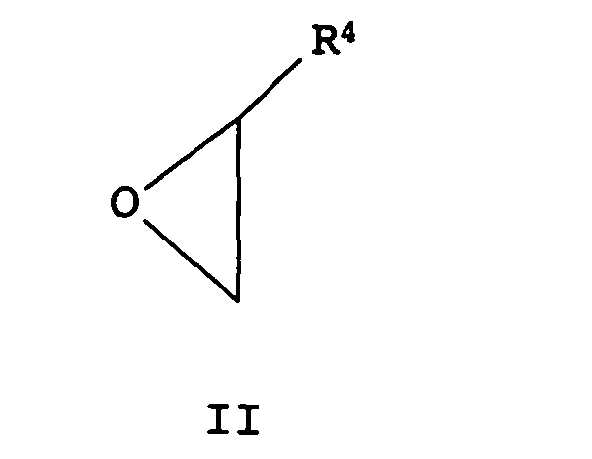
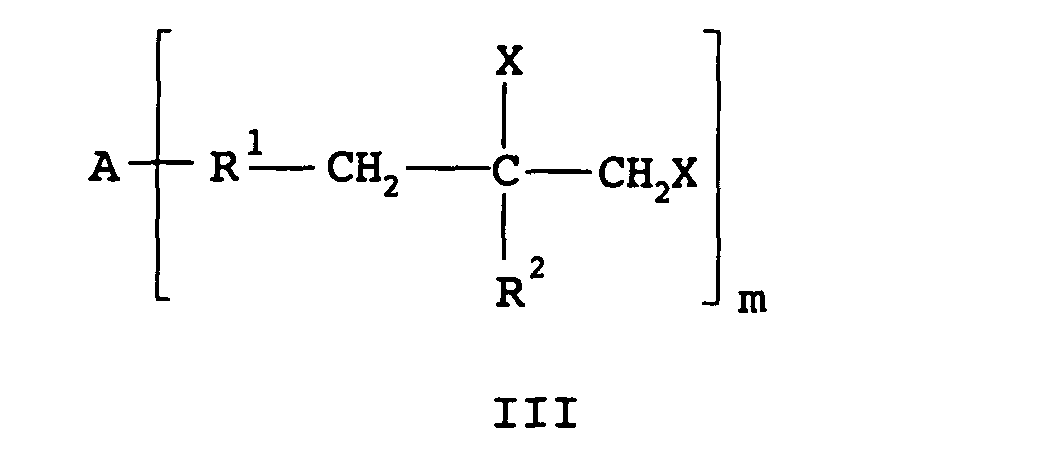
- the structure of the reaction products obtained can be exemplified by the reaction product of a polyisobutene epoxide of the formula Ia and an epoxide of the formula II can be illustrated as follows: wherein one of the radicals X is OH and the other radical X is a radical of the formula stands in which A, R 1 , R 2 and m have the meaning already given, R 4 for the rest of the epoxide and R 5 for a terminating group, for. B. fluorine, hydroxy or OR 3 (in which R 3 has the meaning given above), and n stands for an integer and z. B. is in the range of 1 to 20.
- the process according to the invention can be carried out in bulk or in excess of the alcohol used or a solvent be that is inert under the reaction conditions.
- suitable examples of solvents are acyclic ethers such as diethyl ether, Methyl tert-butyl ether, dimethoxyethane, diethylene glycol dimethyl ether, Triethylene glycol dimethyl ether, cyclic ether such as tetrahydrofuran or dioxane and aliphatic or aromatic Hydrocarbons such as hexane or toluene or mixtures thereof.
- solvents are suitable that are based on the cationic Participate in polymerization, such as propylene carbonate.
- the reaction temperature is usually between the melting and Boiling point of the reaction mixture, preferably in the range from 0 up to 140 ° C, especially 15 to 80 ° C.
- One embodiment of the invention is a curable composition which has at least one terminal epoxy group Polyisobutene epoxide, a different epoxy, preferably an epoxy compound with at least two epoxy groups in the molecule, and optionally a poly (thi) ol.
- the composition is in contact with a Lewis acidic compound brought.
- the composition contains a cationic Photoinitiator, the curing of the composition by Exposure is done.
- the curable composition can be in the usual Wise auxiliaries, e.g. B. mineral or fibrous fillers, such as calcium carbonate, mica, kaolin, aluminum oxide, soot, Silicic acid, carbon fibers, glass fibers or textile fibers.
- polyisobutenyl (thio) ethers obtained are suitable for many Applications, e.g. B. as macromers, adhesives and sealants or Starter for polyalkylene oxides.
Landscapes
- Chemical & Material Sciences (AREA)
- Health & Medical Sciences (AREA)
- Chemical Kinetics & Catalysis (AREA)
- Medicinal Chemistry (AREA)
- Polymers & Plastics (AREA)
- Organic Chemistry (AREA)
- General Chemical & Material Sciences (AREA)
- Epoxy Resins (AREA)
Abstract
Description
- a) einer Lewis-sauren Verbindung, und/oder
- b) eines kationischen Photoinitiators unter Belichtung.




Die Glycidylether können sich auch von einkernigen Phenolen wie Resorcin oder Hydrochinon, oder mehrkernigen Phenolen, wie Bis(4-hydroxyphenyl)methan, 4,4'-Dihydroxybiphenyl Bis(4-hydroxyphenyl)sulfon, 1,1,2,2-Tetrakis(4-hydroxyphenyl)ethan, 2,2-Bis(4-hydroxyphenyl)propan, 2,2-Bis(3,5-dibrom-4-hydroxyphenyl)propan oder von Novolaken, die erhältlich sind durch Kondensation von Aldehyden wie Formaldehyd, Acetaldehyd, Chloral oder Furfural, mit Phenolen, wie Phenol, 4-Chlorphenol, 2-Methylphenol, 4-tert-Butylphenol, oder Bisphenolen.

Claims (9)
- Verfahren zur Herstellung von Polyisobutenyl(thio)ethern durch Umsetzung eines wenigstens eine terminale Epoxidgruppe aufweisenden Polyisobutenepoxids mitunter Katalysei) sich selbst,ii) anderen Epoxiden, und/oderiii) unter Alkoholen und Thiolen ausgewählten Nucleophilen,a) einer Lewis-sauren Verbindung, und/oderb) eines kationischen Photoinitiators unter Belichtung.
- Verfahren nach Anspruch 1, wobei das Polyisobutenepoxid eine der Formeln Ia bis Id aufweist
 worin A für Wasserstoff oder den Rest eines Inifermoleküls steht, B für Chlor oder den Rest eines Kopplungsmittels steht, R1 für eine Isobuteneinheiten aufweisende Kette steht, R2 für Wasserstoff oder Methyl steht und m für eine ganze Zahl von 1 bis 6, vorzugsweise 1, 2 oder 3, steht.
- Verfahren nach Anspruch 1 oder 2, wobei die Lewis-saure Verbindung unter Halogeniden und Sulfonaten des Bors, Aluminiums, Galliums, Antimons, Titans, Zinns, Vanadiums, Eisens und der Seltenerdmetalle ausgewählt ist.
- Verfahren nach Anspruch 3, wobei die Lewis-saure Verbindung unter Bortrifluorid, Bortrichlorid, Aluminiumchlorid, Eisentrichlorid und Titantetrachlorid ausgewählt ist.
- Verfahren nach Anspruch 1 oder 2, wobei der kationische Photoinitiator unter Sulfonium- und Iodonium-Salzen ausgewählt ist.
- Verfahren nach einem der vorhergehenden Ansprüche, wobei der Alkohol oder das Thiol wenigstens zwei Hydroxyl- und/oder Mercaptogruppen umfasst.
- Polyisobutenyl(thio)ether, erhältlich nach dem Verfahren nach einem der Ansprüche 1 bis 6.
- Polyisobutenyl(thio)ether nach Anspruch 7, erhältlich aus einem Polyisobutenepoxid der Formel Id gemäß Anspruch 2.
- Härtbare Zusammensetzung, umfassendi) ein wenigstens eine terminale Epoxidgruppe aufweisendes Polyisobutenepoxid,ii) ein davon verschiedenes Epoxid, undiii) gegebenenfalls ein Poly(thi)ol.
Applications Claiming Priority (2)
| Application Number | Priority Date | Filing Date | Title |
|---|---|---|---|
| DE10254924 | 2002-11-25 | ||
| DE10254924A DE10254924A1 (de) | 2002-11-25 | 2002-11-25 | Polyisobutenylether und-thioether |
Publications (2)
| Publication Number | Publication Date |
|---|---|
| EP1422246A2 true EP1422246A2 (de) | 2004-05-26 |
| EP1422246A3 EP1422246A3 (de) | 2004-10-13 |
Family
ID=32185941
Family Applications (1)
| Application Number | Title | Priority Date | Filing Date |
|---|---|---|---|
| EP03026650A Withdrawn EP1422246A3 (de) | 2002-11-25 | 2003-11-19 | Polyisobutenylether und -thioether |
Country Status (3)
| Country | Link |
|---|---|
| US (1) | US6958382B2 (de) |
| EP (1) | EP1422246A3 (de) |
| DE (1) | DE10254924A1 (de) |
Cited By (1)
| Publication number | Priority date | Publication date | Assignee | Title |
|---|---|---|---|---|
| WO2014064151A1 (de) | 2012-10-23 | 2014-05-01 | Basf Se | Quaternisierte ammoniumsalze von hydrocarbylepoxiden und deren verwendung als additive in kraft- und schmierstoffen |
Families Citing this family (2)
| Publication number | Priority date | Publication date | Assignee | Title |
|---|---|---|---|---|
| WO2005086911A2 (en) * | 2004-03-09 | 2005-09-22 | The Regents Of The University Of Colorado | Reactive oligomeric thiol and ene materials as dental restorative mixtures |
| EP1810294B1 (de) | 2004-11-09 | 2018-11-28 | Thomson Licensing | Verknüpfung von inhalten auf separaten speichermedien |
Family Cites Families (11)
| Publication number | Priority date | Publication date | Assignee | Title |
|---|---|---|---|---|
| DE410180C (de) * | 1920-12-13 | 1925-03-02 | Gualtiero Poma | Verfahren zur Reduktion organischer oder anorganischer Stoffe durch Natriumamalgam |
| US3917496A (en) | 1971-03-12 | 1975-11-04 | United Technologies Corp | Propellant compositions containing epoxy functional polymer having a saturated backbone |
| FR2630449B1 (fr) | 1988-04-26 | 1992-03-20 | Bp Chimie Sa | Nouveau produit d'addition entre un thiol et un polybutene comportant une double liaison carbone-carbone et procede de preparation |
| US5057617A (en) | 1988-11-07 | 1991-10-15 | Exxon Chemical Patents Inc. | Dispersant additives prepared from monoepoxy thiols |
| US5008338A (en) | 1989-01-31 | 1991-04-16 | Amoco Corporation | Hydroxyethers of epoxidized polybutenes |
| DE3923527A1 (de) | 1989-07-15 | 1991-01-24 | Basf Ag | Modifiziertes polyisobuten |
| CA2022858A1 (en) | 1989-08-31 | 1991-03-01 | Joanna K. Money | Epoxy resins containing epoxidized polybutenes |
| US5225486A (en) * | 1989-08-31 | 1993-07-06 | Amoco Corporation | Epoxy resins containing epoxidized polybutenes |
| DE4030164A1 (de) | 1990-09-24 | 1992-03-26 | Basf Ag | Kraftstoffe fuer verbrennungsmotoren und schmierstoffe enthaltende hochmolekulare aminoalkohole |
| US5977255A (en) * | 1997-10-06 | 1999-11-02 | Dow Corning Corporation | Glycidoxy-functional polymer cured with amine-functional organosilicon compound |
| US6303703B1 (en) | 1999-04-15 | 2001-10-16 | Ferro Corporation | Method for making monoamines |
-
2002
- 2002-11-25 DE DE10254924A patent/DE10254924A1/de not_active Withdrawn
-
2003
- 2003-11-03 US US10/698,457 patent/US6958382B2/en not_active Expired - Fee Related
- 2003-11-19 EP EP03026650A patent/EP1422246A3/de not_active Withdrawn
Cited By (3)
| Publication number | Priority date | Publication date | Assignee | Title |
|---|---|---|---|---|
| WO2014064151A1 (de) | 2012-10-23 | 2014-05-01 | Basf Se | Quaternisierte ammoniumsalze von hydrocarbylepoxiden und deren verwendung als additive in kraft- und schmierstoffen |
| US10173963B2 (en) | 2012-10-23 | 2019-01-08 | Basf Se | Quaternized ammonium salts of hydrocarbyl epoxides and use thereof as additives in fuels and lubricants |
| US10689326B2 (en) | 2012-10-23 | 2020-06-23 | Basf Se | Quaternized ammonium salts of hydrocarbyl epoxides and use thereof as additives in fuels and lubricants |
Also Published As
| Publication number | Publication date |
|---|---|
| DE10254924A1 (de) | 2004-06-03 |
| EP1422246A3 (de) | 2004-10-13 |
| US6958382B2 (en) | 2005-10-25 |
| US20040102653A1 (en) | 2004-05-27 |
Similar Documents
| Publication | Publication Date | Title |
|---|---|---|
| EP0271442B1 (de) | Multifunktionelle Epoxidharze | |
| DE69519832T2 (de) | Verfahren zur Polyetherreinigung | |
| EP0022073B1 (de) | Diglycidyläther von di-sekundären Alkoholen, ihre Herstellung und Verwendung | |
| US11440995B2 (en) | Method for preparing aliphatic polythioether | |
| EP0204659B1 (de) | Polyepoxide und deren Verwendung | |
| DE10211664A1 (de) | Verfahren zur Herstellung hochverzweigter Polymere | |
| EP0091883A1 (de) | Vorverlängerungskatalysatoren für Epoxidharze | |
| DE2609474A1 (de) | Epoxyharz-zusammensetzungen | |
| DE2448168C3 (de) | Härtbare Epoxyharz-Zusammensetzung und Verfahren zu ihrer Herstellung | |
| EP2459619B1 (de) | Schlagzähmodifizierte zusammensetzungen | |
| DE1966703B2 (de) | Langkettige, aliphatische oder cycloaliphatische Säurereste enthaltende Diglycidylester | |
| EP0064945B1 (de) | Heisspolymerisierbare Massen | |
| EP0205402A2 (de) | 2,6-Disubstituierte 4-Epoxypropylphenylglycidylether und deren Verwendung | |
| DE10254924A1 (de) | Polyisobutenylether und-thioether | |
| EP0231149B1 (de) | Mercaptan enthaltende Polyphenole | |
| US5008338A (en) | Hydroxyethers of epoxidized polybutenes | |
| DE69332815T2 (de) | Polyglyzidyl-Äthern und ihre Verwendung | |
| DE2030137A1 (de) | Neue Esterather | |
| EP0243318B1 (de) | Epoxidgruppenhaltige Phenolether | |
| DE69625640T2 (de) | Modifizierte Polyamine, ihre Verwendung als Härtungsmittel für wässrige Epoxidharze, Verfahren für ihre Herstellung | |
| DE2147899A1 (de) | Neue Polyglycidylverbindungen, Verfahren zu ihrer Herstellung und Anwendung | |
| JPS6312094B2 (de) | ||
| EP1620484B1 (de) | Verfahren zur herstellung von präpolymeren auf der basis von polysulfiden und polyepoxiden | |
| DE69323449T2 (de) | Verfahren zur Herstellung ethylenisch ungesättigter, pfropfbarer Orthoester | |
| CA1105042A (en) | Epoxy resins and process for producing the same |
Legal Events
| Date | Code | Title | Description |
|---|---|---|---|
| PUAI | Public reference made under article 153(3) epc to a published international application that has entered the european phase |
Free format text: ORIGINAL CODE: 0009012 |
|
| AK | Designated contracting states |
Kind code of ref document: A2 Designated state(s): AT BE BG CH CY CZ DE DK EE ES FI FR GB GR HU IE IT LI LU MC NL PT RO SE SI SK TR |
|
| AX | Request for extension of the european patent |
Extension state: AL LT LV MK |
|
| PUAL | Search report despatched |
Free format text: ORIGINAL CODE: 0009013 |
|
| AK | Designated contracting states |
Kind code of ref document: A3 Designated state(s): AT BE BG CH CY CZ DE DK EE ES FI FR GB GR HU IE IT LI LU MC NL PT RO SE SI SK TR |
|
| AX | Request for extension of the european patent |
Extension state: AL LT LV MK |
|
| 17P | Request for examination filed |
Effective date: 20050413 |
|
| AKX | Designation fees paid |
Designated state(s): AT BE BG CH CY CZ DE DK EE ES FI FR GB GR HU IE IT LI LU MC NL PT RO SE SI SK TR |
|
| 17Q | First examination report despatched |
Effective date: 20061206 |
|
| RAP1 | Party data changed (applicant data changed or rights of an application transferred) |
Owner name: BASF SE |
|
| STAA | Information on the status of an ep patent application or granted ep patent |
Free format text: STATUS: THE APPLICATION IS DEEMED TO BE WITHDRAWN |
|
| 18D | Application deemed to be withdrawn |
Effective date: 20100324 |