EP0243318B1 - Epoxidgruppenhaltige Phenolether - Google Patents
Epoxidgruppenhaltige Phenolether Download PDFInfo
- Publication number
- EP0243318B1 EP0243318B1 EP87810247A EP87810247A EP0243318B1 EP 0243318 B1 EP0243318 B1 EP 0243318B1 EP 87810247 A EP87810247 A EP 87810247A EP 87810247 A EP87810247 A EP 87810247A EP 0243318 B1 EP0243318 B1 EP 0243318B1
- Authority
- EP
- European Patent Office
- Prior art keywords
- formula
- compound
- radical
- group
- hydrogen
- Prior art date
- Legal status (The legal status is an assumption and is not a legal conclusion. Google has not performed a legal analysis and makes no representation as to the accuracy of the status listed.)
- Expired - Lifetime
Links
Classifications
-
- C—CHEMISTRY; METALLURGY
- C08—ORGANIC MACROMOLECULAR COMPOUNDS; THEIR PREPARATION OR CHEMICAL WORKING-UP; COMPOSITIONS BASED THEREON
- C08G—MACROMOLECULAR COMPOUNDS OBTAINED OTHERWISE THAN BY REACTIONS ONLY INVOLVING UNSATURATED CARBON-TO-CARBON BONDS
- C08G59/00—Polycondensates containing more than one epoxy group per molecule; Macromolecules obtained by polymerising compounds containing more than one epoxy group per molecule using curing agents or catalysts which react with the epoxy groups
- C08G59/18—Macromolecules obtained by polymerising compounds containing more than one epoxy group per molecule using curing agents or catalysts which react with the epoxy groups ; e.g. general methods of curing
-
- H—ELECTRICITY
- H01—ELECTRIC ELEMENTS
- H01B—CABLES; CONDUCTORS; INSULATORS; SELECTION OF MATERIALS FOR THEIR CONDUCTIVE, INSULATING OR DIELECTRIC PROPERTIES
- H01B3/00—Insulators or insulating bodies characterised by the insulating materials; Selection of materials for their insulating or dielectric properties
- H01B3/18—Insulators or insulating bodies characterised by the insulating materials; Selection of materials for their insulating or dielectric properties mainly consisting of organic substances
- H01B3/30—Insulators or insulating bodies characterised by the insulating materials; Selection of materials for their insulating or dielectric properties mainly consisting of organic substances plastics; resins; waxes
- H01B3/40—Insulators or insulating bodies characterised by the insulating materials; Selection of materials for their insulating or dielectric properties mainly consisting of organic substances plastics; resins; waxes epoxy resins
-
- C—CHEMISTRY; METALLURGY
- C08—ORGANIC MACROMOLECULAR COMPOUNDS; THEIR PREPARATION OR CHEMICAL WORKING-UP; COMPOSITIONS BASED THEREON
- C08G—MACROMOLECULAR COMPOUNDS OBTAINED OTHERWISE THAN BY REACTIONS ONLY INVOLVING UNSATURATED CARBON-TO-CARBON BONDS
- C08G59/00—Polycondensates containing more than one epoxy group per molecule; Macromolecules obtained by polymerising compounds containing more than one epoxy group per molecule using curing agents or catalysts which react with the epoxy groups
- C08G59/02—Polycondensates containing more than one epoxy group per molecule
-
- C—CHEMISTRY; METALLURGY
- C08—ORGANIC MACROMOLECULAR COMPOUNDS; THEIR PREPARATION OR CHEMICAL WORKING-UP; COMPOSITIONS BASED THEREON
- C08G—MACROMOLECULAR COMPOUNDS OBTAINED OTHERWISE THAN BY REACTIONS ONLY INVOLVING UNSATURATED CARBON-TO-CARBON BONDS
- C08G59/00—Polycondensates containing more than one epoxy group per molecule; Macromolecules obtained by polymerising compounds containing more than one epoxy group per molecule using curing agents or catalysts which react with the epoxy groups
- C08G59/02—Polycondensates containing more than one epoxy group per molecule
- C08G59/04—Polycondensates containing more than one epoxy group per molecule of polyhydroxy compounds with epihalohydrins or precursors thereof
- C08G59/06—Polycondensates containing more than one epoxy group per molecule of polyhydroxy compounds with epihalohydrins or precursors thereof of polyhydric phenols
- C08G59/08—Polycondensates containing more than one epoxy group per molecule of polyhydroxy compounds with epihalohydrins or precursors thereof of polyhydric phenols from phenol-aldehyde condensates
-
- C—CHEMISTRY; METALLURGY
- C08—ORGANIC MACROMOLECULAR COMPOUNDS; THEIR PREPARATION OR CHEMICAL WORKING-UP; COMPOSITIONS BASED THEREON
- C08G—MACROMOLECULAR COMPOUNDS OBTAINED OTHERWISE THAN BY REACTIONS ONLY INVOLVING UNSATURATED CARBON-TO-CARBON BONDS
- C08G59/00—Polycondensates containing more than one epoxy group per molecule; Macromolecules obtained by polymerising compounds containing more than one epoxy group per molecule using curing agents or catalysts which react with the epoxy groups
- C08G59/18—Macromolecules obtained by polymerising compounds containing more than one epoxy group per molecule using curing agents or catalysts which react with the epoxy groups ; e.g. general methods of curing
- C08G59/20—Macromolecules obtained by polymerising compounds containing more than one epoxy group per molecule using curing agents or catalysts which react with the epoxy groups ; e.g. general methods of curing characterised by the epoxy compounds used
- C08G59/32—Epoxy compounds containing three or more epoxy groups
- C08G59/3218—Carbocyclic compounds
-
- C—CHEMISTRY; METALLURGY
- C08—ORGANIC MACROMOLECULAR COMPOUNDS; THEIR PREPARATION OR CHEMICAL WORKING-UP; COMPOSITIONS BASED THEREON
- C08G—MACROMOLECULAR COMPOUNDS OBTAINED OTHERWISE THAN BY REACTIONS ONLY INVOLVING UNSATURATED CARBON-TO-CARBON BONDS
- C08G59/00—Polycondensates containing more than one epoxy group per molecule; Macromolecules obtained by polymerising compounds containing more than one epoxy group per molecule using curing agents or catalysts which react with the epoxy groups
- C08G59/18—Macromolecules obtained by polymerising compounds containing more than one epoxy group per molecule using curing agents or catalysts which react with the epoxy groups ; e.g. general methods of curing
- C08G59/20—Macromolecules obtained by polymerising compounds containing more than one epoxy group per molecule using curing agents or catalysts which react with the epoxy groups ; e.g. general methods of curing characterised by the epoxy compounds used
- C08G59/32—Epoxy compounds containing three or more epoxy groups
- C08G59/38—Epoxy compounds containing three or more epoxy groups together with di-epoxy compounds
Definitions
- the present invention relates to new phenol ethers containing epoxy groups, curable mixtures containing such epoxy compounds, the preparation of these compounds and their use for producing hardened products, in particular for coating electronic components.
- Bisphenol-based glycidyl ethers or epoxidized novolaks are known. As a rule, such compounds are prepared by reacting the corresponding phenols with halohydrins, in particular with epichlorohydrin.
- JP-OS 60-60,123 describes the epoxidation of novolak allyl ethers in a two-phase system. Hydrogen peroxide is used as the oxidizing agent. The reaction is carried out in the presence of a catalyst system composed of quaternary ammonium salt, a vanadium, tungsten or molybdenum compound and a phosphorus compound.
- GB-PS 828,364 describes inter alia polyepoxides which are prepared by epoxidation of the diglycidyl ether of o, o,-diallyl-substituted bisphenol A with peracids. Due to the etherification stage with epichlorohydrin as the reagent, the compounds have a relatively high content of non-hydrolyzable, hydrolyzable or ionic chlorine.
- the invention relates to compounds of the formula I. wherein R1 is C1-C20alkyl, C5-C9cycloalkyl or C7-C14Aralkyl, R2 has one of the meanings of R1 or is additionally hydrogen or a radical of the formula II R3 is C1-C6alkyl or halogen, R4 and R5 independently are hydrogen or C1-C6alkyl, R6 is hydrogen or methyl, m is 0, 1 or 2 and n represents an integer from 0 to 30, with the proviso that at least two radicals R2 in compound I are an epoxy group of the formula II have to be.
- R1 as C1-C20alkyl is straight-chain or branched, but preferably straight-chain.
- radicals are methyl, ethyl, n-propyl, isopropyl, n-butyl, sec-butyl, tert-butyl, n-pentyl, hexyl, heptyl, octyl, 2-ethylhexyl, nonyl, decyl, dodecyl, tetradecyl, hexadecyl , Octadecyl or eicosyl.
- R1 is preferably straight-chain C1-C6alkyl and very particularly methyl.
- C5-C9cycloalkyl R1 is, for example, cyclopentyl, cyclohexyl, cycloheptyl, cyclooctyl or cyclononyl, but especially cyclohexyl.
- R1 as C7-C14 aralkyl examples include benzyl, ⁇ -methylbenzyl, ⁇ , ⁇ -dimethylbenzyl, ⁇ -ethylbenzyl or ⁇ , ⁇ -diethylbenzyl. Benzyl is preferred.
- straight-chain or branched alkyl radicals are meant, but preferably straight-chain radicals. Examples include methyl, ethyl, propyl, butyl, pentyl or hexyl. Methyl is particularly preferred.
- R3 as halogen can be fluorine, chlorine, bromine or iodine; it is preferably chlorine or bromine and in particular bromine.
- the index m determines whether other core substituents are present in addition to the ether group and the substituent R2.
- m is 0.
- Novolaks are also within the scope of the invention in which only a part of the nuclei, preferably more than 80% of the nuclei of a molecule, but at least two of them, carry an epoxy group.
- the epoxy propyl radical of the formula III is very particularly preferred as the epoxy group of the formula II which can be obtained by epoxidation of allyl groups.
- novolak ethers preferably from those with the index n of 1 to 20, in particular 3 to 20.
- novolak derivatives are generally mixtures of compounds of different degrees of condensation and thus of different chain lengths .
- the bridge -C (R4R5) - is preferably -CH2-, -CH (CH3) - or -C (CH3) 2-; R4 and R5 are therefore independently of one another preferably hydrogen or methyl.
- the radicals R2 and -C (R4R5) - are preferably in the non-terminal phenyl nuclei in the two ortho positions and the para position to the phenol ether group -OR1.
- the residues R3, if present, are in these cases in the meta position (s) to the residue -OR1.
- R2 is a radical of the formula II and is located in the ortho or para position to the radical -OR1.
- R1 is C1-C6alkyl or benzyl
- R2 is a group of the formula III and is in the ortho-position to the group -OR1
- R3 is C1-C4alkyl, chlorine or bromine
- m 0.1 or 2 and n represents an integer from 3 to 20.
- the compounds of formula I can be prepared by epoxidation of phenol ethers with alkenyl substituents.
- the epoxidation is usually carried out by converting the olefinic group using peracids. This process can be carried out without halogen-containing reagents, which results in very low-halogen products. Surprisingly, a product with a high degree of epoxidation is obtained, while no epoxide formation occurs during the epoxidation of the corresponding unetherified bisphenols or unetherified novolaks [cf. in addition SA Harrison et al. in Journal of Organic Chemistry, 27 , 3311 (1962)].
- DE-OS 2,630,107 describes the epoxidation of ethers of mononuclear o-allylphenols. The yields of epoxidized product are around 50% of theory. The epoxidation reaction in the corresponding multinuclear allyl compounds surprisingly gives higher yields.
- the starting materials of the formula IV are known or can be obtained by processes known per se.
- commercially available 2- (meth) allylphenol can be reacted in a manner known per se with aldehydes to give the corresponding novolaks of the formula IV.
- the compounds of the formula IV can also be obtained by Claisen rearrangement from bisphenol or novolak (meth) allyl ethers.
- the process variant in which the etherification reagent has no halogen as leaving group is very particularly preferred;
- an alkyl sulfate is used as an etherification reagent.
- the polyphenol IV can be reacted with the following reagents: alkyl halides, in particular methyl chloride, methyl bromide or methyl iodide, alkyl sulfates, in particular dimethyl sulfate or alkyl sulfonates, for example methyl p-toluenesulfonate.
- alkyl halides in particular methyl chloride, methyl bromide or methyl iodide
- alkyl sulfates in particular dimethyl sulfate or alkyl sulfonates, for example methyl p-toluenesulfonate.
- Percarboxylic acids are generally used as the epoxidation reagent of the olefinic group of the formula V.
- the peracids used for the epoxidation of the etherified compounds IV are primarily organic peracids, such as Performic acid, peracetic acid, succinic acid, perbenzoic acid, m-chloroperbenzoic acid and monoperphthalic acid.
- the organic peracids can be used as such or formed in situ, for example from aliphatic or aromatic carboxylic acids, carboxylic anhydrides, carboxylic esters, acid chlorides or ketene and hydrogen peroxide.
- the peracids For in-situ formation of the peracids, it is preferred to use aliphatic or aromatic mono- or dicarboxylic acids or their anhydrides, such as formic acid, acetic acid, propionic acid, succinic anhydride, benzoic acid, or phthalic acid, and hydrogen peroxide, optionally with the addition of acidic catalysts, such as sulfuric acid or alkali metal salts .
- acidic catalysts such as sulfuric acid or alkali metal salts .
- the epoxidation of the adducts is preferably carried out in the presence of preformed or in situ generated performic acid or peracetic acid.
- inorganic peracids such as permolybdic acid, pervanadic acid or tungsten acid can also be used.
- the epoxidizing agent (peracid) is advantageously used in an amount of at least 1 mol per (meth) allyl group present and preferably in excess, e.g. a 20-20
- etherification of the compounds IV and the epoxidation of the products is advantageously carried out in the presence of inert organic solvents and in the case of epoxidation, if appropriate with the addition of buffer substances such as sodium acetate or sodium hydrogen phosphate.
- Suitable solvents are, for example, optionally halogenated aliphatic or aromatic hydrocarbons, such as chloroform, dichloromethane, benzene, toluene and chlorobenzene, ether, such as diethyl ether, diisopropyl ether, dioxane and tetrahydrofuran, and also carboxylic acid alkyl esters, such as ethyl acetate and n-butyl ester.
- Halogenated, especially chlorinated aliphatic hydrocarbons are preferred as solvents; chloroform is particularly preferred.
- the reaction temperatures are generally between -10 and + 100 ° C, preferably between 10 and 60 ° C.
- the polyepoxides obtainable according to the invention are pure substances which are essentially free of chloride and alkali metal ions. They are suitable for the production of hardened products, e.g. for the coating of integrated circuits, for which products of high purity are required.
- any desired epoxy resin hardener is suitable as hardener (b), e.g. Cyanamide, dicyandiamide, polycarboxylic acids, polycarboxylic anhydrides, polyamines, polyaminoamides, adducts from amines and polyepoxides and polyols.
- Suitable polycarboxylic acids and their anhydrides are e.g. Phthalic anhydride or tetrahydro- and hexahydrophthalic anhydride, as well as the acids belonging to the above-mentioned anhydrides.
- polyamines which are suitable as curing agents are aliphatic, cycloaliphatic, aromatic and heterocyclic polyamines, such as hexamethylenediamine, diethylenetriamine, m-xylylenediamine, bis (4-amino-cyclohexyl) methane, m- and p-phenylenediamine, bis (4 -aminophenyl) methane, bis (4-aminophenyl) sulfone and aniline-formaldehyde resins.
- Suitable polyaminoamides are, for example, those made from aliphatic polyamines and dimerized or trimerized unsaturated fatty acids.
- Possible polyol hardeners (b) are, in particular, mono- or polynuclear aromatic polyols, including novolaks, such as resorcinol, hydroquinone, 2,6-dihydroxytoluene, pyrogallol, 1,1,3-tris (hydroxyphenyl) propane, bis (4- hydroxyphenyl) methane, 2,2-bis (4-hydroxyphenyl) propane, bis (4-hydroxyphenyl) sulfone and 4,4'-dihydroxybiphenyl as well as novolaks made from formaldehyde or acetaldehyde and phenol, chlorophenol or alkylphenols with up to 9 carbon atoms in the alkyl , especially cresol and phenol novolaks.
- novolaks such as resorcinol, hydroquinone, 2,6-dihydroxytoluene, pyrogallol, 1,1,3-tris (hydroxyphenyl) propane, bis (4- hydroxypheny
- Preferred hardeners are polycarboxylic acid anhydrides, such as tetrahydro-, hexahydrophthalic anhydride, and aromatic polyamines, especially bis (4-aminophenyl) methane, bis (4-aminophenyl) sulfone and m- or p-phenylenediamine, and very particularly polyol hardeners based on novolak, in particular cresol novolaks .
- the mixtures according to the invention can also contain other customary additives, in particular (c) an accelerator and / or (d) further epoxy resins.
- accelerators (c) Compounds known per se can also be used as accelerators (c). Examples include: complexes of amines, especially tertiary amines, such as monoethylamine with boron trifluoride or boron trichloride, tertiary amines, such as benzyldimethylamine; Urea derivatives, such as N-4-chlorophenyl-N ⁇ , N ⁇ -dimethylurea (monuron); optionally substituted imidazoles, such as imidazole or 2-phenylimidazole.
- Tertiary amines, especially benzyldimethylamine, and imidazoles, especially 2-phenylimidazole or 2-ethyl-4-methylimidazole are preferred as accelerators (c).
- epoxy resins (d) are primarily those with more than one average on a hetero atom, e.g. groups of the formula II bonded to an S and preferably to an O or N atom, as described in the foregoing.
- component (d) optionally pre-extended diglycidyl ethers of dihydric phenols or Cyclohexanols, especially 2,2-bis (4-hydroxyphenyl) propane, 2,2-bis (dibromo-4-hydroxyphenyl) propane, bis (4-hydroxyphenyl) methane, bis (4-hydroxycyclohexyl) methane or 2,2 -Bis (4-hydroxycyclohexyl) propane, polyglycidyl ether from novolaks, or tetraglycidylated 4,4'-diaminodiphenylmethane.
- 2,2-bis (4-hydroxyphenyl) propane 2,2-bis (dibromo-4-hydroxyphenyl) propane, bis (4-hydroxyphenyl) methane, bis (4-hydroxycyclohexyl) methane or 2,2 -Bis (4-hydroxycyclohexyl) propane
- polyglycidyl ether from novolaks or tetraglycidylated 4,4
- Pre-extended diglycidyl ethers of bisphenol A, tetrabromobisphenol A or bisphenol F, polyglycidyl ethers of phenol-formaldehyde or cresol-formaldehyde novolaks, or mixtures thereof, are particularly preferred.
- Components (b) and (c) are used in the usual effective, i.e. sufficient amounts are used for curing the mixtures according to the invention.
- the ratio of components (a), (b), (c) and optionally (d) depends on the nature of the compounds used, the required curing rate and the properties desired in the end product and can be easily carried out by a person skilled in the art of epoxy resin curing be determined.
- the curing agent (b) is an amine
- 0.75 to 1.25 equivalents of hydrogen amine are normally used per 1 epoxy equivalent.
- polycarboxylic acid or polycarboxylic acid anhydride hardeners 0.4 to 1.1 equivalents of carboxyl or anhydride groups are usually used per 1 epoxy equivalent.
- Accelerators (c) are generally used in amounts of 0.1 to 5 percent by weight, based on the epoxy resins (a) and optionally (d).
- the curable mixtures for reducing the viscosity can be reactive diluents, such as styrene oxide, butyl glycidyl ether, 2,2,4-trimethylpentyl glycidyl ether, phenyl glycidyl ether, cresyl glycidyl ether or glycidyl ester of synthetic, highly branched, mainly tertiary aliphatic, additional monocarboxylic acids.
- reactive diluents such as styrene oxide, butyl glycidyl ether, 2,2,4-trimethylpentyl glycidyl ether, phenyl glycidyl ether, cresyl glycidyl ether or glycidyl ester of synthetic, highly branched, mainly tertiary aliphatic, additional monocarboxylic acids.
- the mixtures according to the invention can also contain plasticizers, extenders, fillers and reinforcing agents, such as, for example, coal tar, bitumen, textile fibers, glass fibers, asbestos fibers, boron fibers, carbon fibers, mineral silicates, mica, quartz powder, aluminum oxide hydrate, concrete, kaolin, silica airgel or metal powder, for example aluminum powder or iron powder, furthermore pigments and dyes, such as carbon black, oxide paints and titanium dioxide, flame retardants, thixotropic agents, flow control agents, such as silicones, Waxes and stearates, some of which are also used as mold release agents, contain adhesion promoters, antioxidants and light stabilizers.
- plasticizers such as, for example, coal tar, bitumen, textile fibers, glass fibers, asbestos fibers, boron fibers, carbon fibers, mineral silicates, mica, quartz powder, aluminum oxide hydrate, concrete, kaolin, silica airgel or metal powder, for example aluminum powder or iron
- the mixtures according to the invention find e.g. Use as adhesives or for the production of hardened products, such as composite materials and laminates, but especially for wrapping electronic components. They can be used in a formulation adapted to the specific area of application, in the unfilled or filled state, e.g. can be used as paints, coating compositions, lacquers, molding compounds, immersion resins, casting resins, impregnating resins, laminating resins, matrix resins and adhesives.
- the mixtures according to the invention can be cured in one or two stages in a manner known per se.
- the mixtures according to the invention are generally cured by heating to temperatures between 80 and 200 ° C., in particular 100 and 180 ° C.
- the cured products produced with the polyepoxides obtainable according to the invention are notable for good mechanical, thermal and chemical properties.
- reaction mixture is left to react for a further 16 hours, cooled and washed with 5 l of water and 10% sodium hydrogen sulfate solution, dried and concentrated in vacuo. This results in 633.50 g (98.85% of theory) of 2-allyl novolak methyl ether with a viscosity of 8100 mPas (40 ° C.) and ⁇ 110 ppm of total chlorine.
- reaction mixture is left to react for 6 hours, then the reaction mixture Diluted with 250 ml of toluene, the aqueous phase separated and the organic phase extracted successively with 5 x 250 ml of 10% NaHCO3 solution until the reaction mixture is washed neutral and free of peroxides.
- the solution is dried over Na2SO4, filtered and concentrated.
- the result is 213.4 g (78% dTh) of a viscous resin (700 mPas / 120 ° C) with an epoxy content of 4.02 Aeq / kg and ⁇ 118 ppm total chlorine.
- reaction mixture is left to react for 4 hours, then it is taken up in 1 l of chloroform, the aqueous phase is separated off, the organic phase is washed neutral with 2% sodium hydroxide solution, dried over Na2SO4 and Na2SO3 or made free of peroxide, filtered and concentrated.
- the result is 220.7 g (92.5% of theory) of a viscous resin with an epoxy content of 4.43 equivalents / kg.
- the organic phase is dried over Na2SO4 and Na2SO3 and made free of peroxide (control with iodine starch paper). After filtration, the solvent is drawn off on a rotary evaporator at 39.9 mPa and 70 ° C and then the product is dried at 0.11 mPa and 80 ° C. 361.25 g of a viscous resin are obtained (yield: 98.0% of theory).
- diallyl-dimethoxy-bisphenol F is produced in the following way: 4.0 mol bisphenol F (content of dinuclear, trinuclear or polynuclear compounds is 76.5 or 14.4 or 9.1% by weight; proportion of structural isomers of the dinuclear compounds: 13.0% by weight o, o- Derivative, 49.1% by weight of o, p ⁇ -derivative and 37.9% by weight of p, p ⁇ -derivative) are placed in 5 l of toluene together with 10 mol of tetrabutylammonium hydrogen sulfate. It is heated to 80 ° C. and 1,600 g (20 mol) of 50% aqueous sodium hydroxide solution are added dropwise.
Landscapes
- Chemical & Material Sciences (AREA)
- Health & Medical Sciences (AREA)
- Chemical Kinetics & Catalysis (AREA)
- Medicinal Chemistry (AREA)
- Polymers & Plastics (AREA)
- Organic Chemistry (AREA)
- Physics & Mathematics (AREA)
- Spectroscopy & Molecular Physics (AREA)
- Epoxy Resins (AREA)
- Epoxy Compounds (AREA)
- Structures Or Materials For Encapsulating Or Coating Semiconductor Devices Or Solid State Devices (AREA)
- Organic Insulating Materials (AREA)
Description
- Die vorliegende Erfindung betrifft neue Phenolether enthaltend Epoxidgruppen, härtbare Gemische enthaltend solche Epoxidverbindungen, die Herstellung dieser Verbindungen, sowie deren Verwendung zum Herstellen gehärteter Produkte, besonders zum Umhüllen elektronischer Bauteile.
- Glycidylether auf Bisphenol-Basis oder epoxidierte Novolake sind bekannt. In der Regel stellt man solche Verbindungen durch Umsetzung der entsprechenden Phenole mit Halogenhydrinen, insbesondere mit Epichlorhydrin, her.
- Herstellungsbedingt enthalten diese Produkte einen gewissen Anteil an ionischem Halogen oder an hydrolysierbarem, d.h. nicht aromatisch gebundenem, Halogen.
- In letzter Zeit ist die Nachfrage nach Epoxidharzen mit möglichst geringem Gehalt an ionischem oder hydrolysierbarem Halogen gewachsen. Insbesondere bei der Umhüllung elektronischer Bauteile stören solche Verunreinigungen. Die Herstellung über Halogenhydrine führt zu grösseren Mengen dieser Verunreinigungen, die schwer aus dem Reaktionsprodukt zu entfernen sind. Es wäre deshalb wünschenswert, wenn bei der Herstellung dieser Epoxidharze des Weg über die Halogenhydrine umgangen werden könnte.
- In der JP-OS 60-60,123 wird die Epoxidierung von Novolak-Allylethern in einem Zweiphasensystem beschrieben. Als Oxidationsmittel verwendet man Wasserstoffperoxid. Die Reaktion wird in Gegenwart eines Katalysatorsystems aus quaternärem Ammoniumsalz, einer Vanadium-, Wolfram- oder Molybdänverbindung und einer Phosphorverbindung durchgeführt.
- Es wäre wünschenswert, die Kombination Wasserstoffperoxid/Katalysatorsystem durch die einfachere Epoxidierung mit Persäuren zu ersetzen. Diese Epoxidierung von Novolak-Allylethern mit Persäuren führt jedoch, wie eigene Untersuchungen zeigten, zu Produkten mit einem geringen Epoxidgehalt.
- In der GB-PS 828,364 sind unter anderem Polyepoxide beschrieben, die durch Epoxidierung des Diglycidylethers von o,oʹ-diallylsubstituiertem Bisphenol A mit Persäuren hergestellt werden. Die Verbindungen besitzen, bedingt durch die Veretherungsstufe mit Epichlorhydrin als Reagenz, einen relativ hohen Gehalt an nicht hydrolysierbarem, hydrolysierbarem oder ionischem Chlor.
- Gegenstand der Erfindung sind Verbindungen der Formel I


- R¹ als C₁-C₂₀Alkyl ist geradkettig oder verzweigt, bevorzugt jedoch geradkettig. Beispiele für solche Reste sind Methyl, Ethyl, n-Propyl, Isopropyl, n-Butyl, sek.Butyl, tert.Butyl, n-Pentyl, Hexyl, Heptyl, Octyl, 2-Ethylhexyl, Nonyl, Decyl, Dodecyl, Tetradecyl, Hexadecyl, Octadecyl oder Eicosyl.
- Vorzugsweise handelt es sich bei R¹ um geradkettiges C₁-C₆Alkyl und ganz besonders um Methyl.
- Als C₅-C₉Cycloalkyl ist R¹ beispielsweise Cyclopentyl, Cyclohexyl, Cycloheptyl, Cyclooctyl oder Cyclononyl, insbesondere jedoch Cyclohexyl.
- Beispiele für R¹ als C₇-C₁₄Aralkyl sind Benzyl, α-Methylbenzyl, α,α-Dimethylbenzyl, α-Ethylbenzyl oder α,α-Diethylbenzyl. Bevorzugt wird Benzyl.
- Handelt es sich bei irgendwelchen Substituenten um C₁-C₆Alkyl, so sind damit geradkettige oder verzweigte Alkylreste gemeint, bevorzugt jedoch geradkettige Reste. Beispiele dafür sind Methyl, Ethyl, Propyl, Butyl, Pentyl oder Hexyl. Bevorzugt wird insbesondere Methyl.
- R³ als Halogen kann Fluor, Chlor, Brom oder Iod sein; bevorzugt ist es Chlor oder Brom und insbesondere Brom.
- Der Index m bestimmt, ob neben der Ethergruppe und dem Substituenten R² noch weitere Kernsubstituenten anwesend sind. Vorzugsweise ist m 0. In diesem Falle befindet sich anstelle des Restes R³ ein Wasserstoffatom am Phenylkern.
- Unter den Rahmen der Erfindung fallen auch solche Novolake, bei denen nur ein Teil der Kerne, vorzugsweise mehr als 80 % der Kerne eines Moleküls, mindestens jedoch zwei davon, eine Epoxidgruppe tragen.
- Ganz besonders bevorzugt werden Verbindungen der Formel I, wie oben definiert, worin sämtliche Reste R² eine Epoxidgruppe der Formel II bedeuten.
- Ganz besonders bevorzugt als Epoxidgruppe der Formel II wird der Epoxipropylrest der Formel III

- Ebenfalls bevorzugt werden Verbindungen der Formel I, wie oben definiert, worin R¹ C₁-C₆Alkyl ist.
- Ferner werden Verbindungen der Formel I bevorzugt, die sich von Bisphenolen ableiten. Bei diesen Verbindungen ist der Index n 0.
- Ebenfalls bevorzugt werden Verbindungen der Formel I, die sich von Novolakethern ableiten, bevorzugt von solchen mit dem Index n von 1 bis 20, insbesondere 3 bis 20. Bei diesen Novolakderivaten handelt es sich in der Regel um Gemische von Verbindungen unterschiedlichen Kondensationsgrades und somit unterschiedlicher Kettenlänge.
- Die Brücke -C(R⁴R⁵)- ist vorzugsweise -CH₂-, -CH(CH₃)- oder -C(CH₃)₂-; R⁴ und R⁵ sind also unabhängig voneinander bevorzugt Wasserstoff oder Methyl. Bei den Novolaken der Formel I, worin n grösser als 0 ist, befinden sich die Reste R² und -C(R⁴R⁵)- in den nicht endständigen Phenylkernen bevorzugt in den beiden ortho-Positionen und der para-Position zur Phenolethergruppe -OR¹. Die Reste R³, falls vorhanden, befinden sich in diesen Fällen also in der oder den meta-Position(en) zum Rest -OR¹.
- Ganz besonders bevorzugt werden Verbindungen der Formel I, wie oben definiert, worin R² ein Rest der Formel II ist und sich in ortho-oder in para-Position zum Rest -OR¹ befindet.
- Insbesondere werden Verbindungen der Formel I bevorzugt, worin R¹ C₁-C₆Alkyl oder Benzyl ist, R² eine Gruppe der Formel III bedeutet und sich in ortho-Position zur Gruppe -OR¹ befindet, R³ C₁-C₄Alkyl, Chlor oder Brom ist, m 0, 1 oder 2 bedeutet und n eine ganze Zahl von 3 bis 20 darstellt.
- Ebenfalls bevorzugt werden Verbindungen der Formel I, worin m 1 oder 2 ist und R³ Chlor oder Brom bedeutet.
- Die Verbindungen der Formel I können durch Epoxidierung von Phenolethern mit Alkenylsubstituenten hergestellt werden.
- Die Epoxidierung wird in der Regel durch Umwandlung der olefinischen Gruppe mittels Persäuren erfolgen. Dieses Verfahren kann ohne halogenhaltige Reagenzien durchgeführt werden, wodurch sehr halogenarme Produkte entstehen. Ueberraschenderweise wird ein Produkt mit einem hohen Epoxidierungsgrad erhalten, während bei der Epoxidierung der entsprechenden nicht veretherten Bisphenole oder der nicht veretherten Novolake keine Epoxidbildung eintritt [vgl. dazu S.A. Harrison et al. in Journal of Organic Chemistry, 27, 3311 (1962)]. In der DE-OS 2,630,107 wird die Epoxidierung von Ethern einkerniger o-Allylphenole beschrieben. Die Ausbeuten an epoxidiertem Produkt liegen bei etwa 50 % der Theorie. Die Epoxidierungsreaktion bei den entsprechenden mehrkernigen Allylverbindungen liefert überraschenderweise höhere Ausbeuten.
- Die Erfindung betrifft daher auch ein Verfahren zur Herstellung von Verbindungen der Formel I, wie oben definiert, ausgehend von Verbindungen der Formel IV


- a) Veretherung der phenolischen Hydroxylgruppen der Verbindung IV mit einem zur Einführung des Restes R¹ geeigneten Reagenz und
- b) Epoxidierung der Alkenylgruppen V mit einem zur Einführung der 2,3-Epoxidgruppe geeigneten Reagenz.
- Die Ausgangsmaterialien der Formel IV sind bekannt oder können nach an sich bekannten Verfahren erhalten werden. So lässt sich beispielsweise kommerziell erhältliches 2-(Meth)allylphenol in an sich bekannter Weise mit Aldehyden zu den entsprechenden Novolaken der Formel IV umsetzen. Ferner sind die Verbindungen der Formel IV durch Claisen Umlagerung aus Bisphenol- oder Novolak(meth)allylethern erhältlich.
- Ganz besonders bevorzugt wird diejenige Verfahrensvariante, worin das Veretherungsreagenz kein Halogen als Abgangsgruppe besitzt; in einem solchen Verfahren wird beispielsweise ein Alkylsulfat als Veretherungsreagenz eingesetzt.
- Als Veretherungsmethoden kommen sämtliche gängige Verfahrensweisen in Frage. So kann man das Polyphenol IV beispielsweise mit folgenden Reagenzien umsetzen: Alkylhalogeniden, insbesondere Methylchlorid, Methylbromid oder Methyliodid, Alkylsulfaten, insbesondere Dimethylsulfat oder Alkylsulfonaten, beispielsweise Methyl-p-toluolsulfonat.
- Als Epoxidierungsreagenz der olefinischen Gruppe der Formel V nimmt man in der Regel Percarbonsäuren. Als Persäuren für die Epoxidierung der veretherten Verbindungen IV kommen vor allem organische Persäuren, wie z.B. Perameisensäure, Peressigsäure, Perbernsteinsäure, Perbenzoesäure, m-Chlorperbenzoesäure und Monoperphthalsäure, in Betracht. Die organischen Persäuren können als solche eingesetzt oder in situ gebildet werden, beispielsweise aus aliphatischen oder aromatischen Carbonsäuren, Carbonsäureanhydriden, Carbonsäureestern, Säurechloriden oder Keten und Wasserstoffperoxid. Zur in-situ-Bildung der Persäuren verwendet man vorzugsweise aliphatische oder aromatische Mono- oder Dicarbonsäuren oder deren Anhydride, wie Ameisensäure, Essigsäure, Propionsäure, Bernsteinsäureanhydrid, Benzoesäure, oder Phthalsäure, und Wasserstoffperoxid, gegebenenfalls unter Zusatz von sauren Katalysatoren, wie Schwefelsäure oder Alkalimetallsalzen. Die Epoxidierung der Addukte wird bevorzugt in Gegenwart von vorgebildeter oder in situ erzeugter Perameisensäure oder Peressigsäure durchgeführt. Gewünschtenfalls können auch anorganische Persäuren, wie Permolybdänsäure, Pervanadinsäure oder Perwolframsäure, eingesetzt werden. Das Epoxidierungsmittel (Persäure) wird zweckmässig in einer Menge von mindestens 1 Mol pro vorhandene (Meth)allylgruppe und vorzugsweise im Ueberschuss, z.B. einem 20-200%igen molaren Ueberschuss, verwendet.
- Die Veretherung der Verbindungen IV und die Epoxidierung der Produkte wird mit Vorteil in Gegenwart inerter organischer Lösungsmittel und im Falle der Epoxidierung, gegebenenfalls unter Zusatz von Puffersubstanzen, wie Natriumacetat oder Natriumhydrogenphosphat, vorgenommen. Als Lösungsmittel eignen sich z.B. gegebenenfalls halogenierte aliphatische oder aromatische Kohlenwasserstoffe, wie Chloroform, Dichlormethan, Benzol, Toluol und Chlorbenzol, Ether, wie Diethylether, Diisopropylether, Dioxan und Tetrahydrofuran, sowie Carbonsäurealkylester, wie Essigsäureethylester und -n-butylester. Halogenierte, besonders chlorierte aliphatische Kohlenwasserstoffe sind als Lösungsmittel bevorzugt; besonders bevorzugt ist Chloroform. Die Reaktionstemperaturen liegen im allgemeinen zwischen -10 und +100°C, bevorzugt zwischen 10 und 60°C.
- Die erfindungsgemäss erhältlichen Polyepoxide sind reine Substanzen, die im wesentlichen frei von Chlorid- und Alkalimetallionen sind. Sie eignen sich zur Herstellung von gehärteten Produkten, z.B. für die Umhüllung von integrierten Schaltungen, wofür Produkte von hoher Reinheit benötigt werden.
- Weiterer Gegenstand der Erfindung sind daher Gemische enthaltend
- a) ein Polyepoxid der Formel I und
- b) einen Härter für die Komponente (a).
- Dabei können auch Gemische verschiedener erfindungsgemäss erhältlicher Polyepoxide und/oder Härter verwendet werden. Als Härter (b) eignen sich an sich beliebige Epoxidharzhärter, wie z.B. Cyanamid, Dicyandiamid, Polycarbonsäuren, Polycarbonsäureanhydride, Polyamine, Polyaminoamide, Addukte aus Aminen und Polyepoxiden und Polyole.
- Geeignete Polycarbonsäuren und ihre Anhydride sind z.B. Phthalsäureanhydrid oder Tetrahydro- und Hexahydrophthalsäureanhydrid, sowie die zu den oben genannten Anhydriden gehörenden Säuren.
- Als Beispiele von Polyaminen, die sich als Härtungsmittel eignen, seien aliphatische, cycloaliphatische, aromatische und heterocyclische Polyamine, wie Hexamethylendiamin, Diethylentriamin, m-Xylylendiamin, Bis(4-amino-cyclohexyl)methan, m- und p-Phenylendiamin, Bis(4-aminophenyl)methan, Bis(4-aminophenyl)sulfon und Anilin-Formaldehydharze genannt. Geeignete Polyaminoamide sind z.B. solche, die aus aliphatischen Polyaminen und dimerisierten oder trimerisierten ungesättigten Fettsäuren hergestellt sind.
- Als Polyolhärter (b) kommen vor allem ein- oder mehrkernige aromatische Polyole, einschliesslich Novolake, in Betracht, wie Resorcin, Hydrochinon, 2,6-Dihydroxytoluol, Pyrogallol, 1,1,3-Tris(hydroxyphenyl)propan, Bis(4-hydroxyphenyl)methan, 2,2-Bis(4-hydroxyphenyl)propan, Bis(4-hydroxyphenyl)sulfon and 4,4ʹ-Dihydroxybiphenyl sowie Novolake aus Formaldehyd oder Acetaldehyd und Phenol, Chlorphenol oder Alkylphenolen mit bis zu 9 C-Atomen im Alkyl, besonders Kresol- und Phenolnovolake.
- Bevorzugte Härter sind Polycarbonsäureanhydride, wie Tetrahydro-, Hexahydrophthalsäureanhydrid, sowie aromatische Polyamine, besonders Bis(4-aminophenyl)methan, Bis(4-aminophenyl)sulfon und m- oder p-Phenylendiamin, sowie ganz besonders Polyolhärter auf Novolakbasis, insbesondere Kresolnovolake oder Phenolnovolake.
- Die erfindungsgemässen Gemische können auch weitere übliche Zusätze enthalten, vor allem (c) einen Beschleuniger und/oder (d) weitere Epoxidharze.
- Als Beschleuniger (c) können ebenfalls an sich bekannte Verbindungen verwendet werden. Als Beispiele seien genannt: Komplexe von Aminen, besonders tertiären Aminen, wie Monoethylamin mit Bortrifluorid oder Bortrichlorid, tertiäre Amine, wie Benzyldimethylamin; Harnstoffderivate, wie N-4-Chlorphenyl-Nʹ,Nʹ-dimethylharnstoff (Monuron); gegebenenfalls substituierte Imidazole, wie Imidazol oder 2-Phenylimidazol. Tertiäre Amine, besonders Benzyldimethylamin, und Imidazole, besonders 2-Phenylimidazol oder 2-Ethyl-4-methylimidazol, sind als Beschleuniger (c) bevorzugt.
- Als weitere Epoxidharze (d) kommen vor allem solche mit durchschnittlich mehr als einer an ein Heteroatom, z.B. an ein S- und vorzugsweise an ein O- oder N-Atom, gebundenen Gruppen der Formel II, wie sie im Vorangehenden beschrieben sind, in Betracht.
- Besonders bevorzugt setzt man als Komponente (d) gegebenenfalls vorverlängerte Diglycidylether von zweiwertigen Phenolen oder Cyclohexanolen, vor allem 2,2-Bis(4-hydroxyphenyl)propan, 2,2-Bis(dibrom-4-hydroxyphenyl)-propan, Bis(4-hydroxyphenyl)methan, Bis(4-hydroxycyclohexyl)methan oder 2,2-Bis(4-hydroxycyclohexyl)-propan, Polyglycidylether von Novolaken, oder tetraglycidyliertes 4,4ʹ-Diaminodiphenylmethan ein. Ganz besonders bevorzugt sind gegebenenfalls vorverlängerte Diglycidylether von Bisphenol A, Tetrabrom-bisphenol A oder Bisphenol F, Polyglycidylether von Phenol-Formaldehyd- oder Kresol-Formaldehyd-Novolaken, oder Gemische davon.
- Die Komponenten (b) und (c) werden in den üblichen wirksamen, d.h. für die Härtung der erfindungsgemässen Gemische ausreichenden Mengen eingesetzt. Das Verhältnis der Komponenten (a), (b), (c) und gegebenenfalls (d) hängt von der Art der verwendeten Verbindungen, der erforderlichen Härtungsgeschwindigkeit und den im Endprodukt gewünschten Eigenschaften ab und kann vom Fachmann auf dem Gebiet der Epoxidharz-Härtung leicht ermittelt werden. Wenn das Härtungsmittel (b) ein Amin ist, werden normalerweise 0,75 bis 1,25 Aequivalente Aminwasserstoff pro 1 Epoxidäquivalent eingesetzt. Bei Polycarbonsäure- oder Polycarbonsäureanhydrid-Härtern verwendet man gewöhnlich 0,4 bis 1,1 Aequivalente Carboxyl- bzw. Anhydridgruppen pro 1 Epoxidäquivalent. Bei der Verwendung von Polyphenolen als Härtungsmittel setzt man zweckmässig 0,75 bis 1,25 phenolische Hydroxylgruppen pro 1 Epoxidäquivalent ein. Beschleuniger (c) werden im allgemeinen in Mengen von 0,1 bis 5 Gewichtsprozent, bezogen auf die Epoxidharze (a) und gegebenenfalls (d), verwendet.
- Gewünschtenfalls kann man den härtbaren Gemischen zur Herabsetzung der Viskosität reaktive Verdünner, wie z.B. Styroloxid, Butylglycidylether, 2,2,4-Trimethylpentylglycidylether, Phenylglycidylether, Kresylglycidylether oder Glycidylester von synthetischen, hochverzweigten, in der Hauptsache tertiären aliphatischen Monocarbonsäuren, zusetzen. Als weitere übliche Zusätze können die erfindungsgemässen Gemische ferner Weichmacher, Streck-, Füll- und Verstärkungsmittel, wie beispielsweise Steinkohlenteer, Bitumen, Textilfasern, Glasfasern, Asbestfasern, Borfasern, Kohlenstoff-Fasern, mineralische Silikate, Glimmer, Quarzmehl, Aluminiumoxidhydrat, Betonite, Kaolin, Kieselsäureaerogel oder Metallpulver, z.B. Aluminiumpulver oder Eisenpulver, ferner Pigmente und Farbstoffe, wie Russ, Oxidfarben und Titandioxid, Flammschutzmittel, Thixotropiemittel, Verlaufmittel ("flow control agents"), wie Silicone, Wachse und Stearate, die zum Teil auch als Formtrennmittel Anwendung finden, Haftvermittler, Antioxidantien und Lichtschutzmittel enthalten.
- Die erfindungsgemässen Gemische finden z.B. Anwendung als Klebstoffe oder zur Herstellung von gehärteten Produkten, wie Verbundwerkstoffen und Laminaten, insbesondere jedoch zum Umhüllen elektronischer Bauteile. Sie können in jeweils dem speziellen Anwendungsgebiet angepasster Formulierung, in ungefülltem oder gefülltem Zustand, z.B. als Anstrichmittel, Beschichtungsmassen, Lacke, Pressmassen, Tauchharze, Giessharze, Imprägnierharze, Laminierharze Matrixharze und Klebemittel verwendet werden.
- Die Härtung der erfinderungsgemässen Gemische kann auf an sich bekannte Weise ein- oder zweistufig vorgenommen werden. Die Härtung der erfindungsgemässen Gemische erfolgt im allgemeinen durch Erhitzen auf Temperaturen zwischen 80 und 200°C, besonders 100 und 180°C.
- Die mit den erfindungsgemäss erhältlichen Polyepoxiden hergestellten gehärteten Produkte zeichnen sich durch gute mechanische, thermische und chemische Eigenschaften aus.
- Die Erfindung wird durch die folgenden Beispiele näher erläutert.
- In einem Reaktionsgefäss, versehen mit Rührer, Rückflusskühler und Stickstoffeinleitung erhitzt man die Mischung aus 1369,2 g (10 Mol) 2-Allylphenol (Reinheit 98 %), 771,4 g (9 Mol) Formaldehyd 35%ige Lösung und 23,4 g (0,26 Mol) Oxalsäure wasserfrei während 15 Stunden am Rückfluss. Man gibt weitere 42,9 g (0,5 Mol) Formaldehydlösung und 9,0 g (0,1 Mol) Oxalsäure zu und erhitzt nochmals 15 Stunden am Rückfluss. Das noch heisse Reaktionsprodukt wird 2 mal mit je 2000 ml heissem Wasser ausgewaschen und das verbleibende Harz (im warmen Zustand flüssig) durch Vakuumdestillation von flüchtigen Anteilen gereinigt; am Wasserstrahlvakuum destilliert zuerst Wasser ab, dann wird im Oelpumpenvakuum die Badtemperatur auf ca. 170°C erhöht, wobei ein gelbliches Destillat (hauptsächlich Allylphenol) übergeht. Der Rückstand ist das bei Raumtemperatur sehr hochviskose, gelbliche Allylphenol-Novolakharz.
Ausbeute = 1310 g.
GPC-Analyse (Eichung mit Polystyrol-Standards):M n = 991,
M w = 1468. - In einem 6 l Sulfierkolben mit Rührer, Kühler und Thermometer werden 584,0 g (4,0 Mol) 2-Allylphenolnovolak in 2,05 l Toluol gelöst und auf 40°C erwärmt. Anschliessend werden 1600 g (20 Mol) 50%ige Natronlauge zugegeben sowie 270,75 g (10 Mol-%) Tetrabutylammoniumhydrogensulfat. Innerhalb von 2 Stunden werden 1363,16 g (9,6 Mol) Methyliodid bei 60°C zugetropft. Das Reaktionsgemisch wird noch während 16 Stunden ausreagieren gelassen, abgekühlt und mit 5 l Wasser und 10%iger Natriumhydrogensulfatlösung gewaschen, getrocknet und am Vakuum eingeengt.
Es resultieren 633,50 g (98,85 % dTh) 2-Allylnovolakmethylether der Viskosität 8100 mPas (40°C) und <110 ppm totales Chlor. - 1,56 Mol (250 g) 2-Allylphenolnovolakmethylether werden in einem 1,5 l Sulfierkolben mit Rührer, Thermometer und Kühler vorgelegt und in 750 ml Toluol gelöst. Zur Lösung werden 26,5 g Natriumacetat zugegeben und anschliessend werden innerhalb 3 Stunden 295 g (1,87 Mol) 40%ige Peressigsäure zugetropft. Die Reaktionstemperatur wird bei 40-45°C gehalten. Das Reaktionsgemisch wird noch während 6 Stunden ausreagieren gelassen, anschliessend wird das Reaktionsgemisch mit 250 ml Toluol verdünnt, die wässrige Phase abgetrennt und die organische Phase nacheinander mit 5 x 250 ml 10%iger NaHCO₃ Lösung extrahiert, bis das Reaktionsgemisch neutral und peroxidfrei gewaschen ist. Die Lösung wird über Na₂SO₄ getrocknet, filtriert und eingeengt.
Es resultieren 213,4 g (78 % dTh) eines viskosen Harzes (700 mPas/120°C) vom Epoxidgehalt 4,02 Aeq/kg und <118 ppm totales Chlor. - 215,9 g (0,70 Mol) eines analog Beispiel 1a) und 1b) hergestellten 2-Allylphenolnovolakmethylethers (
M n = 321;M w = 340; GPC-analytisch bestimmt) werden in einem Sulfierkolben mit Rührer, Thermometer und Kühler vorgelegt und in 630 ml Chloroform gelöst. Zur Lösung werden 11,7 g Natriumacetat gegeben und anschliessend werden innerhalb von 4 Stunden 309,0 g (1,63 Mol) 40%iger Peressigsäure zugetropft. Die Reaktionstemperatur wird bei etwa 35°C gehalten. Das Reaktionsgemisch wird noch während 4 Stunden ausreagieren gelassen, anschliessend wird es in 1 l Chloroform aufgenommen, die wässrige Phase abgetrennt, die organische Phase mit 2%iger Natronlauge neutral gewaschen, über Na₂SO₄ und Na₂SO₃ getrocknet bzw. peroxidfrei gemacht, filtriert und eingeengt.
Es resultieren 220,7 g (92,5 % dTh) eines viskosen Harzes mit dem Epoxidgehalt 4,43 Aequ./kg. - In Analogie zu Beispiel 2 setzt man 48,1 g (0,3 Mol) eines 2-Allylphenolnovolakmethylethers (
M n = 309;M w = 325; GPC-analytisch bestimmt) mit 68,3 g (0,36 Mol) 40%iger Peressigsäure und 5,0 g Natriumacetat in 150 ml Chloroform um.
Man erhält ein epoxidiertes Produkt mit einem Epoxidgehalt von 4,22 Aequ./kg.
GPC-Analyse (Eichung mit Polystyrol-Standard):M n = 311;
M w = 333.
Gesamtchlorgehalt: weniger als 100 ppm. - In Analogie zu Beispiel 2 setzt man 48,1 g (0,3 Mol) eines 2-Allylphenolnovolakmethylethers (
M n = 449;M w = 548; GPC-analytisch bestimmt) mit 68,3 g (0,36 Mol) 40%iger Peressigsäure und 5,0 g Natriumacetat in 150 ml Chloroform um.
Man erhält 46,61 g (88,17 dTh) eines epoxidierten Produktes mit einem Epoxidgehalt von 4,45 Aequ./kg und einer Viskosität von 550 mPas bei 80°C (gemessen im Epprecht Viskosimeter).
GPC-Analyse (Eichung mit Polystyrol-Standard):M n = 453;
M w = 578.
Gesamtchlorgehalt: weniger als 100 ppm. - In Analogie zu Beispiel 2 setzt man 48,1 g (0,3 Mol) eines 2-Allylphenolnovolakmethylethers (
M n = 543;M w = 825; GPC-analytisch bestimmt) mit 68,3 g (0,36 Mol) 40%iger Peressigsäure und 5,0 g Natriumacetat in 150 ml Chloroform um.
Man erhält 52,0 g (98,3 % dTh) eines epoxidierten Produktes mit einem Epoxidgehalt von 4,25 Aequ./kg und einer Viskosität von 3270 mPas bei 80°C (gemessen im Epprecht Viskosimeter).
GPC-Analyse (Eichung mit Polystyrol-Standard):M n = 543;
M w = 877. - In Analogie zu Beispiel 2 setzt man 48,1 g (0,3 Mol) eines 2-Allylphenolnovolakmethylethers (
M n = 742 ;M w = 1397; GPC-analytisch bestimmt) mit 68,3 g (0,36 Mol) 40%iger Peressigsäure und 5,0 g Natriumacetat in 150 ml Chloroform um.
Man erhält ein epoxidiertes Produkt mit einem Epoxidgehalt von 4,21 Aequ./kg.
GPC-Analyse (Eichung mit Polystyrol-Standard):M n = 711;
M w = 1429.
Gesamtchlorgehalt: weniger als 100 ppm. - 336,5 g (1,0 mol) 2,2ʹ-Bis(3-allyl-4-methoxyphenyl)-propan werden in 1 000 ml Chloroform gelöst. Dann gibt man unter Rühren 49,4 g (0,6 mol) Natriumacetat zu. Nun werden bei 20-40°C innert 3 Stunden 418,1 g (2,2 mol) 40%ige Peressigsäure zugetropft. Anschliessend lässt man 9 Stunden nachreagieren, verdünnt dann mit 1000 ml Chloroform und trennt die Phasen. Die organische Phase wird zweimal mit je 500 ml deionisiertem Wasser ausgewaschen und mit 2 x 500 ml 10%iger wässriger NaHCO₃ Lösung neutral gestellt. Danach wird die organische Phase über Na₂SO₄ und Na₂SO₃ getrocknet und peroxidfrei gemacht (Kontrolle mit Iodstärkepapier). Nach Filtration wird das Lösungsmittel am Rotationsverdampfer bei 39,9 mPa und 70°C abgezogen und anschliessend wird das Produkt bei 0,11 mPa und 80°C getrocknet. Man erhält 361,25 g eines viskosen Harzes (Ausbeute: 98,0 % der Theorie).
Das Produkt besitzt einen Epoxidgehalt von 4,314 Aequ./kg, eine Viskosität bei 40°C von 2260 cP und ein mittleres Molekulargewicht (GPC-analytisch bestimmt) vonM n = 337 bzw.M w = 358. - 308,4 g (1,0 mol) eines Diallyl-dimethoxy-bisphenols F werden in Analogie zu Beispiel 7 mit 49,4 g (0,6 mol) Natriumacetat und 418,1 g (2,2 mol) 40%iger Peressigsäure in 1 000 ml Chloroform umgesetzt. Nach dem Aufarbeiten, wie in Beispiel 7 beschrieben, erhält man 294,85 g (86,6 % der Theorie) eines viskosen Harzes mit dem Epoxidgehalt von 4,840 Aeqi./kg, der Viskosität bei 40°C von 7470 cP und einem mittleren Molekulargewicht (GPC-analytisch bestimmt) von
M n = 400 bzw.M w = 569. - Das Ausgangsprodukt Diallyl-dimethoxy-bisphenol F wird auf folgende Weise hergestellt:
4,0 mol Bisphenol F (Gehalt an zwei-, drei- oder mehrkernigen Verbindungen beträgt 76,5 bzw. 14,4 bzw. 9,1 Gew.%; Strukturisomerenanteil der zweikernigen Verbindungen: 13,0 Gew.% o,oʹ-Derivat, 49,1 Gew.% o,pʹ-Derivat und 37,9 Gew. p,pʹ-Derivat) werden in 5 l Toluol zusammen mit 10 mol Tetrabutylammoniumhydrogensulfat vorgelegt. Es wird auf 80°C erwärmt und 1 600 g (20 mol) 50%ige wässrige Natronlauge zugetropft. Anschliessend tropft man langsam 13,6 mol Allylchlorid zu und lässt noch eine Stunde am Rückfluss nachreagieren. Das Reaktionsgemisch wird viermal mit je 2 l 10%iger HCl-Lösung ausgeschüttelt und anschliessend zweimal mit je 2 l deionisiertem Wasser nachgewaschen. Die organische Phase wird abgetrennt und im Rotationsverdampfer eingeengt. Man erhält 1 122 g Produkt (Ausbeute: 100 % der Theorie). Das Produkt besitzt ein GPC-analytisch gemessenes Molekulargewicht vonM n = 323 bzw.M w = 333 und nimmt bei der Hydrierung in DMA (Katalysator: 5 Gew.% Pd auf Kohle) 8,6 mmol Wasserstoff pro g auf. - 1108 g (3,9 mol) des in der vorangehenden Stufe hergestellten Diallylethers von Bisphenol F werden zusammen mit 16,2 g LiCl und 4,25 g Na₂CO₃ in 260 ml Toluol vorgelegt. Das Gemisch wird auf 150°C erwärmt, wobei das Toluol abdestilliert. Anschliessend wird die Temperatur langsam auf 190°C gesteigert und dann 3 Stunden auf diesem Wert gehalten. Dann erhöht man nochmals um 10°C und hält die Temperatur für weitere 2 Stunden auf diesem Wert. Nach dem Abkühlen auf 80°C wird mit Wasser gewaschen und das Produkt in Toluol aufgenommen. Nach dem Abtrennen des Toluols erhält man das diallylsubstituierte Bisphenol F
- 350 g (1,25 mol) des vorangehend hergestellten Diallyl-Bisphenols F werden zusammen mit 42,5 g (0,1 mol) Tetrabutylammoniumhydrogensulfat in 625 ml Toluol vorgelegt. Die Mischung wird auf 80°C erwärmt und es werden 500 g (6,25 mol) 50%ige wässrige Natronlauge innert 2 Stunden zugegeben (violette Verfärbung). Dann kühlt man auf 70°C herunter und gibt innert 2 Stunden 425,75 g (3 mol) Methyliodid zu. Die Reaktionsmischung wird über Nacht bei 80°C stehen gelassen und dann einmal mit 500 ml Wasser ausgeschüttelt. Die organische Phase wird abgetrennt, mit 2%iger Salzsäure neutralisiert und mit Wasser nachgewaschen. Nach dem Abtrennen der organischen Phase wird über Na₂SO₄ getrocknet, filtriert und das Lösungsmittel im Rotationsverdampfer abgezogen. Man erhält 353,4 g eines Dimethylethers des Diallyl-bisphenols F (Ausbeute: 91,7 % der Theorie). Das Produkt besitzt eine Viskosität von 510 cP bei 25°C und ein GPC-analytisch ermitteltes Molekulargewicht von
M n = 405, bzw.M w = 594. Im IR-Spektrum ist keine OH-Bande mehr zu erkennen. Dafür ist im ¹H-NMR Spektrum eine CH₃-O- Absorption bei 3,8 ppm (gemessen gegen TMS in CDCl₃; Singulett) zu sehen. - Man vermischt 100 Gewichtsteile des jeweiligen epoxidierten Produktes mit den in der folgenden Tabelle angegebenen Mengen eines o-Kresolnovolakhärters (8,3 OH-Aequ./kg) und 2-Ethyl-4-methylimidazol (EMI) als Härtungsbeschleuniger. Mittels eines Differentialthermoanalysators werden von diesen Mischungen die Glasübergangstemperaturen gemessen (Messbereich: 25-350°C; Aufheizgeschwindigkeit: 5°C/min).
Ferner ermittelt man die Tg-Werte der vorher ausgehärteten Mischungen (Tg-Screen Werte). Die Ergebnisse finden sich ebenfalls in der folgenden Tabelle.
Claims (18)
- Verbindungen der Formel I


- Verbindungen der Formel I gemäss Anspruch 1, worin sämtliche Reste R² eine Gruppe der Formel II bedeuten.
- Verbindungen der Formel I gemäss Anspruch 2, worin die Epoxidgruppe R² ein Epoxipropylrest der Formel III ist

- Verbindungen der Formel I gemäss Anspruch 1, worin R¹ C₁-C₆Alkyl ist.
- Verbindungen der Formel I gemäss Anspruch 4, worin R¹ Methyl ist.
- Verbindungen der Formel I gemäss Anspruch 1, worin n 0 ist.
- Verbindungen der Formel I gemäss Anspruch 1, worin n eine ganze Zahl von 1 bis 20 ist.
- Verbindungen der Formel I gemäss Anspruch 1, worin R⁴ und R⁵ unabhängig voneinander Wasserstoff oder Methyl bedeuten.
- Verbindungen der Formel I gemäss Anspruch 1, worin R² ein Rest der Formel II ist und sich in ortho- oder in para-Position zum Rest -OR¹ befindet.
- Verbindungen der Formel I gemäss Anspruch 1, worin n grösser als 0 ist und die Gruppen -C(R⁴R⁵)- und R² in den nicht endständigen Phenylkernen sich jeweils in beiden ortho-Positionen und in der para-Position zum Rest -OR¹ befinden.
- Verbindungen der Formel I gemäss Anspruch 1, worin R¹ C₁-C₆Alkyl oder Benzyl ist, R² eine Gruppe der Formel III gemäss Anspruch 3 bedeutet und sich in ortho-Position zur Gruppe -OR¹ befindet, R³ C₁-C₄Alkyl, Chlor oder Brom ist, m 0, 1 oder 2 bedeutet und n eine ganze Zahl von 3 bis 20 darstellt.
- Verbindungen der Formel I gemäss Anspruch 1, worin m 1 oder 2 ist und R³ Chlor oder Brom bedeutet.
- Gemische enthaltend a) ein Polyepoxid der Formel I gemäss Anspruch 1 und b) einen Härter für Komponente (a).
- Gemische gemäss Anspruch 13 enthaltend zusätzlich als Komponente c) einen Beschleuniger und/oder d) weitere Epoxidharze.
- Verfahren zur Herstellung von Verbindungen der Formel I gemäss Anspruch 1 ausgehend von Verbindungen der Formel IV
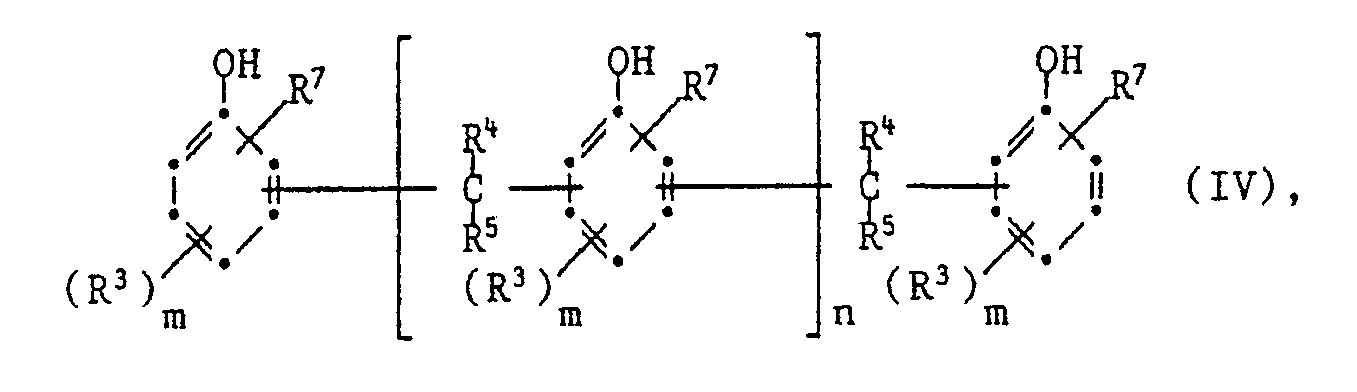
 a) Veretherung der phenolischen Hydroxylgruppen der Verbindung IV mit einem zur Einführung des Restes R¹ geeigneten Reagenz undb) Epoxidierung der Alkenylgruppen V mit einem zur Einführung der 2,3-Epoxidgruppe geeigneten Reagenz.
 - Verfahren zur Herstellung von Verbindungen der Formel I gemäss Anspruch 15, worin das Veretherungsreagenz kein Halogen als Abgangsgruppe besitzt.
- Verfahren zur Herstellung von Verbindungen der Formel I gemäss Anspruch 15, worin das Epoxidierungsreagenz eine Percarbonsäure ist.
- Verwendung der Verbindungen der Formel I gemäss Anspruch 1 als Umhüllungsmaterialien für elektronische Komponenten.
Applications Claiming Priority (2)
| Application Number | Priority Date | Filing Date | Title |
|---|---|---|---|
| CH162086 | 1986-04-22 | ||
| CH1620/86 | 1986-04-22 |
Publications (3)
| Publication Number | Publication Date |
|---|---|
| EP0243318A2 EP0243318A2 (de) | 1987-10-28 |
| EP0243318A3 EP0243318A3 (en) | 1988-10-12 |
| EP0243318B1 true EP0243318B1 (de) | 1991-03-20 |
Family
ID=4214699
Family Applications (1)
| Application Number | Title | Priority Date | Filing Date |
|---|---|---|---|
| EP87810247A Expired - Lifetime EP0243318B1 (de) | 1986-04-22 | 1987-04-21 | Epoxidgruppenhaltige Phenolether |
Country Status (6)
| Country | Link |
|---|---|
| US (1) | US4754003A (de) |
| EP (1) | EP0243318B1 (de) |
| JP (1) | JPS62256822A (de) |
| KR (1) | KR910004902B1 (de) |
| CA (1) | CA1287640C (de) |
| DE (1) | DE3768696D1 (de) |
Families Citing this family (7)
| Publication number | Priority date | Publication date | Assignee | Title |
|---|---|---|---|---|
| US4877859A (en) * | 1987-03-24 | 1989-10-31 | Daikin Industries, Ltd. | Fluorine-containing novolak resin and derivative thereof |
| US4996279A (en) * | 1988-10-07 | 1991-02-26 | Shell Oil Company | Dissymmetric polymer materials |
| JPH02210905A (ja) * | 1989-02-09 | 1990-08-22 | Ngk Spark Plug Co Ltd | 電気濾波器の封止方法 |
| US5578740A (en) * | 1994-12-23 | 1996-11-26 | The Dow Chemical Company | Process for preparation of epoxy compounds essentially free of organic halides |
| ES2166095T3 (es) * | 1996-08-06 | 2002-04-01 | Vantico Ag | Eteres poliglicidilicos de alcoholes secundarios. |
| DK2880071T3 (da) * | 2012-08-02 | 2017-01-02 | Alzchem Ag | Flydende hærdere til hærdning af epoxyharpikser |
| CN103709718B (zh) * | 2013-12-19 | 2016-08-17 | 华为技术有限公司 | 一种热固性树脂组合物及其应用 |
Citations (1)
| Publication number | Priority date | Publication date | Assignee | Title |
|---|---|---|---|---|
| DE2630107A1 (de) * | 1975-07-04 | 1977-01-27 | Nippon Chemiphar Co | 5-benzyl-2-oxazolidon-derivate und verfahren zu ihrer herstellung |
Family Cites Families (9)
| Publication number | Priority date | Publication date | Assignee | Title |
|---|---|---|---|---|
| DE352003C (de) * | 1920-04-28 | 1922-04-20 | Meilach Melamid Dr | Verfahren zur Darstellung von AEthern der kernmethylierten Homologen der Oxybenzylalkohole |
| US2983703A (en) * | 1954-10-20 | 1961-05-09 | Koppers Co Inc | Epoxyalkyl allylarylethers |
| NL216211A (de) * | 1956-04-12 | |||
| CH397626A (de) * | 1960-11-07 | 1965-08-31 | Ciba Geigy | Verfahren zur Herstellung von epoxydierten Dien-Anlagerungsprodukten |
| US3291770A (en) * | 1962-03-07 | 1966-12-13 | Interchem Corp | Coatings from partial condensation of allylated phenolic resin with epoxy resin |
| US3329737A (en) * | 1964-03-09 | 1967-07-04 | Minnesota Mining & Mfg | Curable composition containing a polyepoxide and an allylic polyphenolic novolac, free of methylol groups |
| DE2963311D1 (en) * | 1978-12-29 | 1982-08-26 | Ciba Geigy Ag | Propenyl-substituted phenolglycidyl ethers, process for their preparation and their use |
| JPS6060123A (ja) * | 1983-09-13 | 1985-04-06 | Sumitomo Chem Co Ltd | エポキシ化物の製造法 |
| DE3682537D1 (de) * | 1985-06-06 | 1992-01-02 | Ciba Geigy Ag | Polyepoxide und deren verwendung. |
-
1987
- 1987-04-15 US US07/038,575 patent/US4754003A/en not_active Expired - Fee Related
- 1987-04-16 CA CA000534929A patent/CA1287640C/en not_active Expired - Lifetime
- 1987-04-21 EP EP87810247A patent/EP0243318B1/de not_active Expired - Lifetime
- 1987-04-21 DE DE8787810247T patent/DE3768696D1/de not_active Expired - Lifetime
- 1987-04-21 JP JP62098477A patent/JPS62256822A/ja active Pending
- 1987-04-22 KR KR1019870003871A patent/KR910004902B1/ko not_active Expired
Patent Citations (1)
| Publication number | Priority date | Publication date | Assignee | Title |
|---|---|---|---|---|
| DE2630107A1 (de) * | 1975-07-04 | 1977-01-27 | Nippon Chemiphar Co | 5-benzyl-2-oxazolidon-derivate und verfahren zu ihrer herstellung |
Also Published As
| Publication number | Publication date |
|---|---|
| EP0243318A3 (en) | 1988-10-12 |
| JPS62256822A (ja) | 1987-11-09 |
| CA1287640C (en) | 1991-08-13 |
| US4754003A (en) | 1988-06-28 |
| EP0243318A2 (de) | 1987-10-28 |
| KR870010100A (ko) | 1987-11-30 |
| DE3768696D1 (de) | 1991-04-25 |
| KR910004902B1 (ko) | 1991-07-15 |
Similar Documents
| Publication | Publication Date | Title |
|---|---|---|
| EP0271442B1 (de) | Multifunktionelle Epoxidharze | |
| EP0022073B1 (de) | Diglycidyläther von di-sekundären Alkoholen, ihre Herstellung und Verwendung | |
| EP0204659B1 (de) | Polyepoxide und deren Verwendung | |
| EP0252358B1 (de) | Flüssig-kristalline Diglycidylverbindungen, ihre Herstellung und Verwendung in härtbaren Epoxid-Gemischen | |
| DE2240318A1 (de) | Epoxyde von alkoxy- substituierten tri(hydroxyphenyl)alkanen | |
| EP0205402B1 (de) | 2,6-Disubstituierte 4-Epoxypropylphenylglycidylether und deren Verwendung | |
| EP0243318A2 (de) | Epoxidgruppenhaltige Phenolether | |
| DE1942836C3 (de) | Diglycidylester von aliphatischen Dicarbonsäuren, Verfahren zu ihrer Herstellung und ihre Verwendung | |
| DE69332815T2 (de) | Polyglyzidyl-Äthern und ihre Verwendung | |
| DE2154624A1 (de) | Neue diglycidylderivate von zwei nheterocyclische ringe enthaltenen verbindungen, verfahren zu ihrer herstellung und anwendung | |
| EP0135477B1 (de) | Polyglycidyläther | |
| DE69400309T2 (de) | Naphthalenring enthaltendes harz, harzzusammensetzung und damit hergestellte gehärtete gegenstände | |
| DE2240197A1 (de) | Verfahren zur herstellung von epoxiden von verbindungen des leukaurintyps | |
| EP0377909A1 (de) | Diglycidylverbindungen, ihre Herstellung und ihre Verwendung in härtbaren Epoxid-Gemischen | |
| EP0108720A1 (de) | Neue cycloaliphatische Diallyläther | |
| DE2147899A1 (de) | Neue Polyglycidylverbindungen, Verfahren zu ihrer Herstellung und Anwendung | |
| EP0278900A2 (de) | Vorverlängerte Epoxidharze auf Basis von Cyclohex-1-ylmethylen-diphenolderivaten oder Bicyclo[2.2.1]hept-1-ylmethylen-diphenolderivaten | |
| DE69032962T2 (de) | Glycidylderivate von 2,6-Dibromo-3,5-dialkyl-4-hydroxybenzylethern | |
| CH690823A5 (de) | Epoxyharz, Epoxyharzzusammensetzungen und aus den Epoxyharzzusammensetzungen hergestellte gehärtete Produkte. | |
| DE1816095A1 (de) | Neue heterocyclische N,N'-Diglycidylverbindungen,Verfahren zu ihrer Herstellung und ihre Anwendung | |
| EP0370946A2 (de) | Verfahren zur Herstellung von Epoxidverbindungen | |
| DE69709747T2 (de) | Polyglycidylether von sekundären alkoholen | |
| DE2125355A1 (de) | Neue, zweikernige N-heterocyclische N,N-Diglycidylverbindungen, Verfahren zu ihrer Herstellung und ihrer Anwendung | |
| CH456949A (de) | Flammhemmende härtbare Mischungen | |
| KR100296490B1 (ko) | 사슬연장촉매를함유하는에폭시수지조성물 |
Legal Events
| Date | Code | Title | Description |
|---|---|---|---|
| PUAI | Public reference made under article 153(3) epc to a published international application that has entered the european phase |
Free format text: ORIGINAL CODE: 0009012 |
|
| 17P | Request for examination filed |
Effective date: 19870423 |
|
| AK | Designated contracting states |
Kind code of ref document: A2 Designated state(s): CH DE FR GB IT LI NL |
|
| PUAL | Search report despatched |
Free format text: ORIGINAL CODE: 0009013 |
|
| AK | Designated contracting states |
Kind code of ref document: A3 Designated state(s): CH DE FR GB IT LI NL |
|
| 17Q | First examination report despatched |
Effective date: 19890824 |
|
| GRAA | (expected) grant |
Free format text: ORIGINAL CODE: 0009210 |
|
| AK | Designated contracting states |
Kind code of ref document: B1 Designated state(s): CH DE FR GB IT LI NL |
|
| ITF | It: translation for a ep patent filed | ||
| REF | Corresponds to: |
Ref document number: 3768696 Country of ref document: DE Date of ref document: 19910425 |
|
| ET | Fr: translation filed | ||
| GBT | Gb: translation of ep patent filed (gb section 77(6)(a)/1977) | ||
| PLBE | No opposition filed within time limit |
Free format text: ORIGINAL CODE: 0009261 |
|
| STAA | Information on the status of an ep patent application or granted ep patent |
Free format text: STATUS: NO OPPOSITION FILED WITHIN TIME LIMIT |
|
| PGFP | Annual fee paid to national office [announced via postgrant information from national office to epo] |
Ref country code: DE Payment date: 19920202 Year of fee payment: 6 |
|
| PGFP | Annual fee paid to national office [announced via postgrant information from national office to epo] |
Ref country code: FR Payment date: 19920217 Year of fee payment: 6 |
|
| 26N | No opposition filed | ||
| PGFP | Annual fee paid to national office [announced via postgrant information from national office to epo] |
Ref country code: GB Payment date: 19920327 Year of fee payment: 6 |
|
| PGFP | Annual fee paid to national office [announced via postgrant information from national office to epo] |
Ref country code: NL Payment date: 19920430 Year of fee payment: 6 |
|
| PGFP | Annual fee paid to national office [announced via postgrant information from national office to epo] |
Ref country code: CH Payment date: 19920721 Year of fee payment: 6 |
|
| PG25 | Lapsed in a contracting state [announced via postgrant information from national office to epo] |
Ref country code: GB Effective date: 19930421 |
|
| PG25 | Lapsed in a contracting state [announced via postgrant information from national office to epo] |
Ref country code: LI Effective date: 19930430 Ref country code: CH Effective date: 19930430 |
|
| PG25 | Lapsed in a contracting state [announced via postgrant information from national office to epo] |
Ref country code: NL Effective date: 19931101 |
|
| GBPC | Gb: european patent ceased through non-payment of renewal fee |
Effective date: 19930421 |
|
| NLV4 | Nl: lapsed or anulled due to non-payment of the annual fee | ||
| PG25 | Lapsed in a contracting state [announced via postgrant information from national office to epo] |
Ref country code: FR Effective date: 19931229 |
|
| REG | Reference to a national code |
Ref country code: CH Ref legal event code: PL |
|
| PG25 | Lapsed in a contracting state [announced via postgrant information from national office to epo] |
Ref country code: DE Effective date: 19940101 |
|
| REG | Reference to a national code |
Ref country code: FR Ref legal event code: ST |
|
| PG25 | Lapsed in a contracting state [announced via postgrant information from national office to epo] |
Ref country code: IT Free format text: LAPSE BECAUSE OF NON-PAYMENT OF DUE FEES;WARNING: LAPSES OF ITALIAN PATENTS WITH EFFECTIVE DATE BEFORE 2007 MAY HAVE OCCURRED AT ANY TIME BEFORE 2007. THE CORRECT EFFECTIVE DATE MAY BE DIFFERENT FROM THE ONE RECORDED. Effective date: 20050421 |