EP1415764B1 - Fastener for a surface treatment article and quick release system - Google Patents
Fastener for a surface treatment article and quick release system Download PDFInfo
- Publication number
- EP1415764B1 EP1415764B1 EP04002217A EP04002217A EP1415764B1 EP 1415764 B1 EP1415764 B1 EP 1415764B1 EP 04002217 A EP04002217 A EP 04002217A EP 04002217 A EP04002217 A EP 04002217A EP 1415764 B1 EP1415764 B1 EP 1415764B1
- Authority
- EP
- European Patent Office
- Prior art keywords
- fastener
- backing
- surface treating
- article
- backup pad
- Prior art date
- Legal status (The legal status is an assumption and is not a legal conclusion. Google has not performed a legal analysis and makes no representation as to the accuracy of the status listed.)
- Expired - Lifetime
Links
- 238000004381 surface treatment Methods 0.000 title description 9
- 230000013011 mating Effects 0.000 claims description 12
- 238000007670 refining Methods 0.000 claims description 5
- 239000002245 particle Substances 0.000 description 40
- 239000000463 material Substances 0.000 description 26
- 229920001169 thermoplastic Polymers 0.000 description 23
- 229920002725 thermoplastic elastomer Polymers 0.000 description 22
- -1 polyethylene Polymers 0.000 description 20
- 230000003750 conditioning effect Effects 0.000 description 18
- 229920000642 polymer Polymers 0.000 description 16
- 239000004416 thermosoftening plastic Substances 0.000 description 12
- 229920000728 polyester Polymers 0.000 description 10
- 239000000835 fiber Substances 0.000 description 9
- 229920001296 polysiloxane Chemical class 0.000 description 9
- 239000004952 Polyamide Substances 0.000 description 7
- 239000000203 mixture Substances 0.000 description 7
- 229920002647 polyamide Polymers 0.000 description 7
- 229920002635 polyurethane Polymers 0.000 description 7
- 239000004814 polyurethane Substances 0.000 description 7
- 229920001187 thermosetting polymer Polymers 0.000 description 7
- 229920002302 Nylon 6,6 Polymers 0.000 description 6
- 239000011230 binding agent Substances 0.000 description 6
- 238000000576 coating method Methods 0.000 description 6
- 239000000314 lubricant Substances 0.000 description 6
- 238000004519 manufacturing process Methods 0.000 description 6
- 239000000945 filler Substances 0.000 description 5
- 238000002844 melting Methods 0.000 description 5
- 230000008018 melting Effects 0.000 description 5
- VTYYLEPIZMXCLO-UHFFFAOYSA-L Calcium carbonate Chemical compound [Ca+2].[O-]C([O-])=O VTYYLEPIZMXCLO-UHFFFAOYSA-L 0.000 description 4
- 239000004677 Nylon Substances 0.000 description 4
- 239000004743 Polypropylene Substances 0.000 description 4
- 239000000853 adhesive Substances 0.000 description 4
- 230000001070 adhesive effect Effects 0.000 description 4
- 239000003365 glass fiber Substances 0.000 description 4
- 238000002347 injection Methods 0.000 description 4
- 239000007924 injection Substances 0.000 description 4
- 229910052751 metal Inorganic materials 0.000 description 4
- 239000002184 metal Substances 0.000 description 4
- 238000000034 method Methods 0.000 description 4
- 229920001778 nylon Polymers 0.000 description 4
- 229920001155 polypropylene Polymers 0.000 description 4
- 229920005989 resin Polymers 0.000 description 4
- 239000011347 resin Substances 0.000 description 4
- 239000004698 Polyethylene Substances 0.000 description 3
- 239000004793 Polystyrene Substances 0.000 description 3
- 239000004676 acrylonitrile butadiene styrene Substances 0.000 description 3
- 238000005452 bending Methods 0.000 description 3
- 239000011248 coating agent Substances 0.000 description 3
- 229910003460 diamond Inorganic materials 0.000 description 3
- 239000010432 diamond Substances 0.000 description 3
- 229920001971 elastomer Polymers 0.000 description 3
- 238000003780 insertion Methods 0.000 description 3
- 230000037431 insertion Effects 0.000 description 3
- 238000005065 mining Methods 0.000 description 3
- 239000011146 organic particle Substances 0.000 description 3
- TWNQGVIAIRXVLR-UHFFFAOYSA-N oxo(oxoalumanyloxy)alumane Chemical compound O=[Al]O[Al]=O TWNQGVIAIRXVLR-UHFFFAOYSA-N 0.000 description 3
- 229920002492 poly(sulfone) Polymers 0.000 description 3
- 229920000573 polyethylene Polymers 0.000 description 3
- 229920006324 polyoxymethylene Polymers 0.000 description 3
- 229920002223 polystyrene Polymers 0.000 description 3
- 230000002787 reinforcement Effects 0.000 description 3
- 230000003014 reinforcing effect Effects 0.000 description 3
- 229920000049 Carbon (fiber) Polymers 0.000 description 2
- 239000006057 Non-nutritive feed additive Substances 0.000 description 2
- 239000004697 Polyetherimide Substances 0.000 description 2
- 239000004642 Polyimide Substances 0.000 description 2
- VYPSYNLAJGMNEJ-UHFFFAOYSA-N Silicium dioxide Chemical compound O=[Si]=O VYPSYNLAJGMNEJ-UHFFFAOYSA-N 0.000 description 2
- MCMNRKCIXSYSNV-UHFFFAOYSA-N Zirconium dioxide Chemical compound O=[Zr]=O MCMNRKCIXSYSNV-UHFFFAOYSA-N 0.000 description 2
- XECAHXYUAAWDEL-UHFFFAOYSA-N acrylonitrile butadiene styrene Chemical compound C=CC=C.C=CC#N.C=CC1=CC=CC=C1 XECAHXYUAAWDEL-UHFFFAOYSA-N 0.000 description 2
- 229920000122 acrylonitrile butadiene styrene Polymers 0.000 description 2
- 229920001400 block copolymer Polymers 0.000 description 2
- 229910000019 calcium carbonate Inorganic materials 0.000 description 2
- QXJJQWWVWRCVQT-UHFFFAOYSA-K calcium;sodium;phosphate Chemical compound [Na+].[Ca+2].[O-]P([O-])([O-])=O QXJJQWWVWRCVQT-UHFFFAOYSA-K 0.000 description 2
- 239000004917 carbon fiber Substances 0.000 description 2
- 239000003086 colorant Substances 0.000 description 2
- 239000002131 composite material Substances 0.000 description 2
- 150000001875 compounds Chemical class 0.000 description 2
- 239000012141 concentrate Substances 0.000 description 2
- 229920001577 copolymer Polymers 0.000 description 2
- 239000007822 coupling agent Substances 0.000 description 2
- 239000000975 dye Substances 0.000 description 2
- 239000000806 elastomer Substances 0.000 description 2
- 238000001746 injection moulding Methods 0.000 description 2
- HGPXWXLYXNVULB-UHFFFAOYSA-M lithium stearate Chemical class [Li+].CCCCCCCCCCCCCCCCCC([O-])=O HGPXWXLYXNVULB-UHFFFAOYSA-M 0.000 description 2
- VNWKTOKETHGBQD-UHFFFAOYSA-N methane Chemical compound C VNWKTOKETHGBQD-UHFFFAOYSA-N 0.000 description 2
- 238000000465 moulding Methods 0.000 description 2
- 239000000049 pigment Substances 0.000 description 2
- 229920003023 plastic Polymers 0.000 description 2
- 239000004033 plastic Substances 0.000 description 2
- 229920001748 polybutylene Polymers 0.000 description 2
- 239000004417 polycarbonate Substances 0.000 description 2
- 229920000515 polycarbonate Polymers 0.000 description 2
- 229920001601 polyetherimide Polymers 0.000 description 2
- 229920001721 polyimide Polymers 0.000 description 2
- 229920001343 polytetrafluoroethylene Polymers 0.000 description 2
- 239000004810 polytetrafluoroethylene Substances 0.000 description 2
- 239000004800 polyvinyl chloride Substances 0.000 description 2
- 229920000915 polyvinyl chloride Polymers 0.000 description 2
- 239000012744 reinforcing agent Substances 0.000 description 2
- 239000000126 substance Substances 0.000 description 2
- 239000004634 thermosetting polymer Substances 0.000 description 2
- 230000007704 transition Effects 0.000 description 2
- XOOUIPVCVHRTMJ-UHFFFAOYSA-L zinc stearate Chemical class [Zn+2].CCCCCCCCCCCCCCCCCC([O-])=O.CCCCCCCCCCCCCCCCCC([O-])=O XOOUIPVCVHRTMJ-UHFFFAOYSA-L 0.000 description 2
- DMYOHQBLOZMDLP-UHFFFAOYSA-N 1-[2-(2-hydroxy-3-piperidin-1-ylpropoxy)phenyl]-3-phenylpropan-1-one Chemical compound C1CCCCN1CC(O)COC1=CC=CC=C1C(=O)CCC1=CC=CC=C1 DMYOHQBLOZMDLP-UHFFFAOYSA-N 0.000 description 1
- QYEXBYZXHDUPRC-UHFFFAOYSA-N B#[Ti]#B Chemical compound B#[Ti]#B QYEXBYZXHDUPRC-UHFFFAOYSA-N 0.000 description 1
- 229910052580 B4C Inorganic materials 0.000 description 1
- 229910052582 BN Inorganic materials 0.000 description 1
- PZNSFCLAULLKQX-UHFFFAOYSA-N Boron nitride Chemical compound N#B PZNSFCLAULLKQX-UHFFFAOYSA-N 0.000 description 1
- OKTJSMMVPCPJKN-UHFFFAOYSA-N Carbon Chemical class [C] OKTJSMMVPCPJKN-UHFFFAOYSA-N 0.000 description 1
- 229920013683 Celanese Polymers 0.000 description 1
- 229920001634 Copolyester Polymers 0.000 description 1
- 229920001875 Ebonite Polymers 0.000 description 1
- 229920006347 Elastollan Polymers 0.000 description 1
- RYECOJGRJDOGPP-UHFFFAOYSA-N Ethylurea Chemical compound CCNC(N)=O RYECOJGRJDOGPP-UHFFFAOYSA-N 0.000 description 1
- PEDCQBHIVMGVHV-UHFFFAOYSA-N Glycerine Chemical compound OCC(O)CO PEDCQBHIVMGVHV-UHFFFAOYSA-N 0.000 description 1
- 229920003620 Grilon® Polymers 0.000 description 1
- 240000007049 Juglans regia Species 0.000 description 1
- 235000009496 Juglans regia Nutrition 0.000 description 1
- 241001272720 Medialuna californiensis Species 0.000 description 1
- 229920000877 Melamine resin Polymers 0.000 description 1
- CERQOIWHTDAKMF-UHFFFAOYSA-M Methacrylate Chemical compound CC(=C)C([O-])=O CERQOIWHTDAKMF-UHFFFAOYSA-M 0.000 description 1
- VVQNEPGJFQJSBK-UHFFFAOYSA-N Methyl methacrylate Chemical compound COC(=O)C(C)=C VVQNEPGJFQJSBK-UHFFFAOYSA-N 0.000 description 1
- 229930182556 Polyacetal Natural products 0.000 description 1
- 229920002614 Polyether block amide Polymers 0.000 description 1
- 239000004614 Process Aid Substances 0.000 description 1
- 239000004959 Rilsan Substances 0.000 description 1
- 229920002472 Starch Polymers 0.000 description 1
- 229920001079 Thiokol (polymer) Polymers 0.000 description 1
- 229910033181 TiB2 Inorganic materials 0.000 description 1
- 239000012963 UV stabilizer Substances 0.000 description 1
- 239000000654 additive Substances 0.000 description 1
- RREGISFBPQOLTM-UHFFFAOYSA-N alumane;trihydrate Chemical compound O.O.O.[AlH3] RREGISFBPQOLTM-UHFFFAOYSA-N 0.000 description 1
- 229910052782 aluminium Inorganic materials 0.000 description 1
- PNEYBMLMFCGWSK-UHFFFAOYSA-N aluminium oxide Inorganic materials [O-2].[O-2].[O-2].[Al+3].[Al+3] PNEYBMLMFCGWSK-UHFFFAOYSA-N 0.000 description 1
- CEGOLXSVJUTHNZ-UHFFFAOYSA-K aluminium tristearate Chemical class [Al+3].CCCCCCCCCCCCCCCCCC([O-])=O.CCCCCCCCCCCCCCCCCC([O-])=O.CCCCCCCCCCCCCCCCCC([O-])=O CEGOLXSVJUTHNZ-UHFFFAOYSA-K 0.000 description 1
- 229940063655 aluminum stearate Drugs 0.000 description 1
- 239000003963 antioxidant agent Substances 0.000 description 1
- 239000002216 antistatic agent Substances 0.000 description 1
- INAHAJYZKVIDIZ-UHFFFAOYSA-N boron carbide Chemical compound B12B3B4C32B41 INAHAJYZKVIDIZ-UHFFFAOYSA-N 0.000 description 1
- CJZGTCYPCWQAJB-UHFFFAOYSA-L calcium stearate Chemical class [Ca+2].CCCCCCCCCCCCCCCCCC([O-])=O.CCCCCCCCCCCCCCCCCC([O-])=O CJZGTCYPCWQAJB-UHFFFAOYSA-L 0.000 description 1
- 239000008116 calcium stearate Chemical class 0.000 description 1
- 235000013539 calcium stearate Nutrition 0.000 description 1
- 239000000919 ceramic Substances 0.000 description 1
- CETPSERCERDGAM-UHFFFAOYSA-N ceric oxide Chemical compound O=[Ce]=O CETPSERCERDGAM-UHFFFAOYSA-N 0.000 description 1
- 229910000422 cerium(IV) oxide Inorganic materials 0.000 description 1
- 239000003795 chemical substances by application Substances 0.000 description 1
- 238000004140 cleaning Methods 0.000 description 1
- 230000000295 complement effect Effects 0.000 description 1
- 230000007423 decrease Effects 0.000 description 1
- KZHJGOXRZJKJNY-UHFFFAOYSA-N dioxosilane;oxo(oxoalumanyloxy)alumane Chemical compound O=[Si]=O.O=[Si]=O.O=[Al]O[Al]=O.O=[Al]O[Al]=O.O=[Al]O[Al]=O KZHJGOXRZJKJNY-UHFFFAOYSA-N 0.000 description 1
- 229920006351 engineering plastic Polymers 0.000 description 1
- JBKVHLHDHHXQEQ-UHFFFAOYSA-N epsilon-caprolactam Chemical compound O=C1CCCCCN1 JBKVHLHDHHXQEQ-UHFFFAOYSA-N 0.000 description 1
- 239000012467 final product Substances 0.000 description 1
- 239000003063 flame retardant Substances 0.000 description 1
- 239000004811 fluoropolymer Substances 0.000 description 1
- 229920002313 fluoropolymer Polymers 0.000 description 1
- IVJISJACKSSFGE-UHFFFAOYSA-N formaldehyde;1,3,5-triazine-2,4,6-triamine Chemical compound O=C.NC1=NC(N)=NC(N)=N1 IVJISJACKSSFGE-UHFFFAOYSA-N 0.000 description 1
- 239000002223 garnet Substances 0.000 description 1
- 239000011521 glass Substances 0.000 description 1
- 239000010439 graphite Chemical class 0.000 description 1
- 229910002804 graphite Inorganic materials 0.000 description 1
- 238000009434 installation Methods 0.000 description 1
- 238000003754 machining Methods 0.000 description 1
- 239000011159 matrix material Substances 0.000 description 1
- 239000010445 mica Substances 0.000 description 1
- 229910052618 mica group Inorganic materials 0.000 description 1
- CWQXQMHSOZUFJS-UHFFFAOYSA-N molybdenum disulfide Chemical class S=[Mo]=S CWQXQMHSOZUFJS-UHFFFAOYSA-N 0.000 description 1
- 229910052982 molybdenum disulfide Inorganic materials 0.000 description 1
- 239000000178 monomer Substances 0.000 description 1
- 229910052863 mullite Inorganic materials 0.000 description 1
- RKISUIUJZGSLEV-UHFFFAOYSA-N n-[2-(octadecanoylamino)ethyl]octadecanamide Chemical class CCCCCCCCCCCCCCCCCC(=O)NCCNC(=O)CCCCCCCCCCCCCCCCC RKISUIUJZGSLEV-UHFFFAOYSA-N 0.000 description 1
- 229920003986 novolac Polymers 0.000 description 1
- 235000014571 nuts Nutrition 0.000 description 1
- 239000011368 organic material Substances 0.000 description 1
- 239000004014 plasticizer Substances 0.000 description 1
- 238000005498 polishing Methods 0.000 description 1
- 229920002959 polymer blend Polymers 0.000 description 1
- 239000002861 polymer material Substances 0.000 description 1
- 229920000098 polyolefin Polymers 0.000 description 1
- 239000000843 powder Substances 0.000 description 1
- 125000002924 primary amino group Chemical group [H]N([H])* 0.000 description 1
- 239000000047 product Substances 0.000 description 1
- 238000010107 reaction injection moulding Methods 0.000 description 1
- 230000000717 retained effect Effects 0.000 description 1
- 239000005060 rubber Substances 0.000 description 1
- 150000004760 silicates Chemical class 0.000 description 1
- HBMJWWWQQXIZIP-UHFFFAOYSA-N silicon carbide Chemical compound [Si+]#[C-] HBMJWWWQQXIZIP-UHFFFAOYSA-N 0.000 description 1
- 229910010271 silicon carbide Inorganic materials 0.000 description 1
- 239000000377 silicon dioxide Substances 0.000 description 1
- 229920002379 silicone rubber Polymers 0.000 description 1
- 239000007787 solid Substances 0.000 description 1
- 239000004094 surface-active agent Substances 0.000 description 1
- 239000000375 suspending agent Substances 0.000 description 1
- 229920002994 synthetic fiber Polymers 0.000 description 1
- 239000012209 synthetic fiber Substances 0.000 description 1
- 239000012815 thermoplastic material Substances 0.000 description 1
- 229920006345 thermoplastic polyamide Polymers 0.000 description 1
- 125000000391 vinyl group Chemical group [H]C([*])=C([H])[H] 0.000 description 1
- 229920002554 vinyl polymer Polymers 0.000 description 1
- 235000020234 walnut Nutrition 0.000 description 1
- 239000000080 wetting agent Substances 0.000 description 1
- 229940100445 wheat starch Drugs 0.000 description 1
Images


Classifications
-
- B—PERFORMING OPERATIONS; TRANSPORTING
- B24—GRINDING; POLISHING
- B24B—MACHINES, DEVICES, OR PROCESSES FOR GRINDING OR POLISHING; DRESSING OR CONDITIONING OF ABRADING SURFACES; FEEDING OF GRINDING, POLISHING, OR LAPPING AGENTS
- B24B29/00—Machines or devices for polishing surfaces on work by means of tools made of soft or flexible material with or without the application of solid or liquid polishing agents
- B24B29/005—Machines or devices for polishing surfaces on work by means of tools made of soft or flexible material with or without the application of solid or liquid polishing agents using brushes
-
- B—PERFORMING OPERATIONS; TRANSPORTING
- B24—GRINDING; POLISHING
- B24B—MACHINES, DEVICES, OR PROCESSES FOR GRINDING OR POLISHING; DRESSING OR CONDITIONING OF ABRADING SURFACES; FEEDING OF GRINDING, POLISHING, OR LAPPING AGENTS
- B24B45/00—Means for securing grinding wheels on rotary arbors
- B24B45/006—Quick mount and release means for disc-like wheels, e.g. on power tools
-
- B—PERFORMING OPERATIONS; TRANSPORTING
- B24—GRINDING; POLISHING
- B24D—TOOLS FOR GRINDING, BUFFING OR SHARPENING
- B24D13/00—Wheels having flexibly-acting working parts, e.g. buffing wheels; Mountings therefor
- B24D13/20—Mountings for the wheels
-
- B—PERFORMING OPERATIONS; TRANSPORTING
- B24—GRINDING; POLISHING
- B24D—TOOLS FOR GRINDING, BUFFING OR SHARPENING
- B24D7/00—Bonded abrasive wheels, or wheels with inserted abrasive blocks, designed for acting otherwise than only by their periphery, e.g. by the front face; Bushings or mountings therefor
- B24D7/16—Bushings; Mountings
-
- B—PERFORMING OPERATIONS; TRANSPORTING
- B24—GRINDING; POLISHING
- B24D—TOOLS FOR GRINDING, BUFFING OR SHARPENING
- B24D9/00—Wheels or drums supporting in exchangeable arrangement a layer of flexible abrasive material, e.g. sandpaper
- B24D9/08—Circular back-plates for carrying flexible material
- B24D9/085—Devices for mounting sheets on a backing plate
Definitions
- the present invention relates generally to abrasive articles and more particularly to arrangements for mounting abrasive articles on a backup pad
- U.S. Patent No. 3,562,968 to Johnson et al. discloses a surface treating tool providing for easy installation of the surface treating article.
- the surface treating article has adhered thereto a drive button that engages a complementary cylindrical opening in a drive assembly comprising a backup pad which is driven by a driving means.
- the adhesively-bonded drive button provides for quick and easy attachment and removal of surface treating elements without special mounting tools.
- a similar fastening system incorporated in various embodiments of integrally molded brushes is disclosed in U.S. Patent No. 5,679,067 , "Molded Abrasive Brush,” (Johnson et al); and WIPO International Patent Application No. WO96/33638 , "Abrasive Brush and Filaments,” (Johnson et al.).
- Surface conditioning discs having a threaded male button bonded to the back side of the disc by an adhesive are available commercially as Roloc TM surface conditioning discs from Minnesota Mining and Manufacturing Company, St. Paul, Minnesota. Coated abrasive discs including a threaded male button bonded to the back are also available. These surface conditioning discs have on the front side a conformable, three-dimensional non-woven open web material formed of synthetic fibers and abrasive particles. This web is needle tacked to an open weave scrim backing.
- U.S. Patent No. 3,688,453 to Legacy et al. describes abrasive articles which comprise a lofty non-woven web needle tacked to a woven backing and impregnated with resin and abrasive.
- the fastener is not attached in a permanent manner to the surface treating article.
- the surface treating article comprises a surface treating element with a fastener on the rear surface thereof
- the surface treating element includes a generally planer backing that includes a working surface and a rear surface, in which the working surface has desired characteristics for refining a surface.
- the fastener includes: i) a first end opposite the backing; ii) a second end adjacent the backing; iii) a tapered portion that increases in cross sectional area in the direction from the first end to the second end; iv) a groove located between the tapered portion and the second end; and a mating portion having a non-circular and non-polygonal cross section.
- the surface treating element may be a molded brush including a plurality of bristles extending from the backing.
- the fastener may be integrally molded with the molded brush.
- the surface treating element may be a coated abrasive article having the fastener joined thereto.
- the surface treating element may be a non-woven surface conditioning article having the fastener joined thereto
- the surface treating article of the present invention may be used with a quick release system for releasably attaching a surface treating article to a backup pad.
- the system includes a surface treating article with a fastener as described above, and a back-up pad.
- the back up pad includes a body with a front surface and a back surface, a mounting opening provided on the front surface.
- the opening is formed by an inner surface generally perpendicular to the body and defining a non-circular cross section corresponding to the mating portion cross section.
- the opening includes an elastic means mounted therein for releasably engaging the groove in the fastener.
- the present invention also provides a fastener for use with a rotary surface treating element as defined in claim 2.
- the fastener comprises a base and a fastener member.
- the base includes a front surface and a rear surface, and a fastener member extending from the rear surface.
- the fastener member includes a first end opposite the base backing, a second end adjacent the base, a tapered portion that increases in cross sectional area in the direction from the first end to the second end, a groove located between the tapered portion and the second end, and a mating portion having a non-circular and non-polygonal cross section.
- the present invention is directed to surface treatment articles which include a quick release fastener on the rear surface thereof.
- the fastener can be integral and unitary with the surface treating articles, such as when the article is a molded brush and the fastener is molded therewith.
- the fastener can be a separate element that is joined to the surface treating element.
- Such embodiments include coated abrasive discs and nonwoven surface conditioning discs having the fastener mounted on the rear surface thereof Molded brushes may also have the fastener formed separately and then joined thereto.
- surface treatment article 10 is a molded brush.
- Brush 10 comprises a backing 30 having front surface 32 and rear surface 34.
- a plurality of bristles 36 project outwardly from front surface 32 of backing 30. In between bristles 36 there are spaces in which the front surface 32 of the backing is exposed.
- the brush is preferably integrally molded and comprises a moldable polymer substantially free of abrasive particles.
- the brush is preferably integrally molded and comprises a generally homogenous composition of abrasive particles in a moldable polymer.
- abrasive particles may be homogeneously dispersed within bristles 36 but not in the backing 30.
- Surface treatment article 10 comprises fastener 11 integral with backing 30.
- the fastener provides a means to secure the surface treatment article 10 to a rotary tool and/or a support pad or a backup pad during use. It is preferred that the fastener 11 is molded integrally with the backing and bristles. It is preferred that the fastener 11 be centered relative to the backing for proper rotation.
- the fastener is adapted to attach the surface treatment article to a high speed rotary tool, such as a right angle grinder, for example. Such an arrangement allows the surface treatment article to be rotated at high speeds about an axis of rotation centered on the attaching means, and generally perpendicular to the backing (for flat, planar bases).
- each of the bristles is translated in a circular path about the axis of rotation, while being oriented generally parallel to the axis of rotation.
- the brush and fastener are configured to be capable of being rotated at least 100 RPM, depending on the size and configuration, preferably at least 5000 RPM, and some smaller brushes are capable of being rotated at up to 30,000 RPM.
- the fastener 11 may be made from the same material as the rest of the brush 10, and may contain the optional abrasive particles. Alternatively, the fastener 11 may be made from a separate injection of moldable polymer without abrasive particles.
- the fastener 11 includes a first end 12 which is configured to fit into a corresponding opening in the backup pad or drive shaft as described below. Fastener 11 also includes second end 14 adjacent the backing of the surface treatment article. Adjacent first end 12 is a tapered portion 16 to facilitate engagement of the fastener 11 into the opening of the backup pad and to facilitate engagement with the o-ring described below. Adjacent to and rearward from the taper 16 is a flat portion 18 which defines the bottom end of groove 20. Rearward of groove 20 is a taper 22 which transitions into flat walls 24 and corners 26. The walls 24 and corners 26 are configured for close fit with the walls and corners of the opening in a backup pad.
- the walls 24 thus define a mating portion with a cross section corresponding to the cross section of the opening in the backup pad.
- the groove 20 is configured for a snap engagement with the o-ring 80 in the backup pad 50. Rearward of the flat walls 24 is the rear surface 34 of the backing 30 on the molded brush.
- FIG 3 illustrates a side view of a backup pad 50 for use with the surface treating articles described herein.
- Backup pad 50 includes front surface 54 for supporting the surface treating article and rear surface 56 which tapers to boss 58.
- the boss 58 includes a first end 60 having a recess 61 therein.
- Mounted in recess 61 is a mounting nut 90 having a threaded inner diameter 92 for engagement with the drive shaft on a power tool.
- the backup pad could instead include a quick change arrangement for attachment to a power tool.
- backup pad 50 includes an opening 64 in the front surface 54 for receiving the fastener 11 on the surface treating article.
- the opening 64 includes flat walls 66 which join at corners 68, wherein the walls define a hexagonal cross-sectional opening 64.
- the opening also includes a groove 70 in which is retained an o-ring 80.
- the groove 70 may be molded into the opening 64 or machined into the opening 64.
- Figure 5 illustrates the fastener 11 of the surface treating article 10 mounted onto the backup pad 50.
- the fastener 11 and opening 64 in the backup pad 50 are configured for close engagement with one another to minimize relative rotation between the backup pad and the surface treating article.
- the backup pad is preferably somewhat smaller in diameter than the surface treating article. However, the backup pad can be significantly smaller than the surface treating article, or can be larger than the surface treating article.
- the material and size of fastener 11 and the backup pad 50 at the opening 64 are selected to withstand the torque imparted during use of the backup pad 10 with a power tool.
- Preferred materials for the fastener 11 include those preferred materials for molded brush 10 described below, and those materials described below for fastener 11 discussed with respect to Figures 6 and 7.
- Preferred materials for backup pad 50 include metal, nylon, hard rubber, and composites
- Groove 20 in fastener 11 engages with o-ring 80 to prevent inadvertent release of the surface treating article 10 from the backup pad 50, while allowing the surface treating article to be easily removed from the backup pad without tools simply by pulling the article 10 away from the backup pad 50 with enough force to overcome the snap fit between the o-ring 80 and groove 20. It is seen that the distance between the rear surface 34 of backing 30 and groove 20 on the fastener 11 can be chosen such that front surface 54 of the backup pad 50 engages with the shoulder rear surface 34 of the backing 30 when groove 20 is engaged with the o-ring 80.
- taper 16 on the fastener 11 facilitates engagement of the fastener with the o-ring, and expands the o-ring as the fastener 11 is inserted into the opening 64 in the backup pad 50.
- the elastic and resilient o-ring 80 then snaps back to a small diameter and engages with the groove 20 in the fastener 11.
- O-ring 80 may instead be any type of elastic member that releasably engages with groove 20 in fastener 11.
- Suitable elastic members include split rings, C-clips, and the like. These can be made of any suitable material such metal, rubber, vinyl, or composites selected to allow the elastic member to expand elastically without significant permanent deformation, and then contract into the groove in the fastener.
- the dimensions of the walls 24 on the fastener 11 relative to the opening 64 in the backup pad 50 should be selected to minimize relative rotation between the surface treating article and the backup pad during use, while allowing easy mounting and dismounting of the surface treating article from the backup pad.
- Any non-polygonal arrangement may be used for the cross-sectional shape of the mating portion of the fastener 11 and the shaft and opening 64 in the backup pad, except for circular, to provide an arrangement in which the surface treating article does not rotate relative to the backup pad. Therefore, what is required is that the opening 64 and the corresponding portion of the fastener 11 be non-cylindrical, thereby providing a fit to prevent relative rotation between the surface treating article and the backup pad.
- the mating portion may be tapered so as to be larger at second end 14 adjacent the surface treating article and smaller at the end adjacent groove 20.
- the opening 64 in the backup pad could be tapered so as to be larger at the first surface 54 of the backup pad.
- o-ring 80 is illustrated as remaining in the groove 70 in opening 64 in the backup pad 50, the o-ring 80 may instead remain in the groove 20 on the fastener 11.
- the components of the mounting system may be reversed. That is, a fastener 11 may be included on the power tool backup pad for engagement with a mating opening in the surface treating article.
- the backing 30 is generally planar.
- the backing may be convex, concave, or conical in shape.
- the bristles may be of uniform length in which case the tips of the bristles will not be coplanar, or bristles may be of varying length in which case the tips may be coplanar.
- the backing may be flexible or rigid, and may include a reinforcing member to increase its rigidity.
- the backing can preferably have a thickness of from about 1.0 to 15.0 mm, more preferably from about 1.5 to 10 mm, still more preferably from about 2.0 to 6 mm, and most preferably from about 2.5 to 4.0 mm.
- Backing 30 is preferably circular as illustrated in Figure 2.
- the diameter of backing is preferably from about 2.5 to 20.0 cm (1.0 to 8.0 in), although smaller and larger backings may be used.
- Backing shapes other than circular may be used, including, but not limited to, oval, rectangular, square, triangular, diamond, and other polygonal shapes.
- the backing is molded integral with the bristles to provide a unitary brush.
- the backing and bristles are molded simultaneously.
- the brush 10 comprises a generally homogenous composition throughout.
- the abrasive particle/binder mix may not be perfectly homogeneous.
- one insertion may contain a mixture of moldable polymer and optional abrasive particles primarily located in the bristles.
- a second insertion which would be present primarily in the backing 30 of the brush 10, may contain moldable polymer without abrasive particles or with fewer abrasive particles.
- the bristles 36 extend from the front surface 32 of backing 30.
- the bristles may have any cross sectional area, including but not limited to, circular, star, half moon, quarter moon, oval, rectangular, square, triangular, diamond or polygonal.
- the bristles comprise a constant circular cross section along the length of the bristle.
- the bristles have a non-constant or variable cross section along all or a portion of the length of the bristle.
- tapered bristles such that the cross sectional area of the bristle decreases in the direction away from backing 30.
- Tapered bristles can have any cross section as described above, and preferably have a circular cross section. Tapered bristles tend to be easier to remove from the mold during fabrication of the brush than constant cross sectional area bristles.
- bristles are subjected to bending stresses as brush 10 is rotated against a workpiece. These bending stresses are highest at the root of the bristles. Therefore, a tapered bristle such as illustrated in Figure 1 is more able to resist bending stresses than a cylindrical bristle.
- the bristles preferably include a fillet radius at the transition between the root of the bristle and the front surface 32 of the backing.
- Bristles 36 comprise an aspect ratio defined as the length of the bristle measured from root to tip, divided by the width of the bristle.
- the width is defined as the average width along the length for purposes of determining the aspect ratio.
- the width is taken as the longest width in a given plane, such as the comer-to-comer diagonal of a square cross section.
- the aspect ratio of bristles 36 is preferably at least 1, more preferably from about 4 to 18, and still more preferably from about 6 to 16.
- the size of bristles can be selected for the particular application of brush 10.
- the length of the bristles is preferably from about 5 to 80 mm, more preferably from about 5 to 50 mm, still more preferably from about 5 to 25 mm, and most preferably from about 10 to 20 mm.
- the width of the bristles is preferably from about 0.25 to 10 mm, more preferably from about 0.5 to 5.0 mm, still more preferably about 0.75 to 3.0 mm, and most preferably from about 1.0 to 2.0 mm. In one preferred embodiment, all of the bristles have the same dimensions. Alternatively, bristles on a single brush may have different dimensions such as different lengths, widths or cross sectional areas.
- the lengths of the bristles and contour of the backing are preferably chosen so that the tips are generally coplanar, although other arrangements are also within the present invention.
- the density and arrangement of the bristles 36 can be chosen for the particular application of brush 10.
- the bristles 36 may be arranged on the backing 30 in a random or ordered pattern.
- the bristles are perpendicular to planar backing 30. This makes it easier to remove the molded brush 10 from the mold. However, it is also within the scope of the present invention for the bristles to be oblique to the backing.
- the moldable polymer material is preferably an organic binder material that is capable of being molded, i.e., it is capable of deforming under heat to form a desired shape.
- the moldable polymer may be a thermoplastic polymer, a thermosetting polymer, or a thermoplastic elastomer.
- the organic binder is heated above its melting point which causes the polymer to flow. This results in the thermoplastic polymer flowing into the cavities of the mold to form the brush 10. The brush is then cooled to solidify the thermoplastic binder.
- thermoplastic polymers examples include polycarbonate, polyetherimide, polyester, polyethylene, polysulfone, polystyrene, polybutylene, acrylonitrile-butadiene-styrene block copolymer, polypropylene, acetal polymers, polyurethanes, polyamides, and combinations thereof.
- preferred thermoplastic polymers of the invention are those having a high melting temperature and good heat resistance properties.
- Thermoplastic polymers may be preferably employed for low speed applications of brush 10, in which stress during operation is relatively low.
- thermoplastic polymers suitable for use with the present invention include Grilon TM CR9 copolymer of Nylon 6,12 available from EMS-American Grilon, Inc., Sumter South Carolina; Profax TM and KS075 polypropylene based thermoplastic available from Himont USA, Inc., Wilmington, Delaware; and Duraflex TM polybutylene based thermoplastic available from Shell Chemical Co., Houston, Texas.
- the moldable polymer is a thermoplastic elastomer ("TPE”) or includes a thermoplastic elastomer.
- TPE thermoplastic elastomer
- Commercially available thermoplastic elastomers include segmented polyester thermoplastic elastomers, segmented polyurethane thermoplastic elastomers, segmented polyamide thermoplastic elastomers, blends of thermoplastic elastomers and thermoplastic polymers, and ionomeric thermoplastic elastomers.
- Segmented thermoplastic elastomers useful in the present invention include polyester TPEs, polyurethane TPEs, and polyamide TPEs, and silicone elastomer/polyimide block copolymeric TPEs, with the low and high equivalent weight polyfunctional monomers selected appropriately to produce the respective TPE.
- Thermoplastic polymer has a more limiting definition than the general definition, which is a material which softens and flows upon application of pressure and heat.” It will of course be realized that TPEs meet the general definition of TP, since TPEs will also flow upon application of pressure and heat. It is thus necessary to be more specific in the definition of "thermoplastic” for the purposes of this invention.
- Thermoplastic as used herein, means a material which flows upon application of pressure and heat, but which does not possess the elastic properties of an elastomer when below its melting temperature. Blends of TPE and TP materials are also within the invention, allowing even greater flexibility in tailoring mechanical properties of the filaments of the invention.
- segmented polyesters include those known under the trade designations "Hytrel TM 4056", “Hytrel TM 5526”, “Hytrel TM 5556”, “Hytrel TM 6356", “Hytrel TM 7246", and “Hytrel TM 8238” available from E.I. Du Pont de Nemours and Company, Inc., Wilmington, Delaware, with the most preferred including Hytrel TM 5526, Hytrel TM 5556, and Hytrel TM 6356.
- a similar family of thermoplastic polyesters is available under the tradename “Riteflex” (Hoechst Celanese Corporation).
- polyester TPEs are those known under the trade designations "Ecdel”, from Eastman Chemical Products, Inc., Kingsport, Tennessee; “Lomad”, from General Electric Company, Pittsfield, Massachusetts; “Arnitel” from DSM Engineered Plastics; and “Bexloy” from Du Pont.
- Further useful polyester TPEs include those available as “Lubricomp” from LNP Engineering Plastics, Exton, Pennsylvania, and is commercially available incorporating lubricant, glass fiber reinforcement, and carbon fiber reinforcement.
- segmented polyamides include those known under the trade designation “Pebax” and “Rilsan”, both available from Atochem Inc., Glen Rock, New Jersey.
- segmented polyurethanes include those known under the trade designation "Estane”, available from B.F. Goodrich, Cleveland, Ohio.
- Other preferred segmented polyurethanes include those known under the trade designations "Pellethane”, and “Isoplast” from The Dow Corning Company, Midland, Michigan, and those known under the trade designation "Morthane”, from Morton Chemical Division, Morton Thiokol, Inc.; and those known under the trade designation "Elastollan”, from BASF Corporation, Wyandotte, Michigan.
- the abrasive particles typically have a particle size ranging from about 0.1 to 1500 micrometers, usually between about 1 to 1000 micrometers, and preferably between 50 and 500 micrometers.
- the optional abrasive particles may be organic or inorganic.
- abrasive particles include fused aluminum oxide, ceramic aluminum oxide, heated treated aluminum oxide, silicon carbide, titanium diboride, alumina zirconia, diamond, boron carbide, ceria, aluminum silicates, cubic boron nitride, garnet, and silica. Still other examples of abrasive particles include solid glass spheres, hollow glass spheres, calcium carbonate, polymeric bubbles, silicates, aluminum trihydrate, and mullite. As used herein, the term abrasive particles also encompasses single abrasive particles which are bonded together to form an abrasive agglomerate. Abrasive agglomerates are further described in U.S. Patent Nos.
- the abrasive particles may also contain a surface coating. Surface coatings are known to improve the adhesion between the abrasive particle and the binder in the abrasive article.
- Organic abrasive particles suitable for use with the brush of the present invention are preferably formed from a thermoplastic polymer and/or a thermosetting polymer.
- Organic particles can also be made from natural organic materials such as walnut shells, wheat starch, and the like.
- Organic abrasive particles useful in the present invention may be individual particles or agglomerates of individual particles. The agglomerates may comprise a plurality of the organic abrasive particles bonded together by a binder to form a shaped mass.
- the particles are preferably present in the moldable polymer at a weight percent (per total weight of moldable polymer and organic abrasive particles) ranging from about 0.1 to about 80 weight percent, more preferably from about 3 to about 60 weight percent. The weight percentage depends in part on the particular abrading or brush applications.
- the organic abrasive particles can be formed from a thermoplastic material such as polycarbonate, polyetherimide, polyester, polyvinyl chloride, methacrylate, methylmethacrylate, polyethylene, polysulfone, polystyrene, acrylonitrile-butadiene-styrene block copolymer, polypropylene, acetal polymers, polyurethanes, polyamide, and combinations thereof
- a thermoplastic material such as polycarbonate, polyetherimide, polyester, polyvinyl chloride, methacrylate, methylmethacrylate, polyethylene, polysulfone, polystyrene, acrylonitrile-butadiene-styrene block copolymer, polypropylene, acetal polymers, polyurethanes, polyamide, and combinations thereof
- preferred thermoplastic polymers of the invention are those having a high melting temperature, e.g. greater than 200°C, more preferably 300°C; or good heat resistance properties.
- the organic abrasive particles should have a higher melting or softening point that the thermoplastic matrix, so that the organic particles are not substantially affected by the filament manufacturing process.
- the organic particle should be capable of maintaining a generally particulate state during filament or brush segment processing, and therefore should be selected so as not to substantially melt or soften during the filament manufacturing process.
- a preferred organic abrasive particle is a metal and mold cleaning plastic blast media available commercially as "MC” blast media from Maxi Blast Inc., South Bend, Indiana, available with an antistatic coating, but preferably untreated.
- the "MC” media is a 99% melamine formaldehyde cellulosate, an amino thermoset plastic.
- the average Knoop hardness ("KNH”) of the organic abrasive particle is generally less than about 80 KNH, and preferably less than about 65 KNH.
- the optional abrasive particles are preferably from about 5 to 60 percent by weight of the particle and polymer mixture, and more preferably about 30 to 40 percent, although more or less may be used as desired.
- the moldable polymeric material may further include optional additives, such as, for example, fillers (including grinding aids), fibers, antistatic agents, antioxidants, processing aids, UV stabilizers, flame retardants, lubricants, wetting agents, surfactants, pigments, dyes, coupling agents, plasticizers and suspending agents.
- fillers including grinding aids
- fibers including fibers, antistatic agents, antioxidants, processing aids, UV stabilizers, flame retardants, lubricants, wetting agents, surfactants, pigments, dyes, coupling agents, plasticizers and suspending agents.
- additives such as, for example, fillers (including grinding aids), fibers, antistatic agents, antioxidants, processing aids, UV stabilizers, flame retardants, lubricants, wetting agents, surfactants, pigments, dyes, coupling agents, plasticizers and suspending agents.
- fillers including grinding aids
- antistatic agents including antioxidants, processing aids, UV stabilizers, flame retardants, lubricants
- the molded polymer include a lubricant.
- a lubricant in the moldable polymer reduces the friction of the bristle contacting the workpiece surface. This reduces the heat generated when refining the workpiece. Excessive heat may cause the brush to leave residue on the workpiece or to otherwise harm the workpiece.
- Suitable lubricants include lithium stearate, zinc stearate, calcium stearate, aluminum stearate, ethylene bis stearamide, graphite, molybdenum disulfide; polytetrafluoroethylene (PTFE), and silicone compounds, for example useful with thermoplastics and thermoplastic elastomers.
- a preferred silicone material is a high molecular weight polysiloxane described in WIPO International Patent Application Publication No. WO96/33841 ; entitled "Abrasive Article Having a Bond System Comprising a Polysiloxane” (Barber)
- Polysiloxanes are available in many different forms, e.g., as the compound itself or as a concentrate.
- Example of the polymers into which the polysiloxane can be compounded include polypropylene, polyethylene, polystyrene, polyamides, polyacetal, acrylonitrile-butadiene-styrene (ABS), and polyester elastomer, all of which are commercially available.
- Silicone modified Hytrel TM is available commercially as BY27-010 (or MB50-010), and silicone modified Nylon 6,6 is available as BY27-005 (or MB50-005), both from Dow Corning Company, Midland, Michigan.
- Lubricants preferably can be present in the moldable polymer in amounts of up to about 20 percent by weight (exclusive of abrasive particle content), and preferably in an amount from about 1 to 10 percent, although more or less may be used as desired.
- the moldable polymeric material may include any or all of the following as is well known in the art: coupling agents; fillers; and grinding aids.
- the brush 10 and fastener 11 of the present invention are preferably injection molded as is well known in the art.
- the mold will contain cavities which are the inverse of the desired brush and fastener configuration.
- the mold design must take into account the brush configuration including the size and configuration of the backing 30, the bristles 36, and the fastener 11.
- the surface treating article of the present invention can be a coated abrasive disc, a nonwoven abrasive surface conditioning disc, a polishing pad, a brush, or similar surface treating element.
- the fastener 11 can be joined to such a surface treating article by any suitable means, such as by adhesive.
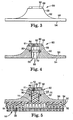
- One such embodiment is illustrated in Figure 6 as surface treating article 110 comprising fastener 11 mounted on coated abrasive disc 130.
- Another embodiment is illustrated in Figure 7 as surface treating article 210 comprising fastener 11 mounted on nonwoven surface conditioning disc 230.
- Surface treating elements 130, 230 have a working front surface 132, 232 and rear surface 134, 234.
- the fastener 11 is attached centrally to the rear surface of the article.
- Such a separate fastener 11 may also be joined to the molded brushes describe herein, rather than being integrally molded with the brush.
- fastener 11 includes a generally planar base 27.
- the base 27 includes a front surface 28 that is joined to the coated abrasive disc 130 or surface conditioning disc 230.
- the front surface 28 of the fastener base is preferably smooth and planar so as to provide sufficient surface area to achieve the desired strength of attachment to the surface treating article.
- the base 27 of the fastener 11 is circular, although other shapes may be used.
- the base 27 of the fastener 11 has a diameter of approximately 3 cm (1.2 in), although larger and smaller fasteners are within the scope of the invention.
- rear surface 29 Opposite to the front surface 28 of the base 27 is rear surface 29. As illustrated, rear surface 29 tapers toward the outer edge of the fastener base 27. Extending from the center of the rear surface 29 is the male element of the fastening system as described above with respect to the embodiment illustrated in Figures 1-2.
- the fastener 11 may comprise any polymeric material that has the appropriate melt, flow, and adhesion characteristics to become attached to the surface treating article.
- useful polymeric materials will be thermoplastic in nature.
- thermosetting polymeric materials may be employed if they are only lightly crosslinked or have a stable intermediate or "B-stage" state and therefore can be caused to flow under heat and pressure.
- thermoplastic polymeric materials include polyamides, polyesters, copolyamides, copolyesters, polyimides, polysulfone, and polyolefins.
- An example of a suitable thermosetting polymeric material is a novolak molding powder.
- thermoplastics are preferred, and of the thermoplastics, polyamides are preferred, with poly(hexamethylene adipamide) (nylon 6,6) being most preferred.
- the polymeric material may optionally include colorants, fillers, process aids, and reinforcing agents.
- colorants include pigments and dyes.
- fillers include glass bubbles or spheres, particulate calcium carbonate, mica, and the like.
- Processing aids may be materials such as lithium stearate, zinc stearate, and fluoropolymer materials that are known to enhance the flow characteristics of molten polymeric materials.
- Reinforcing agents may include glass fiber, carbon fiber, and metal fiber, all at levels up to about 50% by weight.
- the fastener 11 may be made by any process known to one skilled in the art. These include but are not limited to injection molding, reaction injection molding, and conventional machining. Preferred is injection molding.
- the surface treatment element is a coated abrasive disc 130, having a front or working surface 132, and rear surface 134.
- the fastener 11 is mounted on the center of the rear surface 134 such as by an adhesive.
- Suitable examples of coated abrasive discs 130 include any known abrasive article, such as conventional coated abrasive articles, including those available under the tradenames Regal TM Regalloy TM , Regalite TM , Green Corps TM and Trizact TM all available from Minnesota Mining and Manufacturing Company, St. Paul, Minnesota.
- FIG. 7 Another preferred embodiment of a surface treating article 210 of the present invention is illustrated in Figure 7.
- the surface treating article 210 includes surface conditioning disc 230 having fastener 11 attached thereto.
- the fastener 11 is joined to the rear surface 234 of the surface conditioning disc 230.
- One preferred surface treating article is a nonwoven abrasive surface conditioning disc 230, such as is commercially available from Minnesota Mining and Manufacturing Company, St. Paul, Minnesota, under the trade designation "SCOTCH-BRITE" A-CRS Surface Conditioning Disc; A-Med Surface Conditioning Disc or A-VFN Surface Conditioning Disc.
- the front or working surface 232 of such discs preferably comprises a lofty nonwoven web of nylon 6,6 staple fibers that has been needle punched through a reinforcing woven nylon scrim backing.
- about 40% of the staple fibers of the web protrude through interstices formed by the warp yarns and fill yarns of the woven scrim to attach the nonwoven web and the woven scrim together.
- the remaining fibers remain on the front surface side of the surface conditioning disc 230.
- a preferred surface conditioning article is described in detail in U.S. Patent No. 3,688,453 , "Abrasive Articles," Legacy et al.
- the woven scrim comprise at least 5 warp yarns per inch and 5 fill yarns per inch, and more preferably about 16 warp yarns and fill yarns per inch.
- the preferred yarns are at least 100 denier, and more preferably approximately 840 denier.
- a yarn may be one or more fibers that act as or are treated as one unit.
- a yarn may be continuous filament or "spun" (aligned and twisted) from staple into a unified bundle.
- a yarn may be multifilament (more than one continuous filament) or monofilament.
- the open area between the warp and weft fibers is preferably at least 5% of the total area of the scrim, and more preferable approximately 30%.
- the fastener 11 preferably has a 3 cm diameter base 27 and is injection molded from nylon 6,6 having up to 45% by weight reinforcing glass fibers.
- the scrim preferably includes sixteen warp yarns per inch and sixteen fill yarns per inch.
- the yarns are preferably 840 denier multifilament nylon yarns.
- the woven scrim preferably includes a PVC coating to maintain the weave.
- the non-woven web comprises nylon 6,6 staple fibers needle tacked to the woven scrim such that approximately 40% of the fibers extend through the interstices of the woven scrim.
Landscapes
- Engineering & Computer Science (AREA)
- Mechanical Engineering (AREA)
- Polishing Bodies And Polishing Tools (AREA)
- Snaps, Bayonet Connections, Set Pins, And Snap Rings (AREA)
- Constituent Portions Of Griding Lathes, Driving, Sensing And Control (AREA)
- Connection Of Plates (AREA)
Applications Claiming Priority (3)
| Application Number | Priority Date | Filing Date | Title |
|---|---|---|---|
| US966644 | 1997-11-10 | ||
| US08/966,644 US6095910A (en) | 1997-11-10 | 1997-11-10 | Surface treatment article having a quick release fastener |
| EP98911496A EP1037728B1 (en) | 1997-11-10 | 1998-03-06 | Surface treatment article having a quick release fastener |
Related Parent Applications (1)
| Application Number | Title | Priority Date | Filing Date |
|---|---|---|---|
| EP98911496A Division EP1037728B1 (en) | 1997-11-10 | 1998-03-06 | Surface treatment article having a quick release fastener |
Publications (3)
| Publication Number | Publication Date |
|---|---|
| EP1415764A2 EP1415764A2 (en) | 2004-05-06 |
| EP1415764A3 EP1415764A3 (en) | 2004-08-04 |
| EP1415764B1 true EP1415764B1 (en) | 2007-12-12 |
Family
ID=25511694
Family Applications (2)
| Application Number | Title | Priority Date | Filing Date |
|---|---|---|---|
| EP98911496A Expired - Lifetime EP1037728B1 (en) | 1997-11-10 | 1998-03-06 | Surface treatment article having a quick release fastener |
| EP04002217A Expired - Lifetime EP1415764B1 (en) | 1997-11-10 | 1998-03-06 | Fastener for a surface treatment article and quick release system |
Family Applications Before (1)
| Application Number | Title | Priority Date | Filing Date |
|---|---|---|---|
| EP98911496A Expired - Lifetime EP1037728B1 (en) | 1997-11-10 | 1998-03-06 | Surface treatment article having a quick release fastener |
Country Status (10)
| Country | Link |
|---|---|
| US (1) | US6095910A (enExample) |
| EP (2) | EP1037728B1 (enExample) |
| JP (1) | JP2001522730A (enExample) |
| KR (1) | KR20010015804A (enExample) |
| CN (1) | CN1132722C (enExample) |
| BR (1) | BR9814010A (enExample) |
| CA (1) | CA2309613A1 (enExample) |
| DE (2) | DE69838858T2 (enExample) |
| ES (2) | ES2297284T3 (enExample) |
| WO (1) | WO1999024221A1 (enExample) |
Families Citing this family (28)
| Publication number | Priority date | Publication date | Assignee | Title |
|---|---|---|---|---|
| WO2002020218A2 (en) * | 2000-09-08 | 2002-03-14 | 3M Innovative Properties Company | Abrasive sheet, method of manufacturing the same and method to abrade a fiber optic connector |
| ITMI20010134U1 (it) * | 2001-03-12 | 2002-09-12 | Valentini Guido | Platorello operativo di forma sostanzialmente circolare per utensile portatile |
| US6863596B2 (en) * | 2001-05-25 | 2005-03-08 | 3M Innovative Properties Company | Abrasive article |
| US7056200B2 (en) | 2001-09-04 | 2006-06-06 | 3M Innovative Properties Company | Quick change connector for grinding wheel |
| US6743085B2 (en) | 2001-11-20 | 2004-06-01 | 3M Innovative Properties Company | Rotating back up abrasive disc assembly |
| US6723142B2 (en) | 2002-06-05 | 2004-04-20 | Tepco Ltd. | Preformed abrasive articles and method for the manufacture of same |
| DE10230308B4 (de) * | 2002-07-05 | 2008-11-06 | Robert Bosch Gmbh | Einsatzwerkzeug mit einem Stützteller |
| US6929000B2 (en) | 2002-07-08 | 2005-08-16 | Micron Technology, Inc. | Apparatus and methods for aligning a center of mass with a rotational axis of a shaft or spindle |
| US7121937B2 (en) * | 2003-03-17 | 2006-10-17 | 3M Innovative Properties Company | Abrasive brush elements and segments |
| US7708489B2 (en) * | 2003-11-03 | 2010-05-04 | Illinois Tool Works Inc. | Retainer and associated assembly |
| US20060093429A1 (en) * | 2003-11-03 | 2006-05-04 | Trotter Jason K | Retainer and associated assembly |
| US7081043B2 (en) * | 2004-01-14 | 2006-07-25 | 3M Innovative Properties Company | Molded abrasive brush and methods of using for manufacture of printed circuit boards |
| US7121924B2 (en) * | 2004-04-20 | 2006-10-17 | 3M Innovative Properties Company | Abrasive articles, and methods of making and using the same |
| US20050282474A1 (en) * | 2004-06-17 | 2005-12-22 | Wagner Spray Tech Corporation | Powered paint preparation tool, kit and method |
| CA2578446C (en) * | 2004-07-21 | 2013-02-12 | Parker-Hannifin Corporation | Adaptor and method for converting standard tube fitting/port to push-to-connect tube fitting/port |
| US8240719B2 (en) * | 2004-07-21 | 2012-08-14 | Parker-Hannifin Corporation | Adaptor and method for converting standard tube fitting/port to push-to-connect tube fitting/port |
| US6945863B1 (en) | 2004-08-19 | 2005-09-20 | Weiler Corporation | Rotary finishing disc |
| SG134181A1 (en) * | 2006-01-13 | 2007-08-29 | 3M Innovative Properties Co | Integrally molded brush and the method of manufacture and its uses thereof |
| JP5027468B2 (ja) * | 2006-09-15 | 2012-09-19 | 日本ミクロコーティング株式会社 | プローブクリーニング用又はプローブ加工用シート、及びプローブ加工方法 |
| WO2008124835A1 (en) * | 2007-04-10 | 2008-10-16 | D.C. Henning, Inc. | Quick mount adapter and backing plate surface care system and apparatus |
| US20080295947A1 (en) * | 2007-06-01 | 2008-12-04 | Bourbeau Alain | Method for ultrasonic welding and ultrasonic welding fastener and joining systems |
| EP2655847B1 (en) * | 2010-12-22 | 2017-05-31 | Ticona LLC | Fiber reinforced shaped articles and process for making same |
| EP3106497A1 (en) | 2011-06-01 | 2016-12-21 | Saint-Gobain ADFORS Canada, Ltd. | Multi-directional reinforcing drywall tape |
| EA027965B1 (ru) * | 2011-07-07 | 2017-09-29 | 3М Инновейтив Пропертиз Компани | Изделие, включающее многокомпонентные волокна и полые керамические микросферы, и способы их изготовления и использования |
| DE102011122106A1 (de) * | 2011-12-22 | 2013-06-27 | Carl Freudenberg Kg | Besenblock mit Borstenstruktur |
| US9610670B2 (en) * | 2013-06-07 | 2017-04-04 | Apple Inc. | Consumable abrasive tool for creating shiny chamfer |
| JP6123065B2 (ja) * | 2013-06-25 | 2017-05-10 | 東レ・モノフィラメント株式会社 | 研磨ブラシ用毛材および研磨ブラシ |
| KR20150002176A (ko) * | 2013-06-28 | 2015-01-07 | 삼성디스플레이 주식회사 | 기판 표면 연마 장치 |
Citations (1)
| Publication number | Priority date | Publication date | Assignee | Title |
|---|---|---|---|---|
| US4517863A (en) * | 1982-12-27 | 1985-05-21 | Muro Kinzoku Kogyo Co., Ltd. | Successive screw feeder driver |
Family Cites Families (49)
| Publication number | Priority date | Publication date | Assignee | Title |
|---|---|---|---|---|
| US26552A (en) * | 1859-12-20 | Assjgnqk | ||
| US1587843A (en) * | 1925-05-19 | 1926-06-08 | Koreneff Philipp | Polishing tool |
| US2671994A (en) * | 1953-03-20 | 1954-03-16 | Henry E Hickman | Release device for buffer and sanding disks |
| US2764853A (en) * | 1956-03-12 | 1956-10-02 | Carm P Rhees | Mounting head for grinding polishing, and featheredging tools |
| US2800752A (en) * | 1956-04-11 | 1957-07-30 | Black & Decker Mfg Co | Sanding disk |
| US3154894A (en) * | 1960-10-04 | 1964-11-03 | Diagrit Electrometallics Ltd | Tool for dressing the surface of a conical hole |
| US3157010A (en) * | 1962-01-17 | 1964-11-17 | Merit Products Inc | Abrading article |
| US3270468A (en) * | 1963-07-01 | 1966-09-06 | Merit Products Inc | Abrasive device |
| US3270467A (en) * | 1963-07-01 | 1966-09-06 | Merit Products Inc | Abrasive device |
| US3210892A (en) * | 1963-10-30 | 1965-10-12 | Albertson & Co Inc | Safety wheel assembly |
| US3362114A (en) * | 1964-11-04 | 1968-01-09 | Rexall Drug Chemical | Universal driving spindle and wheel assembly |
| US3315420A (en) * | 1964-11-17 | 1967-04-25 | Atlas Copco Ab | Holder for abrasive disks |
| US3376675A (en) * | 1965-05-17 | 1968-04-09 | Alma A. Hutchins | Quick-change rotary tool |
| US3460292A (en) * | 1965-10-19 | 1969-08-12 | Gen Motors Corp | Finishing tool |
| US3603042A (en) * | 1967-09-20 | 1971-09-07 | Speedfam Corp | Polishing machine |
| US3526065A (en) * | 1967-09-26 | 1970-09-01 | James H Lee | Rotary finishing tool |
| US3579917A (en) * | 1968-11-15 | 1971-05-25 | Speedfam Corp | Polishing machine |
| US3562968A (en) * | 1969-03-12 | 1971-02-16 | Minnesota Mining & Mfg | Surface treating tool |
| US3667169A (en) * | 1970-04-27 | 1972-06-06 | Norton Co | Abrasive finishing article |
| US3688453A (en) * | 1970-12-11 | 1972-09-05 | Minnesota Mining & Mfg | Abrasive articles |
| US3739535A (en) * | 1971-03-03 | 1973-06-19 | Red Lee Metal Finishing Co Inc | Fluid cooled hub assembly for a contact wheel |
| US3747286A (en) * | 1971-07-14 | 1973-07-24 | Standard Abrasives | Abrasive finishing article assembly |
| US3858368A (en) * | 1973-09-14 | 1975-01-07 | Francis E Cocherell | Disposable quick coupling rotary grinding disc for compoundly curved surfaces |
| US4015371A (en) * | 1976-04-08 | 1977-04-05 | Machinery Brokers, Inc. | Grinding wheel assembly |
| US4311489A (en) * | 1978-08-04 | 1982-01-19 | Norton Company | Coated abrasive having brittle agglomerates of abrasive grain |
| US4541205A (en) * | 1983-04-08 | 1985-09-17 | United Abrasives, Inc. | Abrasive wheel assembly |
| US4605154A (en) * | 1985-01-28 | 1986-08-12 | Johnstone Railway Supply Mfg., Co. Inc. | Radiator heater solder pouring process |
| US4652275A (en) * | 1985-08-07 | 1987-03-24 | Minnesota Mining And Manufacturing Company | Erodable agglomerates and abrasive products containing the same |
| DE3607580A1 (de) * | 1986-03-07 | 1987-09-10 | Gehring Gmbh Maschf | Honeinrichtung |
| US4799939A (en) * | 1987-02-26 | 1989-01-24 | Minnesota Mining And Manufacturing Company | Erodable agglomerates and abrasive products containing the same |
| US4944638A (en) * | 1988-05-31 | 1990-07-31 | Brohammer Lawrence F | Removable spindle for drill heads |
| ATE106300T1 (de) * | 1989-04-01 | 1994-06-15 | Messer Griesheim Gmbh | Polier- oder schleifeinrichtung. |
| IT1229703B (it) * | 1989-05-11 | 1991-09-07 | Franco Romanini | Utensile per levigatura o simili. |
| US4932163A (en) * | 1989-08-29 | 1990-06-12 | Chilton Douglas L | Dust control system for an abrasive grinder |
| US5309682A (en) * | 1990-03-28 | 1994-05-10 | Robert Bosch Gmbh | Hand held power tool with working disc |
| DE9016232U1 (de) * | 1990-11-29 | 1991-03-21 | Fa. Andreas Stihl, 71336 Waiblingen | Formschlußkupplung für ein Handarbeitsgerät |
| US5486176A (en) * | 1991-03-27 | 1996-01-23 | Smith & Nephew Richards, Inc. | Angled bone fixation apparatus |
| US5207028A (en) * | 1991-05-17 | 1993-05-04 | Black & Decker Inc. | Tool element subassembly and method of manufacturing same |
| TW307801B (enExample) * | 1992-03-19 | 1997-06-11 | Minnesota Mining & Mfg | |
| US5226682A (en) * | 1992-07-21 | 1993-07-13 | Aeroquip Corporation | Coupling assembly |
| US5443413A (en) * | 1993-07-30 | 1995-08-22 | Western Atlas Inc. | Brushless spindle motor for a grinding machine including hydrostatic bearings |
| US5423717A (en) * | 1993-10-04 | 1995-06-13 | Ford Motor Company | Grinding wheel assembly |
| JP3036348B2 (ja) * | 1994-03-23 | 2000-04-24 | 三菱マテリアル株式会社 | ウェーハ研磨パッドのツルーイング装置 |
| US5505747A (en) * | 1994-01-13 | 1996-04-09 | Minnesota Mining And Manufacturing Company | Method of making an abrasive article |
| US5639273A (en) * | 1995-02-03 | 1997-06-17 | C.M.E. Blasting & Mining Equipment Ltd. | Grinding cup and holder device |
| US5679067A (en) * | 1995-04-28 | 1997-10-21 | Minnesota Mining And Manufacturing Company | Molded abrasive brush |
| GB2306593A (en) * | 1995-08-04 | 1997-05-07 | Smiths Industries Plc | Releasable Fluid coupling |
| US5611724A (en) * | 1995-12-01 | 1997-03-18 | General Electric Company | Grinding wheel having dead end grooves and method for grinding therewith |
| US5816625A (en) * | 1997-08-14 | 1998-10-06 | Clarke; Robert H. | Quick release coupling with spacer ring to align spline rod |
-
1997
- 1997-11-10 US US08/966,644 patent/US6095910A/en not_active Expired - Lifetime
-
1998
- 1998-03-06 EP EP98911496A patent/EP1037728B1/en not_active Expired - Lifetime
- 1998-03-06 EP EP04002217A patent/EP1415764B1/en not_active Expired - Lifetime
- 1998-03-06 CN CN988108992A patent/CN1132722C/zh not_active Expired - Fee Related
- 1998-03-06 CA CA002309613A patent/CA2309613A1/en not_active Abandoned
- 1998-03-06 DE DE69838858T patent/DE69838858T2/de not_active Expired - Fee Related
- 1998-03-06 KR KR1020007005008A patent/KR20010015804A/ko not_active Ceased
- 1998-03-06 DE DE69827033T patent/DE69827033T2/de not_active Expired - Fee Related
- 1998-03-06 ES ES04002217T patent/ES2297284T3/es not_active Expired - Lifetime
- 1998-03-06 JP JP2000520273A patent/JP2001522730A/ja active Pending
- 1998-03-06 WO PCT/US1998/004372 patent/WO1999024221A1/en not_active Ceased
- 1998-03-06 BR BR9814010-8A patent/BR9814010A/pt not_active Application Discontinuation
- 1998-03-06 ES ES98911496T patent/ES2226111T3/es not_active Expired - Lifetime
Patent Citations (1)
| Publication number | Priority date | Publication date | Assignee | Title |
|---|---|---|---|---|
| US4517863A (en) * | 1982-12-27 | 1985-05-21 | Muro Kinzoku Kogyo Co., Ltd. | Successive screw feeder driver |
Non-Patent Citations (1)
| Title |
|---|
| "DIN 3126", 31 December 1993, DEUTSCHE INDUSTRIE NORMEN * |
Also Published As
| Publication number | Publication date |
|---|---|
| WO1999024221A1 (en) | 1999-05-20 |
| DE69838858D1 (de) | 2008-01-24 |
| DE69827033D1 (de) | 2004-11-18 |
| EP1037728B1 (en) | 2004-10-13 |
| CN1132722C (zh) | 2003-12-31 |
| DE69827033T2 (de) | 2006-02-09 |
| US6095910A (en) | 2000-08-01 |
| ES2297284T3 (es) | 2008-05-01 |
| JP2001522730A (ja) | 2001-11-20 |
| EP1037728A1 (en) | 2000-09-27 |
| EP1415764A3 (en) | 2004-08-04 |
| BR9814010A (pt) | 2000-09-26 |
| CN1278755A (zh) | 2001-01-03 |
| EP1415764A2 (en) | 2004-05-06 |
| KR20010015804A (ko) | 2001-02-26 |
| ES2226111T3 (es) | 2005-03-16 |
| CA2309613A1 (en) | 1999-05-20 |
| DE69838858T2 (de) | 2008-12-04 |
Similar Documents
| Publication | Publication Date | Title |
|---|---|---|
| EP1415764B1 (en) | Fastener for a surface treatment article and quick release system | |
| US5679067A (en) | Molded abrasive brush | |
| US5903951A (en) | Molded brush segment | |
| AU728602B2 (en) | Rotary bristle tool with preferentially oriented bristles | |
| US12377522B2 (en) | Elongate abrasive article with orientationally aligned formed abrasive particles | |
| EP0822768B1 (en) | Abrasive brush and filaments | |
| KR100612164B1 (ko) | 연마 제품의 제조 방법 및 연마 제품 | |
| MXPA00004469A (es) | Articulo para el tratamiento de superficies que tiene un sujetador de liberacion rapida | |
| JP3111041U (ja) | 平形カップブラシ | |
| CA2218245C (en) | Abrasive brush and filaments | |
| JP2002045235A (ja) | 平形カップブラシ | |
| MXPA00000467A (en) | Rotary bristle tool with preferentially oriented bristles | |
| HK1014848B (en) | Generally molded abrasive brush, brush assembly and the method of manufacture and the use thereof |
Legal Events
| Date | Code | Title | Description |
|---|---|---|---|
| PUAI | Public reference made under article 153(3) epc to a published international application that has entered the european phase |
Free format text: ORIGINAL CODE: 0009012 |
|
| AC | Divisional application: reference to earlier application |
Ref document number: 1037728 Country of ref document: EP Kind code of ref document: P |
|
| AK | Designated contracting states |
Kind code of ref document: A2 Designated state(s): DE ES FR GB IT |
|
| PUAL | Search report despatched |
Free format text: ORIGINAL CODE: 0009013 |
|
| RIN1 | Information on inventor provided before grant (corrected) |
Inventor name: LUEDEKE, ARTHUR P. |
|
| AK | Designated contracting states |
Kind code of ref document: A3 Designated state(s): DE ES FR GB IT |
|
| 17P | Request for examination filed |
Effective date: 20050204 |
|
| AKX | Designation fees paid |
Designated state(s): DE ES FR GB IT |
|
| 17Q | First examination report despatched |
Effective date: 20050527 |
|
| 17Q | First examination report despatched |
Effective date: 20050527 |
|
| GRAP | Despatch of communication of intention to grant a patent |
Free format text: ORIGINAL CODE: EPIDOSNIGR1 |
|
| GRAS | Grant fee paid |
Free format text: ORIGINAL CODE: EPIDOSNIGR3 |
|
| GRAA | (expected) grant |
Free format text: ORIGINAL CODE: 0009210 |
|
| AC | Divisional application: reference to earlier application |
Ref document number: 1037728 Country of ref document: EP Kind code of ref document: P |
|
| AK | Designated contracting states |
Kind code of ref document: B1 Designated state(s): DE ES FR GB IT |
|
| REG | Reference to a national code |
Ref country code: GB Ref legal event code: FG4D |
|
| REF | Corresponds to: |
Ref document number: 69838858 Country of ref document: DE Date of ref document: 20080124 Kind code of ref document: P |
|
| PGFP | Annual fee paid to national office [announced via postgrant information from national office to epo] |
Ref country code: ES Payment date: 20080326 Year of fee payment: 11 |
|
| REG | Reference to a national code |
Ref country code: ES Ref legal event code: FG2A Ref document number: 2297284 Country of ref document: ES Kind code of ref document: T3 |
|
| PGFP | Annual fee paid to national office [announced via postgrant information from national office to epo] |
Ref country code: GB Payment date: 20080327 Year of fee payment: 11 |
|
| PGFP | Annual fee paid to national office [announced via postgrant information from national office to epo] |
Ref country code: FR Payment date: 20080317 Year of fee payment: 11 Ref country code: DE Payment date: 20080430 Year of fee payment: 11 |
|
| ET | Fr: translation filed | ||
| PGFP | Annual fee paid to national office [announced via postgrant information from national office to epo] |
Ref country code: IT Payment date: 20080328 Year of fee payment: 11 |
|
| PLBE | No opposition filed within time limit |
Free format text: ORIGINAL CODE: 0009261 |
|
| STAA | Information on the status of an ep patent application or granted ep patent |
Free format text: STATUS: NO OPPOSITION FILED WITHIN TIME LIMIT |
|
| 26N | No opposition filed |
Effective date: 20080915 |
|
| GBPC | Gb: european patent ceased through non-payment of renewal fee |
Effective date: 20090306 |
|
| REG | Reference to a national code |
Ref country code: FR Ref legal event code: ST Effective date: 20091130 |
|
| PG25 | Lapsed in a contracting state [announced via postgrant information from national office to epo] |
Ref country code: DE Free format text: LAPSE BECAUSE OF NON-PAYMENT OF DUE FEES Effective date: 20091001 |
|
| PG25 | Lapsed in a contracting state [announced via postgrant information from national office to epo] |
Ref country code: GB Free format text: LAPSE BECAUSE OF NON-PAYMENT OF DUE FEES Effective date: 20090306 Ref country code: FR Free format text: LAPSE BECAUSE OF NON-PAYMENT OF DUE FEES Effective date: 20091123 |
|
| REG | Reference to a national code |
Ref country code: ES Ref legal event code: FD2A Effective date: 20090307 |
|
| PG25 | Lapsed in a contracting state [announced via postgrant information from national office to epo] |
Ref country code: ES Free format text: LAPSE BECAUSE OF NON-PAYMENT OF DUE FEES Effective date: 20090307 |
|
| PG25 | Lapsed in a contracting state [announced via postgrant information from national office to epo] |
Ref country code: IT Free format text: LAPSE BECAUSE OF NON-PAYMENT OF DUE FEES Effective date: 20090306 |