EP1405872A1 - Utilisation d'un film à base de PVDF, de PMMA ou leur mélange pour recouvrir des objets en matériau thermodur - Google Patents
Utilisation d'un film à base de PVDF, de PMMA ou leur mélange pour recouvrir des objets en matériau thermodur Download PDFInfo
- Publication number
- EP1405872A1 EP1405872A1 EP03292335A EP03292335A EP1405872A1 EP 1405872 A1 EP1405872 A1 EP 1405872A1 EP 03292335 A EP03292335 A EP 03292335A EP 03292335 A EP03292335 A EP 03292335A EP 1405872 A1 EP1405872 A1 EP 1405872A1
- Authority
- EP
- European Patent Office
- Prior art keywords
- parts
- layer
- pvdf
- pmma
- adhesive layer
- Prior art date
- Legal status (The legal status is an assumption and is not a legal conclusion. Google has not performed a legal analysis and makes no representation as to the accuracy of the status listed.)
- Withdrawn
Links
Images




Classifications
-
- C—CHEMISTRY; METALLURGY
- C09—DYES; PAINTS; POLISHES; NATURAL RESINS; ADHESIVES; COMPOSITIONS NOT OTHERWISE PROVIDED FOR; APPLICATIONS OF MATERIALS NOT OTHERWISE PROVIDED FOR
- C09J—ADHESIVES; NON-MECHANICAL ASPECTS OF ADHESIVE PROCESSES IN GENERAL; ADHESIVE PROCESSES NOT PROVIDED FOR ELSEWHERE; USE OF MATERIALS AS ADHESIVES
- C09J133/00—Adhesives based on homopolymers or copolymers of compounds having one or more unsaturated aliphatic radicals, each having only one carbon-to-carbon double bond, and at least one being terminated by only one carboxyl radical, or of salts, anhydrides, esters, amides, imides, or nitriles thereof; Adhesives based on derivatives of such polymers
- C09J133/04—Homopolymers or copolymers of esters
- C09J133/06—Homopolymers or copolymers of esters of esters containing only carbon, hydrogen and oxygen, the oxygen atom being present only as part of the carboxyl radical
- C09J133/08—Homopolymers or copolymers of acrylic acid esters
-
- B—PERFORMING OPERATIONS; TRANSPORTING
- B32—LAYERED PRODUCTS
- B32B—LAYERED PRODUCTS, i.e. PRODUCTS BUILT-UP OF STRATA OF FLAT OR NON-FLAT, e.g. CELLULAR OR HONEYCOMB, FORM
- B32B27/00—Layered products comprising a layer of synthetic resin
- B32B27/06—Layered products comprising a layer of synthetic resin as the main or only constituent of a layer, which is next to another layer of the same or of a different material
- B32B27/08—Layered products comprising a layer of synthetic resin as the main or only constituent of a layer, which is next to another layer of the same or of a different material of synthetic resin
-
- B—PERFORMING OPERATIONS; TRANSPORTING
- B32—LAYERED PRODUCTS
- B32B—LAYERED PRODUCTS, i.e. PRODUCTS BUILT-UP OF STRATA OF FLAT OR NON-FLAT, e.g. CELLULAR OR HONEYCOMB, FORM
- B32B27/00—Layered products comprising a layer of synthetic resin
- B32B27/30—Layered products comprising a layer of synthetic resin comprising vinyl (co)polymers; comprising acrylic (co)polymers
- B32B27/304—Layered products comprising a layer of synthetic resin comprising vinyl (co)polymers; comprising acrylic (co)polymers comprising vinyl halide (co)polymers, e.g. PVC, PVDC, PVF, PVDF
-
- B—PERFORMING OPERATIONS; TRANSPORTING
- B32—LAYERED PRODUCTS
- B32B—LAYERED PRODUCTS, i.e. PRODUCTS BUILT-UP OF STRATA OF FLAT OR NON-FLAT, e.g. CELLULAR OR HONEYCOMB, FORM
- B32B27/00—Layered products comprising a layer of synthetic resin
- B32B27/34—Layered products comprising a layer of synthetic resin comprising polyamides
-
- B—PERFORMING OPERATIONS; TRANSPORTING
- B32—LAYERED PRODUCTS
- B32B—LAYERED PRODUCTS, i.e. PRODUCTS BUILT-UP OF STRATA OF FLAT OR NON-FLAT, e.g. CELLULAR OR HONEYCOMB, FORM
- B32B7/00—Layered products characterised by the relation between layers; Layered products characterised by the relative orientation of features between layers, or by the relative values of a measurable parameter between layers, i.e. products comprising layers having different physical, chemical or physicochemical properties; Layered products characterised by the interconnection of layers
- B32B7/04—Interconnection of layers
- B32B7/12—Interconnection of layers using interposed adhesives or interposed materials with bonding properties
-
- C—CHEMISTRY; METALLURGY
- C08—ORGANIC MACROMOLECULAR COMPOUNDS; THEIR PREPARATION OR CHEMICAL WORKING-UP; COMPOSITIONS BASED THEREON
- C08J—WORKING-UP; GENERAL PROCESSES OF COMPOUNDING; AFTER-TREATMENT NOT COVERED BY SUBCLASSES C08B, C08C, C08F, C08G or C08H
- C08J5/00—Manufacture of articles or shaped materials containing macromolecular substances
- C08J5/12—Bonding of a preformed macromolecular material to the same or other solid material such as metal, glass, leather, e.g. using adhesives
- C08J5/124—Bonding of a preformed macromolecular material to the same or other solid material such as metal, glass, leather, e.g. using adhesives using adhesives based on a macromolecular component
- C08J5/128—Adhesives without diluent
-
- C—CHEMISTRY; METALLURGY
- C09—DYES; PAINTS; POLISHES; NATURAL RESINS; ADHESIVES; COMPOSITIONS NOT OTHERWISE PROVIDED FOR; APPLICATIONS OF MATERIALS NOT OTHERWISE PROVIDED FOR
- C09J—ADHESIVES; NON-MECHANICAL ASPECTS OF ADHESIVE PROCESSES IN GENERAL; ADHESIVE PROCESSES NOT PROVIDED FOR ELSEWHERE; USE OF MATERIALS AS ADHESIVES
- C09J7/00—Adhesives in the form of films or foils
- C09J7/20—Adhesives in the form of films or foils characterised by their carriers
- C09J7/22—Plastics; Metallised plastics
-
- C—CHEMISTRY; METALLURGY
- C09—DYES; PAINTS; POLISHES; NATURAL RESINS; ADHESIVES; COMPOSITIONS NOT OTHERWISE PROVIDED FOR; APPLICATIONS OF MATERIALS NOT OTHERWISE PROVIDED FOR
- C09J—ADHESIVES; NON-MECHANICAL ASPECTS OF ADHESIVE PROCESSES IN GENERAL; ADHESIVE PROCESSES NOT PROVIDED FOR ELSEWHERE; USE OF MATERIALS AS ADHESIVES
- C09J7/00—Adhesives in the form of films or foils
- C09J7/30—Adhesives in the form of films or foils characterised by the adhesive composition
- C09J7/38—Pressure-sensitive adhesives [PSA]
-
- C—CHEMISTRY; METALLURGY
- C09—DYES; PAINTS; POLISHES; NATURAL RESINS; ADHESIVES; COMPOSITIONS NOT OTHERWISE PROVIDED FOR; APPLICATIONS OF MATERIALS NOT OTHERWISE PROVIDED FOR
- C09J—ADHESIVES; NON-MECHANICAL ASPECTS OF ADHESIVE PROCESSES IN GENERAL; ADHESIVE PROCESSES NOT PROVIDED FOR ELSEWHERE; USE OF MATERIALS AS ADHESIVES
- C09J7/00—Adhesives in the form of films or foils
- C09J7/30—Adhesives in the form of films or foils characterised by the adhesive composition
- C09J7/38—Pressure-sensitive adhesives [PSA]
- C09J7/381—Pressure-sensitive adhesives [PSA] based on macromolecular compounds obtained by reactions involving only carbon-to-carbon unsaturated bonds
- C09J7/385—Acrylic polymers
-
- B—PERFORMING OPERATIONS; TRANSPORTING
- B32—LAYERED PRODUCTS
- B32B—LAYERED PRODUCTS, i.e. PRODUCTS BUILT-UP OF STRATA OF FLAT OR NON-FLAT, e.g. CELLULAR OR HONEYCOMB, FORM
- B32B2250/00—Layers arrangement
- B32B2250/24—All layers being polymeric
-
- B—PERFORMING OPERATIONS; TRANSPORTING
- B32—LAYERED PRODUCTS
- B32B—LAYERED PRODUCTS, i.e. PRODUCTS BUILT-UP OF STRATA OF FLAT OR NON-FLAT, e.g. CELLULAR OR HONEYCOMB, FORM
- B32B2398/00—Unspecified macromolecular compounds
- B32B2398/10—Thermosetting resins
-
- C—CHEMISTRY; METALLURGY
- C09—DYES; PAINTS; POLISHES; NATURAL RESINS; ADHESIVES; COMPOSITIONS NOT OTHERWISE PROVIDED FOR; APPLICATIONS OF MATERIALS NOT OTHERWISE PROVIDED FOR
- C09J—ADHESIVES; NON-MECHANICAL ASPECTS OF ADHESIVE PROCESSES IN GENERAL; ADHESIVE PROCESSES NOT PROVIDED FOR ELSEWHERE; USE OF MATERIALS AS ADHESIVES
- C09J2427/00—Presence of halogenated polymer
-
- C—CHEMISTRY; METALLURGY
- C09—DYES; PAINTS; POLISHES; NATURAL RESINS; ADHESIVES; COMPOSITIONS NOT OTHERWISE PROVIDED FOR; APPLICATIONS OF MATERIALS NOT OTHERWISE PROVIDED FOR
- C09J—ADHESIVES; NON-MECHANICAL ASPECTS OF ADHESIVE PROCESSES IN GENERAL; ADHESIVE PROCESSES NOT PROVIDED FOR ELSEWHERE; USE OF MATERIALS AS ADHESIVES
- C09J2427/00—Presence of halogenated polymer
- C09J2427/006—Presence of halogenated polymer in the substrate
-
- C—CHEMISTRY; METALLURGY
- C09—DYES; PAINTS; POLISHES; NATURAL RESINS; ADHESIVES; COMPOSITIONS NOT OTHERWISE PROVIDED FOR; APPLICATIONS OF MATERIALS NOT OTHERWISE PROVIDED FOR
- C09J—ADHESIVES; NON-MECHANICAL ASPECTS OF ADHESIVE PROCESSES IN GENERAL; ADHESIVE PROCESSES NOT PROVIDED FOR ELSEWHERE; USE OF MATERIALS AS ADHESIVES
- C09J2433/00—Presence of (meth)acrylic polymer
-
- C—CHEMISTRY; METALLURGY
- C09—DYES; PAINTS; POLISHES; NATURAL RESINS; ADHESIVES; COMPOSITIONS NOT OTHERWISE PROVIDED FOR; APPLICATIONS OF MATERIALS NOT OTHERWISE PROVIDED FOR
- C09J—ADHESIVES; NON-MECHANICAL ASPECTS OF ADHESIVE PROCESSES IN GENERAL; ADHESIVE PROCESSES NOT PROVIDED FOR ELSEWHERE; USE OF MATERIALS AS ADHESIVES
- C09J2433/00—Presence of (meth)acrylic polymer
- C09J2433/006—Presence of (meth)acrylic polymer in the substrate
Definitions
- PVDF polyvinylidene fluoride
- thermoset material due to its very good weather, radiation and chemical resistance is used to protect objects or materials. In addition it is appreciated for its shiny appearance and its resistance to graffiti. We are therefore led to take on all kinds of substrates and in particular thermoset materials with a PVDF film.
- PVDF does not adhere very well to materials thermosets, it is therefore necessary to have an adhesive composition between PVDF and thermoset material. This composition is coextruded with the PVDF to form a bilayer film then this film is then fixed on the material thermoset, for example by hot pressing.
- PVDF can also be a mixture of PVDF and PMMA. For some applications in less aggressive conditions you can only use PMMA.
- US Patent 4581412 describes crosslinkable compositions which are copolymers of fluorinated monomers and functionalized monomers. They are applied as an aqueous emulsion or in solvents on substrates and then crosslinked.
- Patent application JP 52-87231 A describes a similar coating but applied to a material not yet crosslinked.
- the coatings obtained have good properties due to the presence of fluorinated monomers but they are of the paint or varnish type and have nothing to see a PVDF film that is bonded to a substrate. In particular these coatings have lower weather resistance than PVDF films bonded to a substrate.
- US Pat . No. 4,364,886 describes an ABS or thermoset material based on unsaturated polyester covered with a PVDF film, an adhesive is placed between the PVDF and the substrate.
- This adhesive is either PMMA or a mixture by weight of 30% of PMMA, 40% of an acrylic elastomer, 25% of ABS and 5% of a mixture of zinc oxide and zinc sulfide .
- Patent application JP 52-20907 A describes a structure comprising, in this order, a layer of non-crosslinked resin mixed with glass fibers, a sheet of glass fibers or polyester fibers, then a layer made of an ester resin. acrylic or vinylidene fluoride.
- thermoset material we have now found that we can coat substrates in thermoset material with a film of PVDF, PMMA or a mixture of PVDF and PMMA provided that there is between this film and the substrate layer based on functionalized PMMA. We also discovered that these films could be used in the SMC technique (the term is described below).
- US Pat . No. 5,242,976 describes a composition coextrudable with PVDF to make it adhere to substrates which may be polyester.
- the composition is a mixture by weight of 27 to 50% of PMMA, of 17.5 to 36.5% of PVDF and of 25 to 47.45% of an acrylic elastomer.
- PMMA can contain a monomer chosen from styrene, alpha methylstyrene, acrylonitrile and (meth) acrylic acid. It has now been found that for adhesion to the thermoset material, PMMA must be functionalized.
- the adhesive layer can consist of 2 adjacent layers, one like the one described above and the other essentially consisting of functionalized PMMA and possibly a acrylic elastomer and placed opposite the layer (A). That is to say that has in order: the layer essentially consisting of functionalized PMMA and optionally an acrylic elastomer, the previous adhesive layer (Functionalized PMMA, possible PVDF, possible acrylic elastomer and UV absorber, if any) and layer (A).
- the film may include a peelable protective layer disposed on the side of the layer (A), ie on the side opposite the adhesive layer. This layer is peeled after fixing the film on the thermoset material.
- This film can be manufactured by coextrusion and is then fixed on the thermoset material for example by hot pressing.
- the invention also relates to the substrates coated with this film, the an adhesive composition being disposed against the substrate.
- a peelable protective layer can be placed on the side of layer (A) and possibly this layer (A) may be present in the form of 2 layers.
- the SMC structure is cut on demand, we peel the support film, we place it in a mold and then cross-link it to obtain an object made of thermoset material covered with a film of layer (A).
- the support film can be replaced by an adhesive layer and a layer (A) i.e. a symmetrical structure in which the crosslinkable composition is at the center.
- a protective peelable layer can be placed on the side of one or each of the layers (A).
- one of the layers (A) or each of the layers (A) may be present in the form of 2 layers.
- the SMC structure is cut on demand, it is placed in a mold then cross-linking is caused to obtain an object made of material thermoset covered on each side, or entirely depending on its shape, with a layer (A).
- thermoset material it is defined as being formed of polymer chains of variable length linked together by covalent bonds so as to form a three-dimensional network.
- thermoset networks we can cite for example the networks resulting from the reaction of an unsaturated polyester (UPE) or a vinylester (VE) with a reactive solvent.
- UPE unsaturated polyester
- VE vinylester
- a reactive solvent preferably styrene or an acrylic monomer or a mixture of reactive solvents and fumaric double bonds included in polyester prepolymers which is therefore called unsaturated.
- These unsaturated polyester prepolymers result from a polyesterification between diacids or acid anhydrides or a mixture of anhydride and acid of which at least one is unsaturated, an example which may be cited is maleic anhydride or phthalic anhydride, and polyols, examples include 1,2 propylene glycol. Radical copolymerization between the unsaturated prepolymer and the reactive solvent can be initiated either by peroxides or by effect catalytic in the presence of heavy metal salts or amine, either by using a light / photo initiator couple, either by using ionizing rays or another judicious combination of these different priming means.
- Thermoset materials can also result from the reaction of a vinyl ester resin with reactive solvent.
- vinylester resins come from the condensation of epoxides with acrylic or methacrylic acids.
- Thermoset materials can also result from the reaction of a mixture of polyester prepolymer and vinyl ester resin with solvent reagent.
- Thermoset materials based on UPE or VE or a mixture of UPE and VE may contain fillers, release agents, fibrous reinforcements, anti-UV, additives to improve stability to storage before crosslinking, as well as optical brighteners or pigments.
- thermoset material can obviously be covered with a gel-coat.
- This gel coat is a layer of pure resin allowing to have a beautiful surface appearance.
- thermoset materials based on unsaturated polyester or resin vinylester are described in ULLMAN'S ENCYCLOPEDIA OF INDUSTRIAL CHEMISTRY, VCH Publishers, 5 th edition, Vol A 21, pages 217-251.
- PVDF is thus designated PVDF, homopolymers of vinylidene fluoride (VF2) and copolymers of vinylidene fluoride (VF2) preferably containing at least 50% by weight of VF2 and at least one other monomer copolymerizable with VF2 .
- the comonomer is fluorinated, it can be chosen for example from vinyl fluoride; trifluoroethylene (VF3); chlorotrifluoroethylene (CTFE); 1,2-difluoroethylene; tetrafluoroethylene (TFE); hexafluoropropylene (HFP); perfluoro (alkyl vinyl) ethers such as perfluoro (methyl vinyl) ether (PMVE), perfluoro (ethyl vinyl) ether (PEVE) and perfluoro (propyl vinyl) ether (PPVE); perfluoro (1,3-dioxole); perfluoro (2,2-dimethyl-1,3 -dioxole) (PDD).
- the optional comonomer is selected from chlorotrifluoroethylene (CTFE), hexafluoropropylene (HFP), trifluoroethylene (VF3) and tetrafluoroethylene (TFE).
- the PVDF has a viscosity ranging from 100 Pa.s to 2000 Pa.s, the viscosity being measured at 230 ° C, at a shear gradient of 100 s -1 using a capillary rheometer.
- these PVDFs are well suited for extrusion and injection.
- the PVDF has a viscosity ranging from 300 Pa.s to 1200 Pa.s, the viscosity being measured at 230 ° C, at a shear gradient of 100s -1 using a capillary rheometer.
- homopolymers of methyl methacrylate and copolymers containing at least 50% by weight of methyl methacrylate are thus designated.
- a comonomer mention may, for example, be made of alkyl (meth) acrylates, acrylonitrile, butadiene, styrene and isoprene.
- alkyl (meth) acrylates are described in KIRK-OTHMER, Encyclopedia of chemical technology, 4th edition in Vol 1 pages 292-293 and in Vol 16 pages 475-478.
- the PMMA can contain 0 to 20% by weight and preferably 5 to 15% of at least one other alkyl (meth) acrylate such as, for example, methyl acrylate and / or ethyl acrylate.
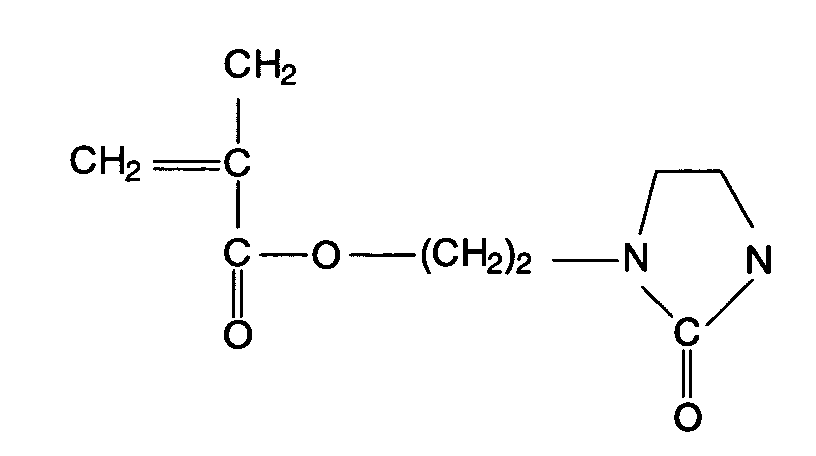
- PMMA can be functionalized, that is to say that it contains, for example, acid, acid chloride, alcohol, anhydride and ureido functions. These functions can be introduced by grafting or by copolymerization.
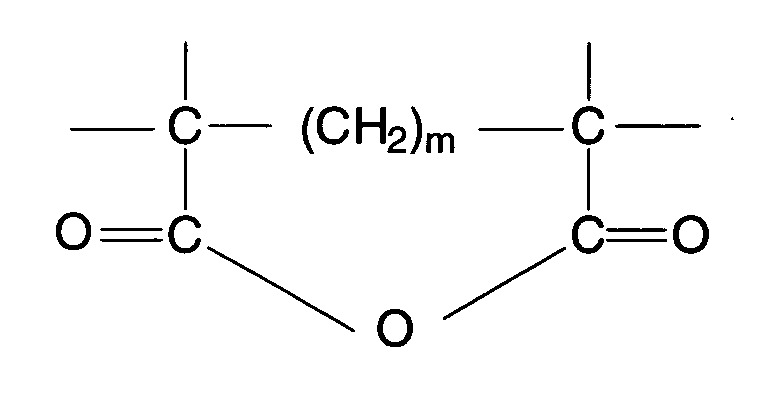
- the acid functions it is advantageously an acid function provided by the acrylic or methacrylic acid comonomer. Two neighboring acrylic acid functions can dehydrate to form an anhydride according to the following formula in which m is 0 or 1:
- the proportion of functions can be from 0 to 15% by weight of PMMA including any functions.
- MVI melt volume index or melt volume index
- PMMA can be between 2 and 15 cm3 / 10 min measured at 230 ° C under a load of 3.8 kg.
- PMMA can contain an acrylic elastomer. Indeed there are PMMA commercial grades known as "shock quality" which contain acrylic impact modifiers, most often of the bark heart type. These modifiers acrylic shock may also be present in PMMA because they have been introduced during its polymerization or prepared simultaneously during of its polymerization. This proportion of acrylic elastomer can be, in weight, from 0 to 30 parts for respectively 100 to 70 parts of PMMA. the acrylic elastomer is described later in the paragraph concerning the adhesive layer.
- the layer (A) comprises as constituents main 50 to 100 parts of PVDF for respectively 50 to 0 parts of PMMA, more advantageously the layer (A) comprises as constituents main 70 to 100 parts of PVDF for respectively 30 to 0 parts of PMMA and preferably 75 to 85 parts of PVDF for 25 to 15 respectively parts of PMMA.
- This layer may contain pigments or dyes.
- the PVDF can be chosen from those mentioned above for the PVDF layer.
- PMMA is chosen from among Functionalized PMMA which have been mentioned above for the PVDF layer. If the layer (A) is transparent, i.e. it does not contain dyes or pigments, it is recommended to add a UV absorber in the layer adhesive. Indeed if objects made of thermoset material and covered with layer (A) are exposed to daylight the adhesive layer is damaged, it is no longer adhesive and the layer (A) peels off the material thermoset.
- UV absorber these products are known in themselves. Such products are cited in US Pat. No. 5,256,472. Benzotriazoles and benzophenones are advantageously used. By way of example, it is possible to use Tinuvin® 213 or Tinuvin® 109 and preferably Tinuvin® 234 from the company Ciba Specialty Chemicals.
- the proportion of UV absorber is 2 to 3 parts per 100 parts of the adhesive layer.
- the adhesive layer may contain an acrylic elastomer . Its presence improves the quality of adhesion (increases the peel strength) and gives better mechanical strength to the films made up of the adhesive layer and the PVDF layer. This facilitates their handling to fix them on the object in thermoset material.
- the elastomers based on at least one monomer chosen from acrylonitrile, the alkyl (meth) acrylates and the core shell are thus designated.
- the core-shell copolymer it is in the form of fine particles having an elastomer core and at least one thermoplastic shell, the particle size is generally less than ⁇ m and advantageously between 50 and 300 nm.
- cores that may be mentioned are homopolymers of isoprene or butadiene, copolymers of isoprene with at most 30 mol% of a vinyl monomer and copolymers of butadiene with at most 30 mol% of a vinyl monomer.
- the vinyl monomer can be styrene, an alkylstyrene, acrylonitrile or an alkyl (meth) acrylate.
- Another core family consists of homopolymers of an alkyl (meth) acrylate and copolymers of an alkyl (meth) acrylate with at most 30 mol% of a monomer chosen from another (meth ) alkyl acrylate and a vinyl monomer.
- the alkyl (meth) acrylate is advantageously butyl acrylate.
- the vinyl monomer can be styrene, an alkylstyrene, acrylonitrile, butadiene or isoprene.
- the core of the core-shell copolymer can be crosslinked in whole or in part. It suffices to add at least difunctional monomers during the preparation of the core, these monomers can be chosen from poly (meth) acrylic esters of polyols such as butylene di (meth) acrylate and trimethylol propane trimethacrylate. Other difunctional monomers are for example divinylbenzene, trivinylbenzene, vinyl acrylate and vinyl methacrylate.
- the core can also be crosslinked by introducing therein, by grafting or as a comonomer during the polymerization, unsaturated functional monomers such as anhydrides of unsaturated carboxylic acids, unsaturated carboxylic acids and unsaturated epoxides. By way of example, mention may be made of maleic anhydride, (meth) acrylic acid and glycidyl methacrylate.
- the bark or barks are homopolymers of styrene, a alkylstyrene or methyl methacrylate or copolymers comprising at least at least 70 mol% of one of these preceding monomers and at least one comonomer chosen from the other preceding monomers, another (meth) alkyl acrylate, vinyl acetate and acrylonitrile.
- the bark can be functionalized by introducing, by grafting or as a comonomer during polymerization, unsaturated functional monomers such as anhydrides of unsaturated carboxylic acids, carboxylic acids unsaturated and unsaturated epoxides.
- Anhydride may be cited as an example maleic, (meth) acrylic acid and glycidyl methacrylate.
- the heart represents, by weight, 70 to 90% of the copolymer core bark and bark 30 to 10%.
- a copolymer As an example of a copolymer, mention may be made of that consisting of (i) from 75 to 80 parts of a heart comprising at least 93% of butadiene in moles, 5% of styrene and 0.5 to 1% of divinylbenzene and (ii) 25 to 20 parts of two barks essentially of the same weight, one interior made of polystyrene and the other PMMA exterior.
- All these core-shell copolymers are sometimes called soft / hard to cause of the elastomeric heart.
- This composition shows no exudation from the UV absorber.
- shock quality which contain modifiers acrylic shock, most often of the bark heart type.
- shock modifiers acrylics may also be present in PMMA because they have been introduced during its polymerization or prepared simultaneously during of its polymerization.
- composition of the adhesive layer can be prepared by mixing PVDF, PMMA and acrylic elastomer, if present melted in which the UV absorber, if any, is added.
- the composition of the adhesive layer can be prepared by mixing PVDF, PMMA and acrylic elastomer, if present melted in which the UV absorber, if any, is added.
- the film consisting of the adhesive layer and the layer (A) can be manufactured by any means.
- the layer (A) is made in cast, it is ie by extrusion in a flat die then it falls on rollers coolers and then the adhesive layer is coated on this layer (A).
- By adjusting the speeds of rollers arranged in the longitudinal direction and / or rollers arranged in the transverse direction you can cause stretching in the longitudinal direction and / or in the transverse direction. You can also do a blowing coextrusion. All of these techniques are known in themselves.
- the thickness of the layer (A) is advantageously between 2 and 50 ⁇ m and that of the adhesive layer between 10 and 100 ⁇ m.
- the adhesive layer can consist of 2 adjacent layers, one like that described above and the other essentially consisting of functionalized PMMA and optionally an acrylic elastomer and placed opposite the layer (A). . That is to say that we have in order: the layer essentially consisting of functionalized PMMA and optionally an acrylic elastomer, the previous adhesive layer (functionalized PMMA, possible PVDF, possible acrylic elastomer and possible UV absorber) and the layer (A).
- This layer essentially consisting of functionalized PMMA and optionally an acrylic elastomer serves to reinforce the adhesive layer / layer film (A). Its thickness can be from 10 to 200 ⁇ m.
- the possible peelable protective layer it is a temporary layer making it possible to protect the layer (A) during the stages of film handling, possible thermoforming and injection.
- This protective layer makes it possible to maintain or promote a given surface condition.
- This layer can be smooth or rough depending on the desired surface condition.
- This layer avoids the use of release agent capable of degrading the surface condition.
- This layer has, for example, a thickness between 10 and 150 ⁇ m and preferably from 50 to 100 ⁇ m.
- the materials which can be used to make this layer can be chosen from (i) saturated polyesters such as PET, PBT, copolyesters and polyetheresters, (ii) homopolymeric or copolymeric polyolefins such as polyethylenes and polypropylenes and (iii) polyamides.
- PET sold under the brand MYLAR® by the company DuPont.
- This layer can contain different fillers, such as TiO 2 , silica, kaolin, calcium carbonate, aluminum flakes and their derivatives.
- a thick peelable layer for example several mm or even up to 10 or 20 mm. In this case it is not peelable in the proper sense but provisional. That is to say that it does not adhere to PVDF but that it serves as a support.
- the outer layer comprises as constituents main 85 to 100 parts of PVDF for respectively 15 to 0 parts of PMMA and preferably 90 to 100 parts of PVDF for respectively 10 to 0 parts of PMMA.
- the thickness of the adhesive layer is advantageously between 10 and 100 ⁇ m and that of each of the other layers is advantageously between 2 and 50 ⁇ m.
- films are produced using the same techniques described above. for films made up of an adhesive layer and a PVDF layer.
- the multilayer film of the invention is used to cover objects in thermoset material (the substrate) for example either by molding or still by hot pressing on the thermoset material.
- thermoset material the substrate
- the overmolding technique The film is placed in a mold, the layer (A) being placed against the wall of the mold, then the precursor of the thermoset material in the mold (ie on the side of the adhesive layer) and then crosslinking is carried out to obtain a coated thermoset material from (A).
- the precursor denotes the complete composition with the ingredients necessary for crosslinking and possible fillers such as for example glass fibers.
- thermoset material covered with (A).
- thermoset material a sheet of the precursor of the thermoset material on the adhesive layer of the film already in the mold then that we closed the mold. Then we cause crosslinking.
- This sheet of precursor of the thermoset material comes from an SMC, i.e. the precursor thermoset material placed between 2 support films. We cut the SMC to dimensions of the mold or according to the required dimensions, peel the films supports and we obtain the sheet consisting of the precursor of the material thermoset.
- the SMC is generally composed of a polymer resin crosslinkable, in particular an unsaturated polyester, of reinforcing fillers such as glass fibers, as well as various other additives in quantities unimportant.
- the SMC is usually prepared by depositing fibers on a layer of unsaturated polyester resin, itself supported on a film mobile, generally made of polyethylene or polyamide. Another film by same nature is then deposited on top of the resin / filler system reinforcement to form a composite mass sandwiched between two films. The sandwich then passes through a series of kneading and compaction and is generally wound up in the form of large rolls. It is then stored before further processing. During the storage period, the polyester resin partially crosslinked, causing an increase in viscosity of the SMC, until reaching a consistency making it suitable for molding. SMC users, usually molders, cut a piece of appropriate size from the roll, peel off the backing film and place the SMC in a heated mold for processing and simultaneous complete cooking. So, composite masses sandwiched of SMC find easy application in operating modes of compression molding.
- the carrier film has three main properties.
- the first relates to the permeability to styrene.
- This support film must have a very low permeability to styrene in order to avoid the loss of styrene monomer which plays the role of reactive diluent in the precursor of the thermoset material. This loss of monomeric styrene is also detrimental to the health of individuals during the operations of manufacturing the SMC and its storage.
- the second property concerns the ease of peeling of this film on the polyester structure, so that there is no residual film on the structure and avoiding the risks of tearing of this film during the SMC manufacturing and transformation operations. .
- thermosetting resin for example polyester, very sensitive to water
- This support film is generally made of polyethylene, polyamide or polyamide alloy, it can be monolayer or multilayer.
- the prior art has already described such films, may for example cite the patents EP 506515, EP 786319, EP 990515 and EP 997268.
- the thickness of the support film can be between 10 and 100 ⁇ m.
- This SMC multilayer structure can be manufactured by coating the precursor of the thermoset material on the support film and we just apply the film consisting of the adhesive layer and the layer (A) which we have produced previously.
- the SMC structure is cut on demand, we peel the support film, we place it in a mold and then cross-link it to obtain an object made of thermoset material covered with a film of (A).
- an object made of thermoset material covered with a film of (A) can start with thermoforming or just thermoform if it is sufficient to obtain the thermoset material covered with (A).
- the support film can be replaced by an adhesive layer and a film of (A), that is to say that there is a symmetrical structure in which the crosslinkable composition is at the center.
- a protective peelable layer can be placed on the side of layer (A) and the layer (A) can be in the form of 2 layers.
- the SMC structure is cut on demand, it is placed in a mold then cross-linking is caused to obtain an object made of material thermoset covered on each side, or entirely depending on its shape, with a film (A).
- a film (A) Depending on the shape of the object, we can start with thermoforming or do than thermoforming if it is sufficient to obtain the thermoset material covered with (A).
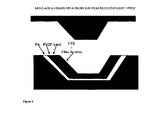
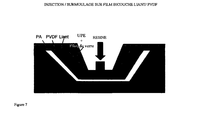
- Figure 1 shows a peelable layer (support layer) of polyamide and the production of an object after thermoforming the film.
- bin means the layer adhesive and
- PVDF denotes the layer (A) formed of PVDF.
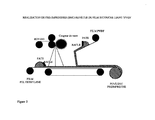
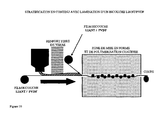
- FIG 2 shows the fabrication of an SMC structure in which the support film is made of polyethylene.
- roving means glass fibers and
- film PVDF designates the film consisting of the adhesive layer and the layer (A).
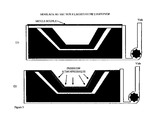
- Figure 3 shows a three-layer structure consisting of the layer adhesive (binder), a layer (A) of PVDF perfectly bonded to the binder, and a thick sheet of temporary polyamide (temporary layer), placed at the bottom of mold, a glass mat is deposited on this three-layer, then the mat is sprayed with UPE or VE resin and it causes penetration of this resin using with stiff brushes or rollers, this operation will be repeated until obtaining the desired thickness.
- a gel coat may be placed between the binder according to the invention and the first layer of glass mat and resin.
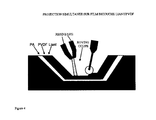
- the deposit glass and resin can also be produced by simultaneous projection using a spraying machine which allows to deposit on the binder bilayer film according to the invention / layer (A) of the cut roving which is impregnated with UPE resin in the pistol jet during its transfer. (See figure 4). After the reaction the plate polyamide can be removed and recycled.
- Figure 5 shows the three-layer consisting of the adhesive layer (the binder), a layer (A) of PVDF perfectly bonded to the binder, and a plate thick temporary polyamide. It is deposited at the bottom of the mold, the resin and the glass mat are deposited in contact with the binder then using a counter mold flexible, atmospheric pressure is used by the use of vacuum to force the penetration of the resin into the glass mat. After the reaction the plate of polyamide can be removed and recycled.
- FIG. 6 shows the three-layer consisting of the adhesive layer (the binder), a layer (A) of PVDF perfectly bonded to the binder, and a thick plate temporary polyamide. It is deposited at the bottom of the mold, the counter-mold flexible from bag molding is replaced by a rigid mold carried by a hurry. During cold pressing, only the calories provided by the exotherm of the reaction allow the bonding to be carried out at around 50 to 60 ° C. During molding hot the counter mold and the mold can be heated so that the reaction can take place from 100 to 150 ° C. After the reaction the plate of polyamide can be removed and recycled.
- FIG. 7 shows the three-layer consisting of the adhesive layer (the binder), a layer (A) of PVDF perfectly bonded to the binder, and a thick plate temporary polyamide. It is placed at the bottom of the mold, the glass mat is then placed inside the mold in contact with the binder according to the invention. The liquid resin is then injected into the fibrous reinforcement, either under pressure or by putting the mold under vacuum. After the reaction the polyamide plate can be removed and recycled.
- Figure 8 shows a bilayer consisting of the layer adhesive (binder) according to the invention and a layer (A) of PVDF perfectly bonded, deposited on a mandrel on which is wound according to a program of perfectly established and calculated distribution of glass fibers impregnated with resin.
- Figure 9 shows a bilayer consisting of the adhesive layer (the binder) and a perfectly bonded PVDF layer (A) which is deposited by lamination on fiberglass impregnated with resin.
- This impregnated and coated fiber of the bilayer according to the invention is forced through a heated die which causes polymerization of the resin and bonding with the bilayer.
- Figure 10 shows that roving is deposited with the resin between two bilayer structures (adhesive layer and layer (A) of PVDF) according to the invention towed or between a bilayer structure according to the invention and a sheet of cellophane both towed.
- the leaves present on each side of the charged resin serve as a mold.
- the structure runs in a heated oven or as soon as the resin gels, the waveforming is carried out using at the exit, if a cellophane layer has been used, it is withdrawn.
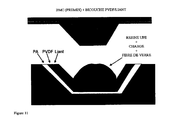
- FIG. 11 shows that the precursor of the thermoset material can be placed at the bottom of the mold. Then the temperature is increased to 120 - 150 ° C under relatively high pressures of 10 to 100 bar.
- the realization BMC part consists of thickening the liquid polyester resin, containing peroxides with high oil recovery charges with glass fibers to using a mixer with Z blades or an extruder extruder. Dough obtained is deposited on a bilayer film according to the invention (adhesive layer also called binder and layer (A) in PVDF), the paste in contact with the layer of binder at the bottom of a mold. The molding is then carried out hot.
- Composition of the adhesive layer It comprises by weight 50% of Kynar 720, 15% of OROGLAS V825 T and 35% of EXL 3600.
- Composition of the PVDF layer 80% by weight of Kynar 720-20% by weight of OROGLAS V825 T.
- Resin composition Typical SMC polyester resin on base orthophthalic.
- a bilayer film consisting an adhesive layer according to the invention and a layer (A) of PVDF previously obtained by the usual film coextrusion techniques is deposit.
- a sample of commercial SMC resin supplied by the company CRAY VALLEY is cut to cover around 70% of the inside of the mold. The structure is then molded for 5 minutes and cooled for 2 minutes. After demolding it is totally impossible to peel the bilayer of the resin crosslinked.
- An indelible felt mark Staedtler® Lumocolor Permanent made on the coated side of the film according to the invention is easily erased then that on the uncoated side, it is impossible to erase the mark.
- Odors of residual monomers as well as odors of residues polymerization are inhibited on the side of the coated surface while they are still present on the uncoated side.
- a bilayer film consisting an adhesive layer as in Example 1 but PMMA is not functionalized (it is OROGLAS V 825 T) and a layer (A) of PVDF (identical to that of Example 1) previously obtained by the techniques usual film coextrusion is deposited.
- SMC resin sample supplied by CRAY VALLEY (identical to that of ex 1) is cut to cover about 70% of the inside of the mold. The structure is then molded for 5 minutes and cooled for 2 minutes. After demolding it is possible to peel the fluorinated bilayer of the crosslinked resin.
Landscapes
- Chemical & Material Sciences (AREA)
- Organic Chemistry (AREA)
- Chemical Kinetics & Catalysis (AREA)
- Engineering & Computer Science (AREA)
- Manufacturing & Machinery (AREA)
- Materials Engineering (AREA)
- Health & Medical Sciences (AREA)
- Medicinal Chemistry (AREA)
- Polymers & Plastics (AREA)
- Laminated Bodies (AREA)
- Adhesive Tapes (AREA)
- Adhesives Or Adhesive Processes (AREA)
Abstract
Description
Claims (15)
- Utilisation de films constitués d'une couche adhésive et d'une couche (A) pour revêtir des objets en matériau thermodur :la couche adhésive comprenant , en poids :0 à 60 parties de PVDF,10 à 100 parties de PMMA fonctionnalisé,0 à 50 parties d'un élastomère acrylique,0 à 4 parties d'un absorbeur UV,le total faisant 100 parties,la couche (A) comprenant comme constituants principaux 0 à 100 parties de PVDF pour respectivement 100 à 0 parties de PMMA.
- Utilisation selon la revendication 1 dans laquelle la proportion d'absorbeur UV est comprise entre 2 et 3 parties.
- Utilisation selon la revendication 1 dans laquelle la couche adhésive comprend :20 à 60 parties de PVDF,10 à 60 parties de PMMA fonctionnalisé,0 à 50 parties d'un élastomère acrylique,0 à 4 parties d'un absorbeur UV,le total faisant 100 parties,
- Utilisation selon la revendication 1 dans laquelle la couche adhésive comprend :25 à 35 parties de PVDF,45 à 55 parties de PMMA fonctionnalisé,8 à 18 parties d'un élastomère acrylique,2 à 3 parties d'un absorbeur UV,le total faisant 100 parties.
- Utilisation selon la revendication 1 dans laquelle la couche adhésive comprend:30 à 35 parties de PVDF,50 à 55 parties de PMMA fonctionnalisé,8 à 12 parties d'un élastomère acrylique,2 à 3 parties d'un absorbeur UV,le total faisant 100 parties.
- Utilisation selon selon l'une quelconque des revendications précédentes dans laquelle l'élastomère acrylique est de type coeur écorce.
- Utilisation selon l'une quelconque des revendications précédentes dans laquelle une couche pelable de protection est disposée du coté de la couche (A).
- Utilisation selon l'une quelconque des revendications précédentes dans laquelle la couche (A) comprend comme constituants principaux 70 à 100 parties de PVDF pour respectivement 30 à 0 parties de PMMA.
- Utilisation selon l'une quelconque des revendications précédentes dans laquelle l'épaisseur de la couche (A) est comprise entre 2 et 50 µm et celle de la couche adhésive entre 10 et 100 µm.
- Utilisation selon l'une quelconque des revendications 1 à 6 dans laquelle la couche (A) se présente sous forme de 2 couches :l'une disposée contre la couche adhésive et comprenant comme constituants principaux 50 à 90 parties de PVDF pour respectivement 50 à 10 parties de PMMA,l'autre (appelée aussi couche extérieure) comprenant comme constituants principaux 75 à 100 parties de PVDF pour respectivement 25 à 0 parties de PMMA.
- Utilisation selon la revendication 9 ou 10 dans laquelle la couche extérieure comprend comme constituants principaux 85 à 100 parties de PVDF pour respectivement 15 à 0 parties de PMMA.
- Utilisation selon l'une quelconque des revendications 9 à 11 dans laquelle l'épaisseur de la couche adhésive est comprise entre 10 et 100 µm et celle de chacune des autres couches est comprise entre 2 et 50µm.
- Structure multicouche SMC comprenant dans cet ordre:un film support,une composition réticulable (le précurseur du matériau thermodur),une couche adhésive comprenant, en poids :0 à 60 parties de PVDF,10 à 100 parties de PMMA fonctionnalisé,0 à 50 parties d'un élastomère acrylique,0 à 4 parties d'un absorbeur UV,le total faisant 100 parties,une couche (A) comprenant comme constituants principaux 0 à 100 parties de PVDF pour respectivement 100 à 0 parties de PMMA.
- Structure selon la revendication 13 dans laquelle le film support est remplacé par 2 couches :une couche adhésive comprenant, en poids :0 à 60 parties de PVDF,10 à 100 parties de PMMA fonctionnalisé,0 à 50 parties d'un élastomère acrylique,0 à 4 parties d'un absorbeur UV,le total faisant 100 parties,une couche (A) comprenant comme constituants principaux 0 à 100 parties de PVDF pour respectivement 100 à 0 parties de PMMA.la couche adhésive étant disposée contre la composition reticulable.
- Utilisation selon l'une quelconque des revendications 1 à 12 dans laquelle une couche essentiellement constituée de PMMA fonctionnalisé et éventuellement d'un élastomère acrylique est disposé contre la couche adhésive.
Applications Claiming Priority (2)
| Application Number | Priority Date | Filing Date | Title |
|---|---|---|---|
| FR0212263 | 2002-10-03 | ||
| FR0212263 | 2002-10-03 |
Publications (1)
| Publication Number | Publication Date |
|---|---|
| EP1405872A1 true EP1405872A1 (fr) | 2004-04-07 |
Family
ID=31985422
Family Applications (1)
| Application Number | Title | Priority Date | Filing Date |
|---|---|---|---|
| EP03292335A Withdrawn EP1405872A1 (fr) | 2002-10-03 | 2003-09-24 | Utilisation d'un film à base de PVDF, de PMMA ou leur mélange pour recouvrir des objets en matériau thermodur |
Country Status (5)
| Country | Link |
|---|---|
| EP (1) | EP1405872A1 (fr) |
| JP (2) | JP3727633B2 (fr) |
| KR (1) | KR20040031631A (fr) |
| CN (1) | CN1315640C (fr) |
| CA (1) | CA2443593A1 (fr) |
Cited By (4)
| Publication number | Priority date | Publication date | Assignee | Title |
|---|---|---|---|---|
| FR2894178A1 (fr) * | 2005-12-06 | 2007-06-08 | Arkema Sa | Film multicouche protecteur |
| EP2382090A4 (fr) * | 2009-01-27 | 2012-05-30 | Arkema Inc | Couche barrière de polyvinylidène pour intérieurs de récipients |
| EP2814859A4 (fr) * | 2012-02-16 | 2015-07-29 | Arkema Inc | Composition adhésive durcissable par rayonnement pour feuilles arrière photovoltaïques |
| WO2024011446A1 (fr) * | 2022-07-13 | 2024-01-18 | Rohm And Haas Company | Film de fluorure de polyvinylidène modifié par une résine acrylique flexible |
Families Citing this family (16)
| Publication number | Priority date | Publication date | Assignee | Title |
|---|---|---|---|---|
| FR2866652B1 (fr) * | 2004-02-20 | 2007-08-17 | Arkema | Composition coextrudable avec le pvdf et sans effet de blanchiment sous contrainte |
| FR2882298B1 (fr) * | 2005-02-23 | 2010-02-26 | Arkema | Film multicouche protecteur a base de pvdf et de pmma |
| IN2014DN08319A (fr) * | 2005-12-15 | 2015-07-10 | Huntsman Adv Mat Switzerland | |
| JP4976762B2 (ja) * | 2006-07-03 | 2012-07-18 | 電気化学工業株式会社 | フッ化ビニリデン系樹脂積層フィルム及びその製造方法 |
| US20100310844A1 (en) * | 2007-05-08 | 2010-12-09 | Basf Se | Method for coating a molded foam part |
| JP4810525B2 (ja) * | 2007-12-27 | 2011-11-09 | フクビ化学工業株式会社 | 3層押出成形体 |
| FR2927016B1 (fr) * | 2008-02-06 | 2012-10-19 | Arkema France | Film tricouche pour cellule photovoltaique |
| EP2397519B1 (fr) * | 2009-02-13 | 2015-11-25 | Denki Kagaku Kogyo Kabushiki Kaisha | Film de résine à base de fluorure de vinylidène |
| CN102675778B (zh) * | 2011-10-19 | 2014-02-19 | 南京工业大学 | 一种pvdf/petg组合物及其制备的薄膜 |
| MX2016013619A (es) * | 2014-04-17 | 2017-02-28 | Arkema France | Primera superficie resistente a la intemperie sobre una capa de union sobre un sustrato pultrusionado. |
| CN104191770A (zh) * | 2014-09-17 | 2014-12-10 | 上海海优威新材料股份有限公司 | 聚偏氟乙烯复合膜及其制备方法 |
| FR3044585B1 (fr) * | 2015-12-08 | 2020-01-31 | Arkema France | Structure multicouche comprenant une couche contenant un polymere fluore et copolymere acrylique - procede de fabrication et tube associes |
| JP6431999B1 (ja) * | 2018-05-22 | 2018-11-28 | デクセリアルズ株式会社 | 漏油補修材、漏油補修方法、及び、配管 |
| CN112606500A (zh) * | 2019-12-30 | 2021-04-06 | 武汉高正新材料科技有限公司 | 一种易粘接型建筑装饰膜 |
| JP7362872B2 (ja) * | 2022-03-25 | 2023-10-17 | 日東電工株式会社 | 光半導体素子封止用シートおよび表示体 |
| KR102747453B1 (ko) * | 2024-01-10 | 2024-12-26 | 김수환 | 사료 저장 탱크 제조방법 |
Citations (4)
| Publication number | Priority date | Publication date | Assignee | Title |
|---|---|---|---|---|
| US4364886A (en) * | 1980-03-07 | 1982-12-21 | Chimiques Ugine Kuhlmann | Process for the manufacture of polyvinylidene fluoride - incompatible polymer laminates |
| EP0476942A2 (fr) * | 1990-09-18 | 1992-03-25 | Rohm And Haas Company | Compositions de résine |
| JPH05220907A (ja) * | 1992-02-17 | 1993-08-31 | Mitsubishi Petrochem Co Ltd | 耐候性改良繊維強化プラスチック製品 |
| US5242976A (en) * | 1990-03-02 | 1993-09-07 | Societe Atochem | Composition for improving adhesion of vinylidene polyfluoride and non-compatible polymeric resins |
-
2003
- 2003-09-24 EP EP03292335A patent/EP1405872A1/fr not_active Withdrawn
- 2003-09-30 CN CNB031272894A patent/CN1315640C/zh not_active Expired - Fee Related
- 2003-10-02 KR KR1020030068773A patent/KR20040031631A/ko not_active Withdrawn
- 2003-10-03 JP JP2003346435A patent/JP3727633B2/ja not_active Expired - Fee Related
- 2003-10-03 CA CA002443593A patent/CA2443593A1/fr not_active Abandoned
-
2005
- 2005-06-08 JP JP2005168264A patent/JP2005330492A/ja not_active Abandoned
Patent Citations (4)
| Publication number | Priority date | Publication date | Assignee | Title |
|---|---|---|---|---|
| US4364886A (en) * | 1980-03-07 | 1982-12-21 | Chimiques Ugine Kuhlmann | Process for the manufacture of polyvinylidene fluoride - incompatible polymer laminates |
| US5242976A (en) * | 1990-03-02 | 1993-09-07 | Societe Atochem | Composition for improving adhesion of vinylidene polyfluoride and non-compatible polymeric resins |
| EP0476942A2 (fr) * | 1990-09-18 | 1992-03-25 | Rohm And Haas Company | Compositions de résine |
| JPH05220907A (ja) * | 1992-02-17 | 1993-08-31 | Mitsubishi Petrochem Co Ltd | 耐候性改良繊維強化プラスチック製品 |
Non-Patent Citations (1)
| Title |
|---|
| DATABASE WPI Section Ch Week 199339, Derwent World Patents Index; Class A14, AN 1993-308772, XP002243410 * |
Cited By (5)
| Publication number | Priority date | Publication date | Assignee | Title |
|---|---|---|---|---|
| FR2894178A1 (fr) * | 2005-12-06 | 2007-06-08 | Arkema Sa | Film multicouche protecteur |
| WO2007066042A3 (fr) * | 2005-12-06 | 2007-09-13 | Arkema France | Panneau en materiau (ligno)cellulosique recouvert d'un film multicouche a base de pmma et de pvdf |
| EP2382090A4 (fr) * | 2009-01-27 | 2012-05-30 | Arkema Inc | Couche barrière de polyvinylidène pour intérieurs de récipients |
| EP2814859A4 (fr) * | 2012-02-16 | 2015-07-29 | Arkema Inc | Composition adhésive durcissable par rayonnement pour feuilles arrière photovoltaïques |
| WO2024011446A1 (fr) * | 2022-07-13 | 2024-01-18 | Rohm And Haas Company | Film de fluorure de polyvinylidène modifié par une résine acrylique flexible |
Also Published As
| Publication number | Publication date |
|---|---|
| KR20040031631A (ko) | 2004-04-13 |
| JP2005330492A (ja) | 2005-12-02 |
| CN1315640C (zh) | 2007-05-16 |
| JP3727633B2 (ja) | 2005-12-14 |
| CA2443593A1 (fr) | 2004-04-03 |
| JP2004143456A (ja) | 2004-05-20 |
| CN1496818A (zh) | 2004-05-19 |
Similar Documents
| Publication | Publication Date | Title |
|---|---|---|
| EP1405872A1 (fr) | Utilisation d'un film à base de PVDF, de PMMA ou leur mélange pour recouvrir des objets en matériau thermodur | |
| US7179863B2 (en) | Use of a film based PVDF, PMMA or a blend thereof for covering articles made of a thermoset | |
| EP1120244B1 (fr) | Film multicouche thermoformable pour la protection de substrats et objets obtenus | |
| FR2882298A1 (fr) | Film multicouche protecteur a base de pvdf et de pmma | |
| EP1484346A1 (fr) | Procédé de greffage de polymère fluoré et structures multicouches comprenant ce polymère greffé | |
| EP0976804A1 (fr) | Adhésif polymérique et structures à couches polymériques multiples, leur procédé de préparation et leur utilisation | |
| EP1225037A1 (fr) | Film multicouche thermoformable pour la protection de substrats et objets obtenus | |
| LU83332A1 (fr) | Procede de preparation d'articles manufactures a base de polymeres thermoplastiques contenant des fibres de verre et articles obtenus | |
| EP1541339A1 (fr) | Film acrylique multicouche à propriétes optique et mécaniques améliorees | |
| EP1543953A2 (fr) | Film acrylique multicouche à proprietes optiqe et mecaniques ameliorées | |
| FR2662611A1 (fr) | Ski et elements de ski. | |
| WO2003045689A2 (fr) | Film multicouche thermoformable a base de polymere acrylique pour la protection de substrats et objets obtenus | |
| CA2044527C (fr) | Films multicouches et materiaux composites incluant des films a base de polyamides et de copolyolefine(s) modifiees aptes au collage | |
| FR2894178A1 (fr) | Film multicouche protecteur | |
| FR2893696A1 (fr) | Tube multicouche pour le transport d'eau ou de gaz | |
| EP0001954B1 (fr) | Procédé pour la fabrication du verre feuilleté et produit obtenu selon ledit procédé | |
| EP1713843A1 (fr) | Procede de greffage de polymere fluore et structures multicouches comprenant ce polymere greffe | |
| FR3008418A1 (fr) | Film polymere multicouche pvdf - adhesif sensible a la pression | |
| CA1304664C (fr) | Composite polyfluorure de vinylidene - polymere non compatible, procedede fabrication du composite | |
| CN100379818C (zh) | 木质装饰用丙烯酸树脂膜及其对木质装饰体的应用 | |
| FR2663237A1 (fr) | Procede de collage d'elements de la structure d'un ski. | |
| CH617887A5 (en) | Laminated material and its manufacturing process | |
| BE1010189A3 (fr) | Panneau composite thermoformable et procede pour sa fabrication. | |
| FR2913913A1 (fr) | Structure multicouche petg/pmma | |
| EP0898511A1 (fr) | Panneau composite thermoformable et procede pour sa fabrication |
Legal Events
| Date | Code | Title | Description |
|---|---|---|---|
| PUAI | Public reference made under article 153(3) epc to a published international application that has entered the european phase |
Free format text: ORIGINAL CODE: 0009012 |
|
| 17P | Request for examination filed |
Effective date: 20030929 |
|
| AK | Designated contracting states |
Kind code of ref document: A1 Designated state(s): AT BE BG CH CY CZ DE DK EE ES FI FR GB GR HU IE IT LI LU MC NL PT RO SE SI SK TR |
|
| AX | Request for extension of the european patent |
Extension state: AL LT LV MK |
|
| AKX | Designation fees paid |
Designated state(s): AT BE BG CH CY CZ DE DK EE ES FI FR GB GR HU IE IT LI LU MC NL PT RO SE SI SK TR |
|
| RAP1 | Party data changed (applicant data changed or rights of an application transferred) |
Owner name: ARKEMA |
|
| 17Q | First examination report despatched |
Effective date: 20050329 |
|
| RAP1 | Party data changed (applicant data changed or rights of an application transferred) |
Owner name: ARKEMA FRANCE |
|
| 17Q | First examination report despatched |
Effective date: 20050329 |
|
| RAP1 | Party data changed (applicant data changed or rights of an application transferred) |
Owner name: ARKEMA FRANCE |
|
| STAA | Information on the status of an ep patent application or granted ep patent |
Free format text: STATUS: THE APPLICATION IS DEEMED TO BE WITHDRAWN |
|
| 18D | Application deemed to be withdrawn |
Effective date: 20070524 |