EP1405834A2 - Optische Fasern aus Mehrkomponentengläsern - Google Patents
Optische Fasern aus Mehrkomponentengläsern Download PDFInfo
- Publication number
- EP1405834A2 EP1405834A2 EP03019676A EP03019676A EP1405834A2 EP 1405834 A2 EP1405834 A2 EP 1405834A2 EP 03019676 A EP03019676 A EP 03019676A EP 03019676 A EP03019676 A EP 03019676A EP 1405834 A2 EP1405834 A2 EP 1405834A2
- Authority
- EP
- European Patent Office
- Prior art keywords
- weight
- fiber according
- glass
- optical
- content
- Prior art date
- Legal status (The legal status is an assumption and is not a legal conclusion. Google has not performed a legal analysis and makes no representation as to the accuracy of the status listed.)
- Withdrawn
Links
Images
Classifications
-
- C—CHEMISTRY; METALLURGY
- C03—GLASS; MINERAL OR SLAG WOOL
- C03C—CHEMICAL COMPOSITION OF GLASSES, GLAZES OR VITREOUS ENAMELS; SURFACE TREATMENT OF GLASS; SURFACE TREATMENT OF FIBRES OR FILAMENTS MADE FROM GLASS, MINERALS OR SLAGS; JOINING GLASS TO GLASS OR OTHER MATERIALS
- C03C13/00—Fibre or filament compositions
- C03C13/04—Fibre optics, e.g. core and clad fibre compositions
- C03C13/045—Silica-containing oxide glass compositions
- C03C13/046—Multicomponent glass compositions
Definitions
- the invention relates to optical stepped fibers made of multi-component glasses comprising a core glass and the core glass completely on it Cladding glass enclosing the peripheral wall and the use of such optical stepped fibers.
- an optical fiber for light transmission is made of one high refractive core glass and a cladding glass surrounding it lower refractive index than that of the core glass.
- glass fibers of this type transmit light that is coupled into one end of the fiber is going to the other end of the fiber, with the light at the. interface between core glass and cladding glass is completely reflected (total reflection).
- Step fibers are often packed together in a dense fiber bundle Provide protective hose, their ends glued into metal sleeves and the End faces processed by grinding and polishing to optically flat surfaces. Correspondingly assembled optical fiber bundles are called fiber optic Light guide.
- Fiber optic light guides can be found in a wide variety of technical and medical fields application (general industrial technology, Lighting, traffic technology, automotive industry, architecture, endoscopy, Dental Medicine). Your most important function is to transfer one if possible large luminous flux from one location A to another location B, mostly over short to medium distances (a few to a maximum of 100 m). there the light emitted by a powerful light source is often used e.g. that of a halogen or discharge lamp using optical aids such as Lens / reflector coupled into the fiber bundle.
- the amount of light transmitted through fiber optic light guides depends on the NA of their fibers also depend on the transmission property of them containing core glasses. Only core glasses of certain specific Composition and with very low levels of contamination Raw materials from which they were melted guide the light as much as possible Low attenuation over the entire length of the light guide.
- Optical step fibers are manufactured from multi-component glasses using either the so-called double crucible or the rod-tube process.
- core and cladding glass are heated to temperatures which correspond to a viscosity range between 10 4 to 10 3 dPs and are thereby drawn out to form a fiber.
- core and cladding glass In order for a stable, low-loss fiber to be produced, core and cladding glass must be compatible with one another in a number of properties, such as viscosity curve, thermal expansion, tendency to crystallize, etc. In particular, there must be no contact reaction or crystallization in the interface between the fiber core and cladding, which would seriously interfere with total reflection of the light guided in the fiber core and would thus render the fiber unsuitable for use in low-attenuation light transmission. In addition, the mechanical strength of the fiber would be adversely affected by crystallization.
- the probably best known and most widespread fiber system consists of a lead glass with a high lead content (mostly ⁇ 35% PbO) and one Alkali borosilicate glass as a cladding glass. Its advantage lies in the achievable high numerical aperture (up to> 0.7 for PbO portions of the core glass of> 50%) with low manufacturing costs and good drawability to fibers without Crystallization problems.
- a second fiber system consists of an alkali borosilicate glass that is both Core as well as cladding glass is used.
- Pure quartz-based fibers also come in principle as the third fiber system as a bundle fiber for light transmission in question.
- Another subtask is a complete or at least one almost lead-free fiber with a numerical aperture ⁇ 0.48 and to develop the aforementioned properties.
- an optical step fiber which comprises a core glass and a cladding glass which completely surrounds the core glass on its peripheral wall, the core glass having a composition of 42 to 53% by weight SiO 2 , 16 to 38% by weight ZnO, 1 to 20% by weight of PbO, the sum of ZnO and PbO being ⁇ 30% by weight, ⁇ 14% by weight of Na 2 O, ⁇ 12% by weight of K 2 O, the sum of Na 2 O and K 2 O ⁇ 2% by weight, and the cladding glass has a composition of 60 to 72% by weight SiO 2 , ⁇ 20% by weight B 2 O 3 , ⁇ 10% by weight Al 2 O 3 , ⁇ 18% by weight Na 2 O, ⁇ 15 wt.% K 2 O and refining agents in the usual amounts.
- the task is solved with a step fiber whose core glass has a composition of 42 to 53% by weight SiO 2 , 30 to 38% by weight ZnO, ⁇ 14% by weight Na 2 O, ⁇ 12 wt.% K 2 O, the sum of Na 2 O and K 2 O being ⁇ 2 wt.%, ⁇ 0.9 wt.% BaO and the cladding glass a composition of 60 to 72 wt.% SiO 2 , ⁇ 20% by weight B 2 O 3 , ⁇ 10% by weight Al 2 O 3 , ⁇ 18% by weight Na 2 O, ⁇ 15% by weight K 2 O.
- the cladding glass can contain refining agents.
- the published patent application DE 199 58 522 A1 describes optical glasses containing zinc with refractive indices n d between 1.52 and 1.66. In addition to ZnO, these glasses mostly also contain PbO in different percentages, mainly alkalis and a few other elements such as B, Ba, Mg, Ca, Al, Y, Zr and Ge. A total of 24 examples are given.
- the glasses specified there are characterized by a high Pure transmission and good color neutrality.
- the glasses also have good crystallization stability and properties Meltability. The totality of these properties leave these glasses as potential core glass candidates for optical fiber come, provided a suitable, compatible cladding glass can be found can.
- optical step fibers are made of Multi-component glasses manufactured using either the double crucible or the rod-tube process.
- the rod-tube method was used, since a double crucible was not available and the various jacket gas variants were already available in tube form.
- a cylindrical rod made of high-index core glass and the tube of low-index cladding glass surrounding it are heated in a cylindrical furnace to a temperature corresponding to a toughness of about 10 4 to 10 3 dPas.
- the core and cladding glass merge into a so-called onion, from which the optical fiber is drawn.
- the fiber diameter depends on the ratio of the fiber drawing speed to the tracking speed of the rod-tube system and the dimensions of the core rod and tube. Particular care must be taken in this process to ensure that the core rod surface and the inner tube surface are extremely clean and free of any dirt and particles so that they can fuse to form the ideal, trouble-free fiber interface. It has also proven to be advantageous if the outer diameter of the core rod and the inner diameter of the tube differ by only a few tenths of a millimeter, so that a uniform, wrinkle-free onion can form.
- the fiber was pulled out on a rod-tube drawing machine cylindrical furnace according to the prior art. It was exclusively Drawn fibers with a diameter of 70 ⁇ m. This corresponds to one worldwide common standard that applies to multi-component fibers that are almost are processed exclusively into bundle fibers. The attenuation was measured according to the so-called Cut-back process (DIN 58 141 -1).
- Both the light and the optical fiber are used consider the data transfer.
- Typical applications for the The automotive industry for example, transmits light (Vehicle lighting inside and outside), medical technology (endoscopy, Surgical microscopy) and signaling technology (traffic sign, Web signaling) and alphanumeric display systems.
- Applications for data transmission is also found in the automotive industry also in general industrial and building technology.
- the compilation of core and cladding glasses different Glass composition was based on the principle, the property catalog to optimize the fibers produced therefrom according to the invention. there stood a large numerical aperture, low attenuation, low Manufacturing costs and environmental compatibility of the raw materials used in the Foreground. Of course, the crystallization-free drawability of the Fiber can be guaranteed.
- the task of delivering a fiber with NA ⁇ 0.50 shows Core glass variant 1 the absolutely lowest attenuation level (80 dB / km at 553 nm with very good purity of the raw material components used). She contains only 3.5% PbO and results with the alkali borosilicate glass Type 1 in Table 2 has a numerical aperture of 0.522.
- the missing PbO must be replaced by one or more additional raw material components.
- the components Li 2 O, BaO and ZrO 2 which were tested in different composition ratios in the core glass variants, proved to be particularly suitable candidates (see Table 1).
- the NA of the fiber is reduced to ⁇ 0.50 or 0.48, however, in favor of lower attenuation (see core glass variants 7 and 8 ).
- the lead-free variant 8 shows another one by a factor greater than 2 lower attenuation (553 nm) than conventional light flint glass.
- a counter example of an unsuitable lead-free core glass variant is a glass with 44.7% by weight SiO 2 , 39.9% by weight ZnO, 7.9% by weight Na 2 O, 7.3% by weight K 2 O and 0.2
- the core glass serving as a counterexample has a refractive index n d of 1.58 and an NA of 0.534, but due to the strong crystallization at the interface between the core glass and the cladding glass, there is no measurable attenuation in the range of 401 nm under consideration up to 553 nm and is therefore not suitable for use in a fiber.
- Tab. 2 shows the respective composition of the selected ones Cladding glasses. These are three alkali borosilicate glasses, No. 1, 4 and 5 as well as a soda-lime glass (No. 2) and alkali-aluminosilicate glass (No. 3).
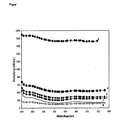
- the second best fiber variant with soda-lime glass (cladding glass 2) as Sheath material lies on one in the entire measured spectral range significantly poorer damping level (approx. 30% to 60% higher values, depending on the wavelength).
- the cladding glass 3, an alkali-aluminosilicate glass, in connection with the core glass variant 1 is practically the whole Wavelength range with an almost two times worse Damping as the best variant with a cladding glass 1.
- the curve design of the lead-free designated by the number 6 Fiber variant from the core glass variant 8 (see Tab. 1) and the Cladding glass variant 1 (see Tab. 2) can be seen, which in the whole considered the lowest attenuation with less than 200 dB / km having.
Landscapes
- Chemical & Material Sciences (AREA)
- General Chemical & Material Sciences (AREA)
- Life Sciences & Earth Sciences (AREA)
- Optics & Photonics (AREA)
- Engineering & Computer Science (AREA)
- Chemical Kinetics & Catalysis (AREA)
- Physics & Mathematics (AREA)
- Geochemistry & Mineralogy (AREA)
- Materials Engineering (AREA)
- Organic Chemistry (AREA)
- Glass Compositions (AREA)
- Optical Fibers, Optical Fiber Cores, And Optical Fiber Bundles (AREA)
- Manufacture, Treatment Of Glass Fibers (AREA)
Abstract
Description
Kern- als auch als Mantelglas zum Einsatz kommt.
in der EP 0018110 oder der EP 0081928, beide von British Post Office. Auch in der japanischen Patentliteratur sind entsprechende Glaszusammensetzungen für optische Fasern veröffentlicht, so z.B. von NSG das deutsche Patent DE 29 40 451 C2 oder das amerikanische Patent US 4,264,131 von Tokyo Shibaura Denki Kabushiki Kaisha. Diese Gläser enthalten neben einem hohen Boranteil auch hohe Anteile an Erdalkali und/oder Zirkon- und Germaniumoxid, um die gewünschte hohe Brechzahl zu erreichen.
- eine hohe Numerische Apertur (≥ 0,50)
- eine niedrige bis mittlere Dämpfung im gesamten sichtbaren Spektralbereich
- geringen Farbstich
- niedrige Herstellkosten
- gute Ziehbarkeit, d.h. ohne Tendenz zu Kristallisation oder Grenzflächenreaktion bei der Herstellung
- umweltfreundlichere Rohstoffkomponenten der zugehörigen Kern- und Mantelgläser im Vergleich z. B. zu stark bleihaltigen Flintgläsern.
konnten aus dem in der DE 199 58 522 A1 zugrundeliegendem Glassystem Gläser gefunden werden, die zur Herstellung von Fasern geeignet sind.
- hat eine große Numerische Apertur von ≥ 0,50
- besitzt eine niedrige Dämpfung von 80 dB/km bis 165 dB/km, abhängig von
der
Reinheit der verwendeten Rohstoffe - zeigt einen geringen Farbstich (Δ D (451 nm/553 nm) < 205 dB/km)
- hat geringe Herstellkosten
- zeigt eine gute Ziehbarkeit
- besteht weitgehend aus umweltschonenden Rohstoffkomponenten.
Mehrkomponenten-gläsern entweder nach dem Doppeltiegel- oder dem Stab-Rohr-Verfahren hergestellt.
Im vorliegenden Fall wurde ausschließlich das Stab-Rohr-Verfahren verwendet, da ein Doppeltiegel nicht verfügbar war und die verschiedenen Mantelgfasvarianten bereits in Rohrform vorlagen.
| Glaszusammensetzung (Gew.%) | 1 | 2 | 3 | 4 | 5 | 6 | 7 | 8 | konventionelles Kernglas (Leichtflint) |
| SiO2 | 44,6 | 44,6 | 45,8 | 50,9 | 46,4 | 47,7 | 48,3 | 48,6 | 53 |
| ZnO | 34,8 | 37,5 | 29,5 | 17,6 | 37,3 | 34,4 | 31,6 | 33,0 | - |
| PbO | 3,5 | 1,3 | 8,0 | 19,4 | - | - | - | - | 34 |
| Na2O | 8,0 | 9,4 | 9,0 | 8,2 | 8,3 | 8,3 | 8,1 | 8,2 | 5,9 |
| K2O | 8,9 | 7,0 | 7,5 | 3,7 | 5,8 | 5,8 | 9,1 | 9,1 | 6,9 |
| Li2O | - | - | - | - | 1,1 | 0,9 | - | - | - |
| BaO | - | - | - | - | 0,8 | 0,8 | 0,8 | 0,8 | - |
| ZrO2 | - | - | - | - | - | 1,8 | 1,8 | - | - |
| Läutermittel | 0,2 | 0,2 | 0,2 | 0,2 | 0,3 | 0,3 | 0,3 | 0,3 | 0,2 |
| nd | 1,576 | 1,58 | 1,58 | 1,58 | 1,58 | 1,58 | 1,57 | 1,567 | 1,581 |
| NA | 0,522 | 0,534 | 0,534 | 0,534 | 0,534 | 0,534 | 0,504 | 0,494 | 0,537 |
| Faser-Dämpfung [dB/km] bei λ(nm): | |||||||||
| 401 | 272 | 263 | 338 | 628 | 397 | 360 | 273 | 171 | 634 |
| 451 | 170 | 251 | 190 | 370 | 335 | 334 | 282 | 153 | 427 |
| 553 | 80 | 117 | 86 | 165 | 228 | 163 | 140 | 96 | 226 |
| Kontaktreaktion Kern/ Mantelglas | nein | beginnend | nein | nein | nein | nein | nein | nein | nein |
| Glaszusammensetzung | Mantelglasvarianten | ||||
| Gew. -% | 1 | 2 | 3 | 4 | 5 |
| SiO2 | 69 | 70 | 68 | 81 | 75 |
| B2O3 | 19 | 1 | 3 | 12 | 10 |
| Al2O3 | 3 | 4 | 8 | 2,5 | 5 |
| Na2O | 1 | 13 | 15 | 3,5 | 7 |
| K2O | 8 | 2,3 | 1 | 0,1 | |
| Li2O | 1 | ||||
| MgO | 2,5 | ||||
| BaO | 2 | 0,6 | |||
| CaO | 5 | 3 | 1,4 | ||
| ZnO | 1,5 | ||||
| F | 0,2 | 0,5 | 0,2 |
| Mantelglastyp | Kernglas | Faserdämpfung (dB/km) bei λ (nm) | Entglasung/ Kontaktreaktion | |||
| 400 | 452 | 554 | 642 | |||
| Mantelglas 1 | Kernglasvariante 1 | 365 | 264 | 131 | 161 | nein |
| Mantelglas 2 | 461 | 346 | 213 | 252 | nein | |
| Mantelglas 3 | 521 | 402 | 263 | 293 | sehr schwach | |
| Mantelglas 4 | 670 | 565 | 425 | 445 | beginnend | |
| Mantelglas 5 | 1897 | 1863 | 1727 | 1748 | stark | |
| Mantelglas 1 | Kernglasvariante 8 (bleifrei) | 171 | 153 | 96 | 113 | nein |
Claims (38)
- Optische Stufenfaser aus Mehrkomponentengläsern umfassend ein Kernglas und ein das Kernglas vollständig an seiner Umfangswand umschließendes Mantelglas mit einer Numerischen Apertur ≥ 0,50, wobei das Kernglas eine Zusammensetzung aufweist mit:
SiO2 42 bis 53 Gew.% ZnO 16 bis 38 Gew.% PbO 1 bis 20 Gew.% mit ZnO + PbO ≥ 30 Gew.% Na2O < 14 Gew.% K2O < 12 Gew.% Na2O + K2O ≥ 2 Gew.% SiO2 60 bis 72 Gew.% B2O3 < 20 Gew.% Al2O3 < 10 Gew.% Na2O < 18 Gew.% K2O < 15 Gew.% - Optische Stufenfaser nach Anspruch 1,
dadurch gekennzeichnet, dass das Mantelglas und/oder das Kernglas Läutermittel enthält. - Optische Stufenfaser nach Anspruch 1 oder 2, wobei das Kernglas einen PbO-Gehalt von 2 bis 12 Gew.% aufweist.
- Optische Stufenfaser nach einem der Ansprüche 1 bis 3, wobei das Kernglas einen BaO-Gehalt < 0,9 Gew.% aufweist.
- Optische Stufenfaser aus Mehrkomponentengläsern umfassend ein Kernglas und ein das Kernglas vollständig an seiner Umfangswand umschließendes Mantelglas mit einer Numerischen Apertur ≥ 0,48, wobei das Kernglas eine Zusammensetzung aufweist mit:
SiO2 42 bis 53 Gew.% ZnO 30 bis 38 Gew.% Na2O < 14 Gew.% K2O < 12 Gew.% Na2O + K2O ≥ 2 Gew.% BaO < 0,9 Gew.% SiO2 60 bis 72 Gew.% B2O3 < 20 Gew.% Al2O3 < 10 Gew.% Na2O < 18 Gew.% K2O < 15 Gew.% - Optische Stufenfaser nach Anspruch 5,
dadurch gekennzeichnet, dass das Mantelglas Läutermittel enthält. - Optische Stufenfaser nach Anspruch 5 oder 6, wobei das Kernglas zusätzlich einen PbO-Gehalt < 1 Gew.% aufweist.
- Optische Stufenfaser nach einem der Ansprüche 1 bis 7, wobei das Kernglas einen F-Gehalt < 2 Gew.% aufweist.
- Optische Stufenfaser nach Anspruch 8, wobei das Kernglas einen F-Gehalt < 0,5 Gew.% aufweist.
- Optische Stufenfaser nach einem der Ansprüche 1 bis 9, wobei das Kernglas einen Li2O -Gehalt < 3 Gew.% aufweist.
- Optische Stufenfaser nach einem der Ansprüche 1 bis 10, wobei im Kernglas die Summe der Komponenten Li2O, Na2O und K2O ≥ 2 Gew.% ist.
- Optische Stufenfaser nach Anspruch 11, wobei im Kernglas die Summe der Komponenten Li2O, Na2O und K2O ≥ 5 Gew.% ist.
- Optische Stufenfaser nach einem der Ansprüche 1 bis 12, wobei das Kernglas einen ZrO2-Gehalt < 2 Gew.% aufweist.
- Optische Stufenfaser nach einem der Ansprüche 1 bis 13, wobei das Kernglas einen MgO-Gehalt < 6 Gew.% aufweist.
- Optische Stufenfaser nach einem der Ansprüche 1 bis 14, wobei das Kernglas einen CaO-Gehalt < 5 Gew.% aufweist.
- Optische Stufenfaser nach einem der Ansprüche 1 bis 15, wobei das Kernglas einen SrO-Gehalt < 6 Gew.% aufweist.
- Optische Stufenfaser nach einem der Ansprüche 1 bis 16, wobei das Kernglas einen B2O3-Gehalt < 1 Gew.% aufweist.
- Optische Stufenfaser nach einem der Ansprüche 1 bis 17, wobei das Kernglas einen Al2O3-Gehalt < 1,5 Gew.% aufweist.
- Optische Stufenfaser nach einem der Ansprüche 1 bis 18, wobei das Mantelglas einen Li2O-Gehalt < 2 Gew.% aufweist.
- Optische Stufenfaser nach einem der Ansprüche 1 bis 19, wobei das Mantelglas einen MgO-Gehalt < 3 Gew.% aufweist.
- Optische Stufenfaser nach einem der Ansprüche 1 bis 20, wobei das Mantelglas einen BaO-Gehalt < 3 Gew.% aufweist.
- Optische Stufenfaser nach einem der Ansprüche 1 bis 21, wobei das Mantelglas einen SrO-Gehalt < 4 Gew.% aufweist.
- Optische Stufenfaser nach einem der Ansprüche 1 bis 22, wobei das Mantelglas einen CaO-Gehalt < 6 Gew.% aufweist.
- Optische Stufenfaser nach einem der Ansprüche 1 bis 23, wobei das Mantelglas einen ZnO-Gehalt < 3 Gew.% aufweist.
- Optische Stufenfaser nach einem der Ansprüche 1 bis 24, wobei das Mantelglas einen F-Gehalt < 1 Gew.% aufweist.
- Optische Stufenfaser nach einem der Ansprüche 1 bis 25, wobei im Mantelglas die Summe der Komponenten Li2O, Na2O und K2O ≥ 3 Gew.% ist.
- Optische Stufenfaser nach einem der Ansprüche 1 bis 26, wobei das Mantelglas einen SiO2-Gehalt von 66 bis 72 Gew.% aufweist.
- Verwendung einer optischen Stufenfaser nach einem der Ansprüche 1 bis 27 zur Übertragung von Licht.
- Verwendung einer optischen Stufenfaser nach einem der Ansprüche 1 bis 27 in einem Faserbündel.
- Verwendung einer optischen Stufenfaser nach einem der Ansprüche 1 bis 27 zur Datenübertragung.
- Verwendung einer optischen Stufenfaser nach einem der Ansprüche 1 bis 27 zur Datenübertragung in Fahrzeugen.
- Verwendung einer optischen Stufenfaser nach einem der Ansprüche 1 bis 27 zur Fahrzeugbeleuchtung.
- Verwendung einer optischen Stufenfaser nach einem der Ansprüche 1 bis 27 als Verkehrszeichengeber.
- Verwendung einer optischen Stufenfaser nach einem der Ansprüche 1 bis 27 für die Bahnsignalisation.
- Verwendung einer optischen Stufenfaser nach einem der Ansprüche 1 bis 27 als alphanumerisches Display.
- Verwendung einer optischen Stufenfaser nach einem der Ansprüche 1 bis 27 zur Beleuchtung in sogenannten Kaltlichtquellen.
- Verwendung einer optischen Stufenfaser nach einem der Ansprüche 1 bis 27 zur Beleuchtung in der medizinischen und technischen Endoskopie.
- Verwendung einer optischen Stufenfaser nach einem der Ansprüche 1 bis 27 zur Beleuchtung in der Operationsmikroskopie.
Applications Claiming Priority (2)
| Application Number | Priority Date | Filing Date | Title |
|---|---|---|---|
| DE10245987 | 2002-10-02 | ||
| DE10245987A DE10245987B3 (de) | 2002-10-02 | 2002-10-02 | Optische Stufenfasern aus Mehrkomponentengläsern |
Publications (2)
| Publication Number | Publication Date |
|---|---|
| EP1405834A2 true EP1405834A2 (de) | 2004-04-07 |
| EP1405834A3 EP1405834A3 (de) | 2006-01-04 |
Family
ID=31984362
Family Applications (1)
| Application Number | Title | Priority Date | Filing Date |
|---|---|---|---|
| EP03019676A Withdrawn EP1405834A3 (de) | 2002-10-02 | 2003-09-09 | Optische Fasern aus Mehrkomponentengläsern |
Country Status (4)
| Country | Link |
|---|---|
| US (1) | US7072562B2 (de) |
| EP (1) | EP1405834A3 (de) |
| JP (1) | JP4397019B2 (de) |
| DE (1) | DE10245987B3 (de) |
Cited By (1)
| Publication number | Priority date | Publication date | Assignee | Title |
|---|---|---|---|---|
| WO2007104300A1 (de) * | 2006-03-14 | 2007-09-20 | Schott Ag | Glasfaserkabel |
Families Citing this family (14)
| Publication number | Priority date | Publication date | Assignee | Title |
|---|---|---|---|---|
| JP2005298271A (ja) * | 2004-04-12 | 2005-10-27 | Sumitomo Electric Ind Ltd | 光ファイバの製造方法及び光ファイバ |
| EP1904410A1 (de) * | 2005-07-22 | 2008-04-02 | Schott AG | Verfahren und vorrichtung zur herstellung von gekrümmten glaskörpern sowie nach diesem verfahren hergestellter glaskörper |
| US7722777B2 (en) * | 2006-10-17 | 2010-05-25 | Ofs Fitel, Llc | Method of preparing core rods for optical fiber preforms |
| US7554457B2 (en) * | 2007-04-11 | 2009-06-30 | General Electric Company | System and method for sensing misalignment of a railroad signaling system |
| US7908114B2 (en) * | 2007-05-15 | 2011-03-15 | General Electric Company | System and method for aligning a railroad signaling system |
| DE102008009139B4 (de) | 2008-02-14 | 2021-09-23 | Schott Ag | Seitenemittierende Stufenindexfaser, Faserbündel und Flächengebilde und deren Verwendungen sowie Preformen und Verfahren zu deren Herstellung |
| DE102008009138A1 (de) | 2008-02-14 | 2009-08-27 | Schott Ag | Seitenemittierende brechwertangepasste Faser |
| DE102008034791B4 (de) | 2008-07-25 | 2022-01-20 | Schott Ag | Preformen und Verfahren zur Herstellung von seitenemittierenden Stufenindexfasern |
| DE102008009137B4 (de) | 2008-02-14 | 2017-09-21 | Schott Ag | Seitenemittierende Stufenindexfaser |
| EP2243048B1 (de) | 2008-02-14 | 2019-04-24 | Schott AG | Seitenemittierende stufenindexfaser, methode der herstellung, und verwendung selbiger |
| DE102012100233B4 (de) | 2012-01-12 | 2014-05-15 | Schott Ag | Hochtransmittive Gläser mit hoher Solarisationsbeständigkeit, ihre Verwendung und Verfahren zu ihrer Herstellung |
| CN110002763B (zh) * | 2019-04-23 | 2022-01-28 | 中国建筑材料科学研究总院有限公司 | 一种用于光纤面板的芯料玻璃及其制备方法和应用 |
| CN110156335A (zh) * | 2019-05-27 | 2019-08-23 | 中国建筑材料科学研究总院有限公司 | 一种中数值孔径光纤用光学玻璃及其制备方法和应用 |
| CN110117158A (zh) * | 2019-05-27 | 2019-08-13 | 中国建筑材料科学研究总院有限公司 | 一种具有低折射率、高透过率的光学玻璃及其制备方法和应用 |
Citations (5)
| Publication number | Priority date | Publication date | Assignee | Title |
|---|---|---|---|---|
| JPS5487236A (en) | 1977-12-23 | 1979-07-11 | Toshiba Corp | Multi-component glass fiber for optical communication |
| US4264131A (en) | 1978-05-16 | 1981-04-28 | Tokyo Shibaura Denki Kabushiki Kaisha | Optical fiber of high durability prepared from multicomponent glass |
| US4573762A (en) | 1983-06-27 | 1986-03-04 | U.S. Philips Corporation | Germanium-free optical fibers having large numerical apertures |
| DE2940451C2 (de) | 1978-10-06 | 1988-12-29 | Nippon Sheet Glass Co., Ltd., Osaka, Jp | |
| DE19958522A1 (de) | 1999-12-04 | 2001-06-21 | Schott Glas | Zinkhaltige optische Gläser |
Family Cites Families (12)
| Publication number | Priority date | Publication date | Assignee | Title |
|---|---|---|---|---|
| US4277270A (en) * | 1978-04-21 | 1981-07-07 | Eotec Corporation | Method of manufacture of optical fiber |
| DE3071158D1 (en) | 1979-04-04 | 1985-11-14 | Post Office | Optical fibre core glass, optical fibres containing such glass and process for the manufacture of such glass |
| JPS57202504A (en) * | 1981-06-08 | 1982-12-11 | Fuji Photo Optical Co Ltd | Manufacture of flexible bundle of optical fiber |
| DE3270298D1 (en) | 1981-12-03 | 1986-05-07 | British Telecomm | Glasses, methods for making them, and optical fibres containing them |
| JPH07104537B2 (ja) * | 1987-06-24 | 1995-11-13 | ホ−ヤ株式会社 | 燐酸塩レ−ザ−ガラス単一モ−ドファイバ− |
| US5034354A (en) * | 1990-05-16 | 1991-07-23 | Corning Incorporated | Alkali-free multichannel plate and glass |
| ATE92901T1 (de) * | 1992-02-19 | 1993-08-15 | Baccarat Cristalleries | Bleifreie kristallglaszusammensetzung. |
| CA2340412A1 (en) * | 1998-08-14 | 2000-02-24 | Corning Incorporated | Lead-free glasses |
| EP1254080A1 (de) * | 1999-10-18 | 2002-11-06 | Corning Incorporated | Transparente glasskeramik auf der basis von alpha- und betawillemit |
| TW593195B (en) * | 2001-02-05 | 2004-06-21 | Koninkl Philips Electronics Nv | Multicomponent glass, glass fiber, twister and taper |
| US20020192421A1 (en) * | 2001-05-22 | 2002-12-19 | Jennings Timothy Allan | Composite glassy carbon disk substrate for a data storage device and method for fabricating same |
| US20040109225A1 (en) * | 2002-12-06 | 2004-06-10 | Np Photonics, Inc. | Multi-mode pumped ase source using phosphate and tellurite glasses |
-
2002
- 2002-10-02 DE DE10245987A patent/DE10245987B3/de not_active Expired - Lifetime
-
2003
- 2003-09-09 EP EP03019676A patent/EP1405834A3/de not_active Withdrawn
- 2003-09-30 US US10/674,601 patent/US7072562B2/en not_active Expired - Fee Related
- 2003-10-01 JP JP2003342868A patent/JP4397019B2/ja not_active Expired - Lifetime
Patent Citations (5)
| Publication number | Priority date | Publication date | Assignee | Title |
|---|---|---|---|---|
| JPS5487236A (en) | 1977-12-23 | 1979-07-11 | Toshiba Corp | Multi-component glass fiber for optical communication |
| US4264131A (en) | 1978-05-16 | 1981-04-28 | Tokyo Shibaura Denki Kabushiki Kaisha | Optical fiber of high durability prepared from multicomponent glass |
| DE2940451C2 (de) | 1978-10-06 | 1988-12-29 | Nippon Sheet Glass Co., Ltd., Osaka, Jp | |
| US4573762A (en) | 1983-06-27 | 1986-03-04 | U.S. Philips Corporation | Germanium-free optical fibers having large numerical apertures |
| DE19958522A1 (de) | 1999-12-04 | 2001-06-21 | Schott Glas | Zinkhaltige optische Gläser |
Cited By (3)
| Publication number | Priority date | Publication date | Assignee | Title |
|---|---|---|---|---|
| WO2007104300A1 (de) * | 2006-03-14 | 2007-09-20 | Schott Ag | Glasfaserkabel |
| DE202007018590U1 (de) | 2006-03-14 | 2008-11-27 | Schott Ag | Optisches Glas als Kernglas für einen faseroptischen Lichtleiter sowie faseroptische Stufenindexfaser mit diesem Kernglas |
| US7760977B2 (en) | 2006-03-14 | 2010-07-20 | Schott Ag | Fiber-optic cable |
Also Published As
| Publication number | Publication date |
|---|---|
| US7072562B2 (en) | 2006-07-04 |
| JP4397019B2 (ja) | 2010-01-13 |
| DE10245987B3 (de) | 2004-05-06 |
| JP2004123526A (ja) | 2004-04-22 |
| EP1405834A3 (de) | 2006-01-04 |
| US20050100305A1 (en) | 2005-05-12 |
Similar Documents
| Publication | Publication Date | Title |
|---|---|---|
| DE10311802B4 (de) | Boroaluminosilikatglas und dessen Verwendung | |
| DE10309495B4 (de) | Aluminosilikatglas und dessen Verwendung | |
| WO2007104764A1 (de) | Optisches glas als kernglas für einen faseroptischen lichtleiter sowie faseroptische stufenindexfaser mit diesem kernglas | |
| EP2072477B1 (de) | Kernglas im Alkali-Zink-Silikat-Glassystem für einen faseroptischen Lichtleiter und faseroptischer Lichtleiter mit diesem Kernglas | |
| DE10245987B3 (de) | Optische Stufenfasern aus Mehrkomponentengläsern | |
| DE102007025601B4 (de) | Optische Gläser der Bariumschwerflintlage, deren Verwendung und Verfahren zur Herstellung eines optischen Elements | |
| EP3782961B1 (de) | Hochtransmittive gläser mit hoher solarisationsbeständigkeit, ihre verwendung und verfahren zu ihrer herstellung | |
| DE102006052787A1 (de) | Optisches Glas | |
| DE10256629B3 (de) | Vorzugsweise Pb- und As-freie optische Gläser mit Tg ≦ 500°C und deren Verwendung | |
| WO2003097544A1 (de) | Borosilicatglas mit uv-blockung und seine verwendung sowie fluoreszenzlampe | |
| DE2020421A1 (de) | Glas mit grossem Brechungsindex,besonders fuer optische Zwecke | |
| DE10108992A1 (de) | Solarisationsstabiles Borosilicatglas und seine Verwendungen | |
| DE19747354C1 (de) | Erdalkalialuminoborosilicatglas für Lampenkolben und dessen Verwendung | |
| DE4132258C1 (en) | Optical glass - contg. oxide(s) of silicon, germanium, boron, aluminium, zinc, magnesium, sodium, potassium, lithium, strontium, barium, calcium, gadolinium, tantalum, lead, etc. | |
| DE10333399B3 (de) | Verwendung eines Glases für optische Transmissionskomponenten großer Dicke | |
| DE10245880B4 (de) | Weissgläser/Borosilikatgläser mit spezieller UV-Kante | |
| DE3206226A1 (de) | Optisches und ophthalmisches glas mit brechwerten >=1,56, abbezahlen von >=40 und dichten <=2,70 q/cm (pfeil hoch)3(pfeil hoch) | |
| EP1106585B1 (de) | Zinkhaltige optische Gläser | |
| DE19650692A1 (de) | Bleifreie Krongläser | |
| DE69010794T2 (de) | Fluorborsilikatglas und beschichteter Gegenstand. | |
| DE3439163C2 (de) | Glas für eine Mehrstärken-Brillenglaslinse im System SiO&darr;2&darr;-B&darr;2&darr;O&darr;3&darr;-PbO-BaO | |
| DE102007044851B3 (de) | Optisches Glas und seine Verwendung als Kernglas für eine optische Stufenindexfaser | |
| DE10253756B4 (de) | Borosilicatglas mit UV-Blockung und seine Verwendung | |
| DE2359657A1 (de) | Glas mit extrem niedrigen optischen verlusten, insbesondere zur herstellung hochtransparenter lichtleitfasern | |
| DE19631581C1 (de) | Blei- und lanthanfreie Bariumflintgläser |
Legal Events
| Date | Code | Title | Description |
|---|---|---|---|
| PUAI | Public reference made under article 153(3) epc to a published international application that has entered the european phase |
Free format text: ORIGINAL CODE: 0009012 |
|
| 17P | Request for examination filed |
Effective date: 20030909 |
|
| AK | Designated contracting states |
Kind code of ref document: A2 Designated state(s): AT BE BG CH CY CZ DE DK EE ES FI FR GB GR HU IE IT LI LU MC NL PT RO SE SI SK TR |
|
| AX | Request for extension of the european patent |
Extension state: AL LT LV MK |
|
| RAP1 | Party data changed (applicant data changed or rights of an application transferred) |
Owner name: SCHOTT AG |
|
| PUAL | Search report despatched |
Free format text: ORIGINAL CODE: 0009013 |
|
| AK | Designated contracting states |
Kind code of ref document: A3 Designated state(s): AT BE BG CH CY CZ DE DK EE ES FI FR GB GR HU IE IT LI LU MC NL PT RO SE SI SK TR |
|
| AX | Request for extension of the european patent |
Extension state: AL LT LV MK |
|
| AKX | Designation fees paid |
Designated state(s): AT BE BG CH CY CZ DE DK EE ES FI FR GB GR HU IE IT LI LU MC NL PT RO SE SI SK TR |
|
| 17Q | First examination report despatched |
Effective date: 20060608 |
|
| GRAP | Despatch of communication of intention to grant a patent |
Free format text: ORIGINAL CODE: EPIDOSNIGR1 |
|
| STAA | Information on the status of an ep patent application or granted ep patent |
Free format text: STATUS: THE APPLICATION IS DEEMED TO BE WITHDRAWN |
|
| 18D | Application deemed to be withdrawn |
Effective date: 20120703 |