EP1393804A1 - Mehrschichtiger Katalysator zur autothermen Dampfreformierung von Kohlenwasserstoffen und Verfahren zu seiner Verwendung - Google Patents
Mehrschichtiger Katalysator zur autothermen Dampfreformierung von Kohlenwasserstoffen und Verfahren zu seiner Verwendung Download PDFInfo
- Publication number
- EP1393804A1 EP1393804A1 EP02019014A EP02019014A EP1393804A1 EP 1393804 A1 EP1393804 A1 EP 1393804A1 EP 02019014 A EP02019014 A EP 02019014A EP 02019014 A EP02019014 A EP 02019014A EP 1393804 A1 EP1393804 A1 EP 1393804A1
- Authority
- EP
- European Patent Office
- Prior art keywords
- catalyst
- catalyst layer
- oxides
- layer
- hydrocarbons
- Prior art date
- Legal status (The legal status is an assumption and is not a legal conclusion. Google has not performed a legal analysis and makes no representation as to the accuracy of the status listed.)
- Withdrawn
Links
Images
Classifications
-
- B—PERFORMING OPERATIONS; TRANSPORTING
- B01—PHYSICAL OR CHEMICAL PROCESSES OR APPARATUS IN GENERAL
- B01J—CHEMICAL OR PHYSICAL PROCESSES, e.g. CATALYSIS OR COLLOID CHEMISTRY; THEIR RELEVANT APPARATUS
- B01J23/00—Catalysts comprising metals or metal oxides or hydroxides, not provided for in group B01J21/00
- B01J23/38—Catalysts comprising metals or metal oxides or hydroxides, not provided for in group B01J21/00 of noble metals
- B01J23/40—Catalysts comprising metals or metal oxides or hydroxides, not provided for in group B01J21/00 of noble metals of the platinum group metals
- B01J23/46—Ruthenium, rhodium, osmium or iridium
- B01J23/464—Rhodium
-
- B—PERFORMING OPERATIONS; TRANSPORTING
- B01—PHYSICAL OR CHEMICAL PROCESSES OR APPARATUS IN GENERAL
- B01J—CHEMICAL OR PHYSICAL PROCESSES, e.g. CATALYSIS OR COLLOID CHEMISTRY; THEIR RELEVANT APPARATUS
- B01J23/00—Catalysts comprising metals or metal oxides or hydroxides, not provided for in group B01J21/00
- B01J23/38—Catalysts comprising metals or metal oxides or hydroxides, not provided for in group B01J21/00 of noble metals
- B01J23/40—Catalysts comprising metals or metal oxides or hydroxides, not provided for in group B01J21/00 of noble metals of the platinum group metals
-
- B—PERFORMING OPERATIONS; TRANSPORTING
- B01—PHYSICAL OR CHEMICAL PROCESSES OR APPARATUS IN GENERAL
- B01J—CHEMICAL OR PHYSICAL PROCESSES, e.g. CATALYSIS OR COLLOID CHEMISTRY; THEIR RELEVANT APPARATUS
- B01J37/00—Processes, in general, for preparing catalysts; Processes, in general, for activation of catalysts
- B01J37/02—Impregnation, coating or precipitation
- B01J37/024—Multiple impregnation or coating
- B01J37/0244—Coatings comprising several layers
-
- C—CHEMISTRY; METALLURGY
- C01—INORGANIC CHEMISTRY
- C01B—NON-METALLIC ELEMENTS; COMPOUNDS THEREOF; METALLOIDS OR COMPOUNDS THEREOF NOT COVERED BY SUBCLASS C01C
- C01B3/00—Hydrogen; Gaseous mixtures containing hydrogen; Separation of hydrogen from mixtures containing it; Purification of hydrogen; Reversible storage of hydrogen
- C01B3/02—Production of hydrogen; Production of gaseous mixtures containing hydrogen
- C01B3/32—Production of hydrogen; Production of gaseous mixtures containing hydrogen by reaction of gaseous or liquid organic compounds with gasifying agents, e.g. water, carbon dioxide or air
- C01B3/34—Production of hydrogen; Production of gaseous mixtures containing hydrogen by reaction of gaseous or liquid organic compounds with gasifying agents, e.g. water, carbon dioxide or air by reaction of hydrocarbons with gasifying agents
- C01B3/38—Production of hydrogen; Production of gaseous mixtures containing hydrogen by reaction of gaseous or liquid organic compounds with gasifying agents, e.g. water, carbon dioxide or air by reaction of hydrocarbons with gasifying agents using catalysts
- C01B3/382—Processes with two or more reaction steps, of which at least one is catalytic, e.g. steam reforming and partial oxidation
-
- C—CHEMISTRY; METALLURGY
- C01—INORGANIC CHEMISTRY
- C01B—NON-METALLIC ELEMENTS; COMPOUNDS THEREOF; METALLOIDS OR COMPOUNDS THEREOF NOT COVERED BY SUBCLASS C01C
- C01B3/00—Hydrogen; Gaseous mixtures containing hydrogen; Separation of hydrogen from mixtures containing it; Purification of hydrogen; Reversible storage of hydrogen
- C01B3/02—Production of hydrogen; Production of gaseous mixtures containing hydrogen
- C01B3/32—Production of hydrogen; Production of gaseous mixtures containing hydrogen by reaction of gaseous or liquid organic compounds with gasifying agents, e.g. water, carbon dioxide or air
- C01B3/34—Production of hydrogen; Production of gaseous mixtures containing hydrogen by reaction of gaseous or liquid organic compounds with gasifying agents, e.g. water, carbon dioxide or air by reaction of hydrocarbons with gasifying agents
- C01B3/38—Production of hydrogen; Production of gaseous mixtures containing hydrogen by reaction of gaseous or liquid organic compounds with gasifying agents, e.g. water, carbon dioxide or air by reaction of hydrocarbons with gasifying agents using catalysts
- C01B3/40—Production of hydrogen; Production of gaseous mixtures containing hydrogen by reaction of gaseous or liquid organic compounds with gasifying agents, e.g. water, carbon dioxide or air by reaction of hydrocarbons with gasifying agents using catalysts characterised by the catalyst
-
- H—ELECTRICITY
- H01—ELECTRIC ELEMENTS
- H01M—PROCESSES OR MEANS, e.g. BATTERIES, FOR THE DIRECT CONVERSION OF CHEMICAL ENERGY INTO ELECTRICAL ENERGY
- H01M8/00—Fuel cells; Manufacture thereof
- H01M8/06—Combination of fuel cells with means for production of reactants or for treatment of residues
- H01M8/0606—Combination of fuel cells with means for production of reactants or for treatment of residues with means for production of gaseous reactants
- H01M8/0612—Combination of fuel cells with means for production of reactants or for treatment of residues with means for production of gaseous reactants from carbon-containing material
-
- C—CHEMISTRY; METALLURGY
- C01—INORGANIC CHEMISTRY
- C01B—NON-METALLIC ELEMENTS; COMPOUNDS THEREOF; METALLOIDS OR COMPOUNDS THEREOF NOT COVERED BY SUBCLASS C01C
- C01B2203/00—Integrated processes for the production of hydrogen or synthesis gas
- C01B2203/02—Processes for making hydrogen or synthesis gas
- C01B2203/0205—Processes for making hydrogen or synthesis gas containing a reforming step
- C01B2203/0227—Processes for making hydrogen or synthesis gas containing a reforming step containing a catalytic reforming step
- C01B2203/0244—Processes for making hydrogen or synthesis gas containing a reforming step containing a catalytic reforming step the reforming step being an autothermal reforming step, e.g. secondary reforming processes
-
- C—CHEMISTRY; METALLURGY
- C01—INORGANIC CHEMISTRY
- C01B—NON-METALLIC ELEMENTS; COMPOUNDS THEREOF; METALLOIDS OR COMPOUNDS THEREOF NOT COVERED BY SUBCLASS C01C
- C01B2203/00—Integrated processes for the production of hydrogen or synthesis gas
- C01B2203/02—Processes for making hydrogen or synthesis gas
- C01B2203/0283—Processes for making hydrogen or synthesis gas containing a CO-shift step, i.e. a water gas shift step
-
- C—CHEMISTRY; METALLURGY
- C01—INORGANIC CHEMISTRY
- C01B—NON-METALLIC ELEMENTS; COMPOUNDS THEREOF; METALLOIDS OR COMPOUNDS THEREOF NOT COVERED BY SUBCLASS C01C
- C01B2203/00—Integrated processes for the production of hydrogen or synthesis gas
- C01B2203/08—Methods of heating or cooling
- C01B2203/0805—Methods of heating the process for making hydrogen or synthesis gas
- C01B2203/0838—Methods of heating the process for making hydrogen or synthesis gas by heat exchange with exothermic reactions, other than by combustion of fuel
- C01B2203/0844—Methods of heating the process for making hydrogen or synthesis gas by heat exchange with exothermic reactions, other than by combustion of fuel the non-combustive exothermic reaction being another reforming reaction as defined in groups C01B2203/02 - C01B2203/0294
-
- C—CHEMISTRY; METALLURGY
- C01—INORGANIC CHEMISTRY
- C01B—NON-METALLIC ELEMENTS; COMPOUNDS THEREOF; METALLOIDS OR COMPOUNDS THEREOF NOT COVERED BY SUBCLASS C01C
- C01B2203/00—Integrated processes for the production of hydrogen or synthesis gas
- C01B2203/10—Catalysts for performing the hydrogen forming reactions
- C01B2203/1005—Arrangement or shape of catalyst
-
- C—CHEMISTRY; METALLURGY
- C01—INORGANIC CHEMISTRY
- C01B—NON-METALLIC ELEMENTS; COMPOUNDS THEREOF; METALLOIDS OR COMPOUNDS THEREOF NOT COVERED BY SUBCLASS C01C
- C01B2203/00—Integrated processes for the production of hydrogen or synthesis gas
- C01B2203/10—Catalysts for performing the hydrogen forming reactions
- C01B2203/1041—Composition of the catalyst
- C01B2203/1047—Group VIII metal catalysts
-
- C—CHEMISTRY; METALLURGY
- C01—INORGANIC CHEMISTRY
- C01B—NON-METALLIC ELEMENTS; COMPOUNDS THEREOF; METALLOIDS OR COMPOUNDS THEREOF NOT COVERED BY SUBCLASS C01C
- C01B2203/00—Integrated processes for the production of hydrogen or synthesis gas
- C01B2203/10—Catalysts for performing the hydrogen forming reactions
- C01B2203/1041—Composition of the catalyst
- C01B2203/1047—Group VIII metal catalysts
- C01B2203/1064—Platinum group metal catalysts
-
- C—CHEMISTRY; METALLURGY
- C01—INORGANIC CHEMISTRY
- C01B—NON-METALLIC ELEMENTS; COMPOUNDS THEREOF; METALLOIDS OR COMPOUNDS THEREOF NOT COVERED BY SUBCLASS C01C
- C01B2203/00—Integrated processes for the production of hydrogen or synthesis gas
- C01B2203/14—Details of the flowsheet
- C01B2203/142—At least two reforming, decomposition or partial oxidation steps in series
-
- C—CHEMISTRY; METALLURGY
- C01—INORGANIC CHEMISTRY
- C01B—NON-METALLIC ELEMENTS; COMPOUNDS THEREOF; METALLOIDS OR COMPOUNDS THEREOF NOT COVERED BY SUBCLASS C01C
- C01B2203/00—Integrated processes for the production of hydrogen or synthesis gas
- C01B2203/80—Aspect of integrated processes for the production of hydrogen or synthesis gas not covered by groups C01B2203/02 - C01B2203/1695
- C01B2203/82—Several process steps of C01B2203/02 - C01B2203/08 integrated into a single apparatus
-
- Y—GENERAL TAGGING OF NEW TECHNOLOGICAL DEVELOPMENTS; GENERAL TAGGING OF CROSS-SECTIONAL TECHNOLOGIES SPANNING OVER SEVERAL SECTIONS OF THE IPC; TECHNICAL SUBJECTS COVERED BY FORMER USPC CROSS-REFERENCE ART COLLECTIONS [XRACs] AND DIGESTS
- Y02—TECHNOLOGIES OR APPLICATIONS FOR MITIGATION OR ADAPTATION AGAINST CLIMATE CHANGE
- Y02E—REDUCTION OF GREENHOUSE GAS [GHG] EMISSIONS, RELATED TO ENERGY GENERATION, TRANSMISSION OR DISTRIBUTION
- Y02E60/00—Enabling technologies; Technologies with a potential or indirect contribution to GHG emissions mitigation
- Y02E60/30—Hydrogen technology
- Y02E60/50—Fuel cells
-
- Y—GENERAL TAGGING OF NEW TECHNOLOGICAL DEVELOPMENTS; GENERAL TAGGING OF CROSS-SECTIONAL TECHNOLOGIES SPANNING OVER SEVERAL SECTIONS OF THE IPC; TECHNICAL SUBJECTS COVERED BY FORMER USPC CROSS-REFERENCE ART COLLECTIONS [XRACs] AND DIGESTS
- Y02—TECHNOLOGIES OR APPLICATIONS FOR MITIGATION OR ADAPTATION AGAINST CLIMATE CHANGE
- Y02P—CLIMATE CHANGE MITIGATION TECHNOLOGIES IN THE PRODUCTION OR PROCESSING OF GOODS
- Y02P20/00—Technologies relating to chemical industry
- Y02P20/50—Improvements relating to the production of bulk chemicals
- Y02P20/52—Improvements relating to the production of bulk chemicals using catalysts, e.g. selective catalysts
Definitions
- the invention relates to a multilayer catalyst for the production of Hydrogen through autothermal steam reforming.
- the invention further relates to a Process for the autothermal steam reforming of hydrocarbons Using this catalyst. This will turn on a preheat temperature heated educt mixture of hydrocarbons, oxygen and water or Water vapor passed over a multilayer catalyst, which in the It is capable of both partial oxidation and steam reforming of Catalyze hydrocarbons.
- the method is used for generation of hydrogen or hydrogen-containing fuel gases in reformer systems for Fuel cells.
- CPO Catalytic Partial Oxidation
- the present invention is concerned with a further possibility of Hydrogen production, the so-called autothermal steam reforming.
- This The process combines steam reforming (equation (1)) with the catalytic partial oxidation (equation (2)), the exothermic, partial oxidation being the provides the necessary heat of reaction for endothermic steam reforming.
- the starting material mixture can be preheated to a preheating temperature.
- the product mixture is at the temperature prevailing at the reactor outlet in thermodynamic equilibrium.
- the autothermal steam reforming connects the Advantages of the catalytic partial oxidation (good starting behavior) with those of the Steam reforming (high hydrogen yields).
- the process is therefore well suited for the on-board generation of hydrogen for mobile fuel cell systems also for use in compact reformers for stationary fuel cell systems.
- US-A-4,415,484 discloses a catalyst for use in an autothermal Reforming reactor.
- the catalyst contains 0.01 to 6% rhodium and 10 to 35 % Calcium oxide on a support made of aluminum oxide, which in addition about 3 contains up to 15% magnesium oxide.
- the catalyst is used in the form of pellets and is particularly characterized by a low tendency to coke at low Oxygen / carbon ratios.
- a typical catalyst system for Implementation of the autothermal reforming contains approximately according to this document a third of its length is an iron oxide catalyst for partial oxidation and the rhodium catalyst described over two thirds of its length. On multilayer catalyst structure is not described.
- WO 98/55227 describes a bifunctional catalyst for the partial oxidation of hydrocarbons, which is both an activity for the dehydrogenation of the Owns hydrocarbons as well as has the ability to hydrocarbon chain to oxidize selectively.
- the dehydrogenation activity is caused by metals of the 8th group of the Periodic table provided during the selective oxidation by ionized oxygen takes place.
- Oxides are the source of ionized oxygen Crystallize fluorite structure or a perovskite structure such as zirconium oxide, Cerium oxide, bismuth oxide, etc.
- a preferred catalyst is Pt / CeGdO, for example. He comes in pellet form with diameters from 1.125 to 1.5 inches (2.8 to 3.8 cm) used.
- WO 99/48805 describes a process for the catalytic generation of hydrogen through a self-sustaining, partial oxidation and steam reforming of Hydrocarbons, a mixture of the hydrocarbons and one Oxygen-containing gas and optionally steam reacted on a catalyst , which contains rhodium dispersed on a carrier material, which as cations Contains cerium and zircon.
- the catalyst is used in granular form. On multilayer structure of the catalyst is not described.
- DE 197 27 841 A1 describes a method and a device for autothermal Reforming of hydrocarbons in which the fuel has a Feed device is fed to a two-stage reforming reactor.
- the emerging reformate is in a heat exchanger in counterflow and in heat-exchanging to raw materials from outside to inside Reformed.
- the fuel supplied via the feed device is with the starting material directly to the reaction zone having a catalyst applied in which the combustion and reforming or catalysis performed becomes.
- the reforming reactor contains an upper part with a catalyst coated honeycomb body and in the lower area one with catalyst coated bed. A honeycomb body can also be used instead of the bed become.
- a multi-layer structure of the catalyst is not described here either.
- EP 0 112 613 B1 describes a process for the autothermal reforming of Hydrocarbons described in which the partial oxidation in Zone 1, the Steam reforming spatially separated from it, takes place in Zone 2.
- the partial Oxidation becomes Pt and Pd-containing catalysts for steam reforming Precious metal catalysts used.
- a multilayer structure of the Catalyst is not disclosed.
- WO 99/33567 describes catalysts for the partial oxidation of Hydrocarbons whose monolithic supports have a multi-layer structure have different porosity.
- the multilayer refers Structure not on the catalyst itself, but on the carrier substrate.
- the catalyst system contains a first catalytic one Component based on copper oxide and zinc oxide, which acts as the lower layer mainly catalyzes steam reforming, as well as a second, upper catalytic one Layer containing a noble metal (platinum or palladium) and a metal oxide and the mainly the partial oxidation of methanol activated.
- the one described here Catalyst system is for the autothermal reforming of hydrocarbons however not usable because of the higher decomposition temperatures or reduction of the base metal oxides (CuO, ZnO) and subsequently to one Alloy formation comes with the precious metal component, so long-term stability is not given.
- the invention provides a catalyst and a method for autothermal, catalytic Steam reforming of hydrocarbons using this catalyst ready.
- the catalyst according to the invention has a multilayer on a support body Coating immense two different catalyst layers, each one contain at least one platinum group metal on an oxidic support material.
- the multilayer coating has in addition to a first, lower catalyst layer, the preferably catalyzes the partial oxidation ("CPO" according to Eq. (2)), a second, top catalyst layer, which is mainly an activity related to the Steam reforming (according to Eq. (1)).
- CPO partial oxidation
- a second, top catalyst layer which is mainly an activity related to the Steam reforming (according to Eq. (1)).
- the Layer sequence apart from the different catalyst components, vice versa.
- a preheat temperature is reached heated educt mixture of hydrocarbons, oxygen and water or Water vapor is passed over the catalyst, an adiabatic Reaction is carried out.
- the process is one-step, that is The starting material mixture is passed over a single, multilayer catalyst which is in the Is able, by the catalytic, partial oxidation of the starting material mixture for the to provide the energy required for endothermic steam reforming.
- This increases the temperature of the educt mixture from the preheating temperature to the necessary Reaction temperature between 600 and 900 ° C.
- Partial oxidation and Steam reforming flows smoothly into one another on the catalytic converter.
- the sequence of exothermic catalytic, partial oxidation and endothermic steam reforming result in a uniform temperature profile in the catalyst that is not large Temperature fluctuations and peaks.
- the catalyst according to the invention contains a catalyst mass on a support body, which in the form of a multiple coating on the geometric surfaces of the Carrier body is applied.
- Preferred supporting bodies are monolithic honeycomb bodies made of ceramic or metal, open-cell ceramic or metallic foam body, Metal sheets or irregularly shaped components.
- the total thickness of the catalytic Coating is usually between 20 and 200 ⁇ m.
- the catalyst mass contains, in addition to a first, lower catalyst layer, which preferably catalyzes the partial oxidation, a second, upper catalyst layer which has an activity with regard to steam reforming.
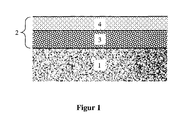
- FIG. 1 A schematic representation of a possible structure of the catalyst according to the invention is shown in FIG. 1 .
- the catalyst comprises a support body (1) on which a multilayer catalyst mass (2) is applied, which in turn comprises a lower layer (3) and an upper layer (4).
- the lower catalyst layer can catalyze the partial oxidation
- the upper catalyst layer can catalyze the steam reforming.
- the two different catalyst layers each contain at least one Platinum group metal on a finely divided, oxidic carrier material. It is about So so-called supported catalysts or supported catalysts, in which the Precious metal in a high distribution (i.e. dispersion) on the oxidic carrier material is applied.
- supported catalyst refers to this Invention only on the catalyst mass and must be differentiated from the catalyst the carrier body (1) with the catalyst mass (2) applied to it includes.
- the lower catalyst layer (3) which catalyzes the partial oxidation, contains as Precious metal preferably 0.1 to 5 wt .-% platinum, based on their total weight.
- platinum has a high activity for the oxidation of hydrocarbons.
- the oxidation activity can be adapted to the requirements of the process
- a catalyst mass which contains platinum is preferably used Contains alumina and rare earth oxides.
- the upper catalyst layer (4) (for steam reforming) contains noble metal preferably 0.1 to 5% by weight of rhodium, based on their total weight. Rhodium points a high activity for steam reforming while maintaining its Oxidation activity is low compared to that of platinum.
- Suitable oxidic carrier materials for the platinum group metals are oxides such as aluminum oxide, silicon dioxide, titanium dioxide or mixed oxides thereof and zeolites. Materials with a specific surface area of more than 10 m 2 / g are preferably used in order to enable a highly disperse distribution of the catalytically active components on this large surface area.
- the techniques for producing such a supported catalyst and for coating an inert support body with it are known to the person skilled in the art.
- the catalyst mass can additionally have at least one Oxide selected from boron oxide, bismuth oxide, gallium oxide, oxides of the alkali metals, Oxides of alkaline earth metals, oxides of subgroup elements and oxides of Rare earth metals, for example in a concentration of up to 40 wt .-%, based on the total weight of the catalyst mass.
- Oxide selected from boron oxide, bismuth oxide, gallium oxide, oxides of the alkali metals, Oxides of alkaline earth metals, oxides of subgroup elements and oxides of Rare earth metals, for example in a concentration of up to 40 wt .-%, based on the total weight of the catalyst mass.
- the multilayer catalyst according to the invention has considerable advantages conventional catalysts. So the inventors found that Surprisingly, by applying the upper catalyst layer (for Steam reforming) on the lower, oxidation-active layer overall the partial Oxidation of the starting material mixture is damped at the inlet of the catalyst. Thereby high temperature peaks are avoided, which could destroy the catalyst. In addition, the yield of hydrogen is increased and the content of Residual hydrocarbons, especially methane, are lowered
- the process can be carried out using aliphatic and / or aromatic hydrocarbons (methane, Propane, toluene etc.) or hydrocarbon mixtures (e.g. natural gas, gasoline, heating oil or diesel oil) are operated.
- the Air ratio ⁇ of the educt mixture and its preheating temperature should be chosen that there is a temperature between 600 and 900 ° C at the outlet of the catalyst established.
- the proposed procedure provides only part of an overall procedure Obtaining hydrogen for mobile and stationary fuel cell units.
- the entire process includes autothermal reforming Process steps for removing carbon monoxide from the reformate, for example by one or more water gas shift stages.
- the reaction in the Water gas shift stages are exothermic and can be in continuous operation of the reformer unit
- the amount of heat required to preheat the educt mixture to a suitable one Provide preheating temperature between about 270 and 350 ° C, for example. to
- the reactant mixture can also be put into operation quickly for a short time be electrically preheated.
- the low thermal mass of the catalyst leads Advantageously, the full after just a few seconds Hydrogen production begins.
- the catalyst mass can be on a monolithic support body, which has a length L and an entry face flow channels are applied up to an exit end face and a lower catalyst layer lying directly on the support body and one on the lower catalyst layer located upper catalyst layer.
- the lower layer over the entire length L of the supporting body, and the upper layer only on a certain segment, for example the outlet-side part of the supporting body applied.
- the exact design of the layer sequence depends on the Construction, the geometry and the mode of operation of the reformer system.
- the catalyst mass can be an additional one Catalyst layer, for example for carbon monoxide conversion, which is applied in whole or in part as a third layer on the second coating.
- the Catalyst layer for carbon monoxide conversion can be catalytically active Components of at least one of the noble metals Pt, Pd, Rh, Ru, Ir, Os and Au on one oxidic carrier material from the group aluminum oxide, silicon dioxide, titanium dioxide, Contain rare earth oxides or mixed oxides thereof or zeolites. Even more than three-layer structures, for example four-layer arrangements, are possible.
- Methane was reformed using the process according to the invention, a two-layer catalyst being used.
- the catalyst was a catalytically coated ceramic honeycomb body with a cell density of 62 cells / cm 2 and a volume of 30 ml.
- the lower layer of the two-layer catalyst consisted of one Platinum / alumina / ceria / zirconia supported catalyst.
- the top layer of the The catalyst consisted of a rhodium / alumina supported catalyst.
- the Total concentration of the catalytic coating was 150 g / l; the Coating concentration of the noble metals was 0.5 g / l platinum and 0.5 g / l rhodium.
- the inlet temperature of the mixture was 610 ° C, the outlet temperature was 645 ° C.
- the dry reformate of the two-layer catalyst contained 45.9% by volume of hydrogen, compared to 43.4% by volume in the dry reformate of the single-layer catalyst of comparative example 1.
- the CO content was only 4.1% by volume and the residual methane content (CH 4 ) could be significantly reduced to 1% by volume by using the two-layer catalyst.
- Table 1 The results are summarized in Table 1.
- a catalytically coated ceramic honeycomb body with a cell density of 62 cells / cm 2 and a volume of 30 ml was also used as a comparative example.
- the catalytic coating in the single-layer system consisted of a rhodium / aluminum oxide supported catalyst and was applied to the honeycomb body in a concentration of 150 grams per liter. The coating concentration of the rhodium was 1 g / l. Methane was reformed according to the procedure described in Example 1.
- the starting materials were turned on Heated 600 ° C and then passed together over the catalyst.
- the material flows from Methane, water and air were identical to example 1.
- the inlet temperature was 605 ° C
- the outlet temperature was 640 ° C.
- the dry reformate of the single-layer catalyst contained 43.4% by volume of hydrogen (compared to 45.9% by volume in the two-layer catalyst according to the invention from Example 1).
- the concentrations of undesired CO (4.8 vol .-%) and residual methane (1.7 vol .-%) were significantly higher.
- the results are also summarized in Table 1. From this one can see the superiority of the multilayer catalyst system according to the invention.
Landscapes
- Chemical & Material Sciences (AREA)
- Chemical Kinetics & Catalysis (AREA)
- Organic Chemistry (AREA)
- Engineering & Computer Science (AREA)
- Materials Engineering (AREA)
- Inorganic Chemistry (AREA)
- General Health & Medical Sciences (AREA)
- Combustion & Propulsion (AREA)
- Health & Medical Sciences (AREA)
- Life Sciences & Earth Sciences (AREA)
- Manufacturing & Machinery (AREA)
- Sustainable Development (AREA)
- Sustainable Energy (AREA)
- Electrochemistry (AREA)
- General Chemical & Material Sciences (AREA)
- Hydrogen, Water And Hydrids (AREA)
- Catalysts (AREA)
Priority Applications (7)
| Application Number | Priority Date | Filing Date | Title |
|---|---|---|---|
| EP02019014A EP1393804A1 (de) | 2002-08-26 | 2002-08-26 | Mehrschichtiger Katalysator zur autothermen Dampfreformierung von Kohlenwasserstoffen und Verfahren zu seiner Verwendung |
| US10/644,377 US7150866B2 (en) | 2002-08-26 | 2003-08-20 | Catalyst for autothermal reforming of hydrocarbons with increased water gas shift activity |
| EP03794941A EP1542800B1 (de) | 2002-08-26 | 2003-08-26 | Verfahren zur autothermen dampfreformierung von kohlenwasserstoffen mit einem mehrschichtigen katalysator |
| PCT/EP2003/009449 WO2004024324A1 (de) | 2002-08-26 | 2003-08-26 | Mehrschichtiger katalysator zur autothermen dampfreformierung von kohlenwasserstoffen und verfahren zu seiner verwendung |
| AU2003264107A AU2003264107A1 (en) | 2002-08-26 | 2003-08-26 | Multi-layer catalyst for the autothermal steam reforming of hydrocarbons and a method for using said catalyst |
| CNA03823257XA CN1684771A (zh) | 2002-08-26 | 2003-08-26 | 用于烃自热水蒸气转化的多层催化剂和使用所述催化剂的方法 |
| JP2004535170A JP4950420B2 (ja) | 2002-08-26 | 2003-08-26 | 炭化水素の自己熱交換式水蒸気リフォーミングのための多層触媒および前記触媒を使用する方法 |
Applications Claiming Priority (1)
| Application Number | Priority Date | Filing Date | Title |
|---|---|---|---|
| EP02019014A EP1393804A1 (de) | 2002-08-26 | 2002-08-26 | Mehrschichtiger Katalysator zur autothermen Dampfreformierung von Kohlenwasserstoffen und Verfahren zu seiner Verwendung |
Publications (1)
| Publication Number | Publication Date |
|---|---|
| EP1393804A1 true EP1393804A1 (de) | 2004-03-03 |
Family
ID=31197822
Family Applications (2)
| Application Number | Title | Priority Date | Filing Date |
|---|---|---|---|
| EP02019014A Withdrawn EP1393804A1 (de) | 2002-08-26 | 2002-08-26 | Mehrschichtiger Katalysator zur autothermen Dampfreformierung von Kohlenwasserstoffen und Verfahren zu seiner Verwendung |
| EP03794941A Expired - Lifetime EP1542800B1 (de) | 2002-08-26 | 2003-08-26 | Verfahren zur autothermen dampfreformierung von kohlenwasserstoffen mit einem mehrschichtigen katalysator |
Family Applications After (1)
| Application Number | Title | Priority Date | Filing Date |
|---|---|---|---|
| EP03794941A Expired - Lifetime EP1542800B1 (de) | 2002-08-26 | 2003-08-26 | Verfahren zur autothermen dampfreformierung von kohlenwasserstoffen mit einem mehrschichtigen katalysator |
Country Status (6)
| Country | Link |
|---|---|
| US (1) | US7150866B2 (https=) |
| EP (2) | EP1393804A1 (https=) |
| JP (1) | JP4950420B2 (https=) |
| CN (1) | CN1684771A (https=) |
| AU (1) | AU2003264107A1 (https=) |
| WO (1) | WO2004024324A1 (https=) |
Cited By (2)
| Publication number | Priority date | Publication date | Assignee | Title |
|---|---|---|---|---|
| WO2016041654A1 (de) | 2014-09-18 | 2016-03-24 | Robert Bosch Gmbh | Brennstoffzellenvorrichtung mit verbessertem anodengasprozessor |
| US10686204B2 (en) | 2015-08-10 | 2020-06-16 | Nissan Motor Co., Ltd. | Solid oxide fuel cell system |
Families Citing this family (32)
| Publication number | Priority date | Publication date | Assignee | Title |
|---|---|---|---|---|
| US20040037757A1 (en) * | 2001-05-07 | 2004-02-26 | Kiyoshi Taguchi | Hydrogen purification apparatus |
| GB0119327D0 (en) * | 2001-08-08 | 2001-10-03 | Johnson Matthey Plc | Catalyst |
| CN1729050A (zh) * | 2002-12-20 | 2006-02-01 | 本田技研工业株式会社 | 用于氢产生的含铂-钌催化剂配方 |
| AU2003297311A1 (en) * | 2002-12-20 | 2004-07-22 | Honda Giken Kogyo Kabushiki Kaisha | Platinum-alkali/alkaline-earth catalyst formulations for hydrogen generation |
| CN100368280C (zh) * | 2002-12-20 | 2008-02-13 | 本田技研工业株式会社 | 用于中低温度氢产生的含有碱金属的催化剂配方 |
| JP2006511427A (ja) * | 2002-12-20 | 2006-04-06 | 本田技研工業株式会社 | 白金およびロジウムおよび/または鉄を含有する水素生成用触媒配合物 |
| CN1729139A (zh) * | 2002-12-20 | 2006-02-01 | 本田技研工业株式会社 | 用于氢产生的催化剂配方 |
| US7214331B2 (en) | 2004-02-26 | 2007-05-08 | The Boc Group, Inc. | Catalyst configuration and methods for syngas production |
| US8617265B2 (en) * | 2004-04-12 | 2013-12-31 | Intelligent Energy, Inc. | Hydrogen generation apparatus incorporating a staged catalyst and method for using same |
| JP2005305338A (ja) * | 2004-04-22 | 2005-11-04 | Toyota Motor Corp | 排ガス浄化触媒及びその製造方法 |
| KR100647700B1 (ko) * | 2005-09-14 | 2006-11-23 | 삼성에스디아이 주식회사 | 담지 촉매 및 이를 이용한 연료전지 |
| US7442364B1 (en) * | 2005-11-16 | 2008-10-28 | Wang Chi S | Plasma-induced hydrogen production from water |
| US20070130831A1 (en) * | 2005-12-08 | 2007-06-14 | General Electric Company | System and method for co-production of hydrogen and electrical energy |
| KR101255237B1 (ko) * | 2006-02-07 | 2013-04-16 | 삼성에스디아이 주식회사 | 연료전지용 담지 촉매, 그 제조방법, 이를 포함하는연료전지용 전극 및 상기 전극을 포함하는 연료전지 |
| JP5173180B2 (ja) * | 2006-10-30 | 2013-03-27 | 株式会社キャタラー | 排ガス浄化用触媒 |
| KR100837396B1 (ko) * | 2007-01-15 | 2008-06-12 | 삼성에스디아이 주식회사 | 담지 촉매, 그 제조방법, 이를 포함하는 캐소드 전극 및상기 캐소드 전극을 포함하는 연료전지 |
| US8318630B2 (en) * | 2007-10-29 | 2012-11-27 | Ict Co., Ltd. | Catalyst for removing nitrogen oxides and method for removing nitrogen oxides using the same |
| US9132416B1 (en) | 2007-11-29 | 2015-09-15 | U.S. Department Of Energy | Nano-structured noble metal catalysts based on hexametallate architecture for the reforming of hydrocarbon fuels |
| WO2009102500A2 (en) | 2008-02-15 | 2009-08-20 | Cummins Inc. | System and method for on-board waste heat recovery |
| US20100068130A1 (en) * | 2008-09-17 | 2010-03-18 | Frederick Carl Wilhelm | Process for the Production of Hydrogen Gas Employing a Thermally Stable Catalyst |
| US8207084B2 (en) | 2009-06-23 | 2012-06-26 | Ford Global Technologies, Llc | Urea-resistant catalytic units and methods of using the same |
| US20110159400A1 (en) * | 2010-03-02 | 2011-06-30 | Ford Global Technologies, Llc | Hybrid Catalyst System and Electrode Assembly Employing the Same |
| US20110159403A1 (en) * | 2010-03-02 | 2011-06-30 | Ford Global Technologies, Llc | Layered Catalyst Assembly and Electrode Assembly Employing the Same |
| US9745191B2 (en) * | 2011-04-11 | 2017-08-29 | Saudi Arabian Oil Company | Auto thermal reforming (ATR) catalytic structures |
| GB201303396D0 (en) * | 2013-02-26 | 2013-04-10 | Johnson Matthey Plc | Oxidation catalyst for a combustion engine |
| RU2684108C2 (ru) | 2014-02-07 | 2019-04-04 | Басф Корпорейшн | Катализатор для пиролиза сырья |
| FR3022803B1 (fr) * | 2014-06-27 | 2016-11-04 | Eurecat Sa | Procede pour limiter l'emission de poussieres a partir de grains de catalyseurs |
| CN106268307A (zh) * | 2016-10-20 | 2017-01-04 | 中国船舶重工集团公司第七八研究所 | 一种盒式催化单元 |
| CN108550861B (zh) * | 2018-05-03 | 2020-06-19 | 深圳市鑫三奇科技有限公司 | 一种燃料电池用触媒层 |
| EP3814274B1 (en) | 2018-06-29 | 2022-05-04 | Shell Internationale Research Maatschappij B.V. | Electrically heated reactor and a process for gas conversions using said reactor |
| EP4081337A1 (en) | 2019-12-23 | 2022-11-02 | Shell Internationale Research Maatschappij B.V. | Electrically heated reactor, a furnace comprising said reactor and a method for gas conversions using said reactor |
| US12382670B2 (en) * | 2020-11-04 | 2025-08-05 | Samsung Electronics Co., Ltd. | Thin film structure and semiconductor device comprising the same |
Citations (3)
| Publication number | Priority date | Publication date | Assignee | Title |
|---|---|---|---|---|
| EP0462593A1 (en) * | 1990-06-20 | 1991-12-27 | Nippon Shokubai Co., Ltd. | Use of a specific catalyst for purifying exhaust gases from Diesel engines |
| US5459119A (en) * | 1993-02-10 | 1995-10-17 | Ngk Insulators, Ltd. | Catalyst for purification of exhaust gases |
| WO2002018269A2 (en) * | 2000-08-31 | 2002-03-07 | Engelhard Corporation | Process for generating hydrogen-rich gas |
Family Cites Families (12)
| Publication number | Priority date | Publication date | Assignee | Title |
|---|---|---|---|---|
| US4415484A (en) | 1982-04-26 | 1983-11-15 | United Technologies Corporation | Autothermal reforming catalyst |
| DE3382193D1 (de) | 1982-09-30 | 1991-04-11 | Engelhard Corp | Verfahren zur herstellung von wasserstoffreichem gas aus kohlenwasserstoffen. |
| US6470152B2 (en) | 1992-03-17 | 2002-10-22 | Sony Corporation | Photographic and video image system |
| US6110861A (en) | 1997-06-02 | 2000-08-29 | The University Of Chicago | Partial oxidation catalyst |
| US20020007595A1 (en) | 1997-06-24 | 2002-01-24 | Uli Maier-Roeltgen | Method for reforming hydrocarbons autothermally |
| DE19727841A1 (de) | 1997-06-24 | 1999-01-07 | Fraunhofer Ges Forschung | Verfahren und Vorrichtung zur autothermen Reformierung von Kohlenwasserstoffen |
| WO1999033567A1 (en) | 1997-12-24 | 1999-07-08 | Shell Internationale Research Maatschappij B.V. | Multiple layer monolithic structure and use thereof |
| GB9806199D0 (en) | 1998-03-24 | 1998-05-20 | Johnson Matthey Plc | Catalytic generation of hydrogen |
| JP3743995B2 (ja) * | 1999-12-15 | 2006-02-08 | 日産自動車株式会社 | メタノール改質触媒 |
| DE10025032A1 (de) | 2000-05-20 | 2001-11-29 | Dmc2 Degussa Metals Catalysts | Verfahren zur autothermen, katalytischen Dampfreformierung von Kohlenwasserstoffen |
| JP2002104808A (ja) * | 2000-09-27 | 2002-04-10 | Hitachi Ltd | 燃料改質方法 |
| US6713040B2 (en) * | 2001-03-23 | 2004-03-30 | Argonne National Laboratory | Method for generating hydrogen for fuel cells |
-
2002
- 2002-08-26 EP EP02019014A patent/EP1393804A1/de not_active Withdrawn
-
2003
- 2003-08-20 US US10/644,377 patent/US7150866B2/en not_active Expired - Fee Related
- 2003-08-26 JP JP2004535170A patent/JP4950420B2/ja not_active Expired - Fee Related
- 2003-08-26 WO PCT/EP2003/009449 patent/WO2004024324A1/de not_active Ceased
- 2003-08-26 CN CNA03823257XA patent/CN1684771A/zh active Pending
- 2003-08-26 EP EP03794941A patent/EP1542800B1/de not_active Expired - Lifetime
- 2003-08-26 AU AU2003264107A patent/AU2003264107A1/en not_active Abandoned
Patent Citations (3)
| Publication number | Priority date | Publication date | Assignee | Title |
|---|---|---|---|---|
| EP0462593A1 (en) * | 1990-06-20 | 1991-12-27 | Nippon Shokubai Co., Ltd. | Use of a specific catalyst for purifying exhaust gases from Diesel engines |
| US5459119A (en) * | 1993-02-10 | 1995-10-17 | Ngk Insulators, Ltd. | Catalyst for purification of exhaust gases |
| WO2002018269A2 (en) * | 2000-08-31 | 2002-03-07 | Engelhard Corporation | Process for generating hydrogen-rich gas |
Cited By (3)
| Publication number | Priority date | Publication date | Assignee | Title |
|---|---|---|---|---|
| WO2016041654A1 (de) | 2014-09-18 | 2016-03-24 | Robert Bosch Gmbh | Brennstoffzellenvorrichtung mit verbessertem anodengasprozessor |
| US10686204B2 (en) | 2015-08-10 | 2020-06-16 | Nissan Motor Co., Ltd. | Solid oxide fuel cell system |
| EP3336946B1 (en) * | 2015-08-10 | 2020-12-09 | Nissan Motor Co., Ltd. | Solid oxide fuel cell system |
Also Published As
| Publication number | Publication date |
|---|---|
| AU2003264107A1 (en) | 2004-04-30 |
| CN1684771A (zh) | 2005-10-19 |
| EP1542800B1 (de) | 2012-07-18 |
| JP4950420B2 (ja) | 2012-06-13 |
| WO2004024324A1 (de) | 2004-03-25 |
| US20040063577A1 (en) | 2004-04-01 |
| JP2005537132A (ja) | 2005-12-08 |
| US7150866B2 (en) | 2006-12-19 |
| EP1542800A1 (de) | 2005-06-22 |
Similar Documents
| Publication | Publication Date | Title |
|---|---|---|
| EP1393804A1 (de) | Mehrschichtiger Katalysator zur autothermen Dampfreformierung von Kohlenwasserstoffen und Verfahren zu seiner Verwendung | |
| EP1157968B1 (de) | Verfahren zur autothermen, katalytischen Dampfreformierung von Kohlenwasserstoffen | |
| DE69913037T2 (de) | Reformierungsreaktor | |
| DE60225404T2 (de) | Verfahren zur katalytischen autothermen Dampfreformierung von Gemischen von höheren Alkoholen, insbesondere Ethanol mit Kohlenwasserstoffen | |
| DE60129569T2 (de) | Verfahren zur herstellung von synthesegas mit lanthanid-dotierter rhodiumkatalysatoren | |
| DE69908242T2 (de) | Reformer | |
| DE69506869T2 (de) | Selbstunterhaltender wasserstofferzeuger | |
| DE69925052T2 (de) | Verfahren zur Herstellung von wasserstoffreichem Gas | |
| DE69702190T2 (de) | Anlage für teiloxidationsreaktionen | |
| DE69905467T2 (de) | Katalytische teiloxidation mit einem rhodium-iridium legierungskatalysator | |
| EP0787679B1 (de) | Verfahren und Vorrichtung zur Gewinnung eines wasserstoffreichen, kohlenmonoxidarmen Gases | |
| US4863707A (en) | Method of ammonia production | |
| WO2013135707A1 (de) | Verfahren zur herstellung eines kohlenmonoxid enthaltenden gasgemisches bei hohen temperaturen an mischmetalloxidkatalysatoren umfassend edelmetalle | |
| DE10013894A1 (de) | Verfahren zur katalytischen Umsetzung von Kohlenmonoxid in einem Wasserstoff enthaltenden Gasgemisch mit verbessertem Kaltstartverhalten und Katalysator hierfür | |
| EP1136441A2 (de) | Verfahren zur katalytischen Umsetzung von Kohlenmonoxid in einem Wasserstoff enthaltenden Gasgemisch | |
| EP1063011A1 (de) | Katalysator für die Dampfreformierung von Alkoholen | |
| DE10296796T5 (de) | Schnellstart eines Brennstoffprozessors unter Verwendung von Wasserradsorption | |
| WO2003039740A1 (en) | Combustion deposited metal-metal oxide catalysts and process for producing synthesis gas | |
| EP1249275A1 (de) | Katalysator und Verfahren zur Entfernung von Kohlenmonoxid aus einem Reformatgas | |
| WO2004046026A1 (de) | Verfahren zur erzeugung eines wasserstoffhaltigen brenngases für brennstoffzellen sowie vorrichtung dafür | |
| EP1373134A2 (de) | Membranreaktor und verfahren zur herstellung von hochreinem wasserstoffgas | |
| WO2013135664A1 (de) | Verfahren zur reduktion von kohlendioxid bei hohen temperaturen an mischmetalloxid-katalysatoren auf oxidischen mit aluminium, cer und/oder zirkonium dotierten trägern | |
| WO2013135662A1 (de) | Verfahren zur reduktion von kohlendioxid bei hohen temperaturen an mischmetalloxidkatalysatoren | |
| EP1515910A1 (de) | Verfahren zur herstellung von wasserstoffhaltigen gasen | |
| DE69603253T2 (de) | Direkte umwandlung von methan zu hüthan |
Legal Events
| Date | Code | Title | Description |
|---|---|---|---|
| PUAI | Public reference made under article 153(3) epc to a published international application that has entered the european phase |
Free format text: ORIGINAL CODE: 0009012 |
|
| 17P | Request for examination filed |
Effective date: 20020925 |
|
| AK | Designated contracting states |
Kind code of ref document: A1 Designated state(s): AT BE BG CH CY CZ DE DK EE ES FI FR GB GR IE IT LI LU MC NL PT SE SK TR |
|
| AX | Request for extension of the european patent |
Extension state: AL LT LV MK RO SI |
|
| AKX | Designation fees paid |
Designated state(s): AT BE BG CH CY CZ DE DK EE ES FI FR GB GR IE IT LI LU MC NL PT SE SK TR |
|
| STAA | Information on the status of an ep patent application or granted ep patent |
Free format text: STATUS: THE APPLICATION IS DEEMED TO BE WITHDRAWN |
|
| 18D | Application deemed to be withdrawn |
Effective date: 20051117 |