EP1392650B1 - Geschützte tyrosinderivate, verfahren zu deren herstellung und deren verwendung zur herstellung von o-(2- ?18 f]-fluorethyl)-l-tyrosin - Google Patents
Geschützte tyrosinderivate, verfahren zu deren herstellung und deren verwendung zur herstellung von o-(2- ?18 f]-fluorethyl)-l-tyrosin Download PDFInfo
- Publication number
- EP1392650B1 EP1392650B1 EP02740662A EP02740662A EP1392650B1 EP 1392650 B1 EP1392650 B1 EP 1392650B1 EP 02740662 A EP02740662 A EP 02740662A EP 02740662 A EP02740662 A EP 02740662A EP 1392650 B1 EP1392650 B1 EP 1392650B1
- Authority
- EP
- European Patent Office
- Prior art keywords
- group
- formula
- denotes
- tyrosine
- compound
- Prior art date
- Legal status (The legal status is an assumption and is not a legal conclusion. Google has not performed a legal analysis and makes no representation as to the accuracy of the status listed.)
- Expired - Lifetime
Links
- 0 *CCOc1ccc(C[C@@](C(O*)=O)N*)cc1 Chemical compound *CCOc1ccc(C[C@@](C(O*)=O)N*)cc1 0.000 description 2
Classifications
-
- C—CHEMISTRY; METALLURGY
- C07—ORGANIC CHEMISTRY
- C07C—ACYCLIC OR CARBOCYCLIC COMPOUNDS
- C07C227/00—Preparation of compounds containing amino and carboxyl groups bound to the same carbon skeleton
- C07C227/14—Preparation of compounds containing amino and carboxyl groups bound to the same carbon skeleton from compounds containing already amino and carboxyl groups or derivatives thereof
- C07C227/18—Preparation of compounds containing amino and carboxyl groups bound to the same carbon skeleton from compounds containing already amino and carboxyl groups or derivatives thereof by reactions involving amino or carboxyl groups, e.g. hydrolysis of esters or amides, by formation of halides, salts or esters
-
- C—CHEMISTRY; METALLURGY
- C07—ORGANIC CHEMISTRY
- C07C—ACYCLIC OR CARBOCYCLIC COMPOUNDS
- C07C309/00—Sulfonic acids; Halides, esters, or anhydrides thereof
- C07C309/01—Sulfonic acids
- C07C309/28—Sulfonic acids having sulfo groups bound to carbon atoms of six-membered aromatic rings of a carbon skeleton
- C07C309/29—Sulfonic acids having sulfo groups bound to carbon atoms of six-membered aromatic rings of a carbon skeleton of non-condensed six-membered aromatic rings
- C07C309/30—Sulfonic acids having sulfo groups bound to carbon atoms of six-membered aromatic rings of a carbon skeleton of non-condensed six-membered aromatic rings of six-membered aromatic rings substituted by alkyl groups
-
- C—CHEMISTRY; METALLURGY
- C07—ORGANIC CHEMISTRY
- C07B—GENERAL METHODS OF ORGANIC CHEMISTRY; APPARATUS THEREFOR
- C07B2200/00—Indexing scheme relating to specific properties of organic compounds
- C07B2200/05—Isotopically modified compounds, e.g. labelled
-
- Y—GENERAL TAGGING OF NEW TECHNOLOGICAL DEVELOPMENTS; GENERAL TAGGING OF CROSS-SECTIONAL TECHNOLOGIES SPANNING OVER SEVERAL SECTIONS OF THE IPC; TECHNICAL SUBJECTS COVERED BY FORMER USPC CROSS-REFERENCE ART COLLECTIONS [XRACs] AND DIGESTS
- Y02—TECHNOLOGIES OR APPLICATIONS FOR MITIGATION OR ADAPTATION AGAINST CLIMATE CHANGE
- Y02P—CLIMATE CHANGE MITIGATION TECHNOLOGIES IN THE PRODUCTION OR PROCESSING OF GOODS
- Y02P20/00—Technologies relating to chemical industry
- Y02P20/50—Improvements relating to the production of bulk chemicals
- Y02P20/55—Design of synthesis routes, e.g. reducing the use of auxiliary or protecting groups
Definitions
- the invention relates to a process for the preparation of O- (2- [ 18 F] -fluoroethyl) -L-tyrosine and to novel starting compounds for the preparation of O- (2- [ 18 F] -fluoroethyl) -L-tyrosine
- PET positron emission tomography
- PET studies focused on the study of glucose metabolism using the compound 18 F-fluoro-deoxyglucose (FDG) as the diagnostic agent.
- FDG F-fluoro-deoxyglucose
- the invention initially relates to novel starting compounds for the preparation of O- (2- [ 18 F] -fluoroethyl-L-tyrosine ([ 18 F] FET) according to formula (1): wherein R 1 represents a suitable protecting group for the carboxyl group and R 2 represents a suitable protecting group for the amino group.
- the group R 3 is a suitable leaving group for the fluorination of the starting product of formula (1) to the corresponding fluorinated compound.
- Suitable groups R 1 are those which protect the carboxyl group under the respective reaction conditions. As will be described in more detail later in the description of the method according to the invention, a preferred embodiment provides for carrying out the method in a dipolar aprotic solvent. In this preferred embodiment of the process, the group R 1 should fulfill the task of not being split off under the conditions of nucleophilic 18 F-fluorination. It is desirable that the group R 1 can be split off in a last step of the process together with the group R 2 with little effort under acidic conditions,
- Such suitable groups R ' are, for example, those radicals which are strongly acidic Conditions also cleaved in an organic, non-aqueous solvent can be.
- Groups R 1 according to the invention are the methylthiomethyl group, the tetrahydrofuranyl group, the diphenylmethyl group, the para-methoxybenzyl group, the piperonyl group and the tert-butyl group.
- Preferred for the group R 1 is the tert-butyl group.
- Suitable groups R 2 are those which protect the amino group of the amino acid under the respective reaction conditions.
- a preferred embodiment provides for carrying out the method in a dipolar aprotic solvent.
- the group R 2 is intended to fulfill the task of exerting the protective effect under the conditions of nucleophilic 18 F fluorination and to prevent racemization of the L-amino acid. It is desirable that the group be cleaved in a final step of the process with little effort.
- R 2 are arylalkyl radicals.
- a preferred group R 2 is the triphenylmethyl group.
- the group R 3 represents a suitable leaving group. This group is substituted in the actual fluorination process by fluorine-18.
- Groups R 3 in the context of the compound are p-tosyloxy, methanesulfonyloxy, trifluoromethanesulfonyloxy and bromine.
- a preferred group R 3 is the p-tosyloxy group.
- the compounds of formula (1) are particularly useful as starting compounds for the preparation of O- (2- [ 18 F] fluoroethyl) -L-tyrosine.
- the process according to the invention for the preparation of O- (2- [ 18 F] fluoroethyl) -L-tyrosine provides that a starting compound of the formula (1) is F-fluorinated in a first step 18 and in a second step the protective groups R 1 and R 2 to give the desired end compound O- (2- [ 18 F] fluoroethyl) -L-tyrosine.
- a compound of the formula (1) is reacted in the presence of a phase transfer system, for example of the formula R 4 N +18 F, where R is an alkyl group having 3 to 6 C atoms, preferably n-butyl.
- 18 F is prepared by a process known per se, in which water enriched with 18 O is converted into [ 18 F] fluoride by a (p, n) -core reaction in a cyclotron.
- phase transfer catalysts are basically catalysts such as [K ⁇ 2.2.2] 2 CO 3 and (TBA + HCO 3 - ) into consideration.
- Suitable solvents for the nucleophilic 18 F-fluorination are the customary organic solvents. It has been found that carrying out with an aprotic solvent such as, for example, acetonitrile, N, N-dimethylacetamide, N, N-dimethylformamide, dimethlylsulfoxide and hexamethylphosphoric triamide takes place particularly favorably, acetonitrile being particularly suitable on account of its physicochemical properties.
- an aprotic solvent such as, for example, acetonitrile, N, N-dimethylacetamide, N, N-dimethylformamide, dimethlylsulfoxide and hexamethylphosphoric triamide takes place particularly favorably, acetonitrile being particularly suitable on account of its physicochemical properties.
- the first step is usually carried out at a temperature of about 85 ° C. A duration of 5 minutes is usually sufficient for the implementation.
- the Deprotection performed. It is not necessary to pre-clean beforehand, and the fact that the second step of deprotection takes place in the same container as the first step, which is therefore a one-pot process, concerns one attractive aspect of the invention.
- the deprotection itself is triggered by adding a strong acid, it comes here to an acid which is also present in a non-aqueous system, e.g. dichloromethane can be used.
- the deprotection proceeds particularly well with trifluoroacetic acid.
- the final purification step of the final compound O- (2- [ 18 F] fluoroethyl) -L-tyrosine is carried out by conventional means and methods.
- the separation of the labeled amino acid can be carried out very favorably by solid phase extraction from the organic phase.
- the application of silica gel and aluminum oxide offers this.
- acid adsorbed on the solid phase is largely removed by a suitable elution step.
- it is not particularly important which solvent is used for the elution it is important for the selection of the solvent, which acid was used and which solid phase combination was used.
- it has been found that a mixture of n-pentane and diethyl ether is very suitable for this elution step, especially when using trifluoroacetic acid.
- the solvent residues adhering to the solid phase can be mixed with a Inert gas, e.g. Nitrogen or argon, vaporized and discharged and the labeled amino acid can be extracted with a suitable buffer solution.
- a buffer solution is used, which is an immediate HPL chromatography allows.
- the labeled amino acid can be produced with relatively little effort in a one-pot process.
- the process allows production while avoiding racemization.
- the use of [ 18 F] fluoride guarantees a low-carrier end product, which is necessary for use on the patient. It is the advantage of the method according to the invention that production of a labeled amino acid with a molar activity of more than 18.5 GBq / ⁇ mol is readily possible.
- the preparation of the starting compounds of the formula (1) can be carried out with known per se Procedures are performed. One can in the production of the amino acid L-Tyrosin go out yourself and the other reagents for the desired end product choose.
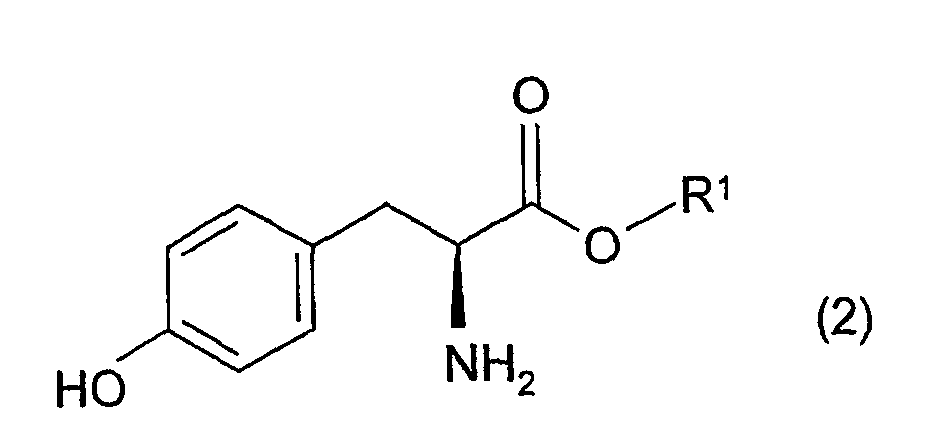
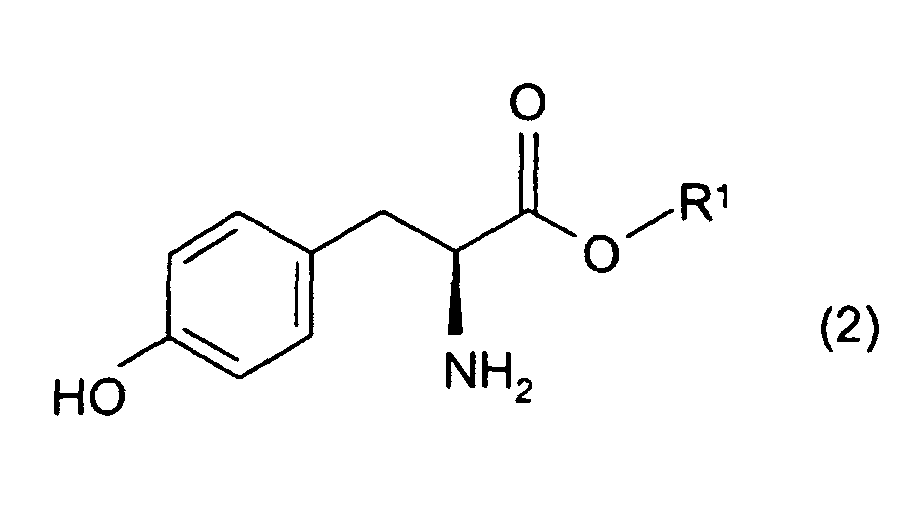
- a starting compound of the formula (1) is to be prepared which has a tert-butyl group as group R 1 , it is suitable to start from a compound L-tyrosine tert-butyl ester, since this compound is commercially available. Otherwise, L-tyrosine is combined in a first step with a reagent capable of undergoing reaction with the carboxyl group to form a compound of formula (2):
- R 1 has the same meaning as described in the description of the starting compounds of the invention.
- Suitable reagents for carrying out the reaction are, in particular, alcohols, such as, for example, tert-butanol or the olefin isobutene.
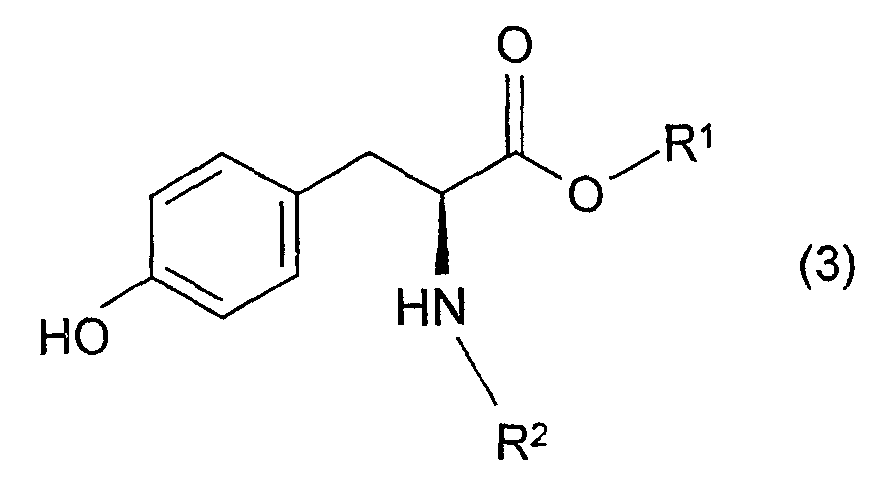
- the compound of the formula (2) reacts with a compound R 2 X, where a compound of the formula (3) is formed.
- R 2 here has the same meaning as described in connection with the description of the starting compounds of the invention.
- X represents a halogen, preferably chlorine.
- the compound of formula (3) is converted to a compound of formula (1), in which last step an R 3 -C 2 N 4 group is introduced on the hydroxyl group of the aromatic ring.
- Suitable reagents for this last step are 1,2-bifunctional ethylene derivatives such as ethylene glycol di (p-toluenesulfonate) and 2-bromoethanol.
- the last step is Ethylene glycol di (p-toluenesulfonate) performed.
- the 18 F-containing water is evaporated to dryness in the presence of 40 .mu.mol tetra-n-butylammonium hydrogencarbonate. Subsequently, a solution of 25 mg (37 .mu.mol) of N-trityl-O- (2-tosyloxyethyl) -L-tyrosine tert-butyl ester in 0.5 ml of acetonitrile is added and the solution is heated to boiling for 5 min.
- the solvent is evaporated, added at a temperature of about 20 ° C 1 ml of a mixture of trifluoroacetic acid / triethylsilane / dichloromethane (1 / 0.4 / 2) (v / v / v) and stirred for 10 min. After dilution with 9 ml of dichloromethane, the solution is passed successively through a silica gel and an alumina cartridge (1 g each). The cartridges are washed with 10 ml of a solvent mixture of n-pentane / diethyl ether (1/1).
- An inert gas stream is used to evaporate the remaining solvent, to elute the [ 18 F] crude FET product with the aid of a 35 mmol trisodium phosphate solution and to purify it by reversed-phase high-pressure liquid chromatography.
- the [ 18 F] FET product fraction is passed through a cation exchanger (LiChrolut SCX, H + form, 1g), then rinsed with sterile water, and the 18 F-labeled amino acid is eluted with a physiological concentration sodium phosphate buffer and the eluate is sterile-filtered.
Landscapes
- Chemical & Material Sciences (AREA)
- Organic Chemistry (AREA)
- Chemical Kinetics & Catalysis (AREA)
- Organic Low-Molecular-Weight Compounds And Preparation Thereof (AREA)
- Heterocyclic Compounds That Contain Two Or More Ring Oxygen Atoms (AREA)
- Furan Compounds (AREA)
- Low-Molecular Organic Synthesis Reactions Using Catalysts (AREA)
Description
Ein Nachteil dieser Herstellung ist die Notwendigkeit, das 18F-Fluorierungsreagenz vor der weiteren Umsetzung chromatographisch zu reinigen.

Ausbeute: 70 % Fp. 171°C
(*kommerziell erhältlich)
Ausbeute: 60 % Fp. 54...64°C
Claims (6)
- L-Tyrosinderivate der Formel (1)wobei R1 eine geeignete Schutzgruppe für die Carboxygruppe darstellt, R2 eine geeignete Schutzgruppe für die Aminogruppe darstellt und R3 eine geeignete Abgangsgruppe darstellt,

wobei R' eine Methylthiomethylgruppe, eine Tetrahydrofuranylgruppe, eine Diphenylmethylgruppe, eine para-Methoxybenzylgruppe, eine Piperonylgruppe oder eine tert-Butylgruppe darstellt,
R2 eine Arylalkylgruppe darstellt und
R3 p-Toluolsulfonyloxy, Methansulfonyloxy, Trifluormethansulfonyloxy oder Brom darstellt. - Tyrosinderivate gemäß Anspruch 1, worin R1 eine tert-Butylgruppe darstellt, R2 eine Triphenylmethyl-Gruppe darstellt und R3 eine Toluolsulfonyloxygruppe darstellt.
- Verfahren zur Herstellung von O-(2-[18F]-Fluorethyl-L-tyrosin), wobei eine Ausgangsverbindung der Formel (2)mit R2X zu einer Verbindung der Formel (3)
 umgesetzt wird und in einem zweiten Schritt die Verbindung der Formel (3) in eine Verbindung der Formel (1) umgewandelt wird,
 und die Verbindung der Formel (1 ) in einem dritten Schritt mit einem Tetraalkylammonium[18F]fluorid der Formel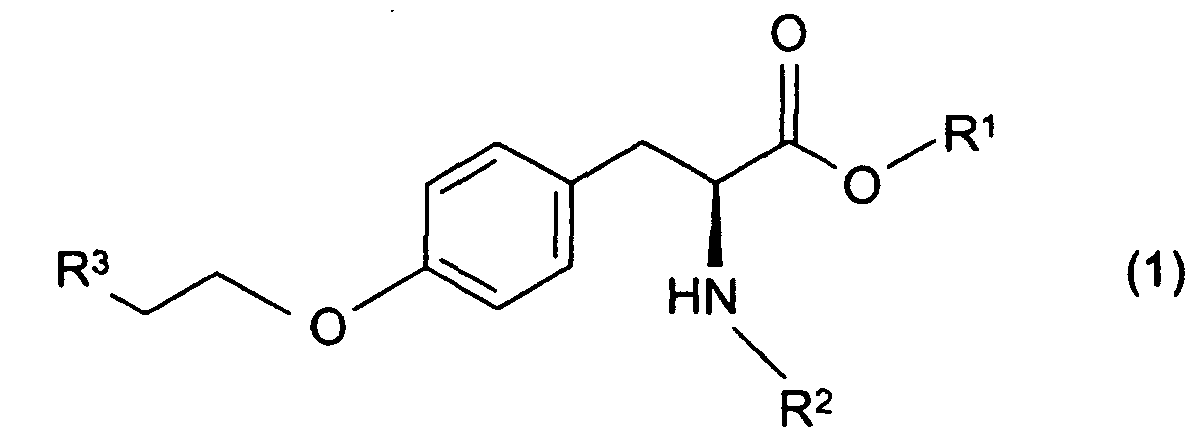
in einem aprotischen Lösungsmittel,
zu der Verbindung der Formel (5)reagiert und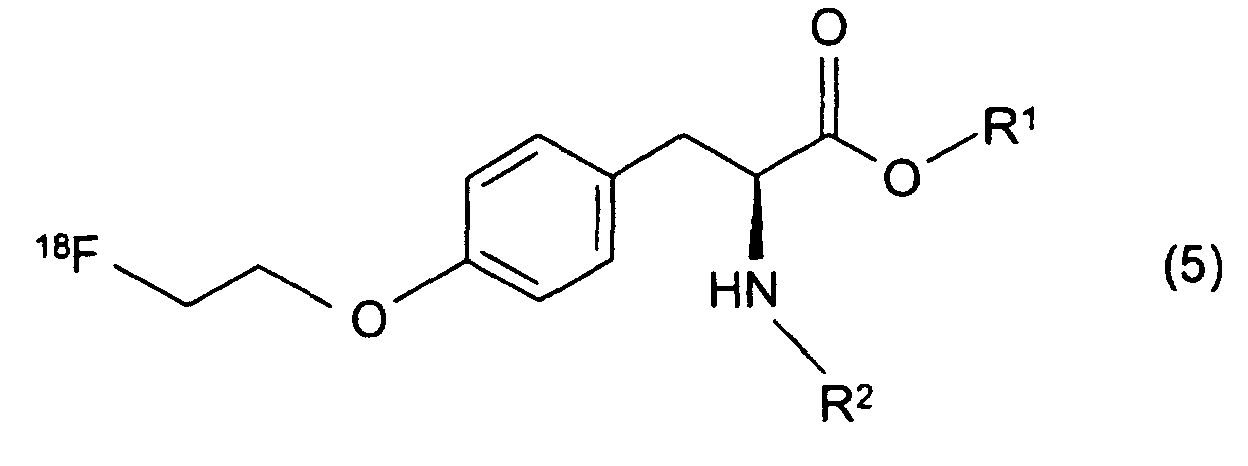
in einem weiteren Schritt in einem aciden System die Gruppen R1 und R2 abgespalten werden und das entstandene Produkt O-(2-[18F]-Fluorethyl-L-tyrosin) anschließend gereinigt wird,
wobei
R1, R2 und R3 die gleiche Bedeutung wie in Anspruch 1 haben
X ein Halogen ist und
R eine Alkylgruppe mit 3 bis 6 C-Atomen, insbesondere eine n-Butylgruppe darstellt. - Verfahren gemäß Anspruch 3,
wobei der Phasentransfer-Katalysator Tetrabutylammonium hydrogencarbonat ist. - Verfahren nach einem der Ansprüche 3 oder 4, wobei das aprotische Lösungsmittel ausgewählt ist aus der Gruppe bestehend aus Acetonitril, N,N-Dimethylacetamid, N,N-Dimethylformamid, Dimethylsulfoxid und Hexamethylphosphorsäuretriamid.
- Verfahren nach einem der Ansprüche 3 bis 5, wobei das acide System im letzten Verfahrensschritt Trifluoressigsäure in Dichlormethan umfasst.
Priority Applications (1)
| Application Number | Priority Date | Filing Date | Title |
|---|---|---|---|
| DK02740662T DK1392650T3 (da) | 2001-06-05 | 2002-05-29 | Beskyttede tyrosinderivater, fremgangsmåde til deres fremstilling og deres anvendelse til fremstilling af O-(2-[18F]-fluorethyl)-L-tyrosin |
Applications Claiming Priority (3)
| Application Number | Priority Date | Filing Date | Title |
|---|---|---|---|
| DE10127126 | 2001-06-05 | ||
| DE10127126A DE10127126A1 (de) | 2001-06-05 | 2001-06-05 | Geschützte Tyrosinderivate, Verfahren zu deren Herstellung und deren Verwendung zur Herstellung von O-(2-[·18·F]-Fluorethyl)-L-tyrosin |
| PCT/EP2002/005887 WO2002102765A2 (de) | 2001-06-05 | 2002-05-29 | Geschützte tyrosinderivate, verfahren zu deren herstellung und deren verwendung zur herstellung von o-(2-[18f]-fluorethyl)-l-tyrosin |
Publications (2)
| Publication Number | Publication Date |
|---|---|
| EP1392650A2 EP1392650A2 (de) | 2004-03-03 |
| EP1392650B1 true EP1392650B1 (de) | 2005-03-02 |
Family
ID=7687167
Family Applications (1)
| Application Number | Title | Priority Date | Filing Date |
|---|---|---|---|
| EP02740662A Expired - Lifetime EP1392650B1 (de) | 2001-06-05 | 2002-05-29 | Geschützte tyrosinderivate, verfahren zu deren herstellung und deren verwendung zur herstellung von o-(2- ?18 f]-fluorethyl)-l-tyrosin |
Country Status (6)
| Country | Link |
|---|---|
| US (1) | US6919475B2 (de) |
| EP (1) | EP1392650B1 (de) |
| JP (1) | JP4172393B2 (de) |
| AT (1) | ATE289992T1 (de) |
| DE (2) | DE10127126A1 (de) |
| WO (1) | WO2002102765A2 (de) |
Families Citing this family (7)
| Publication number | Priority date | Publication date | Assignee | Title |
|---|---|---|---|---|
| JP2007106722A (ja) * | 2005-10-14 | 2007-04-26 | Inst Nuclear Energy Research Rocaec | 無支持体の18F標識アミノ酸O−(2−[18F]fluoroethyl)−L−Tyrosineの前駆体の製造方法。 |
| JP2007112725A (ja) * | 2005-10-18 | 2007-05-10 | Inst Nuclear Energy Research Rocaec | 無支持体の18Fで標識したアミノ酸O−(2−[18F]fluoroethyl)−L−Tyrosineの製造方法。 |
| KR100706760B1 (ko) | 2006-06-13 | 2007-04-13 | 한국원자력연구소 | 티로신 유도체 및 그것을 포함하는 약제학적 조성물 |
| KR100706761B1 (ko) * | 2006-06-23 | 2007-04-13 | 한국원자력연구소 | 티로신 유도체의 제조 방법 |
| RU2476423C2 (ru) * | 2007-12-19 | 2013-02-27 | Нихон Меди-Физикс Ко., Лтд. | Способ получения радиоактивного, меченного фтором органического соединения |
| JP5237880B2 (ja) * | 2009-04-30 | 2013-07-17 | Jfeテクノス株式会社 | マイクロチップを用いたpet用標識化合物の製造方法及び装置 |
| WO2014126071A1 (ja) * | 2013-02-12 | 2014-08-21 | 国立大学法人大阪大学 | 芳香族アミノ酸誘導体およびそれを用いるpetプローブ |
Family Cites Families (3)
| Publication number | Priority date | Publication date | Assignee | Title |
|---|---|---|---|---|
| US5672335A (en) * | 1994-11-30 | 1997-09-30 | Schering Aktiengesellschaft | Use of metal complexes as liver and gallbladder X-ray diagnostic agents |
| GB9604242D0 (en) * | 1996-02-28 | 1996-05-01 | Glaxo Wellcome Inc | Chemical compounds |
| NZ502582A (en) * | 1997-07-31 | 2002-07-26 | American Home Prod | Substituted phenylalanine type compounds which inhibit leukocyte adhesion mediated by VLA-4 |
-
2001
- 2001-06-05 DE DE10127126A patent/DE10127126A1/de not_active Withdrawn
-
2002
- 2002-05-29 DE DE50202381T patent/DE50202381D1/de not_active Expired - Lifetime
- 2002-05-29 US US10/480,004 patent/US6919475B2/en not_active Expired - Lifetime
- 2002-05-29 EP EP02740662A patent/EP1392650B1/de not_active Expired - Lifetime
- 2002-05-29 AT AT02740662T patent/ATE289992T1/de active
- 2002-05-29 JP JP2003505308A patent/JP4172393B2/ja not_active Expired - Fee Related
- 2002-05-29 WO PCT/EP2002/005887 patent/WO2002102765A2/de not_active Ceased
Also Published As
| Publication number | Publication date |
|---|---|
| JP4172393B2 (ja) | 2008-10-29 |
| EP1392650A2 (de) | 2004-03-03 |
| US20040192954A1 (en) | 2004-09-30 |
| JP2004529989A (ja) | 2004-09-30 |
| DE50202381D1 (de) | 2005-04-07 |
| US6919475B2 (en) | 2005-07-19 |
| ATE289992T1 (de) | 2005-03-15 |
| WO2002102765A3 (de) | 2003-10-30 |
| DE10127126A1 (de) | 2002-12-19 |
| WO2002102765A2 (de) | 2002-12-27 |
Similar Documents
| Publication | Publication Date | Title |
|---|---|---|
| EP2086924B1 (de) | [f-18]markierte l-glutaminsäure, [f-18]markiertes l-glutamin, ihre derivate und ihre verwendung sowie verfahren zu ihrer herstellung | |
| DE69837095T2 (de) | Fluorierung von proteinen und peptiden für positronemissionstomographie | |
| EP3174854B1 (de) | Verfahren zur herstellung von fluor-18-markiertem cabozantinib und analoga davon | |
| DE69633461T2 (de) | Dopamin und serotonin transport-ligande und bilderzeugungsmitteln | |
| EP2123621A1 (de) | Neue {F-18}-markierte L-Glutaminsäure- und L-Glutaminderivate (I), ihre Verwendung sowie Verfahren zu ihrer Herstellung | |
| DD297636A5 (de) | Chelatbildner zur komplexierung von radioaktiven isotopen, deren metallkomplexe sowie ihre verwendung in diagnostik und therapie | |
| EP2230229A1 (de) | Verfahren zur herstellung einer mit radioaktivem fluor markierten organischen verbindung | |
| EA022897B1 (ru) | СПОСОБ ПОЛУЧЕНИЯ F-18 МЕЧЕНЫХ Аβ ЛИГАНДОВ | |
| WO2022189304A2 (en) | Aliphatic 18f-radiolabeling of a tetrazine precursor | |
| WO2018091043A1 (de) | Präkursoren für die radiofluorierung | |
| EP1392650A2 (de) | Geschützte tyrosinderivate, verfahren zu deren herstellung und deren verwendung zur herstellung von o-(2- ?18 f]-fluorethyl)-l-tyrosin | |
| WO1997010852A2 (de) | Bifunktionelle sulfidhaltige sulfonamid-chelatbildner vom typ xsns für radioaktive isotope | |
| EP2123619A1 (de) | Neue [F-18]-Markierte L-Glutaminsäure-und L-Glutaminderivate (II), ihre Verwendung sowie Verfahren zu ihrer Herstellung | |
| DE4311021A1 (de) | Bifunktionelle Chelatbildner, deren Technetium- und Rhenium-Komplexe, Verfahren zu ihrer Herstellung und diese Verbindungen enthaltende radiopharmazeutische Mittel | |
| AU2010321278A1 (en) | Method for production of F-18 labeled glutamic acid derivatives | |
| EP0692981B1 (de) | Chelatbildner vom typ xn 1?s 1?x' für radioaktive isotope, deren metallkomplexe und ihre verwendung in diagnostik und therapie | |
| EP1923382A1 (de) | [F-18] markierte L-Glutaminsäure, [F-18] markiertes Glutamin, ihre Derivate und ihre Verwendung sowie Verfahren zu ihrer Herstellung | |
| DE4311022C2 (de) | Bifunktionelle chalkogenatom-unterbrochene Chelatbildner vom Typ S¶3¶N¶2¶ für radioaktive Isotope und deren Metallkomplexe, Verfahren zu ihrer Herstellung sowie diese enthaltende pharmazeutische Mittel | |
| EP0588229A2 (de) | Makrozyklische Chelatbildner zur Herstellung von Technetium- oder Rheniumkomplexen | |
| WO1995012610A1 (de) | N-alkyl-peptidchelatbildner, deren metallkomplexe mit radionukliden, verfahren zu ihrer herstellung und diese verbindungen enthaltende radiopharmazeutische zusammensetzungen | |
| Schmall et al. | Synthesis of a fluorinated fatty acid, dl-erythro-9, 10-[18F] difluoropalmitic acid, and biodistribution studies in rats | |
| DE19928911B4 (de) | Verfahren zur Herstellung von 3-0-Methyl-6-[18F]Fluor-DOPA, (3-0-Methyl-6-[18F]Fluor-L-4-hydroxyphenylalanin, 3-(2-[18F]Fluor-4-hydroxy-5-methoxy-phenyl)-2-amino-propansäure) | |
| DE19951715C1 (de) | 18F-Radiotracer und deren Verwendung zum Monitoring der Expression der Cytosin-Deaminase nach Gentransfer sowie Verfahren zur Herstellung der 18F-Radiotracer | |
| JP3041419B2 (ja) | ドパミンd4受容体に結合する放射性ヨウ素標識診断剤 | |
| EP2336114A1 (de) | Verfahren zur Herstellung von L-3,4 Dihydroxy-6-[18F]fluor-phenylalanin und 2-[18F]Fluor-L-tyrosin und deren alpha-methylierten Derivaten aus einem Vorläufer |
Legal Events
| Date | Code | Title | Description |
|---|---|---|---|
| PUAI | Public reference made under article 153(3) epc to a published international application that has entered the european phase |
Free format text: ORIGINAL CODE: 0009012 |
|
| 17P | Request for examination filed |
Effective date: 20031125 |
|
| AK | Designated contracting states |
Kind code of ref document: A2 Designated state(s): AT BE CH CY DE DK ES FI FR GB GR IE IT LI LU MC NL PT SE TR |
|
| GRAP | Despatch of communication of intention to grant a patent |
Free format text: ORIGINAL CODE: EPIDOSNIGR1 |
|
| GRAS | Grant fee paid |
Free format text: ORIGINAL CODE: EPIDOSNIGR3 |
|
| GRAA | (expected) grant |
Free format text: ORIGINAL CODE: 0009210 |
|
| AK | Designated contracting states |
Kind code of ref document: B1 Designated state(s): AT BE CH CY DE DK ES FI FR GB GR IE IT LI LU MC NL PT SE TR |
|
| PG25 | Lapsed in a contracting state [announced via postgrant information from national office to epo] |
Ref country code: FI Free format text: LAPSE BECAUSE OF FAILURE TO SUBMIT A TRANSLATION OF THE DESCRIPTION OR TO PAY THE FEE WITHIN THE PRESCRIBED TIME-LIMIT Effective date: 20050302 Ref country code: IE Free format text: LAPSE BECAUSE OF FAILURE TO SUBMIT A TRANSLATION OF THE DESCRIPTION OR TO PAY THE FEE WITHIN THE PRESCRIBED TIME-LIMIT Effective date: 20050302 Ref country code: TR Free format text: LAPSE BECAUSE OF FAILURE TO SUBMIT A TRANSLATION OF THE DESCRIPTION OR TO PAY THE FEE WITHIN THE PRESCRIBED TIME-LIMIT Effective date: 20050302 |
|
| REG | Reference to a national code |
Ref country code: GB Ref legal event code: FG4D Free format text: NOT ENGLISH |
|
| REG | Reference to a national code |
Ref country code: CH Ref legal event code: EP |
|
| GBT | Gb: translation of ep patent filed (gb section 77(6)(a)/1977) |
Effective date: 20050302 |
|
| REG | Reference to a national code |
Ref country code: IE Ref legal event code: FG4D Free format text: GERMAN |
|
| REF | Corresponds to: |
Ref document number: 50202381 Country of ref document: DE Date of ref document: 20050407 Kind code of ref document: P |
|
| REG | Reference to a national code |
Ref country code: DK Ref legal event code: T3 |
|
| REG | Reference to a national code |
Ref country code: SE Ref legal event code: TRGR |
|
| PG25 | Lapsed in a contracting state [announced via postgrant information from national office to epo] |
Ref country code: CY Free format text: LAPSE BECAUSE OF FAILURE TO SUBMIT A TRANSLATION OF THE DESCRIPTION OR TO PAY THE FEE WITHIN THE PRESCRIBED TIME-LIMIT Effective date: 20050529 Ref country code: LU Free format text: LAPSE BECAUSE OF NON-PAYMENT OF DUE FEES Effective date: 20050529 |
|
| PG25 | Lapsed in a contracting state [announced via postgrant information from national office to epo] |
Ref country code: MC Free format text: LAPSE BECAUSE OF NON-PAYMENT OF DUE FEES Effective date: 20050531 |
|
| PG25 | Lapsed in a contracting state [announced via postgrant information from national office to epo] |
Ref country code: GR Free format text: LAPSE BECAUSE OF FAILURE TO SUBMIT A TRANSLATION OF THE DESCRIPTION OR TO PAY THE FEE WITHIN THE PRESCRIBED TIME-LIMIT Effective date: 20050602 |
|
| PG25 | Lapsed in a contracting state [announced via postgrant information from national office to epo] |
Ref country code: ES Free format text: LAPSE BECAUSE OF FAILURE TO SUBMIT A TRANSLATION OF THE DESCRIPTION OR TO PAY THE FEE WITHIN THE PRESCRIBED TIME-LIMIT Effective date: 20050613 |
|
| PG25 | Lapsed in a contracting state [announced via postgrant information from national office to epo] |
Ref country code: PT Free format text: LAPSE BECAUSE OF FAILURE TO SUBMIT A TRANSLATION OF THE DESCRIPTION OR TO PAY THE FEE WITHIN THE PRESCRIBED TIME-LIMIT Effective date: 20050907 |
|
| REG | Reference to a national code |
Ref country code: IE Ref legal event code: FD4D |
|
| ET | Fr: translation filed | ||
| PLBE | No opposition filed within time limit |
Free format text: ORIGINAL CODE: 0009261 |
|
| STAA | Information on the status of an ep patent application or granted ep patent |
Free format text: STATUS: NO OPPOSITION FILED WITHIN TIME LIMIT |
|
| 26N | No opposition filed |
Effective date: 20051205 |
|
| REG | Reference to a national code |
Ref country code: FR Ref legal event code: PLFP Year of fee payment: 15 |
|
| REG | Reference to a national code |
Ref country code: FR Ref legal event code: PLFP Year of fee payment: 16 |
|
| REG | Reference to a national code |
Ref country code: FR Ref legal event code: PLFP Year of fee payment: 17 |
|
| PGFP | Annual fee paid to national office [announced via postgrant information from national office to epo] |
Ref country code: DE Payment date: 20210401 Year of fee payment: 20 Ref country code: FR Payment date: 20210525 Year of fee payment: 20 Ref country code: IT Payment date: 20210531 Year of fee payment: 20 Ref country code: NL Payment date: 20210519 Year of fee payment: 20 |
|
| PGFP | Annual fee paid to national office [announced via postgrant information from national office to epo] |
Ref country code: SE Payment date: 20210521 Year of fee payment: 20 Ref country code: BE Payment date: 20210519 Year of fee payment: 20 Ref country code: AT Payment date: 20210518 Year of fee payment: 20 Ref country code: CH Payment date: 20210525 Year of fee payment: 20 Ref country code: DK Payment date: 20210521 Year of fee payment: 20 Ref country code: GB Payment date: 20210526 Year of fee payment: 20 |
|
| REG | Reference to a national code |
Ref country code: DE Ref legal event code: R071 Ref document number: 50202381 Country of ref document: DE |
|
| REG | Reference to a national code |
Ref country code: DK Ref legal event code: EUP Expiry date: 20220529 |
|
| REG | Reference to a national code |
Ref country code: NL Ref legal event code: MK Effective date: 20220528 |
|
| REG | Reference to a national code |
Ref country code: BE Ref legal event code: MK Effective date: 20220529 |
|
| REG | Reference to a national code |
Ref country code: CH Ref legal event code: PL |
|
| REG | Reference to a national code |
Ref country code: GB Ref legal event code: PE20 Expiry date: 20220528 |
|
| REG | Reference to a national code |
Ref country code: AT Ref legal event code: MK07 Ref document number: 289992 Country of ref document: AT Kind code of ref document: T Effective date: 20220529 |
|
| PG25 | Lapsed in a contracting state [announced via postgrant information from national office to epo] |
Ref country code: GB Free format text: LAPSE BECAUSE OF EXPIRATION OF PROTECTION Effective date: 20220528 |